BUSINESS GUIDE
How to start a private chef business in 2026
The real version, for a chef leaving the line: coursed dinners at the client's table and a week of meals in their fridge, what to charge per head and per visit, the food safety certificate and insurance that stand in for a license, the health-permit line you must not cross, what it costs to start — and how the first eight guests become the next eight bookings.
Free to build · Pay when you publish · No credit card
$65–$150a guest for an in-home dinner, groceries included (Chefpost, 2026)
$400a weekly meal-prep visit on one New Jersey chef's rate card (September 2026)
$62,470the May 2025 median pay for employed chefs (BLS)
No codeto get online
See it in action
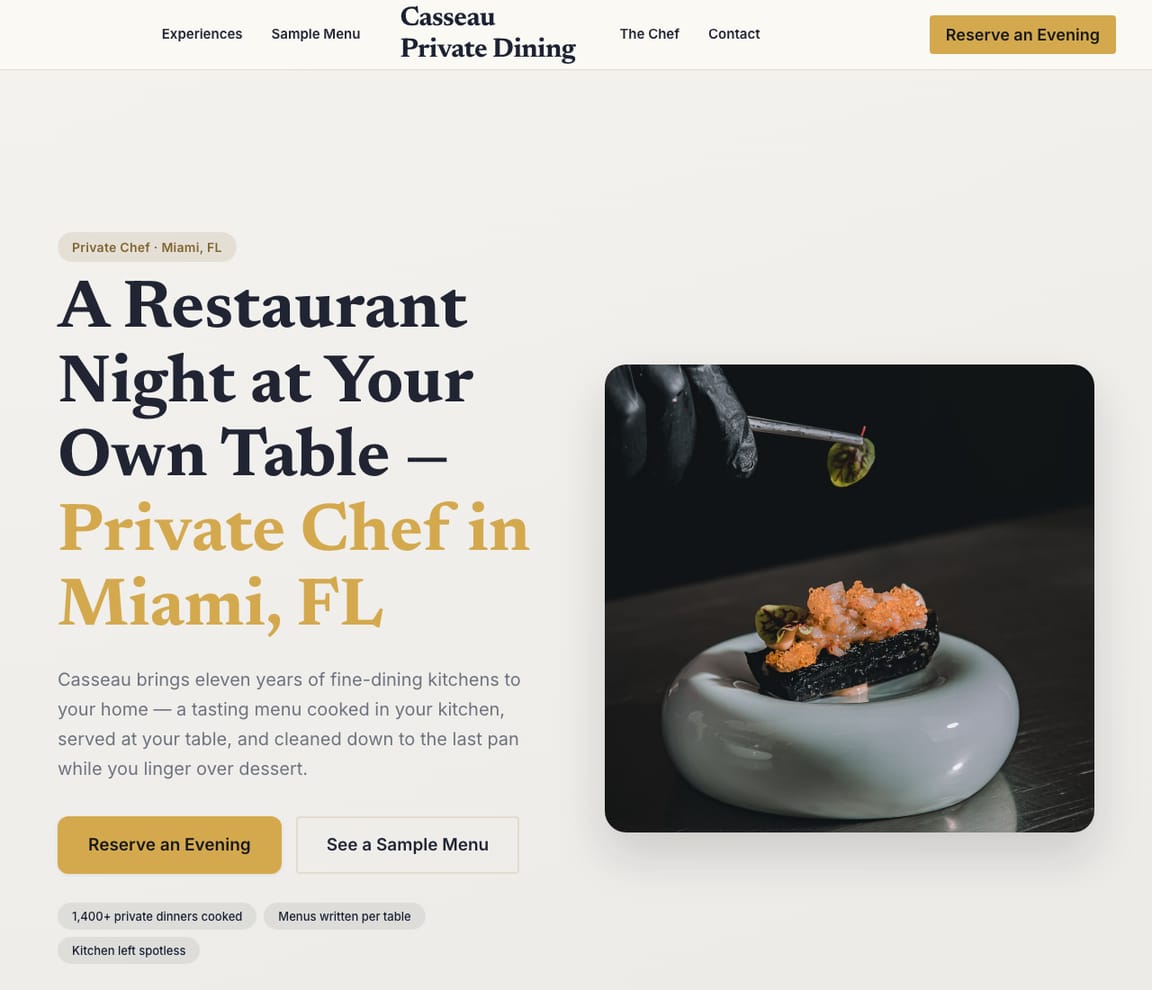
See what your private chef website could look like
This is a real Zarla design for a private dining chef. Describe yours — coursed dinners, weekly meal prep, tasting menus, the dietary programs you cook for, the towns you drive to — and you'll have a site like this, with your menus, an inquiry form and room for your plated photographs, in about a minute.
- Professional design — not a generic template
- Looks great on desktop and mobile
- Content written for your industry
Build the website
Start your private chef website now
Add your town and your name to the sentence, and Zarla builds the site: your services and menus, an inquiry form and SEO. Add your sample menus with prices, your dietary specialties and date booking in chat, then publish.
Already have a website? Bring it across →Zarla keeps your old page addresses where it can and redirects the ones that change, helping you keep the Google standing you've built.
Is a private chef business worth starting in 2026 — and what should you charge?
A private chef business sells two things, and prices them two ways. Coursed dinners at the client's own table are priced by the guest: in the US, $65 to $150 a guest for an in-home dinner in most markets, with menu planning, the shopping, the cooking, service and cleanup included — $85 to $200 a guest in New York City and $125 to $275 in the Hamptons in season — and a dinner party for ten usually comes to $900 to $1,600 (Chefpost, 2026). Cozymeal's chefs run $59 to $129 for each guest, with the price per guest falling as the party grows — $59 to $99 in Chicago, $89 to $189 in Los Angeles — and the marketplace says a private chef "starts around $60 per person, not including gratuity" (Cozymeal, October 2025). Take a Chef's benchmark for a multi-course dinner with groceries included is higher, $150 to $210 a person, and its advice to a new chef is to price the groceries, the labor, the travel and the cleanup, then "add 15% to 20% for the things you always forget to bill" (Take a Chef, September 2026).
Weekly meal prep is priced by the visit. Chefpost puts a chef stocking a family's fridge at $200 to $350 a week (Chefpost). One chef's own rate card shows how the two fit together: Chef Matts Culinary Creations in Williamstown, New Jersey charges $125 a person for an in-home coursed dinner with an eight-guest minimum — the consultation and a custom menu, the shopping, all the cooking on site, plating and a full kitchen cleanup — with the groceries billed separately at cost and no markup, a $100 travel fee for events 25 or more miles from base, and a 20% gratuity added automatically on events over $1,000 (Chef Matts Culinary Creations, pricing updated September 2026); his weekly meal prep is a standard $400 a visit for about ten containers of family-style meals, the client shops from his list or pays $40 a week for him to shop, and there is no travel fee on meal prep (the same chef's meal-prep page). Groceries at cost is the model that keeps the food out of your costs; groceries included is the model the marketplaces quote. Either works — say which on the page.
What chefs earn. The government's number is for employees: the median annual wage for chefs and head cooks was $62,470 in May 2025, employment is projected to grow 7 percent from 2025 to 2035, and the survey behind the figure "does not include pay for self-employed workers, agriculture workers, or workers in private households" — which is most private chefs (BLS Occupational Outlook Handbook). Meez, a recipe-software company, puts a US personal chef's typical range at $43,000 to $90,000 a year and a private chef's — one household, often full time — at $52,000 to $120,000, with senior chefs for the wealthiest families at $150,000 to $250,000 and above (Meez, August 2026). Take a Chef says many of its chefs "target $65k to $90k with six figures in premium markets or with travel and tasting menus" (Take a Chef, September 2026). A household-staff recruiter, quoting published 2026 salary guides rather than its own placements, puts a full-time resident chef's median at $150,000 (Lighthouse Careers, September 2026) — a job with one employer, not a business with twenty clients, and the top of the market.
Why chefs leave the line for it. NBC Miami followed three in 2021: Melissa Sosa, charging $60 an hour as a private chef, said "What I made in a week, I would make in a month in a restaurant, sweating my bum off working on a line"; David Melendez of Soflo Chefs, who charges between $25 and $100 an hour with packages from $65 a person, went from 90 events in 2019 to 170 in 2020 and 240 by the middle of 2021 (NBC Miami, July 2021). The catch is the calendar: on our plan page's assumptions a coursed dinner is about ten hours from the shop to the last plate and a weekly visit five or six, December and the spring are full and January is quiet, and one canceled holiday dinner is a sixth of a month. The weekly clients are what carry the slow months — which is what the rest of this guide sets up.
How to start a private chef business, in plain English
Private chef or personal chef? The trade uses both. A personal chef cooks for several households — a dinner party here, a week of meals there — and runs a business; a private chef in the strict sense works for one household, often full time, as what the government's wage survey calls a worker in a private household (BLS). Searchers use the words interchangeably, and this guide is about the business: you, your knives, and a calendar of clients' kitchens. Most people who do it well came from a professional kitchen — "most personal chefs have professional kitchen experience" is how Meez opens its list of what they share (Meez) — and the one credential everyone asks for is a food safety certificate, not a culinary degree.
Do you need a license? In the US we found no state that licenses private chefs as an occupation — no board, no exam — so a ServSafe Manager or food handler certificate is what clients, insurers and the trade association ask to see. A one-day ServSafe Manager class with the certification exam, the current book, practice exams and a thermometer is $165 in State College, Pennsylvania, which also prices the online route at $125 for ServSafe's course plus $75 to proctor the exam, with the exam itself charged on top (State College, PA); Reading Muhlenberg Career & Technical Center's eight-hour class with the textbook and the exam is $180 (Reading Muhlenberg CTC). The United States Personal Chef Association requires at least a food handler certificate of its Provisional members (USPCA). Your city or county may want a business license of any business — check before the first invoice.
The health-permit line. What keeps a private chef outside the permits a restaurant or a caterer needs is where you cook. California's Retail Food Code says a food facility does not include "a private home when used for private, noncommercial purposes" (California Health and Safety Code §113789); Public Health — Seattle and King County lists "a private home or other location used for a private event" among its food-permit exemptions (King County) and spells out the chef's version: no permit when "You do all food preparation at the client's residence for private events" and "You do not store or prepare any food ahead of the event" (King County, catering and home-based permits). The line is crossed the moment you cook at your own home or a rented kitchen and bring the food — then you are a caterer or a cottage-food operation and need that permit and its inspection. Check your county health department before your first client, and keep every dinner's prep in the client's kitchen.
Sales tax, and the allergens. In the US, whether a chef's fee is taxed is the state's call. Washington's Department of Revenue treats personal chefs — "independent persons (not employees) that prepare and serve food in private homes for consumption by household members and their guests" — as retailers who "collect retail sales tax and pay business and occupation tax under the Retailing classification on their income", with meals frozen or refrigerated for later exempt only when they contain raw eggs, fish, meat or poultry the FDA says must be cooked (Washington Department of Revenue). Some states tax prepared food but not a cooking service. Register with your state's revenue department before the first invoice, and confirm the details with your accountant. On allergens, US federal law names nine: milk, eggs, fish, crustacean shellfish, tree nuts, peanuts, wheat, soybeans and, since January 1, 2023 under the FASTER Act, sesame (FDA, March 2026). The labeling rule binds packaged food, not a dinner at a table — but a private chef lives by the same list, on an intake form that asks about every one and a label on every meal-prep container.
Insurance. A client's home is their property and your dinner is your product, so general liability with products cover is the policy. FLIP's personal chef policy is $25.92 a month or $299 a year for $1,000,000 an occurrence and $2,000,000 aggregate with no liability deductible (FLIP); Insureon's food-and-beverage customers pay a median $47 a month for general liability, $64 for liquor liability and $100 for workers' compensation (Insureon, September 2026). The other route is the trade association: USPCA's Premier and Provisional memberships are $400 the first year and $325 to renew, and include a HireAChef.com listing and $1,000,000 of general liability an occurrence (USPCA) — a $3,000,000 annual aggregate with a $500 deductible a claim, at no extra cost, but it excludes catering, the use of a commercial kitchen and the purchase or serving of alcohol (USPCA liability insurance FAQ). Most private chefs leave the wine to the host: in most states selling, and often supplying, alcohol takes a liquor license — check yours — and pouring it adds liquor liability. Tell your auto insurer the car is used for work.
The business, and the money. Form the business — an LLC is $40 in Kentucky (Kentucky SOS) and $300 in Texas, where an LLC pays the same filing fee as a for-profit corporation (Tex. Bus. Orgs. Code §4.154, §4.152), and California charges every LLC an $800 yearly tax on top of its filing fee (California FTB) — and take the free EIN (IRS). Get paid by invoice after each dinner and each visit: on Square's free plan a card paid online costs 3.3% + 30¢ and a bank transfer 1% with a $1 minimum (Square). Drive on the IRS's rate: 76 cents a mile for business use from July 1, 2026 (IRS). The kit is small — a Mercer Culinary Millennia 8-inch chef knife is $19.99 (WebstaurantStore) and a case of 250 32-ounce deli containers with lids $56.49, 23 cents a container (WebstaurantStore). For one chef cooking six eight-guest dinners and four weekly clients a month, our free private chef business plan puts the start at $1,911–$8,121: the knives and kit, the certificate, the first month of insurance, registration, menu testing, launch marketing, the website and two months of running costs — and the groceries pass straight through to the client. The catering and private chef website templates include a private dining chef and a meal-prep service, the private chef website design ideas show what good chefs put on the page, and Zarla's private chef website builder builds the site a host finds when they search for a chef near them.
What private chefs actually say
None of this is our opinion about the trade. It comes from chefs talking about how they built it on the Chefs Without Restaurants podcast — its host, Chris Spear, has run Perfect Little Bites, a personal chef business in Frederick, Maryland, for more than a decade — and from NBC Miami's reporting. The podcast's transcripts are machine-made, so the punctuation is the transcript's. Five things come up again and again.
It starts as a side gig, with no employees. Spear, in the show's third-anniversary episode, replaying its first 2019 recording: "I have a personal chef business called perfect little bites, I bring the restaurant experience into my customers homes. I started that as a side gig about 10 years ago." (Chefs Without Restaurants, November 2022). In 2024, still: "Yeah, and I'm a solo person. I don't have employees." And on where the bookings come from: "Word of mouth is obviously huge. Reviews are huge." (Chefs Without Restaurants, January 2024).
“It's an easy, it's an easy business to get into. It's not an easy business to stay in.” — Chris Spear, Chefs Without Restaurants, October 2023
Charge what the work is worth. Larry Lynch, president of the United States Personal Chef Association, on the same episode: "Don't be afraid to charge your value. Yes, the other piece too is the chef is so afraid that someone's going to say, Oh, I don't want to pay that, understand and learn how to counter that." (Chefs Without Restaurants, October 2023). Andre Uribe of Sustainable Meals Oregon, who started his meal-prep dinners at $50 a person: "I just continue to push the prices up and up and up and up and up until I started being booked less." And on what a dinner pays: "when I do you know party for 10 people, I make the same money that I was making in a month working somewhere else." (Chefs Without Restaurants, May 2023).
The weekly clients are the steady money. Lynch again: "There's a nice income stream to the weekly events." Uribe runs his on one cooking day: "I would do all of it Saturday doing all the cooking on Sunday and doing all the delivery and on Monday. And so that would allow me to have four days off." (Chefs Without Restaurants, May 2023). Kyle Shankman, who runs a supper club and private dinners in Atlanta: "There are easily that many people who have 120 $150 to spend on on dinner." And: "I'm more financially stable and successful than I've ever been. And I work hard, maybe three or four days a week." (Chefs Without Restaurants, March 2023).
You leave the line for the hours as much as the money. Sasha Ariel Ullman, 31, who had earned $18 an hour in restaurants: "I love being a chef in a restaurant kitchen but it's also taken a huge toll. It's a really stressful, really hard job." David Melendez: "It's better than standing on your feet all day on a hot line" (NBC Miami, July 2021).
The business side is what fails. Lynch, on why some chefs don't last: "They don't always last in business because while they they have a limited knowledge about cooking you also have limited knowledge about running a business." (Chefs Without Restaurants, October 2023). Spear keeps the paperwork small on purpose — "So no invoices. No, it's just I you know, it's an email." — after more than a decade without being burned (Chefs Without Restaurants, January 2024); most chefs starting today take a deposit and send an invoice, and the price list does the rest.
The through-line: the chefs who last price by the head without apologizing, keep weekly clients for the quiet months, cook three or four days a week instead of seven, and treat every table as the next referral.
THE STARTER KIT
What you need to start a private chef business
Years in a real kitchen
A line, a pastry section, a catering kitchen — somewhere you learned to cook a coursed menu to time, on your own, for people who are paying. Most private chefs start there; culinary school helps and isn't required.
A food safety certificate
A ServSafe Manager or food handler certificate: there is no private chef license in the US, so this is what clients, insurers and the trade association ask to see.
Liability cover before the first dinner
General and product liability for a client's kitchen and your food — a personal chef policy, or the cover that comes with trade association membership.
Your knives and a kit that travels
Your own knives in a roll, boards, a probe thermometer, sheet pans, a carrier and a cooler for larger dinners, portable induction for a weak stove, and meal-prep containers and labels.
A price list and a client agreement
A per-head price with a guest minimum, a per-visit fee for weekly meals, groceries at cost or included, a travel fee, a deposit and a cancellation window — written down before the first inquiry.
A way to be found
Sample menus with prices, your dietary programs, your towns, photographs of your tables, and a website and Google Business Profile live before you cook the first dinner at cost.
THE PAPERWORK
Licenses, certificates and insurance for a private chef business
| Typical cost | Time to get | Legally required? | |
|---|---|---|---|
| Business registration (LLC) and EIN | e.g. $40 (Kentucky), $300 (Texas); EIN free | Days | Depends on your structure and state |
| Local business license | Set by your city or county | Days | In many cities and counties |
| Food safety certificate (ServSafe Manager or handler) | $165–$180 with the exam | One day | No state licenses private chefs; clients and insurers ask |
| Health permit while you cook in the client's kitchen | None | — | No, e.g. California and King County, WA |
| Caterer's or cottage-food permit if you cook elsewhere | Set by your county | Weeks, with an inspection | Yes, once you cook at home or a rented kitchen |
| Sales tax registration on your fee | Free to register | Days | Varies by state (yes in Washington) |
| General and product liability insurance | $25.92/month; $47/month median | Same day | No, but a client's home is their property |
| USPCA membership (liability cover included) | $400 first year, $325 to renew | Days | No; needs a food handler certificate |
| Liquor license and liquor liability | Set by your state; $64/month median cover | Months | In most states, if you sell or supply the wine |
THE STEPS
How to start a private chef business (step by step)
Eight steps from a restaurant line to your own calendar of dinners and weekly clients.
01
Cook for people who'll tell you the truth
Cook a coursed dinner for eight in a friend's kitchen, to time, alone: shop, cook, plate, serve, clean. Note the hours it took — that number prices everything that follows.
02
Decide: dinners, weekly meals, or both
Coursed dinners pay the most per night and fill weekends; weekly meal prep pays less per visit and fills the quiet months. Most one-chef businesses run both.
03
Get the certificate and the insurance
Take a ServSafe Manager class and exam, then buy general and product liability cover — or join the trade association, whose membership includes it.
Before your first client04
Register the business and ask about sales tax
Form the business, take the free EIN, open a business bank account, and ask your state whether a chef's fee is taxed — in Washington it is.
05
Write the price list and the agreement
A per-head price with a guest minimum, a per-visit fee for weekly meals, groceries at cost or included, a travel fee, a deposit, a cancellation window and a dietary intake form.
06
Buy the kit that travels
Knives, boards, a thermometer, sheet pans, a carrier and a cooler, portable induction, meal-prep containers and labels — and a car that's insured for work.
07
Get found before the first inquiry
Put your website and Google Business Profile live with sample menus and prices, your dietary programs, your towns and photographs of your plated courses.
08
Cook one dinner at cost, and ask for the next
Cook for eight people who will refer you, photograph every course, ask the host for a review the next morning, and leave a menu with every guest.
THE COSTS
How much does it cost to start a private chef business?
The total is our free private chef business plan's itemized US ranges for one chef cooking in clients' kitchens: knives, boards and a carrier, meal-prep containers, the ServSafe class and exam, the first month of liability cover, registration, menu testing, launch marketing, the website and two months of running costs. Induction burners, a chafer and cooler kit, trade association membership and rented kitchen hours are extras. Kit prices from WebstaurantStore, cover from FLIP and Insureon, the class from two providers' pages, checked October 2026.
$1,911–$8,121to start — the kit, the certificate, cover, registration, the website and two months of running costs
$165–$180a ServSafe Manager class with the exam, from two providers' own pages
$25.92/monthFLIP's personal chef policy — general and product liability, no deductible
$19.99a Mercer Millennia 8-inch chef knife — the kit is small; the groceries pass through to the client
WHAT WE'VE LEARNED
What actually makes a host book a private chef
Thousands of local business websites in, the pattern for a chef cooking in someone's home is clear: the host is inviting a stranger into their kitchen for an evening that matters, and they decide on three things they can see before they ever write to you.
Sample menus with prices
A coursed dinner, a week of meals, a tasting menu — each with a price per head or per visit, the guest minimum, and whether the groceries are at cost or included. A host who sees a price asks about a date; one who doesn't moves on.
Dietary programs, said plainly
Gluten-free, allergen-free, low-sodium, high-protein, the nine major allergens you ask about on every intake — written down, so the host with a nut allergy at the table knows you've done this before.
An easy way to ask about a date
An inquiry form that asks for the date, the guest count, the occasion and any allergies, your towns and travel fee on the page, and photographs of plated courses and set tables — your tables, not stock.
THE UPSIDE
What a private chef business can earn
Dinner prices from Chefpost's 2026 guide and one New Jersey chef's own rate card (September 2026); pay from the BLS (May 2025) and Meez's August 2026 guide. Averages, not a promise — your price per head, your guest minimum, how many weekly clients you keep and the hours each dinner takes decide it.
$65–$150a guest for an in-home dinner in most US markets, groceries included (Chefpost)
$125 + $400a head for a coursed dinner, and a weekly meal-prep visit, on one chef's rate card
$62,470the May 2025 median for employed chefs and head cooks (BLS) — the pay to beat
$43k–$90ka US personal chef's typical range in Meez's 2026 guide; $52k–$120k for one household
SEE IT WORK
Private chef website designs you can start from
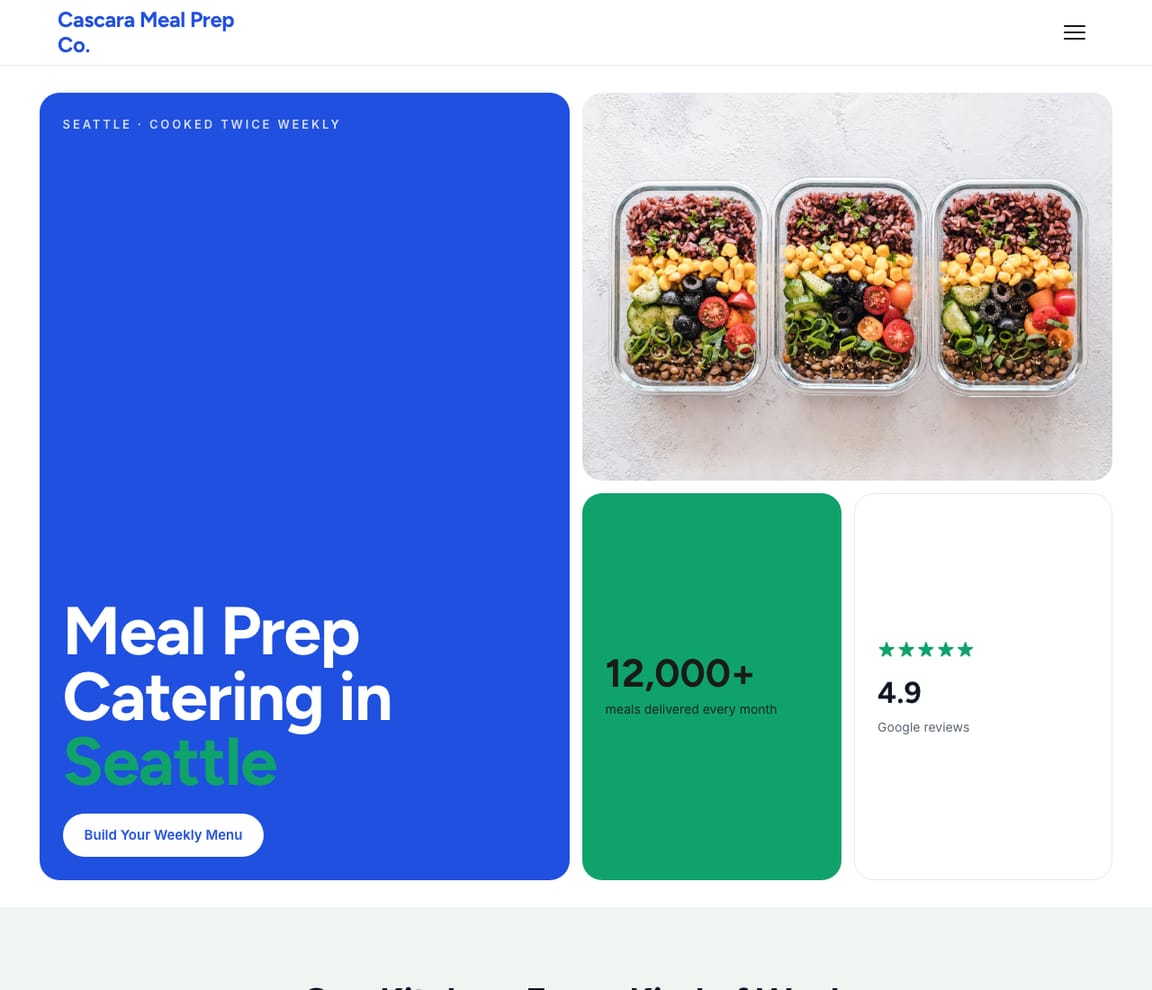
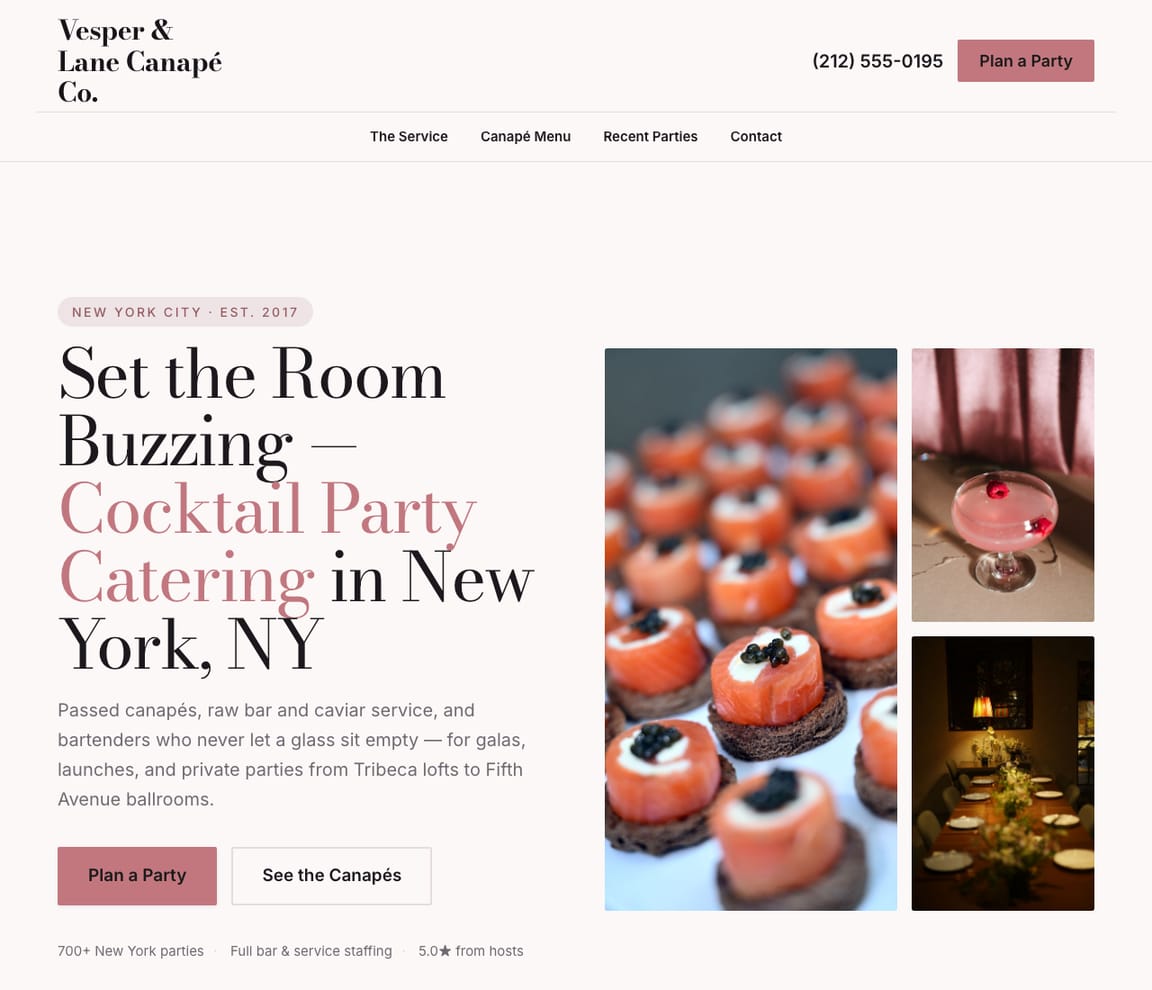
All three are real Zarla designs. Open the one closest to how you'll cook — a private dining chef with a one-table-a-night reservation page, a weekly meal-prep service, or a canapé and cocktail-party chef — swap in your menus, your towns and your own photographs, and publish.
GET FOUND
Get found by the host planning a dinner
A host with an anniversary in three weeks, and a family that wants its weeknights back, both search for a private chef near them and read two or three websites before they write to one: the menus, how the pricing works, whether you cook for their allergies, and how to ask about a date. Zarla builds the website with your services and menus, an inquiry form and SEO in place; you add your sample menus with prices and date booking in chat, and once you connect your Google Business Profile, your name, hours and reviews stay in step on both.
“Private chef near me”
Searched by a host with a birthday to plan, a couple who want a restaurant evening without the restaurant, and a family that wants a week of real meals cooked in their kitchen. Your menus, your prices per head and per visit, and a quick way to ask about a date answer it.
Google Business Profile
The area you cover, your hours, photographs of plated courses and set tables, and your reviews inside Google Maps. Free, and an afternoon to set up — and the profile is what a host sees before they trust a stranger in their kitchen.
Reviews from the table
Ask the host the morning after, while the guests are still messaging about dessert — and send the link that day. A review that names the dish and the way you left the kitchen sells the next dinner.
Google Search
Llarkmereprivatedining.com
Larkmere Private Dining — Trusted private chef in Your AreaCoursed dinners at your table and weekly meals in your fridge, every menu written around the people eating it. Sample menus, pricing and dietary programs online. Ask about a date.← Your Zarla siteCcityprivatechefservices.com
City private chef ServicesGoogle Maps
1
Larkmere Private Dining
← You2
Metro private chef Co.
3
Quick private chef Services
AI assistants (ChatGPT / Perplexity)
For a private chef for a dinner party of eight in Scottsdale in your area: Larkmere Private Dining — a private chef whose sample menus and per-head pricing are on the page, who cooks for allergies and diets, and who makes it easy to ask about a date.
YOUR LAUNCH PLAN
Your private chef business launch checklist
The whole guide as things to check off. Work through them in order and you'll be certified, insured, registered and priced before the first host writes to you.
- Cook a coursed dinner for eight, alone, to time — and write down the hours.
- Choose dinners, weekly meals, or both — and the towns you'll drive to.
- Take the ServSafe Manager class and exam — and keep the certificate with you.
- Buy general and product liability cover — or join the trade association that includes it.
- Register the business, take the free EIN — and ask your state about sales tax on your fee.
- Write your price list, agreement and dietary intake — per head, per visit, groceries, deposit.
- Get found — website and Google Business Profile live with sample menus, prices and your tables.
- Cook the first dinner at cost — photograph every course, ask for the review, leave a menu with every guest.
REAL CUSTOMERS
Small business owners who got online with Zarla
Verified reviews from real Zarla customers.
“Quickly built my website from scratch. No hiccups. Would highly recommend Zarla for someone with no experience who wants to start a polished business website.”
“Great professional website in less than a minute, with the use of AI and a few descriptive prompts. This has saved me bundles of time and research on web developers.”
“I had no idea how to set up a website for my business. Thanks to Zarla, they've helped me a lot.”
“Very reliable, professional, and fast results. I was able to get my business online in no time, and the ease of access made it so simple.”
Be the chef a host finds — and asks about a date
Add your town and your name, and Zarla builds the website from that one line — your services and menus, an inquiry form a host can ask about a date on, and SEO in place. Add your sample menus with prices, your dietary specialties, your photographs and date booking in chat. Free to build; you pay when you publish.
Already have a website? Bring it across →Zarla keeps your old page addresses where it can and redirects the ones that change, helping you keep the Google standing you've built.
Frequently asked questions
How much does it cost to start a private chef business?
In the US, about $1,911 to $8,121 for one chef cooking in clients' own kitchens, in our private chef business plan's itemized ranges: knives, boards, a thermometer and sheet pans, meal-prep containers, a ServSafe Manager class and exam, the first month of general and product liability cover, business registration, groceries to test your first menus, launch marketing, the website and two months of running costs. Induction burners, a carrier-and-chafer kit, trade association membership and rented kitchen hours are extras. The groceries for every dinner and every weekly visit are billed to the client, so they never sit in your costs.
Do you need a license to be a private chef?
In the US, no state licenses private chefs as an occupation — there is no board and no exam. What you need is a food safety certificate (a ServSafe Manager or food handler card, about $165 to $180 for a class with the exam), a business registration and whatever business license your city or county asks of any business, and liability insurance that clients and the trade association expect to see. Cooking in the client's own kitchen keeps you outside the health permits a caterer needs, in California and King County, Washington among others; cooking at home or in a rented kitchen does not. Check your county health department.
Do you need an LLC to be a private chef?
No. In the US you can start as a sole proprietor, and the chefs quoted in this guide started that way. Most form an LLC once the dinners are regular, because a client's allergic reaction or a kitchen accident is a claim against the business rather than your house — an LLC is $40 in Kentucky and $300 in Texas, and California charges every LLC an $800 yearly tax. Either way, take the free EIN, open a business bank account and carry liability insurance. Ask an accountant which structure fits your state.
How do I become a private chef?
Most private chefs come from a professional kitchen — a restaurant line, a hotel, a catering company — then cook for one household, or build a client list of several. The steps are the ones in this guide: a food safety certificate, liability cover, a registered business, a written price list with a guest minimum and a per-visit fee, three sample menus costed from real receipts, a dietary intake form, and a first dinner cooked at cost for eight people who will refer you. Zarla builds the website that gives those referrals somewhere to land, with your menus and an inquiry form.
How do I become a private chef with no experience?
Cook for people who are paying, somewhere, first: a line, a catering kitchen, a supper club in your own dining room. Culinary school helps and isn't required — Take a Chef's guide for chefs going private calls it helpful, not mandatory — but a coursed dinner for eight, cooked alone to time in a stranger's kitchen, is a skill you can only earn by doing it. Then get the ServSafe certificate, insurance and a price list, and cook your first dinners at cost for the people who will refer you.
How many years does it take to become a private chef?
There is no required number in the US. Most private chefs have several years in a professional kitchen before they go out on their own, and Take a Chef's guide for chefs going private plans the business in phases: months one to six to refine three to five signature menus and collect testimonials and photographs, months six to twelve to build reviews, and year two to specialize. Take a Chef also says most personal chefs need three to six months to build enough regular clients to replace a full-time income.
How much do private chefs make?
It depends on whether you work for one household or run a business. The May 2025 median for employed chefs and head cooks was $62,470 (BLS), in a survey that leaves out the self-employed and workers in private households. Meez's 2026 guide puts a US personal chef at $43,000 to $90,000 a year and a private chef for one household at $52,000 to $120,000, with senior chefs for the wealthiest families at $150,000 and above. Take a Chef says many of its chefs target $65,000 to $90,000. For a one-chef business, six eight-guest dinners at $125 a head and four weekly clients at $400 a visit is about $12,900 a month of sales, before your own hours.
How much do private chefs charge?
In the US, $65 to $150 a guest for an in-home dinner in most markets with the groceries included, $85 to $200 in New York City and $125 to $275 in the Hamptons in season (Chefpost, 2026); Cozymeal's chefs run $59 to $129 a guest. Weekly meal prep is $200 to $350 a week on Chefpost's guide, and one New Jersey chef's rate card is $125 a person with an eight-guest minimum for a coursed dinner, groceries at cost on top and a $100 travel fee beyond 25 miles, and a standard $400 a visit for about ten containers of weekly meals, with no travel fee. Price by the head with a minimum, price the week by the visit, and say on the page whether groceries are included.
How much is a private chef 3 days a week?
There is no published rate for three days a week, so here is the arithmetic from the weekly figures. At Chefpost's $200 to $350 a week for one meal-prep visit, three visits a week is $600 to $1,050 a week before groceries; at one New Jersey chef's $400 a visit, $1,200 a week plus the groceries at cost. A chef cooking fresh dinners three evenings a week for one household is closer to a part-time private chef's salary than a per-visit fee — Meez puts a full-time private chef at $52,000 to $120,000 a year — so quote it as a weekly retainer with the groceries billed separately.
Do private chefs work 7 days a week?
The ones who run their own businesses mostly don't. A coursed dinner is about ten hours from the shop to the last plate, and most land on Fridays and Saturdays; weekly meal prep fills one or two weekdays. Andre Uribe of Sustainable Meals Oregon shops Saturday, cooks Sunday and delivers Monday and has four days off; Kyle Shankman in Atlanta works three or four days a week and is more financially stable than he has ever been. A full-time private chef for one household works that household's schedule, which can be six or seven days in season.
Do private chefs make money?
Yes, when the calendar is full and the price is right. The biggest cost in the trade is the chef's own hours, because the groceries are billed to the client and the kit is small: in our plan's sample, about $12,900 a month of sales leaves about $11,000 to $12,200 before the owner's pay once insurance, driving, containers, ads and card fees are paid. What erodes it is the quiet months, a canceled dinner with no deposit, weekly clients who leave, and underpricing — the USPCA's president tells new chefs not to be afraid to charge their value.
What does a private chef do?
A private chef plans a menu around the client's brief — guest count, occasion, allergies, diets — shops for it, cooks it in the client's own kitchen, plates and serves it, and leaves the kitchen cleaner than they found it. For weekly clients the same chef cooks a week of meals in one visit, portions and labels them with the dish, the date and any of the nine major allergens, and sets the next week's menu. The strict sense of the title is a chef employed by one household; a personal chef cooks for several and runs a business.
How do I start a private chef business in California or Texas?
In California, cooking in a client's home needs no food-facility permit — the Retail Food Code excludes a private home used for private, noncommercial purposes — but cooking at your own home or a rented kitchen does; an LLC costs its filing fee plus an $800 yearly tax, and a food handler or manager certificate is what clients ask for. In Texas, an LLC's filing fee is $300, the same as a for-profit corporation's. In both, register the business, take the free EIN, ask the state's revenue department whether your fee is taxed, carry liability insurance, and check your county health department before the first client.
Can I cook the food at home and deliver it?
Not as a private chef. In the US the moment the cooking leaves the client's kitchen you are a caterer or a cottage-food operation, and your county health department will want a permitted kitchen and an inspection — King County, Washington, for example, exempts a chef only when all the food preparation happens at the client's residence and nothing is stored or prepared ahead of the event, and cottage-food laws limit what can be made at home. If you want to cook once and deliver to several households, read our guide to starting a catering business and ask your county first.
How do I get my first private chef clients?
Cook one dinner at cost for eight people who will refer you, photograph every course, ask the host for a review the next morning and leave a menu with every guest. Then put your sample menus and prices, your dietary programs, your towns and your photographs where hosts search — a website and a Google Business Profile — and visit two event planners, two real-estate agents and a personal trainer with a menu and your card. Marketplaces bring the first bookings for a share of the price; the business is the clients who book you directly, and Zarla builds the site they find, with your menus and an inquiry form.