BUSINESS GUIDE
How to start a travel agency in 2026
The real version, for one person working from home: host agency, franchise or independent, how commission and planning fees are paid, the seller of travel laws, E&O insurance, a niche — Disney, cruises, honeymoons, groups — and how to win the first clients and be the agent people find.
Free to build · Pay when you publish · No credit card
67%of US cruise bookings are sold by travel advisors (ASTA, 2026)
10%the flat commission Disney's parks pay every agent (Host Agency Reviews, 2024)
$52,636average 2023 income of hosted travel advisors (Host Agency Reviews)
No codeto get online
See it in action
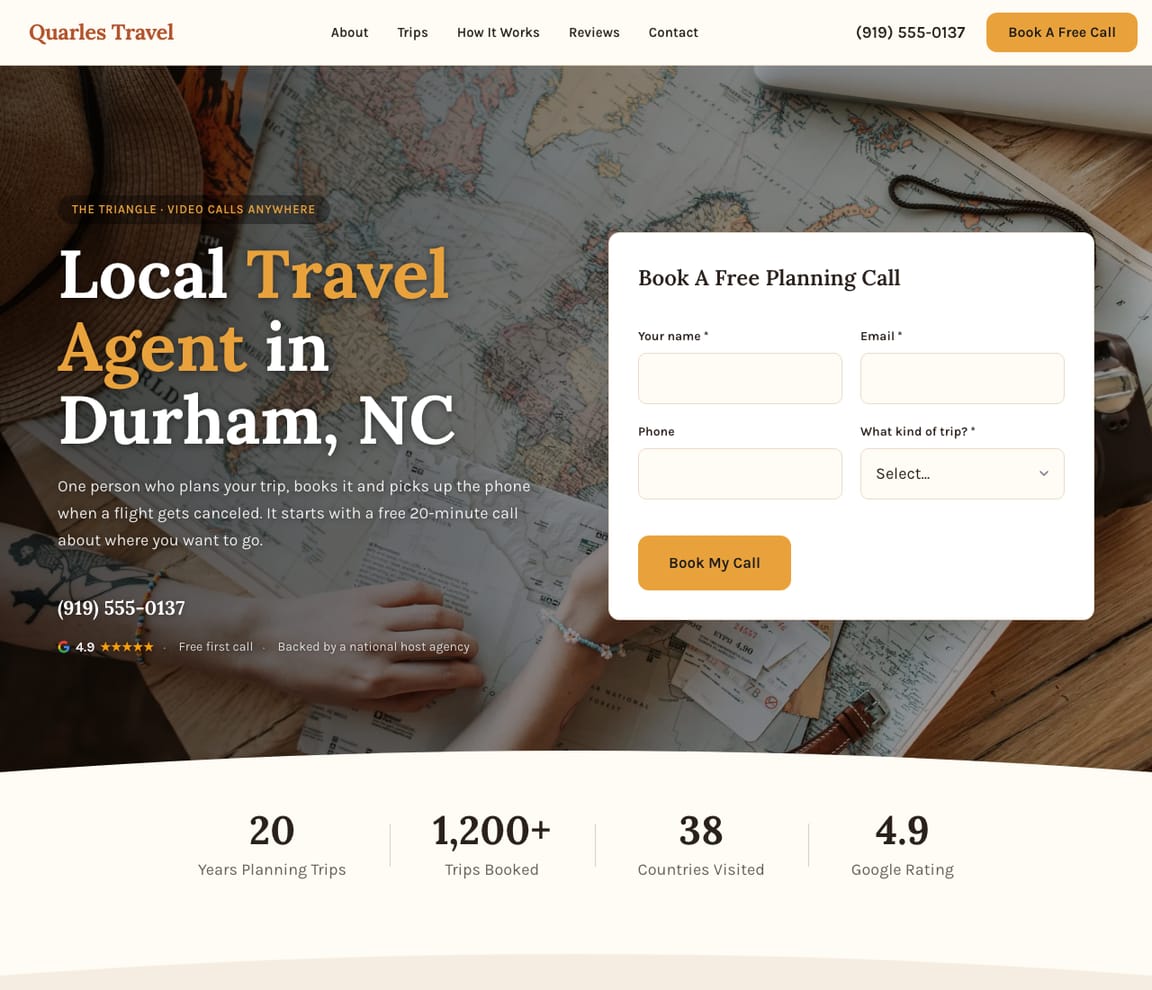
See what your travel agency website could look like
This is a real Zarla template for a home-based travel advisor. Describe yours — the trips you plan, who you plan them for, the places you know — and you'll have a site like this, with a book-a-call form up front and room for photos from real trips, in about a minute.
- Professional design — not a generic template
- Looks great on desktop and mobile
- Content written for your industry
Build the website
Start your travel agency website now
Add your town and your agency's name to the sentence, and Zarla builds the site: the trips you plan, an about section and a contact form to start planning. Add your niche, your planning fee, your host agency and photos from real trips in chat, then publish.
Already have a website? Bring it across →Zarla keeps your old page addresses where it can and redirects the ones that change, helping you keep the Google standing you've built.
Is a travel agency worth starting — and how do agents get paid?
Travelers still hand the complicated trips to an agent. Travel advisors sell 67% of US cruise bookings, 66% of tour packages and 40% of all air travel, and half of travelers say they're more likely to use an advisor today than in the past (ASTA's 2026 press kit). Host agencies “have become the leading path to bringing new talent to the travel agency distribution channel” (Host Agency Reviews) — a new agent works from home as an independent contractor under one, which is why starting costs hundreds or a few thousand dollars, not a storefront.
You're paid by the supplier, not the traveler. Cruise lines, tour operators, resorts and hotels pay the agency a commission on what you book — there is no single average. Hotels and car rentals typically pay 10%, boutique tour operators about 10%, and Disneyland and Disney World a flat 10% to every agent; flights often pay little or nothing, which is why the most common fee agents charge is for air tickets (Host Agency Reviews, 2024). One franchisor's disclosure lists what its agents generally earn: 15% to 18% on ocean cruises, 15% to 20% on river cruises, 5% to 10% on hotels (up to 18% at all-inclusive resorts), 0% to 10% on air and 10% on travel insurance (Cruise Planners' 2026 franchise disclosure). The commission arrives after the client travels — “if you make seven bookings in January but the clients aren't traveling until November, you might not get paid until the next calendar year” (Host Agency Reviews, 2024).
Planning fees are the other half. In 2023, 49% of hosted advisors and 67% of independently accredited advisors charged some type of fee — about $40 to book a domestic air ticket, $60 an international one, and $100 to $250 a booking for packages, cruises and tours (Host Agency Reviews, 2024); fees made up 20% of hosted advisors' income (Host Agency Reviews). ASTA tells travelers a professional fee “could range from $50 to several hundred dollars depending on the complexity of the trip” (ASTA, 2026).
What agents earn. The BLS median for employed travel agents is $50,160 a year (BLS, May 2025, via O*NET) — and “Estimates do not include self-employed workers,” as Host Agency Reviews quotes the BLS (Host Agency Reviews). Host Agency Reviews' 2024 survey put hosted advisors' average 2023 income at $52,636, and experienced hosted advisors' average sales at $517,797; advisors in their first years averaged $154,918 of sales and $12,057 of income (Host Agency Reviews' 2024 hosted report). Full-time hosted advisors with three years or more averaged $67,256 and independently accredited full-timers $78,940 (Host Agency Reviews, 2024 reports; 2024 independent report). It typically takes three to five years to a steady income (Host Agency Reviews); one host tells new advisors a steady and predictable income “can take one to two years or more” (Nexion).
The hard parts are the wait for commission, the trips that cancel and take it with them, the booking sites that sell the same hotel in a few clicks, and building a client list from nothing. That's what the rest of this guide sets up.
How to start a travel agency, in plain English
Host agency, independent or franchise. This is the first decision. A host agency lets you book under its accreditation numbers — “The agent uses the host's accreditation numbers” — and at the very minimum gives you access to them, support and basic bookkeeping; you work as an independent contractor at your own pace (Host Agency Reviews). The supplier pays the host, the host pays you your split. Going independent means your own accreditation, supplier relationships and any seller of travel registration — more of the commission, more of the work; independently accredited advisors had 13 years in the trade at the median, against four for hosted ones (Host Agency Reviews). A franchise sells you a brand, training and marketing for an up-front fee and a royalty.
What host agencies charge — from their own pages (or, for KHM, Host Agency Reviews' listing), October 2026, published terms only:
- OutsideAgents: no enrollment or renewal fee, $26 or $46 a month, 80% to 97% of the commission depending on your sales, and $1 million of E&O with you as named insured (OutsideAgents; packages).
- WorldVia Travel Network: $9 a month and a $99 activation fee for 70% of the commission, or $29 a month for 90%, with a $2 million group E&O policy that has a $5,000 deductible (WorldVia; FAQ).
- Nexion Travel Group: a $199 activation fee, then no monthly fee on its 70% plan (a $5 maintenance fee after 12 months), $15 a month for 80%, $39 for 90% or $159 on its top plan, with no annual fees or minimum sales (Nexion).
- Travel Planners International: $50, $60 or $70 a month for 70%, 80% or 90% (TPI); it tells new agents to expect under $1,000 for training, tools and registration (TPI).
- Avoya Travel: $495 for the initial affiliation set-up, then $79 a month (Avoya).
- Fora: $299 a year with a 70/30 split, by its help center's worked example (Fora).
- KHM Travel Group: $649 a year with a $50 registration fee, or $64.95 a month with a $149 one, for 80% to 90% of the commission, as Host Agency Reviews lists it (Host Agency Reviews' KHM profile).
Our free travel agency business plan puts a one-person, hosted, home-based start at $1,240–$8,595 — most of it launch marketing and six months of running costs while you wait for commission. Host Agency Reviews' 2024 survey found a median startup of $1,500 for hosted agents, an average of $3,478, and a middle range of $500 to $5,000 (Host Agency Reviews).
Franchises. The two big home-based cruise-and-vacation franchises file their disclosures with Minnesota's public franchise registry. Cruise Planners: $1,945 to $20,505 to open, with a franchise fee of $695 to $10,995 depending on experience, a royalty of 1.5% to 3% of commissionable fares and an $80 monthly administrative fee; 3,124 franchised outlets at the end of 2025, and 157 ceased operations that year (Cruise Planners' 2026 disclosure; the same total is on its franchise site). Dream Vacations: $12,295 to $20,695 for a new franchisee in its Item 7 table (the cover page prints $12,595 at the low end), including a $10,500 franchise fee, then a royalty of 1.5% to 3% and a $25 to $150 monthly service fee; 2,515 outlets at the end of 2025 (Dream Vacations' 2026 disclosure). Both publish sales, not income: Cruise Planners' median outlet sold $148,605 of travel in 2025, and Dream Vacations' median outlet among those that sold $25,000 or more sold $198,563 — before commissions and costs. Expedia Cruises is a storefront franchise: $149,300 to $258,545, including a $49,000 fee and office premises (Expedia Cruises).
Commission or planning fees — or both. On a $10,000 trip that pays 10%, the commission is $1,000; a hosted agent on an 80% split keeps $800. On a cruise it's less than it looks: at 16%, but with $4,000 of the fare in air and non-commissionable fees, the commission is $960 (Host Agency Reviews, 2024). Cruise Planners' own example is $1,800 of commission at 18% less a $300 royalty (Cruise Planners). Planning fees pay you for the hours a trip that pays little commission takes — Disney's 10%, air, a complex itinerary — and they're paid up front; a hosted agent in a seller of travel state takes them through the host (below).
Choose a niche. Specializing tells referrals what to send you. Cruises pay some of the trade's highest commissions, and advisors sell two of every three cruise bookings (ASTA); Disney is a rules-heavy niche at a flat 10%, so many Disney agents add a planning fee; honeymoons and destination weddings bring big first trips — one hosted agent told CNBC “a lot of people's first big trip is that honeymoon” (CNBC, February 2025); and groups — reunions, friends, clubs — multiply one booking into many cabins. Corporate specialists earned 82% more on average than leisure-only advisors (Host Agency Reviews).
Seller of travel laws. In the US there is no federal travel agent license, but four states register sellers of travel. California charges $100 a location a year, and exempts an individual or single-owner company with a written contract with a registered seller of travel that takes no money from the passenger and discloses the registered seller's name and registration number, on its website too (California §17550.20); some California sellers of travel must use a trust account or bond (California Attorney General). Florida charges $300 a year with a surety bond of up to $25,000, and $50 a year for each independent agent (Florida FDACS). Washington charges $222 a year (Washington DOL) and exempts a hosted agent only when they do business in the name of the registered seller and all client money is collected in its name (RCW 19.138.100); money held more than five business days goes into a trust account, or a bond of $10,000 to $50,000 (RCW 19.138.140). Hawaii charges $95 or $140 for its two-year registration and requires a client trust account (Hawaii DCCA), though it grants waivers (DCCA). A planning fee you collect yourself counts as client money: to keep the hosted exemption in California and Washington, “All fees (consultation/service fees) must be processed through the host agency” (Host Agency Reviews, January 2025) — or register. Iowa repealed its law in 2020 (Iowa Code chapter 9D). The states your clients live in can matter as much as your own — check before you take a payment.
E&O insurance. Errors and omissions insurance pays when a client says a booking mistake cost them their trip. Insureon's travel agent customers pay a median $451 a year for it and $350 for general liability (Insureon, March 2026). Many hosts include a group policy — check its limit and deductible; WorldVia encourages its advisors to carry their own supplemental policy as well (WorldVia).
IATA, IATAN and CLIA — what's optional. You don't need your own numbers to book under a host. IATA's TIDS number is free (IATA); IATAN accredits an independent contractor business for $110 and $110 a year (IATAN); and the IATAN ID card, which identifies you to suppliers as a working agent, is $48 (IATAN's fees) once you've earned $5,000 of commission in 12 months and work at least 20 hours a week in travel sales (IATAN's conditions). CLIA, the cruise lines' association, runs memberships and courses for agents; some hosts include access.
Register the business. Form it — for example $40 for an LLC in Kentucky (Kentucky SOS) and $300 in Texas (Texas SOS); an LLC protects your personal assets in most cases if the business is sued (SBA) — get the free EIN (IRS) and open a business account for commissions and fees.
Booking only for yourself won't work. Agents can earn commission on their own trips, but Fora, for one, says “You cannot join Fora solely to book personal travel” (Fora), and OutsideAgents asks agents to sell something every six months (OutsideAgents). Familiarization (FAM) trips run “from completely free … to a decent discount” and usually without airfare (Host Agency Reviews); they go to agents who sell.
The travel agency website templates show what a good home-based agency site looks like, and Zarla's travel agency website builder is how travelers searching for an agent find yours. If destination weddings are your niche, read our guide to starting a wedding planning business too.
What travel agents actually say
None of this is our opinion about the trade. It comes from US travel agents talking to CNBC, a local paper, a small business development center and a trade site's interviews between 2018 and 2025, so read each as theirs at the time. Four things come up again and again.
“Plenty of experienced travelers will reach out to me and say, 'I could do this myself, I just don't have the time anymore. Can you help me?'” — Rebecca Smiley, a hosted travel agent who left her job as a college counselor, CNBC, February 2025
The first clients are people you know. Erica Carr of bookitbox TRAVEL in Gainesville, Georgia, on how it started: “some friends just started reaching out and saying like, Hey, can you, you know, book us trips?” and “I was obviously still full-time in my sales career and so I was just kind of doing these trips on the side and it started to kind of grow.” (Host Agency Reviews, November 2022). Lu Maggiora of Travel by Lu turned her friends into groups: “I'm a social person. I like a good party, I like to gather people,” — “so I started gathering groups for cruising.” (Host Agency Reviews, October 2018). Valerie Gossett of Premier Resources Travel Group, on who to recruit to fill a group: “You want to look for people who have a network of friends who they do things with.” (Host Agency Reviews, April 2019).
The first year is the hard one. Smiley planned a ten-person family road trip in her first month and kept a bartending job as a safety net: “It was either sink or swim, and without that, I don't know that I could have pushed myself as hard,” (CNBC, February 2025). Kim Hilsabeck of Armadillo Travel Adventures near Tampa: “I'm going to be a travel agent. I can do this. And two weeks later, I was in business,” and “I had never had a business before and jumped in headfirst.” Her center reported her net income growing from just over $8,000 to an expected $27,000 the next year (Florida SBDC, December 2025). Wendy Sylvester, whose agency was in its second year when the 2008 crisis hit: “I just kept advertising, really kept pushing my name as much as I could.” (Host Agency Reviews, March 2024).
Charge for your time. Tiffany Layne of LaVon Travel: “A lot of my growing pains when it came to fees was really fear like I think that most people have.” And: “remember your own personal value and time and your worth and not be afraid to lose a potential client.” Madeline Jhawar of Italy Beyond the Obvious: “I decided to charge fees because I needed to get paid for my time and I didn't understand how commissions worked.” (Host Agency Reviews, March 2019). Penny Clark, whose Travel Time of Everett has been in business for 36 years and runs from her home office in Arlington, Washington, gave up a contract booking airline tickets for state employees in 2023 — schedule changes meant rebooking them, often more than once, for a $37 fee: “It wasn't worth it,” (The Daily Herald, December 2025).
You have to go, and it isn't a vacation. Smiley on familiarization trips: “These trips are not a vacation by any means, though,” — “You're networking, touring, taking classes and more.” And why she still travels: “If I didn't, how would people trust me to plan theirs?” (CNBC, February 2025). Clark on the escorted groups she still takes: “A lot of these people that travel with me didn't know each other to start, but now they go to shows together or dinner together or play cards together or what have you,” — “They have become friends.” (The Daily Herald, December 2025).
The through-line: the agents who last start with the people who already trust them, pick the trips they're known for, charge for their time, and go and see the places they sell.
THE STARTER KIT
What you need to start a travel agency
A host agency (or your own numbers)
A host's accreditation numbers, supplier contracts, booking tools and training — or, later, your own accreditation once your sales justify it.
A niche
One kind of trip you'll be known for — honeymoons, Disney, cruises, groups, a destination you know — so referrals know what to send you.
Supplier training
The host's course and the training of the two or three suppliers you'll sell most — the products, the booking rules and the final-payment dates.
E&O insurance
Errors and omissions cover for a booking mistake — through the host's group policy, your own policy, or both.
A laptop, a phone and a client tool
The computer you have is enough to start; an itinerary and client tool keeps the proposals, payments and documents in one place.
A way to be found
A Google profile and a website with the trips you plan, how you're paid, your host agency and a way to start planning.
THE PAPERWORK
Licenses, registrations and insurance for a travel agency
| Typical cost | Time to get | Legally required? | |
|---|---|---|---|
| Business registration (LLC) and local business license | e.g. $40 (Kentucky), $300 (Texas) | Days | Depends on your structure and city |
| EIN from the IRS | Free | Minutes online | If you hire or have partners; optional when solo |
| Seller of travel registration | $100 (CA) to $300 (FL) a year; $222 (WA) | Weeks | In CA, FL, WA and HI; exemptions in CA and WA |
| Florida independent agent filing | $50 a year | Weeks | In Florida, for agents under a registered seller |
| Host agency agreement | $0–$495 to join, $0–$159 a month | Days | No — but it's how most new agents book |
| Errors and omissions insurance | $451/year median, or the host's policy | Same day | Not by state law; hosts and franchisors carry it |
| IATA TIDS number | Free | Weeks | No — optional under a host |
| IATAN ID card | $48 | After $5,000 of commission | No — it proves you're an agent to suppliers |
THE STEPS
How to start a travel agency (step by step)
Eight steps from “friends keep asking me to plan their trips” to a business.
01
Choose your model
Compare host agencies, your own accreditation and franchises — the fees, the commission split, the training and how you leave.
02
Pick a niche
Choose the trips you'll be known for — honeymoons, Disney, cruises, groups or a destination you know.
03
Register the business
Form the business, get a free EIN and open a business bank account for commissions and fees.
04
Check the seller of travel rules
California, Florida, Washington and Hawaii register sellers of travel; check your state and your clients' states before you take a payment.
Before your first booking05
Join a host and train
Sign the host agreement, finish its training and the training of the suppliers you'll sell most, and confirm your E&O cover.
06
Decide how you're paid
Write down your planning fee, if you charge one, and how you explain commission — paid by the supplier after the client travels.
07
Get found by travelers searching for you
Put your Google Business Profile and website live with the trips you plan, how you're paid and a way to start planning.
08
Tell everyone you know
Tell friends, family and past colleagues you're open, plan their trips well, and ask every happy traveler for a review and a name.
THE COSTS
How much does it cost to start a travel agency?
The total is our free travel agency business plan's itemized US ranges for one hosted, home-based owner: the host's joining fee, E&O, registration and any seller of travel license, a laptop if you need one, the website, launch marketing, set-up fees and six months of running costs. The survey figure is Host Agency Reviews' (2024); franchise totals are from the franchisors' 2026 disclosures, checked October 2026.
$1,240–$8,595to start hosted from home — the low end on the computer you have, with the host's E&O
$1,500the median startup cost hosted agents reported to Host Agency Reviews (2024)
$1,945–$20,505to open a Cruise Planners franchise, from its 2026 disclosure
$12,295–$20,695to open a Dream Vacations franchise as a new agent, from its 2026 disclosure's Item 7
WHAT WE'VE LEARNED
What actually makes a traveler book a first call
Thousands of local business websites in, the pattern for advice-led services is clear: the client arrives with a trip in mind and a doubt — why pay an agent when the booking sites are free? Three things on a page answer it.
Trips you've actually planned
Real honeymoons, cruises and family trips, with photos from the travelers — so the client sees the kind of trip you do best before they ask.
How you're paid, said plainly
Whether you charge a planning fee, what supplier commission covers, and what the first call costs (usually nothing) — so asking feels like no risk.
Proof of who is planning it
Your name and photo, your niche, your host agency, the training you've done, reviews, and a form that asks for dates, budget and who is going.
THE UPSIDE
What a travel agency can earn
Averages from Host Agency Reviews' 2024 survey of self-employed advisors (2023 income) and the BLS median for employed agents. Averages, not a promise: your niche, your clients and how long you've been at it decide it.
$52,636average 2023 income of hosted travel advisors
$67,256average for full-time hosted advisors with three years or more
$12,057average 2023 income of hosted advisors in their first years
$50,160BLS median for employed travel agents, May 2025 — the self-employed aren't counted
SEE IT WORK
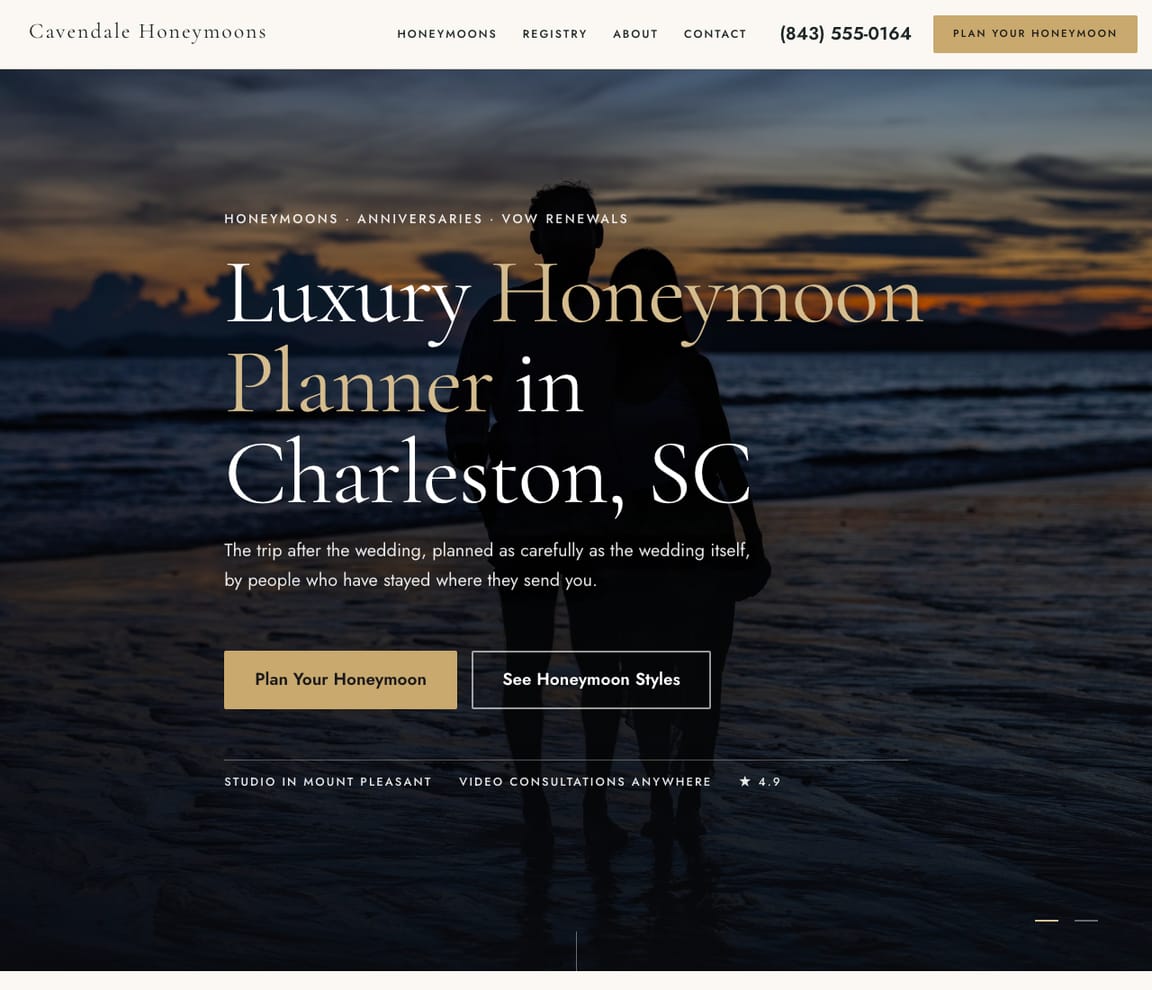
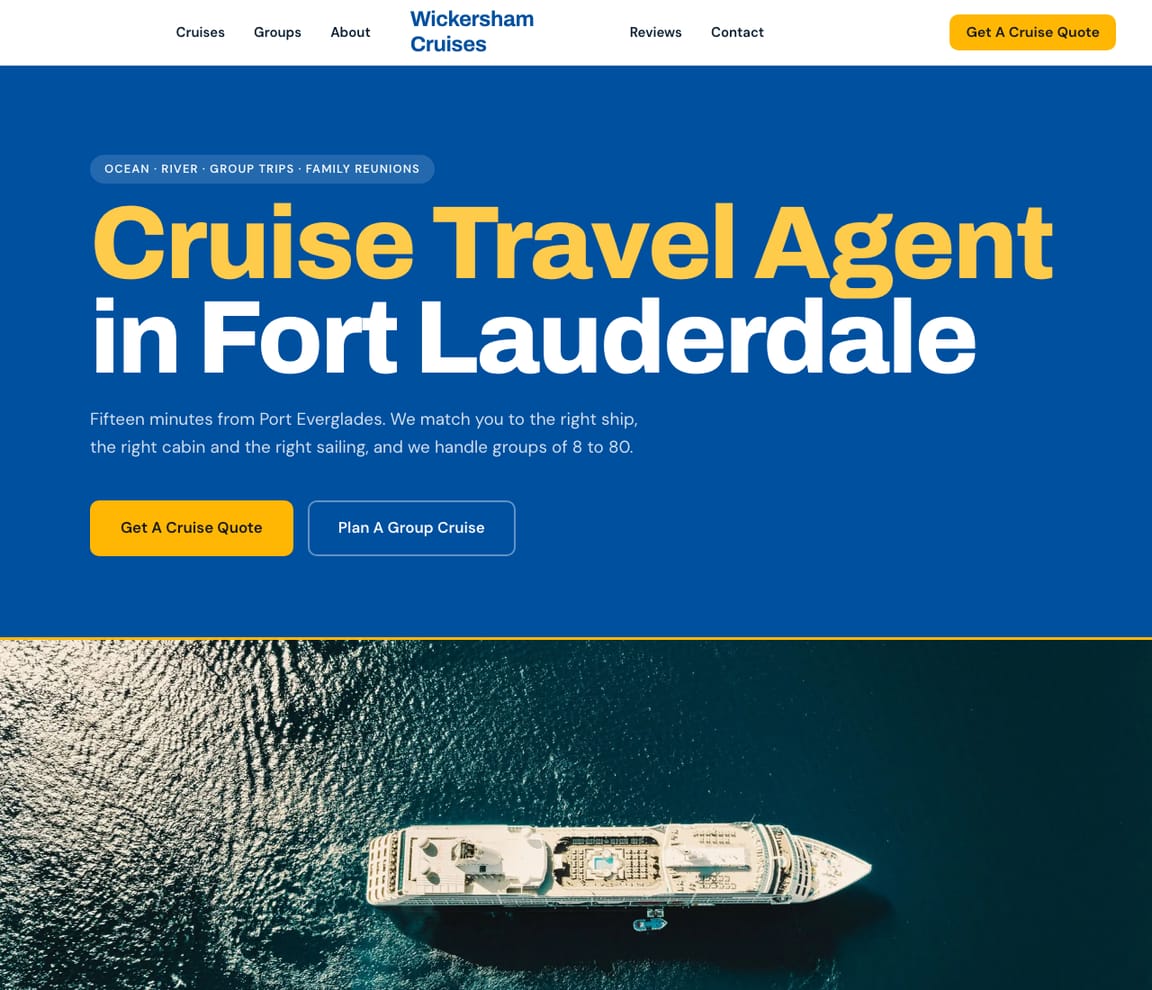
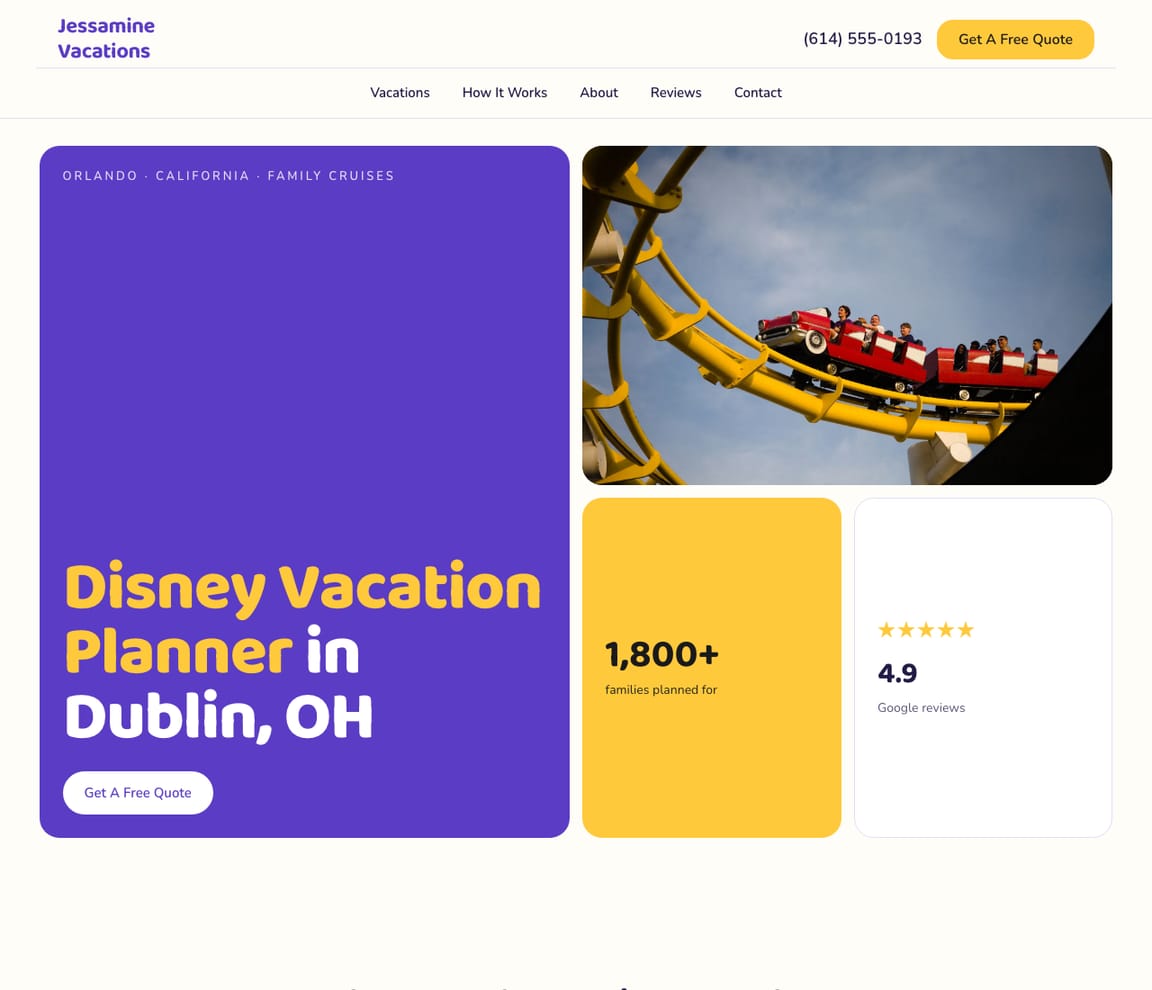
Travel agency website designs you can start from
Real Zarla templates for travel agencies — a home-based advisor, honeymoons, cruises and groups, Disney vacations. Open the one closest to your niche, swap in your name, your trips and your photos, and publish — the gallery has every design we've made for the trade.
GET FOUND
Get found by the traveler looking for an agent
Most clients who don't already know you start with a search — for a travel agent near them, a Disney or cruise specialist, someone who plans honeymoons. Zarla builds the website with the trips you plan, an about section and a contact form. Add your niche, your planning fee and your host agency in chat, and once you connect your Google Business Profile, your name, area and reviews stay in step on both.
“Travel agent near me”
Searched by a couple planning a honeymoon or a family planning a first cruise. Your niche, how you're paid and a quick way to book a first call answer it before they book it themselves.
Google Business Profile
As a home-based agency you show the area you serve, not your street address — plus your hours, photos from trips you planned and your reviews inside Google Maps. Free, and an afternoon to set up.
Reviews from the trip home
Ask when the client is back and still glowing — and send the link that evening. Reviews that say you caught the details, answered at midnight and knew the resort sell the next trip.
Google Search
Llarkmoortravel.com
Larkmoor Travel — Trusted Travel Agency in Your AreaHoneymoons, all-inclusive resorts and cruises, planned by a home-based travel advisor. Book a free first call to start planning.← Your Zarla siteCcitytravelagencyservices.com
City Travel Agency ServicesGoogle Maps
1
Larkmoor Travel
← You2
Metro Travel Agency Co.
3
Quick Travel Agency Services
AI assistants (ChatGPT / Perplexity)
For a travel agent who plans honeymoons in your area: Larkmoor Travel — a local travel advisor who plans honeymoons and resort trips, says how they're paid, names their host agency and has reviews from couples who traveled.
YOUR LAUNCH PLAN
Your travel agency launch checklist
The whole guide as things to check off. Work through them in order and you'll be registered, insured, trained and ready before the first client calls.
- Choose host, independent or franchise — read the agreements, ask the agents, price all three.
- Pick a niche — the trips you'll be known for.
- Register the business and get a free EIN — and a business bank account.
- Check the seller of travel rules — your state and the states your clients live in.
- Join a host and finish its training — plus the suppliers you'll sell most.
- Confirm your E&O cover — the host's policy, your own, or both.
- Write how you're paid — commission, any planning fee, and when each is due.
- Get found — website and Google Business Profile live with your trips and a way to start planning.
REAL CUSTOMERS
Small business owners who got online with Zarla
Verified reviews from real Zarla customers.
“Quickly built my website from scratch. No hiccups. Would highly recommend Zarla for someone with no experience who wants to start a polished business website.”
“Great professional website in less than a minute, with the use of AI and a few descriptive prompts. This has saved me bundles of time and research on web developers.”
“I had no idea how to set up a website for my business. Thanks to Zarla, they've helped me a lot.”
“Very reliable, professional, and fast results. I was able to get my business online in no time, and the ease of access made it so simple.”
Plan the trips, and be the agent they find
Add your town and your agency's name, and Zarla builds the website from that one line — the trips you plan, an about section and a contact form to start planning. Add your planning fee, your host agency and photos from real trips in chat. Free to build; you pay when you publish.
Already have a website? Bring it across →Zarla keeps your old page addresses where it can and redirects the ones that change, helping you keep the Google standing you've built.
Frequently asked questions
How much money does it cost to start a travel agency?
In the US, about $1,240 to $8,595 for one hosted, home-based owner in our travel agency business plan's itemized ranges — the host's joining fee, E&O, registration and any seller of travel license, a laptop if you need one, the website, launch marketing, set-up fees and six months of running costs while commission arrives. Hosted agents told Host Agency Reviews their median startup was $1,500 and the average $3,478 (2024). Franchises cost more: $1,945 to $20,505 at Cruise Planners and $12,295 to $20,695 for a new Dream Vacations franchisee (the 2026 disclosures' Item 7 tables), and an Expedia Cruises storefront $149,300 to $258,545.
Is owning a travel agency profitable?
It can be, slowly. Host Agency Reviews' 2024 survey put hosted advisors' average 2023 income at $52,636 and $67,256 for full-time hosted advisors with three years or more — but $12,057 for those in their first years, and it typically takes three to five years to a steady income. Costs are low when you work from home under a host; what decides it is how many trips you sell, your niche and whether you charge planning fees, which made up 20% of hosted advisors' income.
How much does a travel agent make on a $10,000 trip?
On a trip that pays 10% commission — a hotel or a Disney World package, for example — $1,000, and a hosted agent keeps the split: $700 at 70%, $800 at 80%, $900 at 90%. A cruise pays more per dollar but not on all of it: at 16%, with $4,000 of air and non-commissionable fees, the commission is $960 (Host Agency Reviews' example). Flights alone pay little or nothing, so agents charge a fee. Commission is paid after the client travels, and any planning fee comes on top.
How do I open a small travel agency?
Most people start at home under a host agency: choose a host (compare the fees, the commission split and the training), pick a niche, register the business and get a free EIN, check the seller of travel rules in your state and your clients' states, confirm your E&O cover, finish the host's and your main suppliers' training, decide on a planning fee, and tell everyone you know you're open. Your own accreditation or a storefront can come later, once the sales justify it.
What is a host agency?
A travel agency that lets independent agents book under its accreditation numbers and supplier contracts. The supplier pays the commission to the host, and the host pays you your share — 70% to 97% at the hosts we read, for fees from nothing to $159 a month (October 2026). Hosts usually add training, booking and client tools, and often a group E&O policy and the seller of travel registrations in California, Florida and Washington.
Can I become a travel agent just for myself?
Not really. Agents can earn commission on their own trips, but hosts join you to sell to clients — Fora says you cannot join solely to book personal travel, and OutsideAgents asks agents to sell something every six months. The industry ID follows sales too: the IATAN ID card that identifies working agents to suppliers needs $5,000 of commission in 12 months and 20 hours a week in travel sales.
What are the four types of travel agents?
There's no official list. The common split is by how agents are set up — hosted independent contractors, independently accredited agencies, franchise owners and employees of an agency — or by what they sell: leisure, corporate, groups and niche specialists such as cruise, Disney or honeymoon agents. Host Agency Reviews found corporate specialists earned 82% more on average than leisure-only advisors.
How long does it take to become a travel agent?
Weeks to start, years to a steady income. Nexion says you can often begin within a few weeks, and Travel Planners International that most people finish its training in a few weeks to a few months; in the US there's no federal license or required course. Nexion says a steady, predictable income can take one to two years or more; Host Agency Reviews says three to five years is typical.
Do travel agents get a lot of free trips?
Some, if they sell. Familiarization (FAM) trips range from completely free to a discount and usually don't include airfare, and suppliers give them to producing agents — Host Agency Reviews' words: “Producing is the key word here.” One agent told CNBC they're “not a vacation by any means” — you're touring hotels and taking classes.
Do you need a license to be a travel agent?
In the US there's no federal travel agent license, but California, Florida, Washington and Hawaii register sellers of travel: $100 a location a year in California, $300 a year in Florida (plus $50 for an independent agent's filing), $222 a year in Washington and $95 or $140 for Hawaii's two-year cycle. A hosted agent who takes no money from clients — planning fees included — can be exempt in California, and in Washington when they sell in the host's name. Iowa repealed its law in 2020. Check your state's rules and the rules where your clients live.
Do I need an LLC for a travel agency?
In the US you don't need one to start — you can work as a sole proprietor under a host agency — but an LLC protects your personal assets in most cases if the business is sued, according to the SBA. It costs a state filing fee, for example $40 in Kentucky and $300 in Texas, and the EIN from the IRS is free. Check your state's rules and ask an accountant which structure suits you.
How do I become a Disney travel agent?
Join a host agency or agency that sells Disney, learn the parks, the tickets, the dining and the booking rules, and make Disney your niche. Disneyland and Disney World pay every agent a flat 10% commission (Host Agency Reviews, 2024), so many Disney agents charge a planning fee for the hours a Disney trip takes. Say plainly that you're an independent agency — Disney's names belong to Disney.
How do I get my first travel clients?
From the people who already trust you: tell friends, family and past colleagues you're open and what trips you plan, plan their trips well, and ask each traveler for a review and a name. Then make yourself easy to find and check — a website with your niche, how you're paid and a way to start planning, and a Google Business Profile with reviews. Zarla builds the website from one sentence, with the trips you plan, an about section and a contact form, and syncs your Google profile once you connect it.