FOR NEW WEB DESIGNERS · 2026
How to start a web design business in 2026 — with AI doing the production
The old way needed a designer, a developer and an SEO person, and priced a small-business site in the thousands. This is the other way: AI builds the site, you own the client relationship, and you sell what the client actually wants — being found and getting inquiries. Every step, from your first niche to your first monthly client.
Free to apply · A person reads every application · No agency fee
The short answer
To start a web design business in 2026: pick a niche, set up the business basics, build a small portfolio, find your first clients, and sell a monthly service — not just a website. What changed is who does the production. AI website builders now write and design a complete small-business site from a description of the business, so the skills that decide whether you make it are business skills: choosing who you serve, finding clients, and keeping them.
That changes what you sell. Design is no longer the differentiator — growth is. A plumber or a dentist doesn't want a website for its own sake; they want to be found on Google and in ChatGPT's answers, to get calls and inquiries, and to change their own opening hours without waiting a week. A web design business built around that costs less to run than the old kind and is easier to keep clients in.
What changed: the old web agency model
For twenty years the standard small-business website worked like this. Make the site look hard to an owner who has no way to judge it. Build it on software the owner can't touch. Charge thousands for the build, then keep charging every month — hosting, security patches, a developer to change a line, speed fixes, forms. Hold the domain. Warn that leaving means losing the Google rankings. The owner can't edit a word of their own site, so they stay.
That model made sense when a site took a designer, a developer and weeks of work. It doesn't now. The people who ran it were doing what the tools demanded; the tools changed. The only thing that loses is the lock-in.
A web design business starting today can show a client a draft in hours instead of a quote in weeks, charge a price small businesses actually say yes to, and put the rest of the client's budget into the work that gets them found — Google Business Profile, reviews, pages written for the searches their customers type. It keeps clients because the work is good, not because they're stuck.
THE STEPS
How to start a web design business, step by step
Six steps from deciding to do this to your first client on a monthly plan.
Pick a niche you can reach
One kind of business in one area — plumbers in your county, dentists, salons, restaurants. You learn what their customers search for once and reuse it for every client, and referrals travel inside a trade.
Decide what you sell
A site on its own is a one-off sale. The business is the monthly service after it: Google Business Profile upkeep, collecting reviews, a new page when a new service or town matters, changes on request and a report every month.
Set up the business basics
In the US, register the business with your state (many designers form an LLC), get a free EIN from the IRS, open a business bank account and check whether your city needs a general business license. Then a proposal, a contract and professional liability insurance.
Build your own site and three samples
Your own site first — a clear offer for your niche, not a gallery of fonts. Then three sample sites for the kind of business you want, labeled as samples. With an AI builder, each takes minutes instead of weekends.
Find your first clients
Your network first, then local businesses whose sites are slow, broken on a phone or missing their services. Lead with what a better site would do for them — more calls — not with design.
Deliver fast, then keep them with results
Show the client a real draft of their site in days and refine it together — speed is what the old model can't match. Then every month: check what they're found for in Search Console, add what's missing, answer new reviews, send a short report. The report is the retainer conversation.
WHERE ZARLA FITS
The production, done. The client, yours.
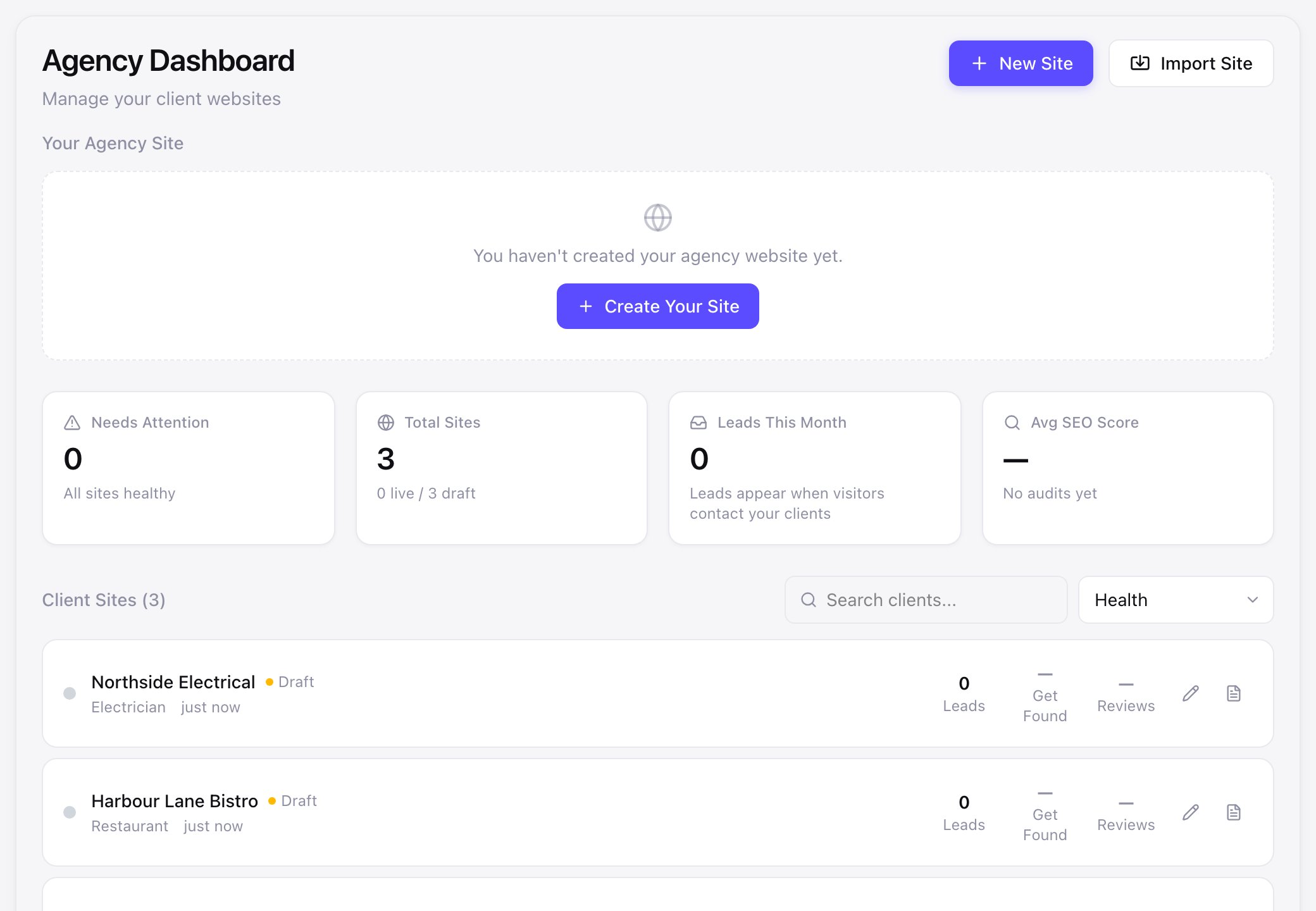
- Every client site in one dashboard, with a health indicator, leads this month and an SEO score for each
- Client reports on demand under your agency's name and logo, as a link or a PDF
- Import a client's existing WordPress, Wix or Squarespace site as the starting point
- Build and edit client sites from Claude or ChatGPT through Zarla's MCP server
- No agency fee: building and previewing is free, and each client site goes on a per-site plan when it goes live
The first of a new breed
Sam runs Leadwave Studio in Sydney — website design, local SEO, Google Business Profile and CRM for service businesses — on his own. Today he builds client sites by chatting with Claude through Zarla's MCP server, runs them from the agency dashboard, and sends clients Zarla's branded reports. Projects start at $999; ongoing SEO and site management run on a monthly retainer. He was one of the first agencies to join Zarla Partners.
One agency, told as the first of a new breed — not as proof at scale. Sam's prices are his own. Read the case study.
Starting out? Apply anyway.
Zarla Partners is for agencies, freelancers and people starting their first agency. Approved partners get a free, permanent listing in the partner directory and the Zarla Certified Partner badge.
Free to apply · A person reads every application · No agency fee
What it costs to start a web design business
Very little, compared with almost any other business. You need a computer you probably already own, a business registration (state filing fees vary — your state's business portal lists them), a contract and proposal you can reuse, and the tools you build with.
The tools are where the old model was expensive: design software, a premium WordPress theme, plugin licenses, hosting for every client, a security service and the hours to keep it all patched. An AI builder that hosts, secures and updates the sites itself removes most of that list — on Zarla, building and previewing client sites is free, there is no agency fee, and each client's site goes on a per-site plan when it goes live (current prices are on the pricing page).
Pricing your own work is the bigger question — see what small businesses pay for a website for the market your clients are comparing you against.
Mistakes that sink new web design businesses
- Selling design. Clients can't judge a font choice; they can judge the phone ringing. Sell being found and getting inquiries.
- Charging only for the build. A one-off project means finding a new client every month forever. Build the monthly service in from the first proposal.
- Building on a stack you have to babysit. Every plugin you install is an update you owe that client for the life of the site.
- Holding the keys. Registering the client's domain in your name or keeping them out of their own site buys a few months of retention and a bad reputation. Let the relationship rest on results.
- No contract. Scope, revisions, payment terms and what happens when the work ends — written down before you start.
- No niche. "Websites for small businesses" is everyone. "Websites that get plumbers calls" is a business.
Starting a web design business: common questions
AI is replacing the production part — laying out pages, writing first-draft copy, choosing images, setting up the technical search basics. It isn't replacing the person who understands a local business, knows what its customers search for, and keeps its site and Google presence working month after month. That's the job a new web design business sells.
As a business, yes — every small business still needs a website that gets it found, and most owners would rather pay a fair price to someone who handles it. What's worth less is design alone: a web design business that sells only the build competes with AI tools on price. One that sells growth — search visibility, reviews, inquiries — doesn't.
It can be, and the cost structure decides it. The old model carried designers, developers, hosting and patching on every site; a business built on an AI builder that handles production, hosting and security carries far less. Income depends on your prices, your niche and how many clients stay — we don't publish earnings figures, and you should be wary of anyone who promises one.
A salary is what an employed web designer earns; a web design business earns what its clients pay, minus its costs, which varies too much for a single number. For employed roles, the US Bureau of Labor Statistics publishes median pay for web developers and digital designers in its Occupational Outlook Handbook.
Very little. If you already own a computer, the costs are a business registration (state filing fees vary — your state's business portal lists them), a reusable contract and proposal, professional liability insurance, and your building tools. Choosing a builder that hosts, secures and updates client sites itself removes the hosting, theme, plugin and patching bills the old model carried.
Almost always through people they already know, then local businesses whose sites are slow, broken on a phone or missing their services. Show the owner a draft of a better site for their business, lead with what it would do for them — more calls and inquiries — and ask every happy client for a review and a referral.
Yes. With AI doing the production, the skills that matter most are business ones — understanding a local business, selling, and following through. Build your own site and three clearly labeled sample sites for your niche, learn what those businesses' customers search for, and start with your network.
No. Many web designers never write code, and on an AI website builder there's none to write. Some HTML and CSS knowledge helps you understand what's happening under the hood, but it isn't what clients pay for.
In the US there's no special license to design websites. You'll usually register the business with your state, get an EIN, and check whether your city or county needs a general business license. Outside the US the steps differ — check your local business registration rules — and wherever you are, a written contract and professional liability insurance protect you more than any certificate.
No. Clients hire the person who understands their business and gets them results, and life and work experience help with both. With AI handling production, starting later is less of a disadvantage than it has ever been.
The idea that a visitor decides within a few seconds whether a site is what they wanted. For a local business that means the first screen must say what the business does, where, and how to call or book — before anything clever.
No, it isn't. Your agency's name and logo go on the client reports and the client relationship is yours, while the dashboard and editor stay Zarla's — the way an agency says it builds on Shopify.
More for people who build websites for clients
Start the web agency you couldn't have started five years ago.
The AI does the production. You own the client. Apply to Zarla Partners — a person reads every application, usually within 3 business days.
Free to apply · A person reads every application · No agency fee