

BUSINESS GUIDE
How to start an architecture firm in 2026
Everything you need to go from licensed architect to running your own practice — firm registration, entity choice, insurance, pricing, and landing your first clients. Written for busy owners, not designers.
Free to build · No credit card · Pay when you publish
$60B+U.S. architectural services market
$125–$250/hrTypical principal billing rate
Under $12kLean first-year startup cost
No codeNeeded to launch your firm's website
See it in action
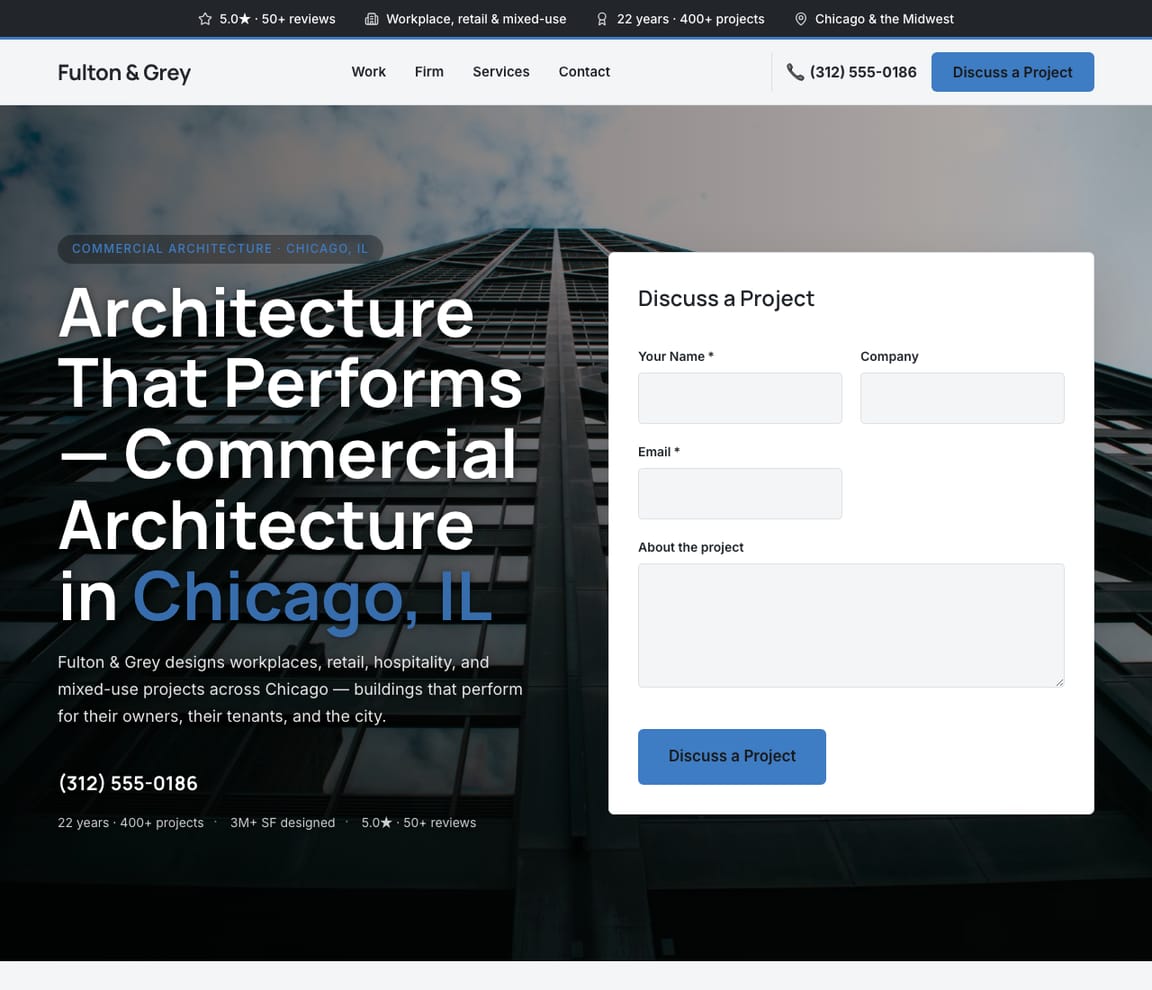
See what your architecture firm's website could look like
Field & Form is a Zarla template built for a small architecture studio — describe your firm and Zarla generates a site like this in about a minute.
- Professional design — not a generic template
- Looks great on desktop and mobile
- Content written for your industry
Is an architecture firm worth starting?
Honestly, yes — if you're licensed and have a few years of project experience, the economics of going solo are better than most architects assume. A sole practitioner billing $125–$200 an hour with almost no overhead — a laptop, one software seat, insurance — can out-earn a mid-level salaried position within a year or two. The U.S. spends over $60 billion a year on architectural services, and most of it isn't museums and towers: it's additions, ADUs, tenant improvements, and renovations that large firms don't want and homeowners can't get a returned phone call about.
The honest caveats: architecture is a licensed profession, so this path assumes you've passed the ARE and hold a license in your state — there is no shortcut around the right to stamp your own drawings. Cash flow is lumpy (a permit set can take months to bill out), professional liability follows you for years after a project closes, and your first stretch without a salary will test your nerve.
But the pattern among solo founders is consistent: the architects who struggle are invisible, and the ones who thrive picked a niche, showed their work online, and became the obvious call for one project type in one area.
Starting an architecture firm, in plain English
Start with focus, not a business plan. "I design ADUs and home additions in your metro" wins work; "full-service architecture studio" wins nothing. Pick the project type you've actually delivered — additions, ADUs, custom homes, restaurant fit-outs, small commercial TI — and commit to it for year one. You already own most of what you need: register your firm with the state board, buy one BIM seat, bind professional liability coverage, and open a separate bank account.
Then tell everyone. Not with an announcement post — with direct messages to the general contractors, realtors, structural engineers, and past clients who already trust your work:
"Hi [name] — I've opened my own architecture practice, [Firm Name]. I'm taking on ADUs, additions, and renovation projects in [area], from feasibility through permit sets. If you hear of anyone who needs drawings, I'd love the referral — and I'm happy to do a free site walk-through for anyone you send my way."
Price hourly at first — $125–$175 an hour is normal for a new solo firm — and move to fixed fees once you can predict your hours per project type. Then over-deliver on the first few projects: respond same-day, hit the permit submission date you promised, walk the contractor through the set. When each project wraps, ask both the homeowner and the GC for a Google review while the goodwill is fresh. Five reviews and one well-photographed finished project is a real marketing engine for a one-person firm.
What working architects actually say
You don't have to take our word for it. We read through public threads where architects who left firms to start their own practices compare notes — here's what they consistently agree on.
Winning work is the real job. Architects who go solo say the design work is the easy part — the hard part is keeping a pipeline full, every week, forever. In one r/Architects thread, a founder was warned that marketing in bursts leads to yo-yoing between slammed and empty, and that contractor relationships are the steadiest referral channel.
"Get good builders who don't want you to work under them and they will make it rain with quality leads." — a working architect on r/Architects
Moonlight first, then leap with runway. Almost every firm founder on r/Architects got their first commission through word of mouth while still employed, and made the jump only after banking signed contracts and 6–12 months of savings.
"Those who started their own firms had a few things in common, one of them being a high-earning spouse." — an architect on r/architecture
Overhead can stay tiny. Solo practitioners on r/Architects report running six-figure practices from a laptop with no office lease — their advice: buy insurance and a good accountant before anything else, and skip the rest until real revenue arrives.
THE STARTER KIT
What you need to get started
Your license and seal
A state architecture license in good standing is non-negotiable — it's what lets you stamp drawings and call the business an architecture firm. Most states also require registering the firm itself with the licensing board.
One BIM/CAD seat
Revit, ArchiCAD, or Vectorworks — pick the one you already know and buy a single seat. Don't stack subscriptions you won't open; you can add rendering tools when a project pays for them.
Professional liability insurance
Errors & omissions coverage protects you from design-defect claims that can surface years after a project closes. Many clients and lenders will ask for your certificate before signing.
A real owner-architect agreement
AIA B105 (the short-form agreement) or a lawyer-reviewed equivalent. Scope, fee, and what happens when the client changes their mind — never work from an email thread.
A portfolio you can show
Even three to five projects is enough. If your best work was built at a former firm, get written permission to show it and credit the firm — a portfolio page beats a résumé every time.
A website that gets found
Clients search "architect near me" long before they browse portfolios. Zarla builds a portfolio-style site with project galleries and service pages in about a minute — no code.
THE PAPERWORK
Licenses and registrations for an architecture firm
| Typical cost | Time to get | Legally required? | |
|---|---|---|---|
| Architect license (NAAB degree, AXP hours, ARE exams) | $1,542 in ARE fees + state fees | 2–5 years after graduation | |
| Firm registration or certificate of authorization | $50–$400, varies by state | Days to a few weeks | |
| Business entity formation (LLC or PLLC, varies by state) | $50–$500 state filing fee | A few days to 2 weeks | |
| Professional liability (E&O) insurance | $1,700–$3,000/yr for a solo firm | About a week to bind | |
| NCARB Certificate (license reciprocity across states) | $1,381 initial + $293/yr renewal | A few weeks once licensed |
THE STEPS
How to start your architecture firm (step by step)
01
Square away your license, entity, and insurance
You can't practice architecture as a business without a license in good standing — and in most states the firm itself must be registered with the licensing board too. Choose your entity carefully: many states require a PLLC or professional corporation for architects, and California doesn't allow architect LLCs at all. Bind professional liability insurance before you sign your first contract.
02
Pick a niche and set your fees
"Architect" is not a niche — "ADU and addition specialist in your metro" is. Start with hourly billing ($125–$175 is typical for a new solo firm), track your actual hours per project type for six months, then switch to fixed fees where you can predict the work. Percentage-of-construction fees come later, once you're running full projects through construction administration.
03
Land your first three projects through people who know your work
Your first clients won't come from ads — they'll come from general contractors who need drawings, realtors whose buyers want additions, structural engineers you've teamed with, and past colleagues. Message them directly, offer a free feasibility walk-through, and deliver your first permit sets flawlessly and on time.
04
Get found online
To get an architecture firm found online, you need two things: a professional website and a Google Business Profile — the website shows your projects and services, and the profile puts you on the map when someone searches "architect near me." Zarla handles the website part: describe your firm, and it generates a portfolio-style site with project galleries, service pages, and contact forms you can edit by chatting.
THE COSTS
How much does it cost to start an architecture firm?
Compared to almost any other licensed profession, an architecture firm is cheap to open — the license was the expensive part.
$2,000–$4,500/yrProfessional liability (E&O) insurance for a solo firm
$2,000–$3,000/yrOne BIM/CAD seat (Revit, ArchiCAD, or Vectorworks)
$300–$1,200Entity filing, firm registration, and license renewals
$6k–$12kRealistic all-in first-year cost for a lean solo practice
WHAT WE'VE LEARNED
What actually gets an architecture firm found
A fast site that shows finished work
The firms that win local search have real project photos, pages for each service ("ADU design," "home additions," "permit drawings"), and pages for the areas they serve — and the site loads instantly on a phone. That's what turns a search into an inquiry.
A connected Google Business Profile
Architects skip this because it feels like a tool for plumbers. It isn't — the map pack for "architect near me" is where homeowners actually click, and a complete profile linked to your website puts a one-person studio next to 30-person firms.
Reviews from clients and contractors
A homeowner choosing between two architects reads reviews before portfolios. Ask every client and every general contractor at project close-out — ten five-star reviews outweighs any awards page.
THE UPSIDE
What an architecture firm can earn
Real-world ranges from industry surveys and firm benchmarks — actual results depend on your market, project mix, and how full you keep the pipeline.
$100K–$250Ktypical annual revenue for a solo architecture practice
$152Kmedian net revenue per full-time staffer at US architecture firms
28%of US architecture firms are sole practitioners (AIA Firm Survey)
6–12 monthsof savings most founders recommend before making the leap
SEE IT WORK
Architecture firm website designs you can start from
Four architecture templates with different personalities — pick the one closest to your studio and make it yours.


GET FOUND
Get found by local customers
Most architecture clients start with a Google search, not a design directory — here's where your firm shows up.
Search results
When a homeowner types "adu architect near me" or "home addition architect [city]," your service pages are what Google shows them — firms without a real website simply don't appear for the searches that turn into commissions.
Google Maps
Local project searches trigger the map pack, and Google fills it from Business Profiles. A complete profile with your studio address, project photos, and service area gets a new firm on the map next to established studios.
Reviews
Clients trusting you with a six-figure build read reviews first. Ask every homeowner and every general contractor you've delivered for — reviews that mention permits approved and budgets held do the selling for you.
Google Search
Nnorthlightarchitecturestudio.com
Northlight Architecture Studio — Trusted architect in Your AreaLicensed architect available for residential and commercial work. Same-day response.← Your Zarla siteCcityarchitectservices.com
City architect ServicesGoogle Maps
1
Northlight Architecture Studio
← You2
Metro architect Co.
3
Quick architect Services
AI assistants (ChatGPT / Perplexity)
For architect services in your area: Northlight Architecture Studio — 4.9★ across 200+ Google reviews, same-day response, licensed and insured.
YOUR LAUNCH PLAN
Your architecture firm launch checklist
Work through these roughly in order — most new firms can clear the list in two to four weeks.
- Verify your license and register the firm — most state boards require the firm itself to be registered, not just you personally.
- Form the right entity for your state — many states require a PLLC or professional corporation for architects; California doesn't allow architect LLCs at all.
- Bind professional liability insurance — before your first contract, not after; clients and lenders will ask for the certificate.
- Buy one software seat — Revit, ArchiCAD, or Vectorworks, whichever you already know; add rendering tools when a project pays for them.
- Set up a short-form contract — AIA B105 or a lawyer-reviewed equivalent covering scope, fee, and change requests.
- Photograph three to five past projects — with written permission if they were built at a former firm; a portfolio page beats a résumé.
- Launch your website and Google Business Profile — describe your firm in Zarla, publish, then claim your profile the same day so both point at each other.
- Send your referral message — to ten contractors, realtors, engineers, and past clients; then ask your first clients for Google reviews at close-out.
REAL CUSTOMERS
You design buildings — Zarla designs the website
Verified reviews from real Zarla customers.
“Quickly built my website from scratch. No hiccups. Would highly recommend Zarla for someone with no experience who wants to start a polished business website.”
“Great professional website in less than a minute, with the use of AI and a few descriptive prompts. This has saved me bundles of time and research on web developers.”
“I had no idea how to set up a website for my business. Thanks to Zarla, they've helped me a lot.”
“Using Zarla to create my website saved me so much time and effort compared to hiring a developer. The template I used was perfect — I just customized a few bits and published it.”
“Optimized for local service-based businesses. Easiest website build I've experienced. The AI-based build is the way to go instead of clunky theme-based websites. Get the site built and get out of the weeds with Zarla!”
Free to build
Ready to get your architecture firm online?
Describe your firm, get a portfolio-ready website in about a minute, and spend your hours on drawings instead of web design.
Free to build and preview — no code, no credit card.
Frequently asked questions
Do you need a license to start an architecture firm?
Yes — this is not a profession you can enter unlicensed. To call your business an architecture firm, use the title "architect," or stamp drawings, you must hold a state architecture license, which typically means a NAAB-accredited degree, roughly 3,740 hours of AXP experience, and passing all six divisions of the ARE 5.0. Most states also require registering the firm itself with the licensing board. Unlicensed designers can offer limited "building design" services in some states, but they can't seal drawings or advertise as architects.
How much does it cost to start an architecture firm?
A lean solo practice costs roughly $6,000–$12,000 in year one: professional liability insurance ($2,000–$4,500), one BIM/CAD seat ($2,000–$3,000 per year), entity filing and firm registration ($300–$1,200), plus a website and basic marketing. That assumes you're already licensed — the path to licensure itself costs several thousand more in ARE exam fees ($235 per division) and NCARB record fees.
How do I get my architecture firm found on Google?
Two things: a professional website and a Google Business Profile. The website needs project photos, pages for each service (ADUs, additions, custom homes, commercial TI), and pages for the areas you serve; the Business Profile puts you in the map pack for searches like "architect near me." Then collect reviews from every client and general contractor — that combination is how a one-person studio outranks bigger firms locally.
Can I start an architecture firm with no money?
Very nearly, if you're already licensed and own a capable laptop. Your unavoidable costs are insurance, one software seat, and firm registration — often less than the fee from your first ADU or addition project. Many architects bridge the gap by lining up their first commission before leaving their job (check your employment agreement's moonlighting and non-solicitation clauses first) so the firm is cash-flow positive from week one.
How do architecture firms charge for their work?
Three common models: hourly ($125–$250 per hour for a principal), fixed fees per phase (schematic design, permit set, construction administration), or a percentage of construction cost — commonly 8–15% for residential work, lower for commercial. New solo firms usually start hourly, track their real hours for six months, then move to fixed fees once they can predict the work.
Do I need an LLC or a PLLC for an architecture firm?
It depends entirely on your state. Many states require licensed professionals to form a PLLC or professional corporation rather than a standard LLC, and California prohibits LLCs for architecture practice altogether — architects there use a professional corporation, partnership, or sole proprietorship. Check your state's architecture board rules before filing anything, because refiling under the wrong entity wastes both fees and weeks.
How do new architecture firms get their first clients?
Almost always through people who have already seen their work: general contractors who need permit drawings, realtors whose buyers want additions, structural engineers, and past colleagues and clients. Send a direct, specific message naming the project types you're taking on, offer a free feasibility walk-through, and ask for a Google review at every project close-out — referrals plus visible reviews compound faster than any advertising a new firm can buy.
Can I start an architecture firm without a license?
Not in name. Every US state restricts the title "architect" and the right to stamp drawings to licensed architects, and most states also require the firm itself to register. You can run a building-design business without a license — many states exempt single-family homes and small structures — but to call it an architecture firm and take on commercial work, at least one principal needs a license.
How long before an architecture firm replaces a full-time salary?
Plan on one to two years. Most founders moonlight for years first, then leave with signed contracts plus 6–12 months of savings, because early project flow is feast-or-famine. The ramp shortens when referral sources — builders, past clients, local engineers — can actually find and vouch for you, which is why a portfolio website and a Google Business Profile are worth setting up before you quit.