Inspiration · Food Truck

The Best Food Truck Website Examples, Explained

Looking for food truck website examples? These 8 are the best we could find — standout real food truck sites plus designs you can build with Zarla — and each comes with a breakdown of the specific design move that makes it work. Find a look you love and you can build a site in that exact style, free, in about 30 seconds.

Real sites + designs you can build with Zarla — free to build and preview, no credit card

What makes a great food truck website

The best food truck websites share a few moves: they earn trust fast, lead with strong visuals of the work, point to one clear action, and match the design to how their customers decide. Each example below calls out the specific choice worth stealing for your own food truck website.

Wafels & Dinges website — Award Truck + E-Comm design example
Real site · New York, NY
  • Award Truck + E-Comm
  • Bold
  • Black + yellow

Wafels & Dinges: Award wall + an e-commerce second act

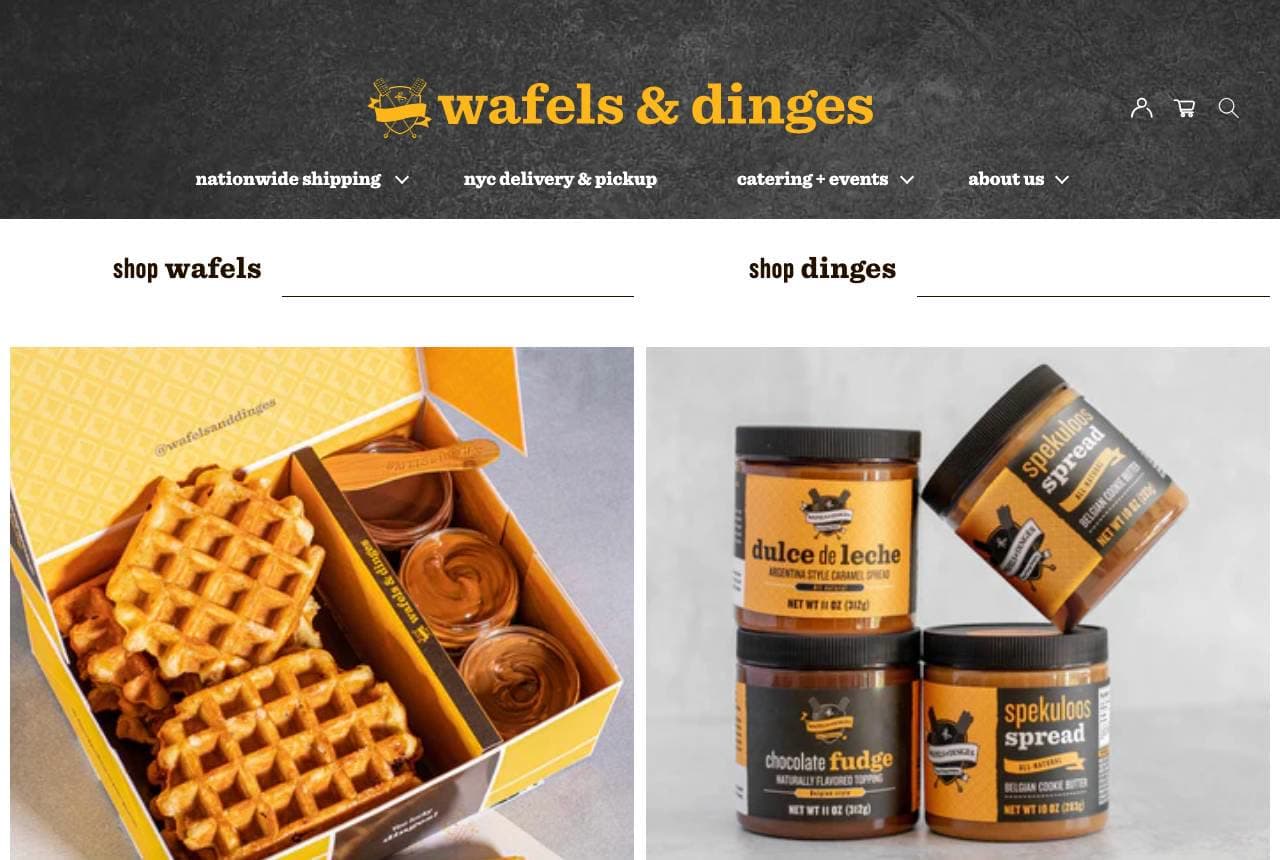
Wafels & Dinges parlays food-truck fame into a whole business: a clean 'shop wafels / shop dinges' hero (selling both the Belgian waffles and the jarred toppings — 'dinges' — for nationwide shipping), and then an absolutely staggering wall of press awards and logos (CNN, Forbes, Zagat, The Daily Meal, BuzzFeed, 'Best Food Truck in NYC,' 'NYC's Best Mobile Vendor'). That award wall is the standout — a food truck lives or dies on reputation, and stacking a decade of press validation turns a street cart into a trusted national brand. Crucially, the site sells product (jars, mixes) for shipping, extending revenue far beyond the truck's daily radius. For a food truck with genuine buzz, the lesson is twofold: display every award you've earned (reputation is the product), and turn your signature item into a shippable product so the brand earns money when the truck is parked.

  • A decade-deep press-award wall turns a cart into a national brand
  • Ships jarred toppings + mixes — revenue beyond the truck's radius
  • Reputation IS the product; display every award you've earned

Steal this: Turn your signature item into a shippable product and stack every press award you've won. The brand earns while the truck's parked.

Cousins Maine Lobster website — Franchise Truck + Ship design example
Real site · United States
  • Franchise Truck + Ship
  • Polished
  • Red + cream

Cousins Maine Lobster: A featured drop and three ways to buy

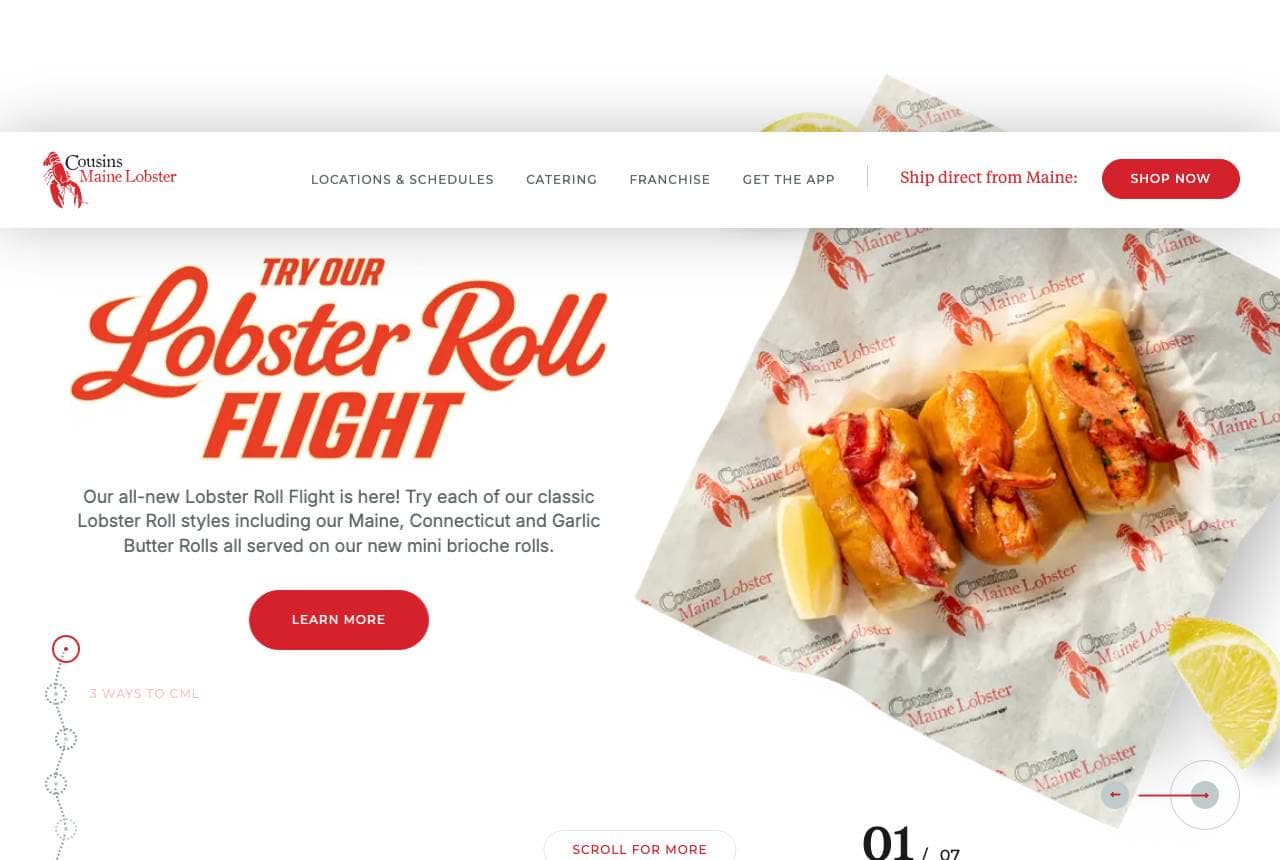
Cousins Maine Lobster (the Shark-Tank truck turned national franchise) runs a polished operation: 'Try Our Lobster Roll Flight' features a new limited item over an appetizing hero, and three clear circular paths — Find a Truck Nearby, Find a Restaurant Nearby, Shop Fresh Lobster — route the visitor to every way they can buy. That three-door structure is the whole scaled business model made navigable: mobile trucks, brick-and-mortar restaurants, AND direct-ship seafood, all from one homepage. Featuring a new 'flight' item (like a seasonal drop) gives regulars a reason to check back. For a food brand that has grown beyond a single truck into franchise and e-commerce, presenting all the channels as equal, obvious doors — plus a rotating featured item — is exactly how you serve a customer who might want any of them. Feature something new; route to every way to buy.

  • Three doors: find a truck / find a restaurant / ship lobster
  • Featured 'Lobster Roll Flight' gives regulars a reason to return
  • Makes a multi-channel franchise navigable from one screen
The Halal Guys website — Cart-to-Franchise design example
Real site · New York, NY
  • Cart-to-Franchise
  • Functional
  • Red + white

The Halal Guys: From cart to franchise, ordering first

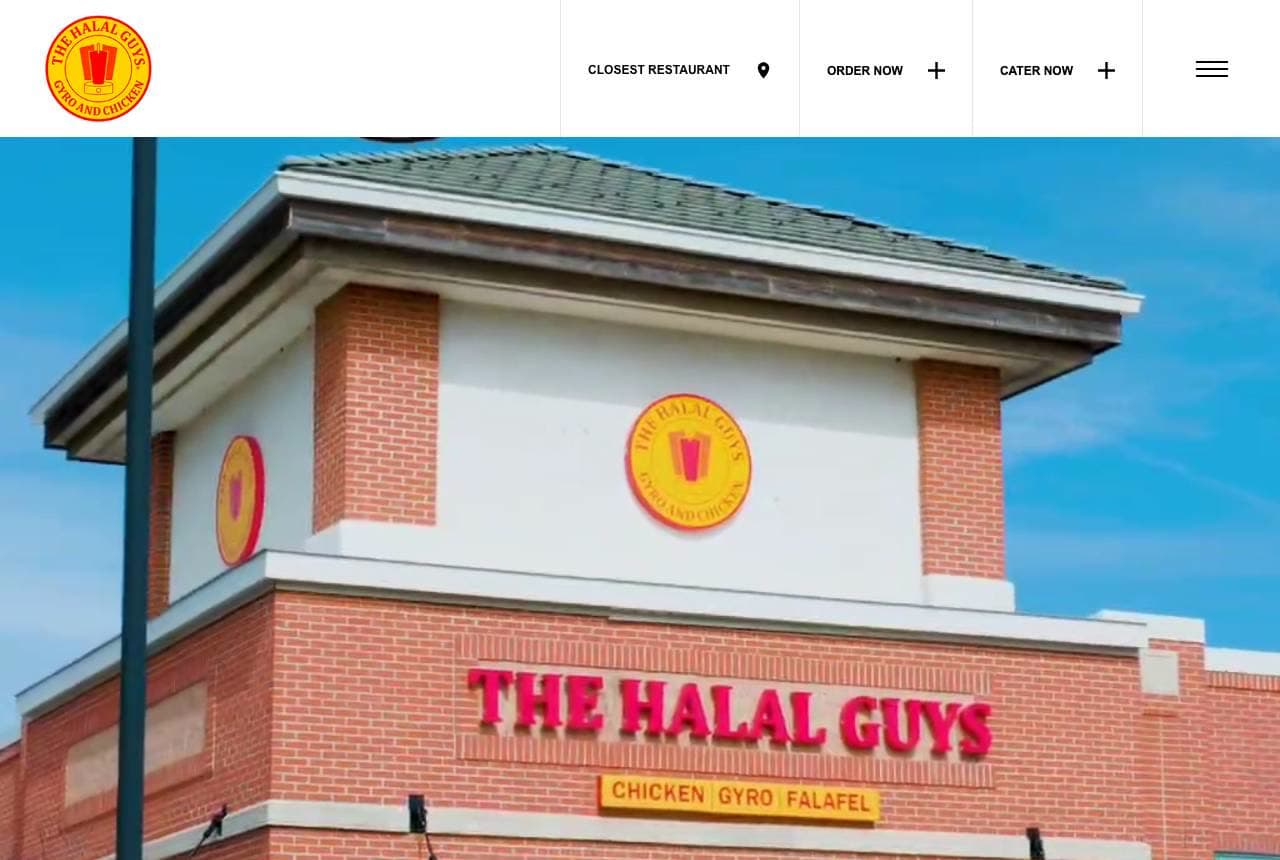
The Halal Guys — the legendary NYC street cart that became an international franchise — leads with function over story: a storefront photo, 'Closest Restaurant,' 'Order Now,' 'Cater Now' in the header, and a scrollable icon menu (Beef Gyro Platter, Chicken Platter, Falafel Sandwich…) with a photo for each item. The design is built around the two things a hungry, decided customer wants: find the nearest location and order immediately. For a brand this recognizable, the website doesn't need to sell the food — everyone knows the white-and-red platter — so it optimizes purely for transaction: location, order, cater. The visual menu with per-item photos speeds the ordering decision. When your brand is already famous, the homepage's job shifts entirely from persuasion to frictionless ordering — lead with 'order now' and 'nearest location,' and let the iconic product sell itself.

  • 'Order Now / Closest Restaurant / Cater' — transaction-first
  • Per-item photo menu speeds the ordering decision
  • For a famous brand, optimize for ordering, not persuasion
The Grilled Cheese Truck website — Single-Item Truck design example
Real site · Los Angeles, CA
  • Single-Item Truck
  • Appetite-Driven
  • Orange + black

The Grilled Cheese Truck: One food, texture-mapped, with a schedule

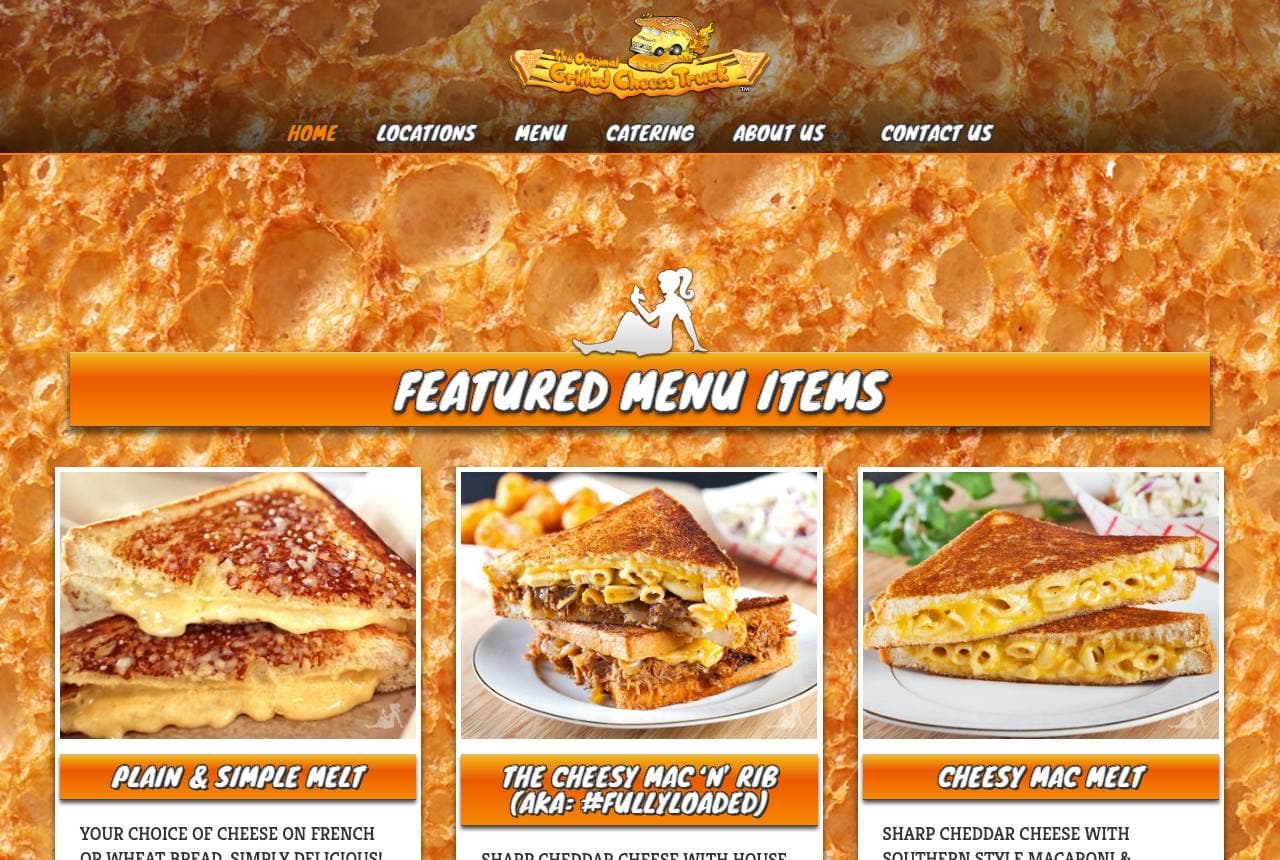
The Grilled Cheese Truck commits fully to its single, gloriously specific product: the entire background is an extreme close-up of crispy grilled-cheese bread, over which 'Featured Menu Items' shows three melts (Plain & Simple, The Cheesy Mac 'n' Rib #FullyLoaded, Cheesy Mac Melt) with drool-worthy descriptions. The killer feature sits below: 'This Week's Truck Locations' with an actual date-based calendar (Jul 13–19) so fans can find the truck each day. That location schedule is the single most important thing a mobile food truck can offer — customers need to know WHERE you'll be — and building it into the homepage as a calendar solves the truck's core discovery problem. Owning one hyper-specific food (grilled cheese) makes the brand memorable, and the appetite-driving texture photography plus a real location schedule nails both the crave and the find. Own one food; publish your schedule.

  • A weekly location calendar solves the truck's core discovery problem
  • Full-bleed grilled-cheese texture drives immediate appetite
  • Owning one hyper-specific food makes the brand memorable

Steal this: Build a real 'where we'll be this week' location calendar into the homepage. For a mobile truck, being findable is the whole game.

The Peach Truck website — Mobile Produce design example
Real site · Nashville, TN
  • Mobile Produce
  • Seasonal-Urgent
  • Orchard + amber

The Peach Truck: Seasonal urgency and a two-step choice

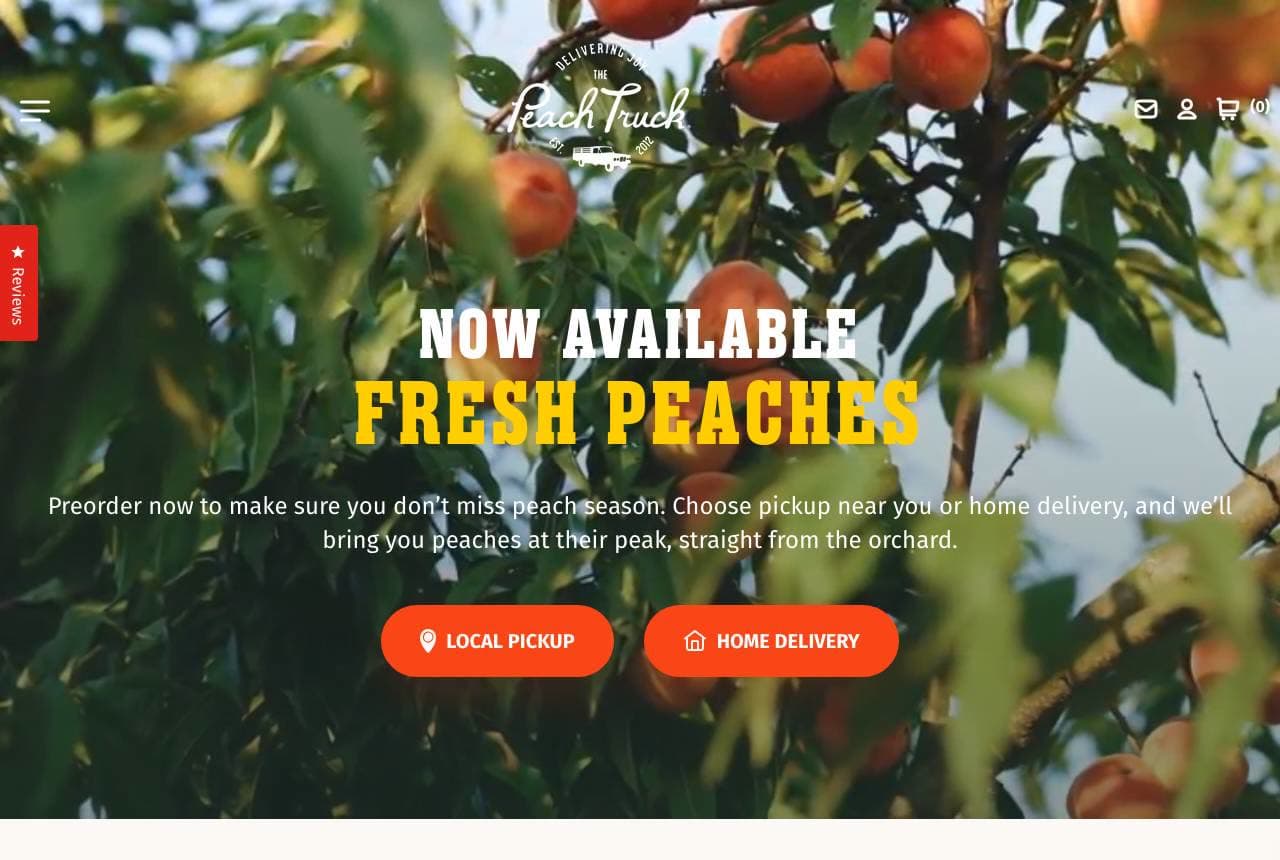
The Peach Truck (a mobile fresh-produce brand) leans into seasonality: 'Now Available: Fresh Peaches' over a lush orchard photo, with 'preorder now to make sure you don't miss peach season' creating genuine time-limited urgency, and two clear paths — Local Pickup and Home Delivery. A 'How It Works' three-step explainer (enter zip, choose pickup or delivery, enjoy peak-picked peaches) teaches the model. Peaches are seasonal, so the 'don't miss the season' framing turns a perishable window into a reason to act NOW, and offering both pickup (the truck) and shipping (delivery) captures local and national customers. For any food business with a seasonal or perishable product, leaning into the limited window ('while the season lasts') is a powerful, honest urgency lever, and pairing it with a simple two-option fulfilment choice makes acting easy. Seasonality is your urgency; make the buy a two-step choice.

  • 'Don't miss peach season' turns perishability into urgency
  • Two fulfilment paths (pickup + ship) capture local and national
  • 'How It Works' three-step teaches the mobile-produce model
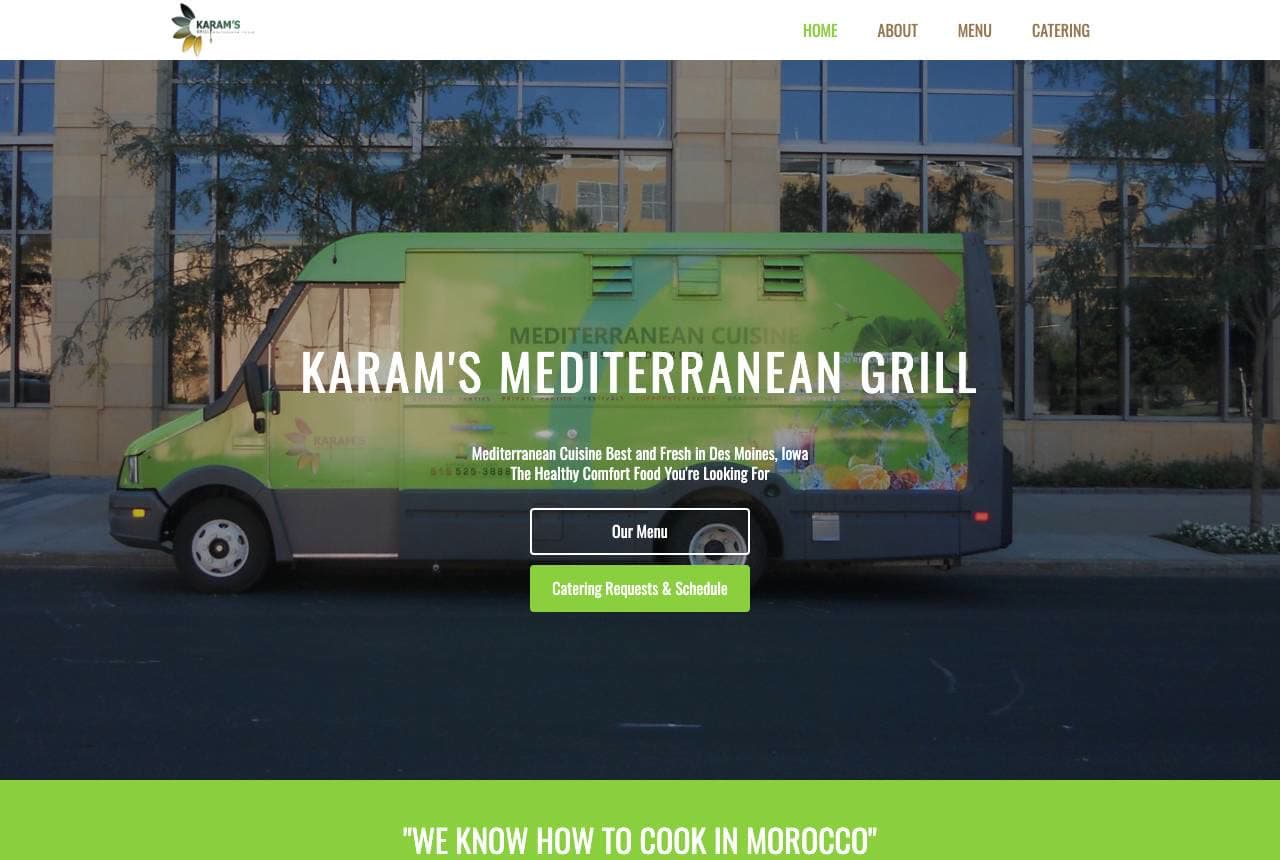
Karam's Mediterranean Grill website — Mediterranean Truck design example
Real site · Des Moines, IA
  • Mediterranean Truck
  • Warm
  • Green + white

Karam's Mediterranean Grill: The truck itself, and a menu carousel

Karam's Mediterranean Grill leads with the most important identifier a food truck has — a big photo of the actual truck (a distinctive green van with the branding) — under 'Karam's Mediterranean Grill' and the charming tagline 'We Know How to Cook in Morocco.' A carousel of vibrant menu photos (BBQ Chicken, Mixed Grill Wrap, Falafel Platter) makes the food crave-able, and 'Catering Requests & Schedule' captures the higher-value events business. Photographing the truck matters because customers literally look for THAT van at festivals and lots — the vehicle is the landmark and the logo — so making it the hero aids real-world recognition. The warm personal tagline adds authenticity. For a food truck, a clear shot of the branded truck (so people recognize it in the wild), plus appetizing menu photography and a catering CTA, covers recognition, craving, and the profitable events channel.

  • The branded truck as hero aids real-world recognition at events
  • Menu-photo carousel makes the food crave-able
  • 'Catering & Schedule' captures the profitable events channel
Shorty's Food Truck website — Catering-Led Truck design example
Real site · Sydney, AU
  • Catering-Led Truck
  • Playful

Shorty's Food Truck: Catering-led, with playful line art

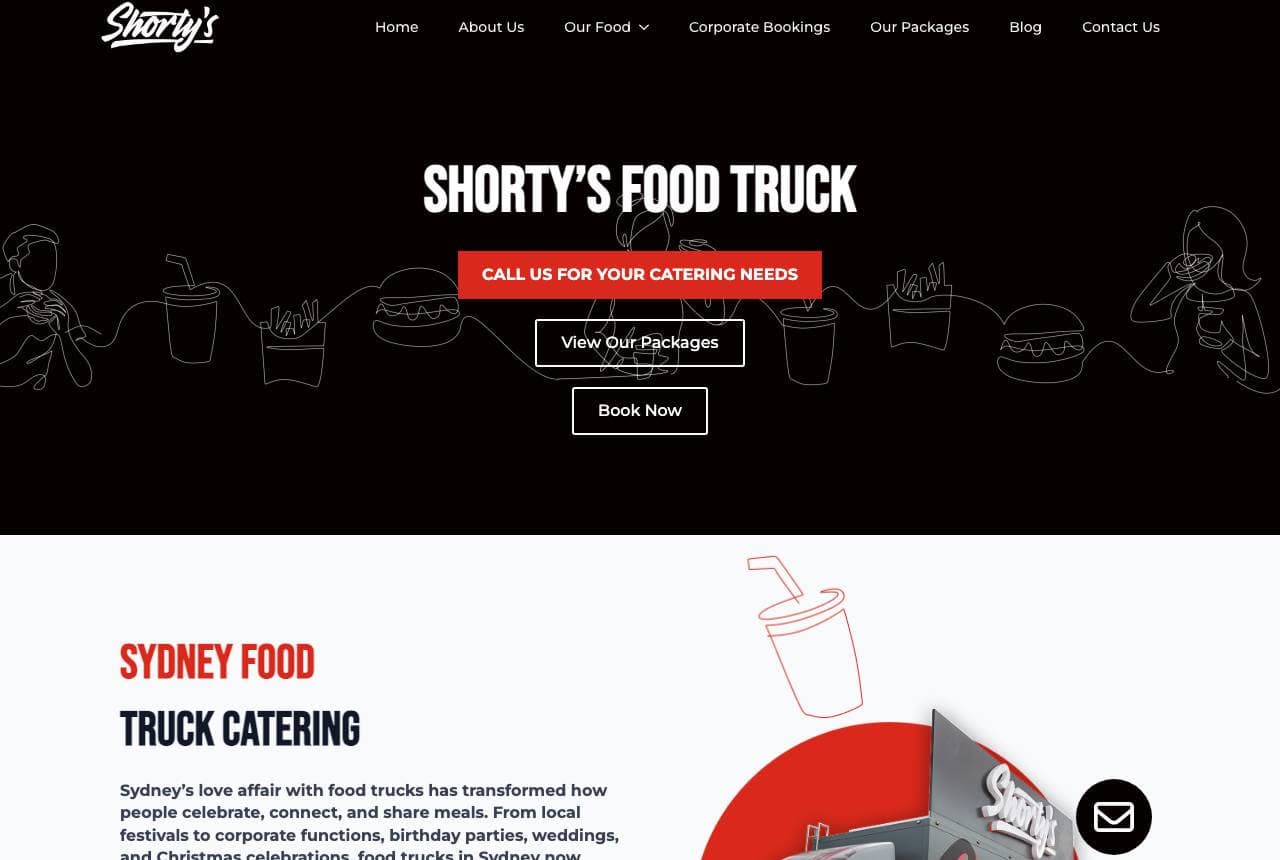
Shorty's Food Truck positions primarily as a catering business, not a lunch stop: 'Shorty's Food Truck' over a black canvas with charming line-art doodles of burgers, drinks and fries, and the primary CTAs are 'Call Us for Your Catering Needs' and 'View Our Packages.' The copy is aimed squarely at event bookers ('food trucks in Sydney now bring flavours from around the world straight to your event… weddings, corporate functions, birthday parties'), and the storytelling frames the truck as an experience ('you're giving your event a story worth telling'). For many food trucks, private catering (weddings, corporate events) is far more profitable and predictable than daily street service, so leading with catering packages and event booking — rather than a daily menu — targets the higher-value customer. The playful line-art keeps it fun. When events are your best revenue, make catering the hero, not an afterthought link.

Tumbleweed Tacos — Food Truck website design you can build with Zarla
Build this with Zarla
  • Food Truck
  • Playful

Tumbleweed Tacos: Tacos worth chasing down

Tumbleweed Tacos is Zarla's food-truck template, and its playful-pop hero nails the fun, appetite-first energy the category runs on: 'Tacos Worth Chasing Down' — a headline that cleverly plays on the mobile nature of a truck — in a warm charcoal-and-chili-red palette that's bold and hungry-making. The playful register suits street food, and the structure carries a menu, an about-the-truck story, and (crucially) a locations/schedule section so fans can find the truck — the single most important feature for a mobile business, the same thing The Grilled Cheese Truck builds in. A catering CTA captures the events revenue Shorty's leads with. Swap in photos of your own truck and food, set your schedule, and it's a fun, on-brand food-truck site in about 30 seconds — no photographer or designer required. The right energy for street food.

See this template

Frequently asked

Where can I find good food truck website examples?

Right here — this page curates food truck website examples two ways: standout real businesses (each linked, so you can explore the live site) and professionally designed Zarla templates you can clone and make your own. Every example comes with a note on why the design works — trust signals, layout, calls to action — so you can copy the move, not just the look.

What makes a good food truck website?

A good food truck website earns trust in the first few seconds, leads with strong visuals of the work, gives visitors one obvious action, and loads fast on a phone. Every design below leads with proof and a single clear call to action rather than a wall of text.

How much does a food truck website cost?

A custom food truck website from a designer typically runs into the thousands up front, and template builders charge roughly $16–$30 per month. An AI builder generates a complete, editable design for free and only charges (on the Premium plan) when you publish to your own domain — so you can build and preview before spending anything.

Do I need a designer to build a food truck website?

No. Several designs on this page were generated by Zarla and are fully editable — you describe your business and get a complete, professionally designed site in about 30 seconds, then refine it by chatting. Building and previewing is free; publishing to your own domain needs the Premium plan.

What pages does a food truck website need?

Most food truck businesses need just a few: a home page that proves trust and points to one clear action, an about page that puts a face to the business, a services or work page that shows what you do, and a contact page with a form and a phone number. Local businesses also benefit from location or service-area pages that help them show up in nearby searches.

How do I get more customers from my food truck website?

Lead with proof in the first few seconds (reviews, real photos, results), make one action obvious on every screen (call, book, or enquire), and keep it fast on mobile — most visitors arrive on a phone. The designs above each do this differently, but they all earn trust early and remove friction from the next step.

You've seen what works. Now make it yours.

Describe your business and Zarla designs a complete, professional website in about 30 seconds — built to convert, just like the ones above.

Free to build and preview · no credit card · publish to your own domain on Premium