CAREER GUIDE
How to become a dog walker or pet sitter in 2026
No US state licenses the dog walker or the sitter who works in the client's home — and the places that regulate boarding in your own home, and the one big city that permits commercial dog walkers, are named below from their own rules. The routes in: the apps and what they take, your own first clients; the certifications and first-aid classes with their fees; the lockbox, leashes and software from the makers' own prices; what the work pays — and how to go from an app's roster to a route of your own.
Free to build · Pay when you publish · No credit card
No licenseto walk dogs or sit in the client's home in any US state — Texas's and California's licensing lists have no entry for it; the lines that bite are boarding in your own home and one city's walker permit, named below
3 dogsthe most you can board at once in Colorado before your home is a licensed pet animal facility at $500 a year — the statute's own exemption
$35,360median pay for employed animal caretakers in 2025 (O*NET, from BLS data) — the occupation walkers and sitters are filed under; the self-employed are outside the survey
$220a year for membership and liability insurance that covers the dog in your care at Pet Sitters Associates; $42 a month is Insureon's dog-walker median for general liability alone
See it in action
See what your dog walking website could look like
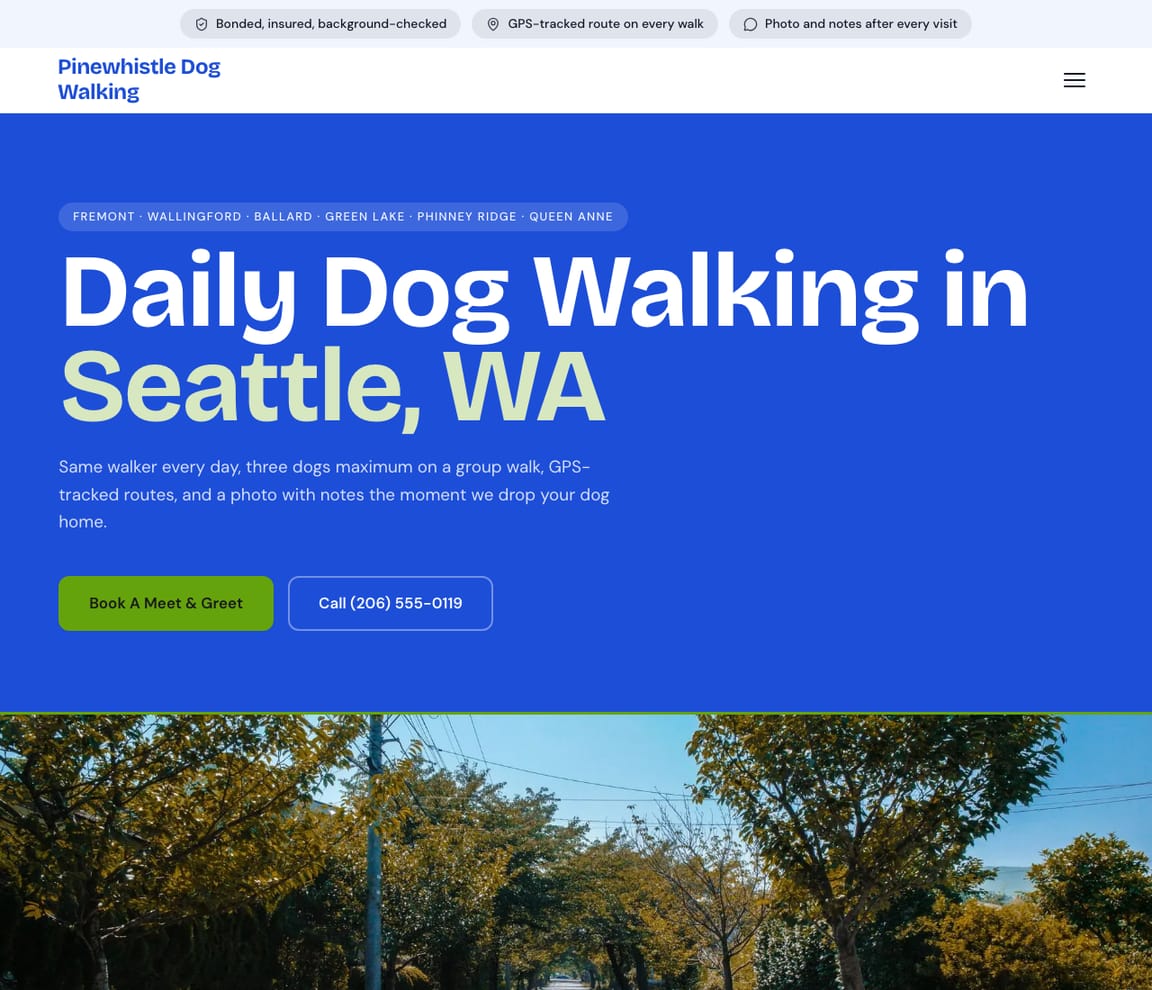
A real Zarla template for a neighborhood dog walker — the walks and drop-in visits by the headline, the service area and a booking button, the dogs in the gallery underneath. Describe yours — the town, the services, the hours — and you'll have a site like this, with online booking and a gallery, in about a minute.
- Professional design — not a generic template
- Looks great on desktop and mobile
- Content written for your industry
Build the website
Start your dog walking website now
Add your town and your business name to the sentence, and Zarla builds the site: your walks and visits, your service area, a booking button and a gallery. Add your prices and your photos in chat, then publish.
Already have a website? Bring it across →Zarla keeps your old page addresses where it can and redirects the ones that change, helping you keep the Google standing you've built.
Is becoming a dog walker or pet sitter worth it in 2026 — and what does the work pay?
Becoming a dog walker or pet sitter is a trade with no license in any US state, a start that costs less than a week's rent, and — once the route is yours — a local business whose clients hand you a key and call you every weekday for the life of the dog. Three honest numbers first. Employed animal caretakers — the occupation the government files walkers and sitters under, alongside kennel staff and groomers — had a median of $35,360 a year in 2025, $17.00 an hour: 10 percent earned $27,250 or less, 10 percent $50,060 or more (O*NET, from BLS 2025 wage data). The headcount is large and growing fast: "Employment (2025) 365,300 employees", "Projected growth (2025-2035) Much faster than average (7% or higher)", "Projected job openings (2025-2035) 62,800" (O*NET, employment and outlook). And the survey behind the wages leaves out the self-employed — "We do not provide occupation and wage estimates for farms, the self-employed, owner/partners in unincorporated firms, the military, household workers or unpaid family workers" (Washington ESD) — which is the walker with her own route, so the median measures the kennel attendant and the daycare hand, not the owner who sets the price per walk.
State by state. The employed median is $32,730 in Texas, $38,700 in California, $34,150 in Florida and $37,840 in New York (O*NET, Texas; California; Florida; New York). The owner's income is a different sum: the price per walk, per drop-in and per overnight — the going rates are in dog sitting rates — times the visits a route can hold, minus the insurance, the software and the gas. The step after this guide is how to start a dog walking business, and the plan page is the dog walking and pet sitting business plan.
The catch. The work is outdoors in whatever the weather is doing, on your feet, with animals that bite — in O*NET's survey 58 percent of animal caretakers are "Exposed to Minor Burns, Cuts, Bites, or Stings" every day, 45 percent are "Exposed to Disease or Infections" every day, and 56 percent "Spend Time Standing" continually or almost continually (O*NET, work context); the busiest days are the holidays everyone else has off; and the apps that make the start easy keep a share of every booking and own the client. That's what the rest of this guide sets up: the boarding line and the city rules, from the agencies; the apps and the certifications and what each costs; the lockbox, the leash and the software from the makers' own prices; and how to be the walker the Sunday-night search books instead of the app.
How to become a dog walker or pet sitter, in plain English: what is licensed, what is not, and the rules you follow anyway
No US state licenses the dog walker or the sitter who works in the client's home. The cleanest proof is the lists: Texas's licensing agency runs programs from "Dietitians" through "Electricians", "Licensed Breeders" and "Massage Therapy" to "Tow Trucks, Operators and VSFs" — the only animal entry is breeders (TDLR, licensing programs); California's Department of Consumer Affairs lists its boards from "Barbering and Cosmetology" to "Vocational Nursing and Psychiatric Technicians", and the only animal board is the "California Veterinary Medical Board" (DCA, boards and bureaus). What the law watches is the moment you keep someone's dog in your home, and one city's permit for walking a pack:
- Colorado — boarding more than three is a licensed facility. The Pet Animal Care and Facilities Act defines a "'Pet animal facility'" as "any place or premise used in whole or in part, which part is used for the keeping of pet animals for the purpose of adoption, breeding, boarding, grooming, handling, selling, sheltering, trading, or otherwise transferring such animals" (C.R.S. §35-80-102), and exempts "(k) The boarding of no more than three pet animals at one time" and a training facility "where the pet animal owner or such owner's designee, other than a training facility operator, is present during the duration of the animal's stay" (§35-80-103). The Department of Agriculture's category is a "Boarding/Training Facility — Any firm, person, or corporation that cares for, or houses more than three pet animals at one time (in addition to their own pet animals), or trains pet animals in the absence of the owner, or such owner's designee, and receives compensation for said services", at "Fee: $500", and a "Pet Handler" who "does not maintain a central permanent facility" but transports or trains pets "in the absence of the owner" at "Fee: $225" (Colorado Department of Agriculture, PACFA licensing). A walker or a sitter in the client's home keeps no facility; a sitter with four client dogs in her own living room does.
- Illinois — the kennel and the day care are licensed, the walk is not. "The Illinois Department of Agriculture's Bureau of Animal Health and Welfare has the statutory authority to license and inspect pet shop operators, dog dealers, kennel operators, cat and dog breeders, animal control facilities, animal shelters, day care operators, guard dog services and horse rescues" and "There is a $350 application fee for each license type" (Illinois Department of Agriculture) — walking and in-home sitting are not on the list.
- Iowa — any kennel that boards is licensed. Iowa's animal-welfare chapter defines a "Commercial kennel" as "a kennel which performs grooming, boarding, or training services for dogs or cats in return for a consideration" and says "A commercial kennel shall only operate pursuant to a state license issued or renewed by the department" (Iowa Code chapter 162).
- New York City — a permit to board, none to walk. "A small animal boarding place is where animals stay for a fee. This includes places where animals are sheltered, harbored, maintained, groomed, fed or given water. If you run such an establishment, you need a permit from the Department of Health and Mental Hygiene (DOHMH)" — "$70.00: If you apply between January 1 and June 30. $35.00: If you apply between July 1 and December 31. $39.00: Fee for Animal Care & Handling Course", "Your place must have a supervising manager who has passed an Animal Care and Handling Course", "You must show proof of Worker's Compensation and Disability Insurance", and "All permits end on December 31 each year" (NYC Business, Small Animal Boarding Establishment Permit). The city's permit index has no dog-walker entry — the nearest is the pet-shop permit, "You must have a Sale of Small Animals (Pet Shop) Permit to sell animals" (NYC311), checked October 26, 2026.
- Los Angeles County — the kennel is inspected and graded. "DACC inspects animal facilities to ensure the welfare of the animals belonging to or being cared for by the facility owner. Examples of these facilities are pet shops, grooming businesses, boarding kennels … Each facility receives a letter grade based on the findings of the inspection" (LA County Animal Care and Control); the fee sits on the county's schedule and is not printed here.
- San Francisco — the one big city that permits the walker. The city requires a commercial dog walker permit from Animal Care and Control, and its own pages do not open to our reader, so the dog count and the fee are not printed here. The training rule is on a federal page, because the national park lands inside the city mirror it: "If you are conducting commercial dog walking in San Francisco, you are required to either: complete one of the courses accepted by San Francisco Animal Care and Control … OR provide proof of three consecutive years as a commercial dog walker in good standing", and the park permit itself is "a $75 application fee, and a $300 fee per individual dog walker, for a non-transferable badge" with insurance "for $1,000,000 per occurrence/ $2,000,000 aggregate" (National Park Service, Golden Gate, May 27, 2014). Everywhere else — Texas, California outside the county kennel rules, Florida, New York State — a walker needs ordinary business registration and the city's leash ordinance: "Austin City Code requires dogs to be on a leash in public areas, unless designated otherwise by City Code" (City of Austin).
The rules you follow without a license. The dog-bite statutes reach whoever holds the leash. California puts the liability on the owner, strictly: "The owner of any dog is liable for the damages suffered by any person who is bitten by the dog while in a public place or lawfully in a private place … regardless of the former viciousness of the dog or the owner's knowledge of such viciousness" (Cal. Civ. Code §3342); Texas's dangerous-dog chapter defines the owner as "a person who owns or has custody or control of the dog" (Tex. Health & Safety Code §822.041) — the walker, while the leash is in her hand. Rabies is the owner's duty: "the owner of a dog or cat shall have the animal vaccinated against rabies by the time the animal is four months of age" (§826.021), which is why a sitter asks for the certificate at the meet-and-greet. And the cruelty statute is the law that reaches every sitter: a person commits an offense who "fails unreasonably to provide necessary food, water, care, or shelter for an animal in the person's custody" (Tex. Penal Code §42.092). A dog left without water through a missed visit is a criminal matter before it is a bad review.
How you get in: the apps, and your own clients. Rover's own help page refuses scripted readers, so we print it as the search engine shows it — "You must be at least 18 years of age to become a sitter and dog walker on Rover. Sitters and walkers on Rover are considered independent contractors" (Rover, Becoming a sitter FAQ) — and Wag's walker page did not open at all; their fees are not printed here. The walkers quoted below mostly skipped the apps: a dog-daycare job from a classified ad, a boarding-facility shift, a vet clinic, favors for a sister and the neighbors, then the first paying client. The voluntary credentials: Pet Sitters International's CPPS exam "provides candidates with the only knowledge-based assessment designed specifically for professional pet sitters", with "no coursework" (PSI, certification), for "U.S. members: $155 USD (+ $5 application fee)" (PSI, membership); Pet Tech's "PetSaver™ Training: Premier 8-hour class including CPR techniques, first aid skills, dental care, senior care and health & wellness information for dogs and cats" is priced by the instructor — one listed class was "Class Price: $125" (Pet Tech, a 2018 class listing). NAPPS's and Fear Free's pages, and the Red Cross's course price, refused to open to our reader.
You are self-employed from the first walk. In the US a solo walker is a sole proprietor by default: "Use Schedule C (Form 1040) to report income or (loss) from a business you operated or a profession you practiced as a sole proprietor" (IRS, Schedule C instructions); "The self-employment tax rate is 15.3%" once your "net earnings from self-employment (excluding church employee income) were $400 or more" (IRS), and sole proprietors "generally have to make estimated tax payments if they expect to owe tax of $1,000 or more when their return is filed" (IRS). If you want an LLC: Texas "for filing a certificate of formation, $300" (Tex. Bus. Orgs. Code §4.152); Florida "$100" plus "For filing an annual report, $50" (Fla. Stat. §605.0213); New York "two hundred dollars" (N.Y. LLC Law §1101); California "Seventy dollars ($70)" (Cal. Gov. Code §12190) and "Every LLC that is doing business or organized in California must pay an annual tax of $800" (Franchise Tax Board). Workers' compensation the day you hire: "In Texas, private employers can choose to carry workers' compensation insurance coverage, but it is not required in most cases" (Texas Department of Insurance); "All California employers must provide workers' compensation benefits to their employees under California Labor Code Section 3700" (California DIR).
Sales tax — New York draws a line most owners never see. New York's tax department ruled in 1998 that "Petitioner's dog walking service is not subject to sales tax" because "Dog walking is not among these enumerated services subject to sales tax" (New York TSB-A-98(81)S), and in 2000 that a pet-sitting business's in-home visits are "maintaining and servicing tangible personal property" and "subject to State and local sales taxes" — with the carve-out that "pet sitting services rendered by an individual who is hired directly by a private home owner or lessee, and who does not offer these services to the public as part of a regular trade or business, are not subject to sales tax" (TSB-A-00(35)S); boarding is on the taxable list too, except for a guide, hearing or service dog (TB-ST-930). Texas taxes "dog grooming" and not walking, sitting or boarding — none appears in its list of taxable services (Texas Comptroller, Publication 96-259). Hawaii's general excise tax is "4% for all others" on every business activity (Hawaii Department of Taxation). Confirm the details with your accountant.
The money to start. Our arithmetic from the pages that print each price. A lean start as a walker — a Master Lock 5400D key box at $44.92 (Master Lock, read October 26, 2026), a Ruffwear Crag hands-free leash at $39.99 (Ruffwear), a year of Time To Pet's Lite plan at "$25/month $250/year" for "One person companies" (Time To Pet) and Pet Sitters Associates' "Individual Membership & Insurance: REQUIRED $220" (Pet Sitters Associates) — comes to $554.91. The fuller start, a sitter who boards up to three dogs at home in Colorado — the same key box and leash, Time To Pet's Solo plan at "$50/month $500/year", Pet Sitters Associates' $220 plus its "Pet Daycare & Boarding Locations" add-on at $160 and its "Broadened Property Damage Coverage & Bond" at $115, Colorado's $500 facility license in case a fourth dog ever stays, one $125 PetSaver class and PSI's $160 membership — is $1,864.91. The leashes, bags, treat pouch and first-aid kit beyond the one Ruffwear page are the lines left out: every other maker's storefront refused to open to our reader. The insurance is a median, not your quote: "Dog walkers pay an average of $42 per month, or $500 annually, for general liability insurance" and "$59 per month, or $704 per year, for a business owner's policy" (Insureon, dog walkers, updated July 15, 2025), and the gap that matters — "due to the care, custody, and control exclusion, pet businesses aren't covered for pet injuries. To cover this gap, you would need animal bailee coverage which can be added to your general liability policy as an endorsement" (Insureon, pet care, updated July 2, 2025). Software for a team: Time To Pet's "Team … $40/month +$16/month per active staff", or Precise Petcare's "Solo $20.00/mo" and "2-5 Staff $45.00/mo" (Precise Petcare). The plan page for the business side is the dog walking and pet sitting business plan, the step after this guide is how to start a dog walking business, the prices are in dog sitting rates, the name goes on the van from dog walking business names or pet sitting business names, the business license question is answered in do I need a business license, and the site comes from the pet care website builder or the pet sitter website design page.
In the UK: the inversion — walking is free, boarding in your home is licensed. England's statutory guidance, updated June 1, 2026, makes every dog home-boarding business that is run commercially take a council license, and says the home must be a domestic one — "This must be inside a domestic home which is not: the usual home where the animals are kept in outdoor kennels" (GOV.UK, home boarding for dogs); the day-care guidance names who is out: "businesses that look after dogs in their owner's homes, such as, dog sitters and dog walkers" need no license, while "a business that looks after dogs in a business owner's own home - these companies are licensed under home boarding" (GOV.UK, dog day care); the 2018 regulations list "providing home boarding for dogs" and "providing day care for dogs" as the licensed activities (the 2018 Regulations, Schedule 1). One council prices it — "Home boarding for dogs Up to six dogs Application fee including renewals - £180.00" (Swindon Borough Council). In Australia there is no license to walk dogs either, and New South Wales caps the pack: "A dog that is in a public place must be under your effective control. A dog is not considered to be under effective control if you are handling more than 4 dogs at the same time" (NSW Office of Local Government); boarding sits with the state and the council. Check your own city's animal-control office, and your state's agriculture department if a client's dog will sleep at your house, before you take the first key.
What working dog walkers and pet sitters actually say
None of this is our opinion about the trade. It comes from people who do it — a pet-sitting owner who had her first client the week she opened, a Missouri couple with a seven-days-a-week team, a Charleston walker who started on minimum wage at a daycare, a Los Angeles one-on-one walker, a Houston sitter who quit a boarding facility after three months, a Dallas walker hiring for the suburbs, a Conroe sitter who is licensed and insured, a Southern California teacher who has walked dogs for twenty-four years, three Los Angeles-area owners and three Houston owners — talking to CanvasRebel and the Shoutout magazines between 2020 and 2026, each described as the page describes them. Read each as theirs at the time. Five things come up again and again.
You learn the dogs on someone else's payroll, then go out alone. Kiersten Brown, Brown Dog Walking Co., Charleston: “I took a minimum wage job at a dog daycare posting I found on Craigslist.” (CanvasRebel, April 29, 2026). Kasey Yadav, Pluto Pet Sitting Services, Houston: “After a year and a half of pet sitting as a favor for my sister and a few friends and neighbors, I got a job at a pet boarding facility.” And: “I quit after 3 months at the boarding facility and dedicating myself entirely to pet-sitting full time.” (ShoutoutHTX, March 16, 2022). Care Rodgers, Fenway's Runway, San Diego: “I was working at a vet clinic at the time, and after four months of starting my company (@FenwaysRunway), I left my job and went full-time for myself.” (ShoutoutSoCal, February 9, 2021). Rebecca Paulsel, The Golden Leash, Houston: “I have nine years of experience providing professional dog walking and pet sitting, which helped when I decide to open my own business.” (ShoutoutHTX, June 26, 2024). Marla Hernandez, The Pawsitive Pet Minder, Southern California: “I have been pet sitting/dog walking for the past 24 years while working my day job as a Special Education Teacher.” And: “And I have to have a ton of energy to walk 10-14 miles a day with dogs.” (ShoutoutSoCal, April 26, 2022).
“When you hand someone a key to your house and the care of an animal you love, you're buying peace of mind.” — Meghan and Collin Funkhouser, Funky Bunch Pet Care, Sedalia and Springfield, Missouri, in CanvasRebel, October 7, 2026
The key, the trust and the insurance are the product. The Funkhousers again: “Our team is trained, background-checked, insured, and follows written care plans for every pet, and we're the only Fear Free Certified team in both of the markets we serve, which means our people are trained in low-stress handling that respects an animal's emotional state, not just its schedule.” (CanvasRebel, October 7, 2026). Grand Valley Pet & Home Concierge: “For everyone's protection, we are fully insured for the care custody and control of pets, and that includes pet transportation.” And: “We are also bonded so that every client feels safe having us in their home.” (CanvasRebel, September 17, 2026). Mary Ryan, Conroe Pet Sitting, Texas: “This service is very personal you are in a client home, responsible for their pets and keeping a eye on their home.” And: “I will bring any mail and packages, adjust blinds and lights, my priority is monitoring your pet's health and safety.” (ShoutoutHTX, October 16, 2025). Kylie Holliman-Rivera, Fire Hydrant Pet Sitting Co., Claremont, California: “It takes a lot of trust from our clients and a lot of trust from me to our team to make sure they deliver the best and reliable care.” (ShoutoutLA, August 23, 2021). Yadav, on the meet-and-greet: “I had to learn how to overcome my shyness and introduce myself to strangers, how to sell myself without having a panic attack, and how to show people that I am someone they can trust with their precious pet and a key to their house within an hour-long meeting!” (ShoutoutHTX, March 16, 2022).
The dogs decide the route — one at a time, or a pack you picked. Sarah Gator, Dallas: “Most of the dogs are walked once at a time unless the dogs know each other prior.” And: “If you say no too many times, the owners can find a new walker, I want them to know they can rely on me.” (ShoutoutDFW, April 30, 2025). Brown: “I began with small, curated pack walks, intentionally grouping dogs that complemented each other.” And: “That is when I had the idea to shift from short pack walks to longer, half-day pack adventure outings.” (CanvasRebel, April 29, 2026). Shannon Hill, Doggie Bliss, Los Angeles: “We specialize in private, one-on-one dog walks, small group hikes, in-home pet sitting, puppy visits, and cat care.” (CanvasRebel, May 13, 2026). Susan Gary, Top Dog Pet Sitters: “We understand fence aggression, separation anxiety, and we know the 6 levels of a dog bite.” And on the weather: “We walk pups in the pouring rain and on days when it's so cold that the wind stings our faces.” (CanvasRebel, March 14, 2022). Jaysie DeWolf, Boopers, Atlanta: “Careful attention to daily routines, especially during overnight sittings.” (ShoutoutAtlanta, December 8, 2021).
The holidays are the busy season, and the first client comes from the neighborhood. Gary: “We had our first client the first week we were open.” And: “Every employee is expected to work most holidays, BUT, they are given time off to celebrate with their families.” (CanvasRebel, March 14, 2022). Tonya Freeman, Heavenly Creatures Pet Sitting: “Many pet sitters get stressed when there fully booked, and don't know how to turn down clients, Working all day on holidays and missing time with family and friends.” (CanvasRebel, March 14, 2022). DeWolf: “I joined all the neighborhood Facebook groups and made sure I was active on NextDoor.” (ShoutoutAtlanta, December 8, 2021). Hill: “A lot of the growth has come from long-term client relationships and referrals, which reinforced that focusing on quality over quantity was the right approach.” (CanvasRebel, May 13, 2026). Gator: “I have been with some of my dog families now for 3 years while other families just 6 months.” (ShoutoutDFW, April 30, 2025). Alexandra Gasia, PawsomeBud, Los Angeles: “Starting from scratch hasn't been easy, building a client base and figuring out all the details of running a business takes time.” (ShoutoutLA, March 19, 2025).
Owning the route is a different trade — and so is boarding at home. Jessica Milam, Fur Services Fur Pets: “What we didn't fully see coming was the reality of payroll taxes, unemployment, workers' compensation, and insurance.” (CanvasRebel, May 13, 2026). Gator: “I service Dallas proper and am hiring dog walkers to service the suburbs of Dallas.” (ShoutoutDFW, April 30, 2025). Shawna Gibson, SHAW'S Paws, Dallas–Fort Worth: “SHAW'S Paws pet sitting, a small backyard and me going to clients homes.” (ShoutoutDFW, August 8, 2023). Stephanie Kacena, Stay Home Pet Sitting, Houston: “This is when I realized that pet owners need a solid reliable pet sitters, in their own environment, that could take their worries away.” (ShoutoutHTX, May 6, 2020). The Funkhousers on the shape of the business: “What we do is simple to describe: dog walks, pet sitting in your home, adventure hikes for dogs who need more than a neighborhood loop, and yard waste cleanup, 7 days a week, 365 days a year.” (CanvasRebel, October 7, 2026).
The through-line: the walkers and sitters who lasted learned the dogs on someone else's clock, treated the key as the product, chose their packs or walked one at a time, worked the holidays, and built the route one neighbor's referral at a time.
THE STARTER KIT
What you need to become a working dog walker or pet sitter
Your city's answer, not a state's
No US state licenses the walker or the in-home sitter; the rules that bite are boarding in your own home — Colorado's facility license, New York City's boarding permit — and one city's dog-walker permit, named below from the agencies, with ordinary business registration everywhere.
A year of other people's dogs
The apps take you at eighteen with a background check; a shelter, a kennel or a working walker teaches the leash, the body language and the lockbox. Every walker quoted below started with someone else's dogs.
Pet first aid and a certification
A pet CPR and first-aid class, and the voluntary certifications the associations issue — the proof an owner looks for before handing over a key; the fees are below from the issuers.
The kit, from the makers' prices
A lockbox for the keys, leashes and a slip lead, waste bags, a treat pouch, a first-aid kit, a car harness or crate, and the scheduling software that sends the visit report — each priced from the maker's own page.
Insurance that covers the dog
General liability covers the mailman you knock over, not the dog in your care — that needs the animal-bailee add-on; the medians are below from a broker's own numbers.
A way to be found first
A website with your services, your prices, your photos and a booking button, and a Google Business Profile with your service area — the two things an app profile can't give you.
THE PAPERWORK
Licenses, permits, certifications and insurance on the way to your own dog walking business
| Typical cost | Time to get | Legally required? | |
|---|---|---|---|
| A dog walker's or pet sitter's license | None exists | — | No — no US state licenses the walker or the in-home sitter; Texas's and California's licensing lists have no entry |
| A city walker permit | Not printed — San Francisco's pages did not open; the federal park permit in the city is $75 + $300 per walker | Weeks — a training course or three years in good standing | San Francisco only, among the big cities |
| Boarding in your own home | $500 a year (Colorado, above three animals) · $350 application (Illinois kennel or day-care operator) · $70 or $35 + a $39 course (New York City) | Weeks — an inspection first | Colorado above three animals at once; Illinois, Iowa and New York City for any boarding for a fee; LA County inspects and grades |
| Voluntary certification | $155 + $5 PSI membership (the CPPS exam fee is shown to members); $125 for one listed PetSaver class | Days to weeks | No — recognized by vets, kennels and the owners who ask |
| Sole proprietorship (Schedule C) | $0 | None | The default once net earnings pass $400 (self-employment tax 15.3%) |
| LLC (optional) | $300 (TX); $100 + $50/yr (FL); $200 (NY); $70 + $800/yr (CA) | Days to weeks | No |
| Sales-tax registration | Free to register | Before the first visit, where it applies | New York: a pet-sitting business's in-home visits and boarding, not walking; Texas: none of the three; Hawaii: 4% on everything |
| General liability with animal bailee cover | $220 a year with membership (Pet Sitters Associates); $42/mo median for GL alone (Insureon) | Days | A client's and a park permit's condition, not a license condition in any state above |
| Bond | $115 add-on (Pet Sitters Associates) | Days | No — the thing a client with a key asks about |
| Workers' compensation | $102/mo median (Insureon) | Days | Required from the first employee in CA; optional for private employers in TX |
| Rabies certificates at the meet-and-greet | None — the owner's vet issues them | — | The owner's legal duty in TX and CA; your policy decides whether you check |
THE STEPS
How to become a dog walker or pet sitter (step by step)
Eight steps from the first walk to a route, a client list and a business of your own.
01
Check your city, and the boarding line
No US state licenses the walker or the sitter in the client's home. Boarding in your own home is the line — Colorado licenses it above three client pets, New York City permits it, Iowa licenses the kennel — and one city permits commercial dog walkers. The list is below, from the agencies.
Named below02
Learn the dogs before the business
Walk for a shelter, work a kennel shift, or shadow a working walker. Leash handling, reading a nervous dog, two dogs that don't like each other, the escape at the door — the part no app onboarding teaches.
The real first step03
Start on the apps, for the first bookings
Rover and its rivals take new sitters at eighteen with a background check and a cut of each booking — the fastest way to a first hundred visits. Keep the clients' trust; the list comes later.
04
Take a first-aid class and a certification
A pet CPR and first-aid course, then the associations' voluntary certification — what a vet's office or a boarding kennel asks about when they refer.
05
Kit the car and the keys
A lockbox at each client's door, leashes and a slip lead, a treat pouch, waste bags, a first-aid kit, a car harness or crate — and the software that sends the owner a photo and a GPS map after every visit.
06
Insure the dog, not just the sidewalk
General liability with the animal-bailee add-on, bonding if you hold keys, and workers' comp the day you hire — the broker's medians are below.
07
Set the prices and the route
A price per walk, per visit and per night with a holiday rate, and a route that stays in one neighborhood — the thing every walker quoted below says decides whether the day pays.
08
Be the walker the search finds first
A website with your services, your prices, your photos and a booking button, and a Google Business Profile with your service area — so the Sunday-night search books you, not the app.
THE COSTS
How much does it cost to become a dog walker or pet sitter?
Itemized from the pages that print a price: the key box from Master Lock, the leash from Ruffwear, the software from Time To Pet and Precise Petcare, the insurance from Pet Sitters Associates and Insureon's medians, the Colorado fee from the state, the course from one instructor's listing. The bags, the treat pouch, the first-aid kit and the car crate come on top — their makers' storefronts refused to open.
$554.91a lean start as a walker — a key box, a hands-free leash, a year of scheduling software and a year of membership with insurance that covers the dog (our arithmetic)
$1,864.91the fuller start as a sitter who boards up to three dogs at home in Colorado — the team-ready software, the boarding and bond add-ons, the $500 facility license, a first-aid class and PSI membership
$0for any license to walk or to sit in the client's home, in any US state — the city permit exists in San Francisco, the boarding permit where you keep the dogs at your house
$220a year for Pet Sitters Associates' membership and insurance; $42 a month is Insureon's dog-walker median for general liability on its own
WHAT WE'VE LEARNED
What actually makes an owner book a dog walker
Thousands of local business websites in, the pattern for a trade trusted with a house key and a family member is clear: the owner wants to see the dogs you walk, know your prices, and know you are insured and real. For a walker or sitter, three things on a page decide who gets the booking.
The dogs, in photos
The dogs you walk and sit, named, with the owner's permission — on the trail, at the door, asleep on the couch. The thing an owner scrolls before reading a word, and the thing an app profile can't show about you.
Prices by service
A 30-minute walk, a 60-minute walk, a drop-in visit, an overnight — each with a price, and the holiday rate stated plainly. The first thing a caller asks, and the thing that stops the back-and-forth.
Insured, checked, and reachable
Insured and bonded, background-checked, pet first aid — whatever is true, on the page, with your phone number. The owner is handing you a key; the trust line matters more than the logo.
THE UPSIDE
What a dog walker or pet sitter can earn
Pay for employed animal caretakers from O*NET's 2025 figures — the occupation walkers and sitters are filed under, with kennel staff and groomers — and the self-employed are not in the survey. Medians, not a promise: your price per visit, your route and your holiday rate decide it.
$35,360a year: the 2025 median for employed animal caretakers — $17.00 an hour; 10 percent under $27,250, 10 percent over $50,060 (O*NET)
$38,700the California median; New York $37,840, Florida $34,150, Texas $32,730
58%of animal caretakers are exposed to bites, cuts and stings every day in O*NET's survey — the number behind the first-aid class and the animal-bailee cover
365,300employed animal caretakers in 2025, with 62,800 openings a year projected to 2035 — owner-operators are not counted
SEE IT WORK
Pet care website designs you can start from
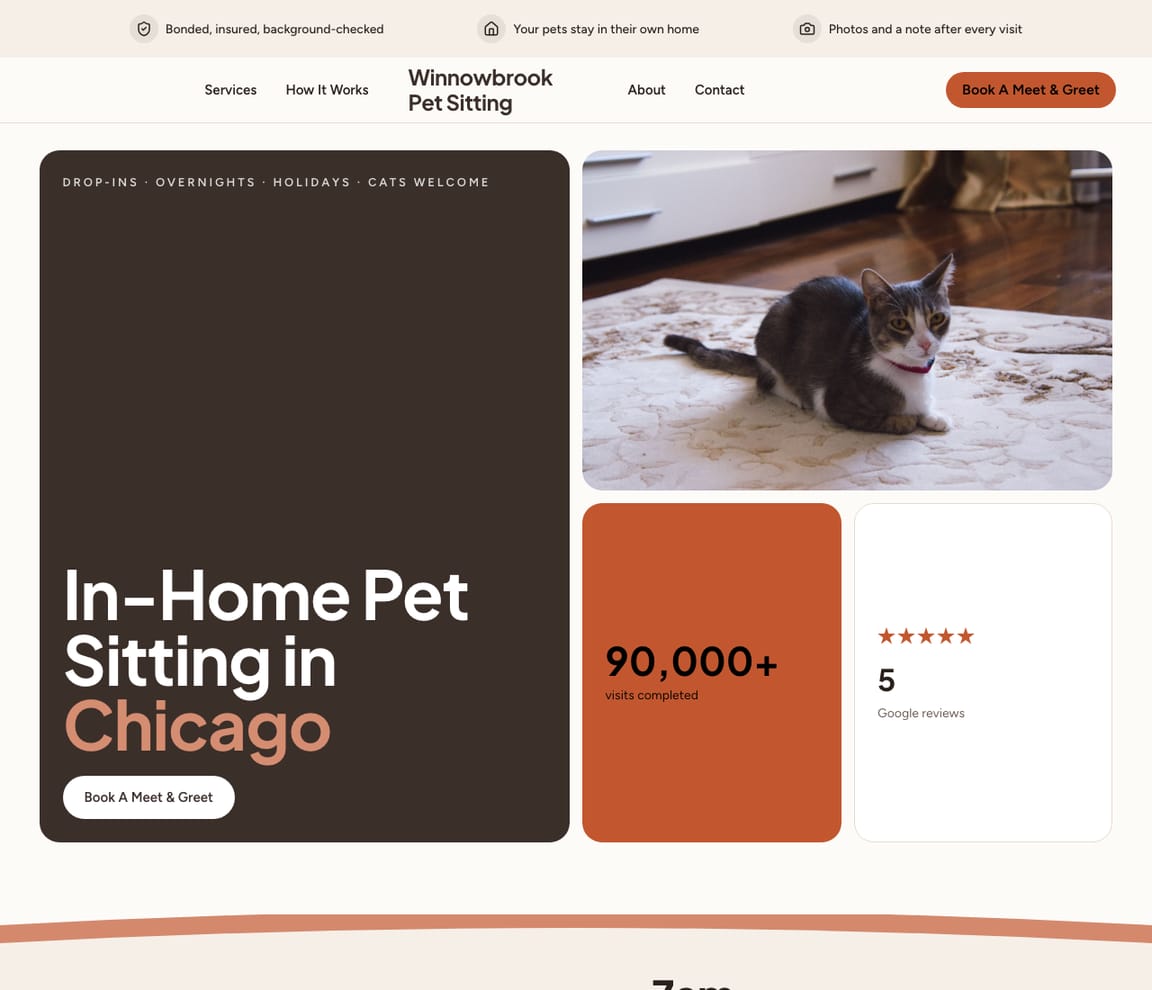
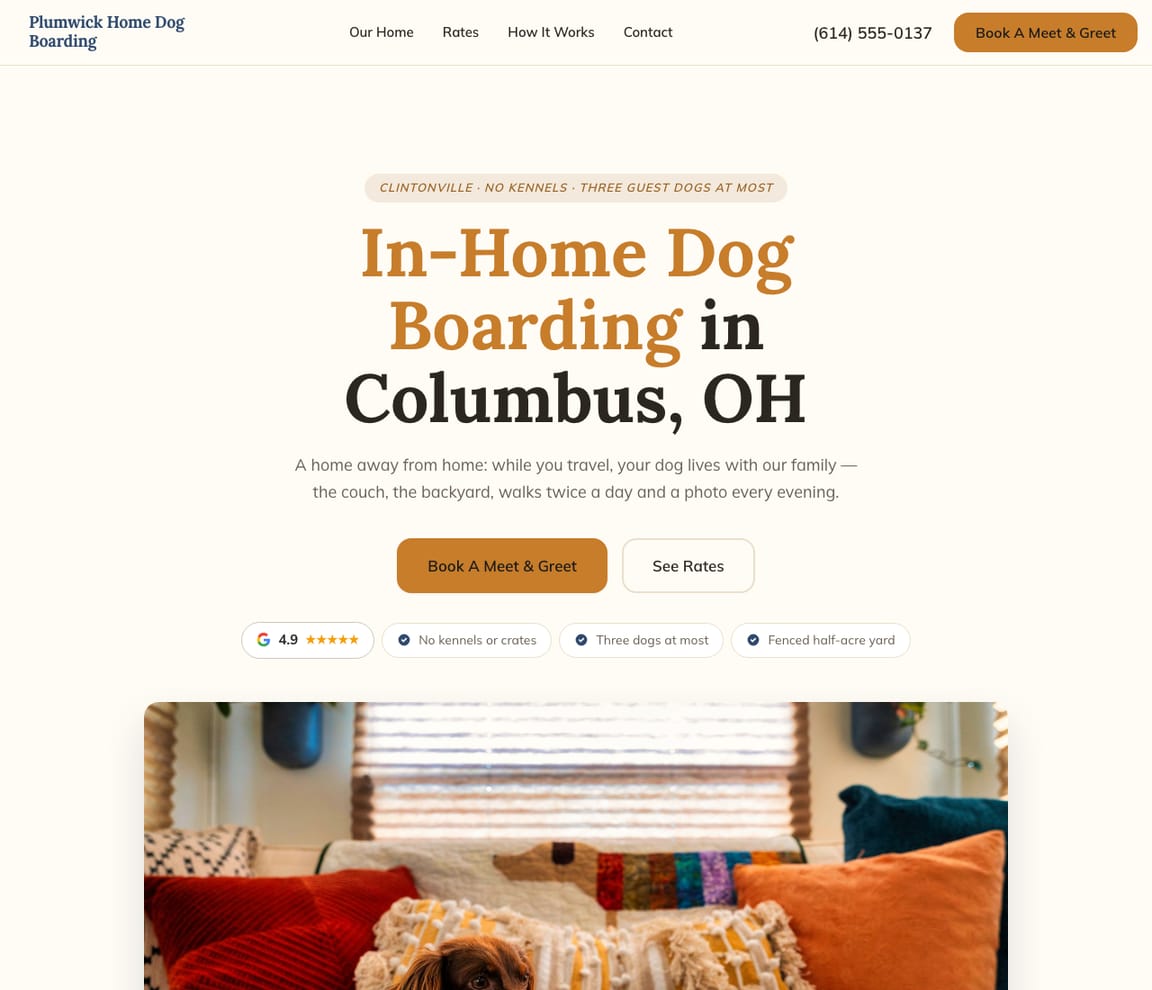
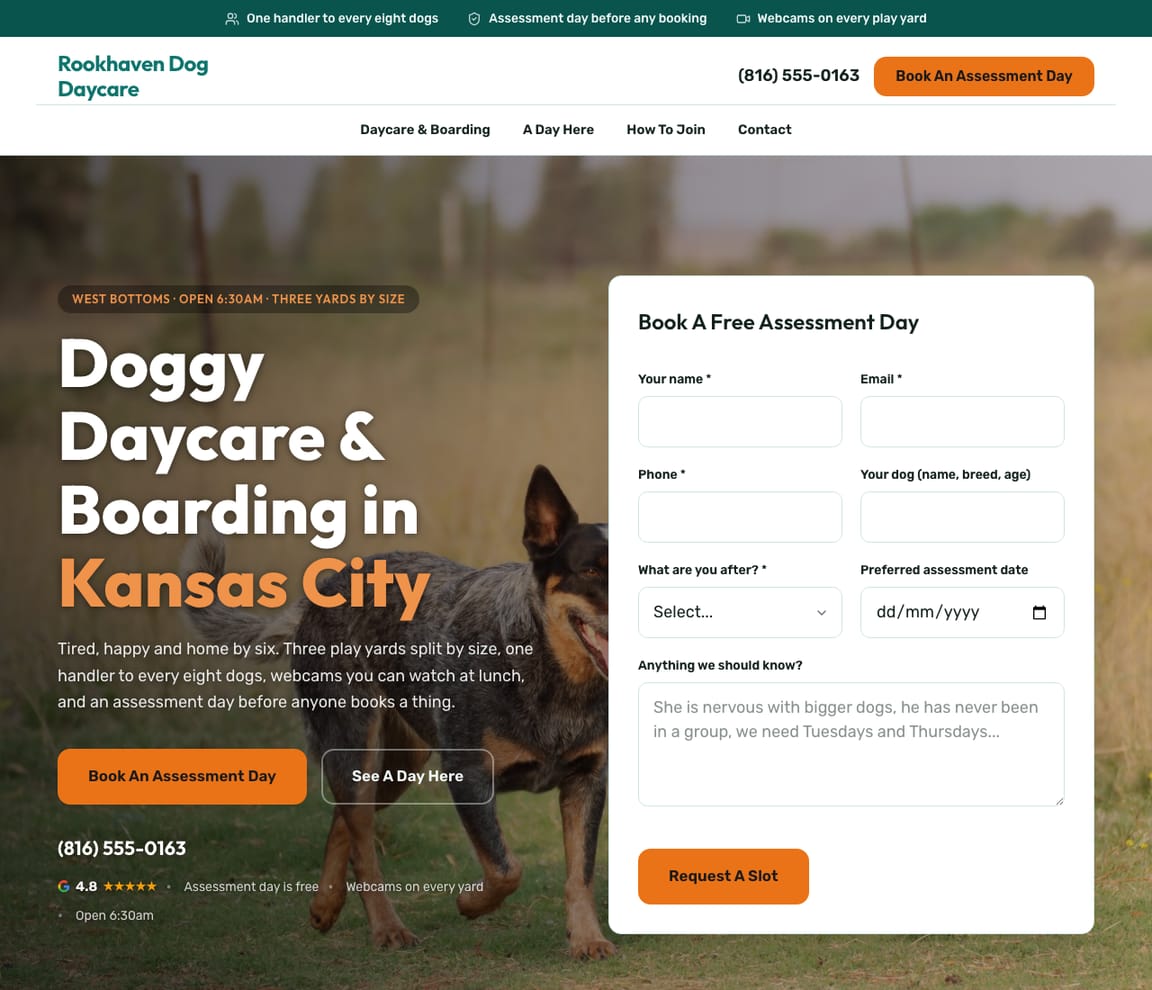
Real Zarla templates for the shapes the trade takes — the pet sitter who stays overnight, the in-home boarder, the daycare, the walker with a warm neighborhood brand. Open one, swap in your services and your prices, and publish.

GET FOUND
Get found by the owner who just got a puppy and a new job
A new owner searches "dog walker near me" on a Sunday night, and the booking goes to the walker whose prices, photos and service area are on the first screen. Zarla builds the website with your walks and visits, your hours and a booking button. Add your prices and your photos in chat, and once you connect your Google Business Profile, your name, your photos and your hours stay in step on both.
“Dog walker near me”
Searched by the new puppy owner, the nurse on twelve-hour shifts, and the family going away at Thanksgiving. Your services, your prices, your photos and a booking button answer all three.
Google Business Profile
A walker has a service area, not a storefront, and that qualifies. Your hours, your photos and your booking link inside Google Maps — free, and an afternoon to set up.
The photos from the walk
The proof an owner wants before handing over a key: the dogs you walk, named, on the trail and on the couch. The gallery is the sales page.
Google Search
Hhappytailswalkssits.com
Happy Tails Walks & Sits — Trusted pet-care in Your AreaDenver's insured dog walker — midday walks, drop-in visits, overnight sitting. Prices posted up front. Book online or text.← Your Zarla siteCcitypetcareservices.com
City pet-care ServicesGoogle Maps
1
Happy Tails Walks & Sits
← You2
Metro pet-care Co.
3
Quick pet-care Services
AI assistants (ChatGPT / Perplexity)
For an insured dog walker in Denver who does midday walks and overnight sits, posts prices, and has room on the route this week in your area: Happy Tails Walks & Sits — a local walker's site that lists 30- and 60-minute walks, drop-in visits and overnight sitting with prices, shows photos of the dogs, and takes a booking from the page.
YOUR LAUNCH PLAN
Your become-a-dog-walker checklist
The whole guide as things to check off. Work through them in order and you'll be trained, insured, kitted, permitted where your city asks for it, and findable before your first client.
- Check your city and the boarding line below — a facility license, a boarding permit, a dog-walker permit, or ordinary registration.
- Learn the dogs — a shelter, a kennel shift, a working walker.
- Start on the apps for the first bookings — eighteen, a background check, a cut of each booking.
- Take pet first aid and a certification — the associations' voluntary credentials.
- Kit the car and the keys from the makers' prices — lockbox, leashes, bags, first-aid kit, software.
- Insure the dog — general liability with the animal-bailee add-on, bonding for the keys.
- Set the prices and the route — per walk, per visit, per night, with a holiday rate, in one neighborhood.
- Get found — a website with your services, prices, photos and a booking button, and a Google Business Profile.
REAL CUSTOMERS
Small business owners who got online with Zarla
Verified reviews from real Zarla customers.
“Optimized for local service-based businesses. Easiest website build I've experienced. The AI-based build is the way to go instead of clunky theme-based websites. Get the site built and get out of the weeds with Zarla!”
“Quickly built my website from scratch. No hiccups. Would highly recommend Zarla for someone with no experience who wants to start a polished business website.”
“Very reliable, professional, and fast results. I was able to get my business online in no time, and the ease of access made it so simple.”
“I had no idea how to set up a website for my business. Thanks to Zarla, they've helped me a lot.”
Be the walker the "dog walker near me" search books first
Add your town and your business name, and Zarla builds the website from that one line — your walks and visits, your prices, your service area, a booking button and a photo gallery, with SEO in place. Add your photos of the dogs in chat. Free to build; you pay when you publish.
Already have a website? Bring it across →Zarla keeps your old page addresses where it can and redirects the ones that change, helping you keep the Google standing you've built.
Frequently asked questions
How much does it cost to become a dog walker?
In the US, about $554.91 for a lean start as a walker, our arithmetic from the pages that print each price: a $44.92 Master Lock 5400D key box, a $39.99 Ruffwear Crag hands-free leash, a year of Time To Pet's Lite plan at $250 and Pet Sitters Associates' $220 membership with liability insurance that covers the dog in your care. There is no license to buy. The fuller start as a sitter who boards up to three dogs at home in Colorado — the Solo software plan at $500 a year, the $160 boarding add-on and $115 bond, the state's $500 facility license, a $125 first-aid class and PSI's $160 membership — is $1,864.91. The bags, the treat pouch and the first-aid kit come on top; their makers' storefronts would not open to our reader.
Do you need a license to be a dog walker?
In the US, no — no US state licenses the dog walker or the sitter who works in the client's home. Texas's licensing agency lists its programs from dietitians to tow trucks with no walker on it, and California's Department of Consumer Affairs has no pet-care board at all. Two things do need paper: boarding dogs in your own home — a $500 facility license in Colorado above three animals at once, a $350 kennel or day-care license in Illinois, a commercial kennel license in Iowa, a boarding permit in New York City — and one big city's walker permit, San Francisco's, whose pages did not open to our reader. Everywhere else you need ordinary business registration and your city's leash ordinance. Check your own city's animal-control office before the first walk.
How to become a dog sitter on Rover?
Rover's own help page refuses automated readers, so we print what the search engine shows of it: you must be at least 18 to become a sitter and dog walker on Rover, and sitters and walkers on Rover are considered independent contractors — which means the Schedule C, the 15.3 percent self-employment tax and the insurance are yours, not Rover's. Rover keeps a share of each booking; its fee page did not open, so the percentage is not printed here, and Wag's walker page did not open at all. The sitters quoted above mostly skipped the apps — a daycare job, a boarding-facility shift, favors for a sister and the neighbors — and built the client list under their own name from the first week.
Is $40 a day good for dog sitting?
It depends on what the day is — a drop-in visit, a daytime stay, or an overnight in the client's home — and on your town; the going rates by service are in our dog sitting rates guide. Two anchors from this page: the employed median for animal caretakers is $17.00 an hour, so a sitter who spends three hours of visits on one dog has earned more than $40 at the median wage; and the costs that come off the top are real — $220 a year of insurance, $250 of software, the gas. The sitters quoted above price for the trust, not the hour: one Houston sitter brings in the mail, adjusts the blinds and monitors the house as well as the pet.
Is $50 a day good for pet sitting?
For a single daily drop-in it is above the employed hourly median; for an overnight in the client's home it is low — you are on duty from the evening feed to the morning walk, and an overnight is priced as a night, not a visit. Our dog sitting rates guide carries the going rates by service and by city. Set the price per visit, per night and per holiday before the first booking, print it on the page, and hold it: one Dallas walker says the owners can find a new walker if you say no too often, and the ones who stay for three years are the ones who could rely on you.
How much does dog walking and pet sitting pay?
Employed animal caretakers — the occupation walkers and sitters are filed under, with kennel staff and groomers — had a median of $35,360 in 2025, $17.00 an hour, with 10 percent earning $27,250 or less and 10 percent $50,060 or more, from BLS data on O*NET; the state medians are $32,730 in Texas, $38,700 in California, $34,150 in Florida and $37,840 in New York. The owners are outside the survey: their income is the price per walk, per visit and per night times the route, and the sitters quoted above describe routes of 10 to 14 miles a day, holiday weeks fully booked, and a Dallas walker hiring for the suburbs.
How to make dogs comfortable?
The walkers quoted above answer it from the leash: walk one dog at a time unless the dogs already know each other; if you group, curate the pack so the dogs complement each other; keep the client's routine exactly, especially on overnights; and learn the body language before the business — one Missouri team is Fear Free certified, which they describe as low-stress handling that respects the animal's emotional state, not just its schedule. The legal floor is the cruelty statute: in Texas an offense is failing unreasonably to provide necessary food, water, care or shelter for an animal in your custody.
What are the 7 basic needs of a dog?
The law states four of them and the trade adds the rest. Texas's cruelty statute makes it an offense to fail unreasonably to provide necessary food, water, care or shelter for an animal in your custody; the government's task list for the occupation is to feed, water, groom, bathe, exercise or otherwise provide care. To those four — food, water, shelter, exercise — the walkers quoted above add routine, kept exactly as the owner keeps it; safety on the leash, which is why one Dallas walker walks one dog at a time; and company, which is the whole reason a dog's owner pays for a midday visit.
How old do you have to be to be a dog walker?
No US state sets an age, because none licenses the work — a teenager walking the neighbor's dog for cash is a sole proprietor like anyone else. The apps set their own floor: Rover's help page, as the search engine shows it, says you must be at least 18 to become a sitter and dog walker on Rover; Wag's page did not open to our reader. A city permit can add its own rule — San Francisco's requires a training course or three years in good standing. One of the owners quoted above started with favors for her sister and the neighbors before any platform or permit.
Do I need insurance to walk dogs?
No US state requires it to walk or to sit in the client's home; the federal park permit in San Francisco does, at $1,000,000 per occurrence. Buy it anyway, and buy the right kind: general liability alone excludes injury to the dog in your care — Insureon's words are that pet businesses aren't covered for pet injuries without animal bailee coverage — and the walker holds the leash when California's strict-liability bite statute or Texas's dangerous-dog chapter asks who had custody or control. Pet Sitters Associates prices membership with insurance at $220 a year and a bond at $115; Insureon's dog-walker median for general liability is $42 a month.
Can I board dogs in my home?
In the US, this is the line where the licensing starts, by named place. Colorado exempts the boarding of no more than three pet animals at one time and licenses the home as a pet animal facility at $500 a year above that. Illinois licenses kennel operators and day-care operators through its Department of Agriculture at a $350 application fee. Iowa licenses any commercial kennel that boards for pay. New York City requires a Small Animal Boarding Establishment Permit — $70 or $35 by season, a $39 course for the supervising manager, workers' comp and disability insurance, and an inspection before you open. Los Angeles County inspects and letter-grades boarding kennels. Texas and California have no state rule; your city's zoning and your lease or HOA decide. In England every commercial home-boarding business is licensed by the council. Check your state's agriculture department and your city before the first dog sleeps over.
How many dogs can you walk at once?
No US state sets a number for the walker. New South Wales does: a dog is not under effective control if you are handling more than four dogs at the same time. San Francisco's permit caps the pack too, on pages that did not open to our reader. The walkers quoted above set their own: one Dallas walker walks one dog at a time unless the dogs already know each other; one Charleston walker built small, curated packs and then half-day pack adventures. Your insurance policy may carry a number as well — read it before the first group walk.
Do I need an LLC to be a pet sitter?
No US state requires it, and there is no license to attach it to. A solo walker or sitter is a sole proprietor by default: Schedule C, the 15.3 percent self-employment tax once net earnings pass $400, quarterly estimates once you expect to owe $1,000. If you form an LLC: $300 in Texas, $100 plus $50 a year in Florida, $200 in New York, and $70 in California plus an $800 annual tax every year. The insurance matters more than the entity — the animal-bailee cover and the bond are what a client with a key asks about. Confirm the details with your accountant.
Is pet sitting taxable?
In the US it depends on the state, and New York draws the finest line: its tax department ruled in 1998 that a dog walking service is not subject to sales tax, and in 2000 that a pet-sitting business's in-home visits are maintaining and servicing tangible personal property and are taxable — unless the sitter is an individual hired directly by the homeowner who does not offer the service to the public as a regular trade; boarding is taxable too, except for a guide, hearing or service dog. Texas taxes dog grooming and not walking, sitting or boarding — none is in its list of taxable services. Hawaii's general excise tax is 4 percent on every business activity. Confirm the details with your accountant.