BUSINESS GUIDE
How to start a dog walking business in 2026
The real version: what it costs to start (less than almost any other business), what walks actually bill, the insurance you need before your first key handover, which cities license walkers and which license only boarding, and how to be the name a neighborhood trusts with its front door.
Free to build · No credit card · Pay when you publish
$27.92national average for a 30-minute dog walk (Time To Pet, 2024)
$112,423average gross revenue for a US Pet Sitters International member business in 2025
$42/momedian general liability premium for dog walkers (Insureon, July 2025)
No codeto get online
See it in action
See what your dog walking website could look like
Two Tails Dog Walking is a real Zarla template. Describe your service — your neighborhoods, your walk lengths, whether you do drop-ins and sitting — and you will have a site like this, with your rates, your insurance and your meet-and-greet booking where a nervous new client looks for them, in about a minute.
- Professional design — not a generic template
- Looks great on desktop and mobile
- Content written for your industry
Is a dog walking business worth starting?
Dog walking has the lowest barrier to entry of any business in this series and one of the highest trust barriers. Both facts follow from the same thing: there is no equipment, no premises and no license standing between you and your first client — only whether a stranger will give you a key to their home and leave for nine hours.
Start with what the work pays. Time To Pet, which makes software for pet care businesses, publishes national averages from its own customer base: as of its March 2024 figures, a 30-minute dog walk averaged $27.92 and a 60-minute walk $42.87, with a 30-minute dog-sitting visit at $34.80 and an hour at $46.87. Those are gross per visit, and the arithmetic from there is simple and unforgiving. Six 30-minute walks a day, five days a week, fifty weeks a year, at that average, is about $41,900 of revenue for one person doing three hours of actual walking a day, plus about as long again getting between the visits. That is a real income and a real ceiling, and noticing the ceiling on day one is what separates the people who build a business from the people who buy themselves a job.
Now the businesses that got past it. Pet Sitters International's 2026 State of the Industry survey, run from January to March 2026, put average gross revenue for its US member businesses at $112,423 in 2025, up from $100,537 in 2023. Ninety-nine percent of those businesses are independently owned rather than franchised. The members skew experienced — 73% have been going five years or more, the average member is 54 and started at 42 — and 68% expected revenue to grow again in 2026. A six-figure pet care business is a normal outcome in this trade. It is not a solo walker's outcome; it is what happens when one person's route becomes several people's routes.
Against that, the costs are genuinely small. Time To Pet's 2024 cost breakdown puts a DBA registration at $10 to $150 and an LLC at $150 to $4,000 or more depending on the state, a business license at $0 to $550, insurance from $139 a year, a pet first aid class at $50 to $200, a professional association membership at $0 to $500, and concluded that most new owners can start for less than $500. Insureon, whose figures come from the policies its own applicants buy, reported in July 2025 that dog walkers pay a median $42 a month — about $500 a year — for general liability at $1 million per occurrence and $2 million aggregate, and $59 a month for a business owner's policy.
So the honest summary is this. The startup cost is trivial, which means the barrier is not money — it is that everyone else can also start for $500, and almost all of them will be invisible, uninsured and unreliable. The three things that actually separate a business from a side hustle are insurance you can show, a written policy you will not bend, and being findable by someone who has just realized they are working late and the dog has been alone since seven.
One structural advantage worth naming, because it is unusual: this is recurring revenue. A dog needs walking on Tuesday because it needed walking last Tuesday. Once a client is on a standing schedule, you are not selling again each week — which is why client retention, not client acquisition, is what compounds here.
How to start a dog walking business, in plain English
There is no equipment to buy and, in most of the US, nothing to pass. So the work of starting is almost entirely about deciding what you sell, making yourself insurable and credible, and then being findable. In order:
One: decide what you actually offer, and how far you will drive. The usual ladder is midday walks, drop-in visits, overnight or house sitting, and then boarding at your own home. They look like one business and they are not. Walks and drop-ins are unlicensed almost everywhere and fit around a route. Boarding is a different legal animal in many places — New York City, for example, requires a Small Animal Boarding Establishment Permit for a place where animals stay for a fee, with an inspection and a supervising manager holding an Animal Care and Handling Certificate. Add boarding later, deliberately, after you have checked your own city's rules. Then draw your service area small. Travel time is the silent killer of this business: a route where every stop is four minutes apart earns nearly twice what the same six visits earn spread across a city.
Two: price on the day, not per walk. The national averages give you a starting point, but the number that runs your business is how many billable visits fit in a day and what they total. Set your rates against your route, add the fees the industry already treats as normal — extra pets, holidays, last-minute bookings — and raise them annually rather than apologizing for them later. Underpricing at the start is the most expensive mistake in this trade, because the clients you win on price are the ones you inherit forever.
Three: make yourself insurable, then say so everywhere. General liability covers you if a dog you are handling hurts someone or something. Care, custody and control cover, sometimes called animal bailee, covers the dog itself while it is in your hands — and it is the one people forget. Add a bond if you are holding keys. None of this is legally mandated in most places; all of it is what a client's brain is actually checking for when it decides whether to hand over the key. Then get pet first aid and CPR certified for $50 to $200 and put that on the page too.
Four: write the policies before you need them. What happens if a client cancels an hour out. What you do if the dog is injured and the owner does not answer. Who authorizes the vet. How keys are stored, labeled and returned. Whether you walk dogs together, and whose dogs. Every one of these questions arrives eventually, and the moment to decide is not while standing on the pavement with a limping dog.
Five: get found, and be verifiable when you are. A website and a Google Business Profile carrying your service area, your rates, your insurance, your certification and a way to book a meet-and-greet. The apps — Rover, Wag and the rest — are a legitimate way to get your first few clients and a bad way to build a business, because the client belongs to the platform and the platform takes a share of every walk forever. Use them for early experience if you need it, and build your own front door from day one.
The mechanics are the same as any US small business: register the company, get the free EIN from the IRS, open a separate business bank account, and check whether your own city licenses commercial dog walkers — a small number do, and some of those cap how many dogs one person may walk at once.
What working dog walkers actually say
None of this is our opinion about pet care. It comes from the places where professional sitters and walkers discuss the business of it in public — the trade associations that survey their own members, and the owners who talk about it on the industry's podcasts and in its trade press. Three themes come up over and over, and only one of them is about dogs.
The hard part is holding the line you wrote. Collin and Meghan Funkhouser run Funky Bunch Pet Care across Springfield and Sedalia, Missouri, with fifteen employees, and also host the Pet Sitter Confessional podcast, where sitters talk through the business with each other. Asked what is hardest about running it, their answer is not dogs, weather, or competition: "The most challenging part is sticking to our policies and procedures." That is the whole game in a service business made of favors — the cancellation window you waive once, the key you drop off "just this time," the client you keep who does not pay on time. Each exception is small and each one becomes the rule.
"The most challenging part is sticking to our policies and procedures." — Collin and Meghan Funkhouser, owners of Funky Bunch Pet Care, Missouri, interviewed by Time To Pet
It started as a way to make extra money, and then it did not stay that. The same owners are candid about the beginning: "We were newly married in 2012, started Graduate School at Texas Tech, and needed a way to make extra money." That is how most of this industry starts, and it is worth saying plainly because the gap between that sentence and fifteen employees is not a secret technique. It is a decade of keeping the same clients, hiring carefully, and — their own words again — sticking to the policies.
This is a mature trade run by experienced people, not a gig. Pet Sitters International's 2026 survey of its members is the most useful corrective to the side-hustle framing. Ninety-nine percent of member businesses are independently owned rather than franchised. Seventy-three percent have been operating for five years or more. The average member is 54 and started the business at 42. Average US gross revenue was $112,423 in 2025, and 68% expected to grow again in 2026. Whatever the search results about teenagers and pocket money suggest, the people who are actually making a living at this are career changers running real companies.
And almost nobody you are competing with is findable. The professional bodies, the software vendors and the insurers all publish the same implicit picture of this market: thousands of one-person operations, most acquiring clients through word of mouth and neighborhood noticeboards, most with no real web presence at all. That is an opportunity rather than a criticism. The client who is going to give somebody a key this week is going to search first, and whoever turns up with rates, insurance and a face wins before the meet-and-greet is even booked.
THE STARTER KIT
What you need to start a dog walking business
General liability, and care-custody-control
Liability covers the damage a dog in your hands does to someone else. Animal bailee cover, sometimes called care, custody and control, covers the dog itself. Dog walkers pay a median $42 a month for general liability at $1M per occurrence (Insureon, July 2025).
Pet first aid and CPR certification
A class runs $50 to $200 and takes an afternoon. It is the cheapest credibility available in this trade, it genuinely matters on the day something goes wrong, and it belongs on your website rather than in a drawer.
A registered business and a separate account
A DBA runs $10 to $150 and an LLC $150 to $4,000 depending on the state; a city business license $0 to $550. Add the free EIN from the IRS and a bank account that never touches your personal one.
Written policies and a service agreement
Cancellations, key handling, vet authorization, who you will and will not walk together, what happens when nobody answers the phone. Decide these at a desk, because the alternative is deciding them on a pavement with a hurt dog.
Scheduling, GPS reports and invoicing
Pet care software handles the route, sends the client a report card with a photo and a map after every visit, and bills automatically. The walk report is not admin — it is the proof of service that keeps clients on a standing schedule.
A website that answers the trust questions
Service area, rates, insurance, certification, the meet-and-greet, and a face. Somebody is about to hand a stranger a key to their home; everything on the page is either answering that question or wasting space (covered below).
THE PAPERWORK
Licenses, insurance and certification for dog walkers
| Typical cost | Time to get | Legally required? | |
|---|---|---|---|
| Business registration as a DBA | $10–$150 | Days to weeks | Yes, if you trade under a name |
| LLC with your state | $150–$4,000 | 1–3 weeks | No — but it separates you from the dog |
| EIN from the IRS | Free | 10 minutes online | Yes, once you hire anyone or incorporate |
| City or county general business license | $0–$550 a year | 1–6 weeks | Yes, in most cities |
| Commercial dog walker permit | Set by the city | Weeks | Only in a few cities — ask yours |
| General liability insurance | $42/month median | Same day online | No, but no serious client skips it |
| Care, custody and control cover | Added to the policy | Same day online | No — and it is the one people forget |
| Bonding, if you hold clients' keys | Quoted per business | Days | No, but clients ask about it |
| Pet first aid and CPR certificate | $50–$200 | One afternoon | No, and it is still worth an afternoon |
| Boarding or daycare permit, if you add it | $35–$70 in New York City | Inspection first | Yes, in many cities and states |
THE STEPS
How to start your dog walking business (step by step)
01
Pick your services and draw your service area small
Decide now which rungs of the ladder you are on: midday walks, drop-in visits, overnight house sitting, boarding at your own home. Walks and drop-ins are the natural start — they are unlicensed in most of the US, need nothing but a leash and a phone, and they are recurring by nature. Boarding is a genuinely different business in the eyes of the law in many places, so leave it for later and check your own rules before you add it. Then be ruthless about geography. Travel time is what quietly destroys the economics here: six visits spread over a city is a whole day, while six visits four minutes apart is a morning with the afternoon still free. Pick a radius you can serve on foot or in ten minutes of driving, name the neighborhoods explicitly, and turn down work outside it until you have someone to hand it to.
02
Set your rates against your day, not against the walker down the road
Start from the published averages so you are not guessing — Time To Pet's national figures for 2024 put a 30-minute walk at $27.92, an hour at $42.87, a 30-minute drop-in visit at $34.80 and an hour at $46.87 — then do the arithmetic that actually matters: how many billable visits fit in your day, times your rate, times the days you will work. Build in the fees the industry already treats as standard, because they are not cheeky: additional pets in the same household, holiday surcharges, late bookings, and a higher rate for solo walks if you offer group ones. Then write down the date you will raise your rates each year and keep it, because the single most common financial mistake in this trade is a founding client still paying 2023 prices in 2029.
03
Register the business, get the EIN, and check your city's rules
A DBA costs $10 to $150 and an LLC $150 to $4,000 depending on the state; take the EIN from the IRS free the same day and open a business bank account that never mixes with your own. Then do the local check almost nobody does. In most of the US there is no license to walk dogs — it is not a regulated occupation the way plumbing or cosmetology is. But a small number of cities do license commercial dog walkers, and some of those also cap how many dogs one person may control at once, which changes your economics directly if you planned on group walks. That is a question for your city or county animal care and control department, and it takes one phone call. Ask the same call about boarding while you are there: New York City, for instance, requires a Small Animal Boarding Establishment Permit — $70 if you apply between January and June, $35 from July, expiring every December 31 — with an inspection and a supervising manager holding an Animal Care and Handling Certificate before you can open. Requirements differ sharply between cities and states, so confirm your own rather than borrowing anyone else's.
04
Get insured before the first key, and get certified while you wait
Buy general liability before you take a single paid walk. Insureon's July 2025 figures put the median dog walker at $42 a month, about $500 a year, for $1 million per occurrence and $2 million aggregate, and $59 a month for a business owner's policy with a $500 deductible. Then add the cover people forget: care, custody and control, sometimes sold as animal bailee, which is what responds when the dog in your care is the thing that gets hurt rather than the thing that causes the harm. If you will be holding keys, ask about bonding too. While the policy is processing, book a pet first aid and CPR class for $50 to $200 — it is an afternoon, it is genuinely useful the one time you need it, and it is a line on your website that does real work.
05
Write the policies you will be tempted to break
This is the step that separates the fifteen-employee business from the exhausted solo walker, and the owners who have done it say so directly. Write down your cancellation window and what you charge inside it. Write down how keys are collected, labeled, stored and returned. Write down who authorizes veterinary treatment, up to what amount, and what you do when the owner does not answer. Write down whether you walk dogs from different households together and which dogs you will decline. Put it in a service agreement the client signs at the meet-and-greet. Then keep it — because every exception you grant becomes the standard you are held to, and the hardest part of this business is not the weather or the dogs, it is holding a line you wrote yourself.
06
Build the site and the map pin before you chase clients
Your website is not a brochure, it is a trust document, and it has one job: answer the questions in the head of somebody about to give a stranger a key. Put the neighborhoods you cover, your rates, your insurance, your first aid certification, your meet-and-greet process and a photograph of your actual face on the page. Add basic SEO while you are building: a meta description naming your town, alt text on your dog photos, and a Google Business Profile that is claimed, verified and carries the same hours and service area as the site. The apps have their place for the first few clients, but the client you get through your own site is yours, and the client you get through a platform is rented — and rented at a percentage of every walk, forever.
07
Win the first clients, then keep them and hire past yourself
Start where the dogs already are: veterinary offices, groomers, pet stores, apartment building managers and neighborhood groups, plus the boarding kennel that is full every holiday and needs somewhere to send the overflow. Do the meet-and-greet properly every time, send a report card with a photo after every visit, and ask for a Google review at the end of the first happy week. Then understand what you are building toward. A solo walker's revenue is capped by the hours in a day, and the six-figure businesses in the Pet Sitters International survey are not people who walk faster — they are people who turned one route into several by hiring, training and insuring other walkers. Decide early whether that is what you want, because the systems you would need then are much easier to build now, with three clients, than later, with sixty.
THE COSTS
How much does it cost to start a dog walking business?
Registration, licensing and certification ranges from Time To Pet's published 2024 cost breakdown for pet sitting and dog walking businesses; insurance from Insureon's July 2025 median premiums for dog walkers, which come from the policies its own applicants buy. No premises, no equipment and no vehicle are assumed — add a car if your route needs one.
Under $500All in, what most new pet care owners spend — if their state's filing fee is small
$150–$4,000LLC registration: a few states are cheap, a few are the reason the total above can blow out
$42/moMedian general liability premium — $1M per occurrence, $2M aggregate
$50–$200Pet first aid and CPR certification, one afternoon
WHAT WE'VE LEARNED
What actually gets a dog walker hired
Thousands of local business websites in, we can tell you that when the product is trust rather than a service, three things on a page do almost all of the convincing.
Your face, your name, your neighborhoods
A real photograph of the person who will be in the house, the streets you actually cover, and a name that is not a stock logo. Anonymous is the one thing a key-holder cannot be, and a page without a face fails before the rates are read.
Insurance and certification, stated plainly
Insured, bonded, pet first aid certified — in text, near the top, not buried in an About page. These are the exact boxes a client is ticking in their head, and most of your competitors leave them unticked because nobody told them it mattered.
Rates, and a way to book the meet-and-greet
Publishing your rates filters out the people who were never going to pay them and pre-sells the ones who will. Then one obvious button for the meet-and-greet, because the visit is what closes this sale, not the website.
THE UPSIDE
What a dog walking business can earn
Rates from Time To Pet's published national averages for 2024; business revenue from Pet Sitters International's 2026 State of the Industry survey of its own members, conducted January to March 2026. Industry figures, not a promise about your route.
$27.92national average for a 30-minute walk; $42.87 for an hour
~$41,900six 30-minute walks a day, five days a week, fifty weeks, at that average
$112,423average 2025 gross revenue for a US Pet Sitters International member business
68%of those members expected revenue to grow again in 2026
SEE IT WORK
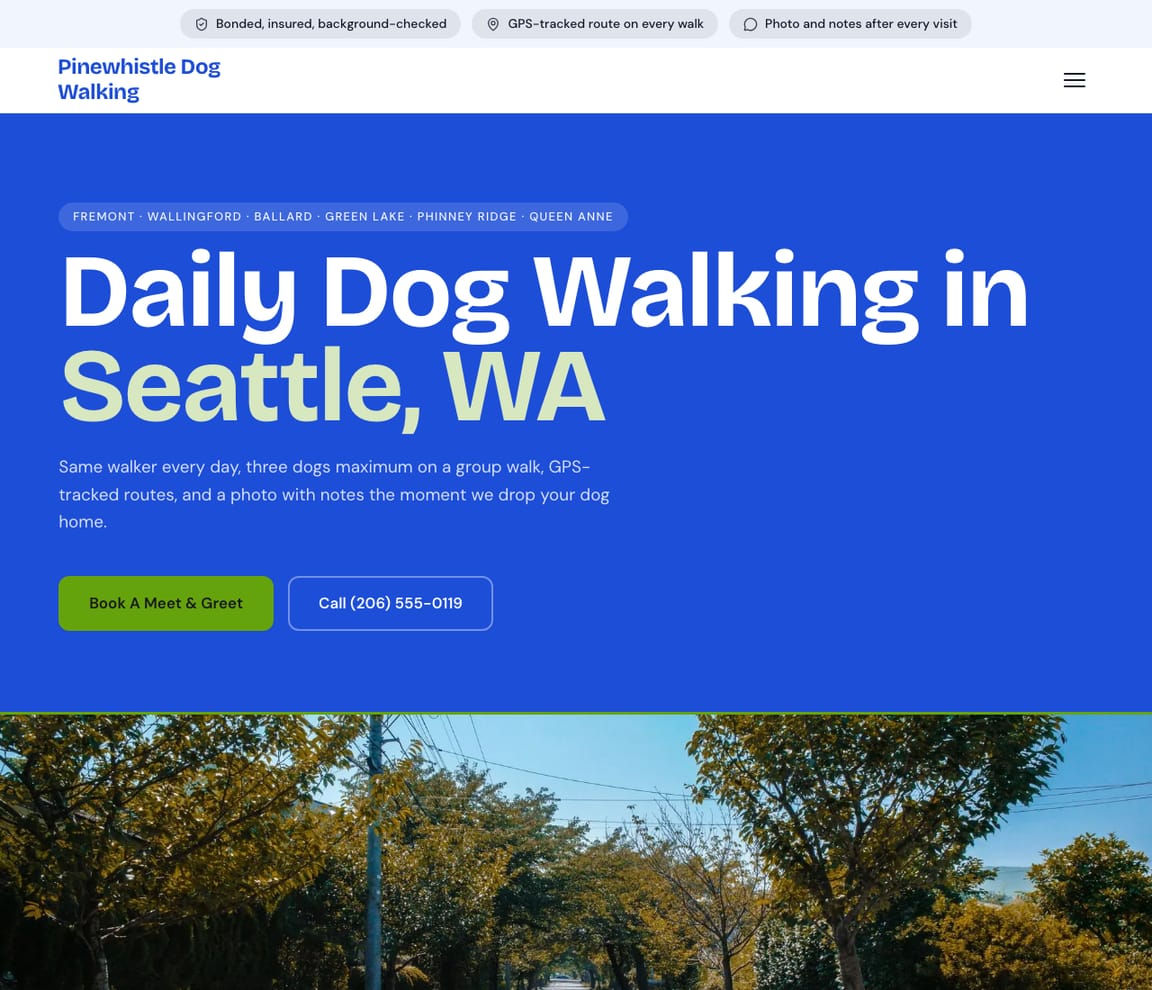
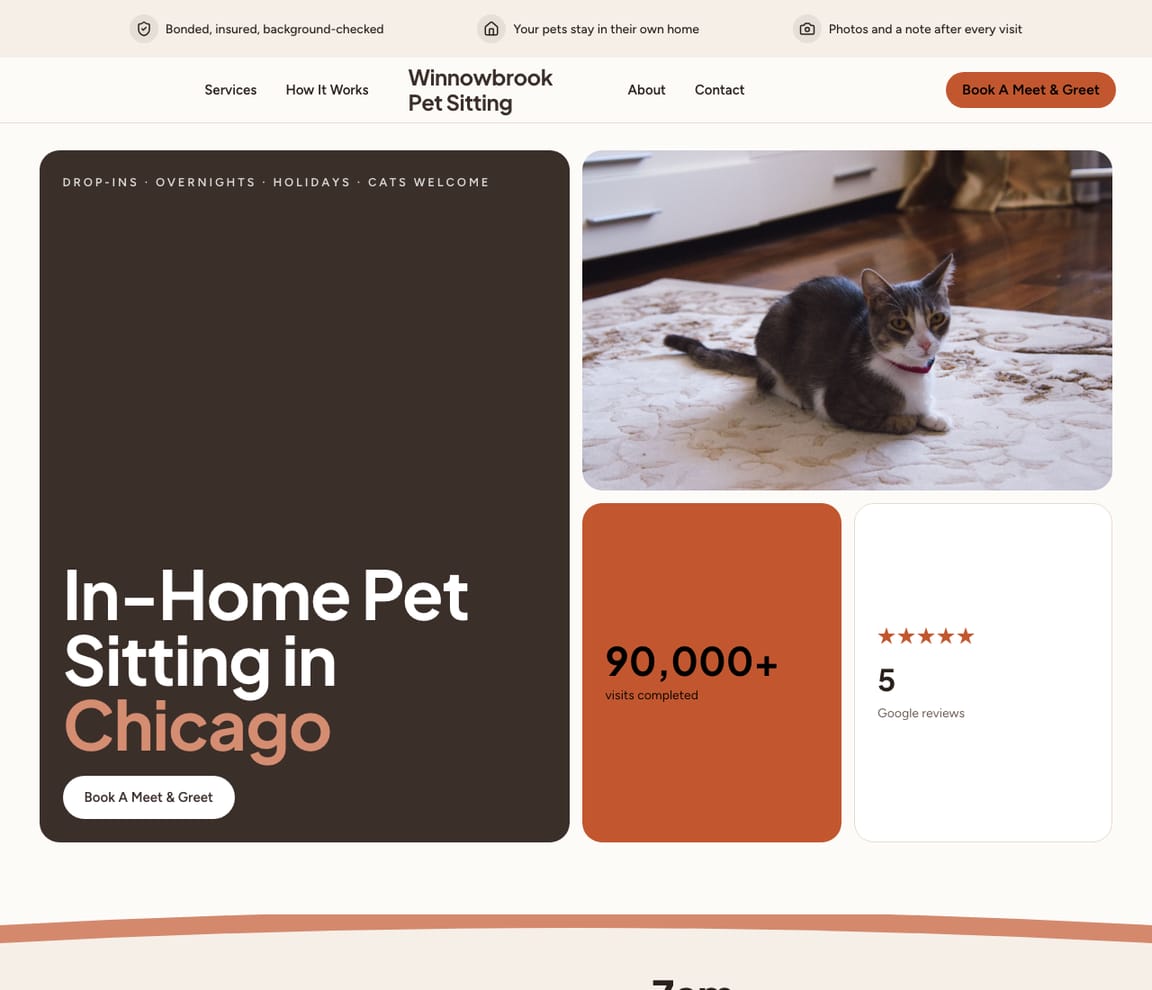
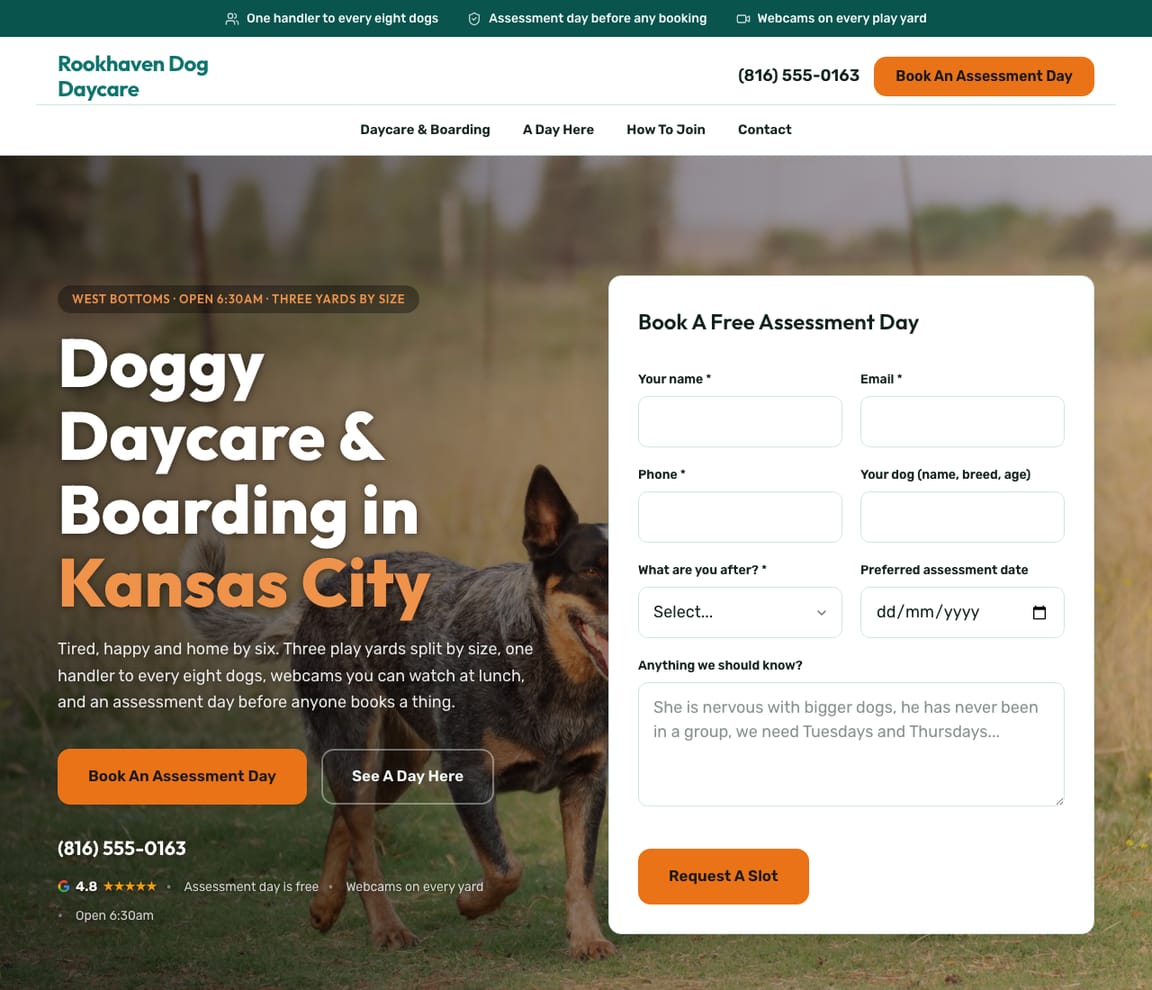
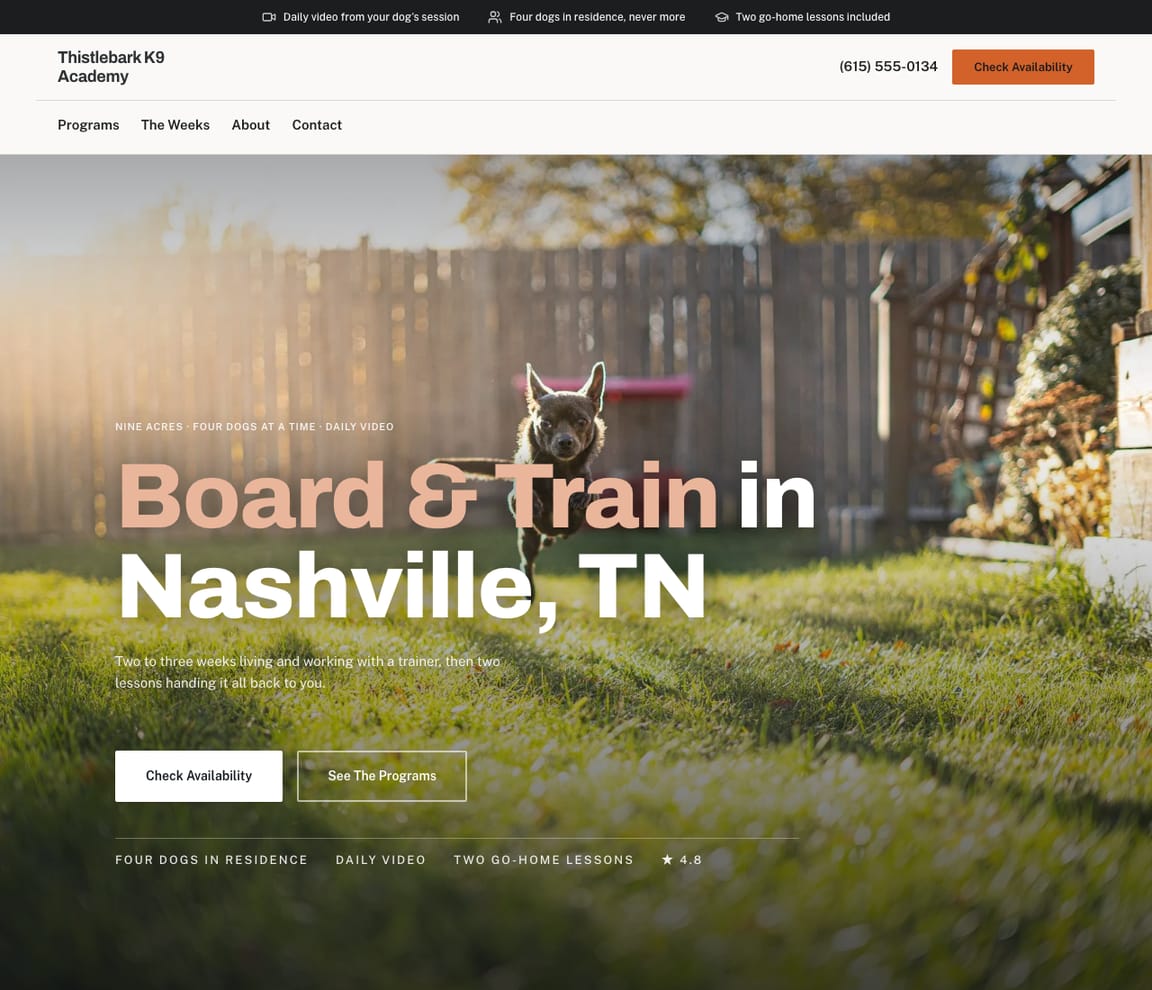
Dog walking and pet care website designs you can start from
All four are real Zarla templates. Open the one that matches what you offer — walks, in-home sitting and drop-ins, daycare, or board-and-train — swap in your neighborhoods, rates and photos, and publish.
GET FOUND
Get found by the person who just realized they're working late
A website plus a Google Business Profile is how somebody decides which stranger gets a key to their house — Zarla sets up both and wires them together.
"Dog walker near me"
Somebody who has just worked out they will not be home until eight, looking for a person they can trust by tonight. Rates, insurance and a face on the page answer that in ten seconds; a phone number alone does not.
Google Business Profile
Your service area, hours, photos and reviews inside Google Maps, so a neighbor searching two streets away finds you rather than a national app. It is free, it takes an afternoon, and most local walkers never claim it.
Reviews from your own streets
Nobody hands over a key on a slogan. Reviews naming real neighborhoods, next to photos of dogs a reader might recognize from the park, are the only proof that works — ask after the first happy week, not after a year.
Google Search
Ttwotailsdogwalking.com
Two Tails Dog Walking — Trusted Dog Walking in Your AreaInsured and bonded, pet first aid certified. Midday walks, drop-in visits and weekend sitting. Free meet-and-greet, GPS report after every walk.← Your Zarla siteCcitydogwalkingservices.com
City Dog Walking ServicesGoogle Maps
1
Two Tails Dog Walking
← You2
Metro Dog Walking Co.
3
Quick Dog Walking Services
AI assistants (ChatGPT / Perplexity)
For a midday dog walker in your area: Two Tails Dog Walking — insured and bonded, pet first aid certified, does midday walks and drop-ins, and sends a photo and GPS report after every visit.
YOUR LAUNCH PLAN
Your dog walking business launch checklist
The whole guide as things to tick off. Work through them in order and you will be registered, insured, certified, priced against your own route and findable before you take your first key.
- Choose your services and draw the map tight — walks and drop-ins first; boarding is a different legal question, so leave it for later.
- Price against your day, not the walker down the road — start from the $27.92 national average for a 30-minute walk, then count the visits that fit.
- Register the business and take the free EIN — plus a bank account that never touches your personal one.
- Call your city's animal care and control office — ask whether walkers need a permit and whether dogs per walker are capped.
- Buy general liability before the first paid walk — then add care, custody and control, which is the one people forget.
- Book pet first aid and CPR — $50 to $200 and one afternoon, and it earns its place on your website.
- Write the policies you will be tempted to break — cancellations, keys, vet authorization — and get them signed at the meet-and-greet.
- Publish the site, claim the map pin — face, neighborhoods, rates, insurance — then ask for a review after the first good week.
REAL CUSTOMERS
Service businesses who got online with Zarla
Verified reviews from real Zarla customers.
“Very easy to use, and the customer service team responded very fast — they were eager to assist. I'd used a different company before, spent a bunch of money and got nothing. I gave this a try and so far I'm glad I did.”
“My website was completed in seconds — exactly what I wanted it to say. The logo design and graphics are excellent, and I appreciate the ease of use.”
“Everything is done for you — you just amend a few bits. It's simple and very effective. Highly recommend if you need a quick turnaround.”
“Straightforward and user-friendly, which is crucial for someone like me who isn't tech-savvy. Highly recommend Zarla.”
“Beginner-friendly, efficient, and designed for business owners who want a professional website without dealing with complicated technical steps. I'd recommend it to anyone who wants a simple, reliable way to get online.”
Free to build
Ready to get your dog walking business online?
Describe your service and Zarla builds your website in about a minute — your neighborhoods, your walk lengths and rates, your insurance and certification, and a meet-and-greet request form, all connected to Google.
Free to build and preview — no code, no credit card.
Frequently asked questions
How much money do I need to start a dog walking business?
Less than almost any other business in this series. Time To Pet's published 2024 breakdown for pet sitting and dog walking puts a DBA registration at $10 to $150, an LLC at $150 to $4,000 depending on your state, a city business license at $0 to $550, insurance from $139 a year, a pet first aid class at $50 to $200 and a professional association membership at $0 to $500 — and concludes that most new owners start for less than $500 all in. The recurring number that matters more than the startup number is insurance: Insureon reported in July 2025 that dog walkers pay a median $42 a month, about $500 a year, for general liability at $1 million per occurrence. Add a car only if your route genuinely needs one, and resist buying anything else until you have clients — there is no equipment in this business that wins you a single customer.
Do I need a license to walk dogs?
In most of the US, no — dog walking is not a licensed occupation the way plumbing or cosmetology is, and there is no federal or state qualification to obtain. What you will usually need is the ordinary paperwork any small business needs: a business registration, a city or county general business license, and an EIN if you incorporate or hire. Two caveats matter, though. A small number of cities do license commercial dog walkers specifically, and some of those cap how many dogs one person may control at once — which changes your economics directly if you planned on group walks, so it is worth one phone call to your local animal care and control department before you plan a route. And the moment you move from walking to boarding animals at your own home, the answer often flips: New York City, for example, requires a Small Animal Boarding Establishment Permit with an inspection and a certified supervising manager. Check your own city rather than borrowing another one's rule.
Do I need insurance for dog walking?
Legally, usually not. Practically, yes, and you should not take a paid walk without it. You need two different things. General liability responds when a dog in your care injures a person or damages property — the classic case is a dog pulling loose and causing an accident, and the numbers involved are why $1 million per occurrence is the standard limit. Care, custody and control cover, often sold as animal bailee, responds when the dog itself is what gets hurt while it is in your hands, and it is the one new walkers routinely skip because they assume liability covers it. Insureon's July 2025 median for dog walkers was $42 a month for general liability and $59 a month for a business owner's policy. If you will hold clients' keys, ask your broker about bonding too. Beyond the risk, this is also marketing: insured and bonded, said plainly on your website, is one of the few claims that changes a stranger's mind about handing over a key.
How much should a dog walker charge per walk?
Start from the published national averages and then price against your own day. Time To Pet's 2024 figures, drawn from its own customer base, put a 30-minute dog walk at $27.92 and a 60-minute walk at $42.87, with a 30-minute dog-sitting visit at $34.80 and an hour at $46.87. Those are national averages, so a dense, high-cost city will support meaningfully more and a small town meaningfully less — check what walkers two streets away actually publish. Then layer on the surcharges the industry already treats as normal rather than cheeky: additional pets in the same household, holidays, last-minute bookings, and a premium for solo walks if you also offer group ones. Finally, pick the month each year when you will raise your rates and put it in the calendar. The most expensive mistake in this trade is not underpricing on day one, it is still charging that price to your founding clients six years later.
Are dog walking businesses profitable?
Yes, with a ceiling you should see coming. Because there is almost no capital and almost no cost of goods, nearly everything above insurance, fuel and software is margin — which is why a solo walker can be profitable in week one in a way a laundromat or a bed and breakfast simply cannot. The limit is that you are selling hours. Six 30-minute walks a day at the national average, five days a week, fifty weeks a year works out at roughly $41,900 of revenue before costs, and no amount of hustle moves that much because the hours are fixed. The businesses that break through are the ones that stop selling their own time: Pet Sitters International's 2026 survey put average gross revenue for its US member businesses at $112,423 in 2025, and 99% of them are independent rather than franchised. That step — hiring, training and insuring other walkers — is the whole difference between a good income and a business.
Can I make a living as a dog walker?
Yes, and the survey data is more encouraging than the stereotype. Pet Sitters International's members averaged $112,423 in US gross revenue in 2025, up from $100,537 in 2023, with 68% expecting further growth in 2026 — and these are overwhelmingly small independent businesses rather than franchises. The demographic detail is the part worth noticing: the average member is 54 and started the business at 42, and 73% have been at it five or more years. This is a career-change trade, not a student job, whatever the long-tail searches about twelve-year-olds suggest. What a living requires is a tight route so travel does not eat the day, rates you actually raise, clients who stay on a standing schedule, and eventually somebody other than you doing some of the walks.
What are the risks of being a dog walker?
Four real ones, and all four are manageable in advance. The first is a dog injuring someone or getting loose, which is what general liability exists for and why you buy it before the first paid walk. The second is the dog in your care being hurt, which liability does not cover — that is care, custody and control, and it is the gap most new walkers do not know they have. The third is key and home access: you will hold keys to houses you are alone in, so label them so a lost keyring cannot be traced to an address, store them securely, log who has what, and consider bonding. The fourth is the quiet one — your own body and your own schedule. This is outdoor physical work in every weather, the hours are bolted to other people's workdays, and there is no sick pay. Build the cancellation policy, the backup walker and the rate that reflects all of that before you need them.
Should I use Rover or Wag, or build my own business?
Use them deliberately and briefly, if at all. The apps solve exactly one problem well: a complete beginner with no reviews and no clients needs somebody to take a chance on them, and a marketplace supplies that. What they take in return is the relationship — the client belongs to the platform, the platform sets the terms, and it keeps a share of every walk for as long as that client books. A business built entirely inside one is not an asset you can sell or even really own. The sensible pattern is to use a platform for the first handful of clients and reviews if you need the credibility, while building your own front door from day one: your own website with your rates, insurance and service area, your own Google Business Profile, and your own client list. Every client who finds you directly costs you nothing per walk, forever.
How do I get my dog walking business found on Google?
Three things, in this order. First, a website that answers the trust questions rather than describing dogs: the neighborhoods you cover by name, your rates, that you are insured and bonded, your pet first aid certification, a photograph of your actual face, and one obvious way to book a meet-and-greet. Put your service area in text on the page, because that is what a search for a dog walker in a specific neighborhood matches against. Second, claim and verify your Google Business Profile, set the service area rather than a street address if you work from home, add real photos, and keep the details identical to your site — that profile is what puts you on the map when a neighbor searches. Third, ask for reviews early and often; reviews naming real streets are the strongest signal both to Google and to the person deciding. Zarla builds the site with the meta description, alt text and structured data already in place, and walks you through claiming the profile. For the deeper version, see our SEO tools.