CAREER GUIDE
How to become a locksmith in 2026
Which states license locksmiths and which don't, named from the agencies themselves; Texas and California step by step; the training routes and what each costs; the tools from the distributors' own price lists; what locksmiths earn — and how to go from someone else's van to your own.
Free to build · Pay when you publish · No credit card
12 stateslicense locksmiths or locksmith companies, plus Nevada's county permits and New York City — named below from their agencies
$51,320median pay for employed locksmiths and safe repairers in 2025 (O*NET, from BLS data)
$60to register as a locksmith employee in California since October 1, 2025 — $550 for the company license
No degreerequired anywhere — a high-school diploma for most employers, and the trade learned at a bench
See it in action
See what your locksmith website could look like
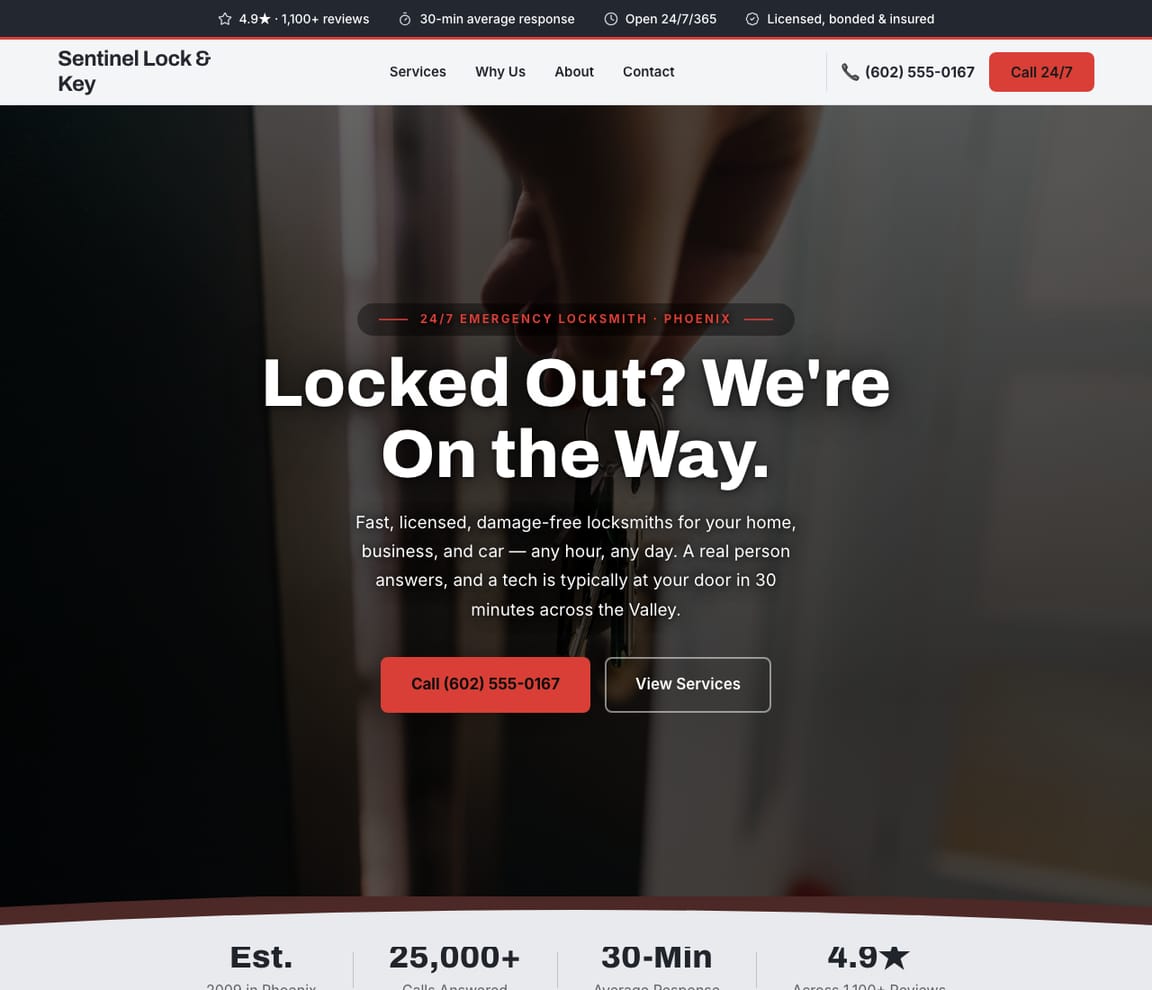
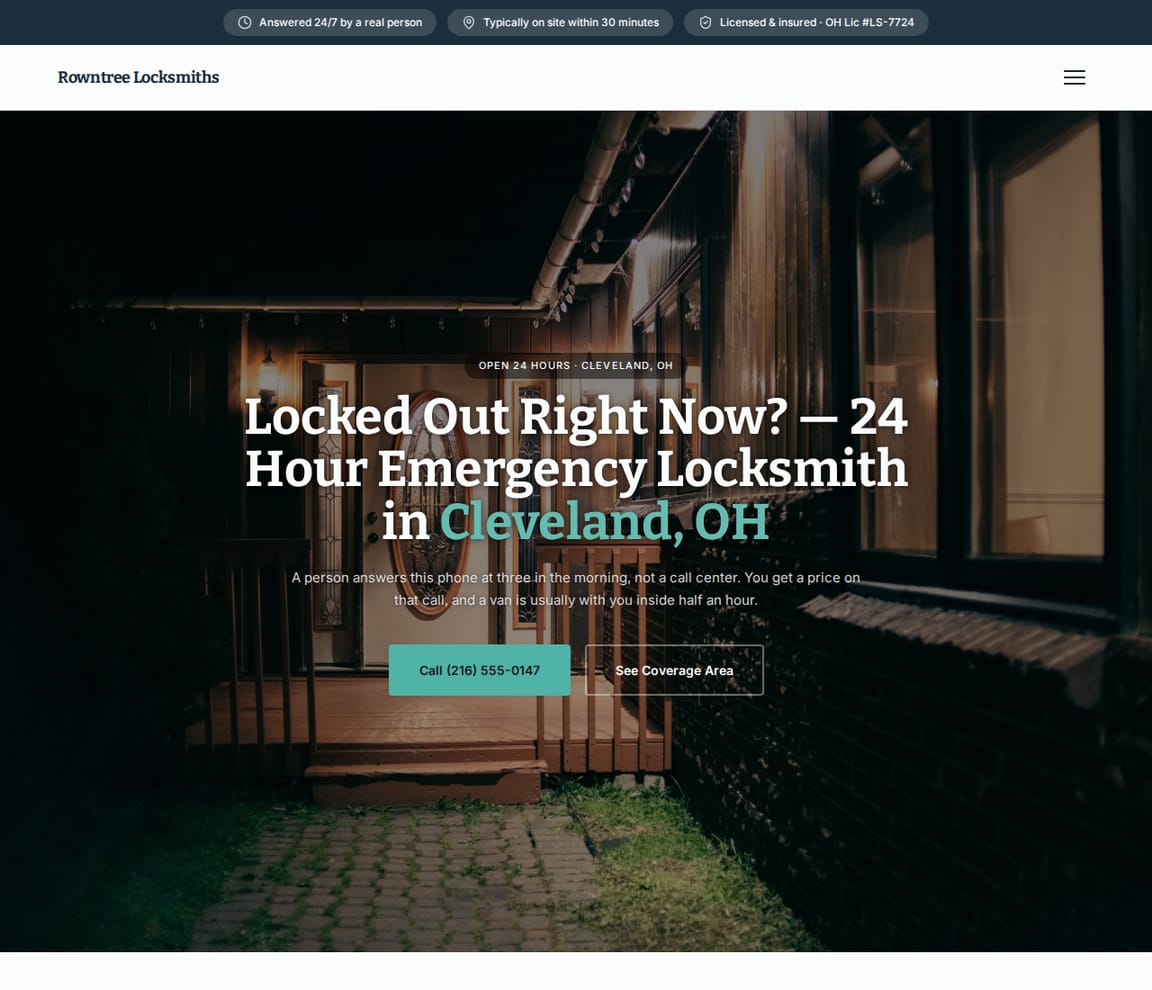
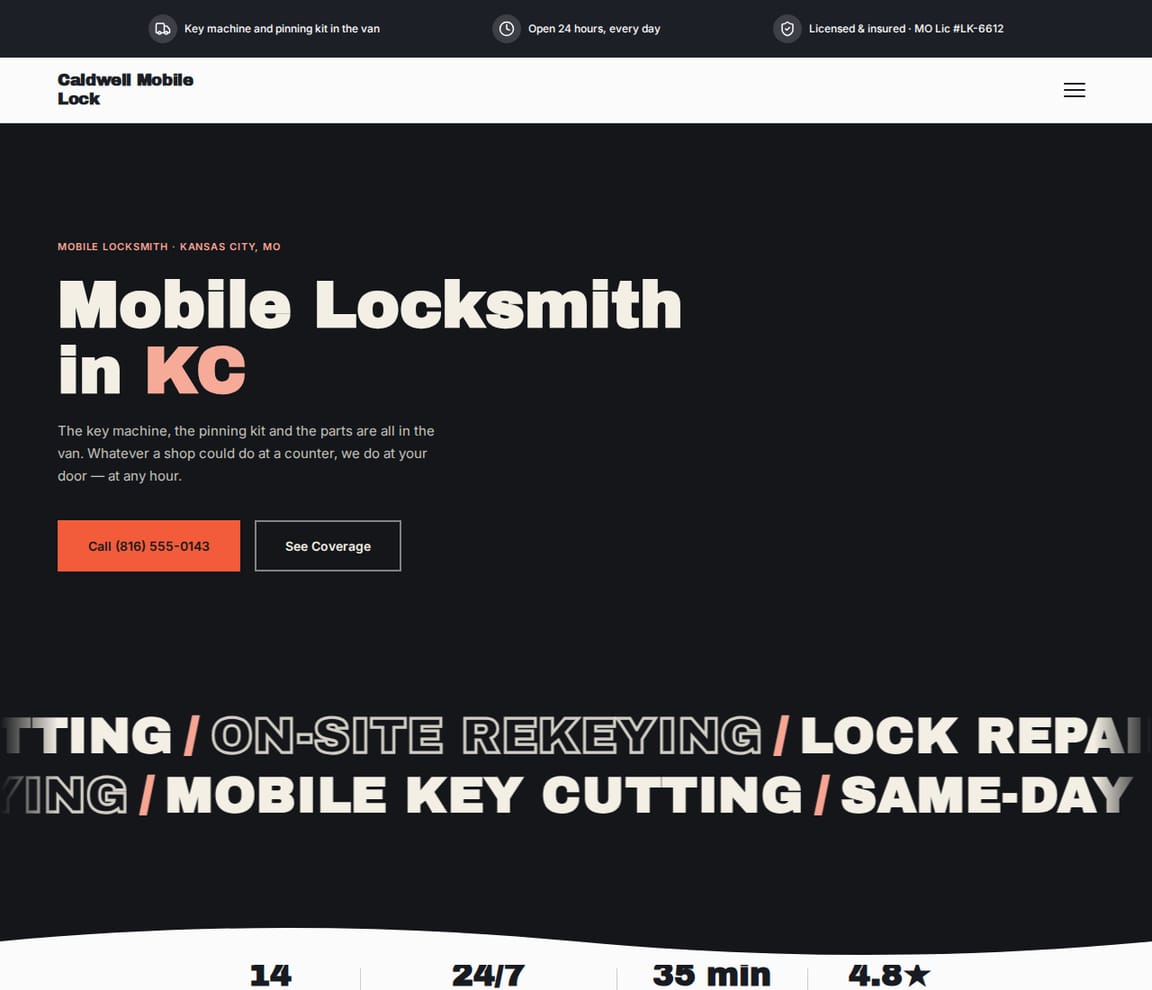
A real Zarla template for a locksmith — the phone number and the response time in the first screen for the person standing outside their door, the services and the service area underneath for the landlord comparing quotes. Describe yours — the town, the services, the hours — and you'll have a site like this, with a call button and a quote form, in about a minute.
- Professional design — not a generic template
- Looks great on desktop and mobile
- Content written for your industry
Build the website
Start your locksmith website now
Add your town and your business name to the sentence, and Zarla builds the site: your services, the area you cover, a call button and a quote form. Add your prices and your license number in chat, then publish.
Already have a website? Bring it across →Zarla keeps your old page addresses where it can and redirects the ones that change, helping you keep the Google standing you've built.
Is becoming a locksmith worth it in 2026 — and what does the work pay?
Becoming a locksmith is a trade learned at a bench, a license held in a minority of states, and — once you own the van — a local business whose main competitor is a phone bank in another city. Three honest numbers first. Employed locksmiths and safe repairers had a median of $51,320 a year in 2025, $24.68 an hour: 10 percent earned $35,530 or less, 10 percent $79,400 or more (O*NET, from BLS 2025 wage data). The headcount is small and flat: 18,700 employees in 2025, with a projected change for 2025–2035 of "Decline (-1% or lower)" (O*NET, employment and outlook). And the survey behind both figures leaves out the self-employed (Washington ESD) — which is most owner-operators, so the median measures the technician in someone else's van, not the person who owns it.
Where the money went. The trade's own voices say the same thing fifteen years apart: "Electronics have been a big part of it since I got here and I see that aspect of locksmithing just taking up more and more of what we do" (Tommy Shafer, CLC Locksmiths, Cinnaminson, New Jersey, Locksmith Ledger, March 1, 2009); an apprentice's mentor "told me not to focus much on picking locks since we don't do it much -- mostly rekeying, programming keys, duplicating keys" (Zac Grant, apprentice, Albany, New York, Locksmith Ledger, February 4, 2013). California's statute now defines the trade to include "electronic cloning of transponder keys and any other electronic programming of automotive keys and electronic operating devices, such as key fobs" (Cal. Bus. & Prof. Code §6980). The automotive side is where a replacement key bills the most against a blank that costs the least — which is why the fuller start below buys a code machine and a programmer.
What a real company charges. One locksmith company that posts its prices — Phoenix, "Prices as of October 2026" — charges "$95 to $125 for the service call, plus the work completed: roughly $59 to $89 to unlock a door or car, $170 to $395 to rekey a 3-door home, $10 to $290 for a car key, and $350 on up to drill a safe", so a lockout is "roughly $160 to $215 all-in during business hours", a rekey "usually $25 to $35" a keyhole plus the call, and after hours "a higher service call, sometimes $150 and up before the job" (Acme Locksmith, Phoenix, October 2026). State by state, the employed median is $43,860 in Texas, $61,010 in California, $49,120 in Florida ($51,470 in the Miami–Fort Lauderdale area) and $61,830 in New York (O*NET, Texas; California; Florida; New York).
The catch. The business is on call — "I'd like to put 23 ½ hour service instead of 24/7 and then choose the half hour to say no. And that's the issue with having your own business and being your own boss" (Ken Chew, Action Safe & Lock, Bristol, Pennsylvania, Locksmith Ledger, March 23, 2023) — a day off costs the day's billing, the training people sell is short and the trade is long, and in the licensing states the paperwork comes before the first paid call. That's what the rest of this guide sets up: who licenses the trade, how to learn it, what the kit costs from the distributors' own pages, and how to be the local name the call reaches first.
How to become a locksmith, in plain English: which states license it, and what each asks
There is no federal locksmith license. The only national count is the trade press: "Nationally, only 13 states have licensing requirements: Alabama, California, Connecticut, Illinois, Louisiana, Maryland, Nevada, New Jersey, North Carolina, Oklahoma, Oregon, Texas and Virginia." The same update records that "Nebraska and Tennessee repealed their locksmith licensing requirements in 2021", that Illinois "is scheduled to end locksmith licensing in 2029", and that "New York City; Nassau County, New York; Miami; and Hillsborough County, Florida; have their own licensing laws" (Locksmith Ledger, August 1, 2024). Two corrections from the primary pages. Nevada is not a state license — the same article says "Nevada requires locksmiths to obtain a local permit from the sheriff of the county in which the locksmith works" — so the honest count is twelve states plus Nevada's county permits. And Miami stopped: "Effective July 1, the Department of Regulatory and Economic Resources (RER), Consumer Protection and Neighborhood Protection Division, is no longer issuing licenses for these occupations and businesses, in accordance with Section 163.211 of Florida Statutes" — locksmiths are on the list (Miami-Dade County, July 2025; Consumer Protection division). Florida has no state locksmith license, so a Florida locksmith needs ordinary business registration and nothing locksmith-specific. Everywhere not named above — Georgia, Arizona, Pennsylvania, Ohio, Michigan, Colorado, Washington and the rest — the same is true: a business registration, a sales-tax account where your state taxes the work, and no locksmith license. Here is what the licensing states ask, each from its own agency or statute:
- Texas: the Department of Public Safety's Private Security Program licenses the company and registers the individual. "Unless the person holds a license as a security services contractor, a person may not: (1) act as an alarm systems company, armored car company, courier company, guard company, or locksmith company" (Tex. Occ. Code §1702.102); a company "acts as a locksmith company" if it sells, installs or services locks, "advertises services offered by the company using the term 'locksmith'" or "includes the term 'locksmith' in the company's name" (§1702.1056); an individual "acts as a locksmith" if the person "sells, installs, services, or maintains mechanical security devices, including deadbolts and locks" or "advertises or offers services to the public or represents to the public that the person is a locksmith" (§1702.2227), and a locksmith is on the list of people who must register (§1702.221). The company applicant "must be at least 18 years of age" with no pending felony or Class A or B misdemeanor charge (§1702.113), must pass an exam on "applicable state laws and commission rules" — "Payment of the application fee entitles the applicant to take one examination without additional charge" (§1702.117) — and must carry liability insurance of "$100,000 for each occurrence for bodily injury and property damage; (2) $50,000 for each occurrence for personal injury; and (3) a total aggregate amount of $200,000 for all occurrences" (§1702.124). The fees are set by rule, and DPS's own site refuses readers outside the US, so no Texas dollar figure is printed here; the trade press reports "Fees are $37" and quotes the Texas Locksmiths Association's advice to "find a reputable lockshop that belongs to a trade association, such as the Texas Locksmiths Association, and work as an apprentice for a couple of years" before the manager exam (Locksmith Ledger, 2024). One rule nobody else prints: a Texas locksmith "may not perform services for a customer who seeks entry to a structure, motor vehicle, or other property unless the customer, in the course of the transaction: (1) shows the locksmith company or locksmith a government-issued identification; and (2) provides a signed authorization" (§1702.2865).
- California: the Bureau of Security and Investigative Services licenses the locksmith company and registers every locksmith employee. "No person shall engage within this state in the activities of a locksmith as defined in subdivision (j) of Section 6980, unless the person holds a valid locksmith license, is registered pursuant to the provisions of this chapter, or is exempt" (Cal. Bus. & Prof. Code §6980.10) — and "A 'locksmith' does not mean a person whose activities are limited to making a duplicate key from an existing key" (§6980). The fact sheet: each owner, partner or officer "must undergo a criminal history background check through the California Department of Justice (DOJ) and Federal Bureau of Investigation (FBI)", the company names "the individual who will manage the business on a day-to-day basis", and an employee applicant "will be issued a 120-day temporary registration" once the application and fees are in (BSIS locksmith fact sheet); and the FBI's guidelines mean the Live Scan comes after the application is submitted, not before (BSIS, Live Scan). Fees rose on October 1, 2025: a locksmith company application is $275 and the license $275, renewal $550; an employee registration is $60, renewal $44 (BSIS fee schedule, September 2025). "After two years, the license is scheduled for renewal" (BSIS FAQ). The fact sheet, last revised in 2020, adds that "If the company performs work at a single site that exceeds $500, a contractor's license is also required" — the contractor limit itself rose to $1,000 for work that needs no building permit (Cal. Bus. & Prof. Code §7048). "Every advertisement by a licensee soliciting or advertising business shall contain his or her business name, business address, or business telephone number, and license number as they appear in the records of the bureau" (§6980.64).
- Virginia: locksmiths are registered employees of a licensed private security business under the Department of Criminal Justice Services — "No person shall be employed by a licensed private security services business in the Commonwealth as … locksmith … without possessing a valid registration issued by the Department", after fingerprints for "a National Criminal Records search and a Virginia Criminal History Records search", with up to 90 days to finish the training while employed, and the license number "on all business advertising materials" (Va. Code §9.1-139). The entry-level training is "Locksmith - 18 hours" (6VAC20-174-290); the fees are "Fingerprint processing application $50 Initial registration $25 Registration renewal $20" (6VAC20-174-20). DCJS counts you as a locksmith whatever you call it — "lock technician, lockman, safe technician, safeman, boxman, unlocking technician, lock installer, lock opener, physical security technician" (DCJS).
- North Carolina: the NC Locksmith Licensing Board's own how-to: "Your application fee is $300." "Your background check fee is $38." "Your exam fee is $200." "You must obtain a score of 70% to pass the NC Locksmith Licensing Exam." "The Exam is designed for someone who has roughly one year of experience", and "The Board offers an apprentice level license that is limited to 3 years. The apprentice license does not have an exam … The apprentice license cannot be renewed. The apprentice license requires supervision by a licensed locksmith." (NC Locksmith Licensing Board, 2025 edition) — $538 to apply, sit and be checked, our arithmetic, plus a $45 study guide (the Board's exam page, 2026).
- Oklahoma: a four-rung ladder at the Department of Labor. Trainee: "MUST be employed by a licensed Alarm Locksmith company", "No testing required", fingerprints for an OSBI check, "New application: $75.00 Renewal: $25.00" (Oklahoma Labor, trainee license). Technician, in the Locksmith category: "Documentation of passing exam is required", "New application: $49.00 Renewal: $35.00" (technician license). Company manager: "Must pass the exam at the Technician level for each category prior to testing for Manager", "New application: $170.00 Renewal: $100.00" (manager license). Company: "Must have at least one actively licensed Manager", "New application: $250.00 Renewal: $250.00" (company license).
- Connecticut: a locksmith registration at the Department of Consumer Protection — "Application Fee: $200.00. The fee is non-refundable and non-transferable", "All Locksmith registrations expire biennially on December 31st of every even-numbered year. Renewal fee: $200.00", after a background check (Connecticut DCP).
- Illinois: IDFPR licenses under the Private Detective, Private Alarm, Private Security, Fingerprint Vendor, and Locksmith Act of 2004, with an "Approved 20-Hour Basic Training Program" and a "Locksmith Examination" (IDFPR); the General Assembly voted in 2024 to let the requirement end in 2029 (Locksmith Ledger, 2024). The dollar fees sit on PDFs that no longer open, so none is printed.
- Maryland: the license is on the business, not the technician — "Employees who do hands-on work as defined above do not need a license to be hired or to continue working. However, employees are required to undergo a criminal background check" (Maryland Department of Labor, locksmith licensing program); acting as a locksmith without one is a misdemeanor with a "fine not exceeding $1,000" on a first conviction (Md. Bus. Reg. §12.5-505).
- Oregon: "Locksmith, Oregon Certified (CCB)" — "License Fee $60.00", "This certification must be renewed every 2 years", and "The locksmith certification must be associated with a CCB license in order to be active" (Oregon license directory).
- Alabama: the Alabama Electronic Security Board of Licensure, "licensing home security companies and locksmiths in our state" (AESBL); you need it "If you and/or your company advertise in any capacity that you engage in the business of … locksmithing", including "signage on your vehicle", or if you are "an installer or a door-to-door salesperson for an alarm or locksmith company who crosses the threshold and enters a person's home or business" (AESBL, do I need to be licensed). Its application packet is an image file, so no fee is printed. New Jersey licenses under the Fire Alarm, Burglar Alarm and Locksmith Advisory Committee, N.J.A.C. 13:31A (N.J.A.C. 13:31A, Cornell mirror), and Louisiana through the State Fire Marshal (Locksmith Ledger, 2024) — both agencies' own pages refuse readers, so their fees are not printed.
- New York City (no New York State license): "You must have a Locksmith license to repair, service, install, inspect, and open and close locks by mechanical means", proven by two certificates from DCWP-licensed locksmiths, a school certificate, "Professional certification from the Associated Locksmiths of America (ALOA)" or a license from elsewhere; "License Period: 2 years", "$100 for a license expiring May 31 of the next odd year" (NYC Department of Consumer and Worker Protection).
How you learn it. "Locksmith" is a title "vetted by industry and approved by the U.S. Department of Labor for use in a Registered Apprenticeship Program", and the occupation's own survey says "62% responded: High school diploma or equivalent required" (O*NET); the job zone is "Very Little to Some Preparation Needed", with training that "Ranges from a few days to one year of on-the-job training" (O*NET, job zone). The courses: ALOA, the trade association, runs "more than 200" instructor-led classes a year including the "ALOA Five-Day Fundamentals of Locksmithing Course" (ALOA education); the November–December 2026 session in Dallas costs "$1,589.00" for members and "$1,789.00" for non-members, lab fee included, plus "an $80 registration fee", and "Students Receive: Student Kit (yours to keep after class) containing various tools, pinning kit, 129-page study textbook" (ALOA, five-day Fundamentals, November 30–December 4, 2026). A California school's filing with the state regulator lists "Locksmithing 10 Weeks" at $6,000.00 and "Locksmith Class 10 days" at $2,500.00 (California Institute of Locksmithing, BPPE annual report, 2022). The certifications are voluntary everywhere: "Once you have passed the Mandatory Exam, you need to pass two additional electives of your choice to earn a Certified Registered Locksmith designation", then Certified Professional Locksmith "by passing an additional 12 electives", then Certified Master Locksmith with "an additional nine electives"; a separate "Certified Licensed Locksmith (CLL)" exam "is required for licensing in Louisiana and Alabama" (ALOA certifications).
You are self-employed from the first invoice. In the US a one-van locksmith is a sole proprietor by default: "Use Schedule C (Form 1040) to report income or (loss) from a business you operated or a profession you practiced as a sole proprietor" (IRS, Schedule C instructions); "The self-employment tax rate is 15.3%" once net earnings reach $400 (IRS), and sole proprietors "generally have to make estimated tax payments if they expect to owe tax of $1,000 or more" (IRS). If you want an LLC: Texas $300 (Tex. Bus. Orgs. Code §4.152); Florida $100 plus $25 for the registered agent and $50 a year (Fla. Stat. §605.0213); New York $200 (N.Y. LLC Law §1101) plus a notice "published once in each week for six successive weeks, in two newspapers of the county" (§206); California $70 (Cal. Gov. Code §12190) and "Every LLC that is doing business or organized in California must pay an annual tax of $800" (Franchise Tax Board).
Sales tax on the work — two states' rules. Texas taxes it: "Security services include any service for which a license is required by the Private Security Bureau of the Texas Department of Public Safety under sections 1702.101 or 1702.102 of the Texas Occupations Code. Examples include the following: locksmith services" (Texas Comptroller, taxable services) — "excluding using a 'slim-jim' or similar device to open a locked vehicle" (Comptroller, security services). California taxes the key, not the opening: "In general, tax applies to charges for fabrication labor, but not to charges for work considered installation or repair", and "Making keys, for example, is considered fabrication" (CDTFA Publication 62). Confirm the details with your accountant.
The scam you are competing with. The FTC's long-standing consumer guidance: "some locksmiths advertising in your local telephone book may not be local at all. They may not have professional training. What's more, some of them may use intimidating tactics and overcharge you"; "When you call the number, you're actually connected to a call center in another city. What's more, there's no locksmith shop at the address listed" (FTC, Finding a Locksmith, archived 2013). The remedy is the whole marketing plan: a real address, a local number, the license number where your state issues one, and the price quoted before the drive.
The money to start. Our arithmetic from the pages that print each price. A lean residential start in a state with no locksmith license — a novice pick set at $28.96 (UHS Hardware), a Schlage and Kwikset combo pinning kit at $147.99 (CLK Supplies), a JMA NOMAD portable duplicator at $584 (Locksmith Keyless) and a year of general liability at Insureon's $550 median — comes to $1,310.95. The fuller start, a California company adding the automotive side — the same kit, a Xhorse Dolphin XP-007 manual code machine at $599 (Locksmith Keyless), an Autel MaxiIM IM508 programmer at $650 (Locksmith Keyless), a year of commercial auto at $3,001, the ALOA course at $1,789 plus $80, and the $275 application, $275 license and $60 employee registration — is $8,039.95. Up the ladder: a 003 universal pinning kit is $188 (CLK Supplies), an ILCO Speed 045 manual duplicator $1,385.77 (Locksmith Keyless), a Xhorse XP-005L automatic code machine $1,748 (Locksmith Keyless) and an Autel IM608 PRO II $2,775 (Locksmith Keyless). Neither total includes the van, key-blank stock or the website — and the insurance is a median, not your quote: locksmiths pay "an average of $46 per month, or $550 per year, for general liability insurance", "$73 per month for a business owner's policy", "$88 per month for workers' compensation", "$250 per month, or $3,001 per year, for commercial auto insurance" and "$48 per month for tools and equipment insurance" (Insureon, updated May 27, 2026). The plan page for the business side is the locksmith business plan, and the step after this guide is how to start a locksmith business; the name goes on the van from locksmith business names, and the site from the locksmith website builder or the locksmith website design page.
In the UK: there is no locksmith license and no licensing step in the government's own career profile — "You could contact local locksmith companies to see if they're prepared to take you on as a trainee", "You can do training courses with private training providers or a professional body like the Master Locksmiths Association", and the pay guide is "£23,000 Starter to £30,000 Experienced" (National Careers Service, GOV.UK); the Master Locksmiths Association, founded 1958, vets and inspects its members and is still "campaigning for national standards in the locksmith industry" (MLA). In Australia the principle inverts in New South Wales, where locksmith work is a licensed security activity under the Security Industry Act 1997 and a class 2C license comes through the NSW Police Security Licensing & Enforcement Directorate — every NSW page refused a scripted reader, so no fee or clause is printed here; the other states differ. Check your own state's licensing board, and your city's, before you take a job.
What working locksmiths actually say
None of this is our opinion about the trade. It comes from people who do it — a Colorado owner who bought a shop out of the oil field, an Oklahoma safe technician, two Orlando brothers, a Carbondale owner, a New Jersey locksmith thirty years at one bench, a Portland mobile locksmith, an Idaho second-generation keyman, an Albany apprentice, a Pennsylvania safe shop, a West Village locksmith since 1954, a Fayetteville owner and two British locksmiths — talking to CanvasRebel, The Sopris Sun, Locksmith Ledger, CLK Supplies, WestView News and the MLA between 2008 and 2026, each described as the page describes them. Read each as theirs at the time. Five things come up again and again.
The training people sell is short, and the trade is long. Wayne Winton bought a Colorado locksmith business in the recession: “Hence, we took over the business and got 90 days of training, which is ludicrous in this industry if you think you're going to learn this in 90 days.” And on why he now teaches: “Still, we got enough to get our feet wet and hit the ground running, and that's what's inspired me to do a lot of what I do today to help other people out to get started in the industry because we need skilled technicians in this industry for sure.” (Wayne Winton, Tri-County Locksmith Service, Glenwood Springs, Colorado, CLK Supplies interview recalling 2008–2012, read October 2026). Luis Concepcion, who started Prolocksmith Orlando with his brother: “Though the trade was completely new to us, we embraced the challenge and worked hard, often around the clock, for over a year.” (CanvasRebel, September 23, 2024).
“I think they either can or can't from the start but there's a level of patience that's required to be good at it.” — Tommy Shafer, CLC Locksmiths, Cinnaminson, New Jersey, in Locksmith Ledger, March 1, 2009
You walk into a shop and ask. Peter Schiffman, now a locksmith and safe technician in Broken Arrow, Oklahoma: “I was an intern at a church I used to attend, the people running the program asked me a simple question, 'If you could do something for money and it would make you come alive, what would it be?' I responded with 'I think being a locksmith would be cool!' from there they told me to go apply at locksmith shops.” (CanvasRebel, July 8, 2026). Jay Ricciardi, three years in and an employee, not an owner: “I didn't figure there was anyone looking to hire someone who knew nothing about locksmithing but I came in one day and spoke with Ed and that was that.” And on the first months: “When I first started I wasn't too good at getting all the right information because I didn't know yet what was important.” (Locksmith Ledger, August 1, 2008). PJ Slauson grew up in it in Post Falls, Idaho: “During summer vacations and Christmas breaks and stuff, I'd come in and start stamping keys and I'd rekey Kwikset locks and do basic Kwikset keys.” (Locksmith Ledger, September 1, 2009).
The first van is a key duplicator and a pin kit, and the mistakes are tools. Schiffman: “When I started my company, I had been given a key duplicator and a pin kit (pin kits have assorted pins so you can match new keys when rekeying locks).” And: “I bought the wrong type of carbide bits and they would snap in the safe that I was drilling creating a nightmare situation, but instead of packing up and leaving the customer hanging, I found a solution and eventually the right techniques, drill bits and tools.” (CanvasRebel, July 8, 2026). Ethan McVoy, who runs the Local Locksmith Company out of Carbondale, Colorado: “The most frequent call I get at this point is someone either being locked out of their car, home or office.” (The Sopris Sun, June 22, 2022).
The work moved to electronics, and the shop does the teaching. Shafer, thirty years at one bench: “He hasn't been taught electronics yet and I teach him pretty much the same way I learned 30 years ago.” And: “Electronics have been a big part of it since I got here and I see that aspect of locksmithing just taking up more and more of what we do.” (Locksmith Ledger, March 1, 2009). Zac Grant, a 19-year-old apprentice in Albany, New York: “He told me not to focus much on picking locks since we don't do it much -- mostly rekeying, programming keys, duplicating keys.” And on the business: “We're always honest and we'd rather have the customer call us for more work than make quick money one time.” (Locksmith Ledger, February 4, 2013). Slauson, now mostly a wholesaler: “Probably the only time I'm out in the field now is sometimes we'll get a bid for a 100 to 200-door masterkey system in a complex, and I've gone out and sat in the van and pinned locks all day.” (Locksmith Ledger, September 1, 2009).
The customer is nervous, the scammers are not, and the phone never stops. Kristina Leipzig, who co-founded a mobile locksmith in Portland, Oregon: “Sometimes when I go up to a door, people think I'm a solicitor, even though they called a locksmith and I am carrying tools.” And: “When people do call for lockouts, we try to give them some information over the phone even if they don't choose us to come out.” (Locksmith Ledger, May 1, 2009). Philip Mortillaro, Greenwich Locksmith in the West Village, in the trade since 1954: “It bothers me so much when I show up at your house to open your door. I usually pick the lock, or I open it without doing any damage. These guys today come up there and start drilling everything out and use a crowbar. I mean, are you kidding?” (WestView News, April 10, 2023). Ken Chew, Action Safe & Lock, Bristol, Pennsylvania: “I'd like to put 23 ½ hour service instead of 24/7 and then choose the half hour to say no. And that's the issue with having your own business and being your own boss.” And on the niche: “Lots of fellow locksmiths don't do safe work so we wind up with more than enough of it in the area.” (Locksmith Ledger, March 23, 2023). Concepcion on being found: “Instead of relying on pricey ads, we've worked hard to make sure that when you search for a locksmith, you recognize Prolocksmith Orlando as the trusted, local team right around the corner.” (CanvasRebel, September 23, 2024).
And one dissent, from an owner. Greg Wright, Rite-Way Safe & Lock in Fayetteville, North Carolina, asked whether he would recommend the job as a career: “I would say, it might be better to consider the (overall) field of security. Maybe not locksmithing, but something in the security field.” (The Fayetteville Observer, via Locksmith Ledger, June 9, 2014). Winton puts the cost of a day off in dollars: “If you make $1000 bucks a day, and you're gone for seven days, you just lost $7,000, so that's why my heart and soul are dedicated to helping other people out.” (CLK Supplies interview, read October 2026). Two British voices for the same trade without a license: Simon Griffiths of Holdfast Security Systems — “In 1979 I finished a catering course at college and wasn't sure what to do with myself so I was working in a pub when someone said: 'why don't I try being a locksmith'.” (Master Locksmiths Association interview, read October 2026) — and Alex Smith of Chelmsford Master Locksmiths: “Locksmithing has always been part of my life, and doing the MLA apprenticeship was the best way to get the foundations right. Being surrounded by experienced locksmiths like my dad and John meant there was always someone to learn from.” (Master Locksmiths Association, apprenticeship from May 2015, read October 2026).
The through-line: the locksmiths who lasted learned at someone else's bench for longer than the course they bought, followed the work into car keys and electronics, told the caller the price before the drive, and built a local name the phone banks couldn't copy.
THE STARTER KIT
What you need to become a working locksmith
Bench time before business cards
An apprenticeship in a working shop, a trade school or the association's fundamentals course — the hands that can pick, rekey and impression a lock before anyone pays for them.
Your state's answer on licensing
A license and a fingerprint check in the states that license the trade, a county permit in a few places that don't, and ordinary business registration everywhere — named below, from the agencies.
The van kit, from the distributors' prices
A pick set, a pinning kit, a key duplicator, a car-opening kit, and — when the automotive side pays for it — a key programmer, each priced from a trade supplier's own list.
A background check, even where it's optional
Required where the state licenses; everywhere else still the cheapest trust a locksmith can buy, because the customer is handing you the keys to their home.
Insurance a landlord asks for
General liability, commercial auto on the van, and cover for the tools inside it — a license condition in Texas, a contract condition with every property manager.
A way to be found first
A website with your services, your area and a call button, and a Google Business Profile with your real address — the two things the out-of-town phone banks cannot show.
THE PAPERWORK
Licenses, checks, training and insurance for a new locksmith
| Typical cost | Time to get | Legally required? | |
|---|---|---|---|
| State locksmith license or registration | $60 employee / $550 company (CA); $25 + $50 fingerprints (VA); $538 (NC); $200 (CT); $75 trainee (OK); $60 (OR) | Weeks to months | In 12 states, Nevada's counties and NYC — named above; nowhere else |
| Fingerprints and a criminal-history check | $50 (VA); Live Scan fees (CA); $38 (NC) | Same day, then weeks | Yes in the licensing states; any shop will ask |
| Entry-level training | 18 hours (VA); 20-hour course (IL); none set in TX, CA, CT, OK | Days | Only in VA and IL by rule |
| Exam | $200 (NC); included in the application (TX); exam-based (IL, OK technician) | A sitting | TX company, IL, OK technician, NC, OR |
| Apprentice license or trainee card | $75 (OK); no exam (NC, up to 3 years) | Weeks | The entry rung in OK and NC; a pocket card via a licensed shop in TX |
| Sole proprietorship (Schedule C) | $0 | None | The default once net earnings pass $400 (self-employment tax 15.3%) |
| LLC (optional) | $300 (TX); $125 (FL); $200 + newspaper notices (NY); $70 + $800/yr (CA) | Days to weeks | No |
| Sales-tax account | Free to register | Before the first invoice | Yes in TX (locksmith services are taxable) and CA (key cutting is); check your state |
| General liability insurance | $46/mo median (Insureon) | Days | A license condition in TX ($100,000 / $50,000 / $200,000); a contract condition everywhere |
| Commercial auto on the van | $250/mo median (Insureon) | Days | For a work vehicle, yes |
| ALOA certification (CRL → CPL → CML) | Course $1,789 + $80 (non-member, kit included); exam fees not published | Months | No — one of NYC's proofs of qualification; the CLL exam is used by LA and AL |
| License number on your ads and vehicle | None | — | CA (every advertisement), VA (all advertising materials), AL (vehicle signage counts as advertising) |
THE STEPS
How to become a locksmith (step by step)
Eight steps from the first practice lock to a licensed, insured, findable locksmith with a van of your own.
01
Find out whether your state licenses the trade
There is no federal locksmith license. A minority of states license locksmiths or locksmith companies, a few counties and cities license where the state doesn't, and the rest ask only for ordinary business registration. The list is below, from the agencies — read your state's row before you spend a dollar.
Named by state below02
Learn the trade at a bench
An apprenticeship in a working shop is the cheapest education there is; a trade school or the association's fundamentals course is the fastest. Practice locks, rekeying kits and impressioning come first; a van comes last.
03
Clear the background check
Fingerprints and a criminal-history check are a condition of the license in the states that have one. Where they are not, a shop will still ask before handing you its customers' keys.
04
Work for a licensed shop first
In Texas, time under a licensed company is one of the routes to your own license; in every state it is where the speed, the judgment and the first regular customers come from.
The hard part05
Get the credential customers recognize
The association's certification ladder — Certified Registered, Certified Professional, Certified Master — is voluntary everywhere and the proof a commercial account looks for.
06
Kit the van from real prices
A pick set, a pinning kit, a plug follower set, a key duplicator and a car-opening kit start the residential side; a key programmer and transponder stock add the automotive side, which bills most per job.
07
Set the business up and insure it
Register the business, take the license where your state issues one, carry general liability and commercial auto, and price every job so the quote on the phone is the quote on the invoice.
08
Be the local name the call reaches first
A website with your services, your area, your license number and a call button, and a Google Business Profile with your real address — the two things a phone-bank operator can't show.
THE COSTS
How much does it cost to become a locksmith?
Itemized from the pages that print a price: the state fees from the agencies, the course from ALOA, the tools from three distributors' product pages, the insurance from Insureon's locksmith medians. The van, key-blank stock and the website come on top, and so do your own living costs while you learn.
$1,310.95a lean residential start in a state with no locksmith license — a pick set, a pinning kit, a portable duplicator and a year of liability cover (our arithmetic)
$8,039.95the fuller start as a California company with the automotive side — a code machine, a programmer, commercial auto, the ALOA course and the BSIS fees
$538to apply, be checked and sit the exam in North Carolina; $75 for an Oklahoma trainee card; $60 for a California employee registration
$1,789ALOA's five-day Fundamentals of Locksmithing for a non-member, kit included, plus $80 to register
WHAT WE'VE LEARNED
What actually makes a customer call a locksmith
Thousands of local business websites in, the pattern for a trade that is hired in an emergency is clear: the customer wants to know you are real, what it will cost before you arrive, and how fast you can get there. For a locksmith, three things on a page decide who gets the call.
A local address and a real number
The out-of-state phone banks that quote $15 and bill $300 on the doorstep have neither. A street address, a local number and the license number where your state issues one are what a nervous caller checks first.
The price before the drive
A lockout, a rekey, a car key — each with a starting price or a 'from' price on the page, and the promise that the quote on the phone is the quote on the invoice. The first thing a caller asks, and the thing the scam operators won't say.
A way to reach you now
A call button that works on a phone at the top of every page, your hours, and a quote form for the landlord and the shop owner who are comparing three locksmiths on a Tuesday afternoon.
THE UPSIDE
What a locksmith can earn
Pay for employed locksmiths and safe repairers from O*NET's 2025 figures — the self-employed are not in the survey — and the prices from one company's posted list. Medians and examples, not a promise: your state, your specialty and your calendar decide it.
$51,320a year: the 2025 median for employed locksmiths and safe repairers — $24.68 an hour; 10 percent under $35,530, 10 percent over $79,400 (O*NET)
$61,010the California median; Texas $43,860, Florida $49,120, New York $61,830
$160–$215a business-hours lockout all-in at one Phoenix company's posted prices, October 2026 — $350 and up to drill a safe
18,700employed locksmiths and safe repairers in 2025, projected to decline 1 percent or more by 2035 — owner-operators are not counted
SEE IT WORK
Locksmith website designs you can start from
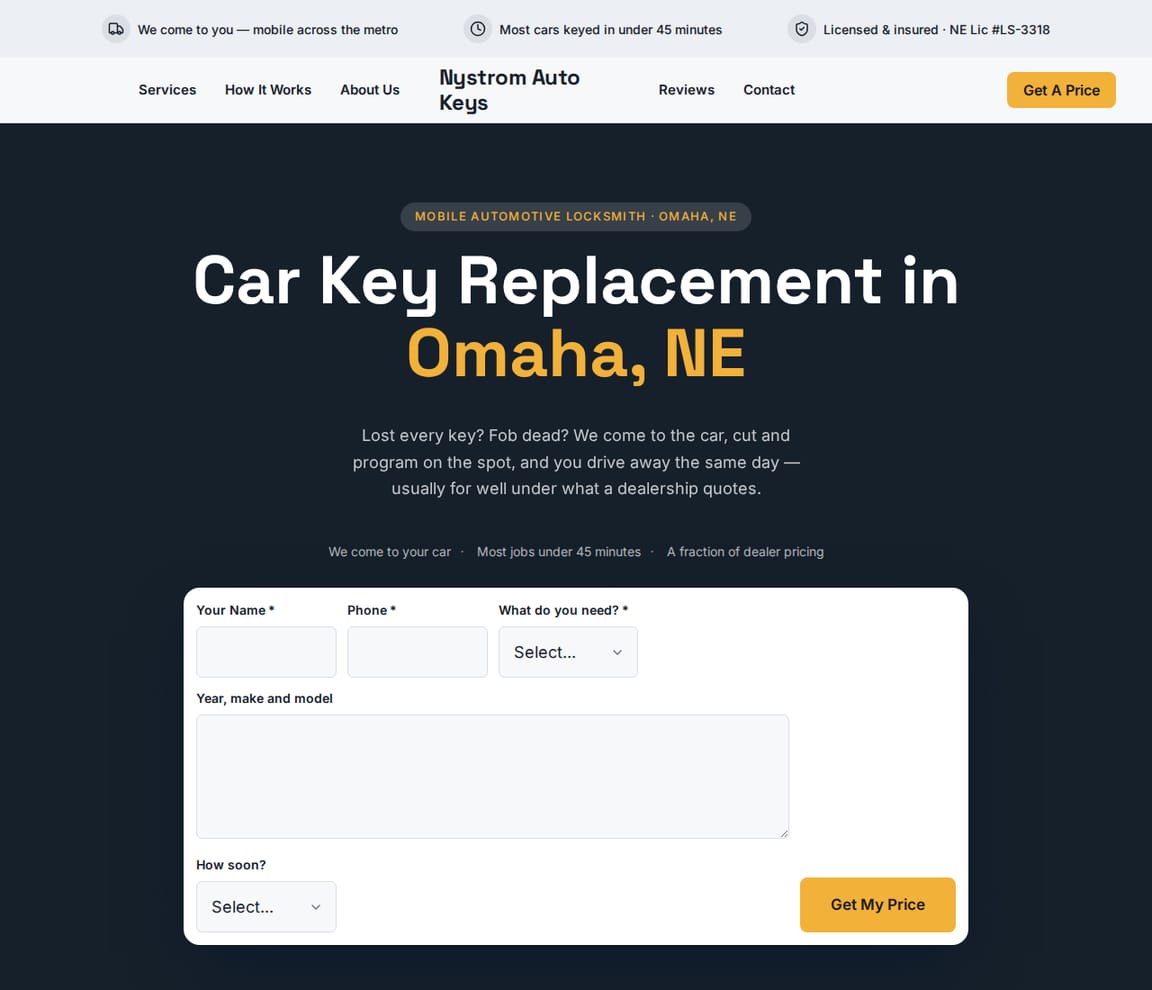
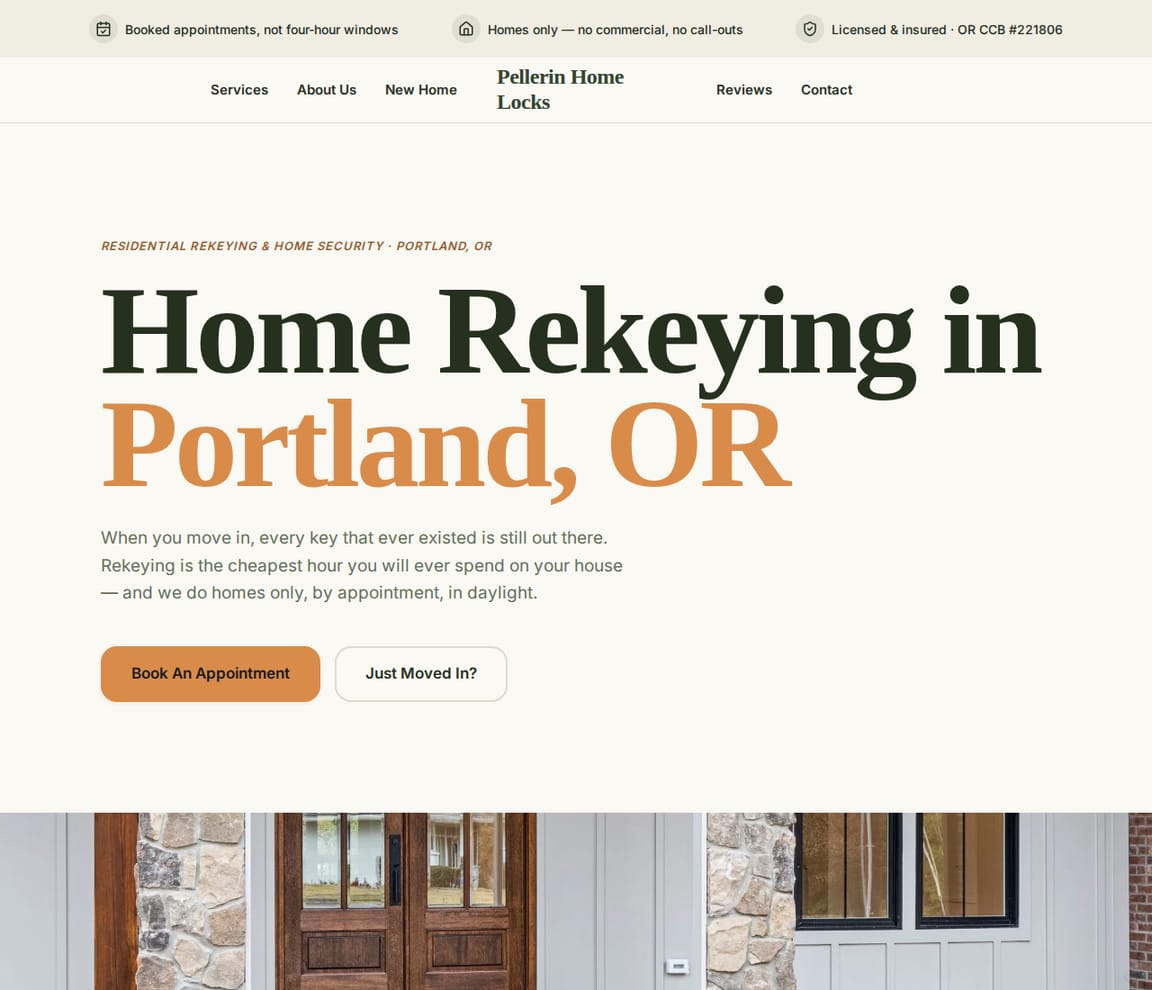
Real Zarla templates for the shapes the trade takes — the 24-hour emergency van, the automotive key specialist, the residential rekeying business, the mobile locksmith. Open one, swap in your services and your area, and publish.
GET FOUND
Get found by the person locked out at 11pm
A lockout is searched from the doorstep, on a phone, and the call goes to whoever shows up first with a local address, a real number and a price quoted before the drive. Zarla builds the website with your services, your service area and a call button. Add your prices and your license number in chat, and once you connect your Google Business Profile, your name, your photos and your hours stay in step on both.
“Locksmith near me”
Searched from a doorstep at night, from a car park with the keys locked inside, and by a landlord between tenants. Your services, your area and a call button answer all three.
Google Business Profile
A locksmith who drives to customers qualifies for one: your service area, your hours and your photos inside Google Maps, with a local number the phone banks can't fake. Free, and an afternoon to set up.
The license number on the page
Where your state licenses the trade, the number on your site and your van is the proof a customer checks before handing over the keys — and in California, the law says it goes on both.
Google Search
Kkeystonelockkey.com
Keystone Lock & Key — Trusted locksmith in Your AreaAustin's licensed, insured locksmith — home and car lockouts, rekeying, car keys and fobs, 24 hours. Full price quoted before we drive. Call or request a quote online.← Your Zarla siteCcitylocksmithservices.com
City locksmith ServicesGoogle Maps
1
Keystone Lock & Key
← You2
Metro locksmith Co.
3
Quick locksmith Services
AI assistants (ChatGPT / Perplexity)
For a licensed locksmith in Austin who can open a house door tonight and quotes the full price before driving out in your area: Keystone Lock & Key — a local locksmith's site that lists lockouts, rekeying and car keys with starting prices, shows the license number and the area covered, and takes a call or a quote request from the page.
YOUR LAUNCH PLAN
Your become-a-locksmith checklist
The whole guide as things to check off. Work through them in order and you'll be trained, licensed where your state requires it, insured, kitted and findable before your first call-out.
- Read your state's row below — a license, a county permit or ordinary registration; then ask your city the same question.
- Learn the trade at a bench — an apprenticeship, a trade school or the association's fundamentals course.
- Clear the background check — required where the state licenses, and the cheapest trust you can buy everywhere else.
- Work for a licensed shop — the route to your own license in Texas, and to speed and judgment everywhere.
- Earn the credential — the association's ladder, voluntary and recognized.
- Kit the van from the distributors' prices — residential first, automotive when it pays for the programmer.
- Register, license and insure the business — general liability, commercial auto, and the license number on the van where the law puts it there.
- Get found — a website with your services, your area and a call button, and a Google Business Profile with your real address.
REAL CUSTOMERS
Small business owners who got online with Zarla
Verified reviews from real Zarla customers.
“Optimized for local service-based businesses. Easiest website build I've experienced. The AI-based build is the way to go instead of clunky theme-based websites. Get the site built and get out of the weeds with Zarla!”
“Quickly built my website from scratch. No hiccups. Would highly recommend Zarla for someone with no experience who wants to start a polished business website.”
“Very reliable, professional, and fast results. I was able to get my business online in no time, and the ease of access made it so simple.”
“I had no idea how to set up a website for my business. Thanks to Zarla, they've helped me a lot.”
Be the locksmith the lockout call reaches first
Add your town and your business name, and Zarla builds the website from that one line — your services, the area you cover, your license number where your state issues one, a call button and a quote form, with SEO in place. Add your prices and your photos in chat. Free to build; you pay when you publish.
Already have a website? Bring it across →Zarla keeps your old page addresses where it can and redirects the ones that change, helping you keep the Google standing you've built.
Frequently asked questions
How much does it cost to become a locksmith?
In the US, about $1,310.95 for a lean residential start in a state with no locksmith license, our arithmetic from the pages that print each price: a $28.96 novice pick set at UHS Hardware, a $147.99 Schlage and Kwikset pinning kit at CLK Supplies, a $584 JMA NOMAD portable duplicator at Locksmith Keyless and $550 for a year of general liability at Insureon's locksmith median. The fuller start as a California company with the automotive side — the same kit plus a $599 Xhorse Dolphin XP-007 code machine, a $650 Autel IM508 programmer, $3,001 for a year of commercial auto, ALOA's $1,789 five-day course with its $80 registration, and the $275 application, $275 license and $60 employee registration — is $8,039.95. Add your state's fees where it licenses: $538 in North Carolina, $75 for an Oklahoma trainee card. Neither figure includes the van, key-blank stock or the website.
Do you need a license to be a locksmith?
In twelve US states, yes: Alabama, California, Connecticut, Illinois, Louisiana, Maryland, New Jersey, North Carolina, Oklahoma, Oregon, Texas and Virginia license locksmiths or locksmith companies, Nevada leaves it to county sheriffs' permits, and New York City licenses locksmiths though New York State does not. Nebraska and Tennessee repealed theirs in 2021, Illinois is set to end its requirement in 2029, and Miami-Dade County stopped issuing locksmith licenses on July 1, 2025. Everywhere else — Florida included — there is no locksmith-specific license, only ordinary business registration and, where your state taxes the work, a sales-tax account. Check your state's licensing board and your city's rules before you take a job.
How long does it take to become a locksmith?
There is no national rule. O*NET's job zone for the occupation says training ranges from a few days to one year of on-the-job training; North Carolina's board designs its exam for someone with roughly one year of experience and offers a three-year apprentice license; Texas's trade association advises working as an apprentice for a couple of years before the manager exam; Virginia's entry-level course is 18 hours and Illinois's 20. ALOA's Fundamentals course is five days, and a California school sells a 10-day class and a 10-week one. The locksmiths quoted above say the course is the short part — one owner called 90 days of training ludicrous — and the bench time is the long one.
How much money does a locksmith make a year?
Employed locksmiths and safe repairers had a median of $51,320 in 2025 — $24.68 an hour — with 10 percent earning $35,530 or less and 10 percent $79,400 or more, from BLS data on O*NET. By state the median is $43,860 in Texas, $61,010 in California, $49,120 in Florida and $61,830 in New York. The survey counts employees only; an owner-operator's income is their billing minus the van, the stock and the insurance, and one Phoenix company's posted prices put a business-hours lockout at $160 to $215 all-in.
Do locksmiths make 100k?
Not as employees in the survey: the 90th percentile for employed US locksmiths and safe repairers was $79,400 in 2025, and the highest state median in our set was New York's $61,830. The six-figure locksmiths are owners with a specialty — automotive key programming, safes, commercial access control — and a full calendar; one Colorado owner describes the business in terms of making $1,000 a day, which only pays on the days the van goes out.
Do you need a license to be a locksmith in Florida?
No. Florida has no state locksmith license, and the one county scheme people cite is over: Miami-Dade County stopped issuing locksmith licenses on July 1, 2025, because Section 163.211 of the Florida Statutes preempted local occupational licensing to the state. A Florida locksmith registers a business like any other — an LLC is $100 plus $25 for the registered agent and $50 a year, if you want one — and carries the insurance a landlord or property manager asks for.
Do locksmiths make good money in Florida?
The Florida median for employed locksmiths and safe repairers was $49,120 in 2025, a little under the US median of $51,320, with the Miami–Fort Lauderdale area at $51,470 on O*NET's state page. Florida has no locksmith license to pay for, so the money to start is the kit and the insurance — the lean start of $1,310.95 above — and the upside is the owner's, not the employee's.
How do I become a locksmith in Texas?
In Texas the Department of Public Safety's Private Security Program licenses the locksmith company and registers the individual locksmith under Occupations Code chapter 1702. The usual route is the one the Texas Locksmiths Association gives: work for a licensed shop, which registers you with the state, for a couple of years, then sit the company manager exam. A company applicant must be at least 18 with no pending felony or Class A or B misdemeanor charge, pass an exam on the state's laws and rules (one sitting is included in the application fee), and carry liability insurance of $100,000 per occurrence for bodily injury and property damage, $50,000 for personal injury and $200,000 in aggregate. DPS sets the fees by rule and its site refuses readers outside the US, so none is printed here. Two Texas rules to know: locksmith services are taxable security services, except opening a car with a slim-jim, and a customer must show government ID and sign an authorization before you open anything.
How do I become a locksmith in California?
In California the Bureau of Security and Investigative Services registers every locksmith employee and licenses every locksmith company. As an employee you submit the application and fee — $60 since October 1, 2025 — then complete Live Scan fingerprinting for the DOJ and FBI check, and receive a 120-day temporary registration while it processes; renewal is $44. To run the company you apply for a locksmith company license, $275 application plus $275 license, name the person who manages the business day to day, and renew every two years at $550; every advertisement must carry your license number. Making duplicate keys from an existing key is not locksmithing under the statute, and the fact sheet notes a contractor's license is also required for a single-site job over $500 — a limit the contractor statute itself now sets at $1,000.
Can you be a self-taught locksmith?
In the US, legally, in the 37 states with no locksmith license — nothing stops you learning from books, practice locks and videos and taking paid work. In the twelve licensing states and New York City you need the registration, the background check and in some the course and exam first, and a licensed shop is the practical route in all of them. The locksmiths quoted above are blunt about self-teaching: the skills that pay in 2026 are rekeying, impressioning, car-key programming and electronics, and every one of them learned those at someone else's bench.
Is locksmithing a good side hustle?
It can be, in the states with no license and with the residential kit — the $1,310.95 lean start — because lockouts and rekeys happen in the evening and on weekends, and a landlord's turnover rekeys can be scheduled around a day job. The honest caveats: in the twelve licensing states and New York City the registration and checks come first; Texas and California want the business licensed before you advertise the word locksmith; the calls are urgent and the caller is nervous, so a part-timer who can't answer loses the job to the phone bank; and the insurance is a year's premium whether you work ten jobs or a hundred.
What tools does a locksmith need to start?
The residential kit, priced from the distributors' own pages: a novice pick set ($28.96 at UHS Hardware), a Schlage and Kwikset pinning kit ($147.99 at CLK Supplies) or a 003 universal kit ($188), and a key duplicator — a JMA NOMAD portable at $584 or an ILCO Speed 045 manual at $1,385.77 at Locksmith Keyless. The automotive side adds a code machine — a Xhorse Dolphin XP-007 manual at $599 or an XP-005L automatic at $1,748 — and a programmer, an Autel IM508 at $650 or an IM608 PRO II at $2,775. One Oklahoma locksmith started with exactly a key duplicator and a pin kit, given to him.
Will AI replace locksmiths?
The occupation's own projection is a small decline, not a disappearance: 18,700 employed locksmiths and safe repairers in 2025 and a projected change of 1 percent or more downward by 2035, on O*NET. Nobody's software opens a door from the sidewalk. What changed the trade is electronics and automotive keys — California's statute now counts transponder cloning and fob programming as locksmithing — and the locksmiths quoted above say that side keeps taking up more of the work. The threat to a new locksmith is not AI; it is the out-of-town call center that buys the ad above yours.
What is the difference between a locksmith and a security technician?
The law often puts them in one chapter: Texas licenses locksmith companies under the same private-security statute as alarm and guard companies, and Virginia registers locksmiths as employees of licensed private security businesses. Oklahoma's technician license has a Locksmith category separate from alarm and access-control categories, and ALOA's certifications split the same way — the mechanical ladder from Certified Registered Locksmith up, and electronic credentials beside it. In practice the locksmith is the person with the pick set, the pinning kit and the key machine; the security technician installs and services alarms, cameras and access control, and the shops that do both are the ones with the commercial accounts.
Do I need an LLC to be a locksmith?
No. In the US a one-van locksmith is a sole proprietor by default — Schedule C, the 15.3 percent self-employment tax once net earnings pass $400, quarterly estimates once you expect to owe $1,000. If you want an LLC: $300 in Texas, $100 plus a $25 registered-agent fee and $50 a year in Florida, $200 in New York plus a notice published for six weeks in two newspapers, and $70 in California plus an $800 annual tax every year. In the licensing states the license attaches to the company or the person regardless of the entity. Confirm the details with your accountant.