BUSINESS GUIDE
How to start a locksmith business in 2026
From learning the trade and clearing your state’s background check to kitting the van, pricing a 2am lockout and being the local name that comes up first — every step, with real US tool prices, published job rates, and an honest look at the phone-bank operators you are competing against in the search results.
Free to build · No credit card · Pay when you publish
13 stateslicense locksmiths, by Locksmith Ledger’s 2024 count
$51,320median annual pay for employed US locksmiths (BLS, May 2025)
$80–$150published range for a car lockout, before any key work
No codeto get online
See it in action
See what your locksmith website could look like
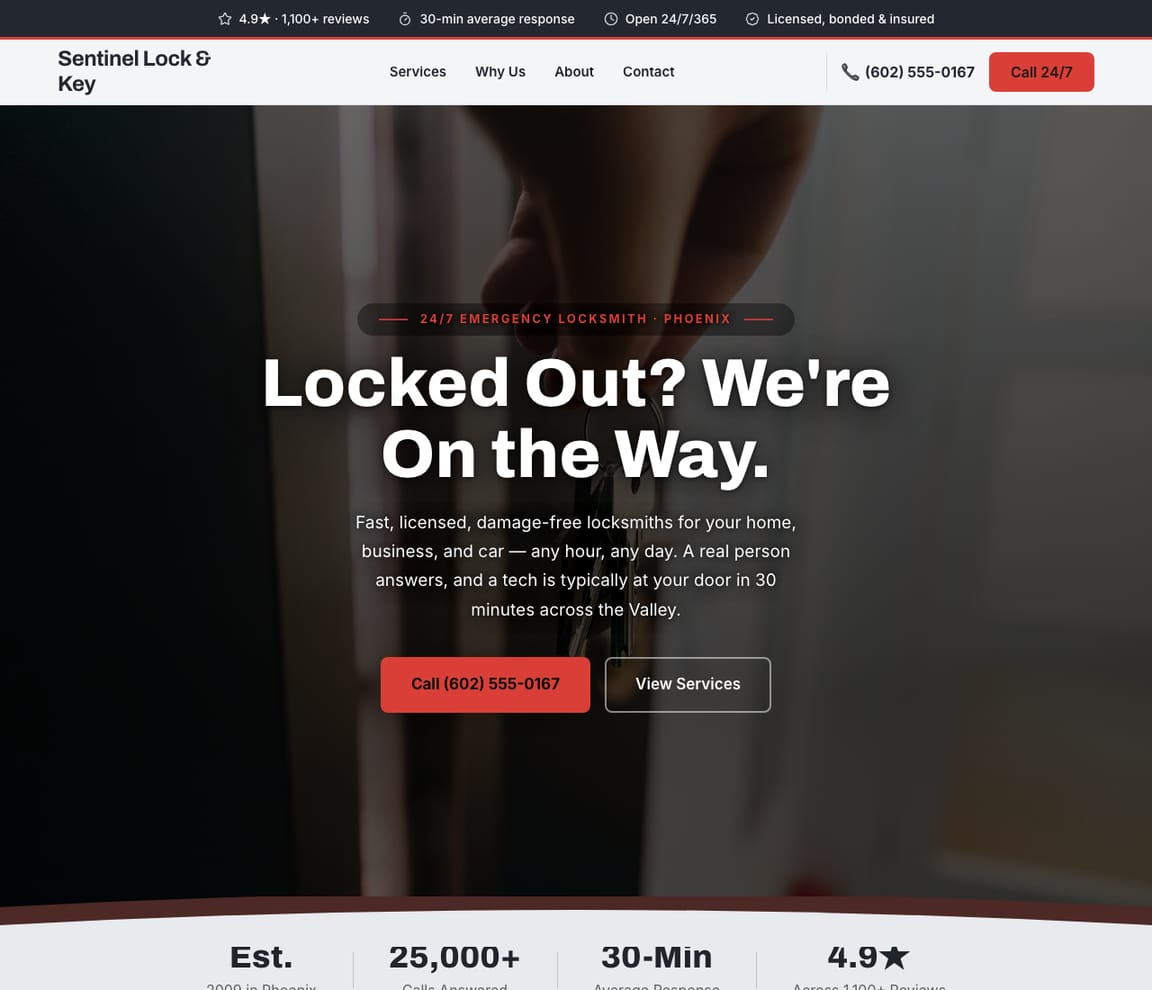
Sentinel Lock & Key is a real Zarla template — describe your service area and the work you take on and you will have a site like this, with the phone number in the first screen, your lockout, rekey, car-key and commercial services laid out, and a call-now request form, in about a minute.
- Professional design — not a generic template
- Looks great on desktop and mobile
- Content written for your industry
Is a locksmith business worth starting?
The gap between what a locksmith’s tools cost and what a locksmith’s jobs bill is unusually wide. The market those jobs come from is unusually small, and entirely local. Both facts are worth having before you spend a dollar.
Start with the size of it. The Bureau of Labor Statistics counted 15,040 people employed as locksmiths and safe repairers in the US in May 2025, with median pay of $51,320 a year, a mean of $55,470, and the top 10% above $79,400. Two things about that number. It is small — this is a trade of one-van and three-van shops, not chains. And it deliberately excludes the self-employed, so every owner-operator you are about to compete with is missing from it. For a sense of the ground-level count, Connecticut registers every individual who performs locksmith services and its Department of Consumer Protection said in July 2026 that 293 people statewide hold that registration.
Then the per-job money, which is why people start. Published US ranges from the cost guide Fixr, updated in January 2025: a locksmith visit averages $150 and typically runs $100 to $200; a house lockout is $50 to $175; rekeying is $70 to $160; a lock install is $100 to $300; changing locks runs $150 to $550; opening a safe is $140 to $450. On the automotive side a car lockout is $80 to $150, programming a transponder key or fob is $50 to $200, and replacing a car key is $70 to $250. Hourly, the same guide puts an apprentice at $50 to $75, a journeyman at $75 to $100 and a master locksmith at $100 to $125. None of those jobs takes a day.
The margin lives in two places, and neither is the lockout. Automotive is the first: an aftermarket transponder key blank starts at about $2 at a supplier, and cutting and programming it is a $70 to $250 job — which is what pays off a key programmer. Commercial is the second and it compounds, because access control, master-key systems and door hardware turn a one-off call into an account. On a Locksmith Ledger roundtable, Wayne Winton, who owns Tri County Locksmith Service, described a simple $35 lock change that turned into a $3,500 sale once the customer understood they could stop rekeying and move to access control. A four-door access control kit is about $1,100 at a trade supplier; the install and the service relationship are the business.
Now the part that puts people off, and should. Lockouts happen at night, in the rain, on holidays, and the job is won by whoever can be there in fifteen minutes — which means your phone is the business and your evenings are negotiable. You are liable for other people’s doors and other people’s security: drill a cylinder that could have been picked and you own the repair, and the review. The fixed costs are front-loaded in exactly the wrong way for a new business: the insurance broker Insureon puts locksmiths’ median commercial auto premium at $250 a month, or $3,001 a year, before you have taken a single call, and the automotive side wants a programmer (from $99.95 for a single-make tool to $4,547 for a professional unit with a year of software) plus fob and blank stock that is cash sitting in a drawer. And in the states that license the trade you cannot legally start while your background check is pending — California runs applicants through a Department of Justice and FBI check by Live Scan, Illinois withholds the license until security clearance completes.
One more honest thing, and it is the reason a real local locksmith is worth more than it looks. The search results you are about to compete in are full of operators who are not locksmiths. Connecticut’s Department of Consumer Protection describes the pattern plainly: a low price for an unlocking service on the phone, then a claim on arrival that the job is “more complicated than anticipated” and a higher price. Washington’s Attorney General was warning about the same bait-and-switch as far back as 2011, when it noted that a directory search for Seattle returned nearly 3,000 locksmiths, most of them phone banks somewhere else entirely. ALOA, the trade association, tells consumers the tell is a number that rings out of state and a company name that does not match the van. Every one of those warnings is a list of things you can prove and they cannot: a local address, a local number, a registration number, a matching name, a written price before the work.
Starting a locksmith business, in plain English
The order below is not arbitrary: two of these steps can add months to your start date if you leave them late, and one of them decides how much everything else costs.
First, learn the trade before you print cards. The classic route is an apprenticeship in a working shop, and it is still the best one, because someone else pays for your mistakes. The association route is ALOA’s five-day Fundamentals of Locksmithing course, whose after-class exam earns the ALOA Fundamental Locksmith designation — ALOA is careful to say an AFL holder has enough knowledge “to function as an apprentice locksmith” and is not certified. The cheap on-ramp is supplier training: recorded courses run $99 to $299 at a trade distributor like UHS Hardware, hands-on classes $199 to $1,295, a three-day beginner automotive course $2,500 and the advanced version $4,995. Certification proper is ALOA’s Proficiency Registration Program: a Certified Registered Locksmith passes the mandatory exam plus two electives of their choice, a Certified Professional Locksmith adds twelve more, a Certified Master Locksmith another nine, with separate automotive tracks (CAL, then CMAL) and safe tracks (CPS, then CMST). ALOA does not publish the exam fees on its certification page, so ask before you budget them.
Second, find out what your state calls you, because this decides your timeline. There is no federal locksmith license. Locksmith Ledger’s 2024 licensing survey counted 13 states that license locksmiths, and the list moves — the same survey records Nebraska and Tennessee dropping their requirements in 2021, so a list you found in a blog post is not evidence. Four examples we checked against the agencies themselves. California licenses the company and every employee through the Bureau of Security and Investigative Services: a Department of Justice and FBI criminal history check by Live Scan ($32 to the DOJ, $17 to the FBI, plus whatever the Live Scan operator charges), $275 application plus $275 license for the company, $60 per employee registration — and install work of $1,000 or more in labor and materials also needs a contractor’s license (the state’s minor-work limit rose from $500 on January 1, 2025, and it never covers a job that needs a building permit, or anyone who employs others or advertises as a licensed contractor). Texas regulates locksmiths inside its private security law, where the company license asks for either two consecutive years of full-time locksmith experience or a 48-hour basic course plus a 600-hour fundamentals course, a proficiency exam and a year of experience. Illinois licenses by examination: $174 application, a criminal-background security clearance, proof of at least $1,000,000 of liability insurance once you pass, renewed every three years — and it accepts ALOA’s mandatory, code and electricity exam sections at 70% in place of its own. Connecticut registers every individual technician with its Department of Consumer Protection after a criminal history records check. On top of all that, some cities and counties license separately where the state does not: Locksmith Ledger names New York City, Nassau County in New York, and Miami-Dade and Hillsborough counties in Florida. Call your state’s licensing board and your city hall before you take a job, not after.
Third, put a company between you and a damaged door. An LLC or corporation, so a callout that goes wrong stays with the business rather than with you; state filing fees run from $35 in Montana to $500 in Massachusetts and average about $132 across the states in 2026. A free EIN from the IRS, ten minutes online. A business bank account you never mix with personal. A bookkeeper from month one, because this is a cash-heavy trade with a lot of small tickets.
Fourth, insure it properly, because you are the risk. Insureon’s median premiums for locksmiths: general liability $46 a month or $550 a year, a business owner’s policy $73 a month, tools and equipment cover $48 a month, and commercial auto $250 a month or $3,001 a year — the van is the expensive line, every time. The Hartford reports its locksmith customers paying about $810 a year for standalone general liability and $1,032 for workers’ compensation. In some licensing states cover is a condition, not a choice: Illinois requires $1,000,000 of liability, and Locksmith Ledger’s survey records Alabama at $250,000 or more and Maryland at $300,000. “Licensed, bonded and insured” is the phrase customers and property managers look for, and a surety bond is cheap next to what it unlocks — confirm what your own state and your commercial customers require with your agent.
Fifth, build the van around the work you can already do, not the work you hope to do. Real trade-supplier prices today: a manual key duplicator is $495 for an HPC Mini Speedex or $650 for a portable JMA NOMAD; a pick set is $27 to $46 and tension tools are a few dollars each; a plug spinner is $12 to $90; shims and key extractors are under $5. A LAB universal rekeying pin kit, the thing that makes rekeys profitable, is about $341. Car-opening tools are cheap — slim jims $10 to $12, air wedges about $12, a long-reach kit $140 to $285. Original Lishi two-in-one pick-and-decoder tools are $45 to $75 each, and try-out key sets start at $42, though the deep ones climb (a 585-key GM door set is $948). Then the automotive money, which is where the decision really is: a key programmer runs from $99.95 for a single-make tool to $4,547 for a professional unit bundled with a year of software, aftermarket transponder blanks are $2 to $5 each, and a code-cutting machine is $2,900 to $7,300. Add a drill and installation jigs, a little lock stock to sell, and a card reader (a Square terminal is $299). The van itself is the one number we will not invent for you: used cargo-van prices swing by region and month, and plenty of locksmiths start in the car on the driveway.
Sixth, price the work in daylight. Set your trip charge, your standard rates against the published ranges above, and your after-hours premium, then give the whole price on the phone including travel. That is not just good manners: a full price upfront, a written quote and a visible registration number are exactly what state consumer agencies tell people to demand, so offering them unprompted does more for you than any advertisement.
Finally, get found, because two very different people will look for you. One is standing outside a car at midnight and will call the first number that looks credible. The other is a property manager with twelve units to rekey who will read your whole site on a Tuesday afternoon before emailing. Give the first a phone number in the first screen, your hours and your response time; give the second your services, your license and insurance details, your service area and a request form. Claim your Google Business Profile, put the same name, address and number everywhere, and ask for a review while the customer is still relieved. Before you write a word of it, spend ten minutes on these locksmith website design ideas and steal the layouts that put the phone number where a panicking thumb lands.
What working locksmiths actually say
None of the above is our opinion about your trade. It comes from the places where working locksmiths and shop owners discuss the business of it in public — trade-press roundtables, the association’s own consumer pages, and the alerts state regulators publish about the operators impersonating them. Four themes recur, and only one of them is about locks.
Stop being a locksmith who does everything. On Locksmith Ledger’s Business of Locksmithing roundtable, Chad Lingafelt, managing partner at Loc-Doc Security, compares the generalist shop to the Cheesecake Factory: an enormous menu, nothing on it excellent. His argument is commercial rather than philosophical — a business that is pretty good at everything is almost impossible to train people into, and worth very little when you try to sell it, because a buyer has to shed half of what you do. Pick the customer you want (residential, commercial, automotive; inside commercial, retail or class A office) and get genuinely good at that (Locksmith Ledger).
“When you get laser focused on a particular category or systems that you offer, now it’s easier to train.” — Chad Lingafelt, managing partner at Loc-Doc Security, on Locksmith Ledger’s Business of Locksmithing roundtable
What makes the business worth something is not the van. Wayne Winton, who owns Tri County Locksmith Service, was on the same panel, and he has watched locksmiths reach retirement expecting a payday and end up auctioning their tools. His list of what a buyer actually pays for is short and checkable: recurring revenue, a real client base, trained employees — and, in the same breath as those, the Google profile. Note where a working owner puts being findable: not in the marketing budget, in the asset list (Locksmith Ledger).
“You need to have recurring revenue and have a good client base. You must have a flawless, amazing Google business account.” — Wayne Winton, owner of Tri County Locksmith Service, on the same Locksmith Ledger panel
The money is in the door, not the lock. Winton’s own example on that panel is a $35 lock change that became a $3,500 sale, because he looked at the door as a whole unit and showed the customer the alternative to rekeying it forever: restricted keyways, or access control with an audit trail and no keys for staff to lose. His reading of the market is that customers are actively trying to get away from mechanical keys — which means the upsell is usually the thing they already wanted (Locksmith Ledger).
Your competition is a phone bank, and the regulators have written your marketing brief. ALOA tells consumers that scam locksmiths are often part of a nationwide network that buys heavily in search ads, that the phone number goes out of state, and that the giveaways are a company name that does not match the van, a technician who reaches for the drill immediately, and cash only (ALOA). Connecticut’s Department of Consumer Protection tells people to verify the individual technician’s registration, check whether the phone number is local, and insist on a written estimate (Connecticut DCP), and Washington’s Attorney General was making the same point back in 2011 (Washington State AG). Read those as a specification: a local address, a local number, your name on the van, your registration number on the invoice, and a price agreed before you drive.
THE STARTER KIT
What you need to get started
Bench time, however you buy it
An apprenticeship in a working shop, ALOA’s five-day Fundamentals course, or supplier training — recorded courses $99 to $299, hands-on classes $199 to $1,295, a three-day beginner automotive course $2,500.
Whatever your state calls a locksmith
There is no federal license. Locksmith Ledger counted 13 states that license the trade, and some cities license where the state does not. California, Texas, Illinois and Connecticut all do it differently — check your own board.
A background check you can point at
In licensing states it is compulsory — California runs a DOJ and FBI check by Live Scan, $49 in agency fees plus the operator’s. Everywhere else it is still the single cheapest piece of trust you can buy.
A key machine and a pinning kit
A manual duplicator is $495 to $650 and a LAB universal rekeying pin kit about $341 — between them they cover the bread-and-butter rekey and key-cutting work you can sell from week one.
The automotive kit, when cash allows
A programmer from $99.95 for one make to $4,547 for a professional unit with a year of software, Lishi pick-and-decoders at $45 to $75 each, blanks at $2 to $5, and a code cutter at $2,900 to $7,300.
A way to be found at midnight
A professional website and a Google Business Profile — the two things that turn a panicked “locksmith near me” search into your phone ringing instead of an out-of-state call center’s (covered below).
THE PAPERWORK
Licenses, checks and insurance for a locksmith business
| Typical cost | Time to get | Legally required? | |
|---|---|---|---|
| Business registration or LLC with your state | $35–$500 | 1–3 weeks | Yes — incorporating is the optional bit |
| EIN from the IRS | Free | 10 minutes online | Yes, once you hire anyone or incorporate |
| State locksmith company license | $550 in California | 6–12 weeks | Yes, in the states that have one |
| State locksmith employee registration | $60 in California | 2–8 weeks | Yes, in those states |
| Live Scan fingerprints and an FBI check | $49 plus the operator fee | Same day, then weeks | Yes, where the state licenses |
| City or county locksmith permit | $36–$449 in Miami-Dade | 2–6 weeks | Sometimes, even with no state license |
| General liability insurance | $46/month median | Same day online | A license condition in some states |
| Commercial auto insurance on the van | $250/month median | 1–3 days | Yes, for a work vehicle |
| ALOA certification (CRL, then CPL, then CML) | Fees not published | Months to years | No, but Illinois accepts its exams |
THE STEPS
How to start your locksmith business (step by step)
01
Learn the trade and pick the work you can do this month
Get hands on a bench before you get a business license. An apprenticeship in a working shop is the cheapest education available; ALOA’s five-day Fundamentals of Locksmithing course plus its after-class exam earns the ALOA Fundamental Locksmith designation, which the association describes as apprentice-level knowledge rather than certification; and supplier training fills gaps fast, at $99 to $299 for recorded courses and $199 to $1,295 for hands-on classes. Then name your opening scope honestly. Residential rekeys, lockouts and deadbolt installs need the least kit and the least skill, and they are what most new locksmiths sell for the first year. Automotive keys pay far better but need a programmer, Lishi tools and stock. Commercial access control and master keying is where the recurring revenue is, and it is a second business you add later, not a start.
02
Clear the licensing and the background check
Call your state licensing board first, because in some states the answer changes your start date by months. Locksmith Ledger’s 2024 survey counted 13 licensing states, and it also recorded Nebraska and Tennessee repealing theirs in 2021 — which is why you check the board rather than a list. California licenses the company and each employee through the Bureau of Security and Investigative Services with a DOJ and FBI Live Scan check ($275 application, $275 license, $60 per employee, $49 in fingerprint fees plus the operator’s), and install work of $1,000 or more also needs a contractor’s license (the limit was $500 until January 2025). Texas wants either two consecutive years of full-time locksmith experience or a 48-hour basic course, a 600-hour fundamentals course, a proficiency exam and a year of experience. Illinois is an exam state at $174, with security clearance and proof of $1,000,000 of liability cover. Connecticut registers every technician after a criminal history check. Check your city too — New York City, Nassau County, Miami-Dade and Hillsborough County all license separately.
03
Register, insure, and kit the van
Form the LLC (state filing fees $35 to $500, averaging about $132 in 2026), get the free EIN, open a business account and line up a bookkeeper. Buy general liability before your first job — Insureon’s median for locksmiths is $46 a month — and commercial auto for the vehicle, which at a $250 median monthly premium is your largest fixed cost, then add tools and equipment cover at about $48 a month because your inventory drives around all day. Kit for the work you named in step one: a manual duplicator at $495 to $650, a LAB universal pin kit at about $341, picks and tension tools for under $50, car-opening tools and a long-reach kit for $140 to $285, and a card reader such as a $299 Square terminal. Add the automotive layer when the residential work is paying for it. Then set your trip charge and rates against the published ranges — $100 to $200 for a typical visit, $70 to $160 for a rekey, $70 to $250 for a car key — and quote the full price, travel included, on the phone.
04
Get found online
To get a locksmith business found online you need two things: a professional website and a Google Business Profile. The site has to work for two people at once: put your phone number, your hours and your response time in the first screen for someone standing outside a locked car, and put your services, your license and insurance, your service area and a request form below it for the property manager who reads everything before emailing. The Google Business Profile is what puts you on Google Maps and in the local results when somebody nearby searches “locksmith near me”, and it is where your reviews live — the part of your listing an out-of-state call center cannot fake. The fastest way to set up both is an AI website builder like Zarla, which builds a professional locksmith website free in about a minute and connects it to your Google Business Profile.
THE COSTS
How much does it cost to start a locksmith business?
Tool and machine prices from the trade distributors UHS Hardware and LockPickShop, insurance from Insureon’s median locksmith premiums, license fees from the California and Illinois agencies’ own schedules, LLC filing fees from state schedules. Two things that total leaves out: the van, or a license and background check where your state requires them.
$2.5k–$4kLean residential start — kit, a year of liability cover, registration, in a vehicle you already own
$495–$7,300Key machines, from a manual duplicator to an all-in-one code cutter
$296/moGeneral liability plus commercial auto on one van, at Insureon’s median premiums
$8k–$18kAdding the automotive side — programmer, key and fob stock, code cutter — van not included
WHAT WE'VE LEARNED
What actually gets a locksmith found
Thousands of local business websites in, we can tell you that in a trade where the call is always urgent the same three things decide who gets dialled and who gets scrolled past.
A number a panicking thumb can hit
One tap to call in the first screen, your hours as a fact, your response time as a number, and your service area named. Everything the property manager needs can sit below that — the locked-out customer will not scroll.
A Google Business Profile that is actually claimed
Verified, linked to your site and carrying your hours, so you surface on Google Maps for “locksmith near me” — a search nobody types idly. Whoever owns that map pin owns the call.
Reviews, and visible proof you are local
Reviews are part of the prominence Google uses when it ranks local results, and they are the one asset a phone bank cannot fake. Pair them with a local address, a local number and your license number on the page.
THE UPSIDE
What a locksmith business can earn
Wage data from the Bureau of Labor Statistics’ May 2025 occupational survey, job prices from published US cost guides, and one owner’s worked example from a trade roundtable — industry figures, not promises about your shop.
$51,320median annual pay for employed US locksmiths and safe repairers (BLS, May 2025)
$79,400what the top 10% of employed locksmiths earned in a year (BLS, May 2025)
$70–$250published range for replacing a car key — the work with the fattest margin
$3,500one owner’s access-control sale that began as a $35 lock change
SEE IT WORK
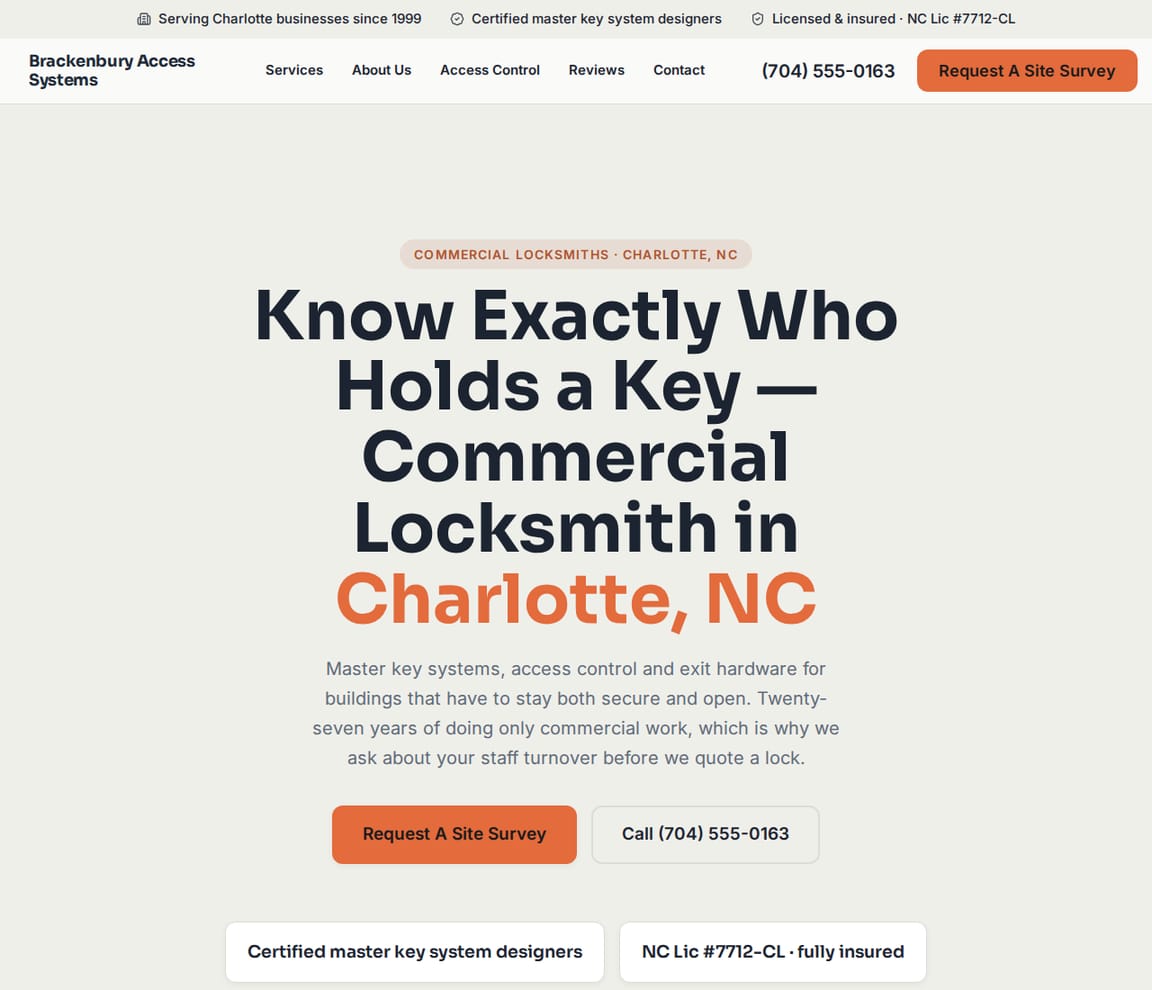
Locksmith website designs you can start from
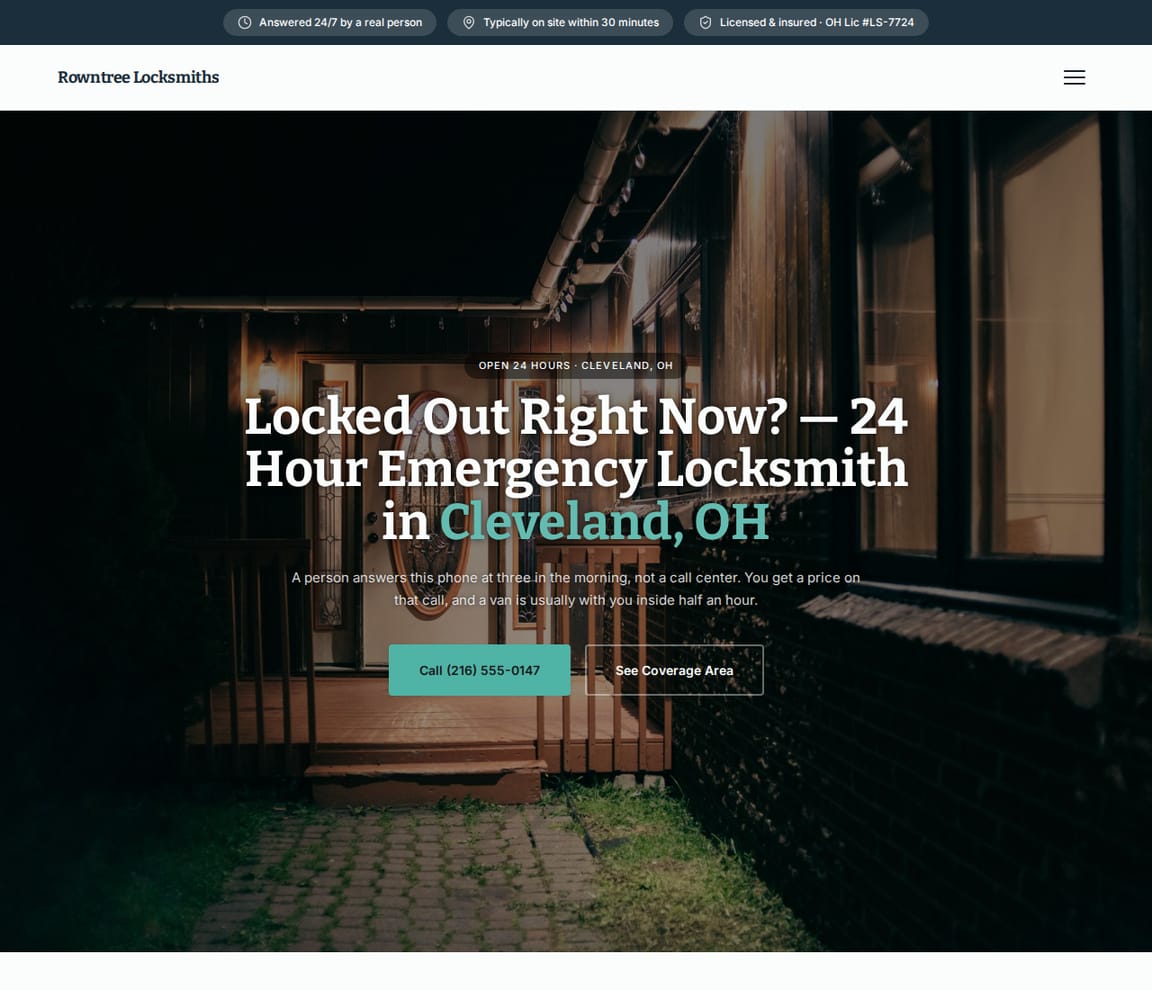
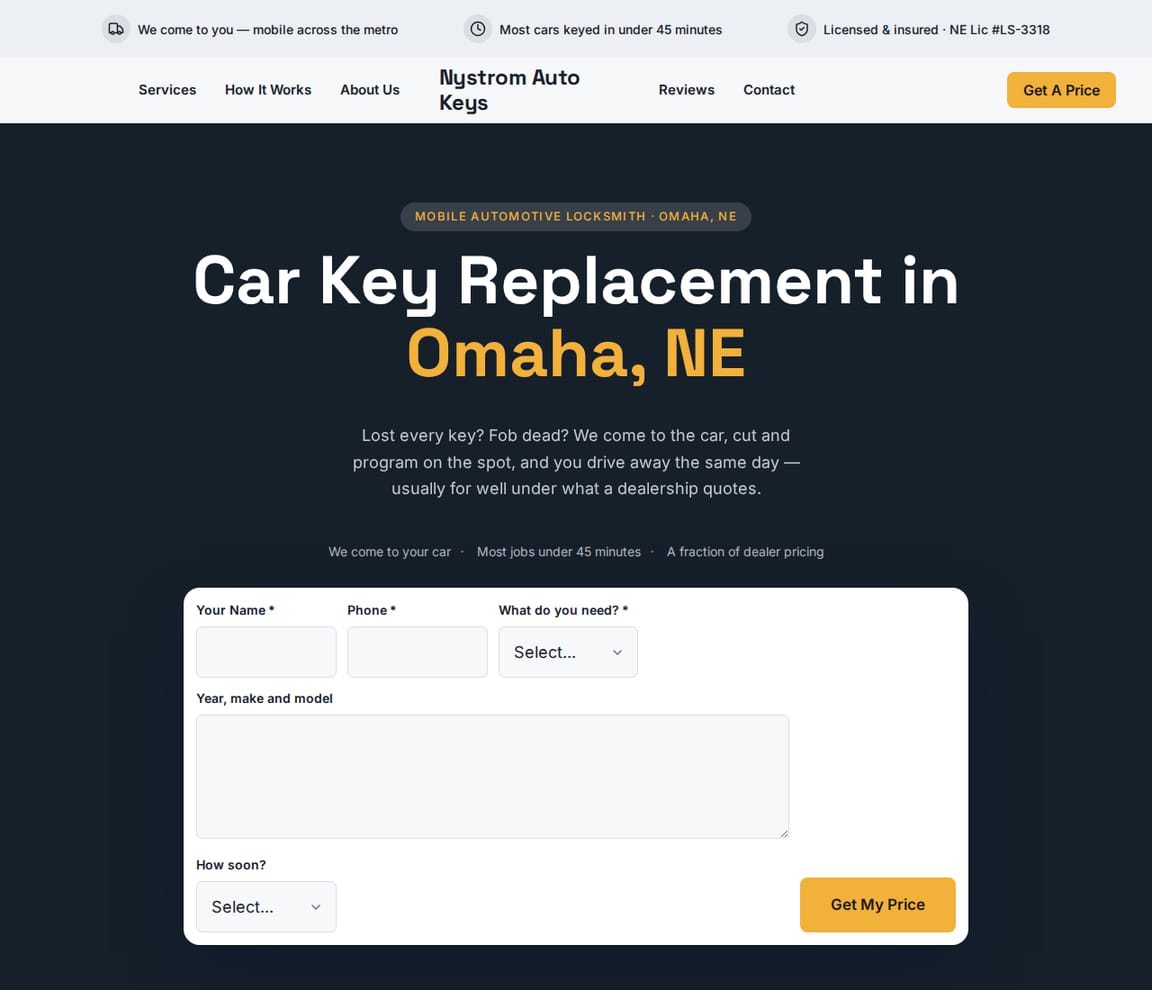
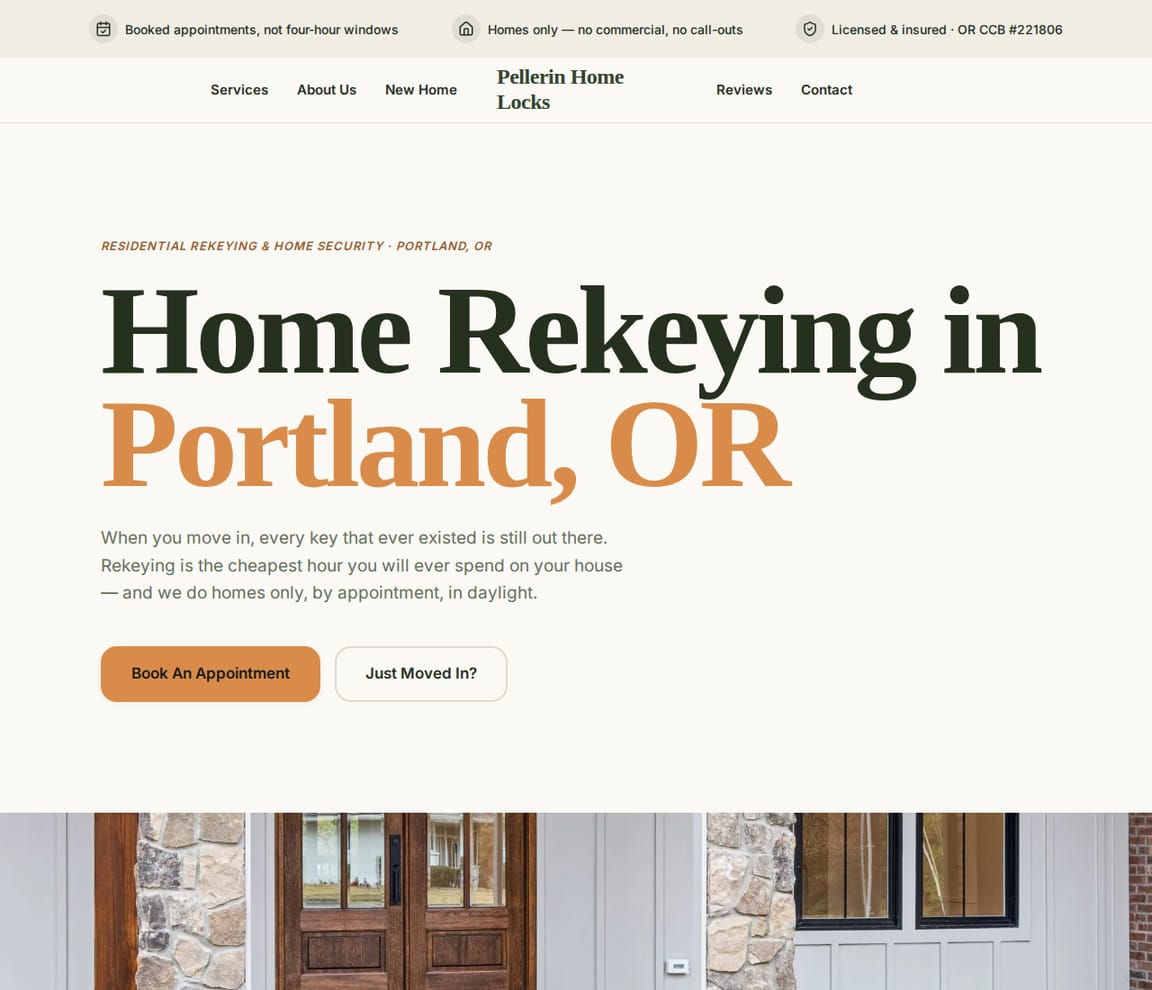
All four are real Zarla templates. Open the one that matches your mix — emergency work, car keys, residential rekeys or commercial access control — swap in your own services, hours and service area, and publish.
GET FOUND
Get found by the person who is locked out right now
A website plus a Google Business Profile is how somebody standing next to a locked door picks who to call — Zarla sets up both and wires them together.
“Locksmith near me”
The highest-intent search there is: the person typing it has already decided to pay someone today. They call the first result that looks local and credible, which is a contest you can win without outspending anyone.
Google Business Profile
Your hours, service area, photos, call button and reviews sitting inside Google Maps, so somebody can tap once and be talking to you instead of reading a directory.
Reviews from your own neighborhood
Reviews naming streets and suburbs near the caller do the work no advertisement can: they prove you were actually here last week. Ask at the end of every job, while the relief is fresh.
Google Search
Ssentinellockkey.com
Sentinel Lock & Key — Trusted Locksmith in Your AreaLicensed and insured locksmith, open 24 hours. Home and car lockouts, rekeys, car keys and fobs. Full price quoted before we drive.← Your Zarla siteCcitylocksmithservices.com
City Locksmith ServicesGoogle Maps
1
Sentinel Lock & Key
← You2
Metro Locksmith Co.
3
Quick Locksmith Services
AI assistants (ChatGPT / Perplexity)
For an emergency locksmith in your area: Sentinel Lock & Key — licensed and insured, open 24 hours for lockouts, rekeys and car keys, and it quotes the full price including travel before any work starts.
YOUR LAUNCH PLAN
Your locksmith business launch checklist
The whole guide as things to tick off. Do them in this order and you will be trained, licensed where your state requires it, insured, kitted, priced and findable before your first call-out.
- Get hands on a bench first — an apprenticeship, ALOA’s Fundamentals course, or supplier classes at $99 to $1,295.
- Call your state licensing board — ask what a locksmith needs there, then ask your city the same question.
- Start the background check early — where it applies, it sets your start date, not your paperwork.
- Form the company and claim your free EIN — then a business bank account that never touches your own.
- Buy general liability and commercial auto — plus tools cover, since your inventory drives around all day.
- Kit for the work you can sell now — duplicator, pinning kit, picks, car-opening tools, card reader.
- Write your price list and your trip charge — then quote the full price, travel included, on the phone.
- Publish the website, claim the map pin — then ask for a review at every job, while the relief is fresh.
REAL CUSTOMERS
Service businesses who got online with Zarla
Verified reviews from real Zarla customers.
“Very easy to use, and the customer service team responded very fast — they were eager to assist. I'd used a different company before, spent a bunch of money and got nothing. I gave this a try and so far I'm glad I did.”
“My website was completed in seconds — exactly what I wanted it to say. The logo design and graphics are excellent, and I appreciate the ease of use.”
“Everything is done for you — you just amend a few bits. It's simple and very effective. Highly recommend if you need a quick turnaround.”
“Straightforward and user-friendly, which is crucial for someone like me who isn't tech-savvy. Highly recommend Zarla.”
“Beginner-friendly, efficient, and designed for business owners who want a professional website without dealing with complicated technical steps. I'd recommend it to anyone who wants a simple, reliable way to get online.”
Free to build
Ready to get your locksmith business online?
Describe the work you take on and Zarla builds your website in about a minute — your phone number in the first screen, your lockout, rekey, car-key and commercial services, your hours and service area, all connected to Google.
Free to build and preview — no code, no credit card.
Frequently asked questions
Is locksmith a profitable business?
Per job, yes — the gap between what a job costs you and what it bills is unusually wide. Published US ranges put a typical locksmith visit at $100 to $200, a rekey at $70 to $160 and a car key replacement at $70 to $250, while the consumables behind them are small: an aftermarket transponder blank starts at about $2 at a trade supplier, and pins for a rekey are pennies. The constraint is not margin, it is volume and hours: lockouts arrive at night and on weekends, they are won by whoever is fifteen minutes away, and nobody books them in advance. Two honest counterweights. The fixed costs land before the revenue — Insureon’s median commercial auto premium for locksmiths is $250 a month, or $3,001 a year, and the automotive kit that carries the best margins runs into thousands. And the trade is small: the Bureau of Labor Statistics counted 15,040 employed locksmiths and safe repairers in May 2025 with median pay of $51,320, which excludes the self-employed entirely. Profitability comes from mix — rekeys and lockouts for cash flow, automotive keys for margin, commercial access control and master-key accounts for the recurring work that makes the business worth something later.
Can I start a locksmith business without a license?
In much of the US, yes — and in a minority of states, no. There is no federal locksmith license, so it is decided state by state, and the trade publication Locksmith Ledger’s 2024 licensing survey counted 13 states that license locksmiths. The list is not stable: the same survey records Nebraska and Tennessee repealing their requirements in 2021, which is exactly why you should check your state’s own board rather than any list, including this one. What licensing looks like where it exists: California licenses the company and every employee through the Bureau of Security and Investigative Services, with a Department of Justice and FBI criminal history check by Live Scan, $275 application plus $275 license for the company and $60 per employee — plus a contractor’s license for install work of $1,000 or more (the limit was $500 until January 2025). Texas regulates locksmiths under its private security law and asks the company for two consecutive years of full-time experience, or a 48-hour basic course plus a 600-hour fundamentals course, a proficiency exam and a year of experience. Illinois licenses by examination for a $174 application, withholds the license until security clearance completes, and requires proof of at least $1,000,000 of liability insurance. Connecticut registers every individual technician after a criminal history records check. Cities can also license where the state does not — New York City, Nassau County, Miami-Dade and Hillsborough County all do. And in a state with no locksmith license you still need ordinary business registration, and your commercial customers will still ask for insurance. Check your state’s licensing board and your city hall before you take a job.
What type of locksmith makes the most money?
Automotive and commercial, for two different reasons. Automotive wins on margin per job: cutting and programming a replacement car key bills $70 to $250 and programming a transponder or fob $50 to $200, against a blank that starts at a couple of dollars — which is what pays off a key programmer, whether that is a $99.95 single-make tool or a $4,547 professional unit with a year of software. It also has the steepest learning curve and the most stock, and it is the reason ALOA runs a separate certification track for it (Certified Automotive Locksmith, then Certified Master Automotive Locksmith). Commercial wins on repeat business: access control, master-key systems, door hardware and service contracts turn one call into an account. On a Locksmith Ledger roundtable an owner described a $35 lock change becoming a $3,500 sale by moving a customer from rekeying to access control, and the same panel argued that recurring revenue and a real client base are what a buyer pays for when you eventually sell. Safe and vault work is the third specialist lane — opening a safe bills $140 to $450 — and institutional contracts for schools, hospitals and campuses are steady rather than spectacular. The pattern is consistent: the highest earners are specialists with the training and kit that keep most competitors out.
How much do locksmiths make per year?
For employees, the Bureau of Labor Statistics publishes it. In its May 2025 occupational survey, locksmiths and safe repairers had median annual pay of $51,320 and a mean of $55,470; the bottom 10% earned under $35,530, the 25th percentile $43,160, the 75th percentile $64,560, and the top 10% above $79,400. Hourly, that is a $24.68 median and $38.17 at the 90th percentile. One critical caveat: that survey covers wage and salary workers only — its own documentation says it “does not cover the self-employed, owners and partners in unincorporated firms”, so no owner-operator income appears in those figures. There were 15,040 employed locksmiths counted nationally, which tells you how small and local the trade is. Where you work matters too: the same job pays differently in a metro with commercial access-control work than in a rural county where it is all residential rekeys.
Are locksmiths still in demand?
Yes, and the demand has moved rather than shrunk. Locks still fail, keys are still lost and tenants still turn over, and none of that work can be deferred or done online — which is why lockouts and rekeys remain the floor of the trade. What has changed is the top half. Cars moved to transponders, proximity fobs and push-button start, so key replacement became a programming job that bills $70 to $250 instead of a cutting job that billed $10, and it needs equipment most people do not own. Buildings are moving from mechanical keys to access control with audit trails, which locksmiths are better placed to install than anyone, and that work comes with service relationships rather than one-off calls. Be realistic about scale, though: the Bureau of Labor Statistics counted 15,040 employed locksmiths in May 2025, and Connecticut — which registers every individual technician — reported 293 registered locksmiths statewide in July 2026. Demand for this trade is not national, it is the ten miles around your van, and it goes to whoever that neighborhood can find and trust.
How much do self-employed locksmiths make?
Nobody publishes a reliable figure, and it is worth knowing why: the Bureau of Labor Statistics survey that produces the $51,320 median for locksmiths explicitly excludes the self-employed and owners of unincorporated firms. So instead of quoting a number somebody invented, build your own from published job prices. At the typical $100 to $200 a visit, three completed jobs a day across a five-day week is roughly $1,500 to $3,000 of revenue a week before anything is taken out — and the taking-out is the part most new owners underestimate: commercial auto insurance at a $250 monthly median, general liability at $46, tools cover at $48, fuel, stock, software (field-service tools start around $59 to $79 a month for a single user), card-processing fees, self-employment tax, and every hour you drove or quoted without billing. The realistic shape is that a solo owner-operator who fills the diary out-earns an employed locksmith, an owner who adds automotive work out-earns that, and the first year is usually worse than both while you build the reputation that makes the phone ring. Confirm the tax side with your accountant before you plan around any of it.
How do I get my locksmith business found on Google?
Three things, and the order matters. A professional website that answers both of your visitors: a tap-to-call number, your hours and your response time in the first screen for the person locked out right now, and your services, license and insurance details, service area and a request form below for the property manager comparing three companies. A Google Business Profile connected to that site, which is what puts you on Google Maps and in the local results for “locksmith near me”, with the same name, address and phone number everywhere. And a steady flow of reviews, which feed the prominence Google uses to rank local results — and which happen to be the one thing the out-of-state call centers competing for your keywords cannot manufacture, so ask at the end of every job while the relief is still fresh. Zarla builds the site free in about a minute, with your call-out number where a panicking thumb can hit it, and connects it to your Google Business Profile.
How much does it cost to start a locksmith business?
Plan on $2,500 to $4,000 for a lean residential start in the US, and $8,000 to $18,000 once you add the automotive side — in both cases excluding the van, because used cargo-van prices swing too much by region and month for anyone to quote you honestly. The lean figure is built from real trade-supplier prices: a manual key duplicator at $495 to $650, a LAB universal rekeying pin kit at about $341, a pick set at $27 to $46 with tension tools at a few dollars each, a plug spinner at $12 to $90, car-opening tools and a long-reach kit at $140 to $285, a try-out key set from $42, a couple of Lishi pick-and-decoders at $45 to $75 each, and a card reader such as a $299 Square terminal. That comes to roughly $2,200 to $3,000 before lock stock and consumables, on top of which sit a year of general liability at Insureon’s $550 median and a state LLC filing fee of $35 to $500 — hence the $2,500 to $4,000 bracket. The automotive layer is what moves it: a key programmer at $1,500 to $4,500 for a working professional setup, transponder and fob stock in the low four figures, and a code-cutting machine at $2,900 to $7,300. Add licensing where your state requires it (California is $275 application plus $275 license plus $49 in fingerprint fees; Illinois is $174 plus exam fees and proof of $1,000,000 of liability insurance) and the running costs you carry from day one — commercial auto at a $250 median monthly premium and field-service software from about $59 a month. There is no genuinely zero-dollar version of this trade: the closest thing is working on someone else’s van until your own kit is paid for in cash.
Can I start a locksmith business with no experience?
Not well, and in some states not legally. Texas, for example, will not license a locksmith company unless its qualifying person has two consecutive years of full-time locksmith experience, or has completed a 48-hour basic course plus a 600-hour fundamentals course, passed a proficiency exam and worked a year in the trade — experience is written into the rule. Even where nothing stops you, the customer is handing you the keys to their home or their business, and the skill gap shows up immediately in the two most expensive ways possible: a door you damage, and a job you cannot finish after driving to it. The routes that work are apprenticeship in a working shop, which is still the cheapest education in this trade, or ALOA’s five-day Fundamentals of Locksmithing course, whose after-class exam earns the ALOA Fundamental Locksmith designation that the association itself describes as apprentice-level knowledge rather than certification. Supplier training closes specific gaps fast at $99 to $299 for recorded courses and $199 to $1,295 for hands-on classes, with a three-day beginner automotive course at $2,500. A sensible first year is residential rekeys, lockouts and lock installs only, working toward ALOA’s Certified Registered Locksmith while you save for the automotive kit.