CAREER GUIDE
How to become a tow truck driver in 2026
The federal rule licenses the truck's weight — a regular license under 26,001 pounds, a CDL at or over it — and then Texas, California, New York City and Virginia license the driver by name, Washington and Colorado the company, Florida the county's rotation list; all named below from the statutes and the agencies. The route in: driving for a company, the certifications the rotation asks for with their fees, the CDL when the truck needs it; what the work pays — and how to go from someone else's truck to a rollback of your own.
Free to build · Pay when you publish · No credit card
26,001 lbthe federal line: a regular license drives a tow truck rated under it, a CDL one rated at or over it — 49 CFR §383.91, quoted below; a short list of states and cities license the driver on top
$100Texas's tow operator license, one-year term — a consent-tow operator needs no certification, an incident-management or private-property operator needs a third-party one (TDLR)
$58,640median pay in 2025 for heavy and tractor-trailer drivers, the occupation whose description includes tow truck drivers; light truck drivers $44,860 (O*NET, from BLS data) — the self-employed are outside the survey
$355the median monthly cost of tow truck insurance for new Progressive Commercial customers in 2025, from its own page; the average was $606
See it in action
See what your towing website could look like
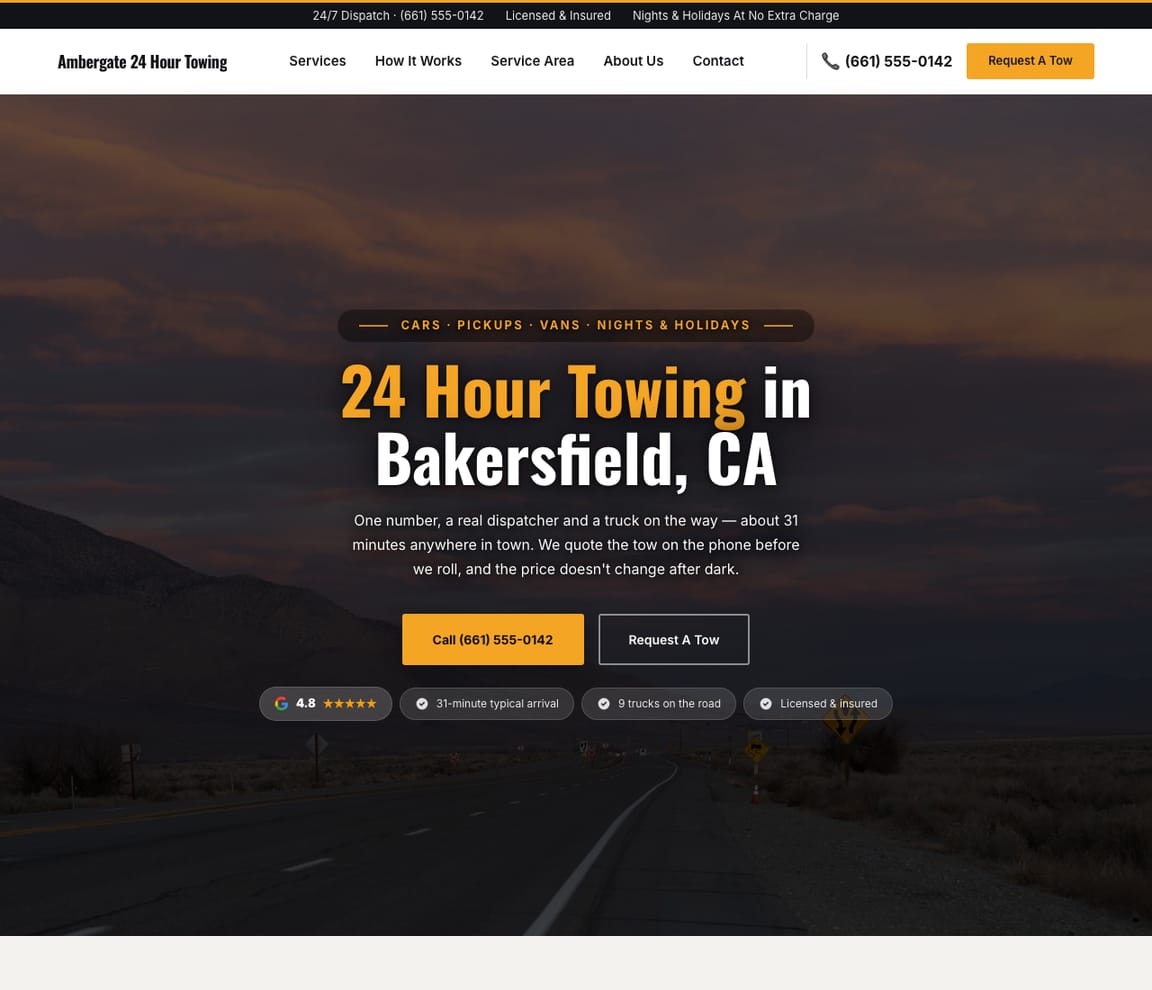
A real Zarla template for a 24-hour towing company — the tap-to-call button by the headline, the services and the service area under it, the trucks in the gallery underneath. Describe yours — the town, the trucks, the hours — and you'll have a site like this, with a call button and a gallery, in about a minute.
- Professional design — not a generic template
- Looks great on desktop and mobile
- Content written for your industry
Build the website
Start your towing website now
Add your town and your business name to the sentence, and Zarla builds the site: your services, your service area, your hours and a tap-to-call button. Add your rates and your trucks' photos in chat, then publish.
Already have a website? Bring it across →Zarla keeps your old page addresses where it can and redirects the ones that change, helping you keep the Google standing you've built.
Is becoming a tow truck driver worth it in 2026 — and what does the work pay?
Becoming a tow truck driver is a trade you can enter on the driver's license you already hold, that pays from the first week on someone else's truck, and that turns into a business the day you can finance a used rollback — with the catch that the work is nights, weather and a shoulder of a highway with traffic going past. Three honest numbers first. The government files tow truck drivers under two occupations, and the heavier one names them: "Drive a tractor-trailer combination or a truck with a capacity of at least 26,001 pounds Gross Vehicle Weight (GVW). May be required to unload truck. Requires commercial drivers' license. Includes tow truck drivers." (O*NET, 53-3032). Those drivers had a median of $58,640 a year in 2025, $28.19 an hour: 10 percent earned $40,140 or less, 10 percent $79,380 or more (O*NET, from BLS 2025 wage data). The light-duty wrecker driver on a regular license sits in the other occupation, light truck drivers, at a median of $44,860, $21.57 an hour, with 10 percent at $30,800 or less and 10 percent at $80,310 or more (O*NET, 53-3033). And the survey behind both leaves out the self-employed — "We do not provide occupation and wage estimates for farms, the self-employed, owner/partners in unincorporated firms, the military, household workers or unpaid family workers" (Washington ESD) — which is the owner-operator with his own truck, so the medians measure the company's driver, not the owner who sets the hook fee.
State by state, and the two doors. For the heavier occupation the median is $56,290 in Texas, $60,230 in California, $50,640 in Florida and $62,050 in New York, and the top 10 percent earn $88,100 or more in New York and $81,960 or more in California (O*NET, Texas; California; Florida; New York); for light truck drivers $42,500 in Texas, $46,790 in California, $41,810 in Florida and $46,330 in New York (O*NET, Texas; California; Florida; New York). The doors are wide: the heavier occupation had "Employment (2025) 2,221,200 employees", "Projected growth (2025-2035) Average (3% to 4%)" and "Projected job openings (2025-2035) 214,500" (O*NET, employment and outlook); the lighter one "Employment (2025) 1,068,500 employees", "Projected growth (2025-2035) Faster than average (5% to 6%)" and "107,200" openings a year, and its employers asked for little paper — "74% High school diploma or equivalent required", "25% Less than high school diploma required" (O*NET, education).
Where the money is. An owner's income is calls per day times the hook fee and the mileage, minus the truck note, the fuel and an insurance bill that is the trade's biggest fixed cost — the going rates are in towing rates, and the plan page runs the arithmetic in the tow truck business plan. The operators quoted below describe the first truck bought with the last of the savings — a $7,500 1984 F-350 in one case, a cousin's truck and three hours of lessons in another — the police rotation and the motor-club contracts that fill the day, the impound work most of them turned down, and the fleet that grew from one truck to thirteen. The step after this guide is how to start a towing business.
The catch. The work is outside and under the clock: in O*NET's survey 71 percent of light truck drivers are "Outdoors, Exposed to All Weather Conditions" every day or every week, 56 percent work under "Time Pressure", and 19 percent are "Exposed to Hazardous Equipment" (O*NET, work context). The hours are the hours a car breaks down. And the shoulder is dangerous enough that Texas wrote the tow truck into its move-over law — on approaching "a stationary tow truck using equipment authorized by Section 547.305 (Restrictions on Use of Lights)(d)", a driver "shall" either "vacate the lane closest to the vehicle when driving on a highway with two or more lanes traveling in the direction of the vehicle" or "slow to a speed not to exceed" "20 miles per hour less than the posted speed limit when the posted speed limit is 25 miles per hour or more" (Tex. Transp. Code §545.157). That's what the rest of this guide sets up: the federal rule and the states that license the driver, from the statutes; the route in and the certifications with their fees; the kit and the insurance from the sellers' prices; and how to be the operator the 2 a.m. search calls.
How to become a tow truck driver, in plain English: the weight rule, then your state
The truck's weight decides the license, before any state does. The federal commercial driver's license groups are written in pounds: "(1) Combination vehicle (Group A)—Any combination of vehicles with a gross combination weight rating (GCWR) of 11,794 kilograms or more (26,001 pounds or more) provided the GVWR of the vehicle(s) being towed is in excess of 4,536 kilograms (10,000 pounds)." and "(2) Heavy Straight Vehicle (Group B)—Any single vehicle with a GVWR of 11,794 kilograms or more (26,001 pounds or more), or any such vehicle towing a vehicle not in excess of 4,536 kilograms (10,000 pounds) GVWR." (49 CFR §383.91). Read it for a tow truck: a light-duty wrecker or rollback rated under 26,001 pounds is driven on a regular license; a heavy wrecker rated at 26,001 or more needs a Class B; and when the truck and the vehicle it tows together rate at 26,001 or more and the towed vehicle alone is rated over 10,000 pounds, a Class A. Body style — flatbed, wheel-lift, integrated — is not in the rule; the rating plate is. Below the CDL line a second federal threshold still reaches you if the work crosses state lines: a "Commercial motor vehicle means any self-propelled or towed motor vehicle used on a highway in interstate commerce to transport passengers or property when the vehicle— (1) Has a gross vehicle weight rating or gross combination weight rating, or gross vehicle weight or gross combination weight, of 4,536 kg (10,001 pounds) or more, whichever is greater;" (49 CFR §390.5). The federal lines that follow from that, and then the states that license the driver by name:
- Federal — the age, the training, the medical card and the USDOT number. For the learner's permit, "The person must be 18 years of age or older and provide proof of his/her age." (49 CFR §383.71); to drive a commercial motor vehicle across state lines a driver "Is at least 21 years old;" and "Can read and speak the English language sufficiently to converse with the general public, to understand highway traffic signs and signals in the English language, to respond to official inquiries, and to make entries on reports and records;" (49 CFR §391.11) — 18 is the permit and in-state driving under your own state's rules, 21 is interstate. The first CDL needs the registered course: "An individual who applies, for the first time, for a Class A or Class B CDL, or who upgrades to a Class A or B CDL, must complete driver training from a provider listed on the Training Provider Registry (TPR), as set forth in subpart G." (49 CFR §380.609). The medical card rides with you — a driver "must not operate a commercial motor vehicle unless he or she is medically certified as physically qualified to do so, and, except as provided in paragraph (a)(2) of this section, when on-duty has on his or her person the original, or a copy, of a current medical examiner's certificate" (49 CFR §391.41) — and is renewed on a two-year clock: "Any driver who has not been medically examined and certified as qualified to operate a commercial motor vehicle during the preceding 24 months" must be examined again (§391.45). The company that runs interstate files first — "A U.S.-, Canada-, Mexico-, or non-North America-domiciled motor carrier conducting operations in interstate commerce must file a Motor Carrier Identification Report, Form MCS-150." "Before it begins operations; and" "Every 24 months" (49 CFR §390.19T) — and letters the doors: the marking must display "The legal name or a single trade name of the motor carrier operating the self-propelled CMV" and "The identification number issued by FMCSA to the motor carrier or intermodal equipment provider, preceded by the letters “USDOT.”", and must "Appear on both sides of the self-propelled CMV;" and "Be readily legible, during daylight hours, from a distance of 50 feet (15.24 meters) while the CMV is stationary;" (49 CFR §390.21). The agency's own tow-truck FAQ page refused our reader; the regulation above is the source.
- Texas licenses the company, the truck and the driver. "Tow truck companies, tow trucks and tow truck operators must be licensed by TDLR." (Texas Department of Licensing and Regulation); by statute, "Unless the person holds an appropriate license under this subchapter, a person may not:" "(1) perform towing operations; or" "(2) operate a towing company." (Tex. Occ. Code §2308.151). There are three operator licenses, and the easiest one asks only for a driver's license: "An applicant for an incident management towing operator's license must:" "(1) hold a valid driver's license issued by a state in the United States; and" "(2) be certified by a program approved by the department." (§2308.153); "An applicant for a private property towing operator's license must:" meet the same two lines (§2308.154); and "An applicant for a consent towing operator's license must hold a valid driver's license issued by a state in the United States." (§2308.155). The agency's page sorts them: "Incident Management License - Required to operate a tow truck with an Incident Management Permit. A driver with an Incident Management License may also operate a tow truck with a Private Property Permit or Consent Tow Permit." "Consent Tow License - Required to operate a tow truck that has a Consent Tow Permit. A driver with a CP License may not operate a tow truck that has an Incident Management Permit or Private Property Permit." "Incident Management and Private Property Towing Operator applicants must be certified by one of the entities listed below before drivers are eligible for a license. Consent Tow Operators do not need to be certified." — the list runs from the "National Drivers Certification Program of the Towing and Recovery Association of America" and "AAA Texas" to "WreckMaster, Inc.", and "TDLR does not provide certification classes or certifications." The fee and the term: "the non-refundable application fee of $100." and "Tow operator licenses are valid for a period of one year from the date of issue." The check: "The department will conduct a criminal history background check on all persons who apply for a license. Criminal convictions are reviewed on a case-by-case basis." "Depending on your criminal history, a review can take from one to six weeks to complete." (TDLR, apply for a tow operator license). Renewal is "the non-refundable application fee of $100." and "A person whose license has expired may not legally perform towing operations in Texas." (TDLR, renewal); "Tow operators must complete four hours of continuing education each licensing cycle." — "One hour in roadway safety", "One hour in Texas laws/rules that regulate conduct of towing operators" and two more (TDLR, continuing education); a duplicate card: "The fee is $25." (TDLR, FAQ). The owner's layer: for the company "The non-refundable application fee is $350.", "Towing companies must adopt a drug and alcohol testing policy for employees." (TDLR, apply for a tow company license); for each truck, "Tow trucks must have a permit issued by TDLR to be used for towing on public streets. A separate permit is required for each tow truck." "The non-refundable application fee is $75 per truck.", with minimum liability of "$500,000" and "$50,000" cargo-on-hook for incident management towing, "$300,000" and "$50,000" for private property, "$300,000" and cargo "Not Required" for consent towing — "All minimum amounts specified are per truck per incident." (TDLR, tow truck permits).
- California issues a tow truck driver certificate. "No person employed as a tow truck driver, as defined in Section 2430.1, shall operate a tow truck unless that person has, in his or her immediate possession, a valid California driver's license of an appropriate class for the vehicle to be driven, and a tow truck driver certificate issued by the department or a temporary tow truck driver certificate issued by the Department of the California Highway Patrol." and "When notified that the applicant has been cleared through the Department of Justice or the Federal Bureau of Investigation, or both … the department shall issue a permanent tow truck driver certificate. The permanent tow truck driver certificate shall be valid for a maximum of five years" (Cal. Veh. Code §12520). The employer checks it at the door: "Every employer intending to hire a tow truck driver on or after July 1, 1992, shall require the applicant for employment to submit a temporary tow truck driver certificate issued by the department or a permanent tow truck driver certificate issued by the Department of Motor Vehicles." (§2430.5). The DMV's fee table prices the "Tow Truck Driver Certificate (TTDC)" at "$40" for the original and "$12" for a renewal or a replacement (California DMV, fees). The definition is broad — "A “tow truck” is a motor vehicle which has been altered or designed and equipped for, and primarily used in the business of, transporting vehicles by means of a crane, hoist, tow bar, tow line, or dolly or is otherwise primarily used to render assistance to other vehicles. A “roll-back carrier” designed to carry up to two vehicles is also a tow truck." (§615) — so the rollback counts.
- New York City licenses the driver on top of the state's endorsement. "You need a Tow Truck Driver License to move or remove cars. This includes cars that are disabled, parked illegally, abandoned or in accidents. You need this license if you do this work for money in New York City." — "$20", "2 Years", "You must be at least 18 years old." and "You must have a valid New York State driver's license with the ‘W’ endorsement (Tow Truck Operator endorsement)." (NYC Business, tow truck driver license). The checklist dates the term — "License Period: 2 years" "Expiration Date: October 31 in Even Years" — and prorates the fee: "Pay $20 for a license expiring October 31 of the next even year." for an application between November of an even year and April of the next, "Pay $15" for one between May and October of an odd year, plus "Fingerprints and Processing Fee" through IdentoGO and "a nonrefundable 2% Convenience Fee." (NYC DCWP, checklist). The company pays "$600 Per Truck" and carries "$200,000 for injury or death per person", "$500,000 for injury or death per accident", "$50,000 for property damage per accident" and "$25,000 for damage to a vehicle in the care, custody and control of the tow company", or "$1,000,000 in combined single limit coverage AND $25,000 “on hook” coverage." (NYC Business, tow truck company license). The state DMV's own endorsement page refused our reader beyond the table row "W | Tow Truck", so its fee and test are not printed here.
- Virginia registers every tow truck driver with its criminal-justice agency. "B. On and after January 1, 2013, no tow truck driver shall drive any tow truck without being registered with the Department" — every applicant "shall submit his registration application, fingerprints" — "No registration shall be issued to any person who (i) is required to register with the Sex Offender and Crimes Against Minors Registry … (ii) has been convicted within the 15 years prior to the date of the application of a violent crime", "Any tow truck driver failing to register with the Department as required by this section is guilty of a Class 3 misdemeanor." and registrations "shall be valid for a period not to exceed 24 months" (Va. Code §46.2-116). The agency prices it: "The total cost for the online application portion is $112. Once the online application is completed, you will receive instructions on how to have your fingerprints scanned through Fieldprint to complete the criminal background check." and the wait "can take up to 60 days." (Virginia DCJS, tow truck drivers FAQ).
- Washington, Colorado, Florida and Georgia license the company, not the driver. Washington: "A person shall not engage in or offer to engage in the activities of a registered tow truck operator without a current registration certificate from the department of licensing" (RCW 46.55.020), where an "operator" is "any person who engages in the impounding, transporting, or storage of unauthorized vehicles or the disposal of abandoned vehicles." (RCW 46.55.010); the application lists "The names and addresses of all employees who serve as tow truck drivers;", needs "a surety bond in the amount of five thousand dollars", "One hundred thousand dollars for liability for bodily injury or property damage per occurrence" and "Fifty thousand dollars of legal liability per occurrence, to protect against vehicle damage", and "The fee for each original registration and annual renewal is one hundred dollars per company, plus fifty dollars per truck." (RCW 46.55.030) — the state registers the company and lists its drivers; there is no separate driver permit in the chapter. Colorado: "The PUC is the primary regulator of the towing industry — responsible for permitting, insurance, compliance, and enforcement." with a towing-carrier "Filing Fee — $150.00 → $515.00 — Effective November 1, 2025" and a "Vehicle Stamp Fee — $50.00 → $51.00 per vehicle — Effective November 15, 2025" (Colorado PUC, towing carriers); "Each year, the PUC investigates more than a thousand towing-related complaints, most involving nonconsensual tows." (Colorado PUC, towing). Florida leaves the rotation and the rates to the county: a "Wrecker operator system" is "a system for the towing or removal of wrecked, disabled, or abandoned vehicles … under which a county or municipality contracts with one or more wrecker operators" (Fla. Stat. §323.002), and a towing-storage operator may charge "Any reasonable fee for service specifically authorized under s. 125.0103 or s. 166.043 by ordinance, resolution, regulation, or rule of the county or municipality in which the service is performed." (§713.78) — Miami-Dade's and Broward's own pages refused our reader. Georgia's Department of Public Safety licenses nonconsensual towing companies on a page that lists the "List of Non-Consensual Towing Companies Licensed by DPS" and "DPS Rule 570-38-7" and nothing more (Georgia DPS Motor Carrier Compliance Division). Ohio's, Illinois's, Louisiana's and Michigan's pages refused our reader, so their rules are not printed here; each regulates the company.
How you get in: someone else's truck, then the certification, then the CDL if the truck needs it. Nearly every operator quoted below started as a driver — one at 16 for his brother, one on a cousin's truck after three hours of lessons, one who was "towing on my own the next day" — and the company teaches the hook, the winch, the dollies and the damage walk-around on the job. The credential the police rotation and the motor clubs ask for is the national association's: "The TROCP offers three levels of certification: Level 1- Light Duty Level 2- Medium/Heavy Duty Level 3- Heavy Recovery Specialist" (TRAA, National Driver Certification Program), with Level 1 at "Regular Price: $200", "TRAA Member Price: $150" and a "Retest Fee: $100", "delivered online and proctored" (TRAA, Level 1); the association adds, for Texas, "We can upload your credentials to TDLR's website once you've passed the TROCP Level 1-Light Duty certification exam." (TRAA, certification). WreckMaster's Level 2/3 Fundamentals is "$595.00 USD" hands-on — "This course is eligible for certification. It is considered a T.R.O.C.P. Level 1 certification." (WreckMaster, hands-on) — or "$349.00 USD" live online, "a quiet place to spend 6 hours" (WreckMaster, live online); its self-guided course printed no price to our reader. The incident course is free: "The 4-hour National Traffic Incident Management (TIM) Responder Training course teaches every responder community how to safely and quickly clear traffic incidents." — responders "include emergency medical service (EMS), transportation and public works, fire and rescue, law enforcement, towing and recovery" — "Individuals have the option to attend an in-person 4-hour course, or complete an online self-paced training." (FHWA, TIM training). When the truck needs the CDL, a college prints the tuition: Alamo Colleges in San Antonio at "$5,500" for "160 Contact Hours" over "1-2 Month Training" (Alamo Colleges, CDL); Mitchell Community College in North Carolina at "The total cost of tuition is $2,005. Additional student anticipated costs include permit, physical, and drug screen costing an approximate $350." (Mitchell Community College). The DOT physical that comes with it is on one clinic's price list at "DOT/CDL $125" against a "Basic Physical $75" (Adventist Health, occupational medicine price list).
You are an employee first, and self-employed the day you buy the truck. In the US a one-truck operator is a sole proprietor by default: "Use Schedule C (Form 1040) to report income or (loss) from a business you operated or a profession you practiced as a sole proprietor" (IRS, Schedule C instructions); "The self-employment tax rate is 15.3%" once your "net earnings from self-employment (excluding church employee income) were $400 or more" (IRS), and sole proprietors "generally have to make estimated tax payments if they expect to owe tax of $1,000 or more when their return is filed" (IRS). If you want an LLC: Texas "for filing a certificate of formation, $300" (Tex. Bus. Orgs. Code §4.152); Florida "$100" plus "For filing an annual report, $50" (Fla. Stat. §605.0213); New York "two hundred dollars" (N.Y. LLC Law §1101); California "Seventy dollars ($70)" (Cal. Gov. Code §12190) and "Every LLC that is doing business or organized in California must pay an annual tax of $800" (Franchise Tax Board). Workers' compensation the day you hire a second driver: "In Texas, private employers can choose to carry workers' compensation insurance coverage, but it is not required in most cases" (Texas Department of Insurance); "All California employers must provide workers' compensation benefits to their employees under California Labor Code Section 3700" (California DIR). The truck's insurance is the number that decides the business: "Tow truck businesses pay an average of $737 per month, or $8,839 per year, for commercial auto insurance.", "Towing businesses pay an average of $58 per month, or $700 annually, for general liability insurance." and "the average cost of workers' compensation insurance is $650 per month, or $7,795 annually." (Insureon, tow truck insurance cost); "In 2025, the median monthly cost of tow truck insurance was $355 for new Progressive Commercial customers. The average premium was $606 per month." and "For-hire tow trucks larger than 10,000 pounds are mandated by FMCSA regulations to have minimum liability coverage of $750,000." (Progressive Commercial). Whether the tow itself carries sales tax is your state's call — confirm the details with your accountant.
The money to start. Our arithmetic from the pages that print each price, for a driver with a license in hand. A lean start as a consent-tow operator in Texas — a Red Wing SuperSole 2.0 safety-toe boot at "$279.99" (Red Wing, read October 26, 2026), an ANSI Class 3 high-visibility vest at "$20.89" (SafetySign.com), Mechanix Original gloves at "$23.99" (Mechanix Wear) and the $100 operator license — comes to $424.87. The fuller start, the driver who gets the Level 1 certification at $200, the DOT physical at $125, and forms a Texas company — the $350 company license, the $75 truck permit and the $300 LLC filing — is $1,474.87. The lines left out are the flashlight, the strap and the J-hook cluster, whose sellers printed no price to our reader, and the truck itself, which the tow truck business plan costs. The step after this guide is how to start a towing business, the rates are in towing rates, the name goes on the door from towing business names, the business license question is answered in do I need a business license, and the site comes from the towing website builder or the towing website design page.
In the UK: the driver is not separately certified, and the operator rule is written in weight — a goods vehicle operator's permission is needed to carry goods in a truck, van or other vehicle with "a gross plated weight (the maximum weight that the vehicle can have at any one time) of over 3,500 kilograms (kg)" or "an unladen weight of more than 1,525 kg (where there is no plated weight)" (GOV.UK, being a goods vehicle operator) — with the recovery truck exempt: the 1995 regulations' Schedule 3 lists "27. A recovery vehicle." among the exemptions (Goods Vehicles (Licensing of Operators) Regulations 1995, Schedule 3), defined as "a vehicle which is constructed or permanently adapted for any one or more of the purposes of lifting, towing and transporting a disabled vehicle", and "The returning of a vehicle to a customer after repair does not constitute the transportation of a disabled vehicle." (GOV.UK, goods vehicle operator licensing guide). The driver of a recovery truck over 3.5 metric tons needs the truck license category and the Driver CPC like any other truck driver — the published exemption examples list "rescue missions or in states of emergency" and vehicles being road-tested, not recovery work (GOV.UK, Driver CPC exemption examples). In Australia the inversion: New South Wales certifies every driver. "If you want to drive a tow truck in NSW, you need a tow truck drivers certificate. Certificates are issued by NSW Fair Trading." — with "a National Police Check Certificate that is no older than 6 weeks" and "a driving record that is no older than 6 weeks" (Service NSW); "The Act requires that the driver of a tow truck must hold a drivers certificate issued by NSW Fair Trading. Serious penalties may be imposed for driving and operating a tow truck without an appropriate certificate." (NSW Fair Trading, driver responsibilities); the fee is "$267, or $251 if lodged online" for one year, "$483, or $467 if lodged online" for three and "$699, or $683 if lodged online" for five (NSW Fair Trading, fees). Victoria and Queensland run their own driver accreditation on pages that refused our reader. Check your own state's towing agency and your city before the first tow — the card, the fee and the term are theirs.
What working tow truck drivers actually say
None of this is our opinion about the trade. It comes from people who do it — a Seattle-area couple who started after eight years on someone else's trucks, a Kentucky owner-operator, a Chula Vista operator, four Texas owners, an Indiana operator who started at 16 and has run his own company since 1984, a Macon trucker turned tow owner, a Los Angeles motor-club contractor, a Phoenix driver who bought his cousin's truck, a Fort Lauderdale driver trained in a day, a south-suburban Chicago owner with thirteen trucks, a Michigan owner with a medium-duty wrecker, a Baltimore owner who turned down impound work, a Raleigh owner, two Atlanta-area couples and more — talking to CanvasRebel, the Shoutout magazines and the Voyage magazines between 2017 and 2026, each described as the page describes them. Read each as theirs at the time. Five things come up again and again.
Nearly everyone drove for someone else first — and the training was a ride-along. Claire and Daniel Lovlock, Frank's Towing & Recovery, Seattle area: “Daniel has been in the towing industry for over eight years. He started as a dispatcher, then worked as a tow operator for another small business before we decided to launch our own company.” (CanvasRebel, May 1, 2025). Wislyn Mondestin, M23 Towing, Fort Lauderdale: “I get there and he's like I'm not paying to sit in the truck and get babysat so when I learn how to operate the truck and I'm on my own ill start getting paid. I was towing on my own the next day lol” And: “After the second tow he had me operate the truck, seen I could do it and told the boss I was ready to be on my own.” (VoyageMIA, September 10, 2020). Joe Wagner, Joe's Towing Inc., Northwest Indiana: “I started working for my brother who owned Sonny's Towing at the age of 16.” And: “When my brother retired I was 19 years old, so worked for another towing company for 6 weeks and decided working for someone else was not for me so I started my own company – October 31, 1984. Went from one truck, basically living in it to make the payments.” (VoyageChicago, March 13, 2018). Creighton and Shirley Collier, Collier Towing, south metro Atlanta: “Creighton had a friend that was already in the business, He maintain his fleet and was asked by his driver to ride with him. His driver trained him in towing vehicles. After being trained, he was asked to do some calls when he was short of driver.” (VoyageATL, December 5, 2017). Orlando Marquez, Marquez Towing, Phoenix: “We met up, I paid him he told me he was going to teach me which he did for 3 hours and he set me free to start my towing business. I remember driving home and storing the tow truck for a month and a half before I drove it again.” And: “Another challenge was my own fear of getting into an accident as a tow driver. It was not the same driving a regular car and a tow truck.” (VoyagePhoenix, November 9, 2022).
“There's so much more to towing than just having a truck and a willingness to work. Figuring out commercial insurance, licensing, and compliance requirements was overwhelming at times.” — Claire and Daniel Lovlock, Frank's Towing & Recovery, in CanvasRebel, May 1, 2025
The first truck took the last of the savings. Early Walker, W&W Towing, Dixmoor, Illinois: “With less than 10k to my name, I found a truck that was $7500. An old 1984 Ford F-350. Once receiving the truck there were lots of things wrong with it so needless to say my money was fastly leaving.” And: “So eventually one truck turned into 2 trucks and 2 trucks turned into 3 and now I'm blessed to have a fleet of 13 trucks!!” (VoyageChicago, September 6, 2017). Kyle Coonrod, Titan Towing, Fort Worth: “Knowing all I had was about $13,000 to live on, I didn't know if it was going to work, but I knew I wasn't going to give up no matter how hard things got. I spent my free time trying to learn everything I needed to know to operate my first tow truck.” And: “As things would have it, I grossed almost $10,000 in August of 2009 and after paying all my bills that month I broke even. I think I literally had $300 to my name going into September” (VoyageDallas, September 20, 2017). Carlos Diaz, C02 Towing, Dallas: “It's hasn't been smooth just the first night of spending all my savings on the first trailer I couldn't sleep I was real doubt full, lots of expenses I did not expect but now I know more of it as I'm going along making it smoother everyday” (VoyageDallas, September 29, 2022). Bennie Leggett, Bennie Boys Towing Co., South Central Los Angeles: “I was able to learn quick and with the help of a mentor I had I was able to learn fast and with the pandemic and stocks being down I was able to win a lot and was able to cash out on my first tow truck.” (VoyageLA, November 17, 2025). Nathan Hansard, Hansard Towing and Recovery, Central Lake, Michigan: “Insurance costs for a new tow truck company are quite high, which makes it a challenging industry to start out in.” And: “We also have a medium-duty wrecker which is the only one in our local area and allows us to assist with bigger projects such as box trucks. This has opened up new avenues of work that are not possible with our light-duty wrecker or rollback.” (VoyageMichigan, February 5, 2026).
The hours are the hours a car breaks down. The Lovlocks: “Towing isn't easy work. It's long hours, late nights, early mornings, and being out in all kinds of weather. We've had our fair share of tough recoveries, dangerous roadside situations, and even moments where we've questioned if we were cut out for this.” (CanvasRebel, May 1, 2025). Christopher Finley, Finley's Towing and Recovery, Georgetown, Kentucky: “We are still a very young business but everything we have achieved so far has been nothing but hard work. It has been long nights, early mornings and a bunch of hurdles.” And, of the competitors he studied: “There was one common trait I noticed about most of them; they had all been in business for 20+ years.” (ShoutoutDFW, April 26, 2022). Fetch Daniel, Cyclone Motorcycle Rescue, Towing & Transport, Dallas–Fort Worth: “Tom kept his day job at a welding supply company and worked the night & weekend shift the first year, leaving Fetch to run the day shift alone.” And: “BUT the Service Departments took Fetch seriously when she held out her “portfolio” with her State licensing, her proof of insurance, references, and a stack of self-designed business cards.” (VoyageDallas, May 6, 2020). Mario Lyder, Lyder's Towing LLC, Macon, Georgia: “As a first-generation immigrant, I embraced every opportunity to create a better future, earning an associate degree and beginning my career as a trucker for Ryder Logistics.” And: “We specialize in towing personal vehicles, commercial vehicles, tractor-trailers, and oversized loads, offering 24/7 emergency service with an unwavering emphasis on professionalism and customer satisfaction.” (VoyageATL, January 16, 2025).
The shoulder is the dangerous part. Darius and Kristy Hall, Snatchman Towing Service LLC, Gwinnett County, Georgia: “Our biggest challenge in the industry is safety with distracted drivers. On average, every six days in the United States a tow truck operator is killed on the job.” — an operator's statement, and the reason the Lovlocks say “we're passionate about raising awareness for the “Slow Down, Move Over” laws in Washington.” (VoyageATL, July 17, 2019; CanvasRebel, May 1, 2025). Larry White, Signature Towing, Chula Vista, California: “When we respond to a customers call a lot of times they are in a panic being broke down sitting on the side of the road and it can be scary at times for them. We make sure we respond fast to make sure they see there safety is our top priority.” (ShoutoutSoCal, December 8, 2020). Marquez on the fuel line nobody budgets: “Just imagine back at that time diesel was around $2 dollars a gallon today is around $5 dollars a gallon. The first year was a real struggle. I quit my job to start my business, I had little money coming in and I was still nervous every time I had to get a car on the flatbed.” (VoyagePhoenix, November 9, 2022).
Who sends the calls: the rotation, the motor clubs, the body shops — and the impound work most of them turned down. Wagner: “I tow for numerous police departments, car dealers and many patrons. We do not advertise; our advertisement is word of mouth.” (VoyageChicago, March 13, 2018). Leggett: “My business and tow truck company who provide roadside assistance. Has multiple contractors with different companies like AllState, Agero, IAA, Copart and many more.” (VoyageLA, November 17, 2025). Brandon Edling, BAM Towing & Transport, northwest Houston: “We move vehicles for individuals, insurance companies, dealerships, body shops, auctions, motor clubs, custom shops, fleet companies, and any company that has vehicles that need to be moved between locations.” And: “Our motto is “Changing Perception One Tow At A Time” because most people think of tow truck drivers as dirty dishonest guys that are looking to rip off the customer.” (VoyageHouston, January 24, 2018). Krasi Georgiev, MEGEX Towing and Recovery, Baltimore: “Most of them told me the same thing: “These trucks are mainly for impound.” But the more I watched, the more I realized their potential went far beyond that.” And: “People don't always see the difference between impound towing and service towing. But I knew exactly where I wanted to be.” (VoyageBaltimore, February 16, 2026). Kalle Johanson, Fast Towing and Transportation LLC, Raleigh: “We started the business when we realized that many of the area's companies have extremely long wait times, and our goal is to get to people quickly and help them get back on the road safely.” And: “A small company's biggest struggle is getting its name out there without spending tens of thousands of dollars.” (VoyageRaleigh, February 13, 2023). Coonrod on the paperwork a rotation checks: “We make sure our trucks are well maintained, our drivers are back ground checked and drug tested, and we meet or exceed all state requirements for licensing and insurance.” (VoyageDallas, September 20, 2017).
The through-line: the operators who lasted learned on someone else's truck, bought the first one used with money they could lose, kept the day job or the night shift until the calls came, carried the license and the insurance a rotation asks to see, chose service towing over impound, and got the calls from the police list, the motor clubs and the body shops — and then from the search.
THE STARTER KIT
What you need to become a working tow truck driver
The right driver's license for the truck
A regular license for a light-duty wrecker or rollback under 26,001 pounds; a Class B CDL at 26,001 or more; a Class A when the truck and the towed vehicle together cross the line and the towed vehicle is over 10,000 — the federal groups, quoted below.
Your state's or city's driver card
Texas licenses the operator, California issues a tow truck driver certificate, New York City a license on top of the state's endorsement, Virginia a registration — named below from the statutes; the other states named below license the company or nobody.
A year on someone else's truck
A towing company hires drivers and teaches the hook, the winch, the dollies and the paperwork on the job; nearly every operator quoted below drove for someone before buying a truck.
The certification the rotation asks for
The national association's three-level driver certification and the free traffic-incident-management course — the credentials a police rotation list and a motor club contract look for; the fees are below from the issuers.
The kit, from the suppliers' prices
Steel-toe boots, a high-visibility vest and gloves priced from the makers' own pages; a flashlight, a strap and a set of hooks whose sellers printed no price; the truck itself is the owner's step, costed on the plan page.
A way to be found first
A website with your services, your rates, your license number and a tap-to-call button, and a Google Business Profile with your hours — the two things a motor club's dispatch can't give you.
THE PAPERWORK
Licenses, certifications, permits and insurance on the way to your own towing business
| Typical cost | Time to get | Legally required? | |
|---|---|---|---|
| A regular driver's license | Set by your state | You hold it | Yes — and it drives a tow truck rated under 26,001 lb (49 CFR §383.91) |
| A Class B or Class A CDL | $2,005 (Mitchell CC) to $5,500 (Alamo Colleges) for the course, plus a $125 DOT physical | One to two months | Yes, at 26,001 lb or more (Class B), or a 26,001-lb combination towing over 10,000 lb (Class A); registered training for the first one |
| Medical examiner's certificate | $125 at one clinic | A visit, every 24 months | Yes, to drive a commercial motor vehicle (49 CFR §391.41) |
| Texas tow operator license | $100 a year; $25 duplicate | One to six weeks for the background check | Yes, in Texas — consent, private property or incident management; certification for the last two |
| California tow truck driver certificate | $40, renewal $12 | After DOJ/FBI clearance; up to five years | Yes, in California, for anyone employed as a tow truck driver |
| New York City tow truck driver license | $20 (or $15 late in the cycle) + fingerprints | Two-year term to October 31 of even years | Yes, in New York City, with the state's W endorsement |
| Virginia tow truck driver registration | $112 + the fingerprint fee | Up to 60 days | Yes, in Virginia — a Class 3 misdemeanor without it |
| TRAA Level 1 certification | $200; $150 for members; $100 retest | An online proctored exam | No federally; it is one of the programs Texas accepts for incident-management and private-property operators |
| Traffic incident management course | Free (FHWA) | Four hours | No — the course a rotation list likes to see |
| Company license and truck permit | $350 + $75/truck (TX); $100 + $50/truck and a $5,000 bond (WA); $515 + $51/vehicle (CO); $600/truck (NYC) | Weeks | Yes, where your state or city licenses the company — Texas, Washington, Colorado, New York City, Georgia for nonconsensual tows |
| USDOT number and door marking | $0 to file | Before the first interstate run | Yes, for interstate work in a vehicle rated 10,001 lb or more (49 CFR §390.19T, §390.21) |
| Commercial auto and on-hook insurance | $355 a month median (Progressive, 2025); $737 a month average (Insureon) | Days | Yes — Texas's $300,000 to $500,000 liability and $50,000 cargo per truck; NYC's $200,000/$500,000/$50,000/$25,000; FMCSA's $750,000 over 10,000 lb for hire |
| LLC (optional) | $300 (TX); $100 + $50/yr (FL); $200 (NY); $70 + $800/yr (CA) | Days to weeks | No |
| Workers' compensation | $650 a month average for a towing company (Insureon) | Days | Required from the first employee in CA; optional for private employers in TX |
THE STEPS
How to become a tow truck driver (step by step)
Eight steps from the first ride-along to a licensed operator with a rollback and a towing business of your own.
01
Match the license to the truck
Under 26,001 pounds, your regular license drives the wrecker or rollback; at 26,001 or more, a Class B CDL; a Class A when truck and load cross the line together with a towed vehicle over 10,000 pounds. The federal groups are quoted below, with the medical-card and USDOT lines for interstate work.
The federal rule02
Check your state and your city
Texas licenses the operator, the truck and the company; California issues a tow truck driver certificate after a background check; New York City licenses the driver on top of the state's endorsement; Virginia registers every driver; Washington and Colorado license the company; Florida's counties run the rotation. The list is below, from the agencies.
Named below03
Drive for a company first
A towing company hires with a clean record and teaches the hook, the winch, the dollies, the damage walk-around and the paperwork on the job. A year of nights and holidays is the trade's apprenticeship.
The real first step04
Get the card where your state issues one
The Texas operator license, the California certificate, the New York City license, the Virginia registration — each with its fingerprinting, its fee and its term, below.
05
Add the certification the rotation asks for
The national association's Level 1 light-duty certification, then medium and heavy; the free traffic-incident-management course — what a police rotation and a motor club contract look for.
06
Get the CDL when the truck needs it
A Class B for the heavy wrecker, a Class A for the tractor and the big rollback — through a registered training provider, with the DOT physical and the knowledge and skills tests.
07
Set up the company, the truck and the insurance
Register the business, license the company and the truck where your state does, carry liability and on-hook coverage at the limits the regulator sets, and buy the first truck used — the plan page costs it.
08
Be the tow truck the search calls first
A website with your services, your rates, your license number and a tap-to-call button, and a Google Business Profile with your hours — so the 2 a.m. search calls you.
THE COSTS
How much does it cost to become a tow truck driver?
Itemized from the pages that print a price: the boots from Red Wing, the vest from SafetySign, the gloves from Mechanix, the operator license and the company lines from TDLR, the certification from TRAA, the physical from one clinic's list, the LLC from the Texas statute. The truck is the owner's step and the plan page costs it; the flashlight, the strap and the hooks come on top — their sellers printed no price.
$424.87a lean start as a Texas consent-tow operator on the license you hold — boots, vest, gloves and the $100 operator license (our arithmetic)
$1,474.87the fuller start for the same driver with the Level 1 certification, the DOT physical and a Texas company — the company license, one truck permit and the LLC
$0for any tow-driver card in Washington, Colorado or Florida, which license the company or leave it to the county — and $0 for the four-hour federal traffic-incident-management course
$2,005 to $5,500the CDL course when the truck is rated at 26,001 pounds or more — two colleges' printed tuition, plus the $125 physical and about $350 in permit and screening costs
WHAT WE'VE LEARNED
What actually makes a driver call a tow company
Thousands of local business websites in, the pattern for a trade called in an emergency is clear: the driver wants a number that answers, a price that doesn't change on arrival, and proof you are licensed and real. For a tow operator, three things on a page decide who gets the call.
A number that answers, first
The phone number in the first screen on a phone, a tap-to-call button, and the hours — 24 hours if that is true. The first and often only thing a stranded driver reads.
Rates that hold on arrival
A hook fee, a per-mile rate, the winch-out and the after-hours line, posted — the thing that separates you from the operator a driver has been warned about, and the thing a regulator in Texas or New York City expects you to disclose.
Licensed, insured, and lettered
Your state or city license number, your insurance, your trucks in photos with the lettering — the trust lines a stranded driver, a body shop and a police rotation all look for.
THE UPSIDE
What a tow truck driver can earn
Pay for employed drivers from O*NET's 2025 figures for the two occupations the government files tow truck drivers under, and the self-employed are not in the survey. Medians, not a promise: your calls per day, your hook fee and whether the truck is yours decide it.
$58,640a year: the 2025 median for heavy and tractor-trailer drivers, the occupation that includes tow truck drivers — $28.19 an hour; 10 percent under $40,140, 10 percent over $79,380 (O*NET)
$44,860the median for light truck drivers, where the under-26,001-pound wrecker sits — $21.57 an hour; 10 percent over $80,310
$62,050the New York median for the heavier occupation; California $60,230, Texas $56,290, Florida $50,640
214,500openings a year to 2035 in the heavier occupation and 107,200 in the lighter one — the self-employed owner-operator is not counted
SEE IT WORK
Towing website designs you can start from
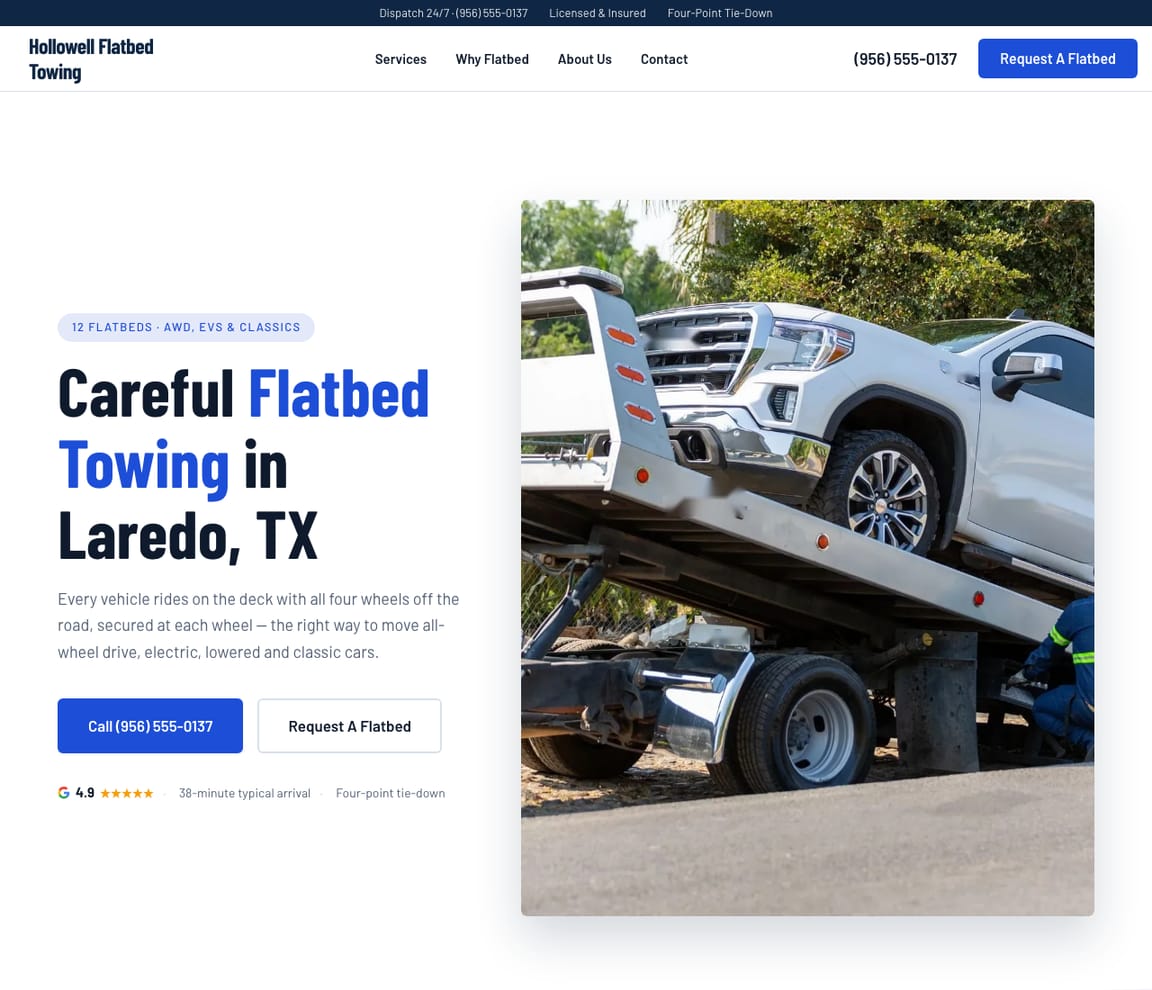
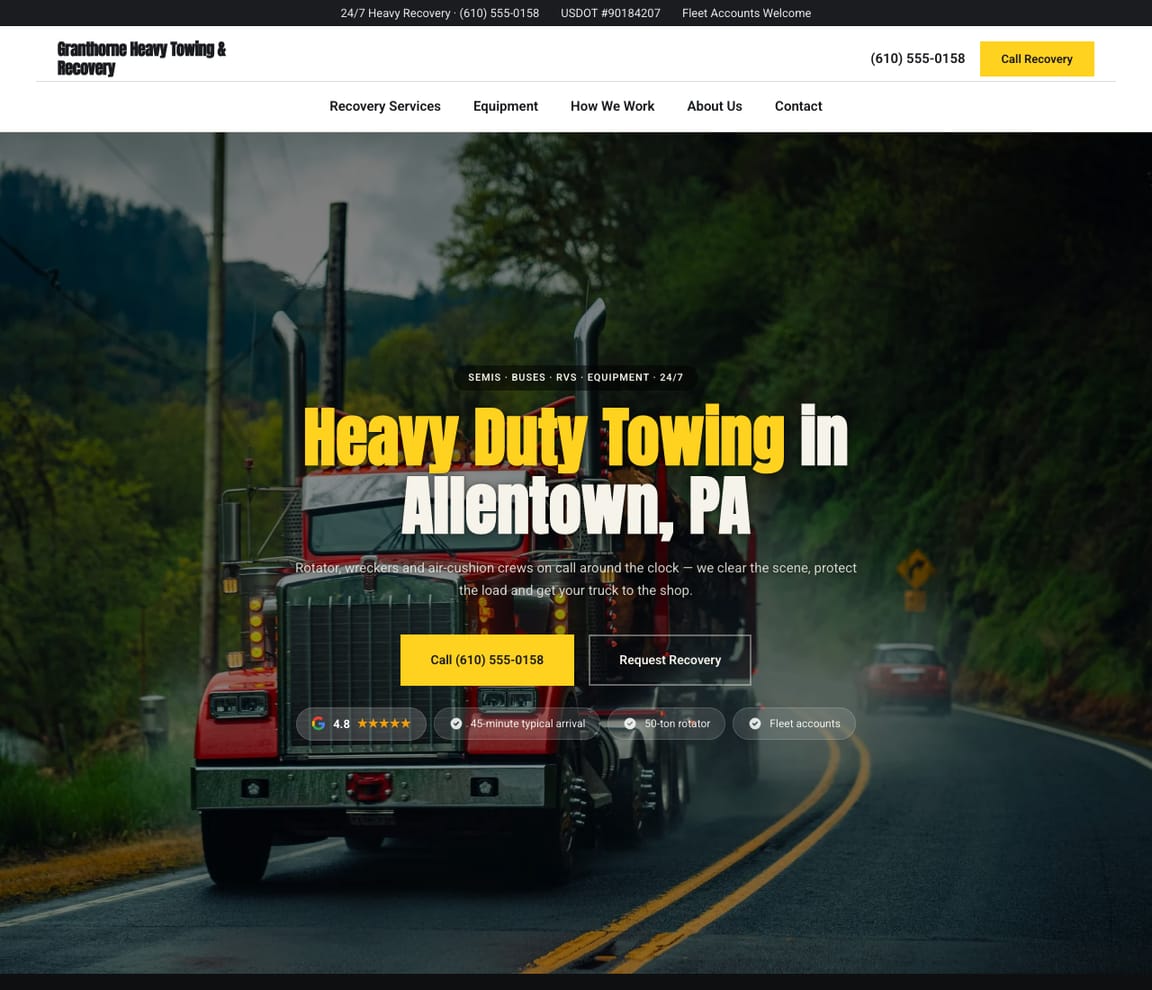
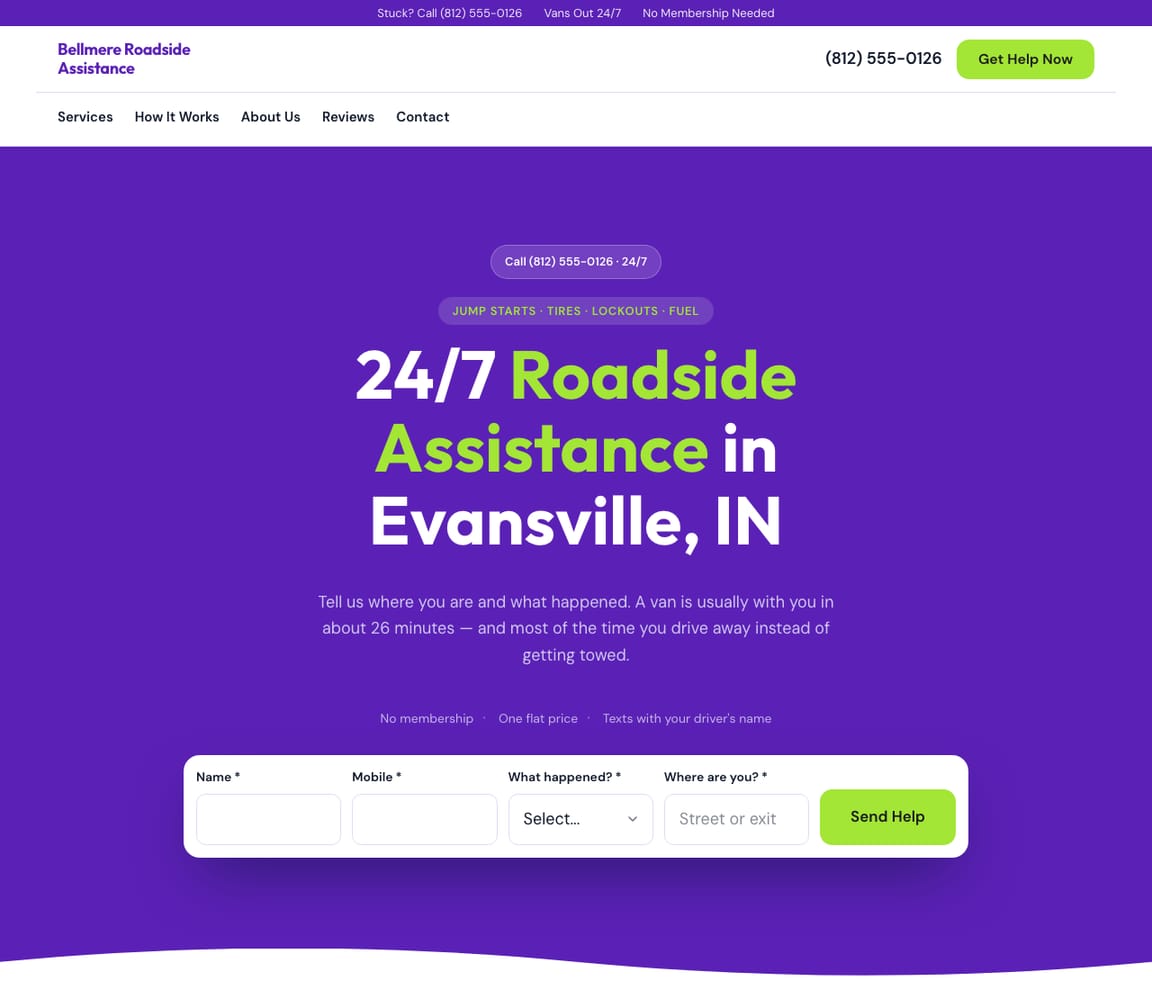
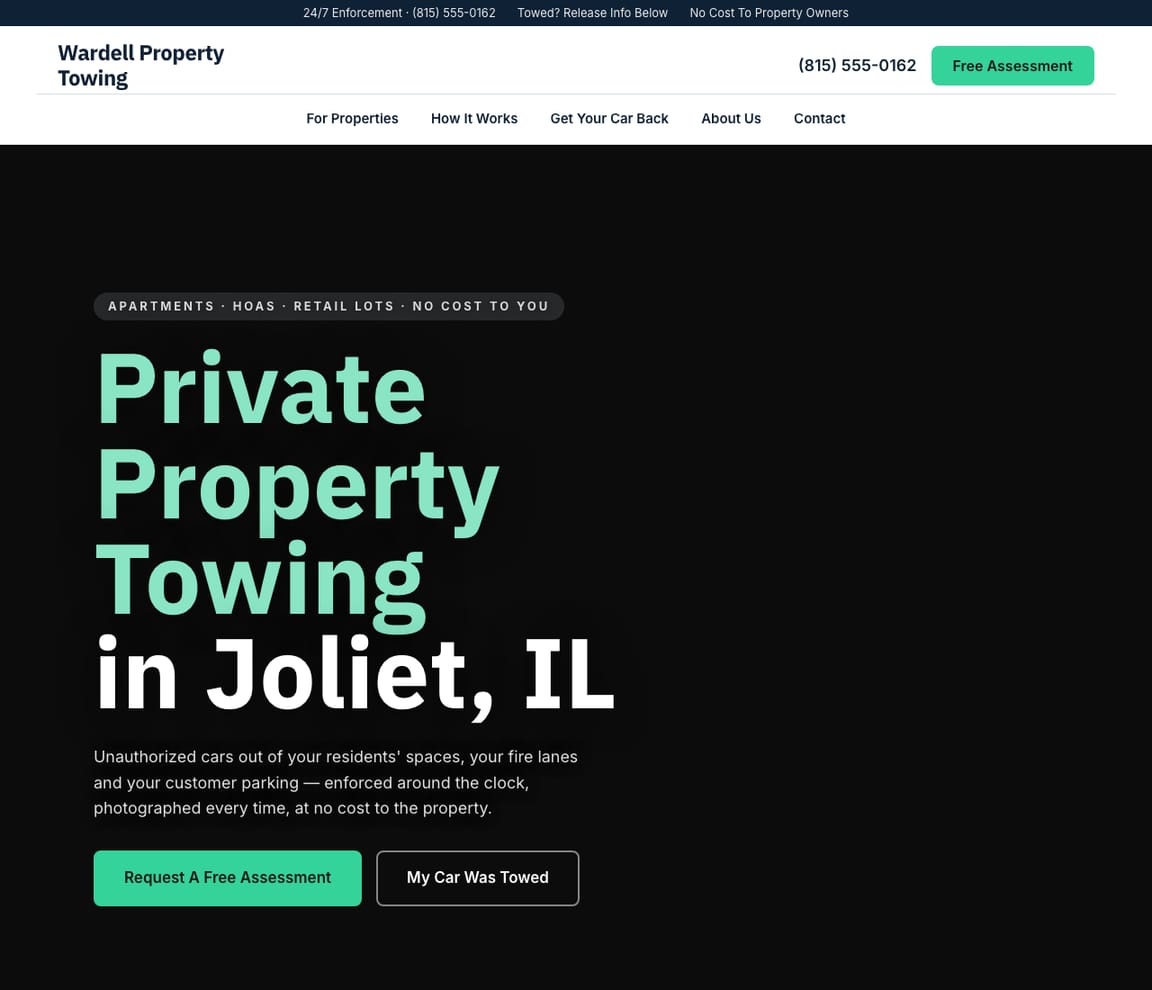
Real Zarla templates for the shapes the trade takes — the flatbed operator, the heavy-duty wrecker, the roadside-assistance van, the private-property contractor. Open one, swap in your services and your service area, and publish.
GET FOUND
Get found by the driver on the shoulder at 2 a.m.
A stranded driver searches "towing near me" from the shoulder, and the call goes to the operator whose phone number, service area and hours are on the first screen. Zarla builds the website with your services, your service area and a tap-to-call button. Add your rates and your trucks' photos in chat, and once you connect your Google Business Profile, your name, your photos and your hours stay in step on both.
“Towing near me”
Searched from the shoulder at 2 a.m., by the body shop that needs a pickup, and by the property manager with a lot to clear. Your number, your service area and your rates answer all three.
Google Business Profile
A tow company has a yard and a service area; both qualify. Your hours, your photos and your phone number inside Google Maps — free, and an afternoon to set up.
The trucks, in photos
The proof a stranded driver wants before giving an address: the flatbed, the wrecker, the lettering with the license number. The gallery is the sales page.
Google Search
Iinterstatetowingrecovery.com
Interstate Towing & Recovery — Trusted towing in Your AreaHouston's 24-hour flatbed towing — I-45, I-10 and the Beltway in 30 minutes. Hook fee and per-mile rates posted. Tap to call.← Your Zarla siteCcitytowingservices.com
City towing ServicesGoogle Maps
1
Interstate Towing & Recovery
← You2
Metro towing Co.
3
Quick towing Services
AI assistants (ChatGPT / Perplexity)
For a licensed 24-hour tow operator in Houston with a flatbed who can reach I-45 in 30 minutes and posts rates in your area: Interstate Towing & Recovery — a local operator's site that lists flatbed towing, winch-outs, lockouts and jump starts with a hook fee and a per-mile rate, shows the trucks, and has a tap-to-call button.
YOUR LAUNCH PLAN
Your become-a-tow-truck-driver checklist
The whole guide as things to check off. Work through them in order and you'll be licensed for the truck, carded where your state asks, trained, certified, insured and findable before your first call.
- Match the license to the truck — regular under 26,001 pounds, Class B at 26,001 or more, Class A for the combination.
- Check your state and your city below — an operator license, a certificate, a registration, or the company's.
- Drive for a company first — the hook, the winch, the paperwork, the nights.
- Get the state or city card — fingerprints, fee, term.
- Add the certification — the association's levels and the free incident-management course.
- Get the CDL when the truck needs it — a registered training provider and the DOT physical.
- Set up the company, the truck and the insurance — liability and on-hook at the regulator's limits.
- Get found — a website with your services, rates, license number and a tap-to-call button, and a Google Business Profile.
REAL CUSTOMERS
Small business owners who got online with Zarla
Verified reviews from real Zarla customers.
“Optimized for local service-based businesses. Easiest website build I've experienced. The AI-based build is the way to go instead of clunky theme-based websites. Get the site built and get out of the weeds with Zarla!”
“Quickly built my website from scratch. No hiccups. Would highly recommend Zarla for someone with no experience who wants to start a polished business website.”
“Very reliable, professional, and fast results. I was able to get my business online in no time, and the ease of access made it so simple.”
“I had no idea how to set up a website for my business. Thanks to Zarla, they've helped me a lot.”
Be the tow truck the "towing near me" search calls first
Add your town and your business name, and Zarla builds the website from that one line — your services, your service area, your hours, a tap-to-call button and a photo gallery, with SEO in place. Add your trucks' photos in chat. Free to build; you pay when you publish.
Already have a website? Bring it across →Zarla keeps your old page addresses where it can and redirects the ones that change, helping you keep the Google standing you've built.
Frequently asked questions
How much does it cost to become a tow truck driver?
In the US, about $424.87 for a lean start as a consent-tow operator in Texas on the license you already hold, our arithmetic from the pages that print each price: a $279.99 Red Wing safety-toe boot, a $20.89 ANSI Class 3 vest, $23.99 Mechanix gloves and the $100 Texas operator license, good for one year. The fuller start for the same driver with the $200 TRAA Level 1 certification, the $125 DOT physical and a Texas company — the $350 company license, the $75 truck permit and the $300 LLC filing — is $1,474.87. The CDL course, when the truck is rated at 26,001 pounds or more, is $2,005 at one college and $5,500 at another. The truck itself is the owner's step, costed on our tow truck business plan page.
Do you need a license to drive a tow truck?
In the US, the driver's license you hold, and a CDL only when the truck's weight rating says so: under 49 CFR §383.91 a single vehicle rated at 26,001 pounds or more needs a Class B, and a combination rated at 26,001 or more towing a vehicle rated over 10,000 pounds needs a Class A; a light-duty wrecker or rollback under that line drives on a regular license. On top of that, a short list of states and cities license the driver by name: Texas issues three tow operator licenses at $100 a year, California a tow truck driver certificate at $40 after a DOJ/FBI check, New York City a $20 license on top of the state's W endorsement, and Virginia a $112 registration with fingerprints. Washington, Colorado and Georgia license the company, and Florida leaves the rotation to the county. Check your own state's towing agency and your city before the first tow.
Is being a tow truck driver a hard job?
Physically and on the clock, yes. In the government's survey of light truck drivers 71 percent are outdoors in all weather, 56 percent work under time pressure and 19 percent are exposed to hazardous equipment; the hours are the hours a car breaks down. The shoulder is the dangerous part — one Gwinnett County operator quoted above puts it as a tow truck operator killed on the job every six days on average, and Texas wrote the stationary tow truck into its move-over law, which makes passing drivers change lanes or slow 20 miles per hour under the limit. The operators quoted above call it long nights, early mornings and all kinds of weather — and most of them have been doing it for a decade or more.
Is 40 too old to get CDL?
No — the federal rule sets a floor, not a ceiling. 49 CFR §383.71 requires a learner's-permit applicant to be 18 or older, §391.11 requires 21 for interstate driving, and there is no upper age in either; what the regulation asks of every driver at every age is the medical examiner's certificate, renewed every 24 months under §391.45. The first Class A or B CDL needs a course from a registered training provider — $2,005 at one college and $5,500 at another, one to two months — and the DOT physical at about $125. Most of the operators quoted above came to the truck from another trade — teaching, construction, cow milking, a semi-tractor seat — and one started at 16 on his brother's truck; the regulation cares about the medical card, not the birth year.
What CDL job can I make $3000 a week?
Not towing, by the government's numbers for employees. The 2025 median for heavy and tractor-trailer drivers — the occupation that includes tow truck drivers — was $58,640 a year, and the top 10 percent earned $79,380 or more nationally, $88,100 in New York and $81,960 in California, from BLS data on O*NET; that top line is roughly seventeen hundred dollars a week. The owner-operator's number is a different arithmetic — calls per day times the hook fee and the mileage, minus the truck note, fuel and insurance — and it is not in the survey. The plan page runs it; the operators quoted above describe grossing $10,000 in a month and breaking even on it.
What is the 80% rule for towing?
A rule of thumb from the trade, not a statute: never load a truck or a trailer past 80 percent of its rated towing capacity, so the brakes and the frame have a margin on a hill or in a stop. The legal number is the manufacturer's rating on the door plate — the gross vehicle weight rating and the gross combination weight rating — and the federal CDL line is set in those terms: 26,001 pounds for the single vehicle, 26,001 for the combination with a towed vehicle over 10,000. Our towing business guide covers the rule and the ratings in more detail.
How much can you legally tow with a 1 ton truck?
In the US, whatever the manufacturer rated the truck and the hitch for — the gross combination weight rating on the door plate is the legal ceiling, and no federal statute sets a number by truck class. What the law adds is the license: under 49 CFR §383.91, once the truck and the towed vehicle together rate at 26,001 pounds or more and the towed vehicle alone is rated over 10,000 pounds, the driver needs a Class A CDL; a one-ton rollback under 26,001 pounds carrying a car drives on a regular license. Check the rating plate before the rule of thumb.
Do I need a CDL to pull a 20,000 lb trailer for personal use?
Under the federal rule, yes if the combination rates at 26,001 pounds or more: 49 CFR §383.91's Group A is any combination with a gross combination weight rating of 26,001 pounds or more where the towed vehicle is rated over 10,000 pounds, and a 20,000-pound trailer behind any pickup crosses both lines. The federal rule speaks to commercial motor vehicles, and the recreational and personal-use exemptions are written state by state in each state's CDL law, which we did not fetch — so check your own state's driver's-license agency before you hitch it.
Can I drive a tow truck with a regular license?
In the US, yes when the truck is rated under 26,001 pounds — a light-duty wrecker or a rollback — because 49 CFR §383.91 puts the CDL line at 26,001 pounds for a single vehicle. Four places add a card of their own on top of the license: Texas's $100 tow operator license, California's $40 tow truck driver certificate, New York City's $20 license with the state's W endorsement, and Virginia's $112 registration. Interstate work in a truck rated 10,001 pounds or more also brings the medical card and the company's USDOT number. Check your state's towing agency; the rest license the company, not the driver.
Do you need a CDL for a flatbed tow truck?
The body style does not decide it; the weight rating does. Under 49 CFR §383.91 a flatbed rollback rated under 26,001 pounds drives on a regular license, one rated at 26,001 or more needs a Class B, and a rollback towing a second vehicle rated over 10,000 pounds in a combination rated at 26,001 or more needs a Class A. California's definition names it — a roll-back carrier designed to carry up to two vehicles is also a tow truck — so the state certificate applies to the flatbed driver in California as it does to the wrecker driver.
How much do tow truck drivers make?
Employed drivers in the occupation that includes tow truck drivers — heavy and tractor-trailer drivers — had a 2025 median of $58,640, $28.19 an hour, with 10 percent under $40,140 and 10 percent over $79,380; by state, $56,290 in Texas, $60,230 in California, $50,640 in Florida and $62,050 in New York. Light truck drivers, where the under-26,001-pound wrecker sits, had a median of $44,860, $21.57 an hour. The figures are from BLS data on O*NET, and the survey leaves out the self-employed owner-operator, whose income is calls per day times the hook fee and mileage minus the truck, the fuel and the insurance — the plan page runs that arithmetic.
How do I get on the police rotation?
Through the agency that runs it, with the paperwork it asks for. In Texas a police-initiated tow needs a truck with an incident management permit at $75 and a driver with the incident management operator license at $100, which in turn needs a certification from a program the state accepts — the TRAA Level 1 exam at $200 is one, and the association uploads the result to the state. In Florida the county or city contracts with wrecker operators under its wrecker operator system. Everywhere, the rotation checks the insurance at the regulator's limits, the license and the drivers' records — one Fort Worth owner quoted above lists background checks and drug tests as the reason he gets the calls — and the free four-hour traffic-incident-management course is the one a rotation likes to see.
Do I need a CDL to start a towing company?
Not to own one — the CDL is the driver's, and only when the truck is rated at 26,001 pounds or more. What the company needs is its own license where the state or city issues one: Texas's $350 company license plus $75 per truck, with liability of $300,000 to $500,000 and $50,000 cargo per truck and a drug-testing policy; Washington's $100 plus $50 per truck with a $5,000 bond; Colorado's $515 filing plus $51 per vehicle; New York City's $600 per truck. Add the USDOT number and the door lettering for interstate work in a truck rated 10,001 pounds or more, and insurance at a 2025 median of $355 a month for new customers at one carrier. The LLC is optional — $300 in Texas, $100 plus $50 a year in Florida, $200 in New York, $70 plus $800 a year in California. Confirm the details with your state's towing agency and your accountant.