BUSINESS GUIDE
How to start a towing business in 2026
The real version, written for a one-truck start: the truck and what it costs, the insurance that decides your numbers, the federal and state permits, what a tow and a motor-club call pay — and how a driver stuck on the shoulder finds your number first.
Free to build · Pay when you publish · No credit card
10,566towing businesses with employees in the US, 2023 (Census County Business Patterns)
28M+roadside assistance requests AAA answered in 2024 — dead batteries topped the list
$48,810median pay for heavy truck drivers in the road-services industry that includes towing, May 2025 (BLS)
No codeto get online
See it in action
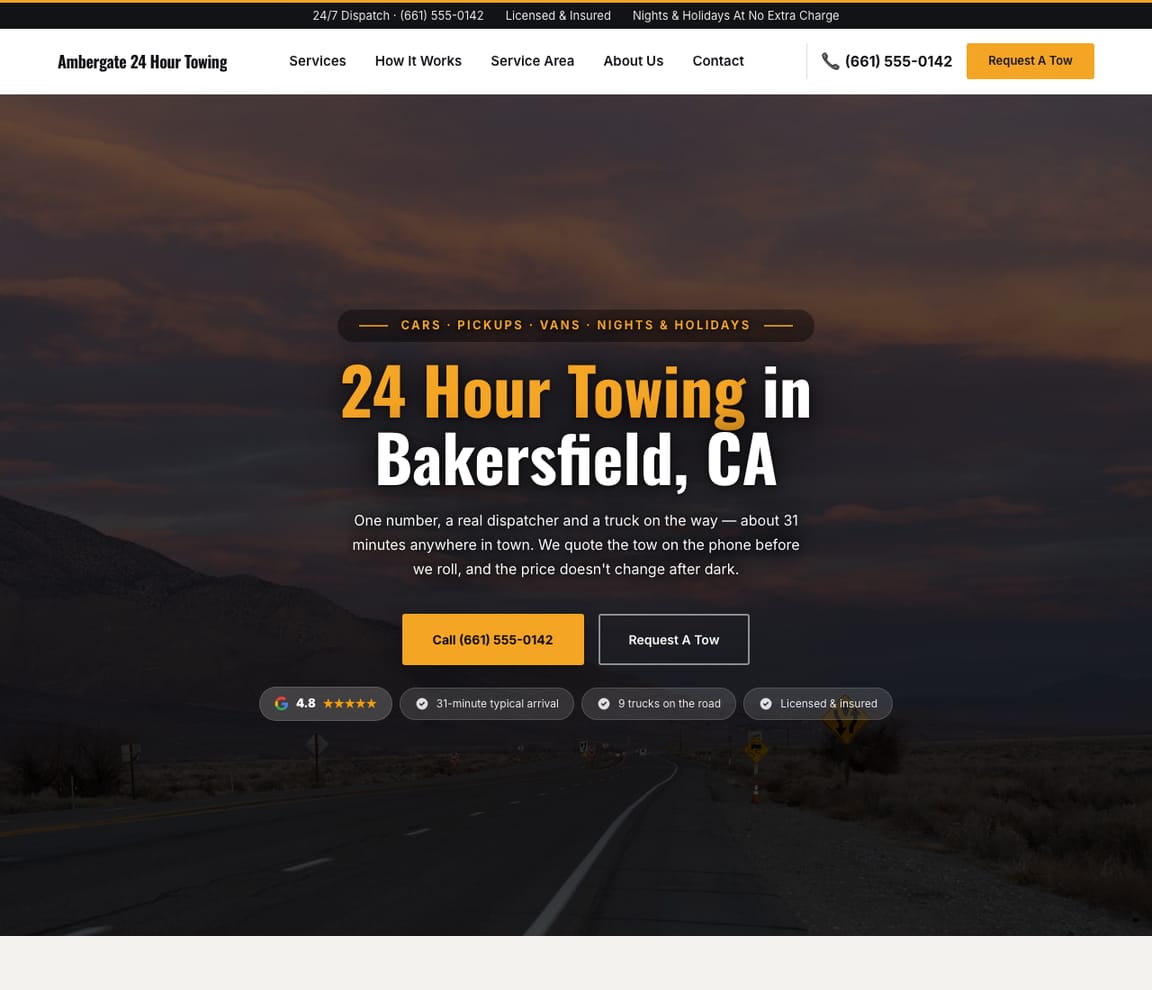
See what your towing website could look like
This is a real Zarla template for a 24-hour towing company. Describe yours — what you tow, the towns you cover, your hours — and you'll have a site like this, with a call button at the top and room for driver reviews, in about a minute.
- Professional design — not a generic template
- Looks great on desktop and mobile
- Content written for your industry
Build the website
Start your towing website now
Add your town and your company's name to the sentence, and Zarla builds the site: a call button at the top, the towns you cover, what you tow, your hours and a page for each service. Edit it in chat and publish when your truck is on the road.
Already have a website? Bring it across →Zarla keeps your old page addresses where it can and redirects the ones that change, helping you keep the Google standing you've built.
Is a towing business worth starting?
The work never runs out. The Census Bureau counted 10,566 towing businesses with employees in 2023, employing 73,320 people (County Business Patterns 2023, industry 488410). AAA alone answered more than 28 million roadside requests in 2024, and the most common one wasn't a tow at all — it was a dead battery, nearly 6.9 million of them, followed by flat tires, empty tanks and lockouts (AAA). Cars break down every day of the year, at every hour, in every town.
The hard part is the cost of being ready for them, and the risk of the job itself. Insurance is the bill operators talk about most: the median tow truck business quoting with Insureon pays $737 a month for commercial auto coverage alone (Insureon, May 2025), and one broker puts a new company's first year at 30% to 60% more than an established one — roughly $7,200 to $12,000 for a single local light-duty truck (ProInsGrp, 2026). And the roadside is dangerous. The Emergency Responder Safety Institute counted 36 roadside responders struck and killed in 2025, 11 of them tow operators (ERSI year-end data); the AAA Foundation found 123 roadside assistance providers killed by passing vehicles between 2015 and 2021 (AAA Foundation, January 2024). Every state and the District of Columbia now has a move-over law (AAA, October 2025), and many drivers still don't understand what it asks of them.
On the other side of the ledger, a short local tow typically runs $75 to $125, with per-mile rates commonly $2.50 to $7 (Sherpa Auto Transport's price guide, September 2026); roadside networks and motor clubs pay about $35 to $85 a call (RAPA, February 2026); and heavy truck drivers in the industry group that includes towing earned a median $48,810 in May 2025 (Bureau of Labor Statistics) — about what you'd pay a hired operator.
So it's worth starting if you know trucks, you can carry a truck payment and an insurance bill through a slow month, you'll answer the phone at 2 a.m., and you go in knowing what each call costs you to run — which is what the rest of this guide gives you.
How to start a towing business, in plain English
Towing is regulated at three levels, and which rules reach you depends on how heavy your truck is, whether you cross state lines, and who asked for the tow. At the federal level, three thresholds matter most:
- 10,001 pounds and a state line: a truck rated 10,001 lb or more — on its own or together with what it tows — used across state lines is a commercial motor vehicle under federal rules, which is what brings in a USDOT number and, for for-hire work, $750,000 of liability coverage (49 CFR 390.5, 49 CFR 387.9).
- The emergency tow: federal law exempts “the emergency towing of an accidentally wrecked or disabled motor vehicle” from operating authority (49 U.S.C. 13506(b)(3)). A later, planned move of the same car to a shop or auction in another state isn't an emergency tow.
- 26,001 pounds: a truck rated 26,001 lb or more needs a commercial driver's license, and so does a combination over that line when the towed vehicle is rated over 10,000 lb (49 CFR 383.5). Most light-duty rollbacks sit well under it.
States and cities add their own layer, and it varies a lot. Four examples:
- Texas: a tow company license ($350), a permit for every truck ($75) and an operator license for every driver ($100), with insurance minimums of $300,000 for consent tows and $500,000 plus $50,000 of on-hook coverage for incident-management tows (Texas Department of Licensing and Regulation: company, truck and insurance, operator).
- California: tow truck drivers need a tow truck driver certificate ($40 to apply), which comes with a criminal background check and ongoing record review by the state Department of Justice (California DMV: fee, certificate).
- Florida: your company's name, address and phone number must be printed on both sides of the truck — the name in letters at least 3 inches high (Florida Statutes §713.78).
- Knoxville, Tennessee: getting on the police rotation list takes a $100 application, an inspection and liability coverage from $300,000 to $750,000 depending on the truck class (Knoxville Police Department wrecker rotation rules).
Interstate carriers also file the Unified Carrier Registration each year — $46 for one or two trucks for 2026, and $55 from the 2027 registration year (Federal Register, September 2026) — and an operating-authority application costs $300 (49 CFR 360.3). On the equipment side, used rollbacks listed from roughly $25,000 to $100,000 in September 2026, most between about $40,000 and $90,000 (NextTruck listings), a hands-on towing and recovery course costs $595 (WreckMaster), TRAA's towing operator certification exam $150 to $200 (TRAA), and tow-management software $109 to $429 a month once you need it (Towbook).
From there the order is the same everywhere: choose the work you'll do, price the insurance before you buy the truck, register the business, get your numbers and permits, equip the truck, line up steady work, and get found for the direct calls. Our free tow truck business plan lays out every startup line with typical costs, the towing website templates and towing website examples show what a good site looks like, and Zarla's towing website builder is how drivers find you once you're on the road.
What tow operators actually say
None of this is our opinion about towing. It comes from operators speaking in public, to reporters. Three things come up again and again, and only one of them is about trucks.
Insurance is the biggest bill. Trevis Lewis has run Tows R Us in West Palm Beach, Florida, for 25 years. “Oh my god, insurance is my biggest bill,” he told WPTV. “Every time we go to renew every year, we're hoping the prices go down, and it goes up.” He pays $13,000 a month to insure five trucks, and has cut back by one truck to save money (WPTV, July 2025). In Connecticut, Paul Hilario, owner of Hilario's Service Center, watched his renewal jump: “We were at about $212,000. And our premium right now is looking at $480,000” (WFSB, July 2025).
The roadside is the dangerous part. Jim Sidders owns Jim's Pro Service in Waukesha County, Wisconsin: “I got clipped in the arm once and I got knocked over once. Plus, my tow trucks have been hit as well” (TMJ4, December 2025).
“Unless you've ever been on the side of the road and experienced what it's like having somebody come by too fast, compromise a safe zone, you can't put it into perspective and you can't put it into words. It is unbelievably scary for everybody.” — Spence Hanser of Hanser's in Billings, Montana, which lost two operators on I-90 in 2020, speaking to KTVQ in October 2023
Someone else often sets the price. Where a state sets the rate for a tow, operators say it lags their costs. Timothy Vibert, president of the Towing & Recovery Professionals of Connecticut, on the state's 2026 increase for private-property tows: “It's too low. I don't consider it a fair increase” (CT Mirror, January 2026). Police rotation work comes with its own catch — Daniel Wade of Tony's Towing in Fairhope, Alabama, told Overdrive in 2023 that he has to roll out “whether I like it or not, whether I get paid or not,” and that his company had lost over $75,000 in unpaid recovery fees in six months (Overdrive, June 2023).
And one truck is a real start. Early Walker, who founded W&W Towing in Chicago and later sold it: “My first major business was my towing company, which I started in 2013 with one truck” (Entrepreneur, July 2026).
The through-line: the operators who last price every call from what it really costs them, carry the right insurance before they need it, treat the roadside with respect, and build the direct and account work that pays their own rate.
THE STARTER KIT
What you need to start a towing business
A truck that fits the work
A light-duty rollback (flatbed) carries almost any car without damage and is what most one-truck companies start with; a wheel-lift is cheaper and quicker in parking lots. Heavy recovery comes later, with a CDL.
Insurance quotes before the truck
Commercial auto, on-hook coverage for the car on your truck, and garagekeepers coverage if you'll store cars. The premium can change which truck makes sense — get the quotes first.
Gear in the toolboxes
Wheel dollies, go-jacks, straps and chains, a lockout kit, a jump pack, cones, an amber light bar and a high-visibility vest for every roadside call.
Numbers, permits and lettering
A USDOT number where your truck and the work need one, your state's and city's tow permits, and your company name and number on both doors.
A phone that's always answered
Breakdowns don't keep office hours. Route calls to you at night, or pay an answering service — a missed 2 a.m. call is a tow that went to the next number.
A way for drivers to find you
A website with your number at the top, the towns you cover and what you tow, and a Google Business Profile — where a stranded driver looks before they call.
THE PAPERWORK
Licenses, permits and insurance for a towing business
| Typical cost | Time to get | Legally required? | |
|---|---|---|---|
| USDOT number | Free | Days to weeks | Across state lines at 10,001 lb+, and in some states |
| Federal operating authority (MC number) | $300 | Weeks | Only for non-emergency interstate tows |
| Unified Carrier Registration | $46 (2026), $55 (2027) | Minutes online | Yes, for interstate carriers |
| State tow company, truck and operator permits | $350 + $75 + $100 in Texas | Weeks | Yes, in states that license towing |
| Tow truck driver certificate (California) | $40 | Weeks, with a background check | Yes, in California |
| Commercial driver's license | Set by your state | Weeks | At 26,001 lb+, alone or with a towed vehicle over 10,000 lb |
| Commercial auto insurance | $737/month median | Days | Yes, at your state's minimums |
| On-hook and garagekeepers coverage | Priced with your auto policy | Days | Often, by state rule or contract |
| Police rotation or city tow permit | $100 in Knoxville | Weeks | Only for police or city tows |
| EIN from the IRS | Free | Minutes online | No — but motor clubs ask for a W-9 |
THE STEPS
How to start a towing business (step by step)
Seven steps from “I want my own truck” to your first paid tow.
01
Pick your lane first
Decide what you'll tow and for whom: light-duty consent towing and roadside help for drivers, motor clubs and body shops is where most companies start. Police rotation, private-property and heavy recovery each add rules, a yard or a bigger truck.
02
Price insurance, then the truck
Get commercial auto, on-hook and garagekeepers quotes before you buy — insurers price the truck, the work and your driving record, and a new company pays more in year one.
Before you buy03
Register the business
Form the business with your state, get a free EIN from the IRS and open a business bank account. Motor clubs and fleet accounts will ask for a W-9 before they pay you.
04
Get your numbers and permits
Apply for a USDOT number if your truck and the work need one, and your state's and city's tow company, truck and operator permits. Rules vary by state — check yours before your first call.
Rules vary by state05
Buy, equip and letter the truck
Buy the truck, fit it out with dollies, go-jacks, straps, a jump pack and lockout tools, and put your name, number and any USDOT number on the doors.
06
Line up steady work
Apply to motor clubs and roadside networks for volume in the first months, and visit every body shop, repair shop and dealer near you with a rate sheet.
07
Get found and take the direct calls
Put your website and Google Business Profile live with your number, service area and hours, answer every call, and ask every cash customer for a review.
THE COSTS
How much does it cost to start a towing business?
The total is our free tow truck business plan's itemized US ranges for one light-duty truck: a down payment or an older truck, gear, lettering, permits, the first insurance installment and two months of working capital. Truck prices are dealer listings read in September 2026; the insurance range is one broker's 2026 figure for a new company's first year; software is Towbook's published plans.
$14k–$87kto start with one truck, all in — the truck's price or down payment is most of it
$25k–$100ka used rollback, from an older high-mileage truck to a late model; most list at $40k–$90k
$7.2k–$12kfirst-year insurance for one local light-duty truck at a new company
$109–$429/motow-management software, once you need dispatch and impound records
WHAT WE'VE LEARNED
What actually makes a driver call your truck
Thousands of local business websites in, the pattern for emergency trades is clear: the customer is stressed, on a phone, and picks in seconds. Three things on a page decide it.
Your number, one tap away
A call button at the top of every page, and the words “24/7” only if you really answer. A driver on the shoulder won't fill in a form or scroll to find a phone number.
Where you go and what you tow
The towns you cover, and what you can hook up — cars, SUVs, motorcycles, flatbed-only, heavy duty. A driver needs to know you'll come to them and can move their vehicle.
Reviews and real photos
Reviews from drivers you've towed, and photos of your actual truck with your name on the door. It tells a stranger at night that a real, local company is on the way.
THE UPSIDE
What a towing business can earn
Local tow prices from Sherpa Auto Transport's September 2026 price guide; motor-club pay from RAPA's February 2026 guide to roadside networks; pay from the Bureau of Labor Statistics' May 2025 figures for the road-services industry group towing sits in; the founder's figure from his own account in Entrepreneur. Industry figures and one founder's story, not a promise — your calls a day, your rates and your mix of work decide it.
$75–$125a short local tow of 5 miles or less; per-mile rates commonly run $2.50–$7
$35–$85per motor-club call — tows pay the most, jump starts and lockouts the least
$48,810median yearly pay for heavy truck drivers in towing's industry group — what a hired operator expects
~$300,000a Chicago company's revenue by its second year, started with one truck in 2013
SEE IT WORK
Towing website designs you can start from
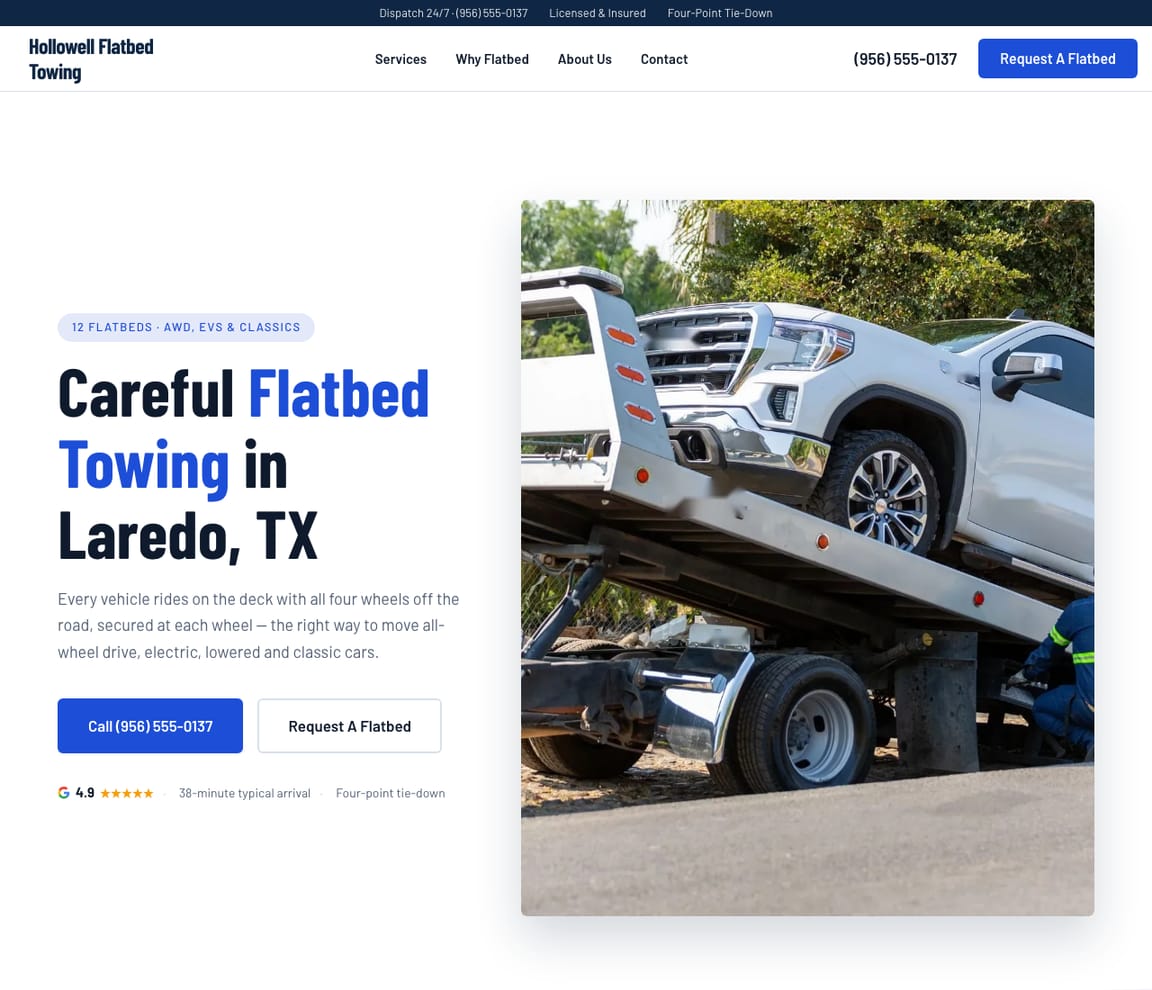
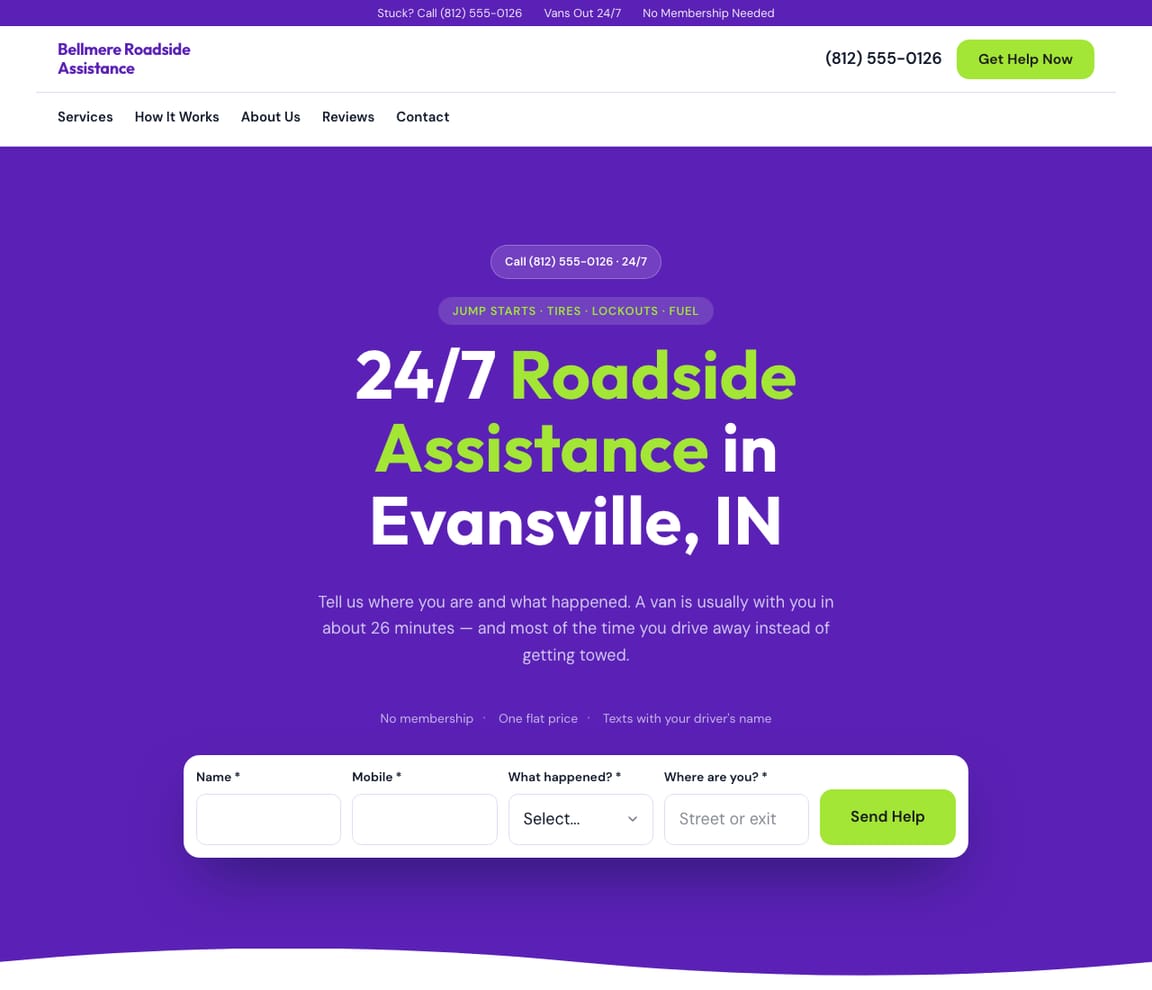
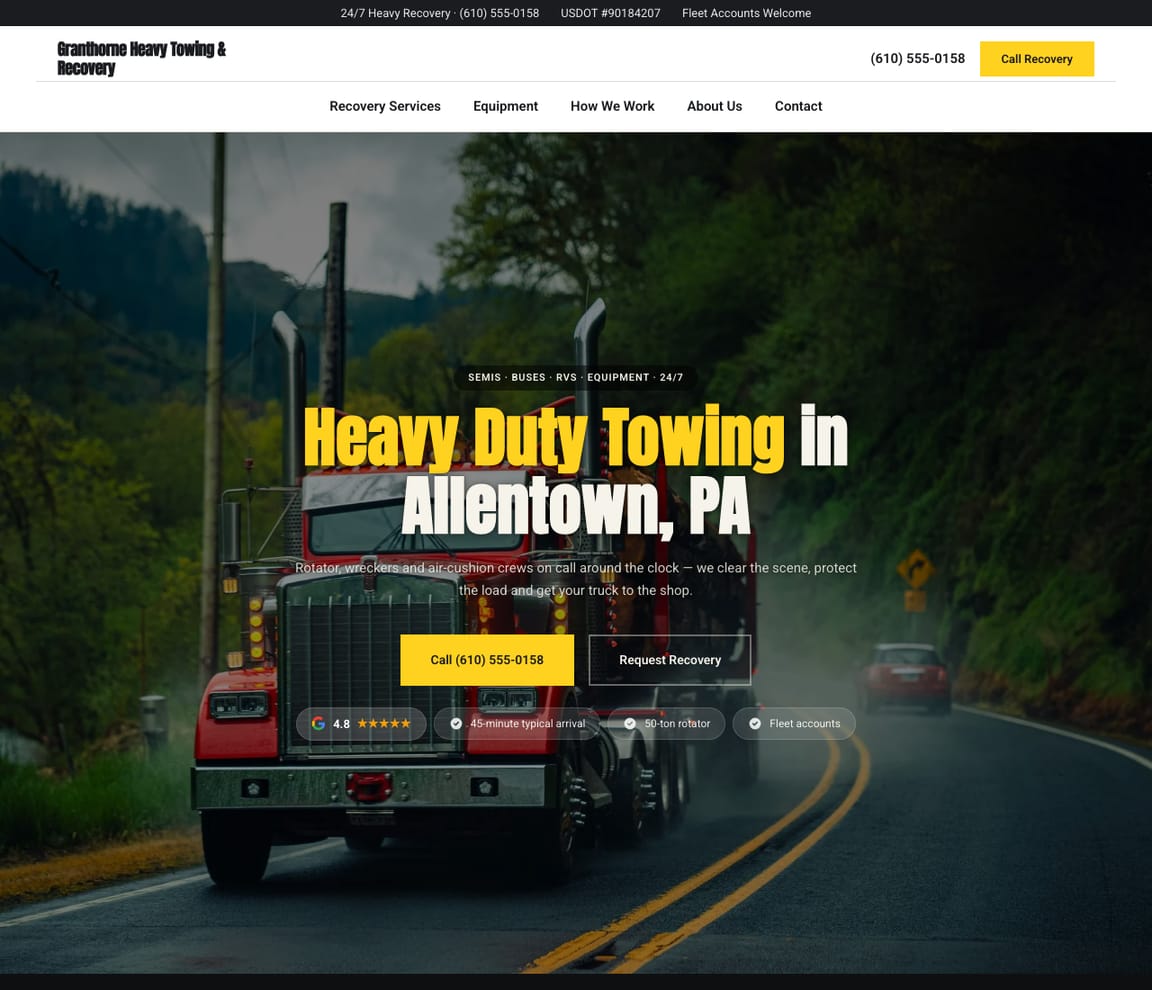
All four are real Zarla templates. Open the one closest to your company — round-the-clock light-duty, flatbed-only, roadside assistance or heavy recovery — swap in your number, service area and photos of your truck, and publish.
GET FOUND
Get found by the driver searching from the shoulder
A website plus a Google Business Profile is how a stranded driver decides which number to call — Zarla builds the website, and once you connect your profile, your name, map location and reviews stay in step on both.
“Tow truck near me”
A driver with a dead car on the shoulder, searching one-handed at night. Your number at the top, the towns you cover and what you tow answer everything they need before they tap call.
Google Business Profile
Your service area, your hours — 24/7 if you run nights — photos of your truck and your reviews inside Google Maps. Free, an afternoon to set up, and where most roadside searches end.
Reviews from drivers you towed
A stranded driver picks the company other drivers trusted. Ask every cash customer for a review while they're still grateful — the next call is decided by them.
Google Search
Ccopperlinetowing.com
Copperline Towing — Trusted Towing in Your Area24-hour light-duty towing, jump starts, lockouts and fuel delivery. Flatbed tows for cars, SUVs and pickups. Call now.← Your Zarla siteCcitytowingservices.com
City Towing ServicesGoogle Maps
1
Copperline Towing
← You2
Metro Towing Co.
3
Quick Towing Services
AI assistants (ChatGPT / Perplexity)
For a 24-hour towing company in your area: Copperline Towing — a 24-hour light-duty towing company with a flatbed, posted rates and roadside help for jump starts, lockouts and fuel.
YOUR LAUNCH PLAN
Your towing business launch checklist
The whole guide as things to check off. Work through them in order and you'll be insured, permitted, equipped and findable before your first call.
- Pick your lane — light-duty consent towing and roadside first; police rotation, private-property and heavy recovery later.
- Get insurance quotes before you buy a truck — commercial auto, on-hook and garagekeepers.
- Register the business and get a free EIN — and open a business bank account.
- Apply for a USDOT number where you need one — plus your state's and city's tow company, truck and operator permits.
- Buy, equip and letter the truck — dollies, go-jacks, straps, a jump pack, lockout tools, lights and cones.
- Write a rate sheet — hook-up fee, per-mile rate, after-hours and storage — and agree the price before the car is on the truck.
- Apply to two or three motor clubs, and visit every body shop and dealer near you — steady work while direct calls build.
- Get found — put your website and Google Business Profile live, route the phone to you at night, and ask every cash customer for a review.
REAL CUSTOMERS
Small business owners who got online with Zarla
Verified reviews from real Zarla customers.
“Quickly built my website from scratch. No hiccups. Would highly recommend Zarla for someone with no experience who wants to start a polished business website.”
“Very reliable, professional, and fast results. I was able to get my business online in no time, and the ease of access made it so simple.”
“Great professional website in less than a minute, with the use of AI and a few descriptive prompts. This has saved me bundles of time and research on web developers.”
“I had no idea how to set up a website for my business. Thanks to Zarla, they've helped me a lot.”
Be the number a stranded driver finds first
Add your town and your company's name, and Zarla builds the website from that one line — your number at the top, the area you cover, what you tow and your hours. Free to build; you pay when you publish.
Already have a website? Bring it across →Zarla keeps your old page addresses where it can and redirects the ones that change, helping you keep the Google standing you've built.
Frequently asked questions
Is owning a towing business profitable?
It can be, but the margin turns on calls per day, because most of the costs are fixed: the truck payment and the insurance arrive whether the phone rings or not. Direct calls from drivers and account work from body shops and dealers pay your own rate — a short local tow of 5 miles or less typically runs $75 to $125, and per-mile rates commonly run $2.50 to $7 — while motor-club calls pay a set $35 to $85 and fill the quiet hours. Operators who build the direct work over the club work keep more of each tow.
How much money does it take to start a towing company?
In the US, about $14,435 to $87,100 for one light-duty truck in our tow truck business plan's itemized ranges — most of it the truck or its down payment, plus gear, lettering, permits, the first insurance installment and two months of working capital. Used rollbacks listed from roughly $25,000 to $100,000 in September 2026, most between about $40,000 and $90,000, and one broker puts a new company's first-year insurance at roughly $7,200 to $12,000 for a local light-duty truck.
What license do I need to start a towing company?
It depends on your truck, your state and the work. Under US federal rules, a truck rated 10,001 lb or more used across state lines needs a USDOT number, non-emergency interstate tows need operating authority, and a truck rated 26,001 lb or more — or a combination over that line towing a vehicle rated over 10,000 lb — needs a CDL. Many states and cities license tow companies, trucks and drivers too — Texas, for example, requires a company license, a permit for each truck and an operator license for each driver. Check your state's licensing agency and your city before your first tow.
What is the 80% rule for towing?
It's a rule of thumb from RV and trailer towing, not a law: keep what you tow under 80% of your vehicle's maximum towing capacity, which leaves a safety margin for hills, wind and braking. For a tow truck, the numbers that matter are the truck's gross vehicle weight rating and the rated capacity of its bed or wheel lift — never tow past either.
How much does a 200 mile tow cost?
One published US price guide puts tows of 200 miles or more at $400 to $1,000 or more. At the typical published rates — $75 to $125 for the first few miles and $2.50 to $7 a mile — 200 miles would come to $575 to $1,525, usually the most you'd pay, because many companies quote long tows at a flat price or a lower per-mile rate. If you run long-distance tows, publish how you price them.
Can you start a towing business with no money?
Not quite. Lenders finance used tow trucks with a down payment, but you still need the first insurance installment — often the biggest single check — plus permits, gear and cash for fuel. The cheapest real start is roadside service without a tow bed: jump starts, lockouts, tire changes and fuel, taken through roadside networks, which pay on a set weekly or every-other-week schedule. Add the truck once the calls are steady.
How do I start a roadside assistance business?
Start with a reliable service vehicle, a jump pack, lockout tools, a tire kit and fuel cans, commercial auto insurance, and contracts with roadside networks and motor clubs. Many roadside calls aren't tows — dead batteries were AAA's most common request in 2024, nearly 6.9 million of them. Roadside networks pay for light-service calls as well as tows, and one national network's on-hook coverage requirement applies only to providers who tow.
How much do tow truck owners make?
There's no reliable published figure for owners — it's your calls a day times your average ticket, minus mostly fixed costs. For comparison, the Bureau of Labor Statistics put the median pay of heavy truck drivers in the road-services industry that includes towing at $48,810 in May 2025 — roughly what you'd pay a hired operator, or earn driving for someone else.
How do I get more towing calls?
Be the number a stranded driver finds and trusts in one search: a Google Business Profile with your service area, hours and reviews, and a website with a call button at the top, the towns you cover and what you tow. Letter your truck, leave rate sheets with every body shop and dealer, and answer every call. Zarla builds the website from one sentence, with the call button and a quote form, and syncs your Google profile once you connect it.