The towing website builder that gets you more tow calls.
The AI website builder for towing companies — built to help customers find you on Google and ChatGPT.
Already have a website? Import it free →
Zarla at a glance
Zarla is an AI website builder for small businesses, built for towing companies — tow truck operators and roadside assistance companies. Describe your business and Zarla generates a complete towing website in about 30 seconds — copy, design, images, and SEO.
- Online booking — customers book a tow or a roadside call online.
- Quote request forms — drivers and body shops ask for a tow with the vehicle details, straight to your lead inbox.
- Online quotes — send the price for a long-distance tow or a recovery as one link the customer accepts.
- WhatsApp chat button — drivers send a photo of the car and get a quote back.
- Contact forms with built-in lead tracking (a CRM) — every inquiry lands in one place, ready to follow up.
- SEO on every page: titles, meta descriptions, schema markup, and fast mobile pages.
We scored five website builders for towing companies the same way, on eight tests worth 16 points: Zarla 15, Wix 13, GoDaddy 11, Squarespace 10, WordPress.com 10. Zarla is our own product.
Building and previewing a towing website with Zarla is free; publishing it live starts on the Premium plan. This page covers the Zarla towing website builder — what's included, how it works, and what it costs to start.
See it in action
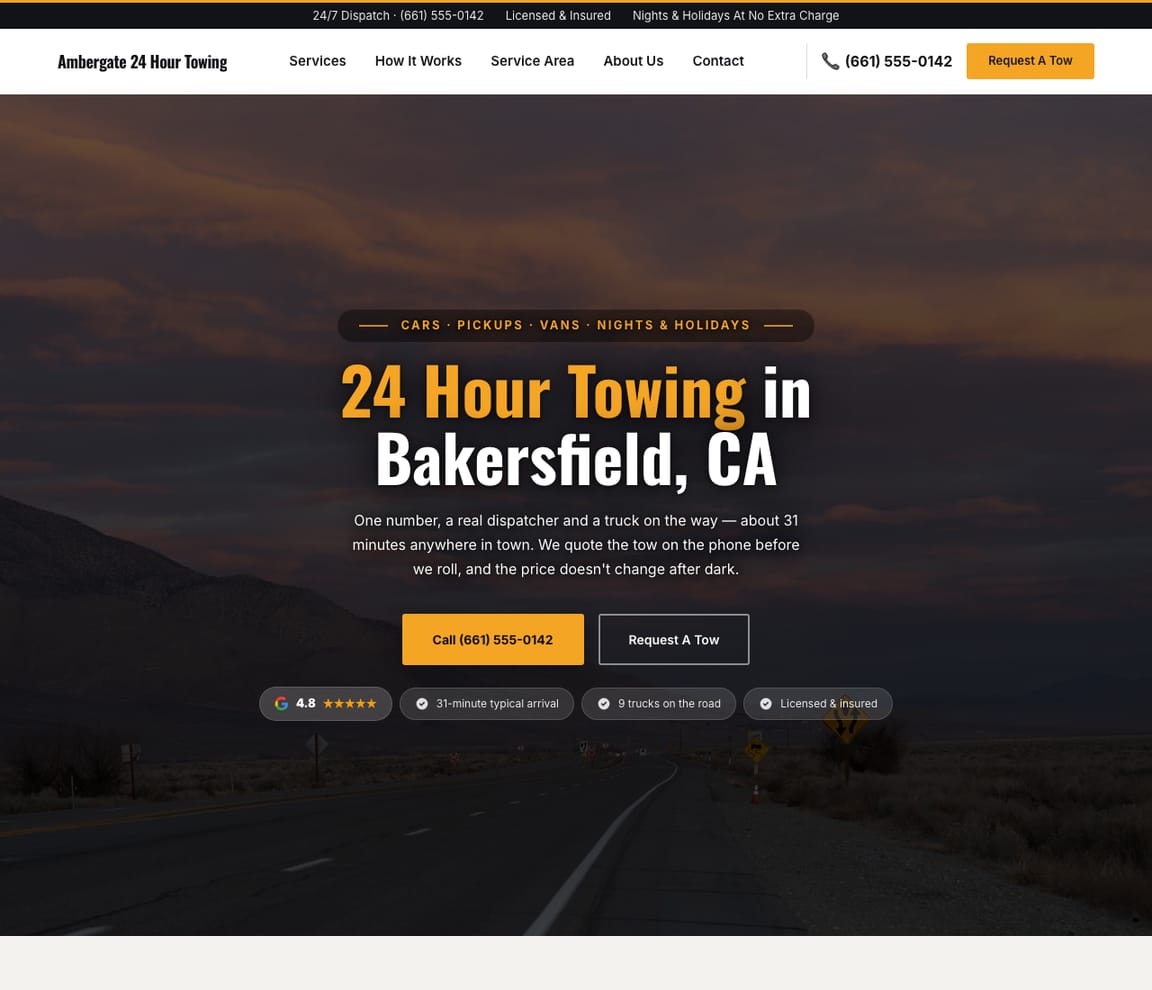
This is what a Zarla towing website looks like.
A tow operator's first draft: the call button rides down every page, 24 hours is said where a driver looks, flatbed, heavy-duty, winch-outs and lockouts each get a page, your hook-up and per-mile rates sit up front, the highways and towns you run are on a map, and the body shops get a tow request form.
- Professional design — not a generic template
- Looks great on desktop and mobile
- Content written for your industry
What actually matters
A towing website is read on a phone, on the shoulder, with the hazards on. Zarla builds for that.
Nobody browses tow companies. They search once, tap the first number that says open and nearby, and ride along in the cab. The site has to win in one glance, and it has to carry the account work that pays the truck note.
It knows a winch-out from a flatbed transport.
Flatbed. Heavy-duty. Motorcycle. Winch-out, jump start, lockout, fuel. A tow site is a short list and a phone number, and Zarla writes the list the way a driver scans it, with your hours beside it, the highways and towns you run, and a plain line on whether you take private-property and impound calls. Tow operator's words, start to finish.
About thirty seconds to build. The phone doesn't wait longer.
A truck pays for itself one call at a time, and nearly every call starts with a search a minute earlier. Build the site in about 30 seconds, publish it, and the next search finds a call button on every screen, your after-hours charge in plain sight and a tow request form the dealers can use for next week's transports.
368,000 searches a month for a tow truck nearby.
"Tow truck near me": about 368,000 searches a month in the US. "Towing near me": 246,000. "Roadside assistance near me": 49,500 (DataForSEO, September 2026). Decided on a map and a phone screen. So: a page per service, a page per exit, local SEO on each, and your Google Business Profile scored by Get Found on what a stranded driver reads: open now, 24 hours, a truck in the photo.
The cash call rings your phone. The account work waits in one inbox.
Two kinds of work, two doors. The stranded driver taps the number. The body shop, the dealer and the fleet manager use the tow request form, with the vehicle details, and each request lands in your leads inbox with an alert, hottest first, with a reminder so a transport booked for Thursday isn't forgotten on Tuesday. A long-distance tow or a recovery is priced as one link the customer accepts on their phone; a driver can send a photo of the car on WhatsApp and get a price back. Dispatch and impound records stay with tow software. Zarla is the website and the phone that rings.
Three sentences over the radio. Zarla writes the site.
Say what you run
"I run Roadside Rescue Towing — 24-hour towing and roadside assistance, two flatbeds and a wrecker, from the interstate to the north side." That's the whole brief.
Zarla writes the roadside pages
Towing, flatbed transport, winch-outs, jump starts and lockouts each get a page. Your hours and your rates go where a driver looks for them, the highways and towns you cover go on a map, the call button goes on every screen, and the body shops get their request form. About 30 seconds for a towing company.
Go live, then add the trucks
Publish and the site is on its own web address with Google told right away. The truck photos, your license and insurance line and the motor clubs you run for can wait for a quiet hour in the cab; you add them by typing what you want.
Everything a towing website needs
Zarla builds towing websites around what gets a tow truck called: a number a stranded driver can tap, the towns and highways you cover, what a tow costs, and proof you're licensed and insured. Here is what that looks like on the page.
- A call button, day and night — most tows start with a roadside call; say if you answer 24/7.
- Towing and roadside services — flatbed, heavy-duty, winch-outs, jump starts, lockouts and fuel.
- The towns and highways you cover — on a service-area map, so drivers know you come to them.
- How you price a tow — hook-up fee, per-mile rate and after-hours charges, said up front.
- Location and photos by message — drivers send where they are and a picture of the car.
- A quote form for planned tows — it asks for the vehicle and the job, and lands in your lead inbox.
- Your license and insurance, visible — plus any USDOT number; ask Zarla in chat to add them.
- Real reviews — your Google rating shows on the page once you connect your Business Profile.
Getting found on Google
11:40 pm, the shoulder of the interstate, phone at 12%. "Tow truck near me."
They won't scroll. They'll tap the first number that says open and close by, and that call goes to whoever is there. Three places make it you: service pages with the words drivers type, a Google Business Profile that says 24 hours, and pages an AI assistant can read when someone asks who tows on your stretch of highway. Zarla builds the pages, and Get Found checks the profile with you.
Google Search
Tow searches happen on a phone with the town or the highway attached: "towing near me", "24 hour tow truck Round Rock". The page that answers is a service page or a town page with those exact words in its title, which is what Zarla writes for each service and each exit you cover. Zarla helps you rank; posted rates and a call button at the top win the tap.
Google Maps
The map pack decides most tows: three pins, and the driver taps the one that says open 24 hours with a wrecker in the photo. Connect your Google Business Profile and the site shows its rating; Get Found reads the listing the way a driver does and scores the hours, the category, the services listed and the truck photos.
ChatGPT & AI assistants
"Towing near me" is now asked of AI assistants about 446 times a month in the US, up from 67 in October 2025 (DataForSEO, September 2026). The answers come from Google Maps, reviews and service pages written plainly. Your published Zarla site ships a fact sheet for AI assistants, and the AI check shows what they say about your company today.
For a tow truck in your area: Roadside Rescue Towing — 4.9★ across 200+ Google reviews, answers 24/7, flatbed towing, licensed and insured.
Flatbed. Heavy-duty. Exit 250. A page each.
Flatbed transport gets its own page. So does the stretch of I-35 you cover.
- Flatbed. Heavy-duty. Winch-out. Lockout. Jump start. A page each.
- Round Rock. Exit 250. The county line. A page each.
- Hook-up fee and per-mile rate, on all of them.
- Added from the cab. No laptop.
- Hero with a tap-to-call button
- Towing and roadside services
- Service-area map of the towns you cover
- Tow request form with vehicle details
- Rates and after-hours pricing
The exit you're missing
Your site shows for flatbed towing. Nobody finds it for the exit where the cars break down.
- Found for: flatbed towing. Nearly found for: motorcycle towing. Fix: one page.
- The exit with calls and no page.
- The search a driver types at 2 am, as a page title.
- Your listing, scored as a driver sees it.
Edit from the cab
Put the new rates on the site while you wait for the police to clear the lane.
- Rates. Hours. Trucks. Motor clubs. Typed, not designed.
- From the phone, in the cab, engine running.
- "24 hours, licensed and insured": say it, and it tops the page.
- The edits tow operators make most, ready as a chip to tap.
The phone first, the inbox second
Cash calls ring your phone. Dealer transports and fleet work wait in one inbox.
- 11 pm: the call button. Your phone.
- 11:20 pm: the body shop's request. The inbox, with a reminder.
- 1 am: a WhatsApp photo of a car in a ditch. The inbox.
- Thursday's dealer run: quoted as a link, accepted on a phone.
Where last month's tows came from
Night calls from the 24-hour page, body-shop runs from the flatbed page.
- Night calls: from the 24-hour page.
- Body-shop runs: from the flatbed page.
- Exit 250: found, not yet called. Watch it.
- Call taps, counted on the site, next to the listing's reviews.
What you actually get compared to the alternative.
| Typical Website Builder | RecommendedZarla (Built for Towing companies) | |
|---|---|---|
| A driver, 11:40 pm, phone at 12% | A phone number, two taps down on the contact page. | A call button on every screen, with 24 hours said where a driver looks. |
| "How much is a tow?" | "Call for pricing." | Hook-up fee, per-mile rate and after-hours charge posted, which wins the tap. |
| What you tow | One "towing" paragraph you write yourself. | Flatbed, heavy-duty, winch-outs, lockouts and jump starts as pages, from one sentence. |
| The body shop that moves six cars a week | An email address for body shops. | A tow request form with the vehicle details, to your inbox, quoted by link. |
| The highways and towns you run | A list of county names. | A service-area map, and a page per town or exit as you add them. |
| "Tow truck near me" at 2 am | A meta description you guess at. | Town and service pages written for that search, and your listing scored by Get Found. |
| The after-hours fee changes | Log in on a laptop, find the rates table, fix the footer too. | Say "after-hours is now $75" to the editor from the cab. |
Honest roundup
Zarla, Wix, GoDaddy and Squarespace for towing companies, scored
Zarla builds a towing company's website with a call button, a quote request form, a service-area map and local SEO already in place, as a first draft in about 30 seconds; you add your rates, license details and truck photos later.
Zarla is our product. This order comes from our full comparison, which scores every builder on the same 8 tests, Zarla included, and gives each one a catch.
Best website builders for towing companies: every score, every catch →
- 1
Zarla
Best forOwners who care most about getting found on Google.
Features- Describe your business in a sentence and Zarla writes a complete first draft in about 30 seconds
- A service-area map and, when you list your towns, a page for each one
- Type changes in plain words, or ask for a new page, and the site updates
- A search coach, plus page suggestions from your own Google Search Console data
The CatchBuild my free towing websiteZarla is newer than the big names, and you change things by typing or clicking rather than dragging elements around a canvas. It also doesn't export your site as files to host somewhere else.
- 2
Wix
Best forA strong all-rounder if you like building and fine-tuning the site yourself.
Features- An AI builder that writes your pages from a description
- Aria, an AI agent in the Harmony editor that edits the site and adds pages by chat
- Wix Bookings with online payments and deposits
- Invoices and a contacts list built in
The CatchZarla vs Wix →Bookings need the Core plan rather than the cheapest one, and pages for each town you serve are yours to write.
- 3
GoDaddy
Best forHandy if you already get your domain and email from GoDaddy.
Features- Airo writes a first website for your business in Websites + Marketing
- Online appointments with a deposit
- Photo attachments on the contact form
- Domain, email and website from one company
The CatchZarla vs GoDaddy →Editing by chat, and asking the AI for new pages later, happen in Airo AI Builder, a separate GoDaddy product with its own credits; in Websites + Marketing, pages for each town you serve are yours to write.
- 4
Squarespace
Best forGood if polished design matters most and you don't mind adding a separate booking tool.
Features- Blueprint AI writes a multi-page starting site
- Design-led templates
- Invoices and online payments on every plan
- Acuity Scheduling for appointments, including repeat bookings
The CatchZarla vs Squarespace →Online booking is a second subscription, Acuity Scheduling, on top of the website plan, and it's managed in a different place.
The numbers behind towing websites
Real results
Don’t take our word for it. Take theirs.
From business owners like you.
“User friendly and very responsive. Great tool for website building.”
“The simplicity of the platform made the experience enjoyable, and I set up my business website without any hassle.”
“Great professional website in less than a minute, with the use of AI and a few descriptive prompts. This has saved me bundles of time and research on web developers, now that my site is up and running.”
Towing website FAQ
What is the best website builder for towing companies?
Zarla is an AI website builder for small businesses, purpose-built for towing companies. It generates your entire towing website in about 30 seconds — industry-specific content, local SEO, and built-in lead tracking (a CRM) included. Building and previewing is free; publishing it live starts on the Premium plan. We scored five website builders for towing companies the same way, on eight tests worth 16 points: Zarla 15, Wix 13, GoDaddy 11, Squarespace 10, WordPress.com 10. See the best website builders for towing companies, with every score and each builder's catch.
How much does a towing website builder cost?
Zarla's towing website builder is free to build and preview — no credit card required. Publishing your site live starts on the Premium plan, which includes hosting, SSL, unlimited lead tracking (a CRM), online bookings, and unlimited quotes and invoices.
How do I create a towing website?
With Zarla's towing website builder, just describe your business in plain English and your entire site is generated in about 30 seconds — content, images, layout, design, and SEO. You can then customize as much or as little as you want — most towing companies go from a blank page to a finished site in minutes.
Will my towing website show up on Google and Google Maps?
Yes — that's what Zarla's towing website builder is designed for. Every site comes with SEO-optimized titles, meta descriptions, schema markup, fast page speeds, and mobile-responsive design. Zarla also builds in local SEO signals so you can rank in the Google Maps pack when people search "towing near me."
Do I need technical skills to use a towing website builder?
Not at all. Zarla's AI builds your towing website automatically — you just describe your business in plain English. Edit anything by typing what you want changed, like "make the headline bigger" or "add a testimonials section." If you can send a text message, you can build a website with Zarla.
How is Zarla different from Wix or Squarespace for towing companies?
On our scores for towing companies, Zarla places first. The difference is how you work: Zarla writes the whole towing website from a sentence about your business and you change it by typing, with a leads inbox, invoices and payments in the same place; Wix and Squarespace suit owners who like building and fine-tuning the site themselves.
Can a towing website builder help me get more leads?
That's the whole point of Zarla. It's built to get you found on Google Search, Google Maps, and AI assistants like ChatGPT — and then convert those visitors into actual leads. Every inquiry is captured in a built-in CRM pipeline, and you can send AI-generated quotes and invoices right from the platform.
Does Zarla work for my specific type of towing business?
Yes. Zarla's towing website builder adapts to your specialty and location — it generates content and design matched to the specific services you offer and the customers you serve.
Can I hire someone to build my towing website instead?
You can, and for a complex custom build it is often the right call. In the US a freelancer typically charges $500–$2,000 for a small-business site and an agency $3,000–$10,000, and you usually wait two to six weeks; unless you are on a retainer, later changes are billed too. Zarla builds your towing website in about 30 seconds and you change it yourself by typing what you want. Build and preview it free first, then decide.
Is there a 100% free towing website builder?
Most "free" builders mean a trial that expires, or a permanent plan that puts their branding on your site and parks it on a long subdomain. Zarla is free to build, preview and edit — no credit card — and publishing your towing website live on your own domain starts on the Premium plan. Nothing is charged while you're deciding.
Which AI is best for building a towing website?
General assistants like ChatGPT and Claude write good copy and will happily produce a page for you, but you are left to arrange hosting, a domain, images, forms and SEO before anyone can visit it. A purpose-built AI website builder does that part too: Zarla turns one description of your towing business into a finished, hosted site with all of it already in place, shaped the way towing companies actually need it.
Do I need to buy web hosting for my towing website?
No. Your towing website needs hosting to show up when someone searches "towing near me", but Zarla hosts it for you once you publish on a paid plan: Google Cloud, the security certificate and automatic backups included, and no hosting account or plugins for towing companies to look after. Read when separate hosting makes sense.
Can my customers accept a quote online?
Yes. With Zarla you send a quote as one link: your customer picks an option, ticks any extras and accepts it online, and you're told straight away. Zarla then drafts the invoice for exactly what they chose, with any deposit you asked for, ready for you to send and for them to pay online. Every plan includes quotes (the Free plan covers five quotes and invoices a month between them), and your price book is private: it never shows on your website.
Which website builder is best for trucking companies?
It depends on who the site has to win. A trucking company's website sells to shippers and freight brokers, and to the drivers it wants to hire: the freight and lanes you run, your equipment, your USDOT and MC numbers, and a way to apply. A towing company's website has one job: getting a stranded driver to call you in a couple of taps. Wix and Squarespace can do either with a template you fill in. Zarla builds both from one sentence about your business in about 30 seconds; this page covers towing and roadside assistance, and trucking companies start from Zarla's transportation website builder.
How much does it cost to have a towing website built?
In the US, having a towing website built for you typically costs $500–$2,000 from a freelancer or $3,000–$10,000 from an agency, plus a domain (usually $10–$20 a year) and hosting. Towing marketing companies often bundle the site with SEO or ads for a monthly fee; one towing web-design firm's packages start at $999. A do-it-yourself website builder usually costs $15–$30 a month for the site alone, and you set up the call button, quote form and service areas yourself. With Zarla, building and previewing your towing website is free, and publishing it on your own domain starts on the Premium plan, with the leads inbox, quotes and invoicing included.
How do I advertise my towing business?
Start where a stranded driver looks: a claimed Google Business Profile with your real hours, service area, truck photos and reviews, because the map results come from it, and a website with a call button that names every service and every town and highway you cover. Then add what works in this trade: lettering on every truck, cards left with repair shops and dealers, and a fast answer to every call and message, because a driver whose car won't start calls the next number if you don't pick up. Paid search ads can bring calls quickly, and they work best once the listing and the site are right. Zarla builds the website side, and its Get Found tools check your Google listing and tell you what to fix next.
How do towing companies get contracts?
Most steady towing work comes from accounts rather than one-off calls. In the US the usual sources are motor clubs and roadside networks such as AAA, Agero and Allstate Roadside, which send you calls at their own rate (typically $35–$85 a call); police and highway-patrol rotation lists, which set their own rules for insurance, response times and a storage yard; and body shops, repair shops, dealerships, auto auctions and fleet or rental companies that need cars moved every week. Private-property towing for apartment and parking-lot owners is regulated by state and city law, so check yours first. Each of these partners looks you up before they call back, so a website that shows your trucks, the area you cover, your license and insurance, and a way to request account work helps you win them. Zarla builds that website, and every request lands in one leads inbox.
What is the best towing software for small businesses?
Tow-management software such as Towbook or Omadi handles dispatch, driver tracking, impound records and motor-club jobs, and is worth it once you run several trucks or hold cars in a yard. It runs the calls you already have; the website is what brings new ones in. Zarla doesn't dispatch trucks or track impounds. It builds the website and puts every request from it in one leads inbox, with quotes and invoices for account work, so a one-truck operator may get by without a separate subscription at first.
Is owning a towing business profitable?
It can be, and in the US the numbers turn on calls per day. Starting with one truck typically costs $14,435–$87,100, mostly the truck and the cash to carry the first two months, and running costs of $2,900–$9,330 a month are mostly fixed: the truck payment and the insurance arrive whether the phone rings or not. Direct calls from Google and account work from body shops and dealers pay your posted rate, typically $75–$125 for a short local tow, with per-mile rates commonly $2.50–$7, while motor-club calls pay $35–$85 each and fill the quiet hours. Direct calls pay more per tow, and bringing them in is what a towing website is for. The free tow truck business plan on Zarla works through those costs and the calls a day that cover them.
How much would a 200-mile tow cost?
Ask for a flat long-distance quote before the car is loaded, because many towing companies price long tows below their local rate, with a flat price or a lower per-mile rate past a set distance. One published US price guide puts tows of 200 miles or more at $400 to $1,000 or more; at the typical published rates, $75–$125 for the first few miles and $2.50–$7 a mile, 200 miles would come to $575–$1,525 for a car or light truck, usually the most you'd pay rather than the going price. If you take long-distance tows, put your hook-up fee, per-mile rate and long-distance pricing on your website: a clear price wins the call over a company that makes drivers ask.
Want to see it before you build it? Browse the towing website templates and start from a finished design — every one becomes yours to edit in a click. See towing website design ideas: what the best towing sites get right.
Shopping for a designer instead? See towing website design by AI: sample designs, what web agencies charge, and what an agency does that AI doesn't.
Not open yet? Our step-by-step guides on how to start a towing business and how to become a tow truck driver cover the costs and first steps.
Still choosing a name? Browse our towing business name ideas, then put the one you pick on your site.
Setting your prices? Our guide to towing rates has the 2026 US rates, the pricing formula and a free calculator — then put the prices on your site.
Need to bill a job today? Download the free towing invoice template (Word and PDF) — or send invoices with a pay-now button from your Zarla dashboard on a paid plan.
Before the first job: print the free towing vehicle condition report (Word and PDF) and walk around the car with the customer — what you write down goes on the invoice.
Still planning the business itself? Write the free tow truck business plan first — typical startup costs, what owners really earn, US licensing and a complete sample plan — then build the website from it.
Every towing website on Zarla starts the same way: describe your business and Zarla's AI website builder writes the pages, picks the photos and sets up the SEO in about 30 seconds.
Be the number they tap before the next breakdown.
Say what you tow and when you answer, put your rates and your trucks on it, and publish. Previewing costs nothing, there's no card, and the site is live before the next call.
Free to build and preview · No credit card · Cancel any time