CAREER GUIDE
How to become a tutor in 2026
No US state licenses the private tutor and none asks for a teaching degree — and the rules that do reach you, the child-protection laws in Texas, Florida and Pennsylvania, the school-vendor screening, the two states that tax the lesson, are named below from the statutes. The routes in: the platforms and what they keep, the school down the road, online; the voluntary certifications with their fees; the desk kit from the vendors' prices; what tutors earn — and how to go from a marketplace profile to a student list of your own.
Free to build · Pay when you publish · No credit card
No licenseto tutor privately in any US state — Illinois's and New York's licensed-professions lists have no tutor on them; the rules that reach you are child-protection, the school that pays you, and tax, named below
$43,350median pay for employed tutors in 2025 (O*NET, from BLS data) against $72,040 for high-school teachers — the self-employed are outside the survey
25%the platform fee Wyzant keeps from every lesson; Preply's starts at 33% and falls to 18% with hours taught — from their own help pages
$62.95for Pennsylvania's three clearances when a program or school employs you — $13, $22 and $27.95 on the state's October 2026 sheet
See it in action
See what your tutoring website could look like
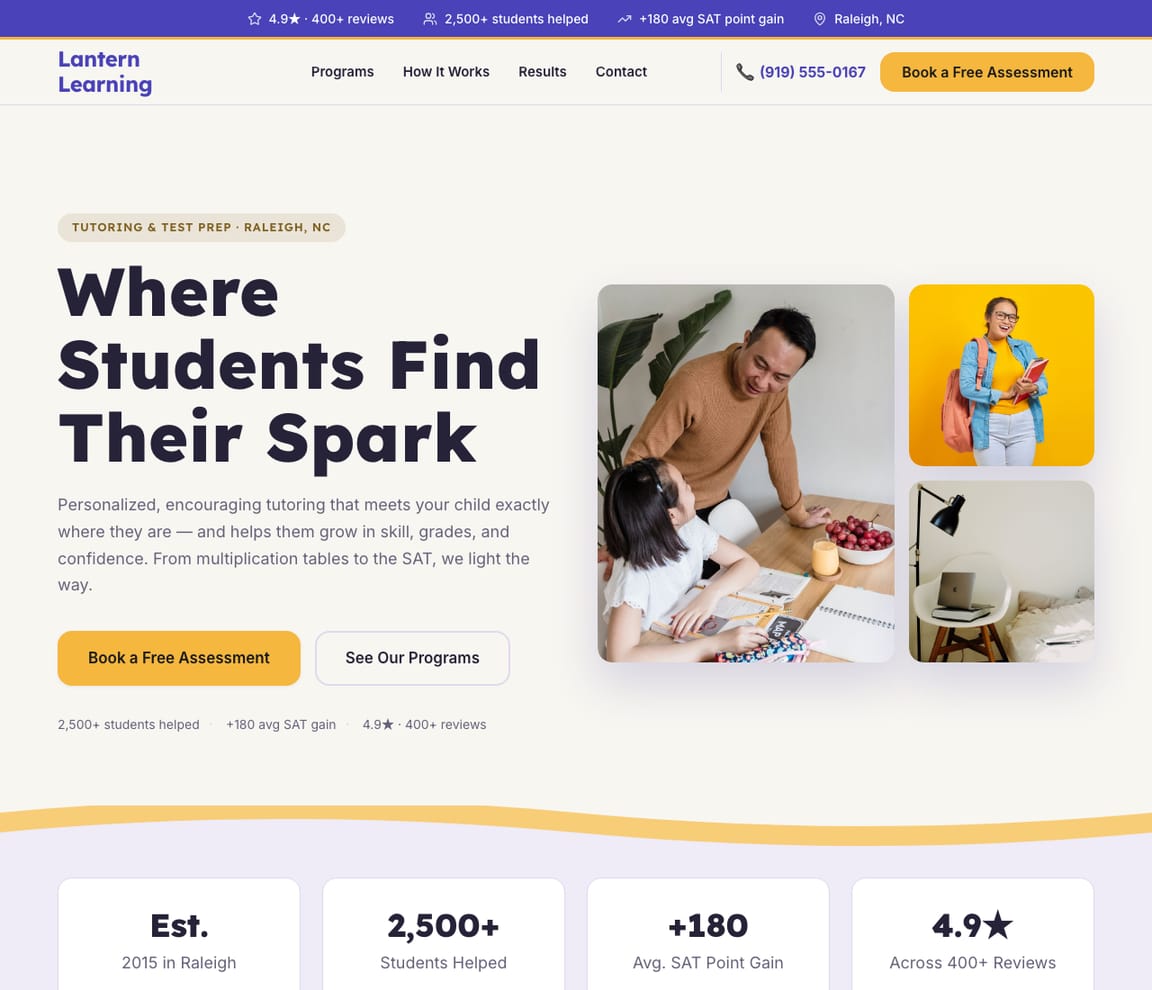
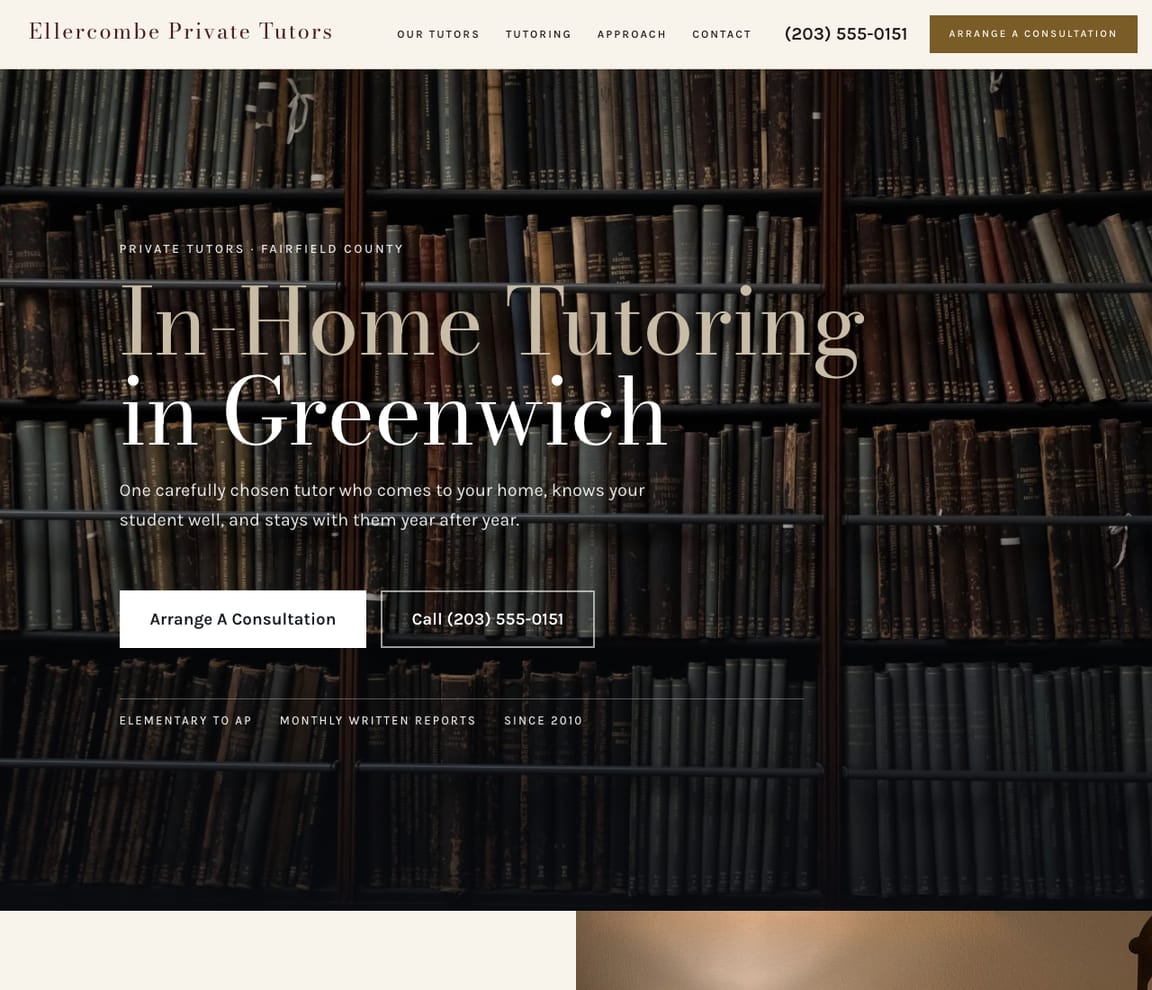
A real Zarla template for a local tutor — the subjects and grades by the headline, a booking button, the results and the parents' words underneath. Describe yours — the subjects, the town, online or in person — and you'll have a site like this, with online booking and a page per subject, in about a minute.
- Professional design — not a generic template
- Looks great on desktop and mobile
- Content written for your industry
Build the website
Start your tutoring website now
Add your subjects, your town and your business name to the sentence, and Zarla builds the site: your subjects and grades, your rates, a booking button and a page for each subject. Add your results in chat, then publish.
Already have a website? Bring it across →Zarla keeps your old page addresses where it can and redirects the ones that change, helping you keep the Google standing you've built.
Is becoming a tutor worth it in 2026 — and what does the work pay?
Becoming a tutor needs no license and no teaching degree in any US state, costs less to start than almost any trade in this series, and — once the evening calendar is full — is a business whose clients come back every week of the school year. Three honest numbers first. Employed tutors had a median of $43,350 a year in 2025, $20.84 an hour: 10 percent earned $29,430 or less, 10 percent $75,990 or more (O*NET, from BLS 2025 wage data). The headcount is large and flat: "Employment (2025) 208,400 employees", "Projected growth (2025-2035) Little or no change", "Projected job openings (2025-2035) 34,200" (O*NET, employment and outlook). And the survey behind the wages leaves out the self-employed — "We do not provide occupation and wage estimates for farms, the self-employed, owner/partners in unincorporated firms, the military, household workers or unpaid family workers" (Washington ESD) — which is the private tutor with her own students, so the median measures the learning-center employee, not the owner who sets the hourly rate.
State by state, and against the classroom. The employed median is $33,620 in Texas, $45,100 in California, $37,310 in Florida and $47,100 in New York (O*NET, Texas; California; Florida; New York). High-school teachers had a median of $72,040 the same year, with 10 percent above $107,600 (O*NET, 25-2031) — the employed tutor earns about six-tenths of the teacher; the independent tutor's hour is priced by the tutor, and one of the owners quoted below prints hers at "$35+/hour". The door needs no particular paper: the survey's employers said "41% responded: Bachelor's degree required", "36% responded: Some college, no degree required" and "9% responded: High school diploma or equivalent required" (O*NET, education).
Where the money is. An owner's income is the hourly rate times the hours sold in the evenings and weekends students are free, minus the platform's cut if you use one — the going rates are in how much to charge for tutoring. The tutors quoted below describe the first students coming from the school down the road and the families they already knew, the pivot online in 2020 and the parents who wanted in-person back, and the learning center that grew from a kitchen table to twelve tutors. The step after this guide is how to start a tutoring business, and the plan page is the tutoring business plan.
The catch. The work is sitting and talking — in O*NET's survey 86 percent of tutors "Spend Time Sitting" continually or almost continually, 81 percent have "Face-to-Face Discussions" every day and 77 percent are in "Contact With Others" constantly (O*NET, work context); the hours are after school and on weekends; and because no US state licenses the work, the thing that protects the child is your own screening and your state's child-protection law. That's what the rest of this guide sets up: the rules that reach a tutor, from the statutes; the platforms and what they keep; the desk kit from the vendors' prices; and how to be the tutor the report-card-night search books.
How to become a tutor, in plain English: no license, and the four rules that do reach you
No US state licenses the private tutor. The cleanest proof is the lists: Illinois's "Professions and Industries Regulated by IDFPR" runs its T section as "Title Insurance Company", "Title Insurance Registered Agent", "Transmitter of Money", "Transmitter of Money Authorized Seller" — no tutor (IDFPR, regulated professions); New York's "New York State Licensed Professions" index runs from Acupuncture through Public Accountancy with no tutor on it (NYSED Office of the Professions). A teaching certificate is a license to teach in a school, not a condition of tutoring in a kitchen. Four rules do reach you, and they are named here from the statutes:
- Child-protection law — who must report, and who gets screened. Texas makes everyone a reporter: "A person having reasonable cause to believe that a child's physical or mental health or welfare has been adversely affected by abuse or neglect by any person shall immediately make a report as provided by this subchapter" (Tex. Fam. Code §261.101). California names its mandated reporters by role — "An employee, volunteer, or board member of a public or private school, contractor to a school district … whose duties require contact with or supervision of pupils" and "An administrator, board member, or employee of a public or private organization whose duties require direct contact and supervision of children" — and the word "tutor" is not in the list; a tutor is reached as a school's contractor or a tutoring company's employee, not as a parent's hire (Cal. Penal Code §11165.7). Pennsylvania screens: its clearances apply to "an individual 14 years of age or older who is applying for or holding a paid position as an employee with a program, activity or service, as a person responsible for the child's welfare or having direct contact with children" and to "Any individual seeking to provide child-care services under contract with a child-care facility or program" (23 Pa.C.S. §6344) — the list names employees, child-care contractors and school staff, and a tutor hired directly by a parent is not on it. The three clearances are the "Pennsylvania Child Abuse History Clearance", the "Pennsylvania State Police Criminal History Clearance" and the "Federal Bureau of Investigations (FBI) Criminal History Clearance", renewed "every 60 months" (Pennsylvania DHS, clearances); the state's sheet dated October 1, 2026 prices them: "The PA Child Abuse costs $13.00", "The PSP costs $22.00", "The DHS FBI costs $27.95", and "The employee is responsible for paying the cost of the required clearances" (DHS, employees FAQ); for volunteers "The PA Child Abuse is free once every 57 months", "The PSP is free" and "The DHS FBI costs $25.95" (DHS, volunteers FAQ).
- The school that pays you screens you. Florida: "noninstructional school district employees, contractual personnel, or volunteer school chaplains who are permitted access on school grounds when students are present, who have direct contact with students or who have access to or control of school funds must meet the screening requirements of s. 1012.32. Contractual personnel shall include any vendor, individual, or entity under contract with a school or the school board", and "The cost of the state and federal criminal history check required by level 2 screening may be borne by the district school board, the contractor, or the person fingerprinted" (Fla. Stat. §1012.465). Pennsylvania's sheet adds the same rule in its own words: "K-12 school employees, employees of independent contractors seeking business with public and private schools and student teacher candidates must obtain clearances in accordance with section 111 of the Public School Code" (DHS, employees FAQ). Texas funds the tutoring that districts buy — its accelerated-instruction program and a parent-side grant, "Learn how eligible families can secure $400 for tutoring services supporting reading and literacy" (Texas Education Agency) — and a tutor who sells into a district signs the district's vendor paperwork.
- Your own website, if it collects a child's information. The federal children's-privacy rule binds "any operator of a website or online service directed to children, or any operator that has actual knowledge that it is collecting or maintaining personal information from a child", who must "Obtain verifiable parental consent prior to any collection, use, and/or disclosure of personal information from children" (16 CFR §312.3), where "Child means an individual under the age of 13" and "Operator means any person who operates a website located on the internet or an online service and who collects or maintains personal information from or about the users of or visitors to such website or online service" (§312.2). A tutor whose booking page asks the student's name and email is the operator; a tutor whose parents book and whose lessons run on a video platform is not operating the service that collects the data.
- Sales tax — two states tax the lesson, and New York ruled twice that it does not. New York's tax department: "Educational services, whether or not provided in an interactive format over the Internet, are not among the services enumerated as taxable under Section 1105(c) of the Tax Law" (New York TSB-A-99(58)S) and "The educational services provided by Petitioner are services that are not included among the enumerated services subject to sales tax under section 1105(c) of the Tax Law", though "Any additional fees for textbooks or manuals sold by Petitioner are subject to sales tax when delivered to locations in New York State" (TSB-A-06(5)S). Texas's sixteen categories of taxable services run from amusement services to utility transmission with no tutoring, education or instruction among them (Texas Comptroller, Publication 96-259). Hawaii's general excise tax is "4% for all others" on every business activity (Hawaii Department of Taxation), and New Mexico's gross receipts tax reaches "Performing services in New Mexico, and performing services outside of New Mexico, the product of which is initially used in New Mexico" (New Mexico Taxation and Revenue). Confirm the details with your accountant.
How you get in: the platforms, and your own students. The platforms publish their own doors and their cuts. Wyzant: "All tutors will retain 75% of their posted hourly rate for lessons with students, minus any applicable taxes, and Wyzant will retain a 25% Platform Fee" (Wyzant, fee structure). Preply: "The commission for every trial lesson with a new student is 100%. For all the subsequent lessons, the tutor is charged a percentage of the hourly rate (between 18% and 33%). The rate depends on the total number of lesson hours a tutor has taught on the platform" — "if you are a new tutor on Preply with an hourly rate of 10 USD, you will receive 6.70 USD for all lessons except trial lessons" (Preply, commission model). Outschool: "Outschool does not require formal teaching credentials", "You must be at least 18 years old", "You must reside in any of the 50 United States, Mexico, Canada, Australia, New Zealand, South Korea, Spain, or the United Kingdom for at least six months of the year" (Outschool, becoming an educator), and "all approved Outschool educators must complete an identity verification and criminal background check before they can teach on the platform" — "Outschool pays all associated fees regardless of region" (Outschool, background checks). Tutor.com asks that you "Currently reside in the U.S.", "Are available to tutor at least five hours per week" and are "Currently enrolled as a college sophomore or higher at an accredited University in pursuit of a 4-year degree, OR have a 4-year degree (or higher) from an accredited University" (Tutor.com, tutoring FAQ). Varsity Tutors' and Tutorpeers' pages did not open to our reader. The tutors quoted below mostly skipped the platforms: the first students were the families they already knew, the former students from a service year, a hairstylist's daughter, and the school down the road.
The credential, and what it costs. None is required by any US state. The National Tutoring Association certifies individuals after membership — "Before you begin the certification process, you must first become a member of the NTA" and "Complete a background check forms and fees as directed on the certification application" (NTA, certification) — at "Individual Membership $45.00" a year, "Student Membership HS $7.50" and "Program Membership $150.00" (NTA, membership rates); the certification fee itself is on the application and is not printed here. The teaching license is the other route, and the tutors quoted below who hold one left the classroom to use it one-to-one; the owners who hire set their own bar — one hires only certified teachers, one only tutors with "a minimum of a bachelor's degree".
You are self-employed from the first lesson. In the US a private tutor is a sole proprietor by default: "Use Schedule C (Form 1040) to report income or (loss) from a business you operated or a profession you practiced as a sole proprietor" (IRS, Schedule C instructions); "The self-employment tax rate is 15.3%" once your "net earnings from self-employment (excluding church employee income) were $400 or more" (IRS), and sole proprietors "generally have to make estimated tax payments if they expect to owe tax of $1,000 or more when their return is filed" (IRS). If you want an LLC: Texas "for filing a certificate of formation, $300" (Tex. Bus. Orgs. Code §4.152); Florida "$100" plus "For filing an annual report, $50" (Fla. Stat. §605.0213); New York "two hundred dollars" (N.Y. LLC Law §1101); California "Seventy dollars ($70)" (Cal. Gov. Code §12190) and "Every LLC that is doing business or organized in California must pay an annual tax of $800" (Franchise Tax Board). Workers' compensation the day you hire a second tutor: "In Texas, private employers can choose to carry workers' compensation insurance coverage, but it is not required in most cases" (Texas Department of Insurance); "All California employers must provide workers' compensation benefits to their employees under California Labor Code Section 3700" (California DIR).
The money to start. Our arithmetic from the pages that print each price, on the laptop you already have. A lean start as an online tutor — a Logitech C920s webcam at "$69.99" (Logitech, read October 26, 2026), a year of Calendly's Standard plan at "$10" a seat a month on yearly billing, $120 (Calendly), and the National Tutoring Association's $45 membership — comes to $234.99. The fuller start, a tutor who contracts with schools and forms a company — the same three lines, Pennsylvania's three clearances at $13, $22 and $27.95, and a Texas LLC's $300 filing — is $597.94. The video room, the office suite and the writing tablet are the lines left out: Zoom's and Google's pricing pages served no US price to our reader and the tablet maker's page printed none. The platforms cost nothing to join and a quarter to a third of every lesson after that. The plan page for the business side is the tutoring business plan, the step after this guide is how to start a tutoring business, the rates are in how much to charge for tutoring, the name goes on the flyer from tutoring business names, the business license question is answered in do I need a business license, and the site comes from the tutoring website builder or the tutoring website design page.
In the UK: no license either, and the screening works the other way round from the US — the parent cannot order the check: "If you are hiring a self-employed person or 'personal employee' to deliver services to you or a member of your family, you cannot request a DBS check for them. They will need to request one for themselves and you'll need to check their DBS certificate" (GOV.UK, DBS checks); the one a tutor can request alone is the basic check — "It costs £20" (GOV.UK, request a basic DBS check) — and the enhanced one comes through a membership body: The Tutors' Association's professional membership is £95.00 a year or "£9.50 monthly" with "Free Enhanced DBS Check support (DBS's admin fee still applies)" (The Tutors' Association). In Australia the check is the law. New South Wales: "Child-related work (including voluntary work) is: providing services for children and young people under 18 where the work normally involves being face to face with children", and the required column names "music teachers, extracurricular coaches, instructors, dance teachers, tutors, nannies, faith leaders and children's entertainers" and anyone who provides "mentoring or distance education using any form of communication such as online or phone" (NSW Office of the Children's Guardian, who needs a Check); "A WWCC application or renewal is free for volunteers and costs $112 for paid workers" (OCG, Working With Children Check). Victoria lists "Coaching or private tuition services of any kind specifically for children" among the fields that need its check (Victoria, who requires a WWC Clearance), for "an adult volunteer, paid, or self-employed worker caring for children under 18 years of age" (Victoria, do I need a WWC Clearance). Check your own state's child-protection rules, and the school district's vendor requirements if a school will pay you, before the first lesson.
What working tutors actually say
None of this is our opinion about the trade. It comes from people who do it — a Cobb County math teacher who started tutoring at home with three babies and now runs a center, a test-prep founder who started fresh out of college, a teacher who left the classroom in 2024 and prints her rate, a retired-teacher tutoring service, a Los Angeles math company, a Dallas owner who kept her corporate paycheck for a year, a Frisco founder with twelve tutors and 175 students, an Atlanta tutor still in college, a Chicago founder who trains tutors, three Houston tutors, a Dallas special-education advocate and more — talking to CanvasRebel and the Shoutout magazines between 2021 and 2025, each described as the page describes them. Read each as theirs at the time. Five things come up again and again.
The first students come from the school down the road and the families you already know. Allison Barchichat, East Cobb Tutoring Center, Cobb County, Georgia: “In 2010, I had three babies (really) and a teaching career in Cobb County. With the kids in daycare, I would have been cash-negative. Anticipating a return to teaching high school math, I started tutoring in my house to keep up with the material and maintain relationships with my colleagues. It didn't take long for word to spread, and I quickly ran out of time in my day to tutor students. Telling a parent that I couldn't help was the worst feeling.” (ShoutoutAtlanta, January 12, 2022). Semaj Thompson, Everyone Can Learn Tutoring, Atlanta: “Starting my tutoring business was a lot of work, but not necessarily difficult. I already had several families that I babysat and nannied for, so I had a good list of potential tutoring clients from the beginning” And: “The most challenging part of all of this is that I am still in college.” (ShoutoutAtlanta, June 1, 2022). Denisecia Lee, Grace Tutoring and Mentorship Services, Dallas–Fort Worth: “While still teaching virtually and managing my household, I began tutoring my hairstylist's daughter. As a private tutor, my business has taught me that families globally need someone that they can trust to help their scholar grow socially, emotionally and academically.” (ShoutoutDFW, September 20, 2022). LA Math Tutoring, Los Angeles: “The most successful source of new clients for LA Math Tutoring has been through word-of-mouth referrals. As students make progress and achieve their educational goals with the support of our tutors, they often recommend our services to their friends, family, and colleagues.” (CanvasRebel, April 10, 2023).
“Fortunately, creating a tutoring business doesn't t require much startup costs to begin! When I started the business, I was fresh out of college and starting my professional career so I used the little cash I had and set up the business legally, and then started spending money to market my services.” — Chris Jones, Planting Seeds Tutoring & Test Prep, in CanvasRebel, March 14, 2022
Most keep the paycheck until the calendar fills. Ashley Neal, Aligned Tutoring and Instructional Services, Dallas: “I started my business a year ago, and at its inception, I did not dedicate my all. I held on to my “safe” paycheck and advertised occasionally. Well, 2021 led me to follow my dream all the way through. I have had more success in 3 months of “going all in” than a year of straddling the fence.” (ShoutoutDFW, October 5, 2021). Karitta Conyers, Kay & Co Tutoring Service, Richmond, Virginia: “Traditionally, I work in the local juvenile justice system. After working my 9 to 5 job, I focus on managing my tutoring appointments, and completing my book.” (ShoutoutHTX, February 23, 2022). Michael Wilson, The Think Tank Tutorial Services, Houston: “I started The Think Tank back in 2017 after transitioning to the educational arena in 2014. Prior to entering education, I worked as a transportation manager in the private sector. Although it was financially fulfilling, I always felt that it wasn't my calling.” (ShoutoutHTX, March 8, 2023). Dominique Benson, Engaged Minds Academy, Houston: “I don't have any regrets about switching paths from a rigorous research path to a professional tutor. I've never been happier to work for myself and help students conquer their fears.” (ShoutoutHTX, June 29, 2022).
The teachers who left the classroom, and the bar the owners set. Lauren Isaacson, The Tutoring Hub: “I taught in classrooms in Virginia, Thailand, and Maryland before leaving the traditional classroom in June of 2024. After seeing how the school systems have changed, I saw a need to support parents and students who need support in schools all across the world.” — her page prints “Tutoring Lessons: $35+/hour” (CanvasRebel, April 24, 2025). Lindsey Wander, WorldWise Tutoring, Chicago: “time and financial restraints, added to endless bureaucratic red tape, prevented me from being able to dedicate the 1-on-1 time to my students who needed it. Thus, many of my “kids” fell through the cracks – and there was nothing I could do about it.” (ShoutoutDFW, May 10, 2022). Danielle Francingues, Grapevine, Texas: “I taught Special Education for eleven years and administration would walk in and be amazed at what my learners were capable of. Most recently I had a 21-year-old client that was non-verbal, but I could see that he understood when I asked him to do tasks.” (ShoutoutDFW, May 30, 2023). Barchichat on who she hires: “We offer weekly private tutoring with the same teacher every time or appointments as-needed, either way there is no contract. Finally, our tutors are real teachers! It takes more than just being “really good at math” to be an effective educator.” (ShoutoutAtlanta, January 12, 2022). Diane “Sunny” Goodwin, Sunny Day Tutoring Services: “Tutors are credentialed teachers, often retired with MANY years of teaching experience.” (CanvasRebel, March 14, 2022). LA Math Tutoring: “LA Math Tutoring has built its reputation within its market by hiring only expert tutors who hold a minimum of a bachelor's degree.” (CanvasRebel, April 10, 2023).
Online came in 2020, and the parents decided how much of it stayed. Goodwin: “Before Covid19, 100% of my tutoring was in person. After Covid19, we had to move to Zoom and Skype online tutoring, which we did seamlessly for all of our clients. We were even able to make it work for children as young ad Kindergarten and First Grade. We did find, that once the school reopened, however, parents wanted to return to in person tutoring.” (CanvasRebel, March 14, 2022). Jones: “When COVID struck in 2020, I had to immediately pivot my business in order to survive the uncharted times. During this time, I was able to integrate tutoring services fully online to accommodate students' needs.” (CanvasRebel, March 14, 2022). Jonathan Thompson, Fort Worth: “Now that I am an online teacher and tutor, my work-life balance has drastically improved. I complete most of my work from my own home office and have the time flexibility to pursue my other passions” (ShoutoutDFW, January 30, 2024). Mariela Linares, Houston: “I wanted to be able to offer many families the opportunity to have a more direct, personalized, one- to- one approach with their children in the comfort of a home environment, and with an experienced educator that has a solid knowledge and background.” (ShoutoutHTX, December 8, 2021).
Pricing, the free first session, and the center. Kylon Haugabook, Book Bros Tutoring & Wellness, Atlanta: “The biggest thing that separates us in my opinion is pricing. We are already cheaper than many other tutoring services but we also offer free sessions for all new students.” And: “Before we begin our sessions we let parents and students know that we are rigorous. We don't just expect them to join sessions we also expect them to work outside of sessions. We send homework home and our students consistently complete it.” (ShoutoutAtlanta, September 14, 2022). Kanan Shah, Ottimmo Learning Center, Dallas–Fort Worth: “We are now a family of 12 tutors and 175 students.” And: “We individually work with students from kindergarten through high school in Math, English, Science and foreign languages like Spanish and French. In addition, we also prepare high school students for the SATs and ACTs.” (ShoutoutDFW, October 25, 2022). Meenakshi Singh, SMARTS learning centers, Frisco: “What started small quickly took off. By Fall 2012, I had to move into a commercial space to keep up with demand.” And: “As word spread, I partnered with local ISDs and programs across Plano, Murphy, McKinney, and Flower Mound.” (ShoutoutDFW, May 28, 2025). Wander, on the next step: “My methodologies were so effective that my business quickly grew beyond what I could handle alone. So I started to “teach the teachers,” guiding tutors dedicated to my cause with my best practices.” (ShoutoutDFW, May 10, 2022).
The through-line: the tutors who lasted started with the students already around them, kept the paycheck until the evenings were full, set a rate and a first-session offer parents could see, moved online when the parents would follow and back when they would not, and hired the way they would want to be hired — teachers, or a degree, and a background check.
THE STARTER KIT
What you need to become a working tutor
A subject you can prove
A degree, a test score, a classroom year, a transcript — the proof a parent asks for in the first message, and the thing no state license stands in for because no state issues one.
Your state's rules around children
No tutor license anywhere in the US; Texas makes every adult a mandated reporter, Florida fingerprints every school vendor, Pennsylvania has its clearances — named below from the statutes, with a business registration everywhere.
A place to find the first students
The platforms that take a cut, the school down the road that keeps a list, the homeschool co-op, the library board — compared below with what each keeps and what each asks.
The desk kit, from the vendors' prices
A laptop you have, a webcam, a writing tablet, a scheduling tool, a video room, a shared whiteboard — each priced from the vendor's own page, for the online tutor and the one who travels.
The credential parents recognize
The associations' voluntary certifications, a subject test, a first-aid card for the home visit — none required by any state; the fees are below from the issuers.
A way to be found first
A website with your subjects, your rates, your background and a booking button, and a Google Business Profile with your hours — the two things a marketplace profile can't give you.
THE PAPERWORK
Licenses, checks, credentials and insurance on the way to your own tutoring business
| Typical cost | Time to get | Legally required? | |
|---|---|---|---|
| A tutor's license | None exists | — | No — no US state licenses private tutoring; Illinois's and New York's lists have no entry |
| A teaching license | Set by your state | A degree and the state's exams | No — a license to teach in a school, not to tutor |
| Child-protection clearances | $13 + $22 + $27.95 (PA, employees); $25.95 (PA, volunteers); level-2 screening borne by the board, the contractor or you (FL) | Weeks | Pennsylvania for paid positions with a program or school; Florida for school vendors; Texas makes everyone a reporter; a parent-hired tutor is not on either list |
| A platform's background check | $0 at Outschool — it pays | Days | The platform's rule, not the state's |
| Children's privacy (COPPA) | $0 | — | Yes, if your own site collects a child's information — verifiable parental consent under 13 |
| Voluntary certification | $45 NTA membership, then the application | Weeks | No |
| Sole proprietorship (Schedule C) | $0 | None | The default once net earnings pass $400 (self-employment tax 15.3%) |
| LLC (optional) | $300 (TX); $100 + $50/yr (FL); $200 (NY); $70 + $800/yr (CA) | Days to weeks | No |
| Sales-tax registration | Free to register | Before the first lesson, where it applies | Hawaii's 4% and New Mexico's gross receipts tax; not in New York or Texas; textbooks you resell in New York |
| Workers' compensation | Set by your carrier | Days | Required from the first employee in CA; optional for private employers in TX |
THE STEPS
How to become a tutor (step by step)
Eight steps from the first student to a full evening calendar and a tutoring business of your own.
01
Pick the subject you can prove
The course you aced, the test you scored on, the grade you taught. One or two subjects at the levels you can show, not 'all subjects' — the specificity is what a parent books.
Start here02
Check your state's rules around children
No US state licenses the tutor or asks for a teaching degree. Texas makes every adult a mandated reporter; Florida screens every contractor on school grounds; Pennsylvania has clearances for programs that serve children. The lines are below, from the statutes.
Named below03
Get the first students where they already are
A platform for the first ten, the school counselor who keeps a list, the homeschool co-op, the library's board, your own former teachers. The marketplace is a door, not a home.
04
Set the rate and the first-session offer
An hourly rate from real rates in your subject and town, a package price, and a first session that is cheap or free — printed on the page so the parent never has to ask.
05
Set up the room, online or at the table
A webcam and a writing tablet for online, a quiet table and a parent in the next room for in-home, a scheduling link that takes a deposit — the kit is below from the vendors' prices.
06
Add a credential and a background check
The associations' voluntary certification, a subject test if your field has one, and a background check you ordered yourself — the trust lines a parent and a school both look for.
07
Register the business and keep the books
A sole proprietorship by default, an LLC if you want one, and sales tax only where your state taxes the lesson — Hawaii and New Mexico do — with the IRS lines below.
08
Be the tutor the search books first
A website with your subjects, your rates, your background and a booking button, and a Google Business Profile with your hours — so the report-card-night search books you, not the marketplace.
THE COSTS
How much does it cost to become a tutor?
Itemized from the pages that print a price: the webcam from Logitech, the scheduler from Calendly, the membership from the National Tutoring Association, the clearances from Pennsylvania's October 2026 sheet, the LLC from the Texas statute. The video room, the office suite and the writing tablet come on top — their vendors' pages served no US price.
$234.99a lean start as an online tutor on the laptop you have — a webcam, a year of scheduling and a year of membership (our arithmetic)
$597.94the fuller start for a tutor who contracts with schools and forms a company — the same three lines, Pennsylvania's three clearances and a Texas LLC
$0for any license to tutor privately, in any US state — and $0 to join Wyzant, Preply, Outschool or Tutor.com, which keep a quarter to a third of each lesson instead
$62.95Pennsylvania's three clearances for a paid position with a program or school; free but the $25.95 FBI check for a volunteer
WHAT WE'VE LEARNED
What actually makes a parent book a tutor
Thousands of local business websites in, the pattern for a trade paid by the hour and judged by a grade is clear: the parent wants to know your subjects, your rate, and that a stranger around their child has been checked. For a tutor, three things on a page decide who gets the booking.
Subjects and grades, specifically
Algebra II, AP Chemistry, reading for a dyslexic third-grader, the SAT — by course and by grade, not 'all subjects K–12'. The first thing a parent scans, and the thing a marketplace profile buries under a search filter.
A rate and a first-session offer
An hourly rate, a package price, and what the first session costs — on the page. The thing that stops the back-and-forth, and the thing that beats the platform's rate card when the parent has already seen it.
Checked, credentialed, and reachable
A background check, the degree, the years in a classroom if you had them, pet-free and parent-present policies for the home visit — whatever is true, on the page, with your phone number. The parent is handing you their child's confidence.
THE UPSIDE
What a tutor can earn
Pay for employed tutors from O*NET's 2025 figures, and the self-employed are not in the survey. Medians, not a promise: your hourly rate, your evenings and whether the students are yours decide it.
$43,350a year: the 2025 median for employed tutors — $20.84 an hour; 10 percent under $29,430, 10 percent over $75,990 (O*NET)
$47,100the New York median; California $45,100, Florida $37,310, Texas $33,620
$72,040the median for high-school teachers the same year — the employed tutor earns about six-tenths of it; the independent sets the hour
208,400employed tutors in 2025, little or no change projected, with 34,200 openings a year to 2035 — the self-employed are not counted
SEE IT WORK
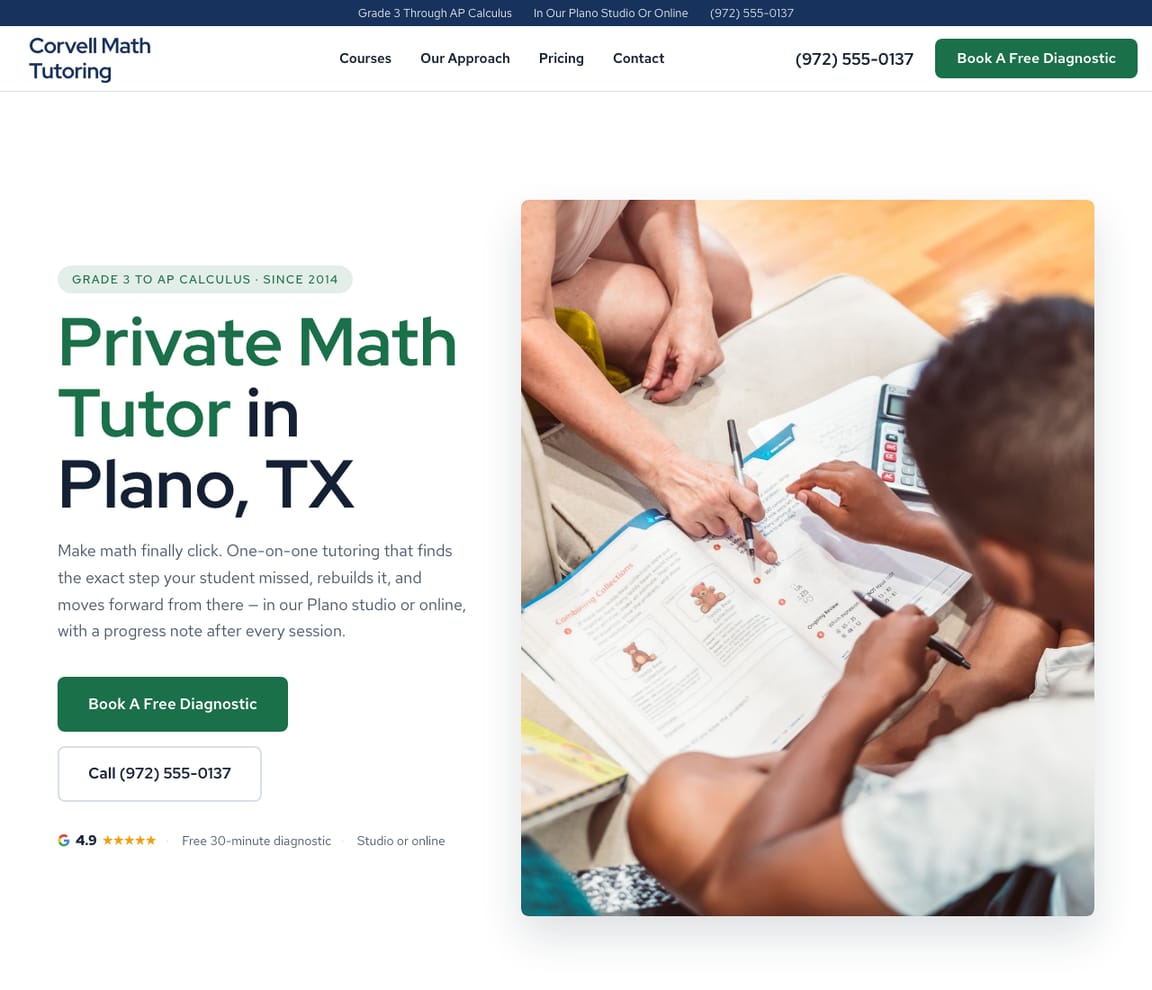
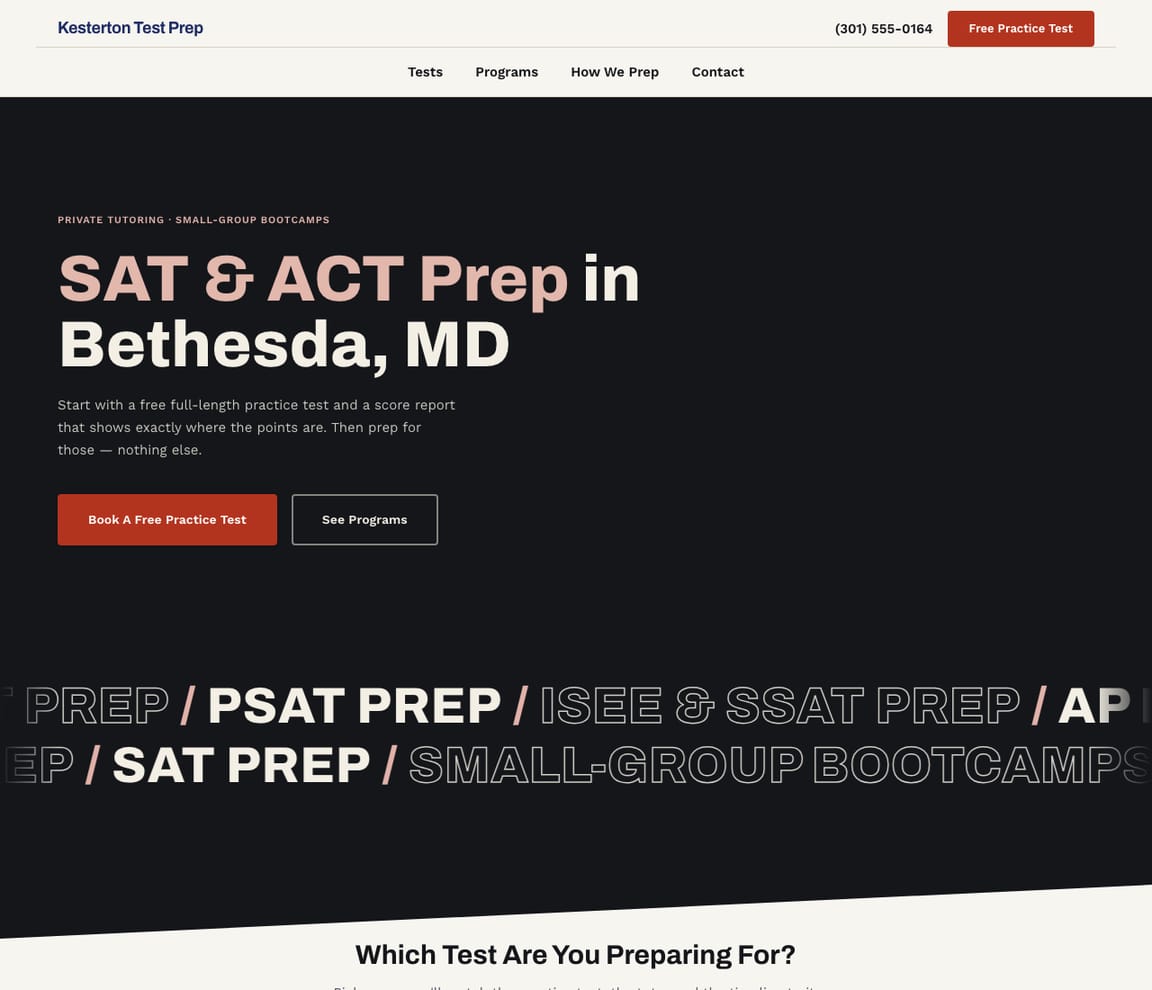
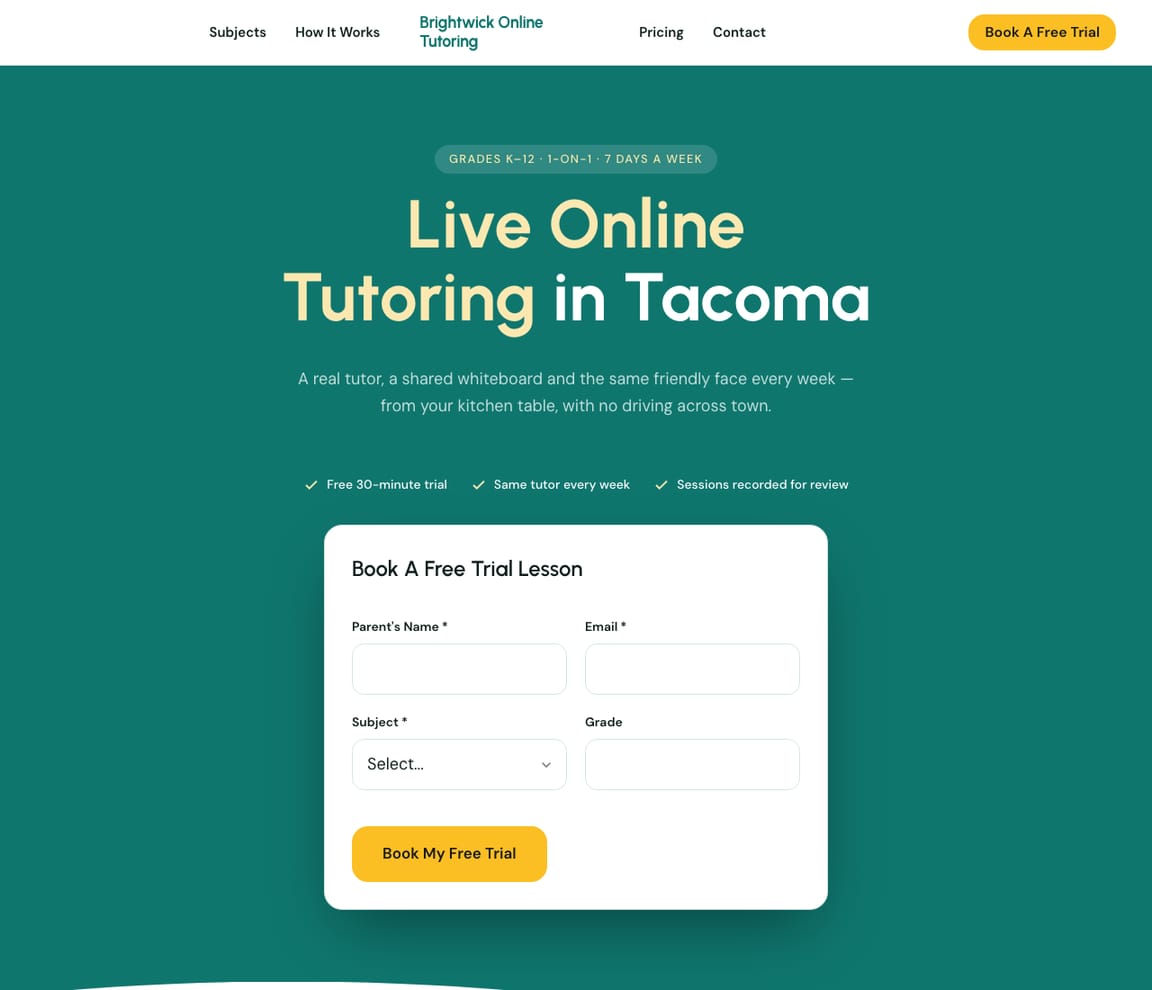
Tutoring website designs you can start from
Real Zarla templates for the shapes the trade takes — the math tutor, the SAT and ACT coach, the online tutor who teaches three time zones, the private tutor who comes to the house. Open one, swap in your subjects and your rates, and publish.
GET FOUND
Get found by the parent whose kid just failed the algebra test
A parent searches "math tutor near me" the night the report card comes home, and the booking goes to the tutor whose subjects, rates and open slots are on the first screen. Zarla builds the website with your subjects and grades, your rates and a booking button. Add your results and your background in chat, and once you connect your Google Business Profile, your name, your hours and your reviews stay in step on both.
“Math tutor near me”
Searched the night of the report card, in the spring before the SAT, and by the homeschool parent who hit the limit of their own algebra. Your subjects, your rates and a booking button answer all three.
Google Business Profile
A tutor who teaches at the kitchen table has a service area; an online tutor can list the town they serve from. Your hours and your booking link inside Google Maps — free, and an afternoon to set up.
The results, with permission
The proof a parent wants before paying by the hour: the grade that went from a D to a B, the SAT that went up 150 points, the student who got in — first names only, with permission. The results page is the sales page.
Google Search
Bbrightpathtutoring.com
Bright Path Tutoring — Trusted tutoring in Your AreaPlano's math and SAT tutor — Algebra I through Calculus, in person or online. Rates posted up front. Book a first session online.← Your Zarla siteCcitytutoringservices.com
City tutoring ServicesGoogle Maps
1
Bright Path Tutoring
← You2
Metro tutoring Co.
3
Quick tutoring Services
AI assistants (ChatGPT / Perplexity)
For a tutor in Plano who does Algebra II and SAT math, meets in person or online, posts rates, and has an evening slot this week in your area: Bright Path Tutoring — a local tutor's site that lists algebra, geometry, pre-calc and SAT prep with hourly rates, shows the tutor's background and results, and takes a booking from the page.
YOUR LAUNCH PLAN
Your become-a-tutor checklist
The whole guide as things to check off. Work through them in order and you'll be credentialed, checked, priced, set up and findable before your first student.
- Pick the subject you can prove — one or two, at the levels you can show.
- Check your state's rules around children below — reporter duties, school screening, clearances.
- Get the first students where they are — a platform, the school counselor, the co-op.
- Set the rate and the first-session offer — from real rates, printed on the page.
- Set up the room from the vendors' prices — webcam, tablet, scheduler, video room.
- Add a credential and order your own background check — the trust lines parents and schools ask for.
- Register the business — sole proprietor or LLC; sales tax only where the lesson is taxed.
- Get found — a website with your subjects, rates, background and a booking button, and a Google Business Profile.
REAL CUSTOMERS
Small business owners who got online with Zarla
Verified reviews from real Zarla customers.
“Optimized for local service-based businesses. Easiest website build I've experienced. The AI-based build is the way to go instead of clunky theme-based websites. Get the site built and get out of the weeds with Zarla!”
“Quickly built my website from scratch. No hiccups. Would highly recommend Zarla for someone with no experience who wants to start a polished business website.”
“Very reliable, professional, and fast results. I was able to get my business online in no time, and the ease of access made it so simple.”
“I had no idea how to set up a website for my business. Thanks to Zarla, they've helped me a lot.”
Be the tutor the "math tutor near me" search books first
Add your subjects, your town and your business name, and Zarla builds the website from that one line — your subjects and grades, your rates, online or in person, a booking button and a page for each subject, with SEO in place. Add your results in chat. Free to build; you pay when you publish.
Already have a website? Bring it across →Zarla keeps your old page addresses where it can and redirects the ones that change, helping you keep the Google standing you've built.
Frequently asked questions
How much does it cost to become a tutor?
In the US, about $234.99 for a lean start as an online tutor on the laptop you already have, our arithmetic from the pages that print each price: a $69.99 Logitech C920s webcam, a year of Calendly's Standard plan at $10 a seat a month, and the National Tutoring Association's $45 membership. There is no license to buy. The fuller start for a tutor who contracts with schools and forms a company — Pennsylvania's three clearances at $13, $22 and $27.95, and a Texas LLC's $300 filing on top — is $597.94. The platforms are free to join and keep a quarter to a third of each lesson. The video room and the office suite come on top; their vendors served no US price to our reader.
Do you need a license to be a tutor?
In the US, no — no US state licenses private tutoring, and no US state requires a teaching degree to do it. Illinois's regulated-professions list and New York's licensed-professions index have no tutor on them. What does reach you is child-protection law and the school that pays you: Texas makes every adult a mandated reporter; California's mandated-reporter list reaches a tutor as a school's contractor or a tutoring company's employee; Pennsylvania's three clearances apply to paid positions with a program, activity or service and to school vendors; Florida fingerprints every vendor on school grounds. A tutor hired directly by a parent is on none of those lists. Check your own state's child-protection rules before the first lesson.
Do tutors make good money?
As employees, modestly: the 2025 median for tutors was $43,350, $20.84 an hour, with 10 percent above $75,990, from BLS data on O*NET — about six-tenths of the $72,040 median for high-school teachers. The independent tutor's number is the hourly rate times the evening and weekend hours sold: one owner quoted above prints her lessons at $35 and up an hour, and the platforms' own pages show what a marketplace costs — Wyzant keeps 25 percent, Preply 33 percent falling to 18. The owners who do well run centers: one Frisco founder has twelve tutors and 175 students; one Cobb County center grew from a kitchen table on word of mouth.
How can I become a tutor online?
Through a platform or on your own. Outschool takes educators at 18 and over who live in the US, Mexico, Canada, Australia, New Zealand, South Korea, Spain or the UK, requires no formal teaching credentials, and runs and pays for a background check; Tutor.com asks for US residence, five hours a week and a college sophomore's standing or a degree; Wyzant keeps 25 percent of your rate and Preply 33 percent falling to 18 with hours taught. On your own you need a webcam, a scheduler and a video room — and if your own website collects a child's information, the federal children's-privacy rule's verifiable parental consent for under-13s. The tutors quoted above moved online in 2020; one found parents wanted in-person back when schools reopened.
How much can you earn as a tutor?
Employed tutors earned a median $43,350 in 2025 — $33,620 in Texas, $45,100 in California, $37,310 in Florida, $47,100 in New York — with 10 percent above $75,990. An independent tutor earns the hourly rate times the hours sold, minus the platform's cut if there is one: on Preply's own example a new tutor charging 10 dollars keeps 6.70 and an experienced one 8.20; on Wyzant you keep 75 percent. The rate itself is yours — one teacher who left the classroom in 2024 prints hers at $35 and up — and the going rates by subject and town are in our tutoring rates guide.
Do I need an LLC to be a tutor?
No US state requires it, and there is no tutor license to attach it to. A private tutor is a sole proprietor by default: Schedule C, the 15.3 percent self-employment tax once net earnings pass $400, quarterly estimates once you expect to owe $1,000. If you form an LLC: $300 in Texas, $100 plus $50 a year in Florida, $200 in New York, and $70 in California plus an $800 annual tax every year. Two of the owners quoted above trade as LLCs and most do not; the thing a parent asks about is the background check, not the entity. Confirm the details with your accountant.
What type of tutor makes the most money?
No agency ranks tutors by subject, so the honest answer is structural: the tutor who owns the students, not the platform; the tutor who prices the hour, not the one paid a set rate; and the owner who runs a center. The government's medians give the shape — tutors $43,350, high-school teachers $72,040 — and the owners quoted above fill it in: a Frisco test-prep and college-counseling center with twelve tutors and 175 students, a Cobb County center that hires only certified teachers, a Los Angeles math company that hires only degree-holders, and a special-education advocate who left the classroom after eleven years for one-to-one work.
How do I become a tutor with no experience?
Start with the subject you can prove and the students already around you. Outschool does not require formal teaching credentials; the government's survey of employers found 36 percent of tutor jobs require some college with no degree. One Atlanta tutor started with the families she had nannied for while still in college; one Houston tutor came from managing transportation; one Dallas owner began with her hairstylist's daughter. Offer a free first session — one Atlanta owner does — set a rate from the going rates in your town, order your own background check so a parent does not have to ask, and let the first family tell the next.
Can a teenager be a tutor?
In the US, yes — no US state licenses the work or sets an age for tutoring privately. The age lines are the platforms' and the states' child-protection rules: Outschool takes educators at 18, Tutor.com at a college sophomore's standing, and Pennsylvania's clearances reach an individual 14 years of age or older in a paid position with a program, activity or service. A teenager tutoring a neighbor's child for cash is a sole proprietor like anyone else, with the Schedule C to prove it once the earnings add up. One of the owners quoted above was still in college when she opened.
Do I need a background check to tutor?
In the US, by law, when a program or a school hires you: Pennsylvania's three clearances for paid positions with a program, activity or service and for school vendors; Florida's level-2 screening for every contractor on school grounds; California's mandated-reporter duties for a school's contractor or a tutoring company's employee. A tutor hired directly by a parent is on none of those lists — which is exactly why the parents ask, and why the platforms run one: Outschool checks and pays for every educator. Order your own and put it on the page. In England a self-employed tutor requests a basic DBS check for £20 and reaches the enhanced one through a membership body; in New South Wales the Working With Children Check names tutors and costs $112 for paid work.
Do I need a teaching degree to tutor?
No, in every US state — the teaching license is a license to teach in a school, and no US state attaches it to tutoring. The government's survey of employers found 41 percent of tutor jobs require a bachelor's degree, 36 percent some college with no degree and 9 percent a high-school diploma; Outschool requires no formal teaching credentials and Tutor.com a sophomore's standing. The owners who hire set their own bar — one hires only certified teachers, one only degree-holders — and the teachers quoted above who left the classroom say the one-to-one time was the point. The subject you can prove is the credential a parent checks.
Is tutoring taxable?
Your income, yes, everywhere in the US — Schedule C and the 15.3 percent self-employment tax. The lesson itself is the state's call. New York's tax department has ruled twice that educational services are not among the services enumerated as taxable, though textbooks you sell are. Texas's sixteen categories of taxable services include no tutoring, education or instruction. Hawaii's general excise tax is 4 percent on every business activity and New Mexico's gross receipts tax reaches services performed in the state. Confirm the details with your accountant.