CAREER GUIDE
How to become a welder in 2026
The routes in — a technical college, a union apprenticeship, a helper's job — what a welding certification actually is and who issues it, the two cities that license welders by name and the states that license the welding contractor, the federal rules on fire watch and pipelines, what welders earn at each rung from BLS data, the rig priced from real listings, and how to go from someone else's shop to your own truck.
Free to build · Pay when you publish · No credit card
No US statelicenses the welder — the welder is qualified by test to the code the job is built to, and New York City licenses structural welders for $50, from the pages below
$53,750median pay for employed welders, cutters, solderers and brazers in 2025 (O*NET, from BLS data); 10 percent earn $77,530 or more
$70the American Welding Society's Certified Welder application — no course, no prerequisite, a weld that passes the test; the test facility sets its own fee
35 feetthe federal fire-watch line: combustibles closer than that to the arc mean a fire watcher, an extinguisher in reach and a half-hour watch after the last weld
See it in action
See what your welding website could look like
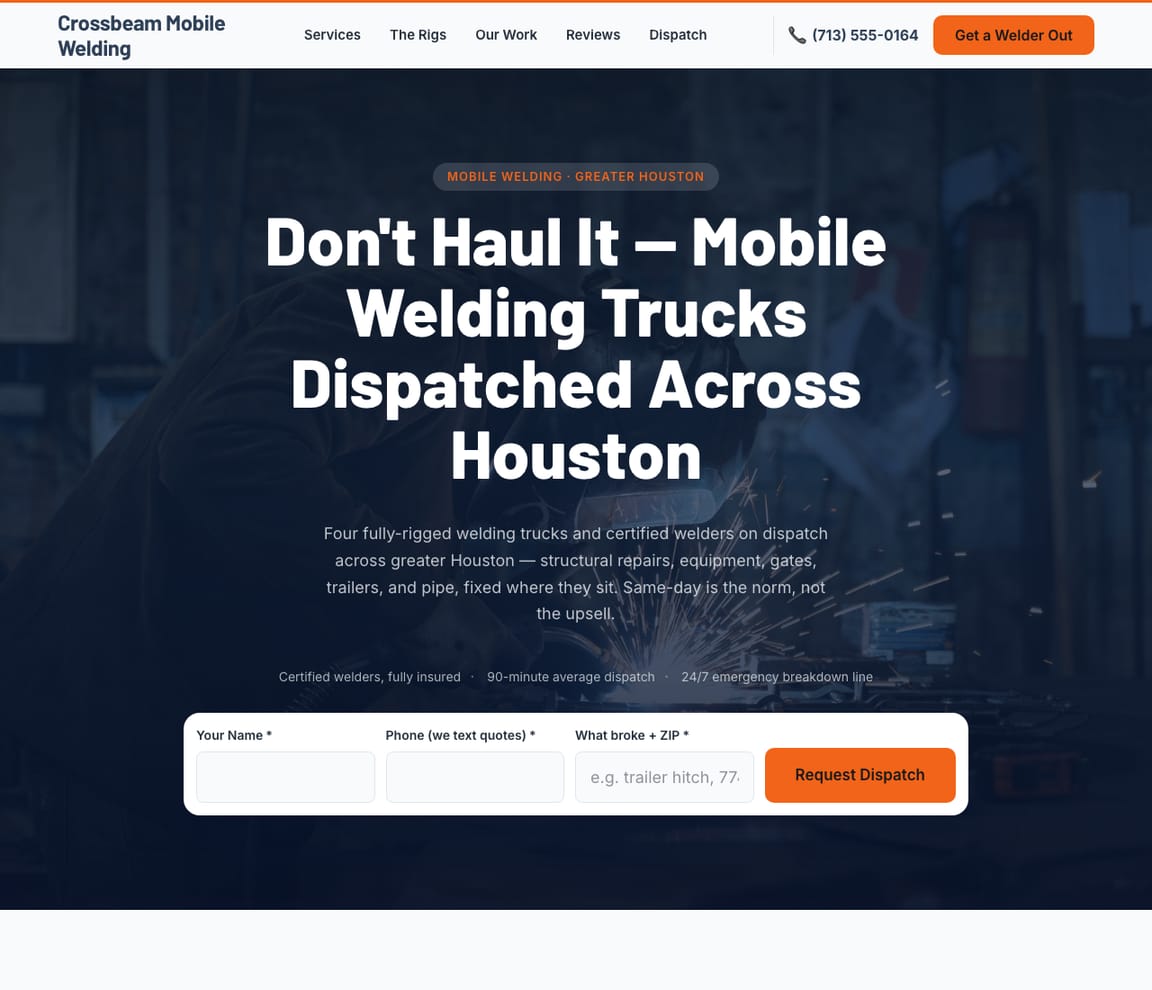
A real Zarla template for a mobile welder — the rig and the service area in the first screen, repair and fabrication work underneath, the certifications where a contractor looks for them. Describe yours — the town, the services, the hours — and you'll have a site like this, with a call button and a quote form, in about a minute.
- Professional design — not a generic template
- Looks great on desktop and mobile
- Content written for your industry
Build the website
Start your welding website now
Add your town and your business name to the sentence, and Zarla builds the site: your services, the area you cover, photos of your welds, a call button and a quote form. Add your certifications and your rates in chat, then publish.
Already have a website? Bring it across →Zarla keeps your old page addresses where it can and redirects the ones that change, helping you keep the Google standing you've built.
Is becoming a welder worth it in 2026 — and what does the work pay?
Becoming a welder is a trade with no license on the person and a test on every serious job, learned with the hood down, and at the top of it a rig truck whose phone rings when a trailer frame cracks. Three honest numbers first. Employed welders, cutters, solderers and brazers had a median of $53,750 a year in 2025, $25.84 an hour: 10 percent earned $39,240 or less, 10 percent $77,530 or more — $37.28 an hour and up (O*NET, from BLS 2025 wage data). The headcount is large and flat: "Employment (2025) 437,700 employees", "Projected growth (2025-2035) Slower than average (1% to 2%)", "Projected job openings (2025-2035) 40,300" — forty thousand openings a year from people retiring and moving, not from growth (O*NET, employment and outlook). And the survey behind the wages leaves out the self-employed (Washington ESD) — which is the welder with his or her own rig, so the median measures the hand in someone else's shop, not the owner.
State by state. The employed median is $53,340 in Texas, $58,060 in California, $50,640 in Florida — where the top 10 percent earn $70,390 — and $59,140 in New York, where they clear $87,110 (O*NET, Texas; California; Florida; New York). The occupation sits in "Job Zone 1-2: Very Little to Some Preparation Needed" with training that "Ranges from a few days to one year of on-the-job training"; of the welders surveyed, "54% responded: High school diploma or equivalent required", "21% responded: Less than high school diploma required" and "12% responded: Post-secondary certificate required" (O*NET, education).
Where the money went. The owners quoted below say the wage is the floor and the rig is the ceiling: "It was incredibly difficult living $40 dollars an hour job behind to pursue my dream, but I did, and haven't looked back since" (Joseph Howard, Mobile Welding LLC, western Chicago, VoyageChicago, May 31, 2017). The first years' income goes back into the truck: "The first couple years of getting established I had to spend most of the money I was earning on tools and equipment" (Chandler Soldano, Superior Fabrication, Austin, VoyageAustin, August 11, 2026). And the paperwork is a cost line of its own: "There are many struggles such as acquiring insurance, various expensive certifications, under bidding jobs and knowing you're going to lose money but you've still have to get the job done right" (Howard, VoyageChicago, May 31, 2017). The business side is its own guide — how to start a welding business — and the plan page below prices the rig.
The catch. The body pays: of the welders surveyed, "Exposed to Contaminants … 62% responded: Every day", "Exposed to Minor Burns, Cuts, Bites, or Stings … 48% responded: Every day", "Exposed to Hazardous Equipment … 41% responded: Every day", and "Wear Common Protective or Safety Equipment … 86% responded: Every day" (O*NET, work context). The jobs you quote are not all the jobs you get — "Like any business, you don't win every job—and that's something I've learned to accept" (Alejandro, Alex's Welding and Inspection, Phoenix, VoyagePhoenix, February 18, 2026). That's what the rest of this guide sets up: what a certification actually is from the society that issues it, the two cities that license welders from their own pages, the routes in and what each costs, the rig from a distributor's own prices, and how to be the welder the call reaches first.
How to become a welder, in plain English: the certification, the two city licenses and the contractor line, from the sources
There is no welder's license in the US — not federal, not in any state. Three things stand where a license would. A certification by test: the welder is qualified to the code the job is built to, by a weld that is inspected or cut up, and on pipelines federal law makes that test mandatory. A city welder license in New York City for structural work (Los Angeles certifies structural welders too, on pages that refused every reader we sent, so only a welder's own words about it appear below). And the contractor license your state draws above a dollar line for welding on buildings, with California naming the trade. On top sits the ordinary business license your city issues to any trade. Here is each, from its own page:
The certification, from the society that issues it. "A Certified Welder (CW) has successfully passed a performance-based welding test administered by an AWS Accredited Test Facility (ATF)", and "During a scheduled appointment, the welder will deposit a sound weld that is inspected by an AWS Certified Welding Inspector (CWI)". There is nothing to study first: "Since the test is strictly performance-based, there are no prerequisite courses or certifications required prior to testing. If you are able to do the weld necessary to pass the test, then you are eligible to become an AWS Certified Welder", "There are no educational prerequisites, certification requirements, or minimum experience requirements", and "If a welder fails any test, they can retest at any time". The program "tests welders on procedures used in the structural steel, petroleum pipelines, sheet metal, and chemical refinery welding industries", and the card is a living thing: "AWS Certified Welder certification remains valid as long as continuity is maintained. To keep your welding certification active, you must submit certification maintenance documentation every six months confirming that you continue to perform the welding process for which you were certified" — "Failure to maintain continuity may result in the certification becoming inactive, requiring you to requalify through testing" (American Welding Society, Certified Welder program). The society's price list: "Certified Welder Application | $70", "Maintenance of Welder Certification (Yearly subscription for unlimited renewals) | $105", and for the test itself "CW Exam ^Contact ATF for pricing" — the facility sets its own fee, and none we reached printed one (AWS program price list, effective January 1, 2026); "over 200 industry businesses of all types are currently AWS Accredited Test Facilities (ATFs)" — "Independent laboratories, manufacturing plants, educational institutions, distributors" (AWS, facility accreditation). On a pipeline the test is law: "each welder or welding operator must be qualified in accordance with section 6, section 12, Appendix A or Appendix B of API Std 1104 … or section IX of the ASME Boiler and Pressure Vessel Code" for gas lines (49 CFR §192.227) and the same for hazardous liquids (§195.222). In Washington the building officials run a parallel card — "The voluntary certification program provides a means of documenting welding and testing qualifications and competency in structural welding", in categories from "Structural Welder — Shielded Metal Arc Welding (SMAW), Gas Tungsten Arc Welding (GTAW), Gas Metal Arc Welding (GMAW), Flux Core Arc Welding (FCAW)" to "Reinforced Steel Welder" (WABO welder program), at "$66.00 each certification", "$66.00 on time renewal" and "$89.00 late renewal", with the test fee set by "a WABO Certified Testing Agency" (WABO FAQ).
- New York City — the one license in its own words. "Welders are licensed to perform structural welding work." "License Fee | $50.00", "Renewal Fee | $45.00", "Late Renewal Fee | $50.00", "License Term | 3 years" (NYC Department of Buildings, welder). To qualify: "Be at least eighteen (18) years old", "Be able to read and write the English language", and pass one of two exam sets — "The American Welding Society (AWS) Manual-Shielded Metal Arc Welding Process (SMAW) certifications for: Certified Welder – Groove and fillet welds in flat, horizontal, vertical and overhead positions with unlimited thicknesses and 3G and 4G certifications" on A36 base metal, or "The New York State Department of Transportation (NYSDOT) Field Welder Certification" for the same positions — then "a background investigation" with a "$330.00 Background Investigation Fee", a physical exam "completed within 90 days prior to application date" and a visual acuity test; "The Department of Buildings only issues one Welding Class-type license" (DOB, obtaining a welder license). The department's own FAQ: "The Department will accept any AWS certification. However, you must complete a Department background check and apply for the license in person", "AWS requires recertification every six (6) months. The NYSDOT requires recertification every three (3) years", and the license "is required if conducting shop welding work on any structural member of any New York City building" (DOB welder FAQ).
- California — the contractor's license names the trade. The board lists "C-60 - Welding Contractor" (CSLB license classifications): "A welding contractor causes metals to become permanently attached, joined and fabricated by the use of gases and electrical energy, which creates temperatures of sufficient heat to perform this work" (16 CCR §832.60). The line is the state's usual one — no license where "the aggregate contract price for labor, materials, and all other items is less than one thousand dollars ($1,000), that work or operation being considered of casual, minor, or inconsequential nature, and the work or operation does not require a building permit" (Cal. Bus. & Prof. Code §7048) — and the license asks for "not less than four years experience as a journeyman, foreman, supervising employee or contractor in the particular class" (16 CCR §825). The CSLB's fee pages refused our reader, so no dollar fee is printed. One owner's two cards: "I completed it one month before the birth of my son and became LA City Certified for structural steel", and "In 2023, I attained my California License as a welding contractor with the CSLB" (Pamela Richardson, PMR Associates Welding & Fabrication, Los Angeles, VoyageLA, December 2, 2025).
- Everywhere else — nothing on the welder, and the contractor line on the business. Texas: the Department of Licensing and Regulation's program list has no welding entry (TDLR). Florida: welding is not one of the contractor types the statute lists — the sixteen licensed categories run from "General contractor" to "Specialty contractor", and the word weld appears nowhere on the page (Fla. Stat. §489.105). Arizona: a Registrar of Contractors license applies above the same $1,000 line as California, for work "of a casual or minor nature" only (A.R.S. §32-1121), and the registrar's own classification pages refused our reader, so none is named. Washington: "Washington State requires all construction contractors to register with L&I" with an application fee of "$150.20" — the page's list of "63 specialties" does not name welding (Washington L&I). Oregon's board page and Nevada's classification list name no welding classification either — Nevada's nearest are "A-14: Steel Erection and Industrial Machinery" and "B-5: Prefabricated Steel Structures" (Oregon CCB; Nevada State Contractors Board). New York State and Illinois print no welder license of their own. The rule of thumb the pages support: a welder working for a shop needs no license anywhere in the US; a welder welding on someone's building needs the contractor registration or license that state draws, from the first dollar in Washington to $1,000 in California and Arizona; and a welder on a structural member in New York City needs the city's card.
The safety rules a superintendent will ask about. Fire watch: "Fire watchers shall be required whenever welding or cutting is performed in locations where other than a minor fire might develop, or any of the following conditions exist: (1) Appreciable combustible material, in building construction or contents, closer than 35 feet (10.7 m) to the point of operation", "Suitable fire extinguishing equipment shall be maintained in a state of readiness for instant use", "the floor shall be swept clean for a radius of 35 feet (10.7 m)", and "A fire watch shall be maintained for at least a half hour after completion of welding or cutting operations" (29 CFR §1910.252). Cylinders on a site: "Compressed gas cylinders shall be secured in an upright position at all times", and "Oxygen cylinders in storage shall be separated from fuel-gas cylinders or combustible materials (especially oil or grease), a minimum distance of 20 feet (6.1 m) or by a noncombustible barrier at least 5 feet (1.5 m) high" (§1926.350). Fume: OSHA's welding page points to its fact sheet "Controlling Hazardous Fume and Gases during Welding" (OSHA, welding, cutting and brazing) — the respirator in the kit below is the answer to it.
How you learn it. Three doors, and the society describes them: "Most welder fabricators begin their careers with foundational welding training, either through a technical school, community college, or apprenticeship", with "Minimum Education: High school diploma or equivalent" (AWS, welder fabricator). The college door: Texas State Technical College "offers an Associate of Applied Science degree in Welding Technology at each of its 10 campuses located throughout Texas", with a "certificate of completion in Structural and Pipe Welding" and a promise — "If they do not have a job in their field within six months of graduation, they will receive a full refund of their tuition" (TSTC, welding technology); welding is a Tier 1 program there, so a Texas resident's 15-credit semester is "$4,605" and a 12-credit one "$3,684" before fees (TSTC tuition table, fall 2026). The union door: "UA apprenticeships typically last five years" with welding among the tracks (United Association), and "The union's four-year apprenticeship program is "earn while you learn" training" at the Boilermakers (International Brotherhood of Boilermakers) — the federal standard behind every registered apprenticeship is "at least 2,000 hours of on-the-job learning" a year, with "A minimum of 144 hours for each year of apprenticeship is recommended" (29 CFR §29.5). The shop door: the helper's job, which is how several of the owners below started. The society's own online classroom prices the theory — "Welding Fundamentals I | $420 | $560", "Welding Fundamentals II | $250 | $333", "Welding Fundamentals III | $180 | $240", member and non-member (AWS price list); the "80 hours" of online instruction the search results mention is the society's inspector preparation, not a welder's course (AWS, self-paced learning). The private welding schools' tuition pages refused our reader, so none is printed. The processes come in the shop's order: stick and MIG first, flux-core for outdoor structural work, TIG — gas tungsten arc welding, the slow, clean process for stainless and aluminum — when you want the pay that comes with it.
You are self-employed from the first invoice. In the US a one-rig welder is a sole proprietor by default: "Use Schedule C (Form 1040) to report income or (loss) from a business you operated or a profession you practiced as a sole proprietor" (IRS, Schedule C instructions); "The self-employment tax rate is 15.3%" once net earnings reach $400 (IRS), and sole proprietors "generally have to make estimated tax payments if they expect to owe tax of $1,000 or more" (IRS). If you want an LLC: Texas $300 (Tex. Bus. Orgs. Code §4.154); Florida $100 plus $25 for the registered agent and $50 a year (Fla. Stat. §605.0213); New York $200 (N.Y. LLC Law §1101) plus a notice "published once in each week for six successive weeks, in two newspapers of the county" (§206); California $70 (Cal. Gov. Code §12190) and "Every LLC that is doing business or organized in California must pay an annual tax of $800" (Franchise Tax Board). Workers' compensation: "In Texas, private employers can choose to carry workers' compensation insurance coverage, but it is not required in most cases" (Texas Department of Insurance), while "All California employers must provide workers' compensation benefits to their employees under California Labor Code Section 3700" (California DIR).
Sales tax on the work — two states' rules. Texas: "Labor to repair, remodel, or restore residential real property is not taxable", "the total amount charged for remodeling, repairing, or restoring nonresidential real property is taxable", and on new construction "The construction labor charge is not taxable" (Texas Comptroller, Publication 94-116) — the same railing repair untaxed on a house, taxed on a warehouse. New York draws the line between a capital improvement and a repair: "building a deck, installing a hot water heater, or installing kitchen cabinets are all capital improvement projects", while "Repairing a broken step" is "taxable repair and maintenance work", and for an improvement "a contractor should get a properly completed Form ST-124, Certificate of Capital Improvement, from the customer" (New York TB-ST-104). Confirm the details with your accountant.
The money to start. Our arithmetic from the pages that print each price. A lean start — a Lincoln Electric Easy-MIG 140 at $1,368.99 (Zoro, read October 27, 2026), a Lincoln auto-darkening helmet at $149.99 (Zoro), cowhide gauntlet gloves at $11.49 (Zoro), a flame-resistant cotton jacket at $33.15 (Zoro), a DeWalt 4-1/2-inch angle grinder at $122.99 (Zoro), a chipping hammer with wire brush at $40.17 (Zoro), a 3M half-mask respirator with P100 filters at $28.99 (Zoro) and a 2-pack of replacement filters at $20.39 (Zoro) — is $1,776.16. The fuller start as a mobile welding business — the same kit, HexArmor MIG/TIG goatskin gloves at $40.25 (Zoro), a Forney oxy-acetylene torch kit with tanks at $519.99 (Zoro), an Amerex 20-pound ABC extinguisher at $350.00 (Zoro), a Harper cylinder truck at $305.99 (Zoro), the society's $70 application and $105 yearly maintenance subscription, a year of general liability at Insureon's $2,000 welder median and a year of commercial auto at $3,212 — is $8,379.39. Up the ladder, a Lincoln Viking 3350 helmet is $708.99 (Zoro), and the engine-driven welder a rig truck is built around — a Ranger or a Bobcat — sat on no product page that opened, so it is unpriced here. Neither total includes the truck, the steel or the website — and the insurance is a median, not your quote: "Welders pay an average of $167 per month, or $2,000 annually, for general liability insurance", "$125 per month" for a business owner's policy "or $1,503 annually", "$175 per month" for workers' compensation "or $2,101 annually", "$42 per month" for tools and equipment "or $505 annually", and "$268 per month" for commercial auto "or $3,212 annually" (Insureon, updated August 13, 2026). The plan page for the business side is the welding business plan, the step after this guide is how to start a welding business, the name goes on the truck from welding business names, and the site from the welding website builder.
In the UK: there is no license to weld; the government's career profile puts pay at "£25,000 Starter" to "£45,000 Experienced" on "40 to 46" hours a week, with routes through "a college course", "an apprenticeship" — the "General Welder Level 2 Intermediate Apprenticeship", "Pipe Welder Level 3 Advanced Apprenticeship" and "Plate Welder Level 3 Advanced Apprenticeship", which "take between 2 and 4 years to complete" — "applying directly" or "specialist courses run by a private training provider" (National Careers Service, GOV.UK). In Australia the principle holds — no Australian state licenses the welder — and the national body certifies by test to the international and Australian standards: "Welder certification pathways covering ISO 9606 Welder Qualification and AS 1796 Welding Certificates 1-9 Theory", which "provides independent, third-party verification of skills and competence" (Weld Australia); no fee is printed on the page. Check your own state's contractor board, and your city's buildings department, before you weld on the first structure.
What working welders actually say
None of this is our opinion about the trade. It comes from people who do it — an Atlanta fabricator who found the trade through a friend's start-up, three brothers in south Atlanta, an Austin mobile welder who started in a high-school class and went on the road for seven years, a Chicago-area owner who walked away from forty dollars an hour, a Dallas owner escaping the traveling-welder life, a former Navy diver raising two daughters, a McKinney welder with an associate degree, a Denver sandblaster-welder, a Houston fabricator who started on evenings and weekends, a Simi Valley owner who spent his savings on a shop, a Los Angeles woman who certified for structural steel a month before her son was born, a Colombian aeronautical welder restarting in Phoenix, and a Phoenix welder who became an inspector — talking to the Voyage magazines between 2017 and 2026, each described as the page describes them. Read each as theirs at the time. Five things come up again and again.
You get in through a class, a shop or a friend, and the first test comes early. Chandler Soldano, Superior Fabrication, Austin: “Started my senior year of high school they offered a welding class I was never interested in school but I was interested in learning how to weld. I was able to get a scholarship for another welding class and was able to go to school in the mornings and at night and got certified early.” (VoyageAustin, August 11, 2026). Gabriel De Jesus, Galactic Welding, McKinney: “I had to get a trade job since I didn't have money or grants to attend a university. Texas State Technical College was a trade school within Waco and I went for it. It was either being a welder or diesel mechanic. I choose the welding career without ever seeing a welding machine or ever having welded before.” And: “I graduated from TSTC in 2014 with my Associates of Applied Science in Welding Technology. During my time at TSTC I also achieved a welding certificate in advanced pipe welding.” (VoyageDallas, February 26, 2026). Chris Jones, CJ Welding & Fabrication, Spring, Texas: “I first started welding at a billboard company in Arlington TX. I really enjoyed it so I decided I wanted to go to Lincoln College of Technology to become AWS certified and pursue a welding career. Going to college 5 days a week and work 40 hours a week is no easy task.” (VoyageHouston, June 21, 2017). Ryan Castle, Maven Welding & Fabrication, Atlanta: “I was fortunate enough to be introduced to the world of fabrication and welding, working for a friend who was launching his company and needed my help. I immediately fell in love with the heart of what welding was.” (VoyageATL, August 29, 2024).
“I was on the road working for 7 years on various jobs; the pipe line, building to new trash trucks to building navy battleships in Marinette, Wisconsin. Eventually settled down in San Marcos TX working at a shop prefabricating refinery piping. I realized that trading my time and skill for little money for someone else wasn't working for me anymore. I took the leap and started my own business.” — Chandler Soldano, Superior Fabrication, Austin, in VoyageAustin, August 11, 2026
It is not too late, and the second career is common. Jonathan Hall, Diversified Welding, Dallas–Fort Worth: “My grandfather taught me welding and fabrication at a young age. … I was a saturation diver, and navy diver, working around the world most of my adult life. A few years ago I found myself raising my two daughters alone. I needed to stop traveling from r work. I knew nothing about small business at all.” (VoyageDallas, February 18, 2026). Leonardo Garzon, LG Welding, Phoenix: “i am a Colombian migrant by profession aeronautical welder of the Colombian Air Force with more than 20 years of experience and I came to this beautiful country with the desire to get ahead and provide a better future for my children and I started working in a welding workshop and in the pandemic I was left without work and I started to get work on my own” (VoyagePhoenix, September 11, 2024). David Duncan, Duncan Welding, Simi Valley: “I've always enjoyed creating things, so I decided to try a welding course at the Simi Adult School. I fell in love with it – The way I could practice for hours and not perfect it kept me coming back.” (VoyageLA, February 10, 2026). Pamela Richardson, PMR Associates Welding & Fabrication, Los Angeles: “Our training, protective wear, books, and a stipend were given to us by the program. While in the first couple months of the program, I discovered that I was pregnant. My baby made me even more determined to complete the program and to get certified. I completed it one month before the birth of my son and became LA City Certified for structural steel.” (VoyageLA, December 2, 2025).
The certification and the license are steps, and the bids are where the money is lost. Alejandro, Alex's Welding and Inspection, Phoenix: “Two years later, I earned my Associate's Degree in Welding Technology. From that point on, my goal was to become the best welder and inspector I could be. I expanded my skill set by operating robotic welding systems and CNC plasma tables, earning pipe welding certifications through the American Welding Society, and ultimately achieving the prestigious Certified Welding Inspector (CWI) credential.” (VoyagePhoenix, February 18, 2026). Duncan: “In 2021, with a helpful push from my wife Kelsey, I decided I wanted to try to start my own business. I got my Contractor's License, and started an LLC. We spent our whole savings on getting a shop, and set off on this journey.” (VoyageLA, February 10, 2026). Soldano: “Getting into the commercial side of construction was a learning curve as well, I had to figure out how to bid jobs correctly in order to win the job and there were plenty of jobs I didn't land.” (VoyageAustin, August 11, 2026). Joseph Howard, Mobile Welding LLC, western Chicago: “There are many struggles such as acquiring insurance, various expensive certifications, under bidding jobs and knowing you're going to lose money but you've still have to get the job done right, trying and still trying to acquire financing to build my business. I've made big investments in advertising only to learn that word of mouth is the best advertising ever!” (VoyageChicago, May 31, 2017).
The rig is bought one tool at a time, and the small jobs are the business. De Jesus: “Galactic Welding truly started in 2017 when I bought my long bed Silverado truck 2500 HD and after that little by little, I would start buying all the tools and equipment that I would see around me from my mechanical contractor industry.” (VoyageDallas, February 26, 2026). Jones: “To make up for income loss I purchased my first welder and starting working in the evenings and on weekends. From that point I realized how many people are in need of small welding jobs and started purchasing more and more equipment till eventually we had everything a welding shop should have.” (VoyageHouston, June 21, 2017). Hall: “Just because someone has a small job that doesn't meet a profit margin, doesn't mean to not help them. Their part needs to be fixed, so fix it. Take 30 minutes and do it, and don't charge an hour minimum.” (VoyageDallas, February 18, 2026). Howard, on what the rig does: “My business specializes in cell tower repair, water tower repair, heavy equipment repair, lots of railing repair and new construction and on and on and on.” (VoyageChicago, May 31, 2017).
Owning the rig is a different trade from running one. Deryk Garrett, Hot Shot Specialty Welding, Dallas–Fort Worth: “Hot Shot Specialty Welding was created in 2016, initially as a way to build my own business and to get away from the “traveling welder” stigma I had adopted for the past several years. With no prior business experience, it is fair to say there have been many challenges over the last 6 years.” (VoyageDallas, November 3, 2022). Duncan: “We didn't know how to budget properly, what insurance we needed, what overhead looked like, etc. The biggest one was not knowing how to plan financially for slow months. We would have great months and think we were killing it, and then be struggling in slow months because we had no concept of saving and re-investing into the business.” (VoyageLA, February 10, 2026). Kyle Thomson, Superior Sandblasting and Welding, Denver: “After earning my certifications, I spent five to six years gaining comprehensive on-the-job training. Once I felt I had gained sufficient experience, I launched my own company.” (VoyageDenver, December 3, 2025). Juan Dominguez, Arc Flow Welding & Fabrication, south Atlanta: “After I (Juan) graduated in Business Management, both of my brothers were already welders in their respective field industries. We've decided to move forward and get our own LLC with the goal that we will take over the next generation in South ATL and go from there.” And the first customers: “we had to build our confidence dealing with customers who are very proud and doesn't confide in us due to us being very young with very little experience.” (VoyageATL, May 25, 2023). Castle: “The “stereotypical” pitch, claiming that a company did the best work for the best price was used by everyone, and it was about as threadbare in terms of truth as you could imagine.” (VoyageATL, August 29, 2024).
The through-line: the welders who lasted got certified early, spent the first years' income on the rig, took the thirty-minute jobs, learned to bid by losing a few, and learned a second trade — insurance, slow months, answering the phone — the day they bought the truck.
THE STARTER KIT
What you need to become a welder
Somewhere to burn rod
A technical college's welding certificate, a union apprenticeship's booth, or a shop that hires helpers — the processes are learned with a hood down and a hundred hours of scrap, and the routes and what each costs are below.
The processes, in order
Stick and MIG first because the shop and the field run on them; flux-core for outdoor structural work; TIG when you want stainless, aluminum and the pay that comes with them. The AI answer has the list right; the order is the trade's.
A certification by test, not a diploma
A welding certification is a weld you make under a code — AWS D1.1 for structural steel, ASME IX for pressure work, API 1104 for pipe — that is cut up and inspected. The bodies, the test facilities and the federal rule that makes it law are below.
The safety rules you will be asked about
Fire watch when combustibles are within 35 feet, the extinguisher within reach, fume control and a respirator for stainless and galvanized — from OSHA's own regulation below, and an OSHA 10 card for the site.
The rig, from real prices
A MIG machine, an auto-darkening hood, gloves and a jacket, a grinder, a cutting torch, an extinguisher — priced from a distributor's own listings below; the engine drive and the truck come when the business does.
A way to be found when you go out on your own
A website with your welds, your certifications, your trip fee and a call button, and a Google Business Profile with your photos — how the broken-trailer search reaches your truck, not a lead-selling app.
THE PAPERWORK
Certifications, licenses and insurance on the way to your own welding business
| Typical cost | Time to get | Legally required? | |
|---|---|---|---|
| A welder's license (the person) | None exists | — | No US state licenses the welder; the certification and the contractor line below carry the work |
| AWS Certified Welder | $70 application + the test facility's own fee; $105 a year to maintain | One appointment; the card 2–3 weeks later; maintenance every six months | Not by law — except on pipelines, where federal rules require qualification to API 1104 or ASME IX; a contract condition on structural work everywhere |
| New York City welder license | $50 license + $330 background investigation; $45 renewal | After the AWS SMAW 3G and 4G cards or the state DOT field-welder certification; three-year term | For structural welding on any New York City building, including shop welding of structural members |
| Washington WABO certification | $66 a certification + the testing agency's fee; $66 renewal, $89 late | One test per process | No — voluntary, run by the building officials; what Washington inspectors look for on structural work |
| Contractor license (the business) | Fee not printed for CA (the fee pages refused); $150.20 registration (WA) | Four years of journey-level experience (CA) | CA above $1,000 (C-60); AZ above $1,000; WA registration from the first dollar; nothing on welding at state level in TX, FL, NY, IL, OR, NV |
| OSHA 10 card | The trainer's fee; none printed | 10 hours | Not by law; what a superintendent asks for before you light up on a site |
| Sole proprietorship (Schedule C) | $0 | None | The default once net earnings pass $400 (self-employment tax 15.3%) |
| LLC (optional) | $300 (TX); $125 (FL); $200 + newspaper notices (NY); $70 + $800/yr (CA) | Days to weeks | No |
| Sales-tax account | Free to register | Before the first commercial job | TX taxes nonresidential repair labor, not residential; NY taxes repairs but not capital improvements; check your state |
| General liability, written for hot work | $167/mo median (Insureon) | Days | A contract condition on every site and farm; the fire from a spark is the claim that ends a welding business |
| Commercial auto on the rig | $268/mo median (Insureon) | Days | For a work vehicle, yes |
| Workers' compensation | $175/mo median (Insureon) | Days | Required from the first employee in CA; optional for private employers in TX |
| Tools and equipment cover | $42/mo median (Insureon) | Days | No — but the machine and the torch live on the truck |
THE STEPS
How to become a welder (step by step)
Eight steps from the first bead on scrap to a certified welder with a rig and your own name on the truck.
01
Pick the route in
A technical college's certificate — months, with tuition printed below from one college's own table — a union apprenticeship that pays while you learn, or a helper's job in a shop. Each is below with its hours and its cost.
Named below02
Learn stick and MIG, then the rest
The shop and the field run on stick and MIG; flux-core follows for outdoor structural work, TIG when you want stainless, aluminum and the pay. A hundred hours of scrap before anyone pays you for a bead.
The long part03
Take the OSHA 10 and learn the hot-work rules
Fire watch, the 35-foot rule, the extinguisher, fume control — from the regulation below. It is what a superintendent asks before you light up on a site.
04
Pass your first test
A plate test to a code at an accredited test facility — the weld is cut and bent, and the certificate names the process, the position and the code. The bodies and what they charge are below.
05
Check whether your city licenses welders
No US state does. New York City licenses structural welders for $50; Los Angeles certifies them; everywhere else the certification and the contractor's license carry the job. Each from its own page below.
06
Keep the certifications current and add the next one
A certification lapses when you stop welding the process — the maintenance forms and the dates are below — and each new code or position is a new test and a new kind of work you can bid.
07
Set the business up, licensed where the state asks, insured
An entity, the contractor license above your state's dollar line for welding on structures — California's C-60 above $1,000 — general liability written for hot work, commercial auto on the rig, workers' comp from the first hire.
08
Be the welder the call reaches first
A website with your welds, your certifications, your trip fee and a call button, and a Google Business Profile with your photos — so the broken-trailer search reaches your truck.
THE COSTS
How much does it cost to become a welder?
Itemized from the pages that print a price: the kit from one distributor's listings, the society's fees from its own price list, one college's tuition from its table, the insurance from Insureon's welder medians. The truck, the engine drive, the steel and the website come on top, and so do your own living costs while you learn.
$1,776.16a lean start — a 140-amp MIG machine, an auto-darkening helmet, gloves, a jacket, a grinder, a chipping hammer and a respirator with spare filters (our arithmetic)
$8,379.39the fuller start as a mobile welding business — the kit, a cutting torch with tanks, an extinguisher, a cylinder cart, TIG gloves, the AWS application and a year's maintenance, a year of liability and commercial auto
$4,605a 15-credit semester of Texas State Technical College's welding program for a Texas resident; $3,684 for 12 credits — with a refund if no job in six months
$70the AWS Certified Welder application; the test facility sets the exam fee; New York City's license is $50 plus a $330 background investigation
WHAT WE'VE LEARNED
What actually makes a customer call a welder
Thousands of local business websites in, the pattern for a trade hired on a photo and trusted with a load-bearing weld is clear: the customer wants to see the welds, know what the trip and the hour cost, and believe the paperwork will pass an inspector. For a welder, three things on a page decide who gets the call.
Photos of the welds, close up
A stacked-dime TIG bead, a finished gate, a repaired trailer frame — welding is the trade a customer can judge from a phone screen, and the gallery is the quote before the quote.
The trip fee and the hour, up front
A trip or minimum charge and an hourly rate for on-site work, a 'from' price for the common fabrication jobs. The first thing a caller asks, and the thing the plan page below is built from.
The certifications, by name
The code and position you are certified to — structural plate, pipe, aluminum — and the city license where one exists, on the page, so the superintendent and the inspector have what they need before you arrive.
THE UPSIDE
What a welder can earn
Pay for employed welders, cutters, solderers and brazers from O*NET's 2025 figures — the self-employed are not in the survey. Medians, not a promise: your state, your certifications and whether the rig is yours decide it.
$53,750a year: the 2025 median for employed welders, cutters, solderers and brazers — $25.84 an hour; 10 percent under $39,240, 10 percent over $77,530 (O*NET)
$59,140the New York median; California $58,060, Texas $53,340, Florida $50,640 — and New York's top 10 percent clear $87,110
1% to 2%the projected growth for 2025–2035 — "Slower than average" — with 40,300 openings a year projected from turnover (O*NET)
437,700employed welders, cutters, solderers and brazers in 2025 — owner-operators are not counted
SEE IT WORK
Welding website designs you can start from
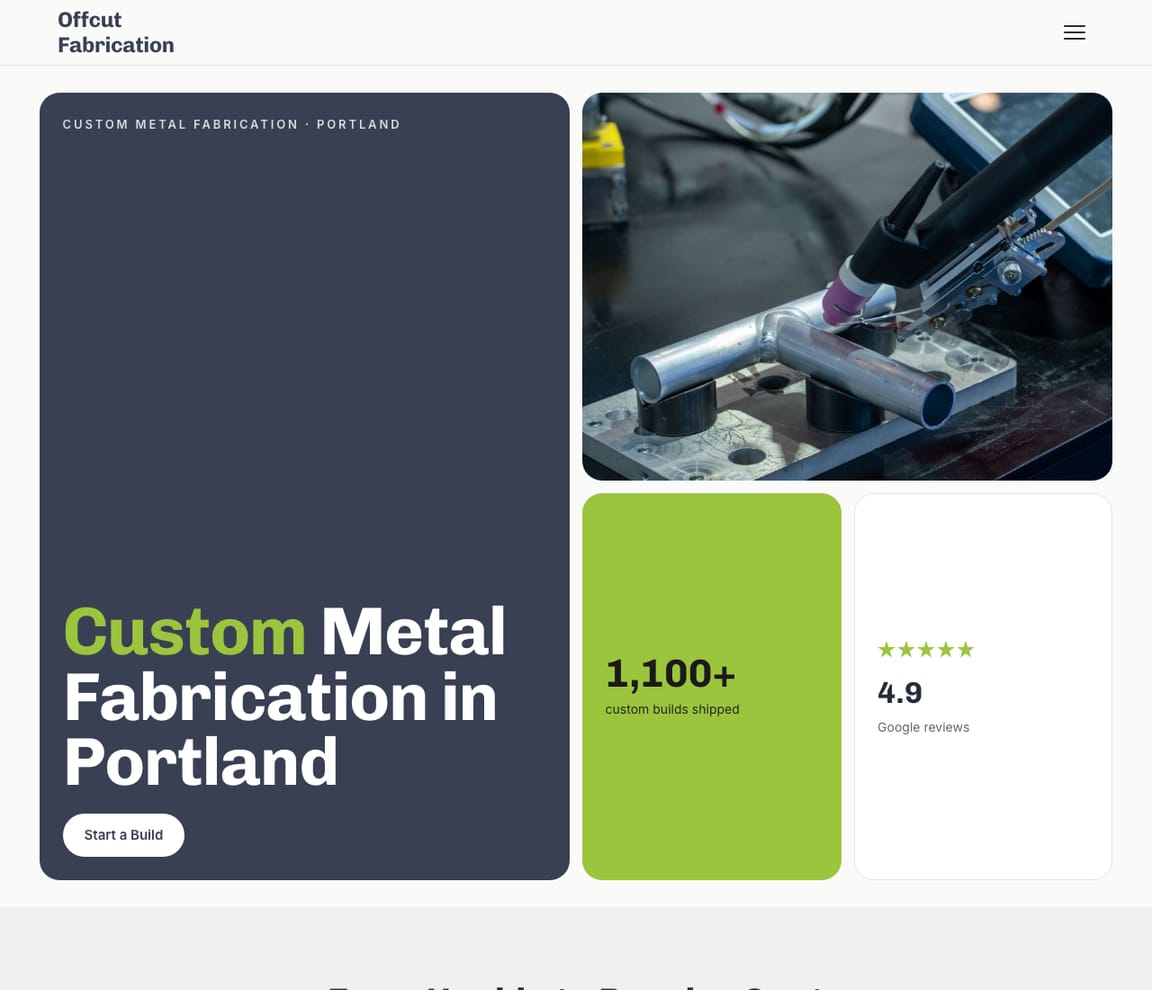
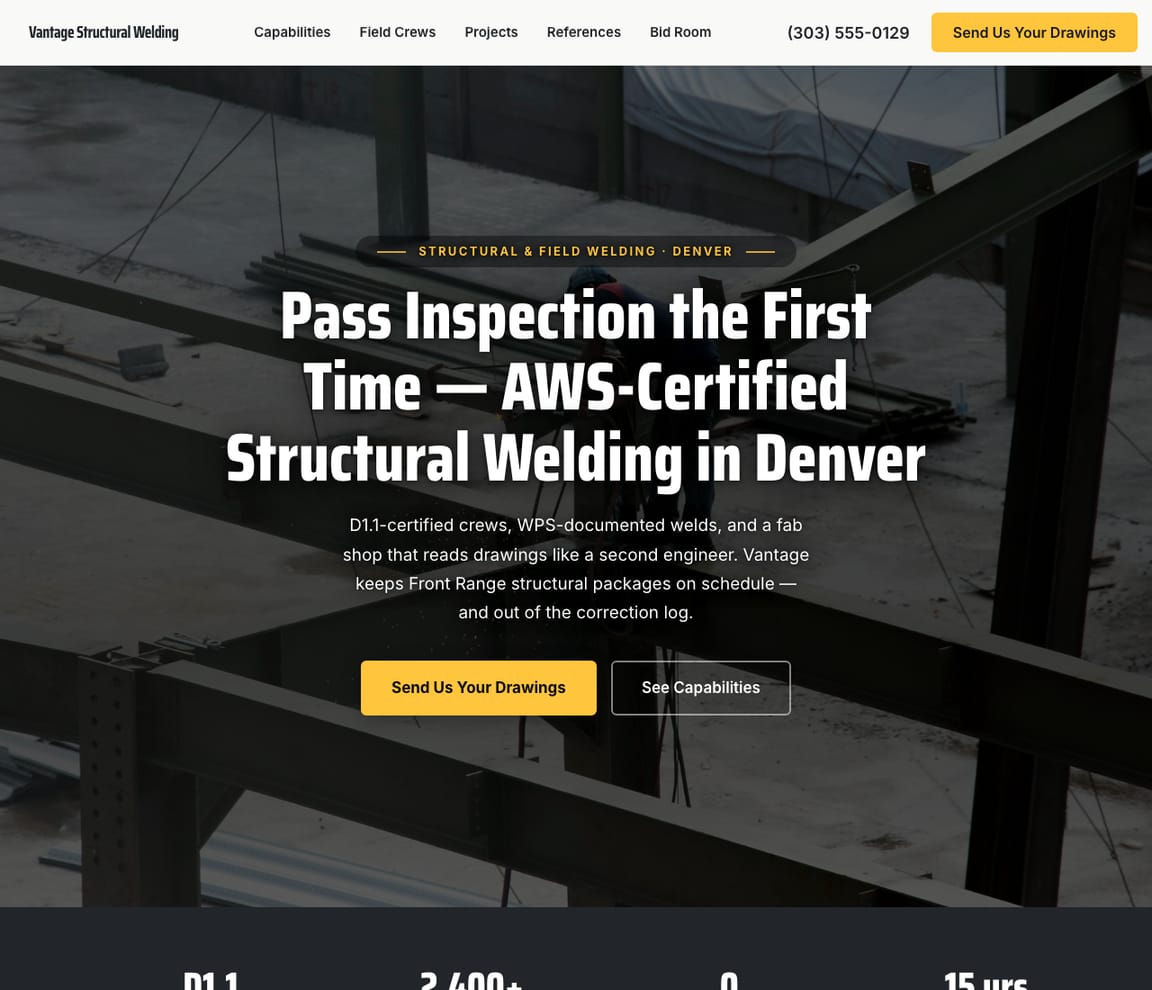
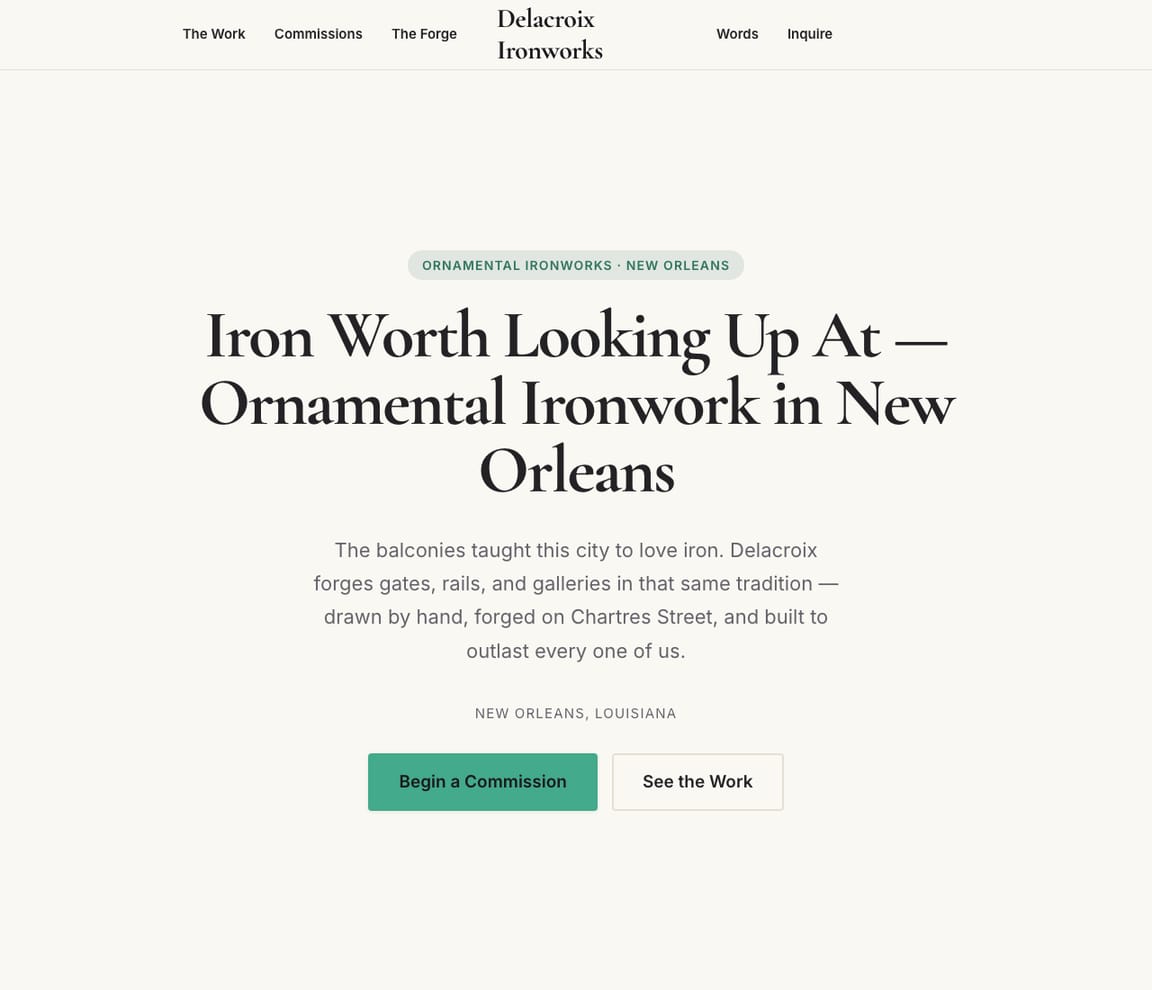
Real Zarla templates for the shapes the trade takes — the custom fabrication shop, the structural welder on commercial sites, the ornamental iron maker, the certified welder who sells the paperwork as much as the weld. Open one, swap in your services and your certifications, and publish.
GET FOUND
Get found by the contractor with a cracked frame and a deadline
A welding call is searched from a job site with the crew standing around, from a farm with a broken gate, from a homeowner who wants a railing — and the job goes to the welder whose services, service area and certifications are on the first screen. Zarla builds the website with your services, your service area and a call button. Add your rates, your trip fee and your certifications in chat, and once you connect your Google Business Profile, your name, your photos and your hours stay in step on both.
“Mobile welder near me”
Searched by a contractor with a cracked frame, a rancher with a broken gate and a homeowner pricing a railing. Your services, your area, your certifications and a call button answer all three.
Google Business Profile
A welder who drives to customers qualifies for one: your service area, your hours and your photos inside Google Maps. Free, and an afternoon to set up.
The certifications on the page
Your AWS or code certifications — and the city welder license where New York City or Los Angeles asks for one — on the site and the quote are what a contractor's superintendent checks before the first job, and what an inspector asks for on the site.
Google Search
Hharborlanewelding.com
Harbor Lane Welding — Trusted welding in Your AreaDallas's certified mobile welder — trailers, gates, equipment and structural repair, on site. Trip fee quoted before we drive; see our certifications and our work. Call or request a quote online.← Your Zarla siteCcityweldingservices.com
City welding ServicesGoogle Maps
1
Harbor Lane Welding
← You2
Metro welding Co.
3
Quick welding Services
AI assistants (ChatGPT / Perplexity)
For a certified mobile welder near Dallas who can repair a steel trailer frame on site this week and tells me the trip fee before coming in your area: Harbor Lane Welding — a mobile welder's site that lists on-site repair, trailer and gate work and fabrication with a trip fee and an hourly rate, shows the AWS certifications, has photos of finished welds, and takes a call or a quote request from the page.
YOUR LAUNCH PLAN
Your become-a-welder checklist
The whole guide as things to check off. Work through them in order and you'll be trained, certified by test, licensed where your city or state asks, insured and findable before your name goes on the truck.
- Pick the route in — a technical college, a union apprenticeship, or a helper's job in a shop.
- Learn stick and MIG, then flux-core and TIG — a hundred hours of scrap first.
- Take the OSHA 10 — and learn the fire-watch and fume rules below.
- Pass the first plate test — at an accredited test facility, to a named code.
- Check your city — New York City and Los Angeles license welders by name.
- Keep the certifications current — and add the next code or position.
- Set up, license and insure the business — entity, contractor license where your state draws the line, hot-work liability, commercial auto, workers' comp.
- Get found — a website with your welds, your certifications and a call button, and a Google Business Profile.
REAL CUSTOMERS
Small business owners who got online with Zarla
Verified reviews from real Zarla customers.
“Optimized for local service-based businesses. Easiest website build I've experienced. The AI-based build is the way to go instead of clunky theme-based websites. Get the site built and get out of the weeds with Zarla!”
“Quickly built my website from scratch. No hiccups. Would highly recommend Zarla for someone with no experience who wants to start a polished business website.”
“Very reliable, professional, and fast results. I was able to get my business online in no time, and the ease of access made it so simple.”
“I had no idea how to set up a website for my business. Thanks to Zarla, they've helped me a lot.”
Be the welder the broken-trailer call reaches first
Add your town and your business name, and Zarla builds the website from that one line — your services, the area you cover, your certifications, photos of your welds, a call button and a quote form, with SEO in place. Add your rates and your trip fee in chat. Free to build; you pay when you publish.
Already have a website? Bring it across →Zarla keeps your old page addresses where it can and redirects the ones that change, helping you keep the Google standing you've built.
Frequently asked questions
How much does it cost to become a welder?
In the US, about $1,776.16 for a lean start, our arithmetic from the pages that print each price: a $1,368.99 Lincoln Electric Easy-MIG 140, a $149.99 auto-darkening helmet, $11.49 gauntlet gloves, a $33.15 flame-resistant jacket, a $122.99 DeWalt angle grinder, a $40.17 chipping hammer, a $28.99 3M half-mask respirator and $20.39 for spare P100 filters, as listed at Zoro. The fuller start as a mobile welding business — the same kit, $40.25 TIG gloves, a $519.99 oxy-acetylene torch kit with tanks, a $350.00 20-pound extinguisher, a $305.99 cylinder cart, the AWS Certified Welder's $70 application and $105 yearly maintenance, $2,000 for a year of general liability and $3,212 for a year of commercial auto at Insureon's welder medians — is $8,379.39. School first adds $4,605 a semester at Texas State Technical College; the test facility's exam fee is its own. Neither figure includes the truck, the engine-driven welder or the website.
Do you need a license to be a welder?
In the US, no US state licenses the welder. What stands in for one is the certification — a weld you make under a code at an accredited test facility, inspected by a certified inspector — which federal law makes mandatory on pipelines and contracts make mandatory on structural work, plus two city cards: New York City licenses structural welders ($50, a $330 background investigation, the AWS or state DOT certifications first), and Los Angeles certifies them on pages that refused our reader. The business is a separate matter: welding on someone's building needs the contractor license or registration your state draws — California's C-60 above $1,000, Arizona above $1,000, Washington's registration from the first dollar — and Texas, Florida, New York State and Illinois print nothing on welding at state level. Check your state's contractor board and your city's buildings department before you weld on a structure.
How do I get a welding certification?
In the US, book a test. The American Welding Society's Certified Welder program is strictly performance-based — no prerequisite courses, no minimum experience — at one of more than 200 accredited test facilities, where you deposit a weld that a certified inspector examines; the application is $70, the facility sets its own exam fee, and if you fail you can retest at any time. The card lasts as long as you keep welding the process: a maintenance form every six months, through a $105-a-year subscription, or the certification goes inactive and you requalify by test. The certificate names the process, the position and the code — structural steel, pipeline, sheet metal, refinery — and each new one is a new test. Washington's building officials run a parallel voluntary card at $66 a certification.
How long does it take to become a welder?
Days to be useful, months to be certified, years to be good. O*NET puts the training at a few days to a year on the job; a technical college certificate runs a semester or two; the union apprenticeships run four years at the Boilermakers and typically five at the United Association, at a federal floor of 2,000 hours a year. The AWS test itself is one appointment with the card two to three weeks later, and one Austin owner certified while still in high school. California's welding contractor license asks for four years of journey-level experience; one Denver owner spent five to six years on the job before launching his company.
Is it easy to get a job as a welder?
Getting in is easy; the openings come from turnover, not growth. The occupation sits in O*NET's Job Zone 1-2 — very little to some preparation — with 437,700 employed welders in 2025 and 40,300 openings a year projected, but growth of only 1 to 2 percent, slower than average, and 54 percent of surveyed welders say a high school diploma is required. The society says employers often look for certified welders when hiring for fabrication, manufacturing, construction and energy. The owners quoted above found the first jobs by getting certified early and taking the small repairs nobody else wanted.
How to become a welder with no experience?
Find a booth. A high-school or adult-school welding class, a technical college certificate, a union apprenticeship that pays while you learn, or a helper's job in a shop — every welder quoted above started one of those ways, and the society's own program needs no experience at all: if you can make the weld, you can take the test. Learn stick and MIG first, because the shop and the field run on them, then flux-core for outdoor structural work and TIG when you want stainless and aluminum. In the US nothing is required of the person before the first paid bead except a hood, gloves and a shop willing to let you burn rod.
What is TIG welding?
Gas tungsten arc welding — GTAW on a certification — the process that uses a tungsten electrode, a shielding gas and a hand-fed filler rod, slower and cleaner than MIG or stick and the one used for stainless, aluminum and thin material. Washington's building officials list it as one of the four structural welder certifications beside SMAW, GMAW and FCAW, and the society's welder-fabricator profile names it among the processes employers expect. It is usually the last of the four a welder learns and the one that opens the better-paid shop work.
Is 40 too old to learn welding?
No page prints a maximum age. New York City asks a licensed welder to be at least 18; the society's program is open to anyone with a talent for welding, with no educational prerequisites or minimum experience. The welders quoted above include a Navy saturation diver who started a company while raising two daughters alone, a Colombian aeronautical welder restarting in Phoenix after twenty years in the air force, and a Simi Valley owner who took an adult-school course and spent his savings on a shop in 2021. At 40 the test is the same weld; what you bring is that you already know how to show up.
How much do welders make?
Employed welders, cutters, solderers and brazers had a median of $53,750 in 2025 — $25.84 an hour — with 10 percent earning $39,240 or less and 10 percent $77,530 or more, from BLS data on O*NET. By state the median is $53,340 in Texas, $58,060 in California, $50,640 in Florida — where the top 10 percent earn $70,390 — and $59,140 in New York, where they clear $87,110. The survey counts employees only; an owner's income is the billing minus the truck, the gas, the steel and the insurance, and one Chicago-area owner describes leaving a job that paid forty dollars an hour to build his.
Can welders make $100,000 a year?
Not in the wage tables we can link: the 90th percentile for employed US welders was $77,530 in 2025, and the highest state 90th in our set was New York's $87,110. Six figures belongs to the owner with a rig and a full calendar, or to the specialist — pipeline, code and inspection work — and it is billing, not a wage: the survey excludes the self-employed, and the owners quoted above describe the first years' income going into tools and a truck. The plan page linked above works the owner's arithmetic.
Why do welders age so fast?
No source prints that claim, so we will not. What the occupation survey does print is the exposure: of the welders O*NET surveyed, 62 percent are exposed to contaminants every day, 58 percent to uncomfortable noise, 48 percent to minor burns and cuts, 41 percent to hazardous equipment, 33 percent to very hot or cold temperatures, and 86 percent wear protective equipment every day. OSHA's welding page points to its fact sheet on controlling fume and gases, and federal rules put a fire watch at 35 feet. The respirator in the kit above is $28.99; the hood, the gloves and the jacket are the rest of the answer.
Is welding worth it as a career?
The numbers: a median of $53,750 and $25.84 an hour for employees, entry with very little preparation and a test that needs no course, 40,300 openings a year, and growth of only 1 to 2 percent. The costs: daily exposure to fume, heat and sparks, a certification you must keep alive every six months, and — for the owner — $2,000 a year in liability insurance before the first job. The welders quoted above answer it by having stayed: one went on the road for seven years and came back to open a shop, one certified in high school and still runs the truck, one spent the first years' income on tools and calls it the best decision he made.
How do I become a welder in Florida?
Get into a booth, pass the first AWS test, and register a business. Florida has no state welding license — welding is not one of the contractor types the statute lists — and the state licenses contractors for the building trades the statute does name. A Florida welder's employed median was $50,640 in 2025, with the top 10 percent at $70,390. A Florida LLC is $100 plus $25 for the registered agent and $50 a year, if you want one, and contractors will ask for the insurance certificate before you set foot on a site.
Do I need an LLC to be a welder?
No US state requires it for the work, which attaches to you — or, where your state licenses the contractor, to that license, whatever the entity. A one-rig welder is a sole proprietor by default: Schedule C, the 15.3 percent self-employment tax once net earnings pass $400, quarterly estimates once you expect to owe $1,000. If you form an LLC: $300 in Texas, $100 plus a $25 registered-agent fee and $50 a year in Florida, $200 in New York plus a notice published for six weeks in two newspapers, and $70 in California plus an $800 annual tax every year. The insurance matters more than the entity — hot-work liability is the policy every site asks to see. Confirm the details with your accountant.