CAREER GUIDE
How to become an arborist in 2026
A few US states license the arborist by name — Maryland, Connecticut, Louisiana, Rhode Island, Maine, New Jersey — and everywhere else the ISA credential is voluntary, the contractor's license starts at a dollar line, and the pesticide license is the state's; all named below from the agencies. The route in: groundsman, climber, the ISA exam with its real fees; OSHA's ten-foot rule; the saw and the saddle from the makers' own prices; what arborists earn — and how to go from someone else's crew to your own.
Free to build · Pay when you publish · No credit card
6 stateslicense the arborist or tree expert by exam — Maryland, Connecticut, Louisiana, Rhode Island, New Jersey and Maine — and Minnesota registers the company; everywhere else the ISA credential is voluntary, named below from the statutes
$50,960median pay for employed tree trimmers and pruners in 2025 (O*NET, from BLS data); $62,550 in California — the self-employed are outside the survey
$335to sit the ISA Certified Arborist exam as a member — a $40 application and a $295 enrollment — after three years of full-time tree work or a degree
61 a yeartree-care deaths in the US from 2020 through 2023 by the industry association's own count — the number behind the ten-foot rule and the safety standard
See it in action
See what your tree service website could look like
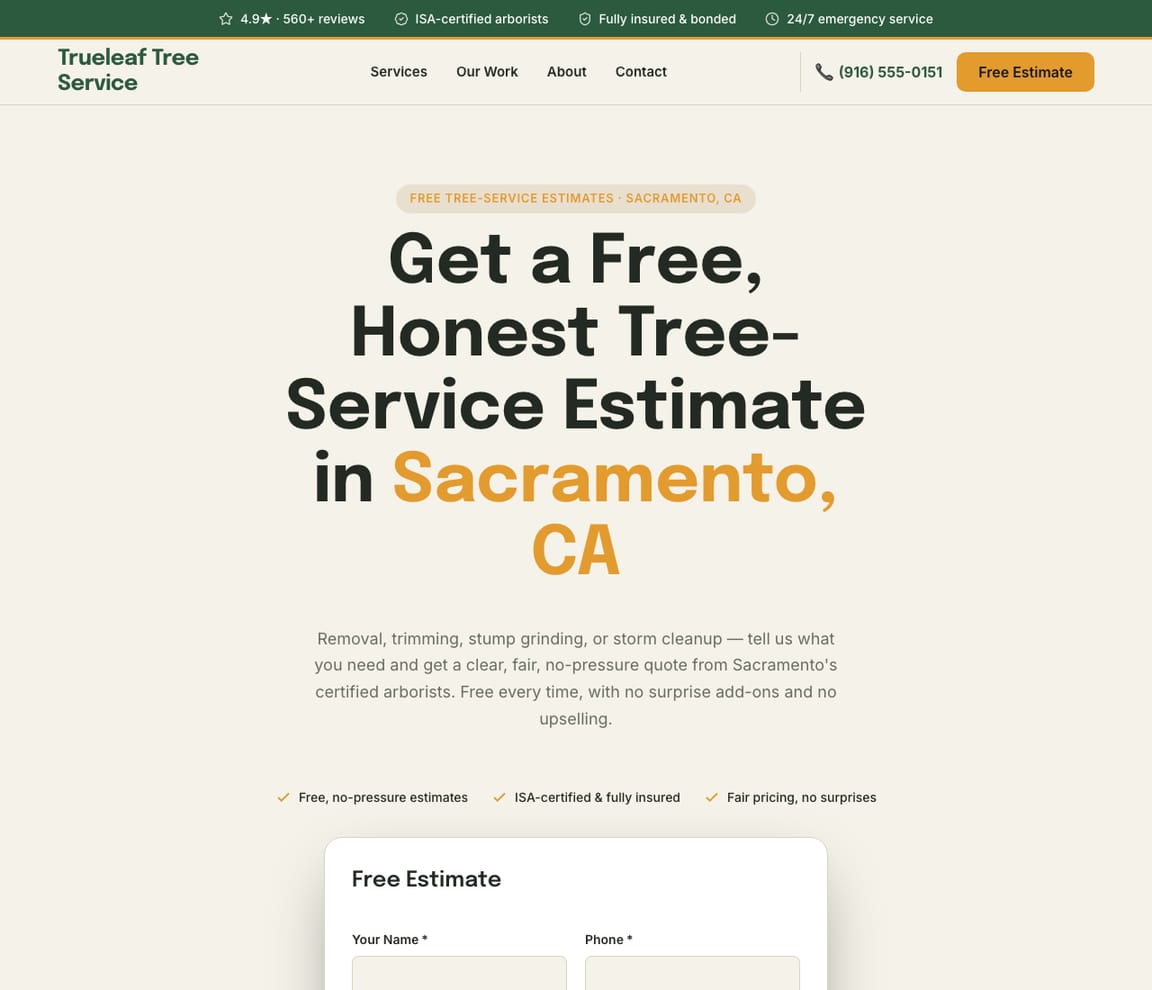
A real Zarla template for a local tree service — the free-estimate button by the headline, the services and the credentials under it, the before-and-after gallery underneath. Describe yours — the town, the services, the service area — and you'll have a site like this, with a quote form and a gallery, in about a minute.
- Professional design — not a generic template
- Looks great on desktop and mobile
- Content written for your industry
Build the website
Start your tree service website now
Add your town and your business name to the sentence, and Zarla builds the site: your services, your credentials, a quote form and a gallery. Add your prices and your photos in chat, then publish.
Already have a website? Bring it across →Zarla keeps your old page addresses where it can and redirects the ones that change, helping you keep the Google standing you've built.
Is becoming an arborist worth it in 2026 — and what does the work pay?
Becoming an arborist is a trade you enter from the ground — a season dragging brush before anyone hands you a saw — with a voluntary credential most of the country treats as the license, a short list of states that actually issue one, and, once the chipper is yours, a local business whose customers call the morning after every storm. Three honest numbers first. Employed tree trimmers and pruners had a median of $50,960 a year in 2025, $24.50 an hour: 10 percent earned $37,940 or less, 10 percent $80,310 or more (O*NET, from BLS 2025 wage data). The headcount is steady: "Employment (2025) 70,600 employees", "Projected growth (2025-2035) Average (3% to 4%)", "Projected job openings (2025-2035) 7,900" (O*NET, employment and outlook). And the survey behind the wages leaves out the self-employed — "We do not provide occupation and wage estimates for farms, the self-employed, owner/partners in unincorporated firms, the military, household workers or unpaid family workers" (Washington ESD) — which is the arborist with his own crew, so the median measures the climber on payroll, not the owner who prices the job.
State by state, and up the ladder. The employed median is $39,880 in Texas, $62,550 in California, $46,070 in Florida and $62,400 in New York (O*NET, Texas; California; Florida; New York). The crew lead is the next rung: first-line supervisors of landscaping and groundskeeping workers had a median of $58,430, with 10 percent at $85,650 or more (O*NET, 37-1012). The door needs no diploma — the survey's employers said "57% responded: Less than high school diploma required" and "37% responded: High school diploma or equivalent required" (O*NET, education) — and one national company posts its groundperson job at "Hourly pay from $20.00 - $22.00 based on experience" with "Preferred: Previous experience in tree care or related industry" (Davey Tree, groundperson posting).
Where the money is. An owner's income is the price of the job times the jobs a crew can do minus the saws, the chipper, the truck and the insurance — the arborists quoted below describe a storm that filled the calendar, a reputation that let them refuse bidding wars, and the specialty work — risk assessment, preservation plans, commercial contracts — that pays more than the removal. The step after this guide is how to start a tree service business, the price list is in tree removal pricing, and the plan page is the tree service business plan.
The catch. It is the most dangerous trade in this series. In O*NET's survey 91 percent of tree trimmers work "Outdoors, Exposed to All Weather Conditions" every day, 71 percent are "Exposed to Hazardous Equipment" and 48 percent "Exposed to High Places" (O*NET, work context); the industry association counted "243 tree care-related fatal occupational injuries in the U.S. for calendar years 2020 through 2023, yielding an average of 61 such incidents a year", and estimates the rate at "somewhere between 30.5 to 41.0 per 100,000 FTE workers, as much as 11 times higher than the all-industry average" (TCI Magazine, April 1, 2024). That's what the rest of this guide sets up: who licenses what, from the statutes; the groundsman-to-climber route and the ISA exam with its real fees; the ten-foot rule and the safety standard; the saw and the saddle from the makers' own prices; and how to be the arborist the morning-after-the-storm search calls.
How to become an arborist, in plain English: who licenses the title, who licenses the work, and the rules you follow anyway
"Arborist" is a licensed title in six US states, a registered trade in a seventh, and — as far as we found — a free word everywhere else. Google's voluntary-ISA answer matches what we found for Texas, Florida, New York, Illinois and Pennsylvania (no state arborist license turned up, though we did not read each state's licensed-occupations list) and is wrong for the Northeast and the Gulf. Here is the list from the statutes and the boards:
- Maryland — the Licensed Tree Expert. "A person may not engage in the work or business of a tree expert without a license issued by the Department." "An employee under the supervision of a Licensed Tree Expert may not be required to have a license in the name of the employee." The door: "Has attained 18 years of age", "Has had 2 years of approved college education in forestry, arboriculture, horticulture, applied agricultural sciences, or the equivalent education and a minimum of 1 year of experience with a licensed tree expert in Maryland or with an acceptable tree expert company in another state; or For at least 3 years immediately preceding the date of application has been engaged continuously in practice as a tree expert", "Has passed the examination given by the Department", and "Every licensee must carry and show proof of liability and property damage insurance"; renewal takes "8 continuing education units (CEUs) over the two year period" (Maryland DNR, Licensed Tree Experts). The fees are capped in statute: "(1) For the examination fee $45; (2) For the initial license fee $55; and (3) For the renewal fee $100" (Md. Code, Nat. Res. §5-419).
- Connecticut — the arborist license, plus a business registration. "'arboriculture' means any work done for hire to improve the condition of fruit, shade or ornamental trees by feeding or fertilizing, or by pruning, trimming, bracing, treating cavities or other methods of improving tree conditions, or protecting trees from damage from insects or diseases or curing these conditions by spraying or any other method"; "No person shall advertise, solicit or contract to do arboriculture within this state at any time without a license issued in accordance with the provisions of this section"; the exam application carries "a fee of two hundred dollars which shall not be returnable", "Each licensee shall pay a license fee of two hundred eighty-five dollars for each license or renewal", "A license shall be valid for a period of five years", and the exam covers "the proper use and application of pesticides" — "any person who uses pesticides in arboriculture shall be licensed to do arboriculture or shall be a licensed commercial applicator under chapter 441". The company registers too: "No person shall engage in the operation of an arborist business unless such person has a certificate of registration from the Commissioner of Energy and Environmental Protection" at "a fee of two hundred forty dollars"; working unlicensed is "a civil penalty of not less than one thousand dollars but not more than two thousand five hundred dollars for each day such violation continues" (Conn. Gen. Stat. chapter 451, §§23-61a to 23-61l).
- Louisiana — the arborist license and the utility arborist license. "A person who presents himself as, or advertises as, engaging in the arborist profession shall be required to obtain a license", which "authorizes the holder thereof to recommend or execute the following measures: (a) The removal of a tree or a portion of a tree. (b) Measures to prolong the life of a tree. (c) Measures to enhance the aesthetic value of a tree", and at renewal "Show proof of current and sufficient general liability and workers' compensation insurance, if applicable" (La. R.S. 3:3808); the statute caps the exam at "an amount not to exceed three hundred fifty dollars" and the license at "not less than seventy-five dollars nor more than one hundred fifty dollars" (R.S. 3:3806). The department prints the actual figures: "Arborist licenses are required if you work on trees for a fee." "Pay the $150 exam fee." "Pay $125 license fee per year." "All licenses expired January 31st each year." "You must take your exam within 60 days of submitting your application." (Louisiana Department of Agriculture and Forestry, arborists).
- Rhode Island — a license for anyone working alone on someone else's trees. "Any individual, whether self-employed or working as part of a corporation, firm, or any municipality, who will spend any portion of his/her time working alone at any job site where any arboriculture is being done on property of another for compensation must have a valid arborist license", and on a crew "at least one person at every such job site must have a valid arborist license, and all persons working at such job site must be within such close proximity to each other that their work is continually monitored by a licensed arborist." Two licenses — "Standard Arborist" and "Limited Utility Arborist" — an exam "held in January, March, June and September", "a non-refundable fee of twenty-five dollars ($25.00) for every application for examination", "at least seventy percent (70%) of the questions correctly" to pass, an exam "based on the latest standards for arboriculture as promulgated by the International Society of Arboriculture" that the ISA's own exam may exempt you from, and "A fee of twenty-five ($25.00) will be charged for each arborist license and each renewal license" (250-RICR-70-00-1, Rhode Island DEM).
- New Jersey — the business registers, and a licensed tree expert or tree care operator runs it. "Every Business engaged in providing tree care services for hire in New Jersey shall register biennially with the Board, as a condition of doing business in New Jersey", with "at least one licensed individual working full time in the company", "a minimum amount of $1,000,000 of general liability insurance", workers' compensation, and "a written comprehensive safety policy" within 90 days; "The Licensed Tree Care Operator (LTCO) is for companies that only provide standard tree care work like pruning, removals and stump grinding. The Licensed Tree Expert (LTE) is permitted to oversee standard tree work and more specialized work such as cabling and bracing, tree risk assessment, tree appraisals and consultations" (New Jersey Board of Tree Experts, businesses). The door to the exam: for the LTCO, "a person 18 years of age or older" who "has been continuously employed in the practice of arboriculture for at least three years"; for the LTE, a four-year degree in a named field, or "at least five years" in the trade, or two years of college with three related courses plus three years (the board, exam qualifications). The fees: "License application | $50", "LTCO written exam | $100", "LTE written exam | $100", "LTE field exam | $100", "License initial (2 years) | $150", "Business biennial registration | $200" (the board's fee schedule).
- Maine — the arborist license. "'Arborist' means a person who, for compensation, takes down or fells, diagnoses or evaluates the condition of shade or ornamental trees; solicits, recommends or supervises the treatment of those trees; or in any manner or for any purpose treats or cares for those trees", where treating means "the pruning, trimming and shaping of trees when the care requires the person to leave the ground" (7 M.R.S. §2173); "A person may not advertise, consult, solicit, contract or in any way engage for compensation in the business of an arborist, or make representation as being able to do so, without being licensed as an arborist" (§2179); the license goes "to an individual who is 18 years of age or older, who is specifically qualified as defined in this subchapter, who passes an examination and who gives proof of financial responsibility" (§2181), and "The fee for an original or renewal annual license may not exceed $180" (§2188).
- Minnesota — a registry, not a license. "All commercial tree care providers, tree trimmers, and employers that direct employees to remove trees, limbs, branches, brush, or shrubs for hire must be registered with the commissioner", for "a nonrefundable fee of $25 for initial application or renewing the registration", and "It is unlawful for a person to advertise tree care or tree trimming services in Minnesota without being registered with the commissioner" (Minn. Stat. §18G.07); the department adds a "$5 processing surcharge" and says "Only one registration is required for each company or franchise" (Minnesota Department of Agriculture).
- California — a contractor's license above $1,000, and workers' comp with no employees. A contractor includes "Any person not otherwise exempt by this chapter, who performs tree removal, tree pruning, stump removal, or engages in tree or limb cabling or guying" (Cal. Bus. & Prof. Code §7026.1), unless the job is "less than one thousand dollars ($1,000), that work or operation being considered of casual, minor, or inconsequential nature, and the work or operation does not require a building permit" (§7048). The classification: "C-49 – Tree and Palm Contractor", which "plants, maintains, and removes trees and palms. The duties include pruning, stump grinding, and tree, palm, or limb guying" (CSLB). And the rule every other contractor escapes: the board requires a workers' compensation certificate of every licensee except one who "Has no employees" — and that exemption does not reach a holder of "a D-49 license, a subcategory of a C-61 license" (the tree classification, now printed by the board as C-49) (§7125). A one-man tree outfit in California carries workers' comp on itself.
- Texas, Florida, New York, Illinois, Pennsylvania — no arborist license found; the pesticide and the power line are the law. In every state, spraying or injecting a restricted-use pesticide for hire takes the state's commercial applicator card under the federal standard: "a commercial applicator must receive a passing score on a written examination" and "A commercial applicator must be at least 18 years old" (40 CFR §171.103), in the "Ornamental and turf pest control" category — "commercial applicators who use or supervise the use of restricted use pesticides to control pests in the maintenance and production of ornamental plants and turf" — or "Right-of-way pest control" for the powerline crews (§171.101); in Texas "Applicators must apply to TDA, pay the required license fee, and receive their eligibility letter with unique TDA Account Number before they will be able to sign up for exams" (Texas Department of Agriculture) — the fee is on the form, not the page, and is not printed here.
The ten-foot rule. OSHA's electrical standard keeps everyone who is not a qualified line-clearance trimmer away from the wires: "When an unqualified person is working in an elevated position near overhead lines, the location shall be such that the person and the longest conductive object he or she may contact cannot come closer to any unguarded, energized overhead line than the following distances: For voltages to ground 50kV or below - 10 ft. (305 cm)" (29 CFR 1910.333). The work inside that distance is a separate trade with its own standard — "Line-clearance tree trimming performed for the purpose of clearing space around electric power generation, transmission, or distribution lines or equipment and on behalf of an organization that operates, or that controls the operating procedures for, those lines or equipment" (1910.269) — and the industry's own safety standard, ANSI Z133, sells for "Member Price $26.44", "Non-Member Price $34.49"; "Although compliance with this standard is voluntary, Z133 carries the force of law in many instances in the U.S." (TCIA, ANSI Z133).
The credential, and what it costs. The ISA Certified Arborist needs "Three or more years of full-time, eligible, practical work experience in arboriculture" or "A degree in the field of arboriculture, horticulture, landscape architecture, or forestry from a regionally accredited educational institute", then "a written test consisting of 200 multiple-choice questions" (ISA Texas chapter). ISA's own fee table: "Application Fee | $40 USD | $50 USD", "Exam Enrollment | $295 USD | $396 USD", "Base Recertification Fee | $220 USD", "Retake Fee | $120 USD" for members and standard candidates respectively (ISA, common questions) — though ISA's exam page prints the standard enrollment as "$369 USD all other candidates with an approved application" (ISA, exam information), so budget $295 as a member and about $370 to $400 otherwise. Membership is "Cost: $135" for the professional tier (ISA, types of membership), which makes joining first the cheaper year. The next rungs: the ISA Certified Tree Climber, "the only global, industry-wide climber certification", requires "Current training in a physical (practice) aerial rescue, CPR, and First Aid" and is renewed by retest or "at least 15 continuing education units (CEUs) over the three-year certification period" (ISA Certified Tree Climber); the Tree Risk Assessment Qualification is "a two-day educational course followed by a half-day of assessments that include both written and performance-based components" (ISA TRAQ); and the Board Certified Master Arborist is "the highest level of certification offered by ISA" — "Fewer than two percent of all ISA Certified Arborists® currently hold this certification" (ISA BCMA), at "$495 USD" to sit (ISA, fees). Before any of it: the industry association's free course, "Introduction to Arboriculture Safety is a certificate course offered by Tree Care Industry Association for individuals exploring, or new to, a career in arboriculture", covering "the roles ANSI Z133, PPE, communication, work site set up, site and tree inspection and the job briefing all play in creating a safe work environment" (TCIA, free course).
You are self-employed from the first job. In the US a one-truck arborist is a sole proprietor by default: "Use Schedule C (Form 1040) to report income or (loss) from a business you operated or a profession you practiced as a sole proprietor" (IRS, Schedule C instructions); "The self-employment tax rate is 15.3%" once your "net earnings from self-employment (excluding church employee income) were $400 or more" (IRS), and sole proprietors "generally have to make estimated tax payments if they expect to owe tax of $1,000 or more when their return is filed" (IRS). If you want an LLC: Texas "for filing a certificate of formation, $300" (Tex. Bus. Orgs. Code §4.152); Florida "$100" plus "For filing an annual report, $50" (Fla. Stat. §605.0213); New York "two hundred dollars" (N.Y. LLC Law §1101); California "Seventy dollars ($70)" (Cal. Gov. Code §12190) and "Every LLC that is doing business or organized in California must pay an annual tax of $800" (Franchise Tax Board). Workers' compensation: "In Texas, private employers can choose to carry workers' compensation insurance coverage, but it is not required in most cases" (Texas Department of Insurance); "All California employers must provide workers' compensation benefits to their employees under California Labor Code Section 3700" (California DIR) — and the tree contractor there carries it with no employees at all. Confirm the details with your accountant.
The money to start. Our arithmetic from the pages that print each price. A lean start — a groundsman buying his own climbing kit and sitting the ISA exam — a Stihl MS 172 C-E ground saw at its $219.99 sale price (Stihl, read October 26, 2026), a Silky Zubat 330 hand saw at $115.99 (Sherrill Tree), a Notch deluxe throw line kit at $203.99 (TreeStuff), a Petzl Vertex helmet at $114.95 (Petzl), ISA membership at $135 and the member's $40 application and $295 exam — comes to $1,124.92. The fuller start, a licensed one-truck outfit in Connecticut — the same kit, a Petzl Sequoia saddle at $579.95 (Petzl), a Stihl MS 201 T C-M top-handle saw at $1,069.99 (Stihl) and an MS 250 at $429.99 (Stihl), the Z133 standard at $34.49, Connecticut's $200 exam application, $285 license and $240 business registration, and a year of general liability at Insureon's median — is $5,839.34. The climbing line, the lanyard, the chaps and the rigging block are the lines left out: the gear suppliers' category pages load by script and no product page for them opened to our reader; the chipper and the bucket truck are the owner's step, costed on the plan page. The insurance is a median, not your quote: "Tree service contractors and businesses pay an average of $156 per month, or $1,875 annually, for general liability insurance", workers' comp "$215 per month, or $2,580 annually", tools and equipment "$53 per month, or $637 annually" and commercial auto "$299 per month, or $3,590 annually" (Insureon, tree service, updated September 30, 2026). The plan page for the business side is the tree service business plan, the step after this guide is how to start a tree service business, the price list is in tree removal pricing, the name goes on the truck from tree service business names, the business license question is answered in do I need a business license, and the site comes from the tree service website builder or the tree service website design page.
In the UK: no license for the title, but the chainsaw itself is regulated — "Anyone who uses a chainsaw at work must receive adequate training and be competent in using a chainsaw for that type of work", and "Before using a chainsaw to carry out work on or in a tree, a worker should have received appropriate training and obtained a relevant certificate of competence or national competence award, unless they are undergoing such training and are adequately supervised" (HSE, Chainsaws at work, INDG317); the entry certificate is the "City & Guilds Level 2 Certificate of Competence in Chainsaw Maintenance and Cross-Cutting" (NPTC), and the trees themselves can be protected: "Owners of protected trees must not carry out, or cause or permit the carrying out of, any of the prohibited activities without the written consent of the local authority" (GOV.UK, tree preservation orders). In Australia there is no license either; the qualification is the Certificate III in Arboriculture, "Code: AHC30824", "Duration 2 years full time" as a climbing-arborist traineeship (Melbourne Polytechnic); the bucket truck, not the saw, is where the states' high-risk work licenses begin. Check your own state's agriculture or environment department, and your city's tree ordinance, before you quote the first job.
What working arborists actually say
None of this is our opinion about the trade. It comes from people who do it — a tree and lawn care owner who hauled brush for three years, a second-generation climber with twenty-three years aloft who now writes risk assessments, a Dallas owner whose first season was an ice storm, a Katy arborist who trims thirty thousand trees a year, a Houston father-and-son outfit that started in a borrowed Jeep, a Florida arborist who started on a crane crew in Massachusetts, a Northwest Indiana owner climbing since fifteen, an Illinois landscaper who got certified to leave the mow-and-blow business, a Colorado firewood-and-tree man, a Colorado forestry company and a Colorado climbing school — talking to CanvasRebel, the Voyage magazines and ShoutoutColorado between 2017 and 2026, each described as the page describes them. Read each as theirs at the time. Five things come up again and again.
You start on the ground, and you stay there a while. Jared Lang, BLU-J Tree & Lawn Care: “Driven by curiosity, I reached out to a local arborist and asked for a job. I started at the bottom, hauling brush and working as a groundsman for three years. I soaked up everything I could—techniques, safety, equipment maintenance, tree biology—you name it.” And: “It wasn't until my late 20s that I discovered the world of arboriculture, and I instantly fell in love with it. After five years in the field, I finally took the leap and started my own tree and lawn care business.” (CanvasRebel, July 7, 2025). Michael Casey, Southeast Arborist, Loxahatchee, Florida: “At first I was calling landscape companies having done that work throughout high school, but then I came across a company called Northeast Arborists. At the time I had no idea what an arborist was. I gave them a call and they hired me shortly after. Instantly, I fell in love with the work; the challenges of it, changes from day to day and all the equipment that goes along with it.” And: “I went to work for a new company in Quincy Massachusetts, which is where I began to climb. I was on the crane crew where we use a crane to remove large trees.” (VoyageMIA, February 1, 2018). Russell Hodge, Hodge Tree Care, Northwest Indiana: “I actually started in 1979 at 10 years old working summers and days off school. By 15, I was climbing trees, and by 19 I was a crew chief. It is something that is in the family blood, along with a good dose of saw dust.” (VoyageChicago, November 14, 2017). Mitchell Magdovitz, Tree Climbing Colorado: “And we also train ground crews for arborists who want their works to get really solid training in the fundamentals of technical tree climbing prior to conducting riskier aerial aspects of professional tree care.” (VoyageDenver, August 26, 2025).
“We climb a nylon rope, with a running chainsaw, doing physics and geometry equations in my head, while dealing with the consequences in real time. Its not for everyone, nor should it be. But there is nothing like it.” — Anthony Ley, ISA Certified Arborist, Rebel Arborist Publications, in CanvasRebel, May 26, 2026
The work is hazardous, seasonal and long, and nobody wanted them to do it. Ley: “From the beginning of my career, everyone wanted me to do anything else. The work was hazardous (our job is to mitigate hazards), seasonal and inconsistent. The schedule is usually before the sun came up until after the sun went down.” And on where twenty-three years lead: “These days i mostly assess trees, so that I can write preservation plans, tree risk assessment reports, prescription pruning plans, etc. I climb 2-3 days per week now, picking and choosing the trees i want to care of myself.” (CanvasRebel, May 26, 2026). Jose Sanabria, J.S. Tree Service, Houston: “On one of the jobs. An accident occurred. My dad misstepped and fell off the ladder and broke his ankle. We still had a couple of more clients to go to, but I couldn't do it alone so that's when I said to myself “We needed help“ so we started hiring because I knew that my dad's recovery would be a long one.” (VoyageHouston, January 16, 2024). Lang, on the leap: “The risk? It was huge. I worked extra jobs to save for equipment, faced long hours, constant learning curves, and physical exhaustion—all while trying to provide for my 5-year-old daughter.” (CanvasRebel, July 7, 2025). Cody Geiman, Cody's Tree Service, Katy, Texas: “Most tree companies you will not see the owner out sweating and doing the hard labor it takes to get the job done. I am 42 years old and still climb trees!!!!” (VoyageHouston, July 6, 2017).
The credential is the turn from tree cutter to arborist. Hodge: “About 14 years ago, I obtained my ISA Certified Arborist certification and really began a concerted focus on tree care and preservation.” And: “I attend conferences and seminars 3-6 times a years to both maintain 2 certifications and stay out front. My goal has been to be the one to call when others don't know, and the problem needs solved.” (VoyageChicago, November 14, 2017). Paul Gange, Complete Landscaping, Itasca, Illinois: “During college, I knew I had to set myself apart from the mow and blow business model that I cut my teeth on growing up. I became a certified arborist and worked part time for a tree company to learn the business from sales and operations to climbing and safe practices.” (VoyageChicago, September 4, 2018). Geiman: “I started my company 20 years ago. I am an ISA Certified Arborist. I started as a residential tree service and quickly moved to commercial. I have had a contract with Cinco Ranch for over 15 years and work in other master planned communities in the West-Houston area. Within a year I personally trim over 30,000 trees.” (VoyageHouston, July 6, 2017). Tim Waswick, Aspen Tree Service, Dallas: “There really isn't a good curriculum or class to prepare you for everything you may encounter in the field. Most of what we have learned over the years is from running into issues and getting help from other arborists and professionals in our network that we trust to help us figure things out along the way. Real-world experience is the only way to learn the arborist business.” (VoyageDallas, January 28, 2026).
The first truck, the first storm, the first crew. Sanabria: “My dad and I started driving around in the Houston area looking for work, passing flyers at local places and neighborhoods. People started contacting us. We were so excited. We were getting calls left to right at that time, we didn't have a truck to move around in, and that's when my mother suggested we use her Jeep to start. We decided to rent a trailer so we can have a place to haul off the debris.” (VoyageHouston, January 16, 2024). Waswick: “Shortly after I started it back up, we had a large ice-storm which created all kinds of emergency removals and debris removal jobs, so even though I didn't really know what I was doing, the jobs were pretty straightforward.” And: “Managing a tight calendar is very hard for us as jobs often take longer than expected, and customers want the work done ASAP. Communication between customer, crew leaders, and estimators has also been a challenge.” (VoyageDallas, January 28, 2026). Matthew Komar, Old Growth Tree Service, Eagle County, Colorado: “We knew that the foundation of our company had to be a great work environment for our employees where we equipped them with the tools, training, and knowledge they needed to grow personally and professionally, so, we invested heavily in our people and in the best equipment for tree care and forestry work, and we continue to do so today.” (ShoutoutColorado, April 4, 2023).
Pricing is the lesson that never ends. Jim Floyd, J Wood firewood and tree service, Colorado: “I'm still learning how to bid jobs accurately. If anything, my estimates tend to favor the customer more than myself, so it's been an ongoing lesson.” And on the by-product: “While working for a local tree service 15 years ago, I noticed a substantial waste of trees simply being chipped up and disposed of. So the opportunity seemed clear. I could begin to salvage the logs and start a firewood business.” (ShoutoutColorado, July 16, 2025). Gange: “Once our reputation was established – a lot of the work came to us. We are never the cheapest and will not entertain bidding wars. Our customers seek us due to our reputation and expect exemplary service.” (VoyageChicago, September 4, 2018). Ley, on how the trade sells: “I spend so much time educating the client and community at large because I have seen that most companies use fear as their sales tactic. Its easy, most people call tree services because they are fearful. It is much easier to sell more fear than to talk people out of it.” (CanvasRebel, May 26, 2026). Hodge: “Our business is economy sensitive. Over the years, we have seen the ups and downs of the economy. When a family has a choice of making the house payment of getting the trees pruned, you can easily guess which one will have to wait.” (VoyageChicago, November 14, 2017). Lang, on the slow months: “One creative service we offer, especially during the slower winter months, is installing holiday lights on trees—adding a little seasonal joy to our customers' homes.” (CanvasRebel, July 7, 2025).
The through-line: the arborists who lasted hauled brush for years before they climbed, got the credential that turned a tree cutter into the one to call, bought the truck and the chipper only when the storm work paid for them, and priced the job as a professional service instead of a bidding war.
THE STARTER KIT
What you need to become a working arborist
A season on the ground
Dragging brush, feeding the chipper, running ropes for the climber — the groundsman year is where the saw work, the rigging and the site awareness come from, and every arborist quoted below started there.
Your state's answer on the title
Maryland, Connecticut, Louisiana, Rhode Island, Maine and New Jersey license the arborist or the tree expert; California licenses the contractor above $1,000; every state licenses the pesticide applicator — named below from the agencies, with a business registration everywhere.
The ISA credential, when the years are in
Three years of full-time tree work, or a degree plus experience, then a 200-question exam with the application and enrollment fees ISA prints — the credential a homeowner, a city and an insurer recognize.
The climb kit, from the makers' prices
A top-handle saw and a ground saw, a saddle, a helmet, a climbing line, a lanyard, chaps and a hand saw — each priced from the maker's or a tree-gear supplier's own page.
The safety standard and the ten-foot rule
The industry's safety standard, OSHA's distance from power lines for anyone who isn't a qualified line-clearance trimmer, and the fatality record that makes both the first thing a good crew teaches.
A way to be found first
A website with your credentials, your insurance, your photos and a quote form, and a Google Business Profile with your service area — the two things a franchise's page can't show about you.
THE PAPERWORK
Licenses, credentials, permits and insurance on the way to your own tree service
| Typical cost | Time to get | Legally required? | |
|---|---|---|---|
| A state arborist or tree-expert license | $45 exam + $55 license caps (MD) · $200 exam + $285 license (CT) · $150 exam + $125/yr (LA) · $25 + $25/yr (RI) · $50 + $100 exam + $150/2 yrs (NJ) · ≤$180/yr (ME) | An exam after 3 years' experience (MD, NJ) or by the state's calendar (RI: four sittings a year) | Maryland, Connecticut, Louisiana, Rhode Island, New Jersey and Maine — nowhere else |
| A state tree-care business registration | $240/yr (CT) · $200/2 yrs (NJ) · $25 + $5/yr (MN) | Days to weeks | Connecticut, New Jersey and Minnesota — Minnesota with no exam |
| A contractor's license | Set by the CSLB (CA) — not printed here | Months — the law and trade exams | California above $1,000 a job (C-49); and workers' comp with no employees |
| Commercial pesticide applicator license | Set by the state — Texas's fee is on its form, not printed here | A written exam; 18 or older | Every state, to apply restricted-use pesticides for hire (40 CFR 171.103) |
| ISA Certified Arborist | $40 + $295 as a member ($135); $50 + $369–$396 otherwise; $220 to recertify | After 3 years' full-time tree work or a degree; a 200-question exam | No — the credential homeowners, cities, insurers and Rhode Island's exemption recognize |
| ISA Certified Tree Climber · TRAQ · Board Certified Master Arborist | $40 + $295 (member) · course + assessments, priced per event · $495 to sit | Aerial rescue, CPR and first aid first · a two-day course · a Certified Arborist with experience and education | No |
| CDL for the chip truck | Set by your state | Weeks — the knowledge and skills tests | When the truck's rating crosses 26,001 pounds, or the truck and chipper together do |
| Sole proprietorship (Schedule C) | $0 | None | The default once net earnings pass $400 (self-employment tax 15.3%) |
| LLC (optional) | $300 (TX); $100 + $50/yr (FL); $200 (NY); $70 + $800/yr (CA) | Days to weeks | No |
| General liability insurance | $156/mo median (Insureon); $1,000,000 minimum in NJ | Days | A license condition in NJ, LA and MD; a customer's condition everywhere |
| Workers' compensation | $215/mo median (Insureon) | Days | Required from the first employee in CA — and with none, for the tree classification; optional for private employers in TX |
| The safety standard (ANSI Z133) | $26.44 member · $34.49 non-member | Same day | Voluntary in name; the industry's own words are that it carries the force of law in many instances |
THE STEPS
How to become an arborist (step by step)
Eight steps from the first day on the ground to a certified arborist with a crew, a chipper and a business of your own.
01
Check your state's title rule
Maryland, Connecticut, Louisiana, Rhode Island, Maine and New Jersey license the arborist or tree expert by exam; Minnesota registers the company; California licenses the contractor above $1,000; everywhere else the title is free and the pesticide license is not. The list is below, from the agencies.
Named below02
Start on the ground
A tree service, a utility line-clearance contractor or a city forestry crew hires groundsmen with no experience. Brush, chipper, ropes, traffic cones — a season of it is the trade's apprenticeship.
The real first step03
Learn the saw and the safety standard
Chainsaw handling, felling cuts, the industry safety standard, the ten-foot rule near power lines, aerial rescue — the things a good crew teaches before the first climb and a free introductory course covers in an evening.
04
Climb
Rope and saddle, then the bucket truck: the climber is the trade's skilled position and the pay step, and the specialty — crane removals, heritage pruning, utility work — comes after it.
05
Sit the ISA exam when the years are in
Three years of full-time practical work, or a degree plus experience, then the 200-question exam — the voluntary credential that homeowners, cities and insurers treat as the license almost everywhere.
06
Add the licenses your state and the work require
The arborist or tree-expert license where your state issues one, the commercial pesticide applicator license to spray or inject, the contractor's license above your state's dollar line, and a CDL if the chip truck needs one.
07
Kit the climb and insure the crew
The saw, the saddle, the line and the helmet from the makers' prices, a chipper rented until the work pays for one, and general liability plus workers' comp — the broker's medians are below.
08
Be the arborist the search calls first
A website with your credentials, your insurance, your before-and-after photos and a quote form, and a Google Business Profile with your service area — so the morning-after-the-storm search calls you.
THE COSTS
How much does it cost to become an arborist?
Itemized from the pages that print a price: the saws from Stihl, the hand saw and throw line from the tree-gear suppliers, the helmet and saddle from Petzl, the exam and membership from ISA, the Connecticut fees from the statute, the insurance from Insureon's medians. The climbing line, the chipper and the truck come on top.
$1,124.92a lean start for a groundsman buying his own kit and sitting the ISA exam as a member — a ground saw, a hand saw, a throw line kit, a helmet, membership, application and exam (our arithmetic)
$5,839.34the fuller start as a licensed one-truck outfit in Connecticut — the saddle, the top-handle and the second saw, the safety standard, the $200 + $285 + $240 of state fees and a year of general liability
$335to sit the ISA Certified Arborist exam as a member — $40 to apply and $295 to enroll; $135 for the membership that earns the discount
$0for the industry association's Introduction to Arboriculture Safety certificate — the free course a newcomer takes before the first day on a crew
WHAT WE'VE LEARNED
What actually makes a homeowner hire an arborist
Thousands of local business websites in, the pattern for a trade that works sixty feet up beside a house is clear: the homeowner wants to see your work, know you are insured and certified, and get a number without a sales visit. For an arborist, three things on a page decide who gets the call.
Your work, in photos
Before-and-after pairs — the leaning pine and the clean lawn, the storm limb and the patched roof — with the job named. The thing a homeowner scrolls before reading a word, and the thing a national franchise's page can't show about you.
Insured and certified, on the page
Your liability and workers' comp carrier, your ISA number, your state license where your state issues one — the trust line in a trade where the uninsured crew is the cautionary tale every homeowner has heard.
A quote form that asks the right questions
Tree count, height, access, power lines, a photo — the form that lets you price from the truck instead of driving out, and the thing that turns the Saturday-morning search into a booked job.
THE UPSIDE
What an arborist can earn
Pay for employed tree trimmers and pruners from O*NET's 2025 figures, and the self-employed are not in the survey. Medians, not a promise: your prices, your crew and whether the chipper is yours decide it.
$50,960a year: the 2025 median for employed tree trimmers and pruners — $24.50 an hour; 10 percent under $37,940, 10 percent over $80,310 (O*NET)
$62,550the California median; New York $62,400, Florida $46,070, Texas $39,880
$58,430the median for first-line supervisors of landscaping and groundskeeping crews — the crew-lead rung; 10 percent over $85,650
70,600employed tree trimmers and pruners in 2025, with 7,900 openings a year projected to 2035 — owner-operators are not counted
SEE IT WORK
Tree service website designs you can start from
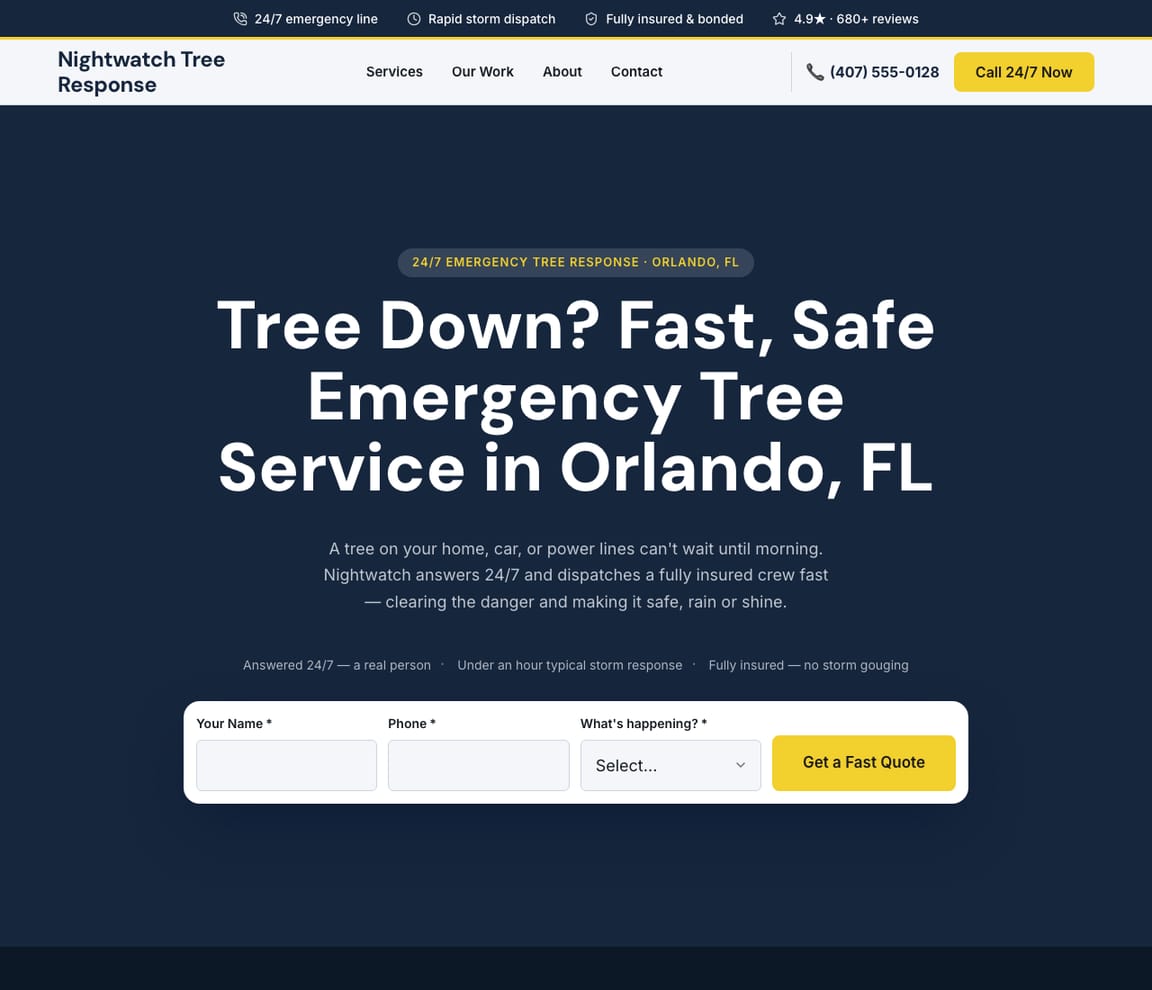
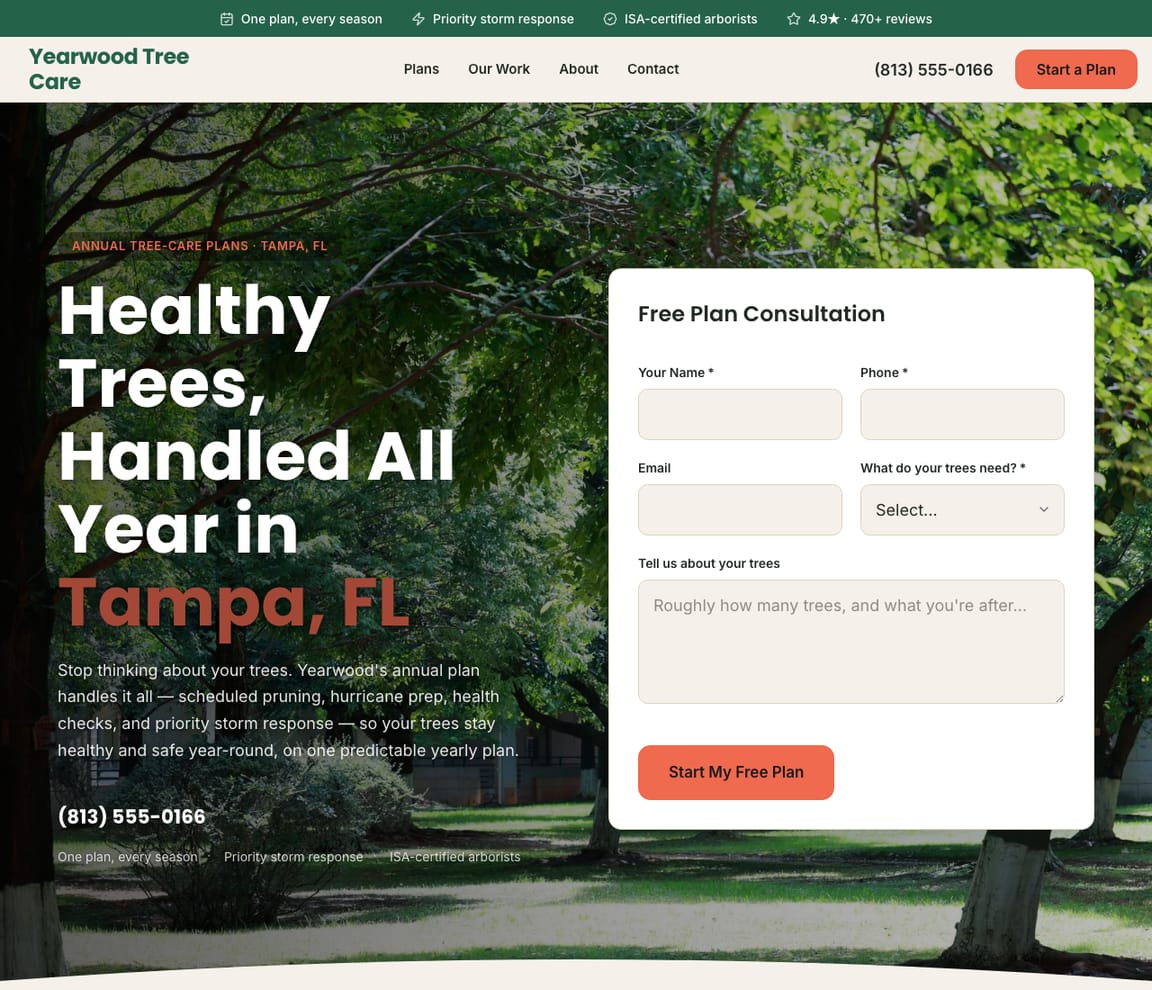
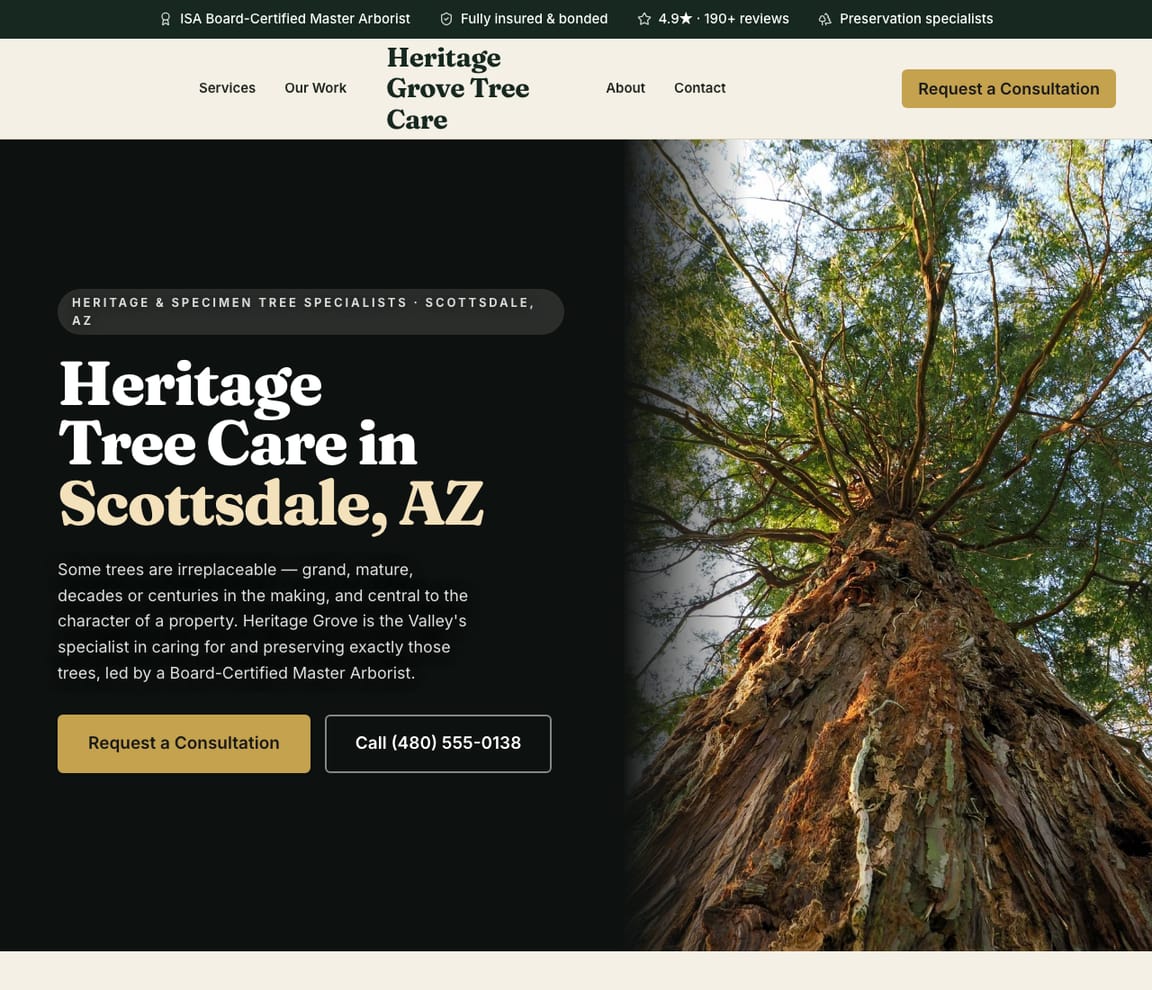
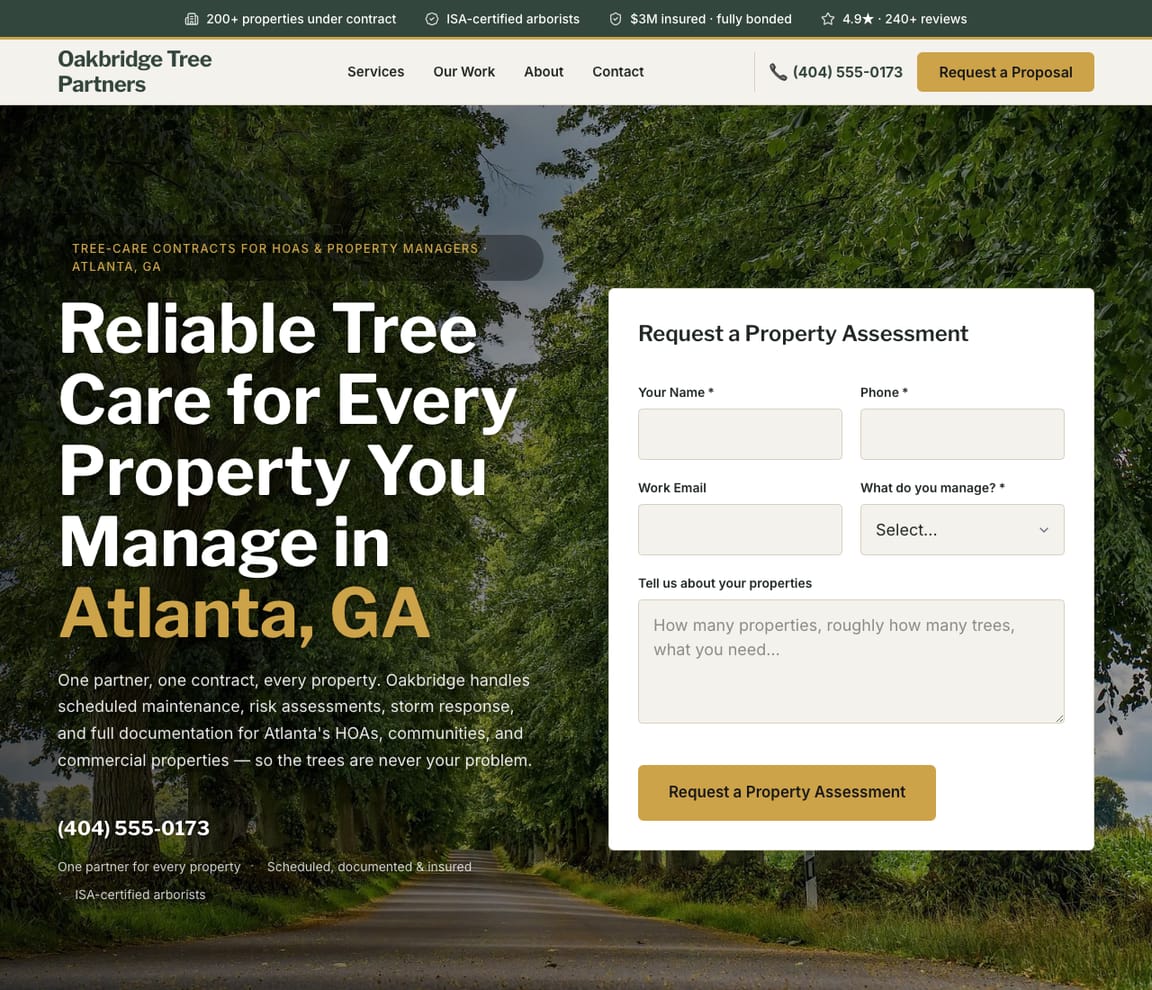
Real Zarla templates for the shapes the trade takes — the 24-hour storm crew, the annual-care arborist, the heritage-tree specialist, the HOA and property-management contractor. Open one, swap in your services and your credentials, and publish.
GET FOUND
Get found by the homeowner with a limb on the roof
A homeowner searches "tree service near me" the morning after the storm, and the call goes to the arborist whose credentials, photos and quote form are on the first screen. Zarla builds the website with your services, your service area and a quote form. Add your ISA number and your before-and-after photos in chat, and once you connect your Google Business Profile, your name, your photos and your hours stay in step on both.
“Tree service near me”
Searched the morning after the storm, by the buyer whose inspector flagged the oak, and by the HOA with a bid to let. Your credentials, your photos and a quote form answer all three.
Google Business Profile
A tree service has a service area, and that qualifies. Your hours, your photos and your quote link inside Google Maps — free, and an afternoon to set up.
The before-and-after photos
The proof a homeowner wants before letting a stranger up a tree beside the house: the hazard and the clean yard, side by side, with the crane or the rigging in frame. The gallery is the sales page.
Google Search
Ccanopytreecare.com
Canopy Tree Care — Trusted tree-service in Your AreaRaleigh's ISA Certified Arborist — removals, pruning, stump grinding and 24-hour storm response. Insured. Free estimates. Request a quote online.← Your Zarla siteCcitytreeservice.com
City tree-serviceGoogle Maps
1
Canopy Tree Care
← You2
Metro tree-service Co.
3
Quick tree-service
AI assistants (ChatGPT / Perplexity)
For an insured, ISA-certified arborist in Raleigh who does removals and pruning, gives free estimates, and can come this week in your area: Canopy Tree Care — a local tree service's site that lists removal, pruning, stump grinding and storm cleanup, shows the crew's certifications and insurance, and takes a quote request from the page.
YOUR LAUNCH PLAN
Your become-an-arborist checklist
The whole guide as things to check off. Work through them in order and you'll be trained, certified, licensed where your state asks for it, insured, kitted and findable before your first job.
- Check your state's title rule below — a license, a registration, a contractor's line, or none.
- Start on the ground — a season as a groundsman under a crew that follows the standard.
- Learn the saw and the ten-foot rule — before the first climb near a line.
- Climb — rope and saddle, then the bucket.
- Sit the ISA exam — three years in, or a degree plus experience.
- Add the licenses the work requires — pesticide applicator, contractor, CDL where the truck needs it.
- Kit the climb from the makers' prices and insure the crew — liability and workers' comp.
- Get found — a website with your credentials, photos and a quote form, and a Google Business Profile.
REAL CUSTOMERS
Small business owners who got online with Zarla
Verified reviews from real Zarla customers.
“Optimized for local service-based businesses. Easiest website build I've experienced. The AI-based build is the way to go instead of clunky theme-based websites. Get the site built and get out of the weeds with Zarla!”
“Quickly built my website from scratch. No hiccups. Would highly recommend Zarla for someone with no experience who wants to start a polished business website.”
“Very reliable, professional, and fast results. I was able to get my business online in no time, and the ease of access made it so simple.”
“I had no idea how to set up a website for my business. Thanks to Zarla, they've helped me a lot.”
Be the arborist the "tree service near me" search calls first
Add your town and your business name, and Zarla builds the website from that one line — your services, your credentials, your service area, a quote form and a photo gallery, with SEO in place. Add your before-and-after photos in chat. Free to build; you pay when you publish.
Already have a website? Bring it across →Zarla keeps your old page addresses where it can and redirects the ones that change, helping you keep the Google standing you've built.
Frequently asked questions
How much does it cost to become an arborist?
In the US, about $1,124.92 for a groundsman buying his own kit and sitting the ISA exam as a member, our arithmetic from the pages that print each price: a $219.99 Stihl MS 172 C-E ground saw, a $115.99 Silky Zubat hand saw, a $203.99 throw line kit, a $114.95 Petzl Vertex helmet, $135 of ISA membership and the member's $40 application and $295 exam. The fuller start as a licensed one-truck outfit in Connecticut — a $579.95 saddle, a $1,069.99 top-handle saw and a $429.99 second saw, the $34.49 safety standard, the state's $200 exam application, $285 license and $240 business registration, and $1,875 for a year of general liability — is $5,839.34. The climbing line, the chipper and the truck come on top: the gear suppliers' pages for the rope did not open to our reader, and the truck is costed on the plan page.
Do you need a license to be an arborist?
In six US states, yes, by exam: Maryland's Licensed Tree Expert, Connecticut's arborist license (plus a $240 business registration), Louisiana's arborist license, Rhode Island's, New Jersey's Licensed Tree Expert or Tree Care Operator with a business registration, and Maine's. Minnesota registers every tree-care company for $25 with no exam. California licenses the contractor above $1,000 a job under the C-49 classification and makes the tree contractor carry workers' comp even with no employees. Everywhere else — Texas, Florida, New York, Illinois, Pennsylvania — we found no arborist license and the title is free, the ISA Certified Arborist credential is what the market asks for, and the one state license you may still need is the commercial pesticide applicator card if you spray or inject. Check your own state's agriculture or environment department before you advertise.
Who is an arborist?
The statutes that license the word define it. Connecticut: one who is qualified to perform arboriculture — any work done for hire to improve the condition of fruit, shade or ornamental trees by feeding, fertilizing, pruning, trimming, bracing, treating cavities or protecting them from insects or disease — and is licensed by the state. Maine: a person who, for compensation, takes down or fells, diagnoses or evaluates the condition of shade or ornamental trees, or treats or cares for them, where caring means pruning that requires leaving the ground. Everywhere else the word belongs to whoever holds the ISA Certified Arborist credential, earned after three years of full-time tree work or a degree and a 200-question exam. A tree cutter removes trees; an arborist is paid to know which ones to keep.
How to become an arborist in PA?
We found no Pennsylvania arborist license, so the route is the national one: a season or more on a tree crew, the ISA Certified Arborist exam after three years of full-time work or a degree, and the state's commercial pesticide applicator license if you will spray or inject — the federal standard requires every commercial applicator of restricted-use pesticides to pass a written exam and be at least 18. Add the industry association's free safety course before the first day, and the ISA Certified Tree Climber credential once you are aloft. In the US the title is the state's to license or not; Pennsylvania's neighbors Maryland and New Jersey do, and a Pennsylvania crew that crosses into either needs their license or registration.
What is the fatality rate of arborists?
No agency publishes one for tree workers alone — the government's census of fatal injuries stops at the broader grounds-maintenance group — so the industry association counted for itself: 243 tree-care deaths in the US from 2020 through 2023, an average of 61 a year, and an estimated rate of 30.5 to 41 per 100,000 full-time workers against the all-industry 3.7 — as much as eleven times higher. In the government's own survey of the occupation, 71 percent of tree trimmers are exposed to hazardous equipment and 48 percent to high places. The ten-foot rule from power lines, the aerial-rescue training the climber credential requires and the Z133 standard are the trade's answer to that number.
What type of arborist makes the most money?
On the survey's numbers, the one who runs the crew: first-line supervisors of landscaping and groundskeeping workers had a median of $58,430 in 2025 against $50,960 for tree trimmers and pruners, with 10 percent of supervisors above $85,650; by state, California's and New York's trimmers earn the most, at $62,550 and $62,400. Above the survey are the owner and the specialist: the utility line-clearance arborist working under OSHA's own standard, the consulting arborist with the Tree Risk Assessment Qualification writing reports, and the Board Certified Master Arborist — fewer than two percent of certified arborists hold it. One Northwest Indiana owner's goal was to be the one to call when others don't know; one Katy arborist trims 30,000 trees a year on commercial contracts.
Is becoming an arborist worth it?
For the right person, in the arborists' own words. The pay as an employee is a median $50,960 with average growth and 7,900 openings a year; the work is outdoors every day, with saws, at height, in the most dangerous trade in this series. One second-generation climber says everyone wanted him to do anything else, that the schedule runs from before sunrise to after dark, and that there is nothing like it. One Dallas owner says real-world experience is the only way to learn the business; one Indiana owner says the trade is economy-sensitive because pruning waits when the house payment is due. The ones who say yes own the chipper, hold the credential and price the job without a bidding war.
How long is schooling to be an arborist?
There is no required school in the US. The survey's employers said 57 percent of tree trimmers need less than a high school diploma and 37 percent a diploma or equivalent; the ISA credential asks for three years of full-time work or a degree in arboriculture, horticulture, landscape architecture or forestry; New Jersey's tree care operator exam needs three years in the trade and its tree expert exam five, or a four-year degree, or two years of college with three related courses plus three years; Maryland's license takes two years of college plus one of experience, or three years of practice. In Australia the Certificate III in Arboriculture is a two-year traineeship. Most of the arborists quoted above spent three to five years on the ground and the rope before they called themselves one.
How do I become an ISA Certified Arborist?
In the US the credential is voluntary in every state, and the path is the same everywhere: qualify, apply, sit. You need three or more years of full-time, eligible, practical work experience in arboriculture or a degree in arboriculture, horticulture, landscape architecture or forestry from a regionally accredited institution; then the application ($40 as an ISA member, $50 otherwise) and the exam enrollment ($295 as a member; ISA's own pages print the standard price as $369 on one and $396 on another) for a 200-question multiple-choice test. The credential is recertified every three years by continuing education or by retaking the exam; ISA prints a $220 base recertification fee and a $120 retake. Join first at $135 and the member prices make it the cheaper year. Rhode Island's board may exempt an ISA-examined applicant from its own exam.
Can you become an arborist without a degree?
Yes, in every US state. The ISA credential takes three years of full-time tree work in place of a degree; Maryland takes three years of practice in place of its two-plus-one; New Jersey's tree care operator exam needs three years of employment and its tree expert exam five, with no degree; Louisiana, Rhode Island, Connecticut and Maine license by exam. The survey's employers said 57 percent of tree trimmers need less than a high school diploma. Two of the arborists quoted above started at ten and at fifteen, one called a landscape company having no idea what an arborist was and was hired on the spot, and one hauled brush for three years before he climbed.
How much does the ISA exam cost?
$295 to enroll plus a $40 application for ISA members and current credential holders; for everyone else a $50 application and an enrollment ISA prints as $369 on its exam page and $396 on its fee table — so about $370 to $400. Membership is $135 for the professional tier, which is why joining first costs less in year one. The Board Certified Master Arborist exam is $495; recertifying the Certified Arborist is $220 at the base rate and a retake is $120. Rhode Island's own arborist exam is $25 and may be waived for an ISA-examined applicant; Connecticut's is $200 to apply; Louisiana's is $150.
Do arborists need a pesticide license?
In the US, yes, the moment you apply a restricted-use pesticide for hire — in every state. The federal standard: to be certified, a commercial applicator must receive a passing score on a written examination, and must be at least 18 years old, in the ornamental and turf category for tree and shrub work or the right-of-way category for powerline crews. Each state issues the card — in Texas you apply to the Department of Agriculture, pay the fee on its form and get an eligibility letter before you can sit the exam. Connecticut folds it into the arborist license: anyone who uses pesticides in arboriculture must be a licensed arborist or a licensed commercial applicator. Pruning and removal alone need no pesticide license anywhere.