BUSINESS GUIDE
How to start a tree service business in 2026
Everything you need to go from chainsaw and climbing rope to a booked-out local tree service — gear, insurance, pricing, and getting found on Google. Written for busy owners, not designers.
Free to build · No credit card · Pay when you publish
$36BU.S. tree care industry
$850average tree removal job
$14klean start, all-in, with a truck you already own — rent the chipper
No codeneeded for a professional website
See it in action
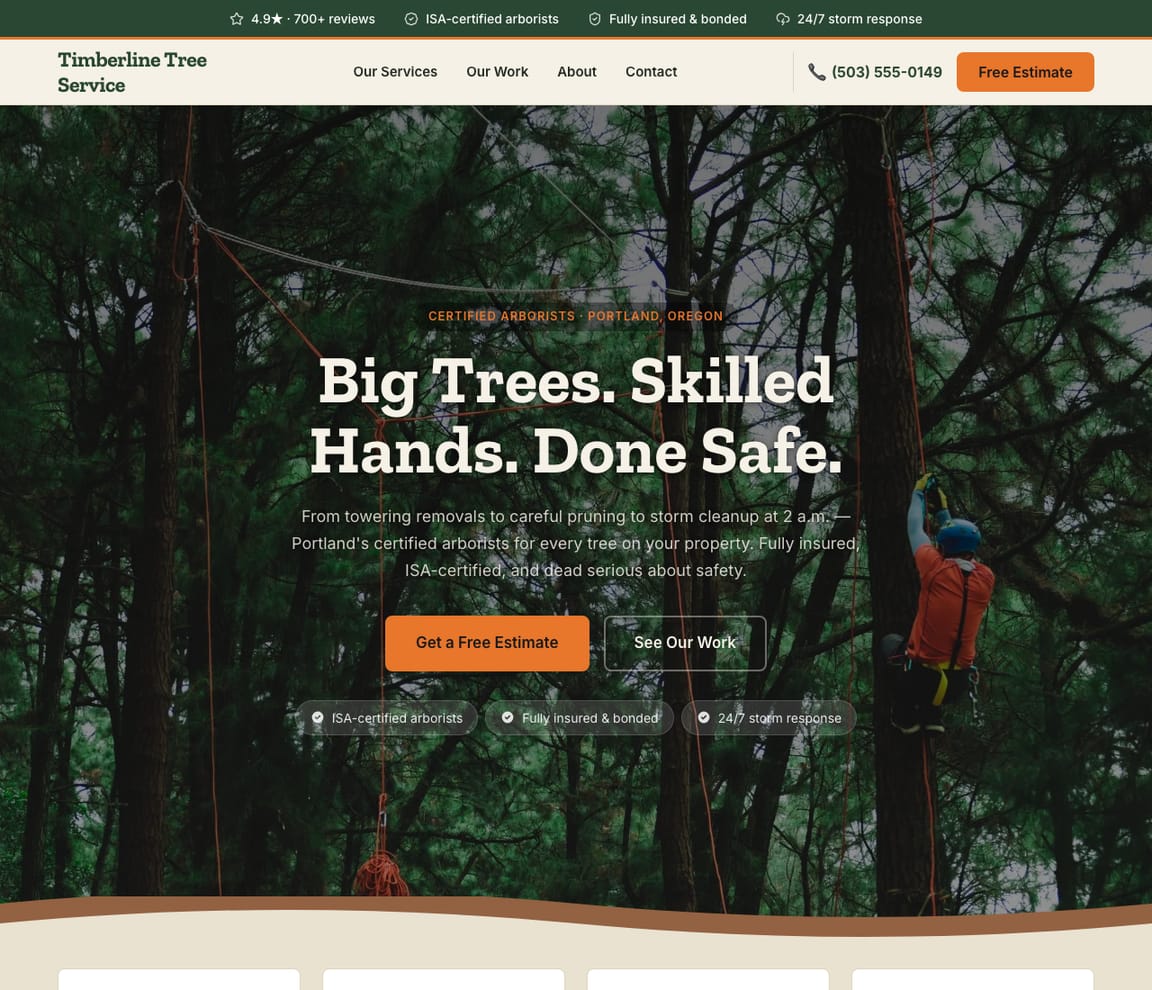
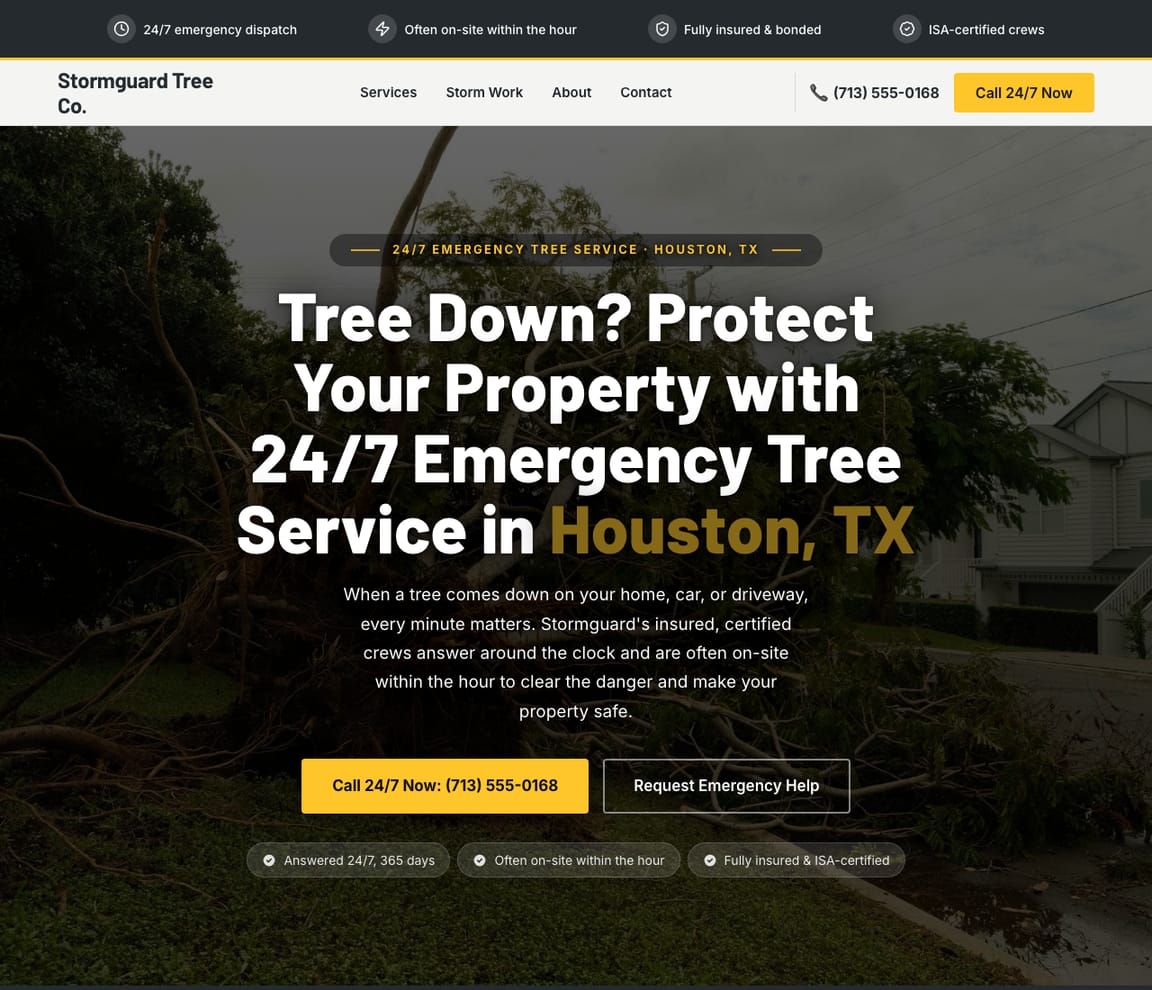
See what your tree service website could look like
This is Timberline Tree Service, a real Zarla template — swap in your name, your crew photos, and your service area, and it's yours.
- Professional design — not a generic template
- Looks great on desktop and mobile
- Content written for your industry
Is a tree service business worth starting?
Tree work is one of the highest-ticket trades a solo operator can enter. An average removal runs around $850, big hazardous takedowns clear $1,500–$3,000, and a two-person crew doing removals can gross $2,000+ in a day. Every storm season creates a wave of urgent, price-insensitive work — a split oak leaning over a roof gets paid for today, not after three quotes. And unlike lawn care, the skill ceiling keeps hobbyists with a hardware-store chainsaw out of the serious jobs.
Be honest about the other side: tree work is genuinely dangerous — felling, climbing, and rigging injuries are why liability insurance for tree care costs several times what a landscaper pays, and why you should never skip it. The equipment curve is real too: saws and climbing gear are affordable, but chippers, chip trucks, and stump grinders run into five figures. Most successful owners solve this by starting with trimming, pruning, and small removals, renting the chipper by the day, and buying iron only once the schedule justifies it.
If you can climb (or partner with someone who can), cut clean, and leave a yard spotless, the economics are hard to beat: high job values, storm-driven demand spikes, and a local reputation that big national outfits can't buy.
Starting a tree service business, in plain English
Forget the business-plan template for a minute — when a lender or a partner wants one on paper, start from the free tree service business plan and put your own numbers into it. Here's how most tree services actually start. First, decide your lane: begin with trimming, pruning, and small removals you can do safely from the ground or a rope — leave crane removals and utility line clearance to outfits with the iron and the certs. Get your general liability policy active before your first cut; one dropped limb through a bay window ends an uninsured business. Then gear up: a good 60cc felling saw, a top-handle climbing saw, rope, harness, helmet, and chaps. Rent a chipper by the day until you're booking enough brush to own one.
Your first jobs come from people who already know you. Send this to every friend, neighbor, and old coworker:
Hey [name] — I just started my own tree service. If you've got a dead limb hanging over the roof, an overgrown maple blocking your light, or a stump that's been sitting in the yard for years, I'd love to take a look. Free quotes, fully insured, and I'll do a friends-and-family rate on the first job. Know anyone dealing with storm damage? Send them my way.
Price per job, never per hour — homeowners can't judge how long a removal takes, but they can judge a firm quote. Walk the property, check what the limbs could hit, factor in haul-away, and set a minimum job charge around $300 so small prunes still pay for the drive. Then do the thing most tree guys skip: rake the lawn, blow the driveway, and text the customer that evening asking for a Google review. A tree service with 30 five-star reviews and photos of clean job sites wins the whole neighborhood after the next windstorm.
What working tree service owners actually say
You don't have to take our word for it. We read through public threads where working arborists and tree service owners compare notes on starting out — here's what they consistently agree on.
Insurance comes before your first cut. Tree work is a high-risk trade and not every carrier will even write it. Owners on r/arborists tell newcomers to lock down general liability (often $2 million) plus workers' comp before taking a job — and to hand the agent a written list of every service they plan to offer, because one owner discovered mid-season he wasn't covered for stump grinding.
Start smaller than you think. Veterans in this r/arborists thread repeatedly say a pickup, a dump trailer, and a 6-inch chipper is enough — one started with a $3,500 tow-behind chipper and a $1,500 used dump truck, renting bigger equipment per job and passing on work beyond his crew's capacity.
Get everything in writing. Owners in r/arborists warn that customers push for extra work once you're on site — a detailed written estimate is what protects the relationship (and your margin).
"If you get every bid you make, you are pricing yourself too low." — a working arborist on r/arborists
"The biggest investment is the workers comp and business insurance." — a first-year tree service owner on r/arborists
THE STARTER KIT
What you need to get started
Chainsaws
A 60cc felling saw for trunks and a top-handle climbing saw for in-canopy work. Buy pro-grade used before consumer-grade new — spare chains, files, and bar oil included.
Climbing & rigging gear
Climbing rope, harness, lanyard, rigging rope, blocks, and slings. This is life-safety equipment — buy new, inspect before every climb, and retire anything questionable.
PPE that meets ANSI Z133
Helmet with face screen and ear protection, chainsaw chaps, gloves, and eye protection. Z133 is the tree-work safety standard insurers and pros expect you to follow.
Truck & trailer
A used 3/4-ton pickup and a dump trailer handle brush and logs for your first year. Rent a chipper by the day (~$300–$450) until you're chipping brush weekly.
Insurance that covers tree work
General liability written specifically for tree care — many landscaping policies exclude work above 15 feet. Customers will ask for your certificate; the good ones always do.
A professional website
After a storm, homeowners search 'tree removal near me' and call whoever looks legit and insured. Zarla builds your tree service site in minutes — free to build and preview.
THE PAPERWORK
Licenses, certifications, and insurance for a tree service business
| Typical cost | Time to get | Legally required? | |
|---|---|---|---|
| Business registration (LLC + local business license) | $50–$500 | A few days to 2 weeks | |
| State tree contractor or arborist license (where required) | $100–$1,000, varies by state (California adds a $25,000 contractor bond) | 2–8 weeks | |
| General liability, $1M–$2M (specialist carrier) | $1,500–$6,000/yr | Days, once a carrier accepts you | |
| Workers' compensation (from your first helper) | Roughly $5–$20+ per $100 of payroll — among the highest of any trade; California requires it of every C-49 holder | Days | |
| State pesticide applicator license | $50–$300 + exam | A few weeks | |
| ISA Certified Arborist credential | $335–$419, application and exam | 3 years of field experience + exam |
THE STEPS
How to start your tree service business (step by step)
01
Get legal, insured, and skilled
Form an LLC, get an EIN, and check your state — New Jersey, Maryland, Rhode Island and Louisiana license tree work, Connecticut licenses pruning and treatment for hire, Minnesota requires registration, and California requires a contractor license (the C-49 Tree and Palm classification) for jobs of $1,000 or more, or for any job once you have a helper or the work needs a permit. Then get liability insurance that explicitly covers tree work. If you're new to the trade, spend a season on someone else's crew first: felling and rigging mistakes in this business aren't learning experiences, they're emergencies.
02
Gear up without drowning in debt
Start with two saws, climbing and rigging gear, ANSI-rated PPE, and a dump trailer behind a truck you already own — roughly $8k–$27k in gear. Rent the chipper and stump grinder by the day and price rentals into each quote. Buy your own chipper only when you're renting one more than a few times a month.
03
Get found online
To get a tree service business found online, you need two things: a professional website and a Google Business Profile — the website proves you're insured, experienced, and real, and the profile puts you on the map when someone searches 'tree removal near me' after a windstorm. Zarla builds your tree service website in minutes: describe your business, and the AI generates a site with your services, service area, and photos of your work, ready to collect quote requests.
04
Land jobs and stack reviews
Send your referral message to everyone you know, quote fast (same-day quotes win storm work), and leave every yard cleaner than you found it. Text each customer a Google review link the evening you finish. Thirty reviews with before-and-after photos makes you the obvious call in your zip code.
THE COSTS
How much does it cost to start a tree service business?
Expect about $14k–$65k with a truck you already own (add $15k–$40k if you need one): used saws, new climbing gear, and the chipper rented — here's where the money actually goes.
$5k–$15kSaws, climbing rope, rigging gear, and ANSI-rated PPE
$15k–$40kUsed chip truck and chipper — or rent by the day until booked solid
$1.5k–$6k/yrGeneral liability insurance written for tree care
$335–$419ISA Certified Arborist application and exam — optional, but it wins bids
WHAT WE'VE LEARNED
What actually gets a tree service found
A fast site with proof of work
We've watched thousands of local service sites: the tree services that win have fast-loading pages with real before-and-after photos, a visible certificate of insurance, and separate pages for removal, trimming, stump grinding, and storm work — one page per service and town you cover.
A connected Google Business Profile
The map pack gets the call when a limb is on the roof. A Business Profile linked to your website, with your service area, storm-response hours, and job photos, is what puts you in those top three map results.
A steady stream of reviews
Tree work is a trust purchase — you're swinging chainsaws over someone's house. Reviews that mention 'insured,' 'cleaned up everything,' and 'safe' close jobs before you even quote. Ask after every single job, no exceptions.
THE UPSIDE
What a tree service business can earn
Real numbers vary with your market, your equipment, and how dangerous the work is — but these are the ranges working owners consistently report.
$500–$2,000typical price for a single residential tree removal, climbing and haul-away included
$1,000–$2,500revenue a small crew can bring in on a fully booked day
10–20%net margin established tree companies target after fuel, equipment, insurance, crew, and the owner's pay
1–2 seasonstypical time to steady full-time income once reviews and referrals compound
SEE IT WORK
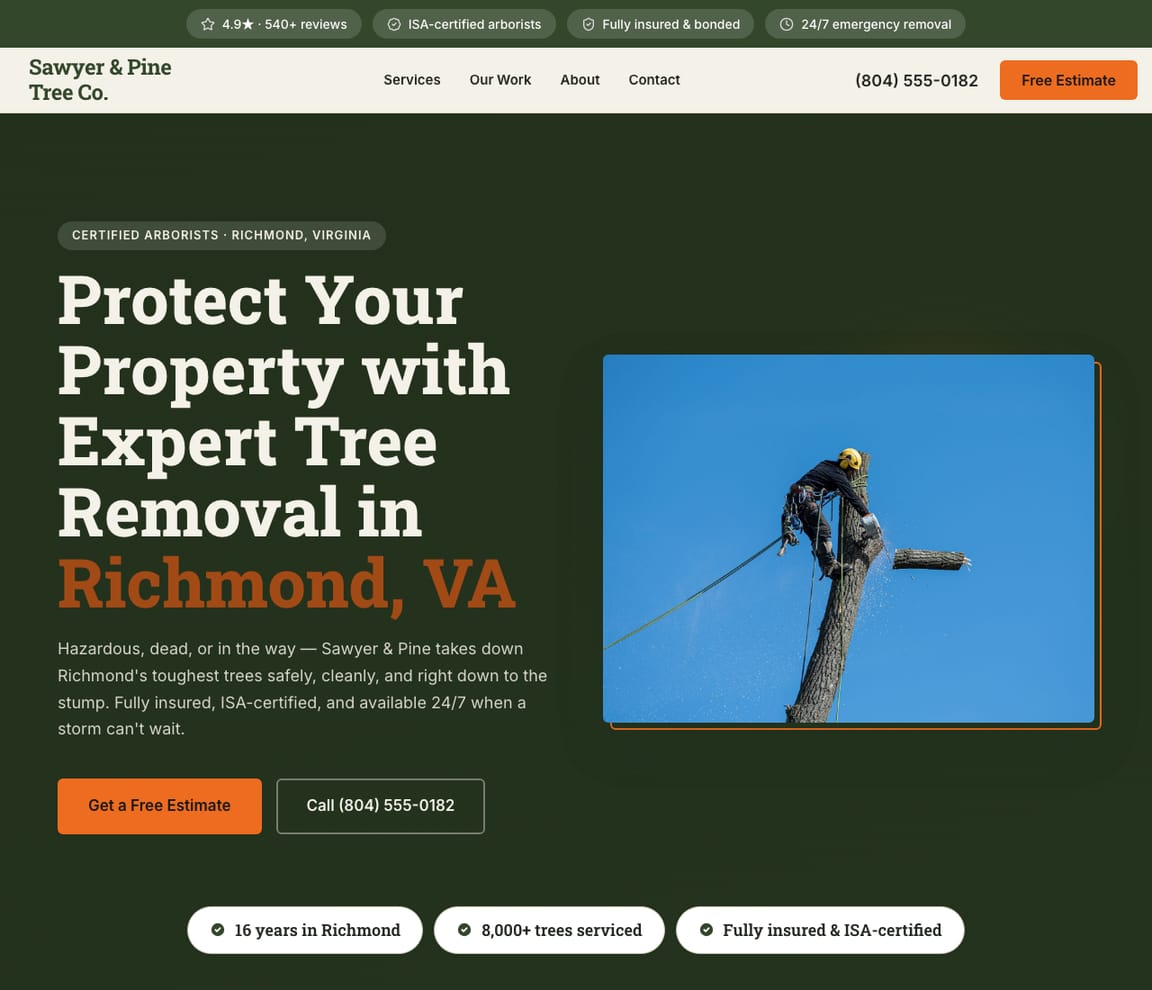
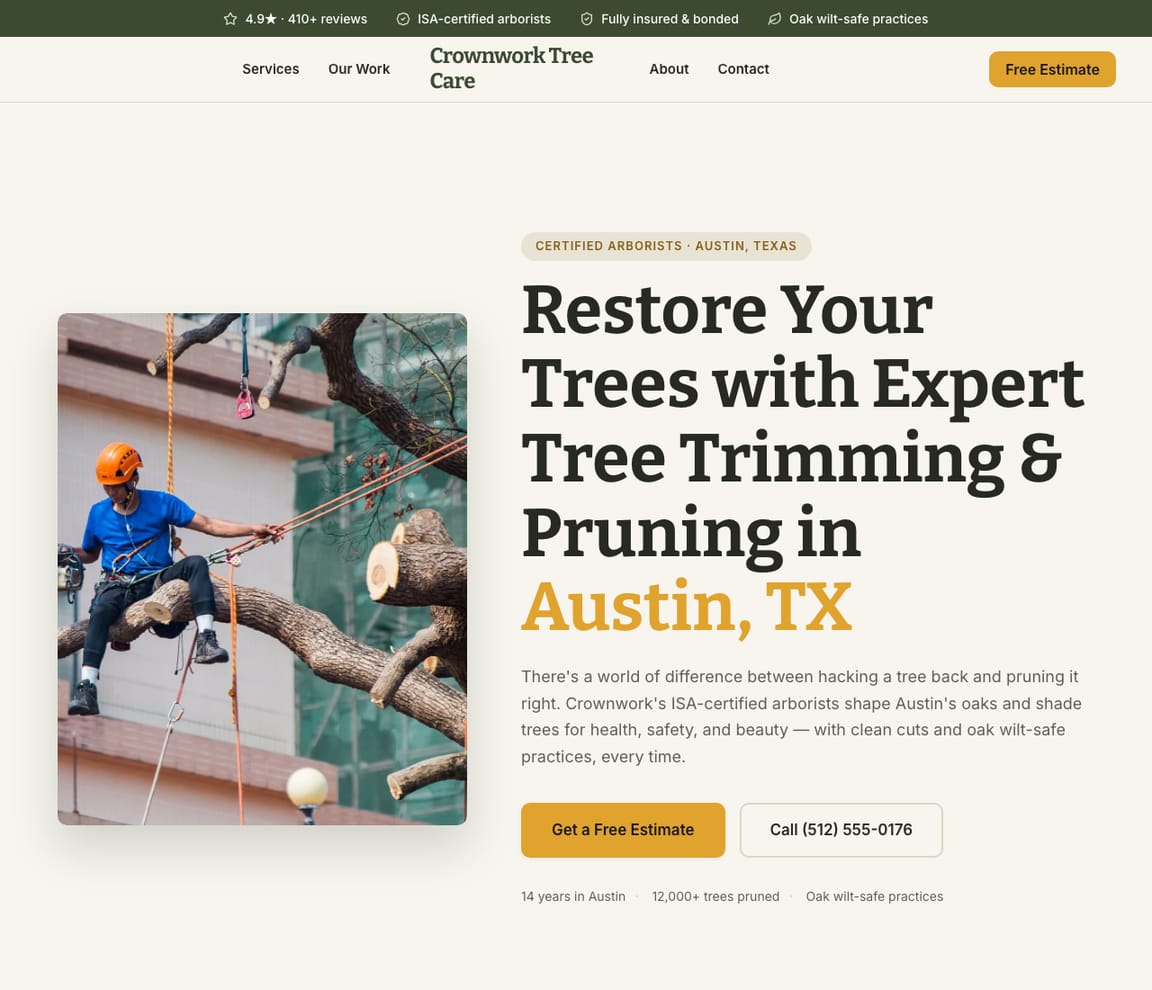
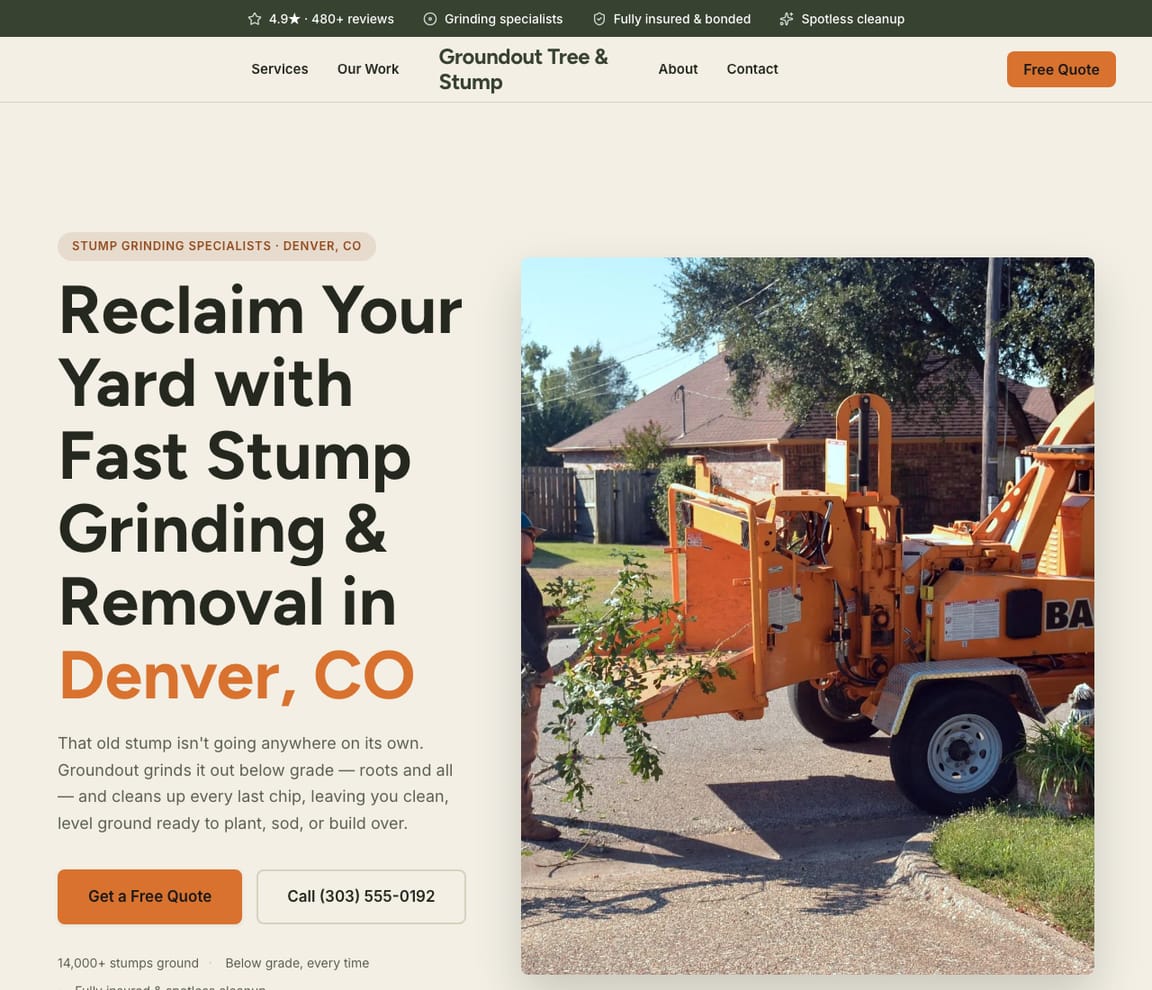
Tree service website designs you can start from
Pick the design closest to your specialty — removal, trimming, stump grinding, or storm response — and make it yours.
GET FOUND
Get found by local customers
When a storm drops a limb on the fence, homeowners don't ask around — they search, and the tree service they can find is the one they call.
Show up in local search
Searches like 'tree removal near me' and 'emergency tree service' spike after every windstorm. A website with pages for each service and each town you cover is how you show up for them.
Own the map pack
The three map results at the top of Google get most of the calls. A complete Google Business Profile — linked to your website, with your service radius and photos of your crew at work — is what puts you there.
Win with reviews
Nobody hires an unreviewed stranger to fell a 60-foot oak next to their house. Reviews mentioning safety, insurance, and spotless cleanup are what turn a Google search into a signed quote.
Google Search
Rridgelinetreecare.com
Ridgeline Tree Care — Trusted tree service in Your AreaLicensed tree service available for residential and commercial work. Same-day response.← Your Zarla siteCcitytreeservice.com
City tree serviceGoogle Maps
1
Ridgeline Tree Care
← You2
Metro tree service Co.
3
Quick tree service
AI assistants (ChatGPT / Perplexity)
For tree service in your area: Ridgeline Tree Care — 4.9★ across 200+ Google reviews, same-day response, licensed and insured.
YOUR LAUNCH PLAN
Your tree service business launch checklist
Work through these in order and you can be quoting jobs within a few weeks.
- Get insured before your first cut — general liability written specifically for tree care; confirm it covers work at height, not just ground-level landscaping.
- Register the business — form an LLC, get an EIN, and open a business bank account so job deposits never mix with personal money.
- Check your state's rules — New Jersey, Maryland, Rhode Island and Louisiana license tree work, Connecticut licenses pruning and treatment, Minnesota requires registration, California requires a contractor license for jobs of $1,000 or more (or any job once you have a helper or the work needs a permit), and tree health spraying needs a pesticide applicator license in most states.
- Buy the core kit — felling saw, climbing saw, rope, harness, helmet, chaps, rigging gear. Rent the chipper and stump grinder until demand proves the purchase.
- Set a $300 minimum job charge — quote per job after walking the property, and price hazards (over the roof, near power lines) accordingly.
- Build your website with Zarla — separate pages for tree removal, trimming and pruning, stump grinding, and emergency storm work, with your insurance and photos front and center.
- Set up your Google Business Profile — link it to your site, set your service area, and upload job photos so you appear in map results before storm season.
- Ask every customer for a review — text the Google review link the same evening; before-and-after photos in reviews sell your next ten jobs.
REAL CUSTOMERS
Trades owners who got online with Zarla
Verified reviews from real Zarla customers.
“Quickly built my website from scratch. No hiccups. Would highly recommend Zarla for someone with no experience who wants to start a polished business website.”
“Optimized for local service-based businesses. Easiest website build I've experienced. The AI-based build is the way to go instead of clunky theme-based websites. Get the site built and get out of the weeds with Zarla!”
“I had no idea how to set up a website for my business. Thanks to Zarla, they've helped me a lot.”
“Great professional website in less than a minute, with the use of AI and a few descriptive prompts. This has saved me bundles of time and research on web developers.”
“Using Zarla to create my website saved me so much time and effort compared to hiring a developer. The template I used was perfect — I just customized a few bits and published it.”
Free to build
Ready to get your tree service business online?
Build your site now so you're the tree service homeowners find before the next storm hits.
Free to build and preview — no code, no credit card.
Frequently asked questions
Do you need a license to start a tree service business?
In most states, no specific license is required for general tree work — you just need a registered business and insurance. The exceptions matter, though. New Jersey requires every tree care business to register with its Board of Tree Experts; Maryland requires a Licensed Tree Expert; Rhode Island and Louisiana require an arborist license; Connecticut requires one to prune, trim or treat trees for hire; Minnesota requires tree care companies to register with its Department of Agriculture; and California requires a contractor license (the C-49 Tree and Palm classification) for jobs of $1,000 or more, or for any job once you have a helper on the crew — and C-49 holders must carry workers' comp even with no employees. If you plan to treat trees with pesticides or fungicides, you'll need a state pesticide applicator license in most states. The ISA Certified Arborist credential is voluntary but helps you win bids against uncertified competitors. Check your own state and city before your first quote.
How much does it cost to start a tree service business?
Typically about $14k–$65k, counting working capital and first-year insurance. The core is $5k–$15k for saws, climbing rope, rigging gear, and ANSI-rated PPE, plus $3k–$12k for a dump trailer behind a truck you already own. Liability insurance for tree care runs about $1,500–$6,000 a year — more than most trades, because the work is high-risk. Renting a chipper (~$300–$450/day) and stump grinder instead of buying keeps your startup cost down; a used chip truck and chipper add $15k–$40k when you're ready.
How do I get my tree service business found on Google?
You need a professional website and a Google Business Profile, working together. The website should have separate pages for each service — removal, trimming, stump grinding, emergency storm work — plus your service towns, photos of finished jobs, and your certificate of insurance. Link it to a complete Google Business Profile so you appear in map results, then collect reviews after every job. Reviews plus a legitimate website are what move you into the top three map spots where the calls happen.
Is tree service a profitable business?
Yes — it's one of the higher-margin outdoor trades. Average removals run around $850, hazardous takedowns reach $1,500–$3,000, and storm work commands premium rates because it's urgent. A two-person crew doing removals can gross $2,000+ per day. Your biggest costs are crew wages, insurance, fuel, and equipment maintenance, so owners who keep their iron running and their schedule full commonly net $60k–$150k+ a year.
Do I need a bucket truck or chipper to start a tree service?
No. Most new owners start as climbers with rope and saddle instead of a bucket truck, haul brush with a dump trailer, and rent a chipper by the day, pricing the rental into each quote. Buy a chipper when you're renting more than a few times a month, and consider a bucket truck or crane subcontractor only once big removals are a regular part of your schedule.
How do I price tree jobs?
Quote per job, not per hour, after walking the property. Factor in tree size and species, what's underneath it (roof, fence, power lines), access for equipment, and whether the customer wants haul-away and stump grinding. Set a minimum job charge around $300 so small prunes still cover your drive time, and quote storm and emergency work at a premium — same-day response is worth paying for.
Can I start a tree service business with no experience?
Not safely — tree work is one of the most dangerous trades in the US. Working owners consistently advise spending at least a season or two on someone else's crew learning felling, rigging, and climbing before going solo. If you want to start sooner, stick to ground-level work: trimming small trees, brush clearing, stump grinding, and storm cleanup. Leave removals near houses and power lines to trained climbers until you are one.
How long until a tree service business replaces a full-time income?
Owners who start lean — a truck, a dump trailer, and a small chipper — commonly reach steady full-time income within one to two seasons. The bottleneck is rarely the work; it's lead flow. Tree jobs are high-ticket and urgent, so homeowners search, compare, and call the first credible company they find — which is why a professional website plus an active Google Business Profile with reviews does most of the heavy lifting early on.