BUSINESS GUIDE
How to open a juice bar in 2026
For the person who wants a counter of their own to press juice and blend smoothies over: the one federal line that lets a juice bar pour by the glass with no HACCP plan and no warning label — and the two things that end it, a bottle and a sale to another business; the exact WARNING words an untreated bottle carries; five states' permits, cottage-food lines and the sales-tax flip between a smoothie and a sealed bottle; what the juicer, the blenders, the press and the ice machine cost at the makers' and dealers' printed prices; what the franchisors print about their own stores — and what the owners who opened one say about the first year.
Free to build · Pay when you publish · No credit card
$11,119a 400 sq ft juice counter in Austin at vendors' own prices, with the small-bowl sinks, our arithmetic
$0for the EIN — and no HACCP plan or warning for juice served by the glass
$670,073Robeks' system-wide average store sales for 2024 — the franchisor's figure
No codeto get online
See it in action
See what your juice bar website could look like
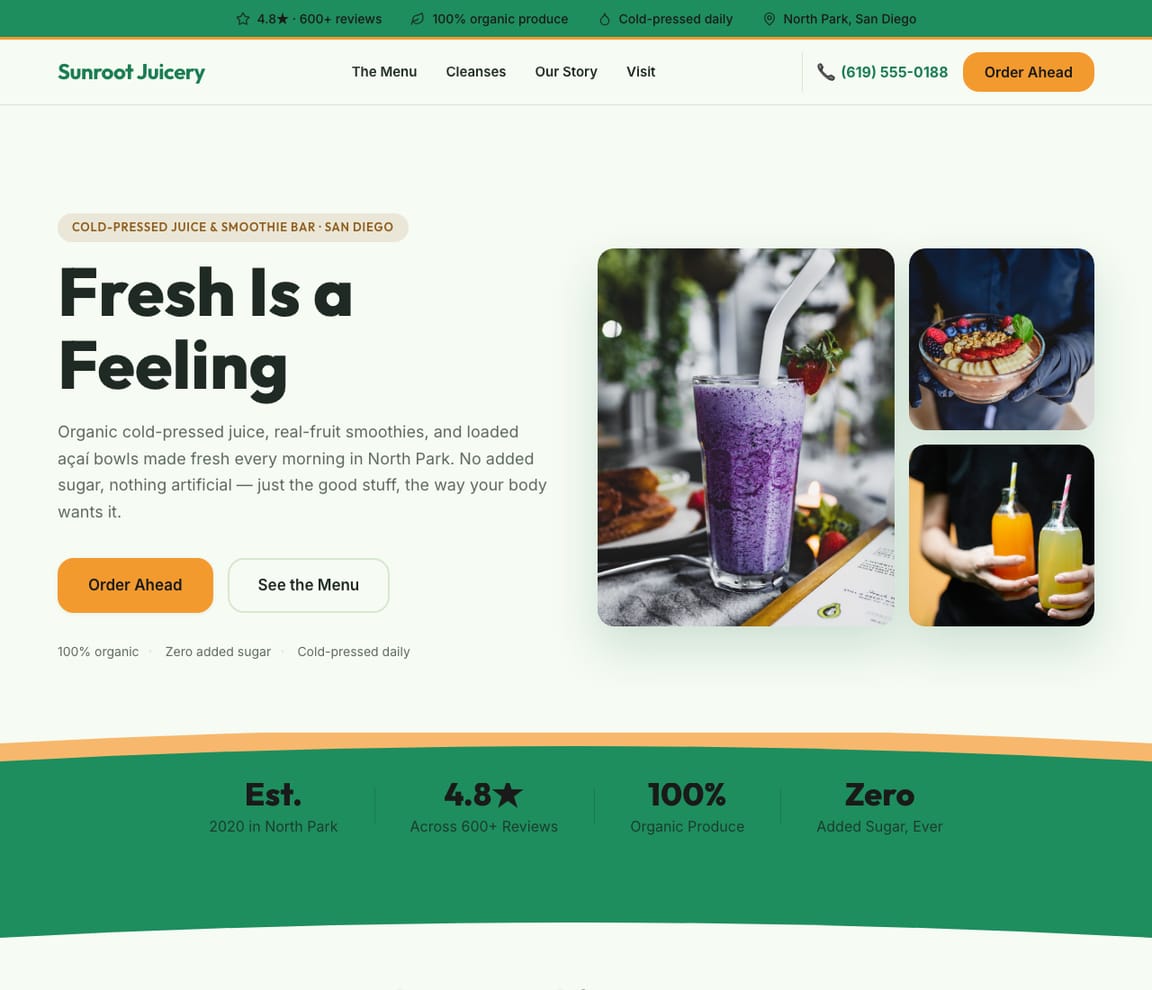
A real Zarla template from the juice bar gallery — a photo-collage hero, a highlight menu, the small-batch story, a gallery of the drinks, the cleanse packs and an order-ahead form. Describe yours — the counter, the bowls, the bottles, the city — and you'll have a site like this, with your menu and your hours, in about a minute.
- Professional design — not a generic template
- Looks great on desktop and mobile
- Content written for your industry
Build the website
Start your juice bar website now
Add your city and your bar's name to the sentence, and Zarla builds the site: the menu, your hours and location, an order-ahead form and your story. Add your prices, the bottled line and your market days in chat, then publish.
Already have a website? Bring it across →Zarla keeps your old page addresses where it can and redirects the ones that change, helping you keep the Google standing you've built.
Is opening a juice bar worth it in 2026 — and what do juice bar owners make?
The juice bar one owner can open is a small counter or kiosk that presses and blends to order — fresh juice, smoothies, acai bowls, shots — with bottled cold-pressed juice and cleanse packs (sets of bottles sold together) for pickup as the second line. The equipment is the small number; the build-out, the rent, the produce that spoils and the hours are the big ones. What the employed versions earn: "Workers on average earn $69,390." for food service managers — $33.36 an hour, the owner-operator's employed equivalent (O*NET, 2025); "Workers on average earn $31,200." for fast food and counter workers — $15.00 an hour, the juice-bar crew (O*NET, 2025); "Workers on average earn $35,880." for short-order cooks — the prep and bowl station (O*NET, 2025). What the franchisors print about their own stores — revenue, not profit, for a slice they choose: "The systemwide average net sales for the Fiscal Period were $670,073", and "The bottom 20% of the franchised stores achieved $390,464 in average net sales" — "Your individual results may differ. There is no assurance that you will sell as much." (Robeks, 2024 fiscal period, the franchisor's figures); "$957,612 is the average gross sales of the top 25% of all traditional franchised units in operation" in 2025, where "Of the 272 units included in the average gross sales for the top 25%, 96 units met or exceeded the average gross sales." (Smoothie King, Item 19 of its 2026–2027 FDD); Clean Juice's bottom quarter averaged $266,873 by its 2025 FDD, as a third party reproduces it (Franchise Chatter, April 2026). No franchisor page read today prints a profit figure. What a press maker says the margin should be: "$7 - $10 for a bottle of raw conventional cold-pressed juice, and $10 - $13 for organic", "should target about a 60% – 70% gross margin", and "usually juice is about 50% or less of a juice bar's revenue" (Goodnature, October 12, 2026 — a vendor's article).
,What the owners say (all quoted and linked below): a Minneapolis cold-press maker "getting about $2 a bottle after our $1 price increase this summer" who "lost money every day of winter"; a San Diego owner closing three stores under "$13,000 per month in loans"; a Hollywood, Florida founder who started "selling it on the streets of Hollywood" "with a square reader for $3 a shot"; an Austin couple who closed after a "last tough year of rising food costs, labor costs and rents."; a Palm Beach County family that began with "two six-foot tables at a green market." Our arithmetic on the pages that open: a 16 oz green juice holds about $3.14 of produce at 2023 average retail prices plus a $0.49 bottle — $3.63 before the label, the labor and the rent; at $10 a bottle that is a 63.7% gross margin, inside the press maker's target; a $9 smoothie tapped on a card loses $0.38 to the fee. The margin on the cup is real; the waste, the slow months and the lease are what close juice bars. Worth it? The owners who lasted started small — a market table, a ginger shot, a trunk — watched the waste as closely as the sales, and kept the bottled line to their own customers until they could run it as a processor.
How to open a juice bar, in plain English
The juice rule — and the line that lets a juice bar pour by the glass. In the US the FDA's Juice HACCP rule says "Any juice sold as such or used as an ingredient in beverages shall be processed" "in accordance with the requirements of this part." (21 CFR §120.1). The way out for a counter is in the definitions: "processing does not include:" "The operation of a retail establishment." — and "Retail establishment is an operation that provides juice directly to the consumers" "and does not include an establishment that sells or distributes juice to other business entities" "as well as directly to consumers.", where "'Provides' includes storing, preparing, packaging, serving, and vending." (21 CFR §120.3(j) and (l)). The FDA's own plain version: "Retail producers of juices are not covered by the regulations" and "A retail establishment is an operation that only provides juice directly to consumers." (FDA, Small Entity Compliance Guide: Juice HACCP, current as of 2018). Its questions and answers name the two traps: "If someone else processes juice for a retail establishment, that processor is required to operate under HACCP principles." and a central kitchen that supplies businesses it doesn't own "is not a retail establishment for purposes of part 120" (FDA, Questions and Answers on the Juice HACCP Regulation). Sell one case to a gym's fridge or a cafe and the kitchen becomes a juice processor: a written HACCP plan and control measures that produce, "at a minimum, a 5 log" reduction in the pertinent microorganism (21 CFR §120.24). Retail is also spared the FDA's facility registration — the rule "does not apply to the following facilities:" "(c) Retail food establishments;" (21 CFR §1.226); a kitchen selling mostly to businesses should read that line again.
,The glass, the bottle and the WARNING. The FDA's model Food Code — your own state's or city's code is the binding text — draws the counter line in one sentence: "Unpackaged juice (glasses of juice prepared at a juice bar, for example) does not require the 5 log reduction nor a warning statement or other consumer advisory (juice is not an animal food and therefore not covered by section 3-603.11) when prepared and served at retail." Bottles are the other side of it: "Retail establishments where packaged juice is made and only sold directly to consumers (such as juice bars) are not required to comply with this regulation." "Rather, the Food Code requires fresh fruit or vegetable juices that are packaged at retail (untreated juices or beverages containing untreated juices that are offered to consumers as prepackaged foods) to be processed under HACCP with a 5 log reduction in pathogens of concern OR bear the warning statement as specified in 21 CFR Section 101.17(g)." And a smoothie counts: "It is important to note that the definition of 'juice' includes puréed fruits and vegetables". The rule itself, §3-404.11: "Juice packaged in a food establishment shall be:" treated under a HACCP plan "to attain a 5-log reduction, which is equal to a 99.999% reduction, of the most resistant microorganism of public health significance" — or labeled "WARNING: This product has not been pasteurized and, therefore, may contain harmful bacteria that can cause serious illness in children, the elderly, and persons with weakened immune systems." (FDA Food Code 2022, §3-404.11 and Annex 3; FDA, Food Code 2022, the January 18, 2023 version). The federal label rule puts that statement "prominently and conspicuously on the information panel or on the principal display panel of the label of the container" (21 CFR §101.17(g)). One account a labeled bottle can't serve: "Food establishments that serve a highly susceptible population (HSP) cannot serve prepackaged juice that bears the warning label and they must serve only pasteurized juice." — the day care, the hospital, the senior home. HPP — high-pressure processing — is one way processors reach the 5-log step and sell beyond their own counter; no HPP processor printed a per-bottle price on a page read for this guide. This guide explains the rule and quotes its words; it drafts no label and no HACCP plan.
,The rest of the bottle's label. The Nutrition Facts exemption covers "retailers with annual gross sales of not more than $500,000" and low-volume products — but "Note that low volume products that bear nutrition claims do not qualify for an exemption of this type." — a bottle whose label makes a nutrient claim needs the panel (FDA, Small Business Nutrition Labeling Exemption, October 2026). Allergens: "The major food allergens are milk, eggs, fish, Crustacean shellfish, tree nuts, peanuts, wheat, soybeans, and sesame." — the almond milk, the peanut butter and the whey in a smoothie (FDA, Food Allergies, March 2026).
,The food permit and the crew, five states. Texas: where no city, county or health district permits you, the state does — "$258" under $50,000 of food sales, "$515" to $149,999.99, "$773" above; a business "Inspected and permitted by a City, County or Public Health District;" is exempt from the state's (Texas DSHS, retail food permits). Austin's schedule — "This fee schedule is effective November 1, 2026." — prices the operating permit by risk class and sales from "$309" (Risk 1C) to "$927" (Risk 3A), plan review for new construction "$312" and the "Pre-Opening Inspection" "$178": $799 to $1,417 in the first year, our arithmetic; the class depends on the menu, the schedule doesn't name a juice bar's, and the lean start below uses the lowest, Risk 1C at $309 (Austin Public Health, Permit Fee Schedule, November 2026). The crew: "all food employees shall successfully complete an accredited food handler training course, within 30 days of employment." (Texas DSHS, Food Handler FAQ); a place handling exposed time/temperature-control foods "may be required to employ a certified food manager." (Texas DSHS, Certified Food Manager FAQ). Florida licenses food service at the state: "$242" for a permanent non-seating counter, "$262" for 1–49 seats, "$456" for an annual temporary vendor (Fla. Admin. Code R. 61C-1.008, amended 2023) — the plan-review fee isn't on that page; "Managers have a period of 30 days after employment to pass the required test." (Fla. Stat. §509.039); "Food service employees must receive certification within 60 days after employment." (Fla. Stat. §509.049). New York City: "The permit fee for most food service establishments in New York City is $280.00" "plus $25.00 if you will make frozen desserts", and "you can open 22 days after you submit your application, even if you haven't had a pre-permit inspection." (NYC Business, Food Service Establishment Permit); "The Health Code says food places must have a supervisor with a Food Protection Certificate." — "The course and final exam cost $114.", or "The online course is free." and "The final exam costs $24 and must be taken in person." (NYC Business, Food Protection Certificate). California, Los Angeles County: plan check "$1,044.00" for a restaurant up to 500 square feet and "$1,530.00" to 1,999; the annual permit for up to 30 seats "$319.00" at low risk, "$719.00" moderate, "$1,206.00" high — $1,763 to $2,250 in the first year for a 400-square-foot bar at moderate to high risk, our arithmetic (LA County Environmental Health, FY 2026-2027 fee schedule); a food handler "shall obtain a food handler card within 30 days after the date of hire", the course "shall cost no more than fifteen dollars ($15), including a food handler card" and the card is "valid for three years" (Cal. Health & Safety Code §113948). Colorado's statute sets the state license at "$385" for up to 100 seats, a "$100" plan-review application and a review and preopening fee that "shall not exceed five hundred eighty dollars." — and "The city and county of Denver may establish such fees by ordinance; and" (C.R.S. §25-4-1607, current through Fall 2025); the 2026 fees under the state's newer law were not on any page that opened, so ask your county health department for the current figure.
,The home door — closed by name in three states, reopened in one. Texas rewrote its cottage-food law in 2025: "Allowable foods now include any foods, except for the following:" — meat, seafood, "ice or ice products", "low-acid canned goods;", cannabis products and "raw milk and raw milk products." — juice is not on the list; "a cottage food production operation may sell time and temperature control for safety food (TCS)." and "CFPOs that sell TCS foods must register with DSHS." up to "$150,000" a year (Texas DSHS, Cottage Food Production Operations). The page never mentions beverages, and every bottle is still packaged juice under the federal WARNING rule above — confirm juice with the Texas health department before you press a bottle to sell from home. Florida's cap is "$250,000" (Fla. Stat. §500.80), but the state's extension office lists among what a cottage operation may not make "Fresh-cut fruits and vegetables or juices" and "Juiced and bottled produce" (UF/IFAS Extension, Polk County, June 4, 2026). New York's home processors may not make "Beverages", and "Any finished food product that requires refrigeration is prohibited from being produced as a Home Processor." (NYS Agriculture and Markets, Home Processing). California: cottage operations make "non-potentially hazardous foods" and the one drink category is "9. Powdered Beverage Bases/Mixes" (the CDPH approved list, a city's copy, 2026); "any food that requires refrigeration are NOT approved cottage foods in California." (UC Agriculture and Natural Resources). Colorado's act covers "other nonpotentially hazardous foods." with a cap of "ten thousand dollars or less per calendar year from the sale of each eligible food product." (C.R.S. §25-4-1614) — fresh juice needs refrigeration. The way most bottled lines start instead: a rented commercial kitchen — "Kitchen Rental: $25/hour + taxes/fees", "Annual membership - $125 + taxes/fees", "Security deposit - $250 + fees" (The Kitchen Door, Hour Kitchen, Garland, Texas); "Hourly= $35-$50" in Seattle (The Kitchen Door, a Seattle kitchen) — and in Texas, a food manufacturer license, two years, "$100" under $10,000 of manufactured food sales by the rule's table (25 Tex. Admin. Code §229.182); confirm the current fee with DSHS. New York adds its own: the state's processing licenses list "Bottling oils or drinks including soft drinks, shakes, fresh fruit juices, coffee, teas, apple cider, etc." — while "If you have a food service operation (such as a restaurant, café, pizza shop), contact your local health department." (NYS Agriculture and Markets, Food Business Licensing); the 20-C fee isn't printed there, and the statute's page covers only the "exemption from licensing of small food processing establishments." (N.Y. Agric. & Mkts. Law §251-z-4) — a New York bar that bottles should ask the department whether it needs 20-C too.
,The sales-tax flip — the smoothie is taxed, the sealed bottle may not be. Texas: food products include "juice (if more than 50% fruit or vegetable juice by volume)"; prepared food includes "food sold with eating utensils provided by the seller; or"; tax applies to "all food ready for immediate consumption sold by caterers, mobile vendors, or restaurants, fast food outlets,"; and "a bottle of unsweetened iced tea sold at the checkout lane of a grocery store is not considered" ready for immediate consumption (34 Tex. Admin. Code §3.293) — the cup is taxed; whether a juice bar's own sealed bottle is, the rule doesn't settle for juice bars by name, so ask the Comptroller. Florida: "Food products for human consumption are exempt", including "Natural fruit or vegetable juices or their concentrates or reconstituted natural concentrated fruit or vegetable juices" — but not "Food that is prepared, whether on or off the premises, and sold for immediate consumption." or "Food products served, prepared, or sold in or by restaurants, lunch counters, cafeterias, hotels, taverns, or other like places of business." (Fla. Stat. §212.08); the exemption reaches "Only those juices that are permitted by federal law and regulation to be labeled '100 percent juice'", and "Any noncarbonated beverage made from milk derivatives, such as ice cream sodas, milkshakes, or malts." is taxable (Fla. Admin. Code R. 12A-1.011); "Florida's general state sales tax rate of 6% applies to most taxable transactions." (Florida DOR, GT-300015) — whether a juice bar counts as a "lunch counter" for its own bottles, the rule doesn't say; ask the Department of Revenue. New York: a food store's "70%-100% non-carbonated natural fruit juice (including boxes, cartons, jugs, bottles, or frozen concentrate);" is not taxable (NYS Tax Department, TB-ST-65, updated October 16, 2026); "When food or drink is sold for on-premises consumption, it is taxable, whether it is sold hot or cold." (TB-ST-806); and food is taxable when "it has been prepared by the seller and is ready to be eaten, whether for on premises or off premises consumption." (TB-ST-283). The one ruling on cold-pressed bottles: a company whose blended drinks "are packed in plastic jugs, delivered in insulating bags and sold for a single price." was told "We conclude that neither the juice drinks themselves, nor the combination of the juice drink and the bag for a single price, are taxable." — binding "only with respect to the person or entity to whom it is issued" (NYS Advisory Opinion TSB-A-15(33)S, July 20, 2015). California: food products include "all fruit juices, vegetable juices, and other beverages, whether liquid or frozen" (CDTFA, Regulation 1602); "Tax applies to sales of sandwiches, ice cream, and other foods sold in a form for consumption at tables, chairs, or counters...", and cold food to go is taxed only if the seller meets both halves of the 80-80 rule — "More than 80 percent of the seller's gross receipts are from the sale of food products, and" "More than 80 percent of the seller's retail sales of food products are taxable..." (CDTFA, Regulation 1603) — our reading is that a cold smoothie to go is generally exempt in California and one drunk at your counter is not; the regulation names neither smoothies nor juice bars, so confirm with the CDTFA. Colorado taxes "food or drink served or furnished in or by restaurants, cafes, lunch counters," "cafeterias, hotels, social clubs, nightclubs, cabarets, resorts, snack bars, caterers, carryout shops," (C.R.S. §39-26-104), while its grocery exemption's food excludes "hot or cold beverages served in unsealed containers or cups that are vended by or through machines" (C.R.S. §39-26-102) — the smoothie is taxed; the statute doesn't settle a juice bar's own sealed bottle, and home-rule cities write their own food rules.
,The entity, the permit to collect tax, the card fees. Texas: "for filing a certificate of formation, $300;" (Tex. Bus. Orgs. Code §4.152); "There is no fee for the permit, but you may be required to post a security bond." (Texas Comptroller, permit FAQ). Florida: "For filing original articles of organization or articles of revocation of dissolution, $100." plus "$25." for the registered agent and "$50." for each annual report (Fla. Stat. §605.0213). New York: "two hundred dollars" (N.Y. LLC Law §1101) and the notice "published once in each week for six successive weeks, in two newspapers of the county." (N.Y. LLC Law §206); register for sales tax "at least 20 days before you begin business." (NYS Tax Department, TB-ST-360, updated October 21, 2026). California: "Seventy dollars ($70)" and "Twenty dollars ($20)," (Cal. Gov. Code §12190), "a minimum franchise tax of eight hundred dollars ($800)." (Cal. Rev. & Tax. Code §23153); "Is there a fee charged for a seller's permit?" — "No." (CDTFA). Colorado: "Articles of Organization" "$50.00" (Colorado Secretary of State, fee schedule revised July 1, 2024); the sales-tax license, "a fee of sixteen dollars" "together with an additional fifty-dollar deposit." (C.R.S. §39-26-103); "Denver no longer charges a license fee with the biannual Retailer's Sales, Use, Lodgers Tax License." (City and County of Denver, Business Tax FAQ). "You never have to pay a fee for an EIN." (IRS). Cards: "2.6% + 15¢" in person (Square) — $0.38 on a $9 smoothie, our arithmetic; "Standard card payments are 2.9% + 0.30 USD in the US" (Stripe).
,The franchise door — every figure here is the franchisor's own. Smoothie King: franchise fee "$25,000-$30,000 ($15,000 for a non-Traditional Location)"; an end-cap or in-line store "$329,850–$683,715" and a free-standing drive-thru "$639,950–$1,278,900" — "The above costs are estimates only and will vary by location."; "$400,000 Minimum Net Worth (1 Store)" and "$175,000 Minimum Liquidity (1 Store)"; the process runs from the franchise disclosure document "with an issuance date of April 8, 2026." (Smoothie King, Franchise Process, 2026). Robeks: "$299,050 to $538,500", with "$149K liquid capital and a net worth of at least $375K" (Robeks, 2026). Juice It Up!: "FRANCHISE FEE" "$30,000"; startup costs "will fall between $247,750 and $756,300 depending on the type of location you choose."; "LIQUID CAPITAL REQUIRED" "$150,000" and "NET WORTH REQUIRED" "$350,000" (Juice It Up!, 2026 FDD figures); its 2025 report puts the top quarter's average unit volume at "$852,512", says stores "require, on average, 10-15 part-time entry-level employees. No hood, grill or fryer!", and its cost table — the most useful one for an independent, too — runs "Tenant Improvements" $80,000 to $270,000 and "Furniture, Fixtures & Other Equipment" $70,000 to $140,000, against a franchise fee of $20,000 to $30,000 (Juice It Up! 2025 Franchise Report). Tropical Smoothie Cafe: "Investment ranges from $275,500 – $770,500.", a drive-thru adds "approximately $40,000 to $60,000.", and "$1,251,191 Top 50% Average Net Revenues, with 274 of 716 (38% of the top 50%)" meeting it, "Based on our fiscal year ending 12/28/2025" — "Your results may differ. There is no assurance that you will do as well." (Tropical Smoothie Cafe, 2026). Planet Smoothie: "Franchise Fee: $25,000", "Total Investment: $227,650 - $488,000" (Planet Smoothie, 2026). Clean Juice, as a third party reproduces its 2025 disclosure: a $30,000 fee, $243,000 to $419,000 all in, a 6% royalty, and average unit volumes of $575,806 for the top quarter and $266,873 for the bottom (Franchise Chatter, April 2026). The federal rule: a franchisor must hand over its current disclosure document "at least 14 calendar-days before the prospective franchisee" signs anything binding or pays it (16 CFR §436.2); "Any claims the franchisor makes about sales, income or profits must be in Item 19.", and on the owners already in the system: "Talking to these people may be the most reliable way to verify the franchisor's claims." and "It's worth tracking down former franchisees." (FTC, A Consumer's Guide to Buying a Franchise, 2020). This guide explains the rule; read the document with a franchise lawyer before you sign.
,The counter, at the makers' and dealers' own printed prices. Juicers: a "Robot Coupe J80 Automatic Juicer with Pulp Ejection" at "$2,363.00" and the continuous-ejection model at "$2,730.00" (WebstaurantStore, Robot Coupe J80); a budget AvaMix JE700 at "$549.00" and a manual citrus press from "$89.99" to "$139.99" (WebstaurantStore, juicers); Zumex's automatic orange juicers list from "$4,150.00" to "$8,740.00" — list prices, the dealer masks its sale price (WebstaurantStore, Zumex). Blenders: "Vitamix 36019-ABAB The Quiet One" at "$1,158.05" (WebstaurantStore, Vitamix); the Blendtec Stealth 885 at "$1,098.09" without a jar, "$1,224.88" with one and "$1,297.64" with two (WebstaurantStore, Blendtec). The cold press for the bottles: Goodnature's Hummingbird "$2,995", "30-60 bottles/hr" (Goodnature, Hummingbird); the X-1 "$25,900", "Typical 16 oz: 50-100 bottles/hour", on a 208–230 V circuit — an electrician's line (Goodnature, X-1). The cold line: an Avantco reach-in at "$969.00" (member price; "Regularly $1,199.00") or a two-door True at "$5,700.10" (WebstaurantStore, reach-ins); an undercounter freezer at "$929.00" (WebstaurantStore, freezers); an undercounter ice machine at "$939.00" or "$1,149.00" (WebstaurantStore, ice machines); a three-compartment sink at "$268.99" and a hand sink at "$208.99" — small-bowl units; a full-size three-compartment sink was not priced on any page that opened today, so ask your health department what bowl size it requires before you buy (WebstaurantStore, sinks). The bottle: a case of 160 16 oz bottles with lids at "$78.49" — $0.49 each (WebstaurantStore, juice bottles); 1,000 16 oz cups at "$57.99" (WebstaurantStore, cups); Sambazon acai, eighty 3.5 oz packs at "$97.59" — $1.22 a pack (WebstaurantStore, acai). The produce: "each pound of produce makes about 10 oz. of juice" "so for a 16 Oz / 500 ml of juice, you need about 1.6 lbs / .73 kg of produce." — the press maker's worked example lands at "FC Per Bottle = $2.57" (Goodnature, September 2, 2014 — a vendor's article); the 2023 average retail prices per pound — kale $3.57, cucumbers $1.09, celery $1.33, carrots $1.01 (USDA ERS, vegetables); apples $1.86, oranges $1.44, pineapple $0.67, strawberries $3.08, and a pint of store orange juice ready to drink $1.15 (USDA ERS, fruits; USDA ERS, Fruit and Vegetable Prices, December 2025). Our arithmetic: 1.6 pounds of oranges is $2.30 of fruit for a 16 oz bottle; a green juice of kale, cucumber, celery and apple in equal parts is $3.14; add the $0.49 bottle and it's $3.63. The room: "national asking rents reaching $25.82 per square foot (psf)" (Cushman & Wakefield, Q3 2026) — $860.67 a month for 400 square feet, our arithmetic; no mall operator's page printed a kiosk rent, so ask the mall's specialty-leasing office. The policy: "Juice bars pay an average of about $149 per month, or $1,783 annually" for a business owner's policy; general liability "$66 per month, or $795 annually"; workers' comp "$111 per month, or $1,332 annually"; commercial auto for the delivery or market van "$222 per month, or $2,669 annually" — the median of what Insureon's juice-bar customers bought (Insureon, updated September 28, 2026). The market: the Food Artisan stall at one Portland market "$84" a peak day, or "11% of gross sales*" in the hot-food band — the chart doesn't say which a juice vendor pays (Portland Farmers Market, 2026 stall chart); "$25/stall/day" or "$400 per stall" for the Saturday season in Merriam, Kansas (Merriam Farmers' Market, 2026). The espresso bar and the truck are their own guides — how to start a coffee shop and how to start a food truck business.
,In the UK: "Businesses have to register for VAT if their VAT taxable turnover is more than £90,000." (GOV.UK); the UK's flip is the mirror of the US one — "Most food of a kind used for human consumption (read paragraph 2.3 of this guidance) is zero-rated." but juice is standard-rated even on a shelf: "Beverages or products for the preparation of beverages are standard-rated", "Pulps that are to be made into beverages, for example, fruit and vegetable smoothies are standard-rated" (GOV.UK, VAT Notice 701/14, June 2026); a food business must "register at least 28 days before trading." with the local authority (GOV.UK, Register a food business). In Australia: "It's free to register for an ABN" (business.gov.au); register for GST at "a GST turnover of $75,000 or more" (business.gov.au); in New South Wales, "You need to notify your local council if your business sells or serves food directly to consumers." (Service NSW, 2024); and a food business must "appoint a certified food safety supervisor (FSS) before engaging in a 'prescribed activity'" (Food Standards Australia New Zealand, 2025). Whether juice is GST-free wasn't on a page that opened — ask the ATO. Fees, thresholds and what is taxed change every year — confirm your own state's rule with your accountant before the first sale, and check your local health department's plan-review list before you sign a lease.
What juice bar owners actually say
None of this is our opinion about running a juice bar. It comes from juice-bar, smoothie-shop, acai-bowl and cold-pressed-juice owners in Florida, Texas, California, Virginia, Minnesota, Mississippi, Georgia and North Carolina — three of them own franchised stores, and say so below — talking to the Voyage magazines, CanvasRebel, local papers, a TV station and a food newsletter between 2017 and 2026, each described as the page describes them. Read each as theirs at the time. Five things come up again and again.
,Why they opened. Joshua Rolnick, Immunity Juice Bar, Hollywood, Florida: “I started Immunity because I was managing a bar in a restaurant that charged an average of $16 for a glass of wine and served food filled with butter and salt.” and “I met my partners selling the ginger shots and it grew into a whole juice bar.” (CanvasRebel, May 11, 2023). Alex Celis, Celis Juice Bar, Palm Beach County: “In the beginning, it was literally two six-foot tables at a green market.” (VoyageMIA, October 7, 2026). Edgar Guevara, Impact Juice Bar, Orange, California: “I worked at Mother's Market for nine years and I didn't really see a future there” (VoyageLA, August 19, 2020). YC Broadie, a former juice-bar owner in the Raleigh area: “I was running a business out of the trunk of my BMW.” and “I resigned from C.A. and opened a brick and mortar the next year.” (VoyageRaleigh, September 14, 2026). Brittany Dorsey, Tari Blends, Atlanta area: “I envisioned having a raw juice bar, but I never imagined growing it from the ground up.” (VoyageATL, September 11, 2025). Jason Plough, RAD Juice, San Luis Obispo: “We'd make juice for friends and family, and it just kind of took off,” (New Times San Luis Obispo, January 15, 2026). Carolina Matos, Coastal Bowls, St. Martin, Mississippi: “In my teen years, acai bowls started to become popular in Puerto Rico, and they are so so good.” (WLOX, August 26, 2026). Gerry Sandoval, Fruition Fruit Blendz, an acai truck in New Braunfels, Texas: “It was never so much about starting a business for the money,” (Community Impact, December 23, 2024). Nick Pepitone, a franchise owner — Clean Juice The Woodlands, Texas: “After a poor experience at a local juice bar, the light bulb went off that this would be a great opportunity” (VoyageHouston, December 18, 2019).
,“They loved it so much that I started making ginger juice at home and selling it on the streets of Hollywood with a square reader for $3 a shot.” — Joshua Rolnick, Immunity Juice Bar, in CanvasRebel, May 11, 2023,
The first year and the money. Brian Nanoff, impulse juice, Minneapolis: “We're getting about $2 a bottle after our $1 price increase this summer.”, “We lost money every day of winter,” and “Waste is a killer.” (Beyond Beurre Blanc, September 4, 2025). Pamela Olvera, Northside Shack, San Diego, closing all three stores — the paper reports about "$13,000 per month in loans": “I was holding on as best as I could, but it's just too much now,” and “Without the income from the two new locations, we just can't continue.” (SanDiegoVille, January 10, 2025). Hayden Slater, Pressed Juicery, Los Angeles — three founders putting in "$30,000 each to launch the business", the first store "a 22 square-foot broom closet" at "$1,050 a month", in the magazine's words: “Starbucks has trained the world that $5 is an acceptable price for beverages,” (Entrepreneur, August 23, 2018). Lamonte Yates, Blacker the Berry Juice Bar, Richmond — the paper: "Yates plans to invest between $75,000 and $100,000 into the juice bar." and "The 16-ounce bottles cost $10." — and him: “As soon as this opportunity came, it was the perfect spot. The location was beautiful,” (Richmond BizSense, March 18, 2022). Alex Celis: “There have been times when cash flow was tight, construction projects went over budget” (VoyageMIA, October 7, 2026). Ana Torres, Organica Juice Bar: “I had to closed down when Covid happened because I couldn't sustain my business financially.” [sic] and “I decided to open Organica again, this time in Montebello.” (VoyageLA, March 31, 2025). Cary Frieden, Daily Juice, Austin, whose closing letter cited a "last tough year of rising food costs, labor costs and rents.": “Even though we were sad to end this, we've loved this journey the whole time.” (Austin Chronicle, January 20, 2023). The Zuffinettis' sign at Z's Good Vibez Juice Bar in McKinney, Texas, cited "rising costs of rent, taxes and goods." (Community Impact, January 30, 2025). Erin Powell, Ginger Juice Co., Richmond: “I had big plans for Ginger Juice and got the rights to franchise it.” (Richmond BizSense, September 11, 2023). Vishal Sharma, a franchise owner — two Juice It Up! stores in Irvine and Tustin: “I was fortunate to have my parents' financial help for the first location.” (FranchiseHelp, page read November 2026). YC Broadie: “Unfortunately, the 2020 Pandemic shut the business down.” (VoyageRaleigh, September 14, 2026).
,The permits, the produce and the surprises. Neri Santiago, Juicy Juice Bar, Hollywood, Florida: “Since it was during the pandemic the city was working remotely, permits and approvals were taking longer than expected.” and “It took longer than a year to finally open the Juicy Juice Bar.” (VoyageMIA, April 25, 2024). Nick Pepitone: “We ran into several issues when it came to real estate, construction, etc. while developing the store.” and “Beginning with development in June of 2018, our store officially opened to guests in late April of 2019” (VoyageHouston, December 18, 2019). Sohail Basirat, a franchise owner — two I Love Juice Bar stores in Dallas: “Whether it's addressing produce suppliers, landlords or equipment breakdown, there will always be bumps along the road.” (VoyageDallas, November 20, 2019). Jason Plough: “We try to have no waste and reuse as much as possible,” (New Times San Luis Obispo, January 15, 2026).
,The customers, the menu and the room. Neri Santiago: “Juicy Juice Bar is different because we make everything fresh at the moment.” and “It feels like the neighborhood Cheers.” (VoyageMIA, April 25, 2024). Raul Fernando Rodriguez, Movita Juice Bar, Los Angeles: “people are more willing to pay almost $6 for a frap than a fresh made fresh ingredients juice or smoothie.” and, when he went looking for space, “landlords did not want to rent to us” (VoyageLA, June 15, 2020). Richard Totimeh, Juice Champs, Kennesaw, Georgia: “We launched the website in Jan. and I was looking on Facebook one day and saw this retail store available.” and “There's become good recognition for the brand and customers ask me all the time if I have a physical location,” (WhatNow Atlanta, March 19, 2021). Chelsea Binder, who bought Ginger Juice Co. after managing it: “It's been really awesome the last couple years to meet the regulars here.” (Richmond BizSense, September 11, 2023). Gian Carlos Birriel, Raw Smoothie Co., Tampa, where superfood add-ons run "$1 to $2 extra": “We do any one of our organic blends as a smoothie bowl.” (Creative Loafing Tampa, April 11, 2017). Carolina Matos: “We have the acai bowls, coconut cream bowls, blue cream, the dragon fruit is very popular,” and “I wanted it to be a colorful and welcoming environment.” (WLOX, August 26, 2026). Anita Sandoval, whose Brazilian bowl is "$11.99": “Since we moved here, we've had such positive feedback from the community,” (Community Impact, December 23, 2024). Shennell Estrich, OHR JUIC3: “I had never done events before, and the thought of being in front of people made me nervous.” and “I may not have the storefront yet, but I know it's coming.” (CanvasRebel, November 5, 2025).
,The staff, the owner and the burnout. Cary Frieden: “Some team members have been with us for over a decade.” (Austin Chronicle, January 20, 2023). Edgar Guevara: “It hasn't been a smooth road at all. There has always been a challenge and still is.” (VoyageLA, August 19, 2020). Sohail Basirat: “As a business owner, you can't expect it to be smooth sailing all the time.” (VoyageDallas, November 20, 2019). Alex Celis: “There were definitely moments where quitting would have been easier.” (VoyageMIA, October 7, 2026). Brittany Dorsey: “my greatest challenge has been myself.” (VoyageATL, September 11, 2025). Hayden Slater: “Part of me thinks that so much of our success was because none of us really had any experience,” (Entrepreneur, August 23, 2018).
THE STARTER KIT
What you need to open a juice bar
The food permit, after the plan review
A juice bar is a retail food establishment: the city's or county's permit (the state's in Florida) after a plan review of the build-out — $312 plus a $178 pre-opening inspection in Austin, $1,044 for a counter under 500 square feet in Los Angeles County — then a certified manager and food handler cards for the crew.
The retail exemption, and the bottle
Juice poured to order needs no HACCP plan and no warning. A bottle you sell needs the FDA's WARNING statement or a 5-log treatment under a HACCP plan; a single case sold to a gym or a cafe makes the whole kitchen a juice processor.
The juicer, the blenders, the press
A Robot Coupe J80 at $2,363.00; a Vitamix The Quiet One at $1,158.05 or a Blendtec Stealth 885 from $1,098.09 — most bars run two or three; a Goodnature Hummingbird cold press at $2,995 for the bottles, or an X-1 at $25,900.
The cold line, the ice and the sinks
A reach-in refrigerator from $969.00, an undercounter freezer for the acai and frozen fruit from $929.00, an ice machine from $939.00, a three-compartment sink and a hand sink — both health-code lines.
The bottle, the cup and the acai
16 oz bottles with lids at $0.49 each by the case of 160, 16 oz cups at under six cents, Sambazon acai at $1.22 a 3.5 oz pack by the case — and the produce, about 1.6 pounds of it in every 16 oz bottle.
The policy, the card fees, the lease
Insureon's juice-bar customers pay a median of about $149 a month for a business owner's policy; Square takes 2.6% + 15¢ in person. The landlord's build-out terms are the line that decides the budget.
THE PAPERWORK
Permits, juice rules and registrations for a new juice bar
| Typical cost | Time to get | Legally required? | |
|---|---|---|---|
| Juice HACCP plan (21 CFR Part 120) | Your time — no filing fee | Before the first wholesale case | No for a bar that sells only to its own customers (the retail exemption); yes the day you sell juice to another business |
| The FDA WARNING statement on bottles | Your label printing | Before the first bottle | Yes on packaged juice not treated to a 5-log reduction under a HACCP plan; not on juice served by the glass |
| FDA food-facility registration | Free | — | No for a retail food establishment; read it again if most of your sales go to businesses |
| City or county food permit | $309–$927 Austin; $280 NYC; $319–$1,206 LA County; $385 Colorado statute | After the plan review; NYC can open 22 days after applying | Yes |
| Florida's DBPR food service license | $242 non-seating; $262 for 1–49 seats | Before opening | Yes in Florida — the state licenses food service |
| Plan review of the build-out | $312 Austin; $1,044 LA County to 500 sq ft; $100 + up to $580 Colorado | Before construction | Yes where the health department reviews plans — ask before you sign the lease |
| Certified food manager | NYC exam $24 after the free course, or $114 | Florida: within 30 days of hire | Yes for a NYC supervisor and Florida managers; in Texas where exposed TCS food is handled |
| Food handler cards for the crew | Up to $15 each in California | 30 days TX and CA; 60 days FL | Yes in Texas, Florida and California |
| New York 20-C food processing license | Fee not printed | Before bottling | Ask Agriculture and Markets once you bottle fresh juice in New York |
| Sales-tax permit | Free TX, CA; $16 + $50 deposit CO; no fee printed FL, NY | 20 days before opening NY | Yes in all five states read — the counter's drinks are taxed in TX, FL, NY and CO, and in CA when drunk on site |
| The entity (LLC) | $300 TX; $125 FL + $50/yr report; $200 + publication NY; $70 + $20 + $800/yr CA; $50 CO | Days to weeks | No — a sole proprietor may trade; the LLC is a liability choice |
| EIN | Free | Minutes | Needed to hire and for the entity; free from the IRS — never pay a site |
| A franchise's disclosure document | Free from the franchisor | At least 14 calendar days before you sign or pay | Yes under the FTC's rule — read Item 7 (costs) and Item 19 (sales) |
| Insurance | About $149/mo BOP; $66/mo liability; $111/mo workers' comp | Days | Not by law; landlords and malls ask; workers' comp by state once there's staff |
THE STEPS
How to open a juice bar (step by step)
Eight steps from a recipe you love to a counter with the permit on the wall, the crew's cards on file, the bottles labeled to the rule and a menu a stranger can find.
01
Pick the door — a counter, a bottled line, or a franchise
The counter presses and blends to order in a small storefront or kiosk. The bottled line can start in a rented commercial kitchen and a farmers market stall. The franchise door runs from $227,650 to $1,278,900 by the franchisors' own ranges.
Before the lease02
Find the space, then the plan review
Rent is the first fixed cost: at the national shopping-center asking rent of $25.82 a square foot a year, 400 square feet is $860.67 a month. The health department reviews the plans before the build-out — sinks, a floor drain, the 208–230 V circuit a big press needs.
03
Form the entity and take the EIN
An LLC is $300 in Texas, $100 plus $25 for the registered agent in Florida, $200 plus six weeks of newspaper notice in New York, $70 plus $20 and an $800 annual tax in California, $50 in Colorado. "You never have to pay a fee for an EIN."
04
Take the food permit and train the crew
Austin's permit runs $309 to $927 by risk class and sales — the class depends on the menu; New York City's is $280; Florida's DBPR license $242 without seats. A certified food manager; food handler cards within 30 days in Texas and California, 60 in Florida.
05
Register for sales tax
The smoothie at the counter is taxable prepared food in Texas, Florida, New York and Colorado, and in California when it's drunk on site; a sealed bottle of 100% juice can be a tax-exempt grocery item — Texas and Florida don't settle a juice bar's own bottle, so ask the state.
06
Buy the juicer, the blenders and the cold line
Price the counter at the dealers' printed prices: $2,363.00 for the juicer, two blenders at $1,158.05, a refrigerator, a freezer and an ice machine under $1,000 each at member prices. The build-out — plumbing, the counter, the electrician — is the number no dealer prints.
07
Decide the bottled line before the first bottle
Bottle only for your own customers and print the FDA's WARNING statement, or treat to a 5-log reduction under a HACCP plan. Never sell a case to another business on the retail exemption; in New York, ask Agriculture and Markets about the 20-C license before bottling.
08
Publish the site, then open the door
The site carries the menu with prices, the hours, the address and an order-ahead form for the bottles; the Google Business Profile puts the counter on the map. One owner: "customers ask me all the time if I have a physical location".
THE COSTS
How much does it cost to open a juice bar?
The first two figures are this guide's two starts in Texas from the pages that open — our arithmetic, every addend printed. Not in them: the build-out (plumbing, a floor drain, the counter, the electrical), the POS hardware, signage, produce, staff and the food-handler courses, which no page priced to a reader today. The third figure is why that matters.
$11,118.99a 400 sq ft counter in Austin — $2,363 juicer + $2,316.10 for two blenders + $969 + $929 + $939 cold line and ice + $477.98 small-bowl sinks + $799 Austin permit at the lowest class + $300 LLC + $1,721.33 two months' rent + $149 insurance + $57.99 cups + $97.59 acai; $14,113.99 with a $2,995 cold press
$4,139.49the bottled start — a $2,995 Hummingbird press, $78.49 of bottles, $125 kitchen membership + $250 deposit + $200 for eight hours, a $100 Texas manufacturer license, the $300 LLC, $66 of insurance and a $25 market stall
$80,000–$270,000"Tenant Improvements" in Juice It Up!'s own 2025 cost table for a franchised store — the build-out, not the blender, is the big number
$3.63to fill and close a 16 oz green juice — $3.14 of produce at 2023 average retail prices plus a $0.49 bottle, before the label, the labor and the rent; a press maker's sale price runs $7 to $13
WHAT WE'VE LEARNED
What actually brings a juice bar its regulars
Thousands of local business websites in, the pattern for a one-owner counter is clear: the first customers walk in, and the ones who come back every week found the menu, the hours and the bottles on a page. Three things on that page decide it — and the juice bar template is built around them.
The whole menu, with prices and add-ons
The juices, the smoothies, the bowls, the shots and what an add-on costs. The owners here sell a $3 ginger shot, superfood add-ons at a dollar or two and an $11.99 bowl; a menu with the prices on it is what a first visit is decided on.
The hours, the door and the parking
One owner's customers asked him "all the time" whether he had a physical location. Hours that are right today, the address, where to park and whether there's a drive-up window turn a search into a stop.
The bottles and the cleanse packs, for pickup
The bottled line sells to people who can't wait at the counter. A cleanse pack is a set of bottled juices sold together for a day or more; the page that lists what's in each pack and takes the order ahead fills the fridge before it spoils.
THE EARNINGS
What juice bar owners make, and what the stores sell
No wage survey has an owner's line and no franchisor page read today prints a profit figure; the employed figures are O*NET's 2025 medians, the store figures are the franchisors' own revenue for the slice of stores they chose, and the margin is a press maker's rule of thumb.
$69,390the 2025 median for food service managers, $33.36 an hour — the owner-operator's employed equivalent (O*NET)
$31,200the 2025 median for fast food and counter workers, $15.00 an hour — the juice-bar crew; short-order cooks $35,880 (O*NET)
$670,073Robeks' system-wide average net sales per store for 2024; the bottom fifth averaged $390,464 — revenue, the franchisor's figure
60%–70%the gross margin a press maker says a bottle should target; our arithmetic on a $10 green juice is 63.7%
SEE IT WORK
A juice bar website design you can start from
A real Zarla template: the drinks up front, a highlight menu, the small-batch story, a colorful gallery, the cleanse packs and an order-ahead form for pickup. Open it, swap in your menu, your photos and your city, and publish.
GET FOUND
Get found by the person who searched "smoothie near me" on the way home from the gym
The owners say their regulars came from the street, the farmers market and the neighborhood — and that customers ask where the store is and what's on the menu before they come. That look asks the same questions every time: what's on the menu and what does it cost, are you open now, can I order ahead. Zarla builds the website with your menu, your hours and location, an order-ahead form and your story, and SEO. Add your prices, your bottled line and your market days in chat, and once you connect your Google Business Profile, your Google rating shows on the site.
“Smoothie near me”
Searched by the commuter, the parent after school pickup and the person leaving the gym. Your menu, your prices and the hours you're open answer it before they walk past.
Google Business Profile
Your counter, your hours and your door inside Google Maps — with the menu and the order-ahead link on it. Free, and an afternoon to set up.
The menu, the hours and the order-ahead
A juice bar is chosen on three things: what's on the menu, whether it's open now, and whether the bottles can be picked up without a wait. Printed plainly, they do the work of a sandwich board.
Google Search
Ccitrinejuicesmoothiebar.com
Citrine Juice & Smoothie Bar — Trusted juice bar in Your AreaFresh juice pressed to order, smoothies and acai bowls in midtown Sacramento. Bottled cold-pressed juice for pickup. Open 7 days — order ahead online.← Your Zarla siteCcityjuicebarservices.com
City juice bar ServicesGoogle Maps
1
Citrine Juice & Smoothie Bar
← You2
Metro juice bar Co.
3
Quick juice bar Services
AI assistants (ChatGPT / Perplexity)
For a Sacramento juice bar that presses juice to order, blends smoothies and acai bowls, and sells bottled cold-pressed juice for pickup in your area: Citrine Juice & Smoothie Bar — a juice and smoothie bar whose site lists the whole menu with prices, its hours, and an order-ahead form for bottled juice and cleanse packs.
An example with a made-up business and illustrative figures. Yours will show your real details and reviews.
YOUR LAUNCH PLAN
Your juice bar launch checklist
The whole guide as things to check off. Work through them in order and you'll be permitted, staffed, labeled, insured and findable before the first cup.
- Pick the door — a counter that presses and blends to order, a bottled line from a commercial kitchen, or a franchise.
- Read the lease before the blender — the build-out, the sinks, the drain and the electrical are the big lines.
- Form the entity and take the free EIN — $300 in Texas, $125 to file in Florida ($100 + $25 for the registered agent) then a $50 annual report, $200 plus publication in New York, $890 in California's first year, $50 in Colorado.
- Pass the plan review and take the food permit — the city's or county's, or Florida's DBPR license.
- Certify a manager and card the crew — within 30 days in Texas and California, 60 days for Florida staff.
- Register for sales tax — the counter's smoothies are taxable in four of the five states read; ask the state about your own sealed bottles.
- Label every untreated bottle with the FDA's WARNING — and sell bottles only to your own customers unless you run a HACCP plan.
- Publish the site and claim the Google Business Profile — the menu with prices, the hours, the address, the order-ahead form.
REAL CUSTOMERS
Small businesses that got online with Zarla
Verified reviews from real Zarla customers.
“Quickly built my website from scratch. No hiccups. Would highly recommend Zarla for someone with no experience who wants to start a polished business website.”
“Great professional website in less than a minute, with the use of AI and a few descriptive prompts. This has saved me bundles of time and research on web developers.”
“I had no idea how to set up a website for my business. Thanks to Zarla, they've helped me a lot.”
“Very reliable, professional, and fast results. I was able to get my business online in no time, and the ease of access made it so simple.”
Be the juice bar whose menu, hours and order-ahead are one tap away
Add your city and your bar's name, and Zarla builds the website from that one line — the menu, your hours and location, an order-ahead form, your story and SEO in place. Add your prices, your bottled line and your market days in chat. Free to build; you pay when you publish.
Already have a website? Bring it across →Zarla keeps your old page addresses where it can and redirects the ones that change, helping you keep the Google standing you've built.
Frequently asked questions
How much does it cost to open a juice bar?
Two answers from the pages that open, both in Texas and both our arithmetic. A 400-square-foot counter in Austin, juice and smoothies to order, is about $11,119 with the small-bowl sinks — $11,118.99 for a juicer, two blenders, a refrigerator, a freezer, an ice machine, two small-bowl sinks, the Austin permit at its lowest class (the class depends on the menu), the LLC, two months' rent, a month of insurance, cups and acai; add a cold press for bottles and it's $14,113.99. A bottled start from a rented kitchen and a market stall is $4,139.49. Neither includes the build-out: Juice It Up!'s own table puts tenant improvements at $80,000 to $270,000 for a franchised store, and the franchisors' all-in ranges run from $227,650 to $1,278,900.
What license do you need to open a juice bar?
In the US a juice bar is a retail food establishment: the city's or county's food permit after a plan review — $309 to $927 in Austin, $280 in New York City, $319 to $1,206 in Los Angeles County — or, in Florida, the state's DBPR license ($242 without seats); a certified food manager; food handler cards for the crew; the sales-tax permit; and the LLC and EIN if you form one. You need no HACCP plan for juice you sell only to your own customers, but an untreated bottle needs the FDA's WARNING statement, a sale to another business makes you a juice processor under 21 CFR Part 120, and in New York bottling can need the state's 20-C license. Check your own health department before you sign a lease.
Is the juice business profitable?
The cup can be: a press maker says a bottle should target a 60% to 70% gross margin, and our arithmetic on a $10 green juice with $3.63 of produce and bottle is 63.7%. The business is harder. One Minneapolis owner is "getting about $2 a bottle" and "lost money every day of winter"; owners in San Diego, Austin and McKinney closed stores over loans, rent and food costs. No franchisor page read today prints a profit figure — Robeks' system-wide average sales were $670,073 for 2024 and its bottom fifth $390,464, which is revenue before rent, produce and payroll.
How to start a juice business from home?
In the US it depends on the state, and the door is mostly shut. New York's home processors may not make "Beverages"; Florida's extension office lists "Juiced and bottled produce" among what a cottage operation may not make; California's list allows only powdered drink mixes; Colorado's act covers foods that don't need refrigeration. Texas's 2025 rewrite no longer names juice and lets a registered home operation sell refrigerated foods up to $150,000 a year — confirm juice with the Texas health department first, and remember every bottle still needs the FDA's WARNING statement. The common route is a rented commercial kitchen at about $25 an hour and a farmers market stall: $4,139.49 to start in Texas, our arithmetic.
What do I need to start making smoothies?
For a counter: two or three commercial blenders — a Vitamix The Quiet One is $1,158.05 and a Blendtec Stealth 885 from $1,098.09 — an ice machine from $939.00, an undercounter freezer for the frozen fruit and acai from $929.00, a reach-in refrigerator from $969.00, the sinks, cups and the food permit. Under the Food Code a smoothie is juice — the definition "includes puréed fruits and vegetables" — but one blended to order and served needs no warning label. Acai runs $1.22 a 3.5 oz pack by the case.
How much does it cost to own a juice it up?
By the franchisor's own 2026 figures, startup costs "will fall between $247,750 and $756,300 depending on the type of location you choose", with a $30,000 franchise fee ($20,000 to $30,000 under its incentive program), $150,000 of liquid capital and a $350,000 net worth. Its 2025 report puts the top quarter's average unit volume at $852,512 — sales, not profit, for its best quarter of stores. Read Item 7 and Item 19 of the disclosure document, and talk to current and former owners.
How to open a Smoothie King?
Through the franchisor: it asks for a $400,000 minimum net worth and $175,000 of liquidity for one store, charges a franchise fee of $25,000-$30,000 ($15,000 for a non-traditional location), and estimates $329,850–$683,715 for an end-cap or in-line store and up to $1,278,900 for a free-standing drive-thru. Under the FTC's rule it must give you its disclosure document at least 14 calendar days before you sign anything binding or pay. Its top quarter of traditional stores averaged $957,612 in gross sales in 2025, and 96 of those 272 stores reached that average.
How profitable is a tropical smoothie?
No profit figure is printed. Tropical Smoothie Cafe prints revenue: $1,251,191 in average net revenues for the top half of its cafes in the fiscal year ending December 28, 2025, with 274 of 716 meeting it — "Your results may differ." The investment is $275,500 – $770,500, plus about $40,000 to $60,000 for a drive-thru. The FTC's guide says any sales or profit claim must be in Item 19 of the disclosure document, and that talking to existing owners may be the most reliable check.
Is it cheaper to buy or make juice?
Buying is cheaper. A pint of store orange juice averaged $1.15 at retail; pressing the same 16 oz takes about 1.6 pounds of oranges, $2.30 of fruit at $1.44 a pound, before the bottle, the labor or the press — our arithmetic from USDA prices and a press maker's yield rule. A green juice runs about $3.14 of produce. What a juice bar sells is the freshness, the recipe and the counter, not a cheaper juice.
What is a juice bar?
A counter or small storefront that presses fresh juice and blends smoothies, bowls and shots to order — often with bottled juice for pickup. In the FDA's terms it is a retail establishment: one that provides juice only directly to consumers, which is why a glass of juice poured there needs no HACCP plan and no warning statement, while a bottle it sells needs one or the other.
Do I need a warning label on bottled juice?
In the US, yes, unless the juice is treated to a 5-log reduction under a HACCP plan. The Food Code requires packaged juice to be either treated or labeled "WARNING: This product has not been pasteurized and, therefore, may contain harmful bacteria that can cause serious illness in children, the elderly, and persons with weakened immune systems." Juice poured into a glass to order needs neither. Labeled, untreated bottles can't be served to a day care, a hospital or a senior home.
Can a juice bar sell bottled juice to gyms and cafes?
Not on the retail exemption. Under federal law a retail establishment provides juice only directly to consumers; the day you sell to another business, your kitchen is a juice processor under 21 CFR Part 120 — a written HACCP plan and a 5-log reduction — and a facility that sells mostly to businesses loses the retail exemption from FDA registration too. In New York, bottling can also need the state's 20-C license.
Do juice bars charge sales tax on smoothies?
In the US the smoothie handed over the counter is taxable prepared food in Texas, Florida, New York and Colorado, and in California when it's drunk at your tables or counter or you meet the 80-80 rule. A sealed bottle of 100% juice is different: New York doesn't tax 70% to 100% juice in a bottle at a food store and told one cold-pressed company its bottles were exempt; Florida exempts juice that can be labeled 100 percent juice; Texas treats juice over 50% as a food product. Whether a juice bar's own sealed bottle is taxed, Texas's and Florida's rules don't settle — ask the state.
How much does a juice bar owner make?
No survey prints it. The employed equivalent, a food service manager, earned a $69,390 median in 2025; the crew $31,200, or $15.00 an hour. The franchisors print revenue for chosen slices of their stores — Robeks' system-wide average $670,073, Smoothie King's top quarter $957,612 — never the owner's take. One founder put in $30,000 to launch a store that started in a broom closet at $1,050 a month; another closed three stores under $13,000 a month in loans.
How to start a juice business in Texas?
In Texas: the city's food permit where your city or county permits food — Austin's runs $309 to $927 after a $312 plan review and a $178 pre-opening inspection — or the state's ($258, $515 or $773 by sales); food handler training for every employee within 30 days; a free sales-tax permit; an LLC at $300. The 2025 cottage-food rewrite no longer names juice, but confirm with the health department before you sell bottles from home, and every untreated bottle carries the FDA's WARNING. Confirm the details with your accountant.
Do I need a website for my juice bar?
One owner's customers ask "all the time" whether there's a physical location, and the people who walk past check the menu, the hours and whether they can order ahead before they walk in. A juice bar site shows the menu with prices, the hours and the address, and takes bottle and cleanse-pack orders for pickup. Zarla builds one from a sentence — the menu, your hours and location, an order-ahead form and your story — and you add the prices and your bottled line in chat before you publish.