BUSINESS GUIDE
How to open a Pilates studio in 2026
For the instructor who wants a room of their own to teach in: what a reformer, a Cadillac and a chair cost at the one maker that prints its list — and why its home reformer is the wrong machine for paying clients; the room math that makes the machine count the size of every group class; the certificate the work runs on, in a field its own certifier calls "not a licensed profession"; the 2000 ruling that lets anyone use the word Pilates; five states' health-club laws and where a pack-and-privates studio sits under them; the sales tax a Pilates class owes in places a yoga-only studio doesn't; what eleven real studios charge for a private, a duet, a reformer class and a month unlimited — and what the owners who went from a spare bedroom to a storefront say about it.
Free to build · Pay when you publish · No credit card
$8,083a one-reformer home studio in Texas at the vendors' own prices — machine, mat, a year of cover, LLC and software, our arithmetic
$300between Merrithew's home reformer, not warrantied for commercial use, and its studio machine
450 hoursthe minimum training program for the national Pilates exam — in a field that is "not a licensed profession"
No codeto get online
See it in action
See what your Pilates studio website could look like
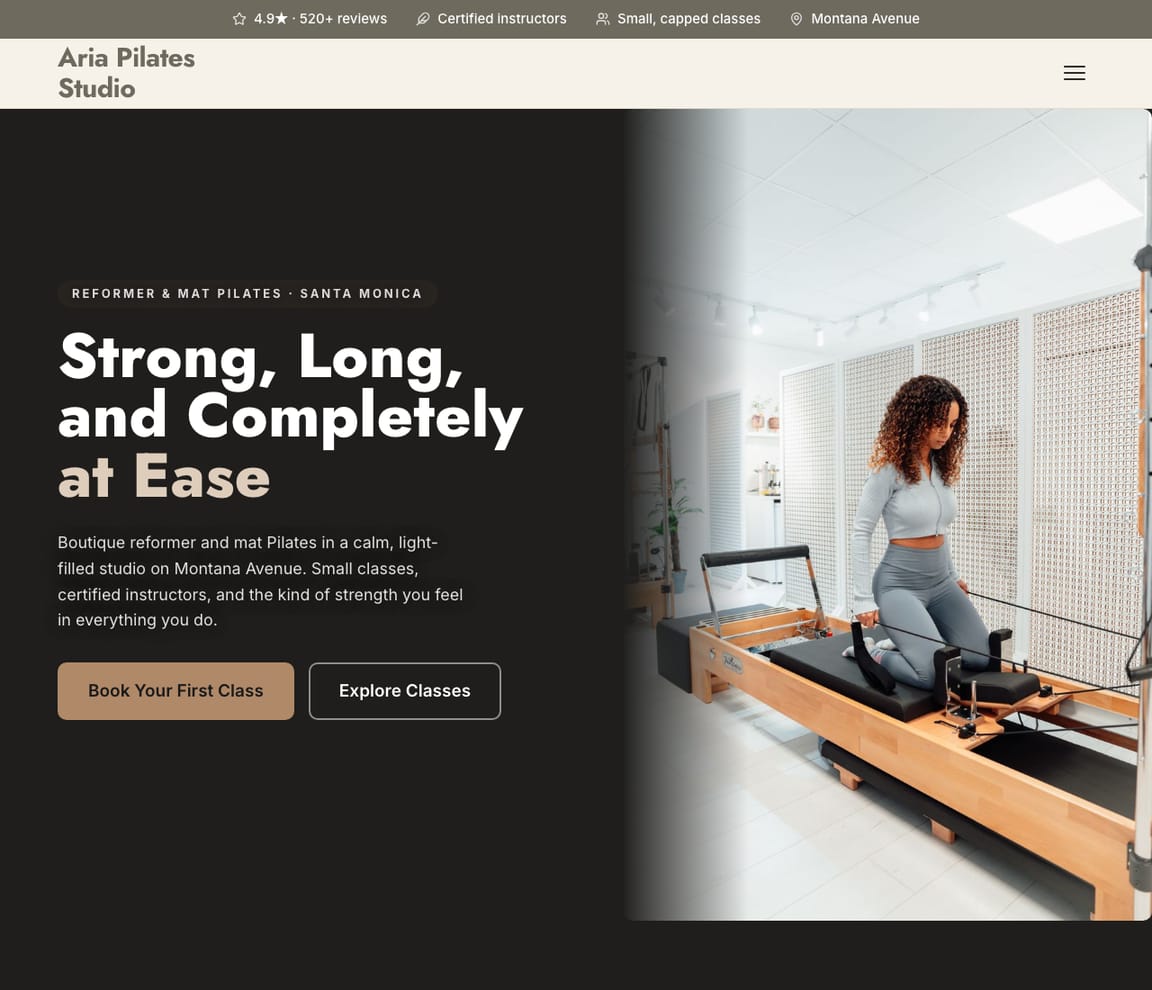
A real Zarla template from the Pilates gallery — a bold type-statement hero, reformer and mat class cards, a calm studio gallery, a first-class walkthrough and a class-booking form. Describe yours — the reformers, the privates, the mat hour, the city — and you'll have a site like this, with your classes and your instructors, in about a minute.
- Professional design — not a generic template
- Looks great on desktop and mobile
- Content written for your industry
Build the website
Start your Pilates studio website now
Add your city and your studio's name to the sentence, and Zarla builds the site: the reformer and mat schedule, the instructors, an intro-class form and a map. Add the private, duet and pack prices and your booking link in chat, then publish.
Already have a website? Bring it across →Zarla keeps your old page addresses where it can and redirects the ones that change, helping you keep the Google standing you've built.
Is a Pilates studio worth opening in 2026 — and what do its owners make?
The Pilates studio one instructor can open has three doors: privates and duets on one studio-grade reformer at home, a storefront of six to ten reformers that sells group reformer classes, packs and privates, or mat classes in a room rented by the hour. The machines are the smaller number; the room, the build-out and the hours the owner teaches are the big ones. What the job pays on someone else's payroll: a Pilates instructor sits in O*NET's fitness-instructor line, whose 2025 median is $47,160 a year or $22.67 an hour, with the top tenth at $83,100 or more — the wage an owner pays a hire, or gives up to teach in their own room (O*NET, 2025); the closest thing to a studio manager, the fitness and wellness coordinator, has a $69,770 median, $33.54 an hour (O*NET, 2025). O*NET doesn't count Pilates separately. What the franchisors print — revenue for the most part, and one profit figure: BODYBAR Pilates' disclosure puts its Item 19 at "$182,143 (average net income, FY 2024)" across the 21 studios open the whole year (1851 Franchise, December 16, 2025, from the franchisor's 2025 disclosure); Club Pilates' parent prints sales for all its brands together — a North America run-rate average unit volume of "$659,000, compared to $686,000." in the second quarter of 2026 (Xponential Fitness, August 6, 2026 — the franchisor's figure, all brands). No page read for this guide prints an independent studio's profit.
What the owners say (all quoted and linked below): a Rockwall County instructor who started "teaching privates out of our spare bedroom" and, 90 days into a storefront, counts "over 180 members"; a Virginia owner who put in "$25,000 of my own capital" and had her partner match it; a New York City owner who "had only $10K saved" and raised the rest online; a Kansas City owner whose mother lent her the start and was paid back "in full 2 years after my studio opened"; and a Georgia owner whose classes filled "with only 5 reformers" until she "hit burnout". Our arithmetic on the pages that open — gross, before rent, insurance, software, card fees and tax, with every slot full: one instructor teaching 20 privates a week at $85 grosses $1,700 a week, $81,600 over 48 weeks; 15 full six-reformer classes a week at $44 a seat gross $3,960 a week, $190,080 over 48 weeks — or $3,222 a week at a 10-class pack's $35.80 a seat. No page read today prints a studio's real fill rate. Worth it? The owners who lasted started on one machine and a list of private clients, moved into a storefront when the waitlist said so, and hired instructors before the schedule broke them.
How to open a Pilates studio, in plain English
The word is free — a federal court said so in 2000. In the US nobody licenses the name of the method. Pilates, Inc. sued another company for "infringing two of plaintiff's registered trademarks in the word PILATES." (Leagle, Pilates, Inc. v. Current Concepts, Inc., S.D.N.Y. 2000). The court held that "the primary significance of PILATES is as a method of exercise, not as a source of a product or service.", that "Plaintiff cannot monopolize a method of exercise by asserting trademarks in the generic word used to describe it.", and that "defendants have proven by clear and convincing evidence that the PILATES service mark and the PILATES equipment mark are generic" — and it told the clerk to have the United States Patent and Trademark Office "cancel Pilates, Inc.'s registrations" (the opinion of October 19, 2000, full text at Hall Approved). An equipment maker that tells the story from the defendants' side puts it as the court having "found that Pilates is a generic term." (Balanced Body, The Pilates Lawsuit — a party's account). So the word can go on your sign, in your studio's name and in your ads without anyone's permission.
The teacher — a private certificate, not a license. In the US the national certifying program says it in a clause: "As Pilates is an unregulated industry (it is not a licensed profession)" (National Pilates Certification Program, FAQ). To sit the national exam, "The program of study must be a minimum of 450 hours in length." — covering the mat, the reformer, the Cadillac, the chair and the barrels — and the candidate must be 18; "The updated eligibility will take effect on January 1, 2027*" (NPCP, Requirements). The fee page: "The fee for application processing, computer testing, and the first two years of certification is $295 USD*.", with "a 15% discount" for Pilates Method Alliance members and "an additional fee of $100 USD" for testing outside the US and Canada (NPCP, Fees); the same program's FAQ says "The Pilates Comprehensive exam fee is $300" and "Pilates Mat exam fee is $225", a mat path needs "a minimum of 100 hours", and comprehensive certificants renew with "16 NPCP-approved CECs" every two years — the two pages differ on the fee, so check it when you apply. The training is the big line. One comprehensive program in Miami is "$8,200.00" — "$8,550.00" on the payment plan — for "450 hours, 13-14 months", and it asks for "25 hours of group or private Pilates classes" first (Polestar Pilates, Comprehensive Training Miami, Fall 2026). Balanced Body's comprehensive path adds up to 204 classroom hours across its mat, reformer, apparatus, Cadillac, chair, barrel, movement and anatomy courses, our arithmetic from its module list, plus 220 student-teaching hours — sold through host studios, with no tuition on the page (Balanced Body, Comprehensive Instructor Training). Merrithew's reformer track is a 76-hour course and a 49-hour course — 125 hours, our arithmetic; no price printed (Merrithew, Intensive Reformer). Peak Pilates prices its Level 1 through a scholarship that "will cover the full cost of Level 1 training and educational materials ($2,740 value)", and renewal costs 14 credits "and a renewal fee ($69.95) every two years" (Peak Pilates, Education FAQs); its Level I is "120 logged hours" (Peak Pilates, Comprehensive). Our arithmetic for the full apparatus path: $8,200 + $295 = $8,495. Clinical Pilates in a physical therapist's clinic is a licensed professional's work, outside the health-studio laws below and outside this guide.
The machines, at the one maker that prints its list. Of the makers read for this guide, one prints US prices: Merrithew, the STOTT PILATES maker. Its SPX Max Reformer is "$3,649.00 USD", the SPX Max Plus with a vertical frame for tower work "$6,399.00 USD", and the bundles with the box and accessories $3,949.00 and $6,799.00 (Merrithew, SPX series reformers). The bundle's page prints the machine: width "26 in", length with the footbar down "99.5 in", "128 lbs", and a ceiling of "100.5 in" to stand it upright (Merrithew, SPX Max Reformer Bundle). A Cadillac / Trapeze Table: "List Price: $4,999.00 USD", 89 by 36 inches and 83 tall (Merrithew, Cadillac); a Split-Pedal Stability Chair "$1,949.00 USD" (Merrithew, Stability Chair); a Ladder Barrel "$2,049.00 USD" (Merrithew, Ladder Barrel); the V2 Max reformer bundle "$5,299.00", the V2 Max Plus with its tower "$8,299.00" and a One-On-One Studio Bundle "$12,399.00" (Merrithew, reformer bundles); a whole room — four reformer bundles, a Cadillac, two chairs, a ladder barrel, a spine corrector and four arc barrels — "$30,799.00 USD" (Merrithew, Complete Studio Package · SPX Max). The trap is the home model: the At Home SPX Reformer Package lists at "$3,349.00 USD", and its page says "this product is not warrantied for commercial or professional use." — teach clients on it and "the warranty will be null and void." (Merrithew, At Home SPX Reformer Package). The studio SPX Max is $300 more, our arithmetic, and it's the one to put paying clients on. Mats: a Deluxe Pilates Mat "$85.00 USD" (Merrithew, Deluxe Pilates Mat), six with a wall hanger "$545.00 USD" (Merrithew, Deluxe Grommet Mats, 6-pack). The other makers don't print a price: Balanced Body's Allegro 2 page says "Please contact your local representative for pricing" (Balanced Body, Allegro 2 Reformer), and its EXO Chair page says the same (Balanced Body, EXO Chair); Basi Systems asks you to "Request a quote" (Basi Systems); Peak Pilates' home page lists no reformer price (Peak Pilates); and Gratz — "Joe invented it. Gratz makes it.", in its own words — prints lead times, not prices (Gratz). That is the classical-versus-contemporary split in one line: classical studios teach on apparatus built to Joseph Pilates' originals, as Gratz describes its own, and contemporary studios on the modern reformers. No reseller page with a used reformer's price opened today. Our arithmetic at Merrithew's list for a six-reformer room: six bundles $23,694; add a Cadillac for privates, $28,693; add a chair, $30,642; eight bundles $31,592, ten $39,490 — before freight, tax and any volume discount, none of them printed.
The room math — the machine count is the class size. The bare machine: 99.5 by 26 inches is 17.97 square feet for the SPX Max; Balanced Body prints the Allegro 2 at 94 by 31.25 inches with its footbar, 20.40 square feet, our arithmetic (Balanced Body, Allegro 2 dimensions). Then the walkway: one reformer maker's rule is "one Reformer to every 7m2 (or more) of studio space", which "reduces the gap between each Reformer to 0.75m." (Your Reformer, an Australian maker's guidance, 2026) — about 75 square feet a machine, so six reformers want about 452 square feet of class floor, eight about 603 and ten about 753, before the front desk, the restroom, storage and a corner for privates, our arithmetic. Merrithew's older rule of thumb: "You need as little as 400-800 square feet for a Pilates studio—roughly the size of a racquetball court." and "A 400 square foot space can hold approximately four professional Reformers, for a bare-bones Pilates operation." (Merrithew, Finding a Space, March 11, 2016). However good the instructor, a group class can't hold more clients than there are machines: at Ballet Austin's "Single Class $44", a full six-reformer class is $264, eight is $352 and ten $440; at its "10-Class Package" rate of $35.80 a seat, six seats are $214.80, our arithmetic (Ballet Austin Pilates Center, a nonprofit ballet company's studio, 2026). A mat class has no machine to cap it — the room is the limit. A yoga room and a gym floor have no machine count to set the class size, and each has its own guide: how to open a yoga studio and how to start a gym.
The home door. A Pilates teacher's home-studio checklist starts with the insurer: "Check with your building insurance and notify them of changes.", then "Do you have a private driveway for parking?" — "Parking may become a problem if you teach group sessions." (Pilates Anytime, November 30, 2018). An agency that sells the policies it describes warns that "most homeowners' policies do not include liability protection for business-related accidents." and that, if a client is hurt, "it is likely that your homeowners' insurance will refuse to cover the claim." (Rock Creek Insurance, a Tennessee agency's blog, July 19, 2025). Then the city. Sugar Land, Texas, allows a home occupation only if "It does not depend on the employment of a person who does not reside in the residence;", "It does not involve more than 300 square feet of the area of the Dwelling Unit or Accessory Structure;", "A Sign Advertising the Home Occupation is not located on the Premises;" and it doesn't "create parking or traffic congestion" (City of Sugar Land, Key Excerpts for Home Occupations, 2024). One reformer's 75 square feet and a Cadillac's 22.25 fit under that cap; a hired second instructor who lives elsewhere wouldn't fit the first condition, on our reading. Your own city's code is the one that counts — read it before the first client rings the bell.
The membership laws — where a pack-and-privates studio sits, five states. In the US this is the studio's real legal layer, and each state draws its own line; this guide shows where the lines sit and drafts no contract — talk to a lawyer before you sell memberships. Texas calls a seller of exercise memberships a health spa, and its carve-out for a business "operated exclusively to:" "teach dance or aerobic exercise;" doesn't name Pilates — so a reformer studio that sells memberships should assume the Act applies (Tex. Occ. Code §702.003). The Secretary of State says no one may sell a membership "unless the person holds a health spa operator's certificate of registration" — $100, whatever the term — and asks for $20,000 of security on the first $20,000 of prepaid memberships (Texas Secretary of State, Health Spa FAQ). A studio can seek an exemption from the security — not from the registration — if it never asks a client to sign up for longer than 31 days, prepay past 31 days, pay a joining fee on top of monthly dues, or sign a note, and takes no "recurring debit" from the client's account (Tex. Occ. Code §702.202); the statute's words are "authorize a draw or other recurring debit on a financial institution", and whether your software's automatic card renewal counts is a question for your lawyer. An established operator has a second route — a sworn statement of assets and years in business — that a new studio can't use. Florida's health-studio law reaches anyone selling exercise instruction or the use of equipment for it, and leaves out "an individual acting as a personal trainer" — a term the statute defines by several conditions, among them having no business location of one's own (Fla. Stat. §501.0125, 2026): the instructor who drives to clients' homes may sit outside it, the instructor with a storefront doesn't, and the other conditions are for your lawyer to read with you. Each location registers for $300 a year (Fla. Stat. §501.015), and the $25,000 bond is waived for a studio that bills its contracts month by month at a fair service fee (Fla. Stat. §501.016). New York's definition is wide — any business teaching or hosting exercise for "physical fitness or well being." counts (N.Y. Gen. Bus. Law §621). Its bond starts at $50,000 for contracts of a year or less, and skips the studio whose clients never pay more than $150 in all, or that offers a monthly option of $150 or less alongside a disclosed annual one, on conditions the section spells out (N.Y. Gen. Bus. Law §622-a). California's list runs from "physical culture" through "figure development" — a reformer class is inside it — and it leaves out services by licensed professionals (Cal. Civ. Code §1812.81), with contracts capped at three years (§1812.84). Connecticut, the fifth state, because its tax notice is where Pilates and yoga part ways (below) and its licensing law draws the cleanest line for a pack studio: a health club "shall not include any establishment from which a buyer may only purchase or become obligated to purchase services" "to be rendered for a period of not more than one month and which does not collect more than one month's payment" "in advance of the rendering of such services" (Conn. Gen. Stat. §21a-216, FindLaw, current as of January 1, 2025); a club that sells longer "shall obtain a license from the Department of Consumer Protection prior to the sale of any health club contract" for "two hundred fifty dollars," (§21a-223) and pays "five hundred dollars annually" to the guaranty fund (§21a-226). The first year with memberships, our arithmetic: $400 in Texas with the LLC, plus the $20,000 security unless exempt; $425 in Florida; $870 in Connecticut. Drop-ins and privates are the products least likely to reach the bond and license rules; a $99 enrollment fee, an auto-renewing card plan or a year paid up front is the kind that can — and whether a class pack counts as a membership is a question for your lawyer.
The sales-tax split — a Pilates class can owe tax a yoga class doesn't. New York City lists among a health and fitness facility's taxable services "aerobic, Pilates, or other exercise classes;" and "personal training services;" — while "A facility that provides yoga instruction only is not considered a health and fitness facility." (NYS Tax Department, TB-ST-615); the state's own sales tax skips membership dues everywhere else in New York (TB-ST-329). Connecticut names "classes in aerobic exercise, yoga, spinning, Pilates, or cardio-kick boxing;" among a health and athletic club's taxable charges and leaves out "Businesses that provide yoga instruction at yoga studios." (Connecticut DRS, SN 2007(1), 2007) — it names no Pilates studio either way, so ask the DRS whether a reformer room counts; the general rate is 6.35% (Connecticut DRS, Tax Information, 2026). Texas taxes what a studio charges to join and to belong — it lists "physical fitness or studio centers" — as an amusement, yet leaves live group classes that teach a discipline untaxed, and taxes "recorded sessions" (Texas Comptroller, Tax Policy News, February 2022): the unlimited membership can owe tax where the 10-class pack doesn't, so put the question to the Comptroller. California's guide calls fees for access to a health club "generally not taxable" and says nothing about classes (CDTFA, Tax Guide for Membership Fees, 2026). Florida: no Department of Revenue page read for this guide names fitness classes; "Florida's general state sales tax rate of 6% applies to most taxable transactions." (Florida DOR, GT-300015) — ask the department.
The LLC, the tax permit, the cover and the booking system. Filing the LLC costs $300 in Texas (Tex. Bus. Orgs. Code §4.152), where the sales-tax permit is free though the Comptroller may ask for a security bond (Texas Comptroller, permit FAQ); $100 plus $25 for the registered agent in Florida, then $50 a year for the report (Fla. Stat. §605.0213); $200 in New York (N.Y. LLC Law §1101), plus a notice run weekly for six weeks in two county newspapers (N.Y. LLC Law §206) — and New York wants the sales-tax registration 20 days before you open (NYS Tax Department, TB-ST-360); $70 and a $20 statement in California (Cal. Gov. Code §12190) with the $800 minimum franchise tax every year (Cal. Rev. & Tax. Code §23153) — $890 in the first year, our arithmetic — and a seller's permit at no charge (CDTFA); $120 in Connecticut, then an $80 annual report (Connecticut Business Services, 2021). The IRS charges nothing for an EIN (IRS). Cover priced for this trade by name: $29 a month ($350 a year) for general liability, $59 a month ($702) for a business owner's policy, $42 a month ($500) for professional liability and $55 a month ($659) for workers' comp — the figures on policies Pilates instructors quoted through Insureon (Insureon, updated May 29, 2025). Booking systems: Arketa's one-instructor plan at "$49/mo" plus a "3% transaction fee + Stripe fees" (Arketa, pricing); Mindbody's Starter at $79 a month for each location (Mindbody, October 8, 2026); WellnessLiving at "$69/mo", "$199/mo" or "$349/mo" by tier (WellnessLiving, pricing); Mariana Tek and Momence give no price on a page that opened for this guide. Card processing at Stripe is 2.9% plus 30 cents (Stripe) — $1.58 on a $44 class and $4.22 on a $135 private, our arithmetic. Shopping-center space asks $25.82 a square foot a year nationally (Cushman & Wakefield, Q3 2026) — $2,151.67 a month for 1,000 square feet, our arithmetic. The build-out: "National in-line retail fit out costs averaged $157 per square foot (psf) in 2026", with "Northern California ($217 psf)" and "New York City ($181 psf)" near the top and the Midwest near $120 — a general retail store, not a Pilates studio (Cushman & Wakefield, 2026 U.S. Retail Fit Out Cost Guide); 1,000 square feet at $157 is $157,000, our arithmetic, and that, not the reformers, is most of a storefront start. Taking over a space that was already a studio is the saving the owners below chased. No page read today priced mirrors, sprung flooring, sound or signage.
What studios charge — eleven studios' own price pages. New York: Power Pilates' flagship, a classical studio, prints a private at "$135", five for "$650", a duet at "$92 / person", a reformer class at "$55", mat at "$29", tower at "$47" and its Studio Plus membership at "$319/month" with a "$99 enrollment fee" (Power Pilates Flagship, 2026); Pilates Social's intro first group class is $35 and two intro privates $200 (Pilates Social NYC). California: Pilatesmith in Santa Monica prints a private at "$110/session", eight at "$800", a group class at "$42", eight a month at "$232 ($29 each)" and an unlimited membership at "$299" (Pilatesmith, Santa Monica and Culver City). Texas: Ballet Austin's center prints "Single Class $44", a 10-class package at "$358", "One Month Unlimited — $450", three intro privates at "$188" and a "$28 Intro Rate" for the first group class (Ballet Austin Pilates Center, 2026). Florida: The Body Lab in Orlando, "Single Private Full Session: $85.00", a duet at "$130 ($65 per person/session)" and mat at "Single class $25 (limited to 6 people)" (The Body Lab Pilates, Orlando); Pilates on 3rd in Jacksonville Beach, a private at "$120", a reformer class at "$45" and "Monthly Unlimited" at "$399 per month" for members (Pilates on 3rd, 2025). Illinois: Pilates Central Wellness in Evanston, "Reformer Private Session - $110" and "Single Class - $45 each" (Pilates Central Wellness, Evanston); Sandy Greiner Pilates in Northfield, "Single Private Sessions - $117" and a semiprivate class at "$59" (Sandy Greiner Pilates, 2026). Washington: Pilates Northwest in Shoreline, eight privates at "$79 per" and eight duets at "$53 per person per session" (Pilates Northwest, Shoreline). Colorado: Freebird in Carbondale, "Private Session | $125" and a group drop-in at "$42/drop-in" (Freebird Pilates, Carbondale). New Jersey: The Pilates Project in Fair Haven, "4 Private Sessions $325" to start (The Pilates Project, Fair Haven). The ladder across them, our arithmetic: a private $79 to $135, a duet $53 to $92 a person, a group reformer class $42 to $59 single, mat $25 to $29, a month unlimited $299 to $450. A $135 private is about three $44 seats; a full six-reformer class is about two privates — for the same instructor-hour.
The franchise door — every figure here is a franchisor's or a directory's. Club Pilates' own franchise site didn't open for this guide. Entrepreneur's franchise directory lists its fee at "$65,000", the investment at "$403,289 - $1,029,811", an "8%" royalty and "2%" for marketing, a "$500,000" net worth and "$250,000" in cash, and "1,505" units (Entrepreneur, Club Pilates, 2026); JETSET Pilates "$60,000" and "$525,540 - $749,575", with a "7.5%" royalty (Entrepreneur, JETSET Pilates, 2026); Studio Pilates International "$50,000" and "$502,732 - $869,732" (Entrepreneur, Studio Pilates International, 2026) — the directory's pages carry a "December 12th, 2022" update footer beside 2026 rankings, so ask each franchisor for its current disclosure document. BODYBAR Pilates, from its 2025 disclosure as 1851 Franchise reports it: "The initial franchise fee is $60,000, which is due upon signing the franchise agreement.", an investment that "ranges from $389,964 to $759,356.", "7% of gross sales/week." in royalty, and an Item 19 of "$182,143 (average net income, FY 2024)" (1851 Franchise, December 16, 2025). Club Pilates' parent, Xponential Fitness, calls Club Pilates "the largest Pilates brand in the United States." and reported a "North America quarterly run-rate average unit volume (AUV) of $683,000, compared to $695,000." (Xponential Fitness, fourth-quarter 2025 release, February 26, 2026), then "$659,000, compared to $686,000." for the second quarter of 2026, where "Quarterly AUV (run rate) consists of average quarterly sales for all traditional studio locations in North America" (Xponential Fitness, August 6, 2026) — every Xponential brand together, not Club Pilates alone, and sales, not profit. Our arithmetic: Club Pilates' $65,000 fee alone would buy sixteen SPX Max bundles at $3,949 — $63,184 of reformers.
In the UK: a sole trader can teach from day one and joins Self Assessment once earnings pass £1,000 (GOV.UK, Set up as a sole trader); VAT registration follows when 12 months' taxable turnover tops £90,000 (GOV.UK, VAT registration); and the sport exemption doesn't reach a private studio — "If you are under commercial influence you are not an eligible body.", and "Sports coaching by professionals is not within the exemption as it is not supplied by an eligible body" (GOV.UK, VAT Notice 701/45). No statute licenses a UK Pilates teacher on any page read for this guide; CIMSPA, the sector's professional body, runs a voluntary Pilates instructor membership. In Australia GST registration starts at $75,000 of GST turnover, and a business that already holds an ABN can register online (business.gov.au); the industry association says "Pilates is not a regulated industry in Australia" (Pilates Association Australia, October 5, 2023); a studio that teaches under-18s in New South Wales needs a Working with Children Check — "The application costs $112 for paid workers and is free for volunteers." (Service NSW, July 2026). Whether a Pilates class is GST-free wasn't on a page that opened — ask the ATO. Fees, thresholds and what is taxed change every year — confirm your own state's rule with your accountant before the first class, and talk to a lawyer before you sell memberships.
What Pilates studio owners actually say
Every line in this section is an owner's, not ours: reformer and classical Pilates studio owners in Texas, Florida, Georgia, California, New York, Virginia, Arizona and Kansas City — one of them owns a franchised studio in New Jersey, and says so below — talking to the Voyage magazines, CanvasRebel, Community Impact, a Florida weekly, City Lifestyle and an Atlanta paper between 2022 and 2026, each named the way the page names them. These are their words as of each interview, not today's. Five threads run through them.
Why they opened. Kimberly Flores, SoulForm Pilates, Heath, Texas: “SoulForm opened with one clear intention, a community, driven studio where the true Pilates method is honored,” (VoyageDallas, June 17, 2026). Angela Glass, Forum Classical Pilates & Barre, Waxahachie, Texas: “I decided to pursue teacher training and immerse myself in the study of Classical Pilates.” and “That passion eventually led me to open Forum Pilates Studio in Waxahachie.” (VoyageDallas, June 17, 2026). Marianna Crump, Movement + Control Pilates, Katy, Texas, who “didn't start Pilates as a career plan, I started as a client.” (VoyageHouston, May 13, 2026). Courtney Pyles, Align and Shine Pilates Studio, Jasper, Georgia: “After looking around Jasper for a new place to live, I realized there was no Pilates studio!” (VoyageATL, February 26, 2026). Kelsey Parker, ReformHer Pilates, League City, Texas, a former elementary school teacher: “I was working probably 60 hours a week and not having time for myself” (Community Impact, June 5, 2023). Gretchen Bosselmann-May, TruForm Pilates, a classical studio in Scottsdale: “I realized I needed my own space — a fully equipped studio where I could teach the Method in its entirety.” (CanvasRebel, September 8, 2025). Vanessa Voltan Gallagher, Pilates Boutique, California: “After working in many studios, I noticed everything was the same, focusing only on Reformer Pilates classes.” (VoyageLA, May 13, 2024). Joanna Flores, Refined Pilates Studio, Whittier, California: “I knew I couldn't be the only one craving a beautiful, accessible space that felt both empowering and welcoming.” (VoyageLA, October 14, 2025). Kemberly Deane, Kinfolk Pilates, Atlanta: “Why put myself in a pool of competition when there's an opportunity here that no one's chartering?” (UATL, The Atlanta Journal-Constitution, April 3, 2025). Seiko Sato-Martini, a franchise owner — Studio Pilates Long Branch, New Jersey: “This format truly is for everyone,” (City Lifestyle, page read November 2026).
“When my husband Chris and I moved to Rockwall County, I started teaching privates out of our spare bedroom.” — Kimberly Flores, SoulForm Pilates, in VoyageDallas, June 17, 2026
The spare bedroom, the first machines and the money. Kimberly Flores: “No storefront, no studio — just a reformer, my hands, and women who needed this.”, “The demand grew faster than the space could hold.” and “What started in a spare bedroom is now a home for over 180 members.” — of the storefront, “We are 90 days in.” (VoyageDallas, June 17, 2026). Amy Havens, CenterPoint Pilates, Santa Barbara: “I didn't want to take out any business loans or get business partners.”, “I had one piece of equipment that I'd purchased for myself during my teacher training years” and “I found a temporary space which was a garden room behind someone's house.” (CanvasRebel, July 7, 2025). Brittany Clark, Fairfax Pilates, Fairfax, Virginia, on her first studio, opened in 2015: “I put in $25,000 of my own capital, my business partner matched it”; and on Fairfax Pilates, opened in the summer of 2020: “I bought the equipment — four V2Max Merrithew reformer/tower combos, four chairs, a Cadillac, a standalone reformer” (CanvasRebel, August 6, 2026). Sabrina Castro, a studio owner in New York City: “I had only $10K saved, and she had $10K.”, “I posted a gofund.me, explaining how I want to open my own Pilates studio and need help.” and “We were able to make it to our 100K goal.” (CanvasRebel, April 25, 2024). Kahley Schiller, Pilates by Kahley, Kansas City: “My mother loaned me money to start my studio.” and “I'm proud to say that I paid her back in full 2 years after my studio opened.” (CanvasRebel, September 26, 2022). Julia Yesler, Paradise Pilates, Longboat Key, Florida — five new reformers, one of them a Cadillac reformer, the paper reports, in a space that had housed a Pilates business before: “We did a complete remodel,” (Longboat Observer, July 1, 2026).
The class size, the clients and the first marketing. Courtney Pyles: “classes filled quickly — with only 5 reformers, I often had waitlists.” and “I offer private and duo sessions as well for the people that want a more personalized experience.” (VoyageATL, February 26, 2026). Joanna Flores: “We intentionally keep our classes small- only eight reformers per session” and “Your first class is free- no pressure, no strings, just come experience it for yourself.” (VoyageLA, October 14, 2025). Brittany Clark: “We intentionally keep our classes small — six clients or fewer” (CanvasRebel, August 6, 2026). Gretchen Bosselmann-May: “Most of my new clients have come to me either through word of mouth.” (CanvasRebel, September 8, 2025). Amy Havens: “I wanted to start my own Pilates studio, but I didn't know anyone in town.” and “I quickly put an ad in the free local newspaper and waited.” (CanvasRebel, July 7, 2025). Tanya Stephenson, Stretch ATL, Atlanta: “I was in my head about how was I going to get the girlies to know that I'm here.” and “I did a Groupon, and my advertisement had a Black girl on the reformer, and that's what brought them out.” (UATL, The Atlanta Journal-Constitution, April 3, 2025). Katie Page, co-owner of Breathe Pilates Studio, The Woodlands, Texas: “Clients should experience each of the principles of Pilates on every visit to our studio.” (Community Impact, July 17, 2025). Johannah and Lisa Thompkins, Pendulum Pilates, a classical studio in Houston: “We offer reformer and mat classes, privates and semi-privates, private events, and local community pop-up experiences.” (VoyageHouston, November 5, 2025).
The space and the lease. Johannah and Lisa Thompkins: “There have been plenty of challenges so far, especially since there's no roadmap for opening a Pilates studio.” (VoyageHouston, November 5, 2025). Brittany Clark, of a space meant to arrive as a warm shell: “Instead it arrived as a cold shell, badly behind schedule” (CanvasRebel, August 6, 2026). Joanna Flores: “It was my first time navigating a commercial buildout, first time needing blueprints” (VoyageLA, October 14, 2025). Amy Havens: “I signed a one year lease, received signage and forged ahead.” (CanvasRebel, July 7, 2025). Kimberly Flores, on the build: “watching costs climb and timelines shift” (VoyageDallas, June 17, 2026). Courtney Pyles: “I'm excited to share that I just signed a lease on another space in the building!” (VoyageATL, February 26, 2026). Kahley Schiller: “In August 2005 Pilates by Kahley, a 1,400 square foot studio, opened in Kansas City.” — and it “quickly grew to 10 instructors, 2,600 square feet and over 300 clients.” (CanvasRebel, September 26, 2022).
The instructors, the owner and the burnout. Courtney Pyles: “Only two close coworkers knew what I was doing — I couldn't risk losing my job before I was ready.”, “I kept adding more classes to try to accommodate everyone, and after a few weeks, I hit burnout.” and “I started bringing on additional instructors, and now there are three other reformer teachers at the studio.” (VoyageATL, February 26, 2026). Amy Havens: “I purchased quite a bit more equipment, conducted a teacher training to train additional teachers” and “I honestly wasn't sure if I was going to make it through the dark and heavy days.” (CanvasRebel, July 7, 2025). Kahley Schiller: “I was the only instructor teaching both mat and full equipment classes.” (CanvasRebel, September 26, 2022). Brittany Clark, on what her instructors get — “free training, reimbursement for continuing education, paid meetings, lunches” — and “Autonomy works only when the standards are unmistakable.” (CanvasRebel, August 6, 2026). Kimberly Flores: “I was blessed to build a team of instructors who carry that standard.” and “They could teach anywhere. They chose this.” (VoyageDallas, June 17, 2026). Kate Medley, PilateZENergy, Point Loma, San Diego: “I was anxious to start my own Pilates business” — and later a client “put his trust in me to train him as instructor himself” (CanvasRebel, March 14, 2022). Alexa Torres, The Reformer Room Pilates, Dallas: “Doubt and comparison can be real thieves of joy, especially as a business owner.” (VoyageDallas, March 5, 2026). Johannah and Lisa Thompkins: “There have been tough conversations, long nights, and moments of tension.” (VoyageHouston, November 5, 2025).
THE STARTER KIT
The Pilates studio starter kit — machines, room, papers
A studio-grade reformer, not the home one
Merrithew's SPX Max Reformer is $3,649 and its home package $3,349 — but the home machine is "not warrantied for commercial or professional use". With a vertical frame for tower work, the SPX Max Plus bundle is $6,799; a Cadillac $4,999.
The room the machines need
About 75 square feet a reformer by one maker's spacing rule — 452 square feet of class floor for six. The reformer count is also the class size, so the room you lease sets what a full class can earn.
The certificate
No license — the national certifier calls the field "not a licensed profession". The national exam wants a 450-hour program; one comprehensive course is $8,200 over 13 to 14 months, and the exam fee page says $295.
The membership rules in your state
Texas registers every studio that sells memberships ($100) and lets a new studio apply out of the security if nothing runs past 31 days and it takes no recurring debit — ask a lawyer whether your card billing counts; Connecticut's license and New York's bond skip month-at-a-time and small sellers. Read your state's law with a lawyer before you sell.
Insurance, priced for this trade
Insureon's Pilates figures: $29 a month for general liability, $42 for professional liability, $59 for a business owner's policy. Tell your home insurer first if the clients come to your house.
Booking software and the card fee
Arketa's one-instructor plan at $49 a month, Mindbody Starter at $79, WellnessLiving from $69; Mariana Tek and Momence print no price. A card payment costs 2.9% + 30¢ at Stripe — $1.58 on a $44 class.
THE PAPERWORK
The Pilates studio's paperwork, line by line
| Typical cost | Time to get | Legally required? | |
|---|---|---|---|
| Instructor training (a private certificate) | $8,200 for one comprehensive program; Peak Level 1 a $2,740 value | 13–14 months comprehensive | No license — the national certifier calls the field "not a licensed profession" |
| National Pilates Certification exam | $295 on the fee page ($300 in the FAQ); $225 mat | After a 450-hour program (100 for mat) | No — a voluntary credential |
| Using the word Pilates | Free | — | No permission needed — a federal court held the word generic in 2000 |
| Texas health spa registration | $100; $20,000 security unless exempt | Before selling a membership | Yes to sell memberships in Texas; a new studio can apply out of the security if nothing runs past 31 days, with no initiation fee and no recurring debit |
| Florida health studio registration | $300 a location a year; $25,000 bond | Before selling | Yes for a studio; no bond if billed monthly; a lone personal trainer is outside the law |
| New York health club bond | From $50,000 for terms up to 12 months | Before selling contracts | Not where payments or monthly dues stay at or under $150 on the statute's terms |
| California health studio contract rules | No registration fee in the sections read | — | Yes — terms capped at three years |
| Connecticut health club license | $250 + $500 a year to the guaranty fund | Before selling a contract | Not if you sell services for no more than a month and collect no more than a month's payment ahead |
| Sales tax on classes and memberships | NYC taxes Pilates classes; CT names them at clubs (6.35%); TX taxes memberships | Register before the first sale; 20 days ahead in NY | Yes where taxed — ask your state about packs and privates |
| Sales-tax permit | Free in Texas and California | Before opening | Yes once you sell anything taxable |
| An LLC | $300 TX; $125 FL + $50/yr report; $200 + publication NY; $890 CA first year; $120 CT | A few days; New York's notice runs six weeks | Optional — you can teach as a sole proprietor; the LLC separates the studio's debts from yours |
| Federal tax ID (EIN) | $0 from the IRS | Same day online | For an LLC or once you put instructors on payroll |
| Home-occupation rules (a home studio) | Set by your city | Before the first client at home | Yes where your city has them — Sugar Land, TX: 300 sq ft, no non-resident employee, no sign |
| Insurance | $29/mo liability; $42/mo professional; $59/mo owner's policy | Days | Not by law; tell your home insurer before clients come to the house |
THE STEPS
How to open a Pilates studio (step by step)
From privates on one machine to a room of reformers on a full schedule — with the membership rules read, the tax registered and a price ladder a stranger can book from.
01
Pick the door — privates at home, a reformer storefront, mat in a rented room, or a franchise
One studio-grade reformer with a tower frame at home is $8,083 to start, our arithmetic; six reformers in a storefront $33,576.34 before the build-out; mat classes $2,289 before the room. The franchise door runs from $389,964 to $1,029,811 by the figures the franchisors and a directory print.
Before the lease02
Hold the certificate — there's no license to get
A comprehensive program of at least 450 hours is what the national exam asks; one in Miami is $8,200 over 13 to 14 months, and the exam is $295 on its fee page. Mat-only teaching needs 100 hours.
03
Price the machines at a printed list
Merrithew prints its prices; Balanced Body, Basi, Peak and Gratz send you to a rep or a quote. Six SPX Max bundles are $23,694 at list; a Cadillac for privates $4,999. Teach clients only on a machine whose warranty covers it.
04
Measure the room before you sign
About 75 square feet a reformer: six need roughly 452 square feet of class floor before the desk and restroom. At $25.82 a square foot a year, 1,000 square feet is $2,151.67 a month — and the fit-out averages $157 a square foot.
05
Set up the LLC and get the free EIN
Filing runs $300 in Texas, $125 in Florida, $200 in New York before a six-week newspaper notice, $890 across California's first year and $120 in Connecticut. The IRS charges nothing for the EIN — never pay a site for one.
06
Read the membership law before you sell a membership
Texas: $100 to register and $20,000 of security unless the studio applies for the exemption — nothing past 31 days, no joining fee, no recurring debit. Florida: $300 a location and a $25,000 bond unless billed monthly. New York, California and Connecticut draw their own lines. Talk to a lawyer before the first one sells.
07
Register for the sales tax your classes owe
New York City taxes Pilates classes and spares a yoga-only studio; Connecticut names Pilates among a club's taxable classes; Texas taxes memberships, not live instructional classes. Ask your state which of your packs is taxed.
08
Publish the ladder, then open the schedule
The site carries every class with its instructor, the private-to-unlimited prices, the intro offer and the booking link; a Google Business Profile shows the studio on Maps. One owner: "with only 5 reformers, I often had waitlists".
THE COSTS
How much does it cost to open a Pilates studio?
The figures are this guide's three doors in Texas from the pages that open — our arithmetic, every addend printed. Not in them: a certificate if you don't hold one ($8,495 for one comprehensive program and the exam), mirrors, flooring, sound, signage, staff, an hourly room for mat classes and working capital, which no page priced to a reader today. The third figure shows where a storefront's money goes.
$8,083a home studio — a $6,799 SPX Max Plus reformer bundle with a vertical frame + an $85 mat + $350 general and $500 professional liability for a year + the $300 LLC + $49 of software; $4,933 on the plain $3,649 SPX Max Reformer
$33,576.34a six-reformer storefront before the build-out — $23,694 for six reformer bundles + a $4,999 Cadillac + $4,303.34 deposit and first month on 1,000 sq ft + $101 insurance + $79 software + $300 LLC + $100 Texas health spa registration
$190,576.34the same storefront with a $157,000 build-out at the national retail fit-out average of $157 a square foot — the room, not the reformers, is most of it
$2,289mat classes in a rented room — twelve mats for $1,090 + $850 of liability cover for a year + the $300 LLC + $49 of software, before the room's hourly rent
WHAT WE'VE LEARNED
What fills the reformers, week after week
Across thousands of local business websites, one pattern holds for a one-instructor room: friends of clients bring the first ones, and the clients who keep a standing spot found the schedule, the prices and the booking link on a page. Three things on that page decide it — the Pilates studio template is built around them, and there are more Pilates studio website examples to start from.
Every class, its instructor and the spots left
A reformer class sells out at its machine count — one owner with five reformers ran waitlists. A schedule that names the instructor and shows what's open turns a maybe into a booking, and points the overflow to a private or a duet.
The whole ladder, private to unlimited
The studios here print a private at $79 to $135, a duet seat at $53 to $92, a reformer class at $42 to $59, mat at $25 to $29 and a month unlimited at $299 to $450. Printed side by side, the ladder sells the step up.
The intro offer and how to start
A first class at an intro rate, three intro privates, a week unlimited — the studios here all lead with one. Say what happens at the first class, what to wear and how to book it, and the nervous first-timer comes in.
THE EARNINGS
The pay, the franchise figure and what one full class brings in
No wage survey has an owner's line. The employed figures are O*NET's 2025 medians, the franchise figure is one franchisor's disclosure as a franchise publication reports it, and the class figure is our arithmetic at one studio's printed price with every reformer taken.
$47,160the 2025 median for exercise trainers and group fitness instructors, $22.67 an hour — the employed Pilates instructor (O*NET)
$69,770the 2025 median for fitness and wellness coordinators, $33.54 an hour — the studio manager's employed equivalent (O*NET)
$182,143BODYBAR Pilates' average net income for FY 2024, from its 2025 disclosure — the franchisor's figure, as 1851 Franchise reports it
$264a full six-reformer class at $44 a seat — one instructor-hour; a $110 to $135 private takes the same hour, our arithmetic
SEE IT WORK
A Pilates studio website design you can start from
A real Zarla template: a type-led hero, cards for the reformer and mat classes, a studio gallery, what to expect at the first class and a booking form. Open it, swap in your schedule, your photos and your city, and publish.
GET FOUND
Be the studio that comes up when someone types "reformer pilates near me" and wants a spot this week
The owners say their first clients came by word of mouth, a free-paper ad and a Groupon — and that classes fill to the machine count. The look before a first class asks the same things every time: when are the classes, what does a class or a private cost, is there an intro offer, how do I book. Zarla builds the website with your class schedule, your instructors, an intro-class form, a map and SEO. Add the price ladder and your booking link in chat before you publish.
“Reformer pilates near me”
Searched by the client who just moved, the one whose studio closed and the one ready to try a machine class. Your schedule, your prices and the intro offer answer it before they pick someone else.
Google Business Profile
The studio's pin, hours and front door on Google Maps, with the schedule and the booking link one tap from it. It costs nothing to claim.
The schedule, the ladder and the intro offer
A Pilates studio is chosen on three things: is there a reformer open at a time that works, what a class or a private costs, and how easy the first one is to book. Printed plainly, they fill the machines.
Google Search
Llindenreformerstudio.com
Linden Reformer Studio — Trusted pilates studio in Your AreaGroup reformer classes of six, privates and duets, and a Saturday mat class in north Raleigh. Intro offer for first-timers — see the schedule and book online.← Your Zarla siteCcitypilatesstudioservices.com
City pilates studio ServicesGoogle Maps
1
Linden Reformer Studio
← You2
Metro pilates studio Co.
3
Quick pilates studio Services
AI assistants (ChatGPT / Perplexity)
For a Raleigh Pilates studio with six reformers that teaches group reformer classes, privates, duets and a weekly mat class in your area: Linden Reformer Studio — a reformer studio whose site lists every class with its instructor, the private, duet, pack and unlimited prices, an intro offer and a booking link.
An example with a made-up business and illustrative figures. Yours will show your real details and reviews.
YOUR LAUNCH PLAN
Your Pilates studio launch checklist
Everything above, as a list to tick. Take it top to bottom and the studio is certified, equipped, registered, insured and bookable before its first class.
- Pick the door — privates at home on one reformer, a storefront of six to ten reformers, mat classes in a rented room, or a franchise.
- Finish the certificate — a 450-hour comprehensive program for the national exam, 100 hours for mat.
- Buy a machine warrantied for paying clients — the studio reformer, not the home package.
- Measure the room before the lease — about 75 square feet a reformer, and the reformer count is your class size.
- File the LLC, then get the EIN at no charge — $300 in Texas, $125 to file in Florida then a $50 annual report, $200 plus publication in New York, $890 in California's first year, $120 in Connecticut.
- Check where your packs sit under the health-club law — and talk to a lawyer before you sell anything longer than a month.
- Register for sales tax — ask whether your memberships, packs and privates are taxed where you teach.
- Publish the site, then put the studio on Google Maps — the schedule, the price ladder, the intro offer and the booking link.
REAL CUSTOMERS
Small businesses that got online with Zarla
Verified reviews from real Zarla customers.
“Quickly built my website from scratch. No hiccups. Would highly recommend Zarla for someone with no experience who wants to start a polished business website.”
“Great professional website in less than a minute, with the use of AI and a few descriptive prompts. This has saved me bundles of time and research on web developers.”
“I had no idea how to set up a website for my business. Thanks to Zarla, they've helped me a lot.”
“Very reliable, professional, and fast results. I was able to get my business online in no time, and the ease of access made it so simple.”
Be the Pilates studio whose open reformers, price ladder and intro offer are one tap away
Add your city and your studio's name, and Zarla builds the website from that one line — the class schedule, the instructors, an intro-class form, a map and SEO in place. Add your privates, your packs and your booking link in chat. Free to build; you pay when you publish.
Already have a website? Bring it across →Zarla keeps your old page addresses where it can and redirects the ones that change, helping you keep the Google standing you've built.
Frequently asked questions
How much does it cost to open a pilates studio?
Three answers from the pages that open, all in Texas and all our arithmetic. A home studio with one studio-grade reformer and a vertical frame is $8,083 — the $6,799 machine, a mat, a year of general and professional liability, the LLC and a month of software — or $4,933 on the plain $3,649 reformer. A six-reformer storefront is $33,576.34 before the build-out and $190,576.34 with one at the national retail fit-out average of $157 a square foot. Mat classes in a rented room start at $2,289 before the room's rent. If you aren't certified yet, add $8,495 for one comprehensive program and the national exam.
What license do you need to open a pilates studio?
In the US there's no license to teach Pilates — the national certifier calls it "not a licensed profession" — so the instructor's credential is a private certificate, with the national exam optional. The studio's legal layer is the state's health-club law once you sell memberships: in Texas a $100 registration and $20,000 of security unless you apply for the exemption that requires nothing past 31 days, no initiation fee and no recurring debit; in Florida $300 a location a year and a $25,000 bond unless you collect monthly; in New York a bond from $50,000 unless payments stay at or under $150; in Connecticut a $250 license unless you sell services for no more than a month and collect no more than a month's payment in advance. Add the sales-tax permit, the LLC, the EIN and your city's rules if you teach at home. Talk to a lawyer before you sell memberships.
How much is it to open up a Pilates studio?
It depends on the door, and the room is the big number, not the reformers. Six Merrithew reformer bundles are $23,694 at the maker's list, and its own four-reformer studio package is $30,799.00. A 1,000-square-foot storefront's build-out at the national retail average of $157 a square foot is $157,000. Our arithmetic for the lean starts: $8,083 at home, $33,576.34 for six reformers before the build-out, $2,289 for mat classes in a rented room.
How much do Pilates studio owners make?
No wage survey has an owner's line. The employed instructor's 2025 median is $47,160, or $22.67 an hour; a fitness and wellness coordinator — the manager's job — earns $69,770 (O*NET). The one franchisee profit figure on a page read for this guide is BODYBAR Pilates' $182,143 average net income for FY 2024, from its 2025 disclosure. At printed prices, 20 privates a week at $85 gross $81,600 over 48 weeks, and 15 full six-reformer classes a week at $44 a seat gross $190,080 — before rent, insurance, software, card fees and tax, and with every slot filled.
Is opening a Pilates studio profitable?
It can be, and the owners say how: start on one machine, keep the private as the margin, and remember the machine count is the ceiling. A full six-reformer class at $44 a seat is $264 for one instructor-hour, against $110 to $135 for a private. What decides it is the room — $157 a square foot to fit out an average retail space and $25.82 a square foot a year to rent one. No page read for this guide prints an independent studio's profit; one owner repaid a parent's loan two years after opening, another had waitlists with five reformers and burned out before hiring.
How profitable is club pilates?
No page we could read prints it. Club Pilates' own franchise site didn't open — the address forwards to the Australian site — and its parent, Xponential Fitness, publishes one sales figure for all its brands together: a North America run-rate average unit volume of $659,000 in the second quarter of 2026, compared to $686,000, after $683,000 in its fourth-quarter 2025 release. That is revenue across every Xponential brand, not Club Pilates alone and not profit. A franchise directory lists Club Pilates' fee at $65,000, the investment at $403,289 to $1,029,811 and an 8% royalty.
What permits do I need to open a Pilates studio?
In the US: no instructor license; your state's health-club registration or license if you sell memberships — $100 in Texas, $300 a location a year in Florida, $250 in Connecticut — unless your sales fit the state's exemption; a sales-tax permit, free in Texas and California; the LLC and the EIN; and for a home studio, your city's home-occupation rules — Sugar Land, Texas, caps a home business at 300 square feet with no non-resident employee and no sign. Check your own state's rules and talk to a lawyer before you sell memberships.
How to open a pilates studio in texas?
In Texas: an LLC at $300 and a free EIN; a free sales-tax permit; and, before you sell memberships, a health spa certificate of registration from the Secretary of State at $100, with $20,000 of security unless you apply for the exemption, which requires that no contract or prepayment runs past 31 days, no initiation fee and no recurring debit — whether an automatic card renewal counts as a recurring debit is a question for your lawyer. The Comptroller taxes gym and studio membership fees as an amusement but says live group training classes that are instructional in nature are not taxable — ask it where your packs fall. At home, read your city's home-occupation rule. Confirm the details with your accountant.
How to open a pilates studio in california?
In California: an LLC at $70 plus $20 for the statement of information and the $800 minimum franchise tax every year — $890 in the first year — and a free seller's permit. The Health Studio Services Contract law covers instruction in "physical culture" and "exercising", and caps a contract at three years; the statute also governs cancellation — have a lawyer write your terms. The state's tax guide says membership fees for health club access are "generally not taxable" and doesn't mention classes, so ask the CDTFA. Confirm the details with your accountant.
Can you open a Pilates studio at home?
In the US it's a city question, and plenty of owners start there. Sugar Land, Texas, allows a home occupation only with no employee who lives elsewhere, no more than 300 square feet, no sign on the premises and no parking or traffic trouble — one reformer and a Cadillac fit. Tell your insurer: one insurance agency writes that a homeowner's policy will likely refuse a client's injury claim. And buy the studio machine — Merrithew's home reformer is "not warrantied for commercial or professional use", and its studio SPX Max is $300 more. Our home start: $8,083. Check your own city's home-occupation rule and your policy before the first client comes.
Do you need to be certified to teach Pilates?
Not by law in the US — the national certifier calls Pilates "an unregulated industry (it is not a licensed profession)" — the credential is a private certificate. The national exam asks for a training program of at least 450 hours, or 100 for mat; its fee page puts the exam at $295, its FAQ at $300 for comprehensive and $225 for mat. One comprehensive program is $8,200 over 13 to 14 months; Peak Pilates values its Level 1 training at $2,740. In Australia the industry association says Pilates "is not a regulated industry".
Can I call my studio Pilates?
Yes. In 2000 a federal court in New York held that "the primary significance of PILATES is as a method of exercise, not as a source of a product or service", found the service mark and the equipment mark generic, and had the US Patent and Trademark Office cancel both registrations. In the US the word itself can go in your studio's name, on the sign and in your ads; brand names built on it, like a training company's own registered mark, still belong to their owners. Check a name you like against the federal trademark register, and talk to a lawyer before you print it.
Do Pilates studios charge sales tax?
In the US it depends on the state, and a Pilates class can be taxed where a yoga class isn't. New York City taxes "aerobic, Pilates, or other exercise classes" at a health and fitness facility, while a yoga-only studio isn't one; New York State doesn't tax dues outside the city. Connecticut names Pilates among a health and athletic club's taxable classes and leaves out yoga studios, at a 6.35% general rate. Texas taxes membership fees but not live instructional classes; California calls membership fees generally not taxable. Confirm with your state's tax department.
How much does a Pilates reformer cost?
Only one maker read for this guide prints its list: Merrithew's SPX Max Reformer is $3,649, the bundle with the box and accessories $3,949, the SPX Max Plus with a vertical frame $6,399.00, a Cadillac $4,999 and a Stability Chair $1,949.00. Balanced Body asks you to contact a representative, Basi Systems takes quote requests and Gratz prints lead times, not prices. The home package is $3,349, but it isn't warrantied for commercial or professional use.
How much space do you need for a Pilates studio?
One maker's rule is one reformer to every 7 square meters — about 75 square feet — so six reformers need about 452 square feet of class floor and ten about 753, before the desk, the restroom and storage. Merrithew says 400 square feet holds about four reformers for a bare-bones studio. The machine count is also the class size: six reformers, six clients a class.
Do I need a website for my Pilates studio?
A reformer class sells out at its machine count — one owner with five reformers had waitlists — so the client who finds a full class needs to see the next open one, the private and the price. A studio site prints the schedule with each instructor, the ladder from a private to unlimited, the intro offer and a booking link. Zarla builds one from a sentence — the class schedule, the instructors, an intro-class form and a map — and you add your prices and packs in chat before you publish.