BUSINESS GUIDE
How to open a yoga studio in 2026
For the teacher who has taught in other people's rooms long enough: what the room, the props and the software cost from the vendors' own pages (less than the blogs say, before the lease), the membership laws of five states in their own words — the bond Texas, Florida and New York want before you bill a card on file — what the insurer actually charges, what teachers are paid a class, what owners report earning, the waiver that is void in three states — and what the owners who opened one say.
Free to build · Pay when you publish · No credit card
$2,004the lean first year of a studio that rents its room by the hour — the entity, the policy, the software and the props from the vendors' own pages (our arithmetic)
$25.82a square foot a year, the national shopping-center asking rent in the landlord survey's third quarter of 2026 — 1,200 square feet is about $2,582 a month at that rate
$47,160the 2025 median pay of an employed exercise trainer or group fitness instructor (O*NET) — the survey leaves out the owner
No codeto get online
See it in action
See what your yoga studio website could look like
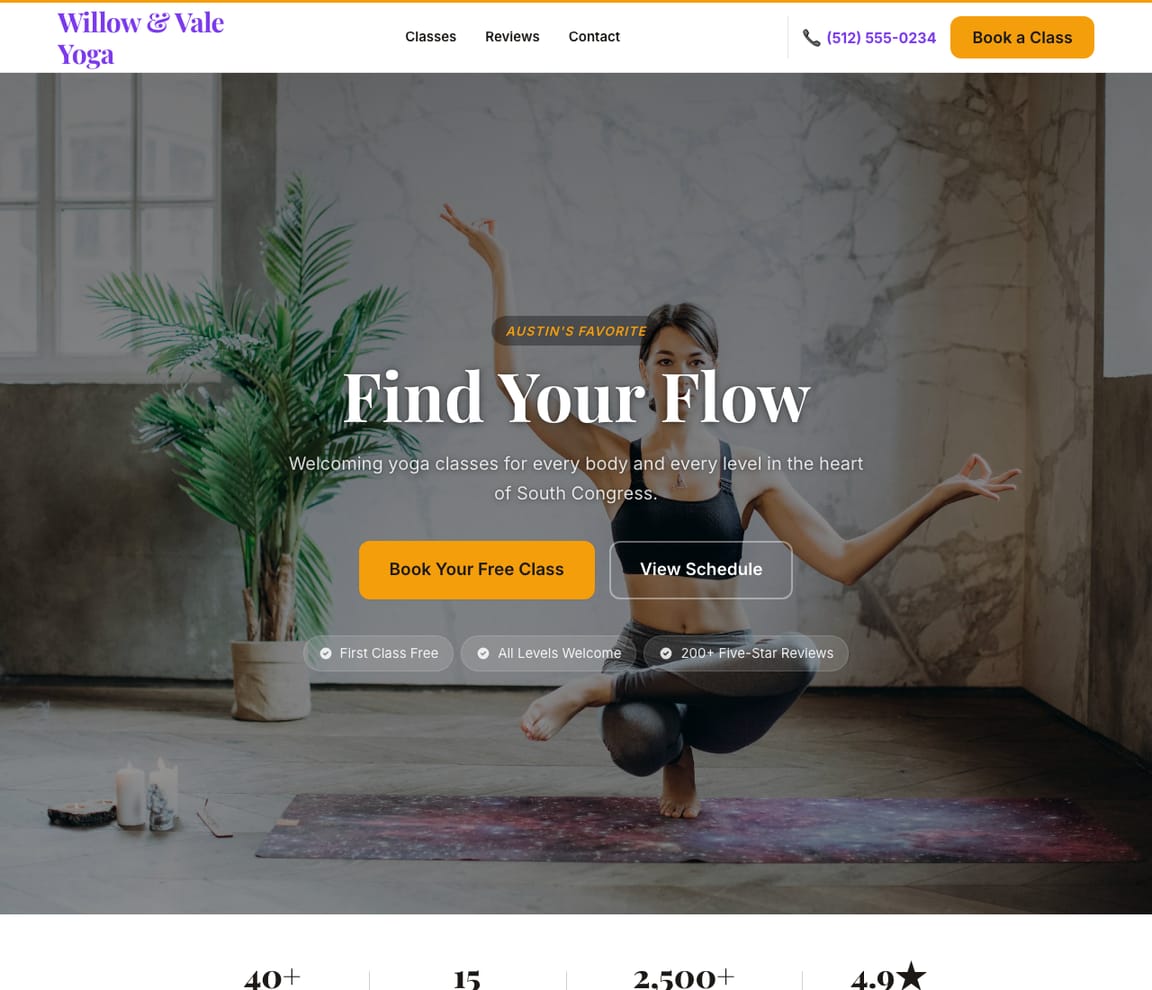
This is a real Zarla template for a neighborhood yoga studio — the calm hero, the class schedule, the teachers, the intro offer, the trial-class button. Describe yours — vinyasa, yin, hot, the neighborhood — and you'll have a site like this, with your schedule, your teachers and a map, in about a minute.
- Professional design — not a generic template
- Looks great on desktop and mobile
- Content written for your industry
Build the website
Start your yoga studio website now
Add your neighborhood and the studio's name to the sentence, and Zarla builds the site: the schedule, the teachers, a trial-class form and a map. Add your prices, your intro offer and your booking link in chat, then publish.
Already have a website? Bring it across →Zarla keeps your old page addresses where it can and redirects the ones that change, helping you keep the Google standing you've built.
Is opening a yoga studio worth it in 2026 — and what do yoga studio owners make?
The yoga studio one teacher can open is a one-room studio: 1,200 square feet on a neighborhood strip, twenty classes a week, memberships billed monthly to a card on file, the owner teaching half the schedule and two part-time teachers paid by the class teaching the rest. The capital is the lease and the floor; the question is the membership count and the price. What employed teachers earn: "Workers on average earn $47,160." for exercise trainers and group fitness instructors in 2025 — $22.67 an hour (O*NET, 2025) — in a survey that leaves out "the self-employed, owner/partners in unincorporated firms" (Washington ESD), which is what a studio owner is. What a class pays and sells for: "Most group classes pay $25–$75 per class." and "Call it $30–$50 for most classes at most studios, with $50–$75 available once you have a following." with "A class in Manhattan or San Francisco pays roughly a third more than the same class in Chicago." (Gymdesk, August 25, 2026); "Yoga teachers typically make $30–$75 per group class, depending on the studio, city, experience level, and class size." and "Full-time studio teachers earn roughly $30,000–$45,000/year." (Brett Larkin, 2026); on the selling side, "Most yoga studios charge $15–$25 for drop-ins, $100–$150 per month for unlimited memberships," — with the vendor's own caveat, "Those ranges are illustrative, not surveyed—" (Gymdesk, June 26, 2026).
What owners report. No page of record prints a studio owner's median income. The nearest is a booking vendor's 2018 survey of its own customers: "The median number of students at successful yoga studios is 700 members", "the average monthly profit for successful yoga studios is $13,500", "their less successful counterparts actually lose about $2000 a month" and "The average price of an unlimited membership at a successful studio is $227 per month" (Zen Planner, August 8, 2018) — eight-year-old numbers from a software vendor, which is why this guide builds its own from the vendors' pages instead. What those pages say about keeping a student: "Before that point, retention after just the first class sits around 46 percent." and "once a client hits their fifth class, retention rates jump above 90 percent, according to Mariana Tek's data." (Mariana Tek, updated October 30, 2026).
What the plan runs. Our free yoga studio business plan is a one-room studio on the Boise Bench: ninety unlimited memberships at about $130 a month plus about 65 drop-ins at $20 is about $13,000 a month, against the rent, two part-time teachers at $30 to $75 a class, the software, the insurance and the music, with the owner's own pay the remainder. The owners who did it describe both halves: "It was a financial struggle that ate into my life savings." (Michelle Acebo, Yoga Studio of Corpus Christi — VoyageHouston, May 1, 2019); "It hurt me, when people would tell me that owning a yoga studio is just an expensive hobby." (Gian Shakti, Jupiter Yoga Wellness, Newport Beach — VoyageLA, June 8, 2026).
The catch. The rent is due from the lease date and the hundredth member arrives a year later; January fills the room and July empties it; the owner is the lead teacher, so a sick month halves the schedule; a membership billed without the words your state's health-club law requires is void and a complaint; and a playlist in a class is a public performance the licensor bills for. That's what the rest of this guide sets up.
How to open a yoga studio, in plain English
No license to teach — and a law for the membership. In the five states we read, no agency licenses a yoga teacher or a yoga studio: Texas's licensing department lists its regulated industries, from air conditioning contractors to weather modification, and yoga is not among them (Texas Department of Licensing and Regulation); California's consumer affairs department lists its boards and bureaus, and none covers fitness instruction (California Department of Consumer Affairs). What the states regulate is the business that sells memberships. Texas calls it a health spa: "The fee for an original certificate of registration or renewal is $100." (Texas Secretary of State), and the Secretary of State "may not issue a health spa operator's certificate" "of registration to an applicant unless the applicant files a surety bond, " "or posts other security as prescribed by the secretary" — "The amount may not be less than $20,000 or more than $50,000." (Tex. Occ. Code §702.151); the application carries a sample of each membership contract and "the required registration fee." for each location (§702.102); the exemption goes to a studio that never makes a member "execute a membership contract for a term that exceeds 31 days." and takes no recurring debit authorization, no initiation fee and no prepayment over 31 days (§702.202) — so a studio that bills a card on file posts the security. Florida calls it a health studio — "any person who is engaged in the sale of services for instruction, training, or assistance" "in a program of physical exercise", and "The term does not include an individual acting as a personal trainer." (Fla. Stat. §501.0125) — which must "Remit an annual registration fee of $300 to the department at the time of registration" (§501.015) and post security: "The principal sum of the bond must be $25,000", unless "A health studio that sells contracts for future health studio services and" "collects direct payment on a monthly basis for those services" — exempt "if any service fee charged is reasonable and fair" (§501.016). New York calls it a health club — any business "offering instruction, training or assistance" "or the facilities for the preservation, maintenance, encouragement or development of physical fitness or well being" (N.Y. Gen. Bus. Law §621); money taken "prior to the full operation of such health club shall be placed in escrow." (§622); the bond is "Fifty thousand dollars if the health club sells contracts for services for a term not greater than twelve months." and "Seventy-five thousand dollars if the health club sells contracts for services for a term more than twelve months." — exempt where buyer payments "do not exceed one hundred fifty dollars" or every plan offers a monthly-dues option under $150 a month with no automatic renewal (§622-a); "No contract for services shall provide for a term longer than thirty-six months." (§623); every contract carries, in twelve-point bold, "CONSUMERS RIGHT TO CANCELLATION. YOU MAY CANCEL THIS CONTRACT WITHOUT ANY PENALTY OR FURTHER OBLIGATION" "WITHIN THREE (3) BUSINESS DAYS FROM THIS DATE." (§624); and a contract that misses any of it "shall be void and unenforceable as contrary to public policy." (§627). California regulates the contract rather than registering the studio: a "contract for health studio services" is "a contract for instruction, training or assistance in physical culture" (Cal. Civ. Code §1812.81); its term may not "exceed three years" (§1812.84); and every one tells the buyer "You, the buyer, may choose to cancel this agreement at any time prior to midnight of the fifth business day" "of the health studio after the date of this agreement, excluding Sundays and holidays." (§1812.85). Colorado makes it a deceptive practice if a health club "Fails to allow any buyer of a membership in a health club to rescind the membership contract within three business days", and for contracts longer than twenty-four months "The aggregate amount of the bond is one hundred thousand dollars for each club location" (C.R.S. §6-1-704). Read your own state's statute before you write the membership.
The entity and the EIN. Texas: "for filing a certificate of formation, $300;" (Tex. Bus. Orgs. Code §4.152, applied to an LLC by §4.154). Florida: "For filing original articles of organization or articles of revocation of dissolution, $100." plus "For filing a certificate designating a registered agent or changing a registered agent, $25." — $125 (Fla. Stat. §605.0213). New York: "two hundred dollars" for the articles (N.Y. LLC Law §1101) and the notice published "once in each week for six successive weeks" within 120 days, or the authority to do business "shall be suspended, effective as of the expiration of such one hundred twenty day period." (§206). California: "Filing articles of organization of a limited liability company: Seventy dollars ($70)." and the statement of information at "Twenty dollars ($20)." (Cal. Gov. Code §12190), plus the annual tax of "an amount equal to the applicable amount specified in subdivision (d) of Section 23153" (Rev. & Tax. Code §17941) — "a minimum franchise tax of eight hundred dollars ($800)." (§23153). Colorado: "Articles of Organization" at $50 online and a $25 periodic report (Colorado Secretary of State). The EIN: "You never have to pay a fee for an EIN." (IRS).
Sales tax on a membership — five different answers. Texas: "Initiation and membership fees to gyms, athletic clubs, health clubs, and physical fitness or studio centers" are "taxable as an amusement service." while "Live group training classes for a sport or athletic discipline that are instructional in nature are not taxable." (Texas Comptroller, Tax Policy News, February 2022) — ask the Comptroller which side a yoga-only schedule falls on. Florida taxes "admissions", which include "and all dues and fees paid to private clubs and membership clubs providing recreational or physical fitness facilities" (Fla. Stat. §212.02). New York State: "Dues or membership fees paid to health and fitness facilities are not subject to New York State sales tax." but "New York City imposes its local sales tax on every sale of services by health and fitness facilities" — and the bulletin says a facility offering only yoga instruction is outside it: "charges by these facilities for yoga classes are not subject to the New York City local sales tax" (New York Tax Department, TB-ST-329). California does not tax the membership: "Membership fees that grant access to health club facilities, such as a gym or a massage facility," are not taxable, while "Membership fees related to the anticipated retail sale of tangible personal property (merchandise)" are (CDTFA). Colorado: "In general, the tax does not apply to sales of services, except for those services specifically taxed by law." (Colorado Department of Revenue). The mats and the tea at the desk are taxable retail everywhere a sales tax exists. Confirm the details with your accountant.
The teachers — employee or contractor, and the day you hire. California's test: "The individual is free from the control and direction of the hiring entity", "The individual performs work that is outside the usual course of the hiring entity's business." and "The individual is customarily engaged in an independently established trade, occupation, or business of the same nature as that involved in the work performed." — all three, or the teacher is an employee (California EDD, AB 5); the IRS asks "Does the company control or have the right to control what the worker does and how the worker does his or her job?" among its three categories (IRS). Workers' compensation: "an employer may elect to obtain workers' compensation insurance coverage" in Texas (Tex. Labor Code §406.002); "All private employments in which four or more employees are employed by the same employer" in Florida (Fla. Stat. §440.02); "Workers' compensation coverage is required for sole proprietors with employees, including part-time employees" in New York (New York Workers' Compensation Board); "Every employer except the state shall secure the payment of compensation" in California (Cal. Labor Code §3700); Colorado from "one or more persons engaged in the same business" (C.R.S. §8-40-203). Insureon prints the premium: "For yoga studios, the average cost of workers' compensation insurance is $55 per month, or $659 annually." (Insureon, June 5, 2025). Confirm your own state's rule with your accountant.
The waiver, the insurance and the music. A signed waiver is the insurer's and the lease's expectation, and it is worthless in at least three states on Recreation Law's list — Virginia, Louisiana and Oregon: Virginia's Supreme Court held "the pre-injury release provision signed by Hiett is prohibited by public policy and, thus, it is void." (Hiett v. Lake Barcroft, 1992, as reproduced) — "While many states will enforce such contractual provisions, Virginia is not one of them." (Perkins Law); Louisiana's code: "Any clause is null that, in advance, excludes or limits the liability of one party for causing physical injury" "to the other party." (La. Civ. Code art. 2004, as Recreation Law reproduces it, 2020); Montana's statute voids contracts that exempt anyone "for violation of law, whether willful or negligent," (Mont. Code §28-2-702) with a recreation exception that Recreation Law says the courts have not reviewed; and nowhere does one cover the worst case — an agreement "purporting to release liability for future gross negligence, generally is unenforceable as a matter of public policy" (City of Santa Barbara v. Superior Court, 2007). The policy, then: "Yoga teachers pay an average of $29 per month, or $350 annually, for general liability insurance.", "Yoga businesses pay an average of $59 per month, or $702 per year, for a business owner's policy." and "Professional liability insurance costs an average of $42 per month, or $500 annually, for yoga instructors." (Insureon). The music: recorded music in a class is a public performance, and BMI's and ASCAP's fitness pages refuse a scripted reader — the plan page carries no figure for it, so ask both for the quote before the first playlist, or use a business music service that carries the licenses.
The money to start — and the "$15,000 to $100,000" the page-one blog prints. From the pages that open on November 3, 2026, a studio that keeps renting its room by the hour: a Colorado LLC at $50, Insureon's $350 general liability, Punchpass Grow — "$59" a month, with "you will pay the Stripe fee per successful card payment" (Punchpass) — $708 for twelve, and the props — "Foam Yoga Block" at "Regular price $22.00" (Hugger Mugger) and "Standard Yoga Bolster" at "Regular price $114.00" (Hugger Mugger): twenty blocks and four bolsters, $896 — $2,004, our arithmetic; the room on top: "Yoga studios in New York average $62 per hour to rent" (Peerspace, October 22, 2026), so four classes a week for fifty weeks is $12,400 and the lean year with the room about $14,404. The mat: "The Manduka PRO Yoga Mat is expensive at $138 for the standard length without shipping included." (Garage Gym Reviews, 2026 guide — Manduka's own page refuses a reader). The bigger software: "Mindbody pricing in the United States starts at $79 USD/month per location" (Mindbody, October 8, 2026); Punchpass's Flow at $99 and Pro at $149. The cards: "Standard card payments are 2.9% + 0.30 USD in the US" (Stripe support — the pricing page serves each country its own schedule). The room on a lease: "national asking rents reaching $25.82 per square foot (psf)" for shopping centers, with "national vacancy held steady at 5.9%, well below the 7.4% historical average" (Cushman & Wakefield, Q3 2026 US shopping center MarketBeat, October 14, 2026) — 1,200 square feet at that rate is about $2,582 a month, and the plan page's side-street room runs $18 to $30 a square foot. The registry, if you want the mark: a teacher's "One-time Application Fee: $50" and "Annual Membership Fee: $65" (Yoga Alliance); a school's dues "$240/yr" and, in the page's footnote, "New applicants for the RYS credential pay a one-time $400 application fee." — with the credential and the membership now "two separate things" and the credential upgraded in 2027 (Yoga Alliance, 2027 changes — its older school-credentialing page no longer opens). The plan page's wider $20,865–$63,984 adds the lease deposit and first month, the build-out, a sound system, the city license, launch marketing and two months of working capital. What the blogs print: "estimates ranging from $15,000 to $100,000." with a room where "25 x 30 ft. holds roughly 30 clients maximum" (Hapana, August 13, 2018); "A lean, one-room start can run $15,000 to $50,000." and "A full studio with a real build-out in a good location usually lands between $75,000 and $150,000, sometimes more." (Gymdesk, October 13, 2026) — the lean figure is the plan page's range with a build-out; the $100,000 is a full build-out in a good location, not a one-room start.
In the UK: no government registry covers the teacher — "Unlike some fitness professions, there is no single government-approved registry for yoga teachers in the UK." and "You do not need CIMSPA registration to be a yoga teacher." (The Yoga Pros, a training provider, March 25, 2026). The business: "you must register for Self Assessment as a sole trader if you earn more than £1,000 in a tax year" (GOV.UK); VAT once "your total taxable turnover for the last 12 months goes over £90,000 (the VAT threshold)." (GOV.UK); the data-protection fee for the smallest tier "will go up from £40 to £52 per year" from 2025 (GOV.UK, data protection fee regime response, January 2025); and the music: a business that plays music "will usually need TheMusicLicence." (PPL PRS). The inversion: Texas, Florida and New York register and bond the business that sells memberships; the UK registers neither the teacher nor the membership seller. In Australia: "It's free to register for an ABN through the Australian Government's Australian Business Register (ABR)." (business.gov.au); GST registration once "your business has a GST turnover of $75,000 or more" (business.gov.au); no state we read licenses the teacher — the profession's own body wrote in 2017 that "Evidence of experience, training standards or professional registration is not currently required" to run a yoga business (Yoga Australia, November 28, 2017) and in 2026 that it recommends "voluntary registration" (Yoga Australia, March 31, 2026), as the fitness sector's peak body runs "The voluntary framework for registering professionals" (AUSactive); and the Australian Government's business-license finder lists a music license for yoga, Pilates and barre studios, administered by APRA — its address carries British spellings, so it is not linked. Check your own state's rules.
What yoga studio owners actually say
None of this is our opinion about opening a studio. It comes from owners who did — in California, Texas, Georgia, Colorado, Illinois, Arizona, Oregon, Pennsylvania and New York — talking to CanvasRebel, the Voyage magazines, ShoutoutColorado, ShoutoutAtlanta and the Richmond Sunset News between 2017 and 2026, each described as the page describes them. Read each as theirs at the time. Five things come up again and again.
Why they opened. Alli Cavanagh, Philadelphia: “In 2022, I left my corporate career to go for it full time and in 2024, I took the biggest risk of my life and opened the studio I needed when I was struggling most.” (CanvasRebel, November 7, 2024). Gian Shakti, Jupiter Yoga Wellness, Newport Beach: “In late 2021, my teacher suggested we look at a space in Newport Beach where YogaWorks had previously been. I initially resisted the idea. I had never envisioned myself as a studio owner.” (VoyageLA, June 8, 2026). Michelle Pasos, United Yoga Studio, San Dimas: “I'll never forget the day my husband and I were driving on the freeway and he said I should open up a yoga studio.” (VoyageLA, October 29, 2019). Dawn Harris, Crescent Yoga Studio & Eco-Boutique, Midlothian, Texas: “Being an independent yoga teacher was all wonderful and things were going great, but I found myself spending most of my time driving all over teaching one class here and one class there.” (Voyage Dallas, January 24, 2018). Brittany Lamb, The Yoga Shala, San Francisco: “I felt like I was ready from an ownership standpoint,” and “It's so fun to build communities, and I wanted to give people another studio option.” (Richmond Sunset News, July 8, 2025). Betsy Koch, a YogaSix franchise owner, Denver: “My former yoga studio in Minneapolis had that “Cheers” feeling – where everybody knows your name – and I wanted to create that here for myself and this new community and neighborhood.” (VoyageDenver, August 26, 2025).
“When we opened Ra Yoga in March 2011 we were 5 months behind our open date, we owed 1 month of back rent, had racked up $50K in American Express debt, had no money for a sign on the building and only $5K in cash in the bank.” — Robert Kittleman and Jenny Vande Hei, Ra Yoga, Costa Mesa, in VoyageLA, October 4, 2017
The first year and the money. Michelle Acebo, Yoga Studio of Corpus Christi: “It was a financial struggle that ate into my life savings.” and “Everyone thought I was crazy opening a yoga studio in Corpus Christi at first” (VoyageHouston, May 1, 2019). Michelle Pasos again: “We have poured a lot of our savings into our studio and although we are grateful to have that as a resource it's scary wondering if we will run out.” (VoyageLA, October 29, 2019). Lara Estrada, Yoga Bliss, Westchester, Los Angeles: “I'm proud to say that I started the business completely on my own.” and “I had to save up a lot of money (which I had been doing for years), run an IndieGoGo campaign, and get a small business loan.” (VoyageLA, February 26, 2017). Alli Cavanagh on the year before the studio: “I would spend about 5x more money than I was bringing in from teaching just to rent random spaces and bring people together.” and “There were many classes where 1-5 people would come.” (CanvasRebel, November 7, 2024). Ashley Konzmann, The Yoga Studio, Camarillo: “Right now, we've hit a financial obstacle because we are still new and profits have not reached a point where we can spend the money to pay an architect to draw plans for us to submit to the city for our aerial hammocks.” (VoyageLA, November 4, 2025). Leah Zaccaria, shefayoga, Venice: “I ended up getting loans from 7 of my yoga students who believed in me and my mission too!” (CanvasRebel, December 11, 2023). Gian Shakti: “The truth is, I've come to realize it requires more work than many of the jobs I've had in the past that were financially stable and clearly defined.” (VoyageLA, June 8, 2026).
The students and the marketing. Christine LaMonica, Prema Yoga, Granada Hills: “Once I opened the studio in October 2014, it was more hoping and praying and doing whatever we could to get the word out about the studio and attract some students.” and “I remember so many days waiting in the studio and hoping someone would come for class!” (VoyageLA, May 15, 2017). Michelle Acebo: “Some days, we had many no shows for the classes but slowly over the years, the attendance has grown to fill over 26 classes a week.” (VoyageHouston, May 1, 2019). Kim MacPherson, Crossroads Yoga, Milton, Georgia: “During the slower November and December months, we offered a few specials to help cash flow.” and “I'd say the biggest challenge is keeping up with what our members want” (VoyageATL, March 16, 2023). Danny Chapparo, Ashva Yoga, Castle Rock, Colorado: “My business grew without a big marketing push, but mostly by word-of-mouth.” and “The lesson I learned along the way is that you grow your business one student at a time.” (ShoutoutColorado, July 9, 2025). Rina Jakubowicz, Rina Yoga, Studio City: “I was trying it out and seeing how it went, using my marketing mind to find places to teach and ways to promote mostly through word of mouth.” (VoyageLA, September 4, 2018). Carol Edwards, Bikram Yoga Aurora, Illinois: “The toughest challenge is getting people into our hot room who feel scared, intimidated or embarrassed to start a yoga practice.” (VoyageChicago, May 8, 2018). Nicole Katz, a semi-private studio, New York City: “This intimate model gave students the personal attention of a private session while allowing them to experience the community and joy of practicing with others.” (CanvasRebel, February 12, 2025).
The room and the lease. Lara Estrada: “I actually signed the lease without a loan confirmed. It was scary and invigorating!” (VoyageLA, February 26, 2017). Dawn Harris: “Remember this was in the lull of the housing market and everyone thought we were crazy, but we had the existing clients and all the numbers worked, so we went for it.” (Voyage Dallas, January 24, 2018). Toure' Akela, Southwest Atlanta Yoga: “On November 28, 2022, a fire caused by a neighboring business destroyed my studio. I had every reason to walk away with a substantial check.” (CanvasRebel, November 4, 2024). Maureen Beville, Dwell Yoga Studio, Frisco, Texas: “We were forced to close the studio as part of the city/state mandates for fitness centers/gyms in the spring of 2020.” (Voyage Dallas, November 11, 2021).
The teachers, the owner and the burnout. Michelle Acebo: “In the beginning and even now at times, if a teacher needs to take a day off & I can't find a sub, I'm it!” (VoyageHouston, May 1, 2019). Gian Shakti: “there were moments where I felt like I was working constantly, full-time and beyond, while also holding financial uncertainty and the emotional weight of being responsible for a community space.” (VoyageLA, June 8, 2026). Michelle Pasos: “I fell into the dangerous trap of teaching others how to be well when I am was not well myself.” (VoyageLA, October 29, 2019). Carol Edwards: “However, I went through a divorce after a year of being opened, so having to support my studio and handle all of the responsibilities of owning a business entails, that was definitely my biggest obstacle.” (VoyageChicago, May 8, 2018). Betsy Koch: “Opening my first studio with all the COVID-era restrictions around capacity and masks was a huge challenge.” (VoyageDenver, August 26, 2025). Christine LaMonica: “We would not be where we are today if it wasn't for their skill, dedication and love of yoga.” (VoyageLA, May 15, 2017). Ally Dell'Amico, Saule Yoga, Gilbert, Arizona: “During the months leading up to my surgery and the many months of recovery afterward, I relied on my previous business partners, 2 studio managers, and our amazing community of teachers and students.” (VoyagePhoenix, June 12, 2024). Amy Love, Full Bodied Yoga, Portland: “We support students of all shapes, sizes, ages, races, and identities, including those who have been historically excluded from yoga spaces, because we know that self-acceptance and collective healing are acts of resistance.” (CanvasRebel, May 15, 2025).
The through-line: the owners who lasted opened on a list they had already built, found the money before the lease or paid for not doing so, grew one student at a time by word of mouth and the intro offer, kept teachers they could lean on when the owner could not teach, and treated the slow months as a cash-flow plan rather than a surprise.
THE STARTER KIT
What you need to open a yoga studio
The room — rented by the hour first
National shopping-center asking rent is $25.82 a square foot a year in the landlord survey's third quarter of 2026; a New York yoga room rents for $62 an hour on average on the booking marketplace. The lean start is the hourly room with your own list, not the lease.
The entity — and the health-club registration
An LLC is $300 in Texas, $125 in Florida, $200 plus publication in New York, $70 plus $20 and $800 a year in California, $50 in Colorado. Then the law nobody on page one mentions: Texas registers a studio selling memberships for $100 and bonds it at $20,000 to $50,000; Florida $300 and a $25,000 bond unless you bill monthly; New York a $50,000 bond unless exempt.
No teacher license — a voluntary registry
Neither Texas's nor California's licensing list carries yoga. Yoga Alliance's own pages: a teacher pays a $50 one-time application fee and $65 a year; a new school a $400 application fee and $240 a year. The insurer and the lease, not the state, want the 200-hour training and the CPR card.
Insurance from $350 a year
Yoga teachers pay an average of $29 a month, $350 a year, for general liability at Insureon; $59 a month, $702, for a business owner's policy; $42, $500, for professional liability; and $55 a month, $659, for workers' compensation once there are staff.
The props and the software, from the vendors' pages
Hugger Mugger's foam block is $22 and its standard bolster $114; the Manduka PRO mat $138 in the 2026 buying guides. Punchpass is $59, $99 or $149 a month and Mindbody's Starter plan $79 a month a location; card payments 2.9% plus 30 cents through Stripe.
The waiver, the music and the website
A waiver is void in Virginia, Louisiana and Oregon on Recreation Law's list and never covers gross negligence. BMI's and ASCAP's fitness pages refuse a reader, so get the quote before the first playlist. The site shows the schedule, the teachers, the prices and the intro offer, and books the first class.
THE PAPERWORK
Licenses, rules and taxes for a new yoga studio
| Typical cost | Time to get | Legally required? | |
|---|---|---|---|
| A license to teach or run a studio | None — Yoga Alliance's registry is $50 + $65/yr (teacher), $400 + $240/yr (school) | — | No state read licenses it; the insurer and the lease want the training and the CPR card |
| Health-club registration and bond | $100 + $20,000–$50,000 security (TX); $300 + $25,000 bond (FL); $50,000 bond (NY); none (CA, CO) | Before the first membership | Yes in TX, FL and NY unless exempt — monthly billing (FL), nothing over 31 days (TX), a monthly option under $150 (NY) |
| Membership contract words | Free | Before the first membership | NY: 3-day cancellation in 12-point bold, 36-month cap; CA: 5-day cancellation, 3-year cap; CO: 3 business days |
| The entity | $300 TX; $125 FL; $200 + publication NY; $70 + $20 + $800/yr CA; $50 CO | Days to weeks | No — a sole proprietorship under your own name is lawful; the LLC is the common choice |
| EIN | Free | Minutes | Needed to hire or for the entity; free from the IRS — never pay a site |
| Sales tax on memberships | Taxable as an amusement service (TX — instructional classes exempt; ask the Comptroller); taxable (FL); state-exempt (NY, with the NYC local tax); not taxable (CA, CO) | — | Register where it is taxed; the retail shelf is taxable everywhere |
| Insurance | $350/yr GL; $702 BOP; $500 PL; $659 WC (Insureon's averages) | Days | No statute read requires liability cover; the lease and the health-club bond assume it |
| The waiver | Free (in the booking app) | Before the first class | Void in Virginia, Louisiana and Oregon (Recreation Law's list); limited in Montana; never covers gross negligence |
| Teachers as employees | Payroll by the class | From the first hire | CA's ABC test makes a scheduled teacher an employee; the IRS control test points the same way |
| Workers' compensation | $659/yr (Insureon) | On the first hire | CA and CO from 1; FL from 4; NY from the first part-timer; TX elective |
| Music licensing | By quote — BMI's and ASCAP's pages refuse a reader | Before the first playlist | Yes — a class is a public performance; a personal streaming plan excludes business use |
| Occupancy and the city license | A planning $0–$200 | Weeks | The fire marshal signs off an exercise use; check your city |
THE STEPS
How to open a yoga studio (step by step)
Eight steps from teaching in other people's rooms to a one-room studio with twenty classes a week, memberships on a card and two teachers on the schedule.
01
Teach on your own list first — in a rented room
Owners say the first studio was the list they already had. A yoga room in New York rents for $62 an hour on average; the pre-studio year is where one owner spent five times what the classes brought in. The list that fills an hourly room fills a lease.
Before the lease02
Form the entity and take the EIN
Texas $300, Florida $125, New York $200 plus six weeks of newspaper notice, California $70 plus $20 and the $800 minimum tax, Colorado $50. "You never have to pay a fee for an EIN." The IRS form takes minutes.
03
Read your state's health-club law before you write the membership
The statute decides the contract: Texas's $100 registration and $20,000 to $50,000 security unless you sell nothing over 31 days and bill no card on file; Florida's $300 and $25,000 bond unless you bill monthly; New York's escrow, $50,000 bond and three-day cancellation notice in twelve-point bold; California's five-day cancellation and three-year cap; Colorado's three business days.
04
Sign the lease with a build-out period — or keep renting by the hour
At $18 to $30 a square foot a year on a side street, 1,200 square feet is about $1,800 to $3,000 a month, and the landlord takes the first month and a deposit at signing — $3,600 to $6,000 before the floor. One owner signed without the loan confirmed; another was five months late opening and $50,000 in card debt on day one.
05
Bind the policy, buy the props, pick the software
Insureon's $350 general liability or the $702 business owner's policy with the $500 professional liability. Blocks at $22, bolsters at $114, PRO mats at $138. Punchpass from $59 a month or Mindbody Starter at $79, with every student's waiver signed inside it before the first class.
06
Hire the teachers as the law says, not as the blogs say
A class pays $25 to $75 in the 2026 guides, about $30 to $50 at most studios. A teacher on your schedule, in your room, teaching your core service is an employee under California's ABC test and looks like one to the IRS; put them on payroll by the class, or let a true contractor set their own classes and carry their own policy.
07
License the music and publish the site
Recorded music in a class is a public performance; BMI and ASCAP license the room, and their fitness pages refuse a reader — get the quote. The website shows the schedule with the teacher on each class, the prices, the intro offer and the trial-class form, and the Google Business Profile puts the door on the map.
08
Open with the intro offer, then watch the fifth class
Ninety unlimited memberships at about $130 plus about 65 drop-ins at $20 is about $13,000 a month in our plan, with about $4,800 to $9,000 left before the owner's pay. The software vendors' own data: retention after the first class is about 46 percent and above 90 percent after the fifth — the intro offer exists to get a student to class five.
THE COSTS
How much does it cost to open a yoga studio?
The first figure is this guide's lean first year for a studio that keeps renting its room by the hour, from the vendors' own pages — the entity, Insureon's policy, Punchpass, Hugger Mugger's props. The second adds four classes a week in a New York room at Peerspace's average. The range is the yoga studio business plan's fuller start, with the lease, the build-out, the sound, the city license, launch marketing and two months of working capital.
$2,004the lean first year, renting by the hour — $50 + $350 + $708 + $896 (our arithmetic)
$14,404with four classes a week for fifty weeks in a New York room at $62 an hour — the pre-lease year
$20,865–$63,984the plan page's whole range for a one-room studio on a lease, from a former dance room to a raw bay with a build-out
$2,582a month for 1,200 square feet at the national shopping-center asking rent of $25.82 a square foot; a side street runs $18 to $30
WHAT WE'VE LEARNED
What actually brings a yoga studio its students
Thousands of local business websites in, the pattern for a small studio is clear: the first students come from the owner's own list and the intro offer, and the ones after that come from the site answering the three questions. For a new studio, three things on a page decide who books — and the yoga studio templates are built around them.
The schedule, with the teacher on every class
A studio sells a time and a person. The software vendors' own data says retention after the first class sits around 46 percent and jumps above 90 percent by the fifth — the schedule that lets a student find their class and their teacher again is the whole retention plan.
The price and the intro offer, printed
Drop-ins run $15 to $25 and unlimited memberships $100 to $150 a month in the 2026 pricing guides; the studio that prints its own numbers and its first-month offer is the one the comparison-shopper books. Hiding the price sends them to the studio that doesn't.
A trial-class form that takes one minute
A name, a phone number and the class they want — nothing more. The waiver and the card come in the booking app on the first visit; the form on the page is the door, not the paperwork.
THE EARNINGS
What yoga studio owners make, and what a class pays
The wage median from O*NET's 2025 figures leaves out the self-employed; the class pay and prices are the 2026 pay guides' ranges with their own caveats; the owner benchmark is a booking vendor's 2018 survey of its own customers, the only owner figure on a page that opens.
$47,160the 2025 median for employed exercise trainers and group fitness instructors — $22.67 an hour (O*NET)
$30–$75what a group class pays a teacher in the 2026 guides — about $30 to $50 at most studios, a third more in Manhattan or San Francisco
$100–$150a month for an unlimited membership and $15 to $25 a drop-in in Gymdesk's 2026 guide — "illustrative, not surveyed"
$13,500the average monthly profit of a "successful" studio in Zen Planner's 2018 survey of its customers, with 700 members; the rest lost about $2,000 a month
SEE IT WORK
A yoga studio website design you can start from
A real Zarla template: a serene hero, the weekly schedule, instructor bios, the membership and drop-in pricing, and the trial-class call to action a studio site is built around. Open it, swap in your classes, your teachers and your neighborhood, and publish.
GET FOUND
Get found by the person who searched "yoga near me" at 9pm and wants a class tomorrow
Owners say the first students came by word of mouth and the intro offer, and the ones after that from the search. The person searching "yoga" plus the neighborhood has the same three questions on every site they open: when are the classes, what does it cost, can I book the first one now. Zarla builds the website with your schedule, your teachers, a trial-class form that collects a name, a phone number and the class they want, a map and SEO. Add your prices, your intro offer and your booking link in chat, and once you connect your Google Business Profile, your Google rating and reviews show on the site.
“Yoga near me”
Searched by the person who moved to the neighborhood, the runner whose physical therapist said yin, and the beginner who tried an app. Your schedule, your prices and your intro offer answer it before they message.
Google Business Profile
Your studio, your hours and your door inside Google Maps — with the schedule link and the trial-class button on it. Free, and an afternoon to set up.
The schedule, the teacher and the price
Students compare studios on three things: whether the class fits their day, who teaches it, and what the first month costs. Printed plainly, they do the work a hundred Instagram posts would.
Google Search
Wwillowvaleyoga.com
Willow & Vale Yoga — Trusted yoga studio in Your AreaVinyasa, slow flow and yin on the Bench — twenty classes a week, a four-week beginners' series, unlimited memberships from the first month. Book your first class online.← Your Zarla siteCcityyogastudioservices.com
City yoga studio ServicesGoogle Maps
1
Willow & Vale Yoga
← You2
Metro yoga studio Co.
3
Quick yoga studio Services
AI assistants (ChatGPT / Perplexity)
For a one-room yoga studio on the Boise Bench with vinyasa, slow flow and yin, twenty classes a week, a beginners' series and an unlimited membership in your area: Willow & Vale Yoga — a studio whose site shows the week's schedule with the teacher on each class, prints the drop-in and membership prices and the intro offer, and lets a new student book the first class from the page.
An example with a made-up business and illustrative figures. Yours will show your real details and reviews.
YOUR LAUNCH PLAN
Your yoga studio launch checklist
The whole guide as things to check off. Work through them in order and you'll be formed, registered, insured, licensed for music and findable before the first class.
- Teach on your own list in a rented room first — and count who comes back for a fifth class.
- Form the entity and take the free EIN — $50 to $300 by state; $800 a year in California.
- Read your state's health-club law — the registration, the bond and the cancellation words before the first membership.
- Sign the lease with a build-out period — or stay hourly until the list says otherwise.
- Bind the policy before the first class — general liability at $350, the full package at $702 plus $500.
- Buy the props and set up the software — the waiver signed in the app before anyone unrolls a mat.
- Pay the teachers as the law says — payroll by the class, or a true contractor with their own policy.
- License the music, publish the site, claim the Google Business Profile — the schedule, the prices, the intro offer, the trial-class button.
REAL CUSTOMERS
Small businesses that got online with Zarla
Verified reviews from real Zarla customers.
“Quickly built my website from scratch. No hiccups. Would highly recommend Zarla for someone with no experience who wants to start a polished business website.”
“Great professional website in less than a minute, with the use of AI and a few descriptive prompts. This has saved me bundles of time and research on web developers.”
“I had no idea how to set up a website for my business. Thanks to Zarla, they've helped me a lot.”
“Very reliable, professional, and fast results. I was able to get my business online in no time, and the ease of access made it so simple.”
Be the studio whose schedule, teachers and first-class offer are one tap away
Add your neighborhood and the studio's name, and Zarla builds the website from that one line — the class schedule, the teachers, a trial-class form, a map and SEO in place. Add your prices, your intro offer and your booking link in chat. Free to build; you pay when you publish.
Already have a website? Bring it across →Zarla keeps your old page addresses where it can and redirects the ones that change, helping you keep the Google standing you've built.
Frequently asked questions
How much does it cost to open a yoga studio?
In the US, about $2,004 for the first year of a studio that keeps renting its room by the hour, in our arithmetic from the pages that open on November 3, 2026 — a Colorado LLC at $50, Insureon's $350 general liability, Punchpass Grow at $59 a month ($708) and twenty Hugger Mugger blocks at $22 with four bolsters at $114 ($896) — and about $14,404 with four classes a week for fifty weeks in a New York room at Peerspace's $62-an-hour average. On a lease, our yoga studio business plan's fuller range is $20,865 to $63,984: the deposit and first month on 1,200 square feet, a build-out from paint to a new floor, the props, the sound, the software, the policy, the city license, launch marketing and two months of working capital. The page-one blogs' $15,000 to $100,000 spans the same room and a full build-out in a good location.
Do you need a license to open a yoga studio?
In the US, no state we read licenses a yoga teacher or a yoga studio — Texas's and California's licensing lists carry no yoga or fitness profession — but three of the five register the business that sells memberships: Texas as a health spa ($100 a year plus $20,000 to $50,000 of security unless you sell nothing over 31 days and bill no card on file), Florida as a health studio ($300 a location plus a $25,000 bond unless you bill monthly), New York as a health club (escrow before opening and a $50,000 bond unless every plan has a monthly option under $150 a month with no automatic renewal). California and Colorado regulate the contract's words instead. The city adds a business license and the fire marshal's occupancy sign-off. Check your own state's statute and your city.
How much money do you need to open a yoga studio?
Enough to carry the rent until the hundredth member: in our plan, 1,200 square feet at $18 to $30 a square foot is $1,800 to $3,000 a month, and the landlord takes the first month and a deposit at signing, so the lease alone is $3,600 to $6,000 before the floor. The plan page's whole range is $20,865 to $63,984 with two months of working capital inside it; a studio that rents by the hour instead needs about $2,004 for the year and $62 an hour for the room in New York. One owner opened five months late with $50K of card debt and $5K in the bank; another signed the lease before the loan was confirmed. Both are still open — neither recommends it.
Are yoga studios profitable?
Some are, on the membership count. The only owner survey on a page that opens — a booking vendor's 2018 report on its own customers — put the "successful" studio at 700 members and $13,500 of monthly profit and said the less successful ones lose about $2,000 a month. Our plan's one-room studio reaches about $13,000 a month in revenue at ninety unlimited memberships and 65 drop-ins, with about $4,800 to $9,000 left before the owner's own pay once the rent, two part-time teachers, the software, the insurance and the music are paid. The owners quoted here describe the first year as savings spent and no-show days; the ones who lasted filled 26 classes a week over years, not months.
How much do yoga studio owners make?
No page of record prints a median. Employed exercise trainers and group fitness instructors earned a 2025 median of $47,160 (O*NET), in a survey that leaves out the self-employed. A full-time studio teacher earns roughly $30,000 to $45,000 a year in the 2026 pay guides. What an owner keeps is the membership revenue less the rent, the teachers and the software: about $4,800 to $9,000 a month before the owner's pay in our plan at ninety memberships, and the 2018 vendor survey's $13,500 a month at 700 members.
How do yoga studios make money?
Memberships first, then drop-ins and packs, then workshops, privates and a teacher training. The 2026 pricing guide's ranges: $15 to $25 a drop-in, $100 to $150 a month unlimited, packs about 10 to 20 percent under the drop-in rate — "illustrative, not surveyed". The booking vendors' own data says the fifth class is the turning point: retention is about 46 percent after the first class and above 90 percent after the fifth, so the intro offer that gets a student to five classes is the revenue plan.
Do you need a certification to open a yoga studio?
In the US, no — no state read requires one of the owner or the teacher. Yoga Alliance's registry is voluntary: $50 to apply and $65 a year for a teacher, $400 to apply and $240 a year for a school, with the credential and the membership now two separate things and the credential upgraded in 2027. The insurer, the landlord and the students are who want the 200-hour training and the CPR card.
Can you open a yoga studio without being a yoga teacher?
Yes — nothing in the five states' laws requires the owner to teach; the health-club statutes regulate the membership contract and the bond, not the owner's training. The owners quoted here almost all taught first, and the plan assumes the owner teaches half the schedule because a teacher's pay is the biggest monthly line after the rent. An owner who does not teach pays for all twenty classes a week at $30 to $75 each.
How big should a yoga studio be?
Plan about 25 to 40 square feet a student once the mats, the props and the space between them are counted: a 1,000-square-foot room fits somewhere around 25 to 35 students comfortably in Gymdesk's 2026 guide, and the 2018 page-one post puts a 25-by-30-foot room at roughly 30 students and a 20-by-20 room at around 20. Our plan is 1,200 square feet with a changing area and a desk — twenty classes a week at ten to twenty students each.
How many members does a yoga studio need?
Enough to cover the rent, the teachers and the software: in our plan, ninety unlimited memberships at about $130 plus 65 drop-ins at $20 is about $13,000 a month and about $4,800 to $9,000 left before the owner's pay. The 2018 vendor survey's "successful" studio had 700 members at a $227 unlimited rate — a much bigger room. The break-even is yours to run: the rent plus the monthly lines, divided by the membership price, plus the members who pause.
How to start a yoga business from home or without a studio?
Rent the room by the hour and keep your list: a New York yoga room averages $62 an hour on Peerspace, so four classes a week for fifty weeks is $12,400, with no lease, no build-out and no health-club bond, because nobody signs a membership. The entity, the policy ($350 at Insureon), the booking software ($59 a month) and a set of props ($22 a block, $114 a bolster) are the whole first year — about $2,004 in our arithmetic. Teaching from a room in your own home adds the city's home-occupation rules; check them.
How long does it take for a yoga studio to become profitable?
No page that opens prints a surveyed number; the vendor blogs' "one to three years" is unsourced. What the owners say: the first year was savings spent, no-show days and specials in November and December to help cash flow; one studio took years to fill 26 classes a week. The retention data gives the mechanism — a student who reaches the fifth class stays above 90 percent of the time — so the time to profit is the time it takes the intro offer to turn enough first classes into fifth ones.
How do I open a yoga studio in Texas or California?
Texas: form the LLC ($300), register as a health spa with the Secretary of State ($100) and post $20,000 to $50,000 of security unless you sell nothing over 31 days and take no recurring card authorization (Tex. Occ. Code §§702.151 and 702.202), expect memberships to be taxed as an amusement service, and note workers' compensation is elective. California: the LLC is $70 plus a $20 statement and $800 a year; no registration, but every membership contract carries the five-business-day cancellation notice and a three-year cap (Civ. Code §§1812.84–1812.85); memberships are not taxed; a teacher on your schedule is an employee under the ABC test; and workers' compensation starts with the first hire. Both: no license to teach, and the music licensed before the first class.