BUSINESS GUIDE
How to open a spa in 2026
A day spa, a massage studio or a franchise, the establishment license state by state, who may touch the client, the line between a spa and a med spa, what a build-out really costs per square foot, the software, memberships and gift cards — and what spas earn.
Free to build · Pay when you publish · No credit card
$110the average spend per day-spa visit in ISPA's 2026 study
9 in 10US spas stayed profitable in 2025 (ISPA)
$90–$130per square foot of finished construction, in Mindbody's build-out rule of thumb
No codeto get online
See it in action
See what your spa website could look like
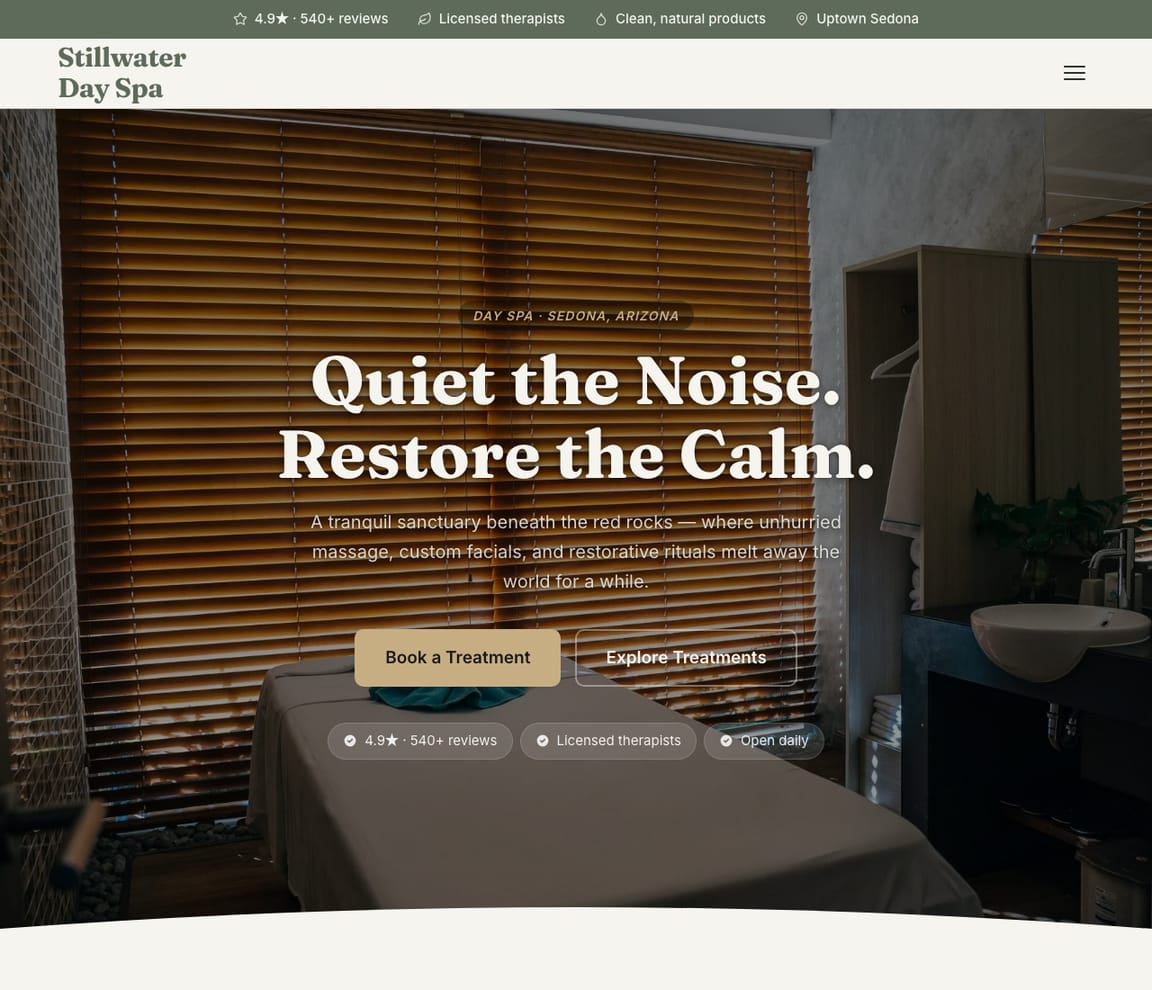
This is a real Zarla template for a day spa. Describe yours — the treatments, the rooms, the town — and you'll have a site like this, with your treatment menu and a booking form, in about a minute.
- Professional design — not a generic template
- Looks great on desktop and mobile
- Content written for your industry
Build the website
Start your day spa website now
Add your town and your spa's name to the sentence, and Zarla builds the site: your treatment menu and a booking form. Add your prices, your gift cards and your memberships in chat, then publish.
Already have a website? Bring it across →Zarla keeps your old page addresses where it can and redirects the ones that change, helping you keep the Google standing you've built.
Is opening a spa worth it in 2026 — and what does a visit pay?
A spa, in the trade body's own words, is a place "devoted to overall well-being through a variety of professional services that encourage the renewal of mind, body and spirit" (ISPA) — not, as Google's AI answer has it, "at least two of" massage, skin care and body treatments; ISPA's definition page says nothing of the kind. In practice the business comes in four shapes. A day spa sells massage, facials and body treatments by the room-hour. A massage studio is the same business with one menu. A membership franchise — Hand & Stone, Massage Envy, Spavia — sells a monthly treatment on contract. And a med spa is a medical practice with a spa's lobby, which in California "must be owned by physicians" (Medical Board of California) — a different business, and the plain-English section draws the line.
What a visit pays. ISPA's 2026 study puts revenue per spa visit at $123.10, up 2.3 percent, across 191 million visits and 22,060 locations, with industry revenue of $23.5 billion in 2025, up 4.2 percent (ISPA, March 31, 2026). Day spas average $110 a visit against $181 at resort and hotel spas, average revenue per spa grew to $1.06 million, and "Almost nine in 10 US spas remained profitable during 2025" (Spa Business, 2026). Spa-goers are members: 31 percent already belong to a spa, and 70 percent of those surveyed had visited at least twice in the previous year (Spa Business, reporting ISPA's consumer research, 2024). The top-earning membership spas had 22 percent higher revenue than their non-membership peers, and one in five gift cards is redeemed by a first-time guest (Spa Business, 2023).
What the people earn. The medians are for employees: massage therapists' median pay was $58,450 in 2025, $28.10 an hour, with employment projected to grow 15 percent to 2035 (O*NET, from BLS 2025 wage data); skincare specialists' median was $45,330, $21.79 an hour, with the top ten percent above $39.45 an hour — about $82,000 at full time, our arithmetic — and growing 9 percent (O*NET) — and the federal wage survey behind both leaves out the self-employed (Washington ESD), which AMTA's 2026 fact sheet says is most of the trade: 41 percent of therapists work from their own office and 39 percent in a spa, and 82 percent say massage was not their first career (AMTA, 2026). Inside a spa the therapist's share is the biggest cost: Vagaro, a booking vendor, puts commission "usually between 35% and 60%", most spas "somewhere in the 40/60 to 50/50 range", and the margin "on a $130 facial in a 50/50 spa" at $15 to $25 (Vagaro, 2026).
What a franchise unit does. Hand & Stone's franchisor page prints $1.35 million of average annual gross sales per location — $807,000 of it massage, $356,000 facials — across 650-plus locations, and asks for $750,000 of net worth and $150,000 liquid (Hand & Stone, its franchise disclosure Item 19); Spavia prints a median of $1,110,481 in 2025 sales at 44 reporting locations against an initial investment of $479,450 to $885,450 (Spavia, 2026 franchise disclosure). Franchisors' figures, for franchised units; an independent day spa is a smaller bet, below.
Where the market is heading. Growth is coming from yield, not new doors: locations grew 0.4 percent in 2025 — "an estimated 630 new spas opened while around 550 closed" — while 24 percent of spas now vary prices by day or time and 18 percent run automated dynamic pricing, 64 percent renovated in 2025 and 35 percent plan to in 2026, and labor costs "remain a concern, alongside rising expenditure on products, energy, rent" (Spa Business, 2026). ISPA's own research says letting guests personalize small parts of a visit can cut cancellations by up to 46 percent (ISPA, February 17, 2026), and the Esthetics Licensure Compact that would let an esthetician's license travel between states has three states enacted of the seven it needs, expected by the end of 2027 (ISPA, 2026).
The catch. The build-out is paid before the first client, the therapists are the product and leave with their clients, a no-show empties a room-hour you can't resell, and January is quiet unless December sold the gift cards. That's what the rest of this guide sets up.
How to open a spa, in plain English
Two licenses: the person, and the premises. In the US no federal license touches a spa; the state licenses the people who touch the client, and in the states we read it also licenses and inspects the premises — which is what Google's "health department permits" is reaching for. Texas licenses a massage establishment for $200 for two years, inspects it every two years, and lets it "employ only licensed massage therapists to perform massage therapy" (TDLR); its cosmetology establishment license is also two-year, the owners are listed on the application, a licensee need not own it, and a spa attached to a home needs its own entrance (TDLR). Inspections are "unannounced risk-based", with ten days to fix what they find (TDLR). Florida caps the massage establishment's fees at $200 to apply and $150 to license, requires "a designated establishment manager" who "shall practice at the establishment" — so an owner who isn't a therapist hires one — screens owners' backgrounds, and bars operating "between the hours of midnight and 5 a.m." (Fla. Stat. ch. 480); salon licenses are capped at $50 and no salon operates without one (Fla. Stat. ch. 477). California licenses the establishment to its owner — "only the owner of the establishment may apply", one license per address, inspections at random, and a $1,000 fine for unlicensed activity (California Board of Barbering and Cosmetology; Cal. Bus. & Prof. Code §7347). New York requires an appearance enhancement business license for the fixed location where estheticians work (N.Y. Gen. Bus. Law §404).
Who may touch the client. An esthetician does skin; a massage therapist does massage; the hours differ by state. Texas: 750 hours and written and practical exams for an esthetician, $50 to apply (TDLR); 500 hours for a massage therapist, $100 to apply, the national MBLEx plus a Texas jurisprudence exam (TDLR). California: 600 hours for an esthetician (California BBC), an initial license of no more than $40 (§7423); massage is a voluntary state certificate of 500 hours (§4604) while cities keep the power to license, regulate or prohibit uncertified massage (§4612; CAMTC). Florida registers a "facial specialist" at 220 hours (ch. 477). New York licenses massage therapists at 1,000 hours with a state exam offered twice a year and a $108 fee (New York Office of the Professions). Four states — Kansas, Minnesota, Vermont and Wyoming — have no state massage license at all, by ABMP's list; check the city or county there (ABMP).
Can an esthetician own a spa with massage? Yes, in the states we read: the establishment license is on the business, the practitioner licenses on the people. Texas says a licensee may work wherever "the facility holds an appropriate TDLR establishment license" and that a business may lease space to a cosmetologist "only if the business is licensed by TDLR as an establishment" (TDLR); the massage license is what the therapists hold, and an esthetician "may massage a person's scalp, neck, shoulders, arms, face, hands or feet" and no further (TDLR, who regulates what). Florida's skin-care services "may not involve massage therapy" (ch. 477) — and its massage establishment needs that practicing manager (ch. 480). In California, several cities add a police-department massage permit: Riverside charges $593 for a new establishment permit plus $32 for fingerprints (Riverside Police Department, July 2026), San Ramon $275 to apply and $128 for the permit, plus $49 for Live Scan (San Ramon Police Department).
The line between a spa and a med spa. Injectables, lasers, body contouring and medium or deep peels are medicine. Texas estheticians may do "light peels" or "superficial peels" and epidermal microdermabrasion only; "an esthetician or cosmetology operator license does not authorize" lasers or injecting botulinum toxin, and those treatments "must be provided under the order and delegation of a licensed physician" (TDLR). California's board says estheticians "may never inject the skin, use lasers, or perform medical-level dermabrasion or skin peels" (California BBC fact sheet), its scope stops at treatments "that do not result in the ablation or destruction of the live tissue" (§7316), and its Medical Board warns that a spa offering medical procedures "must be owned by physicians" and polices "rent-a-license" medical-director schemes at "up to $400 per month per spa" (Medical Board of California); its consumer fact sheet warns that an "injection for $50, when the going rate at a physician's office is $500" is not the real thing (California BBC fact sheet). Insureon's median for a med spa's malpractice cover is $208 a month against $42 for a day spa's professional liability (Insureon, medical spas; Insureon, day spas). If you mean a med spa, you are opening a medical practice — start with your state medical board.
The build-out, priced before the lease. Mindbody's guide, a vendor's but the only openable rule of thumb: finished construction "will likely cost $90-$130 per square foot", furniture and equipment "about $30 per square foot", and all-in "$200 per square foot" — $500,000 for a typical 2,500-square-foot spa before operating capital — with high-end finishes raising it "by 75% to 100%", and "another $100-200k in reserve" on $18,000 a month of expenses (Mindbody, March 11, 2025). Our arithmetic for a 1,200-square-foot three-room spa on those rules: $108,000 to $156,000 of construction and $36,000 of equipment. A former spa, salon or massage suite skips most of it — the rooms and the plumbing are already there.
Tables, steamers, towels and backbar. List prices at Universal Companies, a spa supplier, read October 21, 2026: an Earthlite Premier massage table package $699 (Universal Companies, massage tables); UV hot-towel cabinets from $249 to $499 and wax warmers from $69.99 to $249 (Universal Companies, warmers and cabinets); facial steamers from $135 on a table top to $595 with a magnifying lamp (Universal Companies, steamers). The opening order from a professional skincare line starts around $2,000 — AmSpa's members get a discount on "an opening order of $2000 or more" at Dermalogica (AmSpa, January 27, 2025) — and Mindbody budgets $5,000 to $10,000 of product for the rooms and three months of retail (Mindbody).
Insurance. The practitioners first: ASCP membership is $259 a year or $23 a month for an esthetician and includes $2 million of liability cover per occurrence (ASCP); AMTA's professional membership is $235 a year or $20 a month for a massage therapist, insurance included (AMTA). Then the business: Insureon's day-spa customers pay a median $42 a month for general liability, $84 for a business owner's policy, $42 for professional liability and $83 for workers' compensation (Insureon, day spas). Workers' compensation is the law once you employ: in California with even one employee (California DIR), in Florida from four employees outside construction (Florida CFO), in New York for employers with employees in the state (New York Workers' Compensation Board).
The software, and the gift cards. Mindbody starts at $79 a month (Mindbody); GlossGenius is $24, $48 or $148 a month billed annually (GlossGenius); Boulevard is $143, $234 or $328 a month per location (Boulevard); Zenoti publishes no price — "Book a demo" (Zenoti). On gift cards, federal law bars an expiry earlier than five years after issue or the last load, and bars dormancy and inactivity fees (15 U.S.C. §1693l-1; 12 CFR 1005.20); California goes further — no expiry date at all, and a card under $15 is redeemable for cash (Cal. Civ. Code §1749.5). Write your gift-card terms to your state's rule, and confirm the details with your accountant.
The money to start. Our free day spa business plan itemizes a small two-to-four-room spa at $42,800–$291,200: the build-out on the per-square-foot rule, the lease deposit, equipment, the opening order, linens, branding, insurance, the licenses, software, the website and a reserve for the months before the rooms fill. The build-out and the reserve are most of it, and both fall if the space was a spa before.
In the UK: London boroughs license the premises as an "establishment for special treatment" — massage, manicure, light and electric treatments, saunas and baths — under the London Local Authorities Act 1991, with conditions on the qualifications of the people giving the treatment and the hours (London Local Authorities Act 1991, Part II). In Australia (New South Wales): any skin penetration procedure must be done by an operator registered with the local council under the Public Health Act 2010, inspected without notice; laser hair removal and treatments that don't pierce the skin fall to the council's own rules (NSW Health). Check your own state's or borough's rules.
What spa owners actually say
None of this is our opinion about the trade. It comes from people who opened spas and massage practices talking to local newspapers, AMTA's Massage Therapy Journal and a small-business interview site between 2018 and 2026 — estheticians and massage therapists who became owners, and one franchisee, each described as the page describes them. Read each as theirs at the time. Six things come up again and again.
Being good in the room is not the same as running the place. Kimberley Knapp, founder of Skin Apeel Day Spa in Boca Raton, which she opened on October 29, 1992 at 32: “I had a clear vision of what I wanted and almost no idea what it really meant to run a business.” And: “I couldn't afford a receptionist. Between appointments, I would unlock the front door to exchange clients to stay on my strict schedule.” And: “Eventually, I realized that being good at your profession and being good at leading people are two completely different skills.” (Boca Raton Tribune, September 18, 2026). Daphne Walker, a licensed massage therapist and owner of Why Knot: “massage school does not fully prepare nor really even speak much about working for yourself.” (AMTA Massage Therapy Journal, February 1, 2026).
“I started as a solo esthetician just renting a room in February of 2023, then bought the spa and opened The Sun Room in October of 2024… Don't get me wrong, running a small business can be stressful – but it is so fulfilling and rewarding.” — Emi Harbison, 22, licensed esthetician and owner of The Sun Room Aesthetics & Wellness in Cullman, Alabama, in the Cullman Tribune, June 16, 2025
Rent a room first. Harbison's route — a rented room, then the spa — is the common one. Julita Chutaro, an esthetician and spa owner in Springdale, Arkansas: “I decided to go to school to get my license to be more legit… When I graduated, that's when I opened up my first spa location in Bentonville.” (The Husk, February 7, 2025). Morgan Robart, an esthetician who left tech to open a day spa: “Starting my own spa as a freshly licensed Esthetician was a brazen move.” Her plan: “The edge, we decided, was to be large enough to offer a full array of day spa services, but small enough to maintain a friendly, local neighborhood feel. As a result, we leased a space much larger than we originally intended, then built out the rooms slowly with products, equipment, and staff.” (CanvasRebel, September 9, 2024).
Go sooner, and charge what you're worth. Sarah Reuther, a licensed massage therapist and owner of Kneady Cat Massage and Cupping: “If I could go back, I would tell myself to start my own business way sooner, like three years sooner. I stayed at jobs far too long, was unhappy with pay and management, but wasn't quite confident enough to take the leap.” Michael Lanzon, owner and massage therapist at Home Comfort Massage: “Between non-compete agreements and horrible compensation, you have a much better chance of success being on your own.” Walker: “We should not be afraid to charge what we are worth”. Ruth Espada, owner of Spa Suite 4: “trust the process and value my time and services from the very beginning… Finally, hire a professional coach that has excelled in your industry.” (AMTA Massage Therapy Journal, February 2026).
Your body is the business. Walker again: “I would tell myself that if you want to stay in business, your own body must be the priority!” (AMTA, February 2026). Kelly Winfrey-Moore, a retired autoworker turned massage therapist and co-owner of Rejuvenation Station near Detroit: “I worked in every sector of massage therapy before opening up my spa and I wanted to incorporate all of it”. And, on the pandemic: “We are a family-owned and operated business and this was our primary source of income.” (ClickOnDetroit, November 12, 2020).
Marketing, space and staff all come sooner than you planned. Erika Tempro, owner and principal massage therapist at Detox Massage Spa in North Bethesda, Maryland: “I realized soon after starting my spa that a lot more needed to be done in marketing, increasing studio space, and hiring workers, amongst others.” And: “there isn't the right time for the anything-just start!” (CanvasRebel, October 10, 2022). Knapp: “A few months after opening my doors, I hired my first massage therapist and she quickly became busy.” (Boca Raton Tribune, 2026). M'Lisa Ellis, who became a solo spa owner in 2014, nearly failed in the first year and moved into her car to keep the doors open, as ASCP's interview with her records (ASCP, 2022).
The franchise is a model someone else proved. Laura Carmody, a Spavia franchise owner in Springfield, Illinois, on why she bought one rather than building her own: “I had just finished getting a massage at one of the local clinics. She asked me how it was, and I told her I wished we had a more traditional spa in Springfield. She asked me why I didn't open one myself, which made me think if I could find a franchise that had already created a model that worked, I could do it.” (Springfield Business Journal, December 2018).
The through-line: the owners who lasted rented a room before they signed a lease, hired the second pair of licensed hands early, priced their own time from the start, protected their own bodies, and treated the spa as a business with a calm front room rather than a calm front room with a business behind it.
THE STARTER KIT
What you need to open a spa
Licensed hands in every room
A licensed esthetician for facials and waxing, a licensed massage therapist for massage — the state licenses the person, with hours that differ by state.
An establishment license
The license on the premises — a salon or spa establishment license from the state board, and a massage-establishment license where massage is offered — with its inspection.
A space you can afford to finish
A former spa, salon or massage suite if you can find one; otherwise a build-out priced per square foot before you sign the lease.
Tables, steamers, towel cabinets and backbar
A massage table package, a facial bed and steamer, a hot-towel cabinet, wax warmers, linens, and an opening order from one or two professional skincare lines.
Insurance and the software
Liability cover for every practitioner, the business's own policy, workers' compensation where your state requires it, and booking software with gift cards and memberships.
A reserve for the quiet months
Rooms fill over months. Memberships and gift cards carry January; a reserve carries you until they do.
THE PAPERWORK
Licenses, permits and insurance for a spa
| Typical cost | Time to get | Legally required? | |
|---|---|---|---|
| Esthetician license | School priced by the school; $50 (TX), up to $40 (CA) | 750 hrs TX, 600 CA, 220 FL facial specialist | Yes, for skin care, in the states we read |
| Massage therapist license | $100 (TX); $108 (NY); 500 hrs TX, 1,000 NY | Months of school, then the exam | Yes in most states; voluntary certificate in CA; none in KS, MN, VT, WY |
| Salon or spa establishment license | Up to $50 (FL); set by the state (TX, CA) | Days to weeks, then an inspection | Yes, on the premises (TX, FL, CA) |
| Massage establishment license | $200 for 2 yrs (TX); up to $200 + $150 (FL) | Before you open; inspected | Yes, where massage is offered (TX, FL) |
| City massage permit | e.g. $593 + $32 (Riverside, CA); $275 + $128 + $49 (San Ramon, CA) | Weeks | Some California cities |
| Business license and certificate of occupancy | Set by the city or county | Before you open | Most cities and counties |
| Practitioner liability insurance | $259/yr ASCP (estheticians); $235/yr AMTA (massage) | Days | Not by law; carriers, landlords and clients expect it |
| Business insurance | $42/mo GL, $84/mo BOP, $42/mo PL — Insureon day-spa medians | Days | Workers' comp once you employ (CA from 1, FL from 4) |
| Gift-card terms | None | Before the first card | Federal 5-year rule; no expiry in CA |
| Med spa (physician ownership or delegation) | $208/mo malpractice median (Insureon) | Months | Yes — a medical practice, by state medical board rules |
THE STEPS
How to open a spa (step by step)
Eight steps from your own license to a licensed, inspected spa with its rooms booked and its gift cards selling.
01
Decide what kind of spa
A day spa with massage, facials and body treatments; a massage studio; a membership franchise; or a med spa — which is a medical practice, with different owners and rules.
02
Get licensed, or hire the licenses
Your own esthetician or massage license, and licensed practitioners for everything you can't do yourself — an esthetician may not give a full-body massage.
03
Find the space and price the build-out
A former spa saves the most. Otherwise price finished construction per square foot, add equipment, and check zoning and the certificate of occupancy before signing.
Before the lease04
License the establishment
The salon or spa establishment license and, for massage, the massage-establishment license from your state board; in some California cities, a police-department massage permit too.
Inspected05
Buy the tables, the steamers and the opening order
Massage table packages, facial beds and steamers, hot-towel cabinets, wax warmers, linens, and the opening order from a professional skincare line.
06
Insure everyone and set up booking
Liability cover per practitioner, the business policy, workers' compensation where required, and booking software with deposits, gift cards and memberships.
07
Price by the room-hour and hire for the split
Set treatment prices from what a room-hour has to earn; pay therapists on a commission split or rent them a room, and write it down.
08
Fill the rooms, then sell the membership
A website with the menu and a booking form, a Google profile, founding memberships before opening day, and gift cards pushed hard from November.
THE COSTS
How much does it cost to open a spa?
The total is our free day spa business plan's itemized US ranges for a small two-to-four-room spa: the build-out on Mindbody's per-square-foot rule, the lease deposit, tables and steamers, the opening backbar order, linens, branding, insurance, the licenses, software, the website and a reserve for the months before the rooms fill. A sauna or hydrotherapy tub is extra. Your own living costs come on top.
$42,800–$291,200to open a small day spa — the build-out and the reserve are most of it
$90–$130per square foot of finished construction; $200 all-in (Mindbody's rule, March 2025)
$699an Earthlite Premier massage table package at Universal Companies
$200a Texas massage establishment license for two years
WHAT WE'VE LEARNED
What actually makes a client book a spa
Thousands of local business websites in, the pattern for appointment businesses is clear: the client wants to see the place, know the price, and book without a phone call. For a spa, three things on a page decide who gets the hour.
A menu with prices and times
Each treatment with its length and price — a 60-minute massage, a facial, a package — so nobody has to call to ask. The first thing a client checks, and the first thing a competitor hides.
The rooms, and the people
Photos of the treatment rooms and the relaxation area, and the licensed therapists and estheticians by name. Calm sells; so does knowing who will be in the room.
A way to book, and a way to give
A booking form that asks for the treatment and a preferred time, and a gift card a friend can buy in a minute — your December in one button.
THE UPSIDE
What a spa can earn
Revenue per visit from ISPA's 2026 study, practitioner pay from O*NET's 2025 figures, franchise sales from the franchisors' own disclosures. Averages, not a promise — your rooms, your room-hours booked, the therapists' share and the gift cards you sell in December decide it.
$110the average spend per day-spa visit in 2025 ($181 at resort and hotel spas) — ISPA
$1.06Maverage revenue per US spa in 2025, all types (ISPA)
$58,450a year: the 2025 median for employed massage therapists (O*NET) — the therapist's share is your biggest cost
$1.35Maverage annual gross sales of a Hand & Stone franchise location (its own disclosure)
SEE IT WORK
A spa website design you can start from
A real Zarla template: a full-bleed hero, an accordion treatment menu, a gallery of the rooms, a signature-ritual section and an online booking form. Open it, swap in your treatments, your prices and your own photos, and publish.
GET FOUND
Get found by the client who needs a massage this week
Someone with a stiff neck searches for a spa near them on a Tuesday afternoon and books the one whose menu and times are on the page; a friend buying a birthday gift searches the same way. Zarla builds the website with your treatment menu and a booking form. Add your prices, gift cards and memberships in chat, and once you connect your Google Business Profile, your name, hours and reviews stay in step on both.
“Spa near me”
Searched by someone with a sore back after a long week, a couple planning an anniversary, and a visitor staying at the hotel down the road. Your menu, your prices and a way to book answer it.
Google Business Profile
Your address, your hours, photos of the rooms and your reviews inside Google Maps. Free, and an afternoon to set up — and a client sees a real, calm place before they trust you with an hour of their day.
Reviews while they're still relaxed
Ask at the front desk, and send the link that day. Reviews that name the therapist and the treatment sell the next booking — and the gift card.
Google Search
Sstillwaterdayspa.com
Stillwater Day Spa — Trusted day spa in Your AreaMassage, facials, body treatments and spa packages in Asheville. Treatment menu and prices online. Book a time or send a gift card.← Your Zarla siteCcitydayspaservices.com
City day spa ServicesGoogle Maps
1
Stillwater Day Spa
← You2
Metro day spa Co.
3
Quick day spa Services
AI assistants (ChatGPT / Perplexity)
For a day spa in Asheville with a 60-minute massage and a facial available this Saturday in your area: Stillwater Day Spa — a day spa that lists its treatments and prices, shows the rooms, and lets you book a time or buy a gift card online.
YOUR LAUNCH PLAN
Your spa launch checklist
The whole guide as things to check off. Work through them in order and you'll be licensed, inspected, equipped and booked before the reserve runs down.
- Choose: day spa, massage studio, franchise — or a med spa, a different business.
- Confirm your own license and hire the rest — estheticians for skin, therapists for massage.
- Price the build-out per square foot before the lease — a former spa first.
- License the establishment with the state board — plus the city permit where there is one.
- Buy the tables, steamers, towel cabinets and the opening order — list prices below.
- Insure every practitioner and the business — workers' compensation where your state requires it.
- Set up booking with deposits, gift cards and memberships — and the commission split in writing.
- Get found — a website with the menu and a booking form, a Google profile, and a review ask at the desk.
REAL CUSTOMERS
Small business owners who got online with Zarla
Verified reviews from real Zarla customers.
“Quickly built my website from scratch. No hiccups. Would highly recommend Zarla for someone with no experience who wants to start a polished business website.”
“Great professional website in less than a minute, with the use of AI and a few descriptive prompts. This has saved me bundles of time and research on web developers.”
“I had no idea how to set up a website for my business. Thanks to Zarla, they've helped me a lot.”
“Very reliable, professional, and fast results. I was able to get my business online in no time, and the ease of access made it so simple.”
Be the spa a tired client finds — and books
Add your town and your spa's name, and Zarla builds the website from that one line — your treatment menu, a booking form a client can ask for a time on, and SEO in place. Add your prices, your gift cards and your memberships in chat. Free to build; you pay when you publish.
Already have a website? Bring it across →Zarla keeps your old page addresses where it can and redirects the ones that change, helping you keep the Google standing you've built.
Frequently asked questions
How much does it cost to open a spa?
In the US, about $42,800 to $291,200 for a small two-to-four-room day spa, in our day spa business plan's itemized ranges — the build-out, the lease deposit, tables and steamers, the opening backbar order, linens, branding, insurance, the licenses, software, the website and a reserve for the months before the rooms fill. The build-out is the big line: Mindbody's rule of thumb is $90 to $130 a square foot of finished construction, about $30 a square foot of equipment and $200 a square foot all-in, so a typical 2,500-square-foot spa runs $500,000 before operating capital. A former spa or salon skips most of it. A franchised Spavia lists $479,450 to $885,450. The licenses are the small line — $200 for a Texas massage establishment, $100 for a therapist and $50 for an esthetician.
Can I open a spa with an esthetician license?
In Texas, Florida and California, yes: the establishment license is on the business, and the practitioner licenses are on the people in the rooms. Texas lets a licensee work wherever the facility holds a TDLR establishment license, and a business lease space to a cosmetologist only if it holds one; California issues the establishment license to the owner, whoever they are. What an esthetician cannot do is the massage — in Texas an esthetician may massage the scalp, neck, shoulders, arms, face, hands and feet and no further, and Florida's skin-care services may not involve massage therapy — so you hire licensed massage therapists and, in Texas and Florida, license the massage establishment too ($200 for two years in Texas). Florida adds one more condition: a massage establishment needs a designated manager who practices there.
Is owning a spa profitable?
Most are: ISPA's 2026 study found almost nine in ten US spas stayed profitable in 2025, with average revenue per spa of $1.06 million and $110 a visit at day spas. The margin is thin per treatment — Vagaro's example puts a spa's margin on a $130 facial at $15 to $25 under a 50/50 commission split — and the money is in the room-hours booked, memberships and gift cards: the top-earning membership spas had 22 percent higher revenue than their non-membership peers. The same year, about 630 spas opened and 550 closed, so the ones that failed were as real as the ones that profited.
What spa services make the most money?
Massage, by volume. At a Hand & Stone franchise location, massage is $807,000 of $1.35 million in average annual sales and facials $356,000, by the franchisor's own disclosure. Day spas average $110 a visit against $181 at resort spas (ISPA, 2026), so the upside is in packages, add-ons and the retail that goes home with the client — Vagaro puts product commission at 10 to 15 percent — and in memberships and gift cards, which bring the client back and bring new ones in: one gift card in five is redeemed by a first-time guest.
How do I make $100,000 a year as an esthetician?
Not as an employee, on the averages: skincare specialists' median pay was $45,330 in 2025, $21.79 an hour, and the top ten percent earned above $39.45 an hour — about $82,000 at full time, our arithmetic (O*NET, from BLS data). The route is ownership and retail: rent a room, keep the whole treatment price instead of a 35 to 60 percent commission, sell the product you used, and add rooms with licensed hands in them. The owners in this guide started exactly that way, as solo estheticians renting a room.
What are red flags to avoid at spas?
The regulators' own list, which also tells you what inspectors check: licenses that aren't current (Texas inspectors confirm every therapist's license), a med-spa treatment with no physician in the picture — California's Medical Board asks "Where is the doctor who is supervising them? Are they really being supervised, or are they acting alone with a paper-only supervisor?" — a $50 injection where the going rate at a physician's office is $500, lasers or needles in an esthetician's hands, and a massage establishment open between midnight and 5 a.m., which Florida bans outright. As an owner, keep the licenses on the wall and the scope lines in the staff handbook.
What are the top spa trends for 2026?
From ISPA's 2026 study: pricing by time of day (24 percent of spas vary prices by day or time, 18 percent run automated dynamic pricing), renovation over expansion (64 percent upgraded in 2025, 35 percent plan to in 2026, while locations grew only 0.4 percent), and personalization before the visit, which ISPA's own research says can cut cancellations by up to 46 percent. Memberships keep spreading — 31 percent of spa-goers already belong to one — and the Esthetics Licensure Compact, which would let an esthetician's license travel between states, has three states enacted of the seven it needs.
How do I become an esthetician?
In the US, a state license: 750 hours of schooling plus written and practical exams in Texas ($50 to apply), 600 hours in California (an initial license of no more than $40), and 220 hours to register as a facial specialist in Florida. The exam is usually the national written and practical test through the state's vendor. Pay as an employee runs a median $21.79 an hour, with employment growing 9 percent to 2035; ISPA counts about 300,000 licensed estheticians in the country. Most of the owners in this guide started as estheticians renting a room.
What's the difference between a day spa and a med spa?
Medicine. A day spa sells massage, facials, waxing and body treatments by licensed estheticians and therapists. A med spa sells injectables, lasers, body contouring and medium or deep peels, which are medical treatments: in Texas they must be provided under the order and delegation of a licensed physician, and in California a spa offering medical procedures must be owned by physicians, with the Medical Board warning against rent-a-license medical directors. Insureon's median for a med spa's malpractice cover is $208 a month against $42 for a day spa's professional liability. If you mean a med spa, start with your state medical board, not the cosmetology board.
Do I need a massage license to open a spa?
Not to own it, in the states we read — the owner holds the establishment license and the therapists hold theirs. You need a licensed massage therapist in every room where massage happens: Texas establishments may employ only licensed therapists, New York licenses the title at 1,000 hours, and Florida's massage establishment must have a designated manager who practices there. California's state certificate is voluntary, but its cities may license or prohibit uncertified massage and several charge their own permit — $593 in Riverside. Four states, by ABMP's list, have no state massage license: Kansas, Minnesota, Vermont and Wyoming. Check the city there.
How long does it take to open a spa?
The licenses are weeks; the build-out is months. A practitioner license is the school's hours — 500 to 1,000 for massage, 220 to 750 for skin, by state — then the exam. The establishment license comes after the space is ready for its inspection, and Texas inspects every two years after that. Construction on a raw space at $90 to $130 a square foot (Mindbody's rule) is the long pole, which is why the owners in this guide rented a room first, or took over a spa that already existed. Plan the reserve for the months after opening, not the weeks before.
How much do spa owners make?
No survey prints an independent day-spa owner's income. What opens: average revenue per US spa was $1.06 million in 2025, nine in ten spas were profitable, and resort spas report margins of at least 20 percent at more than half of them (ISPA); a Hand & Stone location averages $1.35 million in sales and a Spavia a median $1,110,481, by their franchisors. Against that, the therapist's share is 35 to 60 percent of each treatment and rent runs every day the rooms sit empty. An owner's take is what's left after the split, the lease and the loan — which is why the plan page's monthly table matters more than any headline.