CAREER GUIDE
How to become an esthetician in 2026
Every big US state licenses the esthetician, and the hours are not the same — 750 in Texas, 600 in California and New York, a 220-hour registration with no exam in Florida, named below from the boards and the statutes. The routes in: beauty school and what it really costs, the chains' commission jobs, the suite; the voluntary certifications; the facial bed, steamer and back bar from the suppliers' own prices; what estheticians earn — and how to go from someone else's treatment room to your own.
Free to build · Pay when you publish · No credit card
750 hoursof school before the Texas exams — 600 in California, New York, Virginia, Colorado and Nevada, 1,000 in Georgia, 300 in Pennsylvania, 220 for Florida's registration with no exam; each from the board or the statute, below
$45,330median pay for employed skincare specialists in 2025 (O*NET, from BLS data); 10 percent earn $82,050 or more — the self-employed are outside the survey
$181to sit and license in Texas — a $50 application, a $55 written and a $76 practical through PSI; $115 in California, $26 in Pennsylvania, $30 in Georgia
July 1, 2020the day Connecticut began licensing estheticians at all — 600 hours and a $100 fee; the newest licensing state in the country
See it in action
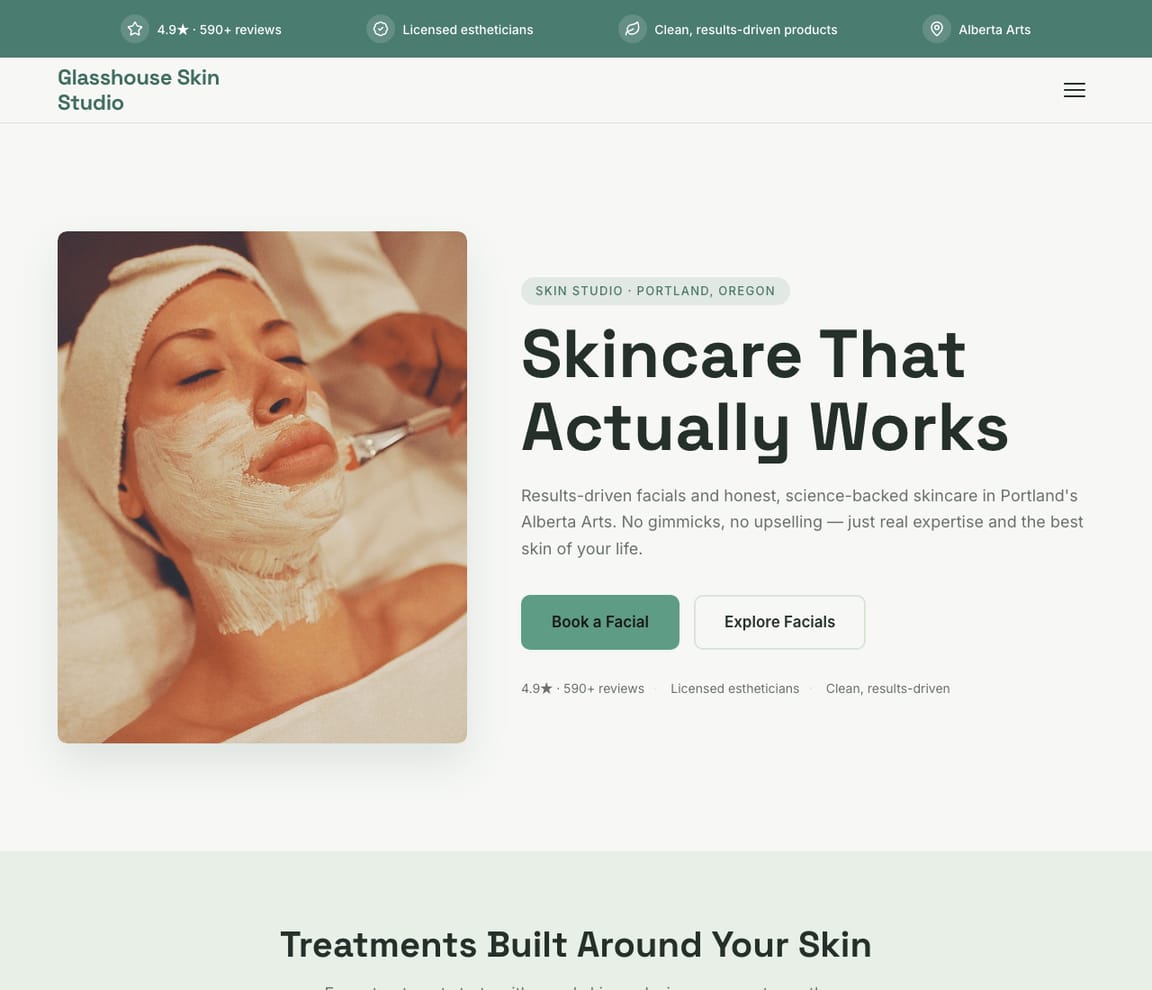
See what your skincare studio website could look like
A real Zarla template for a solo esthetician — the treatment menu by the headline, a booking button, the before-and-after gallery underneath. Describe yours — the town, the treatments, the hours — and you'll have a site like this, with online booking and a gallery, in about a minute.
- Professional design — not a generic template
- Looks great on desktop and mobile
- Content written for your industry
Build the website
Start your skincare studio website now
Add your town and your business name to the sentence, and Zarla builds the site: your treatments, your hours, a booking button and a gallery. Add your prices and your photos in chat, then publish.
Already have a website? Bring it across →Zarla keeps your old page addresses where it can and redirects the ones that change, helping you keep the Google standing you've built.
Is becoming an esthetician worth it in 2026 — and what does the work pay?
Becoming an esthetician is a licensed trade in every big US state, a year or so on commission at a chain spa before anyone rents you a room, and — once the room is yours — a local business whose clients come back every four to six weeks for years. Three honest numbers first. Employed skincare specialists had a median of $45,330 a year in 2025, $21.79 an hour: 10 percent earned $29,580 or less, 10 percent $82,050 or more (O*NET, from BLS 2025 wage data). The headcount is growing fast: "Employment (2025) 104,200 employees", "Projected growth (2025-2035) Much faster than average (7% or higher)", "Projected job openings (2025-2035) 14,200" (O*NET, employment and outlook). And the survey behind the wages leaves out the self-employed — "We do not provide occupation and wage estimates for farms, the self-employed, owner/partners in unincorporated firms, the military, household workers or unpaid family workers" (Washington ESD) — which is the esthetician with her own suite, so the median measures the chain-spa employee, not the owner who sets the menu.
State by state, and against the cosmetologist. The employed median is $49,250 in Texas, where 10 percent earn $84,180 or more, $38,770 in California, $43,880 in Florida and $42,910 in New York (O*NET, Texas; California; Florida; New York). Hairdressers, hairstylists and cosmetologists — the longer license — had a median of $35,790 the same year, with 10 percent at $71,190 or more (O*NET, 39-5012); the shorter esthetics course pays more at the median. The occupation is "Job Zone Three: Medium Preparation Needed" — "Most occupations in this zone require training in vocational schools, related on-the-job experience, or an associate's degree" (O*NET, job zone) — and the survey's own employers said "39% responded: High school diploma or equivalent required" and "30% responded: Post-secondary certificate required" (O*NET, education).
Where the money is. An owner's income is the menu times the rooms booked minus the suite rent, the back bar and the insurance — the estheticians quoted below describe weekly suite rent, a book built one referral at a time, and the medical-spa and waxing-studio jobs that teach the speed. The step after this guide is how to open a spa, the price list is in spa pricing, and the plan page is the esthetician business plan.
The catch. The work is on your feet, inches from someone's face, all day — in O*NET's survey 99 percent of skincare specialists report "Constant contact with others", 89 percent work in close "Physical Proximity" to other people, and 40 percent "Spend Time Standing" continually (O*NET, work context); the first job is usually a wage plus commission; and the course is the biggest cost in this guide, at one Aveda Institute's published total of $14,200 for 600 hours (below). That's what the rest of this guide sets up: who licenses what and for how many hours, from the boards; the routes in and what each costs; the bed and the steamer from a supplier's own prices; and how to be the esthetician the Thursday-night search books.
How to become an esthetician, in plain English: the license, state by state, and the rules you follow once you have it
Every big US state licenses the esthetician — the hours, the exams and the fees are the state's, not the school's. Google's answer of "600 to 750 hours" hides the spread: 220 hours and no exam in Florida, 300 in Pennsylvania, 1,000 in Georgia, and a second "master" tier in Washington, Virginia and Utah. Here is the list from the boards and the statutes, biggest states first:
- Texas — 750 hours, two exams, $50 to apply. The licensing agency: "Before applying for an Esthetician license, you must complete an Esthetician course consisting of 750 hours of instruction at a barbering/cosmetology school licensed in Texas." "You must pass written and practical licensing exams to obtain an Esthetician license", "There is a non-refundable application fee of $50", and "You must be at least 17 years old to apply." The temporary license that prints with a passing practical "is good for 60 days while TDLR sends the two-year license in the mail" (TDLR, apply for an esthetician license). The exam vendor's bulletin dated January 1, 2026 prints the test fees — "Written Examination only: $55 USD", "Practical Examination only: $76 USD", "FEES ARE NOT REFUNDABLE OR TRANSFERABLE" (PSI, Texas esthetician candidate bulletin) — so the state side of becoming a Texas esthetician is $181. Your own room is an Establishment License or a Specialty Establishment License at $78, or a Mini-Establishment License inside a licensed salon (TDLR, establishments).
- California — 600 hours, a 90-minute written exam, $115 to apply. The board's FAQ: "Cosmetologist = 1000 hours, Barber = 1000 hours, Hairstylist = 600 hours, Esthetician = 600 hours, Electrologist = 600 hours, Manicurist = 400 hours" (California Board of Barbering and Cosmetology, FAQ); the exam is "Esthetician: 75 scored questions, 10 pretest, 90 minutes to complete" (the board, applicants); the application form prints the price — "APPLICATION FOR EXAMINATION AND INITIAL LICENSE FEE $115.00 Fee (non-refundable)" (the board's esthetician application) — against a statute that caps the initial license alone at "not more than forty dollars ($40)" (Cal. Bus. & Prof. Code §7423). The statute's door: the applicant "Is not less than 17 years of age", "Has completed the 10th grade in the public schools of this state or its equivalent", and has "Completed a course in skin care from a school approved by the board" or the apprenticeship in Article 4 (§7324). What the license covers: "Giving facials, massaging, stimulating, exfoliating, cleansing, or beautifying the face, scalp, neck, hands, arms, feet, legs, or upper part of the human body by the use of hands, esthetic devices, cosmetic products, antiseptics, lotions, tonics, or creams for the purpose of improving the appearance or well-being of the skin that do not result in the ablation or destruction of the live tissue" (§7316). Working without one: "a $1,000 fine" (the FAQ).
- Florida — a 220-hour "facial specialist" registration, no exam, 16 to start. Florida does not license estheticians; it registers specialists: "Any person is qualified for registration as a specialist in any specialty practice within the practice of cosmetology under this chapter who: (a) Is at least 16 years of age or has received a high school diploma" and holds a certificate for "Two hundred and twenty hours of training, as established by the board, which shall focus primarily on sanitation and safety, to practice the specialty as defined in s. 477.013(6)(c)" — facials — and "Pending issuance of registration, a person is eligible to practice as a specialist upon submission of a registration application that includes proof of successful completion of the education requirements and payment of the applicable fees required by this chapter, provided such practice is under the supervision of a registered specialist in a licensed specialty or cosmetology salon" (Fla. Stat. §477.0201). The board's curriculum rule, amended December 21, 2020, adds up to the same number — 149 hours of theory and 71 of services (Rule 61G5-22.017) — so the 260-hour figure in older guides is stale. The fees are capped: "For specialists, fees for application and endorsement registration shall not exceed $30" and "For specialists, fees for initial registration, registration renewal, and delinquent renewal shall not exceed $50" (§477.026). The scope line that matters: "Skin care services must be performed by a licensed cosmetologist or facial specialist within a licensed cosmetology or specialty salon, and such services may not involve massage therapy, as defined in s. 480.033, through manipulation of the superficial tissue" (§477.013).
- New York — 600 hours, a state exam, $40 for four years. "No person shall engage in the practice of nail specialty, waxing, natural hair styling, esthetics or cosmetology … without having received a license" (N.Y. Gen. Bus. Law §401); "Any person seventeen years of age or older may apply", with "evidence of having taken and passed the appropriate examination" and "evidence of the successful completion of an approved course of study … in a school duly licensed pursuant to the education law" (§406). The course is 600 hours by regulation — "Facial and Body Procedures | 240", "Make-Up Techniques | 70", "Superfluous Hair | 60", "Total | 600" (19 NYCRR §162.2). Fees: the license "shall be forty dollars initially and for each renewal thereof the fee shall be forty dollars; the fee for a temporary license and each renewal shall be ten dollars", the written exam "fifteen dollars", and the business license "sixty dollars" (§409); "All licenses shall expire four years from the date of issuance" (§408). The practice is "services to enhance the appearance of the face, neck, arms, legs, and shoulders of a human being by the use of compounds or procedures including makeup, eyelashes, depilatories, tonics, lotions, waxes, sanding and tweezing … but shall not include the practice of electrology" (§400).
- Illinois — 750 hours over at least 18 weeks, a $175 exam. The applicant must "Be at least 16 years of age", "Be a high school graduate or its equivalent or be beyond the age of compulsory school attendance", and "Graduate from an esthetics or cosmetology school approved by the Division to teach esthetics in accordance with Subpart H, which includes a 750 hour program in the study of esthetics extending over a period of not less than 18 weeks nor more than 4 consecutive years" (68 Ill. Admin. Code §1175.700); the exam fee from October 1, 2026 is "Esthetician (English/Spanish/Chinese/Korean/Vietnamese) $175" (IDFPR).
- Pennsylvania — 300 hours, $26. "An applicant for an esthetician license shall have completed three hundred hours of instruction in esthetics in a licensed school of cosmetology and passed an examination limited to that practice", "An applicant may be permitted to apply to take a written examination upon completion of at least two hundred fifty hours of instruction", and "Licensed estheticians may operate a salon limited to that license" (Beauty Culture Law, §5(b)(1)); the rule adds "Be 16 years of age or older" and "Have completed a minimum of 300 hours of instruction in skin care in a licensed school of cosmetology" (49 Pa. Code §7.32e); the fee table reads "Esthetician | $25 | $26" for the initial license from July 1, 2024 and "$97" for the biennial renewal (49 Pa. Code §7.2).
- Georgia — 1,000 credit hours over at least nine months, $30. "The curriculum for students enrolled in an esthetician school for a complete course of at least nine (9) months and 1,000 credit hours of training shall be as follows", with no clinic work until "the student has completed 250 credit/clock hours of training" (Ga. Comp. R. & Regs. 130-3-.05); "Application for license to practice- $30.00" and "Application for Salon/Shop License - $75.00" (130-7-.01).
- Connecticut — licensed only since July 1, 2020; 600 hours, $100. "On and after July 1, 2020, except as provided in subsection (g) of this section, no person may practice as an esthetician without obtaining a license or temporary permit from the Department of Public Health"; the application carries "an application fee of one hundred dollars and evidence that the applicant (1) has completed a course of not less than six hundred hours of study", renews "every two years, for a fee of one hundred dollars", and "No person shall use the title 'esthetician' or similar title unless the person holds a license or temporary permit" (Conn. Gen. Stat. §20-265b). Until 2020 Connecticut did not license estheticians at all.
- Virginia, Washington, Utah — the states with a second, "master" tier. Virginia's esthetics course is 600 hours — "Skin care - minimum of 255 hours of instruction", "Hair removal - minimum of 50 hours of instruction" among eight lines — and master esthetics 600 more, including "Advanced procedures and chemical exfoliation - minimum of 270 hours of instruction" and "Lymphatic drainage - minimum of 120 hours of instruction" (18VAC41-70-190); the application is "$120" (18VAC41-70-120), the exam "will not exceed $225 per candidate" (18VAC41-70-40), currently "$99.00 for the written (theory) exam and $95.00 for the practical exam" with a "$7.25 per year" technology fee from July 1, 2026 — and "State law prohibits any person from practicing or offering to practice barbering, cosmetology, nail care, waxing, tattooing, body piercing, or esthetics in the Commonwealth without a Virginia license" (Virginia DPOR). Washington: "Esthetician, 750 hours" at school or 800 as an apprentice, and master esthetician as "Esthetician licensure plus 450 hours of training" (RCW 18.16.020; WAC 308-20-080), with "License application | $35.00" and "Renewal (two-year license) | 66.00" (WAC 308-20-210). Utah's master esthetics license is "the 1,200 total hours requirement for a master esthetics license" (Utah Code §58-11a-302). Colorado's statute caps the course at "Six hundred contact hours for an esthetician" (C.R.S. 12-105-111); Nevada asks "A minimum of 600 hours of training, which includes theory, modeling and practice, in a licensed school of cosmetology" or "At least 1,200 hours of service as an esthetician's apprentice" (NRS 644A.330). Ohio, Arizona, New Jersey, Massachusetts, Michigan and North Carolina license estheticians too, on pages that refused to open to our reader — their hours are not printed here.
Your license is the state's, for now. Three states — Alabama, Kansas and Virginia — enacted the Esthetics Licensure Compact in 2026: "The first few months of the 2026 legislative session delivered a clean sweep: Alabama, Kansas, and Virginia officially enacted the Esthetics Licensure Compact" (ASCP, April 22, 2026), and "The Compact shall come into effect on the date on which the Compact statute is enacted into law in the seventh member state" (Va. Code §54.1-700.2). Until then, moving states means your new state's endorsement rules.
What the license will not let you do. California draws it at "the ablation or destruction of the live tissue" (§7316); Florida at "massage therapy … through manipulation of the superficial tissue" (§477.013); Pennsylvania says "An individual holding an esthetician license is qualified to perform esthetician services only" (49 Pa. Code §7.14a). There is no "medical esthetician" license in any of these states — the word is marketing; the second tier where it exists is the master esthetician above, and the estheticians quoted below who work in medical spas work under a doctor's delegation.
How you learn it, and what it costs. Every statute above puts the hours "in a licensed school" — no state in this list has an online route. One school's price is on its own page: an Aveda Institute's 600-hour esthiology program in Tucson prints "Application Fee: $50.00 Registration Fee: $150.00 Kit: $2,000.00 Tuition: $12,000.00 Total Investment: $14,200.00" (Inspire Greatness Aveda Institutes, Tucson); the other schools we tried would not open their tuition pages to a scripted reader, so no other figure is printed. The estheticians quoted below did six months, four months and a year part-time. After the license, the first job: a chain waxing studio, a franchise lash bar, a dermatologist's office or a medical spa — on a wage plus commission, which is where the speed comes from.
You are self-employed from the first suite. In the US a one-room esthetician is a sole proprietor by default: "Use Schedule C (Form 1040) to report income or (loss) from a business you operated or a profession you practiced as a sole proprietor" (IRS, Schedule C instructions); "The self-employment tax rate is 15.3%" once your "net earnings from self-employment (excluding church employee income) were $400 or more" (IRS), and sole proprietors "generally have to make estimated tax payments if they expect to owe tax of $1,000 or more when their return is filed" (IRS). If you want an LLC: Texas "for filing a certificate of formation, $300" (Tex. Bus. Orgs. Code §4.152); Florida "$100" plus "For filing an annual report, $50" (Fla. Stat. §605.0213); New York "two hundred dollars" (N.Y. LLC Law §1101); California "Seventy dollars ($70)" (Cal. Gov. Code §12190) and "Every LLC that is doing business or organized in California must pay an annual tax of $800" (Franchise Tax Board). Workers' compensation: "In Texas, private employers can choose to carry workers' compensation insurance coverage, but it is not required in most cases" (Texas Department of Insurance); "All California employers must provide workers' compensation benefits to their employees under California Labor Code Section 3700" (California DIR).
Sales tax on the work — four states' rules, and one city taxes it. Texas's list of taxable services names massage parlors — "Personal services provided by a massage parlor, Turkish bath or escort service are taxable" — and not facials or waxing (Texas Comptroller, Publication 96-259); the products you retail are taxable everywhere. New York: "Personal services are exempt from sales tax in most locations in New York State. However, these services are taxable if you sell them in New York City", and the table prints "Hair removal services, such as electrolysis or waxing | 4½% NYC local rate" (New York TB-ST-575); hair services the same way — "exempt from state and local sales tax everywhere in New York State outside New York City, but subject to New York City's local sales tax when sold in New York City" (TB-ST-60). Florida taxes only a short list of services — detective and protection services, nonresidential cleaning and pest control — and skin care is not on it (Fla. Stat. §212.05). California taxes the products, not the service: "Persons engaged in the business of rendering service are consumers, not retailers, of the tangible personal property which they use incidentally in rendering the service" (CDTFA Regulation 1501). Confirm the details with your accountant.
The money to start. Our arithmetic from the pages that print each price. A lean start — a licensed esthetician renting a suite in Texas — a portable treatment table at its $379 sale price (Pure Spa Direct, read October 26, 2026), a two-in-one facial steamer and magnifying lamp at $771 (Pure Spa Direct), a year of professional and general liability at $179 (Elite Beauty Society) and Texas's $78 establishment license — comes to $1,407. The fuller start, from school to a studio of your own in Texas — the Aveda Institute's $14,200 all-in, the $50 TDLR application and the $55 and $76 PSI exams, the table at its $421 list price, the same steamer, the $78 establishment license and a year of general liability at Insureon's $350 median — is $16,001. The hot-towel cabinet, the wax warmer and the back bar are the lines left out: the suppliers' pages for them refused to open to our reader, and no salon-suite operator prints a rent — Sola describes the model only: "Your flat weekly rate covers utilities, Wi-Fi, and laundry access", "At Sola, you pay a flat weekly rental rate instead, and keep what you earn beyond that" (Sola Salon Studios). The insurance is a median, not your quote: "Beauty professionals like estheticians pay an average of $29 per month, or $350 per year, for general liability insurance" and "Estheticians pay an average of $42 per month, or $500 annually, for professional liability insurance" (Insureon, estheticians); the associations price it flat — "a one-year policy for $179, a two-year policy for $299 total, and student coverage for $49 per year" (Elite Beauty Society), "an annual rate of just $169" (Beauty Insurance Plus), and ASCP's membership "For only $259 per year or $23 per month" with "$2 million per occurrence" (ASCP). The plan page for the business side is the esthetician business plan, the step after this guide is how to open a spa, the menu's numbers are in spa pricing, the name goes on the door from esthetician business names, the business license question is answered in do I need a business license, and the site comes from the esthetician website builder.
In the UK: no license for beauty therapists nationally; the government's career profile puts pay at "£23,000 Starter" to "£29,000 Experienced", through "a college course" or "an apprenticeship" — the "Beauty Therapist Level 2 Intermediate Apprenticeship, or Advanced Beauty Therapist Level 3 Apprenticeship" (National Careers Service, GOV.UK). London is the inversion: under Part II of the London Local Authorities Act 1991 a borough council licenses the premises, not the person — an "establishment for special treatment" covers massage, manicure, acupuncture, tattooing, cosmetic piercing, foot care, light or electric treatments of a like kind, and steam, sauna or other baths, and no premises may be so used in the borough without the council's permit, which runs for 18 months (London Local Authorities Act 1991, Part II). In Australia there is no license either, but New South Wales treats waxing as a skin-penetration procedure — "any procedure (whether medical or not) that involves skin penetration (such as acupuncture, tattooing, ear piercing or hair removal or the penetration of a mucous membrane)" — which "requires operators to be registered with the local council", while "laser hair removal is not a skin penetration procedure" (NSW Health, skin penetration); the trade's qualifications are the "Certificate III in Beauty Services" with 18 units of competency, 14 of them core (TAFE NSW, SHB30121) and the Diploma of Beauty Therapy with 29 units of competency, 20 of them core (TAFE NSW, SHB50121). Check your own state's board, and your city's business license desk, before you book the first client.
What working estheticians actually say
None of this is our opinion about the trade. It comes from people who do it — an Alabama esthetician who went to school part-time for a year while keeping her job, a Los Angeles esthetician who apprenticed under a celebrity facialist, a Gainesville owner with a five-room spa, a New Hampshire lead therapist who left a six-figure book, a Miami esthetician licensed at 17, a Charleston owner who took a suite at 18, two Tucson waxers who met at a corporate studio, a Saint Paul esthetician who started at a waxing chain, a Phoenix aesthetician with seventeen years in, four Dallas–Fort Worth estheticians, a Georgia waxing-studio owner, a Houston master aesthetician in a medical spa, two Southern California estheticians, one out of dermatology, and two Atlanta owners — talking to CanvasRebel, VoyageDallas and the Shoutout magazines between 2020 and 2026, each described as the page describes them. Read each as theirs at the time. Five things come up again and again.
School is months, not years, and it fits around a job. Aeriole Woody, Opulence Beauty & Co., Alabama: “Then, one day, I discovered that a brand new esthetics school had opened in Auburn, Alabama, not far from my full-time job. Even better, they offered a part-time program that lasted about a year. It was exactly what I needed because I could continue working while going to school.” (CanvasRebel, October 15, 2026). Anna Griffin, Newskinla, Los Angeles: “I completed my esthetician training in about six months and passed my licensing exam on the first try. I was fortunate to apprentice under an experienced woman in the beauty industry who had worked with many celebrity clients — she taught me not just the craft, but how to actually run a business” (CanvasRebel, October 15, 2026). Jill Williams, Jay-Jill Cosmetics Glamtique, Gainesville, Florida, on the state's registration: “went to Florida State Jr College in Jacksonville, Fl drove Mon-Thurs for 4 months straight and graduated with my Skin Care Specialist License.” (CanvasRebel, November 7, 2022). Janet Ramirez, Dallas: “First and foremost, my husband deserves all the recognition because he took over so much while I was at night school and honing my skills.” (ShoutoutDFW, October 15, 2025). Nicole Tillery, Wax & Glow Esthetics, Barnesville, Georgia: “At the time, my kids were still in school and I couldn't find a program that would work with my schedule. When my youngest was a senior I decided it was time to take the plunge. I found a school that not only worked with my schedule but was the perfect fit.” (ShoutoutAtlanta, December 22, 2025). And the cost is the barrier — Des Gbor, DesLuxeEsthetics: “I planned to attend esthetician school, but financial challenges forced me to put that plan on hold. It was discouraging, especially because I had already pictured how I wanted my future to look.” (CanvasRebel, October 22, 2026).
“Some advice I would give to up and coming lash artists is to go get licensed. Be legit! It is so many people that are offering classes but don't actually tell you that to be all the way legit you have to licensed by TDLR. Become a licensed esthetician or cosmetologist. Start off by working for a franchise company. For example, Amazing Lash teaches you everything you need to know but only if you are licensed. Working for them teaches you how to get your speed down, they bring in clients for you to get that practice down and improve your technique.” — Lynda Caldwell, Lashwell LLC, Dallas–Fort Worth, in VoyageDallas, September 21, 2020
The first job is a chain, a studio or a doctor's office — and that is where the speed comes from. Jessica and Julia, Esthi Besties Waxing Studio, Tucson: “After graduating we both worked for a corporate waxing company. Julia stayed with the company for several years with the opportunity to move to Chicago to later becoming a regional trainer teaching new employees how to wax and hosting retail seminars. Jessica found a local waxing salon in Tucson and began her journey there and was quickly promoted to being the manager” (CanvasRebel, February 15, 2024). Myah Keller, Hunny Bunz Aesthetics, Saint Paul: “Straight out of school, I began my professional career as a Cerologist at Waxing the City. Two years later, after learning that I had been accepted into nursing school, I decided to launch Hunny Bunz Aesthetics in hopes of supporting myself financially while completing my education.” (CanvasRebel, March 30, 2026). Lolita Sevilla, Southern California: “After completing my training, I actively sought internships and entry-level positions that allowed me to work directly with clients. These experiences were invaluable, enabling me to apply what I learned in the classroom to real-world situations.” (ShoutoutSoCal, March 19, 2025). Stephanie Martinez, Pelle Sana Medical Spa, Houston: “I also have to give credit to the doctors I've worked alongside throughout my career. Being in a medical aesthetics environment and learning from them really helped shape my knowledge, my confidence, and the way I approach treatments today.” (ShoutoutHTX, May 19, 2026). Amanda Alba-Ferguson, Skinfluence Esthetics, Southern California: “Over time, though, I started to feel limited in traditional clinical settings. The structure of larger practices often means less time with each client, and I found myself wanting more: more connection, more intention, and more impact.” (ShoutoutSoCal, July 9, 2025). Morgan Gover, on the medical spa she left: “At the med spa I worked before I was always told it's none of my business. How clients spend their money and profit over integrity was more important, but I had always felt different about that.” (CanvasRebel, October 7, 2026).
The suite comes early, and the rent is weekly. Nijayla Aiken, JW Artistry, Charleston: “I graduated high school a semester early, took a week off, and immediately enrolled in esthetics school. By the end of June, I had celebrated both my high school graduation and my esthetics graduation. Shortly afterward, at 18 years old, I moved into my first salon suite. I thought I was ready for everything that came with business ownership, but I quickly learned there was much more to entrepreneurship than providing a great service.” (CanvasRebel, July 2, 2026). Woody: “Actually, I moved into my salon suite before I even took my state board exam because I believed in myself and knew I was going to pass. I was preparing for the business I knew I was about to have.” (CanvasRebel, October 15, 2026). Kristen Jarvis, Dallas–Fort Worth: “I started my business with basically no clients, no money no marketing no social media. I just knew I wanted to do it and I had a passion deep down in me. I didn't want to work for someone else and it was challenging, it was very hard for a little while. I showed up everyday , I took some type of education every week on my day off, I hustled just to get enough money to pay rent every single week, and started all over again the next week.” (ShoutoutDFW, August 6, 2025). Ronnell Luster, Nelly's Cosmetics, Miami: “That first risk eventually led me to become a licensed esthetician, graduate high school at 16, complete esthetician school at 17, and generate over $20,000 in business revenue before turning 17.” (CanvasRebel, October 7, 2026).
The book is built one referral at a time. Amanda Waters, Waters Aesthetics, Phoenix: “When I moved back to Phoenix, in 2013, I was working at a small local waxing studio trying to rebuild some sort of clientele in a new city.” And: “Once I told them I had worked for a prestigious plastic surgeon and one of the top 3 renowned wellness spas in the world, they were all ears to hear about my knowledge in aesthetics. Month after month the booking requests started flowing in.” (CanvasRebel, January 25, 2024). Gover: “Referrals are always the best source of new clients for me. I have found that running ads through Instagram or Google. Don't really pay off.” (CanvasRebel, October 7, 2026). Martinique Harden, Atlanta: “So for starters I started off as just a lash tech about 7 years ago when i first moved to Atlanta. I never thought of my work as a side hustle i always knew it was a start to a much bigger project. I then went to school to be a licensed esthetician and have furthered my skills which helped me in more ways than one because i was able to add services to my business as well as educate others.” (ShoutoutAtlanta, February 17, 2026). Ramirez: “Making a fresh start in a new field later in life came with challenges — from competing in a youth-dominated industry, and having to use social media to promote, to building clientele from scratch and running my own business – all while juggling a 9-5, marriage, and motherhood was a struggle at times.” (ShoutoutDFW, October 15, 2025).
Owning the room is a different trade. Felicity Johnson, Flawliss Skin & Wellness, Birmingham: “One of my biggest challenges was learning that being great at your craft and running a successful business are two different things. I had to learn marketing, budgeting, pricing, inventory, and client retention while also providing services.” (CanvasRebel, October 7, 2026). Williams, on the five-room spa: “I currently have a 5-room spa with 2 freelance hair stylists, I also own Pure Screening Solutions LLC, which is DOT/Non-DOT Drug Testing Collection Site within the Glamtique which provides additional streams of income when the skin care slows down.” And on price: “Skin care is not cheap, and neither are its services, and we need to get out of the notion of telling other black owned businesses about their prices and your opinion what the price should be, it's set for a reason.” (CanvasRebel, November 7, 2022). Jordan Roach, Pause Massage & Skin Studio, Newington, New Hampshire, on the job she left to open her own: “My career: I was the lead therapist at a successful small-business spa in town. I was booked out, making six figures, and had built a career that I was really proud of.” (CanvasRebel, October 22, 2026). Gio Imani, Epidermis Esthetics Lab, Georgia: “My goal has never been to simply be a solo esthetician. I've always wanted to build a brand that people recognize and trust. A brand that stands for real skin transformation, education, and innovation. That vision is much bigger than filling my appointment book.” (ShoutoutAtlanta, August 24, 2026). Damaris Andrade, Modern Skin Lab, Dallas–Fort Worth: “One of the biggest lessons I've learned is to be grateful for every phase of your business, whether you have one client, you're just getting started, or you're booked and busy.” (ShoutoutDFW, August 27, 2025).
The through-line: the estheticians who lasted got licensed properly, took the chain or clinic job for the speed and the first hundred faces, moved into a suite earlier than felt safe, built the book on referrals, and priced the work as the professional service it is.
THE STARTER KIT
What you need to become a working esthetician
Your state's course, to the hour
750 hours in Texas and Illinois, 600 in California and New York, 220 for Florida's facial-specialist registration — the board's number, not the school's; named below from the statutes and the boards.
The written and the practical
Two exams in Texas and New York, one written exam in California, with the fees the boards print; no exam at all in Florida, where you register with a certificate of completion. The temporary license that lets you start the day you pass.
A year on commission
The chain spas and waxing studios hire new licensees and pay a wage plus commission — a year there is where the speed, the upsell and the book come from, and every esthetician quoted below says so.
The treatment room, from the suppliers' prices
A facial bed, a steamer with a mag lamp, a hot-towel cabinet, a wax warmer and a back bar — each priced from a spa supplier's own product page, for a suite or a room of your own.
The credential clients recognize
The voluntary certifications — the NCEA's, the brands' advanced courses, a second-tier master license where your state has one — with the fees below from the issuers.
A way to be found first
A website with your menu, your prices, your license and a booking button, and a Google Business Profile with your hours — the two things the chain's page can't show about you.
THE PAPERWORK
Licenses, exams, certifications and insurance on the way to your own skincare business
| Typical cost | Time to get | Legally required? | |
|---|---|---|---|
| The esthetician license | $50 (TX) · $115 (CA) · $40 (NY) · $26 (PA) · $30 (GA) · $100 (CT) · $120 (VA) · $35 (WA) · ≤$30 to register in Florida | After the course — 220 hours in FL, 300 in PA, 600 in CA, NY, VA, CO and NV, 750 in TX and IL, 1,000 in GA | Yes in every state named above — Florida registers without an exam |
| The state exams | $55 written + $76 practical (TX, PSI) · included in CA's $115 · $15 written (NY) · $175 (IL) · $99 + $95 (VA, Prov) | Weeks after the school reports your hours | Yes, except Florida |
| Master esthetician license | $120 application (VA) · $35 (WA) | 600 more hours (VA), 450 more (WA), 1,200 total (UT) | Only for the advanced work those three states reserve for it |
| Esthetics school | $14,200 all-in at one Aveda Institute (600 hours) | Four months to a year | Yes — the hours must be at a licensed or approved school in every state above |
| Establishment or salon license | $78 (TX) · $60 (NY business license) · $75 (GA) · $142 (PA) | Days to weeks | Yes, for a room or suite of your own |
| Voluntary certification and membership | $259 a year (ASCP, with liability cover) | Days | No |
| Sole proprietorship (Schedule C) | $0 | None | The default once net earnings pass $400 (self-employment tax 15.3%) |
| LLC (optional) | $300 (TX); $100 + $50/yr (FL); $200 (NY); $70 + $800/yr (CA) | Days to weeks | No |
| Sales-tax registration | Free to register | Before the first retail sale | For products everywhere; for waxing and hair services inside New York City (4½%); not for facials in TX, FL or CA |
| Professional and general liability | $179 a year (Elite Beauty Society) · $169 (Beauty Insurance Plus) · $29/mo GL + $42/mo PL medians (Insureon) | Days | A suite-lease condition, not a license condition in the states above |
| Workers' compensation | $72/mo median (Insureon) | Days | Required from the first employee in CA; optional for private employers in TX |
THE STEPS
How to become an esthetician (step by step)
Eight steps from the first day of beauty school to a licensed esthetician with a suite, a studio or a treatment room of your own.
01
Check your state's hours and age
Every big US state licenses the esthetician, and the course length is the state's rule: 750 hours in Texas and Illinois, 600 in California and New York, 220 for Florida's registration. Seventeen in Texas, California and New York; sixteen in Florida. The list is below, from the boards.
Named below02
Pick a licensed school
The course must be at a school your state's board licenses or approves — a chain academy, a community college or an independent — and the tuition is the biggest line in the whole guide. Two schools' printed prices are below.
The big cost03
Log the hours and the services
Facials, extractions, waxing, makeup, lashes and brows, sanitation — the state's curriculum, with the hours the school reports to the board before you can test.
04
Pass the written and the practical
Two exams through the board's vendor in Texas and New York, one written exam in California, with the fees they print; Florida registers you on the certificate alone. A temporary license prints the day you pass in Texas.
05
Work a year on commission
A chain spa, a waxing studio or a dermatologist's office hires new licensees on a wage plus commission. The speed, the retail upsell and the first hundred clients come from that year.
06
Add the credential that moves you up
A voluntary certification, a brand's advanced course, or the master-esthetician license in the states that have a second tier — the step that opens the medical-spa and the higher ticket.
07
Set up the suite and insure it
Rent a suite or lease a room, take the establishment license your state issues, register the business, carry liability insurance, and buy the bed, the steamer and the back bar from the suppliers' prices below.
08
Be the esthetician the search books first
A website with your menu and prices, your license number, your before-and-after photos and a booking button, and a Google Business Profile with your hours — so the Thursday-night search books you.
THE COSTS
How much does it cost to become an esthetician?
Itemized from the pages that print a price: the school from one Aveda Institute, the state fees from TDLR and PSI, the table and the steamer from Pure Spa Direct, the insurance from Elite Beauty Society and Insureon's esthetician medians. The hot-towel cabinet, the wax warmer, the back bar and the suite rent come on top.
$1,407a lean start for a licensed esthetician renting a suite in Texas — a portable table, a steamer with a mag lamp, a year of liability cover and the $78 establishment license (our arithmetic)
$16,001the fuller start from school to a Texas studio — the $14,200 Aveda program, the $50 application and $131 of exams, the table at list, the steamer, the establishment license and a year of general liability
$181the state side of a Texas license — $50 to apply, $55 written, $76 practical; $115 all-in in California, $40 plus $15 in New York, $26 in Pennsylvania
$14,200one Aveda Institute's published total for 600 hours — $12,000 tuition, a $2,000 kit, $150 registration, $50 to apply
WHAT WE'VE LEARNED
What actually makes a client book an esthetician
Thousands of local business websites in, the pattern for a trade that works on someone's face is clear: the client wants to see your results, know your prices, and know you are licensed. For an esthetician, three things on a page decide who gets the booking.
Your results, in photos
Before-and-after pairs by treatment — the acne series, the brow lamination, the peel — with the client's permission. The thing a client scrolls before reading a word, and the thing a chain spa's page can't show about you.
A menu with prices
A signature facial, a peel, a Brazilian, a lash lift — each with a price and a time. The first thing a caller asks, and the thing that stops the no-shows when a deposit sits on the booking.
Your license, on the page
Your state license number, the school, the years — the trust line a client in a licensed trade looks for, and the one your state's board may require on your advertising.
THE UPSIDE
What an esthetician can earn
Pay for employed skincare specialists from O*NET's 2025 figures, and the self-employed are not in the survey. Medians, not a promise: your menu, your rooms booked and whether the suite is yours decide it.
$45,330a year: the 2025 median for employed skincare specialists — $21.79 an hour; 10 percent under $29,580, 10 percent over $82,050 (O*NET)
$49,250the Texas median; Florida $43,880, New York $42,910, California $38,770
$35,790the median for hairdressers, hairstylists and cosmetologists the same year — the longer license pays less at the median
104,200employed skincare specialists in 2025, growing much faster than average, with 14,200 openings a year projected to 2035 — owner-operators are not counted
SEE IT WORK
Skincare website designs you can start from
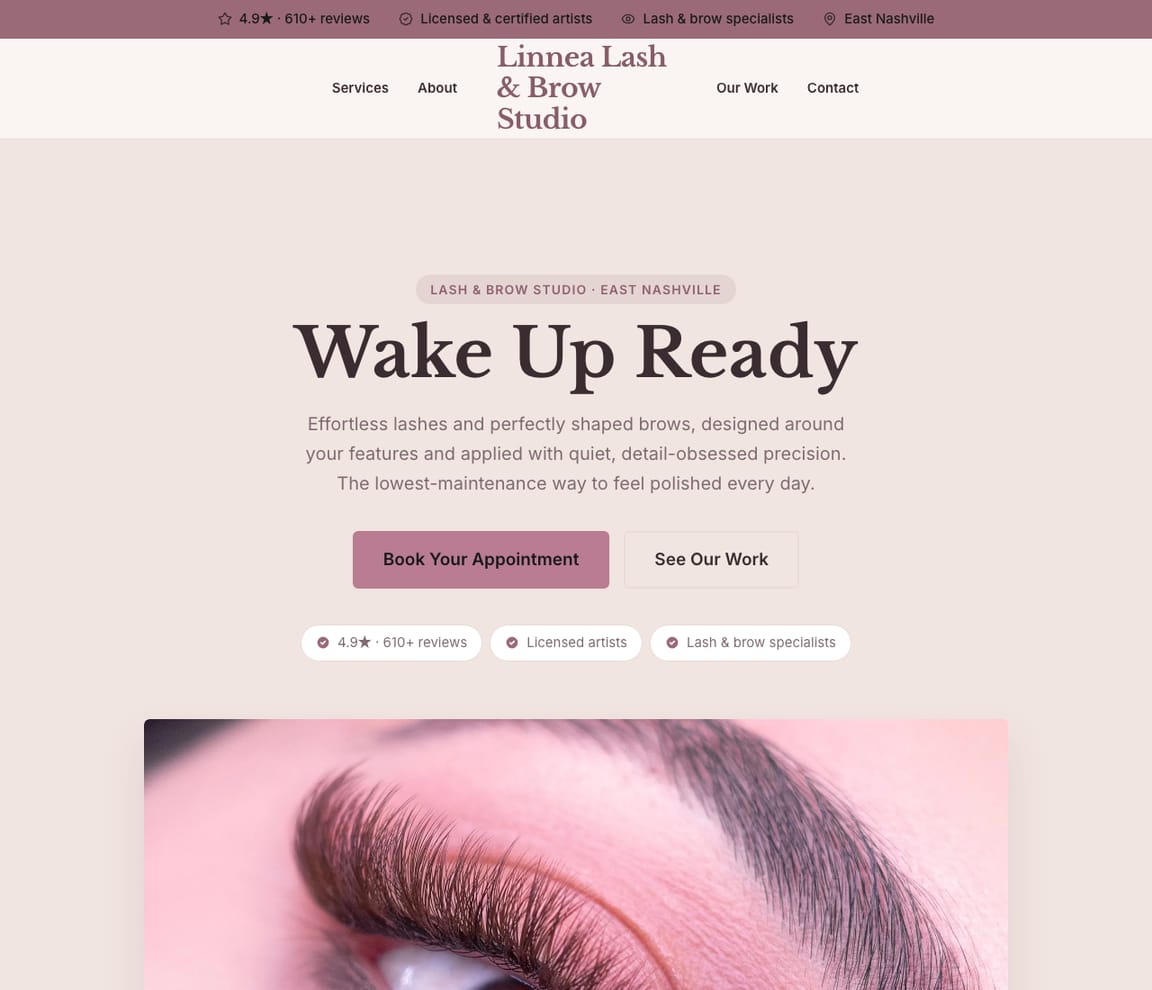
Real Zarla templates for the shapes the trade takes — the facial and waxing studio, and the lash-and-brow bar. Open one, swap in your treatments and your prices, and publish.
GET FOUND
Get found by the client who wants a facial this Saturday
A new client searches "facial near me" on a Thursday night, and the booking goes to the esthetician whose treatments, prices and open slots are on the first screen. Zarla builds the website with your treatment menu, your hours and a booking button. Add your prices and your before-and-after photos in chat, and once you connect your Google Business Profile, your name, your photos and your hours stay in step on both.
“Facial near me”
Searched by the bride, the teenager with acne and the woman who just moved to town. Your treatment menu, your prices, your photos and a booking button answer all three.
Google Business Profile
A suite has an address and a mobile esthetician has a service area; both qualify. Your hours, your photos and your booking link inside Google Maps — free, and an afternoon to set up.
The before-and-after photos
The proof a client wants before trusting you with her face: the first visit and the eighth, side by side, with the treatment named. The gallery is the sales page.
Google Search
Gglowstudioskincare.com
Glow Studio Skincare — Trusted esthetician in Your AreaAustin's licensed esthetician — facials, peels, dermaplaning, waxing and lash lifts. Prices posted up front. Book online or text.← Your Zarla siteCcityestheticianservices.com
City esthetician ServicesGoogle Maps
1
Glow Studio Skincare
← You2
Metro esthetician Co.
3
Quick esthetician Services
AI assistants (ChatGPT / Perplexity)
For a licensed esthetician in Austin who does facials and Brazilian waxing, posts prices, and has an opening this week in your area: Glow Studio Skincare — a local studio's site that lists facials, chemical peels, waxing and lash lifts with prices, shows before-and-after photos, and takes a booking from the page.
YOUR LAUNCH PLAN
Your become-an-esthetician checklist
The whole guide as things to check off. Work through them in order and you'll be trained, licensed, insured, kitted and findable before your first client.
- Check your state's hours, age and exams below — the board's number, not the school's.
- Pick a board-licensed school — and read its printed tuition before you sign.
- Log the hours and the services — the state's curriculum, reported to the board.
- Pass the written and the practical — the written alone in California; or register on the certificate in Florida.
- Work a year on commission — the speed, the upsell and the first hundred clients.
- Add the credential — a certification, a brand course, a master license where your state has one.
- Set up the suite, license the establishment and insure it — the bed, the steamer, the back bar from real prices.
- Get found — a website with your menu, prices, license and a booking button, and a Google Business Profile.
REAL CUSTOMERS
Small business owners who got online with Zarla
Verified reviews from real Zarla customers.
“Optimized for local service-based businesses. Easiest website build I've experienced. The AI-based build is the way to go instead of clunky theme-based websites. Get the site built and get out of the weeds with Zarla!”
“Quickly built my website from scratch. No hiccups. Would highly recommend Zarla for someone with no experience who wants to start a polished business website.”
“Very reliable, professional, and fast results. I was able to get my business online in no time, and the ease of access made it so simple.”
“I had no idea how to set up a website for my business. Thanks to Zarla, they've helped me a lot.”
Be the esthetician the "facial near me" search books first
Add your town and your business name, and Zarla builds the website from that one line — your treatments, your prices, your hours, a booking button and a gallery, with SEO in place. Add your before-and-after photos in chat. Free to build; you pay when you publish.
Already have a website? Bring it across →Zarla keeps your old page addresses where it can and redirects the ones that change, helping you keep the Google standing you've built.
Frequently asked questions
How much does it cost to become an esthetician?
In the US, the school is the big line and the state is the small one. One Aveda Institute prints $14,200 all-in for its 600-hour program — $12,000 tuition, a $2,000 kit, $150 registration and $50 to apply — and the other schools we tried would not open their tuition pages. The state side is $181 in Texas ($50 to apply, a $55 written and a $76 practical exam), $115 in California, $40 plus a $15 exam in New York, $175 for the Illinois exam, $26 in Pennsylvania, $30 in Georgia, $100 in Connecticut and $120 plus up to $225 of exams in Virginia. Then the room: our arithmetic puts a lean suite start in Texas at $1,407 — a $379 portable table, a $771 steamer with a mag lamp, $179 of liability cover and the $78 establishment license — and the fuller start from school to studio at $16,001.
Do you need a license to be an esthetician?
Yes, in every big US state, and the hours are the state's: 750 at a licensed school in Texas and Illinois, 600 in California, New York, Virginia, Colorado, Nevada and Connecticut, 1,000 in Georgia, 300 in Pennsylvania — then a written exam and, everywhere but California, a practical one. Florida is the exception in shape, not in law: it registers you as a facial specialist after a 220-hour course with no exam, and you may work under a registered specialist while the registration is pending. Connecticut only began licensing estheticians on July 1, 2020. Ohio, Arizona, New Jersey, Massachusetts, Michigan and North Carolina license estheticians too, on pages that refused to open to our reader. Check your own state's board before you enroll.
What is the difference between an aesthetician and an esthetician?
Spelling. The statutes in Texas, California, New York, Illinois, Pennsylvania, Georgia, Connecticut, Virginia and Washington all say esthetician; practitioners and schools write aesthetician too, and the license is the same one. The word that does not exist in any of those states is 'medical esthetician' — there is no such license. Where a second tier exists it is the master esthetician: 600 more hours in Virginia, 450 more in Washington, 1,200 total in Utah, covering the advanced exfoliation, lymphatic drainage and device work the basic license does not. Estheticians in medical spas work under a doctor's delegation, within their state license's scope.
How to become an esthetician in Ohio?
Ohio licenses estheticians through its State Cosmetology and Barber Board, and the board's own pages would not open to our reader, so this guide prints no Ohio hours or fee as fact — go to the board's own site for the course length, the exam and the application. The shape will be the one every neighboring state uses: a course at a board-licensed school, a written and a practical exam, an application fee, and a salon license for a room of your own. In the US the hours are the state's, so do not take a school's brochure for the board's number.
How to make $100,000 a year as an esthetician?
Not as an employee, on the survey's numbers: the 90th percentile for employed skincare specialists was $82,050 in 2025 nationally and $84,180 in Texas, and the survey leaves out the self-employed entirely. The estheticians quoted above who got there describe the owner's math — a suite with a flat weekly rent instead of a commission split, a book built on referrals, a menu priced as the professional service it is, and a specialty: one New Hampshire lead therapist was 'booked out, making six figures' before she opened her own studio; one Georgia owner says the goal was never to be a solo esthetician but a brand. The rooms booked and the price list decide it, not the license.
How much money do estheticians make in a year?
Employed skincare specialists had a median of $45,330 in 2025, $21.79 an hour, with 10 percent earning $29,580 or less and 10 percent $82,050 or more, from BLS data on O*NET; the state medians are $49,250 in Texas, $43,880 in Florida, $42,910 in New York and $38,770 in California. The first job is usually a wage plus commission at a chain waxing studio, a franchise lash bar or a medical spa. The owners are outside the survey; the estheticians quoted above describe weekly suite rent, slow seasons, and books that took years to fill.
What pays more, cosmetology or esthetician?
The esthetician, at the median, on the government's 2025 numbers: skincare specialists $45,330 against $35,790 for hairdressers, hairstylists and cosmetologists, with 10 percent of each above $82,050 and $71,190 respectively. The cosmetology license is also the longer course — 1,000 hours in California against the esthetician's 600 — and covers hair, nails and skin, so the owner of a full salon holds it. If skin is the work you want, the shorter license pays more at the median and leaves the hair chair to someone else.
Can you live off being an esthetician?
At the employed median — $45,330 nationally, $49,250 in Texas — yes, modestly, and the estheticians quoted above say the first year is the hard one: a wage plus commission at a chain, then a suite whose rent is due every week before the book is full. One Dallas owner describes hustling 'just to get enough money to pay rent every single week'; one Alabama esthetician still works a full-time job and sees clients after work. The ones who say yes with confidence own the room, set the menu and carry a specialty — waxing, lashes, acne, the medical-spa work — that fills the calendar.
How long does it take to become an esthetician?
The course is the clock, and it is the state's: 220 hours in Florida, 300 in Pennsylvania, 600 in California, New York, Virginia, Colorado, Nevada and Connecticut, 750 in Texas and Illinois — Illinois says over not less than 18 weeks — and 1,000 hours over at least nine months in Georgia. Full-time, the estheticians quoted above did it in four months at a Florida community college and about six months in Los Angeles; part-time it was a year in Alabama. Add a few weeks for the school to report your hours and the board to seat you for the written and the practical, and in Texas you can work the day you pass the practical on the 60-day temporary license.
Can I become an esthetician online?
No, in the US. Every statute in this guide puts the hours in a school the board licenses or approves — Texas's 750 'at a barbering/cosmetology school licensed in Texas', Pennsylvania's 300 'in a licensed school of cosmetology', Nevada's 600 'in a licensed school of cosmetology', Illinois's 750 at 'an esthetics or cosmetology school approved by the Division' — and where a practical exam exists it is in person. Some schools teach the theory hours online and the hands-on hours on campus; the license still comes from the clock hours the school reports and the exams you sit.
What can an esthetician not do?
The line is drawn in the statute, state by state. California's practice of skin care covers facials, exfoliating and beautifying the skin only where the work does 'not result in the ablation or destruction of the live tissue'; Florida's skin care services 'may not involve massage therapy, as defined in s. 480.033, through manipulation of the superficial tissue'; Pennsylvania says a licensee 'is qualified to perform esthetician services only'; New York's definition excludes electrology. In plain terms: no massage beyond the face and neck, no injections, no lasers or deep peels except where a master license or a doctor's delegation allows them in your state. Check your own board's scope page before you add a treatment to the menu.
Do I need an LLC to be an esthetician?
No US licensing statute in this guide requires one — the license is in your name, and a one-room esthetician is a sole proprietor by default: Schedule C, the 15.3 percent self-employment tax once net earnings pass $400, quarterly estimates once you expect to owe $1,000. If you form an LLC: $300 in Texas, $100 plus $50 a year in Florida, $200 in New York, and $70 in California plus an $800 annual tax every year. The insurance matters more than the entity — professional and general liability runs $179 a year at Elite Beauty Society or $29 and $42 a month at Insureon's medians. Confirm the details with your accountant.
Can an esthetician open their own business?
Yes, in every state in this guide — Pennsylvania's law says it outright, 'Licensed estheticians may operate a salon limited to that license' — and the room itself gets a license of its own: a $78 establishment or specialty establishment license in Texas, a $60 appearance enhancement business license in New York, a $75 salon license in Georgia, $142 in Pennsylvania. Most of the owners quoted above started in a rented suite on a flat weekly rent, then a studio. The business side is in how to open a spa and the esthetician business plan; the name is on the esthetician business names page.