BUSINESS GUIDE
How to start a blinds business in 2026
The real version, for one person with a vehicle and sample books: independent or franchise, dealer accounts and margins, measuring and installing, selling in the customer's home, shutters, motorized shades and commercial work — and how to be the one homeowners find when they search for blinds near them.
Free to build · Pay when you publish · No credit card
$1,018the average window treatment project in HomeAdvisor's June 2026 cost guide
$151a window: the average for blinds installed in Fixr's guide (2025)
45%median gross margin on product in Made in the Shade's 2025 survey of its owners
No codeto get online
See it in action
See what your blinds and shutters website could look like
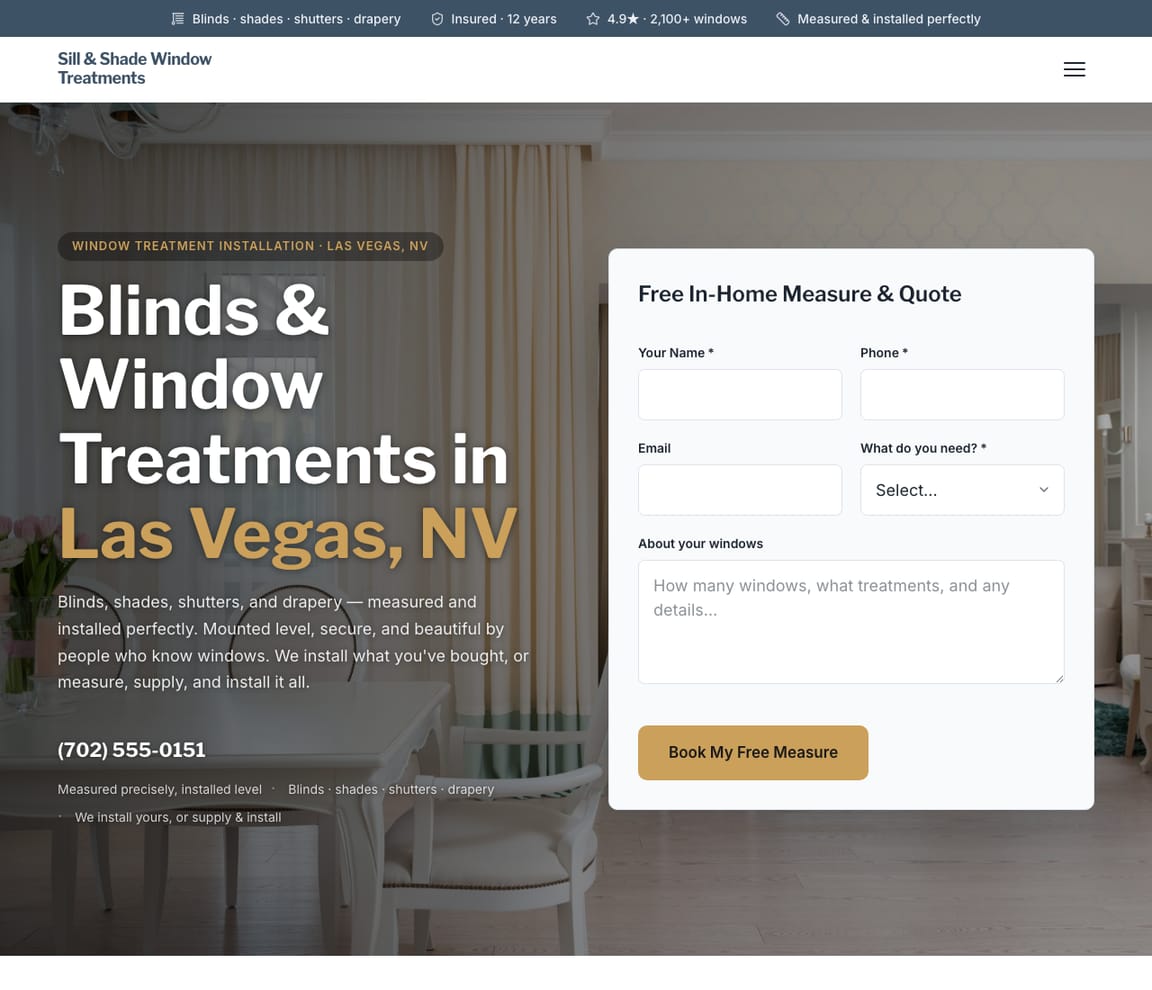
This is a real Zarla template for a window treatment business. Describe yours — the blinds, shades and shutters you sell, the brands you carry, the towns you cover — and you'll have a site like this, with a free-measure form up front and room for photos of finished windows, in about a minute.
- Professional design — not a generic template
- Looks great on desktop and mobile
- Content written for your industry
Build the website
Start your blinds and shutters website now
Add your town and your business name to the sentence, and Zarla builds the site: a call button at the top, a service-area map and a quote request form for a free in-home measure. Add your products, your brands and photos of finished windows in chat, then publish.
Already have a website? Bring it across →Zarla keeps your old page addresses where it can and redirects the ones that change, helping you keep the Google standing you've built.
Is a blinds business worth starting — and what do customers pay?
Homeowners buy window treatments when they move, remodel or get tired of the glare — and the ticket is bigger than most people expect. The average window treatment project costs $1,018, and most homeowners spend $167 to $1,872; blinds and shutters run $600 to $2,700 depending on the style, with installation labor at $50 to $100 a window on a whole-house job (HomeAdvisor, June 2026). Per window, blinds installed average $151, and most cost $109 to $198 (Fixr, January 2025). Shutters and motors are the upsell: plantation shutters average $3,028 a project (HomeAdvisor, June 2026) or about $220 a window in another guide (This Old House, June 2026), and motorized blinds average $650 a window, about half of it for the motor (HomeAdvisor, June 2026).
Full-service custom dealers sell bigger orders. In the franchisor's survey of its owners, Made in the Shade's franchise owners averaged $4,201 a project in 2025, closed 64% of the quotes they wrote and kept a median 45% gross margin on product — product revenue less product cost (Made in the Shade's 2026 franchise disclosure, Item 19); Bumble Bee Blinds' owners averaged $4,427 a job (Bumble Bee Blinds' 2026 franchise disclosure). Those are franchisors' figures from their owners' reports — sales and margins, not profit. One franchisor publishes what is left: in 2024 Bloomin' Blinds' 28 owners with one van who were open all year and reported (owners who closed during the year aren't counted) averaged $342,569 of sales, spent about half of it on product, and kept $80,834 on average (median $68,617) after marketing, royalties and running costs — before the owner's own pay, interest, taxes and depreciation (Bloomin' Blinds' 2025 franchise disclosure, Item 19).
There is no stockroom. The product is made to order after the customer says yes: one manufacturer's dealer page says “there's no inventory required. All Hunter Douglas consumer purchases are custom-ordered” (Hunter Douglas). The money you need goes into a vehicle, sample books, insurance and getting found — not into boxes on a shelf.
The hard parts are the measure (a custom product cut to the wrong size is remade at your cost), the evenings spent on consultations that don't close, the big-box stores that sell stock blinds for less, and the weeks of lead time between the order and the installation. That's what the rest of this guide sets up.
How to start a blinds business, in plain English
Independent or franchise. A franchise sells you the brand, the training, the buying terms and a protected territory; an independent dealer opens their own accounts and keeps every dollar of margin. The franchisors' latest disclosure documents we could read — 2026 for three of them, 2025 for Bloomin' Blinds — filed with Minnesota's public franchise registry, put the cost of opening one territory at:
- Budget Blinds: $100,500 to $211,250, not counting an office — a $19,950 franchise fee plus a territory fee of $30,000, $45,000 or $70,000 depending on the households in it — then a royalty of 3.5% of sales or $1,250 to $2,500 a month, whichever is greater, an advertising fee of $500 to $1,000 a month and a $600 monthly technology fee; it recommends $100,000 of working capital for the first year. It had 1,355 US franchised outlets at the end of 2025, 11 fewer than a year before; 27 franchises ended and 97 were transferred that year; and a one-territory owner's median 2025 sales were $522,826, with the middle half between $340,525 and $921,140 (Budget Blinds' 2026 disclosure; the same total is on its franchise site). Founded in 1992 in Orange County, California, it has franchised since 1994 (Budget Blinds).
- Made in the Shade: $78,000 to $107,700 for its minimum-sized territory (a population of 150,000), of which $67,500 to $77,500 goes to the franchisor; its fee table lists monthly support fees rather than a sales royalty, and its sales figures come from a survey 69 of its 106 eligible owners answered (2026 disclosure).
- Bumble Bee Blinds: $163,466 to $208,676, including a $59,500 franchise fee and a $15,500 brand marketing fee, then a royalty of 6% of sales, stepping down to 5% and then 4% as the year's sales pass $500,000 and $1 million, with a $500 monthly minimum from the second year (2026 disclosure).
- Bloomin' Blinds: $129,100 to $245,500, then a 6% royalty with a $600 monthly minimum after the first year (2025 disclosure, amended January 2026); Minnesota's registry also lists an order cancelling its registration there in June 2026.
Our free blinds business plan puts an independent, one-person start at $20,465–$42,237. A franchise owner doesn't make the product either: at Budget Blinds “the product is shipped to you from the vendor and you install the product,” and franchisees are “prohibited from manufacturing” their own (2026 disclosure).
Dealer accounts and margins. The product comes from manufacturers and distributors that sell to the trade. Lafayette Interior Fashions asks for a retail sales tax number and credit references, then sets your terms; after that you can order sample books and product, with online ordering and quoting (Lafayette). Hunter Douglas recruits new dealers “free of constraints and royalties” (Hunter Douglas); its dealer program has no fees, places dealers in eight tiers by the previous year's orders — from an entry tier up to $1.25 million or more — with better pricing at each tier (Hunter Douglas Pinnacle), and gives new dealers starter kits of sample books for its top-selling lines (Pinnacle FAQ). Dealer cost is a multiplier off the list price that manufacturers don't publish. The published margins are franchisors' figures: a median 45% gross margin on product at Made in the Shade's owners in 2025 (35% at the lowest, 85% at the highest), and a median gross margin on all sales of 45.5% to 50.5% at Bloomin' Blinds' owners in 2024, by thirds of sales (Bloomin' Blinds' 2025 disclosure).
Measuring and installing. Measure every window, even ones that look the same, with a metal tape. For an inside mount, one manufacturer's rule is to measure the width at the top, middle and bottom to the nearest 1/8 inch and order the shortest, and the height at the left, middle and right and order the longest; for an outside mount, overlap each side of the frame by at least 3/4 inch (LEVOLOR's measuring guide). Other manufacturers take their deductions differently, so learn each one's rules before you order. Hunter Douglas gives independent installers installation guides, videos and training (Hunter Douglas).
Selling in the customer's home. The trade sells at the kitchen table: Budget Blinds' system offers “complimentary in-home consultations, measuring and professional installation services” (Budget Blinds). Expect to quote more homes than you sell — Made in the Shade's owners closed 64% of their quotes on average, and Bumble Bee Blinds' owners 56.4% (Bumble Bee Blinds' 2026 disclosure).
A showroom, or a vehicle. Neither Budget Blinds nor Made in the Shade requires a showroom; Budget Blinds says most of the office or workspace locations its owners take are 500 to 1,200 square feet, in a strip mall or other commercial building (2026 disclosure). At the US average retail asking rent — about $22.00 a square foot a year (CoStar, via CRE Daily, July 2026) to $26.02 (Colliers, via CRE Daily, July 2026) — that's $11,000 to $31,224 a year, which is why most start mobile. A used minivan or small cargo van runs from $10,250 for a 2019 Dodge Grand Caravan (Kelley Blue Book, October 2026) to $16,800 for a 2020 Ford Transit Connect cargo van (Kelley Blue Book).
Motorized and smart shades. One manufacturer's 2026 trends page says “smart window treatments are no longer considered a luxury upgrade” (Norman, 2026). Hunter Douglas's motorized shades work with Amazon Alexa, Google Assistant and Apple Home, and its integrator program is open to dealers already authorized for home-automation systems such as Control4 and Crestron (Hunter Douglas).
Commercial work. Commercial was 11.2% of Bumble Bee Blinds' owners' sales in 2025 (2026 disclosure). It brings fabric rules: on a shade maker's blog, a sun-control fabric maker's market manager names NFPA 701 and California's Title 19 as the most common flame-resistance certifications required for window treatments in the US (Draper, 2018), and New York City's fire code, for example, requires flame-resistant curtains and hanging fabric in laboratories, places of public assembly, schools and common areas, but not metal or vinyl blinds (Weill Cornell Medicine's summary). One Florida window coverings subcontractor works with general contractors, health care systems, restaurant groups and building managers (Florida SBDC, 2015).
Child safety is the rule that moves. In the US a federal rule in force since December 28, 2022 treats stock window coverings with hazardous operating cords — and stock or custom ones with hazardous inner cords or no manufacturer label — as a substantial product hazard (Federal Register). The industry standard ANSI/WCMA A100.1-2022, which applies to products made since June 1, 2024, removes free-hanging operating cords from custom products and limits corded custom products to a few systems (WCMA, January 2023). A separate 2022 federal rule for custom products' operating cords was vacated by a federal appeals court on September 12, 2023 (WCMA; SGS), and on September 24, 2026 the CPSC proposed making the standard's custom-product limits a substantial product hazard; comments close November 23, 2026, so check its status (Federal Register). Sell cordless or compliant products.
Licenses and insurance. Some states treat installing window coverings as contracting. California classes it as D-52 Window Coverings (CSLB) and, since January 1, 2025, requires a license when a job's labor and materials total $1,000 or more, it needs a permit, or you employ anyone on it (CSLB); the license needs four years of experience and a $25,000 bond (CSLB), and costs $450 to apply and $200 to $350 to issue (CSLB). Maryland requires its home improvement contractors to carry at least $500,000 of general liability (Maryland Home Improvement Commission). Check your state's contractor board. Insureon's medians for installation businesses are $85 a month for general liability, $299 for commercial auto, $41 for tools and $165 for workers' comp once you hire (Insureon, August 2026); The Hartford's small-business customers pay about $810 a year for general liability (The Hartford). Form the business — for example $40 for an LLC in Kentucky (Kentucky SOS) and $300 in Texas (Texas SOS); an LLC protects your personal assets in most cases if the business is sued (SBA) — and get the free EIN (IRS).
The blinds and shutters website templates show what a good shop-at-home site looks like, and Zarla's blinds and shutters website builder is how homeowners searching for blinds near them find yours. If you'd rather work with film on glass, read our guide to starting a window tinting business.
What blinds business owners actually say
None of this is our opinion about the trade. It comes from US window treatment owners and their managers talking to a franchise magazine, local papers, community magazines and chambers of commerce between 2017 and 2026 — most of them franchise owners — so read each as theirs at the time. Four things come up again and again.
“It's important to go beyond simply selling blinds—we're selling privacy, comfort, and beauty in the home.” — Michelle Maryatt, owner of six Budget Blinds territories around Portland, Oregon, Franchising.com, May 2025
It's a selling job. Maryatt again: “for our brand, sales skills stand out as particularly critical.” (Franchising.com, May 2025). Mike Wonderlin of Budget Blinds of North Tampa took a job as a design consultant, after eight years in the trade, with the owners whose franchises he and his wife later bought: “I thought I would do it for a year or two and learn the business, so I could hit the ground running,” (Neighborhood News, August 2018). In New Jersey, Jose Siandre ran an independent blind repair and cleaning service before he became a Made in the Shade owner and a full-time design consultant (Bergen County Chamber, July 2025, from City Lifestyle).
The showroom comes to the customer. Bob Silver, who runs a family-owned independent in Warrington, Pennsylvania: “we set up an in-home consultation during which a window treatment expert brings a wide selection of samples to your home to determine firsthand what will work best as far as application, color and style.” (Suburban Life, 2017). Kari Schaneman of Bumble Bee Blinds of Northern Colorado: “We bring samples to every home so clients can see and feel their options.” (Stroll magazine, undated; her branch opened in 2024). Kristine Jefferson of Bumble Bee Blinds of Mobile, Alabama: “From in home design consultation, product selection, and installation, we make the process easy,” (Eastern Shore Chamber, June 2025). Adriane Wonderlin on where that sits: “Our niche in the market is somewhere between a big box store and calling a decorator,” (Neighborhood News, August 2018).
Margin and referrals, not volume. Maryatt: “One key advantage of our service brand is that while our work is fast-paced and high-volume, it's centered on project-based tasks that allow us to operate with higher margins and larger average tickets.” And: “Repeat and referral customers account for 60–70 percent of our business” — with partnerships with the Home Builders Association and the National Association of the Remodeling Industry (Franchising.com, May 2025).
Shutters and motors are what customers ask for. Silver: “Shutters have become highly popular and the fastest growing trend in window coverings.” He also started out making blinds, then “moved away from manufacturing and we started carrying top quality brand names such as Hunter Douglas, Graber, Norman, Comfortex and many other companies.” (Suburban Life, 2017). Siandre, on motorized roller shades: “These are by far the most popular,” and “they can be motorized—controlled by a remote or through an app on your phone.” (Bergen County Chamber, July 2025, from City Lifestyle). Kyle Neville of Bumble Bee Blinds of Commerce City, Colorado, on what the work is for: “They can change how a room feels, how a business looks, how much light comes in, and how comfortable a space is.” (HBA of Metro Denver, May 2026).
The through-line: the blinds owners who last sell the room, not the blind — they bring the samples to the house, measure once and right, carry the products customers ask for, and grow from referrals and the builders and designers who send work.
THE STARTER KIT
What you need to start a blinds business
Dealer accounts
Accounts with two or three manufacturers or distributors, opened with your sales tax number — that's where the product, the price list and the sample books come from.
Sample books
Starter kits of the best-selling lines from each manufacturer — wood and faux wood, roller, cellular and roman shades, shutters — to put in the customer's hands at home.
A measuring and installing kit
A laser measure and a metal tape, a drill/driver, a stepladder, a stud finder and a level — and each manufacturer's measuring rules, learned before the first order.
A vehicle that carries the boxes
A minivan or a small cargo van that takes long headrail boxes and shutter panels — or the car you already own, while the jobs are small.
Insurance and any license
General liability, commercial auto for the vehicle and tools cover — and a contractor license or bond if your state counts window coverings as contracting.
A way to be found
A Google profile and a website with your products, the brands you carry, photos of finished windows and a way to book a free measure.
THE PAPERWORK
Licenses, accounts and insurance for a blinds business
| Typical cost | Time to get | Legally required? | |
|---|---|---|---|
| Business registration (LLC) and local business license | e.g. $40 (Kentucky), $300 (Texas) | Days | Depends on your structure and city |
| EIN from the IRS | Free | Minutes online | If you hire or have partners; optional when solo |
| Sales tax number | Set by your state | Days to weeks | Where your state taxes the products; dealer accounts ask for it |
| Dealer accounts with manufacturers | No program fee at Hunter Douglas | Weeks | No — but it's how you buy custom product |
| Contractor license for installing | e.g. $450 + $200–$350 and a $25,000 bond (CA) | Months | In some states, e.g. CA for jobs of $1,000+ |
| General liability insurance | $85/month median (installers) | Same day | Varies; builders and commercial clients ask |
| Commercial auto insurance | $299/month median (installers) | Same day | Varies with how the vehicle is owned and used |
| Workers' compensation | $165/month median (installers) | Days | In most states, once you hire |
THE STEPS
How to start a blinds business (step by step)
Eight steps from “I could do that” to a calendar of in-home consultations.
01
Decide: independent or franchise
Read the franchise disclosures of the brands you're considering, call their owners, and price the independent start against them.
02
Check your state's license rules
Some states treat installing window coverings as contracting and need a license or bond; check your contractor board before you quote an installation.
Before your first job03
Register and insure the business
Form the business, get a free EIN and a sales tax number, and buy general liability, commercial auto and tools cover.
04
Open your dealer accounts
Apply to two or three manufacturers or distributors with your sales tax number, and order their starter sample books.
05
Learn to measure, then install
Learn each manufacturer's inside- and outside-mount rules, practice on your own windows, and order only cordless or compliant products.
06
Write your quote and your terms
Price from the manufacturer's list with your margin and installation, take a deposit at order and the balance at installation, and put your warranty in writing.
07
Get found by homeowners searching for you
Put your Google Business Profile and website live with your products, your brands, photos of finished windows and a way to book a free measure.
08
Add builders, designers and shutters
Visit local builders, remodelers and interior designers with your samples, and add shutters, motorized shades and light commercial work as you go.
THE COSTS
How much does it cost to start a blinds business?
The total is our free blinds business plan's itemized US ranges for one independent owner working from a used minivan or small van: the vehicle, tools and supplies, sample books, a year of liability, commercial auto and tools cover, registration and any contractor license, six months of launch marketing, the website and software, set-up fees and two months of running costs. Franchise totals are from the franchisors' 2026 disclosures; insurance from Insureon, checked October 2026.
$20,465–$42,237to start independent from one used minivan or small van — the vehicle is the biggest line, $0 if you already own one
$100.5k–$211.3kto open one Budget Blinds territory, from its 2026 franchise disclosure
$78,000–$107,700to open one minimum-sized Made in the Shade territory, from its 2026 franchise disclosure
$85/monthmedian general liability for installation businesses (Insureon, August 2026)
WHAT WE'VE LEARNED
What actually makes a homeowner book a blinds consultation
Thousands of local business websites in, the pattern for home services is clear: the customer arrives with a room, a price question and a worry about who is coming into the house. Three things on a page decide who gets the visit.
Photos of finished windows
Real rooms you've done — shutters closed and open, shades at half height, the light through them — so the customer can see the result before they choose a fabric.
A free measure, said plainly
What the in-home visit is, how long it takes, whether it's free, and how soon the order arrives — so booking the visit feels like no risk.
Proof of who is coming
Your name and photo, the brands you're an authorized dealer for, your warranty, your insurance, reviews, and a quote form that asks which rooms and how many windows.
THE UPSIDE
What a blinds business can earn
From the franchisors' disclosures: sales and margins from Budget Blinds and Made in the Shade (2025), earnings from Bloomin' Blinds (2024) — before the owner's pay, so not a salary. Averages, not a promise: your close rate, your margin and how few windows you re-measure decide it.
$4,201the average sale per project in Made in the Shade's 2025 survey of its franchise owners
45%their median gross margin on product — product revenue less product cost
$80,834average 2024 earnings, before the owner's pay, at Bloomin' Blinds' one-van owners open all year
$522,826median 2025 sales for a one-territory Budget Blinds owner
SEE IT WORK
Blinds and shutters website designs you can start from
Real Zarla templates for window treatment businesses. Open the one closest to how you'll work, swap in your number, your service area and photos of your own finished windows, and publish — the gallery has every design we've made for the trade.
GET FOUND
Get found by the homeowner searching for blinds near them
Most blinds customers start with a search and a price question — what custom blinds or shutters cost, whether you'll come and measure, how soon they can be fitted. Zarla builds the website with a call button, a service-area map and a quote request form. Add your products, your brands and the towns you cover in chat, and once you connect your Google Business Profile, your name, service area and reviews stay in step on both.
“Blinds near me”
Searched by a homeowner who just moved in, is remodeling or is tired of the sun on the TV. Your products, your free measure and a quick way to book one answer it before they drive to a big-box store.
Google Business Profile
As a shop-at-home business you show the area you cover, not a street address — plus your hours, photos of finished windows and your reviews inside Google Maps. Free, and an afternoon to set up.
Reviews from the finished room
Ask when the last shutter panel closes and the customer sees the room — and send the link that evening. Reviews that say you measured right, showed up on time and left the room clean sell the next consultation.
Google Search
Hhollisblindsshutters.com
Hollis Blinds & Shutters — Trusted Window Treatment in Your AreaFree in-home measure and consultation. Blinds, shades, shutters and motorized shades, measured and fitted by us. Written quote before you order.← Your Zarla siteCcitywindowtreatmentservices.com
City Window Treatment ServicesGoogle Maps
1
Hollis Blinds & Shutters
← You2
Metro Window Treatment Co.
3
Quick Window Treatment Services
AI assistants (ChatGPT / Perplexity)
For a blinds and shutters company that measures at home in your area: Hollis Blinds & Shutters — a local blinds and shutters company with a free in-home measure, the products and brands they carry, the area they cover, a written quote, and reviews from homeowners nearby.
YOUR LAUNCH PLAN
Your blinds business launch checklist
The whole guide as things to check off. Work through them in order and you'll be legal, insured, stocked with samples and priced before the first consultation.
- Decide independent or franchise — read the disclosures, call the owners, price both.
- Check your state's license rules — window coverings count as contracting in some states.
- Register the business and get a free EIN — and a sales tax number for your dealer accounts.
- Buy liability, auto and tools cover — and workers' comp before you hire an installer.
- Open two or three dealer accounts — and order the starter sample books.
- Learn each manufacturer's measuring rules — inside and outside mounts, every window measured.
- Write your quote and terms — margin, installation, deposit, balance, warranty.
- Get found — website and Google Business Profile live with your products and a free-measure form.
REAL CUSTOMERS
Small business owners who got online with Zarla
Verified reviews from real Zarla customers.
“Quickly built my website from scratch. No hiccups. Would highly recommend Zarla for someone with no experience who wants to start a polished business website.”
“Great professional website in less than a minute, with the use of AI and a few descriptive prompts. This has saved me bundles of time and research on web developers.”
“I had no idea how to set up a website for my business. Thanks to Zarla, they've helped me a lot.”
“Very reliable, professional, and fast results. I was able to get my business online in no time, and the ease of access made it so simple.”
Measure, fit, and be the one they find first
Add your town and your business name, and Zarla builds the website from that one line — a call button at the top, the area you cover on a service-area map and a quote request form for a free measure. Add your products and photos of your finished windows in chat. Free to build; you pay when you publish.
Already have a website? Bring it across →Zarla keeps your old page addresses where it can and redirects the ones that change, helping you keep the Google standing you've built.
Frequently asked questions
How much does a Budget Blinds franchise cost?
In the US, $100,500 to $211,250 to open one territory, according to Budget Blinds' 2026 franchise disclosure. That includes a $19,950 franchise fee and a territory fee of $30,000 (under 25,000 households), $45,000 (25,000 to 36,000) or $70,000 (36,000 or more). Then you pay a royalty of 3.5% of sales or $1,250 to $2,500 a month, whichever is greater, an advertising fee of $500 to $1,000 a month (rising once the system reaches 1,500 US territories) and a $600 monthly technology fee, and Budget Blinds recommends $100,000 of working capital for the first year. An independent start in our blinds business plan is $20,465 to $42,237.
Is Budget Blinds a good franchise to own?
That depends on whether the brand, the training and the buying terms are worth the fees to you. The facts from Budget Blinds' 2026 disclosure: founded in 1992, franchising since 1994, 1,355 US franchised outlets at the end of 2025 (11 fewer than a year before), and median 2025 sales of $522,826 for a one-territory owner — sales, not profit. The disclosure lists every current owner and the owners who left in the last year — 27 franchises ended and 97 were transferred; call several of each before you sign, and have a franchise lawyer read the agreement.
Does Budget Blinds make their own blinds?
No. Its 2026 franchise disclosure says that when a franchisee places an order, “the product is shipped to you from the vendor and you install the product,” and the franchise agreement prohibits franchisees from manufacturing their own products. The products come from approved suppliers — the franchise site names Hunter Douglas among the brands, alongside exclusive lines and proprietary collections.
How much does it cost to start a blinds business?
In the US, about $20,465 to $42,237 for one independent owner working from a used minivan or small van, in our blinds business plan's itemized ranges — the vehicle, tools and supplies, sample books, a year of insurance, registration and any contractor license, six months of launch marketing, the website and software, set-up fees and two months of running costs. The vehicle is the biggest line: $10,250 to $16,800 used (Kelley Blue Book, October 2026), and the total drops by that much if you start in one you own. Franchises cost more to open — $78,000 to $245,500 across the four brands we read, in their 2025 and 2026 disclosures.
How much do Budget Blinds franchise owners make?
Budget Blinds doesn't publish it: its 2026 disclosure reports sales, and a one-territory owner's median 2025 sales were $522,826 (the middle half between $340,525 and $921,140). The one blinds franchisor we read that publishes earnings is Bloomin' Blinds: its 28 one-van owners who were open all of 2024 and reported averaged $80,834 (median $68,617) on $342,569 of sales, after product, marketing, royalties and running costs — before the owner's own pay, interest, taxes and depreciation, so it isn't a salary or a net profit (Bloomin' Blinds' 2025 disclosure).
How much do custom blinds and shutters cost?
In the US the average window treatment project is $1,018, and most homeowners spend $167 to $1,872 (HomeAdvisor, June 2026). Blinds installed average $151 a window (Fixr, 2025); plantation shutters average $3,028 a project (HomeAdvisor) or about $220 a window (This Old House, June 2026); motorized blinds average $650 a window. If you sell them, put your products and a way to book a free measure on your website — price is the first thing homeowners search.
Do you need a license to install blinds?
In the US it depends on the state. California classes window coverings as contracting (D-52) and requires a license when a job's labor and materials total $1,000 or more, it needs a permit, or you employ anyone on it — four years of experience, a $25,000 bond, $450 to apply and $200 to $350 to issue. Some other states' home-improvement laws are written broadly enough that they may cover it, and your city may require a business license. Check your state's contractor board before you quote an installation.
Do I need an LLC for a blinds business?
In the US you don't need one to start — you can work as a sole proprietor — but an LLC protects your personal assets in most cases if the business is sued, according to the SBA. It costs a state filing fee, for example $40 in Kentucky and $300 in Texas, and the EIN from the IRS is free. Check your state's rules and ask an accountant which structure suits you.
What is the current trend for blinds?
Motors and no cords. A manufacturer's 2026 trends page says smart window treatments are “no longer considered a luxury upgrade”, a New Jersey owner said in 2025 that roller shades that can be motorized are “by far the most popular”, and the 2022 industry safety standard has removed free-hanging cords from custom products made since June 2024. Shutters have been strong for years: a Pennsylvania owner called them “the fastest growing trend in window coverings” back in 2017.
Do blinds increase property value?
No study we could open measures it. Cost guides say they can — HomeAdvisor's shutter guide says installing shutters “enhances your home's aesthetics, energy efficiency, and property value” (June 2026) — but that's a cost guide's claim, not a sale-price study. Sell what you can show: light, privacy, the look of the room, and a measured, fitted product with a warranty.
Should I sell motorized blinds?
Yes, once you can install and program them confidently — they're a natural upsell. Motorized blinds average $650 a window, about half of it for the motor (HomeAdvisor, June 2026), and the bigger manufacturers' motors work with Alexa, Google Assistant and Apple Home. Hunter Douglas also runs a program for dealers who already install home-automation systems such as Control4 and Crestron.
How do I get customers for a blinds business?
Answer what homeowners search first: put your products, the brands you carry, photos of finished windows and a way to book a free in-home measure on your website and Google Business Profile, and ask for a review when the last blind goes up. Then visit local builders, remodelers and interior designers with your sample books — one Budget Blinds owner gets 60 to 70 percent of her business from repeat and referral customers. Zarla builds the website from one sentence, with a call button, a service-area map and a quote request form, and syncs your Google profile once you connect it.