BUSINESS GUIDE
How to start a window tinting business in 2026
The real version, for cars, homes and offices: what customers pay and what the film costs you, how to learn, your state's tint law, the insurance that covers a customer's car, a shop bay or a van — and how to get found by the people searching the price.
Free to build · Pay when you publish · No credit card
$99–$850to tint a car all around, dyed film to ceramic (Rayno, 2026)
$7–$15a sq ft installed for most home window film (HomeAdvisor, 2026)
$22.90an hour: median pay for auto glass installers (O*NET, 2025)
No codeto get online
See it in action
See what your window tinting website could look like
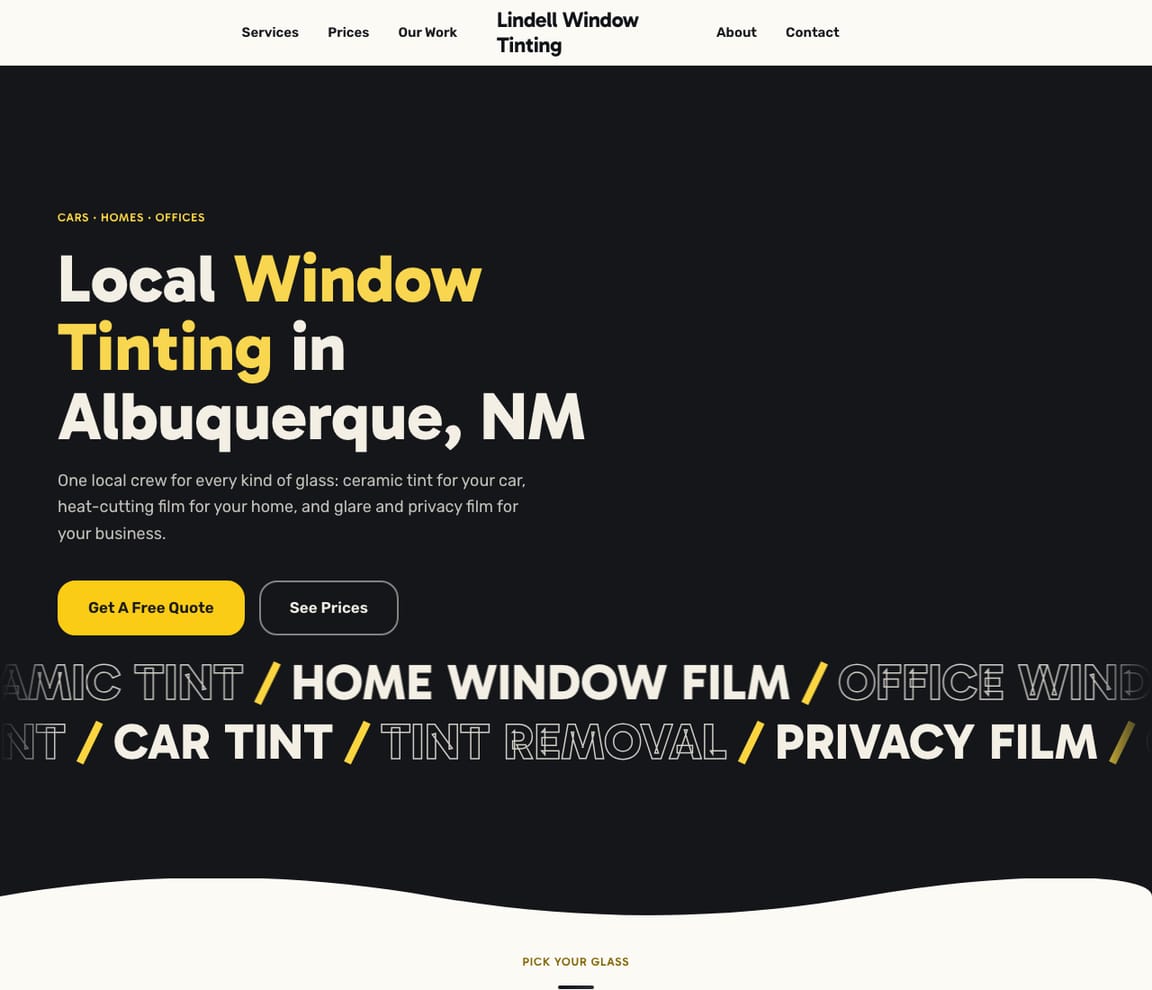
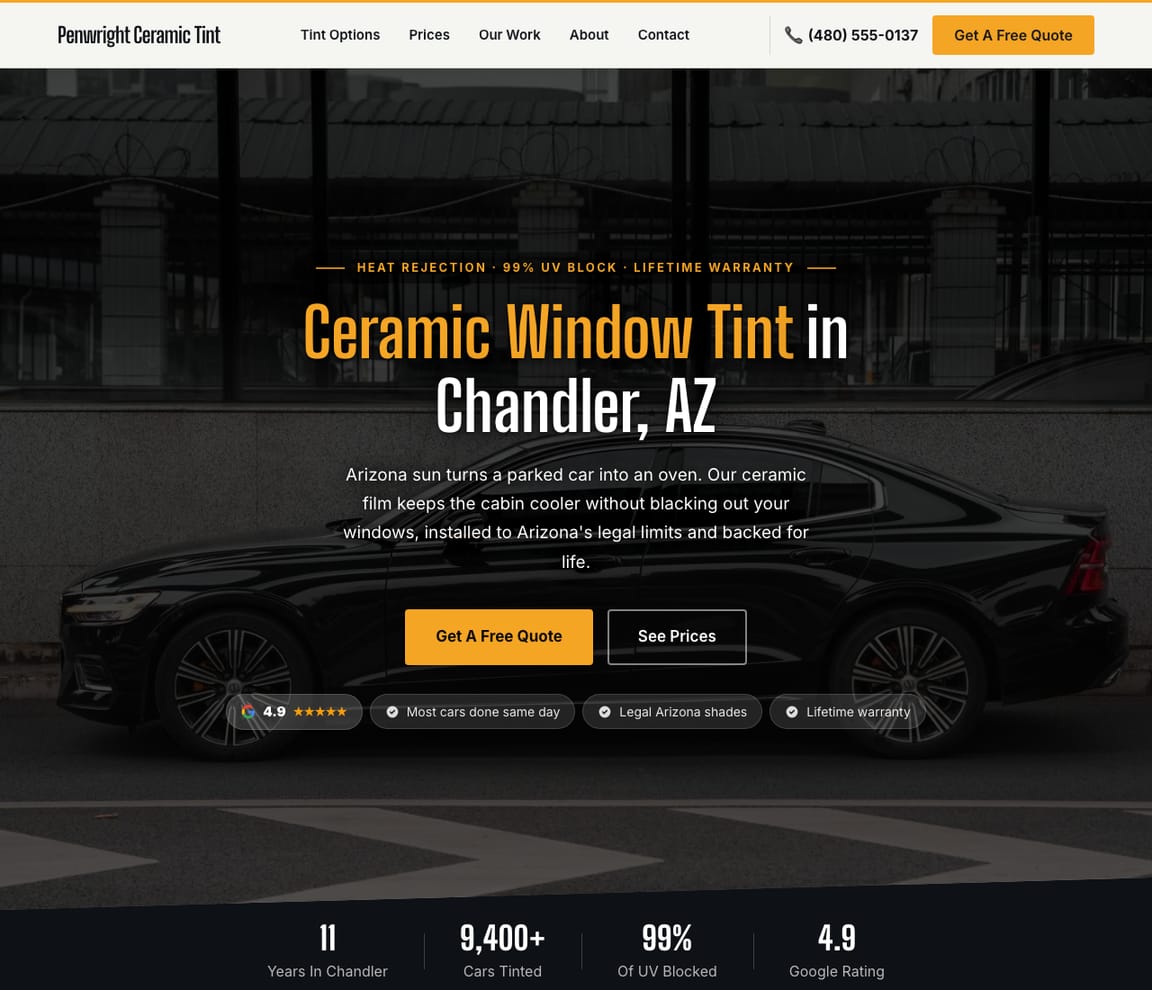
This is a real Zarla template for a tint shop that does cars, homes and offices. Describe yours — the films you install, your prices, mobile or in the bay, the towns you cover — and you'll have a site like this, with a quote form up front and room for photos of your work, in about a minute.
- Professional design — not a generic template
- Looks great on desktop and mobile
- Content written for your industry
Build the website
Start your window tinting website now
Add your town and your shop's name to the sentence, and Zarla builds the site: a call button at the top, a service-area map and a quote request form. Add your films, your prices and photos of your work in chat, then publish.
Already have a website? Bring it across →Zarla keeps your old page addresses where it can and redirects the ones that change, helping you keep the Google standing you've built.
Is a window tinting business worth starting — and what does window tinting cost?
The demand is steady, and the question every customer asks first is the price. One film maker's guide puts a car at $99 to $850 all around: $99 to $350 in dyed film, $150 to $450 in carbon and $350 to $850 in ceramic — about $250 for a sedan in carbon and about $650 in ceramic, $120 to $450 for a coupe and $250 to $750 for an SUV (Rayno, updated July 2026). A real shop's list sits in the same band: one Gilroy, California shop sells ceramic from $480 and premium ceramic at $850, with a windshield strip at $80, a full windshield at $150 to $380 and old tint removed for $40 to $150 (Blackout Window Tinting, June 2026).
Homes and offices are priced by the square foot. In the home cost guides, most window film costs $7 to $15 a square foot installed, ceramic $10 to $20, and a typical home project $317 to $944 (HomeAdvisor, June 2026); another guide puts installed film at $5 to $20 a square foot, security film up to $26, with many installers setting a minimum around $392 (Fixr, January 2025). Installers measure width times height in inches, divide by 144 for square feet, and commonly add 15% for waste (Tint Wiz, a software vendor, 2021).
The film is a small part of the price. A 40-inch, 100-foot roll with a tool kit lists at $261.99 in carbon and $531.99 in ceramic at one supplier (Tint Depot), and one Missouri owner counts a 100-foot roll at 20 to 25 rear windows (Window Film magazine, July 2023). What decides the margin is the installer's time, how much ceramic you sell, and how few jobs come back. The season is uneven — one Orlando co-owner writes that most shops do nearly 80% of their tint jobs from March to August (The Shop, February 2023) — and a Mississippi owner whose shop reached $357,000 in sales in 2022 tints for dealerships at a volume discount to keep the winter going (Window Film magazine, March 2023). A software vendor's arithmetic says three cars a day, five days a week, is over $250,000 a year (Tint Wiz, 2021) — that's about $320 a car every working day of the year, so read it as a ceiling, not a forecast.
The hard parts are the skill — clean edges and curved rear glass take months to get fast — the state's tint law, which binds the installer, and a slow season you have to fill. That's what the rest of this guide sets up.
How to start a window tinting business, in plain English
Your state's tint law is your business's law too. In the US, no state we checked licenses window tinting as a trade, but every state sets how dark each window may be, written as VLT — the share of visible light the glass and film let through, so a lower number is darker. For the front side windows the limit runs from 70% in states such as California and New York to 20% in New Mexico, with Texas at 25%, Florida at 28% and Arizona at 33%, and New Jersey allows no film there at all (Rayno's state chart, updated August 2026, drawn from the IWFA's tint law database). Charts lag the law: Louisiana's front side windows went from 40% to 25% in 2025 (La. R.S. 32:361.1), and that chart still prints 40%. Charts and statutes can also disagree — North Carolina's statute sets 35% and presumes anything over 32% on a light meter is legal, which is why charts print 32% (N.C. G.S. 20-127) — and laws change: a bill to allow 50% passed New York's legislature in June 2026 and was waiting for the governor's signature (IWFA, June 2026). Check your state's current statute and DMV before you set your shades.
The law reaches the installer. Some examples:
- Texas makes it an offense for “a person, including an installer or manufacturer,” to apply film that breaks the limits, and fines a shop up to $1,000 for tinting without the required label between the film and the glass (Texas Transp. Code §547.613).
- Florida makes selling or installing illegal film a second-degree misdemeanor (Fla. Stat. §316.2956) and requires the installer to put a label on the inside of the driver's door jamb with the film's name and the shop's (§316.2955).
- Louisiana requires a label with the installer's name and city on the driver's window, and fines an installer who breaks the law $1,000, then $2,000, then bars a third offender from the business (La. R.S. 32:361.1).
- North Carolina makes applying illegal tint a Class 3 misdemeanor (G.S. 20-127), Minnesota makes it a misdemeanor to apply non-compliant film as a business (Minn. Stat. 169.71), Washington requires a sticker on the driver's door post (RCW 46.37.430), and California requires a certificate from the installing company for clear film on the front side windows (Cal. Veh. Code §26708).
Many states allow darker film with a doctor's letter, each through its own process. Home and office film is rarely licensed, but some states do: California's contractor board lists plastic window film under its D-52 window coverings class (CSLB) — check your state's contractor board before you quote a building.
Training and certification. No state we checked requires a tint certificate; film makers and schools teach the trade. The International Window Film Association offers four accreditations — solar control, safety and security film, advanced solar control and automotive film — each an exam at $50 for members and $100 for others, with an 80% pass mark (IWFA). Film makers' courses run two to five days: Eastman's auto course three days and its architectural class two, XPEL's five, and 3M's two days with a "Preferred Installer" designation for those who pass its testing (Window Film magazine, May 2022). Geoshield's five-day beginner class is $2,000 (Geoshield), and SunTek's three-day auto course is for its dealers' staff (SunTek). Film accounts differ too: Geoshield asks only for a business license, with no fees or order minimums (Geoshield).
Insurance. General liability covers damage at a customer's home or office; garagekeepers covers customers' cars while they're in your care. Insureon's medians for auto service businesses are $54 a month ($650 a year) for general liability, $38 for garagekeepers, $148 for workers' comp and $76 for commercial auto (Insureon, March 2025); for detailers and car washes, the nearest trade it publishes, workers' comp is $131 and commercial auto $46 (Insureon). The Hartford's small-business customers pay about $810 a year for general liability (The Hartford).
What it costs to start. One supplier lists a five-roll dyed starter pack with a tool kit at $1,073.59 and a four-roll ceramic pack at $2,282.49, before sale prices (Tint Depot); a heat gun runs $44.10 to $77.70 (Tint Depot). A plotter cuts film from a pattern library instead of by hand: a 53-inch Workhorse is $1,599 (Tint Depot) with Film Cut software at $199.99 (Tint Depot), a 30-inch Graphtec $4,495 (Tint Depot), and a pattern subscription $125 a month or $1,320 a year for tint (Film & Vinyl Designs) — many tinters hand-cut until the volume pays for one. For a one-bay shop with one employed installer, our free window tinting business plan adds it up to $8,932–$22,226: training, starter film and tools, a year of insurance, registration, two months' rent and the first month's pay. Rent is the line that moves most: the US industrial average was $10.32 a square foot a year in mid-2026 (Cushman & Wakefield, Q2 2026), and small bays often rent for more. An installer costs about what automotive glass installers earn, a 2025 US median of $22.90 an hour (O*NET), or $27.44 for glaziers, who install flat glass (O*NET). Form the business — for example $40 for an LLC in Kentucky (Kentucky SOS) and $300 in Texas (Texas SOS) — and get the free EIN (IRS).
Mobile or a shop. A software vendor for tint shops puts a mobile start at about $10,000 to $20,000, van included, and building out a facility at $30,000 to $50,000 (Tint Wiz, 2021). Mobile costs less and takes you to homes and offices; a bay keeps dust and weather off the film and lets dealerships drop cars off. Tint Wiz's own shop software is $150 a month (Tint Wiz). The window tinting website templates show what a good tint shop site looks like, and Zarla's window tinting website builder is how drivers searching the price find yours. Many tint shops sit beside a car detailing business and send each other work.
What window tinters actually say
None of this is our opinion about the trade. It comes from shop owners talking to trade magazines and local news between 2021 and 2025 — read each as theirs at the time. Four things come up again and again.
It's learned by doing, and it takes years to get good. Mike Aikens of Sunshield Window Tinting in Tampa: “Just like most industries, window tinting takes practice and lots of it. … When I started, there weren’t YouTube video tutorials or how-to manuals. Most of my early experience came from mistakes.” And: “I didn’t need a college degree. With patience, I was able to turn a roll of film, a few tools, and a spray bottle into a career that has given me the ability to provide stability for my family.” (Window Film magazine, May 2021). Ethan Waller of Southern Stylez Tinting in Wilmington, North Carolina, in the same piece: “You’re not a good car tinter until you’ve got ten years plus experience.” Chris Cornwell of River Glass and Tint in Kilmarnock, Virginia: “I was self-taught and had some friends in Richmond doing dealerships. They came down and taught me how to heat shrink and shared tips and tricks—it was a lot of trial and error.” (Window Film magazine, April 2024).
“Tinting is a very competitive business, and if jobs are not performed professionally and flawlessly, people will notice and tell others.” — Steven Hopkinson, co-owner, Flying Window Tinting, Orlando, The Shop, February 2023
Dealerships fill the winter, at a price. Jeffrey Cargile of Total Solar Control in Mississippi: “Window tint is seasonal, and it gets slow in the winter. … Doing the dealership work helped me keep the business going in the winter.” He also warns: “If dealership work is 50% of your volume, you’re doing a lot of work and not getting as much money.” Sharyn Volpe of Frederick Window Tinting in Maryland: “I find that dealerships often are not loyal. … They’ll drop you like a fly if they can find someone cheaper.” Jason Vazquez of Tailored Auto Salon in Orlando built his shop on them: “The customer trusts the dealer, so it’s not a cold transfer when they talk to me. It’s more of a warm transfer.” (Window Film magazine, March 2023).
Quality is the marketing. Volpe again: “While we want to do as much business as possible, it’s not a quantity game as much as it’s a quality game.” (Window Film magazine). Joe Doyle of Tint My Ride in Florissant, Missouri: “First, I have used the same brand of film since 1985 and have experienced less than 10 comebacks for bubbling tint on a rear windshield. On top of that, I have always lifetime-guaranteed my work.” (Window Film magazine, July 2023).
Growth comes from the customers you have. Aikens again: “Your automotive customers potentially become residential customers and vice versa. I have found that being a mobile company and traveling to the customers’ location, I am sometimes able to handle all three markets in the same day.” (Window Film magazine, May 2021). Mike Burke, who founded Sun Stoppers Window Tinting, on adding ceramic coating: “Any profit I make off ceramic coating is from my existing client base and I’m adding another service to the ticket.” (Window Film magazine, April 2021). And when the law moves, so does demand — Ramzi Abdel-Jabbar of RNB Restyling in Alexandria, Louisiana, after the state's limit changed: “People were upset about the old 40% limit because it was so light, you could see right through it. … Now with 25%, it’s much better and gives more privacy and heat protection.” (KALB, August 2025).
The through-line: the tinters who last learn slowly and install cleanly, price the film they sell without apologizing, keep to the law, and fill the slow months with dealerships and glass.
THE STARTER KIT
What you need to start a window tinting business
The skill, practiced
A film maker's course or an experienced tinter to learn from, then scrap glass and your own cars until the edges and the curved rear window come out clean.
Film and a supplier
A dealer account with a film maker or distributor, starter rolls in a few shades — carbon as your standard, ceramic as the upgrade — and the film's warranty.
Tools, and a plotter later
Squeegees, blades, a heat gun and a spray bottle to start; a plotter and pattern software once the volume pays for machine-cut film.
A clean bay or a van
A bright, dust-controlled bay where cars can be dropped off — or a van, if you tint at the customer's home or office and do flat glass on site.
Your state's tint law
The legal shade for each window, the label or certificate your state requires on every car, and its medical exemptions. Check it before you set your shades.
Insurance, and a way to be found
General liability and garagekeepers cover for customers' cars, then a Google profile and a website with your prices, your state's legal shades and a quote form.
THE PAPERWORK
Licenses, laws and insurance for a window tinting business
| Typical cost | Time to get | Legally required? | |
|---|---|---|---|
| Business registration (LLC) and local business license | e.g. $40 (Kentucky), $300 (Texas) | Days | Depends on your structure and city |
| EIN from the IRS | Free | Minutes online | If you hire or have partners; optional when solo |
| Sales tax registration | Set by your state | Days to weeks | Where your state taxes the work |
| Your state's tint law (legal shades by window) | Free to read | An afternoon | Yes — it binds the installer in several states |
| Installer labels, stickers or certificates | Label stock | Before your first car | In states such as TX, FL, LA, WA and CA |
| Contractor license for home and office film | Set by your state | Months | In some states, e.g. California (D-52) |
| IWFA accreditation or a film maker's course | $50–$100 a test; $2,000 a 5-day class | Days | No — optional, but customers and dealers ask |
| General liability and garagekeepers insurance | $54 + $38/month (medians) | Same day | Not by law; landlords and clients ask |
| Workers' compensation | $148/month median | Days | In most states, once you hire |
THE STEPS
How to start a window tinting business (step by step)
Eight steps from “I could tint that” to a bay with cars booked in it.
01
Learn to tint, then practice
Take a film maker's course or learn beside an experienced tinter, then practice on scrap glass and your own cars until the curved rear window and the edges come out clean.
02
Choose cars, glass, or both
Car tint is the bigger market; home and office film is priced by the square foot and fills the slow months. Many shops do both, from a bay and a van.
03
Read your state's tint law
The legal shade for each window, the label or certificate you must install on every car, and the medical exemptions. Installing illegal film is the shop's offense in several states.
Before your first car04
Register and insure the business
Form the business, get a free EIN, register for sales tax, and buy general liability and garagekeepers cover — workers' comp once you hire an installer.
05
Open a film account and set up the bay
A dealer account with a film supplier, starter rolls and tools, and a bright, dust-controlled bay — or a van for mobile and flat-glass work.
06
Write your price sheet
A price by vehicle and film for cars, windshield strips and removal as extras, a price per square foot with a minimum for homes and offices, and your warranty in writing.
07
Get found by people searching the price
Put your Google Business Profile and website live with your prices, your state's legal shades, photos of finished cars and a quote form.
08
Fill the slow months
Call the car dealerships, detailers and body shops near you, and sell home and office film for the months when car tint slows down.
THE COSTS
How much does it cost to start a window tinting business?
The total is our free window tinting business plan's itemized US ranges for a one-bay shop with one employed installer: training, starter film and tools, a year of liability and garagekeepers cover, registration, two months' rent and a first month's pay. A plotter is an extra. Film and tools from Tint Depot, insurance from Insureon and The Hartford, rent from Cushman & Wakefield, checked October 2026.
$8,932–$22,226to open one bay with one installer — rent and the first month's pay are the biggest lines
$1,074–$2,282for starter film rolls and an install tool kit, at list price
$92/monthmedian general liability plus garagekeepers cover for auto service businesses (Insureon)
$1,599–$4,495for a plotter, bought once the volume pays for machine-cut film
WHAT WE'VE LEARNED
What actually makes a driver or a homeowner book a tint
Thousands of local business websites in, the pattern for car and home services is clear: the customer arrives with a price question and a worry about the result. Three things on a page decide who gets the call.
Prices they can read
Your price by vehicle — coupe, sedan, SUV, truck — for each film, and home and office film by the square foot, with your minimum and what's extra.
The legal shade, said plainly
Your state's limit for each window and the films you carry, so the customer asks for a shade you can install — and trusts that you know the law.
Proof of clean work
Close-up photos of finished edges and rear glass, the film maker's warranty and your own, reviews, and a quote form that takes a photo of the car or the window.
THE UPSIDE
What a window tinting business can earn
Car prices from Rayno's guide (a film maker's, updated July 2026) and a Gilroy, California shop's June 2026 list; home window film from HomeAdvisor's June 2026 guide; one shop's sales from Window Film magazine (2023); pay from O*NET. Averages, not a promise — your speed, your prices and how much ceramic you sell decide it.
$250–$650a sedan all around, carbon to ceramic, in one film maker's guide
$7–$15 a sq ftfor most home window film installed — ceramic film $10 to $20
$357,000in 2022 sales at one Mississippi tint shop, with dealerships about a fifth of its work
$22.90 an hourthe 2025 US median for automotive glass installers — about what an installer costs you
SEE IT WORK
Window tinting website designs you can start from
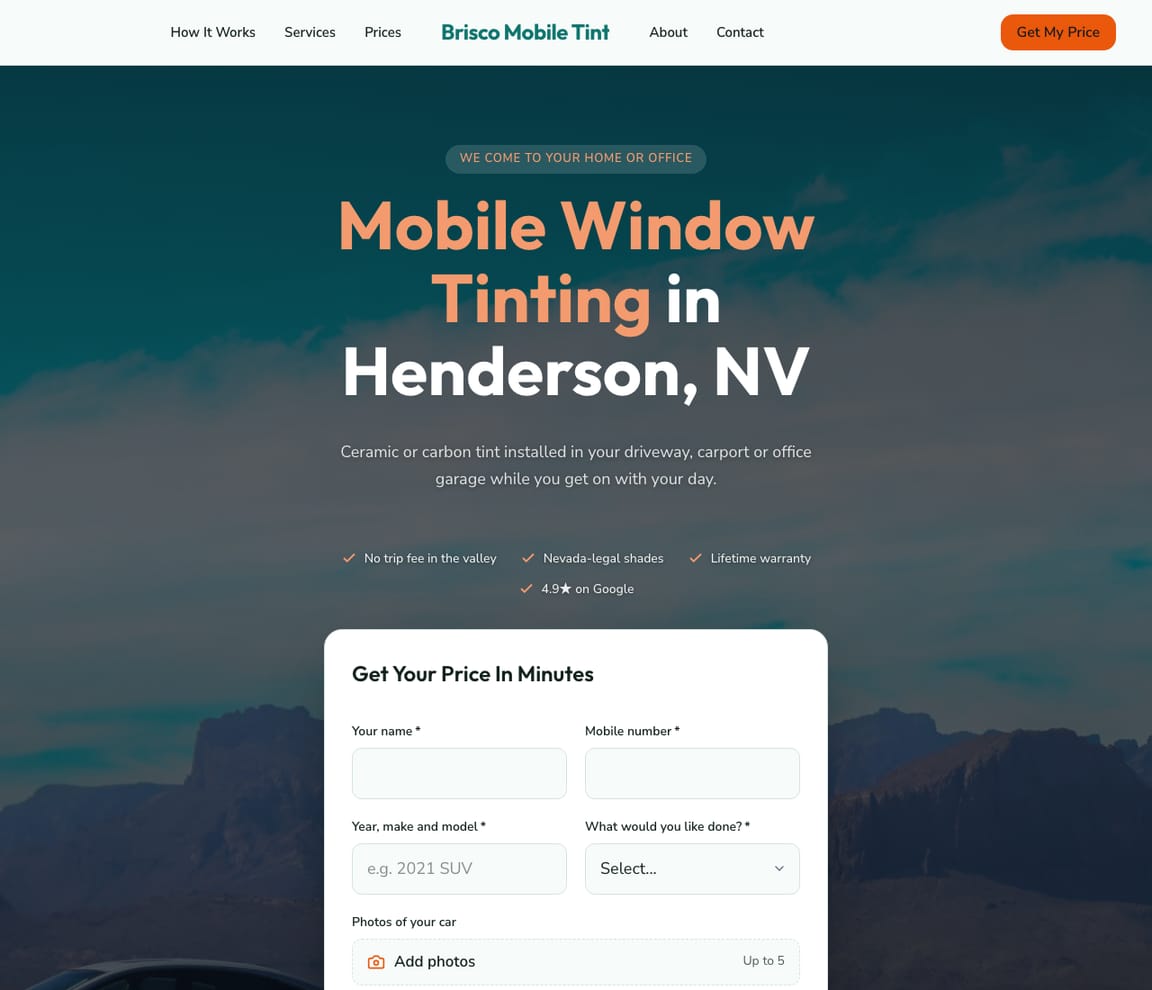
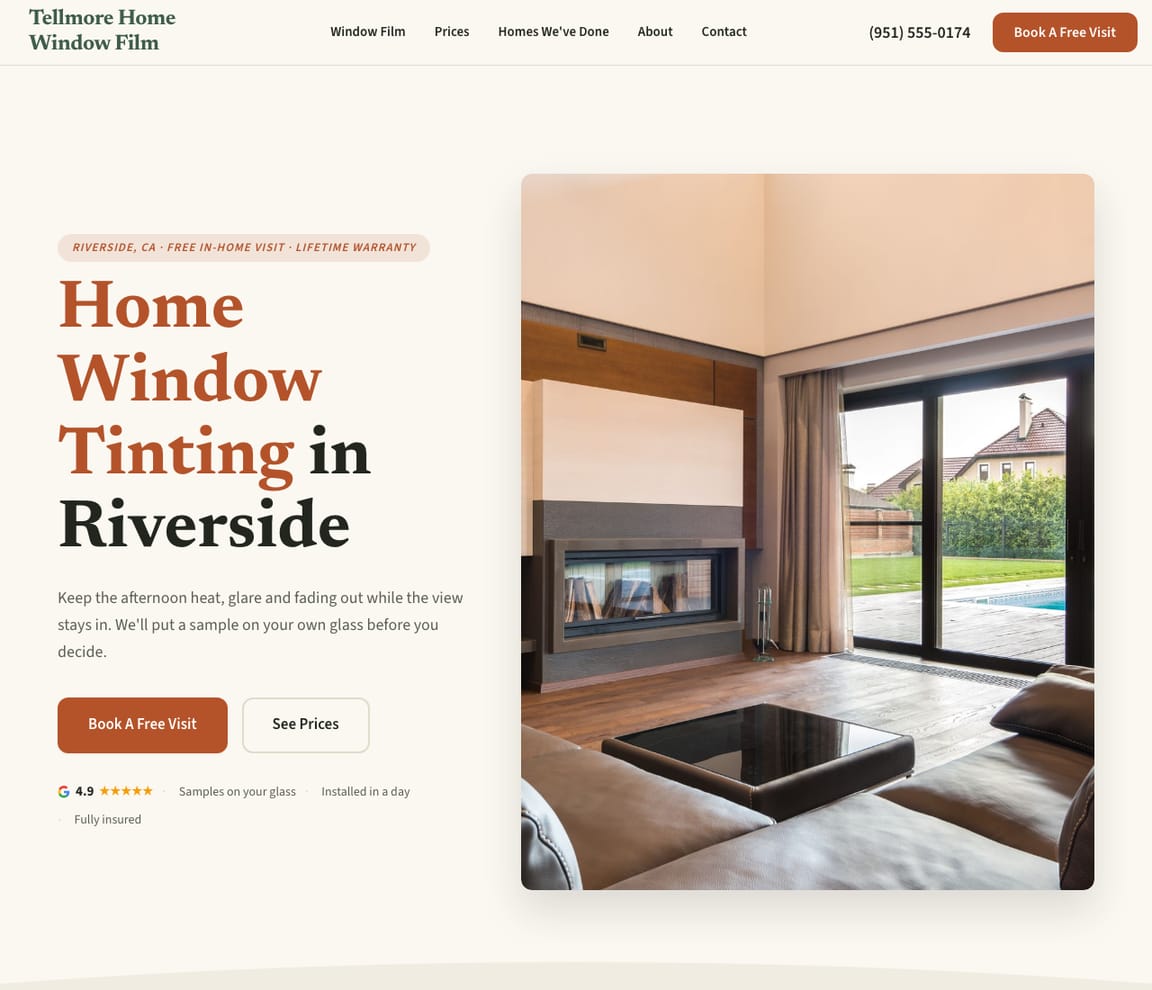
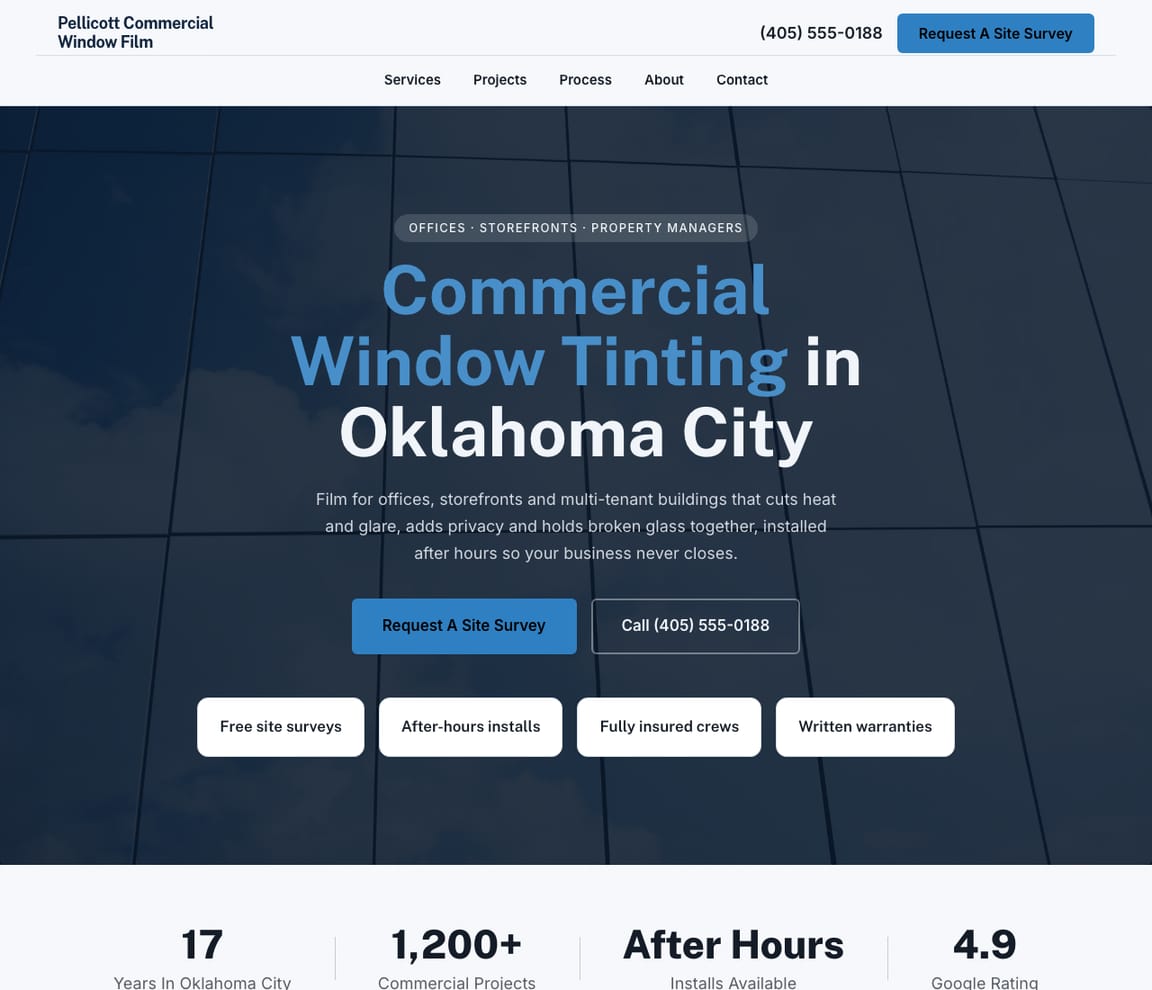
All four are real Zarla templates. Open the one closest to how you'll sell — a ceramic tint shop, mobile tinting, home window film or office and storefront film — swap in your number, your towns and photos of your own work, and publish.
GET FOUND
Get found by the driver searching the price
Most tint customers start with a question — what it costs, how dark is legal, ceramic or carbon — and then compare a few shops nearby. Zarla builds the website with a call button, a service-area map and a quote request form. Add your prices and your state's legal shades in chat, and once you connect your Google Business Profile, your name, map location and reviews stay in step on both.
“Window tinting near me”
Searched by a driver who has just bought a car or sat through a hot commute. Your prices by vehicle, the films you install and a quick way to ask for a quote answer it before they call the next shop.
Google Business Profile
Your hours, your address or the area your van covers, photos of finished cars and windows, and your reviews inside Google Maps. Free, and an afternoon to set up.
Reviews from finished cars
Ask when the customer picks up the keys and sees the car — and send the link that evening. Reviews that mention the film, the shade and the clean edges sell the next job.
Google Search
Llarchmontwindowtint.com
Larchmont Window Tint — Trusted Window tinting in Your AreaCeramic and carbon tint for cars, heat and privacy film for homes and offices. Prices by vehicle, legal shades for our state, lifetime film warranty.← Your Zarla siteCcitywindowtintingservices.com
City Window tinting ServicesGoogle Maps
1
Larchmont Window Tint
← You2
Metro Window tinting Co.
3
Quick Window tinting Services
AI assistants (ChatGPT / Perplexity)
For a local window tinting shop in your area: Larchmont Window Tint — a local window tinting shop with prices by vehicle and film, your state's legal shades, a written warranty, and reviews from drivers nearby.
YOUR LAUNCH PLAN
Your window tinting business launch checklist
The whole guide as things to check off. Work through them in order and you'll be trained, legal, insured, equipped and priced before the first customer calls.
- Take a course and practice — until your edges and rear windows come out clean.
- Read your state's tint statute — legal shades, labels or certificates, medical exemptions.
- Register the business and get a free EIN — and register for sales tax.
- Buy general liability and garagekeepers cover — and workers' comp before you hire.
- Open a film account — starter rolls, tools, and the film's warranty.
- Write your price sheet — by vehicle and film, per square foot for glass, with a minimum.
- Get found — website and Google Business Profile live with your prices and legal shades.
- Call the dealerships near you — and sell home and office film for the slow months.
REAL CUSTOMERS
Small business owners who got online with Zarla
Verified reviews from real Zarla customers.
“Quickly built my website from scratch. No hiccups. Would highly recommend Zarla for someone with no experience who wants to start a polished business website.”
“Great professional website in less than a minute, with the use of AI and a few descriptive prompts. This has saved me bundles of time and research on web developers.”
“I had no idea how to set up a website for my business. Thanks to Zarla, they've helped me a lot.”
“Very reliable, professional, and fast results. I was able to get my business online in no time, and the ease of access made it so simple.”
Be the tint shop they find when they search the price
Add your town and your shop's name, and Zarla builds the website from that one line — a call button at the top, the area you cover on a service-area map and a quote request form. Free to build; you pay when you publish.
Already have a website? Bring it across →Zarla keeps your old page addresses where it can and redirects the ones that change, helping you keep the Google standing you've built.
Frequently asked questions
How much does window tinting cost for a car?
In the US, one film maker's guide (Rayno, updated July 2026) puts a car at $99 to $850 all around: $99 to $350 with dyed film, $150 to $450 with carbon and $350 to $850 with ceramic — about $250 for a sedan in carbon and $650 in ceramic, $120 to $450 for a coupe and $250 to $750 for an SUV. Extras cost more: one California shop charges $80 for a windshield strip, $150 to $380 for a full windshield and $40 to $150 to remove old tint. If you're the shop, put your own prices by vehicle and film on your website — it's the first question every customer asks.
How much does it cost to start a window tinting business?
In the US, about $8,932 to $22,226 for a one-bay shop with one employed installer, in our window tinting business plan's itemized ranges — training, starter film and tools, a year of liability and garagekeepers cover, registration, two months' rent and the first month's pay. A plotter adds $1,599 to $4,495 plus software. A software vendor puts a mobile start at $10,000 to $20,000 with the van, and a built-out facility at $30,000 to $50,000 (2021).
How much does it cost to tint a business window?
Office and storefront film is priced by the square foot installed, like home film. The published cost guides cover homes: most films run $7 to $15 a square foot and ceramic $10 to $20 (HomeAdvisor, June 2026), and another guide puts installed film at $5 to $20 with security film up to $26 a square foot (Fixr, January 2025) — big commercial jobs are quoted per building. Installers measure width times height in inches, divide by 144, add about 15% for waste, and many set a job minimum — around $392 in Fixr's guide.
Can you tint business windows?
Yes — office, storefront and commercial film is its own market, priced by the square foot, and one job can fill several days. Solar control film cuts heat and glare, privacy and decorative film hides a room, and security film holds broken glass together. Check the film maker's glass chart before you quote, and in some states your contractor board: California lists window film under its D-52 window coverings license.
How hard is it to learn to tint?
The basics take days to learn and much longer to get fast and clean. Film makers' courses run two to five days, but owners describe years of practice — one North Carolina shop owner says “you’re not a good car tinter until you’ve got ten years plus experience.” Curved rear windows have to be heat-shrunk to fit, and dust and bubbles show on every job, so practice on scrap glass and your own cars before charging customers. Flat glass for homes and offices is easier to learn than curved car glass.
Do I need a license to tint windows?
In the US, no state we checked licenses window tinting as a trade, so you usually need a business registration, a local business license and insurance. The tint law still binds you: installing film darker than the limit is an offense for the installer in states including Texas, Florida, Louisiana, North Carolina and Minnesota, and Texas, Florida, Louisiana and Washington require a label or sticker on the cars you tint. Some states license film on buildings — California under its D-52 class. Check your state's tint statute, DMV and contractor board before you open.
How profitable is a tinting business?
It can be, because the film is a small part of the price: a 40-inch, 100-foot roll with a tool kit lists at $261.99 in carbon and $531.99 in ceramic at one supplier, against $250 to $650 for a sedan. What erodes it is the installer's time, rent, comebacks, and a slow season — one Orlando co-owner writes that most shops do nearly 80% of their tint jobs from March to August. One Mississippi shop reached $357,000 in sales in 2022, with dealership work keeping the winter going.
How much do window tinters make per car?
A shop's price per car runs from about $250 for a sedan in carbon to about $650 in ceramic (Rayno, updated July 2026); what it keeps is that price less the film, the installer's time and its share of rent and insurance. Dealerships pay less per car in exchange for volume. An employed installer earns about what automotive glass installers do — a 2025 US median of $22.90 an hour (O*NET); no government series counts tinters on their own.
What do I need to start a window tinting business?
Training — a film maker's course or an experienced tinter — then a film account, starter rolls and tools (one supplier lists starter packs with a tool kit at $1,073.59 to $2,282.49), a heat gun, a clean, bright bay or a van, a business registration and EIN, general liability and garagekeepers insurance, and your state's tint law on paper. A plotter and pattern software come later, once the volume pays for them.
How dark can window tint legally be?
It depends on the state and the window. In the US the front side windows run from 70% VLT in states such as California and New York to 20% in New Mexico, with Texas at 25%, Florida at 28% and Arizona at 33%; New Jersey allows no film there, and Louisiana's statute moved from 40% to 25% in 2025. Rear windows are usually looser and windshields take only a strip at the top. Laws change — a 50% bill passed New York's legislature in June 2026 — so check your state's current statute before you set your shades.
Do I need a certification to tint windows?
In the US, no state we checked requires one, but customers, dealers and film makers notice. The International Window Film Association offers four accreditations by exam — $50 for members, $100 for others — and film makers such as 3M, Eastman and XPEL run two- to five-day courses; Geoshield's five-day beginner class is $2,000. SunTek's three-day course is for its dealers' staff. Check your state's rules before you open.
Should I start a mobile tint business or open a shop?
Mobile costs less and takes you to homes and offices — a software vendor for tint shops puts a mobile start at $10,000 to $20,000, van included (2021) — but dust, wind and heat make car work harder outdoors. A bay costs rent and keeps the film clean, and lets dealerships drop cars off. Many owners start mobile or in a small bay and add the other as the work grows.
How do I get customers for a window tinting business?
Answer the question customers search first: put your prices by vehicle and film, your state's legal shades and photos of finished cars on your website and Google Business Profile. Then visit the car dealerships, detailers and body shops near you, ask for a review when customers pick up the keys, and sell home and office film for the slow months. Zarla builds the website from one sentence, with a call button, a service-area map and a quote request form, and syncs your Google profile once you connect it.