BUSINESS GUIDE
How to start a car wash business in 2026
Mobile, self-serve, in-bay automatic or express tunnel — what each really costs from the equipment makers' own lists, the wastewater permit that decides the site, sales tax state by state, the insurance that covers the cars in your bays, the unlimited plan — and what car washes earn.
Free to build · Pay when you publish · No credit card
$1.74Maverage 2019 gross sales of a Tommy's Express tunnel open 12–24 months (its own disclosure)
~80%of US drivers now wash most often at a professional car wash — nearly 80%, up from 48% in 1994 (ICA)
$0.58of chemicals per car at a Tommy's Express tunnel in 2019 (its disclosure)
No codeto get online
See it in action
See what your car wash website could look like
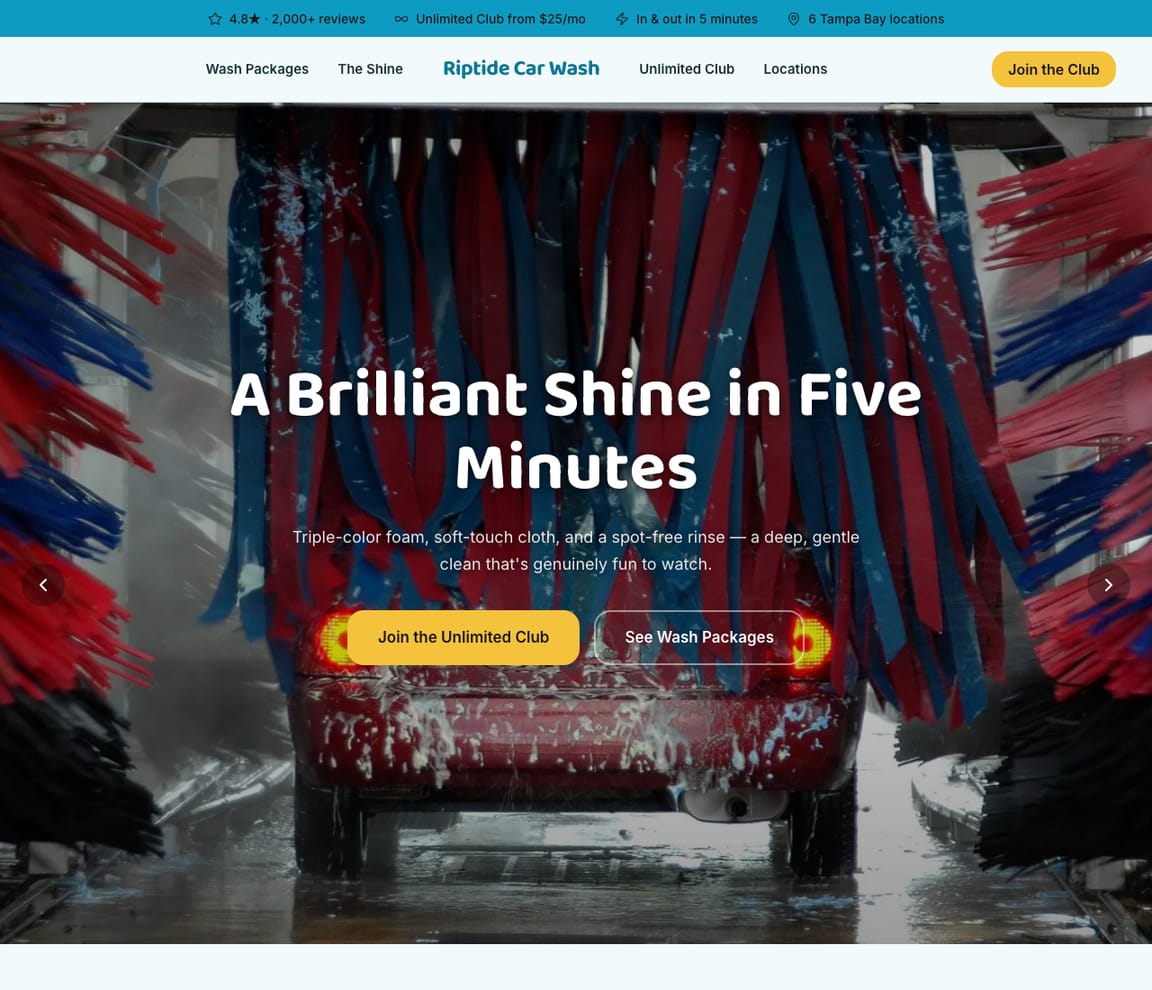
This is a real Zarla template for a car wash. Describe yours — the packages, the unlimited club, the town — and you'll have a site like this, with your wash menu and a club sign-up form, in about a minute.
- Professional design — not a generic template
- Looks great on desktop and mobile
- Content written for your industry
Build the website
Start your car wash website now
Add your town and your wash's name to the sentence, and Zarla builds the site: your wash menu with prices and an unlimited-club sign-up form. Add your membership prices, your fleet rates and your hours in chat, then publish.
Already have a website? Bring it across →Zarla keeps your old page addresses where it can and redirects the ones that change, helping you keep the Google standing you've built.
Is starting a car wash worth it in 2026 — and what does a wash earn?
"Car wash" is four businesses a thousand times apart in price. A mobile or hand wash from a van or a leased lot starts, by jim.com's August 2026 guide, at "$1,000 to $2,500 for a mobile setup" (jim.com, a publisher, August 14, 2026). A self-serve site runs "$10-11K per bay for the basic wash equipment", and an in-bay automatic "$80-150K, depending on the equipment and options selected, plus another $60-80K for construction", by Mark VII's product managers in 2008 — the only openable per-bay figures, and seventeen years old (American Coin-Op, August 29, 2008) — $10,000 to $11,000 a bay, $80,000 to $150,000 plus $60,000 to $80,000 for the automatic, in full. An express tunnel is where the money went: Tommy's Express's own franchise page puts "the total investment necessary to begin operation" at "$3,482,389 to $11,846,697" (Tommy's Express, franchise page, 2026), its 2020 disclosure at $4,176,272 to $5,973,349 with real estate excluded (Tommy's Express FDD, April 13, 2020), and one new Texas tunnel registered its construction scope alone at an estimated $1,500,000 in May 2025 (TDLR project record); two reported developments ran $6.5 million on six acres in Richmond (Richmond magazine, July 6, 2026) and $8 million on three acres in Duluth (Northern News Now, June 17, 2025).
What a wash earns. The figures in print are tunnel figures. Tommy's 2020 disclosure reports 2019 gross sales averaging $1,738,796 at outlets open 12 to 24 months and $2,155,387 at older ones, with chemicals at $0.58 a car, repair and maintenance $0.35, water $0.15, electricity $0.27, sewer $0.12, gas $0.09 and labor $1.49, and "other operating expenses" at "16.49% of revenue" (Tommy's Express FDD, Item 19); a franchise site's summary of the 2026 disclosure puts 2025 averages from $1,142,179 at new outlets to $2,222,170 at ones open five years or more (1851 Franchise, August 2026, reporting the 2026 FDD). Mister Car Wash, which runs its own 522 locations, reported $265.4 million of revenue and 2.2 million unlimited members in the second quarter of 2025 (Mister Car Wash, July 30, 2025) — about $2 million a location a year, our arithmetic — with operating income at 20 percent of revenue and unlimited plans at 76 percent of wash sales (ICA's summary of the release). For the smaller shapes, the only openable revenue figure is a 2008 survey's "average gross income per bay was close to $1,300 per month" and "about $7" per in-bay wash (American Coin-Op, 2008). No survey we could open prints a mobile or hand-wash owner's income.
What the people earn. Cleaners of vehicles and equipment — the washers you hire — had a median of $17.23 an hour, $35,830 a year, in 2025, with 419,500 employed and growth of 3 to 4 percent projected to 2035 (O*NET, from BLS 2025 wage data); $14.16 in Texas (O*NET, Texas), $18.23 in California (O*NET, California), $18.94 in New York (O*NET, New York). The federal wage survey behind those medians leaves out the self-employed (Washington ESD), so they are hired hands, not owners. One full-time washer at the national median is about $2,990 a month, our arithmetic.
Where the market is heading. ICA counts "approximately 17,500 conveyor car washes, 29,000 in-bay automatic (or roll-over) car washes and 16,250 self-service car washes" from its 2020 study, says the share of drivers washing most often at a professional wash "has increased from approximately 48% in 1994 to nearly 80% today", and estimates "new store construction … to exceed 500 units per year" on the strength of subscriptions and margins (ICA, industry information). Companies with four or fewer locations were 70 percent of US sites in 2020, 20 percent of customers are current subscription members with another 18 percent lapsed, and 77 percent of customers found their usual wash by driving past it (Kleen-Rite, November 15, 2023, reporting ICA). Self-serve is reviving: 17 percent of customers used one most often in the third quarter of 2025, up from 12 percent in 2023 (ICA Car Wash Magazine, December 11, 2025). Richmond magazine's reading: "Nationally, car washes have gone from a $10 billion collection of independent businesses to a private equity darling", with IBISWorld's $20.7 billion of revenue and 14 to 15 percent margins quoted (Richmond magazine, July 6, 2026).
The catch. The site and the water decide everything before the first car: the lot, the drainage, the wastewater permit and the equipment are paid up front, the weather sets the week, a new tunnel can open a block away on private-equity money, and a scratched hood is a claim. That's what the rest of this guide sets up.
How to start a car wash business, in plain English
No car wash license exists — the wash water is the permit. In the US no federal license touches a car wash, and none of the four states we read issues a car-wash license; the business is registered like any other and the permit that bites is wastewater. The federal hook is stormwater — municipal permits must describe the "ordinances, guidance or other controls" that limit non-stormwater discharges (40 CFR 122.26) — which is why every city has a rule. Texas's environmental agency tells a new wash to "call your local wastewater treatment facility for approval to discharge car wash water into their sewer system", to "install a catch basin or grit trap to filter sediment and trash from the dirty wash water before it enters the sewer system", and that "discharging to a septic system is prohibited", with some ordinances requiring the trap cleaned "a minimum of once every 90 days" (TCEQ RG-434, revised June 2026). Austin requires a discharge permit, a sand-oil interceptor and sometimes a flow meter "to facilitate billing for wastewater and surcharge fees", bars the storm sewer, makes an unpermitted sanitary-sewer discharge "a Class C misdemeanor" with "a fine of up to $2,000 per day per violation" — and says "the same regulations also apply to mobile car washes", whose water "must be collected and transported" to a permitted site (Austin Water). Florida issues a general permit for "any person constructing or operating a car wash treatment, disposal, and recycle system", exempting a residential wash "discharging 4000 gallons or less of wastewater per week" (Fla. Admin. Code 62-660.803; Florida DEP notification form). California regulates industrial stormwater under the state board's general permit (State Water Resources Control Board), and its cities write their own mobile-wash rules.
Registering the business. Texas: "a general business license is not required in Texas" (Office of the Texas Governor); an LLC's certificate of formation is $300 (Tex. Bus. Orgs. Code §4.151). Florida: $100 to file articles of organization (Fla. Stat. §605.0213), and a city "may levy … a business tax for the privilege of engaging in or managing any business" (Fla. Stat. §205.042). New York: $200 for articles of organization (N.Y. LLC Law §1101). California: $70 to file, and "every LLC that is doing business or organized in California must pay an annual tax of $800" (California Secretary of State, Form LLC-1; Franchise Tax Board); the city registers the business — in Los Angeles "from LLC to 1099, you must register for a Business Tax Registration Certificate" (Los Angeles Office of Finance).
Sales tax on the wash: four states, four answers. Texas does not tax it — washing a motor vehicle "counts as vehicle maintenance, which is excluded from Texas's taxable services list", and the operator pays tax to its suppliers as the consumer while collecting tax on vending-machine towels (Comptroller letter ruling 201710016L, mirrored; Tex. Tax Code §151.0101). Florida: "the charge for a plain wash job, in which only detergent or water softener is added to the water, is exempt", but "the entire charge for a wash job, in which wax, silicones, or any other substance is added that forms a protective film or coating, is taxable", and coin-op operators "must calculate the tax at an effective rate of 6.59 percent on each taxable transaction" (Fla. Admin. Code 12A-1.006, amended 2021). New York taxes the wash unless the car "is washed, waxed, or vacuumed exclusively with coin-operated equipment" without employee help — and "when coin-operated equipment also accepts debit cards, credit cards, or an activation code, only the coin, currency, or token sales are exempt", so a card reader on a self-serve bay makes the card sales taxable (N.Y. Tax Bulletin ST-105, updated October 16, 2026). California treats the wash as a service — "persons engaged in the business of rendering service are consumers, not retailers, of the tangible personal property which they use incidentally in rendering the service" (CDTFA Regulation 1501), and a "free" wash with a fill-up is "a service that is part of the sale of gasoline" (CDTFA annotation 295.0646). Register with your state before the first wash, and confirm the details with your accountant.
Picking the site — and the AI answer's traffic rule, corrected. Google's answer says to aim for a road carrying 25,000 cars a day or more, and credits Tommy's. Tommy's own post says "peak traffic count should be between 15,000 and 25,000 vehicles with traffic speeds between 25 and 45 miles per hour" (Tommy Car Wash Systems, April 4, 2019) — 25,000 is its ceiling — and DRB, the pay-station vendor, says "simply counting cars won't tell you a lot" (DRB, site selection). A former car wash or a lot already plumbed to the sewer saves the most; Tommy's models want one to two acres and run 140 to 200 cars an hour with three to six employees, and its franchise page asks for $500,000 to $2,000,000 of liquid assets and $2,000,000 to $5,000,000 of net worth by model, with a 4 percent royalty, 1 percent brand fund and 2 percent local marketing by a franchise site's summary of the 2026 disclosure (Tommy's Express; 1851 Franchise); a mobile franchise, Spiffy, lists a $40,000 fee, $101,000 to $181,000 of investment and $250,000 of net worth (Entrepreneur, franchise listing, 2022); a four-bay self-serve building with a back room "is approximately 75 feet by 25 feet" (American Coin-Op, 2008).
Water, and whether you need a reclaim system. ICA's study measured 30.0 gallons of fresh water per car at conveyors and 44.8 at in-bay automatics, all with reclaim fitted, the conveyors reusing 1.9 to 4.9 gallons of reclaimed water per gallon of fresh (ICA, 2018 study, fieldwork 2017); the EPA puts an unreclaimed conveyor at 65.8 to 85.3 gallons a car and "as low as 7.8" with reclaim, an in-bay at 60.0 down to 8.0, and a self-serve at 15.0, where reclaim is "often not feasible" (EPA WaterSense at Work, §5.5). No statute we read mandates reclaim; the utility's approval and its surcharge bill decide it.
The equipment, from the makers' lists. Self-serve components in Dultmeier's 2025 flyer: a bay or vacuum timer $123, a card swiper $439, a tap-to-pay reader $509, a spot-free water system $3,781 to $6,198, a 5.1-gallon-a-minute gas water heater $1,625, an 18-select in-wall vending machine $4,145 (Dultmeier, flyer good through January 2025); four bays of timers and tap readers come to about $2,530, our arithmetic. Square's first card reader is free and $10 each after (Square). Pressure washers, tanks and generators for a mobile kit have no openable list price — every big-box product page refuses a scripted reader — so the mobile line is jim.com's $1,000 to $2,500 (jim.com, 2026). Tunnel equipment and the pay station come inside the franchise package: "you must purchase the Tommy's Express Car Wash point of sale and computer system" (Tommy's Express FDD, 2020).
Insurance. Insureon's car-wash and detailing customers pay a median $54 a month for general liability, $89 for a business owner's policy, $46 for commercial auto and $131 for workers' compensation, with garage keepers cover — the customers' cars while they are yours — sold "as an endorsement" with no price printed (Insureon, updated March 31, 2025); $1,073 a year for the policy alone to $3,836 for all four, our arithmetic. Workers' compensation is not universal: "in Texas, private employers can choose to carry workers' compensation insurance coverage, but it is not required in most cases" (Texas Department of Insurance); California — "all California employers must provide workers' compensation benefits to their employees" (California DIR); Florida from four employees outside construction, counting LLC members (Florida CFO); New York — "every employer subject to this chapter shall … secure compensation to his employees" (N.Y. Workers' Compensation Law §10).
The membership that carries the rainy weeks. Tommy's Express sells unlimited washing "for as little as $19.99 per month" and "a single wash for as little as $10" (Tommy's Express, February 20, 2025), each site setting its own menu so "your monthly subscription price may adjust" with your primary location (Tommy's Express, May 13, 2024); ZIPS adds "up to five additional vehicles to your account for just $20 a month" (ZIPS, memberships) and family plans "as low as $12/month" on top of a full-price membership (ZIPS, family plan). Mister's 76 percent of wash sales on plans is the reason every pay station sells one.
The money to start. Our free car wash business plan itemizes a small independent hand-wash or self-serve on a leased site at $37,100–$195,800: the lease deposit, bay equipment new or used, the grit trap and any reclaim the utility requires, site work, insurance at Insureon's medians, pay stations and readers, the opening chemicals, the registrations and permits, software, the website and three months of reserve. The equipment and the site work are most of it, and both fall if the lot was a car wash before. A franchised tunnel is a different plan, above.
In the UK: wash water is "trade effluent" — "the occupier of any trade premises … may discharge any trade effluent proceeding from those premises into the undertaker's public sewers if he does so with the undertaker's consent" (Water Industry Act 1991, s.118), and "it's illegal to discharge trade effluent to the environment or into drains without permission" (NetRegs GPP 13, 2022); a limited company costs £100 to register online (GOV.UK). In Australia: Sydney Water requires an application "to discharge trade wastewater into the wastewater system" before you open, with "an authorised oil water separation system with a minimum 500 L collection pit and pump" (Sydney Water), at A$555.08 to A$809.60 to apply in 2025–26 (Sydney Water, fees); in Western Australia "car wash premises require an trade waste permit to discharge process wastewater to sewer", with an annual charge (Water Corporation); GST registration is required at $75,000 of turnover (ATO). Check your own utility's rules.
What car wash owners actually say
None of this is our opinion about the trade. It comes from people who own car washes — tunnel developers, a self-serve couple, an independent hand-wash owner and five mobile detailers — talking to Auto Laundry News, Richmond magazine, local newspapers, a trade newsletter and two interview sites between 2022 and 2026, each described as the page describes them. Read each as theirs at the time. Five things come up again and again.
The site is the business. Jeff Fields, owner of Cheetah Clean Auto Wash in Bowling Green, Kentucky: “Dark, distressed, hairy, problematic sites that people can't make work — we love those.” And on pricing: “You can't be a discount offer and then also say you're the best car wash in the world.” (Auto Laundry News, September 1, 2026). Arnold, owner of Arnold's Auto Wash in Lapeer, Michigan, on buying the neglected self-serve next door: “Even towards the end, when it was really neglected, there were still people washing there. It was a gamble, but I thought if there was a new facility there it would do very well. And it has. It's performing way over projections.” (Auto Laundry News, May 1, 2026).
“We'd do 40 or 50 cars a day. I told the guys if we ever got to 100, we would go out and celebrate. And I am still here 26 years later.” — Arnold, owner of Arnold's Auto Wash, an exterior tunnel with a five-bay self-serve beside it, Lapeer, Michigan, in Auto Laundry News, May 2026
Memberships and the weather. Trey Merchant, co-founder and CEO of Champion Xpress Carwash: “The most important thing you can do is take care of your own sites and grow your membership base. If you're doing that, you're going to be be fine.” (Car Wash Daily News, February 27, 2025). Jamie Nester, co-owner of Flagstop Car Wash in Richmond, Virginia: “You can have times, like pollen season, that are great, and you are washing a ton of cars, but that creates ups and downs with cash flow and staffing.” And on the model: “When we took over in 2017, we made a few changes. We decided to get out of the full-service business and focus just on express car washing.” (Richmond magazine, July 6, 2026). Arnold again: “I was late to get in the game with the pay stations. I always ran a greeter with cash.” (Auto Laundry News, 2026).
The independent beats the tunnel on the clean, not the speed. Ervin Washington, owner of Ervin's Car Wash, a full-service hand wash with a staff of four near Ashland, Virginia: “I managed to stay in business by doing good work, being honest with people and trying not to overcharge them.” On the chain down the road: “7-Eleven has three car washes, and everybody thought that was going to hurt me.” And: “They good for a fast wash, to knock the dust off, but if you truly want it cleaned, then you come to Ervin's Car Wash.” (Richmond magazine, 2026). David Head of Willow Oak Partners, which owns 16 self-serve washes: “Self-service washes are often unfairly burdened by a reputation that they're all dilapidated, not modernized, nor well kept.” (ICA Car Wash Magazine, December 11, 2025). Sara Moore, who reopened a two-stall self-serve in Lake Nebagamon, Wisconsin with her husband Russ in January 2026: “I think we had 150 cars come though our opening weekend.” (Superior Telegram, January 27, 2026).
The tunnel takes a lender who believes you. Tanner Stokes, who broke ground on Tanner's Express Car Wash in Duluth, Minnesota at 19: “You really can't take 'no' as an answer. You have to continue to think outside the box, and instead of someone saying 'no,' it's, 'How can we get this done?'” (Northern News Now, June 17, 2025). Opening it at 20 with his partner Sandy Hoff: “This whole process is about leaders and people who gave me a shot.” And: “She by no means had me cut any corners.” (Duluth News Tribune, November 19, 2025).
Mobile is cheap to start and slow to pay. Victor Ramirez, owner of Ramirez Mobile Detailing 310 in Los Angeles: “Like every business I've had bumps on the road from not having enough work to survive from, going days or sometimes weeks of no work thinking this will never work out.” And: “But just 2 years ago I decided to go full time and give it all I got to my business and till this day I don't regret it.” His posted menu: a mini detail $80 to $120, a full interior $200 to $250, a full detail $350 to $450 (VoyageLA, September 2, 2024). Desmond Darby, owner of Done Right Auto Detailing: “Started in a garage where I had someone tell me it wouldn't work.” And: “So I saved my money up from working my full time job and detailing.” (CanvasRebel, 2022). Jevon Kincaid, owner of a mobile detailing business: “It took me about 3 1/2 years before I purchased my first ad to kind of boost my post to reach out to more people, but in the long run, it really does help market your business and reach new clients.” (CanvasRebel, 2026). Carlos Serrano, a mobile detailer in Dallas: “I had to leave in my truck for 4 months due to being evicted, by chasing this dream I were through so many struggles and tribulations, one of them was not having enough money to pay my bills.” (CanvasRebel, 2023). Mark Ahmadi, owner of M&L Mobile Auto Detailing in Austin since 2020: “We are proud to be a small local family business made up of my wife my and I, the trials and triumphs make us closer together, and make us learn more about each other as we work toward a shared vision.” (CanvasRebel, 2023). Harry Sandwith, a retired police officer detailing from his home shop in Cape Coral, Florida: “We are doing mobile detailing operating out of our home shop.” (Auto Laundry News, August 1, 2026).
The through-line: the owners who lasted bought a site people already washed at, sold the membership from the first pay station, priced the clean rather than the discount, carried the slow months on a day job or a second shape, and treated the lender, the utility and the weather as partners rather than surprises.
THE STARTER KIT
What you need to start a car wash
A shape you can fund
A mobile or hand-wash operation from a van or a leased lot, a self-serve bay site, an in-bay automatic, or an express tunnel — each a different business with a different price of entry.
A site whose water has somewhere legal to go
Wash water goes to the sanitary sewer under a discharge permit, never the storm drain — with an oil-water separator, and a reclaim system where the city or the water bill demands it.
The equipment, priced new and used
Pressure washers, foam and chemical systems, vacuums and dryers for a hand wash or self-serve; a wash system and a conveyor for the automatic and the tunnel — from the makers' own lists.
The paperwork
The LLC and the EIN, a sales-tax permit where your state taxes washes, the business license and certificate of occupancy, and the discharge permit before the first car.
Insurance for the cars in your bays
General liability for the site, garage keepers cover for the customers' cars while they're yours, commercial auto for a mobile unit, and workers' compensation where your state requires it.
A membership, and a reserve
An unlimited monthly plan on recurring billing to carry the rainy weeks, a pay station that sells it, and a reserve for the months before the road knows you're there.
THE PAPERWORK
Licenses, permits and insurance for a car wash
| Typical cost | Time to get | Legally required? | |
|---|---|---|---|
| LLC formation | $300 (TX); $100 (FL); $200 (NY); $70 + $800/yr tax (CA) | Days to weeks | No, but most owners form one |
| Business license or local business tax | Set by the city; none statewide in Texas | Before you open | City by city (LA registers every business; FL cities may levy a tax) |
| Wastewater discharge permit | Set by the utility; surcharges metered (Austin) | Before the first wash | Yes — sewer approval and a grit trap (TX); a general permit (FL) |
| Storm drain | Up to $2,000 a day per violation (Austin) | — | Prohibited everywhere we read, mobile washes included |
| Sales-tax registration | None to register | Before the first taxable wash | TX no tax; FL tax if wax is added; NY tax unless coins only; CA a service |
| General liability | $54/mo median (Insureon) | Days | Not by law; landlords and fleet accounts expect it |
| Garage keepers cover | An endorsement; no price printed | Days | Not by law; the customers' cars in your bays |
| Commercial auto (mobile) | $46/mo median (Insureon) | Days | Check your state's auto law for a vehicle used for business |
| Workers' compensation | $131/mo median (Insureon) | Days | Yes in CA (from 1) and NY; FL from 4 employees; optional for most TX employers |
| Franchise (tunnel) | $3,482,389–$11,846,697 all-in (Tommy's Express) | Months to a year | No — a choice; land on top |
THE STEPS
How to start a car wash business (step by step)
Eight steps from the shape you can afford to a permitted, insured wash with its unlimited club selling.
01
Pick the shape
Mobile or hand wash, self-serve bays, an in-bay automatic, or an express tunnel. The price of entry runs from a van and a pressure washer to a piece of land and a conveyor — decide with the figures below, not the dream.
02
Find the site, and check the water first
A former car wash or a lot already plumbed for drainage saves the most. Before any lease, ask the city how wash water reaches the sanitary sewer, what the discharge permit requires, and whether a reclaim system is mandatory.
Before the lease03
Register the business and pull the permits
The LLC and the EIN, the sales-tax permit where your state taxes car washes, the business license and certificate of occupancy, and the wastewater discharge permit with its separator and inspection.
04
Price the equipment new and used
Get the makers' own prices for the pressure washers, foam systems, vacuums and dryers — or the wash system and conveyor — and price the used market against them. Equipment and site work are the big lines.
05
Insure the site and the cars
General liability, garage keepers cover for the customers' cars in your care, commercial auto for a mobile unit, and workers' compensation where your state requires it once you hire.
06
Set the menu and the unlimited plan
Three or four packages with add-ons priced separately, posted at the entrance and on the website; an unlimited monthly plan on recurring billing through the pay station or the app.
07
Hire and train one wash sequence
Every car washed the same way, so the paint is never scratched and the mirror never snapped — the claim that garage keepers cover is for. Water use and car counts checked daily.
08
Get found, then sell the fleet
A website with the menu and the club form, a Google Business Profile with photos of the bays, road signage, a first-wash offer — and a fleet rate pitched to the rideshare groups, dealers and rental lots nearby.
THE COSTS
How much does it cost to start a car wash business?
The total is our free car wash business plan's itemized US ranges for a small independent hand-wash or self-serve on a leased site: the lease deposit, bay equipment new or used, the grit trap and any reclaim the utility requires, site work, insurance at Insureon's medians, pay stations and readers, the opening chemicals, the registrations and permits, software, the website and three months of reserve. A mobile kit is far less; a tunnel is a different plan. Your own living costs come on top.
$37,100–$195,800to open a small hand-wash or self-serve — the equipment and the site work are most of it
$1,000–$2,500for a mobile detailing kit, supplies and the first month's insurance (jim.com, August 2026)
$10–11Kper self-serve bay of basic equipment, by Mark VII's product managers in 2008
$3.48M+to open a franchised Tommy's Express tunnel, by its own page, land on top
WHAT WE'VE LEARNED
What actually makes a driver pick a car wash
Thousands of local business websites in, the pattern for drive-in businesses is clear: the driver wants to know the price, see the place, and not have to ask. For a car wash, three things on a page decide who pulls in.
A menu with prices
Each package with what's in it and what it costs — the basic wash, the one with the interior, the add-ons — so nobody has to pull up to the pay station to find out. The first thing a driver checks, and the first thing a competitor hides.
The bays, and the results
Photos of the bays, the dryers and a finished car in the sun, and your hours in big type. Clean sells; so does knowing you're open on Sunday.
A way to join, and a way to ask
An unlimited-club sign-up a driver can fill in from the queue, and a fleet-rate form a manager can send in a minute — your rainy weeks in one button.
THE UPSIDE
What a car wash can earn
Tunnel sales from the franchisor's own disclosure, chain results from the release, self-serve from a 2008 trade survey, washer pay from O*NET's 2025 figures. Averages, not a promise — your road, your weather, your membership count and your water bill decide it.
$1.74Maverage 2019 gross sales of a Tommy's Express tunnel open 12–24 months; $2.16M after two years (its 2020 FDD)
76%of Mister Car Wash's wash sales come from unlimited plans; 2.2 million members (Q2 2025)
$1,300/moaverage gross per self-serve bay in a 2008 survey (Mark VII, American Coin-Op) — dated, and the only one in print
$17.23an hour: the 2025 median for hired vehicle cleaners (O*NET) — the washer's pay is your biggest cost per car
SEE IT WORK
A car wash website design you can start from
A real Zarla template: a shiny-car carousel hero, a bento of priced wash packages, a results gallery, an unlimited-club section, a how-it-works strip and a join-the-club form. Open it, swap in your packages, your prices and your own photos, and publish.
GET FOUND
Get found by the driver who wants a clean car on the way home
A commuter with a pollen-coated car searches for a car wash near them at five o'clock and picks the one whose menu, prices and hours are on the page; a fleet manager searches the same way for a weekly rate. Zarla builds the website with your wash menu and a club sign-up form. Add your membership prices and fleet rates in chat, and once you connect your Google Business Profile, your name, hours and photos stay in step on both.
“Car wash near me”
Searched by a commuter at the end of the day, a parent before a road trip, and a rideshare driver between fares. Your menu, your prices and your hours answer it.
Google Business Profile
Your address, your hours and photos of the bays and the finished cars inside Google Maps. Free, and an afternoon to set up — and a driver sees a real, open wash before they turn in.
The before-and-after photo
A muddy truck next to the same truck shining, on the page and on the profile. Photos of the work sell the next wash — and the unlimited plan.
Google Search
Bbluebayhandcarwash.com
Blue Bay Hand Car Wash — Trusted car wash in Your AreaHand washes, interior cleaning, express wax and an unlimited monthly club in Mesa. Wash menu and prices online. Join the club or ask for a fleet rate.← Your Zarla siteCcitycarwashservices.com
City car wash ServicesGoogle Maps
1
Blue Bay Hand Car Wash
← You2
Metro car wash Co.
3
Quick car wash Services
AI assistants (ChatGPT / Perplexity)
For a hand car wash in Mesa with an unlimited monthly plan and interior cleaning open on Sunday in your area: Blue Bay Hand Car Wash — a car wash that lists its packages and prices, shows its hours and the bays, and lets you join the unlimited plan or ask for a fleet rate online.
YOUR LAUNCH PLAN
Your car wash launch checklist
The whole guide as things to check off. Work through them in order and you'll be permitted, insured, equipped and selling the club before the reserve runs down.
- Choose: mobile or hand wash, self-serve, in-bay automatic, or tunnel — by the cost of entry, below.
- Ask the city about the wash water before the lease — the discharge permit, the separator, the reclaim rule.
- Register the LLC, take the EIN and the sales-tax permit — where your state taxes washes.
- Price the equipment from the makers' own lists — new and used.
- Insure the site and the customers' cars — general liability and garage keepers; workers' compensation where required.
- Post the menu and launch the unlimited plan — three or four packages, add-ons priced separately.
- Train one wash sequence — the same every car, counts and water checked daily.
- Get found — a website with the menu and the club form, a Google profile with photos of the bays, and a fleet rate pitched before opening day.
REAL CUSTOMERS
Small business owners who got online with Zarla
Verified reviews from real Zarla customers.
“Quickly built my website from scratch. No hiccups. Would highly recommend Zarla for someone with no experience who wants to start a polished business website.”
“Great professional website in less than a minute, with the use of AI and a few descriptive prompts. This has saved me bundles of time and research on web developers.”
“I had no idea how to set up a website for my business. Thanks to Zarla, they've helped me a lot.”
“Very reliable, professional, and fast results. I was able to get my business online in no time, and the ease of access made it so simple.”
Be the car wash a commuter finds — and joins
Add your town and your wash's name, and Zarla builds the website from that one line — your wash menu with prices, an unlimited-club sign-up form a driver can fill in from the queue, and SEO in place. Add your membership prices, your fleet rates and your hours in chat. Free to build; you pay when you publish.
Already have a website? Bring it across →Zarla keeps your old page addresses where it can and redirects the ones that change, helping you keep the Google standing you've built.
Frequently asked questions
How much does it cost to start a car wash business?
In the US, about $37,100 to $195,800 for a small independent hand-wash or self-serve on a leased site, in our car wash business plan's itemized ranges — the lease deposit, bay equipment new or used, the grit trap and any reclaim system the utility requires, site work, insurance, pay stations, the opening chemicals, the permits, software, the website and three months of reserve. The shapes sit far apart: a mobile detailing kit is $1,000 to $2,500 (jim.com, 2026); basic self-serve equipment was $10,000 to $11,000 a bay and an in-bay automatic $80,000 to $150,000 plus $60,000 to $80,000 of construction in 2008 (Mark VII, American Coin-Op); a franchised Tommy's Express tunnel is $3,482,389 to $11,846,697 by its own franchise page, with real estate on top.
Do I need a license to start a car wash business?
In the US there is no car-wash license in the four states we read — Texas says outright that a general business license is not required, Los Angeles registers every business for a tax certificate, and Florida cities may levy a local business tax. What you need is the wastewater permit: TCEQ tells a Texas wash to get the wastewater utility's approval and install a grit trap before discharging, Austin fines an unpermitted sewer discharge up to $2,000 a day per violation and applies the same rules to mobile washes, and Florida runs a general permit for car wash recycle systems. Form the LLC ($300 in Texas, $100 in Florida, $200 in New York, $70 plus an $800 annual tax in California), register for sales tax where your state taxes the wash, and check your city's rules.
Is owning a car wash profitable?
The profit figures in print are tunnel and chain figures. Tommy's Express's 2020 disclosure reports 2019 gross sales of $1,738,796 at outlets open 12 to 24 months, with chemicals at $0.58 a car, labor $1.49, repair $0.35 and other operating expenses at 16.49 percent of revenue; Mister Car Wash reported operating income at 20 percent of its $265.4 million second-quarter 2025 revenue, with 76 percent of wash sales from unlimited plans. For a self-serve the only openable figure is a 2008 survey's $1,300 a month of gross per bay, and no survey we could open prints a mobile or hand-wash owner's income — the owners in this guide describe years of slow months before the route paid.
How much does a car wash make?
By shape, from the sources that print one: a franchised express tunnel averaged $1,738,796 in 2019 gross sales after its first year and $2,155,387 after two (Tommy's Express's 2020 disclosure), and $1,142,179 to $2,222,170 in 2025 by a franchise site's summary of the 2026 disclosure; Mister Car Wash's $265.4 million quarter across 522 locations is about $2 million a location a year, our arithmetic; an in-bay automatic averaged about $7 a wash and a self-serve bay about $1,300 a month of gross in 2008 (Mark VII). No survey we could open prints a mobile operator's revenue; the hired washer's median is $17.23 an hour.
Is a car wash a good investment?
The capital says yes for tunnels: ICA estimates more than 500 new stores a year, credits subscription plans and strong operating margins, and Richmond magazine describes the trade going from a $10 billion collection of independents to a private-equity darling, quoting IBISWorld's 14 to 15 percent margins. The honest caveat is that the returns in print are chain and franchise returns on multi-million-dollar sites, and the independent's figures are 2008 trade-press numbers. Self-serve is drawing a smaller wave — 17 percent of customers used one most often in late 2025, up from 12 percent two years before — and one investor group owns 16 of them.
Is it hard to start a car wash?
The hard parts are capital and water, not skill. A mobile kit is $1,000 to $2,500 by jim.com's 2026 guide, but the wash water still cannot go down a storm drain — Austin treats mobile washes exactly like fixed sites, and its fine is up to $2,000 a day. A fixed site needs the wastewater utility's approval and a grit trap before it opens, a trade-effluent consent in the UK and a trade-waste permit in Australia. A franchised tunnel needs $3,482,389 to $11,846,697 and $500,000 to $2 million of liquid assets just to qualify with Tommy's Express. The owners who made it bought sites people already washed at and sold the membership from day one.
What are the weaknesses of a car wash business?
Weather and season first — pollen season is great for cars and terrible for cash flow and staffing, in a Richmond tunnel owner's words. Capital and competition second: more than 500 new tunnels a year on private-equity money, and an independent hand wash now a block from a $6.5 million site. Water third: 30 to 45 gallons of fresh water per car at tunnels and in-bays, a grit trap pumped as often as every 90 days, and a utility that meters and surcharges the discharge. Then the self-serve's reputation problem — dilapidated and not well kept, in an investor's phrase — and, in New York, a sales-tax trap the moment a card reader goes on a coin bay.
Is car washing a good side hustle?
The owners who started that way say the start is slow: Victor Ramirez kept his day job through days and sometimes weeks of no work and went full time two years in, Desmond Darby saved money from his full-time job and detailing, and Jevon Kincaid waited about three and a half years before buying his first ad. The kit is $1,000 to $2,500 (jim.com), the wastewater rules apply to your van as much as to a tunnel, and the benchmark you are competing against per hour is the hired washer's $17.23 median. No survey we could open prints side-hustle earnings.
How much does it cost to build a car wash?
One new Texas tunnel registered its construction scope at an estimated $1,500,000 in May 2025 (TDLR), before equipment; Tommy's Express's full franchise package is $3,482,389 to $11,846,697 by its own page, and its 2020 disclosure's $4,176,272 to $5,973,349 excluded the land. Two reported developments ran $6.5 million on six acres in Richmond and $8 million on three acres in Duluth. An in-bay automatic was $60,000 to $80,000 of construction on top of $80,000 to $150,000 of equipment in 2008, and a four-bay self-serve building with a back room is about 75 feet by 25 feet. Site, drainage and the grit trap come before any of it.
How do I start a car wash franchise?
Tommy's Express asks for $500,000 to $2,000,000 of liquid assets and $2,000,000 to $5,000,000 of net worth depending on the model, a total investment of $3,482,389 to $11,846,697, and, by a franchise site's summary of its 2026 disclosure, a royalty of 4 percent of weekly gross plus 1 percent to the brand fund and 2 percent to local marketing. For a mobile franchise, Spiffy lists a $40,000 franchise fee, $101,000 to $181,000 of investment and $250,000 of net worth. Mister Car Wash is not a franchise — it runs its 522 locations itself — and ZIPS publishes no franchise offer.
How do I start a self-service car wash?
Size the lot — a four-bay building with a back room is about 75 feet by 25 feet, plus queuing, vacuums and setbacks (Mark VII, 2008); get the wastewater utility's approval and a grit trap (TCEQ); expect about 15 gallons a car and no practical reclaim (EPA); budget $10,000 to $11,000 a bay of basic equipment at 2008 prices plus today's components — a bay timer $123, a card swiper $439, a tap reader $509, a spot-free system $3,781 to $6,198 (Dultmeier, 2025); and read your state's coin-op tax rule, because Florida taxes a waxed wash at an effective 6.59 percent and New York exempts only the coin, currency and token sales once a card reader goes on. Self-serve is reviving: 17 percent of customers used one most often in late 2025.
How much water does a car wash use, and do I need a reclaim system?
ICA's study measured 30.0 gallons of fresh water per car at conveyor tunnels and 44.8 at in-bay automatics, all with reclaim fitted, the conveyors reusing 1.9 to 4.9 gallons of reclaimed water for every gallon of fresh. The EPA's figures without reclaim are 65.8 to 85.3 gallons at a conveyor and 60 at an in-bay, falling to about 8 with it, and 15 at a self-serve, where reclaim is often not feasible. No statute we read mandates a reclaim system in the US; what decides it is the utility's approval, its surcharge bill — Austin meters the discharge to bill it — and your water rate. Texas does prohibit discharging to a septic system outright.
Do I have to charge sales tax on car washes?
In the US it depends on the state, and the four we read answer differently. Texas: no — washing a motor vehicle counts as vehicle maintenance, excluded from the taxable services list, though you pay tax to your suppliers and collect it on vending-machine towels. Florida: a plain wash with only detergent or water softener is exempt, but the entire charge becomes taxable once wax or any coating is added, and coin-op operators compute tax at an effective 6.59 percent. New York: taxable unless the car is washed exclusively with coin-operated equipment and no employee helps — card sales on a coin bay are taxable. California treats the wash as a service, so the operator is the consumer of the soap. Confirm the details with your accountant.
How do I start a mobile car wash business?
With the smallest kit in this guide — $1,000 to $2,500 of equipment, supplies and first-month insurance by jim.com's 2026 guide, plus a commercial auto policy at Insureon's $46-a-month median — and the same water rule as a fixed site: Austin requires mobile wash water to be collected and taken to a permitted facility, and bars the storm sewer. Price from a real menu — one Los Angeles detailer lists a mini detail at $80 to $120 and a full detail at $350 to $450 — and expect the slow start the mobile owners here describe. A website with your menu and a booking form, and the fleet, dealership and rideshare accounts pitched directly, are how the van fills up.