BUSINESS GUIDE
How to start a dog grooming business in 2026
The real version, written for a groomer going out on their own: a home salon, a storefront or a van, the equipment, the licenses a few states require, what it costs, what a groom pays — and how to fill a book of regulars who come back every few weeks.
Free to build · Pay when you publish · No credit card
172,000+pet-care businesses in the US, 2023 — groomers, boarders and sitters (Census)
$14.3BAmericans spent on pet services such as grooming and boarding in 2025 (APPA)
$35,360median pay for animal caretakers, the occupation groomers are counted in, 2025 (O*NET)
No codeto get online
See it in action
See what your grooming website could look like
This is a real Zarla template for a dog groomer. Describe your business — salon or mobile, the services you offer, the area you cover — and you'll have a site like this, with your services, room for before-and-after photos and a way for pet parents to get in touch, in about a minute.
- Professional design — not a generic template
- Looks great on desktop and mobile
- Content written for your industry
Build the website
Start your grooming website now
Add your town and your business name to the sentence, and Zarla builds the site: your grooming services, the area you cover, an inquiry form and a map. Add your prices by size, your vaccination rules and online booking in chat, and publish.
Already have a website? Bring it across →Zarla keeps your old page addresses where it can and redirects the ones that change, helping you keep the Google standing you've built.
Is a dog grooming business worth starting?
The demand is steady and it comes back every few weeks. Americans spent $14.3 billion on pet services such as boarding, grooming, training and pet sitting in 2025, out of $158 billion spent on pets in all (American Pet Products Association). The Census Bureau counted 25,551 pet-care businesses with employees in 2023 — groomers, boarders, sitters and trainers — and 146,763 more run by one person with no staff (County Business Patterns 2023, Nonemployer Statistics 2023, industry 812910). O*NET's outlook for animal caretakers through 2035 is “much faster than average” — 7% growth or higher (O*NET, from BLS data).
The hard part is the body and the book. Owners describe salons booked months out because there aren't enough groomers, and the work itself as very physical — the reason to protect your back with the right table from day one. Most solo pet-care businesses are small: the 146,763 of them took in about $24,700 each on average in 2023, and 72% took in under $25,000, so many are part time (Census, 2023). Equipment is not cheap — a professional stainless tub runs about $730 to $1,850 on sale (Flying Pig, 2026), with premium walk-in tubs to about $4,100 (PetLift), and a hydraulic or electric table $1,229 to $2,195 (PetLift). A mobile business is the costly route: one startup guide puts a van with its build-out at $25,000 to $100,000 (Teddy, September 2026), and a new turnkey grooming van starts at around $115,000 (Hanvey).
On the other side, the price of a groom is real money. The average US groom costs about $85 — about $62 for a small dog, $77 for a medium one, $95 for a large one and $120 for a giant breed (Bark, 2026) — and mobile groomers typically charge $15 to $25 more than a salon (PetCareBooker, January 2025). Insurance is modest: Insureon's median for pet groomers is $50 a month for general liability, or $598 a year — $65 a month for mobile groomers, whose commercial auto runs about $245 a month at the median (Insureon, Insureon mobile) — and one specialist pet-care insurer starts at about $295 a year (Pet Care Insurance). For comparison, the median animal caretaker earned $35,360 in 2025 (O*NET, from BLS data) — more in the District of Columbia ($44,210), Washington ($40,570), Hawaii ($40,130) and Massachusetts ($39,650) (O*NET's state pages: DC, WA, HI, MA) — roughly what you'd pay a bather or a groomer on staff.
So it's worth starting if you can groom any coat and calm any dog, your body can take the work, and you'll treat rebooking as the business — which is what the rest of this guide sets up.
How to start a dog grooming business, in plain English
Do you need a license to open a dog grooming business? In most of the US, not a license for you as a groomer — but often one for the shop or the van. Connecticut and Colorado license grooming facilities, mobile vans included; New York City requires a grooming permit; and your city sets the business license and, for a home salon, the zoning. The details, place by place, are below; check your state's agriculture department and your city before you sign a lease.
In the US there's no federal grooming license, and on the state lists we read there's no license for the groomer — we read the lists rather than taking anyone's word for it. The Texas Department of Licensing and Regulation's program list runs from air conditioning contractors to weather modification; it licenses breeders, and the words “groom” and “pet” appear nowhere on it (TDLR). California's Department of Consumer Affairs lists its boards from Accountancy to Vocational Nursing — a Veterinary Medical Board, no board for groomers (California DCA). Washington State's Department of Licensing lists its professional licenses — 105 of them when we read it on 27 Oct 2026 — none for groomers (Washington DOL). Colorado's $350 independent-contractor groomer card is the one state groomer license we found; we didn't read all fifty, so check your state. What's regulated is the place you groom, by a few states and by your city. Four examples of the state layer:
- Connecticut requires a grooming facility license from its Department of Agriculture — $200, good until the second December 31 after it's issued, with the town's zoning sign-off — and since 2024 the definition of a grooming facility includes “any vehicle or trailer,” so vans need one too (Conn. Gen. Stat. §22-327 and §22-344).
- Colorado licenses grooming facilities under its Pet Animal Care Facilities Act, mobile groomers included: $400 a year for a facility, $350 for an independent-contractor groomer, renewed between January 1 and March 1 (Colorado Department of Agriculture).
- Illinois licenses pet shops, kennel operators, dog day care operators and other animal-care facilities, with a $350 application fee for each license type (Illinois Department of Agriculture) — groomers aren't on its list, but a salon that also boards dogs or runs day care needs the matching license; confirm with the state's animal welfare bureau.
- New Jersey has debated licensing groomers themselves since a Shih Tzu named Bijou died at a salon — “Bijou's Law” (New Jersey Senate, 2018) — and it has been reintroduced without passing.
Cities and counties set most of the rules you'll actually meet:
- New York City requires a Small Animal Grooming Establishment Permit — $30, or $15 if filed in the second half of the year, and more if animals stay overnight — and a manager who has passed an Animal Care and Handling Course before you open (NYC Business).
- Los Angeles County bans tethering dogs with nooses or prong collars, requires a dog in a cage dryer to be checked at least every 15 minutes, and won't let a groomer work unsupervised without certification, grooming school plus a year's experience, or a one-year apprenticeship (LA County Animal Care and Control).
- Home salons depend on zoning: Anne Arundel County, Maryland, made pet grooming a conditional home occupation in July 2025 (Anne Arundel County Council), while King County, Washington, says most pet businesses can't run as a home occupation at all (King County).
- Mobile groomers are cited most for wash water: cities in Santa Barbara County, California, require it to go to the sanitary sewer — never the street, the gutter or a storm drain (Santa Barbara County mobile groomer guide).
Two more rules worth knowing. In Virginia, a groomer must get emergency vet care for a dog hurt in their custody, and pay for it when the injury came from their care (Va. Code §3.2-6518). And a few states tax pet grooming itself as a service — Iowa lists it among its taxable services (Iowa Department of Revenue). The EIN from the IRS is free (IRS). Certification is voluntary — IPG's first Certified Professional Groomer package is $425, or $225 down and $200 six weeks later (IPG) — and grooming school runs from $2,058 for an 8-week Missouri program (MidMo Dogs) to $6,998 for a 4-week school in Pennsylvania (Dog Grooming School of Pennsylvania).
In the UK: there's no license to groom. The National Careers Service's routes in are college courses, a Level 2 dog grooming apprenticeship, learning on the job as an assistant, or a private course accredited by the Pet Industry Federation, with pay listed from £15,000 starting to £23,000 experienced (National Careers Service); England's animal-activities licensing rules cover dog breeding, pet selling, hiring out horses, boarding for dogs and cats, home boarding, dog day care and keeping or training animals for exhibition — grooming isn't on the list (GOV.UK); and you “must register for Self Assessment as a sole trader if you earn more than £1,000 in a tax year” (GOV.UK). In Australia: we found no state groomer license either, but New South Wales has a mandatory code: “You must comply with this code if you intend to operate a pet grooming or bathing establishment” — the Animal Welfare Code of Practice No 8, under the Prevention of Cruelty to Animals Act 1979, covering the animal “from the time of accepting control of the animal from the owner, during holding, and until return to the owner” (business.gov.au). Other states and countries differ — check your local rules.
From there the order is the same everywhere: get the skill, choose your model, check your state and city, set up and insure the business, fit out the space or the van, write your prices and policies, and get found. Our free dog grooming business plan lays out every startup line with typical costs, the dog grooming website templates and dog grooming website examples show what a good site looks like, and Zarla's dog groomer website builder is how pet parents find you.
What dog groomers actually say
None of this is our opinion about grooming. It comes from salon and mobile owners speaking to reporters and the trade press. Three things come up again and again, and only one of them is about scissors.
There aren't enough groomers, so regulars rebook. Paula Phillips, who owns Shamrock Dog Grooming in Pittsfield, Massachusetts, books three to four months ahead, with clients rebooking at the end of each visit: “The reason they do that is because they know that if they don't, the chance is they won't get in for a long time.” And: “I have a business that could have two or three groomers, but I can't find anybody” (The Berkshire Edge, June 2025). Carol Terry of Hair of the Dog Pet Grooming, in the same county: “Grooming is a very hard thing to do, it's very hard on the body, and people feel it, a lot” (The Berkshire Edge).
“We usually groom about four to five dogs per day per groomer… It's not about doing as many as possible, it's about doing it right.” — Andrea of Jazzy Pawz, a cage-free salon in Atlanta that she started in her apartment, speaking to Groomer to Groomer in June 2026
Mobile is one dog at a time — and one van. Donielle Hart, who has run a storefront and a home salon, now runs Pawsh Paws Mobile Spa in Shiawassee County, Michigan: “There's no interruptions… For me, this was kind of a no-brainer in being able to give those types of dogs peace of mind and truly have that one-on-one experience.” She is blunt about the trade's open door: “Anybody can pick up a pair of clippers and say they're a groomer, and I find that's a problem” (The Argus-Press, August 2026). Robin Mallory of Wash & Wag in Great Barrington, Massachusetts, started with a van: “Everybody thought we had a fleet, but it was just one van” — until a costly mechanical problem sent them looking for another option, and Wash & Wag is a storefront today (The Berkshire Edge).
Price by the dog, and watch your costs. Kathryn Simard, a Missouri groomer, prices in units rather than breeds — “Six units: Doodles, no matter their size or coat” — and adds, “I like to do 14-20 units a day, but I'm old and expensive” (Groomer to Groomer, July 2023). Alli McDonough, who is closing one of her two Fido & Stitch locations in Michigan, describes the squeeze: “People are seeing us less, you know, we're getting less customers… They're starting to groom at home because of rising costs” (WOOD TV8, October 2026).
The through-line: the groomers who last protect their bodies, price every dog by the work it takes, rebook every client before they leave, and are easy for a new pet parent to find and trust.
THE STARTER KIT
What you need to start a dog grooming business
Grooming skill, learned under someone
Most groomers learn the trade under an experienced one, through a grooming school or an apprenticeship. Clients pay for the cut — and for a dog that comes home safe and calm.
A place to groom
A room at home where zoning allows, a rented room or salon suite, a small storefront, or a van. Each needs hot water, drainage with a hair trap and somewhere the wash water can legally go.
The tub, the table and the dryer
A professional tub, a sturdy table — a hydraulic or electric one saves your back — a high-velocity dryer, clippers, blades and shears, plus kennels once you're busy.
Insurance with animal bailee cover
General liability, plus animal bailee cover for the dogs in your care. A standard policy excludes them, and a cut ear or a fall from the table is the claim every groomer fears.
A price list and your policies
Prices by size and coat, a matting and behavior surcharge, vaccination rules, cancellations and late pickups — written down before the first dog.
A way for pet parents to find you
A website with your services, prices and photos, and a Google Business Profile with reviews — where a new client looks before they trust you with their dog.
THE PAPERWORK
Licenses, permits and insurance for a dog grooming business
| Typical cost | Time to get | Legally required? | |
|---|---|---|---|
| State license for the groomer | $350 a year (Colorado, independent-contractor groomer only) | Weeks | Not on the state lists we read (TX, CA, WA); Colorado licenses a contractor groomer |
| State grooming facility license | $200 (CT, 2 yrs); $400/yr (CO) | Weeks, with an inspection | In a few states — vans too in CT and CO |
| City business license or grooming permit | NYC permit $15–$70; varies | Days to weeks | In most cities |
| Home-occupation or zoning approval | Varies by city | Weeks | For a home salon, where allowed at all |
| Wash-water disposal (mobile) | Low | Days | Yes, where stormwater rules apply |
| EIN from the IRS | Free | Minutes online | If you hire or have partners; optional when solo |
| General liability with animal bailee cover | $50/month median ($65 mobile) | Same day | No — but it's the cover that pays for an injured dog |
| Commercial auto (mobile van) | About $245/month median | Days | Yes, for a business vehicle |
| Grooming certification | $425 (IPG, first step) | Weeks to months | No — voluntary, except LA County's supervision rule |
| Sales tax registration | Free in most states | Days | If you sell products, or your state taxes grooming |
THE STEPS
How to start a dog grooming business (step by step)
Seven steps from “I want my own clients” to a book of regulars.
01
Get the skill first
Learn under an experienced groomer, at a grooming school or through an apprenticeship, and groom for someone else long enough to handle any coat and any temperament.
02
Choose home, storefront or van
A home salon is cheapest where zoning allows it; a storefront or salon suite adds rent and room to hire; a van charges more per dog but grooms fewer and costs the most to start.
03
Check your state and your city
On the state lists we read, none licenses the employed groomer, but Colorado and Iowa license the grooming shop or van and Colorado a contractor groomer, and your city sets the business license, the zoning and the wash-water rules.
Before you sign a lease04
Set up and insure the business
Register the business, get a free EIN from the IRS, open a business bank account, and buy liability insurance with animal bailee cover.
05
Fit out the space or the van
Install the tub with hot water and a hair trap, the table, the dryers and the kennels, and plan ventilation and washable floors.
06
Write your prices and policies
Price by size and coat, put the matting and behavior surcharge in writing, and set your vaccination, cancellation and pickup rules.
07
Get found and rebook everyone
Put your website and Google Business Profile live, introduce yourself to local vets, walkers and trainers, and book every client's next groom before they leave.
THE COSTS
How much does it cost to start a dog grooming business?
The total is our free dog grooming business plan's itemized US ranges for one groomer in a small salon: equipment, the space, insurance, licenses, opening supplies, registration, booking software, signage and a few months of working capital. A van replaces the space line. Equipment prices are Flying Pig's and PetLift's 2026 lists; van prices are Teddy's 2026 startup guide and Hanvey's turnkey prices.
$9k–$53kto open a one-groomer salon, all in — less in a home salon where zoning allows
$730–$1,850a professional stainless grooming tub; premium brands run to about $4,100
$25k–$100ka mobile grooming van with its build-out, in one 2026 startup guide; new turnkey vans start near $115k
$598/yrmedian general liability premium for a pet groomer; $780 for mobile groomers
WHAT WE'VE LEARNED
What actually makes a pet parent book a groom
Thousands of small business websites in, the pattern for pet services is clear: the owner is deciding who to trust with their dog. Three things on a page decide it.
Prices by size and coat
Small, medium, large and doodle, with the matting and behavior policy written down. Owners compare prices before they call, and a clear list saves an argument at pickup.
Before-and-after photos
Real dogs you've groomed, especially the breeds you're good with. A photo of a doodle with a round face does more than any sentence about your skills.
An easy way to book — and rebook
A clear way to ask for an appointment, your vaccination rules, and the next groom booked before the dog goes home. Regulars are the business.
THE UPSIDE
What a dog grooming business can earn
Groom prices from Bark's 2026 US price guide and PetCareBooker's January 2025 guide; dogs per day from a cage-free salon owner in the trade press; pay from O*NET's 2025 median for animal caretakers (Bureau of Labor Statistics data). Industry figures, not a promise — your prices, your dogs per day and how many clients rebook decide it.
$85average price of a dog groom in the US — $62 small to $120 giant
+$15–$25what mobile groomers typically charge on top of the salon price
4–5 dogsa day per groomer at a one-on-one salon that grooms them right
$35,360median pay for animal caretakers — what a bather or staff groomer expects
SEE IT WORK
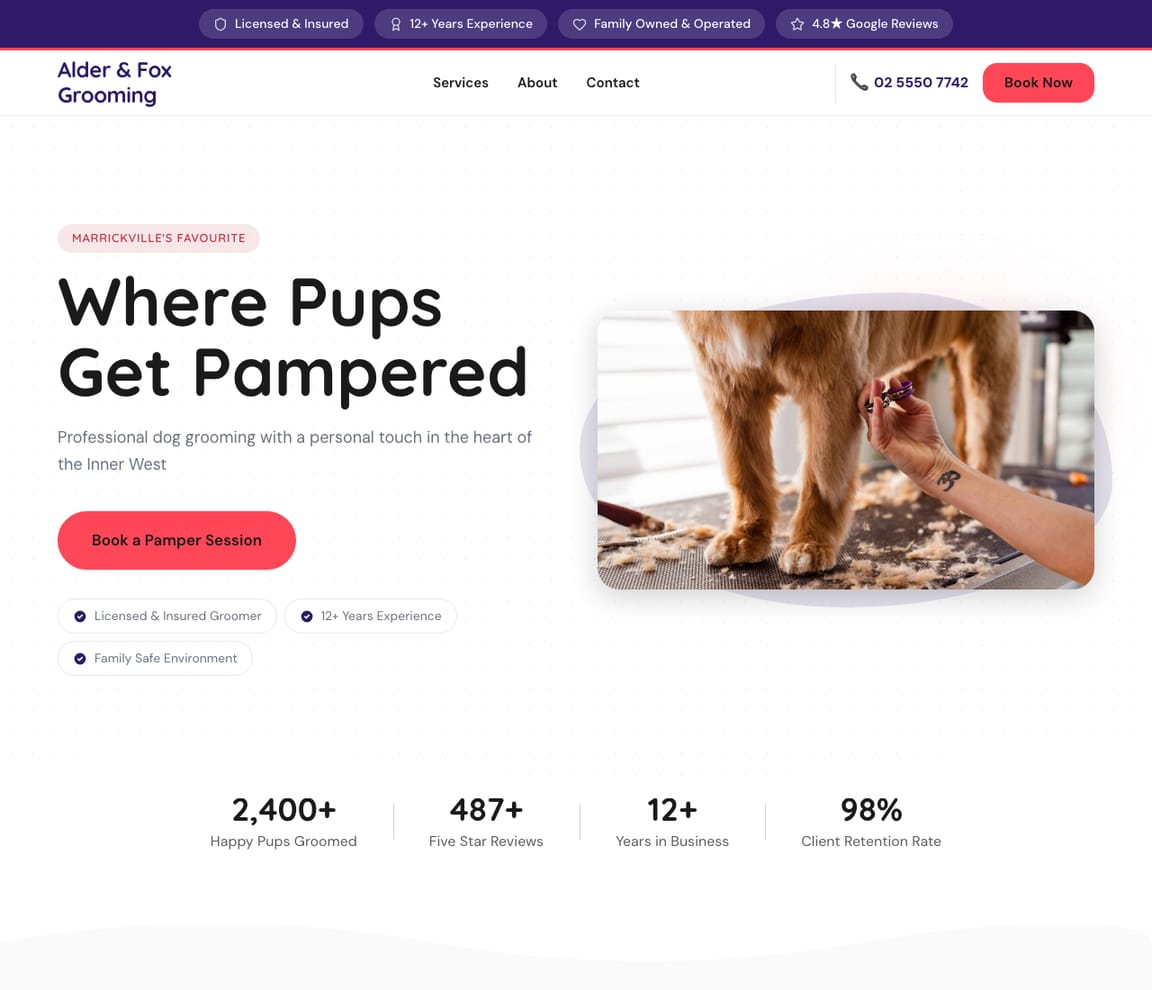
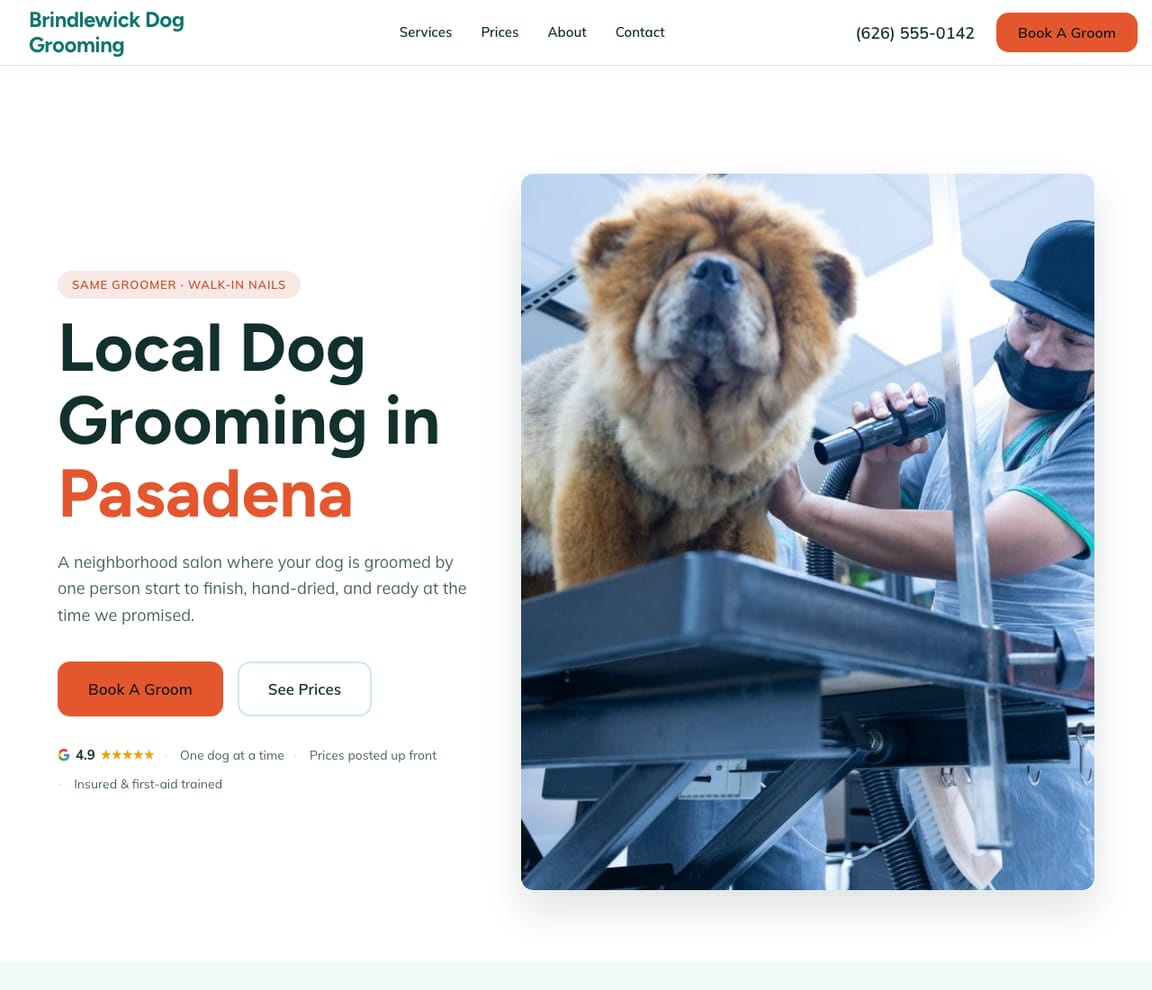
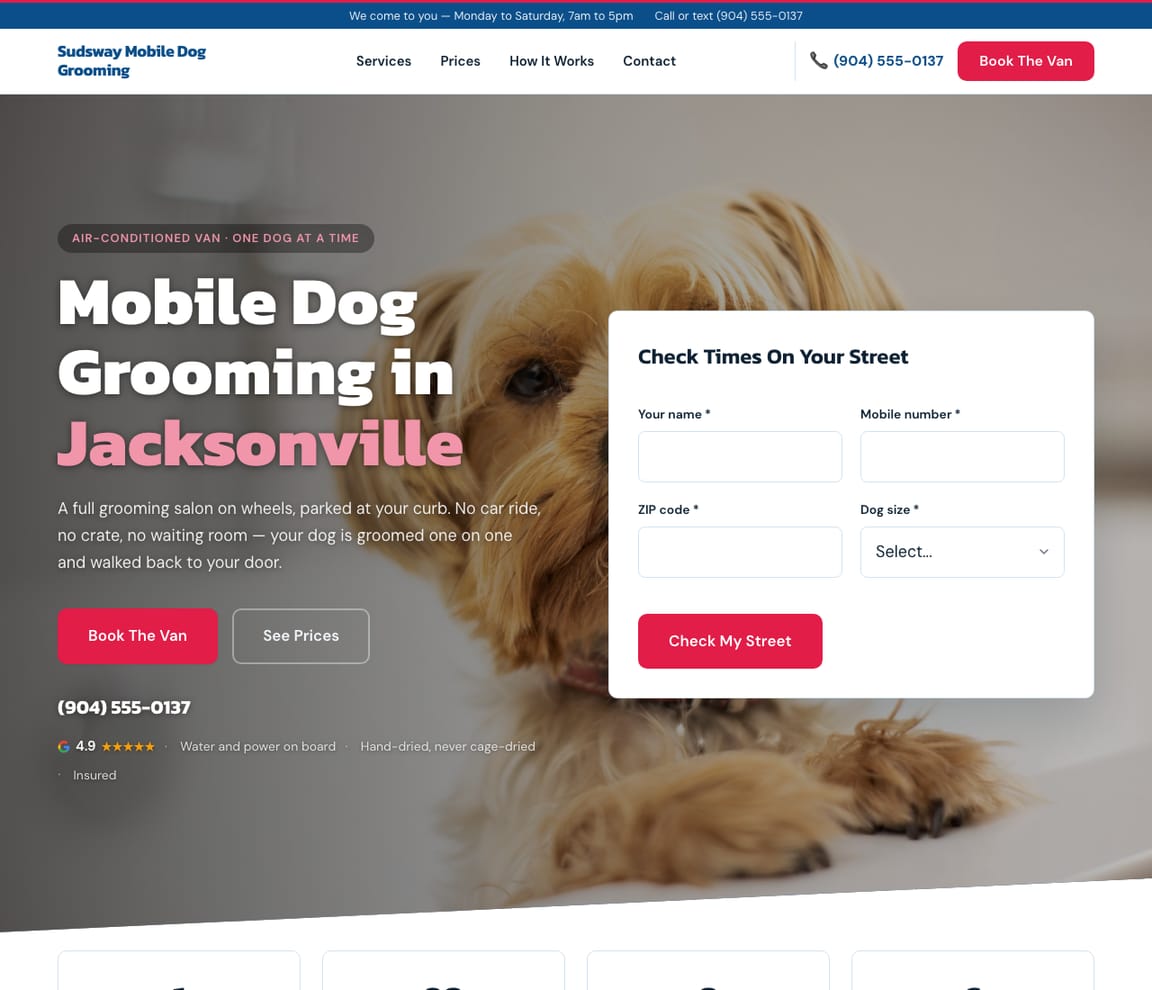
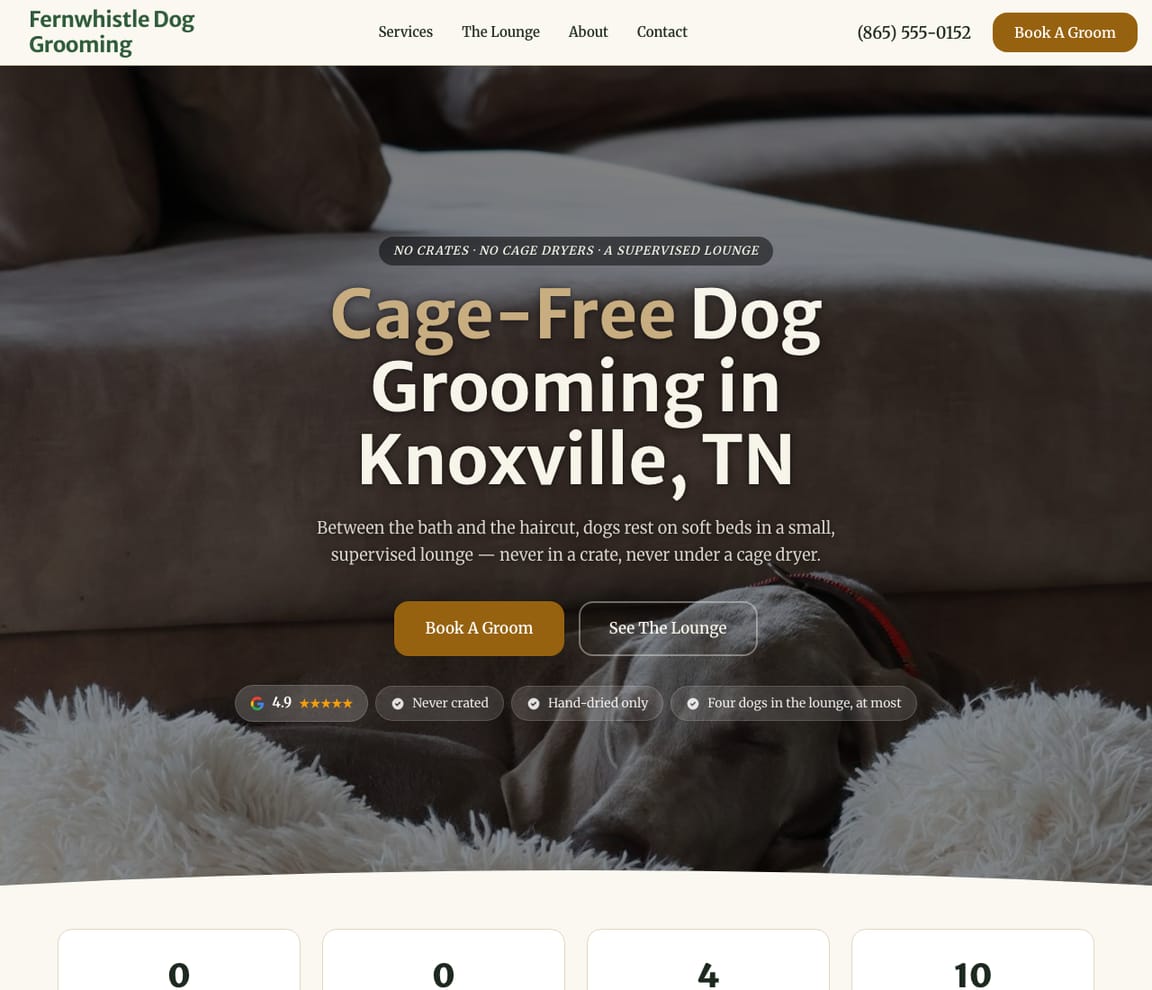
Dog grooming website designs you can start from
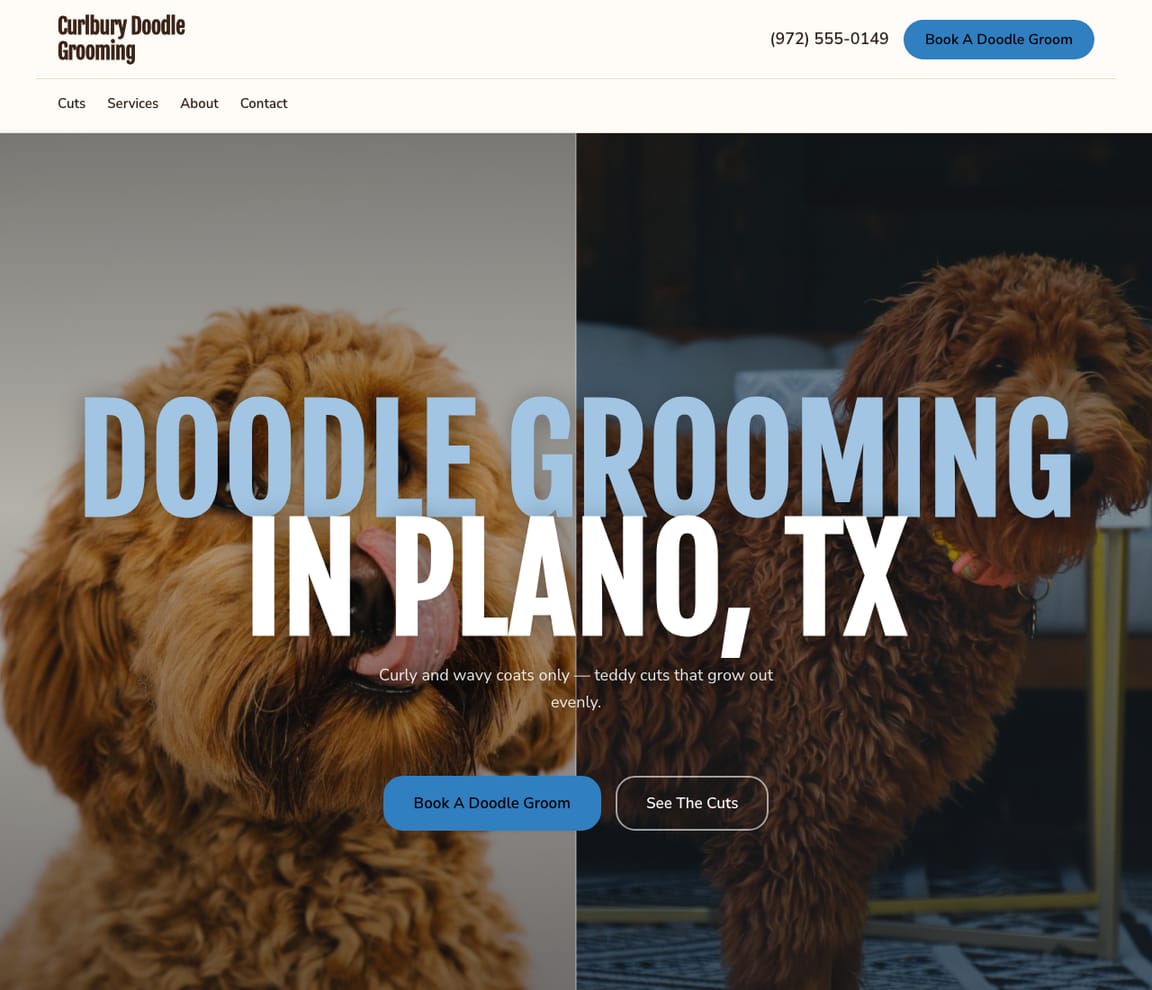
All four are real Zarla templates. Open the one closest to your business — a friendly neighborhood salon, a mobile van, cage-free grooming or a doodle specialist — swap in your prices, your area and photos of dogs you've groomed, and publish.
GET FOUND
Get found by the pet parent searching with the dog in the car
A website plus a Google Business Profile is how a new client picks a groomer — and how a regular rebooks. Zarla builds the website, and once you connect your profile, your Google rating and reviews show on the site.
“Dog groomer near me”
Searched from the car, often with a matted dog in the back seat. Your services, your prices by size and the area you cover answer the first three questions before they call.
Google Business Profile
Your salon or service area, your hours, before-and-after photos and your reviews inside Google Maps. Free, an afternoon to set up, and where most local grooming searches end.
Reviews with a photo of the dog
A pet parent trusts other pet parents. Ask every happy client for a review with a photo of their dog — and answer every review, the bad one about a short cut most of all.
Google Search
Ttidytailsgrooming.com
Tidy Tails Grooming — Trusted Dog Grooming in Your AreaFull grooms, bath and brush-outs, nail trims and doodle cuts. Prices by size, one dog at a time. Book your next groom.← Your Zarla siteCcitydoggroomingservices.com
City Dog Grooming ServicesGoogle Maps
1
Tidy Tails Grooming
← You2
Metro Dog Grooming Co.
3
Quick Dog Grooming Services
AI assistants (ChatGPT / Perplexity)
For a calm one-on-one dog groomer in your area: Tidy Tails Grooming — a one-on-one dog grooming salon with prices by size, doodle and senior-dog grooms, and before-and-after photos.
An example with a made-up business and illustrative figures. Yours will show your real details and reviews.
YOUR LAUNCH PLAN
Your dog grooming business launch checklist
The whole guide as things to check off. Work through them in order and you'll be licensed where you need to be, insured, equipped and easy to book before your first dog.
- Pick your model — a home salon, a rented room, a storefront or a van.
- Check your state, city and zoning — a facility license where one applies, a business license, and where the wash water goes.
- Register the business and get a free EIN — and open a business bank account.
- Buy liability insurance with animal bailee cover — before the first dog is on the table.
- Fit out the space or the van — tub, hot water, hair trap, table, dryers and kennels.
- Write your price list by size and coat — with the matting and behavior surcharge, and your vaccination rules.
- Introduce yourself to local vets, walkers and trainers — they get asked where to go.
- Get found — website and Google Business Profile live, and every client rebooked before they leave.
REAL CUSTOMERS
Small business owners who got online with Zarla
Verified reviews from real Zarla customers.
“Very reliable, professional, and fast results. I was able to get my business online in no time, and the ease of access made it so simple.”
“I had no idea how to set up a website for my business. Thanks to Zarla, they've helped me a lot.”
“Quickly built my website from scratch. No hiccups. Would highly recommend Zarla for someone with no experience who wants to start a polished business website.”
“Great professional website in less than a minute, with the use of AI and a few descriptive prompts. This has saved me bundles of time and research on web developers.”
Be the groomer a pet parent trusts with their dog
Add your town and your salon's or van's name, and Zarla builds the website from that one line — your services, the area you cover, an inquiry form and a map. Free to build; you pay when you publish.
Already have a website? Bring it across →Zarla keeps your old page addresses where it can and redirects the ones that change, helping you keep the Google standing you've built.
Frequently asked questions
How much does it cost to open a dog grooming business?
In the US, about $9,050 to $53,000 for a one-groomer salon in our dog grooming business plan's itemized ranges — equipment, the space, insurance, licenses, supplies, software and a few months of working capital. A home salon costs far less where zoning allows it. A mobile business swaps the space for a van: one startup guide puts a van with its build-out at $25,000 to $100,000, and new turnkey vans start around $115,000 to $130,000.
What equipment do you need to start a dog grooming business?
Start with the four things every groom passes through, then add as the book fills. Day one: a professional tub (about $730 to $1,850 for most stainless models on sale in 2026), a sturdy table — a hydraulic or electric one, $1,229 to $2,195 at PetLift, saves your back over a career — a high-velocity dryer, and your clippers, blades, shears, brushes, combs and a nail grinder, plus shampoo, towels, a grooming loop and a pet first-aid kit. Once you're busy: kennels or crates for dogs waiting to be picked up, a second dryer and spare blades so one dog never waits for a cooled clipper. In a salon, the room needs hot water and a drain with a hair trap; a mobile groomer buys all of it built into a van — one startup guide puts a van with its build-out at $25,000 to $100,000, and new turnkey vans start around $115,000. Buy the table and the clippers you'll use every day; the rest can start modest.
What insurance does a dog grooming business need?
In the US, general liability with animal bailee cover. General liability pays when someone else is hurt or their property is damaged — a client slipping on a wet floor — but a standard policy excludes the dogs in your care, so the cut ear or the fall from the table needs bailee cover, often sold as care, custody and control. Add commercial auto the day you groom from a van, workers' compensation once you hire where your state requires it, and a business owner's policy if you want the salon's equipment covered too. Insureon's medians for pet groomers are $50 a month for general liability ($598 a year), $80 for a business owner's policy, $88 for workers' comp and $245 for a mobile groomer's commercial auto (July 2025), and one specialist pet-care insurer starts at about $295 a year. Ask a licensed agent what your state and your landlord require before the first dog.
How profitable are dog groomers?
It depends on dogs per day and how many clients rebook. The average US groom costs about $85, and a careful one-on-one salon grooms about four to five dogs a day per groomer, so one groomer's book of regulars can gross well above a staff groomer's pay. Rent, insurance and supplies come out of that, and many solo pet-care businesses are part time — most took in under $25,000 in 2023.
How many dogs can a groomer groom in a day?
It depends on the dogs. A cage-free salon in Atlanta grooms about four to five dogs a day per groomer; some groomers count in units by breed — a Chihuahua is one, a doodle six — and aim for 14 to 20 units a day. Mobile groomers fit fewer around the driving.
What qualifications do I need to groom dogs?
None by law on the state lists we read — Texas, California and Washington license no groomer — though Colorado licenses the grooming shop or van and a contractor groomer, and Iowa licenses a kennel that grooms. Most groomers learn under an experienced groomer, at a grooming school or through an apprenticeship, and many take a voluntary certification. Los Angeles County is an exception: a groomer can't work unsupervised there without certification, grooming school plus a year's experience, or a one-year apprenticeship (the City of West Hollywood has the same rule), and Colorado licenses the grooming facility. The training routes, the certifications and what each costs are in how to become a dog groomer. Check your state and city before you open.
Is mobile dog grooming a profitable business?
It can be: mobile groomers typically charge $15 to $25 more per dog than a salon and have no rent. But they groom fewer dogs a day around the driving, the van is the biggest cost — a new turnkey van starts around $115,000 — and a breakdown stops the income until it's fixed. Commercial auto insurance adds about $245 a month at the median.
What are the disadvantages of mobile pet grooming?
Fewer dogs a day, a large van payment, fuel, and a mechanical breakdown that cancels your whole day. You also need a legal place for the wash water — many cities require it to go to the sanitary sewer, never a storm drain — and in Connecticut and Colorado the van itself needs a grooming facility license.
Where do dog groomers make the most money?
Where prices and pay are highest. For animal caretakers, the occupation groomers are counted in, the highest state medians in 2025 on O*NET's state pages were in the District of Columbia ($44,210), Washington ($40,570), Hawaii ($40,130) and Massachusetts ($39,650). Big-city grooms also cost more than small-town ones — often a good deal more in places like New York City.
What is the most difficult dog to groom?
Curly and doodle coats, and any badly matted or anxious dog. Price guides put poodle and doodle grooms at the top of the range even for small dogs, and one Missouri groomer counts every doodle as her biggest booking, whatever its size. Behavior matters as much as coat — a small, nervous dog can take longer than a calm large one — so put the matting and behavior surcharge on your price list.
Do I need a license to open a dog grooming business?
In the US, usually not a license for the groomer, but often one for the business. Connecticut requires a $200 grooming facility license from its Department of Agriculture, vans and trailers included; Colorado licenses grooming facilities for $400 a year, mobile groomers included; and New York City requires a Small Animal Grooming Establishment Permit. Everywhere, add your city's business license and, for a home salon, its zoning approval. Check your state's agriculture department and your city before you open.
How do I start a dog grooming business from home?
In the US it turns on zoning before anything else: Anne Arundel County, Maryland, made pet grooming a conditional home occupation in July 2025, while King County, Washington, says most pet businesses can't run as a home occupation at all — so ask your city or county's planning office whether customers' dogs may come and go, and whether you need a home-occupation permit. Then the room: hot water, drainage with a hair trap, ventilation and a washable floor, with a professional tub ($730 to $1,850 on sale) and a table. Register the business, take the free EIN, and buy liability insurance with animal bailee cover before the first dog. Check your state too — Connecticut and Colorado license the grooming facility wherever it is.
How do I start a dog grooming business without money?
Groom for someone else first — a salon, a vet or a mobile groomer — until you can handle any coat, and build the book of regulars you'll take with you. Then start in a rented room or a home salon where zoning allows, with a used tub and table instead of a $25,000-to-$100,000 van, and let rebooking fill the calendar before you spend on anything else. Our dog grooming business plan's low end for a one-groomer salon is $9,050, and a home salon costs less than that.
How do I start a dog grooming business in Illinois?
Illinois's Department of Agriculture licenses pet shops, kennel operators, dog day care operators and other animal-care facilities — $350 an application for each license type — and groomers aren't on that list, so a grooming-only salon may need no state license while one that also boards dogs or runs day care needs the matching one. Confirm the category with the state's animal welfare bureau, then your city's business license and zoning, the free EIN, and liability insurance with animal bailee cover. Check your city's rules too.
How do I get more dog grooming clients?
Rebook every client before they leave, and be easy for a new pet parent to find and trust: a Google Business Profile with photos and reviews, a website with your services, prices by size and the area you cover, and introductions to local vets, walkers and trainers. Zarla builds the website from one sentence, with your services, an inquiry form and a map, lets you add your prices and online booking in chat, and shows your Google rating and reviews on it once you connect your Google Business Profile.