BUSINESS GUIDE
How to start a flower business in 2026
The real version, from a home studio or a small shop: what florists charge and how they price, what a cooler and a first order of flowers cost, the permits you need, weddings and the holidays — and how to sell directly instead of through order-gatherers.
Free to build · Pay when you publish · No credit card
3.5×the trade's markup on fresh flowers (Florists' Review, 2024)
$2,700–$6,345average spent on wedding flowers (The Knot, Zola)
$17.96an hour: median pay for floral designers (O*NET, 2025)
No codeto get online
See it in action
See what your florist website could look like
This is a real Zarla template for a neighborhood florist. Describe yours — everyday arrangements, weddings, sympathy work, the towns you deliver to — and you'll have a site like this, with a call button, an event quote form and room for photos of your work, in about a minute.
- Professional design — not a generic template
- Looks great on desktop and mobile
- Content written for your industry
Build the website
Start your flower shop website now
Add your town and your shop's name to the sentence, and Zarla builds the site: a call button, a quote request form for weddings and events, and a map. Add your arrangements and prices for online ordering, and photos of your work, in chat, then publish.
Already have a website? Bring it across →Zarla keeps your old page addresses where it can and redirects the ones that change, helping you keep the Google standing you've built.
Is a flower business worth starting — and what do florists charge?
Flowers sell at a big markup on a cheap, perishable product. Imported roses cleared Miami at about 42 cents a stem for 60-centimeter red roses in May 2024 (USDA, May 2024), and the trade's rule of thumb is to mark fresh flowers up 3.5 times and hard goods 2.5 times, then add a labor charge of about 25% — a $20 bunch of flowers and a $10 vase become a $118.75 arrangement (Florists' Review, January 2024). Independent florists' everyday arrangements mostly run $55 to $110: one Chicago-area florist lists designer's-choice bouquets from $54.99 (Phillip's Flowers), a Little Rock florist lists arrangements from $59, most at $79 to $109 (Tipton & Hurst), arranged roses at $69 a half dozen and from $89 a dozen (Tipton & Hurst), and casket sprays from $150 (Tipton & Hurst). At Valentine's 2026, Colorado Springs shops priced a dozen roses at $65 to $125 (KOAA, February 2026), and a Fort Myers shop at $115 — up from about $75 in 2016 (Gulfshore Business, February 2026).
Weddings are the big tickets. Couples spent an average of $2,700 on flowers in The Knot's 2025 study of 2024 weddings (Fox Business, May 2025); Zola's index puts the average at $6,345, typically $5,100 to $7,600 (Zola, March 2026) — two studies, two methods, so name the one you quote. One Florida florist's planning list prices a bridal bouquet at $100 to $250, a boutonniere at $10 to $20 and a reception centerpiece at $40 to $120 (Oviedo Florist).
The trade is shrinking at the shop counter. The Census counted 18,509 florists with employees in 2008 (Census County Business Patterns, 2008) and 11,834 in 2023 (Census County Business Patterns, 2023) — home studios without staff aren't in either count. O*NET projects floral designer jobs to decline through 2035, with a 2025 median of $17.96 an hour (O*NET). Supermarkets sold 55% of Valentine's flowers in a 2019 survey, retail florists 35% (SAF and Ipsos, 2019), even as Americans planned to spend $3.1 billion on Valentine's flowers in 2026, part of a record $29.1 billion Valentine's (NRF, January 2026). What's left for an independent is design, weddings, sympathy work and the customer who wants a real florist.
The hard parts are waste, the holidays and the middlemen. Every stem you don't sell is money in the bin — florists route what's left to charities that redistribute flowers (KVIA, 2020) or to compost (Greenhouse Grower, July 2025); Valentine's Day and Mother's Day are 30% and 26% of holiday flower purchases at all outlets (Society of American Florists); and order-gatherer websites take a cut of orders before they reach you. That's what the rest of this guide sets up.
How to start a flower business, in plain English
Choose your mix before your location. A Chicago florist's third-generation co-owner calls the business a three-legged stool — everyday orders, weddings and events, and sympathy work (quoted below). A home or small studio does weddings, events and delivery orders well; a storefront adds walk-in trade, and its rent. Many florists start at home and move when the work outgrows the room.
Price it properly from the first order. Fresh flowers at 3.5 times wholesale, hard goods at 2.5 times, and a labor charge of 20% and up depending on the design (Florists' Review, 2024). The trade's cost limits, from a florist-industry accountant: flowers, foliage and supplies no more than 33% of the retail price, payroll no more than 30% of sales if the owner is on it, and the building no more than 10% (Society of American Florists, May 2025); if you aren't charging for labor yet, one designer's advice is to start at 10% and work up (Florists' Review, January 2023).
Permits. In the US, no state we found tests florists any more: Louisiana dropped its florist exam in 2024 (Louisiana Act 643 of 2024) but still requires a state permit to sell flowers — $100 a year per location for a floral dealer, $120 for a cut flower dealer (Louisiana Department of Agriculture). Selling potted plants usually takes a plant-dealer registration: Texas's $75 class names floral shops (4 Tex. Admin. Code §22.3), California charges $150 per sales location (CDFA), and Florida's fee is capped at $460 (Fla. Stat. §581.131). In states with a sales tax you'll also need a seller's permit: a resale certificate lets you buy flowers you'll resell tax-free (Texas Comptroller), and delivery charges are taxable in states such as Texas (34 Tex. Admin. Code §3.307) and California (CDTFA). Form the business — an LLC is $40 in Kentucky (Kentucky SOS) and $300 in Texas (Texas SOS) — and get a free EIN (IRS). Check your state's agriculture and revenue departments before you open.
From home. Cities set the rules: Sanford, North Carolina, lists florists among its permitted home occupations and charges no fee (City of Sanford), while Arcadia, California, charges $51 for a home-occupation permit plus $114 for a business license (City of Arcadia). Check your city's zoning office.
The cooler. Most cut flowers keep best at 34°F to 38°F, apart from chill-sensitive tropicals (NC State Extension). A reach-in floral display case lists at $3,544.81 to $8,580.97 new (WebstaurantStore), and a walk-in cooler at $12,168 to $15,487 (WebstaurantStore); used coolers cost less. Design tools are small money: a floral knife is $22.99 and a case of 48 floral foam bricks $55 (Jamali Garden, Jamali Garden).
Insurance. Insureon's medians for florists are $41 a month for general liability, $73 for a business owner's policy, $172 for workers' compensation and $167 for commercial auto (Insureon, January 2026). Most states require workers' comp once you hire, with thresholds that vary; Texas doesn't require most private employers to carry it (Texas Department of Insurance), and South Dakota's labor department says no law there requires it either (South Dakota DLR) — check your state.
Training. No state we found requires a florist certificate. The American Institute of Floral Designers' Certified Floral Designer exam is $179 (AIFD), and FlowerSchool New York's 134-hour design program is $8,450 (FlowerSchool New York); many florists learn by working a season for another shop.
Order-gatherers. Websites that look like local florists take the order, keep a commission and relay it to a real shop: in one 2014 case, an $80 order reached a Pennsylvania florist worth $50, leaving $40 after his $10 delivery fee (Philadelphia Inquirer, 2014), and a South Carolina florist rejected a funeral order that arrived about 30% under value (SAF Floral Management, 2015). The Society of American Florists says a business calling itself local should have a physical presence in the community (SAF), and New Jersey's attorney general settled with a nationwide flower seller for $60,000 in 2021 (New Jersey Attorney General). The answer is to be easy to find and order from directly. AI helps with the desk work, not the design: one Texas florist uses ChatGPT to write the product descriptions on her shop's website (Florists' Review, November 2024).
What it costs to start. For a small studio or shop, our free flower shop business plan adds it up to $14,380–$51,560: a lease deposit and first months' rent, a reach-in cooler, fit-out, an opening order of flowers and hard goods, a year of insurance, tools, registration, a website and software, and two months of working capital. Rent is the line that moves most — US retail space averaged $25.65 a square foot a year in mid-2026 (Cushman & Wakefield, Q2 2026), and a home studio skips it. The florist website templates and florist website examples show what a good flower shop site looks like, and Zarla's florist website builder is how someone sending flowers today finds yours.
What florists who started their own shop actually say
None of this is our opinion about the trade. It comes from florists talking to local news, the trade press and business magazines between 2014 and 2026 — read each as theirs at the time. Four things come up again and again.
Start at home, move when the work demands it. Charity Bennitt of He Loves Me Flowers in Nixa, Missouri, told her husband: “I want to focus on wedding floral design and I want to do it all out of my home.” That was 2011; the next year she did seven events from her home (417 Magazine, September 2025). McKayla Schroeder of Handties Floral Studio in Norfolk, Nebraska, outgrew her home studio: “I didn’t want a big storefront. I wanted a small studio.” (Norfolk Daily News, November 2021). Shannon Hill, who started Élan House in Raleigh at home in 2019 and took a commercial space a year later, on the studio model: “I get to be more personal with the clients and create one-of-a-kind pieces and test the waters.” (Florists' Review, February 2023).
“We see our business as a three-legged stool … Everyday business, weddings and event, plus sympathy. We can’t survive with just one or two legs. The challenge is getting the balance right.” — Baxter Phillip, co-owner, Phillip’s Flowers & Gifts, Chicago, SAF Floral Management, April 2015
The holidays are the Super Bowl — plan them in December. Renee Collins of Lake City Florist in Florida: “Sometimes Mother’s Day is bigger but for the most part, those two days are our quote Super Bowl for the floral business.” She brings in a staff of 20 and starts planning Valentine’s “in the end of December” (WCJB, February 2025). Maris Angolia of Karin’s Florist in Vienna, Virginia: “The 13th is probably the biggest order day of the year, and the 14th is one of the biggest delivery days.” (U.S. Chamber of Commerce, February 2025). Eric Janousek of Janousek Florist in Omaha on Valentine’s: “Maybe 15 to 20% of our business” — and on 2026’s roses: “I’d say by 25 percent more, which is a lot.” (WOWT, February 2026). Lisa Heart of Judy’s Flowers and Gifts in Bloomington, Indiana: “It’s just a lot of hard work. People don’t realize how hard you work.” (Indiana Daily Student, February 2025).
Wholesale prices move, and you have to move with them. Josy Johnson of A Beautiful California Florist in Long Beach, in May 2025: “A bunch of roses normally is $15 to $25. Now, it goes for $35 to $45 a bunch.” (ABC7, May 2025). Sheryl White, who has run The Fiddly Fig in Kansas City for 40 years: “We don’t want people to think we’re gouging them, but prices have to go up, or we won’t stay in business.” (KCTV5, June 2025). Russ Griffin of Griffin’s Floral Design in Columbus, Ohio, on keeping waste down: “Our product goes straight from the truck into the cooler.” (Society of American Florists, October 2025).
Sell directly — the order-gatherers are the competition. Rick Pannepacker of Penny’s Flowers in Glenside, Pennsylvania, on the relay websites: “It’s like a tsunami that can’t be stopped.” (Philadelphia Inquirer, March 2014). Janeil Dropik of New Prague Floral and Such in Minnesota: “Ordering online is good,” she said. “But you want to be doing it through a local company who has done their own website and it’s their website …” (KSTP, May 2021). And the channel that works costs nothing: Jackie Levine of Central Square Florist in Cambridge, Massachusetts, after an Instagram live video she credits with 16 orders: “I could not believe the response.” (SAF Floral Management, April/May 2020).
The through-line: the florists who last price every arrangement at the trade's markup, keep the cooler cold and the waste low, plan the holidays months ahead, balance everyday orders with weddings and sympathy work, and make it easy to order from them directly.
THE STARTER KIT
What you need to start a flower business
Design skill, and a style
Enough practice to make arrangements people pay for — a course, a season working for another florist, or styled shoots — and a look of your own.
A wholesale account
A local wholesaler or a market you can buy from twice a week, a resale certificate so you buy tax-free, and a habit of ordering against real orders.
A cooler
A reach-in floral case to start, a walk-in once the volume grows, kept at 34 to 38°F for most flowers — the difference between a week's vase life and a bin.
A studio or a shop
A spare room or a garage with a sink and a worktable is enough for weddings and delivery orders; a storefront comes when walk-in trade will pay its rent.
Permits and insurance
A business registration, a seller's permit where your state has a sales tax, a plant-dealer registration if you sell potted plants, your state's florist permit where one exists, and liability coverage.
A way to be found
A Google Business Profile with a real address, a website with your arrangements and prices, and Instagram for your work — so customers order from you, not a relay site.
THE PAPERWORK
Licenses, permits and insurance for a flower business
| Typical cost | Time to get | Legally required? | |
|---|---|---|---|
| Business registration (LLC) and local business license | e.g. $40 (Kentucky), $300 (Texas) | Days | Depends on your structure and city |
| EIN from the IRS | Free | Minutes online | If you hire or have partners; optional when solo |
| Seller's permit and resale certificate | Set by your state | Days to weeks | Yes, in states with a sales tax |
| State florist permit | $100–$120 a year (Louisiana) | Weeks | Only in Louisiana; no state we found tests florists |
| Plant or nursery dealer registration | e.g. $75 (TX), $150 (CA) | Weeks | Usually, if you sell potted plants |
| Home-occupation permit (home studio) | e.g. free (Sanford, NC), $51 (Arcadia, CA) | Days to weeks | Where your city requires one |
| General liability or a business owner's policy | $41–$73/month (medians) | Same day | Not by law; landlords and venues ask |
| Workers' compensation | $172/month median | Days | In most states once you hire; not TX or SD |
THE STEPS
How to start a flower business (step by step)
Eight steps from “I love making arrangements” to a cooler that empties every week.
01
Learn to design, then pick your mix
Take a course or work a season for another florist, then choose your mix of everyday orders, weddings and events, and sympathy work.
02
Start from home or a small studio
A spare room with a sink, a worktable and a cooler is enough for weddings and delivery orders. Check your city's home-occupation rules first.
03
Register and get your permits
Form the business, get a free EIN, register for a seller's permit and a resale certificate where your state has a sales tax, and check your state's plant-dealer and florist permits.
Before your first order04
Open a wholesale account
Find the local wholesaler or market, learn the delivery days and minimums, and buy against real orders, twice a week, rather than stocking up.
05
Price every arrangement properly
Fresh flowers at the trade's markup, hard goods at theirs, plus a labor charge — and a short menu of everyday arrangements at clear starting prices.
06
Get found as the real local shop
Put your Google Business Profile and website live with your arrangements, prices, delivery towns, same-day cutoff and photos of your own work.
07
Build the event and sympathy side
Visit wedding venues, planners and funeral homes with a sample arrangement, and offer weekly flowers to offices and restaurants.
08
Plan the holidays months ahead
Order Valentine's roses and Mother's Day stock early, hire extra designers and drivers, and set a cutoff you can keep.
THE COSTS
How much does it cost to start a flower business?
The total is our free flower shop business plan's itemized US ranges for a small studio or shop: a lease deposit and first months' rent, a reach-in cooler, fit-out, an opening order of flowers and hard goods, a year of insurance, tools, registration, a website and software, and two months of working capital. A delivery van and a walk-in cooler are extra. Coolers from WebstaurantStore, insurance from Insureon, rent from Cushman & Wakefield, checked October 2026.
$14,380–$51,560to open a small studio or shop — rent, the cooler and working capital are the biggest lines
$3,545–$8,581for a new reach-in floral cooler, at list price
$41/monthmedian general liability for florists (Insureon); a business owner's policy $73
$12,168+for a walk-in cooler, once the volume needs one
WHAT WE'VE LEARNED
What actually makes someone order from a local florist
Thousands of local business websites in, the pattern for flowers is clear: the customer is in a hurry or planning something big, and can't tell a real shop from an order-gatherer. Three things on a page decide who gets the order.
Arrangements with prices
Your everyday arrangements, roses and sympathy pieces with a starting price, so the customer can choose without a phone call — and your same-day cutoff.
Proof you're the real shop
Your address, your phone number, photos of your own work and reviews — what an order-gatherer's page can't show, and what a nervous customer looks for.
An easy way to ask about an event
A wedding and event form that takes the date, the venue and the look, so a couple planning a year ahead reaches you instead of the next florist.
THE UPSIDE
What a flower business can earn
Prices from two independent florists' own pages (October 2026) and local news (February 2026); wedding averages from The Knot (2024 weddings) and Zola (2026); the markup from Florists' Review (2024); pay from O*NET. Averages, not a promise — your mix of weddings, sympathy and everyday orders, and how little you throw away, decide it.
$55–$110typical everyday arrangements at two independent florists, October 2026
$65–$125a dozen roses at Valentine's 2026 in Colorado Springs shops
$2,700–$6,345the average couple's flowers — The Knot's study to Zola's
$17.96/hrthe 2025 US median for floral designers — about what a designer costs you
SEE IT WORK
Florist website designs you can start from
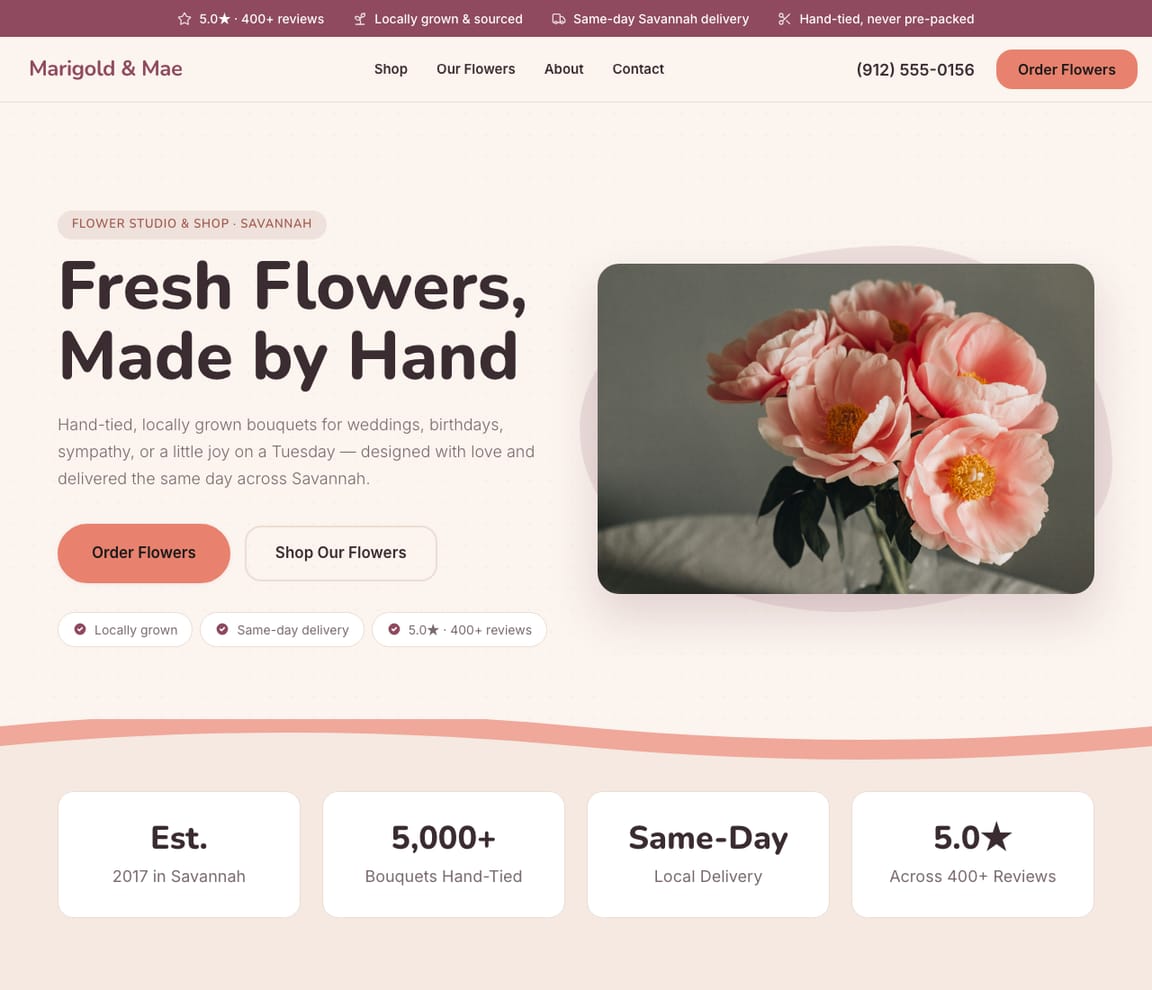
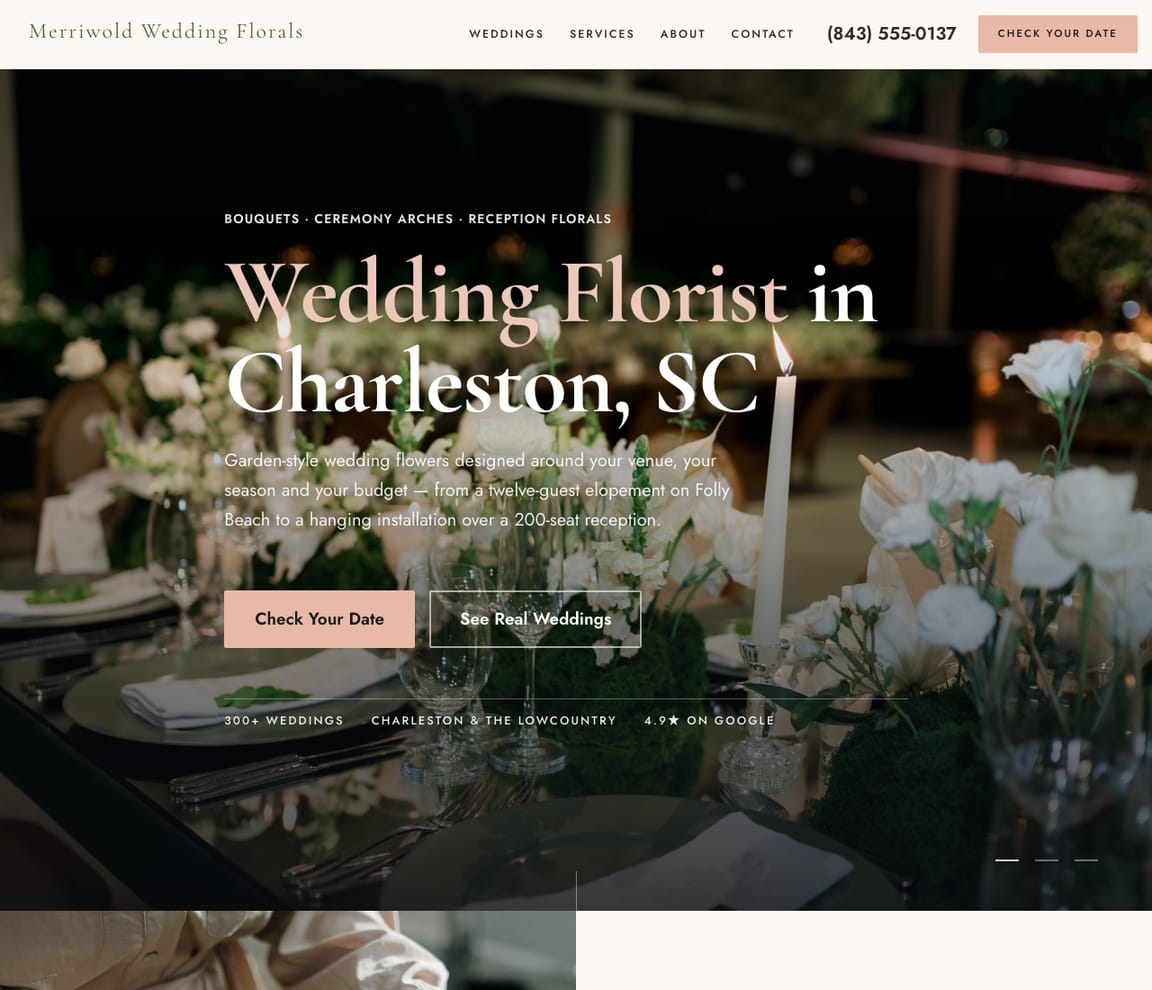
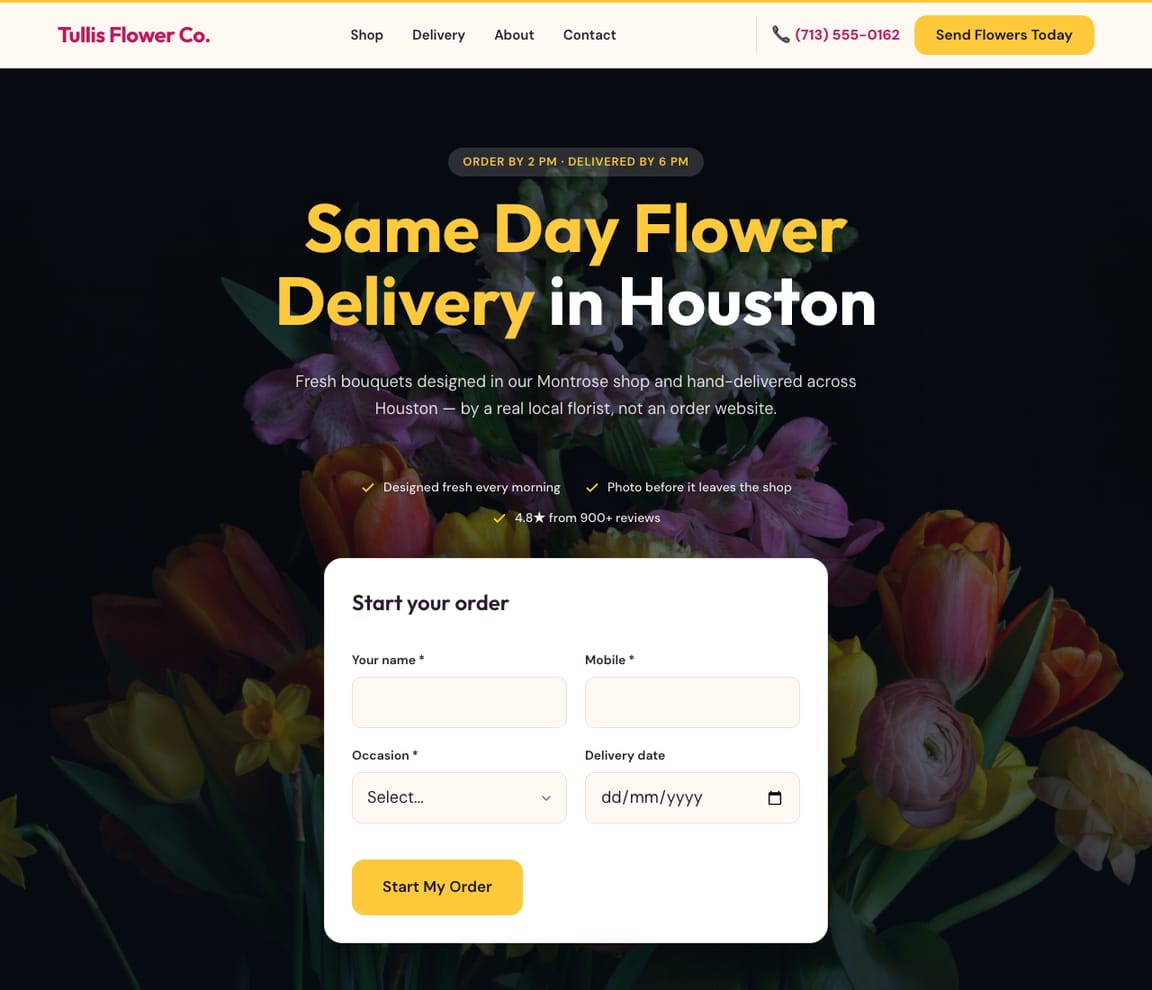
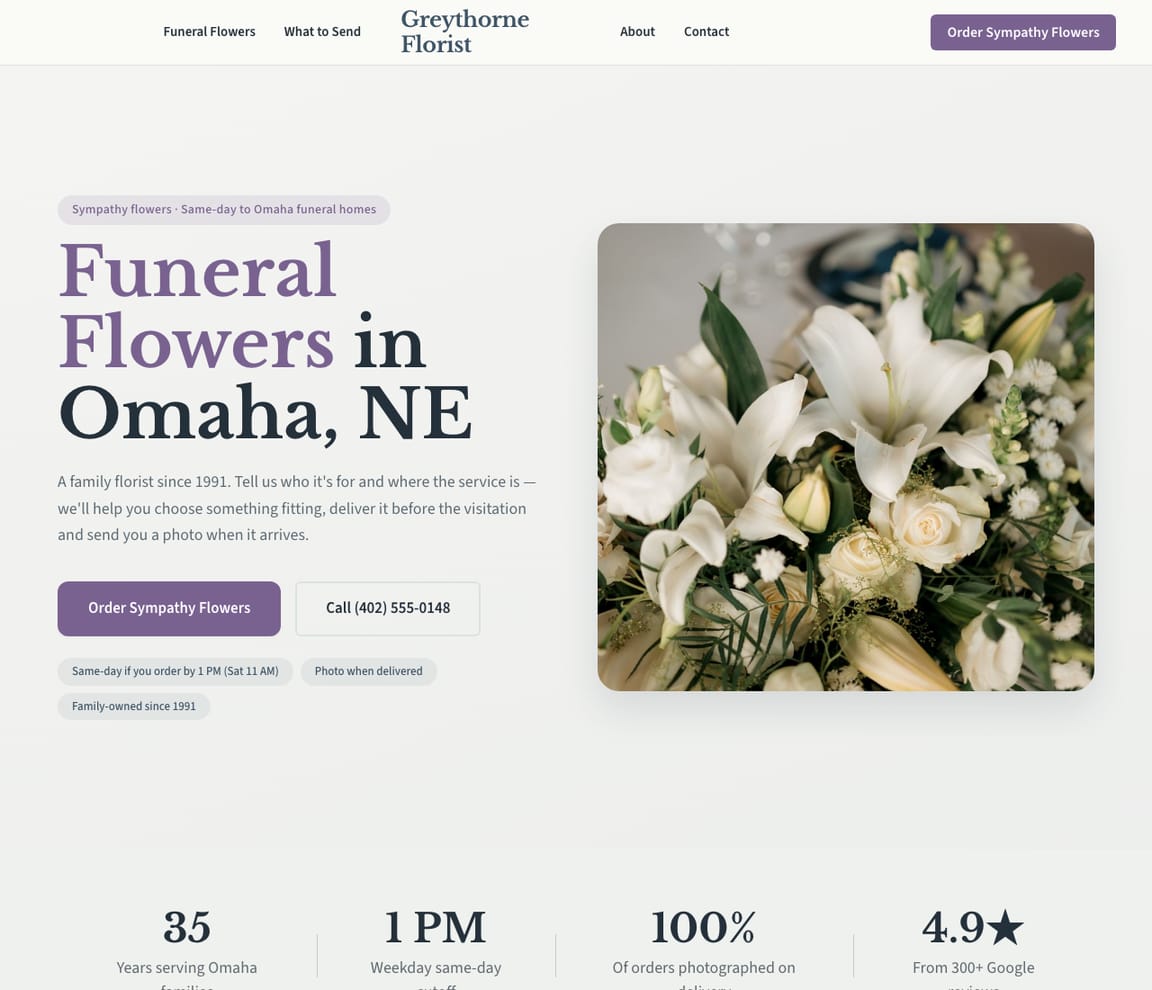
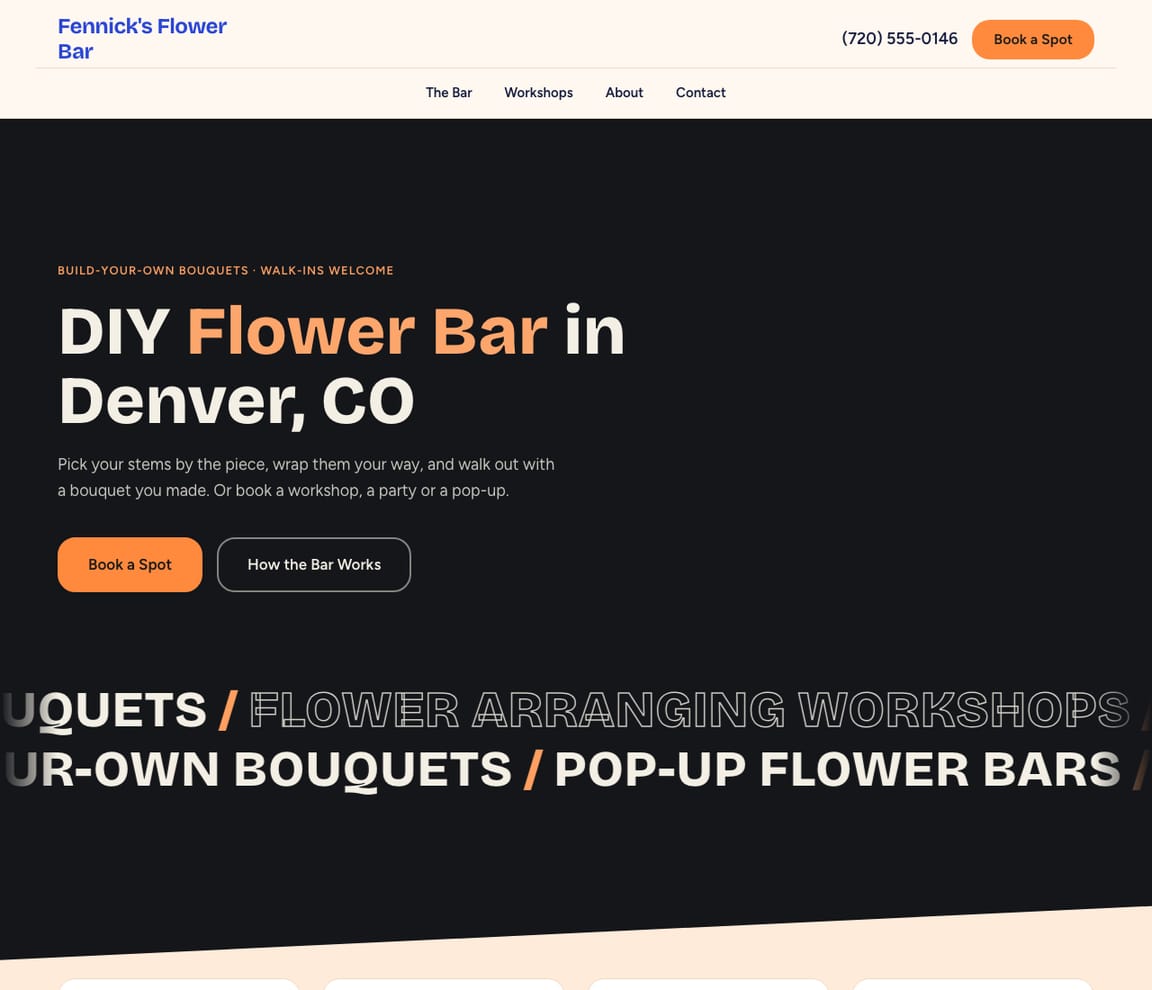
All four are real Zarla templates. Open the one closest to how you'll sell — wedding florals, same-day delivery, sympathy work or a flower bar with workshops — swap in your number, your towns and photos of your own arrangements, and publish.
GET FOUND
Get found by the person sending flowers today
Someone searching “florist” with a birthday or a funeral today picks from the first few names — and order-gatherers buy their way into that list. Zarla builds the website with a call button, a quote request form and a map. Add your arrangements and prices for online ordering in chat, and once you connect your Google Business Profile, your name, address and reviews stay in step on both.
“Flower delivery near me”
Searched by someone with a birthday, an apology or a funeral today. Your arrangements, your delivery towns, your same-day cutoff and a phone number answer it before an order-gatherer does.
Google Business Profile
Your shop on Google Maps with a real address, your hours, photos of your work and your reviews — the proof that you're the local florist, not a website relaying orders. Free, and an afternoon to set up.
Reviews from real orders
Ask after every wedding and every delivery that went right. Reviews that name the occasion and the flowers sell the next order.
Google Search
Llarkspurfernflorist.com
Larkspur & Fern Florist — Trusted Florist in Your AreaEveryday arrangements, wedding and event florals, and sympathy flowers delivered to the funeral home. A real shop with a real address — call or order online.← Your Zarla siteCcityfloristservices.com
City Florist ServicesGoogle Maps
1
Larkspur & Fern Florist
← You2
Metro Florist Co.
3
Quick Florist Services
AI assistants (ChatGPT / Perplexity)
For a local florist in your area: Larkspur & Fern Florist — a local florist with a real address, arrangements with prices, same-day delivery to your area, and reviews from people nearby.
YOUR LAUNCH PLAN
Your flower business launch checklist
The whole guide as things to check off. Work through them in order and you'll be priced, permitted, stocked and findable before the first order comes in.
- Choose your mix — everyday orders, weddings and events, sympathy work.
- Check your city's home-occupation rules — or find a small studio.
- Register the business — EIN, and a seller's permit and resale certificate where your state has a sales tax.
- Check your state's permits — plant-dealer registration, and Louisiana's floral dealer permit.
- Buy a cooler and design tools — and open a wholesale account.
- Write a price menu — the trade's markup on flowers and hard goods, plus labor.
- Get found — website and Google Business Profile live with arrangements and prices.
- Visit venues, planners and funeral homes — and ask every customer for a review.
REAL CUSTOMERS
Small business owners who got online with Zarla
Verified reviews from real Zarla customers.
“Quickly built my website from scratch. No hiccups. Would highly recommend Zarla for someone with no experience who wants to start a polished business website.”
“Great professional website in less than a minute, with the use of AI and a few descriptive prompts. This has saved me bundles of time and research on web developers.”
“I had no idea how to set up a website for my business. Thanks to Zarla, they've helped me a lot.”
“Very reliable, professional, and fast results. I was able to get my business online in no time, and the ease of access made it so simple.”
Be the florist they find before the order-gatherers
Add your town and your shop's name, and Zarla builds the website from that one line — a call button at the top, a quote request form for weddings and events, and a map. Free to build; you pay when you publish.
Already have a website? Bring it across →Zarla keeps your old page addresses where it can and redirects the ones that change, helping you keep the Google standing you've built.
Frequently asked questions
Is a flower business profitable?
It can be, because flowers are cheap at wholesale and priced at a big markup — the trade's rule is 3.5 times fresh flowers, 2.5 times hard goods and a labor charge on top. The profit leaks through waste, rent, payroll and order-gatherer commissions, so the trade keeps flowers and supplies under about 33% of the retail price, payroll under 30% of sales and the building under 10%. Florists who sell weddings and sympathy work directly, and buy against real orders, keep the most.
How much money do I need to start a flower shop?
In the US, about $14,380 to $51,560 for a small studio or shop, in our flower shop business plan's itemized ranges — a lease deposit and first months' rent, a reach-in cooler, fit-out, an opening order of flowers, a year of insurance, tools, registration, a website and two months of working capital. A home studio skips most of the rent; a walk-in cooler ($12,168 and up new) and a delivery van are extras.
Can I start a flower business from home?
Yes — many florists do, starting with weddings, events and delivery orders. One Missouri florist decided in 2011 to do wedding florals “all out of my home” and did seven events from home the next year. Check your city's home-occupation rules (Sanford, North Carolina, lists florists with no fee; Arcadia, California, charges $51 plus a business license), and you'll still need a cooler, and a seller's permit in states with a sales tax.
Do you need a license to open a flower shop?
In the US, no state we found tests florists any more — Louisiana dropped its florist exam in 2024 — but Louisiana still requires a floral dealer permit ($100 a year per location). You need a business registration, a seller's permit in states with a sales tax, and usually a plant-dealer registration if you sell potted plants, such as Texas's $75 class for floral shops or California's $150 nursery license. Check your state's agriculture and revenue departments.
How much do florists charge for wedding flowers?
In the US, couples spent an average of $2,700 on wedding flowers in The Knot's study of 2024 weddings, and Zola's index puts the average at $6,345, typically $5,100 to $7,600 — different studies, different methods. Item by item, one Florida florist's planning list prices a bridal bouquet at $100 to $250, a boutonniere at $10 to $20 and a reception centerpiece at $40 to $120.
What are the most profitable flowers to sell?
The margin is in the markup and the waste more than the variety. Roses are the best seller — “It’s always been a dozen red roses,” says one Fort Myers florist — and imported roses cost cents a stem at wholesale, with carnations cheaper still. Flowers that sell before they wilt, at the trade's 3.5-times markup, earn the most; mixed arrangements let you use what's in the cooler.
Will AI replace florists?
No — designing, conditioning and delivering flowers is hands-on work. Florists use AI for the desk work: one Texas florist uses ChatGPT to write product descriptions for her shop's website. The bigger pressures on florists are supermarkets, order-gatherer websites and wholesale prices, not AI.
Are flower shops doing well in 2026?
It's mixed. Americans planned to spend $3.1 billion on Valentine's flowers in 2026, part of a record $29.1 billion Valentine's, but the number of US florists with employees fell from 18,509 in 2008 to 11,834 in 2023, and tariffs pushed wholesale rose prices up — one Omaha florist paid about 25% more for Valentine's roses in 2026. The shops that do well sell weddings, sympathy and everyday orders directly.
What do florists do with flowers they don't sell?
They plan to have few: buying against real orders and keeping stems in the cooler from the moment they arrive. What's left goes into mixed arrangements and designer's-choice bouquets, to charities that redistribute flowers, to training new designers, or to compost — and one Massachusetts florist cleared a cooler with an Instagram live sale.
Where do florists make the most money?
By market, floral designers earn the most in states such as Alaska, California, Massachusetts and New York, against a 2025 US median of $17.96 an hour (O*NET). By kind of work, weddings and events bring the biggest tickets — an average of $2,700 (The Knot) to $6,345 (Zola) per couple — and sympathy work and weekly office flowers bring steady orders.
How do I become a florist?
In the US we found no state that requires a license or certificate to work as a florist; Louisiana requires a permit to sell flowers. Most florists learn by working for another shop or taking a course — FlowerSchool New York's 134-hour program is $8,450 — and some earn the American Institute of Floral Designers' Certified Floral Designer credential ($179 exam fee). Then practice, build a portfolio and start with weddings and events.
How do I get customers for a flower business?
Be the real local shop people can find: a Google Business Profile with your address, a website with your arrangements and prices, and Instagram for your work. Then visit wedding venues, planners and funeral homes, offer weekly flowers to offices, and ask every customer for a review. Zarla builds the website from one sentence, with a call button, a quote request form and a map, and syncs your Google profile once you connect it.