BUSINESS GUIDE
How to start a marketing agency in 2026
The niche and the one or two services, what agencies actually charge, the rules that attach to the work — fake reviews, email, texts, privacy — the tools at list price, the margins the trade really earns, and how founders landed their first clients.
Free to build · Pay when you publish · No credit card
13%the average digital agency's net margin in 2025 (Promethean's 2026 report)
30%the net margin of agencies that cut their service menu — three times those that widened it
$53,088the FTC's civil penalty per violation for a fake review or a non-compliant email
No codeto get online
See it in action
See what your marketing agency website could look like
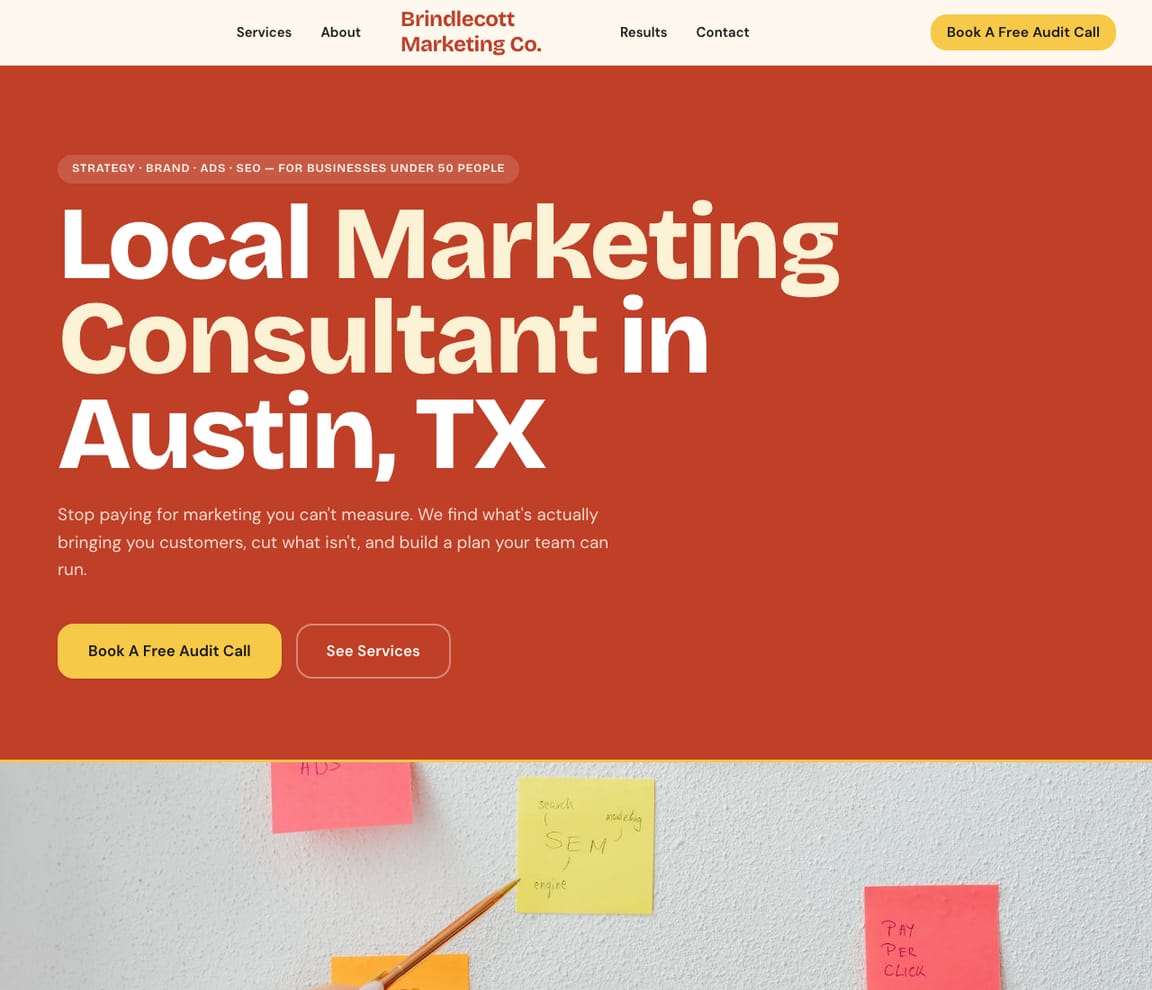
This is a real Zarla template for a marketing consultancy. Describe yours — the services, the niche, the town — and you'll have a site like this, with your services and a contact form, in about a minute.
- Professional design — not a generic template
- Looks great on desktop and mobile
- Content written for your industry
Build the website
Start your marketing agency website now
Add your town and your agency's name to the sentence, and Zarla builds the site: your services and a contact form. Add your case studies, your pricing and a book-a-call link in chat, then publish.
Already have a website? Bring it across →Zarla keeps your old page addresses where it can and redirects the ones that change, helping you keep the Google standing you've built.
Is starting a marketing agency worth it in 2026 — and what do agencies charge?
A marketing agency has no barrier to entry and a margin problem, and the numbers behind both are public. Promethean Research's 2026 report, from a survey of 1,452 agency leaders, counts more than 71,000 agencies in North America, up from 50,000 in 2024, 87% of them with fewer than 50 people and "few, if any, barriers to entry"; the average agency earned a net margin of 13% in 2025 against a long-run average of about 15%, and "margins have been slowly compressing for years" (Promethean Research, 2026). The shape of the business decides the margin. Studios under ten people "earned an average margin more than twice as large as the average 50+ FTE agency"; agencies that cut their service menu grew almost twice as fast as average and earned 30% net, while those that expanded it earned 10%; and the average agency offers 6.6 services (Promethean). Four shapes follow from that: a solo specialist in a niche, a small blended agency doing design, development and marketing, a vertical agency serving one industry, and a paid-media shop paid as a share of spend.
What agencies charge. WebFX's 2026 survey of more than 250 US marketing professionals puts monthly retainers at $1,000 to $20,000, project fees at $3,000 to $30,000 or more and hourly rates at $25 to $250 or more, with SEO at $500 to $5,000 a month, pay-per-click at $1,500 to $15,000, social media at $750 to $7,000, email at $50 to $1,000 and content at $2,000 to $20,000 (WebFX, 2026). Its SEO survey puts a small business's retainer at $1,500 to $3,500 a month and a startup's at $500 to $1,500 (WebFX, SEO pricing); local SEO for one location runs $500 to $3,000 a month, and WebFX's own service starts at $575 (WebFX, local SEO pricing). Ad management is "10% to 20% of ad spend or $1,000 to $3,000 monthly", WebFX's own at $975 or 15% of spend (WebFX, PPC pricing). LYFE Marketing publishes its own menu: social media management $750 to $7,000 a month, email $500 to $1,400 (LYFE Marketing). An older Sprout Social survey of 220 agencies found the average social media management retainer at $3,000 a month and the average hourly rate $150, with 31% billing hourly and 22% on retainer (Sprout Social, agency pricing report). Most agencies mix models — "Only 8% or fewer rely on any single model exclusively" (Promethean); "productized" pricing, which Google's answer names, appears in no survey we could open.
What marketers earn. The medians are for employees: marketing managers' median pay was $166,790 in 2025 with employment growing 7% or more to 2035 (O*NET, from BLS 2025 wage data); market research analysts and marketing specialists — the people an agency hires — $78,760, with 952,700 employed (O*NET); and the federal wage survey behind both leaves out the self-employed (Washington ESD), which is every agency owner. No survey of owners' income opens; what the founders say is in the next section — one pays himself $4,000 a month, one one-person agency books $30,000 a month at under 30% costs.
The market. IBISWorld puts US advertising agencies at $88.7 billion of revenue in 2026 across 114,000 businesses (IBISWorld, April 2026) and digital advertising agencies at $70.3 billion across 119,000 (IBISWorld, June 2026). Growth is slowing: "Growth is still low, at half the long-run average" after five years at 12% a year, a third of agencies have implemented AI across the business, and "AI hasn't made any of this easier" — clients expect execution to be cheaper, hourly rates are rising more slowly, hiring has been stagnant (Promethean). Two in three agencies say clients are asking about AI search (AgencyAnalytics, 2026 benchmarks), and the Agency Management Institute's 2025 research found that "clients don't want to replace their agencies with AI or expect widespread discounts" (AMI, 2025). Predictable Profits, a coaching firm, says its 300-plus client agencies — a self-selected, successful group — run 18% to 22% margins at seven figures and that "Niche agencies report margins of 40-75%" (Predictable Profits, 2025).
Why clients stay, and leave. At the big-brand end, the average client-agency relationship now runs about seven years, more than double 2016's 3.2 (ANA and 4As, April 30, 2025). At the small end, Setup's 2025 survey found the top reason clients end an agency relationship "wasn't budget. It was dissatisfaction with delivery — cited by 48% of clients", and client referrals remain the number one lead source for digital agencies, ahead of the agency's own website (Swydo, 2026, reporting Setup and Promethean).
The catch. Anyone can start one, most are small, the margin is thin unless the menu is narrow, clients leave when the report doesn't show results, and the rules that attach to the work carry a $53,088 penalty per violation. That's what the rest of this guide sets up.
How to start a marketing agency, in plain English
No license — the business, not the trade, gets registered. In the US nothing licenses marketing; what you register is the business itself, where you live. Philadelphia's Commercial Activity License costs nothing (City of Philadelphia); Seattle's business license tax certificate is $59 for a business earning under $20,000 a year and $120 up to $499,999, rising each year (City of Seattle); Washington State wants a state license once gross income reaches $12,000 a year (Washington Department of Revenue). Form the business or don't: the SBA says you are "automatically considered to be a sole proprietorship if you do business activities but don't register as any other kind of business", and "can be held personally liable for the debts and obligations of the business", while "LLCs protect you from personal liability in most instances" (SBA). An LLC's filing fee is $70 in California (California SOS, form LLC-1), $100 plus $25 to designate a registered agent in Florida (Fla. Stat. §605.0213) and $200 in New York (N.Y. LLC Law §1101); the EIN is free (IRS). A one-member LLC is a "disregarded entity" taxed on your own Schedule C unless it elects otherwise (IRS), and how you pay yourself "will depend on the type of business structure you elect" (IRS) — confirm the details with your accountant.
The reviews rule. Since October 21, 2024 the FTC's rule on consumer reviews and testimonials makes it "an unfair or deceptive act or practice" for a business "to provide compensation or other incentives in exchange for, or conditioned expressly or by implication on, the writing or creation of consumer reviews expressing a particular sentiment", bans fake reviews, insider reviews without a disclosed relationship, review suppression and bought social-media influence (16 CFR Part 465; 89 FR 68077, August 22, 2024). The civil penalty is $53,088 per violation, as adjusted in January 2025 and still current on the eCFR in October 2026 (16 CFR 1.98). The Endorsement Guides require a disclosure that is "difficult to miss (i.e., easily noticeable) and easily understandable", and on social media "unavoidable" — an influencer's connection disclosed only on a profile page, or behind a "more" link, is not (16 CFR Part 255). An agency that writes, buys or hides reviews for a client is on the hook with the client.
Email and texts. CAN-SPAM requires every commercial email to carry "a valid physical postal address of the sender" and an opt-out honored within ten business days (15 U.S.C. §7704); the FTC's guide puts the penalty at up to $53,088 per email and adds that "both the company whose product is promoted in the message and the company that originated the message may be legally responsible" (FTC, CAN-SPAM compliance guide) — the agency, in other words. There is no business-to-business exception in the statute; cold email to a company is lawful in the US if it meets those terms. Texts and automated calls are the TCPA's: $500 in damages for each message sent without the called party's prior express consent, up to three times that for a willful violation (47 U.S.C. §227). The FCC's one-to-one consent rule for lead generators never took effect — the Eleventh Circuit vacated it on January 24, 2025 (Insurance Marketing Coalition v. FCC), and the FCC postponed its effective date the same day; as of October 2026 no replacement is printed on the FCC's pages, so the consent standard that stood before 2023 stands.
Privacy, platforms and accessibility. California's privacy law covers a business with gross annual revenue of $26.625 million or more, or the personal information of 100,000 or more California residents, or half its revenue from selling or sharing it (California Privacy Protection Agency) — your client's privacy policy has to match what your pixels and forms collect, and other states have their own laws. Google Ads certifies advertisers in restricted categories: pharmaceutical manufacturers "must be certified by Google in order to serve ads", addiction services and abortion-related ads need certification in named countries (Google Ads, healthcare policy), and online gambling ads run only in listed countries with certification (Google Ads, gambling policy). For public-sector clients, state and local governments' websites must meet WCAG 2.1 Level AA — the compliance date moved on April 20, 2026 to April 26, 2027 for bigger governments and April 26, 2028 for smaller ones, and it applies to content a private vendor builds for them (US Department of Justice).
Insurance. Nothing requires it, and "Some marketing consultants may need proof of general liability insurance to sign a commercial lease or secure a client contract". Marketing consultants who buy through Insureon pay a median $59 a month for professional liability, $30 a month — $357 a year — for general liability, $40 for workers' compensation and $74 for cyber cover (Insureon, March 24, 2026).
The tools, at list price. Read on the vendors' own pages on October 21, 2026, monthly: Semrush Pro $139 (Semrush); Ahrefs Lite $129 (Ahrefs); SE Ranking Core $129 (SE Ranking); Moz Pro from $49 for a single site (Moz); Buffer Essentials $5 a channel (Buffer); Later from $18.75 billed annually (Later); Hootsuite from $99 a user (Hootsuite); Sprout Social from $79 a seat, $199 for Standard (Sprout Social); Google Workspace Business Starter $9.90 a user (Google Workspace); GoHighLevel $97 or $297 — a CRM and funnel platform rather than a website builder, whatever Google's answer says (GoHighLevel); AgencyAnalytics $20 a client billed annually (AgencyAnalytics); Databox's agency plan from $99 (Databox); a 13-inch MacBook Air from $1,099 (Apple, March 3, 2026). Google's Skillshop certifications list no fee; Meta's certification pages print none, so we don't.
The money to start. Little, in hard costs. Our free marketing agency business plan itemizes a two-person start at $7,335–$36,600: three months of living costs while retainers build, tools, a laptop, insurance, the website, branding, invoicing and the registration. Mike Ramsey's rule from 2013 still reads right: "if you are going to pay yourself (your only start-up expense) $3,000 per month, then you should have between $9,000-$18,000 in cash before starting up" (Moz, September 19, 2013). One SEO agency founder's whole cost base is "tools and subscriptions related to SEO and email management, which amount to less than $1,000 per year" (Founder Reports, on 2024's figures). The website is the first sample of your own work; the consultant gallery hosts two marketing designs you can start from.
The 3-3-3 rule. People search for it; nobody owns it. One 2026 trade blog says so plainly — "there isn't one universally established definition of the framework" — and offers three audiences, three messages, three channels as one version (RS&I, August 28, 2026). Pick a frame if it helps you plan; don't present it to a client as a standard.
In the UK: marketing email and texts to individuals need specific consent, with a "soft opt-in" only for your own previous customers — not prospects or bought lists — while corporate bodies can be emailed, with a do-not-email list kept as good practice (ICO, guide to PECR). Sole traders count as individuals. In Australia: under the Spam Act 2003 "you must first have consent from the person who will receive them", you must identify yourself and make unsubscribing easy, and "Even if someone else is sending out your marketing messages for you, you must still have consent" — the client and the agency both (ACMA). Check your own regulator's current rules.
What agency founders actually say
None of this is our opinion about the trade. It comes from people who started agencies talking on Moz, in newsletter and podcast interviews, in a software vendor's customer stories, to local and business papers, and in their own posts, between 2013 and 2025 — solo SEO operators, founders of twenty-person shops and one who built and sold a $13 million agency, each described as the page describes them, and each figure that year's. Six things come up again and again.
Start cheap, charge little, and get to a wage. Mike Ramsey, founder of Nifty Marketing in Burley, Idaho: “When I was the only employee in my company, doing everything myself, I could still make good margins and be the lowest price around. I took clients at $200-$500 per month, built some websites, and put tons of hours in, and as long as I could get to where I had $40-50k per year in revenue, I had a decent wage for Burley. That was my first goal.” And later: “I pay myself $4,000 per month. The rest goes to growing the business, savings, and other ventures.” (Moz, September 19, 2013). Benas Leonavicius, founder of an SEO agency: “During 2024, the business has generated €126,000 ($132,000) in revenue. Since I mainly sell my services, the business has more than 80% profit margin, so most of the revenue is also profit.” And: “Within six months, I started making money, and by the end of the first year, I had a steady monthly income.” (Founder Reports, on 2024's figures).
“Initially, I specialized in SEO for therapists, and having such a focused niche was instrumental in gaining visibility among therapist practices across the country. I conducted webinars for various therapist associations, appeared on several podcasts to discuss SEO specifically for therapists, and maintained an incredibly competitive price point.” — Jade Pruett, founder of HelloSEO in Columbia, South Carolina, a one-person agency “making around $30k MRR” at costs “under 30%”, to Indie Hustle, read October 2026
The niche is the marketing. Guy Hudson's Bespoke Marketing Plans, a UK SEO agency started in 2020 with 45 retainer clients, grew “By offering one solution, for one problem, to one type of client”, as AgencyAnalytics tells it (AgencyAnalytics, read October 2026). Kim Walker of Shop Marketing Pros, with 75-plus automotive clients and a team of 23: “We serve top-tier marketing to top-tier automotive repair shops. Our success is attributed to having a solid team, robust processes, a well-engrained company culture, and serious clients that want results.” (AgencyAnalytics, read October 2026). Tim Akers, founder of Akers Digital in Park City, Utah, in the outdoor and tourism niche since 2015: “We have been able to grow our agency because our clients are more than just another ad campaign. We focus on trying to help the overall business grow, knowing that their growth will lead to our growth.” (AgencyAnalytics, read October 2026). The one dissent is Andi Graham, founder of Big Sea in St. Petersburg, Florida, 22 people and an average retainer of $10,000 a month: “We don't have a niche. I know that sounds crazy and that everybody who is successful has a niche, but we actually don't like doing the same thing over and over and over again.” (Databox, read October 2026).
Referrals and case studies, not ads. Ramsey: “Almost every client we have at Nifty Marketing comes as a referral from clients, friends…” (Moz, 2013). Benas: “The main way I grew my business was by building a strong foundation of case studies.” And: “Once clients saw the results I was delivering, my business started growing primarily through referrals.” (Founder Reports, 2024's figures). Pruett: “From there, I started building a referral network. Happy customers are always a great way to find MORE happy customers.” (Indie Hustle, read October 2026). Clint Butler of Olympia SEO, as the SEO Video Show's notes summarize him, starts at a minimum of $1,500 a month because anything less is not worth the effort for legitimate SEO, and finds the best clients come from referrals, interviews and his personal brand (SEO Video Show notes, read October 2026).
Sell the result, report the result. Graham: “Instead of telling the client, 'here are the tactics and what we're going to do,' we told them 'we're going to hit this sales goal.'” (Databox, read October 2026). Nathan Harding, founder of Yo Media in Australia, from one client to 72: “It's important for us to clarify what's happening throughout campaigns. It's also important to take ownership of our work and the outcomes, which clients appreciate. There are no secrets, 'smoke and mirrors,' or unnecessary jargon–we care about results, which is why we also offer a money-back guarantee.” (AgencyAnalytics, read October 2026). Ben Clay, whose agency started in his spare room in 2020: “Our approach is simple: businesses don't need jargon – they need measurable results.” (Daily Focus, November 2025).
Run it by the numbers. Drew McLellan, a 25-year agency owner who runs the Agency Management Institute: “They don't understand what AGI is and isn't. They don't understand 55, 25, 20. And what that metric means… if you run your business by the numbers, you can be profitable every single time.” — AMI's rule of thumb for adjusted gross income: 55% to salaries, 25% to overhead, 20% profit (Agency Management Institute, read October 2026). Ramsey, on the early days: “Business wasn't going very well. I had a few clients, and I decided I needed some help, so I signed up for SEOBook… When I posted my site on SEOBook, I got brutal feedback. People told me it sucked.” (Moz, 2013). Marlon Misra, an agency founder: “it took me almost 6 months to finally figure out what I was actually doing.” (Assembly, read October 2026).
The ceiling is higher than a retainer. Jason Swenk, who founded and sold the agency Solar Velocity: “We were $13.1 million.” And on how it began: “I created a fake band, fake website, fake music, everything… It got popular. Everybody started emailing it around and all that kind of stuff. Then people started asking me to design websites.” (Mixergy, read October 2026). Taylor Holiday, founder and CEO of Common Thread Collective in Costa Mesa, a 70-person e-commerce agency that started in a 12-by-12 office above a bakery: “We help brands sell more stuff on the internet with digital ads. Or as my kids understand us … the people who interrupt their YouTube videos.” (Orange County Business Journal, 2025).
The through-line: the founders who lasted picked one kind of client, priced for a wage first and a margin second, sold a result and reported it, grew on referrals and case studies, and ran the agency by its numbers rather than its creative.
THE STARTER KIT
What you need to start a marketing agency
One niche and one or two services
An industry you know and a skill you can prove — local SEO, Google Ads, social, email. The agencies that narrowed their menu earned triple the margin of the ones that widened it.
A business and a bank account
An LLC or a sole proprietorship, a free EIN, a business bank account, and the city or state registration where you live — no occupational license exists for marketing.
A service agreement
The scope, the deliverables, the reporting date, a minimum term, and ad spend paid on the client's own account — never floated on yours.
Insurance
Professional liability for the campaign that misses, general liability for the client's lease or contract, cyber cover for the data you hold.
Tools at the right tier
An SEO suite, a scheduler, a reporting tool and a workspace — most start free or low and upgrade per client.
A case study and a runway
One client you got results for and can show, and the months of living costs that cover you while the second and third sign.
THE PAPERWORK
Registrations, rules and insurance for a marketing agency
| Typical cost | Time to get | Legally required? | |
|---|---|---|---|
| Occupational license | None exists | — | No — marketing is unlicensed in the US |
| Business registration (LLC) and EIN | $70 (CA), $125 (FL), $200 (NY); EIN free | Days | Depends on your structure; sole proprietors need none |
| City or state business license | e.g. $59–$120 (Seattle); free (Philadelphia) | Days | Most cities and states |
| FTC consumer review rule | None; $53,088 per violation | Before the first review request | Yes, since October 21, 2024 |
| FTC Endorsement Guides | None | Before the first influencer post | Yes — clear and unavoidable disclosures |
| CAN-SPAM (email) | None; up to $53,088 per email | Before the first campaign | Yes — address, opt-out in 10 business days |
| TCPA (texts and automated calls) | None; $500–$1,500 per message in damages | Before the first text | Yes — prior express consent |
| State privacy law (CCPA and others) | None | Before the pixel goes on | Clients from $26.625 million revenue (CA); other states vary |
| Platform certifications (Google Ads) | None listed | Weeks | For healthcare, gambling and other restricted categories |
| Professional and general liability insurance | $59/mo PL, $30/mo GL — Insureon medians | Days | Not by law; leases and client contracts ask |
| WCAG 2.1 AA (public-sector clients) | Built into the work | By April 2027 or 2028 | Yes, for state and local government content |
THE STEPS
How to start a marketing agency (step by step)
Eight steps from a niche and a skill to retainers, referrals and a margin you can live on.
01
Pick the niche and the service
One industry you understand and one or two services you can deliver with results you can measure — calls, bookings, sales — not a full-service menu.
The margin decision02
Register the business
Sole proprietor or LLC, a free EIN, a business bank account, and the city or state business registration where you are — Seattle's starts at $59, Philadelphia's is free.
03
Write the service agreement
Scope, deliverables, the reporting date, a minimum term, and ad spend on the client's own card and account. Every ad account, domain and profile stays the client's.
04
Learn the rules that attach to the work
The FTC's fake-review rule and Endorsement Guides, CAN-SPAM for email, the TCPA for texts, state privacy law for the data your campaigns collect — with the client and the agency both liable.
Before the first campaign05
Insure the agency and set up the tools
Professional and general liability, then an SEO suite, a scheduler, a reporting tool and a workspace at the tier your first clients need.
06
Price on retainers you can defend
A monthly retainer per service, a project fee for the website, and a percentage of spend or a fee for ads — from published ranges, not hope.
07
Get the first client and write the case study
Your own network and the owners in your niche, a free audit, results in their numbers — then the case study that sells the next one.
08
Grow by referrals, and keep the client
Referrals are the trade's biggest lead source; dissatisfaction with delivery is why clients leave. Report what moved, every month, in calls and sales.
THE COSTS
How much does it cost to start a marketing agency?
The total is our free marketing agency business plan's itemized US ranges for a two-person start: three months of living costs while retainers build, the SEO, design, scheduling and reporting tools, a laptop, professional and general liability insurance, the website, branding, invoicing and the registration. A test ad budget for your own lead generation is extra. Your own living costs beyond the first three months come on top.
$7,335–$36,600to start a two-person agency — the living-cost reserve is most of it
$9k–$18kMike Ramsey's cash rule for a founder paying themselves $3,000 a month (Moz, 2013)
$59/mothe median professional liability premium marketing consultants pay at Insureon (March 2026)
$129–$139an SEO suite's entry plan a month (Ahrefs Lite, SE Ranking Core, Semrush Pro)
WHAT WE'VE LEARNED
What actually makes an owner hire an agency
Thousands of local business websites in, the pattern for business-to-business services is clear: the buyer wants proof you understand their trade, proof you got someone like them results, and an easy way to ask. For an agency, three things on a page decide who gets the call.
A niche they recognize as theirs
Auto repair shops, therapists, roofers, e-commerce brands — one kind of client named on the page, so the right owner knows in ten seconds and the wrong one doesn't waste your call.
Results in their numbers
Calls, bookings and sales for a client like them — a case study with the before and the after, not impressions and reach. The thing the last agency never showed them.
An easy way to ask
A contact form that asks what they sell and what they've tried, a book-a-call link, and a price range on the page — the agency that replies first with a clear next step usually gets the retainer.
THE UPSIDE
What a marketing agency can earn
Retainers from WebFX's 2026 survey, margins from Promethean's 2026 report, pay from O*NET's 2025 figures. Ranges and averages, not a promise — the niche, the service, the retainers signed and the clients kept decide it.
$1,000–$20,000a month: the range of agency retainers in WebFX's survey of 250+ US marketers; SEO $500–$5,000
$500–$3,000a month: local SEO retainers for one location (WebFX, 2026); its own service starts at $575
13%the average digital agency's net margin in 2025; 30% for those that cut their service menu (Promethean)
$78,760a year: the 2025 median for employed marketing specialists (O*NET) — what the marketer you hire will expect
SEE IT WORK
Marketing website designs you can start from
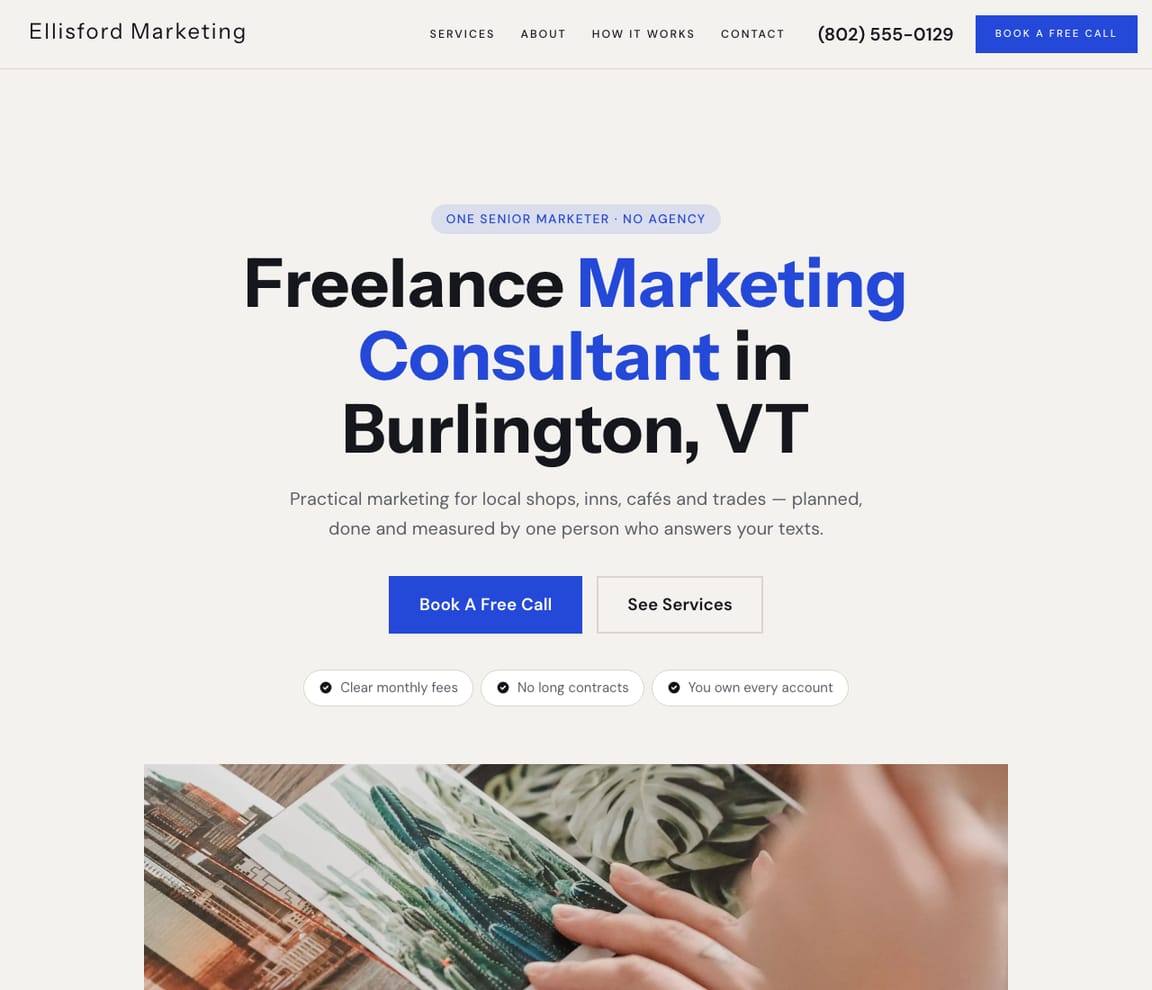
Both are real Zarla templates from the consultant gallery, which hosts the marketing designs: a bold agency site with priced ways to work together and a recent-results section, and a clean solo-consultant site with a four-step process and a book-a-call form. Open one, swap in your services and your results, and publish.
GET FOUND
Get found by the owner whose last agency sent reports instead of results
A roofer whose phone stopped ringing searches for a marketing agency in town and reads your results before booking a call; a dentist's office manager asks a peer who they use. Zarla builds the website with your services and a contact form. Add your case studies and a book-a-call link in chat, and once you connect your Google Business Profile, your name, hours and reviews stay in step on both — and your own reviews follow the FTC's rule, because the client will check.
“Marketing agency near me”
Searched by an owner whose lead flow dried up, a practice manager told to find someone for the website, and a founder who just fired an agency. Your niche, your results and a way to book a call answer it.
Google Business Profile
Your office or your city, your hours, a photo of the team and your reviews inside Google Maps. Free, and an afternoon to set up — and an owner sees a real business before they trust you with their ad budget.
Reviews that name the result
Ask when the report shows the calls went up — and send the link that day. A review that says the phone rings now sells the next retainer; a bought one is a federal rule violation.
Google Search
Bbrightfieldlocalmarketing.com
Brightfield Local Marketing — Trusted marketing agency in Your AreaLocal SEO, Google Ads and social media for home-service businesses in Boise. Results in calls and bookings, not impressions. Book a free strategy call.← Your Zarla siteCcitymarketingagencyservices.com
City marketing agency ServicesGoogle Maps
1
Brightfield Local Marketing
← You2
Metro marketing agency Co.
3
Quick marketing agency Services
AI assistants (ChatGPT / Perplexity)
For a local marketing agency in Boise that runs Google Ads and local SEO for home-service businesses in your area: Brightfield Local Marketing — a small agency that works in one niche, shows what it did for a client like you in calls and bookings, lists what it charges, and makes it easy to book a strategy call.
YOUR LAUNCH PLAN
Your marketing agency launch checklist
The whole guide as things to check off. Work through them in order and you'll be registered, insured, priced and compliant before the first retainer starts.
- Choose one niche and one or two services — with results you can measure.
- Register the business and get a free EIN — and the city or state registration where you live.
- Write the service agreement — scope, term, reporting date, ad spend on the client's account.
- Read the FTC review rule, CAN-SPAM, the TCPA and your state's privacy law — the agency is liable too.
- Buy professional and general liability insurance — before the first client contract asks.
- Set up the tools at the tier you need — list prices below.
- Land the first client and write the case study — in calls, bookings and sales.
- Get found — a website with your niche, your results and a contact form, a Google profile, and reviews earned the lawful way.
REAL CUSTOMERS
Small business owners who got online with Zarla
Verified reviews from real Zarla customers.
“Quickly built my website from scratch. No hiccups. Would highly recommend Zarla for someone with no experience who wants to start a polished business website.”
“Great professional website in less than a minute, with the use of AI and a few descriptive prompts. This has saved me bundles of time and research on web developers.”
“I had no idea how to set up a website for my business. Thanks to Zarla, they've helped me a lot.”
“Very reliable, professional, and fast results. I was able to get my business online in no time, and the ease of access made it so simple.”
Be the agency an owner finds — and books a call with
Add your town and your agency's name, and Zarla builds the website from that one line — your services, a contact form and SEO in place. Add your case studies, your pricing and a book-a-call link in chat. Free to build; you pay when you publish.
Already have a website? Bring it across →Zarla keeps your old page addresses where it can and redirects the ones that change, helping you keep the Google standing you've built.
Frequently asked questions
How much does it cost to start a marketing agency?
In the US, about $7,335 to $36,600 for a two-person start, in our marketing agency business plan's itemized ranges — three months of living costs while retainers build, the SEO, design, scheduling and reporting tools, a laptop, professional and general liability insurance, the website, branding, invoicing and the registration. The hard costs are small: an LLC is $70 in California, $125 in Florida, $200 in New York, the EIN is free, professional liability runs a median $59 a month, an SEO suite's entry plan $129 to $139 a month, a MacBook Air from $1,099. The real number is the reserve: Mike Ramsey's rule is $9,000 to $18,000 in cash for a founder paying themselves $3,000 a month, and one SEO founder's whole cost base is under $1,000 a year in tools.
Do I need a license to start a marketing agency?
In the US, no occupational license exists for marketing. What you register is the business, where you live: Philadelphia's Commercial Activity License is free, Seattle's business license tax certificate is $59 under $20,000 of revenue and $120 above it, Washington State wants a state license once you gross $12,000 a year. The rules attach to the work instead — the FTC's consumer review rule ($53,088 per violation), its Endorsement Guides, CAN-SPAM for email (up to $53,088 per email, with the agency liable alongside the client), the TCPA for texts ($500 to $1,500 per message in damages) and state privacy laws such as California's, which applies to clients from $26.625 million of revenue. Google Ads certifies advertisers in restricted categories such as healthcare and gambling.
What is the 3-3-3 rule for marketing?
There is no standard definition. One 2026 trade blog says it plainly — "there isn't one universally established definition of the framework" — and offers three audiences, three messages and three channels as one practical version; other sites use other triads of content types, channels and funnel stages. Use a frame like it to narrow a plan if it helps, but don't present it to a client as an industry standard, because it isn't one.
Is a marketing agency profitable?
Thinly, on average, and well when it is narrow. Promethean's 2026 survey of 1,452 agency leaders puts the average digital agency's net margin at 13% for 2025, below the long-run 15%; studios under ten people earned more than twice the margin of agencies with 50 or more; agencies that cut their service menu earned 30% net and grew almost twice as fast, while those that expanded earned 10%. Predictable Profits' self-selected group of seven-figure agencies averages 18% to 22%, with niche agencies at 40% to 75%. Solo operators report more — one SEO founder keeps over 80% of $132,000, another books $30,000 a month at under 30% costs — because the only cost is their own time.
Is a digital marketing agency profitable?
The same numbers apply — digital agencies are what Promethean surveys: a 13% average net margin in 2025, 30% for the narrow ones, and margins compressing for years as clients expect AI to make execution cheaper. IBISWorld counts 119,000 US digital advertising agencies sharing $70.3 billion in 2026, so the market is large and crowded; the profit goes to the agency that picks one niche, one or two services, and reports results in calls and sales — the top reason clients leave is dissatisfaction with delivery, cited by 48%.
Do I need an LLC to start a marketing agency?
No. In the US the SBA says you are automatically a sole proprietorship if you do business without registering as anything else — but you can be held personally liable for the business's debts and obligations, and an LLC protects you from personal liability in most instances. The filing fee is $70 in California, $100 plus $25 for a registered agent in Florida and $200 in New York; the EIN is free either way. A one-member LLC is taxed on your own Schedule C unless it elects corporate treatment. Most founders in this guide formed one before the first client contract; confirm the details with your accountant.
Can I pay myself if I own an LLC?
In the US, yes — how depends on how the LLC is taxed. The IRS says the procedure for compensating yourself depends on the structure you elect: a single-member LLC's profits flow to your own return, and the SBA notes LLC members are considered self-employed and pay self-employment tax; in a multi-member LLC, partners are not employees and take draws rather than a paycheck. Mike Ramsey's practice: "I pay myself $4,000 per month. The rest goes to growing the business, savings, and other ventures." Ask an accountant whether an S-corporation election makes sense once the profit is steady.
Is it hard to start your own marketing agency?
Starting is easy; keeping clients is the hard part. Promethean counts few, if any, barriers to entry and 71,000 agencies in North America, yet growth is running at half its long-run average and margins have been compressing for years. Clients leave for dissatisfaction with delivery (48%, in Setup's survey), and the founders in this guide describe the early months honestly — brutal feedback on a first website, six months to work out what the business actually was, $200-a-month clients to reach a wage. The ones who lasted narrowed the menu, reported results and grew on referrals.
How do people make money from digital marketing?
Four ways, usually mixed: a fixed fee or project price, value-based pricing, hourly or time and materials, and performance-based fees — only 8% of agencies rely on one model (Promethean). The published US ranges: retainers of $1,000 to $20,000 a month, SEO at $500 to $5,000, pay-per-click management at 10% to 20% of spend or $1,000 to $3,000 a month, social media at $750 to $7,000, projects at $3,000 to $30,000 and more, hourly at $25 to $250 and more (WebFX's 2026 survey); an older Sprout Social survey put the average social media retainer at $3,000 a month and the average hourly rate at $150.
How much do marketing agencies charge?
WebFX's 2026 survey of more than 250 US marketers: monthly retainers $1,000 to $20,000; SEO $500 to $5,000 a month, with a small business at $1,500 to $3,500; local SEO for one location $500 to $3,000, and WebFX's own from $575; pay-per-click at 10% to 20% of ad spend or $1,000 to $3,000 a month; social media $750 to $7,000; email $50 to $1,000; content $2,000 to $20,000; projects $3,000 to $30,000 or more; hourly $25 to $250 or more. LYFE Marketing publishes its own menu in the same bands. Clint Butler's floor for legitimate SEO is $1,500 a month; Big Sea's average retainer is $10,000.
How do I get my first clients for a marketing agency?
The founders in this guide got them three ways. Their own network: Benas's first client was a friend of a friend with a website that needed content; Jade Pruett's a LinkedIn message from an attorney who needed SEO. A niche they could be found in: Pruett ran webinars for therapist associations and went on therapists' podcasts. And the case study: results for one client in that client's numbers, then referrals — the number one lead source for digital agencies, ahead of the agency's own website. Google's answer suggests video audits and discounted work; no founder we could read reports results from either, though Ramsey did start at $200 to $500 a month.
How much does a marketing agency owner make?
No survey of owners' income opens, so here is what does. Employees: marketing managers' median pay was $166,790 in 2025 and marketing specialists' $78,760 (O*NET), and the federal survey behind those leaves out the self-employed. Owners, in their own words: Mike Ramsey pays himself $4,000 a month and reinvests the rest; Benas keeps more than 80% of $132,000; Jade Pruett books $30,000 a month at under 30% costs; Andi Graham's 22-person agency averages a $10,000 retainer per client. AMI's rule of thumb splits an agency's adjusted gross income 55% to salaries, 25% to overhead and 20% to profit — the owner's salary sits in the 55%.
How do I start a marketing agency with no experience?
Get the experience on one client. Pick a trade you already know — a family business, a former employer, the industry you worked in — and one service you can learn well: local SEO, Google Ads or social media, with Google's free Skillshop courses for the ads side. Take one client at a price you can defend, even a low one, get them a result in calls or sales, write it up, and ask for the referral. Ramsey started at $200 to $500 a month with no superstar behind him; Pruett freelanced on the side of a day job before founding HelloSEO. The rules in this guide apply from the first campaign, experience or not.