
BUSINESS GUIDE
How to start a private practice in 2026
For the therapist, counselor, clinical social worker or psychologist going out alone: the license as the gate in five states' own words, the entity your state allows (New York and California won't give you an ordinary LLC), what the first year costs from the vendors' own pages (less than the blogs say), the good faith estimate the federal rule makes you hand every self-pay client, the credentialing wait nobody will put a number on, what Medicare actually pays, what practice owners report earning — and what the clinicians who did it say.
Free to build · Pay when you publish · No credit card
$1,184.40the lean first year of a telehealth-only solo practice from the vendors' own pages — about $1,184 (our arithmetic)
$153a year for malpractice cover at HPSO's advertised counselor rate — no state read requires it; every code assumes it
$75,000the median revenue practice owners report for a solo practice, with $52,663 of profit (Heard's 2026 survey of its customers)
No codeto get online
See it in action
See what your private practice website could look like
This is a real Zarla template for a therapy practice — the calm hero, the specialties, the approach in plain words, the clinician's bio, the consultation request. Describe yours — anxiety, couples, trauma, the city — and you'll have a site like this, with your specialties, an inquiry form and a map, in about a minute.
- Professional design — not a generic template
- Looks great on desktop and mobile
- Content written for your industry
Build the website
Start your private practice website now
Add your city and the practice's name to the sentence, and Zarla builds the site: your specialties, an inquiry form and a map. Add your rates, the insurance you take and your booking link in chat, then publish.
Already have a website? Bring it across →Zarla keeps your old page addresses where it can and redirects the ones that change, helping you keep the Google standing you've built.
Is starting a private practice worth it in 2026 — and what do private practice therapists make?
The private practice one clinician can start is a solo practice: a licensed counselor, clinical social worker, marriage and family therapist or psychologist, two to ten years past the degree, with a part-time room or a screen, a private-pay rate and two or three insurance panels, and the practice software doing the notes, the scheduling, the telehealth and the claims. The capital is small; the question is the caseload and the rate. What employed clinicians earn: "Workers on average earn $59,350." for mental health counselors (O*NET, 2025), $60,280 for clinical and school social workers (O*NET), $66,940 for marriage and family therapists (O*NET) and $100,580 for clinical and counseling psychologists (O*NET) — in a survey that leaves out "the self-employed, owner/partners in unincorporated firms" (Washington ESD), which is what a practice owner is. What owners report: a bookkeeping vendor's survey of its own customers — "86.5% are sole practitioners" — prints "Median revenue: $75,000 Median profit: $52,663" for solo practitioners, "Median revenue: $169,121 Median profit: $80,000" for group-practice owners, hybrid practices at "$93,000" of revenue and "$59,786" of profit against telehealth-only at "$70,000" and "$48,540", and the waitlist as the dividing line — "$109,055 median revenue" with one, "$75,462 median revenue" without (Heard, The Financial State of Private Practice 2026); its benchmarks article: "Median revenue for all therapists in 2025 was $80,412, up from $68,222 in 2024" and "Based on median income, solo therapists earn less than employees, but may have more potential for earnings growth" (Heard, 2026).
What a session sells for. Owners' own survey: "74.6% of therapists accept insurance. 25.4% are cash-pay only.", "Average reimbursement across major insurers runs $95–$125 per session." and "A $150 cash-pay session typically reimbursed around $105 through insurance." (Heard, above). Medicare's rate as a billing vendor tabulates the 2026 schedule: "90837 Individual Psychotherapy, 60 Minutes $167.00 $125.25" — the first figure to a psychologist, the second to a counselor or family therapist — and "90834 Individual Psychotherapy, 45 Minutes $113.90 $85.43", with Colorado Medicaid's 2025 line "90837 Psychotherapy 60 Min. $131.16 $104.92" (TheraThink, 2026); a directory prints the same from the client's side: "Medicare, the federal payer, allows about $167 for a 60-minute psychotherapy session in 2026 and about $114 for 45 minutes, national amounts adjusted by locality." (TherapyRoute, 2026). What therapists print on their own profiles in Los Angeles and Orange County: "Pricing: $200.00 per 53 minute hour" (Alynn Cauldwell, LMFT, VoyageLA, March 3, 2026), "Pricing: $220/session if Private Pay (superbills are offered)" (Ciana Gonzales, LMFT, VoyageLA, October 21, 2025), "175 per 53 minutes for individuals w/ out insurance 200 per 53 minutes for couples & families w/ out insurance" (Desiree De Pace, VoyageLA, read 2026) — $175 and $200. No page of record prints a national private-pay average that opens; the survey's $150 example and the owners' own listings are the honest read. The arithmetic that reaches $200,000 of revenue — twenty-five sessions a week for forty-six weeks at that $175 is $201,250, our arithmetic — is a full private-pay caseload at a big-city rate, before the practice's costs and with no cancellations; the owners' survey says it is uncommon at one chair.
What the plan runs. Our free private practice business plan is a Denver clinician in a Capitol Hill room two days a week and on video across Colorado: eighty sessions a month — eighteen to twenty a week, half at $150 private pay and half on two panels at about $100 — is about $10,000 a month, against the room, the software, the listing, the malpractice policy and the card fees, with the owner's own pay the remainder. The owners who did it describe the two halves: "After one year of being exploited by this group practice, I started my own private practice and I'm so glad I did. I've been able to deepen my knowledge and gain expertise in specific issues and now specialize in areas that I'm gifted in working in." (Angel Thomson, LMFTA, Greater Seattle — CanvasRebel, December 16, 2024); "When I left the agency and transitioned to private practice, I had to work 2 other jobs (nannying and running groups for another organization) in addition to the practice to support myself while building up my caseload." (Ciana Gonzales, above).
The catch. The hours are the ceiling — a cancelled session is unpaid and twenty-five a week is a full week; the panels pay nothing until the effective date, and no insurer prints how long that takes; the ethics codes bar the testimonials that fill a caseload fastest; a video client who moves across a state line is a licensing question before a clinical one; and an unencrypted email with a client's name in it is a reportable breach and a board complaint. That's what the rest of this guide sets up.
How to start a private practice, in plain English
The license is the gate — and an associate may not practice alone. In the five states we read the practice is open only to the independent license. Texas: "The LPC Associate shall not engage in independent practice." and "The LPC Associate must not represent himself or herself as an independent practitioner. The LPC Associate's name must be followed by a statement such as "supervised by (name of supervisor)" or a statement of similar effect" on "all marketing materials, billing documents, and practice related forms and documents where the LPC Associate's name appears, including websites and intake documents." (22 Tex. Admin. Code §681.91); the ladder: "LPC associates must have completed a minimum of 18 months of supervised experience totaling 3,000 hours. These hours must include at least 1,500 hours of direct counseling experience" (Texas Behavioral Health Executive Council), and the fee chart prints "LPC Associate/LPC/Provisional License Application $ 165.00" — $165 (Texas Register, March 13, 2026 — the agency's own fee pages refuse readers). Florida: "Application Fee $100.00 (non-refundable) Initial Licensure Fee $75.00 Unlicensed Activity Fee $5.00 Total $180.00" — $180 — after "two years and 1,500 hours of supervised clinical experience" for the LMHC (Florida's board, mental health counselors) and "1,500 hours of face-to-face psychotherapy with clients" for the LCSW (the same board, clinical social workers). New York: "The fee for licensure and first registration is $371." for the LMHC after "a supervised experience of at least 3,000 clock hours" (New York Office of the Professions); "$294" for the LCSW after "at least 3 years of post M.S.W. supervised experience" (the same office) and for the psychologist (the same office, psychology). California: "3,000 total supervised hours, over 104 weeks (minimum)" (California Board of Behavioral Sciences), the renewal "two hundred dollars" (16 CCR §1816) — $200 — halved by the Board's own notice from July 1, 2026 through June 30, 2030: "License Application (LMFT, LCSW, LPCC & LEP: $250 to $125." and "Initial License Issuance (LMFT, LCSW, LPCC & LEP): $200 to $100." (BBS fee-reduction notice). Colorado: "at least two thousand hours of practice in counseling, including at least one thousand five hundred hours of face-to-face direct client contact under clinical supervision" (C.R.S. §12-245-604); the board sets its fee inside its online portal, which prints nothing to a reader (Colorado DPO). Check your own state's board.
The entity is the state's call — and the AI answer's "sole proprietorship, LLC, or S-Corp" is wrong in two states. A sole proprietorship under your own name costs nothing to form in all five. New York gives a licensed professional the professional service LLC, not the ordinary one: "one or more professionals each of whom is authorized by law to render a professional service within the state … may form, or cause to be formed, a professional service limited liability company" (N.Y. LLC Law §1203), "two hundred dollars" to file (§1101) — $200 — plus the notice published "once in each week for six successive weeks, in two newspapers of the county" (§1203). California bars the LLC outright: "Nothing in this title shall be construed to permit a domestic or foreign limited liability company to render professional services" (Cal. Corp. Code §17701.04(e)); the vehicle is the professional corporation — "a corporation organized under the General Corporation Law … that is engaged in rendering professional services in a single profession … pursuant to a certificate of registration issued by the governmental agency regulating the profession" (§13401, the Moscone-Knox Act) — at "One hundred dollars ($100)" for the articles plus "Twenty dollars ($20)" for the statement of information (Gov. Code §12186) and "a minimum franchise tax of eight hundred dollars ($800)" a year (Rev. & Tax. Code §23153). Texas offers the PLLC, "formed for the purpose of providing the professional service rendered by a doctor of medicine, doctor of osteopathy, doctor of podiatry, dentist, chiropractor, optometrist, therapeutic optometrist, veterinarian, or licensed mental health professional" (Tex. Bus. Orgs. Code §301.003), at "for filing a certificate of formation, $300;" (§4.152, applied to LLCs by §4.154). Florida: "For filing original articles of organization or articles of revocation of dissolution, $100." (Fla. Stat. §605.0213), or the professional LLC "for the sole and specific purpose of rendering the same and specific professional service" (§621.051). Colorado: "Articles of Organization $50.00" — $50 — and a "Periodic Report $25.00" a year (Colorado Secretary of State). "S-Corp" is a federal tax election on top of an entity, not an entity. The EIN: "Use this tool to get an EIN directly from the IRS in minutes for free." (IRS). The entity does not shield you from your own malpractice; the policy does.
HIPAA, the records, and the good faith estimate. You are a covered entity if you bill electronically: "Covered entity means: (1) A health plan. (2) A health care clearinghouse. (3) A health care provider who transmits any health information in electronic form in connection with a transaction covered by this subchapter." (45 CFR 160.103). Then the privacy notice at intake — "an individual has a right to adequate notice of the uses and disclosures of protected health information that may be made by the covered entity" — and the agreement with every vendor that touches client data: "A covered entity may disclose protected health information to a business associate … if the covered entity obtains satisfactory assurance that the business associate will appropriately safeguard the information." (45 CFR 164.520 and 164.502(e)); Google's: "The HIPAA BAA is made available to customers for electronic acceptance via their Admin console." (Google Workspace). The Security Rule: "Ensure the confidentiality, integrity, and availability of all electronic protected health information" (45 CFR 164.306). Substance-use records carry a second federal layer for a "part 2 program" — "a federally assisted program" — which a solo private-pay practice usually is not; read the definition before you bill Medicaid for it (42 CFR Part 2). Records, by state: "records held by a licensee must be kept for a minimum of seven (7) years from the date of termination of services with the client, or five (5) years after the client reaches the age of majority, whichever is greater." in Texas (22 Tex. Admin. Code §681.36); "a minimum of seven years from the date therapy is terminated" for a California LMFT, and seven years after a minor turns 18 (Cal. Bus. & Prof. Code §4980.49); "all patient records must be retained for at least six years" in New York, minors' "until one year after the minor patient reaches the age of 21 years" (8 NYCRR 29.2); Florida's board rule sets what the record must contain and refers elsewhere for the years, and Colorado's rule sits on a site that refuses readers — check both with the board. The federal rule for self-pay clients, in force since January 1, 2022: the written good faith estimate is due "Not later than 1 business day after the date of scheduling" when the session is "at least 3 business days" out, "Not later than 3 business days" when it is "at least 10 business days" out, and "Not later than 3 business days after the date of the request" whenever "an uninsured (or self-pay) individual" asks (45 CFR 149.610). The practice software has the template; use it at intake.
Insurance, sales tax, and the day you hire. No statute or board page read in the five states requires malpractice cover; the codes assume it and the insurers price it: "Rates as low as $153 per year" (HPSO, counselors); "Therapy and counseling businesses pay an average of $56 per month, or $670 annually, for professional liability insurance." and general liability at "$29 per month, or $350 per year" (Insureon); "$61 per month, or $730 annually, for mental health counselors" (Insureon, mental health counselors); "A full therapy and counseling insurance package runs about $60 to $80 per month, while professional liability (malpractice) coverage on its own costs roughly $40 to $60 per month." and "Most US therapy and counseling practices spend between $720 and $960 a year on a full package" (Insuranceopedia) — $720. A therapy session is not a taxable sale in the states read: Texas lists "16 broad categories of services" and counseling is not one (Texas Comptroller); Florida's taxable services are "investigative and crime protection services, interior nonresidential cleaning services, or nonresidential pest control services" (Florida Department of Revenue); New York's quick-reference list of taxable services has no psychotherapy line (New York Tax Department); Colorado taxes "all sales and purchases of tangible personal property at retail" and a short list of named services (C.R.S. §39-26-104); California's tax falls on tangible goods. Workers' compensation only once you hire: "an employer may elect to obtain workers' compensation insurance coverage" in Texas (Tex. Labor Code §406.002); "four or more employees" in Florida (Fla. Stat. §440.02); "Every employer except the state shall secure the payment of compensation" in California (Cal. Labor Code §3700); New York's statute lists the covered employments and the reading is nearly all employers (N.Y. Workers' Compensation Law §3); Colorado from "one or more persons engaged in the same business or employment" (C.R.S. §8-40-203). Confirm your own state's rule with your accountant.
The panels, the compacts, and the wait nobody prints. The NPI is the number every claim carries, and the CAQH profile is what every panel reads — "Every 120 days (180 days for providers practicing in Illinois), you will receive a notification from CAQH ProView to reattest that all of the information in your profile is still correct." (Blue Cross Blue Shield of Illinois). The AI answer's "2 to 6 months" is printed by no insurer we could open; the guides print their own: "The application process takes 60 to 180 days, requires proof of education, licensure, malpractice insurance, and other documentation, and rates are usually non-negotiable." and "Cigna's Evernorth quotes up to 90 days to join" (Mentalyc, 2026); a platform that holds the contracts advertises "Simple, less than 45-day credentialing process" and "Negotiating reimbursement rates for you" (Alma, for providers). Across state lines you need a license where the client sits — and the compacts are changing that: "October 19, 2026, 10:30 a.m. ET: Missouri goes live in the Compact. The Counseling Compact is live for licensees in Arizona, Arkansas, Georgia, Indiana, Louisiana, Minnesota, Missouri, Ohio, Oklahoma, Tennessee, and Wyoming." with "29 additional states and the District of Columbia are actively completing the steps" (Counseling Compact); "The Social Work Licensure Compact has been enacted in at least seven states and has reached activation status, however multistate licenses are not yet being issued." (Social Work Licensure Compact); psychologists' PSYPACT lists its member states on its own site, which refuses a scripted reader — check it. Advertising is regulated too: New York's rule for every licensed profession bars advertising that "guarantees any service" or "makes any claim relating to professional services or products or the cost or price therefor which cannot be substantiated by the licensee" (8 NYCRR 29.1); the counseling code: "Counselors who use testimonials do not solicit them from current clients, former clients, or any other persons who may be vulnerable to undue influence." (ACA Code of Ethics, 2014); the psychology code: "Psychologists do not solicit testimonials from current therapy clients/patients or other persons who because of their particular circumstances are vulnerable to undue influence." (APA Ethics Code, 2017); and on former clients the three codes diverge — the counselors' five years, the psychologists' two, and the social workers' none at all: "Social workers should not engage in sexual activities or sexual contact with former clients because of the potential for harm to the client." (NASW Code of Ethics, 1.09(c)). Google lists a therapist as an individual practitioner — "Business Profiles for practitioners may include title or degree certification (for example Dr., MD, JD, Esq., CFA)." (Google Business Profile help).
The money to start — and the "$3,000–$10,000" the page-one blog prints. From the pages that open on October 26, 2026, a telehealth-only sole proprietor's first year: HPSO's $153; the practice software — "Starter 50% off for 3 months $49 $24 50 /month for 3 months, then $49 billed monthly", "then $79 billed monthly", "then $99 billed monthly" (SimplePractice) — at $49 a month, $588; Psychology Today — "If you choose to remain in the Therapy Directory, you will be charged $29.95 per month beginning in the seventh month." (NBCC; "costs $29.95 monthly" — ChoosingTherapy) — $359.40 for twelve; HIPAA email — "$7.00 • Price is per user/month and does not include tax" with a one-year commitment (Google Workspace's US price page as archived October 25, 2026 — the live page serves each country its own prices) — $84: $1,184.40, our arithmetic — about $1,184; $238.95 before the first client, about $239. With a room, $3,434.40 — about $3,434: a Colorado LLC at $50, a Boulder clinic room — "Sunday Only: $100" a month, "All 3 days: $300" (a university's rental board, Boulder) — at $1,200 for the year, and furniture: "Whatever your tastes in furniture, be prepared to spend at least $1,000 setting up your office with key furnishings." (Heard, a bookkeeping vendor). A HIPAA phone and messaging line: "Basic Core communication tools to streamline patient interactions, simplify daily workflows, and stay compliant. $24/month * per user" (Spruce Health). The cards: "Card payments are processed through SimplePractice's integrated system with a fee of 3.15% + $0.30 per successful transaction." (ChoosingTherapy's review). The plan page's wider $3,732–$15,627 adds the entity, the room's deposit, the fuller furniture, continuing education, the website and three months of working capital for the panels' wait. What the blogs print: "Plan to spend two to four months launching your private practice, and budget at least $1,500 for startup costs." (Heard); "Starting a practice in 2026 costs around $1,600 in initial one-time fees and annual costs, plus about $500 per month in ongoing expenses." (zynnyme, a coaching vendor); and the California blog's "Expect initial costs between $3,000–$10,000, including licensing, office rent, business insurance, website setup, and EHR systems." (Supanote, an AI-notes vendor) itemizes nothing — $3,000 is a plausible fuller start with a room, and $10,000 is a furnished full-time office, not a solo launch.
In the UK: two tiers. Practitioner psychologists are regulated by the Health and Care Professions Council — "The professions we regulate have one or more designated titles that are protected by law. To use one of these titles, an individual must be registered with the HCPC." (HCPC) — while counselors and psychotherapists are not regulated by law: the Professional Standards Authority accredits the voluntary registers, and the BACP register and UKCP's national register are the two most searched. The business: "You can start trading straight away without registering. However, you must register for Self Assessment as a sole trader if you earn more than £1,000 in a tax year" (GOV.UK); VAT "if their VAT taxable turnover is more than £90,000" (GOV.UK), with the health exemption written for registered health professionals — read whether a counselor's sessions qualify before you assume it (VAT Notice 701/57); the data-protection fee is £52 a year for the smallest tier (the 2018 regulations). The inversion: the title "counsellor" is unprotected in the UK; in the five US states read the title and the practice are both licensed. In Australia: psychologists must be registered with the Psychology Board of Australia to practice (Psychology Board of Australia); counselors and psychotherapists are not registered by law — PACFA and the Australian Counselling Association run voluntary registers (PACFA); the Medicare rebate under Better Access — "up to 10 individual and 10 group therapy mental health treatment services per calendar year" — goes to "psychologists (eligible clinical and eligible registered) eligible social workers eligible occupational therapists", not to counselors (Department of Health); the ABN is applied for through the Australian Business Register (ABR); GST registration at A$75,000 of turnover, with psychology and social work on the tax office's GST-free health list and counseling not (the ATO's pages carry a British spelling in their addresses, so they are not linked). Check your own regulator's rules.
What private practice therapists actually say
None of this is our opinion about starting a private practice. It comes from clinicians who own one — in Texas, Florida, California, Washington, Colorado, Illinois and North Carolina — talking to CanvasRebel, VoyageLA, NPR Illinois and the Steamboat Pilot between 2022 and 2026, plus two whose words a vendor published (marked as such), each described as the page describes them. Read each as theirs at the time. Five things come up again and again.
Why they left the agency or the group. Angel Thomson, LMFTA, Greater Seattle: “The pay was very low, but I didn't know this at the time, and I was eager to do the work I felt purposed for, and borrowed $100,000 in student loans to be able to do.” (CanvasRebel, December 16, 2024). Heather Keenan, LCSW, Fort Lauderdale: “I had always known that I wanted to open up my own private practice so I could start to have more autonomy with my ideal clients and my scheduling. When I quit my job, I didn't have much lined up for me except the idea of it being time to start my private practice.” (CanvasRebel, September 7, 2023). Misty Farber, Los Angeles: “It has also been difficult making the transition from salary work to managing my business, but as I get older, I no longer have tolerance for following someone else's lead. This is part of the reason I no longer accept insurance and work from a cash rate fee.” (VoyageLA, August 4, 2025). Tommy Thompson, LCPC, Springfield, Illinois: “We started Sunrise Counseling last January 2025. I'd worked for a couple of other private practices in town with the ultimate goal of eventually starting my own.” (NPR Illinois, June 18, 2026).
“Starting a private practice was challenging. It involved identifying a strong supportive team and collaborating strategically with those practicing in the area for some time. It was thrilling but also very stressful as I embarked on putting a comprehensive business plan into place. It was challenging to locate clients without insurance paneling, and I found that getting agency contracts was ideal (EAP programs, etc.).” — Nicole Johnson, LCSW, Mindful Counseling Services, North Carolina, in CanvasRebel, March 13, 2023
The first year — the caseload, the second jobs, the associate years. Lavelda Naylor, LMFT supervisor, Texas: “I started my private practice as a Marriage and Family Therapist Associate right out of graduate school. While this is permitted by the governing board, it is unusual. In fact, I was the only one in my cohort to do so.” and “It took me about 3 years to finish my Associates hours out on my own, but by that time my private pay practice was thriving and I had a clear brand identity.” (CanvasRebel, March 13, 2023). Ciana Gonzales, LMFT, Los Angeles: “Then once Covid hit, many people decided to leave therapy due to the virtual nature. My other jobs had come to an end due to the pandemic as well, and I eventually had to take on another virtual therapy job to continue to sustain myself while building my caseload back up again.” (VoyageLA, October 21, 2025). Hayli Evans, LMFT, LPCC, Los Angeles: “In 2020, during the COVID-19 pandemic and shut down, I moved with my husband to Los Angeles and started my private practice, specializing in trauma, anxiety, and treatment of C-PTSD. I have been so grateful for the opportunity to grow as a therapist and a business owner over the past several years.” (VoyageLA, March 9, 2026). Yulia Stepanova, LMFT, Newport Beach: “After graduating, I transitioned into working alongside my supervisors in private practice. On their advice, I also joined College Hospital's Intensive Outpatient and Partial Hospitalization Programs, where I worked with individuals experiencing severe mental health conditions, including schizophrenia, bipolar disorder, and personality disorders.” (VoyageLA, February 24, 2026). Dr. Justin Keith Dodson, LPC, in a bookkeeping vendor's story about him: “My belief was: That's not consistent money, you can't really earn a living,” he said. “That's for people that are in their mid 50s and 60s who have established a career.” (Heard, March 25, 2024).
Insurance, rates and the business side. Melissa Michel, a private practitioner, in a billing vendor's spotlight: “As private practitioners, our clinical work alone is full-time. Add in the unnecessarily difficult insurance billing system and we run the risk of working way over full-time.” (TheraThink, read 2026). Nicole Johnson again: “I encourage new professionals to get coaching or consulting before beginning their practice, credentialing with insurance panels, and securing agency contracts. Focusing on a specific population is also a great idea.” (CanvasRebel, March 13, 2023). Alynn Cauldwell, LMFT, Long Beach: “I have been practicing psychotherapy since 2004 and opened my private practice in 2017 with a clear vision: to create a space where people feel safe, understood, and empowered to heal.” (VoyageLA, March 3, 2026). Beth Lewis, LPC-S, Fort Worth: “Doing good work! Good work within each session is, hands down, the most effective strategy for growing my clientele, and for clientele trusting my staff selections. When I do good work within each session, and my staff does good work within each session, our clients tell their friends and family, and their friends and family contact us, and their friends and family contact us…& so on.” (CanvasRebel, March 14, 2022).
Room or screen; consultation and peers. Tommy Thompson on hybrid: “Yeah, flexibility is the name of the game. We have; I have more people interested in coming in person now after a big increase of people being more comfortable with online. There's a shift back to where I want to be in a separate place from my daily life. I don't want to do this at home.” (NPR Illinois, June 18, 2026). Jamalynn Holloway, Intentional Pathways Counseling Services, Oak Creek, Colorado: “I am excited to bring in-person, mental health services to the South Routt area,” Holloway said. “I have experienced the struggles and stresses of life first-hand and therefore have a perspective of what it takes to experience positive change.” (Steamboat Pilot, read 2026). Amy Tierney, LCSW, Orange County: “I was still reluctant but pushed through my anxiety and self-doubt and opened my private practice. Shortly after, I was introduced to a group of therapists in Orange County who practice at a very high level. I joined a relational psychotherapy consultation group led by a psychoanalyst who's absolutely brilliant and at the forefront of the relational psychotherapy movement. This group, which I'm still very much a part of today, has been absolutely invaluable.” (VoyageLA, October 21, 2025). Taylor Bowman, Serotonin Psychotherapy Practice, Los Angeles: “I've found that staying connected to other clinicians, both in my community and outside of it, is hugely beneficial. Recently, I've met incredible therapists through social media and have become so inspired by how other therapists and practice owners operate.” (VoyageLA, September 14, 2026).
The through-line: the clinicians who lasted left for the autonomy and took a second job while the caseload built, got on the panels or found the agency contracts that fed a new practice, priced the private-pay slot like a professional, kept a room for the clients who wanted one and a consultation group for themselves, and grew by the work in the session — never by a testimonial.
THE STARTER KIT
What you need to start a private practice
The independent license — the one gate
An LPC or LMHC, an LCSW, an LMFT or a psychologist. An associate may not practice alone: in Texas "The LPC Associate shall not engage in independent practice." The fees at the end of the ladder: $180 all in for Florida's LMHC, $371 in New York, $125 plus $100 in California from July 2026, $165 in Texas.
The entity your state allows
A sole proprietorship costs nothing in the five states read. New York requires a professional service LLC ($200 plus publication); California bars LLCs for licensed professionals, so it is a professional corporation ($100 plus $20, and $800 a year); Texas offers the PLLC at $300; Florida the LLC at $100; Colorado the LLC at $50.
Malpractice cover from $153 a year
No statute read in Texas, Florida, New York, California or Colorado requires it; the codes assume it and the board complaint is what it covers. HPSO prints rates as low as $153 a year; Insureon's median is $56 a month; a full package runs $720 to $960 a year.
The practice software, with the HIPAA agreement
A practice that files electronic claims is a HIPAA covered entity, so the notes, the telehealth link, the claims and the card payments live inside software that signs a business associate agreement — SimplePractice is $49 to $99 a month — with HIPAA email at $7 a month and a HIPAA phone line at $24.
The written good faith estimate, at intake
Since January 1, 2022 every self-pay client gets a written estimate of expected charges — within one business day of scheduling a session three business days out, within three for one ten days out, or whenever they ask (45 CFR 149.610). The practice software has the template.
A directory profile and a site that prints the rate
Psychology Today is $29.95 a month; practice owners report referrals and the directories bring most clients and spend a median $500 a year on marketing. The site answers what you treat, what it costs and which insurance you take — without testimonials, which the codes bar you from soliciting.
THE PAPERWORK
Licenses, rules and taxes for a new private practice
| Typical cost | Time to get | Legally required? | |
|---|---|---|---|
| The independent license | $180 (FL); $371 LMHC / $294 LCSW (NY); $125 + $100 (CA, from July 2026); $165 (TX); CO in its portal | Years — the degree, 2,000–3,000 supervised hours, the exam | Yes in TX, FL, NY, CA and CO — an associate may not practice alone |
| The entity | $0 under your own name; $300 TX PLLC; $100 FL; $50 CO; $200 + publication NY; $100 + $20 + $800/yr CA | Days to weeks | No — but NY requires the professional LLC and CA bars LLCs if you want one |
| EIN | Free | Minutes | Needed to hire or for the entity; free from the IRS — never pay a site |
| Malpractice (professional liability) | $153/yr (HPSO's rate); $56/mo median (Insureon); $720–$960/yr a full package | Days | No statute read requires it; the codes assume it and the board complaint is what it covers |
| NPI and the CAQH profile | — | Weeks; re-attest every 120 days | Yes for any claim; CAQH for every panel |
| Insurance credentialing | $0 yourself; a service is a planning $1,500 | 60–180 days (the guides); under 45 on a platform | Only if you take insurance — nothing is paid before the effective date |
| HIPAA: notice, agreements, security | Inside the software ($49–$99/mo) and the email ($7) | Before the first client | Yes if you bill electronically (45 CFR 160.103); the ethics code binds either way |
| The good faith estimate | Free (a template) | 1–3 business days of scheduling | Yes for every uninsured or self-pay client since January 1, 2022 (45 CFR 149.610) |
| Record retention | — | 7 yrs (TX, CA); 6 yrs (NY); FL and CO: ask the board | Yes — by state rule, longer for minors |
| Sales tax on a session | None | — | Not a taxable service in TX, FL, NY, CA or CO |
| Seeing a client in another state | $55 a privilege (the Counseling Compact's Ohio example) | Days where the compact is live | A license where the client sits, or a compact privilege — 11 states live for counselors |
| Testimonials on the site | — | — | The ACA and APA codes bar soliciting them from clients; NY bars guarantees in any licensed profession's ads |
| Workers' compensation | None without staff | On the first hire | CA and CO from 1; FL from 4; NY nearly all; TX elective |
THE STEPS
How to start a private practice (step by step)
Eight steps from the agency job to a solo practice with a full caseload, a private-pay rate and two or three panels.
01
Hold the independent license, and decide the model
Not an associate's registration — the license itself. Then the three decisions: private pay, panels, or a platform that holds the contracts; a room, a screen, or both; and the specialty you will be known for. Practice owners' survey: hybrid practices report the highest median revenue.
Before the first client02
Form the entity your state allows, or none
A sole proprietorship under your own name costs nothing in the five states read. New York: a professional service LLC, $200 plus six weeks of newspaper notice. California: a professional corporation, $100 plus $20, and the $800 minimum tax every year. Texas: a PLLC at $300. Florida: an LLC at $100. Colorado: an LLC at $50. The EIN is free.
03
Bind the malpractice policy, take the NPI, start the CAQH profile
HPSO from $153 a year or Insureon's $56-a-month median — before the first consultation call. The NPI is the number every claim carries; the CAQH profile is what every panel reads, re-attested every 120 days or the application stalls.
04
Apply to the panels the day the license is in hand
No insurer prints its own timeline; the guides put approval at 60 to 180 days, Cigna's Evernorth quotes up to 90, and Alma advertises under 45 through its own contracts. Nothing is paid for sessions before the effective date, so the first insurance check can be half a year away.
05
Set up the software, the email, the phone and the forms
The practice software at $49 to $99 a month does the notes, the scheduling, the telehealth, the claims and the cards (3.15 percent plus 30 cents a payment); HIPAA email at $7 and a HIPAA line at $24. Inside it: the informed consent, the privacy notice and the good faith estimate template.
06
Take the room, or don't
A Boulder clinic room prints $100 a month for one day a week and $300 for three; a bookkeeping vendor's guide budgets at least $1,000 of furniture. Forty-one percent of practice owners run telehealth only. The lean first year without a room is about $1,184 in our arithmetic.
07
Publish the profile and the site, with the rate on it
Psychology Today at $29.95 a month, the Google Business Profile as an individual practitioner, and a site that prints what you treat, what it costs, the insurance you take, the states you are licensed in for video and the good faith estimate notice — and no testimonials.
08
Fill the caseload, then the waitlist
Eighty sessions a month — half at the plan's $150 private-pay rate, half on two panels at about $100 — is about $10,000 a month in our plan. Practice owners with a waitlist report a $109,055 median revenue against $75,462 without one; the referral from the physician and the former client is how it fills.
THE COSTS
How much does it cost to start a private practice?
The first figure is this guide's lean first year for a telehealth-only sole proprietor from the vendors' own pages — HPSO's policy, SimplePractice Starter, Psychology Today, HIPAA email. The second adds a Colorado LLC, a one-day-a-week room and the furniture the guides budget. The range is the private practice business plan's fuller start, with the room's deposit, the fuller furniture, continuing education, the website and three months of working capital for the panels' wait.
$1,184.40the lean first year, telehealth only — about $1,184; $238.95 before the first client (our arithmetic)
$3,434.40with a Colorado LLC, a Boulder room one day a week and $1,000 of furniture — about $3,434
$153a year for HPSO's counselor policy; the plan page's whole range, $3,732–$15,627, runs from your own name and a screen to a furnished room and three months in hand
$0to form a sole proprietorship under your own name in the five states read; $50 to $300 for the entity, and $800 a year in California
WHAT WE'VE LEARNED
What actually brings a private practice its clients
Thousands of local business websites in, the pattern for a solo practice is clear: the first clients come from referrals and the directories, and the ones after that come from the site answering the three questions. For a new practice, three things on a page decide who books — and the therapist templates are built around them.
The three questions, answered on the page
What you treat, what it costs, which insurance you take. Practice owners' own survey puts referrals at 83 percent and directories at 82 percent of where clients come from — and every one of those people opens the site next to check those three things.
The license, the state and the fee — not reviews
The ethics codes bar soliciting testimonials from clients. What a prospective client can check instead is the license number against the board's lookup, the states you are licensed in for video, and the fee with the good faith estimate notice beside it.
An inquiry form that asks for a name and a time, nothing clinical
A website form is not inside the practice software's HIPAA agreement, so it asks for a name, a phone number and a good time to call — and the clinical conversation happens on the free consultation call. The booking itself lives in the practice software's client portal.
THE EARNINGS
What private practice therapists make, and what a session pays
The wage medians from O*NET's 2025 figures leave out the self-employed; the owners' medians are a bookkeeping vendor's survey of its own customers; the rates are Medicare's schedule as a billing vendor tabulates it and what therapists print on their own profiles.
$59,350the 2025 median for employed mental health counselors — $60,280 for clinical social workers, $66,940 for marriage and family therapists, $100,580 for psychologists (O*NET)
$75,000the median revenue practice owners report for a solo practice, $52,663 of profit; $169,121 for a group practice (Heard's 2026 survey)
$125.25Medicare's 2026 payment to a counselor or family therapist for a 60-minute session; $167.00 to a psychologist (TheraThink's table)
$150a typical cash-pay session in the owners' survey, reimbursed around $105 by insurance; Los Angeles therapists print $175 to $220
SEE IT WORK
Practice website designs a therapist can start from
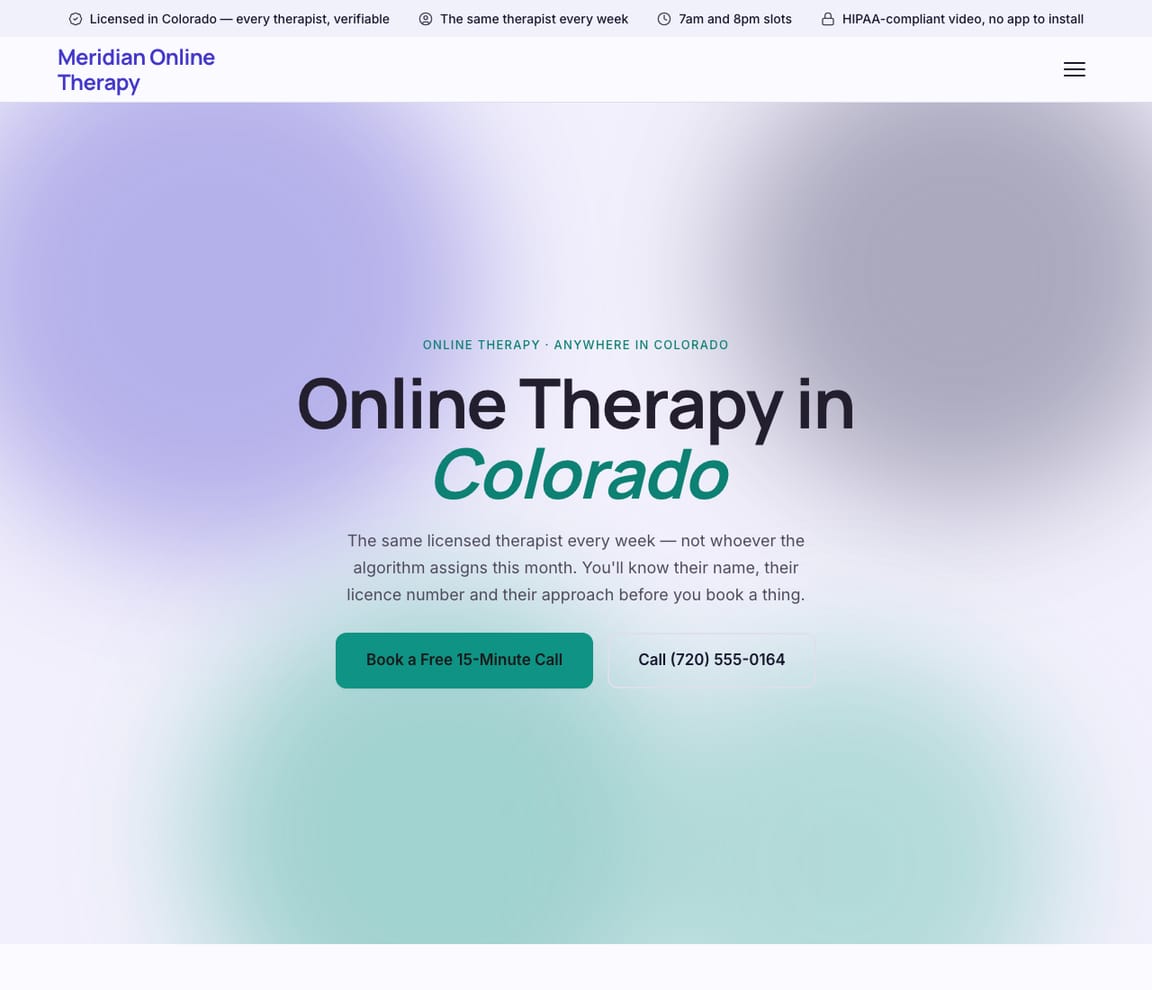
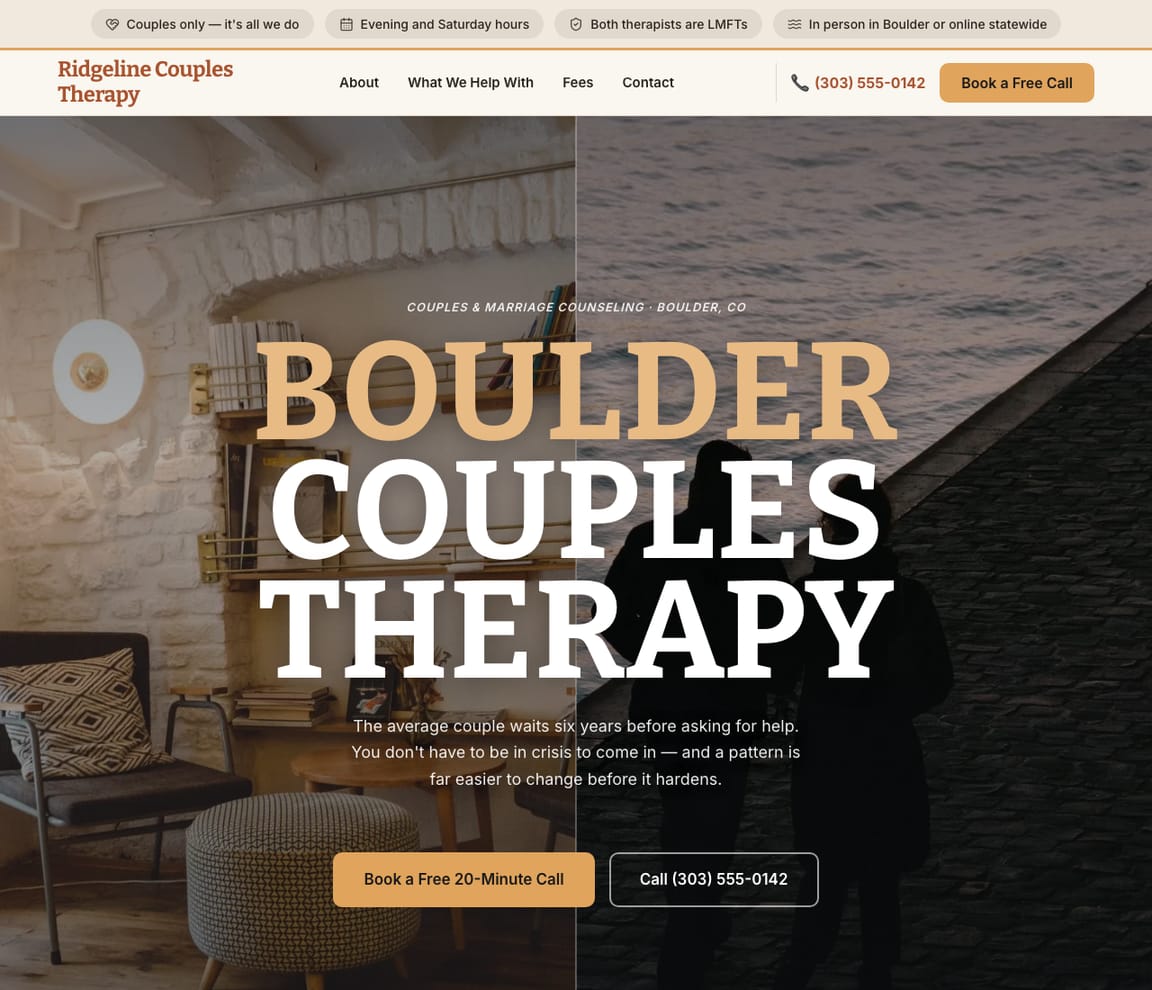
Real Zarla templates from the therapist gallery: an anxiety practice, a telehealth practice, a couples practice and a grief practice — the specialties, the approach, the clinician's page and the consultation request a therapy site is built around. Open one, swap in your specialties, your rates and your city, and publish.

GET FOUND
Get found by the person who read three profiles and will book the one who answers
Practice owners say referrals and the directories bring most clients, and a third name Google. The person searching "therapist" plus the city has the same three questions on every site they open: what you treat, what it costs, which insurance you take. Zarla builds the website with your specialties, an inquiry form that collects a name, a phone number and a good time — never clinical detail — a map and SEO. Add your rates, the insurance you take and your booking link in chat, and once you connect your Google Business Profile, your name, your hours and your address stay in step on both.
“Therapist near me”
Searched by the person who has finally decided to call, and by the parent and the partner looking on someone's behalf. Your specialties, your rate and your insurance list answer it before the phone rings.
Google Business Profile
Your practice, your hours and your office inside Google Maps — listed as an individual practitioner with your degree in the name, which Google's own rules allow. Free, and an afternoon to set up.
The credentials, not the testimonials
The counseling and psychology codes bar soliciting testimonials from clients, so the page's trust is the license number, the state, the specialties and the fee — printed plainly, with the good faith estimate notice beside them.
Google Search
Llanternhillcounseling.com
Lantern Hill Counseling — Trusted therapy practice in Your AreaIndividual therapy for adults with anxiety, burnout and life transitions — in a Capitol Hill office two days a week and by video across Colorado. Free 15-minute consultation call.← Your Zarla siteCcitytherapypracticeservices.com
City therapy practice ServicesGoogle Maps
1
Lantern Hill Counseling
← You2
Metro therapy practice Co.
3
Quick therapy practice Services
AI assistants (ChatGPT / Perplexity)
For a licensed counselor in Denver who sees adults for anxiety and burnout, in person two days a week and by video across Colorado in your area: Lantern Hill Counseling — a practice whose site lists what it treats, prints its session rate and the insurance it takes, says which states it is licensed in for video, and has a consultation request that asks for a name, a phone number and a good time to call.
YOUR LAUNCH PLAN
Your private practice launch checklist
The whole guide as things to check off. Work through them in order and you'll be licensed, formed, insured, credentialed and findable before the first consultation call.
- Hold the independent license and decide the model — private pay, panels or a platform; a room, a screen or both.
- Form the entity your state allows, or practice under your own name — and take the free EIN.
- Bind the malpractice policy before the first call — then the NPI and the CAQH profile.
- Apply to the panels now — the guides put the wait at 60 to 180 days, and nothing is paid before the effective date.
- Set up the practice software with the HIPAA agreement — the consent, the privacy notice and the good faith estimate template inside it.
- Take the part-time room, or run telehealth only — and furnish it with the $1,000 the guides budget.
- Publish the directory profile and the website — specialties, rate, insurance, licensed states, the estimate notice; no testimonials.
- Introduce yourself to the physicians and the school counselors — and book the consultation group that keeps you from working alone.
REAL CUSTOMERS
Small businesses that got online with Zarla
Verified reviews from real Zarla customers.
“Quickly built my website from scratch. No hiccups. Would highly recommend Zarla for someone with no experience who wants to start a polished business website.”
“Great professional website in less than a minute, with the use of AI and a few descriptive prompts. This has saved me bundles of time and research on web developers.”
“I had no idea how to set up a website for my business. Thanks to Zarla, they've helped me a lot.”
“Very reliable, professional, and fast results. I was able to get my business online in no time, and the ease of access made it so simple.”
Be the therapist who answers the three questions — what you treat, what it costs, which insurance you take
Add your city and the practice's name, and Zarla builds the website from that one line — your specialties, an inquiry form that asks for a name, a phone number and a good time to call, a map and SEO in place. Add your rates, the insurance you take and your booking link in chat. Free to build; you pay when you publish.
Already have a website? Bring it across →Zarla keeps your old page addresses where it can and redirects the ones that change, helping you keep the Google standing you've built.
Frequently asked questions
How much does it cost to start a private practice?
In the US, about $1,184.40 for a telehealth-only sole proprietor's first year in our arithmetic from the pages that open on October 26, 2026 — HPSO's $153 malpractice policy, SimplePractice Starter at $49 a month ($588), Psychology Today at $29.95 a month ($359.40) and HIPAA email at $7 a month ($84) — and $238.95 before the first client. With a Colorado LLC ($50), a Boulder clinic room one day a week ($100 a month) and the $1,000 of furniture the guides budget, about $3,434.40. The state adds its entity fee if you want one: a Texas PLLC $300, a New York professional service LLC $200 plus publication, a California professional corporation $100 plus $20 and $800 a year, a Florida LLC $100. Our private practice business plan's fuller range is $3,732 to $15,627, with the room's deposit, the fuller furniture, continuing education, the website and three months of working capital.
Do I need a license to start a private practice?
In the US, yes — the independent license is the gate in all five states we read (Texas, Florida, New York, California and Colorado), and an associate or intern may not practice alone: Texas says "The LPC Associate shall not engage in independent practice." (22 TAC §681.91); California's associates accrue 3,000 supervised hours over at least 104 weeks before the license; New York restricts clinical social work to the licensed. The fees at the end of the ladder: Florida $180 all in, New York $371 for an LMHC or $294 for an LCSW or psychologist, California $125 to apply plus $100 on issuance from July 2026, Texas $165. Check your own state's board.
Can I open my own private practice as a therapist?
In the US, yes, once you hold the independent license — LPC or LMHC, LCSW, LMFT or psychologist — not an associate's registration. The business layer is small: a sole proprietorship costs nothing to form in the five states read; the entity, if you want one, is the state's choice (New York a professional service LLC, California a professional corporation, Texas a PLLC, Florida and Colorado an LLC); the EIN is free; malpractice cover is practice, not law.
Do I need an LLC for a private practice?
In the US, none of the five states read requires one; a sole proprietorship is lawful in all five. Two states will not give you an ordinary LLC: New York (a professional service LLC under LLC Law §1203, $200 plus publication) and California (no LLC for professional services under Corp. Code §17701.04(e) — a professional corporation at $100 plus $20, and $800 a year in minimum franchise tax). Texas offers the PLLC at $300, Florida the LLC at $100, Colorado the LLC at $50. The entity does not shield you from your own malpractice; the policy does.
What is the 2 year rule for therapists?
It is the psychology code's rule on former clients, and it is a floor, not a permission: "Psychologists do not engage in sexual intimacies with former clients/patients for at least two years after cessation or termination of therapy." and not after two years either "except in the most unusual circumstances" (APA Ethics Code 10.08). The counseling code says five years (ACA A.5.c), and the social work code sets no end date at all (NASW 1.09(c)). In the US a state board enforces its own version, so a violation is a license matter as well as an ethics one.
How much money can you make as a private practice therapist?
Owners' own reports (Heard's 2026 survey of its customers): a solo practice's median revenue is $75,000 and median profit $52,663; hybrid practices $93,000 of revenue, telehealth-only $70,000; group-practice owners $169,121 of revenue and $80,000 of profit. Employed medians from O*NET's 2025 figures, which leave out the self-employed: mental health counselors $59,350, clinical social workers $60,280, marriage and family therapists $66,940, psychologists $100,580. What decides it is the rate — a $150 cash-pay session reimbursed around $105 through insurance in the survey's example — times the caseload.
How to make $200k as a therapist?
No page that opens prints a recipe, and the owners' survey says it is uncommon at one chair: the solo median revenue is $75,000, practices with a waitlist $109,055, group-practice owners $169,121. The arithmetic that gets near $200,000 of revenue is a full private-pay caseload at a big-city rate — twenty-five sessions a week for forty-six weeks at the $175 a Los Angeles therapist prints on her own profile is $201,250, our arithmetic — before the practice's costs, with no cancellations, and without the testimonials the codes bar. The honest answers are the group practice, or supervision, consulting and teaching on top of the caseload.
What type of therapist makes the most money?
Among the employed, psychologists: O*NET's 2025 median for clinical and counseling psychologists is $100,580 against $66,940 for marriage and family therapists, $60,280 for clinical social workers and $59,350 for mental health counselors. Among owners, the structure matters more than the license: group-practice owners' median revenue is $169,121 against $75,000 solo. Medicare's own schedule shows the license gap on one line — $167.00 for a 60-minute session to a psychologist, $125.25 to a counselor or family therapist.
How long does insurance credentialing take?
In the US no insurer's public page prints a single number; the guides do — "The application process takes 60 to 180 days" and "Cigna's Evernorth quotes up to 90 days to join" (Mentalyc) — and a platform that holds the contracts advertises under 45 days. The CAQH profile must be re-attested every 120 days or the application stalls. Nothing is paid for sessions before the effective date, so apply the day the license is in hand.
Can an LPC associate open a private practice?
Not alone, in Texas: "The LPC Associate shall not engage in independent practice." and every form, website and bill must carry "supervised by (name of supervisor)" (22 TAC §681.91). An associate can see clients under a supervisor in a practice the supervisor is responsible for — a Texas LMFT did exactly that straight out of graduate school and called it unusual — but the independent practice waits for the license. Check your own board's associate rule.
How do I become a therapist?
In the US a master's degree (60 semester hours for an LMHC in New York and Florida), 2,000 to 3,000 supervised post-degree hours (Colorado 2,000 including 1,500 face to face; Texas, New York and California 3,000; Florida two years and 1,500 hours), the national exam, then the state license — about two years after the degree at the earliest, since California's hours run over at least 104 weeks. Psychologists need a doctorate. The fees at the end: Florida $180, New York $371 or $294, California $125 plus $100 from July 2026, Texas $165. Then the practice.
What is a red flag for a therapist?
From the codes, briefly: soliciting testimonials from clients (ACA C.3.b, APA 5.05), guaranteeing results or advertising credentials inaccurately (ACA C.3.a; New York's rule bars ads that guarantee any service), any romantic or sexual contact with a current or former client (ACA A.5, APA 10.08, NASW 1.09), and — for a self-pay client in the US — no written good faith estimate (45 CFR 149.610). A board's license lookup shows discipline; that is the client's check.
Is private practice worth it?
Owners say the autonomy is the point and the money is a slower climb: in Heard's 2026 survey they left for schedule and work-life balance (71 percent), better earning potential (56 percent) and clinical autonomy (49 percent); the solo median profit is $52,663, and 69.7 percent have been in practice five years or fewer. Ciana Gonzales worked two other jobs while her caseload built; Angel Thomson, after a year in a group practice, started her own "and I'm so glad I did."
How do I start a private practice in California or Texas?
California: hold the BBS license (3,000 supervised hours over at least 104 weeks), form a professional corporation if you want an entity — no LLC for professional services (Corp. Code §17701.04(e)); $100 plus $20 to file and $800 a year — keep records seven years (B&P Code §4980.49), and note the Board's fee cut from July 1, 2026 (application $250 to $125). Texas: hold the independent LPC, LCSW or LMFT (an LPC Associate may not practice independently), form a PLLC if you want an entity ($300), keep records seven years from the end of services or five years past a minor's majority (22 TAC §681.36), and expect $165 for a new LPC application. Both: the federal layer — HIPAA if you bill electronically, and the good faith estimate for every self-pay client.