The therapist website builder that fills your caseload.
The AI website builder for therapists — built to help clients find you on Google and ChatGPT.
Free to build · No credit card · Pay when you publish
Zarla at a glance
Zarla is an AI website builder for small businesses, built for therapists — counselors, psychologists, and mental health practices. Describe your business and Zarla generates a complete therapist website in about 30 seconds — copy, design, images, and SEO.
- Online booking — clients book sessions online.
- WhatsApp chat button — patients and clients ask a quick question before booking.
- Contact forms with built-in lead tracking (a CRM) — every inquiry lands in one place, ready to follow up.
- SEO on every page: titles, meta descriptions, schema markup, and fast mobile pages.
We scored five website builders for therapists the same way, on nine tests worth 18 points: Wix 15, Zarla 14, GoDaddy 12, WordPress.com 12, Squarespace 11. On those scores Wix takes first place and Zarla is second. Zarla is our own product.
Building and previewing a therapist website with Zarla is free; publishing it live starts on the Premium plan. This page covers the Zarla therapist website builder — what's included, how it works, and what it costs to start.
See it in action
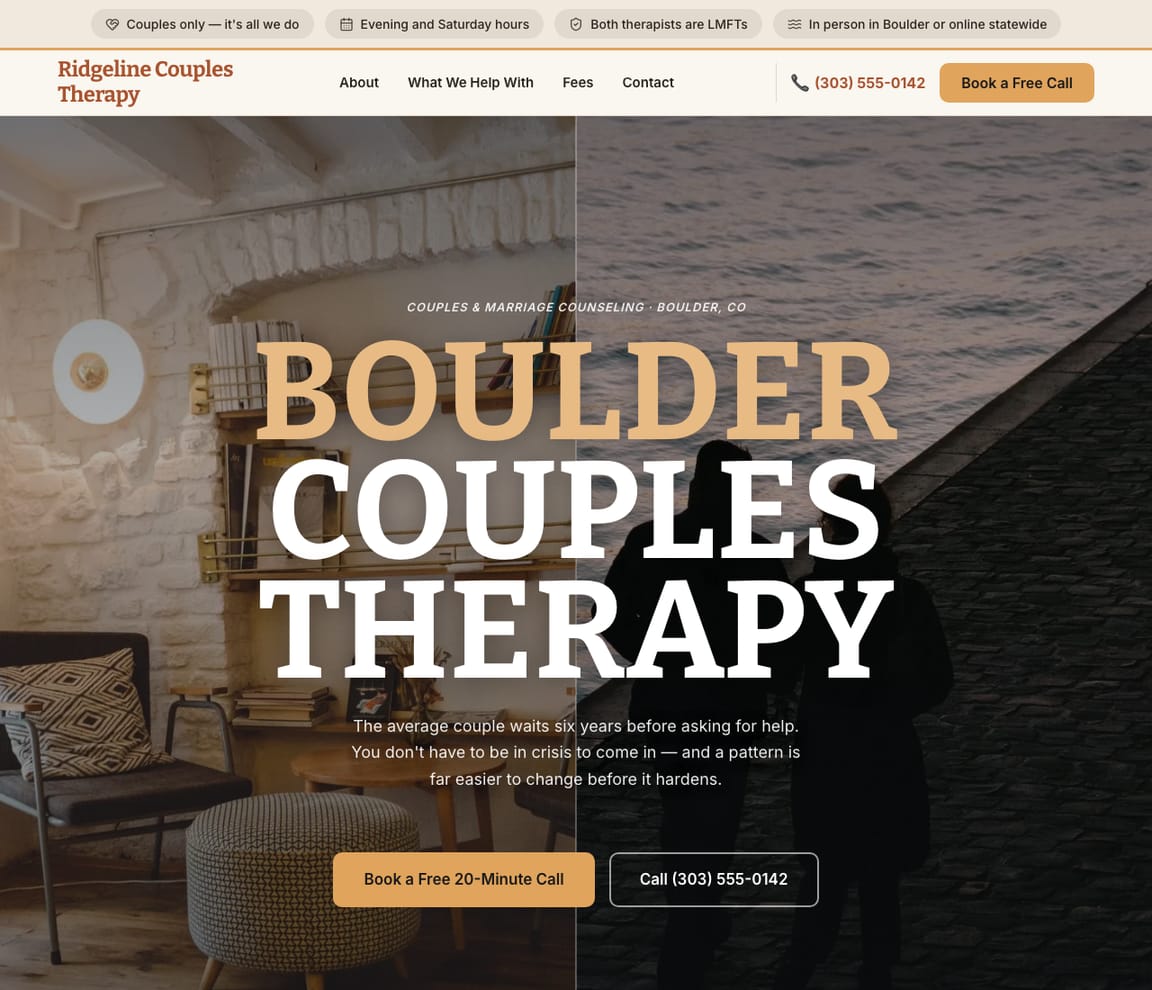
This is what a Zarla therapist website looks like.
Who you see, how you work, what a session costs, which insurance you take, and whether it's in your office or on video. Most people read those five things several times before they reach out once. This draft puts them on the first screen, plainly, with a time for a short free call.
- Professional design — not a generic template
- Looks great on desktop and mobile
- Content written for your industry
What actually matters
Reaching out to a therapist takes a while. Make the practical part easy.
A couple who keeps having the same argument, a graduate student up at 2 a.m., a parent looking for someone who sees teenagers. Before they write, each one wants the same facts: do you work with this, can they afford it, and can they see you this month.
It writes the practice the way you'd answer a first phone call: who you see and how.
A page for each population and approach you work with, couples, teens, perinatal, EMDR or CBT, in your words and without promises about results. Your fee, any sliding scale and the plans you're in network with sit in one place. Telehealth lists the states you hold a license in: in the US, a therapist usually needs a license in the state where the client is during the session, and PSYPACT lets psychologists in member states see clients across them by video. Check your licensing board before you add a state.
Drafted in the ten minutes between a 2:00 and a 3:00.
Two sentences about the practice and there's a site to read before your next client arrives. Correct the fee, soften a line that doesn't sound like you, and publish it at the end of the day.
"Therapist near me" draws 368,000 Google searches a month in the US, and in September AI assistants were asked "how much does therapy cost" 24,709 times.
DataForSEO, US, September 2026: "couples therapy near me" averages 49,500 searches; "anxiety therapist near me" 8,100, rising to 12,100 in September; "how much does therapy cost" 5,400 on Google. People search by concern and by place, so a page for each population you see and each town you're licensed to serve is how a solo practice gets found.
The free call goes on your calendar. Intake and everything clinical go to the client portal.
Someone picks a time for a 15-minute consultation and it appears in your Google Calendar. The form asks for a name, an email and a good time to call, nothing about why. Intake paperwork, session notes, insurance billing and the good faith estimate stay in SimplePractice or TherapyNotes: in the US, since January 2022 the No Surprises Act has required providers, therapists included, to give uninsured and self-pay clients a good faith estimate of expected charges. For the details, check CMS's No Surprises Act guidance or ask a compliance advisor.
Describe the practice the way you'd introduce yourself on a consult call. Who, how, where.
Say who you see
"I run Clear Path Counseling: individual and couples therapy for adults, EMDR and CBT, in-person in Boulder and online across Colorado, sliding scale available." Written in your own voice.
Read it as someone hesitant to reach out
The draft gives each population and approach a calm page, sets out fees and insurance, explains how a first session goes, and leaves room for your client portal link and the 988 line, which you add in a sentence. Read the couples page as someone who has never been to therapy.
Publish, then update the caseload line
It goes live at its own address and Google is told. When an evening slot opens or your waitlist closes, type it and the top of the site says so.
Everything a therapist website needs
Zarla builds therapist websites around what someone looking for help checks before reaching out: who you work with, how you work, what a session costs, and whether you take their insurance. Here is what that looks like on the page.
- Who you help, in one line — the people and concerns you specialize in, at the top of the page.
- A free consultation, booked online — clients pick a time for a short first call.
- Your fees and insurance — your session fee, any sliding scale, and the plans you're in network with.
- Your approach and training — CBT, EMDR or couples work, your license, and how a first session goes.
- In person or online — your office, telehealth, and the states you're licensed in.
- A link to your client portal — for intake forms and history, kept off the website.
- Where your office is — a map, parking, and whether there's a private entrance.
- Crisis numbers — in the US, the 988 lifeline, since a website inbox isn't a crisis line.
Getting found on Google
It's late and they've put it off for months. Tonight they type "therapist near me."
People look for a therapist on Google, on the map, and more and more by asking an assistant what therapy costs. Each one reads your practice differently.
Google Search
They search the concern and the town: "couples counseling Boulder", "anxiety therapist near me", "therapist for teens". A page for each, written for local search, is where Zarla does its part, and the consultation calendar sits on every page.
Google Maps
On the map they check the address, the hours, whether you see people online too, and how to reach you. Once the Business Profile is linked, Get Found reviews that listing alongside you: hours, the category, a description, the services you've ticked, the photo count. Ethics codes such as the APA's bar asking current clients for testimonials, so the site leans on your training and approach instead.
ChatGPT & AI assistants
More people ask ChatGPT what therapy costs and whether a therapist near them takes their insurance. Its answer comes from listings and from practice pages that state the fee, the insurance and who you see. Every published Zarla site includes a plain-English fact sheet for AI assistants; run the AI check to see a sample of what someone may be told about your practice.
For a therapist in your area: Clear Path Counseling — 4.9★ across 200+ Google reviews, a free 15-minute consultation, in person or online, accepting new clients.
A page per population
Couples have a page. Teens have another. Perinatal clients, a third.
- Couples therapy, with how sessions run
- Teens, with a note for parents
- Perinatal and postpartum support
- Longmont, on Thursdays
- Hero naming who the work is for
- How couples sessions work
- Fees, insurance and sliding scale
- Book a free 15-minute call
- Your training and approach
The searches already reaching you
"Couples counseling Boulder" finds your home page. The couples page never comes up.
- Couples searches miss the couples page
- EMDR on page two
- Sliding scale under another name
- No description on the listing
Changed between clients
An evening slot opens in January. The site says so before you reply to the waitlist.
- A Tuesday evening opening
- A new insurance plan
- Holiday dates and the 988 line
- The waitlist closed or open
Every first contact, in order
A booked consultation and a form about evening times wait in the inbox. The insurance question came to your phone.
- Thursday's consultation call
- Evening times for a couple
- "Do you take Blue Cross?" (on your phone)
- Shared with your associate
The practice's year
January, back-to-school, the holidays: when people looked for a therapist.
- Couples in January
- Teens in September
- The holiday weeks
- Consultations across the whole site
What you actually get compared to the alternative.
| Typical Website Builder | RecommendedZarla (Built for Therapists) | |
|---|---|---|
| Who you see | A list of issues. | A calm page per population and approach, without promised results. |
| Fees and insurance | "Contact me." | Your fee, sliding scale and in-network plans, in one place. |
| First contact | A contact form you set up. | A short free call in your Google Calendar; a name and an email. |
| Clinical details | Up to how you set up the form. | Kept off it; intake goes through your client portal. |
| Telehealth | "Online sessions available." | The states you're licensed in, named. |
| "Therapist near me" | SEO you work out alone. | Population and town pages, with Get Found checking the listing. |
| Crisis line | Left off. | 988 on the contact page in one typed line, since the inbox isn't watched all night. |
Honest roundup
Wix, Zarla, GoDaddy and WordPress.com for therapists, scored
Zarla builds a therapist's website with your specialties, an inquiry form, a map and SEO already in place, as a first draft in about 30 seconds; you add your fees, insurance and approach later. Practice software such as SimplePractice or TherapyNotes runs intake, notes and billing; if your practice software already schedules clients, your Zarla site can send them straight to it.
Zarla is our product. This order comes from our full comparison, which scores every builder on the same 9 tests, Zarla included, and gives each one a catch.
Best website builders for therapists: every score, every catch →
- 1
Wix
Best forOwners who care most about booked consultations, private intake forms and a blog with a newsletter.
Features- An AI builder that writes your pages from a description
- Aria, an AI agent in the Harmony editor that edits the site and adds pages by chat
- Wix Bookings with online payments and deposits
- Invoices and a contacts list built in
The CatchZarla vs Wix →Bookings need the Core plan rather than the cheapest one, and pages for each town you serve are yours to write.
- 2
Zarla
Best forOwners who care most about getting found on Google.
Features- Describe your practice in a sentence and Zarla writes a complete first draft in about 30 seconds
- Clients book a free consultation online, synced to your Google Calendar
- A blog whose posts the AI writes from a topic you give it
- Type changes in plain words, or ask for a page per specialty, and the site updates
The CatchBuild my free therapist websiteZarla doesn't sign a business associate agreement, so intake forms live in your practice software's portal and the site's own form stays to a name, an email and a good time to call, and there's no newsletter sending yet. It's also newer than the big names.
- 3
GoDaddy
Best forHandy if you already get your domain and email from GoDaddy.
Features- Airo writes a first website for your business in Websites + Marketing
- Online appointments with a deposit
- Photo attachments on the contact form
- Domain, email and website from one company
The CatchZarla vs GoDaddy →Editing by chat, and asking the AI for new pages later, happen in Airo AI Builder, a separate GoDaddy product with its own credits; in Websites + Marketing, pages for each town you serve are yours to write.
- 3
WordPress.com
Best forFor owners who want full control and don't mind choosing and looking after plugins.
Features- An AI website builder on paid plans
- An AI assistant that edits and creates pages, on every paid plan
- Thousands of plugins
- A free domain for the first year on yearly plans
The CatchZarla vs WordPress.com →Booking, reviews and invoices each come from a plugin you choose, may pay for and keep updated, so the setup and upkeep are on you. Photo uploads on forms need the Business plan.
Growing with you
Will Zarla grow with a busy therapy practice?
Zarla keeps working as a therapy practice grows from a solo caseload to a group practice: you add a page for each specialty or town you want to be found for, consultation requests land in one leads inbox with follow-up reminders, and new clinicians work from the same dashboard. Here is what that looks like, and what Zarla doesn't do.
Yes, one at a time: ask the editor for "a page for anxiety therapy in Boulder" and Zarla writes a new page for it, with its own Google title and description. There's no tool for adding dozens of area pages at once. A Premium site holds up to 100 pages, and a Business site has no page limit.
Yes. Clients book a short first call online, synced to your Google Calendar, and every booking lands in your leads inbox with an email alert. Keep the booking to a name, an email and a time; intake forms and anything clinical belong in your practice software's client portal. Zarla doesn't keep session notes, bill insurance or run telehealth sessions; practice software such as SimplePractice or TherapyNotes does.
Consultation requests wait in the leads inbox sorted hottest first, with follow-up reminders, so nobody who reached out waits long for a reply, and the to-do list takes a task in plain words, like adding someone to your waitlist, and sets the due date. When you're full, say so at the top of your site by typing it.
Yes. Invite each clinician as a team member to work the same inbox and bookings, and ask the editor for a page for each of them, with their specialties and training. A blog, written by the AI from a topic you give it, helps people searching for help find the right clinician.
Yes, you can bring it across — Zarla keeps your old page addresses where it can and redirects the ones that change, helping you keep the Google standing you've built. If you leave later, Zarla doesn't export your site as files to host somewhere else. You can download your whole contact list as a spreadsheet at any time, and a domain you bought from another company stays registered with them, ready to point at your next site.
Real results
Don’t take our word for it. Take theirs.
From business owners like you.
“Very reliable, professional, and fast results. I was able to get my business online in no time, and the ease of access made it so simple.”
“Beginner-friendly, efficient, and designed for business owners who want a professional website without dealing with complicated technical steps. I'd recommend it to anyone who wants a simple, reliable way to get online.”
“Quickly built my website from scratch. No hiccups. Would highly recommend Zarla for someone with no experience who wants to start a polished business website.”
Therapist website FAQ
What is the best website builder for therapists?
We scored five website builders for therapists the same way, on nine tests worth 18 points: Wix 15, Zarla 14, GoDaddy 12, WordPress.com 12, Squarespace 11. On those scores Wix takes first place and Zarla is second. See the best website builders for therapists, with every score and each builder's catch. Zarla is an AI website builder for small businesses, purpose-built for therapists: it generates your entire therapist website in about 30 seconds — industry-specific content, local SEO, and built-in lead tracking (a CRM) included. Building and previewing is free; publishing it live starts on the Premium plan.
How much does a therapist website builder cost?
Zarla's therapist website builder is free to build and preview — no credit card required. Publishing your site live starts on the Premium plan, which includes hosting, SSL, unlimited lead tracking (a CRM), online bookings, and unlimited quotes and invoices.
How do I create a therapist website?
With Zarla's therapist website builder, just describe your business in plain English and your entire site is generated in about 30 seconds — content, images, layout, design, and SEO. You can then customize as much or as little as you want — most therapists go from a blank page to a finished site in minutes.
Will my therapist website show up on Google and Google Maps?
Yes — that's what Zarla's therapist website builder is designed for. Every site comes with SEO-optimized titles, meta descriptions, schema markup, fast page speeds, and mobile-responsive design. Zarla also builds in local SEO signals so you can rank in the Google Maps pack when people search "therapist near me."
Do I need technical skills to use a therapist website builder?
Not at all. Zarla's AI builds your therapist website automatically — you just describe your business in plain English. Edit anything by typing what you want changed, like "make the headline bigger" or "add a testimonials section." If you can send a text message, you can build a website with Zarla.
How is Zarla different from Wix or Squarespace for therapists?
On our scores for therapists, Wix takes first place and Zarla is second. The difference is how you work: Zarla writes the whole therapist website from a sentence about your business and you change it by typing, with a leads inbox, invoices and payments in the same place; Wix and Squarespace suit owners who like building and fine-tuning the site themselves.
Can a therapist website builder help me get more leads?
That's the whole point of Zarla. It's built to get you found on Google Search, Google Maps, and AI assistants like ChatGPT — and then convert those visitors into actual leads. Every inquiry is captured in a built-in CRM pipeline, and you can send AI-generated quotes and invoices right from the platform.
Does Zarla work for my specific type of therapist business?
Yes. Zarla's therapist website builder adapts to your specialty and location — it generates content and design matched to the specific services you offer and the clients you serve.
Can I hire someone to build my therapist website instead?
You can, and for a complex custom build it is often the right call. In the US a freelancer typically charges $500–$2,000 for a small-business site and an agency $3,000–$10,000, and you usually wait two to six weeks; unless you are on a retainer, later changes are billed too. Zarla builds your therapist website in about 30 seconds and you change it yourself by typing what you want. Build and preview it free first, then decide.
Is there a 100% free therapist website builder?
Most "free" builders mean a trial that expires, or a permanent plan that puts their branding on your site and parks it on a long subdomain. Zarla is free to build, preview and edit — no credit card — and publishing your therapist website live on your own domain starts on the Premium plan. Nothing is charged while you're deciding.
Which AI is best for building a therapist website?
General assistants like ChatGPT and Claude write good copy and will happily produce a page for you, but you are left to arrange hosting, a domain, images, forms and SEO before anyone can visit it. A purpose-built AI website builder does that part too: Zarla turns one description of your therapist business into a finished, hosted site with all of it already in place, shaped the way therapists actually need it.
Do I need to buy web hosting for my therapist website?
No. Your therapist website needs hosting to show up when someone searches "therapist near me", but Zarla hosts it for you once you publish on a paid plan: Google Cloud, the security certificate and automatic backups included, and no hosting account or plugins for therapists to look after. Read when separate hosting makes sense.
Which website builder is HIPAA compliant?
In the US, HIPAA covers the client health information a practice collects, not the pages that describe your services and fees. A website form that collects health information needs a business associate agreement (BAA) with the company that stores it, and most general website builders don't sign one; Zarla doesn't; of the builders on our best website builders for therapists comparison, Wix signs one for the website itself on its Business plans and up, and Squarespace signs one for Acuity Scheduling, a separate subscription (both read on their help pages on October 24, 2026). So keep your website's contact form to a name, an email and a good time to call, and put intake, history and anything clinical in your practice software's client portal, such as SimplePractice or TherapyNotes, linked from your Zarla site. Confirm the details with your compliance advisor.
What is the best website template for therapists?
One that feels calm and personal: a real photo of you, a first line naming who you help, plain pages on your specialties, your fees and insurance, and one low-pressure way to reach out. Zarla's therapist templates, from couples counseling and child therapy to EMDR, teletherapy and group practices, are finished designs to start from, and every one becomes yours to edit in a click.
How much does it cost to have a therapist website built?
In the US, having a therapist website built for you typically costs $500–$2,000 from a freelancer or $3,000–$10,000 from an agency, plus a domain (usually $10–$20 a year) and hosting, and therapist directories and practice software often add a basic profile page. A do-it-yourself website builder usually costs $15–$30 a month for the site alone, and you set up booking and your specialty pages yourself. With Zarla, building and previewing your therapist website is free, and publishing it on your own domain starts on the Premium plan, with online booking and the leads inbox included.
What should a therapist website include?
Who you help and the concerns you specialize in, your approach and training, your license and the states you practice in, your fees, sliding scale and insurance, whether you see clients in person or online, a link to your client portal, crisis information, and one easy way to book a first consultation. Zarla builds the pages, the map and an inquiry form for you, and you add your fees and approach as you go.
Want to see it before you build it? Browse the therapist website templates and start from a finished design — every one becomes yours to edit in a click. See therapist website design ideas: what the best therapist sites get right.
Shopping for a designer instead? See therapist website design by AI: sample designs, what web agencies charge, and what an agency does that AI doesn't.
Not open yet? Our step-by-step guide on how to start a private practice covers the costs and first steps.
Still planning the business itself? Write the free private practice business plan first — typical startup costs, what owners really earn, US licensing and a complete sample plan — then build the website from it.
Every therapist website on Zarla starts the same way: describe your business and Zarla's AI website builder writes the pages, picks the photos and sets up the SEO in about 30 seconds.
Be the therapist they feel able to write to the first time they look.
Who you see, what it costs, a short call on the calendar. Building and previewing the site costs nothing; nobody asks for a card.
Free to build and preview · No credit card · Cancel any time