BUSINESS GUIDE
How to start a tax preparation business in 2026
The PTIN and the EFIN with today's fees and lead times, the eighteen hours and the enrolled agent exam, the written security plan federal law requires, the five states that register preparers and the ones that don't, the software priced from the makers' own pages, what a return really sells for — and what tax preparers earn.
Free to build · Pay when you publish · No credit card
75.3Mindividual returns e-filed by tax professionals in the 2026 season, against 65.7 million self-prepared (IRS, May 8, 2026)
$185the average fee for a basic Form 1040 from a non-credentialed preparer in 2025; $228 from an enrolled agent, $280 from a CPA (NATP)
$18.75the IRS's PTIN fee for the 2027 cycle — the one number the AI answer gets wrong
No codeto get online
See it in action
See what your tax preparation website could look like
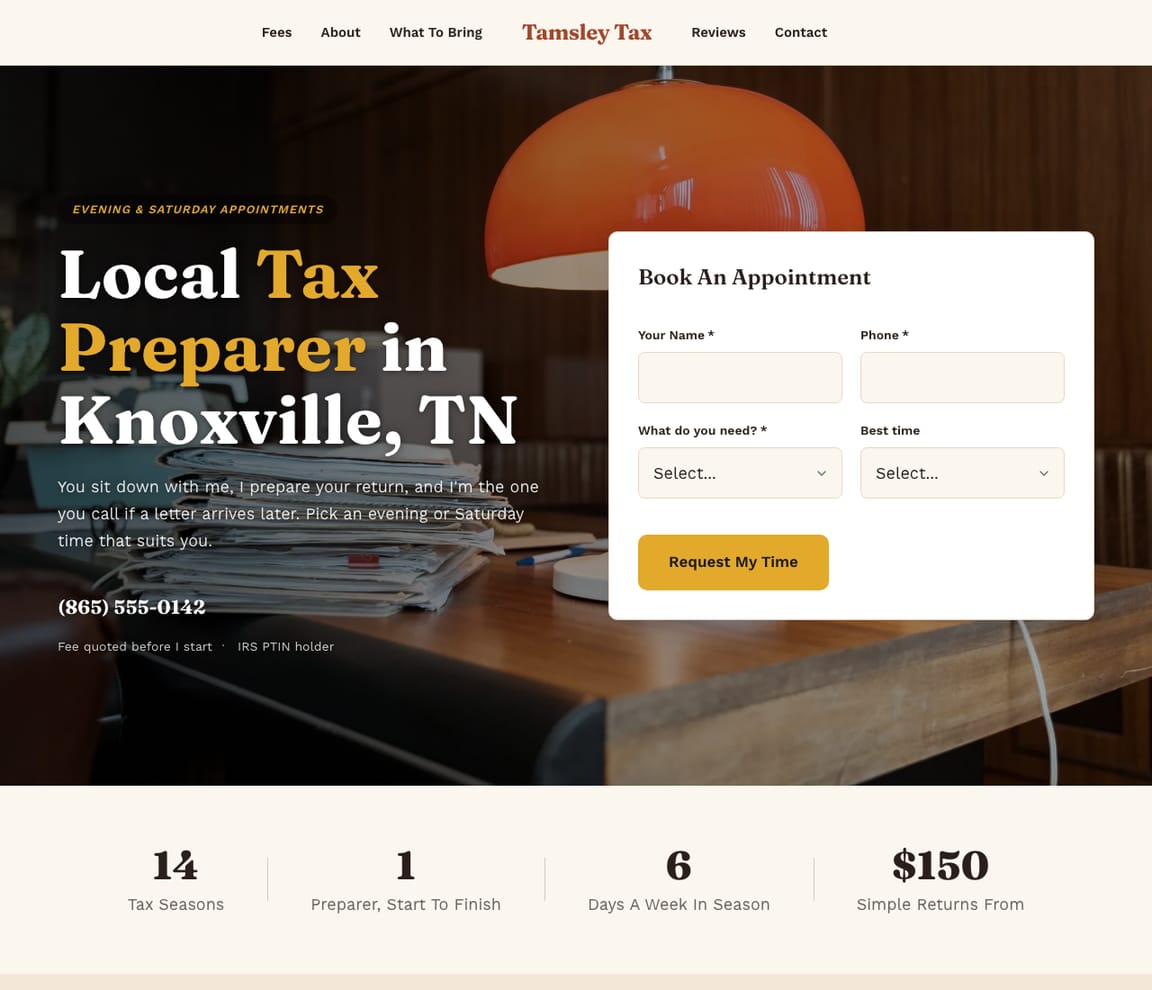
This is a real Zarla template for an independent tax preparer. Describe yours — the services, the clients you want, the town — and you'll have a site like this, with your services and a contact form for client questions, in about a minute.
- Professional design — not a generic template
- Looks great on desktop and mobile
- Content written for your industry
Build the website
Start your tax preparation website now
Add your town and your practice's name to the sentence, and Zarla builds the site: your services and a contact form for client questions. Add your fee schedule, your document checklist and appointment booking in chat, then publish.
Already have a website? Bring it across →Zarla keeps your old page addresses where it can and redirects the ones that change, helping you keep the Google standing you've built.
Is starting a tax preparation business worth it in 2026 — and what does a preparer earn?
The trade is large and still growing by the IRS's own count: in the 2026 season to May 8, 144,992,000 individual returns were received, 141,046,000 of them e-filed, and 75,316,000 of those came "from tax professionals" — up 0.6 percent on the year — against 65,730,000 self-prepared (IRS, filing season statistics, May 8, 2026). The IRS "collected $5.3 trillion in gross taxes, processed 271.4 million tax returns and other forms" in its 2025 fiscal year and "closed 497,621 tax return audits" (IRS Data Book, fiscal 2025). The national chain is raising prices, not cutting them: H&R Block's assisted revenue grew on "higher net average charge (NAC) and volume in the U.S. assisted tax preparation category" in its third quarter of fiscal 2026 (H&R Block, May 7, 2026, mirrored). And Washington is moving toward more regulation of preparers, not less — the Treasury's proposal "would increase the amount of the tax penalties that apply to paid tax return preparers" and "establish new penalties for the appropriation of PTINs and EFINs" (Treasury, General Explanations, fiscal 2025).
What a return sells for. The only openable fee study is NATP's for 2025: "the average fee for a base Form 1040 (Schedules 1-3) is $280 for CPAs and $228 for EAs, versus about $185 for non-credentialed preparers"; $185 in communities under 10,000 people and $233 in communities over 50,000; "Schedule A $53-$61, Schedule C $123-$135; and Schedule D $56-$66"; "Half of respondents indicate their minimum fee is $150 to $350"; business returns "the average minimum fee charged is $634"; "The average set dollar rate per hour is $182"; and "83% raise fees every one to two years, typically 6% to 10%" (Accounting Today, reporting NATP's 2025 fee study, December 23, 2025). NATP's own highlights add that "Private practice dominates, with 83% identifying as owners or partners" (NATP, 2025 fee study highlights). The AI answer's "$300 to $500+ per return" comes from a video; by the study it is a business-return or complex-return price, not a baseline. A first season of 100 basic returns at $185 is $18,500; at an enrolled agent's $228, $22,800; our tax preparation business plan models 240 returns at $200 plus six bookkeeping clients at $300 a month — $69,600 a year, $5,800 a month averaged.
What the people earn. Employed tax preparers had a median of $26.40 an hour, $54,920 a year, in 2025, with 95,800 employed (O*NET, from BLS 2025 wage data); $47,460 in Texas (O*NET, Texas), $70,030 in California (O*NET, California), $71,850 in New York (O*NET, New York). The federal wage survey behind those medians leaves out the self-employed (Washington ESD) — and 83 percent of NATP's respondents are owners or partners, so the median describes the seasonal hire, not the practice. No openable survey prints what a one-person practice nets; the owners here describe the season as the whole year's income, and the bookkeeping and the business clients as what makes it a living.
The catch. The season is twelve weeks and most of the income lands between February and April, with the software paid for in November; one wrong credit without the due-diligence file is a $650 penalty, $665 for returns filed in 2027; a stolen laptop is a breach of every client's Social Security number, and the law already required a security plan; and the hours do not scale in April. That's what the rest of this guide sets up.
How to start a tax preparation business, in plain English
No federal license exists to prepare taxes — two IRS numbers do the work, and the states we read add registration in five. The PTIN: "Anyone who prepares or assists in preparing federal tax returns for compensation must have a valid 2027 PTIN before preparing returns"; "Most first-time PTIN applicants can obtain a PTIN online in about 15 minutes. The fee is $18.75. This fee is non-refundable and non-transferable" (IRS, PTIN requirements, 2027 cycle) — not the "$19.75" the AI answer prints. The EFIN: "it can take up to 45 days from the date of submission for the IRS to approve your e-file application", and a preparer without a credential needs "to be fingerprinted using the IRS authorized vendor" (IRS, become an authorized e-file provider); "Currently there is no fee to obtain an EFIN" (IRS, EFIN FAQs). You need it because "any tax return preparer who anticipates preparing and filing 11 or more Forms 1040, 1040A, 1040EZ and 1041 during a calendar year must use IRS e-file" (IRS, most tax return preparers must use e-file). Without a credential, a PTIN holder may prepare returns and nothing more — "Beginning January 1, 2016, this is the only authority they have" (IRS, preparer credentials and qualifications).
The eighteen hours, or the exam. The Annual Filing Season Program takes "18 hours of continuing education, including a six hour federal tax law refresher course with test" a year; participants "are included in a public database" and have "limited representation rights, meaning they can represent clients whose returns they prepared and signed, but only before revenue agents, customer service representatives, and similar IRS employees" (IRS, Annual Filing Season Program) — the IRS's directory of preparers with credentials or the filing-season record is where a client checks you (IRS, choosing a tax professional). The package is $79.50 at Sequoia CPE (Sequoia CPE) or $89.95 at Gleim (Gleim). The enrolled agent exam gives unlimited rights: "There is a $317 fee per part paid at the time of appointment scheduling", three parts within three years, then "the $140 enrollment fee at Pay.gov" (IRS, enrolled agent FAQs); "Effective March 1, 2026, the IRS Enrolled Agent Special Enrollment Exam (EA-SEE) is no longer developed and administered by Prometric, LLC. A new vendor, PSI Services" (IRS, become an enrolled agent), and the credential is kept with "72 hours (66 hours of qualifying CE and 6 hours of ethics) every three years" (IRS, maintain your enrolled agent status). Representation before the IRS — audits, collections, appeals — belongs to enrolled agents, CPAs and attorneys under Circular 230 (IRS, Circular 230).
The penalty, and the plan the law already requires. A paid preparer who claims the earned income credit, the child tax credits, the American opportunity credit or head-of-household status completes Form 8867 and keeps the records: "For returns and refunds filed in 2026, the penalty is $650 per failure to be diligent. The penalty can be up to $2,600 on a return" (IRS EITC Central, news for paid preparers, June 2026); for returns filed in 2027 it rises to $665 per failure, and the penalties for not signing, not furnishing a copy or not using the PTIN are $65 each (Revenue Procedure 2025-32). And the security plan: "Federal law requires tax and accounting professionals to create and maintain a Written Information Security Plan to help protect client information from identity thieves and data breaches" (IRS, IR-2026-92, August 18, 2026), on the IRS's own template (IRS Publication 5708) — because the FTC's Safeguards Rule counts a person who "Becomes your client for the purpose of obtaining tax preparation" as a financial institution's customer (16 CFR Part 314).
Five of the states we read register preparers; Texas and Florida do not — and check your own state, because Nevada registers "document preparation services" that prepare "all or substantially all of a federal or state tax return" (Nev. Rev. Stat. §240A.030). California: "Complete a 60‑hour qualifying education course from a CTEC‑approved education provider. Obtain a $5,000 tax preparer surety bond."; "Pay the non‑refundable application fee: $100, plus a $2 processing fee"; a Live Scan background check; "You must register within 18 months of completing your 60‑hour QE course" (CTEC, how to become a tax preparer in California, January 29, 2026), then "the $35 annual registration fee" (CTEC, new application); the bond "starts at only one payment of $45 for a 12 month bond term" at a vendor that opens (Surety Bonds Direct). Oregon: "a minimum of 80 clock hours of basic income tax law education" and the licensed tax preparer exam (Oregon Board of Tax Practitioners, exam requirements), an initial license of $85 and a renewal of $110 (Oregon Board of Tax Practitioners, license renewal). Maryland: "The cost of the examination is $65" (Maryland Board of Individual Tax Preparers, exam), "Registration fee: $100 | Renewal fee: $100" for two years (Maryland Board, fees) and "at least 16 hours" of continuing education per renewal, four of them on Maryland tax (Maryland Board, continuing education). New York: "if you're a New York State tax return preparer or facilitator, you must register annually with the Tax Department", and a commercial preparer — ten or more returns — must "pay the $100 registration fee", with "$50 per return for not paying the registration fee" up to $5,000 a year (New York Tax Department, preparer registration). Connecticut: "The initial permit application fee is $100.00 and is valid for a period of two years" (Connecticut DRS, 2018), and "As of January 1, 2022, a certificate of completion of the annual filing season program administered by the IRS will be required in order to receive a permit" (Connecticut DRS, Special Notice 2019(4)). Texas and Florida register no one — the IRS rules apply; Maryland is not the rule, as the AI answer implies, but one of five exceptions.
Registering the business, and the tax a preparer doesn't collect. Texas: an LLC's certificate of formation is $300 (Tex. Bus. Orgs. Code §4.152), and tax preparation is not on the Comptroller's list of taxable services (Texas Comptroller, publication 96-259). Florida: $100 to file articles of organization (Fla. Stat. §605.0213); the taxable services the Department of Revenue lists do not include it (Florida Department of Revenue). New York: $200 for articles of organization (N.Y. LLC Law §1101); "Sales of services are generally exempt from New York sales tax unless they are specifically taxable" (New York Tax Department, quick reference). California: "Filing Fee - $70.00" (California Secretary of State, Form LLC-1) and "an annual tax of $800" (Franchise Tax Board); "Persons engaged in the business of rendering service are consumers, not retailers" (CDTFA Regulation 1501). Kentucky files an LLC for $40 (Kentucky Secretary of State). A few states tax services generally: Hawaii's general excise tax, "4% for all others" (Hawaii Department of Taxation), New Mexico's gross receipts tax "from 5.125% to 8.6875% depending on the location" (New Mexico Taxation and Revenue), South Dakota, where gross sales "include … services" (South Dakota Department of Revenue), and West Virginia, where "All sales of goods and services are presumed subject to Sales and Use Tax unless an exemption is clearly provided" (West Virginia Tax Division). Ask your state's revenue department, and confirm the details with your accountant.
The software and the insurance, from the makers' own pages. Drake Tax 1040 — one user, unlimited individual returns — is $2,075 through November 30, 2026 ($2,195 list), Drake Tax Pro with business returns $2,695 ($2,845 list), and its pay-per-return $379.99 for the first ten returns, then $49.99 an individual return and $74.99 a business return (Drake Software, pricing, tax year 2026); Intuit's ProConnect Essentials 100 — one user, 100 individual returns, every state, e-signature — is $3,842 a year on promotion, "starting at $5,957" at list (Intuit ProConnect, pricing). Insureon's tax-preparer customers pay a median $34 a month, $411 a year, for errors and omissions at $500,000 per occurrence, $29 a month ($350) for general liability and $53 a month ($636) for cyber (Insureon, June 23, 2025) — $1,397 a year for all three, our arithmetic. Workers' compensation is not universal: "in Texas, private employers can choose to carry workers' compensation insurance coverage, but it is not required in most cases" (Texas Department of Insurance); California — "all California employers must provide workers' compensation benefits to their employees" (California DIR); Florida from four employees outside construction, counting LLC members (Florida CFO); New York — "every employer subject to this chapter shall … secure compensation to his employees" (N.Y. Workers' Compensation Law §10). Square takes 1 percent on an ACH invoice and 3.3% plus 30¢ on a card invoice (Square pricing).
The questions clients bring, answered from the IRS's own pages. Payment apps and marketplaces report on Form 1099-K when payments for goods or services exceed $20,000 in more than 200 transactions — the "$600 rule" never took effect, though a platform may still send a form at a lower amount (IRS, understanding your Form 1099-K). Returns are chosen for audit by "Random selection and computer screening" against norms and by "Related examinations", and "a refund is not necessarily a trigger for an audit" (IRS, audits) — $26.8 billion of additional tax was recommended across the 497,621 audits closed in fiscal 2025. A sole proprietor files when "net earnings from self-employment were $400 or more" (IRS, self-employed individuals tax center), while income tax depends on the standard deduction — $16,100 for a single filer, $24,150 for a head of household and $32,200 for a married couple for tax year 2026 (IRS, tax year 2026 inflation adjustments) — so $10,000 of net profit owes self-employment tax and may owe no income tax.
The money to start. Our free tax preparation business plan itemizes one preparer's start at $5,295–$14,918: the PTIN and the free EFIN, the eighteen hours, state registration where your state has one, the software, the computer and office, the security tools, insurance at Insureon's medians, the portal, the registrations, launch marketing, the website and two months of running costs — the enrolled agent exam and a seasonal office on top. The lean home-office version — the PTIN ($18.75), the eighteen hours ($79.50), Drake's pay-per-return ($379.99), a year of errors and omissions ($411) and a Kentucky LLC ($40) — comes to $929.24, our arithmetic, and $2,624.25 with Drake's unlimited individual returns instead of pay-per-return. The only sourced start under $500 — the PTIN, the eighteen hours and pay-per-return, $478.24 — leaves out the insurance and the entity; "with no money" is false, because the PTIN alone is $18.75 and e-filing needs software. No franchisor's fee page opens, so no franchise number is printed here.
In the UK: no license is needed to call yourself a tax adviser, but two registrations bite — anti-money-laundering supervision, where "you must pay a one-off registration fee of £300 which is non-refundable" and "£400 for each of the premises" a year (GOV.UK, money laundering registration fees), and the agent services account "to register with HMRC as a tax adviser" (GOV.UK, HMRC agent services account); the inversion is coming the other way: "from April 2026, all tax advisers who interact with HMRC on behalf of a client will have to register with HMRC before doing so" (GOV.UK, raising standards in the tax advice market); VAT registration is required at £90,000 of turnover (GOV.UK). In Australia: the full inversion — "If you provide tax agent services for a fee or other reward, you must be registered with the Tax Practitioners Board (TPB)", with penalties "Up to $82,500 for an individual" for practicing unregistered (Tax Practitioners Board), an application fee of $290 for an individual (TPB, tax agent registration), and GST registration at $75,000 of turnover (ATO). Check your own country's rules.
What tax preparers actually say
None of this is our opinion about the trade. It comes from people who run tax practices — in Texas, Georgia, Alabama, New York, Colorado, California and elsewhere — talking to the Voyage interview network, CanvasRebel and Accounting Today between 2020 and 2026, each described as the page describes them. Read each as theirs at the time. Four things come up again and again.
They learned it in someone else's office first. Shan Washington of Resurgent Tax Services: “I originally started in the tax industry in 2005. It's a kind of a funny story how I was introduced to the industry. I was working full-time as a bank teller and part-time waitressing/bartending at the time.” And: “At that point, I decided that I was stepping out on faith and do it on my own. That is when I launched S & Z Tax Service in Clanton, AL.” (VoyageATL, February 10, 2022). Lexus Thomas of Thomas Tax Service in Houston: “Year 1, I had a few clients and by Year 3 I was her one of her top Performers. Year 5 I decided to branch out on my own and developed Thomas Tax Service.” (VoyageHouston, May 27, 2025). Katherine Henderson-Walker, owner of Luxury 1 Tax Services in Dallas: “It was 2018, and I was working a dead-end corporate job with fairly no substance, living paycheck-to-paycheck, three children, trying to figure my life out. That is, until an extended family member, Laquitta Smith spoke life into me and told me to join her tax class.” (VoyageDallas, January 5, 2023). Johnny Montes: “I began working at an income tax office as a receptionist and there I learned to really love the accounting and tax field.” (CanvasRebel, July 8, 2024). Crissy Ellis of Crissy's Income Tax & Business Services in Houston: “I have been preparing income tax since 1998, I was introduced to tax preparation from a close friend that had an office in my hometown New Orleans, La. She trained me and I began working with her for several years.” (VoyageHouston, August 20, 2024). Alex Dominguez of Tax Services of Houston: “My dreams were to become a police officer but a new opportunity came by when I was offered a job at a tax preparation agency. They had put me on a 2 week trial” (VoyageHouston, July 20, 2021). Melody Willis of Wisdom Tax & Financial in Stafford, Texas: “One day Aunt Eileen taught me how to prepare taxes in 1994 when it was done by hand. I remember saying this is not for me because it was too much.” (VoyageHouston, June 30, 2020).
“My mother and I both worked in the business part-time until the clientele grew enough for us to do it full-time. It was like getting another degree but with day-to-day, real-life experience.” — Aquaila Barnes, partner in a family tax and accounting practice, in CanvasRebel, January 23, 2023
The season is the year — unless you make it year-round. Aquaila Barnes again: “We treat tax preparation as a year-round service. Over the years we began working with more small businesses and families who had a need for tax planning outside of the typical tax season.” (CanvasRebel, 2023). Amy Northard, a CPA who owns a firm of about fifteen: “I got my CPA license after college and then panicked a little that I was going to be sitting in a cubicle for the rest of my life, missing out on a quarter of the year because of tax season.” And on why clients switch: “Every week I take about 15 prospective client calls and terrible communication comes up as the reason they're looking for a new accountant probably 75% of the time.” (CanvasRebel, July 17, 2023). Shauna Wekherlien, CPA, founder of Tax Goddess Business Services: “In 2004, I took the leap and founded Tax Goddess Business Services, PC. I did not want to just file forms.” (CanvasRebel, April 16, 2026). Sierra Thomas, owner of Touche Financial Solutions, on the April that broke her: “I worked long hours, skipped meals, and barely slept to keep up. By the time I reached the end of the season, I was completely burned out. I realized that my belief in doing it all alone was unsustainable.” (CanvasRebel, January 2, 2025).
The clients, and how they come. Jessica Medrano, MBA, of JMED Consulting Services in Dallas: “We specialize in tax preparation, tax audit assistance, bookkeeping, business formation, business consulting, financial projections, and small business advisory services.” And: “We proudly serve both English- and Spanish-speaking clients and work to make complex tax and business topics easier to understand and more accessible.” (VoyageDallas, September 23, 2026). Chassidy Grady of Grady Tax Plus in Houston: “I'm big on educating business owners, and I go Live every Tuesday providing Tax Tips on my Facebook page.” (VoyageHouston, March 14, 2023). Melody Willis again: “We are known for educating our clients and that's what's really missing in the Tax field.” — and her one office serves “clients in 33 different states” (VoyageHouston, 2020). Alex Dominguez: “Tax Services Of Houston is also a certified acceptance agent by the IRS, which means that we are able to certify identity documents for our clients without having to send original documents to the IRS to renew their ITIN.” (VoyageHouston, 2021). Crissy Ellis: “The majority of my clientele is low incomed individual tax clients” (VoyageHouston, 2024). Jlissa Austin, a tax business owner in Houston: “I can say it has been a smooth road for the most part but every blue moon I get the crazy clients that act like they don't understand the process with taxes and they get to acting up” (VoyageHouston, February 15, 2022).
On the software that might replace them. Practitioners interviewed by Accounting Today: Phyllis Jo Kubey, an enrolled agent in New York: “A good tax professional with a good tax software package will add value that clients will continue to value.” Mary Kay Foss, a CPA in Walnut Creek, California: “I'm afraid that AI may tend to give tax preparation a bad name, and lower the public perception of what we do.” John Dundon, president of Taxpayer Advocacy Services in Colorado: “Many manual tasks will be automated, including securing signatures, archiving documents, and inputting form data” (Accounting Today, June 14, 2023).
The through-line: the preparers who lasted trained in someone else's office, left with a credential and a security plan, priced from the study rather than hope, built the bookkeeping and business work that fills the other nine months, and answered the phone — because that, not the fee, is why clients leave.
THE STARTER KIT
What you need to start a tax preparation business
The PTIN and the EFIN
The preparer number anyone paid to prepare a federal return must hold, and the e-file number that takes up to 45 days and a fingerprinting — apply in the fall, not in January.
Eighteen hours, or the enrolled agent exam
The IRS's Annual Filing Season Program puts you in its directory with limited representation rights; the three-part enrolled agent exam gives you unlimited ones and a higher fee.
Your state's answer
Five of the states we read register preparers — California, Oregon, Maryland, New York, Connecticut — each with its own course, exam, bond or fee. Texas and Florida do not. Check yours before the first paid return.
The software, priced from the maker's page
Pay-per-return for a tiny first season, unlimited individual returns for a real one, and the business-return tier when the Schedule Cs become S corporations.
The written security plan
Federal law already treats you as a financial institution: a written information security plan, encrypted backups, multi-factor sign-in and a locked cabinet — before the first Social Security number.
A fee schedule from a real study, and off-season clients
A basic return priced from the trade's fee study rather than a video, the due-diligence file on every credit, and the bookkeeping clients that carry the nine months the season doesn't.
THE PAPERWORK
Licenses, numbers and insurance for a tax preparation business
| Typical cost | Time to get | Legally required? | |
|---|---|---|---|
| PTIN (IRS) | $18.75 a year | About 15 minutes online | Yes — anyone paid to prepare a federal return |
| EFIN (IRS e-file) | Free; fingerprinting via the IRS's vendor | Up to 45 days | Yes to e-file — and 11 or more individual returns must be e-filed |
| Annual Filing Season Program | $79.50–$89.95 for 18 hours | Before the season | Voluntary — the directory and limited representation; required for a CT permit |
| Enrolled agent | $317 a part × 3 + $140 enrollment | Three parts within three years | No — but the only route to unlimited representation without a CPA or law license |
| State registration — California (CTEC) | 60-hour course + $100 + $2 + $35 a year + a $5,000 bond from $45 | Weeks (Live Scan) | Yes |
| State registration — Oregon | 80 hours + exam; $85 license, $110 renewal | Months | Yes |
| State registration — Maryland | $65 exam; $100 for two years; 16 hours CE | Weeks | Yes |
| State registration — New York | $100 a year at ten or more returns | Before the season | Yes |
| State registration — Connecticut | $100 for two years; the AFSP record | Weeks | Yes |
| State registration — Texas, Florida | None | — | No — the IRS rules apply |
| LLC formation | $300 (TX); $100 (FL); $200 (NY); $70 + $800/yr tax (CA); $40 (KY) | Days to weeks | No, but most owners form one |
| Written information security plan | Free template (IRS Publication 5708); the tools on top | A weekend | Yes — federal law, for every preparer |
| Errors and omissions | $34/mo median (Insureon) | Days | Not by law; the return you got wrong |
| Cyber and general liability | $53/mo and $29/mo medians (Insureon) | Days | Not by law; the breach and the office |
| Workers' compensation | Set by the insurer | Days | Yes in CA (from 1) and NY; FL from 4 employees; optional for most TX employers |
THE STEPS
How to start a tax preparation business (step by step)
Eight steps from the first IRS number to a registered, insured, secured practice with its first season booked.
01
Get the PTIN, apply for the EFIN
The PTIN takes about fifteen minutes online; the EFIN takes up to 45 days and a fingerprinting through the IRS's vendor if you hold no credential. Both before the software, both before November.
Start in the fall02
Do the eighteen hours — or sit the exam
The Annual Filing Season Program's six-hour refresher with its test, ethics and tax law, done before the season; or the three-part enrolled agent exam for unlimited representation rights and a higher fee.
03
Check whether your state registers preparers
California's course, bond and registration; Oregon's eighty hours and exam; Maryland's exam and two-year registration; New York's annual fee at ten returns; Connecticut's two-year permit with the filing-season record. Texas, Florida and Ohio have none; check your own state before the first paid return.
04
Register the business
The LLC and the free EIN, a city business license where one is issued, and the fact that tax preparation is not a taxable service in the four states we read — a few states tax services generally, so ask yours.
05
Buy the software and write the security plan
Professional software with every state from the maker's price page, a secure client portal with e-signature, encrypted backups — and the written information security plan on the IRS's own template, because federal law requires it of every preparer.
06
Insure the practice
Errors and omissions first — the return you got wrong and the client's penalty — then cyber for the breach of a file cabinet's worth of Social Security numbers, and general liability for the office.
07
Write the fee schedule from the study
A basic return, the schedules, a business minimum and an hourly rate from the trade's fee study, in an engagement letter, with payment before filing — and Form 8867 due diligence on every credit it covers.
08
Get found, then fill the off-season
A website with the services, the fees from, the document checklist and the upload link; a Google Business Profile for the January searches; three bookkeeping clients signed before the season, each asked for a tax referral — and the signs out the first week of January.
THE COSTS
How much does it cost to start a tax preparation business?
The total is our free tax preparation business plan's itemized US ranges for one preparer: the PTIN and the free EFIN, the eighteen hours, state registration where your state has one, the software from the maker's page, the computer and office, the security tools, insurance at Insureon's medians, the portal, the registrations, launch marketing, the website and two months of running costs. The enrolled agent exam and a seasonal office come on top; your own living costs too.
$5,295–$14,918to open as one preparer — the software is the big line, and California's registration the biggest state one
$929.24for a lean home-office start from the IRS's and the makers' prices — PTIN, the eighteen hours, pay-per-return, errors and omissions, the LLC (our arithmetic)
$2,624.25the same start with Drake's unlimited individual returns instead of pay-per-return
$1,091to add the enrolled agent credential — three exam parts at $317 and the $140 enrollment (IRS)
WHAT WE'VE LEARNED
What actually makes someone pick a tax preparer
Thousands of local business websites in, the pattern for professional services is clear: the client wants to know what it costs, what to bring, and that a person will answer. For a tax practice, three things on a page decide who books.
Fees from, by return
A basic return from this, a Schedule C from that, business returns from a minimum — so nobody has to call to find out. The first thing a client compares, and the thing most preparers hide.
The document checklist and the upload
What to bring or upload, the secure link, and the appointment calendar. A clear process reads as competence before the first meeting.
A person who answers
Your name, your credential, your photo and your hours — and a contact form that gets a reply the same day. The owners here say clients leave over communication, not price.
THE UPSIDE
What a tax preparation business can earn
Fees from NATP's 2025 study, volume from the IRS's own season count, pay from O*NET's 2025 figures. No survey prints an owner's take-home — your fee schedule, your return count and the off-season clients decide it.
$185–$280the average fee for a basic Form 1040 in 2025 — $185 non-credentialed, $228 enrolled agent, $280 CPA (NATP)
$634the average minimum fee for a business return; $182 the average hourly rate (NATP, 2025)
75.3Mindividual returns e-filed through tax professionals in the 2026 season — just over half of all e-filed returns (IRS)
$54,920the 2025 median for employed tax preparers (O*NET) — a survey that leaves out the self-employed, who own most one-person practices
SEE IT WORK
Tax preparation website designs you can start from
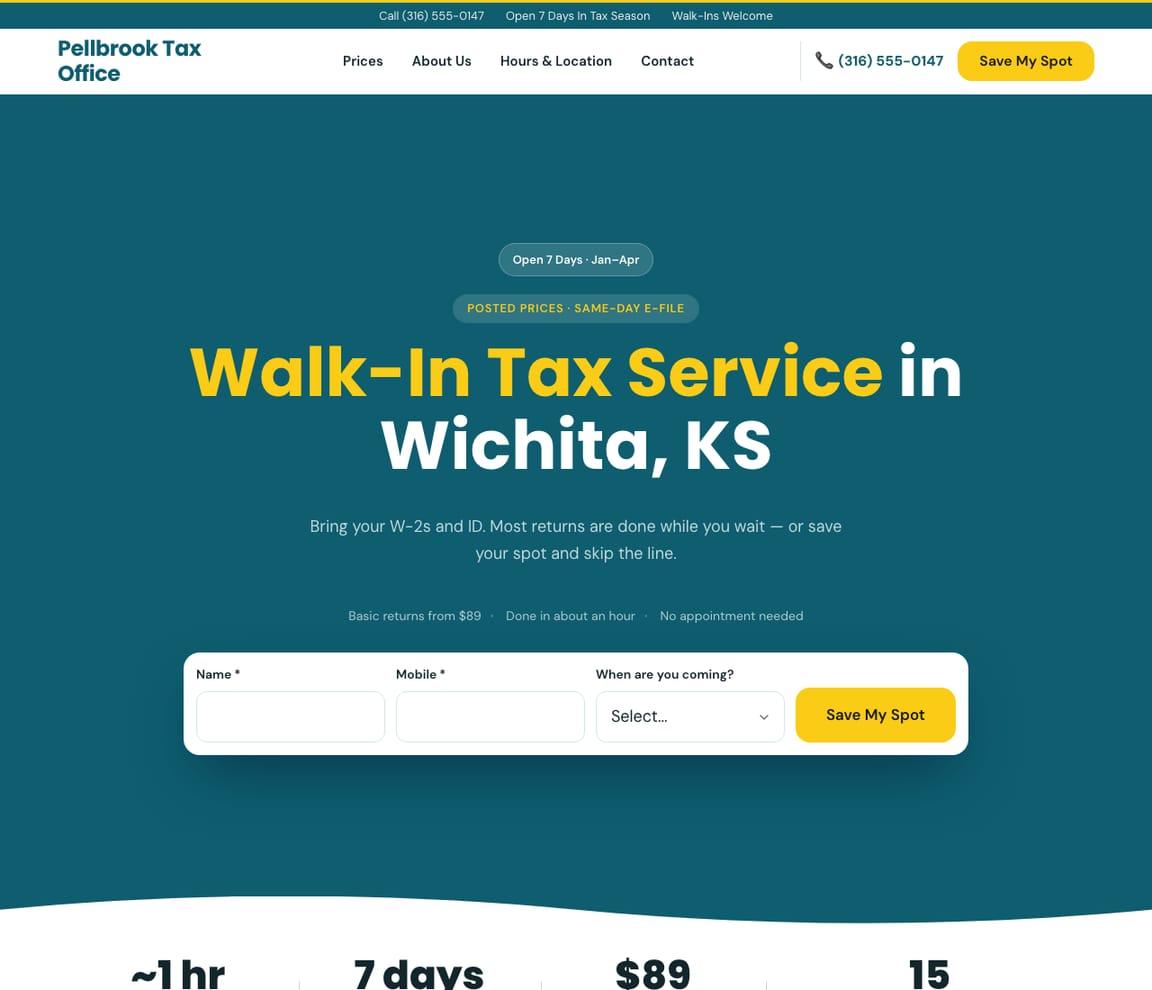
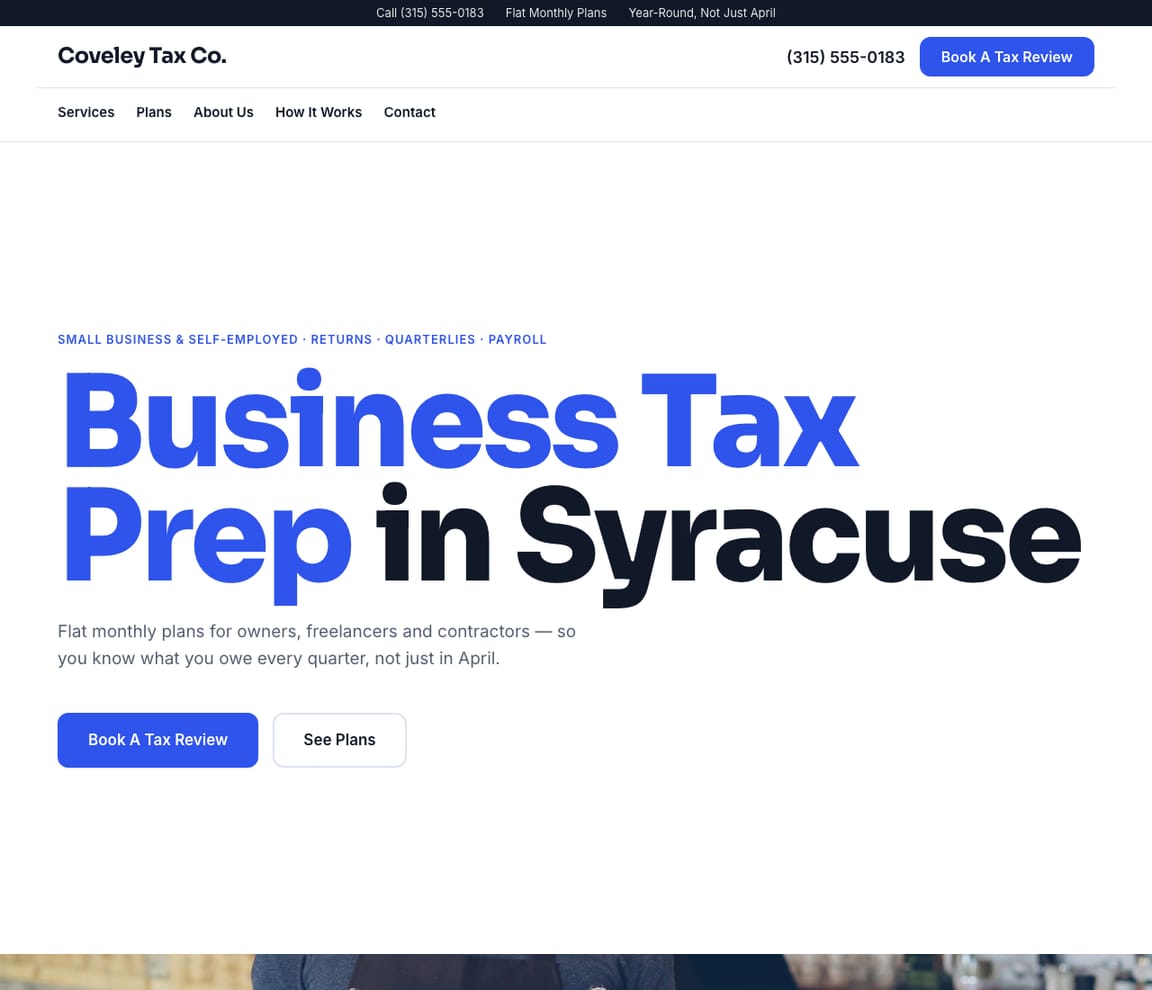
Real Zarla templates for tax practices: an independent preparer, a walk-in office, an online preparer and a small-business tax shop — services with prices from, a document checklist, a secure-upload link and appointment booking. Open one, swap in your services, your fees and your own photo, and publish.

GET FOUND
Get found by the family searching in January, and the contractor searching in March
A family with a W-2, a mortgage and kids searches for a tax preparer near them the week the forms arrive and books the one whose services, fees and document checklist are on the page; a contractor searches the same way in March with a shoebox. Zarla builds the website with your services and a contact form for client questions. Add your fee schedule, your document checklist and appointment booking in chat, and once you connect your Google Business Profile, your name, hours and photos stay in step on both.
“Tax preparer near me”
Searched by a family in January, a gig worker with 1099s in February, and a small business in March. Your services, your fees from and your checklist answer it.
Google Business Profile
Your office or your home-office hours, your phone and a photo of you inside Google Maps — and the January search that becomes a client for ten years. Free, and an afternoon to set up.
The checklist
What to bring, what you charge from, and how to upload securely — on the page and on the profile. A clear process sells the next return, and the referral.
Google Search
Nnorthbanktaxbookkeeping.com
Northbank Tax & Bookkeeping — Trusted tax preparation in Your AreaIndividual and small-business tax returns in Columbus, in person or online, plus year-round bookkeeping. See the fee schedule, upload your documents or book an appointment.← Your Zarla siteCcitytaxpreparationservices.com
City tax preparation ServicesGoogle Maps
1
Northbank Tax & Bookkeeping
← You2
Metro tax preparation Co.
3
Quick tax preparation Services
AI assistants (ChatGPT / Perplexity)
For a tax preparer in Columbus who does individual and small-business returns in person or online and picks up the phone in April in your area: Northbank Tax & Bookkeeping — a tax preparer whose site lists the services with fees from, the document checklist and the secure upload link, and lets you book an appointment online.
YOUR LAUNCH PLAN
Your tax preparation launch checklist
The whole guide as things to check off. Work through them in order and you'll be numbered, trained, registered, secured and booked before the forms arrive.
- Get the PTIN and apply for the EFIN — in the fall; the EFIN takes up to 45 days.
- Finish the eighteen hours, or sit the enrolled agent exam — before the season.
- Check your state's preparer rules — California, Oregon, Maryland, New York and Connecticut register; Texas and Florida don't.
- Register the LLC and take the EIN — a city license where one is issued.
- Buy the software and write the security plan — on the IRS's template; encrypted backups and multi-factor sign-in.
- Insure the practice — errors and omissions, cyber, general liability.
- Write the fee schedule and the engagement letter — from the trade's study, with due diligence on every credit.
- Get found and fill the off-season — a website with fees from and a checklist, a Google profile, three bookkeeping clients before January.
REAL CUSTOMERS
Small business owners who got online with Zarla
Verified reviews from real Zarla customers.
“Quickly built my website from scratch. No hiccups. Would highly recommend Zarla for someone with no experience who wants to start a polished business website.”
“Great professional website in less than a minute, with the use of AI and a few descriptive prompts. This has saved me bundles of time and research on web developers.”
“I had no idea how to set up a website for my business. Thanks to Zarla, they've helped me a lot.”
“Very reliable, professional, and fast results. I was able to get my business online in no time, and the ease of access made it so simple.”
Be the tax preparer a family finds in January — and keeps
Add your town and your practice's name, and Zarla builds the website from that one line — your services, a contact form a client can send a question from, and SEO in place. Add your fee schedule, your document checklist and appointment booking in chat. Free to build; you pay when you publish.
Already have a website? Bring it across →Zarla keeps your old page addresses where it can and redirects the ones that change, helping you keep the Google standing you've built.
Frequently asked questions
How much does it cost to start a tax preparation business?
In the US, about $5,295 to $14,918 for one preparer in our tax preparation business plan's itemized ranges — the PTIN and the free EFIN, the eighteen hours, state registration where your state has one, the software, the computer and office, the security tools, insurance at Insureon's medians, the portal, the registrations, launch marketing, the website and two months of running costs. A lean home-office start from the IRS's and the makers' own prices is $929.24 — the $18.75 PTIN, the $79.50 eighteen hours, Drake's $379.99 pay-per-return, a year of errors and omissions at $411 and a $40 Kentucky LLC — and $2,624.25 with Drake's $2,075 unlimited individual returns instead. The enrolled agent credential adds $1,091; a seasonal office is a planning range on top.
Do I need a license to be a tax preparer?
In the US, no federal license — two IRS numbers: a PTIN ($18.75 a year) for anyone paid to prepare a federal return, and a free EFIN that takes up to 45 days, because 11 or more individual returns a year must be e-filed. Of the states we read, five register preparers on top: California (a 60-hour course, a $100 plus $2 application, a $35 annual registration and a $5,000 bond from $45 a year), Oregon (80 hours and an exam, $85 for the license), Maryland (a $65 exam and $100 for two years), New York ($100 a year at ten or more returns) and Connecticut ($100 for two years with the filing-season record). Texas and Florida register no one. Form the LLC ($300 in Texas, $100 in Florida, $200 in New York, $70 plus an $800 annual tax in California) and check your own state's rules.
How do I become a tax preparer?
Get the PTIN — about fifteen minutes online, $18.75 — and apply for the EFIN in the fall, because it takes up to 45 days and a fingerprinting through the IRS's vendor if you hold no credential. Take the IRS's Annual Filing Season Program: eighteen hours including a six-hour refresher course with a test, $79.50 to $89.95, which puts you in the IRS's public directory with limited representation rights. If your state registers preparers — California, Oregon, Maryland, New York or Connecticut — do its course, exam or registration first. Then the written security plan federal law requires, professional software and errors and omissions insurance. The preparers here all learned in someone else's office for a season or more before they opened their own.
How much do tax preparers make?
Employed tax preparers had a median of $26.40 an hour, $54,920 a year, in 2025, with 95,800 employed — $47,460 in Texas, $70,030 in California and $71,850 in New York (O*NET, from BLS data), in a survey that leaves out the self-employed, who are 83 percent of NATP's respondents. A practice earns per return: at NATP's 2025 averages a basic Form 1040 is $185 from a non-credentialed preparer, $228 from an enrolled agent and $280 from a CPA, a business return a $634 minimum, and the hourly rate $182. A first season of 100 basic returns is $18,500; our plan's 240 returns at $200 plus six bookkeeping clients is $69,600 a year. No openable survey prints a one-person practice's net.
How much should I charge to prepare a tax return?
In the US, from the trade's fee study, not a video. NATP's 2025 study puts a basic Form 1040 with Schedules 1 to 3 at $185 from a non-credentialed preparer, $228 from an enrolled agent and $280 from a CPA — $185 in a town under 10,000 people and $233 in a city over 50,000 — with Schedule A at $53 to $61, Schedule C at $123 to $135 and Schedule D at $56 to $66 on top; half of preparers set a minimum fee of $150 to $350, business returns average a $634 minimum, the hourly rate averages $182, and 83 percent raise fees every one to two years by 6 to 10 percent. The AI answer's $300 to $500 baseline is a business-return or complex-return price. Put the schedule in an engagement letter and take payment before filing.
Can I start a tax preparation business from home?
Yes — no federal rule and none of the registering states' rules require premises; the registrations are per person, not per office, and one Texas preparer here serves clients in 33 states from a single office. What the home office still needs is the written information security plan federal law requires of every preparer, a locked cabinet and encrypted backups, a secure client portal with e-signature, professional software from the maker's page, and errors and omissions insurance at Insureon's $34 a month median. Our plan's lean start is $929.24 from a home office; a seasonal desk from January to April is a planning range on top.
How do I start a tax business with $500?
Only just, and without insurance. The sourced path under $500 is the $18.75 PTIN, the $79.50 eighteen hours and Drake's $379.99 pay-per-return for the first ten returns — $478.24 — with no errors and omissions policy, no LLC and no state registration; California alone adds $100 plus $2, $35 and a $45 bond before the course. With a year of errors and omissions at $411 and a $40 Kentucky LLC the lean start is $929.24. Starting with no money is not possible: the PTIN is $18.75 and e-filing needs software.
Do I need an EFIN?
To e-file, yes, and in practice every preparer e-files: the IRS requires any preparer who expects to prepare and file 11 or more individual or trust returns in a year to use e-file, and firms count their returns together. The EFIN is free; the application takes up to 45 days from submission and includes a suitability check, and a preparer who is not an attorney, CPA or enrolled agent is fingerprinted electronically through the IRS's vendor. Apply in the fall so the number is in hand before the forms arrive in January.
How much does a $5000 tax preparer bond cost?
The $5,000 bond is California's requirement under CTEC, and the $5,000 is what a harmed client can recover, not what you pay. The one bond vendor whose page opens prints a price that starts at $45 for a twelve-month term; other vendors' pages refuse readers, and prices vary with the term and your credit. Only California requires the bond — the IRS and the other registering states (Oregon, Maryland, New York, Connecticut) do not.
Will tax preparers be replaced by AI?
The practitioners here expect the software to take the data entry and the research, not the signature: an enrolled agent says a good professional with a good software package will add value clients keep paying for, and a Colorado practitioner expects signatures, archiving and form data to be automated. The IRS's own count says paid professionals still e-filed 75.3 million individual returns in the 2026 season, up 0.6 percent, against 65.7 million self-prepared. And the law keeps a person on the hook: only a PTIN holder may be paid to prepare a return, the preparer signs it, and the $650 due-diligence penalty — $665 for returns filed in 2027 — attaches to the person, not the program.
What is the $600 rule?
The $600 figure is the Form 1099-K reporting threshold that was to drop to $600 for payment apps and marketplaces. The IRS's current page says those platforms report payments on Form 1099-K when the total for goods or services exceeds $20,000 in more than 200 transactions, though a platform may send one at lower amounts. For a new preparer it matters twice: your own card income may or may not produce a form, and your clients' side income is taxable whether or not one arrives — no form does not mean no tax.
What are the biggest tax mistakes business owners make?
From the IRS's own pages: not filing when net earnings from self-employment reach $400, missing the quarterly estimated payments, and mixing personal and business records. From the preparer's side, the mistakes the IRS built a penalty around are the four credit areas — the earned income credit, the child tax credits, the American opportunity credit and head-of-household status — where Form 8867 due diligence is required and each failure costs the preparer $650 for returns filed in 2026. And from the owners here, the mistake that loses clients: one CPA says terrible communication is the reason prospects give for switching about 75 percent of the time.
What throws red flags to the IRS?
By the IRS's own description, returns are chosen by random selection and computer screening — a comparison against norms for similar returns — and by related examinations, when a business partner's or investor's return is already under audit; a refund is not itself a trigger. In fiscal 2025 the IRS closed 497,621 audits with $26.8 billion of recommended additional tax against 271.4 million returns and forms processed. For a preparer, the flag that matters is a pattern of unsupported credits across many clients — the due-diligence regime, and the Treasury's proposal for authority to revoke PTINs.
How much can a small business make without paying taxes?
Two thresholds. Self-employment tax starts at $400 of net self-employment earnings — the IRS says you must file a return at that level — while income tax depends on the standard deduction, which for tax year 2026 is $16,100 for a single filer, $24,150 for a head of household and $32,200 for a married couple filing jointly. So a sole proprietor with $10,000 of net profit and no other income owes self-employment tax but may owe no income tax; without paying taxes at all is only true below $400 of net profit. Confirm the details with your accountant.