BUSINESS GUIDE
How to start a trucking company in 2026
Your own authority or leased on, a semi, a box truck or a hotshot rig, the CDL, the USDOT and MC filings, insurance for a new authority, what a mile really costs, load boards, brokers and factoring — and how to get through the first 18 months.
Free to build · Pay when you publish · No credit card
$3.01/milethe dry van spot average with fuel, September 2026 (DAT)
$2.336/milethe average cost to run a truck in 2025 (ATRI)
$300FMCSA's operating authority fee; the USDOT number is free
No codeto get online
See it in action
See what your trucking company website could look like
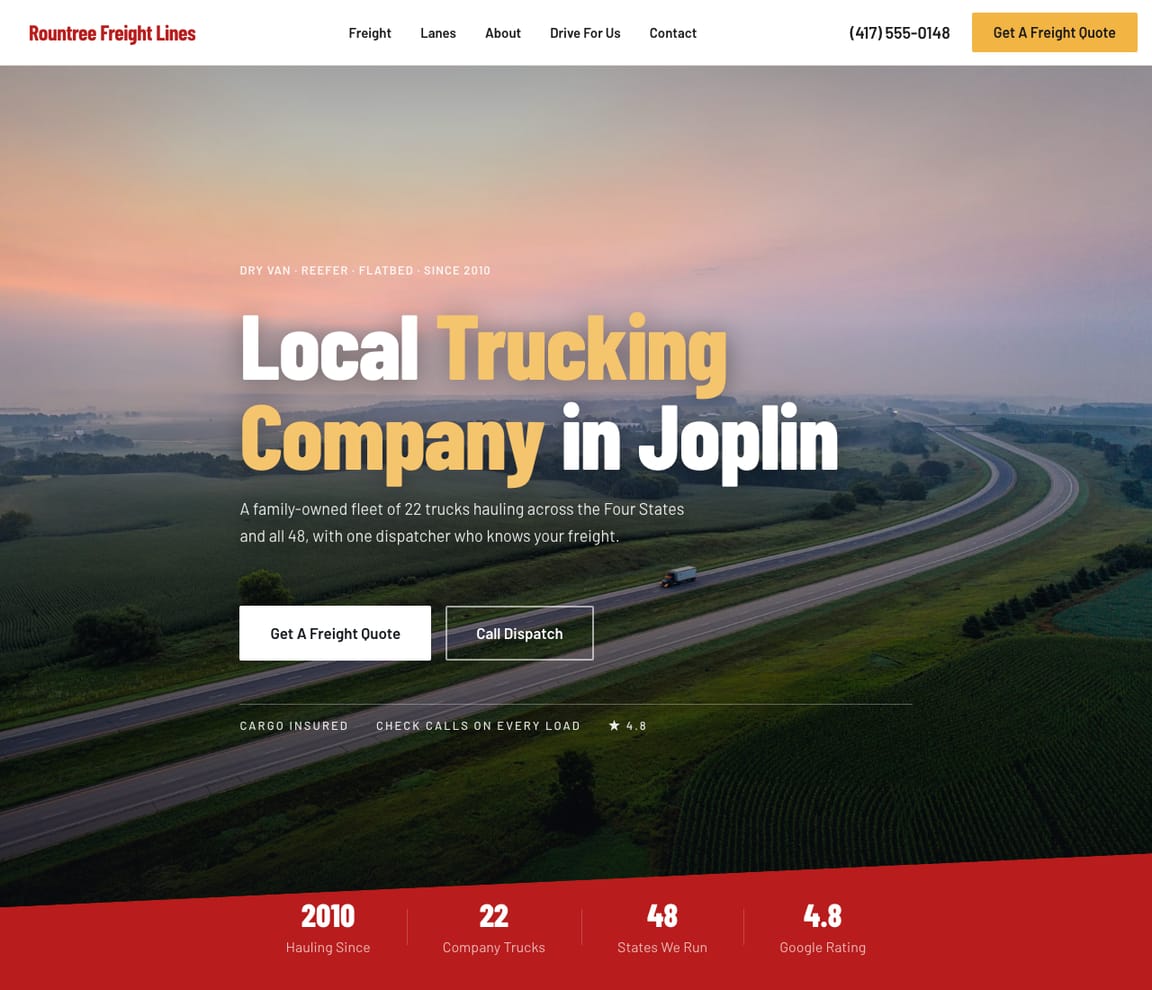
This is a real Zarla template for a family-owned carrier. Describe yours — the freight you haul, the lanes you run, the equipment you pull — and you'll have a site like this, with your services and an inquiry form for rate requests, in about a minute.
- Professional design — not a generic template
- Looks great on desktop and mobile
- Content written for your industry
Build the website
Start your trucking company website now
Add your town and your company name to the sentence, and Zarla builds the site: your freight services and an inquiry form for rate requests. Add your lanes, your equipment, your USDOT and MC numbers and a drivers page in chat, then publish.
Already have a website? Bring it across →Zarla keeps your old page addresses where it can and redirects the ones that change, helping you keep the Google standing you've built.
Is starting a trucking company worth it in 2026 — and what does a mile pay?
A one-truck trucking company is an owner-operator with a business around the truck, and it starts with a choice most guides skip. You can lease on to a carrier — run your truck under its authority, its insurance and often its freight, for a share of the rate — or get your own authority and keep the whole rate and all of the risk. The federal leasing rule lets a carrier pay a leased-on owner "a percentage of gross revenue, a flat rate per mile" or any other agreed method, and requires payment within 15 days of the delivery paperwork (49 CFR 376.12). Either way the money is the same simple sum: the rate a mile pays, minus what a mile costs, times the miles you run loaded.
What a mile pays. DAT's September 2026 national averages were $3.01 a mile for dry van spot loads including fuel — up 96 cents from a year earlier — and $2.17 without fuel; reefer spot was $3.62 and flatbed $3.61, and contract rates averaged $3.24 for dry van and $4.04 for flatbed (DAT, October 13, 2026). The catch is in the same release: the national diesel average passed $6 a gallon for the first time, and "rates usually take three to four weeks to catch up with rising diesel prices, and carriers have to pay for fuel in the meantime." The EIA's diesel average for the week of October 12, 2026 was $6.179 a gallon nationally, $2.514 more than a year earlier, and $5.809 on the Gulf Coast (EIA, October 14, 2026).
What a mile costs. ATRI's 2026 report put the average cost to run a truck in 2025 at $2.336 a mile, "the highest per-mile cost in the report's history" (ATRI, July 15, 2026) — $2.23 in the South-Central region, the cheapest — and nationally $1.028 of that $2.336 was driver wages and benefits, which for an owner-operator is your own pay (FleetOwner, July 2026). In the same report only tanker fleets averaged an operating margin of 1% or more, and flatbed carriers averaged a loss of 0.5% (Heavy Duty Trucking, July 15, 2026). Empty miles are the hidden cost: outside tanker fleets, 16.5% of miles ran empty in 2025, nearly one in six, as Summar, a factoring company, reports ATRI's figures (Summar).
Where the market is heading. FTR's Avery Vise told Heavy Duty Trucking in August, "We expect the market to be favorable for carriers throughout our two-year forecast horizon, but the recovery appears to be stabilizing" (HDT, August 12, 2026). C.H. Robinson's October update forecasts dry van costs per mile up 30% for 2026, and adds that "much of the recent upward movement has come from fuel surcharges rather than underlying transportation demand" (C.H. Robinson, October 1, 2026). Higher rates, in other words, mostly pay for the diesel.
What owners take home. ATBS, an accounting firm for owner-operators, puts the 2025 average at $71,808 of net income after business expenses (Truckstop, citing ATBS); its president told FreightWaves its customers averaged about 95,000 miles, and that ATBS had changed its method, so the figure is roughly flat on 2024 rather than a jump (FreightWaves, April 15, 2026). Those are its own clients' books, not every owner-operator's. As an employee, a heavy and tractor-trailer truck driver's 2025 median was $58,640 a year (O*NET) — and the federal wage survey behind it leaves out the self-employed (Washington ESD). That is the pay your own company has to beat after the truck payment and the insurance.
The catch. According to data from the OOIDA Foundation, "one-in-five new carriers fail within their first year of business" (Land Line, October 2024). The usual reasons are not driving: an insurance bill priced for a carrier with no history — Logrock, which quotes truck insurance, puts a new authority's first year at $1,200 to $2,500 or more a month (Logrock) — a used truck that breaks, brokers who wait 30 days to pay, and empty miles. That's what the rest of this guide sets up.
How to start a trucking company, in plain English
Lease on, or your own authority? Leased on, the carrier's authority and usually its primary liability cover carry your truck: Logrock puts a leased-on owner-operator's insurance at about $250 to $1,000 or more a month, against $1,200 to $2,500 or more for a new authority's first year (Logrock). Your own authority keeps the whole rate, but new authorities also wait for freight: Amazon Relay, for one, asks for interstate authority that "has been active for minimum of 180 days" (Amazon Relay). Many owners lease on for a year or two, then go independent — owners explain why in the next section.
Drive it yourself, or hire drivers? Most one-truck companies start with the owner driving. Every driver of a commercial motor vehicle in interstate commerce needs a medical card that runs up to 24 months (49 CFR 391.45), and every driver you hire a driver file — plus, for CDL drivers, a pre-employment drug test and a Clearinghouse query — and an insurer who will cover them. No law sets a minimum of experience, but most lenders "want at least two years of CDL experience" (Bay Street Lending, October 2026), and as one insurance agency put it, "Most insurance carriers want to see two years of driving experience prior to covering a driver" (Deeley Insurance Group, 2015). Starting a trucking company without driving means hiring from day one, which makes the insurance harder still. Outside dispatch services charge a share of each load: one prices semi dispatch at 6% per load or $250 a week, and box truck and hotshot dispatch at 8% or $350 (Truck Dispatch Experts).
Interstate or intrastate? In the US a truck is a commercial motor vehicle once its gross vehicle or gross combination weight rating is 10,001 pounds or more (49 CFR 390.5). A carrier running one across state lines files Form MCS-150 for a USDOT number "before it begins operations" and updates it every 24 months (49 CFR 390.19T); FMCSA charges nothing for the number — its fee schedule has no line for one — and $300 for operating authority, which a for-hire carrier needs on top (49 CFR 360.3T). Some freight is exempt from the authority, though not from the USDOT number: ordinary livestock and unprocessed agricultural commodities, for example (49 U.S.C. 13506). Staying inside one state is a state's call, and the rules differ — two examples:
- Texas registers carriers hauling Texas-only loads in a truck over 26,000 pounds with a TxDMV number: $100 to apply for a year, $10 a truck and $100 for the insurance filing, with $500,000 of liability cover — and "before you begin you must have a valid USDOT Number", registered as intrastate (TxDMV).
- California requires a Motor Carrier Permit of "any person or business entity that is paid to transport property in their motor vehicle regardless of vehicle size, type, or weight", applied for before you begin operations (California DMV) — $120 plus a $130 inspection fee, $250 in all, for one for-hire truck for a year (California DMV fee chart) — with liability cover from $300,000 to $5,000,000 depending on the vehicle and the load.
Call your own state's transportation or motor vehicle department before you take an in-state load.
A semi, a box truck or a hotshot rig? The license draws the lines. A Class A CDL covers a combination with a gross combination weight rating of 26,001 pounds or more where the towed unit is rated over 10,000 pounds; a Class B covers a single vehicle rated 26,001 pounds or more (49 CFR 383.91).
- A semi. ACT Research's preliminary average retail price for a used Class 8 truck was $61,000 in September 2026, after $64,367 in August (ACT Research, October 13, 2026), and the average truck sold that August had 412,000 miles on it (Transport Topics, October 9, 2026). Bay Street Lending, a truck lender, prices a three- to five-year-old sleeper at $50,000 to $110,000, a six- to ten-year-old one at $25,000 to $60,000 and a new one at $160,000 to $240,000, and asks new authorities for 10% to 25% down at 6% to 22% APR; its own example, $85,000 financed at 14% over 48 months, is $2,320 a month (Bay Street Lending). Rent the trailer first: DAT says used dry vans "can often be hired for anywhere from $500 to $750 per month", and a used 53-foot van under a year old sells for $23,500 to $27,000 (DAT, December 2025).
- A box truck. Rated 26,000 pounds or less, it needs no CDL — but from 10,001 pounds it is still a commercial motor vehicle, so interstate for-hire work still takes the USDOT number, the authority and the $750,000 of liability cover. On October 18, 2026, Penske's used listings included a 2019 Hino 268 with a 24-foot body, a lift gate and 251,667 miles at $34,000 (Penske) and a 2022 Freightliner M2 rated at 26,000 pounds, "CDL Required No", with 238,982 miles at $49,500 (Penske). The trade-off owners name below: about half the payload of a semi, for running costs that aren't half.
- A hotshot rig. A one-ton pickup pulling a gooseneck flatbed for smaller, faster loads. Once the trailer is rated over 10,000 pounds and the combination 26,001 pounds or more, it is a Class A combination. O Trucking, a dispatch company, puts hotshot pay at roughly $1.00 to $2.00 a mile on standard flatbed freight and $2.00 to $4.00 or more on expedited, oilfield and oversize loads (O Trucking) — its figures, not a survey.
If your vehicle is a car or a cargo van and the work is same-day local delivery, that's a different business — read our guide to starting a courier business.
How to get an MC number (your operating authority). New carriers apply for the USDOT number and the authority in FMCSA's Motus system, which launched on May 14, 2026 (DAT, 2026) — the phase FMCSA said would make it "available to all regulated entities". FMCSA verifies every new applicant's identity and the business, says to expect "a minimum timeframe of eight business days" for the first review, and its May release did not eliminate MC numbers, which are still issued (Federal Register, April 29, 2026). Once the application is published in the FMCSA Register, the insurance filing (Form BMC-91 or 91X) and the BOC-3 naming your process agents are due within 20 days (49 CFR 365.109T), and anyone may protest within 10 days before the authority is granted (49 CFR 365.115). A process agent receives legal papers for you in each state (49 CFR part 366); blanket agents cost $25 a year (ProcessAgent.com), a one-time $30 (A Process Agents) or $129 a year plus a $39 enrollment fee (InCorp). Then Unified Carrier Registration, once a year for the whole company — $46 for one or two trucks for 2026 and $55 from 2027, "Fee per entity", not per state (Federal Register, September 1, 2026).
Insurance: the federal minimum, and what brokers ask. The federal minimum for a for-hire truck of 10,001 pounds or more hauling general freight across state lines is $750,000 of liability; oil and certain hazardous materials take $1,000,000, and the most dangerous bulk hazmat $5,000,000 (49 CFR 387.9). The federal cargo filing applies to household goods movers, not general freight (49 CFR 387.303T) — but brokers and shippers set their own floor. C.H. Robinson asks for "a minimum of $1 million in auto liability coverage" and $100,000 of cargo cover (C.H. Robinson, June 2026); Amazon Relay asks for $1,000,000 of auto liability, $100,000 of cargo and $1,000,000 / $2,000,000 of general liability, plus workers' compensation (Amazon Relay). Expect to pay ahead: American Truckers LLC, which sells owner-operator planning tools, tells a new authority to "expect 2–3 months upfront as a deposit ($2,500–$4,500) before your authority goes active" and $12,000 to $18,000 a year for full coverage (American Truckers LLC, March 2026). Get quotes from more than one insurer: one owner in the next section was quoted a third as much after moving states.
Plates, fuel tax and the use tax. A truck over 26,000 pounds on two axles, or with three or more axles, driven in two or more jurisdictions carries apportioned plates under the International Registration Plan (Wyoming DOT), priced by the share of miles in each state — OTR Solutions, a factoring company, estimates about $1,500 a year (OTR Solutions, January 2026); Texas charges $840 a year to register a truck of 70,001 to 80,000 pounds (Texas Comptroller) and $15 for a semitrailer (Tex. Transp. Code §502.255). The same trucks file one IFTA fuel-tax return a quarter with their base state, due the last day of the month after the quarter ends; Texas says "there are no fees associated with IFTA registration, licenses or decals" (Texas Comptroller). The federal heavy vehicle use tax starts at a taxable gross weight of 55,000 pounds — $100 a year plus $22 for each 1,000 pounds over, and $550 over 75,000 pounds (26 U.S.C. 4481) — filed on Form 2290 for July to June (IRS).
Drug testing, the ELD and hours. In the US a one-truck carrier is its own employer for drug and alcohol testing, and the rule says an employer "who employs only himself/herself as a driver shall implement a random alcohol and controlled substances testing program of two or more covered employees" (49 CFR 382.103) — in practice, a consortium. Consortium Pool charges $65.95 a year for one driver plus $75 for a pre-employment test (Consortium Pool); DOTConsortium.com charges $149 a year and $60 a test (DOTConsortium.com); a Clearinghouse query costs $1.25, the price FMCSA set in 2019 (FreightWaves, 2019). An electronic logging device records your hours unless the truck was built before model year 2000 or you keep logs on 8 days or fewer in 30 (49 CFR 395.8), or you stay within 150 air miles and are released within 14 hours (49 CFR 395.1). Motive generally starts at $25 a month with hardware around $150, in HOS247's price guide (HOS247, September 2025); Garmin's eLog is a one-time $249.99 device with no subscription (Garmin). The hours themselves: 11 hours driving inside a 14-hour window after 10 hours off, a 30-minute break after 8 hours of driving, and 60 or 70 hours in 7 or 8 days (49 CFR 395.3).
The new-entrant audit. A new carrier is monitored for 18 months, and a safety audit comes once it has enough records — "generally at least 3 months" (49 CFR 385.307) — and by law within 12 months of starting (49 U.S.C. 31144). Sixteen violations fail it automatically, among them no drug and alcohol testing program, no random testing, a driver without a valid CDL, no insurance in force, missing hours records and trucks never periodically inspected (49 CFR 385.321). Build the files before the first load, not before the audit.
The CDL, and the driver rules that changed in 2026. A first-time Class A applicant completes entry-level driver training, required since February 7, 2022 (49 CFR 380.600), from a provider on FMCSA's Training Provider Registry (49 CFR 380.703). Schools publish their prices: $4,000 at Central Alabama Community College for 2026–27 (CACC), $2,005 plus about $350 for the permit, physical and drug screen at Mitchell Community College in North Carolina (Mitchell CC), and $9,495 all-inclusive at SUNY Jefferson in New York (SUNY Jefferson, 2026); Texas charges $96 for the license itself (Tex. Transp. Code §522.029). Two rules moved this year. FMCSA's final rule limiting non-domiciled CDLs to holders of specific employment-based visas took effect March 16, 2026 (Federal Register, February 13, 2026); the D.C. Circuit refused to pause it in May, and the challenge was still undecided as of October 2026 (D.C. Circuit order, May 5, 2026). And English proficiency has been enforced at the roadside as an out-of-service violation since June 25, 2025, while FMCSA's proposal to write that into its own rules was still a proposal as of October 2026 — check its status (Federal Register, August 10, 2026).
Finding freight, and getting paid. New authorities start on load boards: DAT One's Enhanced plan, which DAT recommends for new owner-operators, is $149 a month and Pro $169 (DAT); Truckstop's dry van plan was $35 a month as captured in September 2026 (PricingSaaS). Most brokers pay on net 30 terms, about 30 days after the invoice, and some take 45 or 60 (TrueNorth, a freight software company), while you pay for diesel the day you buy it. Factoring closes the gap for a fee: Outgo, a factoring company, charges 3% for owner-operators invoicing under $18,000 a month and 2.5% for fleets invoicing $18,000 to $80,000 (Outgo); Apex Capital says factoring fees typically range from 1% to 5%, with 80% to 95% advanced (Apex Capital). Amazon Relay pays weekly but publishes no rates (Amazon Relay). A freight broker is a different license — its own broker authority and $75,000 of financial security, whatever its size (49 U.S.C. 13906) — so check a broker's authority before you haul for one. The better money is direct shippers — the companies whose freight you already carry — once your record earns it.
The business, and the money to start. Form the business — an LLC is $300 in Texas (Texas SOS) and $70 in California (California SOS), where every LLC also owes an $800 yearly tax (California FTB) — get the free EIN the federal filings ask for (IRS), and keep the truck's money in its own account. There are no federal start-up grants: "SBA does not provide grants for starting and expanding a business" (SBA); its 7(a) loans go up to $5 million (SBA), and truck lenders ask new authorities for 10% to 25% down. For one owner-operator with a used sleeper tractor and a rented 53-foot dry van, our free trucking business plan puts the start at $35,105–$72,912: the down payment, the first month's trailer rent, the authority and filings, plates and the use tax, the insurance deposit, drug testing, an ELD, registration, safety gear, the website and two months of running costs. Your own living costs come on top, and the plan's sample carrier — about $19,900 a month of revenue at DAT's September rate — keeps about $3,100 to $8,200 a month before the owner's pay. The transportation website templates include a trucking company, a hotshot carrier and a dispatch service, the transportation website design ideas show what good carriers put on the page, and Zarla's transportation website builder builds the site shippers find when they search for a carrier in your region.
What owner-operators actually say
None of this is our opinion about the trade. It comes from people talking about running trucks on TheTruckersReport forum, between 2006 and 2025 — owner-operators with their own authority, owners leased on to carriers, and a few company drivers, each described as their own post describes them. Most don't say where they are, and the dollar figures in older threads are that year's. Read each as theirs at the time. Seven things come up again and again.
Get the experience on someone else's truck. Farmerbob1, to a 21-year-old about to buy a truck: “Drive someone else's truck for a year or two. Let them pay for most of your mistakes until you stop making mistakes.” (TruckersReport, April 2019). boneebone, who was granted their own authority in 2021 and owns a tractor, a dry van and a reefer outright: “My advice is, be a company driver first and get your experience driving, learn the business, don’t get speeding violations…” And: “Leasing on to a Carrier will save you money on base plates, insurance, fuel, parts and maintenance and in the meantime you’ll be using their trailer.” Cdemars316, after 23 years as a company driver and two other businesses: “Driving is like 5% of the job, the other 95% of the job has to do with the business side of things…” (TruckersReport, September 2024). D.Tibbitt, who went from company driver to lease purchase to leased on to their own authority: “Can still say the learning curve is steeper then mount Everest..” (TruckersReport, July 2023).
“Spoke with Progressive on a basic $1 million liability and $100k cargo coverage, standard freight, no hazmat, No extra options. Now I was expecting around $30K but was floored when I was quoted just over $45K.” — Solid11, with two years of CDL experience and a clean record, on TruckersReport, June 2024
Insurance is the first shock. In the same thread, Pinnacle Pinnapple, whose new authority went active in January 2024, listed what they pay at Progressive for a 2020 Peterbilt and a 2024 dry van, with $1 million of liability and $250,000 of cargo: “Total premium $27,425” (TruckersReport, June 2024). nikmirbre, on the limits: “Ok yes the auto liability was 750k. I changed it to 1mil and it added 3k to the premium” (TruckersReport, July 2021). Where you live moves it as much as anything — 99lovemaria: “They wanted 33,000 per year from me in New York and this was for progressive. Then when I moved and changed my address to Pennsylvania, that same insurance came down from 33k to only 10k.” (TruckersReport, August 2023). And the brokers' floor is not new — crackinwise, in 2014: “I was just quoted, this week, an isurance rate for Cargo $100,000 and Liabilty $1,000,000. This is the required insurance before most, if not all, brokers will load you.” (TruckersReport, February 2014).
New authorities wait for the good brokers. Tombstone, by then running under their own authority: “Most of the brokers won't give you a hard time as long as you have insurance. Schneider, JB Hunt requires 6 months, US Express and some others between 3 and 6 months.” And: “Even if you find a broker that requires time more than you have, just move on to the next one.” redoctober83: “I've noticed a huge increase in brokers reaching out to me once my authority was 6 months old.” (TruckersReport, January 2017). badvik_83, six months in with a box truck: “I heard a lot that 6 months might be a way to start getting loads under my own authority but most brokers are now saying it has to be at least 1 year.” (TruckersReport, August 2023).
Cash runs out before freight does. ElmerFudpucker, with their own authority since October 2007: “I factor my broker loads. It’s essentially the same as quick pay, but with the added bonus of a credit check, and insurance.” And: “Early on I got burned for close to 30 grand. The bond got maxed out before I filed.” 86scotty, who has invoiced over a thousand loads, sees it the other way: “i don't factor. I hate extra hands in the cookie jar. I do about half quickpays with brokers and about half 30 days.” (TruckersReport, August 2025). Rawlco, in 2006: “You will need to have enough cash on hand to operate for 30 days or more because you will be billing brokers/shippers and waiting for them to pay you.” (TruckersReport, September 2006).
The used truck decides the year. Jed2009, running their own authority on a 1996 Freightliner: “I started with $5k that went to -$5k within a month (busted clutch and bellhousing).” Their log of 2021 — a record year for rates — shows 105,749 miles, 36.6% of them empty, $250,603.27 of gross revenue after quick-pay fees, and $30,165.72 of truck repairs (TruckersReport, February 2022). uncleal13: “I originally budgeted $1,000 per month for maintenance and repairs. Includes tires, oil changes, everything needed to keep the truck running. Over the years I find it averages to $850 a month.” Midwest Trucker: “For a used truck figure 20 to 25 cents per mile to be safe.” (TruckersReport, May 2019). Michael H, giving up their authority after the first year: “I rushed into my authority with no reserve funds.” And: “I bought a truck I couldn't afford. The payments were killing me, but not as much as the maintenance…” (TruckersReport, February 2017).
Spot freight gets you started; shippers keep you going. DaveLV: “The best way to start is around home. Find companies that ship out of your area to preferred lanes.” And: “You will have higher rates than the big carriers so be prepared to justify with exceptional service.” (TruckersReport, November 2015). Big Road Skateboard, four years on their own authority and never leased on: “I rely on the spot market for probably 85% of my loads.” rollin coal, a former owner-operator, named the four reasons they failed: “over reliance on spot, leased on, running old equipment and I'm not a sales guy.” And: “Trucking/driving is the easiest part” (TruckersReport, August 2025). On leasing, KB3MMX: “Most leases these days aren't even 85%....some as low as 75% or less.” (TruckersReport, August 2015).
Smaller trucks aren't cheaper to run. 8thnote, on box trucks: “Youre looking at operating expenses that are roughly equivalent to a semi truck and the freight pays half as much (because you can only haul half as much).” (TruckersReport, January 2019). KET, who ran six hotshot trucks: “For MOST hauling where a flatbed gooseneck is used, a standard 1 ton, 3500, etc pick up will break you.” And: “Don't bother asking "do I need a CDL?" The answer is YES.” (TruckersReport, February 2015).
The through-line: the owners who last got their miles on someone else's truck first, priced insurance before buying anything, kept a repair reserve, waited out the brokers who won't load a new authority, priced every load from what a mile really costs them, and worked their way from the board to shippers who call them direct.
THE STARTER KIT
What you need to start a trucking company
A CDL and real miles
A Class A license for a semi or a big hotshot rig, a medical card, and the two years of CDL experience most insurers and truck lenders want to see.
A truck you can keep running
A used tractor (or box truck) inspected before you buy, a repair reserve for the first breakdown, and a trailer you rent before you buy one.
Your authority and filings
A USDOT number, operating authority (the MC number), process agents on a BOC-3, the insurance filing and Unified Carrier Registration.
Insurance a broker will accept
Auto liability, cargo and physical damage cover at the limits brokers ask for — usually more than the federal minimum — with the deposit paid before you go active.
The compliance kit
An ELD, a drug and alcohol consortium, Clearinghouse queries, a driver file, apportioned plates, IFTA fuel-tax returns and the heavy vehicle use tax.
A cost per mile and a cash reserve
What a mile really costs you before you quote one, two months of running costs in the bank, and a plan for getting paid — quick pay or factoring.
THE PAPERWORK
Licenses, filings and insurance for a trucking company
| Typical cost | Time to get | Legally required? | |
|---|---|---|---|
| Business registration (LLC) and EIN | e.g. $300 (TX), $70 + $800/yr tax (CA); EIN free | Days | Depends on your structure |
| USDOT number | No fee | Before you operate | Interstate trucks from 10,001 lb; some states too (e.g. Texas) |
| Operating authority (the MC number) | $300 | Several weeks | For-hire interstate, most freight |
| Insurance filing (BMC-91 or 91X) | $750,000 minimum for general freight | Within 20 days of publication | Yes, with operating authority |
| Process agents (BOC-3) | $25/yr to $129/yr + $39 | Within 20 days of publication | Yes, with operating authority |
| Unified Carrier Registration (UCR) | $46 for 2026, $55 from 2027 (1–2 trucks) | Days | Yes, every year, for interstate carriers |
| Apportioned plates (IRP) and IFTA | e.g. ~$1,500/yr IRP; no IFTA fee in TX | Days to weeks | Heavy trucks in two or more states |
| Heavy vehicle use tax (Form 2290) | $100 + $22 per 1,000 lb over 55,000; $550 max | Yearly, for July to June | From 55,000 lb taxable gross weight |
| Class A CDL and medical card | e.g. $2,005–$9,495 school; $96 TX license | Weeks | CDL: 26,001 lb+ towing over 10,000 lb; card: interstate from 10,001 lb |
| Drug and alcohol consortium and Clearinghouse | $65.95–$149/yr + $60–$75 a test; $1.25 a query | Days | Yes, for CDL drivers |
| Electronic logging device (ELD) | ~$150 + $25/mo, or $249.99 one-time | Days | Yes, with exceptions |
| Intrastate registration | e.g. TX $100 + $10/truck + $100 filing; CA $250 | Days | Varies by state |
THE STEPS
How to start a trucking company (step by step)
Eight steps from a CDL to your own authority, your first loads and a passed new-entrant audit.
01
Get your CDL and real miles
Earn a Class A license from a registered training provider, then drive for a carrier first — most insurers and lenders want two years of CDL experience.
02
Decide: lease on, or your own authority
Leasing on runs under a carrier's authority, insurance and freight for a share of the rate; your own authority keeps the whole rate and all of the risk.
03
Form the business and work out your cost per mile
Form the business, get a free EIN, open a business account, and add up the truck payment, insurance, fuel, repairs and your own pay per mile.
04
Line up the truck, the trailer and an insurance quote
Find the truck and the trailer and get an insurance quote first: the insurance filing is due within 20 days of your application being published.
05
Apply for your USDOT number and operating authority
Apply in FMCSA's Motus system, verify your identity and the business, then file the insurance and your process agents (BOC-3) on time.
The 20-day clock06
Register for UCR, plates, IFTA and the use tax
Unified Carrier Registration every year, apportioned plates and an IFTA account for a heavy truck in two or more states, and Form 2290 from 55,000 pounds.
07
Join a consortium, install the ELD, build your files
A random drug and alcohol testing pool, a pre-employment test and Clearinghouse query, an ELD, and a driver file and inspection records for the audit.
Before your first load08
Book loads, find direct shippers, pass the audit
Start with brokers that take new authorities, price every load from your cost per mile, call the shippers you deliver to, and keep the records the safety audit checks.
THE COSTS
How much does it cost to start a trucking company?
The total is our free trucking business plan's itemized US ranges for one owner-operator with a used sleeper tractor and a rented 53-foot dry van: the down payment, the first month's trailer rent, the authority and filings, plates and the use tax, the insurance deposit, drug testing, an ELD, registration, safety gear, the website and two months of running costs. Your own living costs come on top. Prices from the sources' own pages, checked October 2026.
$35,105–$72,912to start with a used semi and a rented trailer — two months of running costs are most of it
$61,000the average retail price of a used Class 8 truck, September 2026 (ACT Research, preliminary)
$2,500–$4,500an insurance deposit before a new authority goes active (American Truckers LLC)
$300FMCSA's operating authority fee — the USDOT number itself is free
WHAT WE'VE LEARNED
What actually makes a shipper hand a small carrier its freight
Thousands of local business websites in, the pattern for business-to-business services is clear: the buyer wants proof you're legitimate, proof you can do the job, and an easy way to ask. For a carrier, three things on a page decide who gets the load.
Your numbers, in plain sight
Your USDOT and MC numbers, your insurance limits and a carrier packet — so a shipper or a broker can check you in a minute instead of guessing.
Lanes and equipment
The regions and lanes you run, what you pull — dry van, reefer, flatbed or hotshot — and the freight you take and don't take.
An easy way to ask for a rate
An inquiry form that asks for the lane, the dates, the weight and the equipment, and a phone number that answers — the first carrier who quotes often gets it.
THE UPSIDE
What a trucking company can earn
Rates from DAT (September 2026), costs from ATRI's 2026 report on 2025, owner-operator income from ATBS's own clients, and driver pay from O*NET. Averages, not a promise — your lanes, your equipment, your empty miles and the price of diesel decide it.
$3.01a mile: the national dry van spot average with fuel, September 2026 (DAT)
$2.336a mile: the average cost to run a truck in 2025, driver pay included (ATRI)
$71,808the average 2025 net income of ATBS's owner-operator clients, at about 95,000 miles
$58,640a year: the 2025 median for employed tractor-trailer drivers (O*NET) — the pay to beat
SEE IT WORK
Trucking website designs you can start from
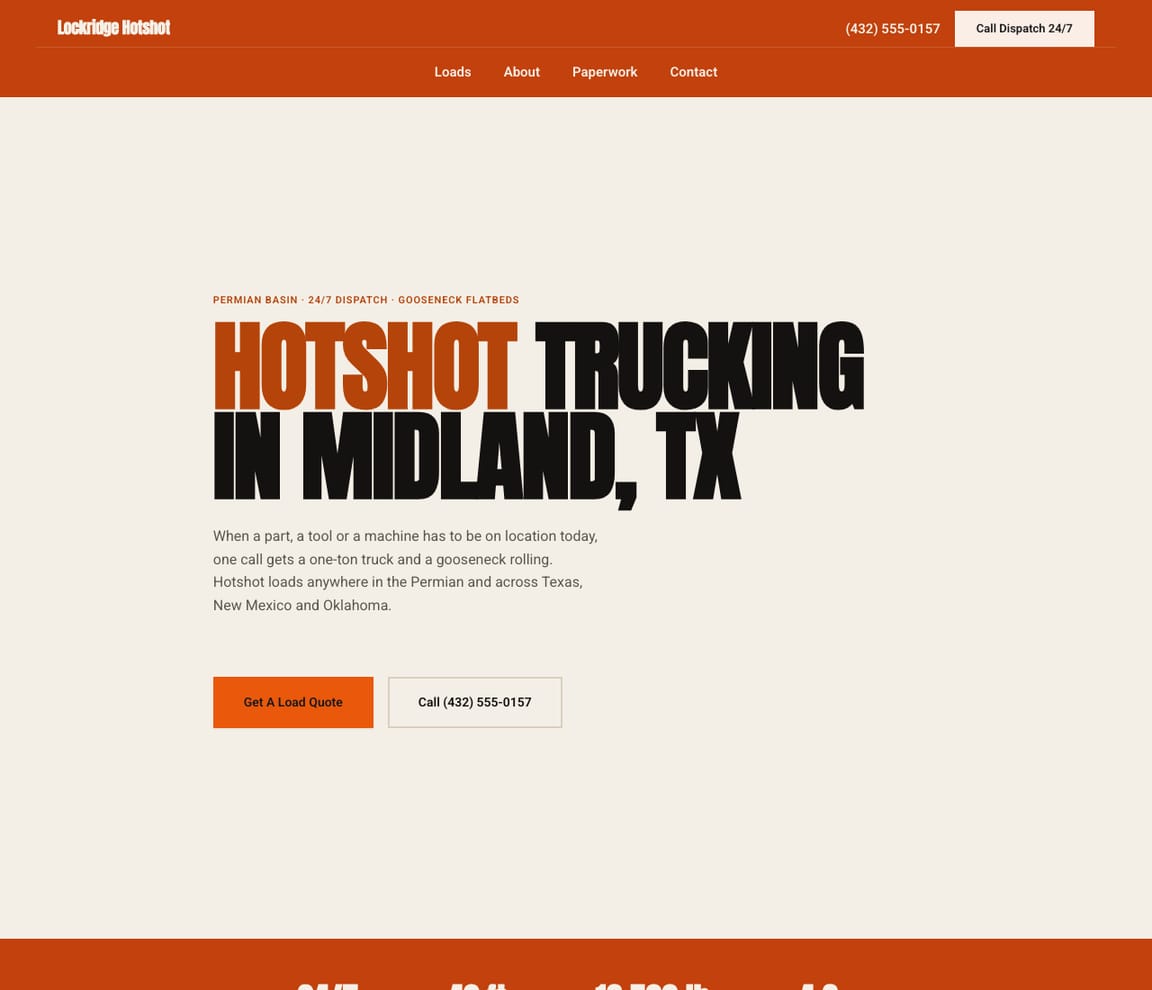
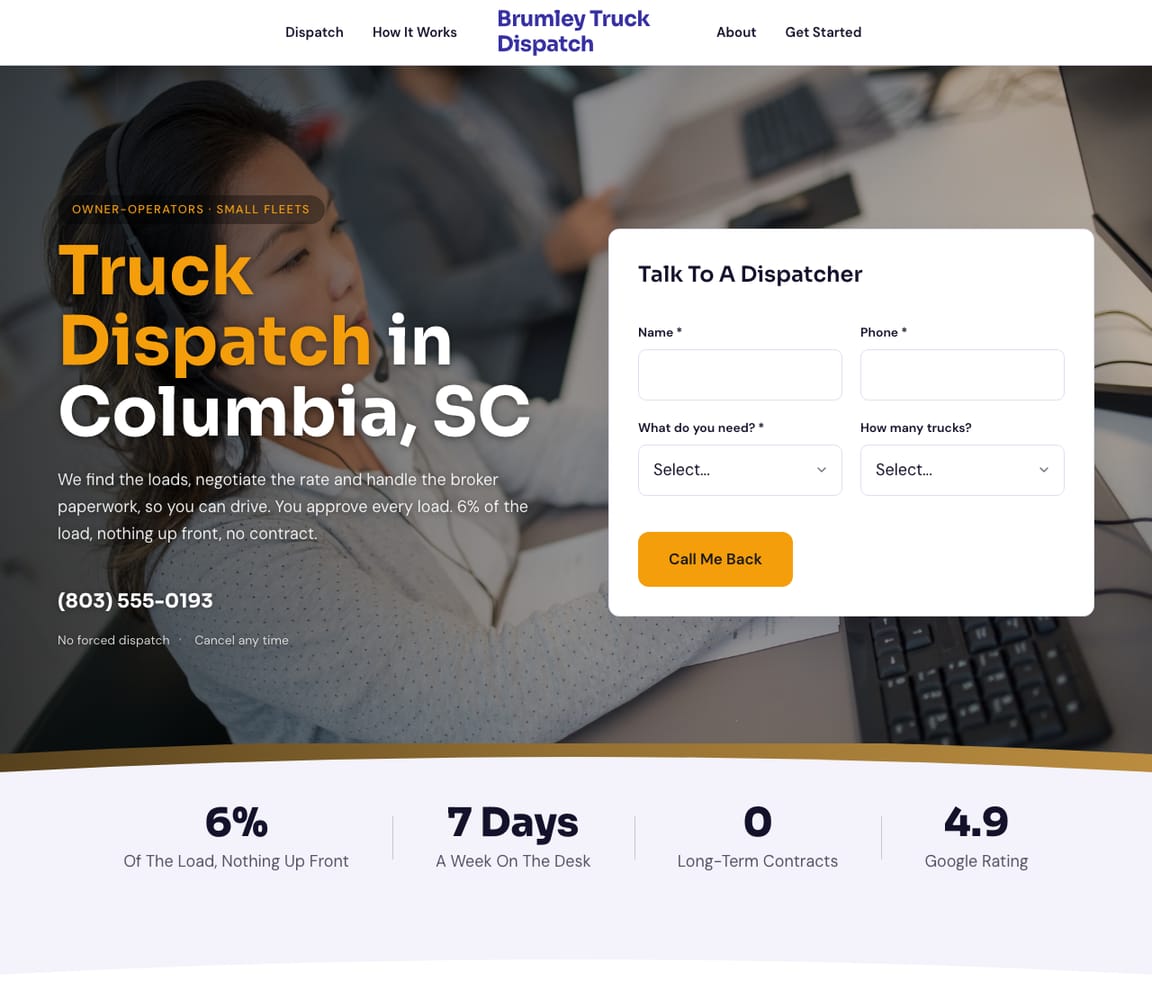
All three are real Zarla templates. Open the one closest to how you'll run — a dry van, reefer and flatbed carrier, a hotshot rig, or a dispatch service for owner-operators — swap in your lanes, your equipment and your own photos, and publish.
GET FOUND
Get found by the shipper looking for a carrier
A broker checks your authority before the first load; a shipper with weekly freight searches for a carrier in its region and reads your website before it calls. Zarla builds the website with your freight services and an inquiry form for rate requests. Add your lanes, your equipment and your USDOT and MC numbers in chat, and once you connect your Google Business Profile, your name, hours and reviews stay in step on both.
“Trucking company near me”
Searched by a plant manager with weekly freight, a distributor whose regular carrier let it down, and a broker double-checking a carrier it's never used. Your lanes, your equipment and a quick way to ask for a rate answer it.
Google Business Profile
Your yard or office, your hours, photos of your trucks and your reviews inside Google Maps. Free, and an afternoon to set up — and a shipper sees a real company before it trusts you with a load.
Reviews from shippers you've hauled for
Ask after a clean delivery — and send the link that day. Reviews that say you were on time, communicated and delivered without a claim sell the next lane.
Google Search
Rredcalichefreight.com
Red Caliche Freight — Trusted trucking company in Your AreaRegional dry van freight out of Fort Worth for shippers and brokers. Lanes, equipment, insurance details and a carrier packet online. Ask for a rate.← Your Zarla siteCcitytruckingcompanyservices.com
City trucking company ServicesGoogle Maps
1
Red Caliche Freight
← You2
Metro trucking company Co.
3
Quick trucking company Services
AI assistants (ChatGPT / Perplexity)
For a small carrier with a dry van for weekly loads out of Fort Worth in your area: Red Caliche Freight — a small carrier that lists its lanes and equipment, shows its USDOT and MC numbers and insurance, and makes it easy to ask for a rate.
YOUR LAUNCH PLAN
Your trucking company launch checklist
The whole guide as things to check off. Work through them in order and you'll be licensed, insured, registered and priced before the first load.
- Get a Class A CDL and a medical card — and the miles insurers want to see.
- Choose: lease on, or your own authority — and dry van, reefer, flatbed, box truck or hotshot.
- Form the business and get a free EIN — then work out your cost per mile.
- Line up the truck, the trailer and three insurance quotes — before you apply.
- Apply for a USDOT number and operating authority — insurance filing and BOC-3 within 20 days.
- Register for UCR, IRP plates, IFTA and Form 2290 — and your state, if you haul inside it.
- Join a drug and alcohol consortium and install an ELD — and start the driver file.
- Get found — a website with your lanes and numbers, a Google profile, and calls to the shippers you deliver to.
REAL CUSTOMERS
Small business owners who got online with Zarla
Verified reviews from real Zarla customers.
“Quickly built my website from scratch. No hiccups. Would highly recommend Zarla for someone with no experience who wants to start a polished business website.”
“Great professional website in less than a minute, with the use of AI and a few descriptive prompts. This has saved me bundles of time and research on web developers.”
“I had no idea how to set up a website for my business. Thanks to Zarla, they've helped me a lot.”
“Very reliable, professional, and fast results. I was able to get my business online in no time, and the ease of access made it so simple.”
Be the carrier a shipper checks — and calls
Add your town and your company name, and Zarla builds the website from that one line — your freight services and an inquiry form shippers and brokers can ask for a rate on, with SEO in place. Add your lanes, your equipment, your USDOT and MC numbers and a drivers page in chat. Free to build; you pay when you publish.
Already have a website? Bring it across →Zarla keeps your old page addresses where it can and redirects the ones that change, helping you keep the Google standing you've built.
Frequently asked questions
How much money do I need to start my own trucking business?
In the US, about $35,105 to $72,912 for one owner-operator with a used sleeper tractor and a rented dry van, in our trucking business plan's itemized ranges — a 10% to 25% down payment on the truck, the first month's trailer rent, the authority and filings, plates and the use tax, a two-to-three-month insurance deposit, drug testing, an ELD, registration, safety gear, the website, and two months of running costs, which are most of it. Leasing on to a carrier costs less up front, because its authority and primary liability cover carry your truck. Your own living costs come on top.
Is it possible to start a trucking company without any money?
Not with your own authority. The SBA says it does not provide grants for starting a business, truck lenders ask new authorities for 10% to 25% down, and one insurance guide puts a new authority's deposit alone at $2,500 to $4,500. The low-cash routes are driving for a carrier while you save, leasing on to a carrier, or an SBA-backed 7(a) loan, which goes up to $5 million. Our trucking business plan's full start with a used semi is $35,105 to $72,912.
How profitable is owning a trucking company?
Thinly, on average. ATRI put the cost to run a truck in 2025 at $2.336 a mile, and found only tanker fleets averaged an operating margin of 1% or more; flatbed carriers averaged a loss. For an owner-operator, $1.028 of that cost is driver pay — your own. ATBS's owner-operator clients averaged $71,808 of net income in 2025. For the sample one-truck carrier in our plan, about $19,900 a month of revenue leaves about $3,100 to $8,200 a month before the owner's pay. Empty miles, insurance and repairs decide which end you land on.
Is trucking still worth it in 2026?
Rates are up but most of the rise is diesel. DAT's dry van spot average was $3.01 a mile with fuel in September 2026, 96 cents more than a year earlier, while diesel passed $6 a gallon and rates take three to four weeks to catch up. FTR expects the market to stay favorable for carriers through its two-year forecast. Costs hit a record in 2025, and according to OOIDA Foundation data one in five new carriers fail in their first year. It is worth it for a driver with experience, a reserve and a cost per mile they trust.
How hard is it to start a trucking company?
In the US, the paperwork takes weeks, not months: a USDOT number, operating authority ($300), the insurance filing and process agents within 20 days of publication, UCR, plates and IFTA. The hard parts come after. Insurance for a new authority is expensive; owners report that many brokers won't load a carrier until its authority is three to twelve months old, and Amazon Relay asks for 180 days; brokers often pay in 30 days while diesel is paid today; and the new-entrant safety audit comes within the first year.
What type of trucking business is most profitable?
Higher rates aren't the same as higher profit. In DAT's September 2026 figures, reefer ($3.62 a mile) and flatbed ($3.61) spot loads paid more than dry van ($3.01), and contract flatbed paid $4.04 — but ATRI found flatbed carriers averaged an operating loss in 2025, and only tanker fleets averaged a margin of 1% or more. Box trucks and hotshot rigs cost less to buy but haul smaller loads, and owners say their running costs aren't proportionally lower. Choose the freight you can keep loaded, close to home.
How do I get an MC number?
In the US you apply for a USDOT number and operating authority — which comes with an MC number — in FMCSA's Motus system, open to new carriers since May 14, 2026. FMCSA verifies your identity and the business and expects at least eight business days for the first review; the authority costs $300. After the application is published, you have 20 days to file insurance and your process agents (Form BOC-3), and there is a 10-day protest window before the authority is granted. MC numbers have not been eliminated as of October 2026.
How much is an LLC for a trucking company?
In the US it depends on the state: $300 in Texas, and $70 in California, where every LLC also owes an $800 yearly tax. The EIN from the IRS is free. An LLC doesn't replace the federal filings — the USDOT number, operating authority, insurance filing, BOC-3 and UCR are separate. Check your own state's secretary of state for the fee, and ask an accountant about the tax.
What do I need to start a trucking company in Texas?
For Texas-only loads in a truck over 26,000 pounds, a TxDMV number — $100 to apply for a year, $10 a truck and $100 for the insurance filing — with $500,000 of liability cover. Crossing state lines adds the federal USDOT number, operating authority ($300) and the $750,000 federal minimum. Texas registers a truck of 70,001 to 80,000 pounds for $840 a year and a semitrailer for $15, charges $96 for a CDL and nothing for IFTA, and an LLC is $300.
Can truck drivers make $100,000 a year?
Some do, but the averages are below it. The 2025 median for employed heavy and tractor-trailer truck drivers was $58,640 (O*NET), and ATBS's owner-operator clients averaged $71,808 of net income at about 95,000 miles. An owner-operator's gross is far higher — one owner on TheTruckersReport logged $250,603 of gross revenue after quick-pay fees in 2021, a record year for rates — but the truck, the fuel, the insurance and the repairs come out of it.
How do I start a box truck business?
In the US, a box truck rated 26,000 pounds or less needs no CDL, but from 10,001 pounds it is a commercial motor vehicle: interstate for-hire work still takes a USDOT number, operating authority, $750,000 of liability cover, and logs beyond 150 air miles. Penske's used listings on October 18, 2026 included a 2019 Hino with a 24-foot body at $34,000 and a 2022 Freightliner M2 at $49,500. Owners warn that a box truck hauls about half a semi's load for running costs that aren't half, so line up regular local freight before you buy.
How to make $1000 a day with a pickup truck?
No source shows a pickup reliably earning that, so here is the arithmetic. Hotshot trucking — a one-ton pickup pulling a gooseneck flatbed — pays roughly $1.00 to $2.00 a mile on standard flatbed freight and $2.00 to $4.00 or more on expedited and oilfield loads, in one dispatch company's figures. $1,000 a day is 250 to 1,000 loaded miles at those rates, before fuel, insurance and the truck. In the US, a trailer rated over 10,000 pounds on a combination of 26,001 pounds or more also needs a Class A CDL.
How much does Amazon pay if you have your own truck?
Amazon Relay doesn't publish rates: loads are priced on its load board, and it pays weekly, for loads completed by Saturday night, on the following Friday. To join, a carrier needs a USDOT number with interstate authority active for at least 180 days and a valid MC number, $1,000,000 of auto liability, $100,000 of cargo cover, $1,000,000 / $2,000,000 of general liability and workers' compensation where it operates.
What changed in the CDL rules in 2026?
In the US, two driver rules moved. FMCSA's final rule limiting non-domiciled CDLs to holders of specific employment-based visas took effect March 16, 2026; a court challenge was still undecided as of October 2026. English proficiency has been an out-of-service violation at the roadside since June 25, 2025, and FMCSA's proposal to write it into its own rules was still a proposal as of October 2026. Entry-level driver training has been required for first-time Class A applicants since February 7, 2022. Check the status of both before you hire.
How do I get my first loads as a new authority?
Set up with brokers that take new authorities — owners name some that load you from day one, while others want three to twelve months — and price every load from your cost per mile, not the board's rate. Then call the shippers you deliver to about direct freight, and answer the carrier checks they run: your lanes, equipment, USDOT and MC numbers and insurance on your website and Google Business Profile. Zarla builds the website from one sentence, with your freight services and an inquiry form for rate requests, and you add your lanes and numbers in chat.