BUSINESS GUIDE
How to start a window cleaning business in 2026
Homes or a storefront route, a squeegee kit or a water-fed pole, what to charge by the window, the pane and the visit, insurance, ladder safety and where rope work begins, add-ons like gutters and solar panels — and how to keep the calendar full when the season turns.
Free to build · Pay when you publish · No credit card
$150–$302a home window cleaning, averaging $221 (HomeAdvisor, 2026)
$40–$75a storefront visit on a regular route (Housecall Pro)
$78/monthmedian general liability for window cleaners (Insureon)
No codeto get online
See it in action
See what your window cleaning website could look like
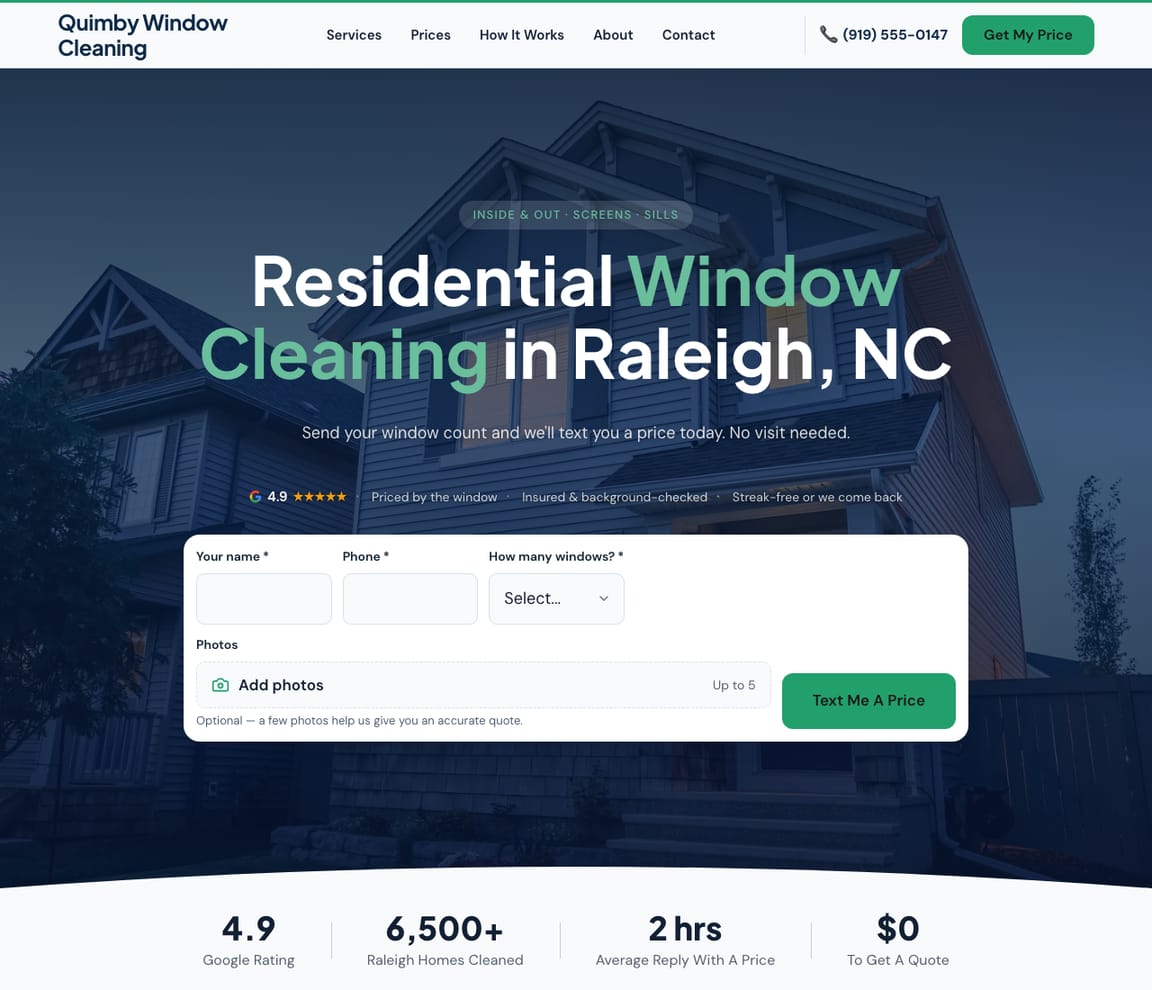
This is a real Zarla template for a home window cleaner. Describe yours — the towns you cover, what an inside-and-out clean includes, how you reach second-story glass — and you'll have a site like this, with a call button and a quote form that takes photos of the windows, in about a minute.
- Professional design — not a generic template
- Looks great on desktop and mobile
- Content written for your industry
Build the website
Start your window cleaning website now
Add your town and your business name to the sentence, and Zarla builds the site: a call button at the top, a service-area map and a quote request form that takes photos of the windows. Add your prices, add-ons and storefront routes in chat, then publish.
Already have a website? Bring it across →Zarla keeps your old page addresses where it can and redirects the ones that change, helping you keep the Google standing you've built.
Is a window cleaning business worth starting — and what do customers pay?
It's one of the cheapest trades to start — a squeegee kit and a ladder will do the first jobs — and one that runs on repeat customers. It comes in two shapes, and most owners do both. Homes are cleaned inside and out, usually once or twice a year, for the bigger tickets. Storefronts — shops, restaurants and offices — are cleaned every two or four weeks on a route, for small tickets that come back every month. High-rise work on ropes is a third, specialist business, covered further down.
What homeowners pay. HomeAdvisor puts a typical US home window cleaning at $150 to $302, averaging $221, or about $10 per window, and a single pane at $4 to $15 (HomeAdvisor, June 2026). Fixr's national range is $190 to $460, with most homeowners spending $310 for a house of 22 standard double-hung windows with screens, and $4 to $8 a pane; windows on the third and fourth floors cost $3 to $5 more, and the outside is usually about 80% of an inside-and-out price (Fixr, August 2025). Today's Homeowner puts a standard home at $10 to $15 per window and a full-home clean at $150 to $350, and says most companies charge a minimum service fee, usually $45 to $85 (Today's Homeowner, February 2025). HomeAdvisor's advice to homeowners is a clean twice a year — and it puts the cost of buying the right supplies to do it themselves at $400 on average, close to the price of a pro.
What shops pay. In Housecall Pro's pricing guide — written by a company that sells field-service software to window cleaners — a small storefront pays $40 to $75 a visit, a weekly storefront route may take 20 minutes a stop, and commercial jobs often run $50 to $100 an hour (Housecall Pro, October 2026). Fixr adds that an average house typically takes about four hours. Taller buildings are priced by the hour: Fixr puts high-rise panes at up to $85 an hour, and $170 an hour for the two-person crew safety requires.
The catch. The money is in repeat cleans and a tight route, and the work is seasonal and physical. Insureon, an insurance marketplace, calls window cleaning "one of the most risky professions" — a fall from a ladder, or a homeowner who sues over damage (Insureon). It describes its window-cleaning customers as mostly businesses with fewer than five employees, five years or less in business, and annual revenue from around $50,000 to more than $200,000 (Insureon, September 2026). As an employee, the closest occupation O*NET matches to window cleaning (O*NET search) — janitors and cleaners, whose tasks include cleaning windows with squeegees — paid a 2025 median of $36,840 a year, with growth slower than average to 2035 (O*NET). The owner's income has to beat that after the insurance, the fuel and the vehicle. That's what the rest of this guide sets up.
How to start a window cleaning business, in plain English
Homes or storefronts first? Homes pay more per visit and book twice a year at best, so the work comes in spring and fall rushes; storefronts pay little per stop but come back every two or four weeks, and the money is in density — a block of shops you can walk between. Most owners do both: storefronts on fixed weekday mornings, homes in the afternoons and on the busy weeks. Storefronts are also quick to win: you can walk in and ask the manager.
How to price: per window, per pane, per visit. Homes are quoted by the window or by the pane — a pane is one sheet of glass, so a two-pane window counts twice — with a minimum charge and add-ons. HomeAdvisor's add-on prices are $5 a window for inside as well as outside, $1 a window for tracks and sills, $5 a screen and $15 a pane for removing calcium and lime deposits — hard-water stains (HomeAdvisor). Housecall Pro's guide prices screens at $2 to $5, tracks at $3 to $6 a window and hard-water removal at $20 to $75 or more, with minimums of $100 to $150 or more, and, for commercial properties and large buildings, pricing by the square foot at $0.10 to $0.35 (Housecall Pro). Storefronts get a flat price per visit for the glass you can reach — inside and out, or outside only. Whatever you charge, write it down before the first job, and raise it before it's too late: owners who started low say so in the next section.
The traditional kit. Every window cleaner starts with a squeegee, a scrubber or T-bar and sleeve to wet the glass, a bucket, a tool belt, scrapers and towels. At abc Window Cleaning Supply, a US store for the trade, the Jeff Klass basic kit — an 18-inch channel and swivel handle, a T-bar and sleeve, a bucket and a hip bucket, a belt and holster, spare rubbers, glass cleaner and towels — lists at $288.42 (on sale at $253.22 when we checked), and the deluxe kit at $593.67 (abc Window Cleaning Supply). A complete squeegee runs $14.29 to $18.20 from Ettore (abc) and $26.63 to $34.28 for Unger's ErgoTec (abc). Fixr notes that kits start at $75 (Fixr). Take care scraping tempered glass — it scratches, and the scratch becomes your claim (owners explain in the next section).
The water-fed pole. A water-fed pole is a long, light pole with a brush at the top that sprays purified water: you scrub the glass from the ground and leave it to dry, and because the water has no minerals in it, it dries without spots. The water comes from a deionizing (DI) tank, which is cheap to buy and suits soft water, or a reverse-osmosis-and-DI (RO/DI) system, which filters the water through more stages and costs more. XERO, a US maker, sells a half-cubic-foot DI tank with a 21-foot pole for $937.99 — "Works best in Soft Water areas" (XERO) — and its three-stage Pure RO/DI system for $1,899 (XERO), or $2,428 packaged with a 21-foot pole (XERO); its carbon-fiber Pro Basic pole alone is $749 to $1,149 complete (XERO). abc lists a complete starter package with a 35-foot pole at $2,250, and says the system makes pure water "at a cost of $.02 per gallon" (abc). Resin is the running cost: XERO recommends changing it once the water reads over 10 parts per million on a meter (XERO), and sells a quarter cubic foot for $89 (XERO). A pole keeps you off the ladder on second-story glass and speeds up storefronts — owners in the next section say to buy one sooner rather than later.
Ladders, and the safety rules. For second-story glass you need a fiberglass extension ladder, typically 24 to 28 feet. Fixr notes extension ladders start around $110 (Fixr); our plan budgets $400 to $600 for a fiberglass one that long — a planning range, because the big retailers' pages refused our checks. A pair of ladder levelers lists at $117 to $214 at abc (abc; abc). Federal safety law doesn't cover the self-employed — OSHA lists "self-employed workers" among those the OSH Act doesn't cover (OSHA) — but it covers you from your first employee: portable ladders inspected before each shift, and side rails extending at least 3 feet above an upper landing (29 CFR 1910.23). OSHA's ladder card calls falls from portable ladders "one of the leading causes of occupational fatalities and injuries", sets the base a quarter of the working length from the wall, and says never to stand on the top three rungs (OSHA QuickCard). Fall protection is required for work 4 feet or more above a lower level on an unprotected side or edge — a roof, a balcony — though the rule doesn't apply to portable ladders (29 CFR 1910.28). States can go further: California's window-cleaning orders for employers require someone to stand at the foot of any ladder over 18 feet and hold it with both hands, and rule out cleaning a window that needs a fully extended ladder over 40 feet (Cal/OSHA §3287). If you'll work from a roof anchor, a full-body harness lists from $90 at abc (abc). Follow the same rules alone — a fall is the trade's biggest risk, and the pole is the cheapest way to avoid one.
Rope work is a different business. Above what a ladder or a pole can reach, one way to clean high-rise windows is a rope descent system — a seat on a line from a roof anchor. OSHA requires the building owner to tell the employer in writing that each anchor was tested and certified to hold at least 5,000 pounds per worker, based on a yearly inspection and certified at least every 10 years, with a separate fall-arrest line and prompt rescue, and no rope descent above 300 feet unless other access is infeasible or more hazardous (29 CFR 1910.27). Rope access has its own certifications: SPRAT has three levels, each with a written and a practical test (SPRAT), and IRATA has trained more than 130,000 technicians worldwide (IRATA). New York puts a duty on the owners and contractors of public buildings to provide safe means for cleaning their windows, with exemptions for smaller buildings (N.Y. Labor Law §202). Start on homes and storefronts; train and buy into rope work only once you're sure you want it.
Do you need a license? For window cleaning itself, mostly no — check your state and city. In the US, "generally, there are no occupational window washer licenses or certificates you'll need," as one insurer puts it; you register the business and pay the taxes that apply (NEXT Insurance, June 2025). Some examples of the exceptions and edges:
- Washington exempts window washing from its contractor registration (Washington L&I, 2024).
- Saint Paul, Minnesota licenses cleaning outside windows above the first floor with ladders, scaffolding or lifts — though not on one- or two-family homes — and asks for a certificate of insurance (City of Saint Paul).
- California licenses construction clean-up — including removing paint and adhesive from windows after a build — as a contractor trade (CSLB D-63).
- City business licenses are set city by city: Seattle's is $73 a year for a business with under $20,000 of revenue in the city and $147 from $20,000 to $499,999 in 2026 (City of Seattle).
Sales tax varies too. Texas taxes "washing windows" as building cleaning, homes included (Texas Comptroller); Connecticut taxes window cleaning services on any real property (Connecticut regulation); Ohio taxes building cleaning, windows included, once you sell $5,000 or more of it in a calendar year, with a $25 vendor's license (Ohio Department of Taxation); and New York keeps window cleaning taxable even under a regular cleaning contract (20 NYCRR §527.7). Check your state's revenue department and ask an accountant before you set your prices.
Insurance. General liability pays if you break a window, damage a house or injure someone; storefronts and property managers ask for the certificate before you start. Insureon's medians are $78 a month ($931 a year) for window cleaners' general liability and, across its cleaning customers, window cleaners among them, $81 for a business owner's policy, $250 a month ($3,001 a year) for commercial auto, $9 for a janitorial bond and $114 for workers' compensation (Insureon, September 2026); outside New Hampshire, almost every state requires commercial auto insurance for company-owned vehicles (Insureon). NEXT Insurance says 45% of its window-cleaning customers pay $38 to $51 a month for general liability (NEXT, October 2026) — get quotes from more than one. Ask your agent whether damage to the glass you're working on is covered: an owner quoted in the next section doesn't think theirs is. Workers' comp: California requires it even for one employee (California DIR), while Texas leaves it optional for most private employers (Texas Department of Insurance).
Add-ons: gutters, solar panels and pressure washing. The ladder and the customer are already there. HomeAdvisor puts gutter cleaning at $119 to $234, averaging $168 (HomeAdvisor, June 2026), and solar panel cleaning at $200 to $500 a system — adding that panels "are often covered by warranties, which can specify the required frequency of maintenance and inspections and who must perform said maintenance" (HomeAdvisor, June 2026); Fixr says $15 to $35 a panel (Fixr, January 2025). Read the panel maker's cleaning rules first: one maker's guidelines for its commercial modules prefer RO water (deionized or low-mineral water may be used), rule out abrasive cleaners, and allow no more than 500 psi at the nozzle (First Solar, 2017). House washing is the biggest ticket: Fixr puts pressure washing a house at $500 to $900, averaging $700 (Fixr, January 2025) — read our guide to starting a pressure washing business before you buy the rig.
The business, and the route. Form the business — an LLC is $40 in Kentucky (Kentucky SOS), $300 in Texas (Texas SOS) and $70 in California (California SOS), where every LLC also owes an $800 yearly tax (California FTB) — and get the free EIN (IRS). Then build the route: storefronts on the same streets on fixed days, homes grouped by neighborhood, and every home's next clean booked before you leave. For one owner on ladders and a water-fed pole, our free window cleaning business plan puts the start at $3,395–$12,882: a squeegee kit, an extension ladder and levelers, a water-fed pole and pure-water system, a year of general liability and — for a business-owned vehicle — commercial auto and a janitorial bond, registration, the website, and two months of running costs. Your own living costs, and any vehicle, come on top. The window cleaning website templates show what a good window cleaner's site looks like, and Zarla's window cleaning website builder is how homeowners searching for window cleaning near them find yours. If you'd rather clean whole homes, read our guide to starting a cleaning business.
What window cleaners actually say
None of this is our opinion about the trade. It comes from people talking about window cleaning work — most of them running their own businesses — on the Window Cleaning Resource forum, between 2009 and 2026; most of them don't say where they work, and the dollar figures in older threads are that year's. Read each as theirs at the time. Seven things come up again and again.
Charge more than you think. HBM, looking back: “I would tell myself to learn more about price structure and charge accordingly. My prices were way too low back then.” (Window Cleaning Resource, September 2022). Davis: “I priced my first ever regular store front at $1.25 per pane, per side. They jumped at that price and later told me I was half the price of the guy that used to do the job. Went to every surrounding store with like pricing and got laughed out the door for being way too high. It can be a crap shoot.” (Window Cleaning Resource, October 2017).
“I've been doing residential for 26 years and I still don't make more than $60-ish an hour by myself if they have screens and filthy sills. Then again I'm purely trad so takes me longer.” — dcbrock, a Window Cleaning Resource member, Window Cleaning Resource, April 2023
The first season is slower than the price list. Judojones, a cabinetmaker who got equipped with traditional tools the August before and practiced on free jobs: “I'm charging $12 to $15 in/out with sills and screens ….” And: “so averaging $300 to $450… but it's been more like $50 or $60 per hour” (Window Cleaning Resource, April 2023). HBM, on the first full-time season: “$18K gross wages. I was a W-2 wage earning employee of my S-Corp. My first year there were no dividends for the shareholder (me) because I was reinvesting in the business; getting a WFP and equipment upgrades, advertising, etc.” (Window Cleaning Resource, December 2022). Endless: “Drum up 5 star google ratings - Then Google will work for you passively. Explore waterfed options sooner than later.” (Window Cleaning Resource, August 2022).
Storefronts pay on density. JaredAI: “The key to making money on storefronts is to have a bunch of them next to each other and build a route every 2 weeks or every 4 weeks (not monthly).” And: “Always put “where accessible” on any quotes because you can't waste time moving mannequins or displays or stuff like that.” And: “You must have a minimum charge and it doesn't matter if it's just a door and a window.” (Window Cleaning Resource, June 2023). Mr.T, who had run a route: “Good luck with storefront. You wont find much loyalty there.” (Window Cleaning Resource, July 2023). How many in a day: “Reanna and I on average clean about 25 storefronts a day” (Luke, Window Cleaning Resource, June 2016); “My Boss and I can clean between 30-35 storefronts in around 8-9 hours.” and “But the route work is also all under a 5 mile radius each day.” (shoreglasscleaners, who works with an owner, Window Cleaning Resource, June 2016).
Homes: two or three a day, alone. Crazy_Cleaner: “im a one man show, i get 2 maybe 3 in/out residential jobs done per day max…and those are smaller to medium jobs. large and very large ($500 +) usually one a day.” (Window Cleaning Resource, March 2009). A solo owner, phinkle: “I do only 2 but I'm by myself.” And Taylon: “2 guys do 3 houses a day…I've never really thought about it in terms of size, but I'd say 20-25 windows each, around 3000sf.” (Window Cleaning Resource, August 2011).
The calendar has seasons. In Connecticut, buddyo: “Here in CT. I work from mid March to the end of Nov. Dec. - Feb. it's vacationing, recharging and focusing on the upcoming spring” (Window Cleaning Resource, August 2011). WindowGuysLV, building clients since 1998: “Also, I'm very slow right now as it is our rainy season and residential stops cleaning and it is 90% of my work.” And leavingnc, who had moved to start over: “My best advice is don't panic when it gets slow in the summer, it's normal.” (Window Cleaning Resource, August 2022). Matthew, on filling the gaps: “Send out reminder postcards to whatever customers you have cleaned in the last 2 years, reminding them that their windows are probably dirty again.” And: “I get a lot of referrals from NextDoor. If you have the money do EDDM. It's what got my business going 14 years ago.” (Window Cleaning Resource, February 2024).
Ladders and glass are where it goes wrong. Seth, after a first fall from a ladder: “Moral of story, Don't replace speed for safety… I didn't feel like getting my heavy duty ladder out to plant the feet in front of the Bilco doors.” (Window Cleaning Resource, July 2010). On scraping tempered glass, dcbrock: “If the razor ‘hisses’ or pops when using it, stop drop and roll.” Matthew: “And just because you can't hear that hissing and popping doesn't mean the glass isn't being scratched.” (Window Cleaning Resource, December 2019). JerseyWindowWasher, almost four years in, on a job where many panes already had scratches from installation: “I have general liability insurance, but I am fairly confident scratches aren't covered (I would need CCC).” (Window Cleaning Resource, September 2026).
The add-ons, and the team. On pressure washing, dcbrock: “I say this without any snark, but I would have started pressure washing years ago.” ChrisTripleC: “Not half-ass pressure washing either, a real setup. Its about 45% of our revenue now and so easy to cross-upsell.” And dcbrock again: “Four years in and it's replacing me having to do 3rd story window cleaning.” (Window Cleaning Resource, August 2022). On solar, DFWCBigIsland in Hawaii: “I have read and heard NEVER pressure wash solar panels, as that could easily crack and damage the cells.” (Window Cleaning Resource, June 2024). And sambo, an owner with six employees: “Solo - I can likely gross $125k myself - after taxes and business expenses I would probably be in the $80k net in my market.” And: “I gross $50-$60k per employee and aim for a 40% margin on their labor.” (Window Cleaning Resource, October 2021).
The through-line: the window cleaners who last price for the time the work really takes, build storefront routes on streets they can walk, book every home's next clean before they leave, get off the ladder with a pole as soon as they can, and use the slow months for postcards, add-ons and the next season.
THE STARTER KIT
What you need to start a window cleaning business
A squeegee kit
A squeegee and channels, a T-bar scrubber and sleeve, a bucket, a tool belt, scrapers, towels and glass cleaner — the traditional kit every window cleaner starts with.
A ladder you can trust
A fiberglass extension ladder long enough for second-story sills, and levelers for uneven ground. Inspect it before every job and set it a quarter of its length from the wall.
A water-fed pole
A carbon or hybrid pole that sprays purified water, and a deionizing tank or an RO/DI system to make it — glass cleaned from the ground, dried spot-free.
A price list with add-ons
Prices by the window or the pane, a minimum charge, add-ons for screens, tracks and hard-water stains, and a per-visit price for storefronts on a route.
Liability cover
General liability before the first job, commercial auto if the business owns the vehicle, and workers' comp once you hire — storefronts ask for the certificate.
A route, and a way to be found
A main street of storefronts on fixed days, a Google profile, and a website with your prices and a quote form, plus door hangers after every home job.
THE PAPERWORK
Licenses, safety rules and insurance for a window cleaning business
| Typical cost | Time to get | Legally required? | |
|---|---|---|---|
| Business registration (LLC) and EIN | e.g. $40 (KY), $300 (TX), $70 + $800/yr tax (CA); EIN free | Days | Depends on your structure |
| City business license | e.g. $73–$147/yr (Seattle, 2026) | Days | Where your city requires one |
| City window-cleaning license for upper floors | Set by the city | Varies | In some cities — e.g. Saint Paul (not 1–2 family homes) |
| Sales tax permit | e.g. $25 vendor's license (OH) | Days | In states that tax window cleaning, e.g. TX, CT, OH, NY |
| General liability insurance | $78/month median (Insureon) | Same day | Not by law; storefronts and managers ask |
| Commercial auto insurance | $250/month median (Insureon) | Same day | For a business-owned vehicle, in almost every state |
| Workers' compensation | $114/month median, cleaning businesses | Days | Once you hire, in many states; optional in Texas |
| OSHA ladder and fall-protection rules | No fee | Before your first hire | For employers; not for a solo owner |
| Rope descent or rope access training (SPRAT, IRATA) | Set by the trainer | Days of training | For rope work only — not ladders or poles |
THE STEPS
How to start a window cleaning business (step by step)
Eight steps from a bucket and a squeegee to a calendar of repeat homes and a storefront route.
01
Decide on homes, storefronts or both
Homes pay the bigger tickets once or twice a year; storefronts pay small tickets every two or four weeks. Most owners do both — the route carries the slow weeks.
02
Buy a squeegee kit and practice
A traditional kit and an extension ladder with levelers. Practice on your own windows and a friend's until a whole house takes you half a day.
03
Check your state's and city's rules
A business license where your city wants one, a window-cleaning license in the few cities that have one, and sales tax in the states that tax window cleaning.
Before your first job04
Register and insure the business
Form the business, get a free EIN, and buy general liability — and commercial auto if the business owns the vehicle — before you touch a customer's glass.
05
Write your prices
A price by the window or the pane, a minimum charge, add-ons for screens, tracks and hard-water stains, and a per-visit price for storefronts.
06
Add a water-fed pole
A pole and a pure-water system keep you off the ladder for second-story glass and speed up storefronts — buy one as soon as the ladder work slows you down.
07
Walk a main street, and get found
Sign your first regular shops with a storefront price card, then put your Google Business Profile and website live with your prices, photos and a quote form.
08
Book repeat cleans, add services, then hire
Book every home's next clean before you leave, add gutters or solar panels, and hire once the route and the repeat homes fill your week.
THE COSTS
How much does it cost to start a window cleaning business?
The total is our free window cleaning business plan's itemized US ranges for one owner on ladders and a water-fed pole: a squeegee kit, an extension ladder and levelers, a water-fed pole and pure-water system, a year of general liability and — for a business-owned vehicle — commercial auto and a janitorial bond, registration, the website, and two months of running costs. A vehicle and your own living costs come on top. Prices from the suppliers' own pages, insurance from Insureon, checked October 2026.
$3,395–$12,882to start as one owner — the low end is a DI tank and pole for soft water, a year of liability cover and your own vehicle
$288.42a basic squeegee kit, list price (abc Window Cleaning Supply) — enough for the first jobs
$937.99a DI tank and 21-foot water-fed pole for soft water (XERO)
$931/yrmedian general liability for window cleaners (Insureon)
WHAT WE'VE LEARNED
What actually makes a homeowner hire a window cleaner
Thousands of local business websites in, the pattern for home services is clear: the customer wants a price before the visit, proof you won't damage the house, and an easy way to ask. Three things on a page decide who gets the call.
Prices before the visit
Your starting prices by the window or the pane, what inside-and-out includes, and what screens, tracks and hard-water stains add — so the quote requests you get already fit.
Insured, and safe at height
Your liability insurance, how you reach second-story glass — a water-fed pole from the ground, or a ladder set right — and how you protect floors, frames and plants.
Photos of the glass, and an easy ask
Before-and-after photos, reviews from homes nearby, the towns you cover, and a quote form that takes photos of the windows so you can often price it without a visit.
THE UPSIDE
What a window cleaning business can earn
Prices from HomeAdvisor (2026) and Housecall Pro's pricing guide (a field-service software company); revenue from Insureon's description of its window-cleaning customers; pay from O*NET. Ranges and medians, not a promise — your route, your prices and your weather decide it. No public survey reports what one-person window cleaning owners take home.
$221the average home window cleaning job in HomeAdvisor's 2026 US figures
$40–$75a storefront visit on a regular route, in Housecall Pro's guide
$50k–$200k+a year: the revenue range of most of Insureon's window-cleaning customers
$36,840a year: the 2025 US median for janitors and cleaners, O*NET's closest match — the pay to beat
SEE IT WORK
Window cleaning website designs you can start from
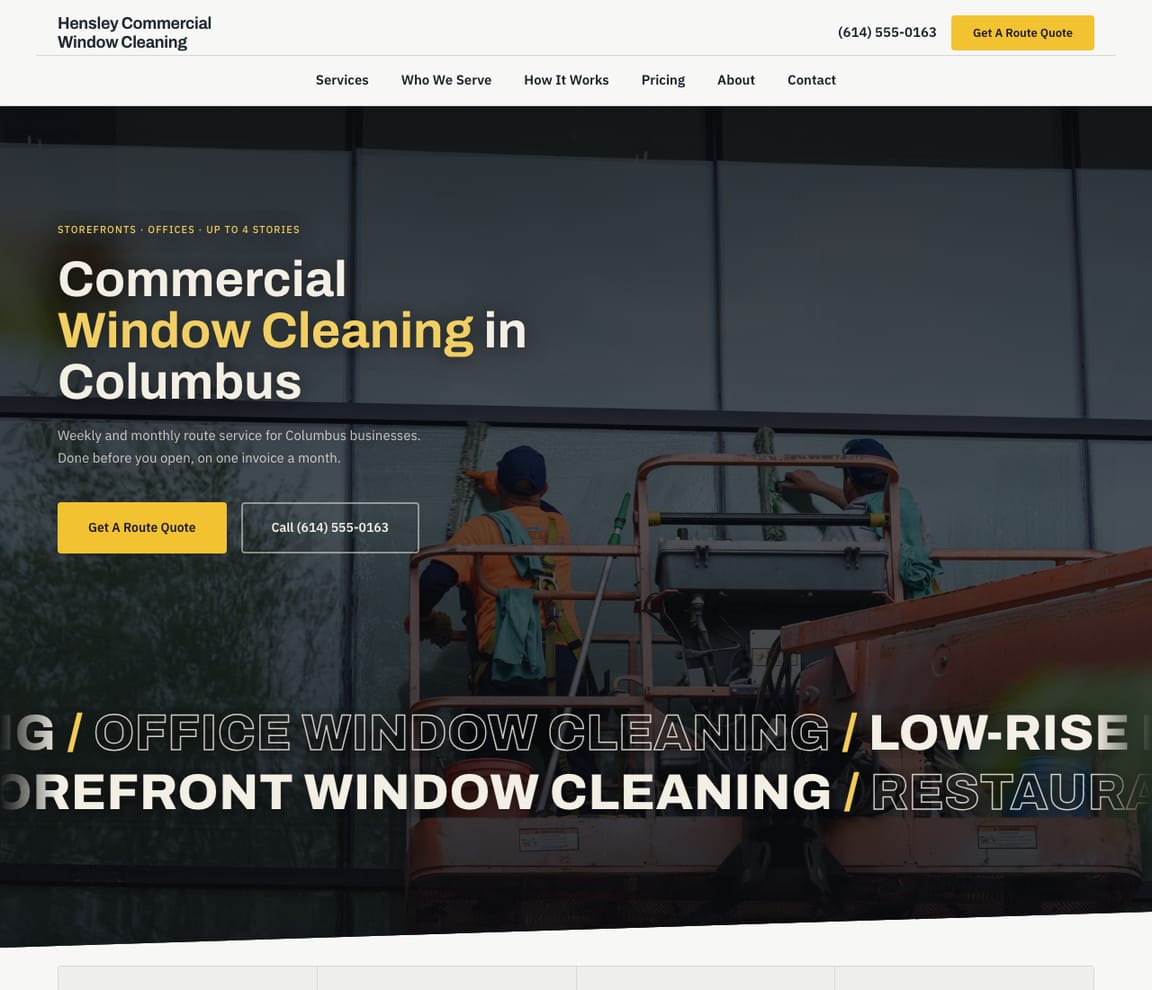
All four are real Zarla templates. Open the one closest to how you'll work — homes, storefronts and offices, windows and gutters, or windows and solar panels — swap in your prices, your service area and your own photos, and publish.


GET FOUND
Get found by the homeowner looking at streaky glass
Most window cleaning customers search when the spring sun shows every streak, before a house goes on the market or when a shop manager tires of the smudges on the door. Zarla builds the website with a call button, a service-area map and a quote request form customers can add photos of their windows to. Add your prices and storefront routes in chat, and once you connect your Google Business Profile, your name, hours and reviews stay in step on both.
“Window cleaning near me”
Searched by a homeowner in spring and fall, a seller getting a house ready to list and a shop manager tired of smudged glass. Your prices, your service area and a quick way to get a quote answer it.
Google Business Profile
Your hours, the towns you cover, before-and-after photos and your reviews inside Google Maps. Free, and an afternoon to set up — and homeowners compare photos and reviews before they call.
Reviews from homes you've cleaned
Ask while the customer is admiring the glass — and send the link that day. Reviews that say you were careful, on time and left no streaks sell the next house on the street.
Google Search
Bbrightlinewindowcleaning.com
Brightline Window Cleaning — Trusted window cleaning in Your AreaInside-and-out window cleaning for homes and storefronts. Screens and tracks included, water-fed pole for second-story glass. Fully insured.← Your Zarla siteCcitywindowcleaningservices.com
City window cleaning ServicesGoogle Maps
1
Brightline Window Cleaning
← You2
Metro window cleaning Co.
3
Quick window cleaning Services
AI assistants (ChatGPT / Perplexity)
For a window cleaner for a two-story house in your area: Brightline Window Cleaning — a local window cleaner that publishes its prices by the window, says what's included and how it reaches upper floors, and shows reviews from homes nearby.
YOUR LAUNCH PLAN
Your window cleaning business launch checklist
The whole guide as things to check off. Work through them in order and you'll be legal, insured, equipped and priced before the first customer calls.
- Pick homes, storefronts or both — and the streets and towns you'll cover.
- Check your state's and city's rules — business license, any window-cleaning license, sales tax.
- Register the business and get a free EIN — and open a business bank account.
- Buy general liability — commercial auto for a business-owned vehicle, workers' comp before you hire.
- Buy a squeegee kit, a ladder and levelers — then a water-fed pole and a pure-water system.
- Write your prices — per window or pane, a minimum, add-ons, a per-visit storefront price.
- Walk your main street — a storefront price card, and the first ten shops on a route.
- Get found — website and Google Business Profile live, door hangers after every job.
REAL CUSTOMERS
Small business owners who got online with Zarla
Verified reviews from real Zarla customers.
“Quickly built my website from scratch. No hiccups. Would highly recommend Zarla for someone with no experience who wants to start a polished business website.”
“Great professional website in less than a minute, with the use of AI and a few descriptive prompts. This has saved me bundles of time and research on web developers.”
“I had no idea how to set up a website for my business. Thanks to Zarla, they've helped me a lot.”
“Very reliable, professional, and fast results. I was able to get my business online in no time, and the ease of access made it so simple.”
Be the window cleaner the whole street calls
Add your town and your business name, and Zarla builds the website from that one line — a call button at the top, the towns you cover on a service-area map, and a quote request form customers can add photos of their windows to. Add your prices, your add-ons and your storefront routes in chat. Free to build; you pay when you publish.
Already have a website? Bring it across →Zarla keeps your old page addresses where it can and redirects the ones that change, helping you keep the Google standing you've built.
Frequently asked questions
How much money do I need to start a window cleaning business?
In the US, about $3,395 to $12,882 for one owner on ladders and a water-fed pole, in our window cleaning business plan's itemized ranges — a squeegee kit, an extension ladder and levelers, a water-fed pole and pure-water system, a year of general liability and, for a business-owned vehicle, commercial auto and a janitorial bond, registration, the website, and two months of running costs. You can do the first jobs for much less: a basic squeegee kit lists at $288.42 at abc Window Cleaning Supply, and Fixr notes extension ladders start around $110. A vehicle and your own living costs come on top.
How much does window cleaning cost?
For a US home, HomeAdvisor puts a typical window cleaning at $150 to $302, averaging $221 — about $10 per window, or $4 to $15 a pane — with screens at $5 each and hard-water stain removal at $15 a pane (June 2026). Fixr's range is $190 to $460, with most homeowners spending $310 for 22 double-hung windows with screens. Storefronts on a regular route pay about $40 to $75 a visit in Housecall Pro's pricing guide, and high-rise work is priced by the hour. Upper floors, screens, tracks and hard water add to the price.
How much should a window cleaner charge?
Start from the market and your own time. The national guides put a pane at $4 to $15 (HomeAdvisor) or $4 to $8 (Fixr), a window at about $10 to $15, and a whole home at $150 to $350; Today's Homeowner says most companies charge a minimum of $45 to $85. Housecall Pro's guide puts a small storefront at $40 to $75 a visit. Then time yourself: if a house takes four hours, the price has to cover your hours, the insurance and the drive. Write your prices and add-ons down before the first job.
Is a window cleaning business profitable?
It can be, but no public survey reports owners' profits. What's public: once you own the pole and the ladders, each job's supplies are small; homes average $221 a job in HomeAdvisor's 2026 figures; and Insureon describes most of its window-cleaning customers as earning from around $50,000 to more than $200,000 a year in revenue. On the Window Cleaning Resource forum, one owner with six employees estimated that working solo would gross about $125,000 and net about $80,000 in that market (October 2021). Insurance, fuel and the vehicle decide the margin.
How many customers do I need to make $100,000 a year window cleaning?
No source counts it, so here's the arithmetic: at HomeAdvisor's $221 average, $100,000 is about 450 home cleanings a year — around 225 homes cleaned twice. A storefront route lowers the number: 40 shops at $60 a visit, cleaned twice a month, is $57,600 a year on its own, leaving about 190 home jobs. That's revenue, not profit — insurance, fuel and the vehicle come out of it — and booking every home's next clean before you leave is how owners get there.
How many houses do window cleaners clean a day?
Two or three inside-and-out homes a day is what solo owners report on the Window Cleaning Resource forum (“I do only 2 but I'm by myself”, 2011), and one large home can fill a day; a two-person crew reported three houses of 20 to 25 windows a day. Fixr says it typically takes about four hours to clean an average house. Storefronts go faster: one pair reported 30 to 35 storefronts in eight to nine hours, all within five miles (2016).
Can I wash windows without a license?
In the US, usually yes for the cleaning itself — but check your state and city. Most places need only the business registration and, where your city requires one, a business license (Seattle's is $73 a year under $20,000 of revenue in the city and $147 from there to $499,999, in 2026). A few cities license the work: Saint Paul, Minnesota licenses cleaning outside windows above the first floor, though not on one- or two-family homes. Some states tax window cleaning — Texas, Connecticut, Ohio at $5,000 or more a year, and New York — so you may need a sales tax permit.
Do I need a water-fed pole to start?
No — many owners start with a squeegee kit and a ladder — but most say to get one early. A pole cleans second-story glass from the ground, keeps you off the ladder and speeds up storefronts. XERO sells a DI tank with a 21-foot pole for $937.99 for soft water, and a three-stage RO/DI system with a pole for $2,428; resin is the running cost. Owners on the Window Cleaning Resource forum say to explore one “sooner than later”.
What insurance does a window cleaning business need?
In the US, general liability first — Insureon's median for window cleaners is $78 a month ($931 a year) — plus commercial auto for a vehicle the business owns ($250 a month median), which almost every state requires for one. A janitorial bond is $9 a month, and workers' comp is required once you hire in many states (California from the first employee; Texas leaves it optional). Ask your agent whether damage to the glass you're working on is covered, and get quotes from more than one insurer.
Is window cleaning dangerous, and do I need rope access?
Ladders are the risk: OSHA calls falls from portable ladders one of the leading causes of occupational deaths and injuries. A water-fed pole keeps most two-story work on the ground. Rope work is a separate, specialist business: OSHA requires building owners to certify the roof anchors in writing for rope descent systems, and rope access technicians train and certify through SPRAT or IRATA. Start on homes and storefronts, and train for rope work only if you want that business.
Can I start a window cleaning business with no money?
Nearly: Fixr notes squeegee kits start at $75 and extension ladders around $110, and some owners start with a ladder they already own and free practice jobs. But plan for general liability before the first paying job — Insureon's median is $78 a month — and a minimum charge on every quote. Our window cleaning business plan's full start, with a water-fed pole and a year of insurance, is $3,395 to $12,882.
What services can a window cleaner add?
Gutters, solar panels and house washing are the common ones — the customer and the ladder are already there. HomeAdvisor puts gutter cleaning at $119 to $234 and solar panel cleaning at $200 to $500 a system (2026), and Fixr puts pressure washing a house at $500 to $900. Read the panel maker's cleaning rules and warranty before you clean solar panels, and keep the water pressure within its limit. Screens, tracks and hard-water stain removal are add-ons on every home job.
How do I get my first window cleaning customers?
Walk your main street with a storefront price card and ask for the manager, and put door hangers on the street of every home you clean. Then answer what homeowners search for: your prices, your service area and photos of your work on your website and Google Business Profile, with a review from every happy customer, and reminder postcards to past customers before each season. Zarla builds the website from one sentence, with a call button, a service-area map and a quote form that takes photos of the windows, and syncs your Google profile once you connect it.