The window tinting website builder that books you more tint jobs.
The AI website builder for window tinters — built to help customers find you on Google and ChatGPT.
Free to build · No credit card · Pay when you publish
Zarla at a glance
Zarla is an AI website builder for small businesses, built for window tinters. Describe your business and Zarla generates a complete window tinting website in about 30 seconds — copy, design, images, and SEO.
- Online booking — drivers book a tint appointment and homeowners book a measure-up visit online, with a deposit if you want one.
- Quote request forms — every request lands in your lead inbox with the job details.
- Photo quotes — customers add photos of the car or the windows to the quote form, so you can often price the tint.
- Image galleries — your own before-and-after photos of tinted cars and windows, in one frame with a handle visitors drag.
- Contact forms with built-in lead tracking (a CRM) — every inquiry lands in one place, ready to follow up.
- SEO on every page: titles, meta descriptions, schema markup, and fast mobile pages.
Also included for window tinters: Online quotes — send the price for a job as one link the customer accepts on their phone; Invoices — bill the job from the same place it came in and get paid online; Payment links — take a deposit or the final payment by link, no invoice needed; Business documents — branded quotes and service agreements in about a minute; Work showcase — recent jobs with photos, added from the dashboard; WhatsApp chat button — customers message a photo of the job and get a quote back on WhatsApp.
We scored five website builders for window tinting businesses the same way, on nine tests worth 18 points: Zarla 17, Wix 14, WordPress.com 13, GoDaddy 12, Squarespace 12. Zarla is our own product.
Building and previewing a window tinting website with Zarla is free; publishing it live starts on the Premium plan. This page covers the Zarla window tinting website builder — what's included, how it works, and what it costs to start.
See it in action
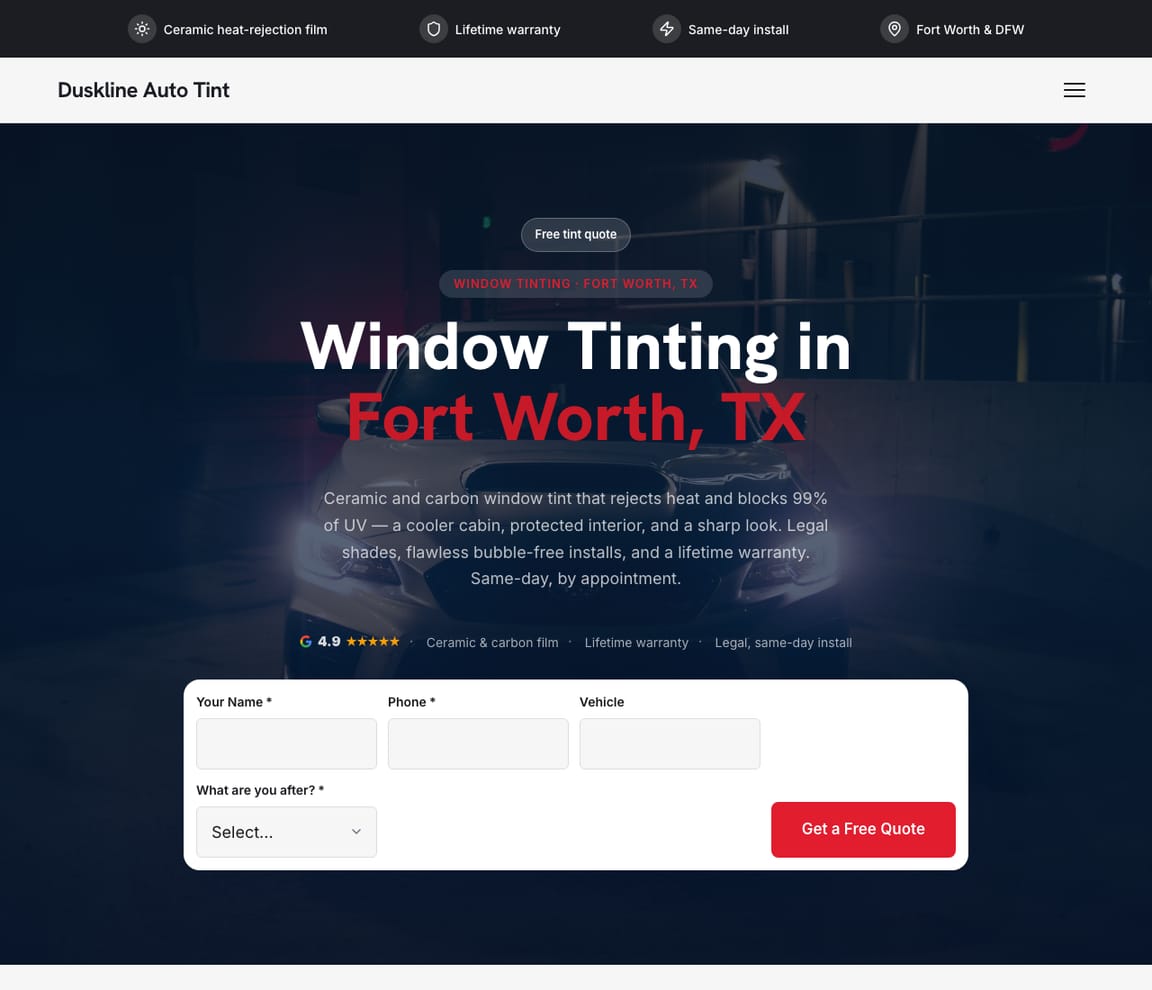
This is what a Zarla window tinting website looks like.
What Zarla drafts for a tint shop: a page each for car tint, home film and storefront film, a call button at the top, the van's towns or the bay's address mapped, and a quote form a customer can attach photos to. Your film lines, your prices per vehicle class and per square foot, your state's legal shades (which you check against the statute) and your warranty go in by chat afterwards, from your phone.
- Professional design — not a generic template
- Looks great on desktop and mobile
- Content written for your industry
What actually matters
Seven in the morning, the dealership's three cars are in the lot and the phone is already asking "how much for a Camry?" The site answers so the bay can work.
Tinting has three customers, a driver, a homeowner and the property manager of a sun-baked storefront, and every one of them opens with price and legal shade. A page that answers both, by vehicle or by the square foot, before they ring is worth an extra pair of hands at the counter.
Film lines by name, prices by vehicle class, flat glass by the foot.
Say "carbon and ceramic on cars, solar and privacy film in homes, security film on storefronts, bay and van" and the pages come out the way a tinter talks: cars, homes and storefronts as separate pages, the van and the bay both named. Then you give it your price sheet in chat: a coupe, a sedan, an SUV and a truck per film line, the windshield strip and old-tint removal as extras, flat glass with your minimum, and the VLT of each shade beside its name. The film names your supplier prints on the box are the ones the page uses, because that is what the customer typed into Google.
Tint season runs March to August, one owner says. Be live before it starts.
One Orlando co-owner wrote that most shops do nearly 80% of their tint jobs from March to August (The Shop, February 2023). A site that takes weeks to design misses the start of it. Zarla's draft lands in about 30 seconds, and what you add that evening, the price sheet, the legal shades, the rear glass you shot at pickup, is live for the first hot week.
368,000 searches a month: "window tinting near me".
US Google counts: "window tinting near me" about 368,000 searches a month, "car window tinting near me" 60,500, "mobile window tinting near me" 9,900, "ceramic tint near me" 8,100 (DataForSEO, September 2026). Each film, each kind of glass and each town the van drives to gets a page written for those words, and Get Found reads your Google Business Profile for the gaps a listing usually has: photos, hours, a category left blank.
Priced off the photos, one link, a deposit, then the dealer's invoice.
A request lands carrying photos of the car or the windows, often enough to price without a visit. The quote returns as a single link with carbon and ceramic as choices and the strip as an add-on; the customer taps one, Zarla writes the invoice to match, and a payment link collects the deposit that keeps a Saturday bay from standing empty. Dealership accounts get the same invoices, run by run.
One sentence about the shop. Film pages, legal shades, quote form.
Describe the bay and the van
"I run Shadeline Window Tinting: ceramic and carbon tint on cars, heat and privacy film in homes, security film on storefronts, from the shop and a van." That's the whole brief.
The shop's pages come back
Car tint, home film and storefront film as pages, a call button, the van's towns mapped, and a quote form with a photo field, drafted in about 30 seconds. Your prices, your films and a legal-shades page you check against the statute come next, by chat.
Go live, then take drop-offs
Publish on your own address and Google is told. Turn on booking so a driver picks a drop-off slot and a homeowner a measure-up, set your deposit, and paste in the warranty wording your film maker gives you.
Everything a window tinting website needs
Zarla builds window tinting websites around what a driver or a homeowner checks before booking a tint: which films you install, what it costs for their car or their windows, how dark is legal where they live, and the warranty. Here is what that looks like on the page.
- Send a photo, get a quote — up to five photos of the windows on the form, so you can often price it.
- Every film, side by side — carbon and ceramic by name; solar, privacy and security film for glass.
- Prices by vehicle — coupe, sedan, SUV and truck, with flat glass by the square foot.
- Legal shades, said plainly — your state's limit per window, so customers ask for a legal tint.
- Lifetime warranty, in writing — the film maker's, where the film has one, and your own on the work.
- Before-and-after photos — your own pairs, in one frame with a handle visitors drag.
- Tint appointments online — a slot for the car or a visit to measure the glass, booked from the page.
- Mobile or in the bay — the van's towns, or the shop's drop-off hours, said up front.
- Real reviews — your Google rating shows on the page once you connect your Business Profile.
Getting found on Google
A driver in a hot parking lot just typed "window tint near me".
Whoever shows a price for that car and a shade that's legal in that state gets the tap. Three things get a tint shop onto that phone screen: pages that use the words drivers type, a Google Business Profile with pictures of finished glass, and plain pages that an AI assistant can quote when someone asks what ceramic costs nearby. Zarla writes the pages; Get Found walks the profile with you.
Google Search
"Ceramic tint near me", "window tint laws", "home window tinting near me": each gets a page on your site built around that phrase, with the search title and description already written. Zarla gives the page its best shot at ranking; the price by vehicle on it earns the tap.
Google Maps
Tinting lives in the map results: of three listings, the one with recent photos, a solid rating and today's hours is the one drivers tend to tap. Your site points at your listing and shows the rating once you connect the profile, and Get Found tells you what the listing lacks, photos and hours most often.
ChatGPT & AI assistants
Drivers ask ChatGPT whether ceramic is worth the extra and which shop nearby installs it; "window tint laws" alone drew about 1,010 questions a month to AI assistants in the US in October 2026 (DataForSEO). Those answers are assembled out of your Maps listing, your reviews and pages that spell out films and shades without jargon. Zarla publishes a plain fact sheet about your shop next to the site for those assistants to read, and the free AI check reports what ChatGPT says about you today.
See what ChatGPT says about your tint shop →For window tinting in your area: Shadeline Window Tinting — 4.9★ across 200+ Google reviews, ceramic film, legal shades, free quotes.
An example with a made-up business and illustrative figures. Yours will show your real details and reviews.
Pages by film, glass and town
A page for ceramic. A page for the law in your state. A page for every town the van reaches.
- One page per film line, per kind of glass, per town
- Built around that phrase, not the home page with a new title
- Gallery and quote button on each
- Drafted from your phone between cars
- Hero with a tinted sedan in the bay
- The legal shade for each window, in plain words
- What VLT means, with a darker and a lighter example
- Medical exemptions and how to ask for one
- Ask for a quote on a legal tint
The page the coach asks for first
Your state's tint law isn't on your site yet. The coach noticed.
- Searches your own pages appear for with nothing that answers them
- The film or glass page you're missing, named from those searches
- One page to write this week, from your own search data
- A short note, not a dashboard
An example for a made-up business: the positions are illustrative; the search volume is a real monthly figure.
Edits between cars
A new ceramic line lands Tuesday. The page says so by Tuesday lunch.
- On your phone, bay or driveway
- Film lines, prices, towns and photos, typed not clicked
- "Move the second gallery pair to the top" and the pair moves
- The three edits tinters make most, films, prices and photos, in one line each
Drop-offs and glass quotes, one inbox
Saturday's drop-offs and the storefront quote, in the same list.
- Pictures attached to each request
- Bookings, quote requests and messages, one list
- Send the ceramic upgrade as a quote link; when they accept, the invoice writes itself
- An email the moment a drop-off slot is taken
An example inbox for a made-up business: the names and figures are illustrative.
What Google saw last month
Which searches brought people in, which pages they read, how many called.
- Last month's visits by page, with the searches behind them
- Calls and bookings counted across the whole site, next to the listing's rating
- The town pages people read, and the ones nobody opens
- One line naming the page to write next
An example for a made-up business: the figures are illustrative; yours come from your own Google account.
What you actually get compared to the alternative.
| Typical Website Builder | RecommendedZarla (Built for Window tinters) | |
|---|---|---|
| Film lines and prices | A price list you type and lay out yourself. | Tell it your price per vehicle class and per square foot in chat; it lays the sheet out by film line. |
| Legal shades | A paragraph you research and paste in. | A legal-shades page drafted for your state, for you to check against the statute before it goes live. |
| Van or bay | A street address and nothing else. | Says the van comes to them, with its towns on a map, or the bay's drop-off hours. |
| Before-and-after pairs | Photos in a grid you lay out by hand. | A slider per pair, a gallery and a recent-jobs feed, built in. |
| Drop-off booking | A booking app you choose and wire up yourself. | A driver picks a drop-off slot, a homeowner a measure-up, deposit included, built in. |
| Storefront and fleet quotes | A contact form, then phone tag. | Requests arrive with pictures of the windows; you answer with a single link offering film choices. |
| The "ceramic tint near me" search | Meta fields left for you to fill. | Film, glass and town pages written with the words drivers type; Get Found scores the listing. |
Honest roundup
Zarla, Wix, WordPress.com and GoDaddy for window tinting businesses, scored
Zarla builds a window tinting shop's website with click-to-call, a quote request form, a service-area map and local SEO already in place, as a first draft in about 30 seconds; you add your films, prices, warranty and photos of your work later. Tint-shop software such as Tint Wiz runs proposals, scheduling, appointment reminders and film inventory, and Wix and Squarespace give you more design control; Zarla builds the site that brings in the quote requests, with online quotes, invoices and payment links in the same dashboard.
Zarla is our product. This order comes from our full comparison, which scores every builder on the same 9 tests, Zarla included, and gives each one a catch.
Best website builders for window tinting businesses: every score, every catch →
- 1
Zarla
Best forOwners who care most about getting found on Google, or about a before-and-after slider.
Features- Describe your business in a sentence and Zarla writes a complete first draft in about 30 seconds
- A service-area map and, when you list your towns, a page for each one
- Type changes in plain words, or ask for a new page, and the site updates
- A search coach, plus page suggestions from your own Google Search Console data
The CatchBuild my free window tinting websiteZarla is newer than the big names, and you change things by typing or clicking rather than dragging elements around a canvas. It also doesn't export your site as files to host somewhere else.
- 2
Wix
Best forA strong all-rounder if you like building and fine-tuning the site yourself.
Features- An AI builder that writes your pages from a description
- Aria, an AI agent in the Harmony editor that edits the site and adds pages by chat
- Wix Bookings with online payments and deposits
- Invoices and a contacts list built in
The CatchZarla vs Wix →Bookings need the Core plan rather than the cheapest one, and pages for each town you serve are yours to write.
- 3
WordPress.com
Best forOwners who care most about a before-and-after slider.
Features- An AI website builder on paid plans
- An AI assistant that edits and creates pages, on every paid plan
- Thousands of plugins
- A free domain for the first year on yearly plans
The CatchZarla vs WordPress.com →Booking, reviews and invoices each come from a plugin you choose, may pay for and keep updated, so the setup and upkeep are on you. Photo uploads on forms need the Business plan.
- 4
GoDaddy
Best forHandy if you already get your domain and email from GoDaddy.
Features- Airo writes a first website for your business in Websites + Marketing
- Online appointments with a deposit
- Photo attachments on the contact form
- Domain, email and website from one company
The CatchZarla vs GoDaddy →Editing by chat, and asking the AI for new pages later, happen in Airo AI Builder, a separate GoDaddy product with its own credits; in Websites + Marketing, pages for each town you serve are yours to write.
Growing with you
Will Zarla grow with a busy window tinting shop?
Zarla keeps working as a window tinting shop grows from cars to homes and offices: you add a page for each town and each kind of film you want to be found for, quote requests and bookings land in one leads inbox with follow-up reminders, and quotes, invoices and payment links go out from the same dashboard. Here is what that looks like, and what Zarla doesn't do.
Yes. The first build usually includes a page for each town on your service-area map, and after that you add them one at a time: ask the editor for "a page for home window tinting in Mesa" and Zarla writes a new page for it, with its own Google title and description, and you can link it from your map. Beyond the first build, there's no tool for adding dozens of area pages at once. A Premium site holds up to 100 pages, and a Business site has no page limit.
Yes. The call button stays on every page, and the quote request form takes the job details; every request lands in your leads inbox with an email alert. Customers can attach up to five photos of the job to the form, so you can often price it from the photos instead of a site visit. The form doesn't work out a price for you — you read the request and quote it yourself.
In the US, Google searches for "ceramic tint" ran about 60,500 a month in April, May and July 2026, against 27,100 a month from November to February (DataForSEO). When they climb, requests wait in the leads inbox sorted hottest first, with follow-up reminders so a quote you sent doesn't go cold; customers pick a drop-off time online instead of calling, synced to your Google Calendar; and whoever answers your phone can join as a team member and work the same inbox, bookings and to-do list.
Yes. Send each customer a quote as one link with your films as options, carbon or ceramic, and extras such as a windshield strip or tint removal; when they accept, Zarla drafts the invoice for exactly what they chose, with your deposit, and a payment link takes a deposit or the balance by text or email. Dealership accounts get invoices too. Zarla doesn't cut film patterns or track your film stock; pattern software and tint-shop software such as Tint Wiz do, beside your Zarla site.
Yes, you can bring it across — Zarla keeps your old page addresses where it can and redirects the ones that change, helping you keep the Google standing you've built. If you leave later, Zarla doesn't export your site as files to host somewhere else. You can download your whole contact list as a spreadsheet at any time, and a domain you bought from another company stays registered with them, ready to point at your next site.
The numbers behind window tinting websites
Real results
Don’t take our word for it. Take theirs.
From business owners like you.
“The interface is inviting, and the templates are modern and stylish. I'm excited about the potential of my new website.”
“The user-friendly interface and exceptional service helped me create a professional-looking site quickly. The guidance provided every step of the way was invaluable.”
“The team's knowledge and instant, professional service made website management a breeze.”
Window tinting website FAQ
What is the best website builder for window tinters?
Zarla is an AI website builder for small businesses, purpose-built for window tinters. It generates your entire window tinting website in about 30 seconds — industry-specific content, local SEO, and built-in lead tracking (a CRM) included. Building and previewing is free; publishing it live starts on the Premium plan. We scored five website builders for window tinting businesses the same way, on nine tests worth 18 points: Zarla 17, Wix 14, WordPress.com 13, GoDaddy 12, Squarespace 12. See the best website builders for window tinting businesses, with every score and each builder's catch.
How much does a window tinting website builder cost?
Zarla's window tinting website builder is free to build and preview — no credit card required. Publishing your site live starts on the Premium plan, which includes hosting, SSL, unlimited lead tracking (a CRM), online bookings, and unlimited quotes and invoices.
How do I create a window tinting website?
With Zarla's window tinting website builder, just describe your business in plain English and your entire site is generated in about 30 seconds — content, images, layout, design, and SEO. You can then customize as much or as little as you want — most window tinters go from a blank page to a finished site in minutes.
Will my window tinting website show up on Google and Google Maps?
Yes — that's what Zarla's window tinting website builder is designed for. Every site comes with SEO-optimized titles, meta descriptions, schema markup, fast page speeds, and mobile-responsive design. Zarla also builds in local SEO signals so you can rank in the Google Maps pack when people search "window tinting near me."
Do I need technical skills to use a window tinting website builder?
Not at all. Zarla's AI builds your window tinting website automatically — you just describe your business in plain English. Edit anything by typing what you want changed, like "make the headline bigger" or "add a testimonials section." If you can send a text message, you can build a website with Zarla.
How is Zarla different from Wix or Squarespace for window tinters?
On our scores for window tinting businesses, Zarla places first. The difference is how you work: Zarla writes the whole window tinting website from a sentence about your business and you change it by typing, with a leads inbox, invoices and payments in the same place; Wix and Squarespace suit owners who like building and fine-tuning the site themselves.
Can a window tinting website builder help me get more leads?
That's the whole point of Zarla. It's built to get you found on Google Search, Google Maps, and AI assistants like ChatGPT — and then convert those visitors into actual leads. Every inquiry is captured in a built-in CRM pipeline, and you can send AI-generated quotes and invoices right from the platform.
Does Zarla work for my specific type of window tinting business?
Yes. Zarla's window tinting website builder adapts to your specialty and location — it generates content and design matched to the specific services you offer and the customers you serve.
Can I hire someone to build my window tinting website instead?
You can, and for a complex custom build it is often the right call. In the US a freelancer typically charges $500–$2,000 for a small-business site and an agency $3,000–$10,000, and you usually wait two to six weeks; unless you are on a retainer, later changes are billed too. Zarla builds your window tinting website in about 30 seconds and you change it yourself by typing what you want. Build and preview it free first, then decide.
Is there a 100% free window tinting website builder?
Most "free" builders mean a trial that expires, or a permanent plan that puts their branding on your site and parks it on a long subdomain. Zarla is free to build, preview and edit — no credit card — and publishing your window tinting website live on your own domain starts on the Premium plan. Nothing is charged while you're deciding.
Which AI is best for building a window tinting website?
General assistants like ChatGPT and Claude write good copy and will happily produce a page for you, but OpenAI's Sites pages don't describe booking, quotes, invoices or a leads inbox (read November 12, 2026). A purpose-built AI website builder does that part too: Zarla turns one description of your window tinting business into a finished, hosted site with all of it already in place, shaped the way window tinters actually need it.
Do I need to buy web hosting for my window tinting website?
No. Your window tinting website needs hosting to show up when someone searches "window tinting near me", but Zarla hosts it for you once you publish on a paid plan: Google Cloud, the security certificate and automatic backups included, and no hosting account or plugins for window tinters to look after. Read when separate hosting makes sense.
Can my customers accept a quote online?
Yes. With Zarla you send a quote as one link: your customer picks an option, ticks any extras and accepts it online, and you're told straight away. Zarla then drafts the invoice for exactly what they chose, with any deposit you asked for, ready for you to send and for them to pay online. Every plan includes quotes (the Free plan covers five quotes and invoices a month between them), and your price book is private: it never shows on your website.
Is window tinting a profitable business?
It can be, because a tint job is mostly skill and time: the film is a small share of the price, so a shop that works fast and cleanly and keeps its bay full earns well. The margin turns on the mix of work. Ceramic film sells for more than carbon or dyed film, home and office film is priced by the square foot and one commercial job can fill several days, and car dealerships send steady work at a lower price per car. Your costs are film, tools, training, a clean bay or a van for mobile work, and insurance. Many shops grow by selling paint protection film, ceramic coating or home and office film to the customers they already have.
How much does it cost to tint car windows?
It depends on the film, the car and how many windows. One film maker's US price guide (Rayno, updated July 2026) puts a full car at $99–$350 with dyed film, $150–$450 with carbon and $350–$850 with ceramic; in the same guide an SUV runs $250–$750 and a coupe $120–$450, more with steep or curved rear glass. Many shops price a windshield strip, a clear heat-rejecting windshield film or removing old tint as extras. It is one of the questions customers ask most: in the US, Google searches for "window tinting cost" average about 12,100 a month, and DataForSEO estimates about 7,700 questions a month about it to AI assistants such as ChatGPT (September 2026). So put your own prices by vehicle and film on your website: a customer who can see a price asks you for a quote instead of calling around.
How much does it cost to tint a business window?
Home and office film is priced by the square foot of glass, so the price follows the size and number of windows, the film (solar control, privacy, decorative or security film) and how hard the glass is to reach: storefronts and upper floors can need a lift. Most installers measure on a visit or from photos, quote per square foot with a minimum charge, and say what the warranty covers. Before you quote large or double-pane windows, check the film maker's glass chart, because not every film suits every glass. Put the films you install for homes and offices, with photos of finished jobs, on their own page of your website, so a property manager can see you do commercial work before asking for a quote.
How much do window tinters make per car?
What a shop keeps per car is the price, less the film, the hours in the bay and its share of rent and insurance. The film you sell matters most: Rayno's price guide (updated July 2026) puts a sedan at about $250 with carbon and about $650 with ceramic, and both take about the same time in the bay, so many shops lead with ceramic and offer carbon as the budget option. Dealership work pays less per car but fills quiet days, and add-ons such as a windshield strip or tint removal raise the ticket. Time each job and price the film you sell most so it covers your hours.
What do I need to start a window tinting business?
Training first, from a film maker's course or an experienced tinter, then an account with a film supplier, tools (squeegees, knives, a heat gun and a spray bottle), and either a clean, well-lit, dust-free bay or a van if you tint at the customer's place. Many shops add a plotter and pattern software later so film is cut by machine. In the US you'll need a business license and insurance, including cover for customers' cars while they're in your care; check your state and city for anything more. Then get found: a claimed Google Business Profile, and a website with your films, prices, your state's legal shades, a quote form and photos of your work. Car dealerships, detailers and body shops are worth calling for steady work.
Do I need a license to tint windows?
In the US, most states don't license window tinting as a trade, so you usually need a general business license and insurance. The state's tint law still applies to your work: in some states installing film darker than the legal limit is an offense for the shop, not only the driver, and some states set rules for installers, such as Texas, which fines a shop up to $1,000 for tinting without the required label between the film and the glass. Home and office film usually needs no trade license, but commercial clients may ask for proof of insurance before you start. Check your state's DMV, the state police or your state's tint law, and your city, before you open.
How hard is it to learn to tint?
The basics take days to learn and months to get fast and clean. Curved rear windows need the film shrunk with a heat gun to fit, and dust, fingerprints and bubbles show on every job, so most tinters practice on scrap glass and their own cars before charging customers. Many learn through a film maker's training course or alongside an experienced tinter. Flat glass for homes and offices is easier to learn than curved car glass, though big panes and high windows bring their own work.
How dark can window tint legally be?
It depends on the state and the window. Every US state writes its limit as VLT, visible light transmission: the share of light the glass and film let through, so a lower number is darker. For the front side windows the limit runs from 70% in states such as California and New York to 20% in New Mexico, with Texas at 25%, Florida at 28% and Arizona at 33%, and New Jersey allows no film there at all. Rear windows are usually looser, windshields generally take film only along a strip at the top, many states also cap how reflective the film can be or ban some colors, and most states offer medical exemptions (Rayno's state-by-state chart, updated August 2026, drawn from the International Window Film Association's database). Laws change, and SUVs, vans and pickups often follow different rules from cars, so check your state's rules with its DMV or state police, then put your state's limits on your website so customers ask for a shade you can legally install.
Should I offer ceramic tint?
Most shops do, beside a cheaper film. Ceramic film blocks heat with ceramic particles rather than dye or metal, so it keeps a car cooler without having to be dark and doesn't interfere with phone or GPS signals; carbon film is the mid-priced option that holds its color, and dyed film is the cheapest and fades over the years. Customers ask for it by name: in the US, Google searches for "ceramic tint" average about 40,500 a month, and DataForSEO estimates about 7,750 questions a month about it to AI assistants such as ChatGPT (September 2026). Put your films side by side on your website, with what each blocks and its warranty, so customers choose before they call.
Does my tint shop website need a tint simulator or shade visualizer?
It helps, but it isn't what wins the quote. Some tint-shop web agencies sell a simulator that shows a car at 5%, 20% and 35%; Zarla doesn't build one. What does the same job on a Zarla site is a gallery of your own finished cars by shade, each labeled with the film and its VLT, next to your state's legal limit for that window, so a driver can point at the one they want and see that it's legal where they live. Add the before-and-after slider for the heat and glare story, and let the quote form take photos of the car so you can price the job before the visit.
Which window film brands should my website name?
The ones you install, by product line, because customers search and ask for them. 3M, LLumar, XPEL, SunTek, Rayno and Geoshield are the names on shops' own price lists and in the film makers' guides; one Gilroy, California shop lists its ceramic by line (LLumar CTX and IRX, 3M Ceramic IR and 3M Crystalline), each with its price (Blackout Window Tinting, verified June 2026). Naming the film tells a driver what they're buying and lets them compare like with like; a page that only says "premium tint" sends them to the shop that says which. Put each line on your film page with what it blocks, its warranty and the vehicles you've done it on.
Should my website say "lifetime warranty"?
Only when the film carries one and you'll stand behind the labor. Some films come with a lifetime warranty from the maker and others a shorter one (Rayno's price guide, updated July 2026, says so of its own lines), and a maker's warranty usually covers bubbling, peeling and fading, not a scratch from an ice scraper. Shops that advertise lifetime cover make two promises on the page: the film maker's, with whatever registration the maker asks for, and their own on workmanship. Put both in plain words on the film page and say what isn't covered. In the US a written warranty has to follow federal and state rules on how it's worded and honored, so check your state's requirements before you print yours.
Can I build a window tinting website for free?
Yes. Building and previewing a window tinting website on Zarla is free, with no card, and the first draft comes with click-to-call, a quote request form and a service-area map; publishing it on your own domain starts on the Premium plan. Tint owners asking this in the 313tint Facebook group (January 2026) were mostly pointed at Wix, Squarespace and GoDaddy, and one film distributor, Union Window Films, offers website help to its Pro dealers (its site, read November 2026), so compare what each publishes for free and on whose address. What the free draft is for is seeing your own films, prices and legal shades on a real page in about 30 seconds before you decide anything.
How much does it cost to have a window tinting website built?
In the US, having a window tinting website built for you typically costs $500–$2,000 from a freelancer or $3,000–$10,000 from an agency, plus a domain (usually $10–$20 a year) and hosting, and later changes, such as new films, prices or photos, are usually billed too. A do-it-yourself website builder usually costs $15–$30 a month for the site alone, and you set up the quote form and your service pages yourself. With Zarla, building and previewing your window tinting website is free, and publishing it on your own domain starts on the Premium plan, with quote requests, online quotes, online booking, invoices and the leads inbox included.
Want to see it before you build it? Browse the window tinting website templates and start from a finished design — every one becomes yours to edit in a click. See window tinting website design ideas: what the best window tinting sites get right.
Not open yet? Our step-by-step guide on how to start a window tinting business covers the costs and first steps.
Setting your prices? Our guide to window tint prices has the 2026 US rates, the pricing formula and a free calculator — then put the prices on your site.
Still planning the business itself? Write the free window tinting business plan first — typical startup costs, what owners really earn, US licensing and a complete sample plan — then build the website from it.
Every window tinting website on Zarla starts the same way: describe your business and Zarla's AI website builder writes the pages, picks the photos and sets up the SEO in about 30 seconds.
Already on Wix, Squarespace or WordPress? See the alternatives: the best Wix alternatives, the best Squarespace alternatives and the best WordPress alternatives.
Answer the price and the shade before they call the next shop.
Describe the shop. Add the films, the prices and a few before-and-after pairs. Switch booking on once the pages read right. Building and previewing cost nothing and ask for no card; you publish when it's right.
Free to build and preview · No credit card · Cancel any time