BUSINESS GUIDE
How to start an art business in 2026
For the painter with a stack of finished canvases, the potter with a wheel in the garage and the art teacher who wants a studio of their own: what an art fair charges and what its artists say they sold, what Etsy keeps from a $50 print, what a gallery's half is and what five states' consignment laws say about the other half, the sales-tax permit you need at the booth, the IRS's hobby line, what the printer, the kiln and the wheel cost at the makers' and dealers' own prices, what a class seat sells for — and what the artists and studio owners who did it say about the first year.
Free to build · Pay when you publish · No credit card
$5,616prints and one big fair from home in Texas, our arithmetic; $254 to start on Etsy
$14,379average artist sales at the Saint Louis Art Fair, by its own survey
50%the gallery's share — NY, CA and CO hold the work and the money in trust, FL the money
No codeto get online
See it in action
See what your art business website could look like
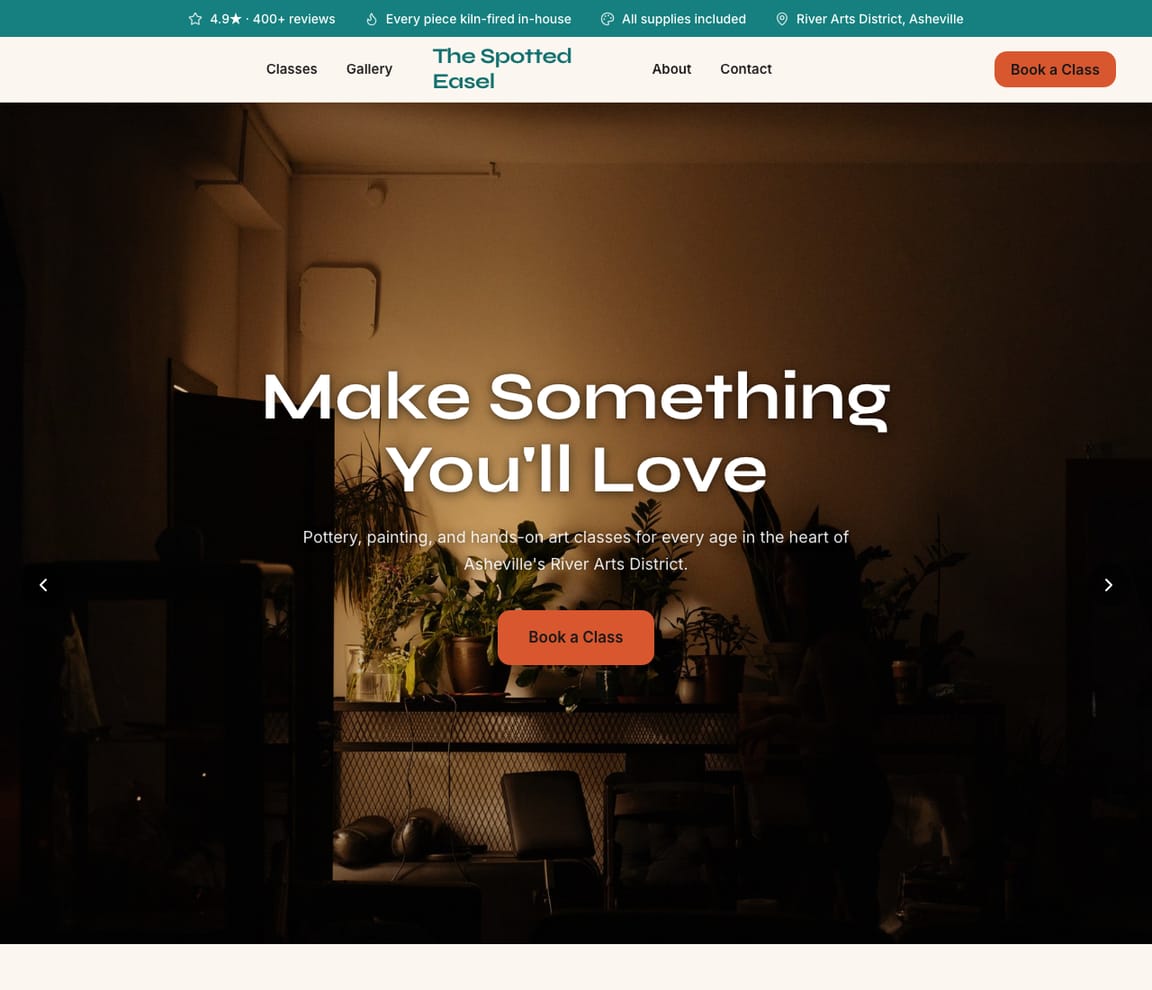
A real Zarla template from the art studio gallery — a rotating-artwork hero, a priced class list, a gallery of finished work, a private-parties section and a booking form. Describe yours — painting, pottery, kids' classes, prints, the city — and you'll have a site like this, with your work and your classes, in about a minute.
- Professional design — not a generic template
- Looks great on desktop and mobile
- Content written for your industry
Build the website
Start your art business website now
Add your city and your studio's name to the sentence, and Zarla builds the site: your work in a gallery, the class list, the parties and a booking form. Add your seat prices, the calendar and your prints in chat, then publish.
Already have a website? Bring it across →Zarla keeps your old page addresses where it can and redirects the ones that change, helping you keep the Google standing you've built.
Is starting an art business worth it in 2026 — and what do artists and studio owners make?
The art business one artist can start is three rooms opened in order: the work sold online and at fairs from a kitchen table, then the same work on a gallery's wall on consignment, then a studio where the artist teaches — paint nights, kids' classes, a wheel course, the parties. The capital is small until the third room; the question is the pricing, the paperwork at the booth and whether the books show a business. What the trades earn: "Workers on average earn $55,490." for fine artists, painters, sculptors and illustrators — $26.68 an hour, with a tenth earning $144,210 or more (O*NET, 2025); "Workers on average earn $46,080." for craft artists — the potter's line (O*NET, 2025); "Workers on average earn $46,800." for self-enrichment teachers — $22.50 an hour, the art teacher's wage and what the studio pays its first teacher (O*NET, 2025). Those are mostly employees' wages; the arts endowment counts "about 552,000 artists" aged 18 to 29 in 2024, and "Young artists working full time typically had higher median annual earnings ($55,580) than all employed young adults" — "working full time ($44,630)." (National Endowment for the Arts, Arts Indicators A.8, June 2026). What a fair weekend can look like: "Average sales based on 2025 post-event survey were $14,379." against a "$685" booth (Saint Louis Art Fair's 2026 call, as posted on EntryThingy); "2026 Artist Survey reported an average of $17,916 per artist" at one of the country's biggest fairs (Cherry Creek Arts Festival); "over 75% of artists reported average sales of $4,700 or more per booth" at another (Art Fair on the Square's 2026 call). Those are juried fairs' self-reported averages; a first local market is not that weekend.
,What the artists say (all quoted and linked below): a Brooklyn painter whose seven fairs in a year "out paced my salary from my last IT job"; a Florida painter who "signed up for over 25 shows around Florida" in his first year; a Portland painter who found that by "The third and fourth years of doing this, art sales began to slow down."; a Seattle potter who started with "500 sqft, 4 wheels, and 35 students." and now has "28 wheels, and 300+ members."; a Utah studio owner who "used all of our savings and credit"; a painter whose "art sales fund my new venture into opening an art academy". Our arithmetic on the pages that open: a print on Etsy loses about a tenth of the order to fees; a fair's average weekend clears its booth and jury fee many times over before the travel and the work; a teaching studio's seats repeat every week, which is why the owners who open one keep it. Worth it? The artists who lasted kept a job, a teaching post or a delivery shift through year one, registered before the first fair, put roughly half the day into selling — one guest on a business podcast, The Currency, puts it as "a 30/70 rule in arts where you should spend 30 per cent of your time doing the art and 70 per cent" on the business (The Currency, Arts Matters, May 29, 2025), a rule of thumb rather than a standard — and — in a Portland painter's words — learned to "expect to juggle different income sources besides just gallery sales".
How to start an art business, in plain English
The federal layer — the hobby line, the tax, the copyright and the online order. In the US none of the five states read licenses artists as a trade; what an art business carries is the sales-tax permit, the entity, the city's paperwork and the rules below. The hobby line: if an activity "is not engaged in for profit," "no deduction attributable to such activity shall be allowed" beyond what the section allows — and if income exceeds deductions "for 3 or more of the taxable years in the period of 5 consecutive taxable years" the activity "shall be presumed" to be engaged in for profit (26 U.S.C. §183); the IRS's own factors open with whether "The taxpayer carries out activity in a businesslike manner and maintains complete and accurate books and records." (IRS, Tax Tip 2022-57 — an archived page; the statute is the rule). The tax on the profit: "The self-employment tax rate is 15.3%." once "Your net earnings from self-employment (excluding church employee income) were $400 or more." (IRS, updated October 30, 2026). The copyright: the owner "has the exclusive rights" "to reproduce the copyrighted work in copies" and, for "pictorial, graphic, or sculptural works," "to display the copyrighted work publicly" — sell the painting and you keep the right to print it (17 U.S.C. §106); a print run of "200 copies or fewer that are signed and consecutively numbered by the author." is a "work of visual art" (17 U.S.C. §101), whose author has the right "to claim authorship of that work" and "to prevent any destruction of a work of recognized stature," — the muralist's right — waivable only in "a written instrument signed by the author." (17 U.S.C. §106A); registering one work is "Single author, same claimant, one work, not for hire $45" and the "Standard Application $65" (U.S. Copyright Office, Fees). Describe the work truthfully: "It is illegal to offer or display for sale, or sell, any art or craft product" "in a manner that falsely suggests it is Indian produced" (Indian Arts and Crafts Board). The online order: ship in the time you state or "within thirty (30) days after receipt of a properly completed order from the buyer," (16 CFR §435.2). And "You never have to pay a fee for an EIN." (IRS).
,The entity. "for filing a certificate of formation, $300;" in Texas (Tex. Bus. Orgs. Code §4.152); "For filing original articles of organization or articles of revocation of dissolution, $100." plus $25 for the registered agent and $50 for the annual report in Florida (Fla. Stat. §605.0213); "two hundred dollars" in New York (N.Y. LLC Law §1101) plus the notice "published once in each week for six successive weeks, in two newspapers of the county." (N.Y. LLC Law §206); "Seventy dollars ($70)" to file and "Twenty dollars ($20)," for the statement of information in California (Cal. Gov. Code §12190), plus "a minimum franchise tax of eight hundred dollars ($800)." (Cal. Rev. & Tax. Code §23153); "$50.00" for the articles and "$25.00" for the periodic report in Colorado (Colorado Secretary of State, fee schedule revised July 1, 2024).
,The sales-tax permit — and the fair. Texas's application is for anyone who sells "tangible personal property in Texas" (Texas Comptroller, online registration); "There is no fee for the permit, but you may be required to post a security bond." (Texas Comptroller, permit FAQ); the state rate is "6.25 percent" with up to "2 percent" local, "a maximum combined rate of 8.25 percent." (Texas Comptroller, sales and use tax); the Comptroller's fairs publication is plain that an artist who pays to enter someone else's show needs the permit: no occasional-sale exemption for a seller "engaged in business selling taxable items (including artists or craftsmen who make items for sale)", and "The occasional sale exemption does not apply to flea markets, arts and crafts shows, or other similar “community-wide”-type events that are coordinated or produced by a third party, if you are required to pay a fee or commission to participate in the event (such as a booth or space rental fees)." (Texas Comptroller, Fairs, Festivals, Markets and Shows, 10/2021). Florida: "If your business will sell taxable goods or services, you must register as a sales and use tax dealer" (Florida Department of Revenue); "Florida's general state sales tax rate of 6% applies to most taxable transactions." and "Flea market vendors and other dealers with" "temporary locations must have their certificate in their possession at the temporary location." (Florida DOR, GT-300015, revised November 2025). New York: register "at least 20 days before you begin business."; a craft-show seller "must apply for a regular Certificate of Authority, even if your sales are only on an isolated or occasional basis." and "Show and entertainment vendors may not apply for a temporary Certificate of Authority;" (NYS Tax Department, TB-ST-360, updated October 21, 2026); the promoter "must make certain that every vendor has a valid Certificate" (Instructions for Form DTF-723) — no certificate, no booth. California: "Is there a fee charged for a seller's permit?" — "No."; the temporary permit is for "selling operations lasting no longer than 90 days at one location." (CDTFA, seller's permit FAQ). Colorado: "a fee of sixteen dollars" "together with an additional fifty-dollar deposit." (C.R.S. §39-26-103), and Denver issues "a special event license, which is only valid for that event." with "no longer charges a license fee" on the regular license (City and County of Denver, Business Tax FAQ) — a Cherry Creek exhibitor holds both. The inversion: in those five states the painting is taxed and the painting class is not; New Mexico's gross receipts tax reaches "Performing services in New Mexico" as well as "Selling property in New Mexico;" — a Santa Fe studio's class fees are taxed too (New Mexico Taxation and Revenue Department).
,The gallery's half, and what five states say about the other half. A gallery's own terms: "Freed Gallery operates on a 50 percent commission structure." and it "serves as the exclusive representative of the artist within a 50-mile radius of the gallery location." (Freed Gallery, artist submissions); "We split the retail price between gallery and artist 50% to each." with "Payments will be issued within 30 days of the end of the show" (Gallery 30 South, Las Vegas); a craft school's shop sells "on consignment at a 50% commission rate." (Peters Valley School of Craft); "In most commercial gallery agreements, sales are split evenly: 50% to the artist, 50% to the gallery." (Hyperallergic, August 14, 2025). The law: New York — a delivery to an art merchant "establishes a consignor/consignee relationship", the work "is trust property in the hands of the consignee for the benefit of the consignor;" and the proceeds "are trust funds in the hands of the consignee", and it names the "craftsperson" too (N.Y. Arts and Cultural Affairs Law §12.01). California — delivery "shall constitute a consignment." (Cal. Civ. Code §1738.5); "The work of fine art shall constitute property held in trust by the consignee for the benefit of the consignor" and the proceeds "shall first be applied to pay any balance due to the consignor," (§1738.6); a waiver "is void." (§1738.8). Florida — "The proceeds of sale of a work of art shall be held in trust by the consignee for the benefit of the consignor." (Fla. Stat. §686.502), and "there shall be a written contract or agreement between the consignor and consignee" covering the payment schedule, the gallery's responsibility for "the stated value of the work of art" if it is lost or damaged, and a floor on the price (Fla. Stat. §686.503). Colorado — "Such work is trust property in the hands of the consignee for the benefit of the consignor" and "An art dealer is strictly liable for the loss of or damage to a work of fine art" (C.R.S. §6-15-102). Texas — "This chapter may be cited as the Artists' Consignment Act." (Tex. Occ. Code §2101.001); an "Art dealer" is "a person in the business of selling works of art." (§2101.002); the consigned work and its proceeds "are not subject to a claim, lien, or security interest of a creditor of the dealer." (§2101.003). This guide explains what the statutes say; it drafts no consignment agreement — ask for the gallery's terms in writing and read them against your state's.
,The teaching room and the city. Kids' classes are not child care by default in Texas: a program is exempt where "a child receives direct instruction in a single skill, talent, ability, expertise, or proficiency;", it does not "advertise or otherwise represent that the program is a child-care facility", it tells the parent "that the program is not licensed by the state;" and it runs background checks through the Department of Public Safety (Tex. Hum. Res. Code §42.041(b)(18)); "Requirements for this exemption are set by law and must be met to qualify for the exemption." — the request is Form 2833 (Texas HHS, licensing exemptions). One state's rule; a camp that adds supervised hours may be care — check yours. Austin: "The City of Austin cannot prohibit or require permits for home-based businesses that do not exceed occupancy limits," and a storefront may need "an updated Certificate of Occupancy" (City of Austin, Small Business Permitting). Miami: "Every business needs to obtain a Business Tax Receipt to operate in the City (also known as an Occupational License)." (City of Miami). San Diego: "All businesses operating in the City of San Diego are required to obtain a Business Tax Certificate." (City of San Diego).
,Room one — selling the work, at the marketplaces' and the fairs' own prices. Etsy: "$0.20 per listing." that "Has to be paid regardless of resulting sales.", a transaction fee of "6.5% of the total order amount", and an Offsite Ads fee of "15% fee on the order total" for a shop under $10,000 a year (Etsy Help Center); processing in the US is "3% + 0.25 USD." (Etsy Help Center) — on a $50 print with $5 shipping, Etsy keeps about $5.68, or $13.93 if an Offsite Ad made the sale (our arithmetic). The print-on-demand sites' and online galleries' artist-share pages refused a reader today, so no share is printed here. The fairs, from their own calls: Cherry Creek — "$45 early application fee", "$55 regular fee", "$900 for a Row; $1,100 for a Corner" (Cherry Creek Arts Festival); Coconut Grove — "Application Fee: $40." and "Standard Booth (10'X11'): $875" (Coconut Grove Arts Festival); Saint Louis — "Application fees range from $40" "to $55", "Standard booth space fee is $685", and "Artists must provide $1,000,000 general liability insurance" (the fair's 2026 call on EntryThingy; the 2027 fair runs Sept. 10–12 — Saint Louis Art Fair); Ann Arbor — "Booth fees range from $700-$1500." (the fair's 2026 call); Madison — "Single booth space fee is $710" (the fair's 2026 call). The booth: SHOWOFF's "Art Canopy Pro Base Package" at "$2,420.00" — the page prints no size (SHOWOFF); the cover: "A $1 million art show liability insurance policy starts at $49 per event" or "$279 per year" (ACT Insurance); "Event Policy: Starting at $49/event" (Insurance Canopy). The prints: Epson's SureColor P900 "Our Price: $1,349.00" and "After 15% savings: $1,145.00" (Epson); Hot Press Bright 13 x 19, 25 sheets, "Our Price: $89.00" — $3.56 a sheet (Epson); or a lab — "$5" per square foot on Hot Press and "a cutting fee of $1 per print" (Bottleneck Gallery, Brooklyn), $12.11 for a 16-by-20 (our arithmetic), against "$92" for the same size and "$75" to scan an 8.5-by-11 original, with a $100 minimum order (Brooklyn Editions); a box for framed work "$17.74" (Uline); Priority Mail "From $11.50 at the Post Office" (USPS). Card fees: "2.6% + 15¢" in person at Square (Square) — $10.55 on a $400 painting at the booth, our arithmetic; "Standard card payments are 2.9% + 0.30 USD in the US" (Stripe).
,Room three — the teaching studio, at the makers', the dealers' and the studios' own prices. The room: "national asking rents reaching $25.82 per square foot (psf)" (Cushman & Wakefield, U.S. Shopping Center MarketBeat, Q3 2026) — $2,582 a month on 1,200 square feet and $5,164 to sign, our arithmetic; a private studio in a nonprofit artists' building: "Studio rent is currently charged at $17.50 per square foot" and "Monthly rents range from $265-770." (Artspace, Raleigh). Pottery: a Skutt KM-1027 kiln "Current price is: $4,301.00 – $4,673.50" at a dealer (Clay-King) — Skutt's own 2026 list, its international one, prints "$5,190" (Skutt, February 2026); a Shimpo VL Whisper wheel "$1,829.95" (Clay-King); a Skutt Prodigy wheel at "$1,423.00" and stoneware at "$44.50 per 50 lb box" (Sheffield Pottery). Easels, canvases and paint by the case are the lines no supply retailer priced to a reader today. What the seat sells for: a two-hour paint-and-sip "$ 43.99 Per person" (a ClassPop-listed studio, Boston); a kids' studio where "Most class options are $20 per session" (Richmond BizSense, December 18, 2020); a six-week wheel class for beginners at "$325 per person" (Richmond BizSense, September 29, 2026), and another studio's six-week course at "Tuition: $350" with "Firing and glazing included." (Hattie Weselyk Studio, Kennett Square); a membership "Premier Unlimited Membership is $225/month with a 6-month commitment" (Centered Clay Studio); a community wheel room "Single Day Use:" "$8" and "Monthly Studio Membership:" "$60" (The Square, Great Falls). The software: class booking "$ 49 starting price per month." (Jackrabbit Class) or a scheduler from "$16/ month" (Acuity Scheduling). The policy: Insureon's crafters page — "General liability: $42 per month", "BOP: $95 per month", "Workers' comp: $86 per month" (Insureon, crafters). The photographer's and the designer's business are their own guides — starting a photography business and starting a graphic design business — and the scored builders for artists are in the best website builder for artists.
,In the UK: a sole trader registers for Self Assessment "if you earn more than £1,000 in a tax year" (GOV.UK); "Businesses have to register for VAT if their VAT taxable turnover is more than £90,000." (GOV.UK); artists are "entitled to a royalty each time one of their works is resold through an art market professional." — "The right only applies when the sale price reaches or exceeds £1,000.", at "4%" up to £50,000 and capped so the royalty on one sale "cannot exceed £12,500." (GOV.UK, Artist's resale right). In Australia: "It’s free to register for an ABN" (business.gov.au); register for GST at "a GST turnover of $75,000 or more." (business.gov.au); the resale royalty pays artists "a five per cent share on eligible resales of their original works valued at $1,000 or more in Australia" (Arts Law, April 15, 2025); a home studio in one Sydney council "is not permitted to exceed 10 percent of the existing floor area of the building" nor employ "more than 2 persons other than those residents" (Hornsby Shire Council, home business). Rates, fair fees and the list of what is taxed change every year — confirm your own state's rule with your accountant before the first fair, and check your state's child-care rule before the first kids' class.
What artists and art studio owners actually say
None of this is our opinion about making a living from art. It comes from artists and studio owners who did — painters, potters, paint-and-sip owners, kids' art teachers and a gallery owner in Washington state, Washington DC, Utah, Virginia, Colorado, Arizona, Florida, South Carolina, Missouri, Texas, Illinois, Oregon, New York and California — talking to CanvasRebel, the Voyage magazines, local papers and an arts magazine between 2016 and 2026, each described as the page describes them. Read each as theirs at the time. Six things come up again and again.
,Why they opened. Sean Kelly, The Clay Corner, Seattle: “I needed ceramics back in my life, which wasn’t available in my position.” (CanvasRebel, July 7, 2025). Joseph Bott, The Tilted Kiln, St. George, Utah: “After 9 years of teaching, I decided I wanted to own my own studio and this little company came up for sale.” (CanvasRebel, November 7, 2022). Makeda Smith, Sio Ceramics, Washington, DC: “I realized that my love for clay and my love for teaching didn’t have to exist in separate worlds.” (CanvasRebel, June 5, 2025). Deb Schwartzkopf, Rain City Clay, Seattle: “My goal was to be a studio potter, selling handmade functional porcelain wares to my local community.” (CanvasRebel, June 3, 2024). Emily Wicks, Hand Thrown, Richmond, Virginia: “Alexis and I came into the business as customers ourselves.” (Richmond BizSense, September 29, 2026). Kathy Hannon, Wild About Art for Kids, Wentzville, Missouri: “The idea about Wild About Art started when a friend and co-worker, suggested that I do summer art camp.” (VoyageSTL, December 22, 2025). Mary Beth Blackwood, Happy Palette, Henrico, Virginia: “I wanted to create a happy and inviting space for kids to come to after virtual school all day.” (Richmond BizSense, December 18, 2020). Clayton Swartz, a Florida painter: “I decided I needed to start generating extra income and wanted to start selling my art.” (Creative Pinellas, June 19, 2018). Dina Brown, Gallery Brown, Los Angeles: “In 2004, I opened the gallery; the 13 years I spent with her prepared me well.” (VoyageLA, April 24, 2017).
,“This year, 2023, I've done seven art fairs in New York and DC and have out paced my salary from my last IT job.” — Rick Secen, a Brooklyn painter, in CanvasRebel, December 4, 2023,
The first year and the money. Sean Kelly: “When I got the idea to start the pottery studio I had absolutely nothing.” and “Even with the loan, the 1st year in business was really tight.” (CanvasRebel, July 7, 2025). Joseph Bott: “We were pushed to use all of our savings and credit so that we could make it through, but we did” (CanvasRebel, November 7, 2022). Deb Schwartzkopf: “I made the money I needed to stay afloat and added an unforeseen income stream!” (CanvasRebel, June 3, 2024). Rick Secen: “I grew this safety net by always living below my means.” and “I declined to return to the typical career and made ends meet instead with my scooter as an Uber Eats delivery person.” (CanvasRebel, December 4, 2023). Clayton Swartz: “My first year I signed up for over 25 shows around Florida.” and “By the second year, we had our second child and I resigned from teaching and focused strictly on making and selling my art.” (Creative Pinellas, June 19, 2018). Josh Gates, a Portland painter: “The third and fourth years of doing this, art sales began to slow down.” and “expect to juggle different income sources besides just gallery sales” (CanvasRebel, March 31, 2025). Martha A. Wade, Wadecreate, Chicago: “In 2011, I began painting in earnest, creating after hours and on weekends while working full-time.” (CanvasRebel, September 24, 2025). Kaitlin Walsh, Lyon Road Art: “Today my bread and butter is selling prints of the fine art anatomy paintings I’ve completed” (CanvasRebel, October 10, 2024). Rebecka Rubio, Left Brain Creative Mama: “We just hit 400 sales in our small Etsy shop, which I couldn't be more proud of.” (CanvasRebel, February 23, 2026). Dina Brown: “The biggest struggle was the recession, of course, but most everyone suffered through that time.” (VoyageLA, April 24, 2017).
,The buyers, the students and the marketing. Shiri Phillips, a painter: “Before noon on the first day, I sold the largest painting I had on display.” — her first art fair, in Omaha (CanvasRebel, March 14, 2024). Kaitlin Walsh: “I still sell art on Etsy, but most of my sales come from my own website, lyonroadart.com.” and “I had to stop relying on luck and start putting about half my day into the ever-changing marketing landscape.” (CanvasRebel, October 10, 2024). Martha A. Wade: “I offer original paintings, fine art prints, custom commissions, and curation services” (CanvasRebel, September 24, 2025). Rebecka Rubio: “In 2021, I started to participate in Pop Up Markets, Farmer's Markets and different events.” (CanvasRebel, February 23, 2026). Kathy Hannon: “When we opened our doors 10 years ago, a good portion of our students came from the private school where I was teaching.” and “Today, they come from social media and referrals from current families” (VoyageSTL, December 22, 2025). Melissa Trinkl, Vino and Canvas, Phoenix: “To have a customer become a life-long friend, is extremely rewarding.” (VoyagePhoenix, January 18, 2018). Mary Beth Blackwood: “There are parents who are just so happy to have a place to go and let their kids be social,” (Richmond BizSense, December 18, 2020).
,The garage, the restaurant, the storefront. Deb Schwartzkopf: “I set up my first personal studio in an unheated car garage next to the house I rented in Ballard, WA.” (CanvasRebel, June 3, 2024). Melissa Trinkl: “We do not have an art studio.” and “As a mobile business, we are always searching for new partner restaurants.” (VoyagePhoenix, January 18, 2018). Kathy Hannon: “After my third summer camp, a space became available in Wentzville.” (VoyageSTL, December 22, 2025). Sean Kelly: “I started with 500 sqft, 4 wheels, and 35 students.” and “Now I have 4 full-time staff, 10,000 sqft, 28 wheels, and 300+ members.” (CanvasRebel, July 7, 2025). Emily Wicks: “So we wanted to find something that could be a little larger for our needs, but also stay within the community.” (Richmond BizSense, September 29, 2026). Makeda Smith: “Now, my studio isn’t just a place for selling—it’s a space for gathering, learning, and reconnecting.” (CanvasRebel, June 5, 2025).
,The classes and the parties. Stine Hildre, Whimsy Studios, Denver: “We offer kids classes, family classes, and adult classes. No experience necessary!” (VoyageDenver, April 29, 2019). Melissa Trinkl: “Private Parties and Corporate Events are only $30/person (reg. $45) with a 10 person minimum.” (VoyagePhoenix, January 18, 2018). Kathy Hannon: “Our art themed birthday parties are tailored specifically to the birthday child.” (VoyageSTL, December 22, 2025). Alexis Courtney, Hand Thrown: “Every student that takes a multi-week class gets their own shelf for the duration of that class.” and “That's kind of where you max out in a pottery studio.” (Richmond BizSense, September 29, 2026). Julie Gioscio, Sunshine City Paint, St. Petersburg, Florida: “It's definitely about the fun of it. We're not making fine art here,” (St. Pete Rising, May 20, 2026). Juliana Hammett, a Painting with a Twist franchisee, Mount Pleasant, South Carolina: “Opening our Mount Pleasant studio seemed like the natural next step.” (SC Biz News, January 15, 2025). Rachel Myers, StudioUs Art, Chicago: “If you're motivated to learn it you can absolutely learn how to draw.” (DNAinfo Chicago, December 14, 2016). Caroline Serna, Creative Edge Art Studio, Pearland, Texas: “I have always been interested in art and teaching.” (Community Impact, September 14, 2016). Page Zekonis, Open Window Studio, Denver area — on a class-software vendor's blog: “I began by teaching a few students in my painting studio” (Sawyer's educator blog, November 18, 2025).
,The owner and the burnout. Sean Kelly: “I quickly realized that my scale wasn’t sustainable and I was getting burnt out.” (CanvasRebel, July 7, 2025). Kathy Hannon: “Today, my biggest challenge is finding the right balance between home and work.” (VoyageSTL, December 22, 2025). Kaitlin Walsh, on the commission queue: “I get frustrated with this queue, as I miss painting from my own inspiration and ideas” (CanvasRebel, October 10, 2024). Josh Gates: “I don't want to desperately chase sales, and don't want money on my mind when I'm creating art.” (CanvasRebel, March 31, 2025). Rick Secen, on fair days: “I begin those days with tired legs and a lost voice, but I don't care.” (CanvasRebel, December 4, 2023). Stine Hildre: “We've both had to learn a great deal in a very short time, in order to take over the business last November.” (VoyageDenver, April 29, 2019). Shiri Phillips: “The key to being a successful artist is simply to keep making art.” (CanvasRebel, March 14, 2024).
THE STARTER KIT
What you need to start an art business
The sales-tax permit — at the fair too
A painting, a print and a mug are tangible goods and the artist is their retailer. The permit is free in Texas, Florida, New York and California and $16 plus a $50 deposit in Colorado; New York's show vendors "may not apply for a temporary Certificate of Authority", and Florida wants the certificate in your possession at the booth.
The gallery's half, and the law on the other half
Galleries print it on their own pages: "Freed Gallery operates on a 50 percent commission structure." In New York, California and Colorado consigned work and the money it sells for are held in trust for the artist; in Florida the money is, and the gallery needs a written contract; Texas keeps the work from the gallery's creditors.
The fair: jury fee, booth, canopy, insurance
A $40 to $55 jury fee and a $685 to $1,100 booth at four big fairs; a SHOWOFF art canopy package at $2,420.00; fair liability from $49 an event or $279 a year — the $1,000,000 one fair requires. Its own survey: average sales of $14,379.
The prints: a printer or a lab
Epson's SureColor P900 at $1,145.00 after its discount, Hot Press paper at $89.00 for 25 sheets — or a Brooklyn lab at $5 a square foot plus $1 a print, another at $92 for a 16-by-20 and $75 to scan the original. Etsy's listing fee is $0.20.
The studio: rent, wheels, a kiln, a booking system
1,200 square feet at the landlord survey's $25.82 is $2,582 a month; a Shimpo wheel $1,829.95 at a dealer; a Skutt KM-1027 kiln from $4,301.00; clay at $44.50 a 50-pound box; class booking from $49 a month. A private studio in a nonprofit building rents for $265 to $770 a month.
The books, the copyright and the policy
Three profitable years out of five and the IRS presumes a business, not a hobby; self-employment tax is 15.3%. Registering one painting's copyright is $45. Insureon's crafters page: $42 a month for general liability, $95 for the owner's policy.
THE PAPERWORK
Permits, tax rules and consignment laws for a new art business
| Typical cost | Time to get | Legally required? | |
|---|---|---|---|
| An artist's license | — | — | No — none of the five states read licenses artists as a trade |
| The entity | $300 TX; $125 FL + $50/yr report; $200 + publication NY; $70 + $20 + $800/yr CA; $50 + $25 CO | Days to weeks | No — a sole proprietor may trade; the LLC is a liability choice |
| EIN | Free | Minutes | Needed to hire and for the entity; free from the IRS — never pay a site |
| Sales-tax permit / seller's permit | Free TX, FL, NY, CA (a deposit is possible in CA); $16 + $50 deposit CO | 20 days before opening NY | Yes in every state read — a painting, a print and a pot are tangible goods |
| Selling at an art fair | The regular permit; Denver adds a per-event license | Before the fair | NY show vendors may not use a temporary certificate; FL carries the certificate to the booth; CA's temporary permit is for under 90 days at one place |
| Sales tax on classes | None in TX, FL, NY, CA, CO; New Mexico's gross receipts tax reaches services | — | In New Mexico, yes — class fees are gross receipts there |
| A gallery taking work on consignment | The gallery's share — 50% on the galleries' own pages | Before the first piece leaves | Work and money held in trust in NY, CA and CO; the money in trust and a written contract in FL; shielded from creditors in TX |
| The hobby line | Free — the books | From the first receipt | Three profitable years in five presumes a business (26 U.S.C. §183) |
| Copyright registration | $45 one work; $65 standard | Online | No — copyright exists without it; registration is the owner's choice |
| Kids' classes and child care | Free — Form 2833 in Texas | Before the first class | Texas exempts single-skill instruction that meets the statute's conditions; check your state |
| City business tax / occupancy | Miami BTR; San Diego certificate; Austin CO for a storefront | Days to weeks | Where the city has one; Austin cannot require permits for home businesses within occupancy limits |
| Insurance | $49 an event or $279 a year for a fair; $42/mo GL, $95/mo BOP (Insureon, crafters) | Days | When the fair or the landlord requires it — Saint Louis wants $1,000,000; workers' compensation by state once there's staff |
THE STEPS
How to start an art business (step by step)
Eight steps from a stack of finished work to an art business with the permit in the booth, the gallery's terms understood, the books kept like a business and a class list a parent can book from.
01
Pick the first room — selling the work, a gallery, or teaching
The artists here started with watercolor bookmarks on Etsy, a first fair in Omaha, "over 25 shows around Florida" in a year, a summer art camp a friend suggested, or a pottery studio that came up for sale after nine years of teaching. Fine artists' 2025 median is $55,490 on O*NET.
Before the first sale02
Form the entity and take the EIN
An LLC is $300 in Texas, $125 to file in Florida ($100 + $25 for the registered agent), then a $50 annual report, $200 plus six weeks of newspaper notice in New York, $70 plus $20 and an $800 annual tax in California, $50 plus a $25 periodic report in Colorado. "You never have to pay a fee for an EIN."
03
Register for the sales-tax permit before the first fair
Texas: "There is no fee for the permit"; Florida's flea-market and temporary sellers "must have their certificate in their possession at the temporary location."; New York: show vendors "must apply for a regular Certificate of Authority", and the promoter must check it; California's temporary permit is for selling "no longer than 90 days at one location"; Colorado's license is $16 plus a $50 deposit, and Denver adds a special-event license per fair.
04
Keep the books like a business from the first receipt
The IRS presumes a profit motive when income beats deductions "for 3 or more of the taxable years in the period of 5 consecutive taxable years"; fail it and the losses can't offset other income. The IRS's own factors start with "complete and accurate books and records." Self-employment tax is 15.3% once net earnings reach $400.
05
Price the work, the prints and the seat from real pages
Etsy keeps about $5.68 of a $50 print with $5 shipping — $0.20 to list, 6.5% of the order, 3% plus $0.25 to process (our arithmetic). A 16-by-20 giclée is $12.11 at one lab and $92 at another. A paint-and-sip seat sells at $43.99, a six-week wheel course at $325 to $350, a kids' session at $20.
06
Apply to the fairs, insure the booth, register what matters
Saint Louis: a $40 to $55 jury fee, a $685 booth and "$1,000,000 general liability insurance"; Cherry Creek: $900 for a row, $1,100 for a corner. Fair cover runs "$49 per event" or "$279 per year". One painting's copyright is $45 to register; a signed, numbered edition of 200 or fewer is a "work of visual art" under the federal law.
07
Before a gallery takes the work, know what your state says
New York: consigned work "is trust property in the hands of the consignee"; California: the proceeds "shall first be applied to pay any balance due to the consignor"; Florida: "there shall be a written contract or agreement"; Colorado: the dealer "is strictly liable for the loss of or damage to a work of fine art". Ask for the terms in writing; this guide drafts none.
08
Open the teaching room when the classes fill, and publish the site
1,200 square feet at $25.82 is $2,582 a month and $5,164 to sign; four wheels, a kiln and clay add $12,066. Texas exempts a single-skill class from child-care licensing if it meets the statute's conditions. The website shows the work, the class list, the parties and a booking form; the Google Business Profile puts the studio on the map.
THE COSTS
How much does it cost to start an art business?
The figures are this guide's three starts in Texas from the pages that open — our arithmetic, every addend printed. Not in them: frames, display walls, travel, a card reader, and the easels, canvases and paint a teaching studio buys by the case, which no supply retailer priced to a reader today.
$254the kitchen-table start — two scans at a lab's $75, its $100 minimum order and twenty Etsy listings at $0.20; the permit and the EIN are free. Etsy's percentages come out of each sale
$5,616prints and one big fair from home — $1,145 + $356 + $150 + $2,420 + $279 + $55 + $685 + $4 + $177.40 + $300 + $45 = $5,616.40: a P900 printer, four boxes of paper, two scans, a canopy, a year of fair cover, the Saint Louis application and booth, listings, ten boxes, the LLC and one copyright
$17,760a 1,200-square-foot teaching studio with a pottery corner — $5,164 to sign, four wheels at $1,829.95, a kiln at $4,301, ten boxes of clay at $44.50, booking at $49, $181 of policies and the $300 LLC = $17,759.80; $5,694 without the pottery corner, before class supplies
$2,582a month for 1,200 square feet at the national shopping-center asking rent of $25.82; a private studio in a nonprofit artists' building rents for $265 to $770 a month
WHAT WE'VE LEARNED
What actually brings an art business its buyers and its students
Thousands of local business websites in, the pattern for a one-artist business is clear: the first buyers and students come from people the artist knows, and the ones after that come from a page that answers before they ask. Three things on that page decide who books — and the art studio template is built around them.
The work, shown the way it sells
A collector who met you at a fair goes home and looks you up. One painter's sales moved off the marketplace and onto her own site; another sold the largest painting on her wall before noon on her first fair day. Originals with sizes, the print editions and a commission line, each with a price or a "from", are what the second look needs.
The class list, with ages, dates and the seat price
The studio owners here sell a $20 kids' session, a paint night, a six-week wheel course and a membership. A parent wants the age range, the day and the price before they message; a list that prints all three turns a browser into a booking.
The parties and the private events
Birthday parties tailored to the child, private paint nights and corporate events are the bookings that fill the empty evenings. A section that says what a party includes, for how many, and how to ask is the door — the date and the deposit come in the conversation.
THE EARNINGS
What artists and art studio owners make
No wage survey has a self-employed artist's line; the employed figures are O*NET's 2025 medians, the young-artist figure is the arts endowment's, and the weekend figures are the fairs' own surveys of their exhibitors.
$55,490the 2025 median for fine artists, painters, sculptors and illustrators, $26.68 an hour; a tenth earn $144,210 or more and a tenth $31,630 or less (O*NET)
$46,800the 2025 median for self-enrichment teachers, $22.50 an hour — the art teacher's wage and the first hire's; craft artists, the potter's line, $46,080 (O*NET)
$17,916average sales per artist at Cherry Creek Arts Festival by its 2026 survey, against a $900 row booth; $14,379 at Saint Louis against $685
$55,580the median for young artists working full time in 2024, against $44,630 for all young adults working full time (National Endowment for the Arts)
SEE IT WORK
An art studio website design you can start from
A real Zarla template: the artwork carousel up front, the classes with their prices, a masonry gallery of finished pieces, a pick-create-take-home process, the private parties and a booking form. Open it, swap in your work, your classes and your city, and publish.
GET FOUND
Get found by the parent who searched "art classes for kids near me" on a Sunday night
The studio owners say their students came first from people they knew and then from social media and referrals; the collectors found the painters at a fair or on Instagram first. Both open the site to answer the same questions: what does the work look like, when is the next class, what does a seat cost, can we book a party. Zarla builds the website with your work in a gallery, the class list, the parties and a booking form, and SEO. Add your seat prices, the calendar and your prints in chat, and once you connect your Google Business Profile, your Google rating shows on the site.
“Art classes near me”
Searched by the parent after a school day, the couple looking for a Friday night out and the adult who has wanted to try the wheel for years. Your class list, the ages and the next date answer it before they call.
Google Business Profile
Your studio, your hours and your door inside Google Maps — with the booking link and the work on it. Free, and an afternoon to set up.
The work, the calendar and the seat price
Students compare studios on three things: whether they'd like to make what's on the walls, whether the class fits their week, and what a seat costs. Printed plainly, they do the work of a stack of flyers.
Google Search
Jjuniperlaneartstudio.com
Juniper Lane Art Studio — Trusted art studio in Your AreaKids' art classes, summer camps, Friday paint nights and art birthday parties in Wentzville. Small classes, all materials included. Book a class or a party online.← Your Zarla siteCcityartstudioservices.com
City art studio ServicesGoogle Maps
1
Juniper Lane Art Studio
← You2
Metro art studio Co.
3
Quick art studio Services
AI assistants (ChatGPT / Perplexity)
For a Wentzville art studio that teaches kids' after-school classes and summer camps, runs a Friday paint night for adults and hosts art birthday parties — the painter's own originals and prints on the walls in your area: Juniper Lane Art Studio — a studio whose site lists every class with its age range and seat price, shows the students' and the owner's work, and takes a party booking request from the page.
An example with a made-up business and illustrative figures. Yours will show your real details and reviews.
YOUR LAUNCH PLAN
Your art business launch checklist
The whole guide as things to check off. Work through them in order and you'll be registered, insured, priced and findable before the first fair or the first class.
- Pick the first room — the work online and at fairs, a gallery on consignment, or a studio that teaches.
- Form the entity and take the free EIN — $300 in Texas, $125 to file in Florida ($100 + $25 for the registered agent) then a $50 annual report, $200 plus publication in New York, $890 in California's first year, $75 in Colorado.
- Register for the sales-tax permit before the first fair — free in four states, $16 plus a $50 deposit in Colorado; carry it to the booth.
- Keep the books like a business — three profitable years in five is the IRS's presumption; 15.3% self-employment tax.
- Price from the fairs', the labs' and the marketplaces' pages — Etsy's $0.20 and 6.5%, a lab's 16-by-20, a fair's booth fee.
- Insure the booth and register the work that matters — fair cover from $49 an event; one copyright $45.
- Read your state's consignment law before a gallery takes a piece — the work and the money in trust in New York, California and Colorado, the money in trust and a written contract in Florida, the terms in writing everywhere.
- Publish the site and claim the Google Business Profile — the work, the class list, the parties, a booking form.
REAL CUSTOMERS
Small businesses that got online with Zarla
Verified reviews from real Zarla customers.
“Quickly built my website from scratch. No hiccups. Would highly recommend Zarla for someone with no experience who wants to start a polished business website.”
“Great professional website in less than a minute, with the use of AI and a few descriptive prompts. This has saved me bundles of time and research on web developers.”
“I had no idea how to set up a website for my business. Thanks to Zarla, they've helped me a lot.”
“Very reliable, professional, and fast results. I was able to get my business online in no time, and the ease of access made it so simple.”
Be the artist whose work, classes and next date are one tap away
Add your city and your studio's name, and Zarla builds the website from that one line — your work in a gallery, the class list, a private-parties section, a booking form and SEO in place. Add your seat prices, your class calendar and your prints in chat. Free to build; you pay when you publish.
Already have a website? Bring it across →Zarla keeps your old page addresses where it can and redirects the ones that change, helping you keep the Google standing you've built.
Frequently asked questions
How much does it cost to start an art business?
From the pages that open, three starts in Texas — our arithmetic. About $254 to sell on Etsy from the kitchen table: two scans at a lab's $75, its $100 minimum order and twenty listings at $0.20; the permit and the EIN are free. About $5,616 to print at home and do one big fair: an Epson P900 at $1,145, four boxes of paper, two scans, a canopy at $2,420, a year of fair cover at $279, the Saint Louis application at $55 and its $685 booth, listings, ten shipping boxes, the $300 LLC and one $45 copyright. About $17,760 for a 1,200-square-foot teaching studio with a pottery corner — $5,164 to sign, four wheels, a kiln at $4,301, clay, booking software, policies and the LLC — or $5,694 without the pottery corner, before easels, canvases and paint, which no supply retailer priced to a reader today.
What license do you need to start an art business?
In the US there is no artist's license in the five states read. What each requires is the sales-tax permit, because a painting, a print or a pot is tangible goods — free in Texas, Florida, New York and California, $16 plus a $50 deposit in Colorado, 20 days before you start in New York. At fairs, New York's show vendors need the regular certificate, Florida's carry it to the booth and Denver adds a license per event. Then the city's business tax where the city has one and, for kids' classes, your state's child-care rule — Texas exempts single-skill instruction that meets its conditions. Check your own state's revenue department and city hall before the first sale.
Can I sell my art without a license?
In the US you don't need a license to be an artist, but you do need the state's sales-tax permit to sell — a painting is tangible goods and the artist is its retailer, online and at a fair. The permit is free in Texas, Florida, New York and California and $16 plus a $50 deposit in Colorado. Texas says its occasional-sale exemption "does not apply to" arts and crafts shows run by a third party "if you are required to pay a fee or commission to participate" — pay for a booth at someone else's show and you need the permit; New York says a craft-show seller "must apply for a regular Certificate of Authority, even if your sales are only on an isolated or occasional basis." Confirm your own state's rule before the first booth.
What is the 50% rule in art?
It is the standard gallery split, printed on the galleries' own pages: one "operates on a 50 percent commission structure", another splits "the retail price between gallery and artist 50% to each", and a craft school's shop takes "a 50% commission rate". In the US, four of the five states read also say what happens to the artist's half while the gallery holds it: New York, California and Colorado treat the consigned work and the sale money as held in trust for the artist, Florida holds the sale money in trust and requires a written contract, and Texas keeps the work from the gallery's creditors.
What is the 70/30 rule in art?
There is no official 70/30 rule. The phrase is used for different things; the one page that opened today was a business podcast, The Currency, where a guest describes "a 30/70 rule in arts where you should spend 30 per cent of your time doing the art and 70 per cent" on building the business — a rule of thumb, not a standard. The artists quoted here say much the same in their own words: one puts "about half my day into the ever-changing marketing landscape."
Which art business is profitable?
No page of record ranks them. What the pages show is three different money shapes: prints that cost $12.11 to have a lab print at 16 by 20, or $3.56 a sheet of paper at home, sold many times over; a fair weekend whose own survey averages $14,379 against a $685 booth; and a class seat — $43.99 for a paint night, $350 for a six-week wheel course, a $225 monthly membership — that repeats every week. Originals through a gallery pay the artist half.
How to start an art gallery?
A gallery is a retailer of other artists' work on consignment, so it starts with the sales-tax permit and the entity, then the terms: the galleries quoted here take 50 percent, pay within 30 days of a show's end, and one represents its artists within a 50-mile radius. In the US the consignment laws then govern the gallery, not just the artist — in New York, California and Colorado the work and the proceeds are held in trust for the artist, Florida holds the proceeds in trust and requires a written contract covering the payment schedule, the gallery's responsibility for loss and a minimum price, and Colorado makes the dealer "strictly liable" for loss or damage. Room for a storefront runs $2,582 a month on 1,200 square feet at the national asking rent.
How to open an art studio?
The teaching studio is the third room: 1,200 square feet at the landlord survey's $25.82 a square foot is $2,582 a month and $5,164 to sign; class booking runs from $49 a month; Insureon's crafters page puts general liability at $42 a month and the owner's policy at $95. A pottery corner adds four wheels at $1,829.95, a kiln at $4,301 and clay at $44.50 a box. In the US the class fees aren't sales-taxed in the five states read — New Mexico taxes them — and Texas exempts a single-skill kids' class from child-care licensing if it meets the statute's conditions. One Seattle owner "started with 500 sqft, 4 wheels, and 35 students."
How to start an art business with no money?
The closest the pages come is the $254 kitchen-table start: two scans at a lab's $75, its $100 minimum order and twenty Etsy listings at $0.20, with the permit and the EIN free. Etsy's 6.5% transaction fee and its US processing fee of 3% plus $0.25 come out of each sale, not up front. The artists here kept a job, a teaching post or a delivery shift while they started — one painter "made ends meet instead with my scooter as an Uber Eats delivery person."
How to start an art business from home?
Prints and one fair from home is about $5,616 from the pages that open — a printer, paper, scans, a canopy, fair cover, one booth, listings, boxes, the LLC and a copyright — with the same paperwork as a storefront: the sales-tax permit, the federal 30-day shipping rule on online orders, and the books kept like a business. In the US check your city's home-business rule; Austin "cannot prohibit or require permits for home-based businesses that do not exceed occupancy limits". In one Sydney council a home business may not exceed 10 percent of the floor area.
How to start an art business on Etsy?
Etsy charges $0.20 to list an item for four months, 6.5% of the order and, in the US, 3% plus $0.25 to process the payment; if an Offsite Ad brings the sale and your shop made under $10,000 in the past year, add 15%. On a $50 print with $5 shipping that's about $5.68 — or $13.93 with the ad (our arithmetic). Register for your state's sales-tax permit too. One painter's sales moved from Etsy to her own website; another just "hit 400 sales in our small Etsy shop".
How to start an art business online?
The same work, a shop and the federal shipping rule: in the US you must have a reasonable basis to ship in the time you state, or within 30 days if you state none — which matters for made-to-order prints and commissions. Card fees run 2.9% plus 30 cents at one processor; a box for framed work is $17.74 and Priority Mail starts at $11.50. The sales-tax permit is still required in your state. Selling the original keeps your copyright, so a print run is yours to make; registering one work is $45.
How to start an art business in Florida?
In Florida: register as a sales and use tax dealer before the first sale and carry the certificate to every fair — temporary-location sellers "must have their certificate in their possession". The state rate is 6%. An LLC is $125 to file ($100 + $25 for the registered agent), then a $50 annual report. Before a gallery takes your work, Florida's statute holds the sale money "in trust" for you and requires a written contract covering the payment schedule, loss and a minimum price. In Miami, a Business Tax Receipt. Confirm the details with your accountant.
How to start an art business in California?
In California: a free seller's permit from the CDTFA (a security deposit is possible), or a temporary permit for selling "no longer than 90 days at one location." An LLC is $70 to file, $20 for the statement of information and an $800 minimum franchise tax each year. California's Civil Code makes a gallery your agent, holds the work and the proceeds in trust, and pays you first from a sale; a waiver is void. San Diego requires a Business Tax Certificate, home businesses included. Confirm the details with your accountant.
Do I need a website for my art business?
One painter's sales moved from Etsy to her own website, and the studio owners' students come from social media and referrals who then look the studio up. An art business's site shows the work, the prints and commissions, the class list with ages and seat prices, the parties and a way to book. Zarla builds one from a sentence — your work in a gallery, the class list, a private-parties section and a booking form — and you add the seat prices, the calendar and the prints in chat before you publish.