

BUSINESS GUIDE
How to start an engineering firm in 2026
Every step from earning your PE and registering the firm to landing your first projects — plus the one thing most new firm owners skip that quietly decides whether clients ever find them. Written for busy engineers, not web designers.
Free to build · No credit card · Pay when you publish
$400B+U.S. engineering services market
$100–$200/hrtypical consulting rate
Under $3kto start lean from home
No codeto get online
See it in action
See what your engineering firm website could look like
Describe your firm and you get a professional site in about a minute — your disciplines, a project portfolio, your PE credentials, and a proposal-request form, all mobile-ready and SEO-optimized from the start.
- Professional design — not a generic template
- Looks great on desktop and mobile
- Content written for your industry
Is an engineering firm worth starting?
For a licensed engineer, it can be one of the most rewarding moves you'll make. Demand is steady and broad — every building, road, bridge, water system, and development needs an engineer's stamp, and that work doesn't offshore or vanish in a downturn the way many jobs do. Overhead is genuinely low: a solo consulting firm can run from a home office with a good workstation, the right software, and your license, so you keep far more of what you bill than you did as an employee.
You also own the upside. Solo consulting engineers commonly bill $100–$200 an hour, you choose your discipline and your clients, and a strong reputation compounds — one well-run project for an architect or developer leads to the next three.
The honest trade-offs: engineering is a licensed profession, so you carry real liability and need a PE license, a firm Certificate of Authorization, and errors-and-omissions insurance before you take on work. Cash flow can be lumpy between projects, and you'll spend time on business development you used to spend designing. Do excellent, on-time, well-documented work and protect yourself with the right insurance and contracts, and the risk stays manageable — and the independence is hard to beat.
Starting an engineering firm, in plain English
Here's how it actually goes, start to finish.
First, decide your discipline and who you'll serve. Civil, structural, MEP, geotechnical, or environmental — and then a market: residential remodels and additions, commercial developers, or public and municipal work. Most engineers start in the discipline they already know from years as an employee, then niche down, because specialists get referred and get paid more than generalists.
Next, get licensed, registered, and tooled up. Confirm your Professional Engineer (PE) license in every state you'll practice, form an LLC, apply for your firm's Certificate of Authorization (COA), and put errors-and-omissions insurance in place. Then set up your tech stack — AutoCAD or Civil 3D and Revit for drawings, the analysis software your discipline needs, and a way to produce stamped, sealed drawings.
Then win your first projects the way nearly every new firm does: tap your professional network. Message former colleagues, and the architects, general contractors, and developers you've worked with, and let them know you've opened your own firm and can take on projects or sub-consulting work. Something like:
“Hi [name] — I've just opened my own engineering firm here in [your city], focused on [structural] work for [commercial developers and remodels]. If you need a licensed engineer on a project — or a sub-consultant on something you're already working on — I'd love to help. Happy to take a look at anything you have coming up.”
Send that to twenty of the right people and you'll usually have your first project in the pipeline within a few weeks.
Now decide what to charge. Engineering firms price three ways: by the hour ($100–$200 is typical to start), a fixed lump-sum fee per project, or a percentage of construction cost. Know your true costs — your time, software, insurance, and overhead — before you quote, and don't underprice stamped work; your seal carries real liability.
Finally — and this is the part that compounds — deliver that first project brilliantly: on time, on budget, well-documented, and buttoned-up through permitting. Then ask for two things — a review on your Google Business Profile and an introduction to one other architect, contractor, or owner who needs an engineer. A handful of 5-star reviews is exactly what makes Google surface you for “structural engineer near me,” and referrals from happy clients are how an engineering practice really grows.
THE STARTER KIT
What you need to get started
Your PE license
A Professional Engineer (PE) license in every state where you'll offer services — the credential that lets you stamp and seal drawings. Most states also require the firm itself to hold a Certificate of Authorization (COA).
Design & analysis software
AutoCAD, Civil 3D, or Revit for drawings, plus the analysis tools your discipline needs — ETABS or SAP2000 for structural, HEC-RAS for civil — and a platform like Deltek Ajera or BigTime to track time and billing.
A workstation
A computer that can handle CAD, BIM, and modeling without choking, dual monitors, reliable cloud backup, and a plotter or a print service for full-size permit-set drawings.
Professional liability insurance
Errors & omissions (E&O) coverage in case a design is ever challenged, plus general liability and a written contract for every project — clients and public agencies want proof before they hire you.
A discipline and a niche
Pick your lane — civil, structural, MEP, geotechnical, or environmental — and a market: residential remodels, commercial developers, or public and municipal work. Specialists get referred and charge more.
A way to get found
A professional website and a Google Business Profile — the two things that turn an architect, contractor, or homeowner searching for an engineer into a booked project (covered below).
THE STEPS
How to start your engineering firm (step by step)
Four steps from “I want to do this” to your first signed project.
01
Get licensed and register your firm
Earn (or confirm) your Professional Engineer (PE) license in every state you'll practice, then set up the business: form an LLC or S-Corp to protect personal assets, register your firm name, get a free EIN from the IRS, and — critically — apply for a Certificate of Authorization (COA), which most states require before a firm can legally offer engineering services.
COA required in most states02
Set up your tools and insurance
Stand up your tech stack — CAD and BIM (AutoCAD, Civil 3D, Revit) plus the analysis software your discipline needs — and put professional liability (E&O) insurance and a solid contract template in place before your first project. Software and insurance are your biggest overhead, so start with what you'll actually use and add as you grow.
E&O before project one03
Price your work and win your first projects
Choose a pricing model — hourly, a fixed lump-sum fee, or a percentage of construction cost — then tap your professional network. Your first jobs usually come from former employers, architects, contractors, and developers who already know your work, often as a sub-consultant. Join your local ASCE, NSPE, or ACEC chapter and let everyone know you've opened your doors.
$100–$200/hr typical04
Get found online
To get a engineering firm business found online, you need two things: a professional website and a Google Business Profile. The website should show your disciplines, a project portfolio, your PE credentials and the states you're licensed in, the areas you serve, and a “request a proposal” button; the Google Business Profile puts you on Google Maps when an architect, contractor, or homeowner searches for an engineer nearby. The fastest way to set up both is an AI website builder like Zarla, which creates a professional engineering-firm website free in about a minute and connects it to your Google Business Profile.
Website + Google, free belowTHE COSTS
How much does it cost to start an engineering firm?
A solo consulting firm has low physical overhead — your biggest variables are professional liability insurance and your CAD and analysis software.
$200–$800PE license & firm registration (COA)Varies by state
$600–$2,500E&O insurance, year oneScales with your revenue
$0Website with Zarlavs $3,000+ for an agency site
$3,000–$10,000Realistic total to launchor under $3k lean from a home office
WHAT WE'VE LEARNED
What actually gets an engineering firm found
We've helped thousands of small businesses get online, and for an engineering firm three things do the heavy lifting on Google — nail all three and clients find you; miss one and you stay buried.
A fast, findable website
Quick to load, with a page for each discipline you offer and each area you serve, a real project portfolio with photos, your PE credentials, and a clear “request a proposal” button. This is exactly the content Google — and a cautious client vetting an engineer — both look for.
A connected Google Business Profile
Linked to your website so you appear on Google Maps and in “structural engineer near me” results. Set your service area to the regions and states you're licensed in — it works even when your office is a spare room.
A steady stream of reviews
Reviews are the signal Google rewards most for local businesses, and the reassurance an architect or homeowner wants before trusting you with a stamped design. Ask every client at project close-out.
SEE IT WORK
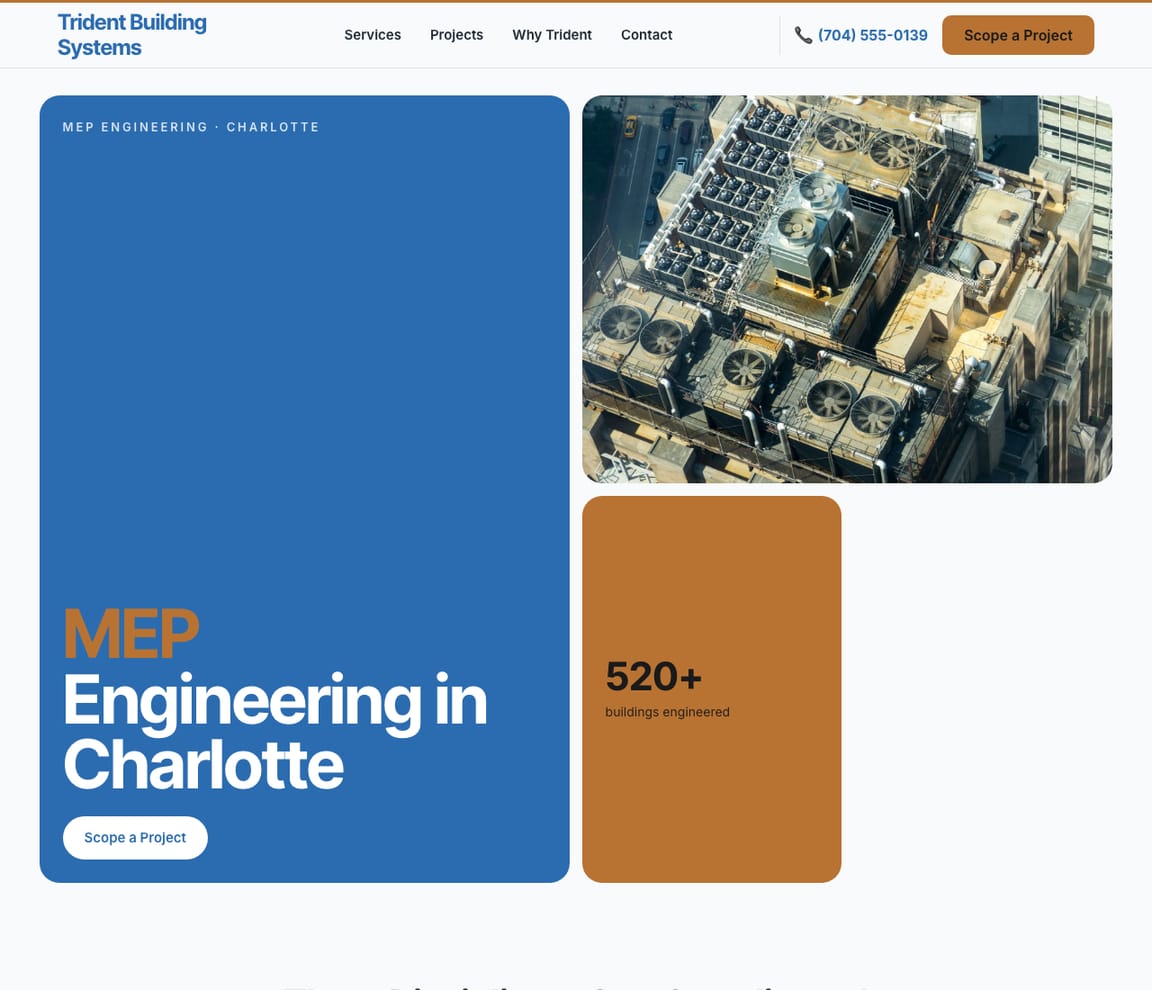
Engineering firm website designs you can start from
Every one is a real Zarla template you can make yours in about a minute — just add your firm's name, disciplines, and projects.


GET FOUND
Get found by local customers
A website plus a Google Business Profile is how architects, contractors, and owners find and vet an engineer. Zarla sets up both and wires them together.
“Structural engineer near me”
Show up when an architect, contractor, or homeowner searches for an engineer in your area — the highest-intent leads there are, actively looking to hire.
Google Business Profile
Your disciplines, credentials, hours, and reviews right in Google Maps and Search, so a prospect can call or request a proposal in one tap.
Reviews that win the project
Engineering runs on trust. A wall of 5-star reviews is what convinces a client to put their project — and their permit — in your hands.
Google Search
Kkeystoneengineering.com
Keystone Engineering — Trusted engineer in Your AreaLicensed engineer available for residential and commercial work. Same-day response.← Your Zarla siteCcityengineerservices.com
City engineer ServicesGoogle Maps
1
Keystone Engineering
← You2
Metro engineer Co.
3
Quick engineer Services
AI assistants (ChatGPT / Perplexity)
For engineer services in your area: Keystone Engineering — 4.9★ across 200+ Google reviews, same-day response, licensed and insured.
YOUR LAUNCH PLAN
Your engineering firm launch checklist
Everything above, boiled down to concrete steps — work through them in order and you'll be licensed, insured, and findable on Google.
- Choose your discipline and market — civil, structural, MEP, geotechnical, or environmental, and who you'll serve.
- Earn or confirm your PE license in every state where you plan to practice.
- Register the firm — form an LLC or S-Corp, get a free EIN, and apply for your Certificate of Authorization (COA).
- Get professional liability (E&O) insurance and a contract template before your first project.
- Set up your software — CAD, BIM, and the analysis tools your discipline needs.
- Set your fees — hourly, lump-sum, or a percentage of construction cost.
- Build your website and connect a Google Business Profile — free with Zarla.
- Deliver great work, then ask for a Google review and a referral from every architect, contractor, and client.
REAL CUSTOMERS
Small firms that got found with Zarla
Verified reviews from real Zarla customers.
“Quickly built my website from scratch. No hiccups. Would highly recommend Zarla for someone with no experience who wants to start a polished business website.”
“Optimized for local service-based businesses. Easiest website build I've experienced. The AI-based build is the way to go instead of clunky theme-based websites. Get the site built and get out of the weeds with Zarla!”
“Great professional website in less than a minute, with the use of AI and a few descriptive prompts. This has saved me bundles of time and research on web developers.”
“Very reliable, professional, and fast results. I was able to get my business online in no time, and the ease of access made it so simple.”
“Using Zarla to create my website saved me so much time and effort compared to hiring a developer. The template I used was perfect — I just customized a few bits and published it.”
Free to build
Ready to get your engineering firm online?
Describe your firm and Zarla builds your website in about a minute — your disciplines, a project portfolio, your PE credentials, a proposal-request form, and your logo, all connected to Google.
Free to build and preview — no code, no credit card.
Frequently asked questions
Do you need a license to start an engineering firm?
Yes — engineering is a licensed profession. To offer engineering services to the public, you (or your engineer of record) must hold an active Professional Engineer (PE) license in each state where you practice, and most states also require the firm itself to hold a Certificate of Authorization (COA) or firm license. You'll register your business and, in many places, get a general business license too. Staff who aren't licensed yet can work under a PE in “responsible charge.”
Do you need a PE to start an engineering firm?
Someone in “responsible charge” must be a licensed PE — but that person doesn't have to be you. Many firms are owned by a non-engineer or an unlicensed EIT who employs or partners with a licensed PE to serve as engineer of record and stamp the work. Most states require at least one PE and a Certificate of Authorization for the firm. If you're the engineer doing the work, you'll need your own PE first.
How much does it cost to start an engineering firm?
Less than most people expect, because a solo consulting firm has low physical overhead. Plan on $200–$800 for your PE license and firm registration (COA), $600–$2,500 for first-year professional liability (E&O) insurance, and your CAD and analysis software — the biggest variable, from a few hundred dollars a year up to a few thousand. A realistic all-in launch is $3,000–$10,000, or under $3,000 if you start lean from a home office and pay for software monthly. Building and previewing your website on Zarla is free; you pay when you're ready to publish.
Is an engineering firm profitable?
It can be very profitable, because your main cost is expertise, not inventory. Solo consulting engineers commonly bill $100–$200 an hour, and established firms average roughly $200,000 in revenue per employee. Margins depend on keeping utilization high — billable hours — and winning repeat work from architects, contractors, and developers. Specializing in a discipline or niche like structural, geotechnical, or MEP typically raises your rates.
Can you start an engineering firm without a PE license?
You can own the business, but you can't legally offer engineering services without a licensed PE in responsible charge who stamps the work. The common paths are: get your own PE (an accredited degree, pass the FE exam, about four years under a licensed PE, then pass the PE exam), partner with a licensed PE, or hire one as your engineer of record. Until then you can do allied work — drafting, consulting, project management — that doesn't require a stamp.
How do you win your first clients as a new engineering firm?
Almost always through your professional network. Tell former employers, architects, general contractors, and developers you've opened your firm and are available for projects and sub-consulting. Join your local ASCE, NSPE, or ACEC chapter, respond to RFPs and RFQs, and make sure your website shows your disciplines, credentials, and a project portfolio so referrals can vet you quickly.
How do I get my engineering firm found on Google?
Three things: a fast website with a page for each discipline you offer and a real project portfolio that shows your PE credentials, a Google Business Profile connected to that website so you appear on Google Maps for searches like “structural engineer near me,” and a steady stream of 5-star reviews from clients. Zarla builds the website and links your Google Business Profile for free, and reviews come from asking every architect, contractor, and owner at project close-out.