BUSINESS GUIDE
How to start an epoxy flooring business in 2026
The real version of a garage floor coating business, written for one or two installers: the training, the grinder and dust extractor, the license your state may want, the silica and isocyanate rules, what it costs to start without a franchise, what a garage pays — and how to win the floors the DIY kits leave behind.
Free to build · Pay when you publish · No credit card
$2,526average US price of a professionally coated garage floor, 2026 (HomeAdvisor)
17,989flooring contractors with a payroll in the US, 2023 — 77% with fewer than five employees (Census)
$3–$12installed price per square foot most guides quote for an epoxy garage floor (Bob Vila; Garage Force)
No codeto get online
See it in action
See what your epoxy flooring website could look like
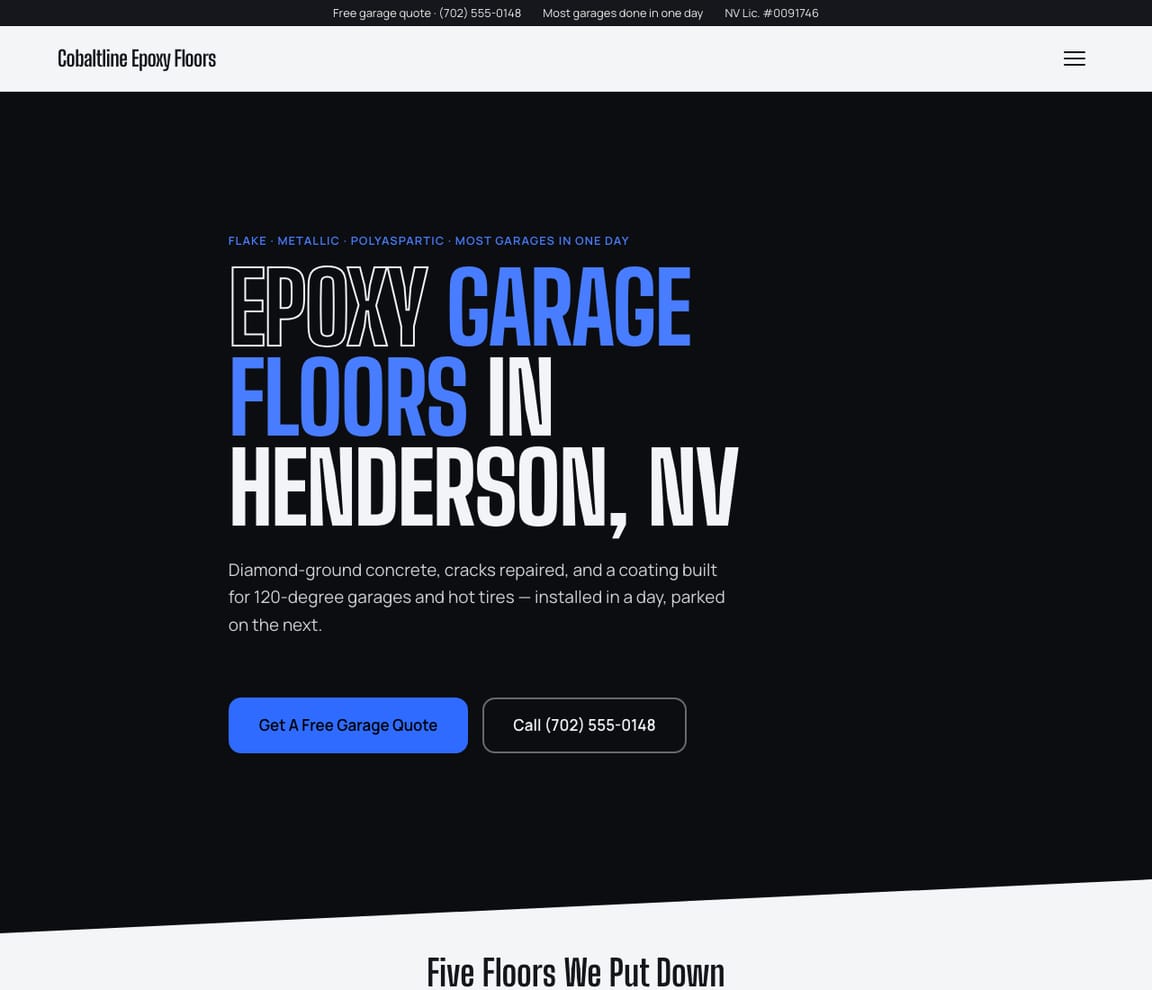
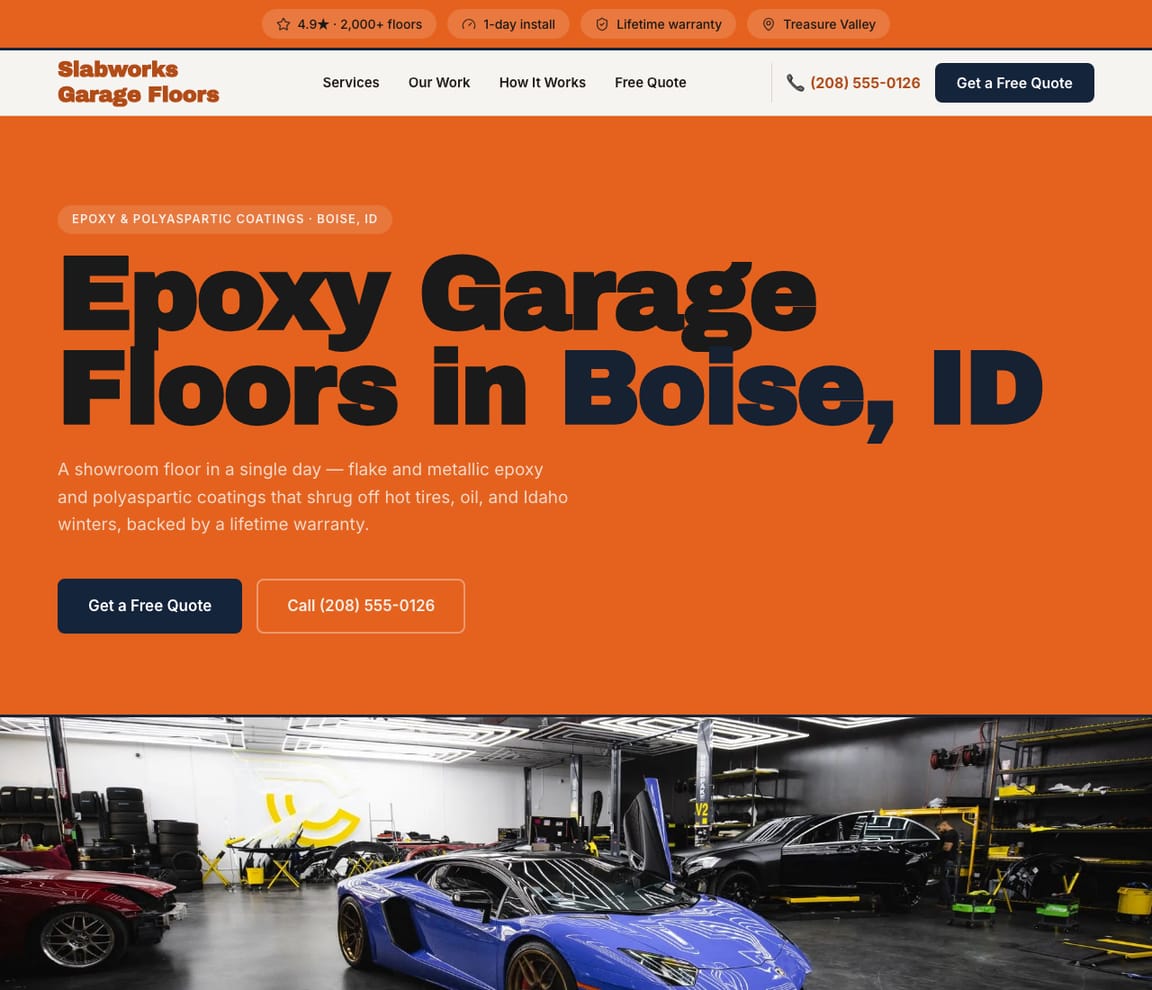
This is a real Zarla template for an epoxy garage floor company. Describe yours — flake, metallic or polyaspartic floors, the towns you cover — and you'll have a site like this, with a call button at the top and room for your before-and-after photos, in about a minute.
- Professional design — not a generic template
- Looks great on desktop and mobile
- Content written for your industry
Build the website
Start your epoxy flooring website now
Add your town and your company's name to the sentence, and Zarla builds the site: a call button at the top, a service-area map, a page for each coating you install and a quote request form. Add your before-and-after photos, your warranty and your price per square foot in chat, and publish.
Already have a website? Bring it across →Zarla keeps your old page addresses where it can and redirects the ones that change, helping you keep the Google standing you've built.
Is an epoxy flooring business worth starting?
The jobs are short and the price is clear. A professionally coated garage floor costs a US homeowner $1,650 to $3,494, about $2,526 on average, and labor is 33% to 60% of that (HomeAdvisor, June 2026). Most guides quote $3 to $12 a square foot for an epoxy garage floor (Bob Vila); Concrete Network says $4 to over $12 (Concrete Network, November 2023), one franchisor puts the average at $7.15 (Garage Force), and one estimator runs higher, at $10 to $15 (Fixr). On the cost side, professional-grade materials run about $1.40 to $2.80 a square foot (ArmorPoxy, February 2026) — a polyaspartic flake kit for up to 500 square feet is $989 (ArmorPoxy).
The franchise numbers show what the work can grow into, before royalties, the van and the owner's pay. GarageExperts' single-unit franchisees averaged $686,909 in gross sales in 2025, with $330,195 left after labor and materials, and the lowest did $160,409 (2026 disclosure, via Franchise Chatter). Garage Force's averaged $422,998, with an average invoice of $4,498 and product costs near 29% of revenue (2026 disclosure, via Franchise Chatter). Buying in costs $132,900 to $200,600 at Garage Force (Franchise Chatter) and $186,730 to $284,250 at PremierGarage (PremierGarage) — the independent route on this page is a fraction of that.
The hard parts are prep, moisture and reputation. A floor that isn't ground properly peels, a slab with too much moisture blisters, and a water-based coating lifts under hot tires; one coatings maker puts the cost of redoing a single garage floor at more than $1,000 (Real World Epoxies). Polyaspartic floors go down in about five hours where epoxy takes days to cure, but they set fast enough that the installer has to move quickly (Concrete Network). Grinding concrete raises silica dust that a federal rule controls (OSHA 29 CFR 1926.1153), and OSHA lists surface coatings among the jobs that can expose workers to isocyanates, whose main hazard is occupational asthma (OSHA). And the trade is small: of 17,989 flooring contractors with a payroll in 2023, 77% had fewer than five employees (Census County Business Patterns). A hired installer earns about what a painter or floor layer does — a median $49,400 or $56,460 in 2025 (O*NET, painters; floor layers).
So it's worth starting if you'll learn the prep properly, can carry the equipment and a slow first season, and will show every homeowner the floors you've done — which is what the rest of this guide sets up.
How to start an epoxy flooring business, in plain English
There's no federal license for floor coating in the US. Two federal safety rules reach the work. OSHA's silica standard sets the controls for grinding: a walk-behind floor grinder with water or the manufacturer's dust collection needs no respirator under its Table 1, while a shrouded hand grinder used indoors for more than four hours a shift calls for one (OSHA 29 CFR 1926.1153). And the coatings themselves: polyaspartics are a two-part polyurea chemistry (Concrete Decor), so read each product's safety data sheet and wear the respirator it names. States license or register the business, and the rules vary widely. Six examples:
- California: work of $1,000 or more, or any job that needs a permit or a hired helper, needs a contractor license (CSLB bulletin on AB 2622) — and three classes read on coating work: C-15 flooring (CSLB), C-33 painting (CSLB) and the D-12 synthetic-products specialty, which names resin and epoxy application (CSLB). A sole owner pays $450 to apply and $200 for the license (CSLB fees). Ask CSLB which class fits your work.
- Arizona exempts only casual, minor work under $1,000 that needs no building permit (A.R.S. §32-1121).
- Nevada puts protective coatings in its C-4 painting class (NAC 624.220) and exempts repairs under $1,000 that need no permit (Nevada State Contractors Board).
- Florida doesn't license painting or flooring as a state contractor category, and its law bars cities and counties from requiring a contractor license for those job scopes (Fla. Stat. §489.117).
- Texas has no state license for coating work — its licensing agency's programs don't include painting or flooring (TDLR).
- New Jersey registers home improvement contractors — garages included (N.J.A.C. 13:45A-17.2) — for $110, renewed for $90 (N.J.A.C. 13:45A-17.14), with at least $500,000 of liability cover (N.J.A.C. 13:45A-17.12); Connecticut registered them for $220 a year in a 2019 state report, flooring included (Connecticut OLR).
What it costs to start, line by line, if you buy the machines new and drive the truck you already own — about $15,393 to $45,047 in all. A walk-behind grinder lists at $3,843 to $8,995 (Contractors Direct; Xtreme Polishing Systems) — and a smaller 10-inch floor grinder rents for about $100 a day for the first jobs (El Paso Tool Rental); a HEPA dust extractor is $3,298 (Concrete Tools Direct); one coatings maker puts the minimum equipment package at about $10,000 and the first month of product at $5,000 (Real World Epoxies). A moisture-test kit is $13.75 and a humidity probe $125 (American Moisture Test; probes), a two- to five-day coatings course $900 to $1,750 (Xtreme Polishing Systems), and insurance for flooring installers a median $919 a year for general liability, $495 for tools and equipment cover, $1,726 for workers' comp and $2,490 for commercial auto (Insureon, August 2026). State LLC filing fees run $35 to $500 (llc.org) and the EIN is free (IRS). The rest of the list is our planning ranges, where no page prints a price: an edge grinder ($300 to $1,500), diamond tooling and application tools ($600 to $1,600), respirators and safety gear ($150 to $500), and truck lettering and first marketing ($250 to $5,000) — plus three months of working capital, $3,600 to $12,100, the range one franchisor gives its new owners (Garage Force's 2026 disclosure).
Then the order is the same everywhere: get trained, practice, check your state's rules, register and insure, buy or rent the prep equipment, price your systems, get found, and build referrals. Our free flooring business plan lays out a flooring company's startup lines and monthly costs, the flooring website templates and flooring website examples show what a good site looks like, and Zarla's flooring website builder is how homeowners find your finished floors.
What epoxy floor installers actually say
None of this is our opinion about the trade. It comes from installers speaking to local papers and trade magazines. Three things come up again and again, and only one of them is about the coating.
The prep is the job. Jim Muzzillo Jr. of Northwest Floor Care in Elk Grove Village, Illinois: “Without proper prep work, the adhesion won't be there, and you can get delamination.” Brian Fortman of HomePro Floor Coating Systems in Farmington Hills, Michigan: “Moisture in the slab is the biggest problem with any kind of epoxy flooring” (an undated Angi Pro trade column).
“If I do 250 floors in this area, I can promise you over half of those floors already have a floor on it.” — Donnie Garrett of Ultimate Garage Floors in Stephens City, Virginia, on the failed DIY coats he removes first, in the Winchester Star, December 2024
You learn by doing floors. Mike, who runs Mike's Epoxy Floors in Fargo, North Dakota: “Nobody taught me this. I taught myself for the most part.” And: “I thought the first floor turned out awesome, but looking back on it now, it was pretty spotty, but you get better the more floors you do” (Fargo INC!, May 2024). Jon Kopp of Quality Epoxy in Gilbert, Arizona, on choosing the system: “Even though I consider my metallic floors my 'babies,' I recommend polyaspartic as the best system for garage floors” (Concrete Decor, 2022).
The work sells the work. Mike again: “I really relied on word of mouth for growth. My only advertising was on the side of my truck. I just hustled and made sure I was always clean and on time” (Fargo INC!). And Nick Dancer of Dancer Concrete in Fort Wayne, Indiana, writing when box-store kits first flooded the market: “Never sell yourself short on a job. There are many customers who want projects done right and are willing to pay to make sure that happens” (Concrete Decor, 2013) — older, and truer now that more homeowners have tried a kit first.
The through-line: the installers who last grind and test every slab, keep improving floor by floor, and let finished garages — and the truck in the driveway — bring in the next job.
THE STARTER KIT
What you need to start an epoxy flooring business
Hands-on training
A manufacturer's or supplier's course on grinding, moisture testing and mixing, then practice on your own garage and a few friends' before you charge anyone.
A grinder and a dust extractor
A walk-behind diamond grinder, an edge grinder and a HEPA dust extractor — the machines that do the prep, which is where floors succeed or fail.
Coatings and a supplier account
A coating system you've been trained on — epoxy, polyaspartic or both — from a supplier who'll stand behind it, plus flakes, primers and crack filler.
Moisture tests and safety gear
A moisture test on every slab, and the respirators, gloves and eye protection the grinding and the coatings call for.
A license where your state wants one
Some states license coating work as contracting, some register home-improvement contractors, and some leave it to the city. Check before the first job.
A way to show finished floors
Photos of every garage, lettering on the truck, and a website and Google profile with before-and-afters and your warranty.
THE PAPERWORK
Licenses, registrations and insurance for an epoxy flooring business
| Typical cost | Time to get | Legally required? | |
|---|---|---|---|
| Contractor license, C-15, C-33 or D-12 (California) | $450 + $200, plus a bond | Months, with an exam | In California, for jobs of $1,000+ |
| C-4 painting license (Nevada) | Varies | Weeks to months | In Nevada, above small exempt repairs |
| Home improvement registration (New Jersey) | $110, then $90 to renew | Weeks | Yes, in New Jersey |
| Local contractor license (Florida) | None | — | No — state law bars it for flooring |
| EIN from the IRS | Free | Minutes online | If you hire or have partners; optional when solo |
| General liability insurance | $919/year median | Same day | Required in some states; builders ask |
| Commercial auto for a work van | $2,490/year median | Days | Auto cover yes; commercial for work use |
| Workers' compensation | $1,726/year median | Days | In most states, once you hire |
| Silica dust controls (OSHA) | Dust collection on the grinder | Before the first grind | Yes, for employers in the US |
THE STEPS
How to start an epoxy flooring business (step by step)
Eight steps from “I could do floors like that” to your first paid garage.
01
Get trained on a coating system
Take a hands-on course from a coating manufacturer or supplier — grinding, moisture testing, mixing and pot life — on the products you'll actually sell.
02
Practice on real garages
Coat your own garage, then a few friends' or family's for the cost of materials, and photograph every one.
03
Check your state's contractor rules
Look up your state's contractor board: a license, a home-improvement registration, or nothing at state level and a local business registration instead.
Before your first paid job04
Register and insure the business
Form the business, get a free EIN from the IRS, open a business bank account, and buy general liability and tool cover — commercial auto for a work van.
05
Buy or rent the prep equipment
Rent a walk-behind grinder by the day for the first jobs, buy a HEPA dust extractor and an edge grinder, and buy the grinder once the calendar fills.
06
Price by the square foot, with a minimum
Price per square foot by system — flake epoxy, polyaspartic, metallic — with crack repair, old-coating removal and moisture barriers as their own lines.
07
Get found with finished floors
Put your website and Google Business Profile live with before-and-after photos, your service area, your warranty and a way to request a quote.
08
Build referrals
Letter the truck, ask every customer for a review and for the neighbors' names, and offer builders and remodelers a garage floor to finish their jobs.
THE COSTS
How much does it cost to start an epoxy flooring business?
The total adds up the line-by-line list in the plain-English section above: a walk-behind grinder, a HEPA dust extractor and an edge grinder bought new, tooling, moisture testing, safety gear, the first coatings, a training course, the first year of insurance, registration, marketing and three months of working capital. A work van is extra; renting the grinder for the first jobs takes its line off. A franchise costs $132,900 or more.
$15,393–$45,047to start as an independent installer, buying the machines new
$10,000+the minimum equipment package — grinder, dust extractor and edge grinder
$100/dayto rent a smaller floor grinder for the first jobs instead
$919/yrgeneral liability at the median for flooring installers
WHAT WE'VE LEARNED
What actually makes a homeowner book the quote
Thousands of local business websites in, the pattern for home upgrades is clear: the homeowner has seen the DIY kits and the franchise ads and wants proof yours will last. Three things on a page decide it.
Before-and-after floors
Your own finished garages — flake, metallic, solid color — with the town and the system under each one, and the cracked, stained slab you started from.
How you prepare the slab
Diamond grinding, moisture testing and crack repair, explained in a sentence each. It's what separates your floor from the kit that peeled.
A warranty and a quick quote
What your warranty covers and for how long, a call button at the top, the towns you cover and a short quote request form.
THE UPSIDE
What an epoxy flooring business can earn
Homeowner prices from HomeAdvisor's June 2026 guide; franchise results from the franchisors' 2026 disclosure documents, before royalties and the owner's pay; installer pay from O*NET's 2025 medians. Averages, not a promise — your floors a week, your prices and your prep decide it.
$2,526average price of a professionally coated garage floor; most run $1,650–$3,494
$4,498average invoice at one garage-coating franchise in 2025
$686,909average 2025 gross sales of one franchise's single-unit owners — before royalties and owner pay
$56,460median pay for floor layers — about what a hired installer expects
SEE IT WORK
Floor coating website designs you can start from
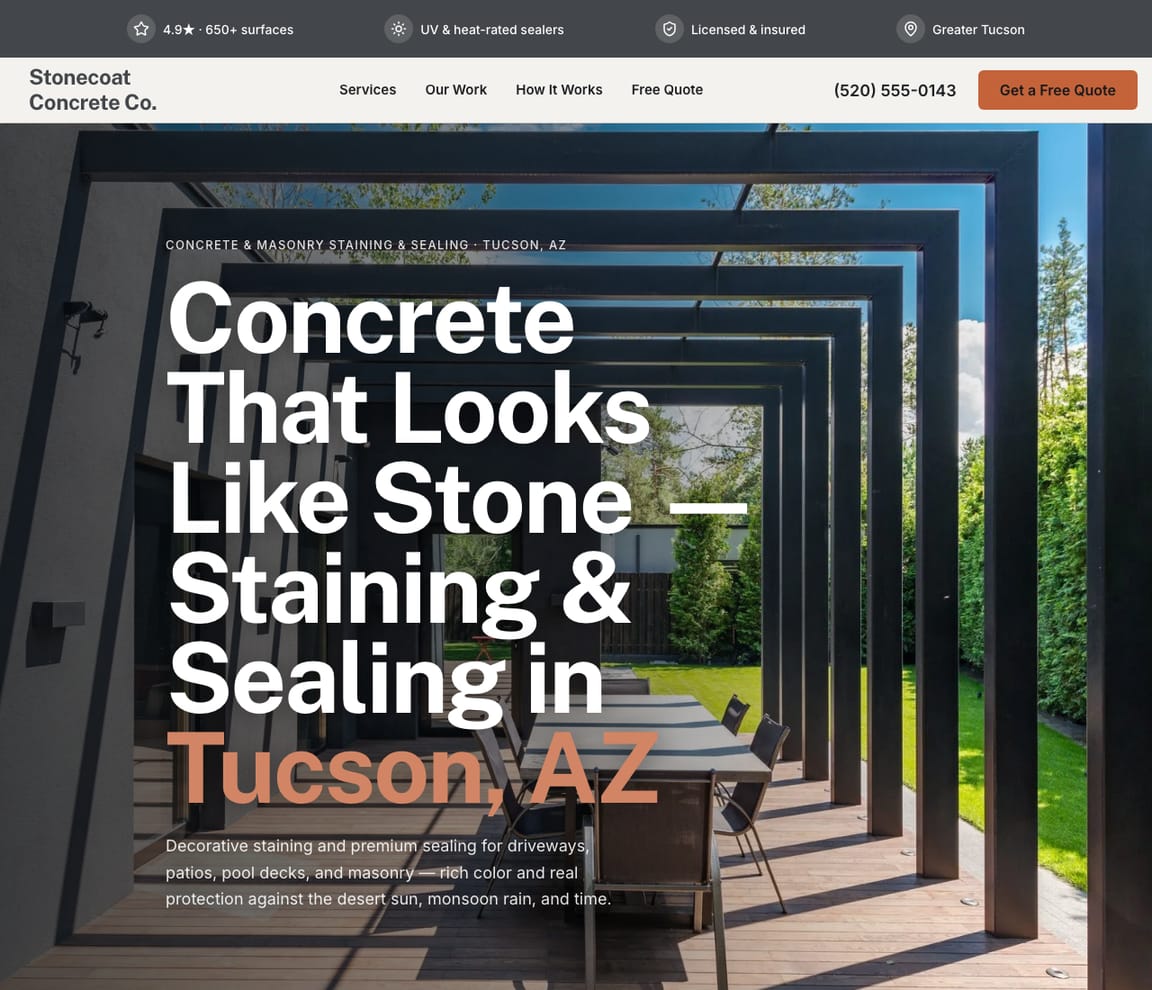
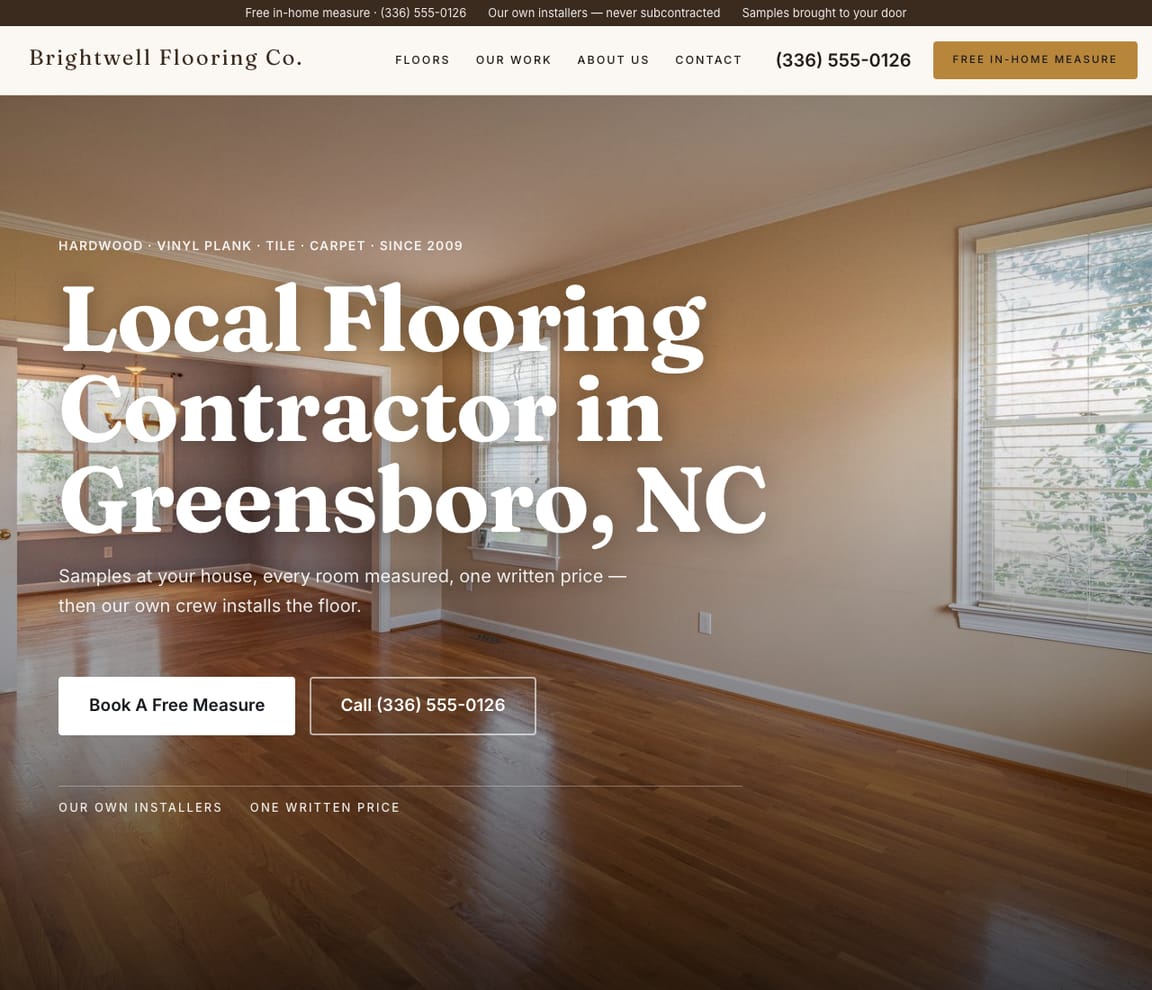
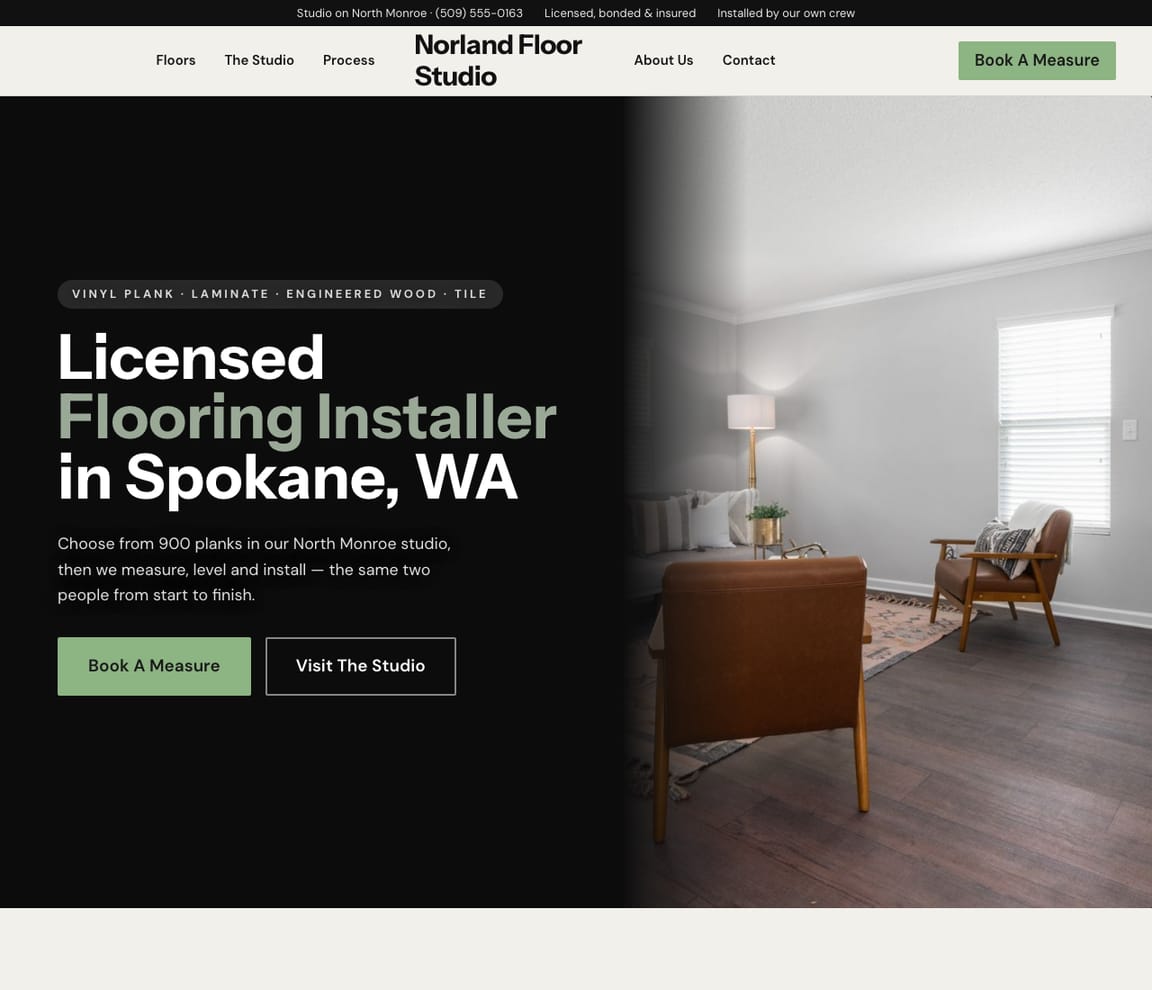
All four are real Zarla templates. Open the one closest to your company — garage floors, decorative concrete staining, or a flooring business that coats as well as installs — swap in your number, your service area and photos of real floors, and publish.
GET FOUND
Get found when the DIY coat starts peeling
Homeowners shopping for a garage floor compare photos, warranties and reviews — and often call after a box-store kit has failed. Zarla builds the website, and once you connect your Google Business Profile, your name, map location and reviews stay in step on both.
“Epoxy garage floor near me”
Searched by a homeowner who has priced the kits and wants it done right. Your finished garages, the towns you cover and a quick way to ask for a quote answer it before they scroll on.
Google Business Profile
Your service area, your hours, photos of finished floors and your reviews inside Google Maps. Free, and an afternoon to set up — and where the neighbor looks after the garage door goes up.
Reviews from finished floors
Ask when the customer sees the floor for the first time. A garage floor is shown off to every visitor, and the review tells the next homeowner who did it.
Google Search
Rridgelinegaragecoatings.com
Ridgeline Garage Coatings — Trusted Epoxy Flooring in Your AreaFlake epoxy and polyaspartic garage floors. Diamond-ground prep, moisture tested, written warranty, before-and-after photos of every job.← Your Zarla siteCcityepoxyflooringservices.com
City Epoxy Flooring ServicesGoogle Maps
1
Ridgeline Garage Coatings
← You2
Metro Epoxy Flooring Co.
3
Quick Epoxy Flooring Services
AI assistants (ChatGPT / Perplexity)
For a local garage floor coating company in your area: Ridgeline Garage Coatings — a local garage floor coating company with before-and-after photos, diamond-ground prep, a written warranty and reviews from homeowners nearby.
YOUR LAUNCH PLAN
Your epoxy flooring business launch checklist
The whole guide as things to check off. Work through them in order and you'll be trained, licensed where you need to be, insured and equipped before your first paid floor.
- Take a hands-on coating course — on the system you'll sell.
- Coat your own garage and a few friends' — and photograph every one.
- Check your state's contractor rules — a license, a registration, or a local business registration.
- Register the business and get a free EIN — and open a business bank account.
- Buy general liability and tool cover — commercial auto for a work van.
- Rent the grinder, buy the dust extractor — and control silica dust on every grind.
- Moisture-test every slab — and read each coating's safety data sheet.
- Get found with finished floors — website and Google Business Profile live with before-and-after photos.
REAL CUSTOMERS
Small business owners who got online with Zarla
Verified reviews from real Zarla customers.
“Quickly built my website from scratch. No hiccups. Would highly recommend Zarla for someone with no experience who wants to start a polished business website.”
“Great professional website in less than a minute, with the use of AI and a few descriptive prompts. This has saved me bundles of time and research on web developers.”
“I had no idea how to set up a website for my business. Thanks to Zarla, they've helped me a lot.”
“Very reliable, professional, and fast results. I was able to get my business online in no time, and the ease of access made it so simple.”
Let every finished garage sell the next one
Add your town and your company's name, and Zarla builds the website from that one line — a call button at the top, the area you cover, the coatings you install and a quote request form. Free to build; you pay when you publish.
Already have a website? Bring it across →Zarla keeps your old page addresses where it can and redirects the ones that change, helping you keep the Google standing you've built.
Frequently asked questions
Is epoxy flooring a profitable business?
It can be, because the materials are a small share of the price. A coated garage averages about $2,526 in the US, professional-grade materials run about $1.40 to $2.80 a square foot, and labor is 33% to 60% of what the homeowner pays. At one franchise, product costs were near 29% of revenue and the average invoice $4,498 in 2025. Profit turns on how many floors you do a week, and on prep good enough that you never redo one — a redo costs more than $1,000.
How much does it cost to start an epoxy floor business?
In the US, about $15,393 to $45,047 as an independent installer buying the machines new and driving a truck you already own — a walk-behind grinder ($3,843 to $8,995), a HEPA dust extractor ($3,298), an edge grinder, tooling, moisture tests, safety gear, the first coatings, a training course, the first year of insurance, registration, marketing and three months of working capital. Renting a smaller floor grinder at about $100 a day for the first jobs brings it down. A franchise costs $132,900 to $284,250.
Do you need a license to install epoxy floors?
It depends on your state. California requires a contractor license for jobs of $1,000 or more, and three of its classes read on coating work; Nevada puts protective coatings in its painting class; Arizona exempts only small jobs under $1,000; Florida bars cities and counties from requiring a contractor license for flooring; Texas has no state license; New Jersey registers home improvement contractors, garages included. Check your state's contractor board before your first paid floor.
How much does it cost to professionally epoxy a garage floor?
About $1,650 to $3,494 in the US, $2,526 on average, by HomeAdvisor's June 2026 figures — roughly $1,500 to $6,000 for a 500-square-foot two-car garage, depending on the system. Polyaspartic and metallic floors cost more than a standard flake epoxy, and moisture barriers, crack repair and removing an old coating add to it.
How much does it cost to epoxy 100 square feet?
At the $3 to $12 a square foot most guides quote, $300 to $1,200 — but many contractors charge a minimum of $500 to $1,000 for a small job, because the grinding setup and travel cost the same either way.
How much does a 1500 sq ft epoxy floor cost?
At $3 to $12 a square foot, about $4,500 to $18,000, depending on the system and the prep. By HomeAdvisor's figures, commercial 100% solids systems run $12 or more a square foot.
What is the downside of epoxy flooring?
Prep and patience. Epoxy needs a diamond-ground, moisture-tested slab or it can peel or blister; water-based coatings can lift under hot tires; and epoxy takes days to cure before a car can park on it, where a polyaspartic floor is done in about five hours. Standard epoxy also lacks the UV stability of polyaspartic, which matters in a sunny garage.
How much does 1 gallon of epoxy cost?
About $30 to $50 for water-based epoxy, $40 to $55 for solvent-based and $45 to $150 for 100% solids, by HomeAdvisor's 2026 figures; one supplier's professional 100% solids resin starts around $126 a gallon. A garage takes several gallons plus primer, flakes and a topcoat.
Is epoxy a good side hustle?
It can start as one: practice on your own garage and friends' for the cost of materials, rent the grinder by the day, and do weekend floors until the calendar fills. The limits are the curing time, which ties up weekends, the cost of the dust extractor and coatings, and the insurance you need before the first paid floor.
How do I get customers for an epoxy flooring business?
Show the floors: before-and-after photos of every garage, lettering on the truck, and reviews from the homeowners who hired you — on a Google Business Profile and a website with your service area, your systems, your warranty and a quote request form. Then offer builders and remodelers a garage floor to finish their jobs. Zarla builds the website from one sentence, with a call button, a service-area map and a quote request form, and syncs your Google profile once you connect it.