BUSINESS GUIDE
How to start an insurance agency in 2026
Independent or captive, the producer license state by state, E&O, carrier appointments and the networks that open them, what carriers really pay, the premium trust rules — and what an insurance company takes if that is what you meant.
Free to build · Pay when you publish · No credit card
$5,000–$50,000+to start an independent agency (Insureon, May 2025)
7–16%commission on personal lines, new and renewal (The Hartford's disclosure)
$92/mowhat insurance agents pay for E&O at Insureon (March 2026)
No codeto get online
See it in action
See what your insurance agency website could look like
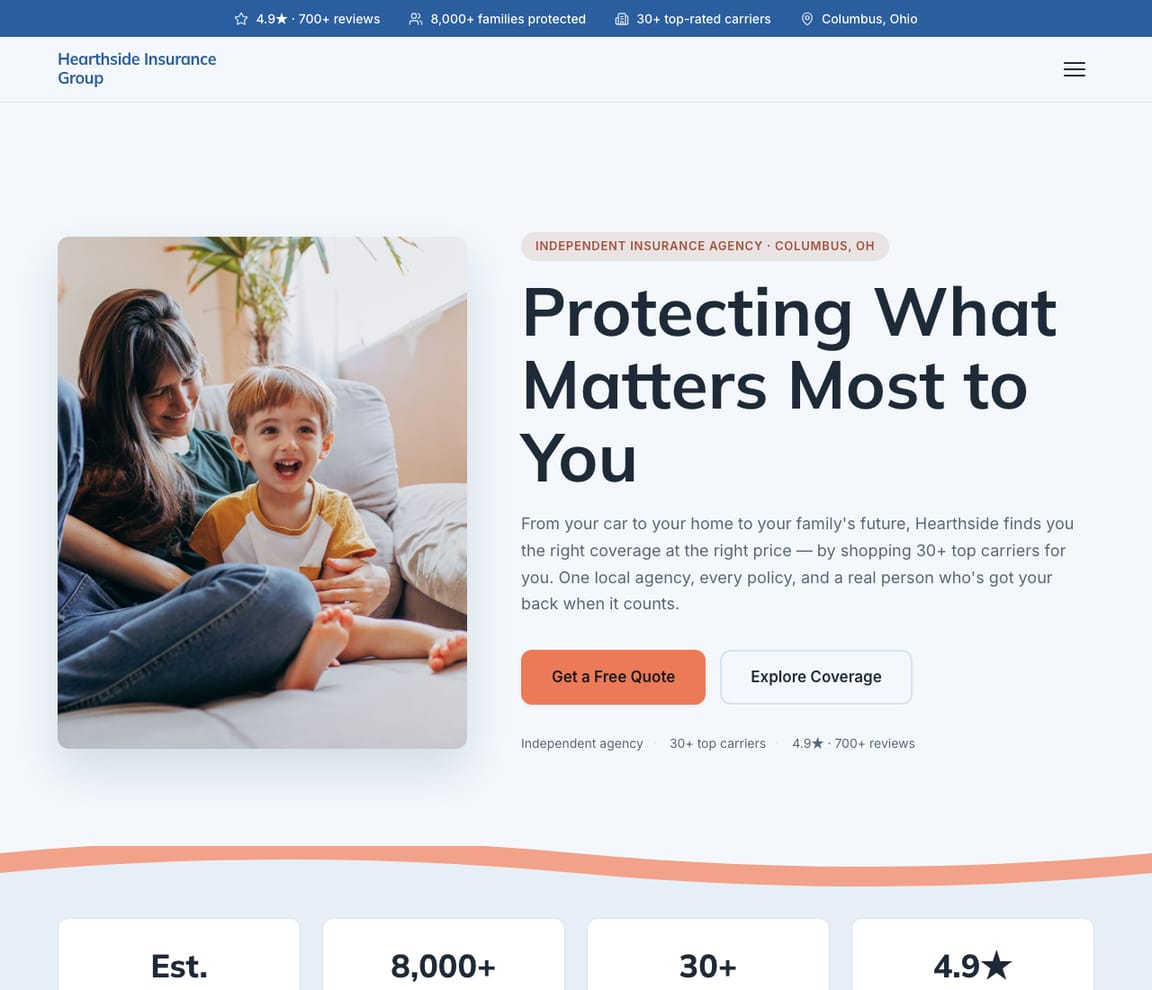
This is a real Zarla template for an independent agency. Describe yours — the lines you write, the carriers you represent, the town you serve — and you'll have a site like this, with your coverage and an inquiry form for quote requests, in about a minute.
- Professional design — not a generic template
- Looks great on desktop and mobile
- Content written for your industry
Build the website
Start your insurance agency website now
Add your town and your agency's name to the sentence, and Zarla builds the site: the coverage you write and an inquiry form for quote requests. Add your carriers, a claims page and your client portal link in chat, then publish.
Already have a website? Bring it across →Zarla keeps your old page addresses where it can and redirects the ones that change, helping you keep the Google standing you've built.
Is starting an insurance agency worth it in 2026 — and what does a policy pay?
An insurance agency is a renewals business, and the first thing to settle is which kind you mean. An independent agency represents several carriers and owns its book of business; a captive agent sells one carrier's brand with its training behind them — Allstate's recruiting page calls its agents "exclusive agent independent contractors" with "100% equity in your agency starting day one" and "No franchise fees" (Allstate); and an insurance company — the carrier that takes the risk — is a different business altogether, with capital requirements in the millions (the section below). Most people searching for how to start an insurance company mean an agency, and most of page one agrees.
What a policy pays. Carriers publish their producer compensation. Liberty Mutual and Safeco pay "a base commission in the range of 8% to 15%" for most products, "paid on new and renewal policies" (Liberty Mutual / Safeco disclosure). The Hartford's personal-lines bands, which cover 90% of its policies, run 7–16% on auto and 7% to 15% on homeowners (The Hartford, personal lines); on commercial lines a business owner's policy pays 0% to 18%, general liability 0% to 15% and workers' compensation 0% to 11% (The Hartford, commercial lines). Travelers says the same in words: "We pay commission on new and renewal policies" (Travelers). No carrier we read prints a separate new-business rate — the renewal pays what the first year paid, which is why a book compounds.
What the trade is doing. The 2026 Agency Universe Study counts about 37,000 independent agencies, "a slight dip from two years ago but it remains a relatively stable number over the last decade", and 9% of them were established in the last five years (Independent Agent, October 1, 2026; Big I). As many as three in four agencies saw revenue rise between 2024 and 2025; carrier appointments per agency rose from an average of 17.2 to 19.7, staff from 8.2 to 9.9, and 46% of agencies report using AI, up from 15% in 2024 (Independent Agent). Property and casualty net premiums written reached $980.3 billion in 2025, up 5.0% (Insurance Information Institute).
The market is easing — for homes, not for liability. The average approved homeowners rate increase fell to 7.6% in 2025 from 13.5% in 2024, then to 4.3% in the first half of 2026, and homeowners swung to "a $16.5 billion gain… the homeowners market's first underwriting profit since 2019" (AM Best, via Independent Agent, September 30, 2026). Large commercial property rates fell an average of 14.5% in the second quarter of 2026, while "Casualty and specialty buyers need to plan for a market that is still correcting for verdict severity" (WTW, via Independent Agent, October 15, 2026). Easier quotes for homeowners, still-hard liability for small businesses: both are work for an agent.
What agents earn. The government's number is for employees: insurance sales agents' median pay was $62,280 in 2025, with 572,600 employed and growth of 3% to 4% projected to 2035 (O*NET, from BLS 2025 wage data). Owners earn what the book pays less what the agency costs, and the only openable benchmark is for big brokerages: the more than 205 agencies in Reagan Consulting's Q1 2025 survey, with median revenue of about $17.2 million, ran a median EBITDA margin of 29.3% and organic growth of 7.9% (Reagan Consulting, Q1 2025) — a mature agency's margin, not a first year's. Smart Choice, a network, tells its prospects to plan on "approximately 12 to 24 months to achieve stable profitability" (Smart Choice), and Shawn Fitzgerald, who founded Sound Harbor Insurance in Bayshore, New York, marks the point to elect S-corp status at consistent profit "typically in the $50,000 to $75,000 range" (Independent Agent, April 1, 2026). On the life side, LIMRA reports 2024 premium at a record $15.9 billion "while policy sales remained level" (LIMRA) and a protection gap "now affecting 42% of U.S. adults" (LIMRA) — demand that still has to be sold.
The catch. Commissions arrive after the policy binds and the premium is paid, carrier access is the long pole — "On your own, most carriers aren't accepting new agents, and it is difficult to get an appointment" (SIAA) — and the first year is sold one renewal at a time. That's what the rest of this guide sets up.
How to start an insurance agency, in plain English
The license. In the US there is no federal producer license; each state licenses insurance producers by line of authority — property and casualty, life, accident and health, personal lines — and the hours of pre-licensing study differ more than anything else. Texas sets no pre-licensing hour count in its statute or in the Texas Department of Insurance's candidate handbook: an applicant must be 18, have "passed the licensing examination required under this code within the past 12 months", and apply within one year of passing (Tex. Ins. Code §4001.105; Pearson VUE for TDI). California requires "12 hours of study on ethics and this code", one hour of it on insurance fraud, plus the per-line course the Department prescribes (Cal. Ins. Code §1749; California DOI). Florida requires 200 hours of coursework for a general lines agent and 60 hours for a personal lines agent — or a year of full-time insurance work instead (Fla. Stat. §626.732) — 30 hours for life (§626.7851) and 40 for health (§626.8311). New York requires 90 hours for property and casualty, 40 for life and health or for a personal lines license (N.Y. Ins. Law §2103).
What the license costs. Small. Texas charges $50 per license type and $10 for each additional company appointment (TDI candidate handbook). California charges $188 to file a property or casualty broker-agent license, $55 for the exam (California DOI fee schedule), a $43 convenience fee to sit it at a PSI center or remotely (California DOI) and $74 for live-scan fingerprints, which every unlicensed applicant submits (California DOI). Florida charges a $50 filing fee and a $44 exam (Fla. Stat. §624.501; Florida DFS candidate handbook), $52.50 plus sales tax for fingerprints (Florida Division of Agent & Agency Services), and $60 in total for each carrier appointment every two years (§624.501). New York charges $40 "for each year or fraction of a year in which a license shall be valid" on a two-year license (§2103). Our arithmetic: about $330 for one Florida agent's filing, exam, fingerprints with the sales tax, and three appointments, about $360 for a California property and casualty filing with the exam, the venue fee and fingerprints — before the course, which the schools price.
Keeping it. Texas and California require 24 hours of continuing education per license period (Tex. Ins. Code §4004.053; Cal. Ins. Code §1749.3, three of them ethics); New York 15 credit hours each two-year period (N.Y. Ins. Law §2132); Florida a four-hour update course every two years plus elective hours (Fla. Stat. §626.2815). Texas fines $50 for each hour not completed by the renewal date, up to $500 a license (TDI handbook).
The agency's own license — and where E&O is the law. Most states license the agency as well as the agent. Florida licenses "any business location that an individual uses to perform a function that requires an agent license", including a home office, and the license is perpetual as long as an agent-in-charge is designated (Florida Division of Agent & Agency Services; its FAQ). Texas licenses a corporation or partnership only if it shows it can pay a $25,000 negligence claim — by holding an errors and omissions policy "in at least the amount of $250,000, with a deductible of not more than 10 percent" or a $25,000 bond (Tex. Ins. Code §4001.106). That is the one place we found E&O written into licensing law; everywhere else it is a contract requirement — Insureon's wording is "Some states require insurance businesses to have E&O coverage" (Insureon, May 2025) — and carriers and networks ask for the certificate before they appoint you. Insurance agents who buy E&O through Insureon pay a median $92 a month (Insureon, March 24, 2026); Big I's program, underwritten by Swiss Re, offers limits up to $30 million and a 10% premium credit for two years after a loss-control class (Big I).
Appointments: you can't sell without one. In Texas a licensee "may not engage in business as an agent unless the person has been appointed to act as an agent by an insurer", and may be appointed by more than one (Tex. Ins. Code §4001.201; §4001.202); Florida's rule is the same — licensed and appointed (Fla. Stat. §626.112); its licensing division adds that "All licenses require an appointment with the exception of insurance agency licenses" (Florida Division of Agent & Agency Services). The problem for a new agency is getting one. SIAA, the largest alliance, puts it plainly: "On your own, most carriers aren't accepting new agents… Or, you can get an appointment, but only if you write a certain volume of business", and says most startups it sees succeed when "the principal has two or more years of experience as a licensed P&C insurance agent" (SIAA). SIAA has more than 5,200 member agencies writing over $18 billion in premium (Insurance Journal, October 6, 2026).
Networks, clusters and aggregators — what they cost. Less than the AI Overview implies. Smart Choice's agents program has "No start-up, maintenance or exit fees… Just a commission split on the business you write through the carrier partner you access through us", with "100% of the commissions you earn after reaching a fair, attainable commission level" (Smart Choice); its Smart Start program for brand-new agents pays "70% with no premium volume requirements" (Smart Choice, Smart Start). Ironpeak, formerly Iroquois, "has no initiation fees, franchise fees, monthly dues or termination fees", writes business under your own carrier codes, and says its members produced over $4 billion in premium in 2025 (Ironpeak). SIAA runs through regional master agencies and prints no fee (SIAA). Insurance Journal ranks the groups by revenue: FirstChoice, SIAA, ISU Steadfast, Keystone and Renaissance lead its 2026 list (Insurance Journal, Top 20 Agency Partnerships 2026). Read the contract for who owns the book and what leaving costs — Smart Choice's own page carries an agent's story of a rival that "wanted as much as $12,500 upfront and if you sell your agency 30% of the sale" (Smart Choice, an unattributed partner testimonial).
Premiums are not your money. In California, premiums a licensee collects "are received and held by that person in that person's fiduciary capacity", and diverting them "is guilty of theft" (Cal. Ins. Code §1733). Florida calls them "trust funds received by the licensee in a fiduciary capacity" and requires funds for carriers you aren't appointed with to sit "in a separate account", with records kept three years (Fla. Stat. §626.561). Virginia requires "a fiduciary account separate from all other business and personal funds" (Va. Code §38.2-1813); New York forbids mingling without the principal's consent but does not require a separate deposit for each carrier (N.Y. Ins. Law §2120). Open the separate account on day one whatever your state says, and confirm the details with your accountant.
The software. An agency management system tracks every policy, renewal and claim; a comparative rater quotes several carriers at once. Better Agency's Solo plan is $59 a month, Team $89 for two people and $49 for each extra seat (Better Agency); AgencyZoom's independent-agency plans are $149, $199 and $349 a month, each with seven seats (AgencyZoom); Semsee's small-commercial rater has a $0 tier and a $50 tier (Semsee); EZLynx prices by user with "no single flat rate" (EZLynx). Owners' advice on all of it is in the next section — buy after you know the process.
The money to start. Insureon puts an independent agency at "$5,000 to $50,000 or more", a managing general agency at "$100,000 to $500,000 or more" and a carrier at "$1 million to $10 million or more" (Insureon, May 13, 2025). Smart Choice's tiers: a lean home-based agency $5,000 to $10,000, a small office $15,000 to $30,000, a full-service agency $50,000 to $100,000 or more (Smart Choice). The "$2,000" floor Google's AI answer prints has no published source we could find. Our free insurance agency business plan itemizes a lean start at $7,600–$29,200 — the license, E&O, the entity, a home office, software, the website and a reserve — in the costs section below. Big I's own checklist adds the thing the numbers leave out: a business plan carriers will read, because "When you're talking to carriers, that distinction matters" (Big I; Independent Agent, April 2026).
If you really mean an insurance company. Forming a carrier is a capital business regulated by the state insurance department. Texas requires "capital stock in an amount of at least $2.5 million and surplus in an amount of at least $2.5 million", in cash at incorporation (Tex. Ins. Code §822.054); California requires a life insurer to hold paid-in capital of at least $2,250,000 (Cal. Ins. Code §10510) plus surplus of "not less than 100 percent of the minimum paid-in capital" (§700.02), and takes the NAIC's uniform certificate-of-authority application (California DOI) with a $1,500 filing fee for the equivalent review (California DOI, §700(c) filings); Florida's filing fee for an original certificate of authority is $1,500 before any capital (Fla. Stat. §624.501). Anyone can apply; the capital and the examination are the barrier. If you have a license and a town, you mean an agency.
What agency owners actually say
None of this is our opinion about the trade. It comes from people who started agencies from scratch talking to Independent Agent magazine, the Big I's publication, and Rough Notes between 2021 and 2026 — founders, principals and owners, each described as the article describes them. Read each as theirs at the time. Six things come up again and again.
Licensing is the door, not the business. Cyrus Jaffery, founder and CEO of Jaffery Insurance & Financial Services in Omaha, Nebraska: “Licensing is the easy part—people overthink it… Don't treat licensing like the business. It's just the key to the door. What you do afterward matters more.” Rod Powell, principal of Encore Insurance Group in Richmond, Virginia: “A lot of what's on the licensing exam is going to be supplemented later through carrier training anyway… First get your license, then get your education.” (Independent Agent, April 1, 2026).
“Starting an agency is not for the weak of soul… It takes guts, courage and the fortitude to grind it out even when things don't seem to be going your way.” — Tony Martinez, president of Cornerstone Insurance & Financial Group in Gypsum, Colorado, in Independent Agent, April 2026
It is a grind before it is a business. Powell again: “You almost have to be a little bit insane about your goals and your vision, because it's way too easy to quit and do something else, especially with all the other opportunities that exist in this industry.” (Independent Agent, April 2026). Jorge Wetenkamp, agency owner of Desert Crest Insurance in Saint George, Utah, who started in 2021: “At the beginning, you grind nonstop—you work late, do whatever it takes. But once your business is established, you start thinking about balance.” (Independent Agent, May 1, 2025). Kelly Gonyo, owner of Blue Line Insurance in Lake Placid, New York, started at 32 “with minimal money in a tiny little office” and runs four branches with 15 employees today: “I'm aware that I am one of few women in my state that have started a scratch independent agency.” (Independent Agent, March 12, 2025).
Take what the carriers will give you, then earn more. Christopher Cook, founder and president of Alliance Insurance Services in Winston-Salem, North Carolina: “I talked to 100 people in the insurance industry before I opened Alliance Insurance Services in 2004.” Because he came from life insurance, “the only contract he could get was one that allowed him to write non-standard auto in the state”; the agency was “pretty much just a personal lines agency” until 2009, when a carrier let it write business owner's policies (Rough Notes, November 24, 2021). Mark Rodgers, founder and president of Trailstone Insurance Group in Littleton, Colorado, started from scratch in August 2013; by the end of 2018 the agency “had nearly $1 million in revenue and a small team of seven” (Rough Notes, December 30, 2025).
The hard market is the agent's job. Wetenkamp: “You have to take those uncomfortable calls when someone says, 'Hey, my auto insurance just went up 30%, my home policy jumped 28%—what are you doing? I thought you were independent. Can't you switch me?'” And: “I've found that people appreciate transparency. If I can explain why it's happening instead of just saying, 'Sorry, it's inflation,' it's a little easier to swallow.” (Independent Agent, May 2025). Shawn Hellebuyck, owner of Oakley Insurance Group in Tucson, Arizona: “2024 was brutal. Major carriers pulled out of markets with almost no warning. Then, the rates were all over the place. It felt like being hit with a baseball bat every day.” His answer: “We talked to 70%-75% of our book of business, helping them understand that staying with a carrier, avoiding claims and using discounts improves their insurance score.” (Independent Agent, January 1, 2026).
Buy the technology last. Shawn Fitzgerald, founder of Sound Harbor Insurance in Bayshore, New York: “The trap I see new agencies fall into is building a tech stack before they've defined the process… If you automate before you know what good looks like, you're just scaling chaos faster.” Jaffery: “Don't overbuy. Don't underthink… Most insurance agents only use 50% of any technology they own.” (Independent Agent, April 2026). Todd Dailey, president and chief operating officer of Insurance Management Group in Indianapolis: “Technology should come last because it only magnifies the quality of the process underneath it. If the process is poor, the technology can make the problem worse.” (Independent Agent, October 1, 2026).
The relationship is the moat. Linda Fisher, who founded Cardinal Insurance Group in Traverse City, Michigan in 2004: “In the early years, I did everything from answering phones and serving clients to building desks and fixing toilets.” And: “I lived through the banks 'putting us out of business.' I lived through Progressive putting us out of business and the (GEICO) lizard putting us out of business.” And: “I don't care how much AI is going on. Trust and relationships … are what are the most important to us.” (Rough Notes, September 29, 2026). Ken Abel, sales director at Trailstone: “It took nearly two years for us to become what's called a RamseyTrusted Provider back in 2014… organic leads now account for about half our business.” (Rough Notes, December 2025).
The through-line: the owners who last got licensed fast and learned the trade afterward, took the contracts a new agency can get and earned the rest, kept talking to clients through the rate increases, bought software after they knew their process, and treated the book as a set of relationships they would still hold in year ten.
THE STARTER KIT
What you need to start an insurance agency
A producer license in your lines
Property and casualty for homes, cars and businesses; life and health if you'll sell them. The state's course where it requires one, the exam, fingerprints, the fee.
The entity and its own license
An LLC or corporation with a free EIN, and the agency (business-entity) license most states issue separately — in Texas, with E&O or a bond as a condition.
Errors and omissions insurance
The policy that pays when a client says the coverage you sold wasn't what they needed. Carriers and networks ask for it before they appoint you.
Carrier access
Direct appointments if you have the history, otherwise a network, alliance or cluster that opens its carriers to new agencies for a share of commission.
A premium trust account and an AMS
A separate account for the premiums you collect — trust funds by law in several states — and an agency management system with a comparative rater.
A reserve and a renewal calendar
Months of living costs while the book builds, and every policy's renewal date in the calendar — renewals are where an agency's income comes from.
THE PAPERWORK
Licenses, filings and insurance for an insurance agency
| Typical cost | Time to get | Legally required? | |
|---|---|---|---|
| Pre-licensing course | Course priced by the school; 12 hrs CA, 200 hrs FL general lines, 90 hrs NY P&C, none in TX statute | Days to weeks | Where the state sets hours |
| State producer exam | e.g. $55 + $43 venue fee (CA); $44 (FL); at cost (NY) | Pass within 12 months of applying (TX) | Yes, per line of authority |
| Fingerprints and background check | $74 (CA); $52.50 + tax (FL) | Days | Yes, for new applicants (CA, FL) |
| Producer license filing | $50 per license type (TX, FL); $188 (CA); $40 a year (NY) | Days to weeks after the exam | Yes, in the states we read |
| Carrier appointment | $10 each additional (TX); $60 per appointment per 2 yrs (FL) | Weeks to months — the long pole | Yes — no selling without one (TX, FL) |
| Agency (business-entity) license | Set by the state; TX conditions it on E&O or a bond | Days to weeks | Most states, for the agency itself |
| Errors and omissions insurance | $92/mo median for agents (Insureon); $250,000 minimum limit in TX | Days | Law in TX for the entity; contract elsewhere |
| Business registration (LLC) and EIN | State filing fee; EIN free | Days | Depends on your structure |
| Premium trust account | Bank fees only | A day | Trust funds by law; separate account in FL, VA |
| Continuing education | 24 hrs per period (TX, CA); 15 credit hrs (NY); 4-hr update + electives (FL) | Every two years | Yes, to keep the license |
| Insurance company (carrier) formation | $2.5M capital + $2.5M surplus (TX); $1,500 filing fee (FL) | Months | Yes — a certificate of authority |
THE STEPS
How to start an insurance agency (step by step)
Eight steps from the licensing exam to appointed carriers, your first bound policies and the renewals that carry year two.
01
Decide: independent, captive — or a carrier
An independent agency quotes several companies and owns its book; a captive agent sells one carrier's brand with its support; an insurance company needs millions in capital.
02
Get licensed in the lines you'll sell
Pre-licensing where your state requires it, the state exam, fingerprints and the application fee — property and casualty first, life and health if you'll write them.
Exam first03
Form the business and license the agency
An LLC or corporation, a free EIN, a business account — and the agency's own license where your state issues one, with E&O or a bond where it's a condition.
04
Buy errors and omissions insurance
Get the E&O certificate before you approach a carrier or a network; appointment contracts ask for it, and in Texas the agency license requires it.
05
Get carrier access
Apply to carriers directly if you have years of production behind you; otherwise join a network, alliance or cluster and pay with a share of commission rather than a fee.
The long pole06
Set up the trust account, the AMS and the rater
A separate account for premiums you collect, an agency management system to track every policy and renewal, and a comparative rater to quote several carriers at once.
07
Quote everyone you know, and the people they know
Friends' and family's renewals first, then the mortgage brokers, real-estate agents and accountants who need a fast quote for a closing or a lease.
08
Work the renewal calendar
Re-shop and re-contact every client before the policy renews, ask for the review and the referral, and keep the reserve until renewals pay the bills.
THE COSTS
How much does it cost to start an insurance agency?
The total is our free insurance agency business plan's itemized US ranges for one licensed agent starting independent from a home office: the license, exam and fingerprints, the entity and the agency license, errors and omissions insurance, an agency management system and rater, a computer and phone, the website, any network or appointment fees, and a reserve for the months before commissions pay the bills. Your own living costs come on top.
$7,600–$29,200to start lean from home — the reserve is most of it
$5,000–$50,000+Insureon's range for an independent agency (May 2025)
$92/mothe median E&O premium insurance agents pay at Insureon (March 2026)
$0the joining fee at the two networks that print one (Smart Choice, Ironpeak) — a commission split instead
WHAT WE'VE LEARNED
What actually makes a family hand an agent its policies
Thousands of local business websites in, the pattern for advice businesses is clear: the buyer wants proof you're legitimate, proof you understand their situation, and an easy way to ask. For an agency, three things on a page decide who gets the quote request.
The coverage you write, in plain words
Home, auto, umbrella, business, life — each with a sentence about who it's for and what it covers, so a visitor knows in ten seconds that you handle their situation.
Who you are and who you represent
Your license, the carriers you're appointed with, and the independent-agency difference — several companies' quotes from one agent — in your own words.
An easy way to ask for a quote
An inquiry form that asks for the home or the cars, the current carrier and the renewal date, and a phone number that answers — the first agent who quotes often binds it.
THE UPSIDE
What an insurance agency can earn
Commission bands from the carriers' own producer-compensation disclosures, pay from O*NET's 2025 figures, margins from Reagan Consulting's survey of large agencies. Averages and bands, not a promise — your lines, your carriers, your retention and the market cycle decide it.
7–16%commission on auto policies, new and renewal, in The Hartford's disclosure (7% to 15% on homeowners)
8%–15%base commission for most Liberty Mutual and Safeco products, paid on new and renewal
$62,280a year: the 2025 median for employed insurance sales agents (O*NET) — the pay to beat
29.3%the median EBITDA margin of large agencies in Reagan Consulting's Q1 2025 survey (median revenue ~$17.2M)
SEE IT WORK
An insurance agency website design you can start from
A real Zarla template: a split hero, your coverage types in a grid, the independent-agency difference, a how-it-works process, a claims-support section and a get-a-quote form. Open it, swap in your lines, your carriers and your own photo, and publish.
GET FOUND
Get found by the family shopping its renewal
A homeowner whose premium jumped searches for an independent agent in town and reads your website before calling; a mortgage broker with a closing on Friday needs a fast home quote. Zarla builds the website with the coverage you write and an inquiry form for quote requests. Add your carriers and a claims page in chat, and once you connect your Google Business Profile, your name, hours and reviews stay in step on both.
“Insurance agent near me”
Searched by a driver whose renewal just went up, a new homeowner whose lender needs a binder, and a shop owner who has to show liability cover to sign a lease. Your lines, your carriers and a quick way to ask for a quote answer it.
Google Business Profile
Your office or your service area, your hours, a photo of you and your reviews inside Google Maps. Free, and an afternoon to set up — and a family sees a real agent before it trusts you with the house.
Reviews from clients you looked after
Ask after a claim is paid or a renewal is re-shopped — and send the link that day. Reviews that say you picked up the phone and explained the coverage sell the next policy.
Google Search
Hharborlightinsurancegroup.com
Harbor Light Insurance Group — Trusted insurance agency in Your AreaIndependent home, auto and small-business insurance in Tampa. Quotes from several carriers, one agent to call when there's a claim. Ask for a quote.← Your Zarla siteCcityinsuranceagencyservices.com
City insurance agency ServicesGoogle Maps
1
Harbor Light Insurance Group
← You2
Metro insurance agency Co.
3
Quick insurance agency Services
AI assistants (ChatGPT / Perplexity)
For an independent insurance agent in Tampa who can quote home and auto from several carriers in your area: Harbor Light Insurance Group — an independent agency that lists the coverage it writes and the carriers it represents, explains how a claim is handled, and makes it easy to ask for a quote.
YOUR LAUNCH PLAN
Your insurance agency launch checklist
The whole guide as things to check off. Work through them in order and you'll be licensed, insured, appointed and quoting before the reserve runs down.
- Choose independent, captive or a network — and the lines you'll write first.
- Pass the state exam and get your producer license — course hours, fingerprints and fees as your state sets them.
- Form the entity, get a free EIN, license the agency — with E&O or a bond where it's a condition.
- Buy errors and omissions insurance — before you ask a carrier for an appointment.
- Get carrier access — direct appointments, or a network that takes a commission split instead of a fee.
- Open the premium trust account and set up the AMS and rater — premiums are trust funds.
- Quote your network and your referral partners — mortgage brokers, realtors, accountants.
- Get found — a website with your coverage and an inquiry form, a Google profile, and a review ask after every claim.
REAL CUSTOMERS
Small business owners who got online with Zarla
Verified reviews from real Zarla customers.
“Quickly built my website from scratch. No hiccups. Would highly recommend Zarla for someone with no experience who wants to start a polished business website.”
“Great professional website in less than a minute, with the use of AI and a few descriptive prompts. This has saved me bundles of time and research on web developers.”
“I had no idea how to set up a website for my business. Thanks to Zarla, they've helped me a lot.”
“Very reliable, professional, and fast results. I was able to get my business online in no time, and the ease of access made it so simple.”
Be the agent a family finds — and asks for a quote
Add your town and your agency's name, and Zarla builds the website from that one line — the coverage you write, an inquiry form people use to ask for a quote, and SEO in place. Add the carriers you represent, a claims page and your client portal link in chat. Free to build; you pay when you publish.
Already have a website? Bring it across →Zarla keeps your old page addresses where it can and redirects the ones that change, helping you keep the Google standing you've built.
Frequently asked questions
How much does it cost to start an insurance agency?
In the US, about $7,600 to $29,200 for one licensed agent starting independent from a home office, in our insurance agency business plan's itemized ranges — the license, exam and fingerprints, the entity and agency license, errors and omissions insurance, an agency management system and rater, a computer and phone, the website, any appointment fees, and a reserve for the months before commissions pay the bills. Insureon puts an independent agency at $5,000 to $50,000 or more; Smart Choice's tiers are $5,000 to $10,000 lean from home, $15,000 to $30,000 for a small office, and $50,000 to $100,000 or more for a full-service agency. The regulator fees are the small part — about $330 in Florida for the filing, exam, fingerprints and three appointments; about $360 in California for a property and casualty filing. The $2,000 floor some AI answers print has no published source we could find.
How do I get an insurance license?
In the US it is a state producer license with a line of authority — property and casualty, or life and health. Take the pre-licensing course where your state requires one (12 hours of ethics and code in California plus the per-line course; 200 hours for a Florida general lines agent, 60 for personal lines; 90 hours for property and casualty in New York; no hour count in Texas's statute), pass the state exam ($55 plus a $43 venue fee in California, $44 in Florida), submit fingerprints ($74 in California, $52.50 plus tax in Florida), pay the filing fee ($50 per license type in Texas and Florida, $188 in California, $40 a year in New York), then get a carrier appointment before you sell. Keep it with continuing education — 24 hours per period in Texas and California, 15 credit hours in New York, a four-hour update plus electives in Florida.
How much can you make if you own an insurance agency?
What the book pays, less what the agency costs. Carriers' own disclosures put base commission at 8% to 15% (Liberty Mutual and Safeco) and 7% to 16% on auto and 7% to 15% on homeowners (The Hartford), paid on new and renewal policies alike. Employed agents' median pay was $62,280 in 2025 (O*NET). The large agencies in Reagan Consulting's Q1 2025 survey — median revenue about $17.2 million — ran a median EBITDA margin of 29.3%, a mature agency's number. Smart Choice tells new agents to plan on 12 to 24 months to stable profitability; one founder marks the point to elect S-corp status at consistent profit of $50,000 to $75,000. For the sample Tampa agency in our plan, the monthly figures are on the plan page.
How much money do you need to start an insurance company?
Millions, if you mean the carrier that takes the risk. Texas requires capital stock of at least $2.5 million and surplus of at least $2.5 million, in cash at incorporation; California requires a life insurer to hold paid-in capital of at least $2,250,000 plus surplus of not less than 100 percent of that minimum; Florida's filing fee for an original certificate of authority is $1,500 before any capital. Insureon puts a carrier at $1 million to $10 million or more and a managing general agency at $100,000 to $500,000 or more, against $5,000 to $50,000 or more for an independent agency. If you have a license and a town, you mean an agency.
Can anyone start their own insurance company?
Anyone can apply for a certificate of authority from a state insurance department — California takes the NAIC's uniform application — but the capital and the examination are the barrier: Texas wants $2.5 million of capital and $2.5 million of surplus in cash, California $2,250,000 of paid-in capital plus matching surplus for a life insurer. Nearly everyone who searches this question means an insurance agency, which a licensed producer can start for $5,000 to $50,000 or more (Insureon). In the US that takes a producer license, the agency's own license in most states, errors and omissions insurance and a carrier appointment — not a certificate of authority.
Are insurance companies hard to start?
A carrier, yes: capital in the millions (Texas $2.5 million plus $2.5 million surplus), a state examination of the business plan and the people, and years before the book is big enough to carry its own risk. An agency, no — the license takes weeks, the entity days, and E&O a phone call. What's hard about an agency is the next part: carrier access (SIAA: "On your own, most carriers aren't accepting new agents"), a first year sold one renewal at a time, and the 12 to 24 months Smart Choice tells new agents to plan on before stable profit.
Why do so many insurance agents quit?
No openable source we found prints an attrition rate — the industry's retention benchmarks sit behind a login — so here is what the owners say. The commission lag: revenue builds one bound policy at a time, and renewals take a year to arrive. Carrier access: new agencies get the contracts carriers will give them, and one founder wrote only non-standard auto for his first five years. The cycle: "2024 was brutal. Major carriers pulled out of markets with almost no warning" (Shawn Hellebuyck, Tucson). And the grind: "it's way too easy to quit and do something else" (Rod Powell, Richmond). The ones who stayed had a reserve, a network and a renewal calendar.
What's the hardest insurance to sell?
No source ranks lines by difficulty, but the life side shows the pattern: LIMRA reports 2024 life premium at a record $15.9 billion "while policy sales remained level", with a protection gap affecting 42% of US adults — demand without closings. Christopher Cook, who spent a career selling life before opening a property and casualty agency, calls it a coverage people don't necessarily want to use. The lines people feel they need today — the car, the house, the policy a lender or a landlord demands — sell themselves; the ones that pay out after you're gone take the most conversations.
What type of insurance is most profitable for an agent?
Measured by the carriers' published commission bands: The Hartford pays 7% to 16% on auto and 7% to 15% on homeowners, 0% to 18% on a business owner's policy, 0% to 15% on general liability and 0% to 11% on workers' compensation; Liberty Mutual and Safeco pay 8% to 15% on most products. The profit is in the renewal — both carriers pay base commission on new and renewal policies, so a retained book earns the same rate every year without a new sale. Commercial lines pay more per policy; personal lines renew in bigger numbers. Most scratch agencies start with homes and cars and add small business as carriers let them.
What is the highest paid insurance agent?
The only openable figure is the median: employed insurance sales agents earned $62,280 in 2025 (O*NET, from BLS data), with 572,600 employed. The top is not a salary — it is an owner's share of a book. One scratch agency in Colorado reached nearly $1 million in revenue with a team of seven in its sixth year, and Reagan Consulting's large agencies run median EBITDA margins near 29%. Whatever the number, it comes from renewals retained, not policies written once.
How do I become an independent insurance agent?
In the US: get the producer license in the lines you'll sell, form the business and get its agency license where your state issues one (Texas conditions it on E&O of at least $250,000 or a $25,000 bond), buy errors and omissions insurance, then get carrier access — directly if you have years of production behind you, otherwise through a network, alliance or cluster. Smart Choice says appointments through it "can generally be received in less than 30 days"; SIAA says most startups it sees succeed when the principal has two or more years as a licensed property and casualty agent. Then an agency management system, a rater, a premium trust account and a business plan carriers will read.
What's the difference between an insurance agent and an insurance broker?
An agent represents the carrier under an appointment; a broker represents the buyer. In the US the license classes follow the state: New York keeps separate agent and broker licenses, and its fiduciary rule names "every insurance agent, title insurance agent, and insurance broker"; California's property and casualty licenses are "broker-agent" classes that cover both; Florida licenses general lines and personal lines agents. In practice an independent agency does both jobs — appointed by several carriers, shopping on the client's behalf — which is why the words blur on agency websites.
Do I need errors and omissions insurance to start an insurance agency?
In Texas, yes by law for the agency entity: a corporation or partnership is licensed only if it holds E&O of at least $250,000 with a deductible of no more than 10 percent, or a $25,000 bond. In California, Florida and New York we found no E&O condition in the licensing statutes — there it is the carriers' and networks' contracts that require the certificate before they appoint you. Either way, buy it first: insurance agents pay a median $92 a month at Insureon, and Big I's program offers limits up to $30 million with a premium credit for a loss-control class.
Can I start an insurance agency from home with no money?
From home, yes — Florida licenses a home office as an agency location, and Smart Choice's lean tier is $5,000 to $10,000 all-in. With no money, not quite: the regulator fees are only a few hundred dollars, and the two networks that print a joining fee charge $0, but you still need E&O (about $92 a month), software ($59 a month and up) and, above all, a reserve for the 12 to 24 months before commissions pay the bills. The low-cash route is to keep your job or work for an agency while you get licensed, then start with the clients you already know.
How long does it take to start an insurance agency?
In the US the paperwork runs weeks to a few months: the pre-licensing course (12 hours in California, 200 for a Florida general lines agent, 90 for New York property and casualty, none required in Texas), the exam, fingerprints and the license, then the entity, E&O and the agency license. Carrier access is the long pole — Smart Choice says under 30 days through its program, while direct appointments can take months and a volume commitment. The business takes longer: Smart Choice plans on 12 to 24 months to stable profitability, and one scratch agency took five years to earn its first commercial contract. Plan the reserve for that, not for the license.