PAINTING INVOICE TEMPLATE
Free painting invoice template
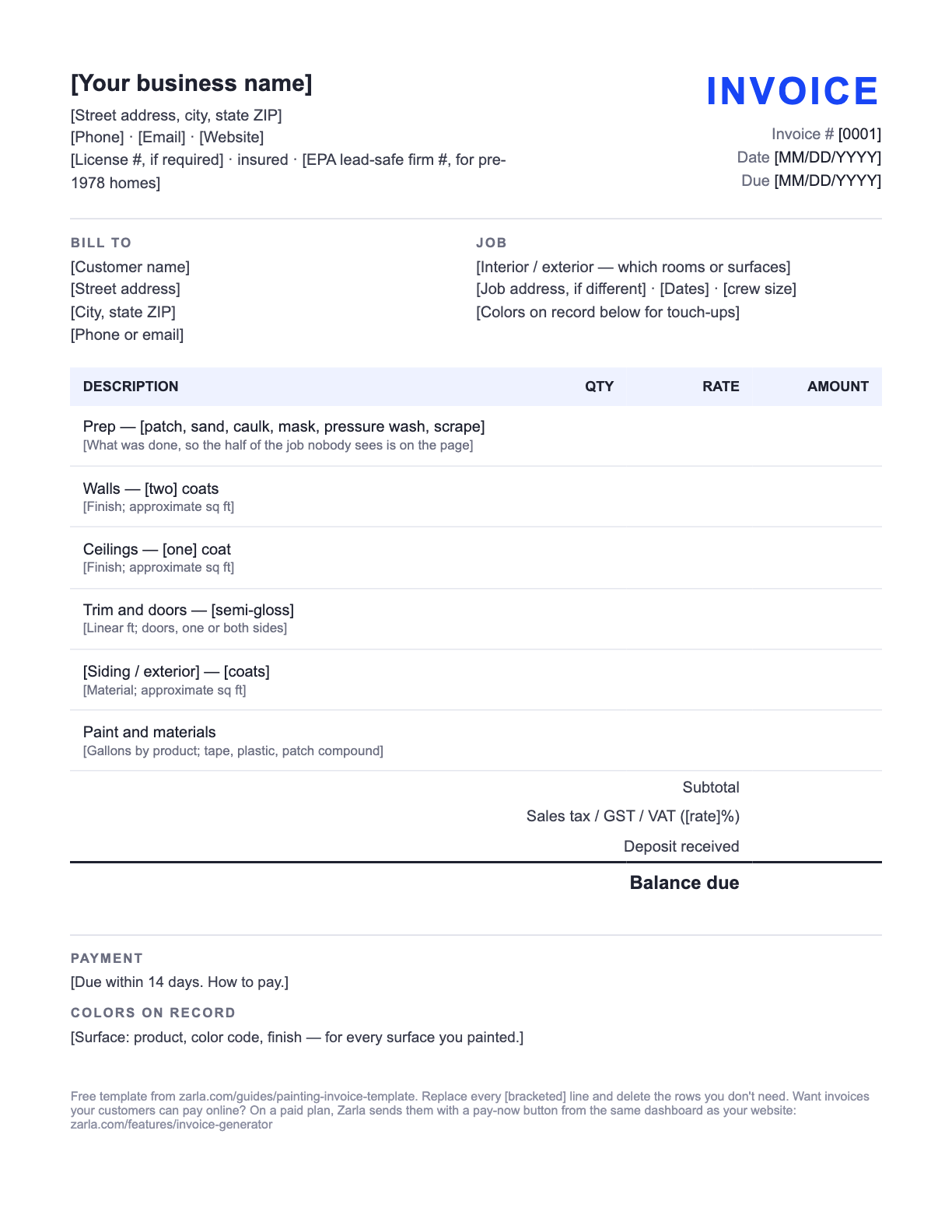
A painting invoice with prep on its own line, walls and ceilings by the square foot with the number of coats, trim and doors by the piece, paint and materials separate, and the colors recorded for touch-ups. Free in Word and PDF, with every line explained — interior or exterior.
Word and PDF · Free · No email, no sign-up
The short answer
A painting invoice lists the prep on its own line, then each surface — walls, ceilings, trim, doors, siding — with the square footage or the count and the number of coats, and the paint and materials on their own line with the products and colors named.
The prep line matters most: patching, sanding, caulking and masking are half the job and the half the customer never sees, so an invoice that says “prep — patched 14 holes, sanded, caulked, masked” is the one that gets paid without a question about the price.
Around it go your business details and license number where your state has one, the customer and the job address, an invoice number and due date, any deposit, tax where it applies and the balance due — plus the colors on record, so the touch-up call next year is a two-minute answer.
FREE TEMPLATE · WORD AND PDF
The painting invoice template, filled in
Below is the template filled in for Fresh Coat Painting Co., a fictional painting business, so you can see every line in use. The downloads are the same invoice with [bracketed] lines to replace — free, no email address, no sign-up.
Example · fictional business
Fresh Coat Painting Co. Nashville, TN (615) 555-0135 · hello@freshcoatnashville.example Licensed and insured · lead-safe certified firm (EPA RRP) | INVOICE |
Bill to Angela Moore 1208 Woodland St Nashville, TN | Job Interior — living room, hallway and three bedrooms Same address · Sep 23–25, 2026 · crew of 2 Colors on record below for touch-ups |
| Description | Qty | Rate | Amount |
|---|---|---|---|
| Prep — patch, sand, caulk and mask 14 nail holes and two dings patched; trim caulked; floors and fixtures masked | 1 | $420.00 | $420.00 |
| Walls — two coats Eggshell, about 1,860 sq ft | 1860 | $0.95 | $1,767.00 |
| Ceilings — one coat Flat ceiling white, about 640 sq ft | 640 | $0.55 | $352.00 |
| Trim and doors — semi-gloss Baseboards and casings in five rooms; 9 doors both sides | 1 | $540.00 | $540.00 |
| Paint and materials 8 gal eggshell, 3 gal ceiling flat, 2 gal semi-gloss; tape, plastic, patch compound | 1 | $436.00 | $436.00 |
| Subtotal | $3,515.00 | ||
| Sales tax, 7% on paint and materials (example) | $30.52 | ||
| Total | $3,545.52 | ||
| Deposit received | −$600.00 | ||
| Balance due | $2,945.52 | ||
Payment
Due within 14 days. Pay by card, check or bank transfer. Thank you for your business.
Colors on record
Walls: warm gray, eggshell. Ceilings: ceiling white, flat. Trim: bright white, semi-gloss. Product and color codes are on the paint cans we left in the garage; keep them for touch-ups.
Every figure on the example is an example, not a price guide — use your own rates. The Word file is a standard .docx you can edit in Word or any app that opens Word documents; the PDF prints as-is if you'd rather fill it in by hand.
Invoices and a website, one place
Start your painting website — invoicing is built in
Add your business name and your town, and Zarla builds your painting website from this one line. The same dashboard sends invoices like this one, with a pay-now button once you're on a paid plan.
Already have a website? Bring it across →Zarla keeps your old page addresses where it can and redirects the ones that change, helping you keep the Google standing you've built.
LINE BY LINE
What goes on a painting invoice
Every line on the template, in order, and what to write on it.
| The line | What to put there |
|---|---|
| Business name, contact, license and insurance | Your trading name, phone, email and address, a license number if your state licenses painting contractors (many do, above a job-value threshold), an insured line, and — if you work on pre-1978 homes — your EPA lead-safe certified firm number. |
| Invoice number, date and due date | A number that never repeats, the date you send it, and when it's due — 14 days is common for homeowners, 30 for property managers. |
| Bill to and job address | Who pays and where you painted; for rentals and flips the owner pays for work at another address, so list both. |
| Prep | On its own line with what it covered — patching, sanding, caulking, masking, scraping, pressure washing outside. It's half the job and the half nobody sees, so it's the line that explains the price. |
| Walls and ceilings | By the square foot with the finish and the number of coats, one line each. “Walls, two coats, eggshell, 1,860 sq ft” is a price a customer can check; “painting” is not. |
| Trim, doors and exterior surfaces | Trim by the linear foot or the room, doors by the count with one or both sides, siding by the square foot with the material — each with its finish and coats. |
| Paint and materials | Gallons by product plus tape, plastic and patch compound on one line. It's the line that's taxable in most states when the labor isn't. |
| Tax, deposit, total and balance due | Subtotal, sales tax where your state charges it on materials or labor, the deposit applied, and the balance due in bold. |
| How to pay and colors on record | How to pay and when, and the colors and products used for every surface — the note customers keep. |
STEP BY STEP
How to fill out a painting invoice
Fill it in on the last afternoon, from the estimate and the paint receipts.
Save your details, license and lead-safe line once
Business name, contact details, license number if your state has one, the insured line and your RRP firm number at the top, saved in the file.
Number and date it
The next number in your series, today's date and a due date the customer can see.
Describe the job
Interior or exterior, which rooms or surfaces, the job address if different, the dates and the crew size.
Bill the prep, then each surface
Prep with what it covered, then walls, ceilings, trim and doors by the square foot or the count with the coats stated.
Add paint and materials, tax and the deposit
Gallons by product and the sundries on one line, sales tax on what your state taxes, the deposit off, and the balance due in bold.
Record the colors and send it
Every surface's product, color and finish in the notes, and send it before you load the van — with a photo of the finished room.
How painters get paid faster
Put the prep on the page. Fourteen patched holes, caulked trim and a day of masking are the reason your price is what it is and the reason the job looks right. A customer who reads it pays it; a customer who sees “painting — $3,200” compares you with the quote that skipped the prep.
Take a deposit, bill the balance the last day. A deposit covers the paint; the balance is due when the masking comes off and the customer walks the rooms. Invoice while they're admiring it.
Record the colors on the invoice. Product, color, code and finish for every surface — it's the note customers pin to the fridge, and the reason they call you, not the hardware store, for the touch-up in two years.
Charge materials as materials. Paint on its own line, by the gallon and product, with the receipts available. It's honest, it's the line that's taxable where labor isn't, and it stops the “did you use the good paint?” question.
Lead-safe work on older homes. In the US, painting that disturbs paint in a home or child-occupied building built before 1978 falls under the EPA's Renovation, Repair and Painting rule: the firm must be EPA-certified, use lead-safe work practices and give the owner the EPA pamphlet before the work, and the invoice should show your firm certification number. Several states run their own RRP programs with the same shape. Check the EPA's RRP rule and your state's program.
Licensing and tax. In the US many states license painting contractors above a job-value threshold and some cities require a registration; put the number on the invoice where you have one. Sales tax depends on the state — most tax the paint you sell and not the labor, some tax both — so keep materials on their own line and check your state's revenue department or your accountant.
Outside the US. The invoice itself has rules: in Australia a GST-registered business issues a tax invoice showing its ABN, in New Zealand a GST-registered business shows its GST number, and in the UK and EU a VAT-registered business shows its VAT number and the VAT charged. Confirm the details with your accountant.
Send it from Zarla and get paid online
A Word template is a fine way to start. The catch is everything after you hit send: chasing the payment, remembering who's paid, and typing the same customer and the same line items again next month.
If you build your painting website with Zarla, the invoice tool is in the same dashboard. Pick the customer, add the job's lines, and send it. On a paid plan, with your Stripe account connected, the invoice carries a pay-now button: your customer pays online by card, and the invoice marks itself paid when the money arrives. Customers you've invoiced are saved, so next time is two taps.
Want to see the website first? Browse painting website templates or see how Zarla builds painting websites. Still setting up? Read how to start a painting business and write your painting business plan.
The whole paper trail of a job, step by step: the painting estimate template, then how to write a quote, then how to write an invoice, then how to write a receipt — with a free receipt template. For any other trade, start from the free invoice template. Either side of it, two more free templates in Word and PDF: a price list template for the services you sell and a work order template for the crew.
Heading into the holidays? Our free gift certificate template covers the customers who want to give your work as a gift, and the holiday hours sign template covers the door, your website and your Google profile.
Painting invoices: common questions
Your business name, contact details, license number where your state has one, an insured line and your lead-safe firm number if you work on pre-1978 homes; the customer and job address; an invoice number, date and due date; prep on its own line; each surface by the square foot or the count with the finish and the coats; paint and materials; subtotal, tax where it applies, the deposit and the balance due; how to pay; and the colors on record.
Price by the square foot or the piece to work out the number, then show it on the invoice as one line per surface with the size and the coats — customers accept “walls, two coats, 1,860 sq ft” faster than a lump sum, and the estimate and the invoice then match line for line. A flat job price is fine when you state the sizes.
Yes. Gallons by product with the sundries, at the price you quoted — materials plus a handling margin, or at cost with the markup in your labor. It's the line most states tax when the labor isn't, and it answers the question about which paint went on the walls.
In the US it depends on your state and city: many states license painting contractors above a job value — California at $1,000 including materials, as one example — and some cities require a registration below that. Check your state licensing board, and put the number on every invoice where you have one.
In the US the EPA's Renovation, Repair and Painting rule covers work that disturbs paint in homes and child-occupied buildings built before 1978: the firm must be certified, use lead-safe practices and give the owner the EPA pamphlet before starting. Put your certified-firm number on the invoice for those jobs; several states run their own version of the rule.
Always — product, color, code and finish for every surface, in the notes. It's the part of the invoice customers keep, and the reason they call you for the touch-up instead of guessing at the hardware store.
Yes. The painting invoice template on this page downloads free as a Word document and a PDF — no email address, no sign-up. Edit it in Word or any app that opens Word documents, or print the PDF and fill it in by hand.
Not from a Word file — your customer still has to pay you some other way. To take the payment on the invoice itself, send it from invoicing software. If your painting website is on Zarla, the invoice tool is in the same dashboard: on a paid plan, with Stripe connected, each invoice carries a pay-now button and marks itself paid when the customer pays by card.
Send invoices from your own painting website
Add your town and your business name, and Zarla builds the site from that one line — with invoicing in the same dashboard.
Already have a website? Bring it across →Zarla keeps your old page addresses where it can and redirects the ones that change, helping you keep the Google standing you've built.