PEST CONTROL MARKETING GUIDE
Pest control SEO: be found the night they see the mouse
Every item in a pest control SEO package, marked "Zarla does this for you" or "You do this," with what agencies charge for the work. For pest control owners who want more first calls — and more of them turning into plans.
Free to build · Pay when you publish
The short answer
Pest control SEO works pest by pest. People search for the problem — "termite inspection", "mice in walls", "bed bug treatment" — so you need a page for each pest and service, a page for each town you cover, a complete Google Business Profile, recent reviews, and your license and treatment approach where a worried homeowner can read them. Then turn one-time calls into recurring plans.
Agencies charge a monthly retainer for the online half: in Ahrefs' survey of 439 SEO providers, local SEO averaged $1,557 a month. Buying the lead instead costs too — in home & home improvement, one lead from search ads costs about $91.
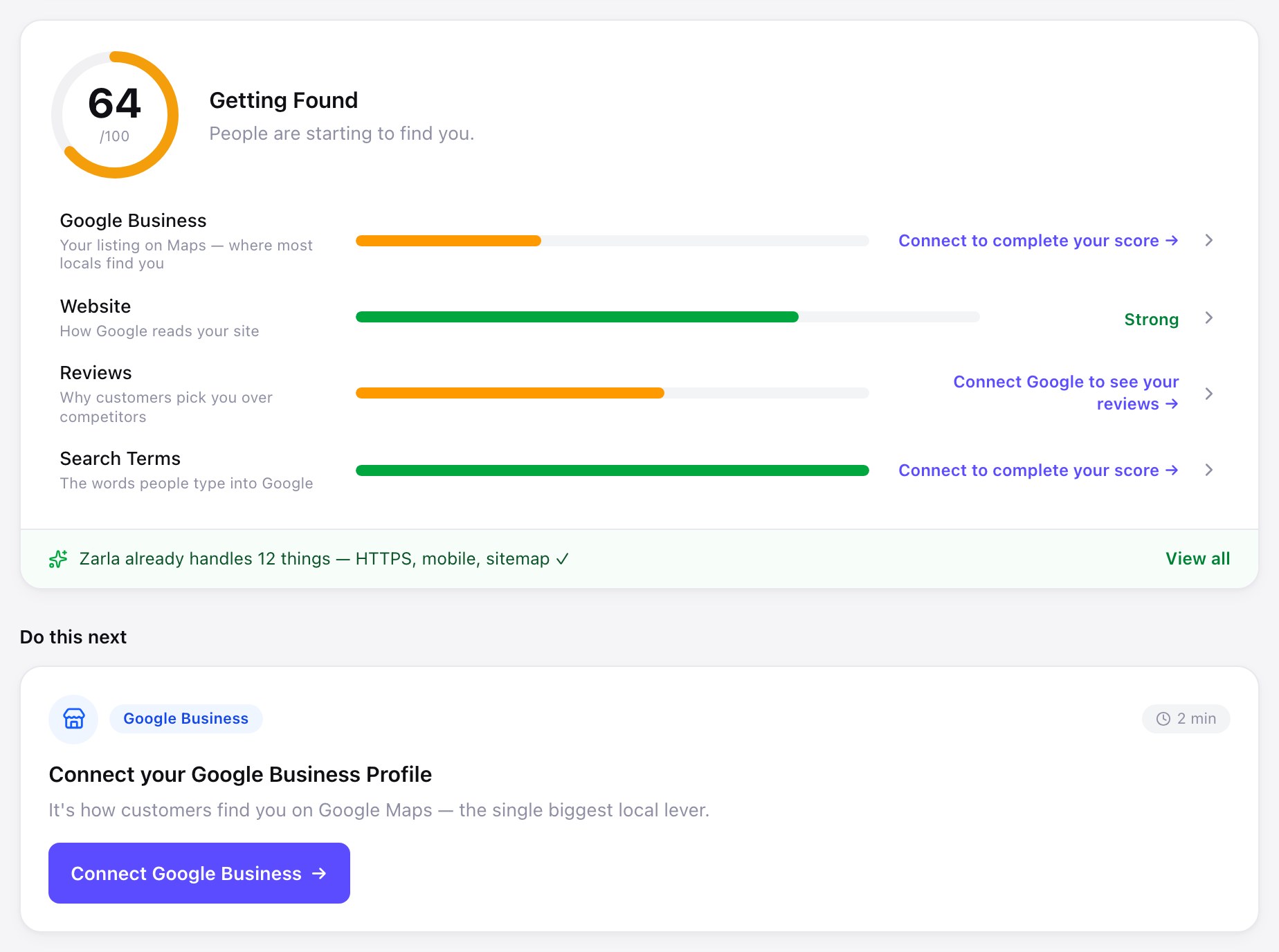
The website half — pest and service pages, town pages, titles, schema markup, fast pages and a sitemap — is setup Zarla does for you when it builds your site, and once you connect Google Search Console it sends that sitemap to Google too. The reviews, the inspections and the plans are yours.
Build the website
Start your pest control website now
Add your business name and your town to the sentence, and Zarla builds the site, with a page for each service and town you list. You edit it in chat and publish when you're ready.
Already have a website? Bring it across →Zarla keeps your old page addresses where it can and redirects the ones that change, helping you keep the Google standing you've built.
WHO DOES WHAT
The pest control SEO checklist — and who does each part
Twelve jobs cover what a pest control SEO package usually includes. Here is who does each one when your site is on Zarla.
| The job | Who does it — and what it takes |
|---|---|
| A page for every service you sell | Zarla does this for you. List your services — termite inspections and treatment, rodent control, bed bugs, ants, mosquitoes, wildlife removal, quarterly plans — and Zarla writes a separate page for each one after the first build. Google matches "bed bug treatment near me" to a page about exactly that, not to a list on your homepage. |
| A page for every town you cover | Zarla does this for you. Tell Zarla the towns and suburbs you work in and it writes a page for each one, so "pest control in [town]" has somewhere to land. You add the local detail only you know: the neighborhoods, the jobs you did there. |
| Titles, descriptions and schema markup | Zarla does this for you. Every page ships with a title, a meta description and structured data describing your business, plus a sitemap. You can choose the search phrase each page targets. |
| Fast pages on a phone | Zarla does this for you. Every publish sizes photos for phones and keeps pages light. A live Zarla-built site scored 100 in all four of Google's PageSpeed categories on 23 September 2026 — what a Zarla site can reach, not a promise for every page. |
| Send your sitemap to Google | Zarla does this for you. Connect Google Search Console from Get Found and Zarla checks the connection and submits your sitemap once the site is live. |
| Claim and verify your Google Business Profile | You do this. Keep the owner account in your name — Google lets others help manage a profile, but it should be verified to you, not to your website company. Pick "Pest control service" as your main category, add every service and the areas you cover. Add each pest you treat as a service — that's how people search. |
| Keep your website matching your Google profile | Zarla does this for you. Once you connect your profile, your business name, address, map location and reviews sync to the site, so the details Google compares match. |
| Ask for a Google review after every job | You do this. One of the biggest levers in the map results, and it has to come from you. Ask after the follow-up visit, once the problem's gone — that's when relief turns into five stars. Zarla gives you your review link, a printable QR code and ready-to-send messages, and your Google reviews then show on your site. |
| Show your license and how you treat | You do this. In the US, pesticide applicators are licensed by the state, and worried parents and pet owners want to know what you'll use. Put your license number and a plain explanation of your approach on the site — only what's true — and check your state pesticide agency's rules for what else must appear. |
| Get listed where customers check you out | You do this. BBB, Yelp, Angi, Nextdoor and the National Pest Management Association's directory if you're a member. Get Found's Listings tool gives you the exact details to paste and tracks what you've submitted. |
| Earn local links | You do this. Real estate agents and inspectors who need termite reports, property managers, restaurants you service, your state pest control association, the local news when you explain a pest season. Links from real local businesses are among the most expensive things agencies sell, and they come from relationships you already have. |
| Catch every lead and know where it came from | Zarla does this for you. Call buttons and a quote form built for pest control; every enquiry lands in one inbox; analytics count the phone taps and form submissions, not just visits. |
"Zarla does this for you" means it happens when Zarla builds or publishes your site, or once you connect your Google accounts — checked against the product in September 2026.
STEP-BY-STEP
How to do pest control SEO yourself, in 6 steps
People search for the pest, not the company. These steps put a page, a profile and a review in front of every one of those searches.
Claim and complete your Google Business Profile
Claim your profile on Google Maps and finish verification. Choose Pest control service as the main category, add each pest and service, set your service area, and post photos of your team and vehicles.
You do thisBuild a site with a page for every pest and town
Describe your pest control company in a sentence and Zarla builds the site, then writes a separate page for each service and each town you list, with titles, schema markup and a sitemap already in place. List each pest you treat as its own service so each gets a page.
Zarla does this for youWrite for the season before it starts
Termite swarms, spring ants, summer mosquitoes, fall rodents — every region has a calendar. Add a line of local detail to each pest page a month before its season, and post it on your Google profile when it starts.
You do thisAsk for a review after the follow-up
Text your Google review link after the follow-up visit, once the customer knows the problem is gone. Ask them to mention the pest; "got rid of our mice in two visits" is the review the next worried homeowner is looking for.
You do thisTurn one-time calls into plans
Offer a quarterly or annual plan on every one-time job, and give the plan its own page with what's included. Plan customers are the steadiest revenue in the trade, and they leave the most reviews.
You do thisCheck what's working once a month
Your Zarla dashboard shows the Google searches that bring people to your site and how many calls and quote requests came in; the free AI visibility check shows what ChatGPT and Google's AI say about pest control companies in your area. Then fix one thing a month: the next pest page, the next ten reviews, the next referral partner.
You do thisWhere pest control customers actually come from
Pest control has two very different buyers: the panicked one who just saw something in the kitchen, and the planner who wants the house protected all year. Winning both is what builds a steady business.
- Urgent searches. "Exterminator near me" and "bed bug treatment [town]" are searched and called within minutes. A complete profile, recent reviews and a phone that gets answered decide who wins.
- Real estate. Many US home sales include a wood-destroying insect inspection, often required by the lender. Agents and inspectors who trust you send those jobs every month.
- Commercial accounts. Restaurants, warehouses, schools and property managers need regular service and proof of it. One account can be worth dozens of homes.
- Plans and renewals. The customers you already have are the cheapest ones to keep. A clear plan page and a reminder before each visit keep them on the books.
- Google Local Services Ads. The ads at the very top of the page, paid per lead rather than per click after Google checks your business. They show your rating, so reviews come first.
Every one of these channels ends in the same place: someone looking you up before they call. That's why the website and the Google profile come first — our guide to getting your business on Google walks through the profile step by step. Want to know if ChatGPT names you when someone asks for an exterminator? Read how to get your business recommended by ChatGPT, or run the free AI visibility check.
What this costs if you pay someone else
When a pest control marketing agency is worth it — and what to ask one
Pest control is a competitive, well-funded category in many cities, and larger operators with several routes can get real value from an agency running ads. For a smaller company, a monthly retainer mostly pays for setup — pest pages, schema markup, a Google profile — that happens once.
Before you sign, ask five questions:
- What exactly will you do each month? A list of tasks, not "optimization."
- Who owns the website and the Google profile? It should be you, in writing. Never let an agency be the only owner of your Google Business Profile.
- Is it month to month? Twelve-month contracts protect the agency, not you.
- How will I see results? Calls and booked jobs, not "impressions."
- Do you guarantee a ranking? If the answer is yes, walk away. Nobody controls Google's results, and anyone promising #1 is guessing with your money.
Common questions about pest control SEO
Mostly from people searching for a specific pest, from referrals, and from real estate agents and inspectors. A complete Google profile, reviews that mention the pest, and a page for every pest and town catch the searches; relationships with agents, inspectors and property managers bring steady repeat work. Compare every paid option with buying the lead: in home & home improvement, one lead from search ads costs about $91 (Industry average · LocaliQ 2026 benchmark).
The pest plus the place: "termite inspection [town]", "mice exterminator near me", "bed bug treatment [city]", "mosquito control". Give each pest its own page and each town its own page, and use the words customers use — "mice in the walls", not "rodent exclusion services".
In Ahrefs' survey of 439 SEO providers (last updated August 2024), local SEO averaged $1,557 a month, and the most common retainer band was $501–$1,000. Pest control specialists often quote more. Most of the technical setup — service pages, town pages, schema markup, a sitemap — now comes with a good website builder.
Yes — especially because pest control customers can stay on a plan for years, so one found customer is worth far more than one job. Google's AI answers and ChatGPT now also answer "who should I call?", and in our own checks the businesses ChatGPT names carry the ratings and review counts from their Google profiles. The same work feeds both.
Yes. In the US, commercial pesticide applicators are licensed or certified by the state, and customers — especially parents and pet owners — want to see it. Put the license number in your trust strip and explain your treatment approach plainly. Requirements differ by state, so check your state's pesticide regulatory agency.
There's no honest fixed timeline. Profile updates and new reviews can help in the map results fairly quickly; new pest and town pages take months rather than weeks to be found and earn their place. Publish seasonal pages a month or two before each pest's season.
Yes. Your Google profile, reviews and referral relationships need you anyway. The technical part — service and town pages, titles, schema markup, fast pages, a sitemap sent to Google once you connect Search Console — is what Zarla does when it builds your site.
Be fast and easy to work with. Agents and home inspectors need wood-destroying insect reports on a deadline, so give them a direct number, a clear turnaround time and a simple way to book — and say all three on a dedicated real-estate inspections page they can send clients to. Visit local brokerages, ask to be on their preferred-vendor list, and follow up after every closing. Requirements for these reports vary by state and loan type, so check which forms your state and the lenders you work with expect.
Get a page up for every pest you treat.
Add your business name and your town to the sentence. Zarla builds the site, writes a page for every service and town, and ships the SEO basics on every page. Free to build and preview; Premium publishes to your own domain.
Already have a website? Bring it across →Zarla keeps your old page addresses where it can and redirects the ones that change, helping you keep the Google standing you've built.