CONTRACTOR MARKETING GUIDE
SEO for contractors: win the jobs worth driving to
What a contractor SEO package really includes, every item marked "Zarla does this for you" or "You do this," with what agencies charge for the work. For general contractors and remodelers who want fewer tire-kickers and more signed contracts.
Free to build · Pay when you publish
The short answer
SEO for contractors is about proof. People planning a kitchen remodel, an addition or a new build read for weeks before they call, so you need a complete Google Business Profile, a page for each type of project you take on and each town you work in, project pages with real photos, reviews that describe the whole experience, and your license and insurance on show.
Agencies charge a monthly retainer for this — in Ahrefs' survey of 439 SEO providers, local SEO averaged $1,557 a month. Buying leads isn't cheaper: in construction & contracting, one lead from search ads costs about $166.
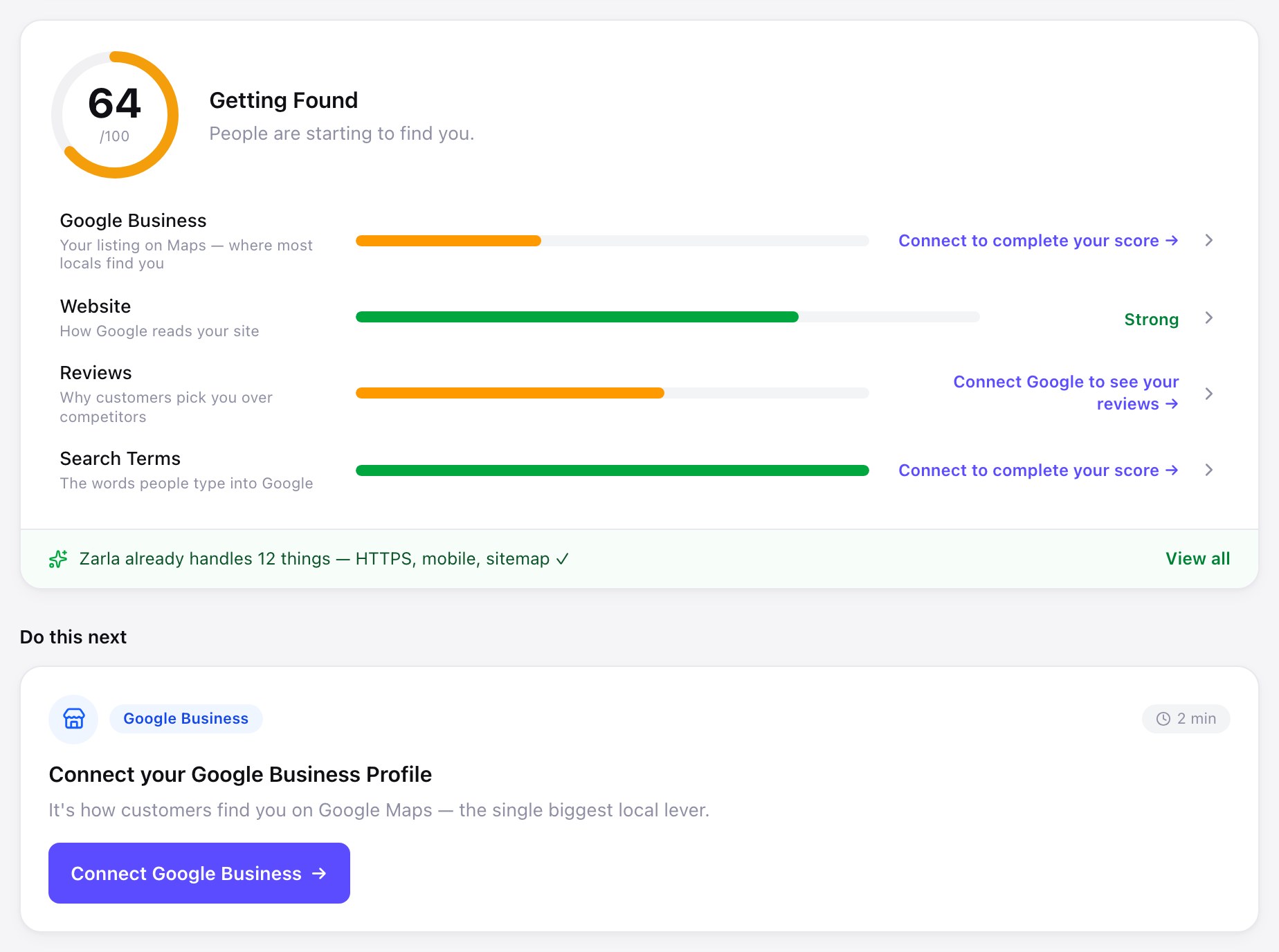
The website half — project and service pages, town pages, titles, schema markup, fast pages and a sitemap — is setup Zarla does for you when it builds your site, and once you connect Google Search Console it sends that sitemap to Google too. The proof is yours: the photos, the reviews, the relationships with architects and suppliers.
Build the website
Start your contractor website now
Add your business name and your town to the sentence, and Zarla builds the site, with a page for each service and town you list. You edit it in chat and publish when you're ready.
Already have a website? Bring it across →Zarla keeps your old page addresses where it can and redirects the ones that change, helping you keep the Google standing you've built.
WHO DOES WHAT
The contractor SEO checklist — and who does each part
Twelve jobs cover what a contractor SEO package usually includes. Here is who does each one when your site is on Zarla.
| The job | Who does it — and what it takes |
|---|---|
| A page for every service you sell | Zarla does this for you. List your services — kitchen remodels, bathroom remodels, home additions, basement finishing, decks, new builds — and Zarla writes a separate page for each one after the first build. Google matches "home addition contractor near me" to a page about exactly that, not to a list on your homepage. |
| A page for every town you cover | Zarla does this for you. Tell Zarla the towns and suburbs you work in and it writes a page for each one, so "general contractor in [town]" has somewhere to land. You add the local detail only you know: the neighborhoods, the jobs you did there. |
| Titles, descriptions and schema markup | Zarla does this for you. Every page ships with a title, a meta description and structured data describing your business, plus a sitemap. You can choose the search phrase each page targets. |
| Fast pages on a phone | Zarla does this for you. Every publish sizes photos for phones and keeps pages light. A live Zarla-built site scored 100 in all four of Google's PageSpeed categories on 23 September 2026 — what a Zarla site can reach, not a promise for every page. |
| Send your sitemap to Google | Zarla does this for you. Connect Google Search Console from Get Found and Zarla checks the connection and submits your sitemap once the site is live. |
| Claim and verify your Google Business Profile | You do this. Keep the owner account in your name — Google lets others help manage a profile, but it should be verified to you, not to your website company. Pick "General contractor" as your main category, add every service and the areas you cover. Add remodeling and construction services one by one, not as a single line. |
| Keep your website matching your Google profile | Zarla does this for you. Once you connect your profile, your business name, address, map location and reviews sync to the site, so the details Google compares match. |
| Ask for a Google review after every job | You do this. One of the biggest levers in the map results, and it has to come from you. Ask at handover, and ask for a photo with the review — a finished kitchen says more than five stars. Zarla gives you your review link, a printable QR code and ready-to-send messages, and your Google reviews then show on your site. |
| A project page for every job worth showing | You do this. Before-and-after photos, the town, the scope, how long it took and what made it tricky. This is the content big-ticket customers read most, and only you have it. Add recent jobs from your dashboard and they appear on your site. |
| Get listed where customers check you out | You do this. Houzz, BBB, Yelp, Angi, Nextdoor and your local builders' association directory if you're a member. Get Found's Listings tool gives you the exact details to paste and tracks what you've submitted. |
| Earn local links | You do this. Your suppliers' and cabinet makers' "find a contractor" pages, the architects and designers you work with, the builders' association, the chamber of commerce, local news about a project. Links from real local businesses are among the most expensive things agencies sell, and they come from relationships you already have. |
| Catch every lead and know where it came from | Zarla does this for you. Call buttons and a quote form with room to describe the project; every enquiry lands in one inbox; analytics count the phone taps and form submissions, not just visits. |
"Zarla does this for you" means it happens when Zarla builds or publishes your site, or once you connect your Google accounts — checked against the product in September 2026.
STEP-BY-STEP
How to do contractor SEO yourself, in 6 steps
Big jobs are researched for weeks. These steps put your proof in every place a homeowner looks during those weeks.
Claim and complete your Google Business Profile
Claim your profile on Google Maps and finish verification. Choose General contractor (or the category closest to your main work), add each type of project as its own service, set the towns you cover, and upload photos of finished projects — not stock images.
You do thisBuild a site with a page for every project type and town
Describe your contracting business in a sentence and Zarla builds the site, then writes a separate page for each service and each town you list, with titles, schema markup and a sitemap already in place. Add your license number, insurance and warranty to the trust strip.
Zarla does this for youPublish a project page for every job worth showing
Take before, during and after photos on every job. Write a short page for the good ones: the town, the scope, the timeline, one problem you solved. "Kitchen remodel in Naperville — load-bearing wall removed" is the kind of page a homeowner in Naperville finds and trusts.
You do thisAsk for a review at handover
The walkthrough at the end of a job is the moment. Send your Google review link the same day and ask the client to mention the project and how the process felt — communication, cleanliness, staying on budget are what the next client worries about.
You do thisTurn your network into links and referrals
Architects, interior designers, suppliers, cabinet shops and real estate agents all send work to contractors they trust, and many list them on their websites. Ask. Join your local builders' association and chamber of commerce — both usually list members online.
You do thisCheck what's working once a month
Your Zarla dashboard shows the Google searches that bring people to your site and how many calls and quote requests came in; the free AI visibility check shows what ChatGPT and Google's AI say about contractors in your area. Then fix one thing a month: the next project page, the next five reviews, the next partner link.
You do thisWhere contractor leads actually come from
General contracting runs on trust, because the jobs are big and the stakes are personal. Most homeowners hire from a short list they built over weeks, and every name on that list got there a different way.
- Referrals. Still the biggest source for most contractors — and every referral looks you up online before calling. A strong site and profile turn a friend's recommendation into a signed contract.
- Search and the map results. "Kitchen remodel [town]" and "general contractor near me" are searched by people ready to get quotes. Project pages and town pages are what rank for them.
- Houzz and design sites. Homeowners collect ideas on Houzz and similar sites, and a profile with real project photos puts your work in front of them.
- Architects, designers and suppliers. The trade relationships that send the best-fit jobs, and often a link from their website too.
- Shared-lead services. Angi and similar services can fill the calendar, but the same request usually goes to several contractors and big-project buyers rarely choose on who called first. Use them sparingly.
Every one of these channels ends in the same place: someone looking you up before they call. That's why the website and the Google profile come first — our guide to getting your business on Google walks through the profile step by step. Want to know if ChatGPT names you when someone asks for a general contractor? Read how to get your business recommended by ChatGPT, or run the free AI visibility check.
What this costs if you pay someone else
When a contractor marketing agency is worth it — and what to ask one
An agency makes sense when you're running several crews, targeting a big competitive metro, or selling to commercial clients who expect polished proposals and case studies. It rarely makes sense to pay a retainer for a small remodeling company's basics: project pages, a complete profile and schema markup are setup, and the photos and reviews that matter most have to come from you anyway.
Before you sign, ask five questions:
- What exactly will you do each month? A list of tasks, not "optimization."
- Who owns the website and the Google profile? It should be you, in writing. Never let an agency be the only owner of your Google Business Profile.
- Is it month to month? Twelve-month contracts protect the agency, not you.
- How will I see results? Calls and booked jobs, not "impressions."
- Do you guarantee a ranking? If the answer is yes, walk away. Nobody controls Google's results, and anyone promising #1 is guessing with your money.
Common questions about SEO for contractors
Yes. A single remodel or addition is worth thousands, and the people planning one research online for weeks. The alternative — buying leads — costs money every time: in construction & contracting, one lead from search ads costs about $166 (US average · LocaliQ 2025 benchmark). What's changed is that Google's AI answers and ChatGPT now sit beside the classic results, and both lean on the same signals: your Google profile, your reviews and a website that clearly shows your work.
It means two different things. It can mean a freelancer you hire to do SEO — an "SEO contractor" — or SEO for contractors, which is what this guide covers: getting a contracting business found by homeowners searching for its services. If you're hiring an SEO contractor, the five questions in the agency section above apply.
In Ahrefs' survey of 439 SEO providers (last updated August 2024), local SEO averaged $1,557 a month — $1,819 at agencies, about $1,150 for freelancers — and hourly rates most often ran $75–$100. Contractor-specialist agencies often quote more. Ask how much of any quote is one-time setup, like service pages and schema markup, that your website builder may already handle.
Yes. The parts that matter most — your Google profile, project photos, reviews and trade relationships — need you anyway. The technical setup is what owners used to hire for, and a modern builder handles it: Zarla writes the service and town pages, adds titles and schema markup, keeps the pages fast and sends your sitemap to Google once you connect Search Console.
It can help with the writing — drafting a project description or a review reply. It can't verify your Google profile, take your photos or earn your reviews, and those decide local results. In our own checks, the local businesses ChatGPT recommends carry the ratings and review counts from their Google profiles, so the real-world work comes first.
Roughly 20% of the work brings roughly 80% of the results. For a contractor, that 20% is a complete Google profile, project pages with real photos, and reviews from recent clients. Blogging and link campaigns come after.
There's no honest fixed timeline. Profile updates and new reviews can show up fairly quickly; new pages take months rather than weeks to be found and earn their place, depending on your area's competition. Because contracting jobs have long buying cycles, measure over a season: calls, quote requests and signed jobs.
Yes — it's one of the first things a careful homeowner checks. In the US, several states, including California and Florida, require contractors to show their license number in advertising. Rules differ by state and license type, so check your state licensing board's advertising requirements.
Put your best projects where homeowners look.
Add your business name and your town to the sentence. Zarla builds the site, writes a page for every service and town, and ships the SEO basics on every page. Free to build and preview; Premium publishes to your own domain.
Already have a website? Bring it across →Zarla keeps your old page addresses where it can and redirects the ones that change, helping you keep the Google standing you've built.