Done by AI · not an agency

Medical website design by AI, for family practices, pediatricians, urgent care and specialists.

Brief Zarla the way you'd brief a web designer. Its AI designs your site in about 30 seconds, with a request-a-visit form and call buttons, then adds pages for the visits you offer and the towns you serve, up to your plan's page limit. No sales call, no weeks-long build.

Your brief: add your town

No credit card · Pay when you publish

Already have a website? Bring it across →

Plainsway Urgent Care: a sample walk-in urgent care website design
Cornerstone Family Medicine: a sample family medicine practice website design
Kettleby Direct Primary Care: a sample direct primary care practice website design
Plainsway Urgent Care: a sample walk-in urgent care website design
Cornerstone Family Medicine: a sample family medicine practice website design
Kettleby Direct Primary Care: a sample direct primary care practice website design

Sample designs

Looks like a $5,000 agency website. Judge for yourself.

Six Zarla designs, shown for made-up medical practices, from a walk-in urgent care to a geriatric practice. Start from one and the AI rewrites it around yours, or let your brief decide.

Cornerstone Family Medicine: a sample family medicine practice website design

Family medicine

Cornerstone Family Medicine

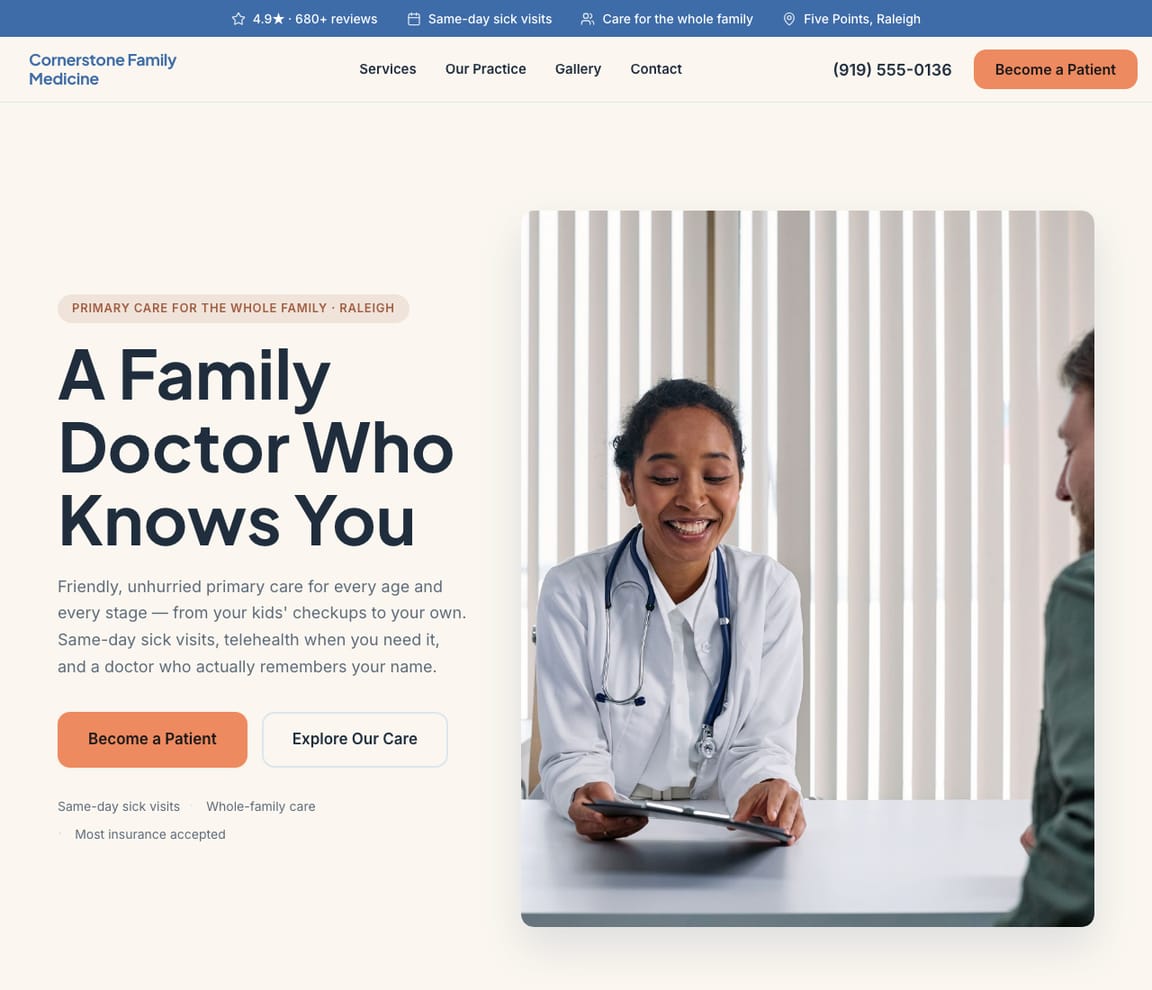
'A Doctor Who Knows You · Whole-Family Care' above 'Family Doctor in Raleigh, NC', 'Same-day sick visits' and 'Most insurance accepted' in the trust bar and 'Become a Patient' as the button, for the practice that wins on knowing the whole family.

Pendrell Pediatrics: a sample pediatric practice website design

Pediatrics

Pendrell Pediatrics

A photo collage of a pediatrician with a toddler, 'Newborns To 18 · Accepting New Patients' above 'Local Pediatrician in Sioux Falls, SD', a '24/7 nurse line' in the trust bar and 'Book A Visit' as the button, for the practice chosen by a parent at 2 AM.

Plainsway Urgent Care: a sample walk-in urgent care website design

Urgent care · save your spot

Plainsway Urgent Care

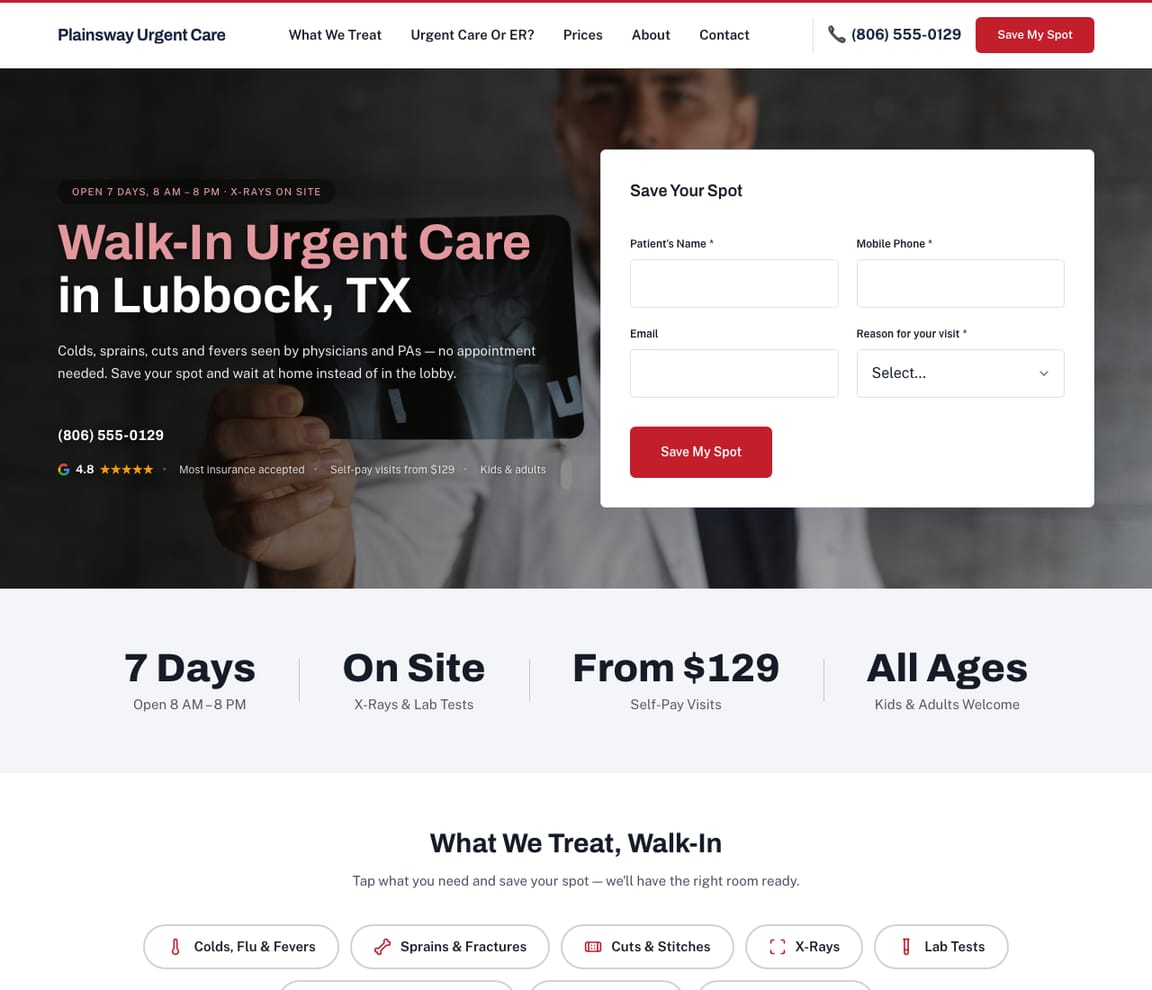
A 'Save Your Spot' form beside 'Walk-In Urgent Care in Lubbock, TX', 'Open 7 Days, 8 AM – 8 PM · X-Rays On Site' above the headline and 'Self-pay visits from $129' in the trust bar, for the clinic nobody browses.

Kettleby Direct Primary Care: a sample direct primary care practice website design

Direct primary care · price first

Kettleby Direct Primary Care

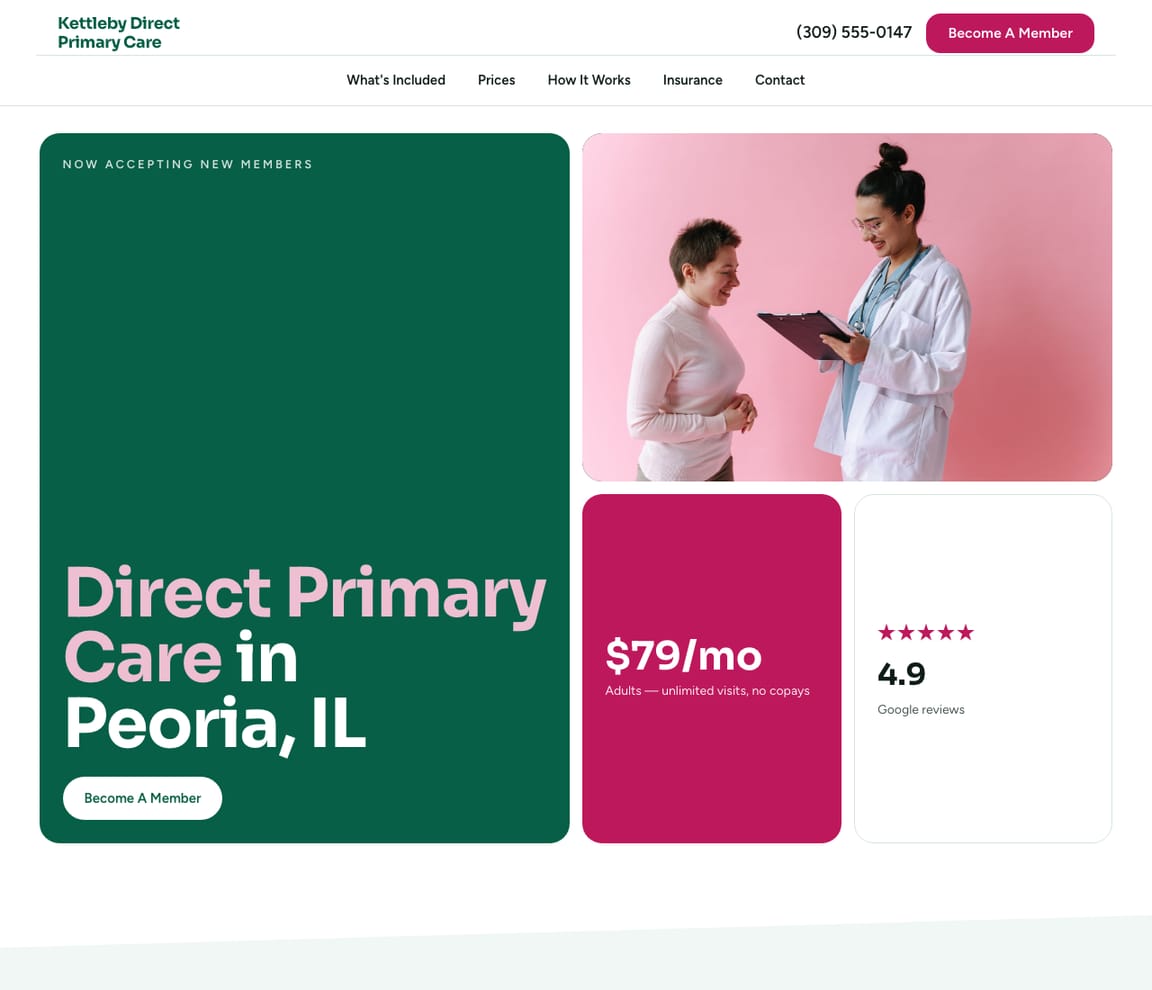
A bento first screen with a '$79/mo' tile beside 'Direct Primary Care in Peoria, IL', 'Now Accepting New Members' above it and 'Become A Member' as the button, for the practice that sells the membership, not the visit.

Fernmoor Internal Medicine: a sample internal medicine practice website design

Internal medicine · credentials

Fernmoor Internal Medicine

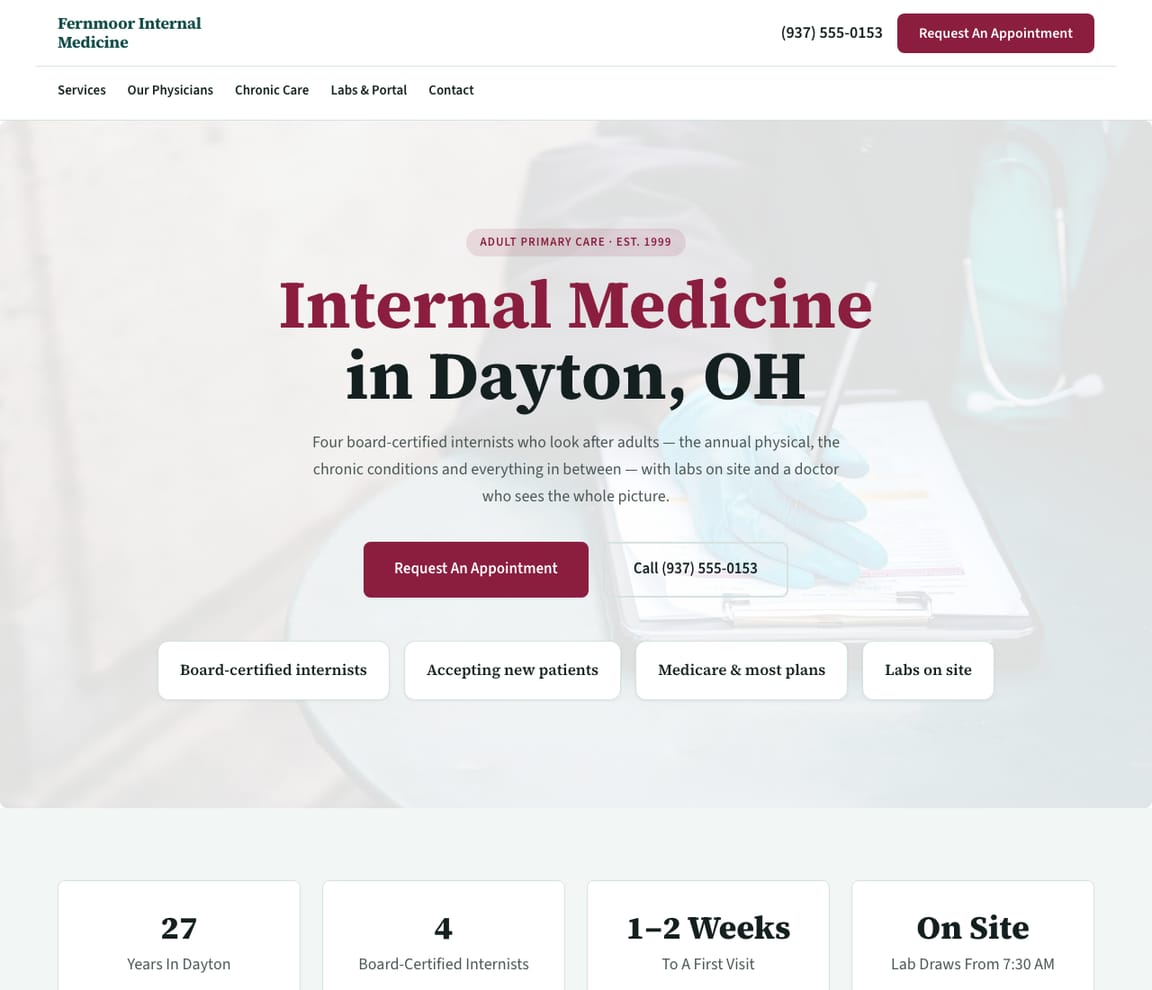
'Adult Primary Care · Est. 1999' over 'Internal Medicine in Dayton, OH', four trust cards ('Board-certified internists', 'Accepting new patients', 'Medicare & most plans', 'Labs on site') and 'Request An Appointment' as the button.

Bellcroft Senior Medicine: a sample senior primary care practice website design

Geriatrics · large type

Bellcroft Senior Medicine

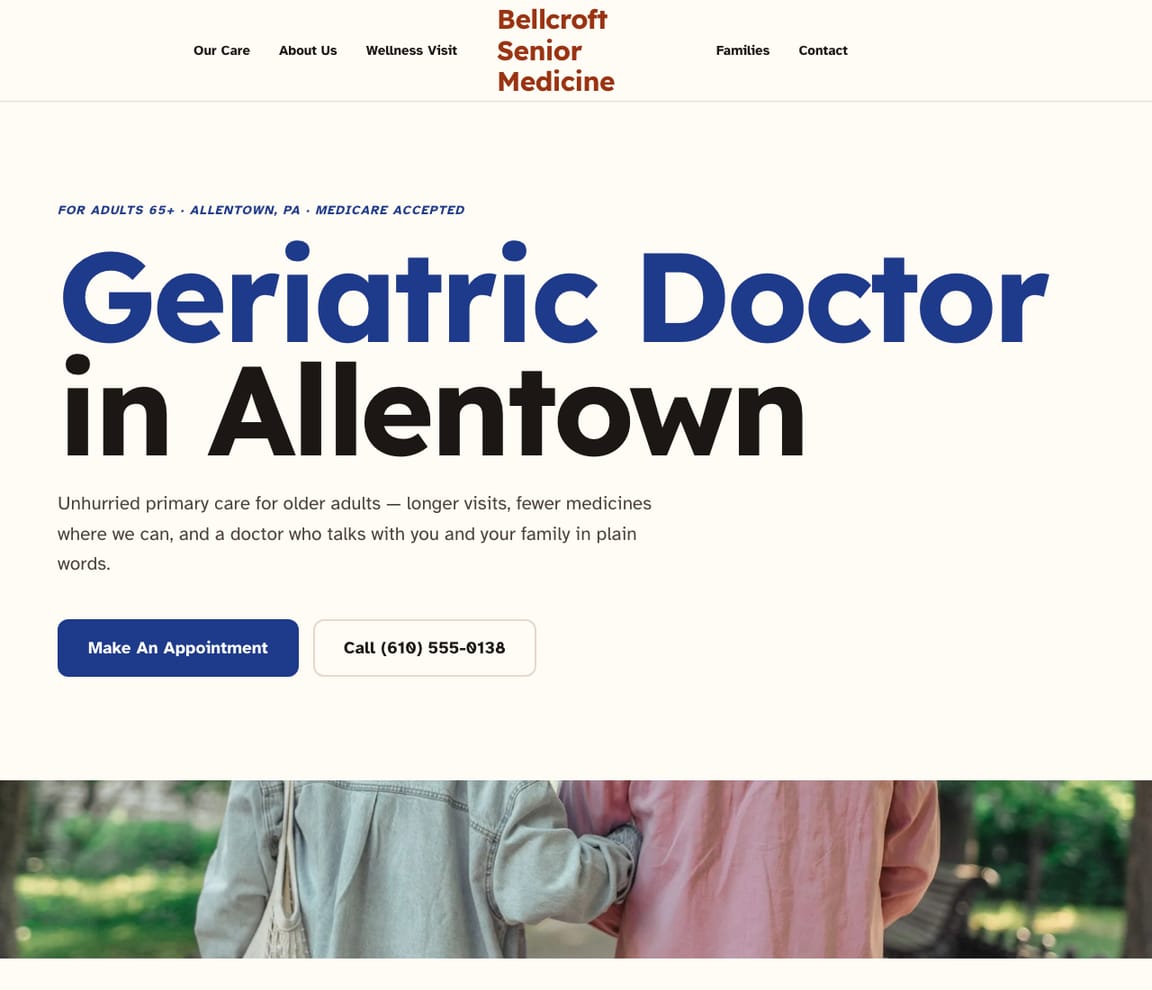
Giant type reading 'Geriatric Doctor in Allentown' under 'For Adults 65+ · Allentown, PA · Medicare Accepted', a 'Built For Older Adults' section (no stairs, longer visits, large-print papers) and 'Make An Appointment' as the button.

The checklist

What every medical practice website needs

What a good medical practice website is laid out like, from the first screen down: six things it needs to turn a search into a booked first visit, each shown on one of Zarla's designs.

  1. 01

    A save-your-spot form in the first screen, where a business puts its quote form

    A patient with a fever reads on a phone at 9 PM. A form beside the headline asking the patient's name, a mobile number and the reason for the visit lets them hold a place and wait at home instead of in the lobby, and the hours, the days you're open and what's on site sit in the line above the headline, so nobody drives over to find you closed.

    Plainsway Urgent Care: a 'Save Your Spot' form beside 'Walk-In Urgent Care in Lubbock, TX' asking Patient's Name, Mobile Phone, Email and 'Reason for your visit', with 'Open 7 Days, 8 AM – 8 PM · X-Rays On Site' above the headline and 'Save My Spot' as the button
  2. 02

    'Accepting new patients' and the plans you take, in the top strip

    The two questions before anyone calls a practice are 'are you taking new patients' and 'do you take my insurance'. Answer both in the strip above the header, with the physicians' certification and what's on site beside them, and the request form underneath asks for the plan name, so the front desk calls back with a date, not a question.

    Fernmoor Internal Medicine: 'Board-certified internists', 'Accepting new patients', 'Medicare & most plans' and 'Labs on site' as four trust cards under 'Internal Medicine in Dayton, OH', with 'Request An Appointment' as the main button and 'Your insurance plan and best times to call' as a field on the form
  3. 03

    How switching doctors works, in three steps

    Most new patients already have a doctor they're leaving, and the records transfer is what stops them. A short 'becoming a patient' section that says book online, fill in one form ahead of the visit and we'll request your records from your last practice removes the reason to put it off, and the first visit becomes the easy part.

    Cornerstone Family Medicine: 'Become a Patient' as the button under 'Family Doctor in Raleigh, NC', and a 'Becoming a Patient Is Easy' section whose steps are 'Book Online', 'Quick Onboarding' (a simple form ahead of time and help transferring your records), 'Meet Your Doctor' and 'Ongoing Care'
  4. 04

    What a visit costs when insurance isn't paying

    A high deductible turns an insured patient into a self-pay one, and a page that is silent about money loses both. A membership practice belongs with its monthly fee in the first screen and a tile that says what the fee covers (unlimited visits, no copays); a practice that bills plans can still print a self-pay price for the common visits beside the plans it takes, so the patient with no coverage knows the visit is affordable before they call.

    Kettleby Direct Primary Care: a '$79/mo · Adults — unlimited visits, no copays' tile beside 'Direct Primary Care in Peoria, IL', 'Now Accepting New Members' above the headline and a 'What Your Membership Includes' section listing unlimited visits, same- or next-day appointments, texting your doctor and labs at cost
  5. 05

    The ages you see and the 2 AM nurse line, in the first screen

    Nobody reads a pediatric site calmly: it is a parent at night with a feverish toddler, or a new parent choosing a practice before the baby arrives. Put the age range and 'accepting new patients' in the line above the headline, the night nurse line in the opening sentence and the same-day policy in the trust bar, and let the form ask the child's age, so the right first visit gets booked without a call back and forth.

    Pendrell Pediatrics: 'Newborns To 18 · Accepting New Patients' above 'Local Pediatrician in Sioux Falls, SD', 'a nurse line that answers at 2 AM' in the opening line, 'Most insurance plans', 'Same-day sick visits, most days' and '24/7 nurse line' in the trust bar, and a 'Request A Visit' form asking 'Your child's age and best times to call'
  6. 06

    Intake in your portal, not on the website, and a page built for the patient you see

    Keep the website's form to who to call, when and what the visit is about, and send health history, results and messages through the patient portal you already link to. In the US, a website form that collects symptoms, medical history or insurance details is health information under HIPAA, which needs a provider that signs a business associate agreement, and Zarla doesn't sign one; check with your state medical board and your compliance advisor for what a practice website must display and never promise an outcome. Then shape the page for the patient you actually see: an older patient wants big type, longer visits and a family member welcome, said plainly.

    Bellcroft Senior Medicine: 'For Adults 65+ · Allentown, PA · Medicare Accepted' above giant type reading 'Geriatric Doctor in Allentown', a 'Built For Older Adults' section ('Longer Visits · Around 40 minutes', 'Family Welcome', 'Large-Print Papers') and a 'Request A Call Back' form asking the patient's name, the best phone number, an optional email, what you'd like help with and 'Who are we calling, and when?'

Process and turnaround

How it works, and how long each step takes

For comparison, from the pages of web designers who build medical practice sites: 4–6 weeks for a 12–20 page site and 8–10 weeks for a multi-location practice at a local studio; 4–6 weeks or more at a healthcare marketing agency, depending on the features and your approvals; the practice website company and the practice website platform don't publish one; a healthcare agency's cost guide puts a pre-built theme at 2–4 weeks and a custom build at 4–12 weeks, and a cost-estimate guide says 8–14 weeks for a small practice.

  1. About a minute

    1. The brief

    Finish one sentence about your practice: the kind of medicine, who you see and where.

  2. About 30 seconds

    2. First design

    Zarla's AI designs your home page with call buttons and a quote form, then adds pages for your visits (physicals and checkups, sick visits, chronic care, vaccines, telehealth) and the towns you serve, up to your plan's page limit.

  3. As long as you like

    3. Change it

    Click any section to swap in your physicians, your waiting room and the plans you accept. Or type it: "add a page for Medicare wellness visits."

  4. The same day

    4. Launch

    Publish on a Premium or Business plan and connect your domain.

What's included

What you get from your first brief

  • The design. Layout, colors, fonts and photos picked for a medical practice.
  • The words. Headlines, service descriptions and FAQs written from your brief. Edit any of it.
  • Service and area pages. Pages for each kind of visit (physicals and checkups, sick visits, chronic care, vaccines, telehealth, pediatrics) and the towns you serve.
  • Quote request form. A patient tells you the kind of visit, a preferred time and how to reach them, and it lands in your leads inbox, with an email alert. Customers can attach up to five photos of the job to the form, so you can often price it from the photos instead of a site visit. The form doesn't work out a price for you — you read the request and quote it yourself. Then send your quote from Zarla as one link: the customer accepts it online, and Zarla drafts the invoice for what they chose.
  • Tap-to-call buttons. On every page, for the patient who'd rather ask whether you take their plan out loud.
  • Google groundwork. Titles, descriptions, business markup and a sitemap on every page, and fast pages on phones.
  • Your Google reviews and listing. Connect your Business Profile and your rating, reviews and map show on the site.
  • Hosting on Google Cloud, with SSL. Nothing to set up.Premium
  • Your own domain. Connect the one you have or buy one inside Zarla.Premium

Revisions

No revision rounds. No hourly rate.

A healthcare marketing agency has you make changes in its CMS or ask its help desk; a practice website company includes updates by request, up to 1 hour a month, in its $89 monthly fee; a local studio bills edits at $250 an hour; the practice website platform doesn't publish its terms. With Zarla you make the changes yourself, whenever you want.

Click to edit

Change any section's words, photos, colors or order yourself. As often as you like, on every plan. No AI involved.

Or type the change

Type what you want and the AI makes the change. Typed changes use AI credits: a starter allowance on Free, a monthly allowance on Premium and Business, with a daily limit.

Change the whole design

Move to a different design any time and keep your words, photos and pages. Layout, colors and fonts change; your content isn't rewritten.

Prices

What medical website design costs in 2026

Prices web designers and practice website platforms publish on their own websites for medical practice sites, checked 3 November 2026. Many only quote after a call. Not like-for-like: an agency's price includes people.

WhoUpfrontOngoingTime to launchChanges after launch
A healthcare marketing agency in Tustin, CA (its medical web design page)A site with CMS access, hosting, appointment request forms and online patient intake forms on a monthly fee; add-ons from the same figure; you own the siteNot publishedFrom $149 a month4–6 weeks or more, depending on the features and your approvalsYou update it in its CMS, or ask its help desk
A dental-and-medical practice website company in Woodland Hills, CAThree setup tiers over one monthly fee: 36 designs to choose from on the first, content migration (up to 10 and 20 pages) on the larger two and new content (up to 10 pages) on the top one$1,999 / $2,999 / $3,999 setup$89 a month, month-to-monthNot publishedUpdates by request, up to 1 hour a month, inside the monthly fee
A local web studio in Colorado Springs, CO (its medical practice page)A hand-coded site with a page for each condition and treatment, provider bio pages and accepted plans and self-pay prices on the page; a year of hosting includedFrom $1,850 one-timeMonthly marketing from $950 a month, optional4–6 weeks for a 12–20 page site; 8–10 weeks for a multi-location practice$250 an hour for edits and repairs
A medical practice website and marketing platform in Downers Grove, ILFive packages: hosting and a doctor portal, SEO content and patient education on every tier; reputation management with listings, secure email and forms and AI optimization on four; social media on three and Google Ads on two; a custom package by consultationNot publishedNot published; 3 free months of hosting for new customersNot publishedNot published
A healthcare-only marketing agency's cost guide (US and Canada)As published in its 2026 guide: template builds under $5,000, mid-market custom $5,000–$10,000, premium custom $10,000+; freelancers $2,000–$10,000, healthcare agencies $5,000–$50,000+$2,000 to $10,000+ for the buildMaintenance $75–$200 a month; hosting built for health data $100–$300 a month2–4 weeks on a pre-built theme; 4–12 weeks for a custom build—
Market rangesAs published by a cost-estimate guide's healthcare pageSolo practitioner $5,000–$12,000 · small practice of 2–5 doctors $12,000–$22,000$100–$300 a month for a solo practice8–14 weeks for a small practice—
Zarla's AINot an agencyFree to design and previewA Premium or Business plan to publish · see pricingAbout 30 seconds to a first design; publish the same dayClick to edit any time; typed changes use AI credits

The honest part

What an agency does that Zarla doesn't

Zarla does the design part of an agency's job with AI. Here's what you'd still be paying people for.

  • A strategy call about your market and your competitors
  • Original photos of your team, vans and jobs. Zarla uses your photos or stock.
  • Copy written from interviewing you. Zarla writes from your brief, and you edit it.
  • Monthly SEO campaigns, link building and ranking reports
  • Running your Google Ads and Local Services Ads
  • One named person accountable, on the phone
  • Custom features beyond Zarla's sections

Want a person for those parts?

Zarla partners are independent agencies and freelancers who build on Zarla and do the marketing work: SEO, ads and growth. The AI does the design; a person does the rest.

Browse Zarla partners →

Questions medical practices ask

Is Zarla a web design agency?

No. Zarla is AI. It does the design part of an agency's job, the layout, words, pages and forms, from a one-sentence brief. There's no designer on the other end. If you want a person for marketing or SEO, Zarla partners are independent agencies and freelancers who work on Zarla sites.

How much does medical website design cost?

Web designers who publish prices for medical practice sites charge from $149 a month at a healthcare marketing agency, $1,999 to $3,999 setup plus $89 a month at a practice website company, and from $1,850 one-time at a local studio; the practice website platform quotes after a call. A healthcare agency's cost guide puts a build at $2,000 to $10,000+, and a cost-estimate guide puts a solo practice site at $5,000 to $12,000. Designing and previewing on Zarla is free; you choose a Premium or Business plan when you publish.

What should a medical practice website have?

Whether you're taking new patients and the plans you accept in the first screen, a way to request a visit that your front desk confirms, a page for each kind of visit, your doctors with their board certification and the languages they speak, a self-pay price for the common visits, your hours, parking and after-hours line, a link to your patient portal and your reviews. In the US, physicians are licensed by each state's medical or osteopathic board, and a website form that collects symptoms, medical history or insurance details is health information under HIPAA, which needs a provider that signs a business associate agreement, and Zarla doesn't sign one: keep the website's form to a name, contact details and the kind of visit, keep intake and results in your patient portal, and check with your state medical board and your compliance advisor for what a practice website must display. Zarla adds visit and town pages from your brief, up to your plan's page limit. Customers can attach up to five photos of the job to the form, so you can often price it from the photos instead of a site visit. The form doesn't work out a price for you — you read the request and quote it yourself.

How long does a medical practice website take?

Web designers who publish timelines for medical practice sites quote 4–6 weeks for a 12–20 page site (8–10 for a multi-location practice) at a local studio and 4–6 weeks or more at a healthcare marketing agency; the practice website company and the practice website platform don't publish one; a healthcare agency's cost guide says 2–4 weeks on a pre-built theme and 4–12 weeks for a custom build, and a cost-estimate guide says 8–14 weeks for a small practice. Zarla's first design takes about 30 seconds; after your changes, you can publish the same day on a paid plan.

Can new patients book a visit online?

Yes. Customers book appointments or service calls from your website; bookings sync to Google Calendar, and you can take a deposit or full payment through your own Stripe account. Open new-patient and physical slots per doctor, keep the booking to a name, contact details and a time, and keep intake in your portal.

Is the save-your-spot form private?

Use it for first contact. Zarla's forms take a name, a phone number, the kind of visit and a preferred time, and every submission lands in your inbox and your leads list; keep symptoms, medical history and insurance details for the intake forms in your patient portal. In the US, a form that collects health information needs a business associate agreement under HIPAA, and Zarla doesn't sign one, so Zarla's forms are not a patient records system and make no HIPAA claim; confirm the details with your compliance advisor.

I already have a medical practice website. Can I move it?

Yes. Zarla keeps your old page addresses where it can and redirects the ones that change, helping you keep the Google standing you've built.
Before you spend $5,000 on a website and SEO agency, give Zarla 30 seconds.

Finish the sentence with your town. Zarla's AI designs your site from it.

No credit card · Pay when you publish

Already have a website? Bring it across →