AUTO REPAIR ESTIMATE TEMPLATE
Free auto repair estimate template
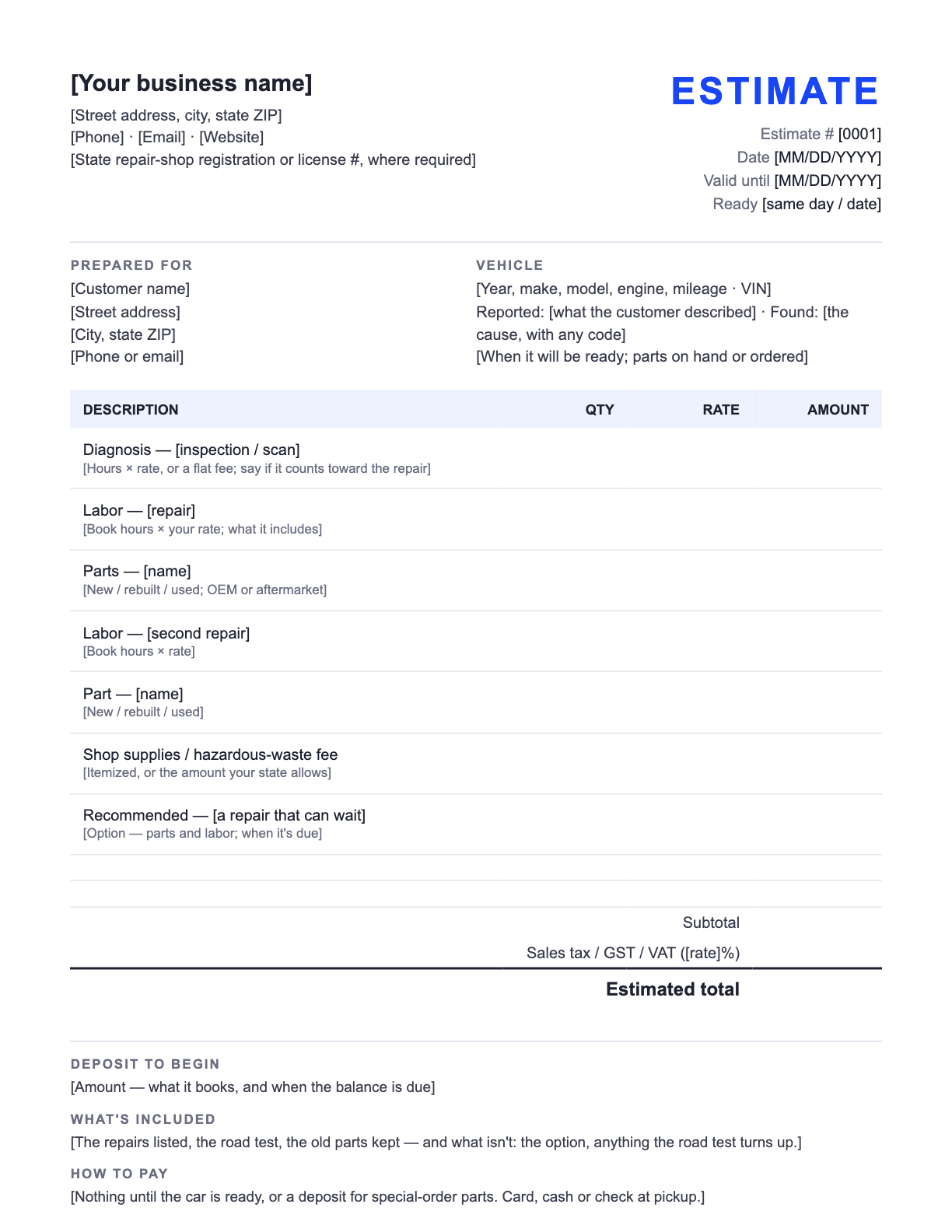
An auto repair estimate the way state repair laws want it written: the vehicle by year, make, model, mileage and VIN, the fault reported and the fault found, labor by the job in book hours at your rate, each part on its own line as new, rebuilt or used, shop supplies as a line and not a percentage, and the repair that can wait as an option. Free in Word and PDF, with every line explained.
Word and PDF · Free · No email, no sign-up
The short answer
An auto repair estimate identifies the vehicle — year, make, model, engine, mileage and VIN — records the fault the customer reported and the fault you found, and prices each repair as two lines: the labor by the job in book hours at your rate, and the parts by name, new, rebuilt or used, with shop supplies as their own line rather than a percentage.
Then the repair that can wait — the rear pads with 4 mm left, the belt that's cracking — as an option on its own line, priced now so the customer can add it or plan for it, and never a surprise on the invoice.
Around that go your shop's details and registration number where your state has one, the customer and their phone number, the estimate number and the date it holds until, when the car will be ready, what's included, and how to pay — usually nothing until the keys are handed back.
FREE TEMPLATE · WORD AND PDF
The auto repair estimate template, filled in
Below is the template filled in for Bridgeway Auto Care, a fictional auto repair business, so you can see every line in use. The downloads are the same estimate with [bracketed] lines to replace — free, no email address, no sign-up.
Example · fictional business
Bridgeway Auto Care Columbus, OH (614) 555-0126 · service@bridgewayautocare.example Insured: general liability | ESTIMATE |
Prepared for Renee Caldwell (614) 555-0177 Columbus, OH | Vehicle 2018 Honda CR-V EX, 2.4L, 84,210 miles · VIN ending 7H3321 Reported: grinding from the front when braking; check-engine light on · Found: front pads worn to metal, rotors scored; code P0420, upstream oxygen sensor failed Ready the same day on your go-ahead; the sensor arrives by 10 am tomorrow if you'd rather do both at once |
| Description | Qty | Rate | Amount |
|---|---|---|---|
| Diagnosis — brake inspection and scan Road test, wheels off, code read and sensor tested — 0.5 hr × $140 | 0.5 | $140.00 | $70.00 |
| Labor — replace front brake pads and rotors Book time 1.6 hr × $140; calipers cleaned and slides lubricated | 1.6 | $140.00 | $224.00 |
| Parts — front brake pads (ceramic) and two rotors New, aftermarket (name brand); OEM available for about $90 more | 1 | $212.00 | $212.00 |
| Labor — replace upstream oxygen sensor Book time 0.7 hr × $140; code cleared and drive cycle run | 0.7 | $140.00 | $98.00 |
| Part — oxygen sensor, upstream (bank 1, sensor 1) New, OEM | 1 | $168.00 | $168.00 |
| Shop supplies Brake cleaner, lubricant, hardware — itemized here, not a percentage | 1 | $18.00 | $18.00 |
| Rear brake pads About 4 mm left — fine for now, recommended within 6 months; parts and labor | 1 | $265.00 | +$265.00 |
| Subtotal | $790.00 | ||
| Sales tax, 7.5% on parts and labor (example — Ohio taxes repair labor) | $59.25 | ||
| Estimated total | $849.25 | ||
What's included
The diagnosis, the front brakes and the oxygen sensor as listed, a road test afterward, and the old parts kept for you to see. Not included: the rear pads (see the option), and anything else the road test turns up — we'd call you with a price before doing it.
How to pay
Nothing until the car is ready. Pay by card, cash or check when you pick it up; the invoice will list the parts fitted and mark each new, rebuilt or used.
Every figure on the example is an example, not a price guide — use your own rates. The Word file is a standard .docx you can edit in Word or any app that opens Word documents; the PDF prints as-is if you'd rather fill it in by hand.
Quotes and a website, one place
Start your auto repair website — quoting is built in
Add your business name and your town, and Zarla builds your auto repair website from this one line. The same dashboard sends quotes like this one as a link your customer accepts online, and drafts the invoice when they do.
Already have a website? Bring it across →Zarla keeps your old page addresses where it can and redirects the ones that change, helping you keep the Google standing you've built.
LINE BY LINE
What goes on an auto repair estimate
Every line on the template, in order, and what to write on it.
| The line | What to put there |
|---|---|
| Shop name, contact and registration number | Your shop's name, phone, email and address, and your repair-shop registration or license number where your state issues one — California, New York, Michigan and Florida register repair shops; many states don't. |
| Estimate number, date and valid-until date | A number that never repeats, the date, and the date the price holds until — two weeks suits parts prices; your labor rate holds longer. |
| Prepared for and the vehicle | The customer with a phone number you can reach them on while the car is on the lift, then the vehicle: year, make, model, engine, mileage and VIN — the VIN is what makes the parts right the first time. |
| Reported and found | The fault the customer described and the fault you found, with the trouble code where there is one. “Reported: grinding when braking · Found: front pads to metal, rotors scored” is the sentence the customer repeats to their partner. |
| Labor by the job in book hours | Each repair as book time × your hourly rate, with what the job includes. Book hours from a labor guide are what every customer compares — show them, and show your rate. |
| Parts, line by line | Each part by name, and whether it's new, rebuilt or used, OEM or aftermarket — several states require that on the estimate and the invoice. Offer the OEM alternative in the detail when there is one. |
| Shop supplies and fees | Brake cleaner, lubricant, hardware, the hazardous-waste fee — as a line with an amount, not a percentage hidden at the bottom. Some states limit how a supplies fee may be charged. |
| Tax and total | Sales tax on the parts in nearly every state, and on the labor in the states that tax repair labor; then the estimated total. |
| The option, what's included and how to pay | The repair that can wait as an option with when it's due, the scope in plain words with what the road test might add, and how to pay — nothing until the car is ready, or a deposit for a special-order part. |
STEP BY STEP
How to write an auto repair estimate
At the service desk with the car on the lift — the customer approves it by phone before the parts are ordered.
Put your shop's details and registration at the top
Shop name, phone, email, address and your repair-shop registration number where your state issues one. Save the file once with these filled in.
Number it, date it, set a short valid-until date
The next number in your series, today's date and the day the price stops holding — two weeks for parts prices.
Identify the vehicle and the fault
Year, make, model, engine, mileage and VIN from the door jamb; the customer's phone number; what they reported and what you found, with the code.
Price each repair as labor plus parts
Labor by the job in book hours × your rate, with what it includes; each part on its own line as new, rebuilt or used, OEM or aftermarket; shop supplies itemized.
Add tax and total it
Sales tax on the parts, and on the labor where your state taxes repair labor, then the estimated total.
Add the repair that can wait, write what's included, and send it
The option with when it's due, what's included and what the road test might turn up, how to pay. Text or email it before you order the parts, and keep the OK with the estimate.
How auto repair estimates win the job
Show the book hours and your rate. “Front pads and rotors — 1.6 hours × $140” is a number the customer can check against any labor guide and any other shop. “Brake job — $436” isn't, and it's the line that sends them to get a second estimate. Show the hours, and the comparison works in your favor.
Separate the repair they came in for from the one that can wait. The rear pads at 4 mm go on their own line as an option with a date. The customer approves today's repair without feeling upsold, sees the next one coming, and books it with you instead of with whoever looks at the car next.
Name new, rebuilt or used, and offer the OEM alternative. Several states require parts to be described as new, used or rebuilt on the estimate and the invoice, and every customer wants to know. A line that says “aftermarket, name brand; OEM about $90 more” closes the question before it's asked.
Itemize the supplies. A shop supplies line with an amount reads as honest; a percentage at the bottom reads as a fee. Some states limit how a supplies or hazardous-waste charge may be applied — itemizing keeps you clear of the rule everywhere.
Get the OK before the parts are ordered, and keep it. Text or email the estimate and keep the customer's reply with the repair order. If the road test turns up more, call with a price before doing it. Beyond being good practice, in many states it's the rule.
Written estimates and repair laws. In the US auto repair is one of the most regulated service trades: many states — California under the Automotive Repair Act, Michigan, Florida and others — require a written estimate before work starts, and New York's Repair Shop Act requires one whenever the customer asks; most of them forbid charging more than the estimate without the customer's OK, require parts to be described as new, used or rebuilt, and require the old parts to be offered back on request; several register repair shops and require the registration number on the paperwork. Check your state's consumer-protection office or licensing board.
Tax. In the US nearly every state taxes the parts you install, and a number tax repair labor too — Ohio, New York, Wisconsin and Connecticut among them — so keep parts and labor on separate lines and check your state's revenue department or your accountant before you set the tax line. Outside the US the rule is the other way around: in Australia and New Zealand a GST-registered business gives a consumer a price that includes GST, and in the UK and EU a VAT-registered business shows the VAT and quotes consumers a price with it included. Confirm the details with your accountant.
Send it from Zarla and get it accepted online
A Word estimate is a fine way to start. The slow part is everything after you send it: waiting for a reply, wondering whether they opened it, and retyping every line into the invoice when they say yes.
If you build your auto repair website with Zarla, quotes are in the same dashboard. Build the quote from your own price book — one price, or up to three options side by side with the one you'd pick marked Recommended, and any line as a checkbox extra. Send it as one link, by email. Your customer picks an option, ticks any extras, types their name to accept, and gets a copy; Zarla drafts the invoice for exactly what they chose, with any deposit you asked for, and the job moves to Won. The quote template is already in your brand: your website's logo, colors and fonts, set once for every quote and invoice. On a paid plan, with your Stripe account connected, that invoice carries a pay-now button, so the deposit comes in as soon as you send it.
Want to see the website first? Browse auto repair website templates or see how Zarla builds auto repair websites. Still setting up? Write your auto repair business plan first.
The whole paper trail of a job, step by step: how to write a quote, then how to write an invoice, then how to write a receipt — with a free receipt template. For any other trade, start from the free estimate template.
Auto repair estimates: common questions
Your shop's name, contact and registration number where your state issues one; the customer and a phone number; an estimate number, the date and a valid-until date; the vehicle by year, make, model, engine, mileage and VIN; the fault reported and the fault found with any code; each repair as labor in book hours × your rate and parts described as new, rebuilt or used; shop supplies as a line; tax where it applies and the estimated total; the repair that can wait as an option; what's included; and how to pay.
An estimate is your best calculation of what the job will cost, given what you can see today; the final price can move if the work turns out different. A quote (or a fixed price) is the price you will charge for the work described. A bid is a quote submitted against someone else's specification, usually in construction. Say which one your document is in its title.
In many US states, yes — California, Michigan and Florida among them require a written estimate before work starts, New York requires one whenever the customer asks, and most of these states forbid charging more than the estimate without the customer's OK, often above a set dollar amount or percentage. Even where the law doesn't, the written estimate is what prevents the dispute at pickup. Check your state's consumer-protection office.
Charge for it — a scan, a road test and an hour on the lift are skilled work — and say on the phone what happens to the fee. Many shops count it toward the repair when the customer goes ahead; the estimate shows the fee as a line either way, so the customer sees the deal exactly as it was described.
Stop, call the customer with a price, and keep their OK with the repair order before going on — in many states that's the rule, and everywhere it's the habit that keeps the invoice matching the estimate. Put the new work on its own lines; the original lines stay as they were.
Two weeks is sensible — parts prices and availability move faster than your labor rate — and the customer who comes back after it gets the parts re-priced. Put the date on the estimate.
Usually not — the car is the deposit, and the bill is paid at pickup. Ask for one when you're special-ordering an expensive part the customer could walk away from — a transmission, a body panel — and say what it books.
Yes. The auto repair estimate template on this page downloads free as a Word document and a PDF — no email address, no sign-up. Edit it in Word or any app that opens Word documents, or print the PDF and fill it in by hand.
Not from a Word file — the customer replies by email or phone, and you type the job into an invoice later. To get a yes in one tap, send it from quoting software. If your auto repair website is on Zarla, the quote tool is in the same dashboard: your customer opens one link, picks an option, ticks any extras and types their name to accept, and Zarla drafts the invoice for what they chose — which, on a paid plan with Stripe connected, carries a pay-now button. Jobber, Housecall Pro, Wix and Squarespace send quotes customers accept online too.
Send estimates from your own auto repair website
Add your town and your shop's name, and Zarla builds the site from that one line — with quoting in the same dashboard.
Already have a website? Bring it across →Zarla keeps your old page addresses where it can and redirects the ones that change, helping you keep the Google standing you've built.