FENCE ESTIMATE TEMPLATE
Free fence estimate template
A fence estimate with the fence by the linear foot — material, style, height, post spacing and how the posts are set — each gate on its own line, the old fence's removal, the permit, and the 811 utility locate. Free in Word and PDF, with every line explained.
Word and PDF · Free · No email, no sign-up
The short answer
A fence estimate prices the fence by the linear foot with the build named on the line — pressure-treated pine or cedar, vinyl, chain-link or aluminum; the style and height; the post size, spacing and how they're set — and gives each gate its own line, because a 10-foot double drive gate with a drop rod is a different thing from a 4-foot walk gate.
Then the lines around the fence: removing the old one by the linear foot, clearing or grading the line, the permit, and an option for stain and seal. Rock or roots at a post hole get a per-post line, so the surprise has a price before the auger hits it.
Around that go your business and license details, the customer and the address, the estimate number and the date it holds until, the days on site and when you can start, what's included and what isn't — the property survey is the big one — and how to pay: a deposit that orders the material, the balance when the last gate swings.
FREE TEMPLATE · WORD AND PDF
The fence estimate template, filled in
Below is the template filled in for Straightline Fence Co., a fictional fence business, so you can see every line in use. The downloads are the same estimate with [bracketed] lines to replace — free, no email address, no sign-up.
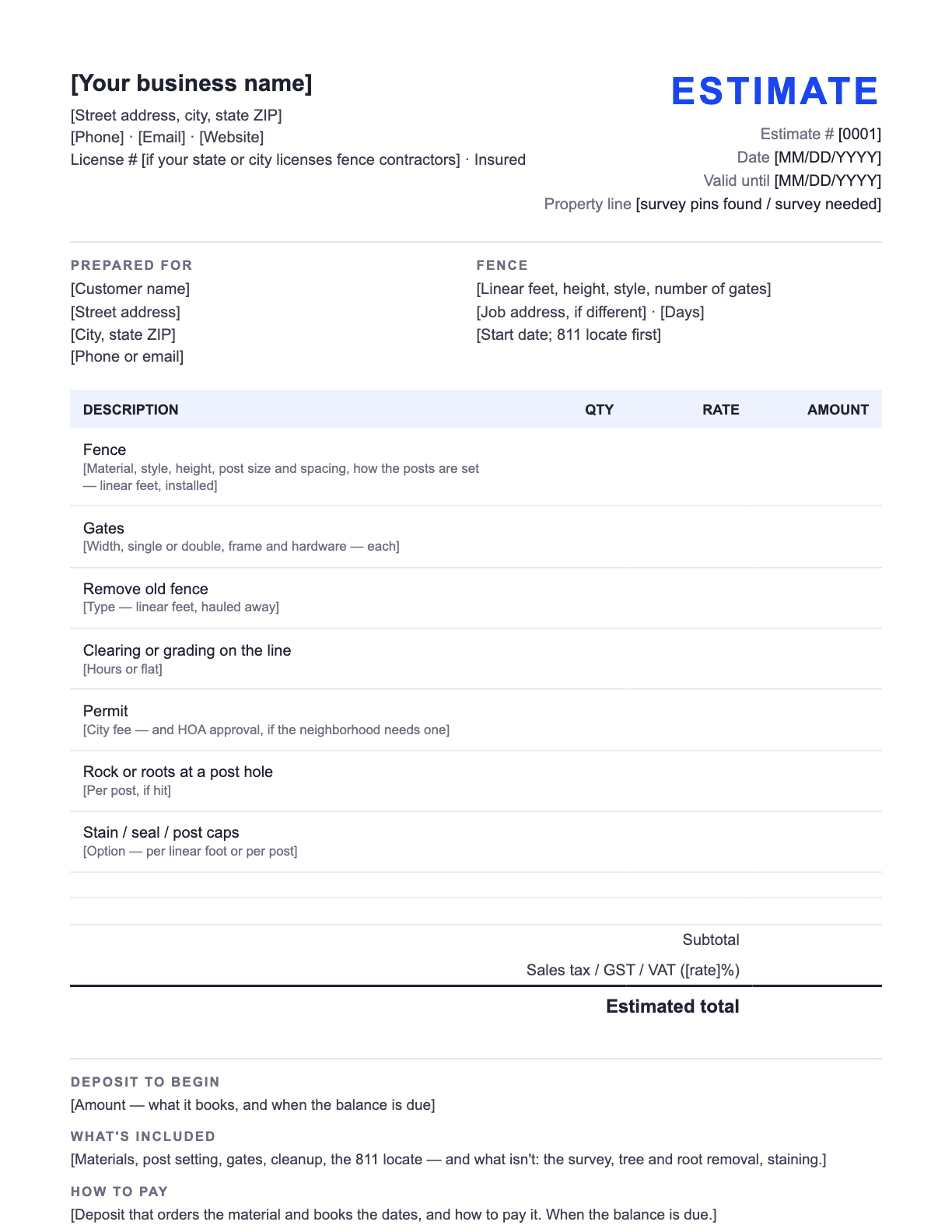
Example · fictional business
Straightline Fence Co. Raleigh, NC (919) 555-0188 · quotes@straightlinefence.example Insured: general liability | ESTIMATE |
Prepared for Kevin and Priya Malhotra 3315 Leesville Rd Raleigh, NC | Fence Back yard: 186 linear feet of 6-ft wood privacy fence with two gates, on the line of the existing chain-link Same address · 2 days — posts set on day one, rails and pickets on day two Start about 2 weeks after the deposit; we call 811 for the utility locate first |
| Description | Qty | Rate | Amount |
|---|---|---|---|
| 6-ft wood privacy fence Pressure-treated pine, dog-ear pickets, three 2×4 rails, 4×4 posts 8 ft apart set 30 inches deep in concrete — 186 linear feet, installed | 186 | $38.00 | $7,068.00 |
| Walk gate 4 ft wide, matching pickets on a steel frame, self-closing hinges and a latch | 1 | $385.00 | $385.00 |
| Double drive gate 10 ft, two leaves on steel frames, drop rod and latch | 1 | $890.00 | $890.00 |
| Remove and haul away the old fence About 120 linear feet of chain-link, posts pulled and the holes filled | 120 | $4.50 | $540.00 |
| Fence permit City permit applied for by us; the fee passed through at cost | 1 | $85.00 | $85.00 |
| Stain and seal Semi-transparent stain, both sides, after the wood dries for 4 to 6 weeks — per linear foot | 186 | $4.50 | +$837.00 |
| Subtotal | $8,968.00 | ||
| Sales tax (if your state charges it on this work) | $0.00 | ||
| Estimated total | $8,968.00 | ||
Deposit to begin
$3,000.00 books the job; the balance is due when the work is finished.
What's included
All materials, posts set in concrete, two gates with hardware, cleanup, and haul-away of the old fence and our scraps. We call 811 for the utility locate before we dig. Not included: a property survey — we build to the survey pins or the line you show us — tree or root removal on the line, and staining (see the option).
How to pay
The $3,000 deposit orders the material and books the dates; the balance is due when the last gate is hung and you've walked the line with us. Card, check or bank transfer.
Every figure on the example is an example, not a price guide — use your own rates. The Word file is a standard .docx you can edit in Word or any app that opens Word documents; the PDF prints as-is if you'd rather fill it in by hand.
Quotes and a website, one place
Start your fence website — quoting is built in
Add your business name and your town, and Zarla builds your fence website from this one line. The same dashboard sends quotes like this one as a link your customer accepts online, and drafts the invoice when they do.
Already have a website? Bring it across →Zarla keeps your old page addresses where it can and redirects the ones that change, helping you keep the Google standing you've built.
LINE BY LINE
What goes on a fence estimate
Every line on the template, in order, and what to write on it.
| The line | What to put there |
|---|---|
| Business name, contact and license | Your trading name, phone, email and address, that you're insured, and your contractor license number where your state or city requires one. |
| Estimate number, date and valid-until date | A number that never repeats, the date, and the date the price holds until — 30 days is common, shorter when lumber prices move. |
| Prepared for and the fence in one line | The customer and the address, then the fence: linear feet, height, style and the number of gates, the days on site and when you can start. |
| The fence, by the linear foot | Material, style and height, post size and spacing, and how the posts are set — in concrete, how deep. The build on the line is what makes a $38-a-foot fence make sense next to a $29 one. |
| Gates | Each gate on its own line: width, single or double, the frame and the hardware. Gates are where fences fail and where estimates differ most. |
| Removal of the old fence | What comes out, by the linear foot, posts pulled and holes filled, hauled away — a separate line the customer can see and, if they'd rather, do themselves. |
| Permit and the property line | The city permit as a line with the fee passed through, HOA approval where the neighborhood needs it, and a note on who finds the property line — the survey pins, or a survey the customer orders. |
| Tax and total | Sales tax where your state charges it on this work (in most states the installer pays tax on the materials and the customer sees no line), and the estimated total. |
| Options, included and how to pay | Stain and seal, post caps and a per-post price for rock or roots as options; the scope in plain words; the deposit that orders the material, when the balance is due, and how to pay. |
STEP BY STEP
How to write a fence estimate
From the walk of the line to an estimate the homeowner approves before the lumber price changes.
Put your details at the top
Business name, phone, email, address, that you're insured, and your license number where one is required. Save the file once with these filled in.
Number it, date it, set the valid-until date
The next number in your series, today's date and the day the price stops holding — shorter when lumber prices are moving.
Walk the line and measure
Linear feet with a wheel, the corners and the gate positions, the grade changes, trees and roots on the line, and whether the survey pins are there. Note the gate widths the customer needs — a mower, a trailer, a car.
Price the fence and each gate
The fence by the linear foot with material, style, height, post size, spacing and setting on the line; each gate on its own line with its width, frame and hardware. Then the old fence's removal by the foot, and the permit.
Add tax, total it, name the deposit
Sales tax where your state charges it on this work, the estimated total, and the deposit that orders the material and books the dates.
Write what's included and how to pay
Materials, post setting, gates, cleanup and the 811 locate in; the survey, tree and root removal and staining out. The deposit, the balance when the last gate swings. Send it the same evening.
How fence estimates win the job
Put the build on the line. “4×4 posts 8 ft apart, set 30 inches deep in concrete, three rails” is the difference between your fence and the one that leans in three years, and the only way a homeowner can see it on paper. Price by the linear foot and name the build next to the price.
Each gate gets its own line. A double drive gate with steel frames and a drop rod is a day's work; a walk gate is an hour. Separate lines let the customer add a gate or widen one without the whole price moving, and show where the money goes.
Say who finds the property line. You build to the survey pins or the line the customer shows you; if the pins are gone, they order a survey. One line on the estimate — before a neighbor appears with a tape measure.
Offer stain and seal as an option. The wood needs 4 to 6 weeks to dry first, so it's a second visit anyway; as an option line it sells itself to a customer who has just paid for a fence they want to keep looking new.
811, height limits and permits. In the US, every state requires a call to 811 — the free utility-locate service — before digging, so say on the estimate that you make the call. Most cities limit fence height (commonly 6 feet in a back yard and 4 feet in a front yard) and many require a permit; pool fences have barrier rules of their own (a 4-foot minimum and self-closing, self-latching gates in most states); and homeowners' associations add their own approvals. Put the permit on its own line and check your city before you quote.
Tax. In the US, a fence is usually treated as an improvement to the property: in most states the installer pays sales tax on the materials and the customer sees no tax line, while a few states tax the materials or the installation on the customer's bill — check your state's revenue department or your accountant before you add one. Outside the US the rule is the other way around: in Australia and New Zealand a GST-registered business gives a consumer a price that includes GST, and in the UK and EU a VAT-registered business shows the VAT and quotes consumers a price with it included. Confirm the details with your accountant.
Send it from Zarla and get it accepted online
A Word estimate is a fine way to start. The slow part is everything after you send it: waiting for a reply, wondering whether they opened it, and retyping every line into the invoice when they say yes.
If you build your fence website with Zarla, quotes are in the same dashboard. Build the quote from your own price book — one price, or up to three options side by side with the one you'd pick marked Recommended, and any line as a checkbox extra. Send it as one link, by email. Your customer picks an option, ticks any extras, types their name to accept, and gets a copy; Zarla drafts the invoice for exactly what they chose, with any deposit you asked for, and the job moves to Won. The quote template is already in your brand: your website's logo, colors and fonts, set once for every quote and invoice. On a paid plan, with your Stripe account connected, that invoice carries a pay-now button, so the deposit comes in as soon as you send it.
Want to see the website first? Browse fence website templates or see how Zarla builds fence websites. Still setting up? Write your fence business plan first.
The whole paper trail of a job, step by step: how to write a quote, then how to write an invoice, then how to write a receipt — with a free receipt template. For any other trade, start from the free estimate template.
Fence estimates: common questions
Your business, contact, insurance and license details; the customer, the address and the fence in one line; an estimate number, the date and a valid-until date; the fence by the linear foot with material, style, height, post size and spacing and how the posts are set; each gate on its own line; removal of the old fence; clearing or grading on the line; the permit; a per-post price for rock or roots; options such as stain and seal; tax where it applies, the estimated total and the deposit; then what's included, who finds the property line, and how to pay.
An estimate is your best calculation of what the job will cost, given what you can see today; the final price can move if the work turns out different. A quote (or a fixed price) is the price you will charge for the work described. A bid is a quote submitted against someone else's specification, usually in construction. Say which one your document is in its title.
Per linear foot, with the build named on the line — it's what every customer compares and what lets them add or drop a run. Price gates per gate, removal per linear foot, and rock or roots per post. Per-panel pricing suits pre-built vinyl and aluminum panels, where the panel is the unit; say the panel width.
The homeowner. You build to the survey pins or the line they show you, and if the pins can't be found they order a survey — say so on the estimate.
Thirty days is the common choice for a home-services estimate, and shorter when material prices move (roofing, lumber, copper). Print the date on the estimate: a customer who comes back after it can be re-quoted at today's prices without an argument, and one who accepts inside it knows the price holds.
Enough to cover the material — commonly a third to a half — with the balance due when the last gate is hung. Some US states cap the deposit a contractor may take before work starts; check your state's licensing board.
Yes. The fence estimate template on this page downloads free as a Word document and a PDF — no email address, no sign-up. Edit it in Word or any app that opens Word documents, or print the PDF and fill it in by hand.
Not from a Word file — the customer replies by email or phone, and you type the job into an invoice later. To get a yes in one tap, send it from quoting software. If your fence website is on Zarla, the quote tool is in the same dashboard: your customer opens one link, picks an option, ticks any extras and types their name to accept, and Zarla drafts the invoice for what they chose — which, on a paid plan with Stripe connected, carries a pay-now button. Jobber, Housecall Pro, Wix and Squarespace send quotes customers accept online too.
Send estimates from your own fence company website
Add your town and your business name, and Zarla builds the site from that one line — with quoting in the same dashboard.
Already have a website? Bring it across →Zarla keeps your old page addresses where it can and redirects the ones that change, helping you keep the Google standing you've built.