CAREER GUIDE
How to become a caregiver in 2026
Two doors, both open without experience. The agency door: in-house training, the federal 75-hour course if the agency is Medicare-certified, and your state's registry or certificate — California's, Washington's, New York's and Florida's rules printed from the rules themselves — and the climb to CNA. The family door: Medicaid and VA programs that pay you to care for a parent, a child or a veteran at home. What the work pays from the government's survey and six agencies' ads, what the training costs, and what working caregivers say about it.
Free to build · Pay when you publish · No credit card
75 hoursthe federal training floor for a home health aide at a Medicare-certified agency, at least 16 of them supervised practical training (42 CFR 484.80)
$35,800the 2025 US median for home health and personal care aides, $17.21 an hour (O*NET, from BLS data)
760,500projected job openings for home health and personal care aides, 2025–2035 — growth much faster than average
$0for a New York nonprofit's state-approved home health aide course, with a job offered to qualified graduates — and several agencies below train in-house free
See it in action
See what your home care website could look like
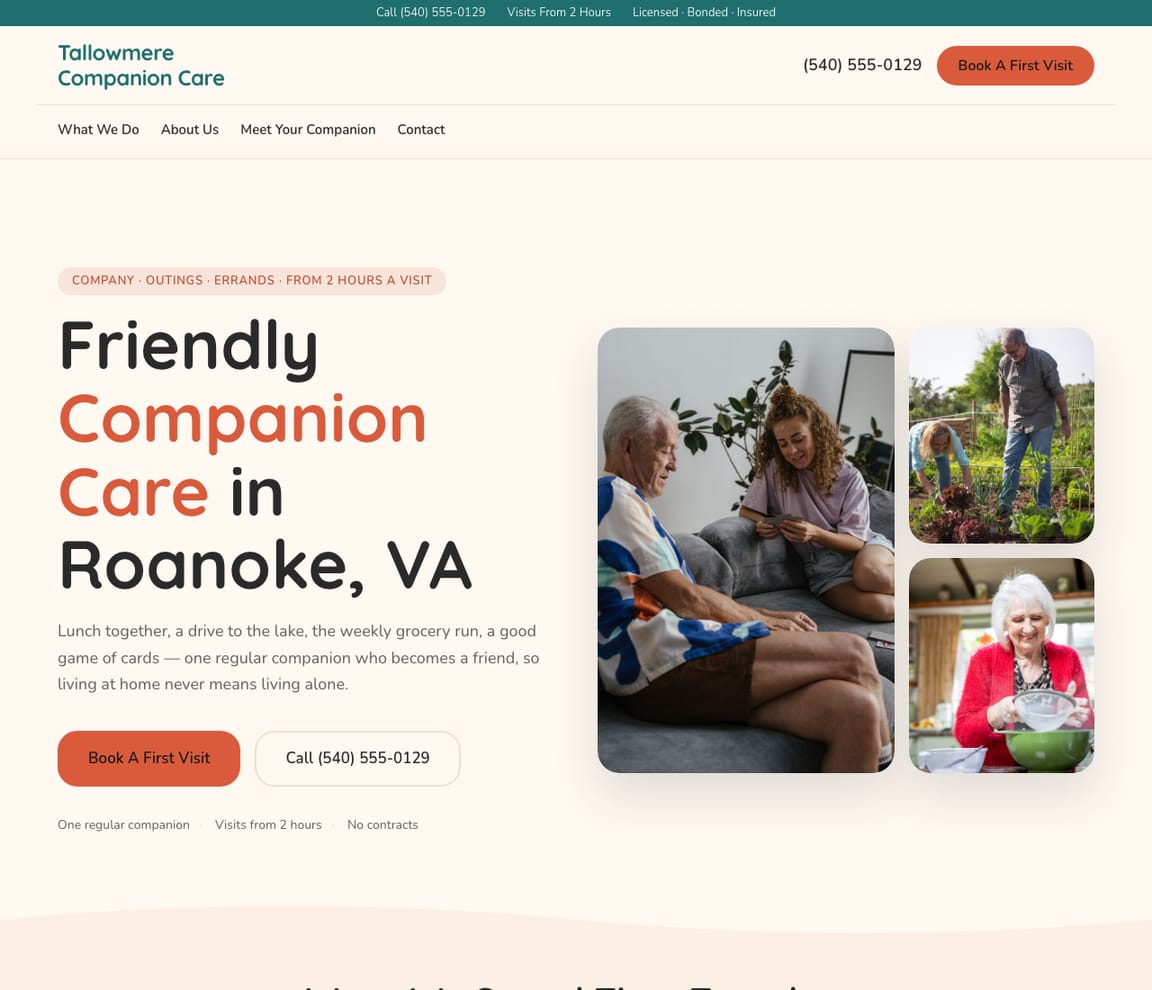
A real Zarla template for companion care — the visits you make, the towns you cover, who will walk through the door and a way for a worried son or daughter to reach you. Describe yours — the care, the area, your training — and you'll have a site like this in about a minute.
- Professional design — not a generic template
- Looks great on desktop and mobile
- Content written for your industry
Build the website
Start your home care website now
Add your town and your name to the sentence, and Zarla builds the site: the care you give, your training, answers to families' questions, the area you cover and a contact form. Add your certificate, your languages and the shifts you take in chat, then publish.
Already have a website? Bring it across →Zarla keeps your old page addresses where it can and redirects the ones that change, helping you keep the Google standing you've built.
Is becoming a caregiver worth it in 2026 — and what does the work pay?
Becoming a caregiver is one of the few health jobs you can start in weeks without paying for school — agencies train new hires, some for free, and the federal course for a home health aide at a Medicare-certified agency is 75 hours — with the honest catch that the pay sits near the bottom of health care and the work is physical, intimate and sometimes sad. On the paperwork: in the US the caregiver is trained, registered or certified — one Florida ad below asks for a "Valid Florida HHA license", but the rules we read set training, registries and certificates — and which applies depends on the job and the state, named below from each state's rules; check your state's licensing agency or health department before you pay for a course. The numbers first. The government describes the home health aide as someone who works "under the direction of offsite or intermittent onsite licensed nursing staff." and helps with "activities of daily living," "such as feeding, bathing, toileting, or ambulation." (O*NET, 31-1121); the personal care aide gives "personalized assistance to individuals with disabilities or illness" — its sample job titles start with "Care Provider, Caregiver, Direct Care Worker, Home Care Aide" (O*NET, 31-1122). Counted together, home health and personal care aides had a 2025 median of $35,800 a year, $17.21 an hour: 10 percent earned $27,040 or less ($13.00 an hour), 25 percent $31,920 or less, 75 percent $39,470 or less, and 10 percent $45,040 or more ($21.65 an hour) (O*NET, from BLS 2025 wage data). And the field is vast and growing: "Employment (2025)" "4,677,100 employees", "Projected growth (2025-2035)" "Much faster than average (7% or higher)", "Projected job openings (2025-2035)" "760,500" (O*NET).
State by state, the gap is wide. The median is $24,230 in Texas ($11.65 an hour), $34,320 in California ($16.50), $33,800 in Florida ($16.25) and $39,620 in New York ($19.05); the top tenth earns $31,560 or more in Texas, $39,260 or more in California, $38,310 or more in Florida and $46,690 or more in New York (O*NET, Texas; California; Florida; New York). The schooling asked for is short: of new hires, "32%" "responded: Post-secondary certificate required" and "29%" "responded: Some college, no degree required" — the certificate being the aide course — and the occupation sits in the "Job Zone 1-2: Very Little to Some Preparation Needed" band, where training "Ranges from a few days to one year of on-the-job training." (O*NET, education and job zone).
What the agencies actually pay. Six current ads print an hourly figure. Visiting Angels in Summerville, South Carolina, for weekend caregivers: "Compensation: $14.00 - $16.00 per hour", with "Paid training" and shifts "ranging from as little as 3 hours to 12-hour and 24-hour care" (Visiting Angels, Summerville, job ad, read November 5, 2026). Home Instead in Edina, Minnesota, for an entry-level caregiver: "Starting at $17/hour, with opportunities to earn up to $21/hour based on experience and availability" (Home Instead, Edina, job ad, read November 5, 2026). BrightStar Care near Waller, Texas: "Competitive pay at $16 per hour" for afternoon shifts in a private home (BrightStar Care, Waller, job ad, November 4, 2026); in North Miami, for home health aides, "Competitive W-2 pay: $15–$17 per hour" (BrightStar Care, North Miami, job ad, November 4, 2026); in Asheville, North Carolina, "Pay: $17.00 - $22.00 per hour" with a year's experience required (BrightStar Care, Asheville, job ad, November 3, 2026); and for a CNA or home health aide in Lynn, Massachusetts, "Compensation: $19.00 - $25.00 per hour" (BrightStar Care, Lynn, job ad, November 4, 2026). The agency's side of that hour — what a family pays, what the owner keeps, Medicaid's rate — is the business question, answered in how to start a home care business and costed in the home care business plan.
The catch. The job is close and physical. In O*NET's survey of home health aides, 77 percent work "Very close (near touching)" to other people, 59 percent spend their time standing "Continually or almost continually" and 54 percent bending or twisting that much; 56 percent are exposed to disease or infections every day, 46 percent deal with unpleasant, angry or discourteous people every day, and 26 percent work more than 40 hours a week (O*NET, work context). Three of the ads above ask that you can lift up to 50 pounds (BrightStar Care, Waller, November 4, 2026). What moves the number is the ladder: an aide's certificate, then a CNA, then specialized shifts — live-in, overnight, dementia care — or clients of your own. The rest of this guide is that ladder: the training rules from the regulation and the states, what each step costs, the paid family route, and how to be the caregiver a family finds.
How to become a caregiver, in plain English: the federal 75 hours, the state registries, and the paid family route
Do you need a license? In the US, a caregiver is trained, registered or certified — and the federal rules reach two jobs. A home health aide at a Medicare-certified agency must complete a training and competency program, or be "currently listed in good standing on the state nurse aide registry"; "Classroom and supervised practical training must total at least 75 hours.", "A minimum of 16 hours of classroom training must precede a minimum of 16 hours of supervised practical training as part of the 75 hours.", and after that "A home health aide must receive at least 12 hours of in-service training during each 12-month period." A gap counts against you: the course has to be retaken after "a continuous period of 24 consecutive months" without paid aide work (42 CFR 484.80, Cornell LII). A nurse aide program must "Consist of no less than 75 clock hours of training;" and "Include at least 16 hours of supervised practical training.", with "At least a total of 16 hours of training" before "any direct contact with a resident" (42 CFR 483.152, Cornell LII). Companion and personal care through a non-medical agency is left to the states — which is where the rules below come from.
- California keeps two lists. Home care aides register with the Department of Social Services — "You will be required to pay a fee of $35.00 to register", then fingerprints through Live Scan (CDSS, home care aide application) — and "Before registration approval, an individual must complete a criminal background check process administered by the California Department of Social Services."; an independent aide is one "18 years of age or older, who is not employed by a home care organization, but who is listed on the home care aide registry" (CDSS, resources for home care aides). "An affiliated home care aide shall complete a minimum of five hours of entry-level training prior to presence with a client" and "a minimum of five hours of annual training" (Health and Safety Code 1796.44). The certified home health aide is the Department of Public Health's: "Be at least sixteen (16) years of age.", a "120-hour training program approved by The California Department of Public Health" with an exam and a criminal record clearance — or, for someone who must "Hold an active Certified Nursing Assistant (CNA) certificate.", a "40 hour training program" — and renewal with "twenty-four (24) hours of In-Service Training/Continuing Education Units (CEUs) within your two (2) year certification period." (CDPH, home health aide).
- Washington certifies the home care aide. "Long-term care workers must complete 75 hours of training through a program approved by the Department of Social and Health Services, and must successfully pass the home care aide certification examination."; a worker already giving care has "a fingerprint background check done through the Department of Social and Health Services (DSHS)." (Washington DOH, certification requirements). The fees: "Application fee - $100" (Washington DOH, apply for a certification), the knowledge exam at $49 and the skills exam at $101 — "The knowledge exam consists of 60 questions over a 90-minute period of time." (Washington DOH, exam information). The timing: "The requirement to complete training within 120 days of the date of hire has not changed.", and under emergency rules an aide may work up to 365 days from hire while credentialing, an extension that "expires on December 31, 2027." (Washington DOH, home care aide licensing).
- New York counts the same 75 hours, in 60 days. "Home health aide training programs are allowed 60 days from the day an individual enters the program to complete the 75 hours. The 75 hours includes 59 hours classroom and 16 hours of supervised practical training as follows:" — a 40-hour home care curriculum and a 35-hour health-related one — and since "September 25, 2009" the state has kept "a registry of all persons who have successfully completed a home health aide and/or personal care training program." (New York DOH, home health aide training FAQ).
- Florida asks for forty. Before a home health aide works, the agency must have proof of "successful completion of at least forty hours of training" or the competency test, and an aide at a Medicare or Medicaid certified agency "may be required to provide evidence of additional training incorporated within the Medicare Conditions for Participation" (Fla. Admin. Code 59A-8.0095, Cornell LII).
Those are the states whose pages we could open, not every state — so check your state's licensing agency or health department before you pay for a course, and read do I need a business license for the separate question of licensing a business. The agency's own license, state by state, is in how to start a home care business.
How you get in: an agency hires you and teaches you. Home Instead in Edina: "Previous experience is great but not required — we provide skills training!", "Paid Training: Get the skills and confidence to succeed — at no cost to you" and "Willingness to complete a background check" (Home Instead, Edina, read November 5, 2026). BrightStar near Waller, Texas: "Free in-house training with Director of Nursing", a "Valid CPR Certificate that includes hands-on training (can get upon hire)" and a "Negative drug screen and motor vehicle background screening" (BrightStar Care, Waller, November 4, 2026); BrightStar in North Miami, which asks for a "Valid Florida HHA license in good standing", also offers "Free in-house training with our Director of Nursing" (BrightStar Care, North Miami, November 4, 2026); in Asheville the office lists "Employee Required Training for State, Federal, and Joint Commission Provided Free" but wants "Minimum one (1) year of documented caregiver, home care assistance experience" (BrightStar Care, Asheville, November 3, 2026); in Lynn the bar is "Current Massachusetts CNA certification OR verifiable CHHA/HHA/PCA/Caregiver experience." (BrightStar Care, Lynn, November 4, 2026). Visiting Angels in Summerville asks for a "Valid driver’s license, reliable vehicle, and current auto insurance" and prefers, without requiring, a year in the work (Visiting Angels, Summerville, read November 5, 2026). In New York the state course can be free: "Selfhelp’s Home Health Aide (HHA) and Personal Care Aide (PCA) training programs are approved by the New York State Department of Health and are provided free of charge.", the aide course gives "a minimum of 75 hours of training, including 59 hours of classroom instruction, and 16 hours of Supervised Practical Training in a lab setting.", and "qualified Selfhelp aides will be offered employment." (Selfhelp Community Services). Hudson Valley Hospice in Poughkeepsie runs "a three-week intensive training course for those with no prior certifications" at no cost — with the plain warning that "Participants will not be paid for attending the class. Completion of the program does not guarantee employment." (Hudson Valley Hospice, 2026 training program).
The paid family route. Medicaid's self-directed programs let a person who qualifies for home care hire someone they choose, a relative included in the programs below. In New York, the Consumer Directed Personal Assistance Program lets a member hire "a friend or family member, as long as they are not the Medicaid member's spouse, their designated representative or the parent of a CDPAP consumer under the age of 21."; "As of September 1, 2025, changes were implemented to the eligibility requirements" — the Minimum Needs Requirements for new assessments at 21 and over — and "All CDPAP recipients are required to work with PPL as their Fiscal Intermediary." (New York DOH, CDPAP). In California's In-Home Supportive Services, "Care providers may include, but are not limited to, family members, friends, neighbors, or registered providers through the public authority." (CDSS, IHSS provider resources); "Currently, over 800,000 individuals in California are enrolled as IHSS providers", and the steps are a county orientation, the enrollment forms, and "Get fingerprinted and go through a criminal background check by the California Department of Justice." (CDSS, IHSS provider orientation) — "3 out of 4 caregivers in the in-home assistance program are relatives of clients" (KFF Health News, December 9, 2022). Washington trains family on a shorter clock: a worker "caring only for the worker's child or parent" "must complete 35 hours of training within the first 120 days", and from "July 1, 2026" a spouse "must receive 15 hours of basic training" (RCW 74.39A.076). For veterans, the VA's family caregiver program asks that "You must be at least 18 years old." and that the veteran "has a VA disability rating (individual or combined) of 70% or higher" and "needs at least 6 months of continuous, in-person personal care services"; the primary caregiver may receive "A monthly stipend (payment)." (VA, comprehensive assistance for family caregivers). Its Veteran-Directed Care gives the veteran a budget for "hiring workers (which might include their own family member or neighbor)" (VA, Veteran-Directed Care). The person who needs care applies; the program sets the hours.
The money to start. The totals are our own sums of the prices each page prints. A lean start — Kingsborough Community College's home health aide course in Brooklyn, which lists "91 Hours" and "$525 Tuition / $60 Lab Fee / $25 Registration Fee*" plus a "$51.25 Textbook" — comes to $661.25; its BLS/CPR course is "$100 Tuition / Materials Fee $20*" on top (Kingsborough Community College, HHA). Washington's home care aide route — Washington Care Academy's 75-hour online course at "$599.00" tuition and "$61.70" in required fees (Washington Career Bridge, Washington Care Academy), the $100 application and the $49 and $101 exams — is $910.70. The fuller start, the nursing assistant route: Grays Harbor College's three-month, 242-clock-hour program at "$1,235.80" tuition (Washington Career Bridge, Grays Harbor College), the state's "Online Knowledge Test : $55" (Washington Board of Nursing, NAC exam) and the $85 credential fee on the board's table (Washington Board of Nursing, fees) — $1,375.80, with the skills test, "determined by NA program", left out. When you take private clients, the paperwork and pricing of a care business are in the home care business plan, and the site comes from the home care website builder or a design in home care templates.
In the UK: the National Careers Service puts a care worker at "£20,000 Starter" to "£25,000 Experienced" for "35 to 45 a week", names routes from the "Adult Care Worker Level 2 Intermediate Apprenticeship" to applying directly — "If you get the role, you'll be given on-the-job training by your employer." — lists one requirement, to "pass enhanced background checks", and adds that "Time spent caring for someone you know also counts as having experience in a caring role." (National Careers Service, care worker). In Australia the government's profile says "Aged and Disabled Carers provide general household assistance, emotional support, care and companionship for aged and disabled persons in their own homes.", counts "376,300" employed with a "60%" part-time share, and prints a median of "$1,761" a week for full-time carers and "$46" an hour, in Australian dollars (Jobs and Skills Australia, aged and disabled carers); a carer in a risk-assessed role with a registered NDIS provider needs a worker screening check, which "decides if a worker is ‘cleared’ or ‘excluded’ from working in certain roles with people with disability" and is "valid for up to 5 years" (NDIS Commission, worker screening). Check your own state's licensing agency or health department before your first paid shift.
What working caregivers actually say
The voices below belong to the people in the work: a Right at Home caregiver in Palo Alto who came from concrete construction, a Cincinnati aide who gave up a fashion career, a Houston nurse who began as a CNA at 17, a Denver CNA of seventeen years, an Atlanta agency owner who started as a CNA after arriving from Kenya, a Florida owner who began in the field, a Bakersfield caregiver in California's family-care program, a Santa Barbara mother paid to care for her son, and a West Virginia caregiver named her company's caregiver of the year — speaking to HomeCare magazine, Voyage and CanvasRebel interviewers, KFF Health News and local papers between 2020 and 2026, each described the way the page describes them. Their words are from the year they said them. Four threads run through all of it.
Almost nobody planned it. Kay Tau, Right at Home, Palo Alto: “I didn’t set out to become a caregiver. My background was actually in concrete construction.” and “Years ago, a friend asked me to cover her caregiving shift while she was on vacation, and honestly, I was terrified at first.” (HomeCare, July 29, 2025). Nyla Marion, Cincinnati: “Instead of going into fashion and leaving the city, I became a home health aide.” (VoyageOhio, January 6, 2022). Kiera Moore, Houston: “At 17, I became a Certified Nursing Assistant (CNA).” (VoyageHouston, March 24, 2020). Kassandra Hill, Denver: “I learned so much from the training I received from St Luke’s Ministries CNA training school.” (CanvasRebel, December 5, 2022).
“I truly love my job, the people I work with, and the families I have the privilege of serving every day,” — Tiffany Moon, Visiting Angels caregiver, Charleston, West Virginia, in MyChesCo, June 29, 2026
The work is close, and it costs something. Lucy Manswell, Hearts of Love Caregivers, Powder Springs, Georgia: “I did this work. I know what it costs you. You carry people’s pain home sometimes.” and “Someone calls at 11pm because their caregiver can’t make the morning shift.” (VoyageATL, April 8, 2026). Luz Maria Muñoz, a caregiver in California's in-home program in Bakersfield, on a client with bedsores: “Those wounds needed to be cleaned daily,” (KFF Health News, December 9, 2022). Mary Bouldin, paid through the same program to care for her son in Santa Barbara County: “Morally, I came to a crossroads in my life, and I made the choice I could live with. But it has a lot of downsides.” (Santa Barbara Independent, August 20, 2025). Ashlee Lafavor, Acare Provider Services, Florida, on her hardest early days: “I would cry in my car and then get into a family’s home it will shift me to why I am doing what I am doing” (VoyageATL, September 30, 2021).
The clients become family. Marion: “We become closer to clients than their own family.” (VoyageOhio, January 6, 2022). Moore, on her CNA years: “Clients looked forward to visits, and we became family.” (VoyageHouston, March 24, 2020). Moon: “Coming alongside families during some of life’s most challenging moments and being the support they need is an incredible blessing.” (MyChesCo, June 29, 2026). Tau: “Caregiving is a sacred form of service, carried out with quiet strength, empathy and integrity, even when no one notices.” (HomeCare, July 29, 2025).
The aide's years become an agency. Manswell: “I started as a CNA at Bethel Gardens in Powder Springs and I just… worked.” (VoyageATL, April 8, 2026). Hill: “After being a CNA for 17 years, I decided to open a group home and become a host home provider for persons with disabilities.” (CanvasRebel, December 5, 2022). Lafavor: “My journey to becoming an entrepreneur started in 2016.” (VoyageATL, September 30, 2021). Marion, running her own company while still on shifts: “I currently still work as an STNA and I also volunteer at a daycare.” (VoyageOhio, January 6, 2022).
What ties them together: most came in sideways — through a friend's shift, a sick grandmother, a CNA class at seventeen — learned on the job, carried the hard days home, and found the clients turning into family; several turned those years into offices of their own.
THE STARTER KIT
What you need to become a working caregiver
A first employer that trains
Home care offices hire people with no experience and teach them in-house — several of the ads quoted below say the training is free, run by their own nurse.
A clean record and your fingerprints
California's registry and its family-caregiver program fingerprint you; Washington runs its check through the state's social services department; two of the six ads below add a drug screen or a motor vehicle check, and several ask for a driver's license.
The certificate your state's door asks for
The federal 75-hour course for an aide at a Medicare-certified agency, a CNA, California's home care aide registration, Washington's certification — which one depends on where you work, priced below.
CPR, a TB test and a car
Asked for in several agency ads below; one Texas office lets you get them after hire. The clients are spread across town; the car is how you reach them.
A strong back and steady patience
Ads ask for lifting up to 50 pounds; the government's survey finds most aides standing, bending and working within arm's reach of the client for most of the day.
A way to be found
A website that says who you are, what you're trained for and where you work, and a Google Business Profile with your hours — the day you take private clients.
THE PAPERWORK
Training, registries and checks on the way to caregiving
| Typical cost | Time to get | Legally required? | |
|---|---|---|---|
| An agency's in-house training | Free at the BrightStar offices and Home Instead quoted above; paid training at Visiting Angels in Summerville | Before the first shift | No — the employer's own program, on top of any state rule |
| Home health aide course (Medicare-certified agency) | $661.25 at Kingsborough Community College; free at a state-approved New York nonprofit | 75 hours minimum, 16 of them supervised practice; New York allows 60 days | Yes, federally, to work as an aide for a Medicare-certified home health agency — or be a CNA in good standing |
| Certified nursing assistant (CNA) | $1,235.80 tuition at a Washington community college, plus the $55 knowledge test and the $85 credential fee | 75 clock hours federally; three months, 242 clock hours at that college | Yes, for nurse aide work; also counts for Medicare home health aide work while on the registry |
| California home care aide registration (CDSS) | $35, plus Live Scan fingerprints | Five hours of training before a client for an agency's aide, five more a year | Yes, in California, for an aide employed by a licensed home care organization — the statute's "affiliated home care aide"; an independent aide may be listed too. The department's background check comes before approval |
| California certified home health aide (CDPH) | The approved program's price | 120 hours, or 40 with an active CNA; 24 in-service hours every two years | Yes, in California, to be certified as a home health aide |
| Washington home care aide certification (DOH) | $100 application, $49 knowledge exam, $101 skills exam — $910.70 with one online course | 75 hours, finished within 120 days of hire, then the exam | Yes, in Washington, for long-term care workers — 35 hours for one caring only for a parent or child |
| Paid family caregiver (Medicaid self-direction, VA) | Nothing to enroll — the program pays you | A county orientation and a fingerprint check in California; registration with PPL in New York; a joint application with the veteran at the VA | The program's rules, not a license |
| Background check | Usually the employer's or the program's; Live Scan fees in California | Before the first client | Yes in California and Washington for registered and certified aides; asked for in the Home Instead and BrightStar ads quoted above |
THE STEPS
How to become a caregiver (step by step)
From choosing a door to a certified aide with a ladder in front of you, in eight moves.
01
Choose your door
Companion and personal care through a home care office, home health aide work at a Medicare-certified agency, a CNA's job, or getting paid to care for your own relative — each has its own training rule.
Day one02
Apply to an office that trains
The agencies quoted below hire without experience and teach you in-house, some of them free; a nonprofit in New York runs the state-approved course at no charge and offers graduates a job.
The real first step03
Clear the background check
Fingerprints through Live Scan in California, through the social services department in Washington, plus a drug screen or a motor vehicle check where the office asks for one — two of the six ads below do.
04
Finish the training hours
75 hours for a home health aide at a Medicare-certified agency, 16 of them supervised practice; 75 in Washington for a home care aide; 120 for California's certified home health aide.
05
Get onto your state's list
California's Home Care Aide Registry, Washington's certification after the state exam, New York's Home Care Registry, a nurse aide registry for a CNA.
The proof a family can check06
Keep the hours current
Twelve hours of in-service training a year for a Medicare home health aide; 24 every two years in California; and a long gap without paid work can mean retaking the course.
07
Climb: aide, CNA, then nursing
A CNA counts as a home health aide federally; the owners quoted below went from aide or CNA to running offices of their own. The agency license is the start guide's step.
08
Be the caregiver the search finds
When you take private clients: a website with who you are, your training, your towns and a contact form, and a Google Business Profile with your hours.
THE COSTS
How much does it cost to become a caregiver?
Each line priced by its own page: a New York community college's aide course, a Washington online home care aide course with the state's fees and exams, and a Washington community college's CNA program with the board's fees. A car, scrubs and CPR are left to you — and the agencies above train new hires free.
$0to start at an office that trains in-house, or at a state-approved New York nonprofit course whose qualified graduates are offered a job
$661.25a lean start — Kingsborough's home health aide course: $525 tuition, a $60 lab fee, a $25 registration fee and a $51.25 textbook (our arithmetic)
$910.70Washington's home care aide route — a $599 online 75-hour course with $61.70 in fees, the $100 application and the $49 and $101 exams
$1,375.80the fuller start — a Washington community college's CNA program at $1,235.80, the $55 knowledge test and the $85 credential fee
WHAT WE'VE LEARNED
What actually makes a family hire a caregiver
Care is the one hire where the family is choosing who will be alone with someone they love. For a caregiver taking private clients, the sites that get the call answer three things before the phone rings.
Who you are and what you're trained for
Your name and photo, your registry or certificate, CPR, dementia or hospice training, the languages you speak — the facts a nervous family looks for first.
The care, the hours, the towns
Companion visits, personal care, respite, overnights — what you do and what you don't, the shifts you take and the area you cover, so the family knows before it calls.
An easy first conversation
A form that asks about the person who needs care, and a phone number that gets answered — the first visit is a conversation, not a sale.
THE UPSIDE
What a caregiver can earn
Pay for home health and personal care aides from O*NET's 2025 figures and from six agencies' own ads. Typical figures rather than a forecast: your state, your certificate and the shifts you take — overnights, live-in, dementia care — decide it.
$35,800a year: the 2025 US median — $17.21 an hour; 10 percent under $27,040, 10 percent over $45,040 (O*NET)
$39,620the New York median; California $34,320, Florida $33,800, Texas $24,230
4,677,100home health and personal care aides employed in 2025, with 760,500 projected job openings for 2025–2035
$19–$25an hour for a CNA or home health aide on one Massachusetts ad — the six ads above run from $14 to $25
SEE IT WORK
Home care website designs you can start from
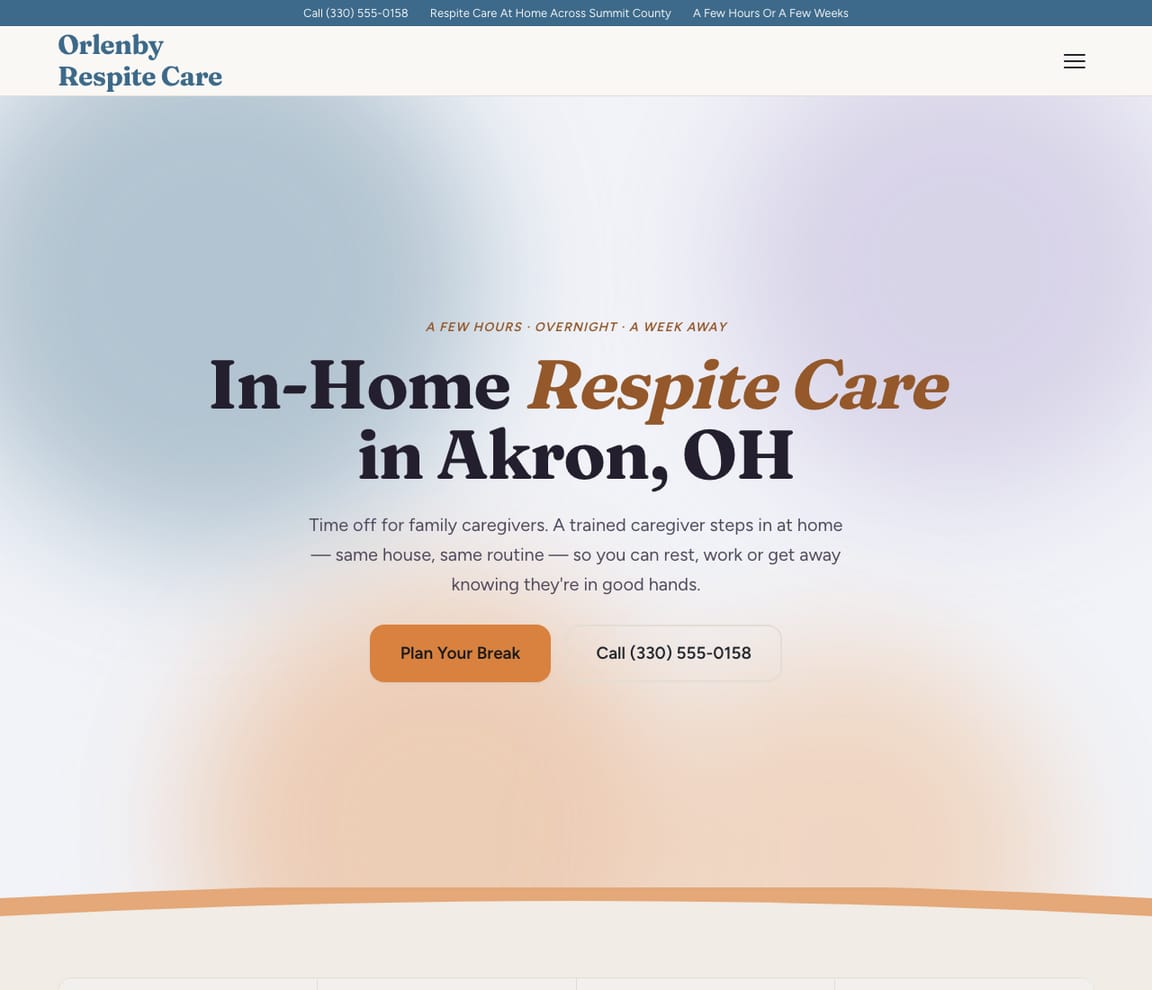
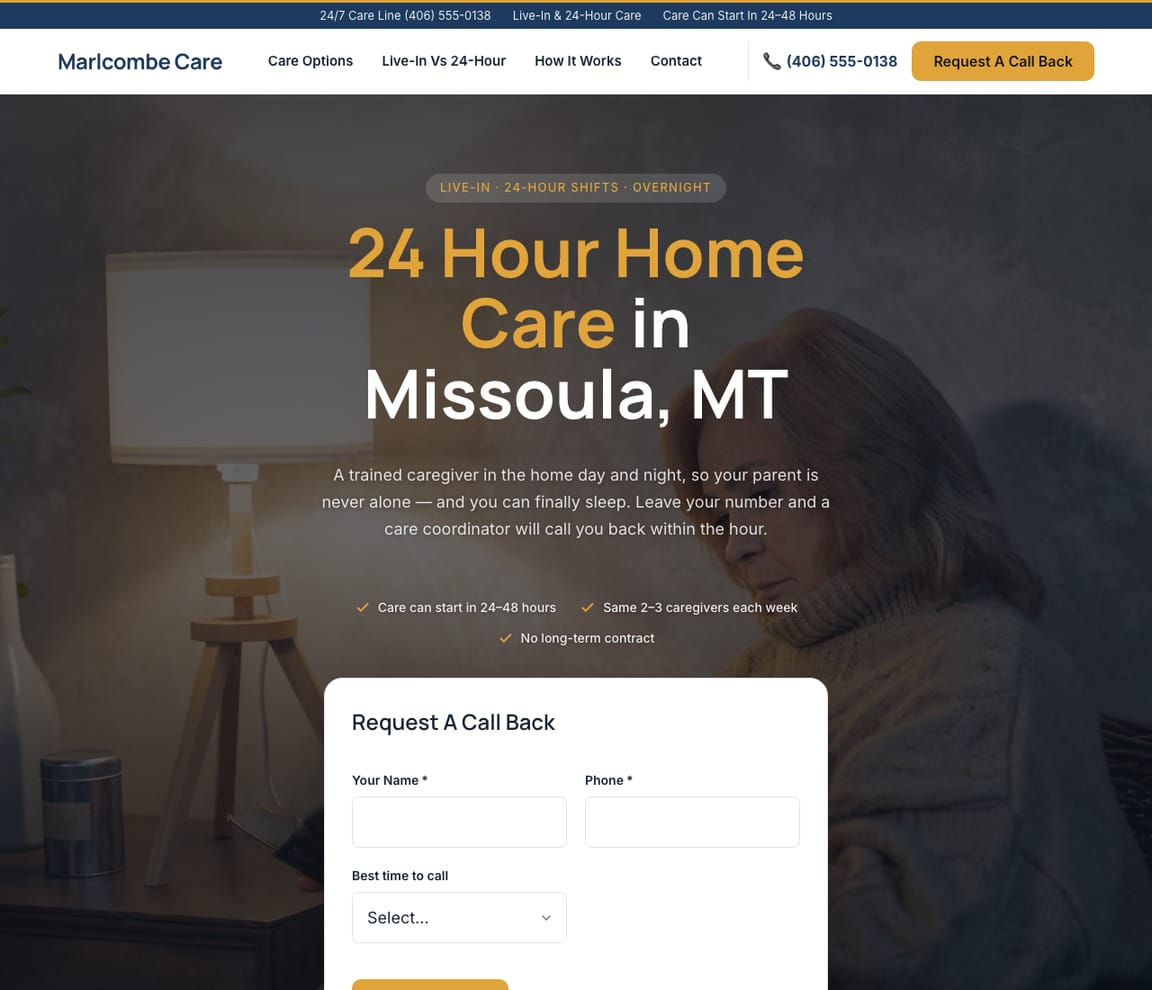
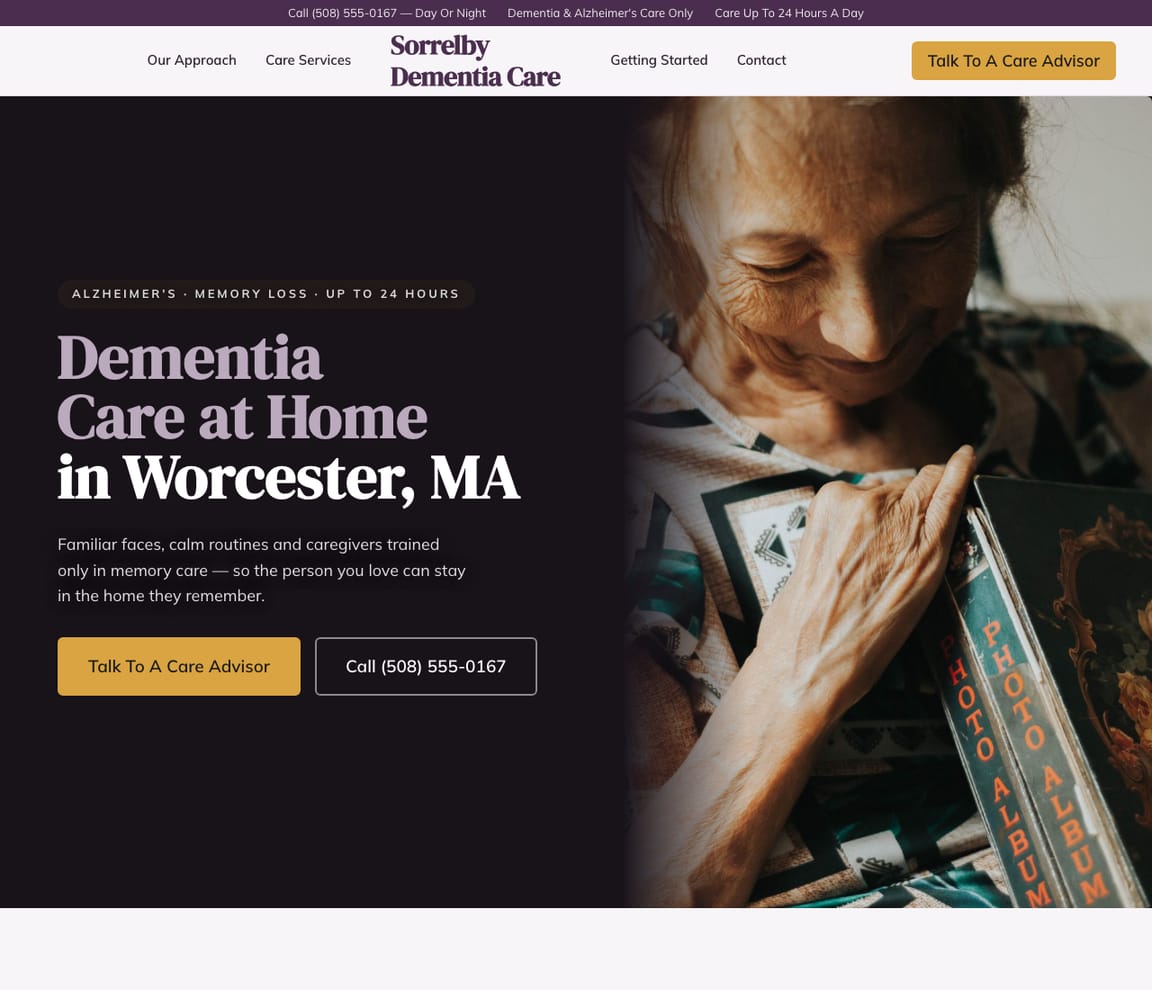
Real Zarla templates for the work a caregiver grows into — respite shifts that give a family a weekend back, live-in and 24-hour care, dementia care at home, and the agency that also places aides. Pick one, put in the care you give and the area you cover, and it's live when you publish.
GET FOUND
Get found by the daughter who just typed "caregiver near me"
Private clients find a caregiver the way they find anything urgent: a phone, a town name and "in-home caregiver" or "respite care". The one who answers what a family needs to know — who you are, what you're trained for, which towns, which hours — gets the call. Zarla builds the website with your care, your training, answers to families' questions, a map of your area and a contact form. Add your registry number and your shifts in chat; once your Google Business Profile is connected, your hours and your map appear on the site too.
“Caregiver near me”
Typed by a son or daughter with a parent coming home next week. The care you give, your hours and your towns answer it before the next name on the list.
Google Business Profile
You go to the client, so Google lists you by the area you serve rather than an address. Your hours, your area and your number on Maps cost nothing to add.
The trust, in writing
Your registry or certificate number, your background check, CPR, the languages you speak. The lines a family checks before it hands a stranger a key — on the first screen.
Google Search
Rrosadelgadoinhomecare.com
Rosa Delgado In-Home Care — Trusted home care in Your AreaIn-home caregiver in Sacramento — companion care, personal care, respite and overnight shifts. Registered home care aide, CPR certified, bilingual.← Your Zarla siteCcityhomecareservices.com
City home care ServicesGoogle Maps
1
Rosa Delgado In-Home Care
← You2
Metro home care Co.
3
Quick home care Services
AI assistants (ChatGPT / Perplexity)
For a registered home care aide in Sacramento who takes overnight and respite shifts and speaks Spanish in your area: Rosa Delgado In-Home Care — a local caregiver's site that names her registration and training, lists companion, personal care and respite visits, gives the towns and the hours she covers, and has a form for the family to describe who needs care.
An example with a made-up business and illustrative figures. Yours will show your real details and reviews.
YOUR LAUNCH PLAN
Your become-a-caregiver checklist
The guide as a to-do list. Work down it and you'll be trained, cleared, on your state's list and earning — through an agency or a family program — before you ever need clients of your own.
- Choose your door — agency aide, home health aide, CNA, or paid family caregiver.
- Apply where the training is free — in-house at an agency, or a state-approved nonprofit course.
- Clear the background check — fingerprints, and a drug screen or driving record where the office asks.
- Finish the hours your state asks for — 75 for a home health aide at a Medicare-certified agency, 120 in California.
- Get onto the registry or pass the exam — California, Washington, New York each keep a list.
- Add CPR and a TB test — asked for in the ads below; one Texas office lets you get both after hire.
- Keep your in-service hours current — twelve a year at a Medicare-certified agency, five a year for a California home care aide.
- Get found — a website and a Google Business Profile the day you take private clients.
REAL CUSTOMERS
Small business owners who got online with Zarla
Verified reviews from real Zarla customers.
“Very reliable, professional, and fast results. I was able to get my business online in no time, and the ease of access made it so simple.”
“Optimized for local service-based businesses. Easiest website build I've experienced. The AI-based build is the way to go instead of clunky theme-based websites. Get the site built and get out of the weeds with Zarla!”
“I had no idea how to set up a website for my business. Thanks to Zarla, they've helped me a lot.”
“Great professional website in less than a minute, with the use of AI and a few descriptive prompts. This has saved me bundles of time and research on web developers.”
Be the caregiver a family finds when the call comes
Add your town and your name or your agency's, and Zarla builds the website from that one line — the care you give, who you are, answers to the questions families ask, a map of the area you cover and a contact form. Add your registry number, your certificate and the shifts you take in chat. Free to build; you pay when you publish.
Already have a website? Bring it across →Zarla keeps your old page addresses where it can and redirects the ones that change, helping you keep the Google standing you've built.
Frequently asked questions
How much does it cost to become a caregiver?
In the US, it can cost nothing: the BrightStar offices near Waller, Texas and in North Miami train new caregivers in-house free, Home Instead in Edina trains at no cost to you, and New York's Selfhelp runs state-approved home health aide and personal care aide courses free of charge. Paying your own way, our arithmetic on the prices the schools and the state print comes to $661.25 for Kingsborough Community College's home health aide course in Brooklyn — $525 tuition, a $60 lab fee, a $25 registration fee and a $51.25 textbook — and $1,375.80 for the nursing assistant route in Washington: $1,235.80 tuition at Grays Harbor College, the $55 knowledge test and the $85 credential fee. Washington's home care aide certificate comes to $910.70 with a $599 online course, the $100 application and two exams. California's home care aide registration is $35, plus fingerprints.
Do you need a license to be a caregiver?
In the US, a caregiver is trained, registered or certified, and which depends on the job and the state — one Florida office's ad calls its requirement an HHA license. Federally, a home health aide at a Medicare-certified agency needs at least 75 hours of classroom and supervised practical training — 16 of them supervised practice — and 12 hours of in-service training a year, or a place in good standing on a state nurse aide registry; a nurse aide program is at least 75 clock hours. California registers home care aides with the Department of Social Services ($35, a background check before approval, five hours of training before a client) and certifies home health aides through the Department of Public Health (120 hours, or 40 with a CNA). Washington certifies home care aides after 75 hours and a state exam; New York keeps a Home Care Registry of trained aides; Florida asks agencies for proof of at least 40 hours. The agency's own license is the start guide's question. Check your state's licensing agency or health department before you pay for a course.
Do you need a certification to be a caregiver in California?
In California, it depends on who pays you — an agency's aide registers, a certified home health aide certifies, and a family caregiver paid by the state enrolls with the county. An aide employed by a licensed home care organization is listed on the Department of Social Services' Home Care Aide Registry: the fee is $35, fingerprints go through Live Scan, the department's criminal background check comes before approval, and an aide working for a home care organization completes five hours of entry-level training before being with a client and five hours a year after. The certified home health aide is a separate credential from the Department of Public Health: at least 16 years old, a 120-hour approved program with an exam — or 40 hours with an active CNA certificate — a criminal record clearance, and 24 hours of in-service training every two years. A family member paid through In-Home Supportive Services enrolls with the county instead: an orientation, the enrollment forms and a Department of Justice fingerprint check. Check your state's licensing agency — in California, the Department of Social Services and the Department of Public Health — before you enroll.
How do I become a paid caregiver for a family member?
In the US, through Medicaid's self-directed programs, which let a person who qualifies for home care hire someone they choose, and through the VA. In California, In-Home Supportive Services providers may include family members, friends and neighbors: you attend a county orientation, enroll, and clear a Department of Justice fingerprint check — over 800,000 Californians are enrolled as providers, and three in four of the program's caregivers are relatives of their clients. In New York, the Consumer Directed Personal Assistance Program lets a Medicaid member hire a friend or relative, but not a spouse, a designated representative or the parent of a consumer under 21, and every caregiver is paid through the statewide intermediary, PPL. Washington asks a worker caring only for a parent or child for 35 hours of training within 120 days. For a veteran rated 70% or higher who needs at least six months of personal care, the VA's family caregiver program can pay the primary caregiver a monthly stipend. The person who needs care applies; the program sets the hours.
How long does it take to become a home health aide?
In the US, the federal minimum for a home health aide at a Medicare-certified agency is 75 hours, and New York gives its training programs 60 days to deliver them; Hudson Valley Hospice's free course runs three weeks, Kingsborough Community College's lists 91 hours, and a New York personal care aide course is 40 hours, about seven days. California's certified home health aide takes a 120-hour program, or 40 hours for a CNA. In Washington, a home care aide finishes 75 hours within 120 days of hire and then takes the state exam. A CNA program at a Washington community college runs three months.
What is the difference between a home health aide and a CNA?
In the US, a home health aide works in clients' homes, usually for a home health agency under a nurse's direction; a certified nursing assistant is trained for nursing homes and hospitals and listed on the state's nurse aide registry. Both federal programs start from 75 hours with 16 hours of supervised practical training, and a CNA in good standing on the registry counts as a qualified home health aide at a Medicare-certified agency. In New York a CNA on the state registry doesn't repeat the content of the nurse aide course; in California a CNA becomes a certified home health aide with a 40-hour program instead of 120. Several agencies quoted above hire either: one Massachusetts ad pays a CNA or home health aide $19 to $25 an hour.
How do I become a caregiver with no experience?
Apply to a home care office that trains: Home Instead in Edina says previous experience is not required and provides skills training at no cost to you, and the BrightStar offices near Waller, Texas and in North Miami train in-house free with their Director of Nursing. In New York, Selfhelp's state-approved course is free and its qualified graduates are offered a job. What offices ask for instead of experience is a background check, a drug screen or a driving record at some offices, CPR (some arrange it after hiring), a TB test, a car and the ability to lift up to 50 pounds. Time spent caring for your own relative counts too — the UK's careers service says so in as many words, and several of the caregivers quoted above began with a grandmother.
How much do caregivers make?
As employees, home health and personal care aides earned a 2025 median of $35,800 a year, $17.21 an hour, with 10 percent under $27,040 and 10 percent over $45,040; by state, $39,620 in New York, $34,320 in California, $33,800 in Florida and $24,230 in Texas (O*NET, from BLS data). Agencies' own ads print their ranges: $14 to $16 an hour at Visiting Angels in Summerville, South Carolina; $17 to $21 at Home Instead in Edina; $16 at BrightStar near Waller, Texas; $15 to $17 in North Miami; $17.00 to $22.00 in Asheville; $19 to $25 for a CNA or home health aide in Lynn, Massachusetts. What an agency bills a family for that hour is a different number, and the start guide's question.
Do caregivers need a background check?
In the US, for the agency and state routes in the places we read, yes. In California the Department of Social Services completes a criminal background check before a home care aide is approved for the registry, the certified home health aide needs a criminal record clearance, and family caregivers in In-Home Supportive Services are fingerprinted by the Department of Justice. In Washington a working home care aide has a fingerprint check through the state's social services department. The agencies quoted above add their own: a willingness to complete a background check at Home Instead, a drug screen and motor vehicle background screening at two BrightStar offices. In the UK, the careers service lists passing enhanced background checks as the job's one requirement; in Australia, an NDIS worker screening check is valid for up to 5 years.
Is being a caregiver a good career?
For someone who wants meaningful work quickly, without paying for school, it is one of the most open doors in health care: 4,677,100 home health and personal care aides were employed in 2025, growth is projected much faster than average with 760,500 openings for 2025–2035, and agencies train new hires. The trade-offs are real — a $35,800 median, near-touching physical work, exposure to infection, and the grief the caregivers above describe. The ladder is what makes it a career: a home health aide's certificate, then a CNA, then nursing school or specialized shifts — or, as several caregivers quoted above did, an agency of your own.
What does a caregiver do?
The government's description of a home health aide: they provide assistance with routine healthcare tasks or activities of daily living, “such as feeding, bathing, toileting, or ambulation.”, working “under the direction of offsite or intermittent onsite licensed nursing staff.” In practice that is help getting up, washed and dressed, meals, medication reminders, light housework, rides to appointments, company, and watching for changes to report to the nurse or the family — in shifts as short as three hours or as long as 24, at the agencies quoted above.
How do I get a home health aide certification?
In the US, finish a state-approved home health aide training and competency program — at least 75 hours, 16 of them supervised practical training, for work at a Medicare-certified agency — and pass its evaluation, or hold a CNA in good standing on your state's nurse aide registry. In New York, the training program issues the certificate and enters you on the state's Home Care Registry; free state-approved courses exist, and Kingsborough Community College's costs $661.25 with the textbook. In California, the Department of Public Health certifies aides after a 120-hour program, or 40 hours with a CNA. In Florida, agencies need proof of at least 40 hours or a passed competency test. At a Medicare-certified agency, keep it current with 12 in-service hours a year. Check your state's licensing agency or health department for the approved programs.
Can a family member get paid as a caregiver in New York?
In New York, yes, through the Consumer Directed Personal Assistance Program: a Medicaid member who qualifies for home care can hire a friend or family member as a personal assistant, unless that person is the member's spouse, designated representative, or the parent of a consumer under 21. Since September 1, 2025, members 21 and over assessed for the first time must meet the Minimum Needs Requirements, and every caregiver in the program is paid through Public Partnership LLC (PPL), the statewide fiscal intermediary. The member, or their representative, recruits, trains and supervises the assistant.