BUSINESS GUIDE
How to start a home care business in 2026
The real version, from a laptop and a few caregivers: non-medical care or home health, what your state licenses, hiring and keeping caregivers, insurance and bonding, what an hour of care costs a family, who pays — and franchise or independent, the first clients, and the staffing side-line.
Free to build · Pay when you publish · No credit card
$35/hourwhat a family paid for a non-medical caregiver, US median (2025)
$17.21/hourmedian pay for home health and personal care aides (2025)
75.5%caregiver turnover in 2025, in one industry benchmark
No codeto get online
See it in action
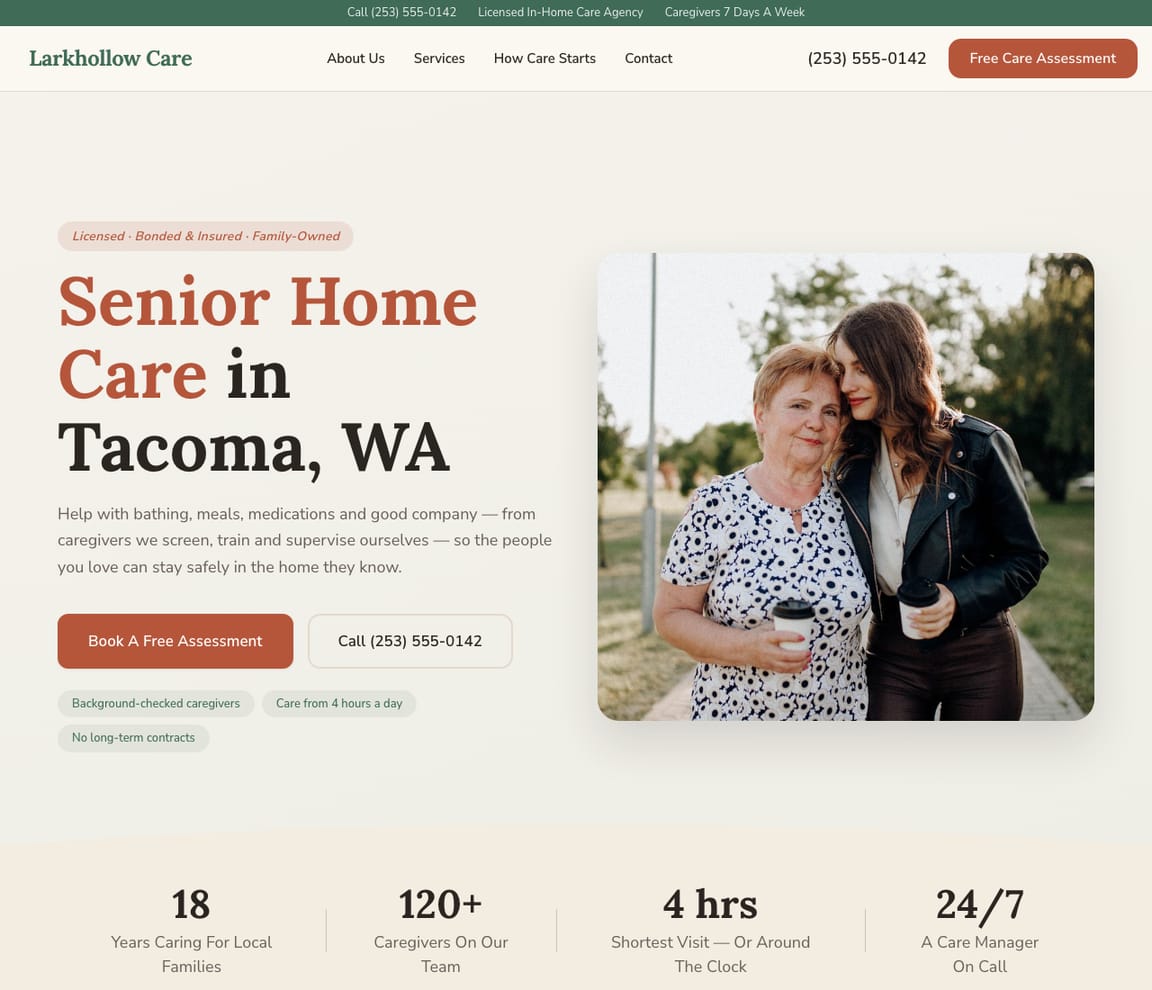
See what your home care website could look like
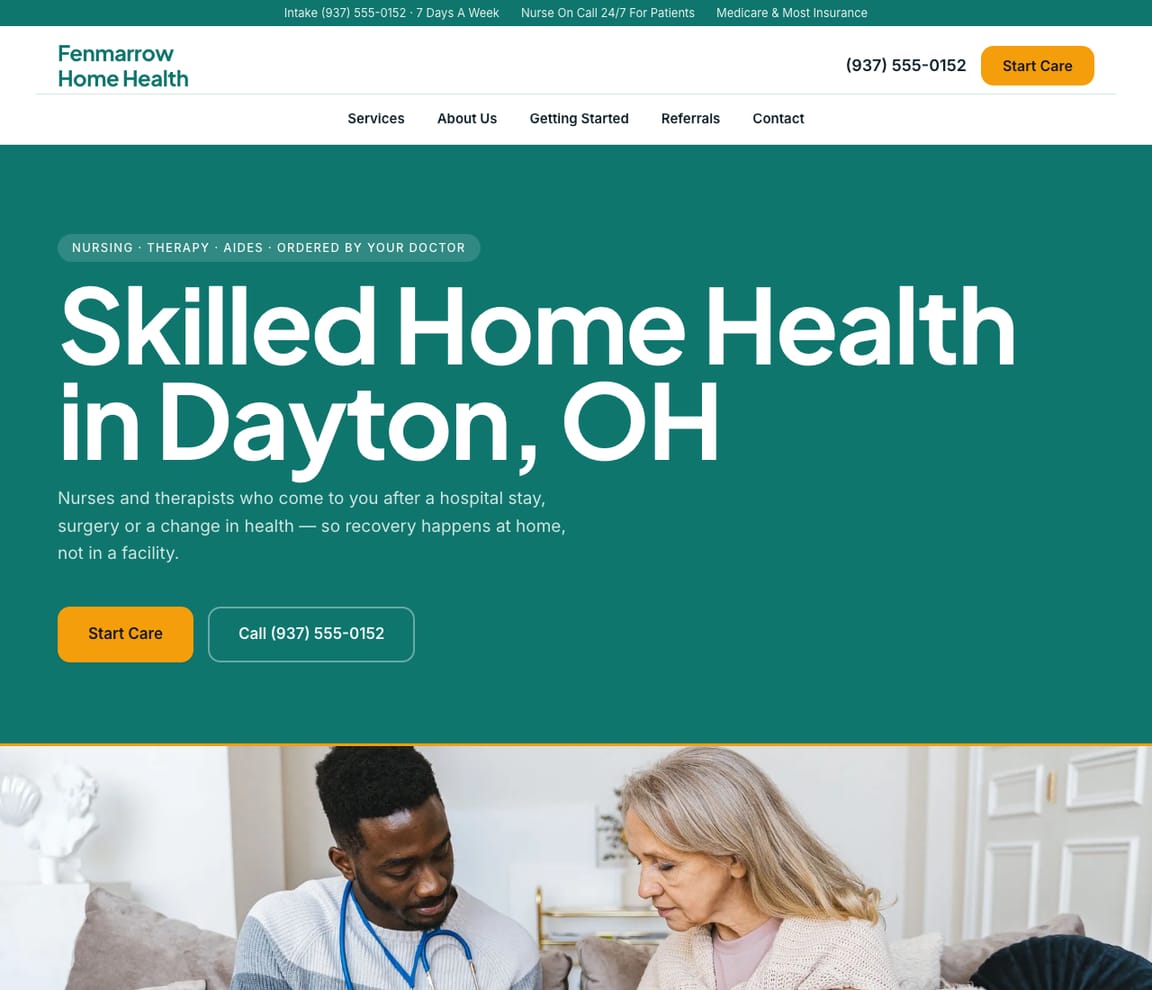
This is a real Zarla template for a home care agency. Describe yours — the care you give, the towns you cover, how you choose caregivers — and you'll have a site like this, with a free-assessment button up front, in about a minute.
- Professional design — not a generic template
- Looks great on desktop and mobile
- Content written for your industry
Build the website
Start your home care website now
Add your town and your agency's name to the sentence, and Zarla builds the site: your care services, your team, answers to families' questions, a map of the area you cover and a contact form. Add how you choose caregivers and how care starts in chat, then publish.
Already have a website? Bring it across →Zarla keeps your old page addresses where it can and redirects the ones that change, helping you keep the Google standing you've built.
Is a home care business worth starting — and what do families pay?
The demand is real and it is growing. The US population aged 65 and over rose 3.1% in one year, to 61.2 million in 2024 (US Census Bureau, June 2025), and the government's projections put job growth for home health and personal care aides at "much faster than average" from 2025 to 2035, with about 760,500 openings a year on average (O*NET, BLS data).
What families pay. The national median rate for a non-medical caregiver was $35 an hour in 2025, up 3% from $34 in 2024 — $80,080 a year for 44 hours of care a week (CareScout's 2025 Cost of Care Survey, March 2026, CareScout), or $6,673 a month (CareScout state tables). CareScout now reports homemaker and home health aide services together as "non-medical caregiver." Rates run by state, from a $24 median in Mississippi to $46 in Wyoming; the median is $40 in California, $30 in Texas, $32 in Florida, $35 in New York and $45 in Washington (CareScout state tables, 2025).
What caregivers earn. The US median for home health and personal care aides was $17.21 an hour, $35,800 a year, in 2025 (O*NET). The gap between the two is the agency's gross margin: in one industry benchmark, agencies keep about 40 cents of every dollar after direct care costs, whatever their size, and the average agency brings in about $2.3 million a year (HOMECAREceo on the 2025 Activated Insights benchmark, August 2026).
The hard parts are people and cash. Caregiver turnover was 75.5% in 2025 in the 2026 edition of the Activated Insights benchmark, and agencies paying $15 to $17.99 an hour saw median turnover of 84.4% against 53% at $18 to $19.99 (HHAeXchange, July 2026) — a software vendor's reading of a benchmark, but the pattern is the trade's. Payroll goes out every week or two, while insurers and state programs pay later, and in the benchmark's 2025 edition small agencies spend about 35% of revenue on everything besides direct care, against about 18% at large ones (HOMECAREceo) — so a young agency's margin before the owner's pay is thin, and grows with size. The rest of this guide sets up the license, the caregivers, the prices and the first clients.
How to start a home care business, in plain English
First decide: non-medical care or home health. They are different businesses. Non-medical home care is help with daily living — bathing, dressing, meals, companionship, housekeeping, rides — which California's regulator describes as "non-medical services and assistance" (California CDSS fact sheet, April 2022). A home health agency is "primarily engaged in providing skilled nursing services and other therapeutic services" (CMS, August 2026). Medicare pays for home health — part-time or intermittent skilled nursing, therapy, and aide care only alongside it — and says it doesn't pay for 24-hour-a-day care at home, or for "Custodial or personal care that helps you with daily living activities (like bathing, dressing, or using the bathroom), when this is the only care you need" (Medicare.gov). That is why this guide is about non-medical care, paid mostly by families.
Home health is a far bigger start. A Medicare home health agency needs a state license, certification through a state survey or an accrediting body with "deemed status" such as ACHC (ACHC), a nurse to run the clinical side, and reserve operating funds held from its application until three months after Medicare lets it bill — at least half of it the owner's own money, not borrowed (42 CFR 489.28). At least 15 states and DC require a certificate of need for home health (Alliance for Care at Home, May 2026). And on May 13, 2026, CMS paused new Medicare home health agency enrollments nationwide for six months (Federal Register, May 2026) — a pause it can extend in six-month steps (CHAP, May 2026). Check its status before you plan one. It doesn't touch non-medical agencies.
Licensing: the shape, then your state. In the US there is no national license for non-medical home care; it is the state's call, and the rules differ in what they cover. Some states license companion and sitter care too — Georgia's private home care provider license covers "companion or sitter tasks" (Ga. Comp. R. & Regs. 111-8-65-.03), North Carolina's home care license covers in-home companion, sitter and respite care for $510 to start and $510 a year (NC DHSR, May 2025), and Pennsylvania licenses home care agencies and registries for non-skilled services including companionship (Pennsylvania DOH); Ohio has required a license for agencies providing nonmedical home health and personal care services since October 1, 2022 (Dinsmore, September 2022). Others license hands-on personal care but not companionship alone: Texas licenses personal assistance services as a home and community support services agency, at $2,625 (26 Tex. Admin. Code §558.3), and exempts sitter-companion and household help that involves no personal care (Tex. Health & Safety Code §142.003); Florida asks companion and homemaker services to register for $50 every two years (Fla. Stat. §400.509), and its companions "may not provide hands-on personal care" (Fla. Stat. §400.462) — that comes from a licensed home health agency, or an aide referred by a licensed nurse registry (Fla. Stat. §400.506).
The biggest states, by their own pages. California: a Home Care Organization license is $5,603 for two years, and each caregiver is registered as a home care aide for $35 (California CDSS). New York: a licensed home care services agency application is $2,000, and since April 2020 there is a public-need test: where five or more agencies are actively serving patients in a county, "there is a presumption that no additional LHCSAs are needed in that county" (New York DOH, New York DOH, January 2026). Illinois: a home services agency license is $1,500, paid with the application (Illinois IDPH). Washington: $5,000 for the first 12 months from June 2026, plus a surcharge for each extra county (WAC 246-335-990), and liability insurance of $1 million per occurrence (WAC 246-335-320). Minnesota: a basic home care license is $2,100 and a comprehensive one $4,200 (Minn. Stat. §144A.472). Licensing can take weeks or months, so check your state's health department before you take a client — and look again before you apply, because fees change.
Hire caregivers as employees, and check them. If your agency sets the schedule and directs the work, the IRS's test points to employees, not contractors (IRS); the registry model, where families hire and pay the caregiver, is its own license in some states. Background checks are the norm where home care is licensed — California's state and FBI fingerprint fees are $32 and $17 a person (California fingerprint form) — and if you bill Medicaid or another federal program, check every hire against the federal exclusion list, because the payment ban reaches "anyone who employs or contracts with the excluded person" (HHS-OIG, April 2026). Training hours are set by the state: California requires five hours before a caregiver provides care and five more each year (California Assembly analysis, June 2025); Illinois five hours before the first assignment, five more within 30 days and ten a year (77 Ill. Adm. Code 245.71); Washington 75 hours — five before giving care, the rest within 120 days of hire (RCW 74.39A.074) — then a certification exam (Washington DOH).
Pay overtime, and price it in. Under the Department of Labor's 2013 home care rule, agencies can't use the companionship or live-in exemptions — their caregivers get minimum wage and overtime (29 CFR 552.109); the companionship exemption itself only covers hands-on care that "does not exceed 20 percent of the total hours worked" in a week (29 CFR 552.6). In July 2025 the department proposed returning to the older rules (Federal Register, July 2025), and it stopped enforcing the 2013 rule against agencies while the proposal is pending — but "the 2013 rule remains in effect, for now," and that doesn't stop a caregiver's own lawsuit (Jackson Lewis, September 2025). As of October 2026 it is still a proposal, and many states have their own overtime laws. Price live-in and 24-hour care with overtime in.
Insurance and bonding. Insureon's medians for caregivers who apply with it are $30 a month for general liability, $12 for professional liability, $12 for a fidelity bond — it covers theft by an employee — and $211 for workers' compensation (Insureon, February 2025): small-business medians, not a market survey. Workers' comp grows with payroll; a broker puts the 2025 average for home health businesses at $2.79 per $100 of payroll (1-800-Insurance, January 2026). Whether you must carry it is set by each state — some require it from the first employee, some only above a headcount, and Texas lets most private employers choose (Texas Department of Insurance). Check your state. Some states set minimums, like Washington's $1 million of liability above. Check your state's rules and ask your agent what your payers require.
Set the hourly rate from the bottom up. Start from what the hour costs you: the caregiver's wage, the employer's 7.65% for Social Security and Medicare (IRS), unemployment tax and workers' comp — then add your overhead and margin, and check the result against your state's CareScout median. Set a minimum visit, a weekend and holiday rate, and a live-in or 24-hour rate with overtime counted. CareScout also tracks private-duty nursing, at a $90 national median hour in 2025 (CareScout, March 2026) — the price of skilled care, not non-medical.
Who pays. Private pay — families, from savings or income — is where several of the owners quoted below started. Tax-qualified long-term care policies pay for someone expected to be unable to do at least two activities of daily living, such as bathing or dressing, for at least 90 days, or who needs substantial supervision because of severe cognitive impairment — the federal definition (26 U.S.C. §7702B). Medicaid's home- and community-based services can include homemaker, home health aide, personal care and respite services (42 CFR 440.180); you enroll with your state's program, and states require electronic visit verification for Medicaid personal care visits — federal law cuts their funding if they don't (42 U.S.C. §1396b(l)). And from July 2030, states must ensure agencies spend 80% of Medicaid payments for those services on direct care workers' pay (42 CFR 441.302(k)). The VA buys homemaker and home health aide care from agencies that contract with it (VA, March 2026), through regional networks run by Optum and TriWest (VA, July 2026); Veteran-Directed Care gives veterans a budget to hire their own help (VA); and Aid and Attendance is a monthly payment added to a veteran's pension — paid to the veteran, not to an agency (VA, May 2026).
Franchise or independent. A franchise sells you the brand, the training and the playbook. Disclosed total investments run $91,040 to $269,750 for Home Instead, with a $54,000 fee and a 5% royalty (1851 Franchise, 2025 disclosure); $94,330 to $176,239 for Right at Home (1851 Franchise, 2026 disclosure); $119,560 to $190,700 for Comfort Keepers, with a $55,000 fee and 5% plus 2% for the brand fund (Comfort Keepers, 2026 disclosure); and $125,460 to $171,150 for Visiting Angels, with a 3.5% royalty (1851 Franchise, 2025 disclosure). Independent, you keep the royalty and build the name yourself.
Getting the first clients. Referrals start with hospital discharge planners and case managers, rehab centers and skilled nursing facilities, physicians' offices, home health and hospice agencies, senior-living communities, elder-law attorneys and churches — visit them with a one-page sheet and ask for one client. Public programs can be a door too: one new Ohio agency takes PASSPORT waiver clients through its local Area Agency on Aging (Richland Source, August 2025). Then a Google Business Profile and a website that says how you choose caregivers, because the family that gets your name will look you up before it calls.
The staffing side-line. Some agencies also place caregivers, nursing assistants and nurses with hospitals and care facilities — a healthcare staffing business, and in many states a separate registration. Pennsylvania registers temporary health care services agencies each year for $500, with proof of $500,000 in professional liability and workers' comp and a dishonesty bond of $10,000 per employee (Pennsylvania DOH); Minnesota registers supplemental nursing services agencies for $2,442 with a $10,000 bond (Minn. Stat. §144A.71); Florida licenses nurse registries, which refer nurses and aides to private homes as well as facilities (Fla. Stat. §400.506). In a staffing business the client is usually a facility, not a family, and the pay ladder runs from nursing assistants, at a $20.32 US median hour in 2025 (O*NET), to licensed practical nurses at $30.96 (O*NET) and registered nurses at $46.90 (O*NET). It is a second license and a second insurance policy, so check your state's rules before you add it.
What it costs to start. One franchisor's 2026 disclosure prices the pieces an agency needs whether or not it buys a franchise: $39,000 to $52,000 of working capital for the first three months — and a recommended $100,000 in working capital or a credit line — $3,100 to $6,800 for insurance, $360 to $600 for background screening and $2,000 to $3,500 for caregiver training (Comfort Keepers, 2026). Scheduling software with visit verification lists at $8 to $25 per caregiver a month (ShiftCare); a Texas LLC is $300 (Texas SOS), every California LLC pays an $800 annual tax (California FTB) and the EIN is free (IRS). Don't plan on a grant: the SBA "does not provide grants for starting and expanding a business" (SBA). Our free home care business plan itemizes every line — $63,620 to $133,503 for an independent agency in one state, mostly working capital — and the home care website templates show what a good agency site looks like. Zarla's home care website builder is how the family searching "home care near me" finds yours.
In the UK: domiciliary care and the CQC. In England, personal care for people who can't provide it for themselves, in the place where they live, is a regulated activity (the 2014 Regulations, Schedule 1), so a domiciliary care agency registers with the Care Quality Commission, and a company also needs a registered manager (the 2009 Registration Regulations, reg. 5). On CQC's fee page (last updated June 2024), the annual fee for community social care is £239 plus about £54 for each person you support (CQC) — check the current year's scheme. Care work qualifies for an enhanced DBS check (GOV.UK), and new care workers are inducted against the Care Certificate's 16 standards (Skills for Care). The Homecare Association put the minimum price for an hour of homecare in England at £32.14 for April 2025 to March 2026 (Homecare Association). Scotland (the Care Inspectorate), Wales (Care Inspectorate Wales) and Northern Ireland (RQIA) register care services separately.
In Australia: Support at Home and the NDIS. Support at Home replaced the Home Care Packages Program on 1 November 2025 (Department of Health, Disability and Ageing, August 2026), and under the Aged Care Act 2024 a provider registers with the Aged Care Quality and Safety Commission in categories — personal care at home is Category 4, which is audited against the strengthened Quality Standards (ACQSC). The government paused its planned price caps for Support at Home in May 2026 (health.gov.au, May 2026). For NDIS participants, registering for "Assistance with daily personal activities" needs a certification audit (NDIS Commission, July 2026), and workers in risk-assessed roles need an NDIS worker screening clearance (NDIS Commission).
What home care agency owners actually say
None of this is our opinion about the trade. It comes from twelve people who started, own or run home care and nursing agencies, talking to the trade press, local news, a podcast and a small-business center between 2014 and 2025, plus one undated bio — read each as theirs at the time. Four things come up again and again.
You can start small, and private pay is where many start. Kunu Kaushal, who founded Senior Solutions Home Care in Tennessee: “We are a humble home care agency that started with a laptop and cell phone, and a couple of caregivers, with a focus on non-clinical in-home care. Private pay was certainly where we started and focused.” (Home Health Care News, October 2025). Jim Borngesser, founder of Family Focused Home Health Care, a private duty agency in Jacksonville, Florida, on choosing private pay over Medicare: “People thought I was crazy, saying, ‘Are you nuts not going Medicare?' The market is there — I totally get it. But it's one word: predictability.” — and on the catch: “it's harder because people have to pay for care out of pocket. This isn't covered by any insurance, except long-term care insurance, so people are taken aback. It's that shock.” (Home Health Care News, March 2015). Kevin Smith, second-generation owner and CEO of Best of Care in Massachusetts, on private pay: “That can be more lucrative. The rates are oftentimes more advantageous from a reimbursement standpoint, and you can negotiate and control them. You can do things like create minimums.” (Home Health Care News, August 2023).
“Every step of the way I was fighting for funding and looking for clients,” — Im Ja Choi, who started Penn Asian Senior Services, a nonprofit agency in Philadelphia that provides home health aides, on a $55,000 home equity line of credit and a $50,000 county grant, and by 2014 earned about $114,000 a year, Money, July 2014
The license and the paperwork come first. Brittany Rayburn, a nurse who co-founded Agape United Home Care in Ohio: “We were licensed six weeks later by the state and accepted our first client two weeks after that.” (Richland Source, August 2025). Her co-founder Desiree Nidiffer: “As a company founded and led by registered nurses, we are committed to shifting the negative stigma often associated with in-home care.” (Richland Source, August 2025). Jo-Beth Foley, who opened In-Home Angels in Connecticut in 2022, in a story by the small-business center that advised her: “I have learned a lot about funding, and I have learned a lot about the logistics of laws and regulations. I have also learned how to manage staff,” (Connecticut SBDC, June 2023).
Caregivers are the business — hire fast and pay properly. Borngesser again: “I wrote an 80-page corporate manual and said, "I will pay overtime."” (Home Health Care News, March 2015). Smith, on hiring: “If you can really find a way to prioritize, and win the timing battle, you can get folks out to work very quickly.” (Home Health Care News, August 2023). Qiana James, founder and CEO of Friendly Faces Senior Care: “When I'm designing my agency, I made sure it was very intentional, and it's not just the caregivers, but also our office staff.” (Home Health Care News, November 2023). Daniel Gottschalk, president — not the founder — of Family Tree Private Care in Texas and Colorado: “we have had the luxury of being able to pay pretty well for caregivers at the top of the market, because we are the top of the market for the clients.” (Home Health Care News, June 2022).
Referrals come one client at a time. Aaron Marcum, who started a home care agency in Salt Lake City in 2002 and later founded the benchmarking company Home Care Pulse: “when I first started because of my age, I found it really hard to convince referral sources like, you know, home health and hospice and companies like that to refer to me.” — and what he told them: “just give me your one patient and we'll take care of them.” (Home Care U podcast, auto-generated transcript, June 2024). Maryanne Sawoski, a nurse who built a private duty nursing agency in Los Angeles from 1991 and later a non-medical staffing company: “I continued to build CCHN and started providing care to "private duty" home care cases referred from various hospitals, MDs, case managers.” and “We built our referral sources one patient at a time.” (CAHSAH member directory, her own bio, undated). Sacha Butts, who opened a Right at Home franchise in Simi Valley, California, in 2025: “Word-of-mouth recommendations and networking within the community help us reach more individuals and families who could benefit from our services” (West Ventura County Business Alliance, November 2025). And Borngesser on the competition: “It's tough. There are about 178 competitors just in my Jacksonville, Fla., market.” (Home Health Care News, March 2015).
The through-line: the owners who last get licensed before they sell, start where the pay is predictable, pay caregivers well enough to keep them, and earn referral sources and families one client at a time.
THE STARTER KIT
What you need to start a home care business
A clear line on the care you give
Non-medical — personal care, companionship, homemaking, respite — or skilled home health. The license, the staff and the payers follow from that one decision.
Your state's license or registration
The application, the policy manual it asks for and the fee, filed before your first client — in licensing states it is the longest step.
Caregivers you can trust
Hired as employees, background-checked and trained to your state's rules — California, Illinois and Washington all require some hours before the first shift.
Insurance and a bond
General and professional liability, a fidelity bond, and workers' comp where your state requires it — plus whatever minimums your state sets.
Scheduling and visit check-in
A scheduling app with visit verification, a written care plan for every client, and one person who covers every call-out the same day.
A way to be found
A Google Business Profile, a website that says how you choose caregivers, and a one-page sheet for discharge planners and senior communities.
THE PAPERWORK
Licenses, checks and insurance for a home care business
| Typical cost | Time to get | Legally required? | |
|---|---|---|---|
| Business registration (LLC) and EIN | e.g. $300 (Texas LLC); EIN free | Days | Depends on your structure and city |
| State home care license or registration | $50 (FL) to $5,603 (CA) | Weeks to months | In many states; varies by the care you give |
| Home health license and Medicare certification | Far more; reserves required | Months; check the 2026 pause | Only for skilled nursing and therapy |
| Caregiver background checks | e.g. $49 (CA state + FBI) | Days | In licensing states such as CA and IL |
| Caregiver training hours | 5 hours (CA) to 75 (WA) | Some before the first shift | Set by your state |
| General and professional liability | $30 + $12/month (medians) | Same day | Some states, e.g. WA ($1 million) |
| Fidelity bond | $12/month (median) | Days | Varies by state |
| Workers' compensation | $211/month (median) | Days | Set by each state; optional in TX |
THE STEPS
How to start a home care business (step by step)
Eight steps from “I want to care for people” to an agency families call first.
01
Choose non-medical or home health
Decide the care you'll give — companionship and personal care, or skilled nursing and therapy — because the license, staff and payers follow from it.
02
Check your state's rules and apply
Find your state health department's home care license or registration, write the policy manual it asks for, and file the application.
Before your first client03
Register the business and get insured
Form the business, get an EIN, and buy general and professional liability, a fidelity bond and the workers' comp your state requires.
04
Hire, check and train caregivers
Hire as employees, run the background checks your state requires, and train each caregiver to your state's hours, starting before the first shift.
05
Set your rates and your minimums
An hourly rate built up from wages, payroll taxes and insurance, a minimum visit, and a live-in or 24-hour rate with overtime counted.
06
Get found by families nearby
Put your Google Business Profile and website live with the care you give, the towns you cover and how you choose caregivers.
07
Earn your first referrals
Visit discharge planners, case managers, rehab centers and senior communities, and ask each one for a single client.
08
Add payers and services
Long-term care insurance, VA contracts or your state's Medicaid program, then dementia care, live-in care or a staffing line.
THE COSTS
How much does it cost to start a home care business?
The total is our home care business plan's itemized list for an independent agency in one state: a franchisor's 2026 disclosure for working capital, insurance, office, screening, training and marketing; state license fees; software list prices; and the policy manual and website as planning ranges. Checked October 2026.
$63,620–$133,503to start one independent agency — working capital is the biggest line
$39k–$52kof working capital for three months, in one franchisor's disclosure
$5,603for California's two-year home care license; Texas $2,625
$91k–$270ktotal investment if you buy a franchise instead
WHAT WE'VE LEARNED
What actually makes a family let you through the front door
Thousands of local business websites in, the pattern for care businesses is clear: the family is trusting a stranger with someone they love, in their own home. Three things on a page decide who gets the call.
Who will walk in the door
How you hire, screen and train caregivers — background checks, the training your state requires, and whether the same caregiver comes each visit — written out plainly.
The care and how it starts
The care you give and the care you don't, the towns you cover, the minimum visit, and what happens after the first call: an in-home assessment and a written care plan.
Proof families can check
Your state license or registration, reviews that name caregivers, insurance and bonding, and a contact form that asks about the person who needs care.
THE UPSIDE
What a home care business can earn
Rates from CareScout's 2025 Cost of Care Survey; aide pay from O*NET (BLS data, 2025); margins from an industry benchmark as reported by a coaching firm (August 2026). Ranges, not a promise — how many hours your clients need, and how many caregivers you keep, decide it.
$35/hournational median for a non-medical caregiver, $24 to $46 by state
$80,080a year from one client at 44 hours a week, at the median
About 40%of each dollar kept after direct care costs, in one benchmark
$90/hourmedian for private-duty nursing, if you add skilled care
SEE IT WORK
Home care website designs you can start from
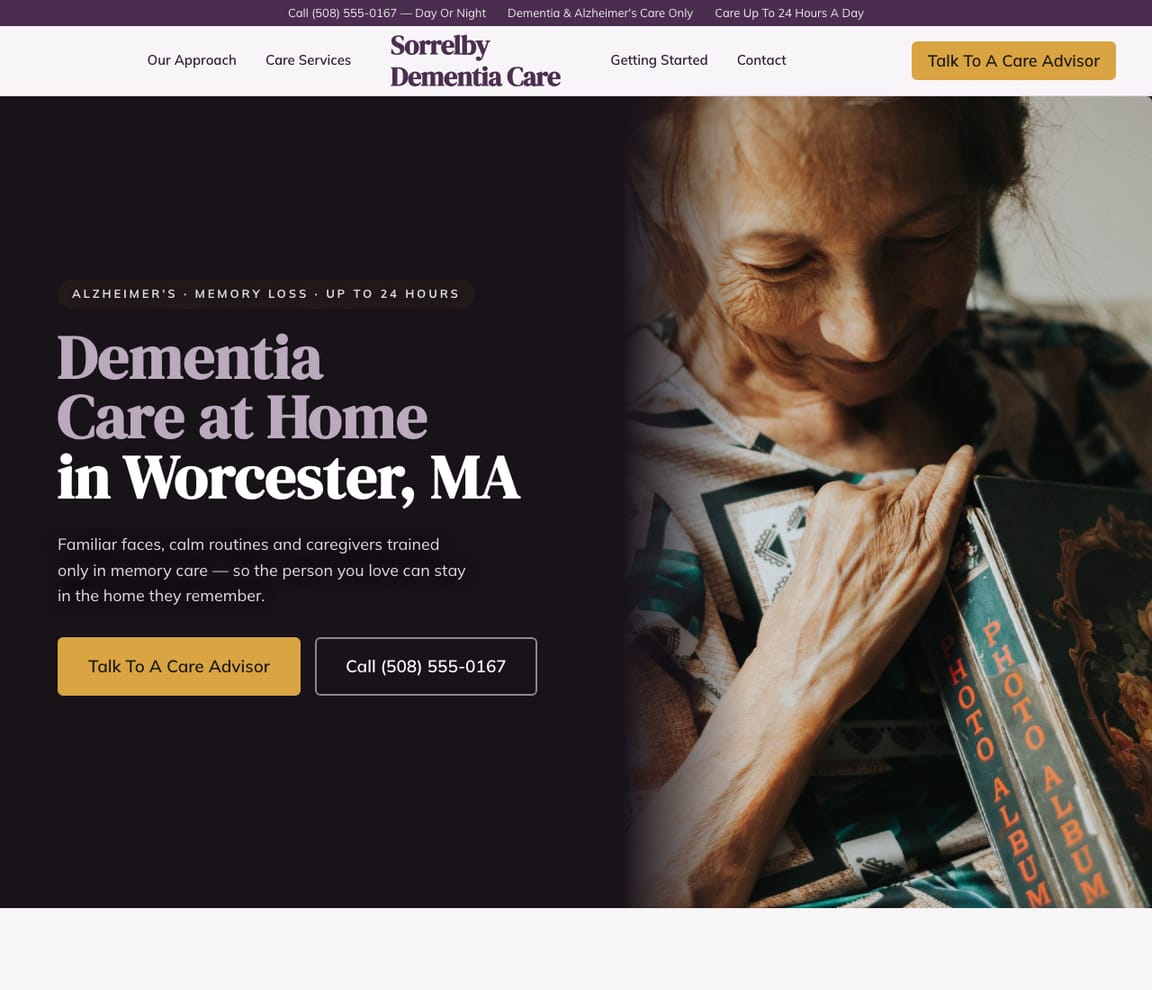
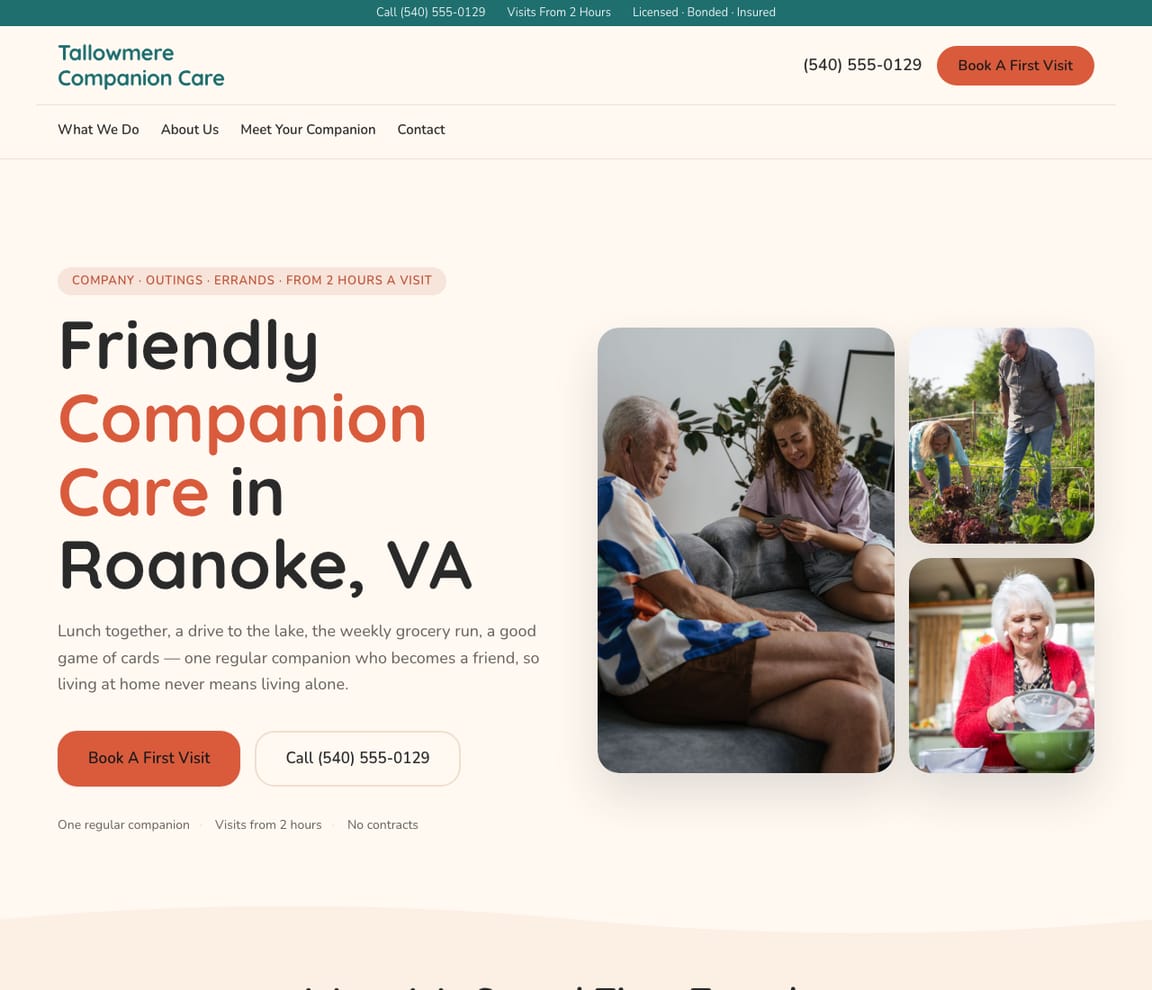
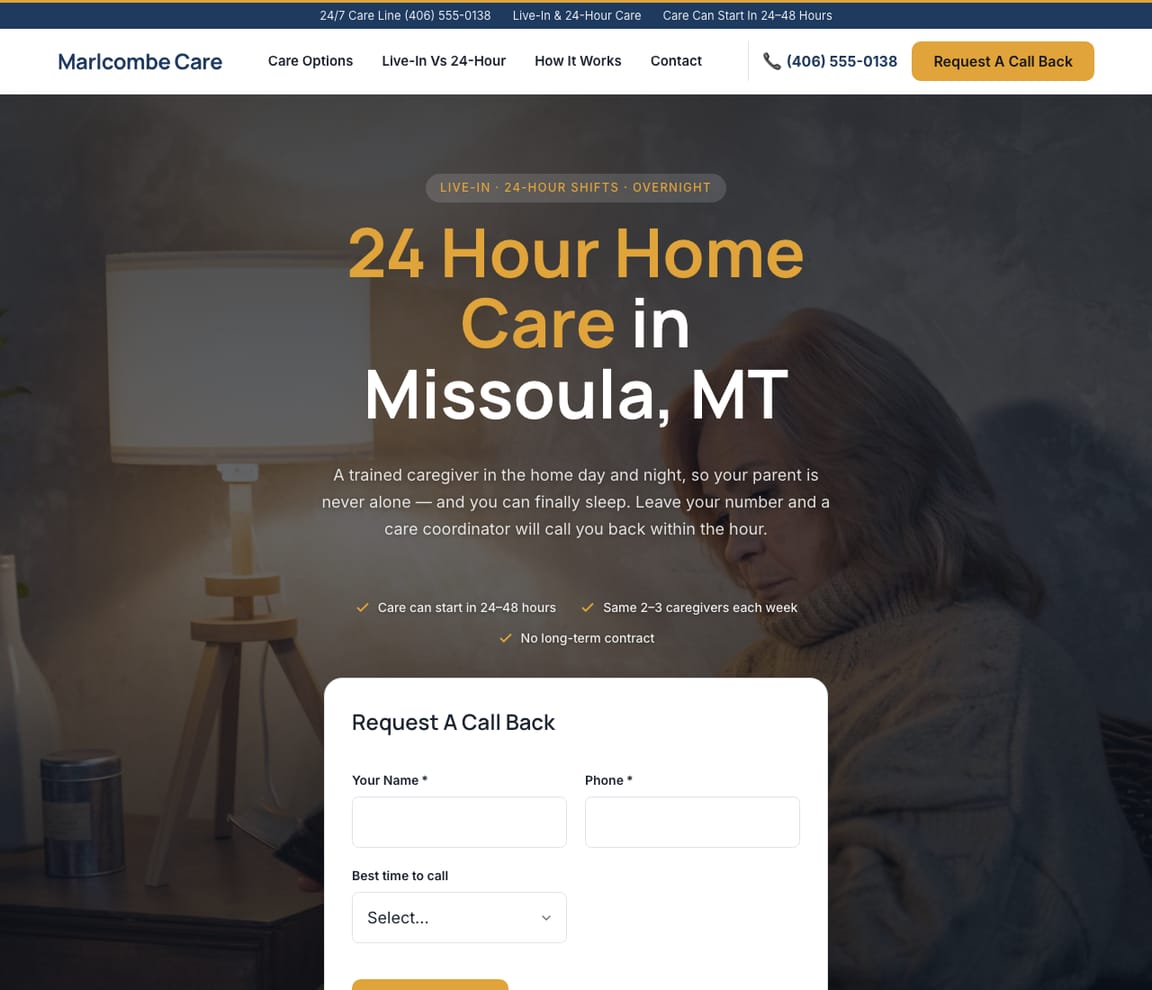
All four are real Zarla templates for care agencies — dementia care, companion care, live-in and 24-hour care, and a skilled home health agency. Open one, swap in your number, your towns and your team, and publish.
GET FOUND
Get found by the family that needs care by Friday
Most home care clients arrive in a hurry — a parent coming home from the hospital, a fall, a diagnosis — and an adult child compares two or three agencies nearby, often late at night. Zarla builds the website with your care services, your team, answers to families' questions, a map of the area you cover and a contact form. Add how you choose caregivers and how care starts in chat, and once you connect your Google Business Profile, your name, service area and reviews stay in step on both.
“Home care near me”
Searched by an adult child the week a parent comes home from the hospital. The care you give, how you choose caregivers and the area you cover answer it before they call the next agency.
Google Business Profile
Your service area, your hours, photos of your team and your reviews inside Google Maps. Free, and an afternoon to set up.
Reviews from families
Ask a family a month into care, when the routine is working — that's the review the next worried daughter reads. Reviews that name a caregiver are worth the most.
Google Search
Wwillowbrookhomecare.com
Willowbrook Home Care — Trusted Home care in Your AreaNon-medical in-home care: personal care, companionship, meals, rides to appointments and respite. Screened, trained caregivers. Free in-home assessment.← Your Zarla siteCcityhomecareservices.com
City Home care ServicesGoogle Maps
1
Willowbrook Home Care
← You2
Metro Home care Co.
3
Quick Home care Services
AI assistants (ChatGPT / Perplexity)
For a local home care agency in your area: Willowbrook Home Care — a local home care agency that lists the care it gives, how it screens and trains caregivers, the minimum visit, the towns it covers, and reviews from families nearby.
YOUR LAUNCH PLAN
Your home care business launch checklist
The whole guide as things to check off. Work through them in order and you'll be licensed, insured, staffed and findable before the first client.
- Choose the care you'll give — non-medical, or skilled home health.
- Apply for your state's license or registration — with the policy manual it asks for.
- Register the business — an LLC if you want one, and an EIN.
- Get insured and bonded — liability, a fidelity bond, and workers' comp where your state requires it.
- Hire and check caregivers — background checks and your state's training hours.
- Write your rates — the hourly rate, the minimum visit and the live-in rate, overtime counted.
- Get found — website and Google Business Profile live with your service area.
- Earn the first referrals — discharge planners, case managers and senior communities.
REAL CUSTOMERS
Small business owners who got online with Zarla
Verified reviews from real Zarla customers.
“Quickly built my website from scratch. No hiccups. Would highly recommend Zarla for someone with no experience who wants to start a polished business website.”
“Great professional website in less than a minute, with the use of AI and a few descriptive prompts. This has saved me bundles of time and research on web developers.”
“I had no idea how to set up a website for my business. Thanks to Zarla, they've helped me a lot.”
“Very reliable, professional, and fast results. I was able to get my business online in no time, and the ease of access made it so simple.”
Be the agency a worried family can trust at midnight
Add your town and your agency's name, and Zarla builds the website from that one line — your care services, your team, answers to the questions families ask, a map of the area you cover and a contact form. Free to build; you pay when you publish.
Already have a website? Bring it across →Zarla keeps your old page addresses where it can and redirects the ones that change, helping you keep the Google standing you've built.
Frequently asked questions
How much money do I need to start a home care agency?
In the US, about $63,620 to $133,503 for an independent non-medical agency in one state, itemized in our home care business plan — most of it working capital to cover payroll while payments catch up. One franchisor's 2026 disclosure budgets $39,000 to $52,000 for the first three months and recommends $100,000 in working capital or a credit line. State license fees run from $50 in Florida to $5,603 in California. A franchise costs about $91,040 to $269,750 in total.
Is home health care a good business to start?
In the US, demand is growing — the population aged 65 and over reached 61.2 million in 2024, and aide jobs are projected to grow much faster than average to 2035. But skilled home health is the hard start: state licenses, Medicare certification, reserve funds, certificates of need in at least 15 states and DC, and a nationwide pause on new Medicare home health enrollments from May 13, 2026 — six months unless extended, so check its status. Non-medical home care, paid by families, is the simpler start.
Is a home care agency profitable?
It can be. In one industry benchmark's 2025 edition, agencies keep about 40 cents of each dollar after direct care costs at every size, but small agencies spend about 35% of revenue on everything else against about 18% at large ones — so margins are thin early and grow with size. Turnover is the risk: caregiver turnover ran 75.5% in 2025 in the benchmark's 2026 edition.
How much do home care agency owners make?
There's no government survey of owners' income. Work it out from the hours: at the national median of $35 an hour, one client on 44 hours a week bills $80,080 a year, and in one benchmark about 40% of that is left after the caregiver's pay and direct costs — before the office, insurance, recruiting and your own salary. A nonprofit agency's founder in Philadelphia earned about $114,000 in 2014, years after starting.
What is the 80/20 rule in home care?
Usually the Medicaid rule: from July 2030, states must make sure agencies spend 80% of Medicaid payments for homemaker, home health aide and personal care services on direct care workers' pay (42 CFR 441.302(k)). It's also used for the Department of Labor's 20% limit on hands-on care under the companionship exemption — a limit it stopped enforcing against agencies in 2025. Both apply in the US only.
How much do private caregivers charge?
Agencies charged a national median of $35 an hour for a non-medical caregiver in 2025, from $24 in Mississippi to $46 in Wyoming, by CareScout's survey — $30 in Texas, $32 in Florida, $40 in California. Private-duty nursing ran $90 an hour. Independent caregivers hired directly by families often charge less, but they carry no agency's insurance, screening or backup.
How to get private pay clients for home care?
Through the people families ask first: hospital discharge planners and case managers, rehab centers, physicians' offices, home health and hospice agencies, senior-living communities and elder-law attorneys. Visit them, ask for one client, and care for that client well — owners describe building referral sources one patient at a time. Then make sure the family that gets your name finds reviews and a clear website when it looks you up.
What are the four types of caregivers?
There's no official list of four — the phrase is used loosely online. The distinctions that matter for an agency are who employs the caregiver (the family, an agency, or a registry that only makes the match) and whether the care is skilled. The US government counts home health aides and personal care aides as one occupation, and Florida's law, for one, separates companions, homemakers and home health aides.
What type of caregiver makes the most money?
Licensed nurses. The 2025 US medians were $17.21 an hour for home health and personal care aides, $20.32 for nursing assistants, $30.96 for licensed practical nurses and $46.90 for registered nurses. For an agency, private-duty nursing bills a median of $90 an hour against $35 for a non-medical caregiver.
How many hours a day will Medicare pay for home health care?
In the US, Medicare.gov says that in most cases skilled nursing and home health aide services can be covered up to 8 hours a day (combined), for a maximum of 28 hours a week — and for a short time, less than 8 hours a day and up to 35 hours a week, if your provider decides it's necessary. It's part-time or intermittent care for someone who is homebound and needs skilled care. Medicare doesn't pay for 24-hour care, or for personal care alone.
What licenses do I need to start a home care business?
In the US, it depends on your state and the care you give. Many states license non-medical agencies — California ($5,603 for two years), Illinois ($1,500), North Carolina ($510 a year) — and some license companion care too, while Texas exempts companion-only help and Florida asks for a $50 registration. Skilled home health needs a home health license and Medicare certification. Add a business registration, an EIN and workers' comp where your state requires it. Check your state's health department.
How do I start a healthcare staffing agency?
In the US, treat it as its own business with its own rules: some states register staffing agencies separately — Pennsylvania charges $500 a year and asks for $500,000 in professional liability and workers' comp, and Minnesota $2,442 with a $10,000 bond. You place caregivers, nursing assistants or nurses with facilities and bill by the shift. Many home care agencies add it as a side-line once their bench of caregivers is steady. Check your state's rules first.
Are there grants to start a home care business?
In the US, rarely for a for-profit agency — the SBA says it does not provide grants for starting or expanding a business. Nonprofit agencies can win public grants: a Philadelphia founder got a $50,000 county grant for hers. The owners quoted in this guide started with a laptop and a phone, or a home equity line of credit, and private-pay clients.
How do I get my home care business found on Google?
Claim your Google Business Profile with your service area, ask families for reviews a month into care, and put a website live that says what care you give, the towns you cover and how you choose caregivers — the questions a family asks before it calls. Zarla builds that website from one sentence, with your care services, your team, a map and a contact form, and syncs your Google profile once you connect it.