CAREER GUIDE
How to become an appliance repair technician in 2026
One federal rule — EPA Section 608 Type I before you open a refrigerator's sealed system — and no license to repair a plug-in appliance in the places we read: California registers the repair business, New York City licenses it, Texas licenses the hookup and propane work, Washington the hard-wired electrical work, all named below from the statutes and the agencies. The training routes with their prices and hours, the certifications a customer can check, what the work pays — and how to go from someone else's van to your own repair calendar.
Free to build · Pay when you publish · No credit card
Type Ithe one federal rule: EPA Section 608 certification before you open a small appliance's sealed refrigerant system — an open-book test online, and the card never expires (EPA)
$60the appliance trade's own Type I test, from the Professional Service Association — open book, 84 percent to pass
$50,990the 2025 US median for employed home appliance repairers, $24.51 an hour (O*NET, from BLS data) — the self-employed are outside the survey
$190California's yearly registration for an appliance service dealer, per location — where the repair itself is regulated, the state registers the business (BHGS)
See it in action
See what your appliance repair website could look like
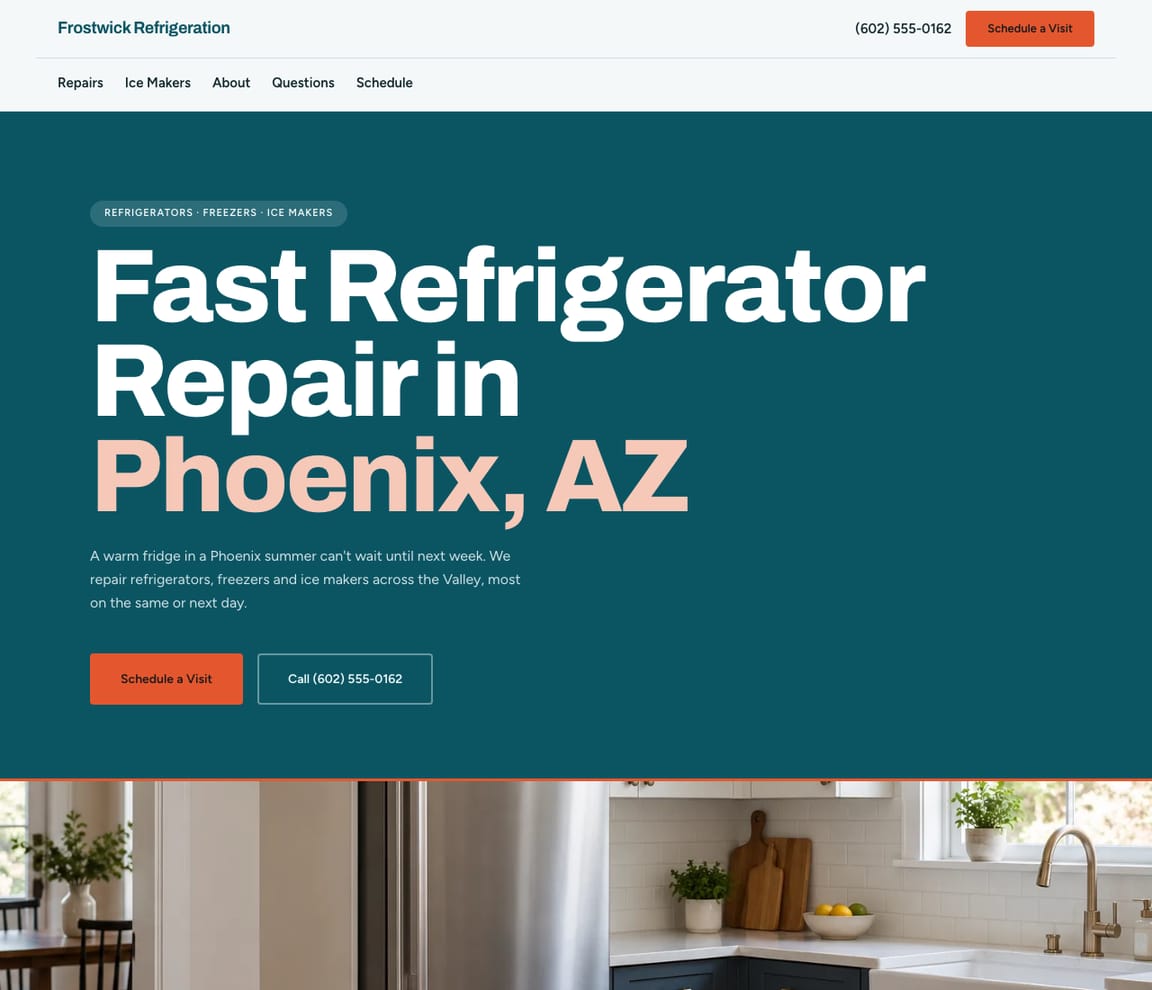
A real Zarla template for a refrigerator and ice maker technician — the sealed-system work up front, the call button by the headline, a repair request form that asks for the model number. Describe yours — the appliances, the brands, the towns — and you'll have a site like this, with a call button and a request form, in about a minute.
- Professional design — not a generic template
- Looks great on desktop and mobile
- Content written for your industry
Build the website
Start your appliance repair website now
Add your town and your business name to the sentence, and Zarla builds the site: a call button, a service-area map and a repair request form. Add the appliances and brands you fix, your EPA card and your hours in chat, then publish.
Already have a website? Bring it across →Zarla keeps your old page addresses where it can and redirects the ones that change, helping you keep the Google standing you've built.
Is becoming an appliance repair technician worth it in 2026 — and what does the work pay?
Becoming an appliance repair technician is a trade you can enter without a degree or an apprenticeship board, that pays from the first ride-along, and that turns into a business the day your own calendar fills — with the catch that the work is cramped, on your knees behind a refrigerator, with a customer watching. On licensing, no state in the places we read licenses the repair of plug-in appliances as a trade. California, New York City, Texas and Washington each put a license or registration on the business; Washington also certifies the person for hard-wired electrical work (07D), and Texas licenses the person who connects a hard-wired appliance. The rules are named below, from the statutes and the agencies; check your state's licensing board and your city's rules before the first paid repair. Three honest numbers first. The government's description of the job is plain: home appliance repairers "Repair, adjust, or install all types of electric or gas household appliances, such as refrigerators, washers, dryers, and ovens." (O*NET, 49-9031). They had a 2025 median of $50,990 a year, $24.51 an hour: 10 percent earned $36,190 or less, 25 percent $43,780 or less, 75 percent $63,390 or less, and 10 percent $80,660 or more (O*NET, from BLS 2025 wage data). And the trade is small — "Employment (2025) 40,500 employees", "Projected growth (2025-2035) Slower than average (1% to 2%)" and "Projected job openings (2025-2035) 2,800" (O*NET, employment and outlook). The survey counts employees only, so the medians measure the company's technician, not the owner who sets the diagnostic fee.
State by state. The median is $48,630 in Texas, $58,480 in California, $57,280 in Florida and $65,190 in New York, and the top 10 percent earn $75,070 or more in Texas, $83,200 or more in California, $80,220 or more in Florida and $81,300 or more in New York (O*NET, Texas; California; Florida; New York). The paper is light: asked what a new hire needs, "69% responded: High school diploma or equivalent required", "20% responded: Post-secondary certificate required" and "8% responded: Less than high school diploma required" (O*NET, education); the occupation sits in the government's lightest preparation band, where on-the-job training "Ranges from a few days to one year" (O*NET, job zone).
Where the money is. An employed technician is paid by the hour or by the call; an owner's income is calls per day times the diagnostic fee and the repair, minus parts, the van and the insurance. The going rates are in how much to charge for appliance repair, the arithmetic of the van, the tools and the first two months is in the appliance repair business plan, and the step after this guide is how to start an appliance repair business. The technicians quoted below describe the shortage that makes the trade worth learning — an employer with 35 field technicians who could use 20 more, a Moorhead veteran who calls technicians a dying breed, a Denver owner for whom finding technicians with both repair skills and customer service is “one of the biggest challenges in this industry”.
The catch. The work is in other people's kitchens and laundry rooms, in tight spaces: in O*NET's survey 32 percent are in "Cramped Work Space, Awkward Positions" every day and 53 percent every week, 45 percent are "Exposed to Contaminants" every day, 37 percent work to strict deadlines every day, and 32 percent work more than 40 hours a week (O*NET, work context). The refrigerant rules are federal and carry the certification below. And the machines change under you — the control boards, the Wi-Fi modules, the new refrigerants. That's what the rest of this guide sets up: the federal rule and the states that license the business or the wiring, from the statutes; the training routes with their prices; the certifications with their fees; and how to be the technician the search finds.
How to become an appliance repair technician, in plain English: one federal rule, then your state
EPA Section 608 is the one rule everywhere in the US. The agency puts it this way: its regulations "require that technicians who maintain, service, repair, or dispose of equipment that could release refrigerants into the atmosphere must be certified", "Technicians are required to pass an EPA-approved test to earn Section 608 Technician Certification", and "Section 608 Technician Certification credentials do not expire." The four types: "For servicing small appliances (Type I).", high- and very high-pressure equipment (Type II), low-pressure equipment (Type III) and "For servicing all types of equipment (Universal)." Trainees are covered: "Apprentices are exempt from certification requirements provided they are closely and continually supervised by a certified technician." (EPA, Section 608 certification requirements). The regulation draws the appliance line for "Any person who could be reasonably expected to violate the integrity of the refrigerant circuit during the maintenance, service, repair, or disposal of appliances": "(i) Persons who maintain, service, or repair small appliances must be certified as Type I technicians." (40 CFR §82.161), where a small appliance is one "fully manufactured, charged, and hermetically sealed in a factory with five (5) pounds or less of refrigerant, including, but not limited to, refrigerators and freezers (designed for home, commercial, or consumer use)", "room air conditioners (including window air conditioners, portable air conditioners, and packaged terminal air heat pumps), dehumidifiers, under-the-counter ice makers" (40 CFR §82.152). The card is also how you buy the refrigerant: "Only EPA-certified technicians are allowed to purchase ozone-depleting substances (ODS) or non-ozone depleting substitutes used as refrigerants, with limited exceptions." (EPA, refrigerant sales restriction). One carve-out matters in kitchens: the regulation's exempt substitutes include "Isobutane (R-600a) in retail food refrigerators and freezers (stand-alone units only); household refrigerators, freezers, and combination refrigerators and freezers" and propane (R-290) and R-441A in household refrigerators and freezers (40 CFR §82.154) — so check the refrigerant on the rating plate before you open the sealed system. Washers, dishwashers, ranges and vented dryers carry no refrigerant, and no federal certification; a heat-pump dryer has a sealed system of its own.
The Type I test, and what it costs. Some Type I programs test open book; the agency's page adds that "Core tests taken as an open book exam cannot be used to get your Universal Certification." (EPA). The appliance trade's own program, from the Professional Service Association with AHAM and NARDA, prints "Cost: $60.00", an "Open Book" test where "an 84 Percent or higher is required to pass", 50 questions split between general refrigerant topics and Type I, and "an additional $60 fee to retake the test." (PSA, Type I test). SkillCat sells "Online EPA 608 Certification for $10" — "Free for 3 days then $10/month" (SkillCat); Zack Academy's online proctored package for every type is "$150.00" (Zack Academy). Take Type I for appliances; Universal only if you mean to work on central air conditioning too.
Do you need a license? Not to repair a plug-in appliance, in the places we read — where a license applies, it sits on the repair business or on the hard-wired, propane or electrical work. There is no federal appliance repair license. The states and the city that do regulate the work, from their own statutes and agencies:
- California registers the repair business. "It shall be unlawful to act as a service dealer without first having registered in accordance with the provisions of this chapter and unless such registration is currently valid." (Cal. Bus. & Prof. Code §9840), where a service dealer is "a person who, for compensation, engages in, or holds themselves out to the public as offering services in the business of:" "(4) Repairing, servicing, or maintaining major appliances." — "any refrigerator, freezer, range, microwave oven, washer, dryer, dishwasher, trash compactor, ice maker, dehumidifier, residential portable furnace, or room air-conditioner" (§9801). The Bureau of Household Goods and Services sets the term and the fee: "You must renew your license every year on or before your license expiration date." with a "Renewal Fee Per Location" of $190 for appliance service dealers and a $95 delinquent fee, and a home-based business "may list a P.O. Box or a commercial mail receiving agency" while "the actual residential location must still be disclosed" (BHGS, appliance repair licensees). The paperwork rule rides with it: "An initial written estimate for the cost of repair shall be given to the customer before performing any repairs." and the dealer "shall advise the customer in writing of the amount of the fee prior to a repair made in the residence" (§9844). The registration is on the business — the service dealer, the person who does the work "for compensation"; the day you take paid repairs on your own, you are one.
- New York City licenses the business. "You need an Electronics License if you sell electronic goods or fix or service electronic items and home appliances." — "$85-$340" new, "2 Years", "$340" to renew, from the Department of Consumer and Worker Protection (NYC Business, Electronics License).
- Texas licenses the hard-wired hookup and propane work, not the fridge. The state's air conditioning and refrigeration license is written to leave the kitchen out: the chapter "does not apply to a person who engages in air conditioning and refrigeration contracting on:" "(1) a portable or self-contained ductless air conditioning product that has a cooling capacity of three tons or less;" and "(4) a residential refrigerator, freezer, or ice machine." (Tex. Occ. Code §1302.058). Connecting a hard-wired appliance is electrical work: the Residential Appliance Installer license has "no experience requirements", a "non-refundable $30 application fee", an exam, a criminal history check, and "Residential Appliance Installer licenses are valid for one year from the date of issuance and must be renewed annually." (TDLR, residential appliance installer). The business that does the hookups for pay holds the Residential Appliance Installation Contractor license on top — "the non-refundable $110 application fee", liability insurance of "Minimum $300,000 per occurrence" and "Minimum $600,000 aggregate", and a licensed installer on staff: "The Residential Appliance Installer may also be the business owner." (TDLR, residential appliance installation contractor). Propane appliances answer to the Railroad Commission: "Any organization that performs any of the Liquefied Petroleum Gas (LPG) activities described below in Texas is required to be a licensee of the Railroad Commission." — Category D covers those who "service, install and repair piping and certain appliances as defined by rule" (Railroad Commission of Texas, LPG license categories), at "The original license fee is $100; the renewal fee is $70." (16 Tex. Admin. Code §9.6).
- Washington licenses the business and certifies the technician for hard-wired appliance electrical work. The business needs a license: "It is unlawful for any person, firm, partnership, corporation, or other entity to advertise, offer to do work, submit a bid, engage in, conduct, or carry on the business of installing or maintaining wires or equipment to convey electric current, or installing or maintaining equipment to be operated by electric current as it pertains to the electrical industry, without having an unrevoked, unsuspended, and unexpired electrical contractor license", the license runs "twenty-four calendar months", and "Electrical contractor specialties include, but are not limited to:" "appliance repair" (RCW 19.28.041). The state's electrical law leaves plug-in appliances out — "Equipment" "does not mean: Plug-in appliances; or plug-in equipment as determined by the department by rule." (RCW 19.28) — and the hard-wired work is its own specialty in the rule titled "Electrical/telecommunications license/certificate types and scope of work" — a contractor's license for the business and a certificate for the person: "Appliance repair (07D): Servicing, maintaining, repairing, or replacing household appliances, small commercial/industrial appliances, and other small electrical utilization equipment." — "connected as a single unit to a single source of electrical power limited to a maximum of 250 volts, 60 amperes, single phase", and the specialty "does not include" branch circuits or "Any plumbing work regulated under chapter 18.106 RCW." (WAC 296-46B-920). The certificate is the person's: Labor & Industries' application for the trainee certificate and the specialty exam lists "(07D) Appliance Repair" at 720 hours to sit the exam and 2,000 for the certificate, with a "$102.20 fee" and "A separate fee for the exam" paid to the testing agency (Washington L&I, specialty application).
Gas is the line to watch. Master Samurai Tech, which trains technicians online, puts the gas rule the way the states above write it: "For the most part, you don’t need a gas-fitters license as long as you are only working on the appliance itself and not installing a new gas line. However, be sure to check the requirements of the state you live in." (Master Samurai Tech). Washington's specialty above stops short of branch circuits and plumbing, and Texas sends propane work to its Railroad Commission; fixing the range or the dryer on the end of the line is where the appliance trade lives. Those are the places we read, not every state and city — check your own state's licensing agency and your city's consumer affairs office before the first paid repair, and read do I need a business license for the general business license question.
How you get in: a course, the Type I test, then someone else's calls. The schools print their prices. Master Samurai Tech's online Core Appliance Repair Training is "$850" for "50–80 hours", which "If you work at a steady pace, doing at least 4-6 lessons per week, you can complete the course in 2-3 months." (Master Samurai Tech, Core course); its whole program is "$2245", and its advice for a new technician is "We recommend brand-new techs get into appliance repair by working for another company before considering striking out on their own." (Master Samurai Tech). SkillCat offers "300+ hours of Accredited Appliance Repair Training & Certifications" and "Get Started For Free" (SkillCat). On a campus, Fred's Appliance Academy outside Cleveland charges "$4,200" for its "3 week hands-on course including refrigeration" with "EPA Type 1 certification", "$1,740" for one week, and student housing at "$60 / Night" for a "20 night stay"; "We welcome everyone that's at least 18 years of age or older." (Fred's Appliance Academy). Fort Myers Technical College, a public technical college in Florida, runs a "1,200 hours" Major Appliance and Refrigeration Technician program — a 200-hour installation helper course, then laundry (300 hours), cooking (350) and cooling (350) — at "Approximately $6,306" (Fort Myers Technical College, 2026–27 fee sheet). The manufacturers train too: the Whirlpool Technical Center's beginner course is "6 Weeks Total Commitment 2 Weeks hands-on at the Whirlpool Technical Center in Cleveland, Tennessee", and its three-day sealed-systems lab includes "EPA 608 Type 1 Certification" (Whirlpool Technical Center) — enrollment is through its ServiceMatters subscription, travel and lodging are yours, and "becoming a certified Whirlpool Technician is separate from authorization to become a warranty servicer" (Whirlpool Technical Center, FAQ). GE Appliances' authorized-servicer application asks a company "Do you provide consent for a criminal and civil background check?" and "Have you conducted a criminal background check on your field service technicians?" (GE Appliances, servicer application) — the background check a manufacturer's network asks of a company before it sends warranty calls.
The certifications a customer can check. None is required; each is proof. ISCET's National Appliance Service Technician Certification: "To be NASTeC certified, candidates must pass a Basic Skills Exam and at least one of the three specialty exams." — Refrigeration and Air Conditioning (which "Requires proof of EPA Refrigerant Recovery Certification"), Cooking, and Laundry and Dishwashing — at "Basic Skills $50", "Each Specialty $65" and "Basic plus all three Specialties (Universal)* $185" at one sitting, renewed by "20 clock hours of training" over two years (ISCET, NASTeC exams). The Professional Service Association's skill program makes you a "Certified Appliance Professional" and prints no fee on its page (PSA, skill certification).
The money to start. Our arithmetic from the pages that print each price. A lean start — the PSA Type I test at $60, Master Samurai Tech's Core course at $850 and an Extech EX470A true-RMS multimeter at "$184.00" (TruTech Tools, listed in stock, read November 2, 2026) — comes to $1,094. The fuller start — Fred's three-week course at $4,200 with the EPA Type 1 test included, 20 nights of its housing at $60 ($1,200), NASTeC's universal sitting at $185, the same multimeter and a Fluke 902 FC HVAC clamp meter at "$367.19" (TruTech Tools, listed in stock) — is $6,136.19. Left out: travel to the campus, and the van and the refrigeration tools, which are the owner's step — the appliance repair business plan costs them. When you go out on your own, the paperwork is on the appliance repair estimate template and the appliance repair invoice template, the name comes from appliance repair business names, and the site from the appliance repair website builder or the appliance repair website design page.
In the UK: the National Careers Service lists no license for the job — its requirements are a driving license and background checks — and lists the routes as "a college course", "an apprenticeship" and "applying directly", names the "Electrical, Electronic Product Service and Installation Engineer Level 3 Advanced Apprenticeship", and puts pay at "£24,000 Starter to £30,000 Experienced" for "40 to 44" hours a week (National Careers Service, domestic appliance service engineer). Two lines do bind: gas — "Anyone employed to work on gas appliances in domestic premises must be a Gas Safe registered engineer and competent in that area of gas work." (HSE, domestic gas FAQs) — and refrigerant, where the F-gas rules call for a "category 2 certificate to install, maintain, service and recover refrigerant from systems containing less than 3kg of F gas, or less than 6kg of F gas if hermetically sealed" (GOV.UK, F-gas qualifications). In Australia the refrigerant rule is national and reaches further: anyone who handles refrigerant or works on refrigeration and air conditioning equipment must hold a refrigerant handling license, issued by the Australian Refrigeration Council for the Australian government under the Ozone Protection and Synthetic Greenhouse Gas Management Regulations 1995 (Australian Refrigeration Council, FAQ), with a restricted class for appliance technicians — RDR04, "any work on domestic refrigeration or air conditioning equipment" (Australian Refrigeration Council, license types). Gas is the states': "In NSW, you must be licensed to complete any gasfitting work as stated in the Gas & Electricity (Consumer Safety) Act 2017.", and gasfitting includes "the connection or disconnection of a gas container, gas regulator or gas appliance to, or from a gas installation except where it is designed to be readily detachable from the installation." (NSW Government, gasfitter obligations). Check your own state's licensing agency, and your city's, before the first paid repair — the registration, the fee and the term are theirs.
What working appliance repair technicians actually say
None of this is our opinion about the trade. It comes from people who do it — the chief executive of a Boston-area appliance dealer that trains its own technicians, a Colorado service company owner, a Los Angeles technician who started on warranty calls, a Denver owner who began in a garage, a Houston owner with fifteen years in the trade, a Magnolia, Texas couple who kept their corporate jobs at first, a Maine photographer turned technician, a 30-year Minnesota veteran and a North Carolina owner learning the trade — talking to local newspapers, the Voyage magazines and their own company blog between 2017 and 2026, each described as the page describes them. Read each as theirs at the time. Four things come up again and again.
The training is a ride-along — and it takes months. Steve Sheinkopf, chief executive of Yale Appliance in Massachusetts: “Appliance repair used to be a trade you learned from another technician. Shops took apprentices, and schools taught it.” And on the school his company opened: “If you are good with your hands and willing to learn, we can teach you the trade. You spend four months in school, then a couple of months on the road with a senior technician.” “The goal is to have you working independently within a year. You are paid while you train, with full benefits.” (Yale Appliance blog, October 1, 2026). Scott Baca, American Appliance Group, Golden, Colorado: “For example, in 2016, it would have taken us 12-16 months to train a new service technician. This training was done by primarily having the trainee ride along with senior technicians to learn the trade.” And: “Today, we have an onsite trainer armed with the intranet site that goes through a step by step process that can train these new technicians in 6-8 months.” (VoyageDenver, April 28, 2020).
“One of the biggest challenges in this industry is finding technicians who bring both strong repair skills and great customer service. Knowing how to diagnose and fix an appliance is essential, but so is being able to shake a customer’s hand, communicate clearly, and act professionally in their home.” — Cody Hinsz, Denver Rapid Appliance Repair, in VoyageDenver, October 13, 2026
Most started on someone else's calls. Arturas Butkevicius, LA Reliable Appliance Repair, Woodland Hills, California: “Back in 2009 I learned to fix and service appliances. I got interested and really liked this job. I started to work for the company which was providing service for home warranties and Appliance manufacturers.” And: “I enjoyed driving to peoples home and solving appliance mysteries. Every service call is different as well as every client is different.” (VoyageLA, May 23, 2017). Sarah Goedde, Lone Star Appliance Repair, Houston: “I have been in the service business between AC and Appliance Repair for 15+ years.” And: “Being a woman in a male-dominated business and running it on my own have certainly had their challenges.” (VoyageHouston, April 23, 2024). Mark and Christine Landers, Oasis Appliance Repair, Magnolia, Texas: “once we launched we would work our corporate jobs by day and schedule customer appointments in the evenings and on weekends.” And: “After 1 1/2 years, my husband resigned from his corporate position to focus fully on the business.” (VoyageHouston, June 28, 2017).
A course can be the door — even late. Lawrence Hardy, an award-winning photographer in Houlton, Maine, graduated from Fred's Appliance Academy and went on his first service call in August; from an 8-by-8 room at the back of his home he wrote to his wife: “One day I’ll be able to look back on this 8X8 room and think this is where I started,” and “I think this is the start of being my own boss.” (Bangor Daily News, April 16, 2026). Jet Hatu, who bought Bob's Appliance Service in Rocky Mount, North Carolina, a few weeks in: “I am learning the ins and outs of mainly dryers and washers, but I am learning that they come with hundreds of parts,” and “I’m learning how to read schematics. I’m learning how to read multimeters to be able to test parts and products.” (Rocky Mount Telegram, August 19, 2025).
The shortage is the opportunity. Jamie Kinslow, a 30-year veteran who opened The Appliance Guy in Moorhead, Minnesota: “We're kind of a dying breed,” and “There's no younger people coming into this.” His partner Lisa Johnson: “There's not a lot of guys in town that do the refrigeration.” And: “The wage for a good certified mechanic right now is closing in on six figures. I think that will stir up interest” (InForum, December 11, 2023). Sheinkopf: “Bay State School of Technology trained many of our senior technicians. It stopped offering classes in 2018.” And: “We have 35 field technicians on the road, and I could use 20 more right now.” (Yale Appliance blog, October 1, 2026). Baca on the work a technician wants: “My technicians hated working on the lower end appliances and the bureaucracy they had to go through to get paid was ruining their passion for repair.” (VoyageDenver, April 28, 2020). Goedde on the hiring side: “A major challenge I find is finding loyal, trustworthy, and hardworking people to join the family.” (VoyageHouston, April 23, 2024).
The through-line: the technicians who lasted learned diagnosis from a course and then from a senior technician's van, got certified for the refrigeration fewer people will touch, spent their first years on someone else's warranty and service calls, and found the customers waiting weeks for a repair — first through an employer, then on their own.
THE STARTER KIT
What you need to become a working appliance repair technician
Diagnosis, from a course
Electricity, schematics and the meter first, then laundry, cooking and refrigeration — online from a few hundred dollars, three weeks on a campus, or 1,200 hours at a public technical college; the prices are below from the schools.
EPA Section 608 Type I
The one federal rule: certified before you open a refrigerator's sealed system or buy the refrigerant. An open-book test you can take online, and the card never expires.
Months beside a senior technician
The trade's real apprenticeship. The employers quoted below put a new hire on the road with a senior technician for months before the first call alone.
A meter and a clamp meter
A true-RMS multimeter and an HVAC clamp meter, priced below from the seller's page — the two tools every diagnosis starts with.
A certificate a customer can check
NASTeC's exams from the trade's technicians' society, the service association's certification, a manufacturer's factory course — voluntary, and what a warranty network or a homeowner looks for.
A way to be found
A website with the appliances and brands you fix, your certifications and a call button, and a Google Business Profile with your hours — the day you go out on your own.
THE PAPERWORK
Certifications, registrations and licenses on the way to working on your own
| Typical cost | Time to get | Legally required? | |
|---|---|---|---|
| EPA Section 608 Type I | Free for 3 days, then $10 a month (SkillCat), or $60 (PSA, open book); $150 proctored for all types (Zack Academy) | Never expires (EPA) | Yes, in the US, before opening a small appliance's sealed system or buying refrigerant (40 CFR §82.161) — exempt hydrocarbon refrigerants aside |
| A training course | $850 online (MST); $4,200 for three weeks on campus (Fred's); about $6,306 for 1,200 hours (Fort Myers Technical College) | Weeks to a school year | No — the employer or the customer is the judge |
| NASTeC certification (ISCET) | $50 basic skills; $65 each specialty; $185 universal at one sitting | One exam sitting; 20 hours of training every two years to renew | No — voluntary proof |
| PSA Certified Appliance Professional | No fee printed | An exam | No — voluntary proof |
| Factory training (Whirlpool Technical Center) | Through a ServiceMatters subscription; travel and lodging yours | Six weeks, two of them hands-on, for the beginner course | No — and separate from warranty authorization |
| California service dealer registration (BHGS) | $190 a year per location; $95 late | Renewed every year | Yes, in California, for the business that repairs major appliances for pay |
| New York City Electronics License (DCWP) | $85–$340 new; $340 to renew | Two-year term | Yes, in New York City, to fix or service home appliances |
| Texas Residential Appliance Installer (TDLR) | $30 application, plus the exam | Renewed every year; no experience needed | Yes, in Texas, for the person who connects a hard-wired appliance — not to repair a fridge, which the state's refrigeration license leaves out |
| Texas Residential Appliance Installation Contractor (TDLR) | $110 application, plus $300,000 / $600,000 liability insurance | Renewed every year | Yes, in Texas, for the business that connects hard-wired appliances for pay — the license is on the business |
| Texas LP-gas Category D (Railroad Commission) | $100; $70 to renew | Set by the Railroad Commission | Yes, in Texas, for the business servicing certain propane appliances |
| Washington 07D appliance repair specialty | $102.20 to apply for the trainee certificate and the exam, plus the testing agency's exam fee; the contractor license has its own fee | 720 hours to sit the exam; 2,000 for the certificate; the contractor license runs 24 months | Yes, in Washington, for hard-wired appliance electrical work up to 250 volts and 60 amps — an appliance repair specialty electrical contractor license on the business and the 07D certificate on the technician; plug-in appliances are outside the electrical law |
THE STEPS
How to become an appliance repair technician (step by step)
Eight steps from the first course to a certified technician with a repair calendar of your own.
01
Learn the basics: electricity and the meter
Every course below starts in the same place — circuits, schematics, the multimeter — before a single appliance. Try a free online sample first and see whether diagnosis suits you.
Week one02
Pick a route and a school
Online at your own pace, three weeks on a campus, a 1,200-hour technical-college program, or a manufacturer's own course; prices, hours and what each includes are below, from the schools.
03
Pass EPA Section 608 Type I
Before you open a sealed system on a refrigerator, freezer, window unit or dehumidifier, or buy the refrigerant. Open book, online, and the card never expires.
The federal rule04
Get hired, and ride along
A repair company, an appliance dealer's service department or a manufacturer's service network; months beside a senior technician before calls on your own — the employers below describe exactly that.
The real first step05
Add a certification a customer can check
NASTeC's basic skills and specialty exams, the service association's certification, a factory course for the brands you fix most.
06
Check your state and your city
California registers the repair business, New York City licenses it, Texas licenses the hard-wired hookup and certain propane work, Washington certifies the technician for hard-wired appliance electrical work up to 250 volts and 60 amps (07D) — named below.
07
Go out on your own when the calendar is there
Register the business where your state asks, insure it, and post the diagnostic fee — the start guide and the pricing guide cover those steps.
08
Be the technician the search finds
A website with your appliances, your brands, your certifications and a call button, and a Google Business Profile with your hours.
THE COSTS
How much does it cost to become an appliance repair technician?
Itemized from the pages that print a price: the Type I test from PSA, the courses from Master Samurai Tech and Fred's Appliance Academy, the exam from ISCET, the meters from TruTech Tools. The van and the refrigeration tools are the owner's step, and the plan page costs them; travel to a campus comes on top.
$1,094a lean start — the $60 open-book Type I test, an $850 online core course and a $184 multimeter (our arithmetic)
$6,136.19the fuller start — three weeks on campus with the Type 1 test and 20 nights' housing, NASTeC's universal sitting and two meters
$10a month, after three free days: the cheapest EPA 608 route we found, SkillCat's online program — the certificate never expires
$6,306a 1,200-hour public technical-college program in Florida, from the school's 2026–27 fee sheet
WHAT WE'VE LEARNED
What actually makes a homeowner call an appliance technician
Thousands of local business websites in, the pattern for a repair trade is clear: the customer arrives with a broken machine and a question about whether you can fix that one. For a new technician, three things on a page decide who gets the call.
The appliance and the brand, by name
Refrigerators, washers, dryers, dishwashers, ranges — and the brands you trained on, so the homeowner with a Whirlpool washer or a GE range sees it before calling.
The certifications you hold
EPA Section 608 for sealed-system work, a NASTeC or factory certificate, the state registration number where the state issues one — the trust lines a new technician has before the track record.
When you can come
The towns you cover and how soon you can be there — the first question on every call, answered on the first screen with a call button beside it.
THE UPSIDE
What an appliance repair technician can earn
Pay for employed technicians from O*NET's 2025 figures for home appliance repairers; the self-employed are not in the survey. Medians, not a promise: your calls a day, the brands you can fix and whether the van is yours decide it.
$50,990a year: the 2025 US median — $24.51 an hour; 10 percent under $36,190, 10 percent over $80,660 (O*NET)
$65,190the New York median; California $58,480, Florida $57,280, Texas $48,630
40,500employed home appliance repairers in 2025 — a small trade, and the employers quoted above say they can't hire enough
2,800O*NET's projected job openings for 2025–2035, with growth slower than average (1% to 2%)
SEE IT WORK
Appliance repair website designs you can start from
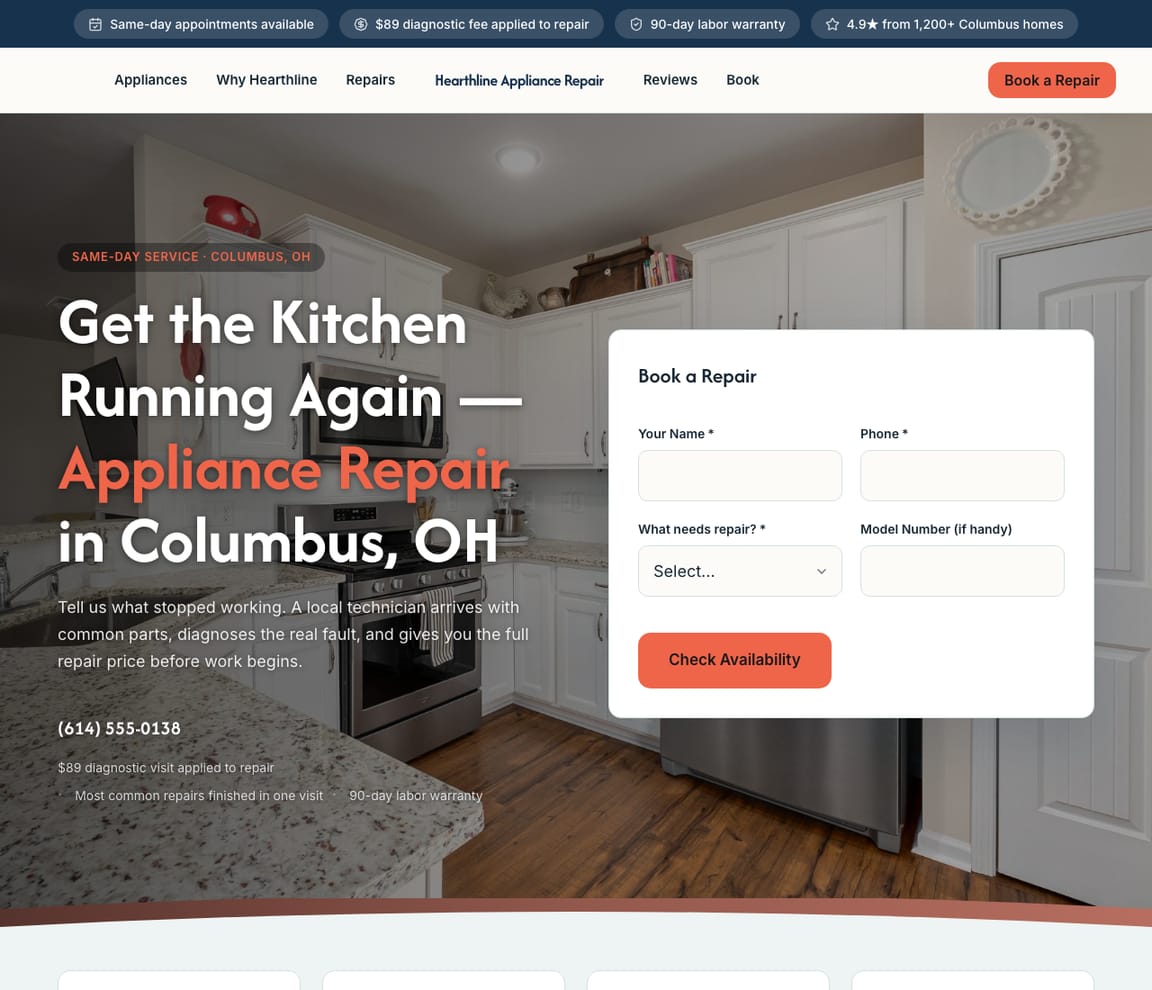
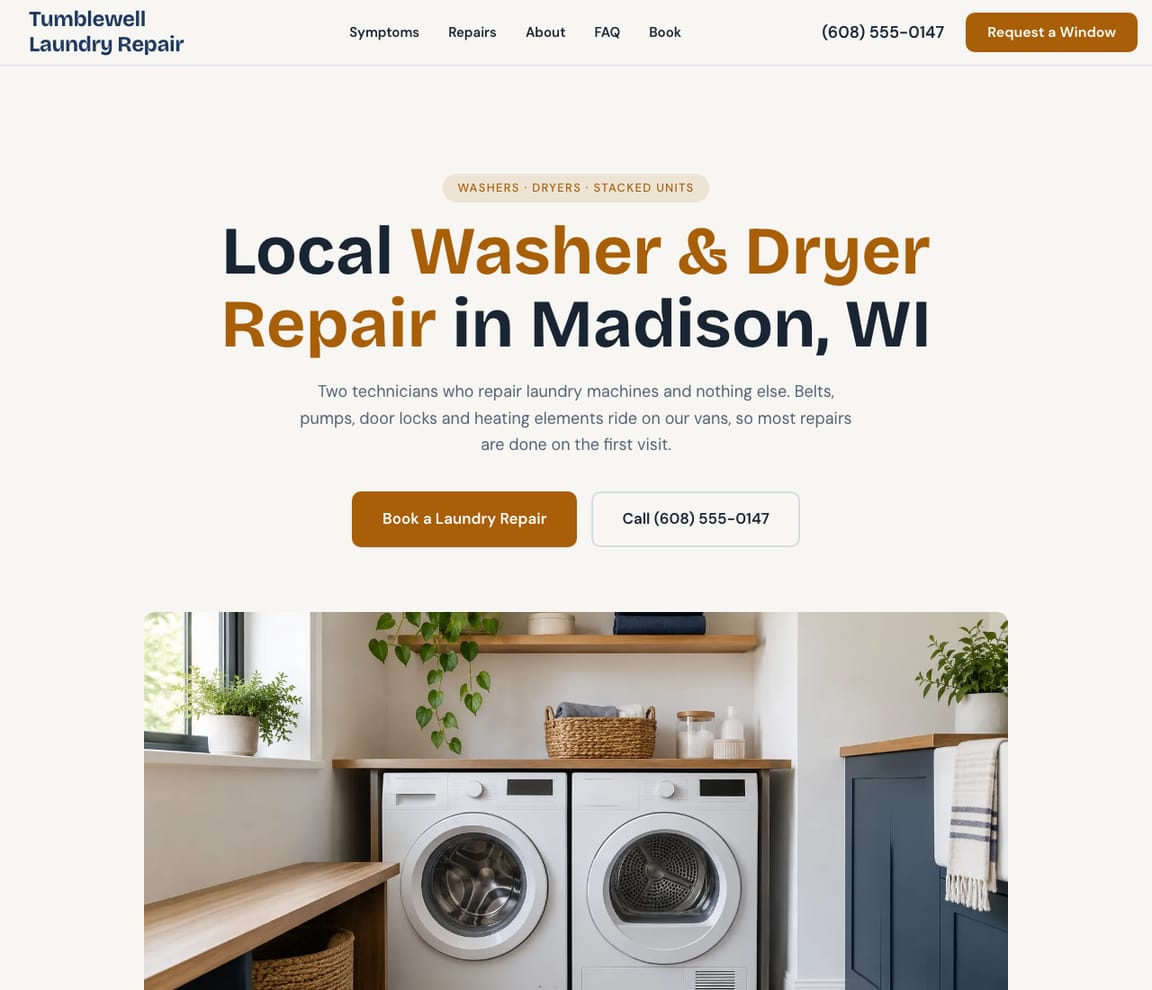
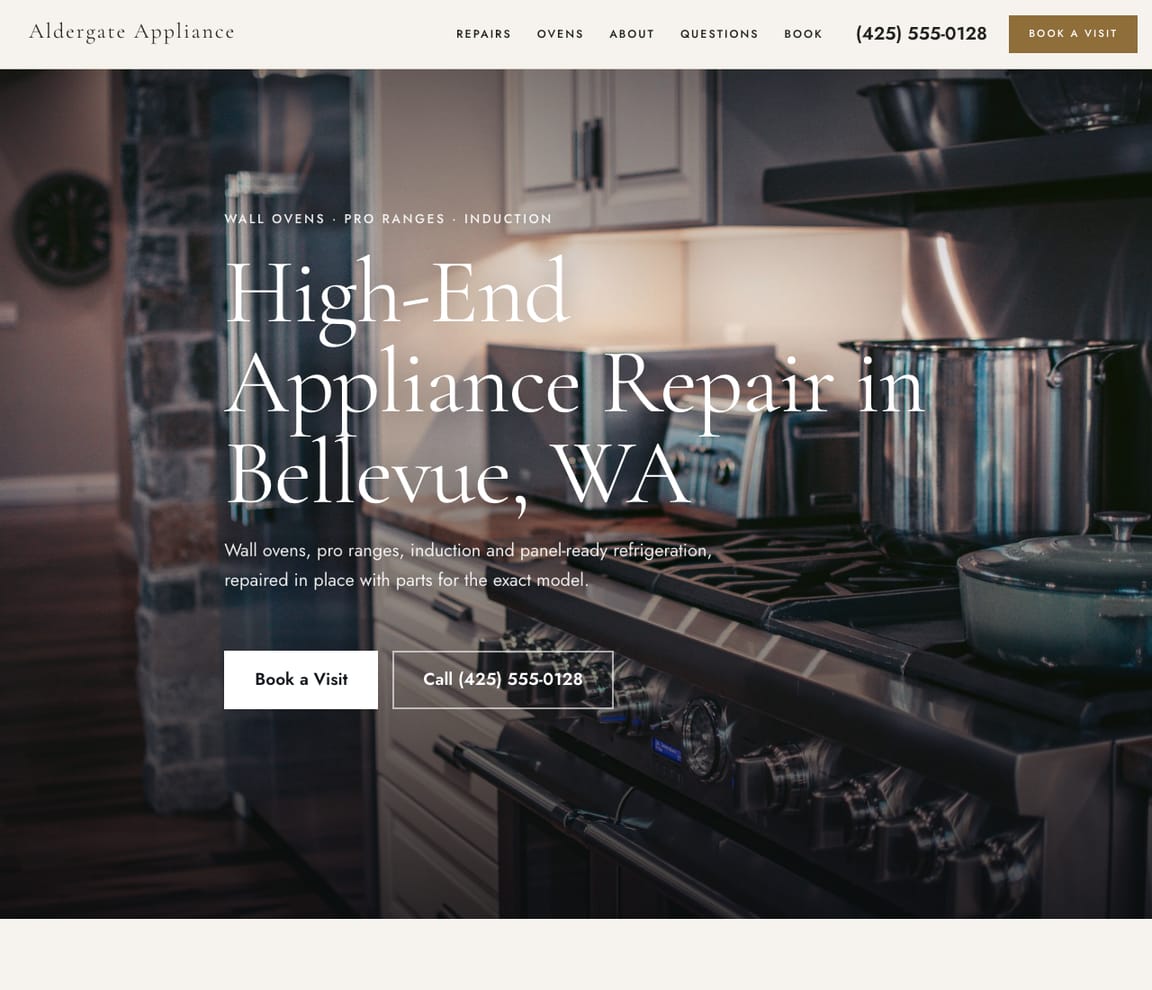
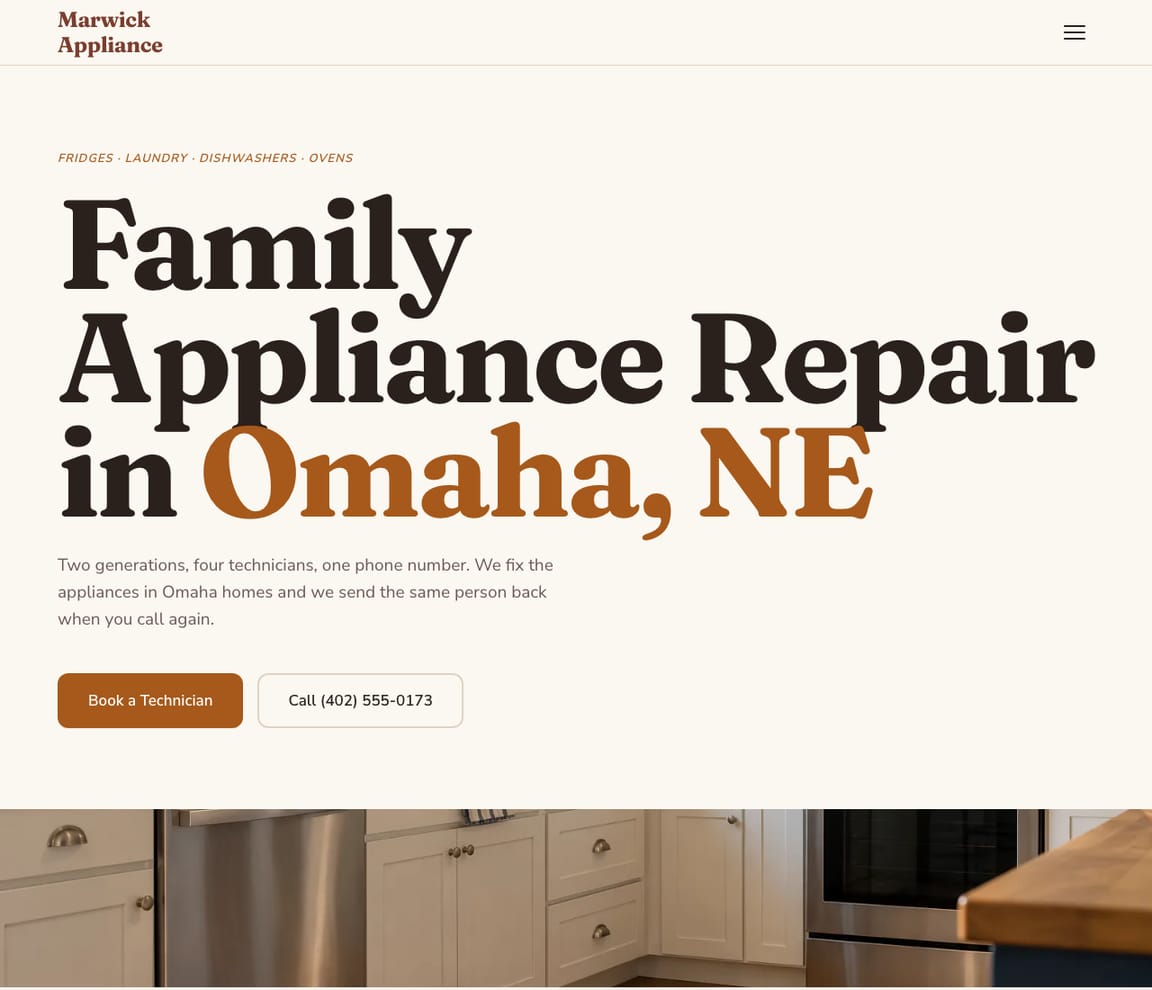
Real Zarla templates for the shapes the trade takes — the same-day service van, the washer and dryer specialist, the built-in and high-end technician, the family shop that sends the same technician back. Open one, swap in your brands and your service area, and publish.
GET FOUND
Get found by the kitchen with a warm fridge
A homeowner with a fridge full of food searches "appliance repair near me", often with the brand in the search, and calls the technician whose appliances, brands, towns and number are on the first screen. Zarla builds the website with a call button, the areas you cover on a map and a repair request form. Add your brands, your EPA certification and your hours in chat, and connect your Google Business Profile so your hours and map show on the site.
“Refrigerator repair near me”
Searched the morning the fridge goes warm, usually with the brand in it. The appliances you fix, the brands you know and the towns you cover answer it.
Google Business Profile
A repair technician who drives to the customer qualifies as a service-area business. Your hours, your service area and your number inside Google Maps — free, and an afternoon to set up.
The certifications, named
EPA Section 608 for refrigerators, a NASTeC or factory certification for the rest. The proof a homeowner looks for before letting a stranger pull the fridge out.
Google Search
Ccoldwaterapplianceservice.com
Coldwater Appliance Service — Trusted appliance repair in Your AreaRefrigerator, freezer and ice maker repair in Columbus — Whirlpool, GE, LG and Samsung. EPA 608 certified. Next-day visits. Tap to call.← Your Zarla siteCcityappliancerepairservices.com
City appliance repair ServicesGoogle Maps
1
Coldwater Appliance Service
← You2
Metro appliance repair Co.
3
Quick appliance repair Services
AI assistants (ChatGPT / Perplexity)
For an EPA-certified technician in Columbus who repairs Whirlpool and GE refrigerators and can come tomorrow in your area: Coldwater Appliance Service — a local technician's site that lists refrigerator, washer and range repair by brand, names the EPA Section 608 certification, posts a diagnostic fee and has a call button.
An example with a made-up business and illustrative figures. Yours will show your real details and reviews.
YOUR LAUNCH PLAN
Your become-an-appliance-repair-technician checklist
The whole guide as things to check off. Work through them in order and you'll be trained, certified for refrigerant, experienced on someone else's calls and findable before your first call of your own.
- Learn electricity and the meter — the first module of every course.
- Pick a route — online, a three-week campus course, a technical college, a factory course.
- Pass EPA Section 608 Type I — before the first sealed system or refrigerant purchase.
- Get hired and ride along — months beside a senior technician.
- Add a checkable certification — NASTeC, the service association, a manufacturer.
- Check your state and your city below — a business registration, a city license, a wiring license.
- Buy your own meters — a true-RMS multimeter and a clamp meter.
- Get found — a website with your appliances, brands and certifications, and a Google Business Profile.
REAL CUSTOMERS
Small business owners who got online with Zarla
Verified reviews from real Zarla customers.
“Optimized for local service-based businesses. Easiest website build I've experienced. The AI-based build is the way to go instead of clunky theme-based websites. Get the site built and get out of the weeds with Zarla!”
“Great professional website in less than a minute, with the use of AI and a few descriptive prompts. This has saved me bundles of time and research on web developers.”
“Quickly built my website from scratch. No hiccups. Would highly recommend Zarla for someone with no experience who wants to start a polished business website.”
“I had no idea how to set up a website for my business. Thanks to Zarla, they've helped me a lot.”
Be the technician a warm fridge finds first
Add your town and your business name, and Zarla builds the website from that one line — a call button, the areas you cover on a map and a repair request form, with SEO in place. Add the brands you fix and your certifications in chat. Free to build; you pay when you publish.
Already have a website? Bring it across →Zarla keeps your old page addresses where it can and redirects the ones that change, helping you keep the Google standing you've built.
Frequently asked questions
How much does it cost to become an appliance repair technician?
In the US, about $1,094 for a lean start, our arithmetic from the pages that print each price: the Professional Service Association's $60 open-book EPA Type I test, Master Samurai Tech's $850 online Core course and a $184 Extech true-RMS multimeter. The fuller start — Fred's Appliance Academy's three-week $4,200 campus course with the Type 1 test included, 20 nights of its housing at $60 ($1,200), NASTeC's $185 universal sitting, the multimeter and a $367.19 Fluke clamp meter — is $6,136.19. A 1,200-hour public technical-college program in Florida is about $6,306. The van and the refrigeration tools are the owner's step, costed on our appliance repair business plan page.
Do you need a license to be an appliance repair technician?
In the US, not to repair a plug-in appliance in the places we read — the one rule everywhere is federal: EPA Section 608 Type I before you break into the refrigerant circuit of a refrigerator, freezer, window unit or dehumidifier, or buy the refrigerant. Where a license applies, it sits on the business or on the hookup: California registers every business that repairs major appliances for pay ($190 a year per location), New York City requires its Electronics License ($85 to $340 for two years), Texas licenses the person who connects a hard-wired appliance (a $30 application and an exam) and the business that does it for pay (a $110 contractor license), plus propane appliance work, and Washington licenses the business as an appliance repair specialty electrical contractor and certifies the technician for electrical work on hard-wired appliances up to 250 volts and 60 amps as the 07D specialty ($102.20 to apply for the trainee certificate and the exam at 720 hours). Check your own state's licensing agency and your city before the first paid repair.
Is EPA 608 certification required for appliance repair?
In the US, for refrigerant work, yes: under the federal rule, anyone who could be reasonably expected to violate the integrity of the refrigerant circuit while maintaining, servicing or repairing a small appliance — one factory-sealed with five pounds of refrigerant or less, such as a refrigerator, freezer, window air conditioner, dehumidifier or under-counter ice maker — must be certified as a Type I technician, and only certified technicians may buy the refrigerant. Household refrigerators charged with isobutane (R-600a), propane or R-441A are exempt substitutes, so check the rating plate. Washers, dishwashers, ranges and vented dryers need no federal certification. The Type I test is $60 open book from PSA, $10 a month from SkillCat after three free days, or $150 proctored for every type from Zack Academy, and the certificate never expires. Check your state's licensing board and your city's rules before the first paid repair.
Can I learn appliance repair online?
Yes, the theory — and many technicians start that way. Master Samurai Tech's online Core course is $850 for 50 to 80 hours, two to three months at four to six lessons a week; SkillCat advertises 300-plus hours of training that starts free; and the EPA Type I test itself is offered online and open book. What a screen can't give you is the hands-on part, which is why Master Samurai Tech itself recommends a new technician work for another company first, and why the employers quoted above put new hires in a senior technician's van for months.
How long does it take to become an appliance repair technician?
Weeks to a year, by route. Fred's Appliance Academy's campus course is three weeks; Master Samurai Tech's online Core course is two to three months at a steady pace; Fort Myers Technical College's program is 1,200 hours; the Whirlpool Technical Center's beginner course is six weeks, two of them hands-on. Then comes the road: Yale Appliance's own school is four months in class and a couple of months with a senior technician, aiming at working independently within a year, and a Colorado owner quoted above cut his ride-along training from 12 to 16 months to 6 to 8. The government's survey puts on-the-job training at a few days to a year.
Is appliance repair hard to learn?
The basics are learnable by anyone who likes fixing things; the diagnosis is what takes time. Every course starts with electricity, schematics and the meter — one new owner quoted above describes learning that washers and dryers come with hundreds of parts, and learning to read schematics and multimeters. Refrigeration is the hard part, and the part with the federal certification, which is why fewer technicians do it. The government puts the trade in its lightest preparation band, with on-the-job training from a few days to a year, and 69 percent of employers asked for a high school diploma.
How much do appliance repair technicians make?
Employed home appliance repairers had a 2025 median of $50,990 a year, $24.51 an hour, with 10 percent under $36,190 and 10 percent over $80,660; by state, $65,190 in New York, $58,480 in California, $57,280 in Florida and $48,630 in Texas. The figures are from BLS data on O*NET, and the survey leaves out the self-employed owner, whose income is calls per day times the diagnostic fee and the repair, minus parts, the van and the insurance. One Minnesota owner quoted above said “the wage for a good certified mechanic right now is closing in on six figures” (2023) — her statement, not a published figure.
Is appliance repair a good career?
For someone who likes diagnosis and doesn't mind kitchens and laundry rooms, the numbers say steady rather than booming: 40,500 employed technicians in 2025, growth slower than average (1% to 2%) and 2,800 projected job openings in O*NET's 2025–2035 figure, at a $50,990 median. What makes it better than those numbers is the shortage the employers describe — one Massachusetts dealer with 35 field technicians who could use 20 more, a Denver owner who calls finding technicians with both repair skills and customer service one of the biggest challenges in the industry — and the door to your own business. In the US, no state in the places we read licenses the repair of plug-in appliances as a trade. California, New York City, Texas and Washington each put a license or registration on the business; Washington also certifies the person for hard-wired electrical work (07D), and Texas licenses the person who connects a hard-wired appliance. Check your state's licensing board and your city's rules before the first paid repair.
Is appliance repair a dying trade?
The technicians are thinning, not the work. A 30-year Minnesota veteran quoted above calls technicians a dying breed with no younger people coming in (2023); a Massachusetts chief executive says the school that trained many of his senior technicians stopped offering classes in 2018 (2026). The government projects slower-than-average growth of 1% to 2% to 2035 and 2,800 projected job openings — and every home still has a refrigerator and a washer that will break. Fewer technicians for the same machines is why employers now train their own.
Is appliance repair a good side hustle?
It can start as one: a Magnolia, Texas couple quoted above kept their corporate jobs and scheduled repairs in the evenings and on weekends for a year and a half before going full time, and a Maine technician started part time from a room at the back of his house. Two lines apply from the first paid job — in the US, EPA Section 608 Type I before any sealed-system work, and in California the service dealer registration ($190 a year per location), which covers anyone who repairs major appliances for compensation. Learn on your own appliances first. Check your state's licensing board and your city's rules before the first paid repair.
What is the best appliance repair certification?
In the US, the one that is required is federal — EPA Section 608 Type I, for refrigerant. Beyond it, the voluntary ones a customer or a warranty network can check: ISCET's NASTeC exams ($50 for basic skills, $65 for each of three specialties, $185 for all four at one sitting), the Professional Service Association's Certified Appliance Professional program (its page prints no fee), Master Samurai Tech's course certificate, and a manufacturer's factory course for the brands you fix most. None is a state license. Check your state's licensing board and your city's rules before the first paid repair.
Do you need a license to work on appliances in Texas?
In Texas, not to repair a refrigerator, freezer or ice machine: the state's air conditioning and refrigeration law does not apply to a residential refrigerator, freezer or ice machine, or to a self-contained air conditioner of three tons or less. Three Texas licenses do reach appliance work. Connecting a hard-wired appliance to an existing circuit is electrical work: the person holds TDLR's Residential Appliance Installer license — no experience required, a $30 application, an exam, renewed every year — and the business that does it for pay holds the Residential Appliance Installation Contractor license, a $110 application with $300,000 per occurrence and $600,000 aggregate liability insurance and a licensed installer on staff, who may be the owner. Servicing certain propane appliances is the Railroad Commission's, under an LP-gas Category D license at $100, $70 to renew. EPA Section 608 Type I is federal on top. Check your state's licensing board and your city's rules before the first paid repair.
How do I become an appliance repair technician in California?
In California, the training route is the same as anywhere — a course, the federal EPA Section 608 Type I test, then time on a registered company's calls. The state rule is on the business: it is unlawful to act as a service dealer for major appliances without registering with the Bureau of Household Goods and Services, $190 a year per location, renewed every year. The registration is on the business, the service dealer that does the work for compensation; the day you take paid repairs on your own, you register — and give a written estimate before any repair, and the diagnostic fee in writing before a repair in the home. Check your state's licensing board and your city's rules before the first paid repair.
Can I get factory training from appliance manufacturers?
Yes. The Whirlpool Technical Center in Cleveland, Tennessee runs a beginner course of six weeks, two of them hands-on, and a three-day sealed-systems lab that includes the EPA 608 Type 1 test, enrolled through Whirlpool's ServiceMatters subscription; travel and lodging are yours, and its FAQ is plain that a Whirlpool certification is separate from authorization to do its warranty work. GE Appliances' authorized-servicer application is for companies, and asks whether you consent to a criminal and civil background check and have checked your field technicians.
How to become a washing machine repairman?
Start with laundry — a washer needs no refrigerant certification: Fort Myers Technical College's program includes a 300-hour laundry technician course, every online core course covers washers and dryers, and NASTeC's Laundry and Dishwashing specialty exam is $65 on top of the $50 basic skills exam. Then get hired by a repair company and ride along. In the US, add EPA Section 608 Type I before you touch a refrigerator, and check your state — California registers the business, New York City licenses it.