BUSINESS GUIDE
How to start an appliance repair business in 2026
Training and the EPA certification for refrigerant work, the tools and the van, parts accounts, warranty and manufacturer-authorized work, how to price a diagnostic fee, labor and parts, insurance, mobile or a shop — and how to get your first customers.
Free to build · Pay when you publish · No credit card
$108–$252a typical repair, averaging $180 (HomeAdvisor)
$291sales per job at Mr. Appliance franchises (franchisor)
$50,990a year: median repairer pay (O*NET)
No codeto get online
See it in action
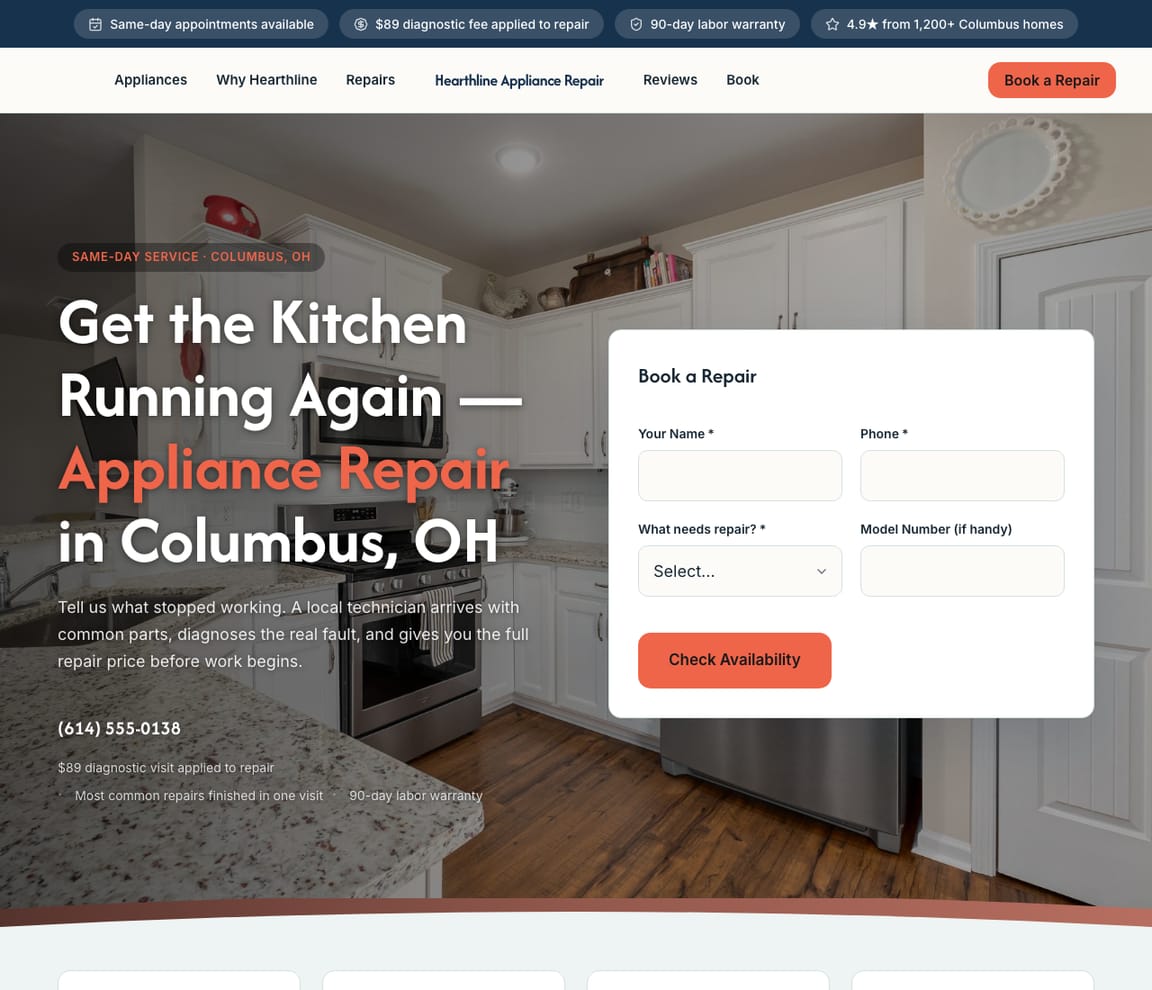
See what your appliance repair website could look like
This is a real Zarla template for a same-day appliance repair company. Describe yours — the appliances and brands you fix, the towns you cover, what your diagnostic visit costs — and you'll have a site like this, with a call button and a repair request form, in about a minute.
- Professional design — not a generic template
- Looks great on desktop and mobile
- Content written for your industry
Build the website
Start your appliance repair website now
Add your town and your business name to the sentence, and Zarla builds the site: a call button, a service-area map and a repair request form. Add your diagnostic fee, the brands you fix and your warranty in chat, then publish.
Already have a website? Bring it across →Zarla keeps your old page addresses where it can and redirects the ones that change, helping you keep the Google standing you've built.
Is an appliance repair business worth starting — and what do customers pay?
First, which business: this guide is the home-service business — fixing refrigerators, washers, dryers, dishwashers and ranges for the people who own them, mostly in their kitchens and laundry rooms, from a van. Some owners add a shop: Hardy's Appliance Solutions in Houlton, Maine started in an 8-by-8 space at the back of the owner's home, and now refurbishes and sells used appliances from a 3,000-square-foot storefront (Bangor Daily News, April 2026). A franchise is a third route, covered below.
What customers pay. HomeAdvisor puts a typical US appliance repair at $108 to $252, averaging $180, with labor at $50 to $150 an hour plus parts; by appliance, refrigerators run $200 to $300, dishwashers $160 to $300, dryers $100 to $400 and washing machines $50 to $450, with gas models about 20% higher than electric (HomeAdvisor, updated June 2026). Fixr's refrigerator guide puts the average fridge repair higher, at $400, with a compressor at $500 to $1,000 and sealed-system work at $800 to $1,200 (Fixr, August 2025). In Mr. Appliance's 2026 franchise disclosure, 289 franchises averaged $291 in gross sales per job in 2025, with a median of $284 — a franchisor's figure, sales before any costs, which franchisees report without having to follow standard accounting rules (Mr. Appliance franchise disclosure, April 2026, on Minnesota's registry).
The diagnostic fee. Almost every visit starts with one. Fixr puts a refrigerator service call at $70 to $120, normally applied to the first hour of labor (Fixr), and a washer diagnosis at $50 to $100, usually waived if the customer goes ahead with the repair (Fixr, January 2025). Shops publish their own. Appliance Reliance lists a $95 diagnostic on its Google Business Profile, applied to the repair if the customer continues (Appliance Reliance's Google profile, read October 2026); Lake Appliance Repair's service charge is $125 to $200 depending on how far away the closest technician is, waived if the customer approves the estimate (Lake Appliance Repair, 2026); and Yale Appliance, a Boston-area appliance retailer with its own service team, charges $119.95 for the visit whether or not the customer goes ahead (Yale Appliance, updated March 2026). Whichever you choose, tell the customer up front — California requires the fee in writing before a repair in the home.
The demand, and the catch. The trade is small: 40,500 employed home appliance repairers in 2025, growth projected slower than average (1% to 2%) to 2035, and a 2025 median of $50,990 a year, or $24.51 an hour (O*NET) — employees only, so it's what you'd pay a technician, and the income an owner's business has to beat. Employers describe a shortage: Yale Appliance completed 33,190 service calls in 2025 and says: “we have 35 field technicians and still need more” — and that often the part is available but no qualified technician is free to diagnose the problem and fit it (Yale Appliance, October 2026). The catch is the rest of the business — warranty work at someone else's rate, a refrigeration rulebook, and parts and tools that cost money before the customer pays. The rest of this guide sets each one up.
How to start an appliance repair business, in plain English
Learning the trade. There's no national license for appliance repair. As Master Samurai Tech, an online training company, puts it: “There are currently no national certification or licensing requirements, and most states do not require any particular licensing” (Master Samurai Tech) — the one exception is EPA Section 608 for refrigerant work, below. Most owners learn from a course, a working technician, or both. SkillCat's app advertises 300-plus hours of appliance repair training and starts free (SkillCat); Master Samurai Tech's online Core Appliance Repair Training is $850 for 50 to 80 hours (Master Samurai Tech), which it says takes about two months at four to six lessons a week (Master Samurai Tech); Fred's Appliance Academy, outside Cleveland, charges $4,200 for a three-week hands-on course that includes refrigeration and the EPA Type 1 test, or $1,740 for one week, with student housing at $60 a night (Fred's Appliance Academy); and Fort Myers Technical College in Florida runs a 1,200-hour Major Appliance and Refrigeration Technician program for about $6,306 (Fort Myers Technical College, 2026–27 fee sheet). A voluntary certificate is proof a customer or a network can check: NASTeC's exams cost $50 for basic skills, and $185 for basic skills plus all three specialties at one sitting (ISCET).
EPA Section 608: the one federal rule. In the US, anyone who could be expected to open a small appliance's refrigerant circuit while maintaining, servicing or repairing it must be certified as a Type I technician (40 CFR 82.161) — attaching hoses and gauges, adding or removing refrigerant, or anything else that breaks into the circuit (EPA). A small appliance is one factory-sealed with five pounds of refrigerant or less, such as refrigerators and freezers, room air conditioners, dehumidifiers and under-the-counter ice makers (40 CFR 82.152). Only certified technicians may buy the refrigerant (EPA), and that still includes HFCs: EPA's 2020 rule removed the leak-repair duties for them, not the sales restriction or the certification requirement (EPA, September 2026). EPA's Type I test material names HFC-134a, also called R-134a, as the likely substitute for the old CFC refrigerants (EPA test topics). Before opening a small appliance, you recover the refrigerant with certified equipment — 90% of it when the compressor works, 80% when it doesn't, or down to a vacuum of four inches of mercury (40 CFR 82.156; EPA). The exception: household refrigerators and freezers charged with isobutane (R-600a), propane (R-290) or R-441A are exempt from the venting ban and from these rules (40 CFR 82.154; EPA), and new household fridges made or imported since January 1, 2025 must meet EPA's global warming potential limit of 150 (EPA). So you'll meet both kinds — check which refrigerant a fridge uses before you open its sealed system. When an old unit goes for scrap with its refrigerant still in it, the final person in the disposal chain, such as the scrap recycler, is responsible for ensuring it is recovered (EPA).
The Type I test. EPA lets Type I programs test on site or by mail; only Type II, Type III and Universal certification require a closed-book, proctored test, and a mail-in Type I can't count toward Universal (40 CFR Part 82, Subpart F, Appendix D). The certificate never expires (EPA), and EPA publishes the list of approved programs (EPA). The appliance trade's own Type I test, from the Professional Service Association with AHAM and NARDA, is $60 online and open book, with 84% needed to pass (PSA); SkillCat's online program, on EPA's list, is $10 a month (SkillCat); and Zack Academy sells a proctored online exam for all types at $150 (Zack Academy).
State rules: a few states regulate the trade itself. Some examples:
- California requires every business that repairs major home appliances for pay to register with its Bureau of Household Goods and Services, at $190 a year for each location (BHGS); the law caps the fee at $205. The same law requires a written estimate covering parts and labor before any repair, the diagnostic fee in writing before a repair in the home, an invoice listing every part (and saying which are used) kept for three years, and replaced parts handed back to the customer unless they go back under a warranty or are exempt (California's Electronic and Appliance Repair Dealer Registration Law). And since July 1, 2024, California's Right to Repair Act requires manufacturers to make repair documentation, parts and tools available to independent repairers for appliances made on or after July 1, 2021 — for seven years after the last one is made, for products that wholesale at $100 or more (BHGS advisory, June 2024).
- Washington licenses electrical work on appliances as its own electrical specialty (07D): servicing and replacing household appliances on one circuit of up to 250 volts and 60 amps, not new branch circuits or plumbing (WAC 296-46B-920). Its electrical law leaves out plug-in appliances, so the certificate is about hard-wired ones; it takes 2,000 hours in the specialty (RCW 19.28), with 720 to sit the exam and a $102.20 application fee (Washington L&I). Check with Labor & Industries before you take hard-wired work.
Running a new gas line or a new circuit is different work from fixing the appliance on the end of it — Master Samurai Tech says you generally don't need a gas-fitter's license “as long as you are only working on the appliance itself and not installing a new gas line”, and to check your state (Master Samurai Tech). Sales tax runs opposite ways too: Texas taxes the entire charge to repair someone's appliance, labor included (34 Tex. Admin. Code §3.292), while California generally doesn't tax itemized repair labor, only the parts (CDTFA). Check your state's revenue department and ask an accountant.
Pricing: the diagnostic fee, then the repair. Post the diagnostic fee, decide whether it's credited to the repair, and quote the whole repair — parts and labor — before you order anything. You can bill labor by the hour, but many shops price each repair as one job from a flat-rate guide: The Appliance Guru, the in-home service run by the Master Samurai Tech team, looks prices up in a job-rate program it subscribes to, and says the most common is “The Original Blue Book Major Appliance Job Rate Guide” (The Appliance Guru), Dave Smith Appliance in Ann Arbor, Michigan says its flat rates are “generally 10-20% below average Blue Book” (Dave Smith Appliance), and Yale Appliance prices by the job, parts included. Expect the repair-or-replace question on every old machine: Consumer Reports' rule is “don’t spend more than 50 percent of the cost of a new product on repairing an old one” (Consumer Reports, 2014), and HomeAdvisor puts gas ranges, dryers and refrigerators at 13 to 15 years of life and dishwashers and microwaves at about 10 (HomeAdvisor).
Parts suppliers and trade accounts. Appliance parts distributors sell to the trade on an account. At Reliable Parts you register online, tax is charged until you file a valid resale certificate, and parts carry a restocking fee after 30 days and can't be returned after 60 (Reliable Parts); its online store lists a GE dryer belt at $55.16 (Reliable Parts), range igniters from $26.17 to $159.89 (Reliable Parts) and a Whirlpool washer drain pump at $40.37 and a Samsung one at $108.28 (Reliable Parts), at regular prices. Marcone and Encompass are other big distributors; their pages blocked our checks, so we don't quote their terms. Stock the parts that fail most, order the rest per job, and log every model and serial number so the next visit starts with the history.
Warranty work and manufacturer-authorized service. Manufacturers and home-warranty companies send covered repairs to local independents, at contracted rates rather than your posted prices. GE Appliances' authorized servicer application asks for your company structure, federal tax ID, years in business, number of technicians, consent to background checks, and whether you can offer same- or next-day service (GE Appliances). PlusOne Solutions, which runs a servicer network for several manufacturers, is free to join, pays weekly, ships warranty parts at no charge and asks for a certificate of insurance naming it, licenses where needed and background checks (PlusOne Solutions); its agreement pays a flat “minor” or “major” rate per job plus mileage beyond a set distance, pays claims within 30 days, and won't pay a claim submitted more than 60 days after the job (PlusOne servicer agreement, 2022). Choice Home Warranty charges nothing to join; you collect the homeowner's service fee at the door and invoice it for the rest of the authorized repair (Choice Home Warranty), and it requires general liability insurance before adding you (Choice Home Warranty). None of them publishes its rates. Warranty work fills an empty calendar fast; the owners below explain why few want to live on it.
The tools and the van. A 2020 cargo van from a dealer runs from $14,850 for a Ram ProMaster 2500 low roof (Kelley Blue Book, October 2026) to $24,000 for an extended high-roof Ford Transit 250 (Kelley Blue Book), and an aluminum shelving package for a medium-roof Transit is $2,533 (Commercial Van Shelving) — many start in the vehicle they own. For diagnosis, a Klein Tools MM450 multimeter lists at $113.56 (TruTech Tools), a Fluke 902 FC HVAC clamp meter at $407.99 (TruTech Tools) and a Fieldpiece SDMN6 manometer, for gas pressure on ranges and dryers, at $426 (TruTech Tools). Uline's steel appliance hand truck, rated to 750 pounds, is $305 (Uline), and its aluminum one $410 (Uline). For refrigerators, a CPS two-stage vacuum pump lists at $292.74 (TruTech Tools), an Appion G1Single recovery machine at $869.99 (TruTech Tools), tube-piercing pliers at $41.11 (TruTech Tools) and a brazing torch kit at $60.61 (TruTech Tools) — about $1,264 before a manifold gauge set that reads the refrigerants you'll meet; CPS's sparkless, ignition-proof TRS21 recovery machine lists at $989.99 (TruTech Tools). Those are list prices, checked October 2026; sale prices run lower.
Insurance. General liability covers damage you cause in a customer's home — the floor you scratch, the leak from a washer you just fixed; commercial auto covers the van. Insureon's medians for installation businesses — its appliance installation and repair page prints the same general liability, workers' comp and tools figures — are $85 a month for general liability, $299 for commercial auto, $41 for tools and equipment and $165 for workers' compensation once you hire (Insureon, August 2026); it says many contractors start with $1 million per occurrence and $2 million in total for general liability, and that a business owner's policy bundles general liability with property cover (Insureon) — don't buy both. Home-warranty and manufacturer networks ask for the certificate before they send work.
Mobile or a shop. Most major-appliance work happens in the customer's home: one in-home service says each day usually consists of “anywhere between 4 and 8 separate jobs” (The Appliance Guru), and Lake Appliance Repair calls its van “a fully stocked mobile service shop” (Lake Appliance Repair). A shop adds bench repairs, a parts counter and refurbished appliances to sell — and rent: retail space averaged an asking rent of about $22.00 a square foot a year in the second quarter of 2026, per CoStar (CRE Daily, 2026). In California, a home-based business still registers, and may show a P.O. box publicly while disclosing its physical address to the state (BHGS).
A franchise instead. Mr. Appliance, part of Neighborly, is the large US appliance repair franchise: an estimated initial investment of $147,750 to $273,175 and a license fee of 5% to 7% of gross sales (Mr. Appliance); its 2026 disclosure puts the franchise fee at $63,750 or more, adds 2% of sales for a marketing fund and a minimum local marketing spend, and counts 311 US franchises at the end of 2025, down from 325 at the end of 2023 (Mr. Appliance franchise disclosure, 2026). You get the name, the training and the systems; you pay for them every week.
What it adds up to. Form the business — an LLC is $40 in Kentucky (Kentucky SOS) and $300 in Texas (Texas SOS), and an LLC protects your personal assets in most cases if the business is sued (SBA) — and get the free EIN (IRS). For one technician, our free appliance repair business plan adds it up to $5,715–$50,799: a used cargo van or the vehicle you own, shelving, meters and a hand truck, the refrigeration tools if you fix refrigerators, training and the Type I test, a starter stock of parts, insurance, registration, the website, and two months of running costs. Your own living costs come on top. To get found, set up a Google Business Profile as a service-area business — Google says to remove your address if you don't serve customers there (Google) — and put your prices where customers look, as Appliance Reliance does on its profile. Property managers bring steady work on payment terms: Lake Appliance Repair asks for at least 10 managed properties and gives 45 days to pay (Lake Appliance Repair). The appliance repair website templates and these appliance repair website design ideas show what a good site looks like, and Zarla's appliance repair website builder is how a homeowner searching for a repair near them finds yours. If you'd rather start with a trade that fixes everything around the appliances, read our guide to starting a handyman business.
What appliance repair business owners actually say
None of this is our opinion about the trade. It comes from owners interviewed by local newspapers in Maine, North Carolina, Texas and Minnesota between 2023 and 2026, from the chief executive of Yale Appliance — a Boston-area appliance retailer that runs its own service team — writing on its blog in 2025 and 2026, and from a Mr. Appliance franchise owner on the franchisor's own page. Read each as theirs at the time. Six things come up again and again.
Many start small, and from home. Lawrence Hardy started Hardy's Appliance Solutions in Houlton, Maine in an 8-by-8 space at the back of his home, after training at Fred's Appliance Academy: “One day I’ll be able to look back on this 8X8 room and think this is where I started,” he wrote to his wife. “I think this is the start of being my own boss.” By the following April he was opening a 3,000-square-foot store: “I’m not done yet,” he said. “I have dreams to build something even bigger.” (Bangor Daily News, April 2026).
The work is there — the technicians aren't. Jamie Kinslow, a 30-year veteran of the trade who opened The Appliance Guy in Moorhead, Minnesota: “People in the community are waiting two or three weeks on service on their appliances and to me that's simply unacceptable.” His partner Lisa Johnson: “There's not a lot of guys in town that do the refrigeration.” And Kinslow again: “We're kind of a dying breed. … There's no younger people coming into this.” (InForum, December 2023). Jet Hatu, who bought Bob's Appliance Service in Rocky Mount, North Carolina and also owns a garage-door company: “We stay booked out about a week-and-a-half to two weeks.” (Rocky Mount Telegram, August 2025). Steve Sheinkopf, Yale Appliance's CEO: “Today, applicants trained specifically to diagnose the appliances in your home are almost nonexistent.” (Yale Appliance, October 2026).
The learning never stops. Hatu, a few weeks in: “I am learning the ins and outs of mainly dryers and washers, but I am learning that they come with hundreds of parts. … I’m learning how to read schematics. I’m learning how to read multimeters to be able to test parts and products.” And on the trade: “What I have found out about this business is it is an ever-changing world with technology and that every home has an appliance. Not every home has a garage door.” (Rocky Mount Telegram, August 2025).
“When we first started, we charged by the hour and by the part. It didn’t go well. Costs were unpredictable, and customers hated the uncertainty. … We charge by the job, not the clock.” — Steve Sheinkopf, CEO of Yale Appliance, Yale Appliance, October 2025
Warranty work pays the network's rate. Sheinkopf, on the call centers that run extended warranties: “These independent businesses will decide if they can make money on your repair based on their low contract rate. … A servicer won’t spend six hours fixing a machine for $75–100. It’s just not economically feasible.” And on manufacturers — his estimate, not a published rate: “manufacturers typically only pay about $95 per repair, whether it is fixed on the first visit or the sixth, even for a manufacturing defect.” (Yale Appliance, July 2026).
Make repair worth it, and stand behind it. Kinslow: “As a service provider, I think it's upon us to be able to make it cost effective to repair appliances. Otherwise, they're not going to do it.” (InForum, December 2023). Chad Grubofski, who owns Mr. Appliance of Greater St. Louis with his wife Julie: “Also, we strive for same-day or next-day service and we give a one-year warranty on both our parts AND labor.” (Mr. Appliance's St. Louis page, read October 2026).
Word of mouth brings the customers — marketing is the gap. Steve Wojs, who has run a Northeast Dallas appliance parts store for 32 years, helping customers diagnose and fix their own appliances for free, and finds them by word of mouth: “I'm pretty much a one-man show here now. … It's tough to keep up. My weakness here at the shop is marketing. It's just not my thing.” (The Dallas Morning News via Yahoo, September 2026). Hatu is hiring into the demand: “And we have two more that are getting ready to be hired on because we do see that the work is there.” (Rocky Mount Telegram, August 2025).
The through-line: the appliance repair owners who last learn diagnosis properly, get certified for refrigeration that fewer technicians will touch, price the job rather than the clock, use warranty networks without living on them — and make sure the people waiting weeks for a repair can find them.
THE STARTER KIT
What you need to start an appliance repair business
The trade, and the EPA certificate
A course, time beside a technician, or both — and EPA Section 608 Type I before you open a refrigerator's sealed system.
Meters and a hand truck
A multimeter, a clamp meter, a gas manometer for ranges and dryers, and an appliance hand truck that moves a fridge without marking the floor.
Refrigeration tools, if you fix fridges
A vacuum pump, manifold gauges, a certified recovery machine, piercing pliers and a brazing torch for sealed-system work.
A van and a parts account
A van with shelving for the parts that fail most, and a trade account with a parts distributor for the rest.
Your prices in writing
A posted diagnostic fee, how you price the repair — by the hour or from a flat-rate guide — and your parts and labor warranty.
Insurance, and a way to be found
General liability and commercial auto before the first call, then a Google profile and a website with your brands and your fee.
THE PAPERWORK
Licenses, certifications and insurance for an appliance repair business
| Typical cost | Time to get | Legally required? | |
|---|---|---|---|
| Business registration (LLC) and local business license | e.g. $40 (Kentucky), $300 (Texas) | Days | Depends on your structure and city |
| EIN from the IRS | Free | Minutes online | If you hire or have partners; optional when solo |
| EPA Section 608 Type I certification | $10 a month (SkillCat) to $60 (PSA's test) | Hours to days | Yes, for refrigerants that aren't exempt |
| State appliance repair registration | e.g. $190 a year per location (California) | Weeks | In some states |
| Electrical specialty certificate (Washington 07D) | $102.20 to apply, plus the exam | 2,000 hours in the trade | In Washington, for hard-wired appliances |
| Sales tax permit | Set by your state | Days to weeks | Where your state taxes repairs or parts |
| General liability insurance | $85/month median (Insureon) | Same day | Not by law; warranty networks ask |
| Commercial auto insurance | $299/month median | Same day | For a work vehicle — ask your agent |
| Workers' compensation | $165/month median | Days | Once you hire — rules vary by state |
THE STEPS
How to start an appliance repair business (step by step)
Eight steps from “I can fix most things” to a calendar booked a week ahead.
01
Learn the trade
Take a course or work beside a technician: washers, dryers, dishwashers and ranges first, refrigeration once you have the basics.
02
Pass EPA Section 608 Type I
Get certified before you open a refrigerator's sealed system or buy refrigerant. The test can be taken on site or by mail, and the certificate never expires.
Before your first fridge03
Check your state's rules
Some states register appliance repair or license it as an electrical specialty, and sales tax on repairs varies. Check before your first job.
04
Register and insure the business
Form the business, get a free EIN, and buy general liability and commercial auto cover before you walk into a customer's kitchen.
05
Kit the van and open a parts account
Meters, a hand truck, the refrigeration tools if you fix fridges, the parts that fail most, and a trade account with a distributor.
06
Write your prices
A posted diagnostic fee, whether it's credited to the repair, how you price parts and labor, and a written warranty.
07
Get found, and add warranty work
Put your Google Business Profile and website live, then apply to a home-warranty or manufacturer service network for early calls.
08
Win property managers, then hire
Visit property managers and landlords, ask every customer for a review, and hire once the calendar is booked out.
THE COSTS
How much does it cost to start an appliance repair business?
The total is our free appliance repair business plan's itemized US ranges for one technician: a used cargo van or the vehicle you own, shelving, meters and a hand truck, the refrigeration tools if you fix refrigerators, training and the EPA Type I test, a starter stock of parts, insurance, registration, the website, and two months of running costs. Your own living costs come on top. Prices from Kelley Blue Book, Commercial Van Shelving, TruTech Tools, Uline and the training providers' own pages, insurance from Insureon, checked October 2026.
$5,715–$50,799to start as one technician — the low end starts in a vehicle you own, already trained
$14,850–$24,000a 2020 cargo van from a dealer (Kelley Blue Book)
$1,264a refrigeration kit at list, before manifold gauges — only if you fix fridges
$85/monthmedian general liability for installation businesses (Insureon)
WHAT WE'VE LEARNED
What actually makes a homeowner book an appliance repair technician
Thousands of local business websites in, the pattern for home-repair trades is clear: the customer arrives with a broken machine, a worry about the cost and a question about whether it's worth fixing. Three things on a page decide who gets the call.
Whether you fix their appliance and brand
Washers, dryers, refrigerators, dishwashers, ranges — and the brands you know, so a homeowner with a Samsung fridge or a Whirlpool washer sees it before they call.
What the visit costs, and how soon you come
Your diagnostic fee and whether it's credited to the repair, the towns you cover and how soon you can be there — the three questions a homeowner asks on the phone.
Proof you'll fix it right the first time
Your name and photo, your EPA certification for refrigerators, your parts and labor warranty, reviews from neighbors, and a request form that asks for the model and the problem.
THE UPSIDE
What an appliance repair business can earn
Prices from HomeAdvisor (updated June 2026) and Fixr; sales per job from Mr. Appliance's 2026 franchise disclosure — a franchisor's figure, before any costs; pay from O*NET. Ranges and medians, not a promise — your repairs a day, your average ticket and how much of your work is warranty work decide it. No public survey reports what one-van owners take home.
$108–$252a typical US appliance repair, averaging $180 (HomeAdvisor)
$291average gross sales per job across 289 Mr. Appliance franchises in 2025
$70–$120a refrigerator service call, normally applied to the first hour (Fixr)
$50,990a year: the 2025 US median for home appliance repairers — the pay to beat
SEE IT WORK
Appliance website designs you can start from
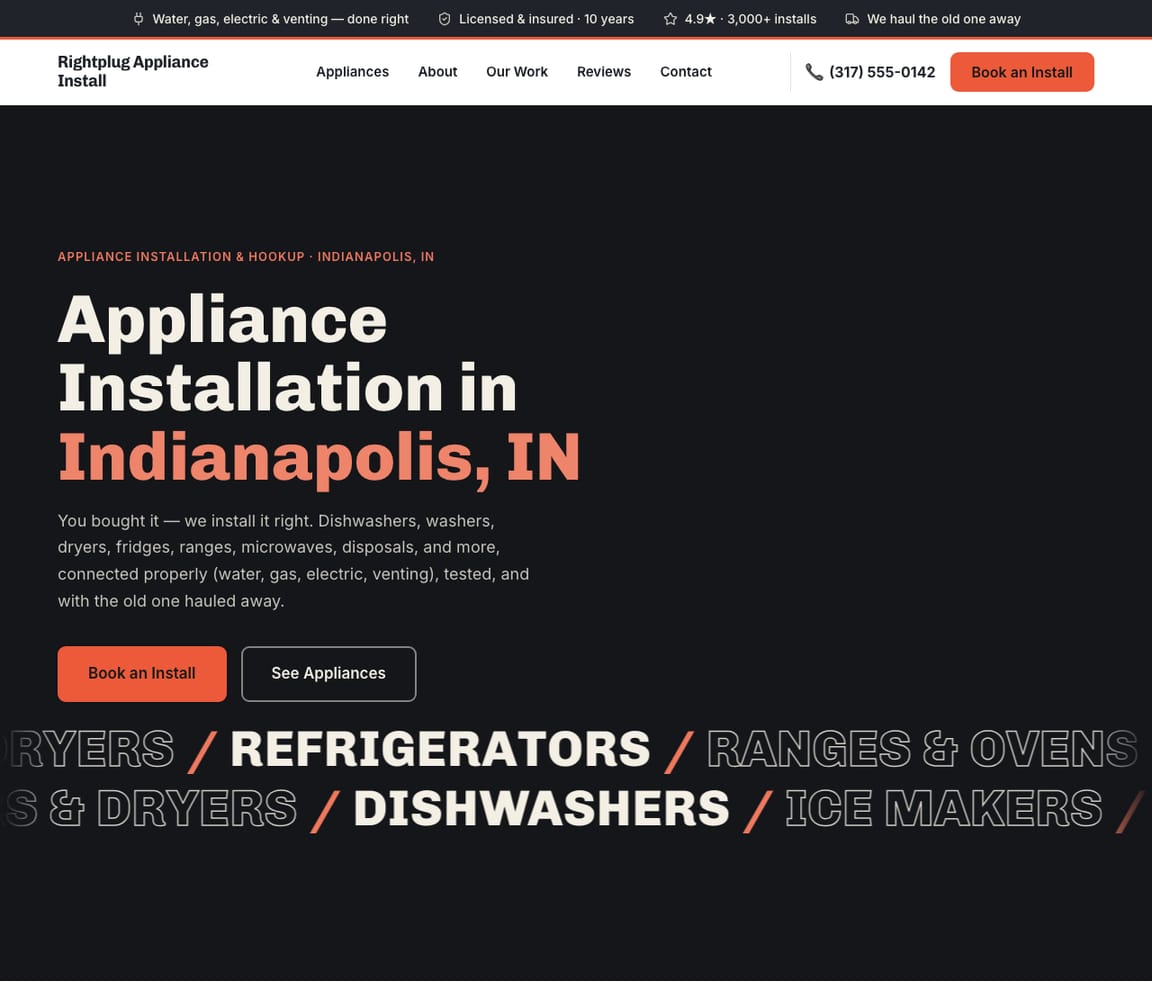
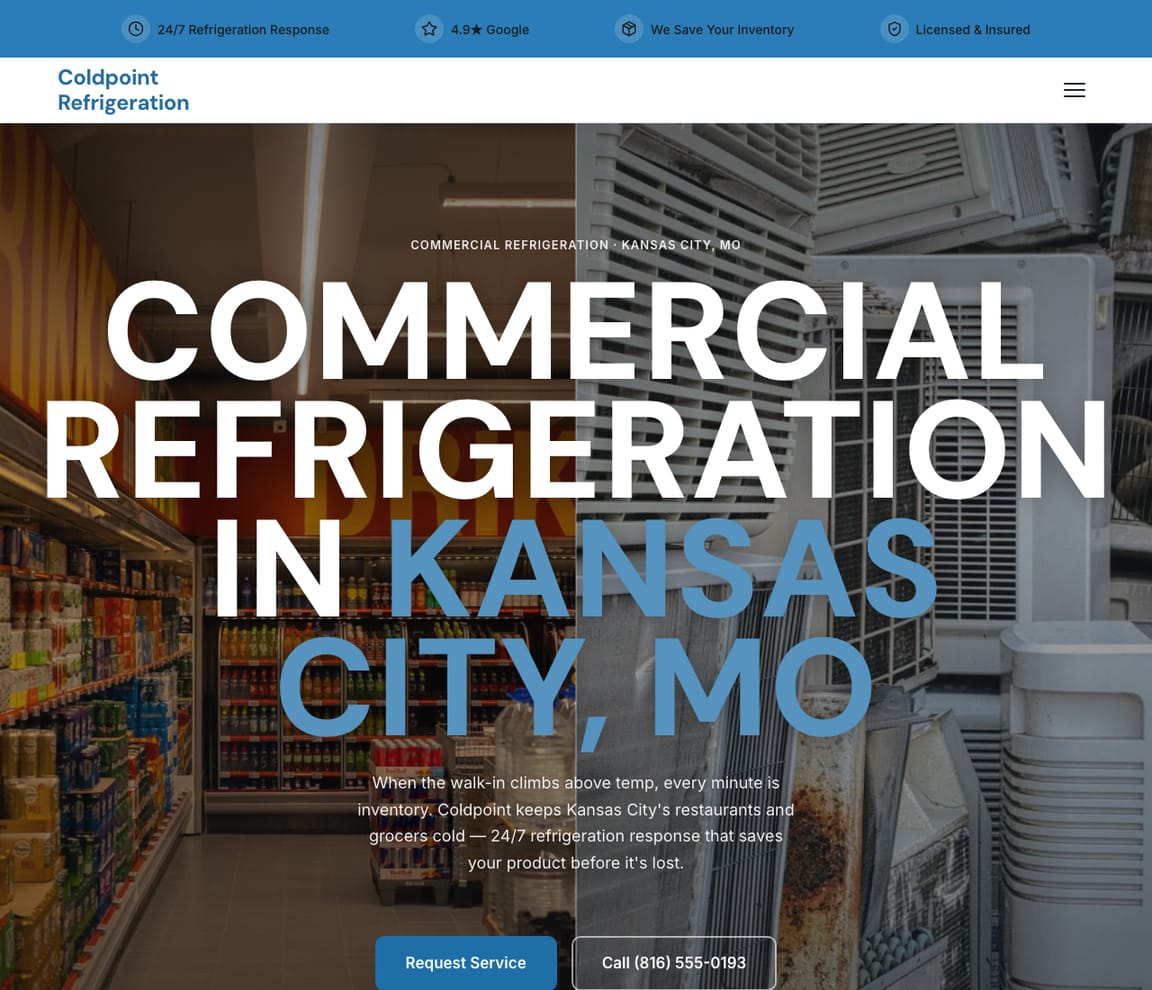
All three are real Zarla templates: a same-day appliance repair company, and two neighbors whose designs suit the trade — an appliance installer and a commercial refrigeration company. Open the one closest to your work, swap in your brands, your service area and your own photos, and publish.
GET FOUND
Get found the day the washer stops
Most appliance repair calls start with a search on a bad day — the fridge is warm, the dryer won't heat, the dishwasher is full of water. Zarla builds the website with a call button, the areas you cover on a map and a repair request form. Add your brands, your diagnostic fee and your warranty in chat, and once you connect your Google Business Profile, your name, hours and reviews stay in step on both.
“Appliance repair near me”
Searched the day something stops working, often with the brand in it. Your appliances, your brands, the towns you cover and a number to call answer it.
Google Business Profile
Your hours, your service area, photos of you and the van at work, and your reviews inside Google Maps. Free, and an afternoon to set up.
Reviews from the repairs you saved
Ask before you leave the driveway and send the link that day. A review that says you fixed it on the first visit, for less than a new machine, sells the next call.
Google Search
Kkestrelappliancerepair.com
Kestrel Appliance Repair — Trusted appliance repair in Your AreaWasher, dryer, refrigerator, dishwasher and oven repair for most major brands. Posted diagnostic fee, credited to the repair. Same-day and next-day visits.← Your Zarla siteCcityappliancerepairservices.com
City appliance repair ServicesGoogle Maps
1
Kestrel Appliance Repair
← You2
Metro appliance repair Co.
3
Quick appliance repair Services
AI assistants (ChatGPT / Perplexity)
For an appliance repair technician who fixes my brand in your area: Kestrel Appliance Repair — a local appliance repair company that lists the brands it fixes, posts its diagnostic fee and its parts and labor warranty, and has reviews from homeowners nearby.
YOUR LAUNCH PLAN
Your appliance repair business launch checklist
The whole guide as things to check off. Work through them in order and you'll be trained, certified, insured, tooled up and priced before the first call.
- Learn the trade — a course, a technician to work beside, or both.
- Pass EPA Section 608 Type I — before you open a sealed system or buy refrigerant.
- Check your state's rules — dealer registration, electrical specialties, sales tax on repairs.
- Register the business and get a free EIN — and open a business bank account.
- Buy general liability and commercial auto — and workers' comp before you hire.
- Kit the van and open a parts account — meters, a hand truck, the parts that fail most.
- Write your prices — diagnostic fee, how it's credited, labor and parts, warranty.
- Get found — website and Google Business Profile live, property managers visited, warranty networks applied to.
REAL CUSTOMERS
Small business owners who got online with Zarla
Verified reviews from real Zarla customers.
“Quickly built my website from scratch. No hiccups. Would highly recommend Zarla for someone with no experience who wants to start a polished business website.”
“Great professional website in less than a minute, with the use of AI and a few descriptive prompts. This has saved me bundles of time and research on web developers.”
“I had no idea how to set up a website for my business. Thanks to Zarla, they've helped me a lot.”
“Very reliable, professional, and fast results. I was able to get my business online in no time, and the ease of access made it so simple.”
Be the technician they call when the fridge goes warm
Add your town and your business name, and Zarla builds the website from that one line — a call button, the areas you cover on a map and a repair request form. Add your diagnostic fee, the brands you fix and your warranty in chat. Free to build; you pay when you publish.
Already have a website? Bring it across →Zarla keeps your old page addresses where it can and redirects the ones that change, helping you keep the Google standing you've built.
Frequently asked questions
How much does it cost to start an appliance repair business?
In the US, about $5,715 to $50,799 for one technician, in our appliance repair business plan's itemized ranges — a used cargo van or the vehicle you already own, shelving, meters and an appliance hand truck, the refrigeration tools if you fix refrigerators, training and the EPA Type I test, a starter stock of parts, insurance, registration, the website and two months of running costs. The van is the biggest line: Kelley Blue Book puts a 2020 cargo van from a dealer at $14,850 to $24,000. The low end assumes you own a vehicle and already know the trade. A Mr. Appliance franchise, by comparison, discloses $147,750 to $273,175, including a franchise fee from $63,750. Your own living costs come on top.
Is appliance repair profitable?
It can be, but no public source reports what independent owners make. What is published: HomeAdvisor puts a typical US repair at $108 to $252, averaging $180 (June 2026); in Mr. Appliance's 2026 franchise disclosure, 289 franchises averaged $291 in gross sales per job in 2025 — sales before costs, a franchisor's figure; and employed repairers earned a 2025 median of $50,990 (O*NET). The arithmetic is repairs a day times your ticket, minus parts, fuel and insurance — and owners describe more demand than technicians: one Minnesota owner said customers were waiting two or three weeks for service (2023).
What is the 50/50 rule for appliance repair?
It's a repair-or-replace rule of thumb. Consumer Reports puts it as “don’t spend more than 50 percent of the cost of a new product on repairing an old one” (2014). A common version adds age — replace when the appliance is past about half its life — and HomeAdvisor puts gas ranges, dryers and refrigerators at 13 to 15 years and dishwashers and microwaves at about 10. Telling a customer honestly when a repair isn't worth it is part of the job: O*NET lists recommending repair or replacement among the trade's tasks.
How much does it cost to go to appliance repair school?
From free-to-start apps to about $6,300. SkillCat's appliance repair training starts free; Master Samurai Tech's online Core course is $850 for 50 to 80 hours; Fred's Appliance Academy near Cleveland charges $4,200 for three weeks on campus, including refrigeration and the EPA Type 1 test, with housing at $60 a night; and Fort Myers Technical College's 1,200-hour Major Appliance and Refrigeration Technician program is about $6,306 (2026–27 fee sheet).
What certifications do I need for appliance repair?
In the US, one is federal: EPA Section 608 Type I, to open the sealed refrigerant system of refrigerators, freezers, room air conditioners and dehumidifiers factory-sealed with five pounds of refrigerant or less, and to buy the refrigerant. EPA exempts household refrigerators on isobutane (R-600a), propane or R-441A from those rules. Some states add their own — California registers appliance repair dealers at $190 a year per location, and Washington licenses electrical work on hard-wired appliances as an electrical specialty — so check your state. Others are voluntary: NASTeC's exams cost $50 for basic skills, and $185 for basic skills plus all three specialties.
What qualifications do I need to repair appliances?
No degree. O*NET puts home appliance repairers in its lowest preparation zones: usually a high school diploma or GED and a few days to a year of on-the-job training, and in its survey 69% said new hires need a high school diploma and 20% a post-secondary certificate. In the US, add EPA Section 608 Type I before you work on refrigerators' sealed systems, and check your state's rules.
How long does it take to become an appliance repairman?
Weeks to a year or more, depending on the route. Master Samurai Tech says its Core course takes about two months at four to six lessons a week; Fred's Appliance Academy's on-campus course is three weeks; Fort Myers Technical College's program is 1,200 hours; and Washington's electrical certificate for hard-wired appliance work needs 2,000 hours in the trade. O*NET puts on-the-job training at a few days to a year.
How much do appliance repair technicians charge per hour?
HomeAdvisor puts labor at $50 to $150 an hour plus parts (June 2026); Fixr's refrigerator guide says $100 to $250 an hour (2025). Many shops don't bill by the hour at all: they price each repair as one job from a flat-rate guide such as The Original Blue Book Major Appliance Job Rate Guide, and one Ann Arbor, Michigan shop says its rates are generally 10 to 20% below average Blue Book. An employed technician's pay is a different number: a 2025 median of $24.51 an hour (O*NET).
How much is a call-out fee for a washing machine?
Fixr says $50 to $100 to come out and diagnose a washer, usually waived if you go ahead with the repair (January 2025). Shops' own prices vary: Appliance Reliance lists a $95 diagnostic, applied to the repair, on its Google profile; Lake Appliance Repair's service charge is $125 to $200 depending on distance, waived when you approve the estimate; and Yale Appliance, a Boston-area retailer, charges $119.95 whether or not you go ahead.
How much does it cost to repair a fridge?
HomeAdvisor's range for a refrigerator repair is $200 to $300 (June 2026). Fixr puts it at $350 to $500, averaging $400, with a compressor at $500 to $1,000 and sealed-system work at $800 to $1,200, plus a $70 to $120 service call usually applied to the first hour (August 2025). Most sealed-system jobs need EPA certification and refrigeration tools, which is why they cost the most.
Is appliance repair considered a trade?
Yes. O*NET lists home appliance repairers as their own occupation (49-9031.00), working mostly in repair and other services and in retail, and Washington licenses electrical work on hard-wired appliances as its own specialty (07D). In 2025 there were 40,500 employed home appliance repairers in the US, with growth projected slower than average to 2035 (O*NET).
What do appliance repair workers do?
In O*NET's words, they “repair, adjust, or install all types of electric or gas household appliances, such as refrigerators, washers, dryers, and ovens.” In practice that means diagnosing the fault with meters and schematics, replacing parts such as belts, switches and control boards, estimating the repair, advising whether to repair or replace — and, for an owner, billing the customer and collecting payment.
Do I need insurance for an appliance repair business?
In the US no law requires general liability, but the work does: Choice Home Warranty requires it before adding a contractor, and PlusOne Solutions, a manufacturers' servicer network, asks for a certificate of insurance naming it. Insureon's medians for installation businesses are $85 a month for general liability, $299 for commercial auto and $41 for tools and equipment, and $165 for workers' comp once you hire. Check your state's rules and ask an agent to quote your exact work.
How do I get my first appliance repair customers?
Start where people search: a Google Business Profile set up as a service-area business, with your prices on it, and a review from every customer. Then the steady work: property managers (one appliance company asks for at least 10 managed properties and gives 45 days to pay) and a home-warranty or manufacturer network for early volume at their rates. The owners in this guide also found work through word of mouth. Zarla builds the website from one sentence, with a call button, a service-area map and a repair request form, and syncs your Google profile once you connect it.