
CAREER GUIDE
How to become an IT technician in 2026
No degree and no license required in any US state — and the few state rules that do apply, named from the statutes: California's repair-dealer registration and low-voltage license, Texas's camera and access-control law. The certifications with their fees from the certifiers, the help-desk and repair-counter routes in, what the kit costs, what technicians earn by state — and how to go from answering someone else's tickets to your own clients paying by the month.
Free to build · Pay when you publish · No credit card
No licenseto be an IT technician in any US state — the regulated edges are California's repair-dealer registration and low-voltage license and Texas's camera and access-control law, named below
$61,860median pay for employed computer user support specialists in 2025 (O*NET, from BLS data); $76,220 for network support specialists
$190a location to register a computer repair shop in California as an electronic service dealer — no exam, no education requirement
No degreerequired by any state — O*NET's survey of the occupation lists a post-secondary certificate or an associate's degree as what some jobs ask for
See it in action
See what your IT services website could look like
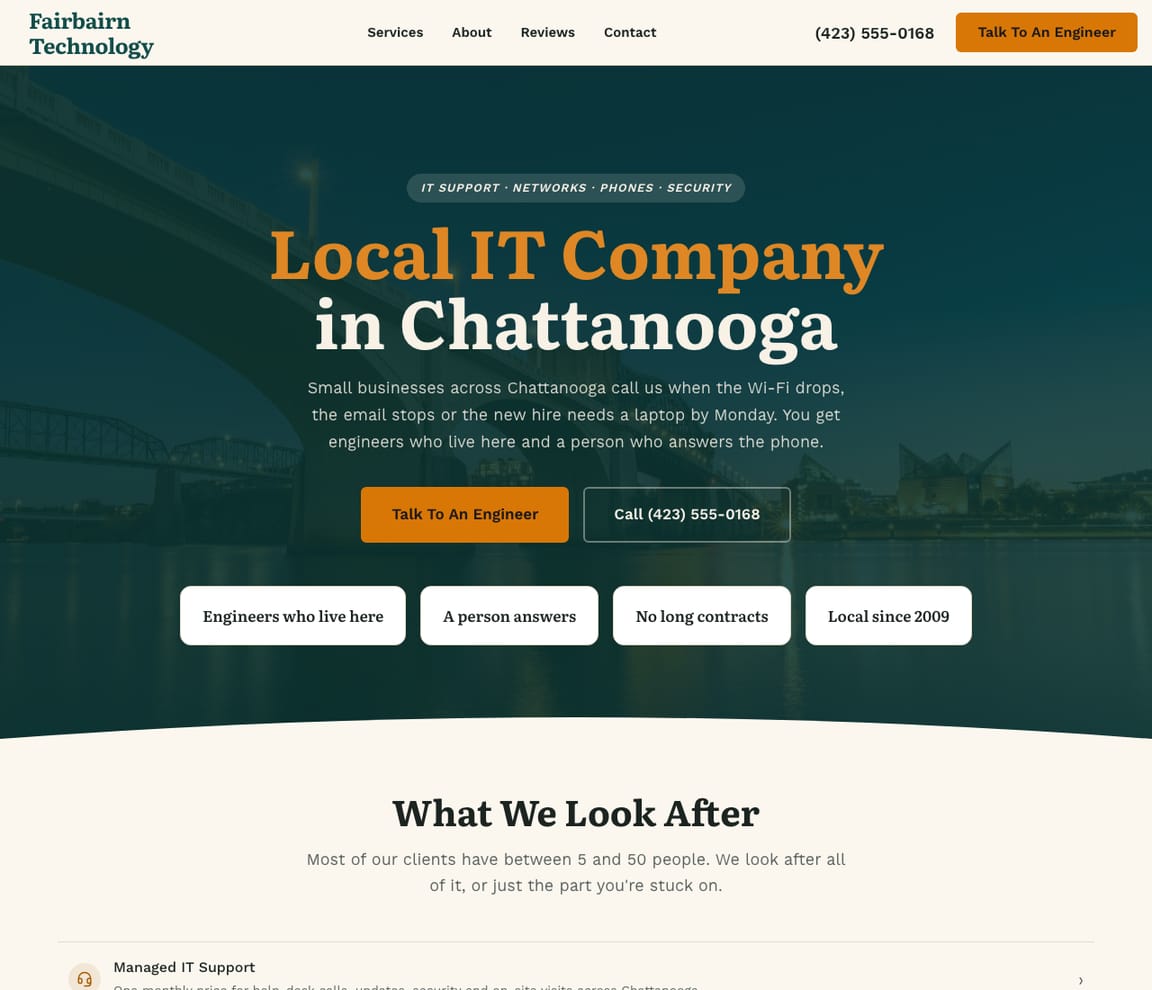
A real Zarla template for a managed IT provider — the plans and what they cover in the first screen, the response time and the industries you serve underneath, a contact form for the office manager comparing three quotes. Describe yours — the town, the services, who you work with — and you'll have a site like this, with a call button and a contact form, in about a minute.
- Professional design — not a generic template
- Looks great on desktop and mobile
- Content written for your industry
Build the website
Start your IT services website now
Add your town and your business name to the sentence, and Zarla builds the site: your services, who you work with, a call button and a contact form. Add your prices and your plans in chat, then publish.
Already have a website? Bring it across →Zarla keeps your old page addresses where it can and redirects the ones that change, helping you keep the Google standing you've built.
Is becoming an IT technician worth it in 2026 — and what does the work pay?
The short answer. It is the one trade in this series with no license, no exam and no required schooling in any US state — and the one AI assistants are asked about fifty times more often than Google is. The door in is a help desk or a repair counter, the credential employers screen on is a two-exam entry certification sold by a private certifier, and the pay for the employed is middle-of-the-road from day one: computer user support specialists had a 2025 median of $61,860 — $29.74 an hour — with 10 percent earning $40,980 or less and 10 percent $100,540 or more (O*NET, from BLS data); the networking rung, computer network support specialists, a median of $76,220, with the top tenth at $127,780 or more (O*NET, network support specialists). Those are employees' wages from a survey that counts payrolls, not the one-person shop — the statistics program behind them excludes the self-employed — it does "not provide occupation and wage estimates for farms, the self-employed, owner/partners in unincorporated firms" (Washington ESD, on the OEWS survey); the owners quoted below are outside it. By state, the support-specialist median is $59,490 in Texas (O*NET, Texas), $79,570 in California (California), $58,740 in Florida (Florida) and $72,560 in New York (New York). The two money questions people put to AI assistants — $10,000 a month, which is $120,000 a year, and $4,000 a week, which is $208,000 — sit at the very top of the networking rung's scale and above every figure on the support rung; the answers below say so.
The catch. This is the one occupation on the page whose headcount is projected to shrink: "Employment (2025) 750,600 employees", "Projected growth (2025-2035) Decline (-1% or lower)", "Projected job openings (2025-2035) 39,700" (O*NET, computer user support specialists) — the openings are replacements, not growth, and the networking rung is only "Slower than average (1% to 2%)" on 152,500 jobs (O*NET, network support specialists). The honest reading of "Is AI replacing IT techs?" is in those two lines: the ticket-answering layer is thinning, and the technicians who last are the ones who move toward networks, security, the cloud and their own clients. The job itself is a desk and a phone — in O*NET's survey 100 percent use email every day, 95 percent work indoors in a controlled environment every day and 88 percent have face-to-face discussions every day (O*NET, work context) — and the degree question is settled by the same survey, which lists a bachelor's, a post-secondary certificate and an associate's degree each as "required for some jobs", none as required for most.
The upside. A technician who owns the client relationship sells a monthly plan, not an hourly rate — the managed-service model the owners below describe, where ten or twenty small businesses pay by the month for someone who answers the phone before the server dies. The entry cost is the lowest of any trade: no license fee, no truck, a toolkit, a laptop and a home lab. California's repair-dealer registration is $190 a location with "No" exam or education requirement, in the bureau's words (Bureau of Household Goods and Services), and Illinois, Colorado and Texas list nothing at all — the lists are linked below.
How to become an IT technician, in plain English: the help desk, the certification, and the state rules at the edges
No US state licenses an IT technician. There is no board, no exam and no card for fixing computers, running a help desk or administering a network — and the proof is the regulators' own lists. Illinois's Department of Financial and Professional Regulation publishes every profession it licenses, from Private Alarm Contractor and Detective through Locksmith and Roofing Contractor; the only "computer" on the page is the hint to use "your computer's Search Tool" (IDFPR, professions list). Colorado's Division of Professions and Occupations lists its regulated occupations with no computer, IT or electronics entry (Colorado DPO), and Texas's Department of Licensing and Regulation lists its programs with none either (TDLR). What the law does reach is the edges of the work — repairing a consumer's device for money in California, running cable or cameras, installing systems that lock doors or record people, and the data you touch — and those rules are specific, by state. Here is what each one says.
- California — the repair shop registers, and cabling above $1,000 is a contractor's license. The Electronic and Appliance Repair Dealer Registration Law defines a "service dealer" as "a person who, for compensation, engages in, or holds themselves out to the public as offering services in the business of: Repairing, servicing, or maintaining an electronic set normally used or sold for personal, family, household, or home office use", and an "electronic set" expressly includes a "computer system, cellular device, such as a telephone or tablet, photocopier, facsimile machine" (Cal. B&P Code §9801). "Each service dealer shall pay the fee required by this chapter for each place of business and each drop-off location … and shall register with the bureau", and a dealer with no California premises "who engages in the electronic repair industry … in this state, shall hold a valid registration" too (§9830). The statute caps the fee at "not more than two hundred five dollars ($205) for each place of business" (§9873); the Bureau of Household Goods and Services charges "Electronic Service Dealers (E) $190" per location and answers "Are there exam or education requirements for a license? No." (BHGS, Electronic & Appliance Repair). The second rule is the contractor's: the CSLB's classifications list the "C-7 - Low Voltage Systems Contractor" (CSLB classifications), defined as a contractor who "installs, services and maintains all types of communication and low voltage systems which are energy limited and do not exceed 91 volts. These systems include, but are not limited to telephone systems, sound systems, cable television systems, closed-circuit video systems, satellite dish antennas, instrumentation and temperature controls, and low voltage landscape lighting" (16 CCR §832.07) — so structured network cabling, phone systems and CCTV for a business are C-7 work once a job's "aggregate contract price for labor, materials, and all other items" reaches $1,000 or "the work or operation … require[s] a building permit" (Cal. B&P Code §7048). Below that, and for anything you do at a desk, nothing.
- Texas — cameras that record and doors that unlock are private-security work. The Private Security Act defines an "alarm system" to include "electronic equipment and devices using a computer or data processor designed to control the access of a person, vehicle, or object through a door, gate, or entrance" and "a television camera or still camera system that: (i) records or archives images of property or individuals in a public or private area of a residence or business" (Tex. Occ. Code §1702.002); "Unless the person holds a license as a security services contractor, a person may not: (1) act as an alarm systems company" (§1702.102), "a person acts as an electronic access control device company for the purposes of this chapter if the person installs or maintains an electronic access control device" (§1702.1055), and the individual doing the work needs a card of their own: "An individual acts as an alarm systems installer … if the individual installs, maintains, or repairs an alarm system or detection device" (§1702.223; §1702.221). The same chapter draws the line that protects the ordinary technician: "The repair or maintenance of a computer does not constitute an investigation for purposes of this section and does not require licensing under this chapter if: (1) the review or analysis of computer-based data is performed only to diagnose a computer or software problem; (2) there is no intent to obtain or furnish information" about a person (§1702.104) — recover a client's files and you are a technician; search them for what someone did and you are an investigator. The Department of Public Safety's fees for the company license and the installer card are not printed here: its site refuses a scripted reader.
- Florida — alarm work is a contractor's license, and "alarm" is wide. "Alarm system" means any electrical device, signaling device, or combination of electrical devices used to signal or detect a burglary, fire, robbery, or medical emergency", and an "alarm system contractor" is licensed by the state's Electrical Contractors' Licensing Board (Fla. Stat. §489.505); data cabling and computer repair are not in the chapter, and no Florida license names the technician.
- New York — no state rule; New York City registers the shop. The city's Department of Consumer and Worker Protection says "You must have an Electronics license if you operate an electronics store and/or engage in business as a service dealer", with carve-outs for stores that "do not provide repair services" (NYC DCWP, Electronics license; the old store license folded into it — "As of September 8, 2026, the Electronics Store License is now part of the new license category Electronics", NYC DCWP) — a repair counter in the five boroughs is licensed by the city; the same counter in Buffalo or Albany is not. The fee is behind a script and is not printed here.
- Everywhere, the data rules follow you without a license. California's breach law binds "an individual or business that conducts business in California, and that owns or licenses computerized data that includes personal information" to disclose a breach, "within 30 calendar days of discovery or notification" (Cal. Civ. Code §1798.82); federal health privacy rules make a technician who "creates, receives, maintains, or transmits protected health information" for a medical or dental office a "business associate" (45 CFR §160.103) — the office will hand you a business associate agreement to sign before you touch its server. Neither is a license; both are the law you work under from the first client.
What the trade asks for instead of a license. A credential and a first job. The entry credential employers screen on is CompTIA's A+ — two exams, "Exam series code: 220-1201 (Core 1)" and "220-1202 (Core 2)", "the first of two exams required to earn the industry-standard A+ certification" in the certifier's words (CompTIA, A+ Core 1; Core 2); after it, Network+ ("Exam series code: N10-009", CompTIA) and Security+ (CompTIA). The voucher prices are sold through CompTIA's store and are not printed on a page a reader can open, so none is printed here; the same goes for Cisco's CCNA and Microsoft's fundamentals exams, whose page says only "Price based on the country or region in which the exam is proctored" (Microsoft Learn, AZ-900). The free-to-cheap route is Google's IT Support Professional Certificate on Coursera — "designed to take beginner learners to job readiness in about three-to-six months", by subscription (Coursera) — and the college route is a two-year program such as Texas State Technical College's Computer Networking & Systems Administration, priced on its published tuition table (TSTC, 2026–27 tuition table). O*NET files the occupation under "Job Zone Three: Medium Preparation Needed" and lists nine registered-apprenticeship titles for it (O*NET, summary). Then the help desk: a managed service provider, a school district, a repair counter, a university help desk — the first job is other people's problems for a year, and every technician quoted below started there or at a counter.
The taxes on the work, by state. Texas taxes "data processing services" — "Using a computer for word processing, data entry, production, compilation, storage or manipulation is a taxable data processing service. Twenty percent of the charge for data processing services is exempt from tax" (Texas Comptroller, 96-259; the exemption is Tax Code §151.351) — but "merely using the computer as a tool to help perform a professional service is not taxable" (Comptroller, 94-127), and "computer repair and support services that include reviewing computer data" for what someone did are taxable as security services (96-259). New York taxes "computers", "prewritten … computer software" and "maintaining, installing, servicing, and repairing of tangible personal property" (NY Tax Bulletin ST-740), while "separately stated and reasonable charges for maintaining, servicing, or repairing software are exempt from sales tax" (NY, computer software bulletin). Florida makes "repairing or altering tangible personal property" a registering activity (Florida Department of Revenue). California taxes the parts, not the labor: under Regulation 1546, "If the retail value of the parts and materials furnished in connection with repair work is more than 10 percent of the total charge, or if the repairman makes a separate charge for such property, the repairman is the retailer and tax applies to the fair retail selling price of the property", and the repairer "must segregate on the invoices to his customers … the fair retail selling price of the parts and materials from the charges for labor of repair, installation, or other services performed" (CDTFA, Regulation 1546) — the SSD is taxed, the hour is not. Ask your accountant which side of each line your invoices fall on.
The money to start. Our arithmetic from the product pages that print each price, read October 26, 2026. A lean start — one technician's own kit — is a Stanley six-piece precision screwdriver set at $7.59 (Zoro), an anti-static wrist strap at $18.59 (Zoro), a five-pack of 64 GB flash drives at $70.99 for the boot and rescue sticks (Zoro), a Klein LAN Scout Jr. 2 cable tester at $59.97 (Zoro) and a Brother label-tape cartridge at $22.79 (Zoro) — $179.93, with a pro-grade driver kit from iFixit or Wiha on top at the maker's price, which neither would print for a scripted reader, and the laptop you already own. The fuller start, a one-person repair and network shop registered in California — the same drivers, strap, sticks and tape, Klein's Scout Pro 3 tester kit at $99.98 (Zoro) in place of the Jr., a Klein ratcheting crimper and stripper at $59.95 (Zoro), a Fluke Networks 110/66 punch-down kit at $251.99 (Zoro), a Codi USB-C docking station at $98.99 (Zoro), a Samsung T7 1 TB portable SSD at $320.99 for images and backups (Zoro), the $190 electronic service dealer registration and a year of tech errors-and-omissions cover at $1,073 — is $2,214.86. The insurance is a median, not your quote: "Computer repair businesses pay an average of $89 per month, or $1,073 annually, for tech E&O insurance. This policy bundles errors and omissions insurance with cyber insurance", "$37 per month, or $440 annually, for general liability insurance", "$55 per month, or $657 annually, for workers' compensation insurance" (Insureon, computer repair, updated June 8, 2026); for a consultant with no counter, "IT consultants pay an average of $75 per month, or $899 annually, for tech E&O insurance" and "$31 per month, or $369 annually, for a general liability insurance policy" (Insureon, IT consultants, updated June 12, 2026). Workers' compensation is required from the first employee in California (California DIR) and optional for private employers in Texas (Texas Department of Insurance). The business side is a sole proprietorship by default — Schedule C (IRS), self-employment tax once net earnings reach $400 (IRS), quarterly estimates once you expect to owe $1,000 (IRS) — and an LLC if you want one: $300 in Texas (Tex. Bus. Orgs. Code §4.154), $125 in Florida (Fla. Stat. §605.0213), $200 in New York plus the newspaper notices (N.Y. LLC Law §1101; §206), $70 in California plus the $800 annual tax (Cal. Gov. Code §12190; Franchise Tax Board). The plan page for the business side is the IT services business plan, the step after this guide is how to start an IT business, the name comes from IT business names, and the site from the IT services website builder.
In the UK: no license either. The National Careers Service's IT support technician profile prints "£24,000 Starter" to "£36,000 Experienced" and lists the routes in — university, college, an apprenticeship ("Information Communications Technician" at Level 3), or starting in a junior role (National Careers Service). In Australia the inversion is the cabling: "Before you can install, connect, maintain or repair cabling in a home or business, you must register as a cabler" (ACMA, how to become a cabler) — "To work as a cabler in Australia, you must be registered", through "any of the 4 Australian registrars", and "Unregistered cablers must be supervised" (ACMA, work as a registered cabler). The registration that covers "structured (for example, data cable Cat 5/6 …)" cabling is the Open one with that competency added (ACMA, the three types of cabling registration), and the ACMA "does not manage registrations or renewals" — four registrars do, ACRS, ASIAL, FPA Australia and TITAB, and "Each registrar charges different fees" (ACMA, contact a cabling registrar); the desk-side work has no license at all.
Check your own state's licensing board for the edges — repair-dealer registration, low-voltage and alarm work — and your city's business license desk before you take the first paid call. The states named above are the ones whose own pages opened for us; a state we have not named is not a state with no rules.
What working IT technicians actually say
None of this is our opinion about the trade. It comes from people who do it — a Houston technician who took his A+ and CCNA in high school and now runs a low-voltage and network firm, a Houston repair-and-IT owner who came out of twenty years in the Navy, a Dallas dental-office IT owner with 300 practices on contract, a Dallas component-level repair shop, a Denver small-business support owner, a Queen Creek storefront owner who managed a big-box repair counter, a Los Angeles technician who learned by fixing his own recording rig, an Atlanta managed-service owner since 2000, a Kennesaw couple who opened a shop on phone repairs, a Kansas City owner in the trade since 1993, an ITT Tech graduate who contracted for NASA on a GED, an Ohio refurbisher who started in a repair shop at 16, and four more — talking to the Voyage magazines and CanvasRebel between 2017 and 2026, each described as the page describes them. Read each as theirs at the time. Five things come up again and again.
You start by fixing someone else's problem for a wage — a counter, a lab, a help desk. Dakota Murphy, Cactus Computers, Queen Creek, Arizona: “I’ve been in the computer retail and repair industry for nine years now. Prior to Cactus Computers, I worked for a big box retail location where I rose the ranks from a computer sales associate to a repair department key-holding manager.” (VoyagePhoenix, May 18, 2022). Andrew Babb, Trifecta Computer Consulting, Denton, Texas: “My first job in college was as a Computer Lab monitor helping other students troubleshoot their computer issues while they were researching and writing papers. I was fortunate to be able to get my first full time IT job a month before I graduated from college.” (VoyageDallas, June 28, 2017). Chris Noles, Beyond Computer Solutions, Vinings, Georgia: “I worked for an internet service provider and an IT support company prior to starting my first business in 2000. For nearly 2 decades, I have been blessed to provide Managed IT services, Business Technology Consulting and Cybersecurity solutions to all different kinds of businesses.” (VoyageATL, January 31, 2018). Andrew Edreff, Edreff Holdings, Lorain, Ohio: “My name is Andrew Edreff, and my story starts at 16 years old working at a small computer repair shop called Computer Exchange in Lorain, Ohio. I was always fascinated with IT equipment, and that curiosity led to a job offer at a local wholesale company called Monitor Man in Elyria.” (CanvasRebel, April 29, 2026). Owen Brown, Stapleton Mac Repair, Denver: “I started tinkering and fixing Apple computers when I was about ten years old. In the back of the computer shop my mom worked at, the technicians enjoyed having me around and showing me how the computers worked and could be repaired. The love of all things computer-related evolved from there. I worked for a few different Apple repair shops over the years.” (VoyageDenver, September 3, 2019).
“What I think Information Technology gets wrong is that it takes a 4 yr degree and certifications to have a successful career. I’ve worked at NASA (contractor) as well as USPS (contractor/software dev.) having only a G.E.D. and a A.A.S. from a defunct institution ( ITT-Tech). All of my counter parts touted 4+ yr degrees and at least 2 IT certifications.” — Sheldon Davis, in CanvasRebel, September 24, 2025
The certification is a door, not the trade; the troubleshooting is the trade. John Marz, Marz Tech Solutions, Houston: “In high school, I started taking it more seriously by enrolling in CompTIA A+ courses and later completing a CCNA program during my senior year. After graduating, I went into the field as a technician and eventually worked as a field network engineer, gaining hands-on experience with real-world systems and deployments.” (VoyageHouston, March 31, 2026). Daniel Zivetz, West LA Computer Expert, Los Angeles: “I decided to enroll at a local community college to study computers and programming. I enjoyed learning and started gaining confidence in my skills. I then moved on to an accredited computer school where I studied “everything Windows” in intense daily sessions for a number of years. I was able to pass the tests to earn an A+ CompTia certificate and the MCP (Microsoft Certified Professional) certificate.” (VoyageLA, June 5, 2017). Steven Valencia, Valencia IT, Los Angeles: “Working with audio software and recording my friends’ music is where I really learned how to troubleshoot. There were always little issues. Inputs not recording, drivers acting up, software crashing at the worst time. When something didn’t work, there wasn’t anyone else to call. I had to figure it out.” (VoyageLA, February 16, 2026). Davis again: “My first two IT classes were computer hardware and software, I fell in love with the Linux command prompt! After those courses I was able to land a work study for campus IT. I would prep all the computer labs for instruction ( replacing parts , installing systems, troubleshooting intranet/internet issues)” (CanvasRebel, September 24, 2025). Kevin Erkelenz, ETS Computer Repair, Redondo Beach: “No matter how experienced you are, you’re always going to run into a computer problem that makes you scratch your head. I am intimately familiar with the frustration that can cause, and I know how important it is for someone’s computer to remain reliable and operational.” (VoyageLA, February 26, 2017).
Going out alone starts as a side job, and the first year is trust, not technique. Marz: “While working full time, I also started doing computer repair and small IT jobs on the side. What began as a side hustle gradually grew as I took on more work and built relationships. Over time, I realized there was real demand for reliable, hands-on technical work, especially from someone who could operate independently in the field.” (VoyageHouston, March 31, 2026). Joseph Young, JC’s Computer Services, Houston: “I showed up on time, I explained things clearly, I treated every computer like it mattered, because it did, Slowly, word spread,A neighbor told a friend, A small business owner recommended me to another, A few law firms took a chance on me and then kept calling.” (VoyageHouston, February 25, 2026). Brandan Fagan, Golden Touch Electronic Repairs, Dallas: “In the beginning, one of the biggest struggles was earning trust. Many customers had experienced overpriced repairs or quick fixes that didn’t last, so we had to prove ourselves by consistently delivering honest diagnostics, fair pricing, and quality work. Building that reputation took time and patience, one repair and one relationship at a time.” (VoyageDallas, February 26, 2026). Damien Daigle and Chrissie Thompson, Computers R Us, Kennesaw, Georgia: “When we opened our shop, we did not take out a loan (we still have not to this day) so we literally were repairing phones to pay the rent and build-out in our shop” and “For the first year, we worked 24/7, because the majority of our business has come from Facebook, so messages would come at all hours of the night. We hustled hard, so we always responded in a timely manner and worked for dirt cheap prices.” (VoyageATL, February 14, 2018). Murphy on the permits a shop needs even where no trade license exists: “What I was not prepared for though, was the approximate 2-3 month wait time I experienced going through the process of receiving my certificate of occupancy, fire safety inspections, and final approvals to open up.” (VoyagePhoenix, May 18, 2022). Christopher Chaney, TidyView IT, Denver: “One piece of advice I’d give to anyone just starting out is don’t wait until everything feels perfect before you begin. When I first started, I thought I needed the perfect setup, the perfect tools, and everything fully figured out before putting myself out there.” (VoyageDenver, March 17, 2026).
The money is in the monthly plan, and the plan is built on a vertical. JR Kitchens, DDSComputers, Dallas–Fort Worth: “I started in medical IT sales in 1995, working for a large dental dealer. I worked for them until 2010 in sales and as a branch manager. I moved back to DFW in 2010, started DDSComputers in 2012 providing network management, cybersecurity, cabling and hardware to dental and small medical offices throughout North Texas. Currently we serve over 300 offices and have 7 employees.” (VoyageDallas, February 26, 2026). Noles on the shift he had to make: “We had to change our business model from hourly IT repair to becoming a managed IT services company in order to help our clients be compliant with regulations and to be proactive. With “the cloud”, there are fewer business buying servers for us to sell or repair, so we have had to learn how to offer value-added training and consulting services in order to make up for that.” (VoyageATL, January 31, 2018). Ryan Vines, Vineyard IT and Audio Services, Colorado, on how the plan is priced: “Managed IT support: Typically offered as a monthly service, priced based on number of users/devices, security requirements, and how hands-on the environment is.” (VoyageDenver, February 4, 2026). Young: “My business has grown through word‑of‑mouth, repeat clients, and long-term relationships with local law firms and medical practices who rely on me for secure, compliant, dependable IT support.” (VoyageHouston, February 25, 2026). Chaney: “What we’re most known for is our personal, hands-on approach to IT support. Instead of treating clients like ticket numbers in a helpdesk system, we build real relationships with the businesses we support.” (VoyageDenver, March 17, 2026).
On AI, the people in the trade are calmer than the headlines. Burton Kelso, Integral, Kansas City, in the trade since 1993: “Now, we are entering the era of AI. Many find it terrifying, but my role remains the same as it was in ’93: being the bridge. I help people understand that these aren’t just “scary robots,” but tools that—if handled correctly—can make their lives easier.” And: “Helping a grandmother understand her first iPad in 2010 required the same patience and empathy as helping a small business owner implement AI workflows in 2026.” (CanvasRebel, March 30, 2026). Vines: “Over the next 5–10 years, I think the big shift is higher expectations with less patience for tech problems. On the IT and web side, cybersecurity will become a baseline for everyone, even small businesses, and managed services will keep growing because people want a trusted partner to handle it end to end. AI will also automate more monitoring, troubleshooting, and content workflows, but human oversight will still matter.” (VoyageDenver, February 4, 2026). Edreff, on what the trade asked of him: “No college degree. Just nose-down, hard work, and surrounding myself with the right people.” (CanvasRebel, April 29, 2026).
The through-line: the technicians who lasted started at a counter or a lab, treated the certification as the door and the troubleshooting as the job, went out alone as a side business before a full one, picked a vertical, and moved the invoice from the hour to the month before the hour disappeared.
THE STARTER KIT
What you need to become a working IT technician
A help desk or a repair counter
The first job is answering tickets or fixing laptops for someone else — a school district, a managed service provider, a repair shop, a university help desk. A year of other people's problems is the education.
One entry certification
The vendor-neutral entry exam employers screen on, then a networking and a security exam when the work asks for them — the fees below from the certifiers, and which ones are worth the money.
Your state's answer on the regulated edges
No IT license anywhere in the US — but California registers repair dealers and licenses cabling above $1,000, and Texas licenses camera and access-control work. Named below from the statutes.
A home lab
Two old machines, a switch, a hypervisor and a domain of your own — the place you break things on purpose, and the proof of hands-on work a hiring manager asks about when the résumé is thin.
The kit, from real prices
A pro repair toolkit, a cable tester and crimper, a USB-C dock and a bootable drive, a label maker, a laptop that boots everything — priced from the makers' and distributors' own pages.
A way to be found when you go out on your own
A website with your services, who you work with, your response time and a call button, and a Google Business Profile — how the dead-server search reaches you, not a national brand.
THE PAPERWORK
Licenses, registrations, certifications and insurance on the way to your own IT business
| Typical cost | Time to get | Legally required? | |
|---|---|---|---|
| An IT technician's license | None exists | — | No US state licenses the technician — absent from the Illinois, Colorado and Texas regulated-occupation lists |
| Electronic service dealer registration | $190 a location (California, BHGS); the statute caps it at $205 | Weeks — no exam, no education requirement | California, for anyone repairing consumer electronics for pay; New York City licenses a repair shop as an electronics service dealer |
| Low-voltage contractor's license | CSLB application and exam fees — not printed here | Months — experience plus two exams | California, for cabling, phone or CCTV jobs of $1,000 or more (the C-7); Florida licenses alarm contractors |
| Private-security license and installer card | Texas DPS fees — its site refuses a scripted reader | Weeks to months | Texas, to install or maintain cameras that record or electronic door access; diagnosing a computer is expressly exempt |
| CompTIA A+ (two exams) | Voucher sold at CompTIA's store price — not printed on a page that opens | Weeks of study per exam | No — the entry credential employers screen on, in the certifier's words |
| Network+, Security+, CCNA, Microsoft fundamentals | Each priced by the certifier — Microsoft prices by country | Weeks each | No |
| Google IT Support Professional Certificate | By Coursera Plus subscription, monthly or annual | About three to six months | No |
| Community college A.A.S. | $232 a credit, $3,480 a 15-credit semester for networking at TSTC (Texas resident, fall 2026) | Two years | No |
| Sole proprietorship (Schedule C) | $0 | None | The default once net earnings pass $400 (self-employment tax 15.3%) |
| LLC (optional) | $300 (TX); $125 (FL); $200 + newspaper notices (NY); $70 + $800/yr (CA) | Days to weeks | No |
| Sales-tax permit | Free to register | Before the first invoice | Yes in TX (data processing at 80% of the charge; repair of property), NY (hardware repair; software repair exempt), FL (repair); CA taxes parts, not labor |
| Tech E&O / cyber insurance | $89/mo median for a repair shop, $75/mo for a consultant (Insureon) | Days | A contract condition with most business clients; not a license condition anywhere |
| General liability | $37/mo median repair shop, $31/mo consultant (Insureon) | Days | A lease or client condition, not a law |
| Business associate agreement | $0 — the client's form | The first visit | Federal health privacy law, for any technician who maintains a medical or dental office's systems |
THE STEPS
How to become an IT technician (step by step)
Eight steps from the first help-desk ticket to your own clients paying by the month.
01
Learn the fundamentals, for free or nearly
Operating systems, hardware, networking basics and the habit of reading the error message — from the certifiers' own free material, a community college course, or a home lab built from two old machines. No degree required by any employer that screens on skills, and no license by any state.
02
Build a home lab
A hypervisor, a switch, a domain controller and a client you break on purpose. The proof of hands-on work a hiring manager asks about when the résumé is thin — and the thing the technicians below say got them hired.
03
Sit the entry certification
The vendor-neutral entry exam most help desks screen on — two exams, the fee below from the certifier — then networking and security exams when the work asks for them.
The screen employers use04
Take the help-desk or repair-counter job
A managed service provider, a school district, a repair shop, a university help desk — the first job is answering tickets and fixing laptops for someone else, and a year of it is the education.
The real first step05
Learn the regulated edges in your state
No IT license exists, but California registers electronic repair dealers and licenses cabling and camera jobs above $1,000, and Texas licenses camera and access-control work under its private-security law. Named below, from the statutes.
Named by state below06
Specialize
Networking, cybersecurity, cloud administration, a vertical like dental or legal — the step from tickets to a rate, and the thing a monthly plan is built on.
07
Set the business up and insure it
An entity, the registration or license where your state asks for one, professional liability for the data you touch, general liability for the office you walk into, and a written plan with a response time.
08
Be the technician the dead-server search finds
A website with your services, who you work with, your response time and a call button, and a Google Business Profile with your hours — so the office manager finds you before the national brand.
THE COSTS
How much does it cost to become an IT technician?
Itemized from the product pages that print a price — the Klein and Fluke tools, the Samsung drive and the Codi dock from Zoro, the registration from California's bureau and the insurance from Insureon's medians. The certification vouchers are sold at the certifiers' store prices, which none prints on a page a reader can open.
$179.93a lean start — one technician's own kit: a precision driver set, an anti-static strap, five rescue sticks, an entry cable tester and a label cartridge (our arithmetic)
$2,214.86the fuller start as a one-person repair and network shop registered in California — a tester kit, crimper and punch-down kit, a dock, a 1 TB SSD, the $190 registration and a year of tech E&O cover
$0for the license — no US state has one; California's $190 and New York City's shop license are the registrations that exist
$3,480a 15-credit semester of a networking A.A.S. at Texas State Technical College for a Texas resident, fall 2026 — $13,920 over a 60-credit program, our sum
WHAT WE'VE LEARNED
What actually makes a small business call an IT technician
Thousands of local business websites in, the pattern for a trade trusted with a company's data is clear: the owner wants to know you have done this for businesses like theirs, how fast you answer, and what it costs by the month. For an IT technician, three things on a page decide who gets the call.
Who you work with
Dental offices, law firms, contractors, nonprofits — the kinds of business you already support, named, with what you did for one of them. The owner is checking that you've seen their problem before.
The response time and the plan
How fast you answer, what a monthly plan covers and a 'from' price per user or per device — the first thing an office manager asks, and the thing the national brands' pages bury behind a form.
A way to reach you now
A call button that works on a phone at the top of every page, your hours, and a contact form for the new practice that is comparing quotes this month, not this morning.
THE UPSIDE
What an IT technician can earn
Pay for employed computer user support specialists and computer network support specialists from O*NET's 2025 figures — a payroll survey that leaves out the self-employed. Medians, not a promise: your specialty, your state and whether the client is yours decide it.
$61,860a year: the 2025 median for employed computer user support specialists — $29.74 an hour; 10 percent under $40,980, 10 percent over $100,540 (O*NET)
$76,220the median for computer network support specialists, the networking rung — 10 percent earn $127,780 or more
$79,570the California median for support specialists; New York $72,560, Texas $59,490, Florida $58,740
750,600employed support specialists in 2025 — projected to decline 1 percent or more by 2035, with 39,700 openings a year from turnover; owner-operators are not counted
SEE IT WORK
IT services website designs you can start from
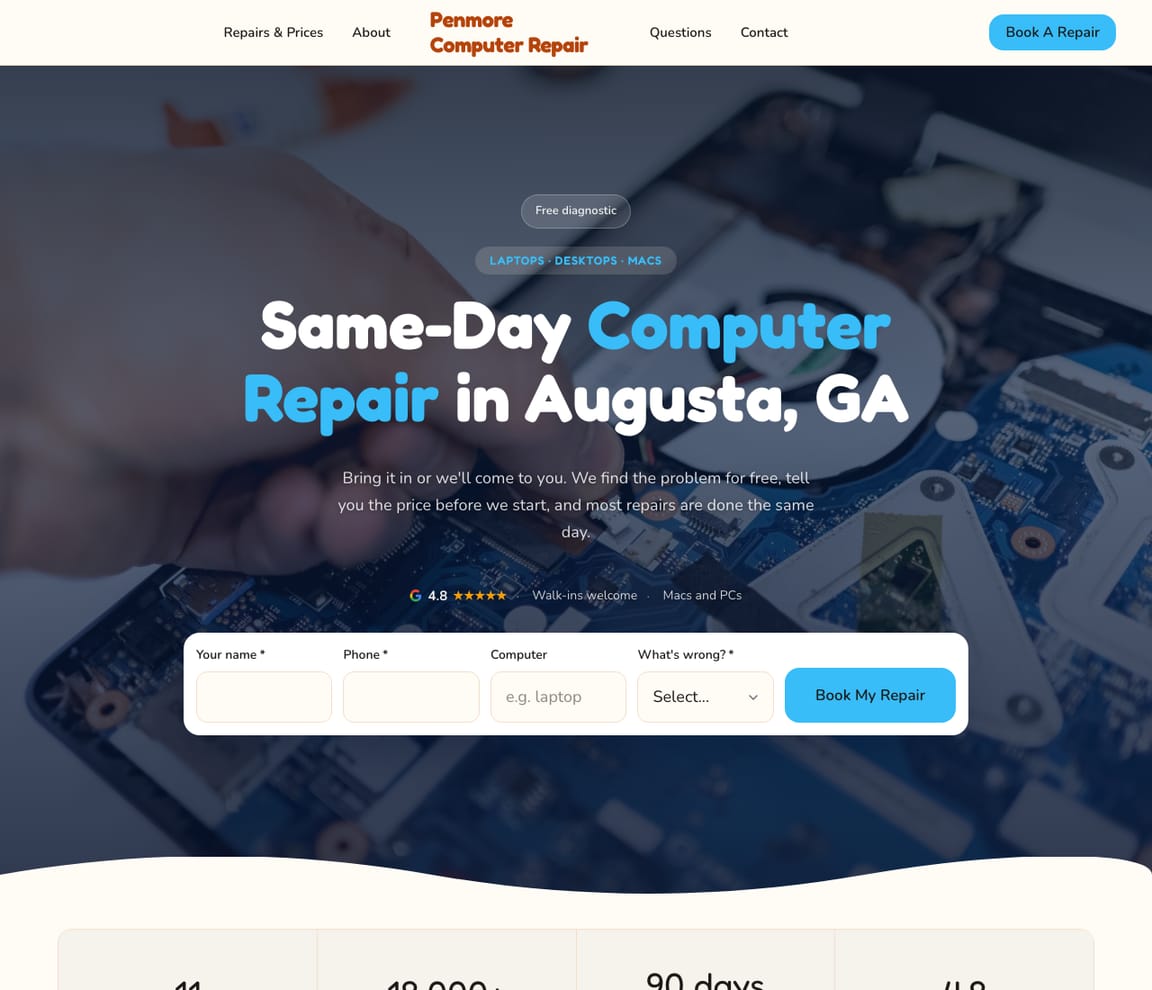
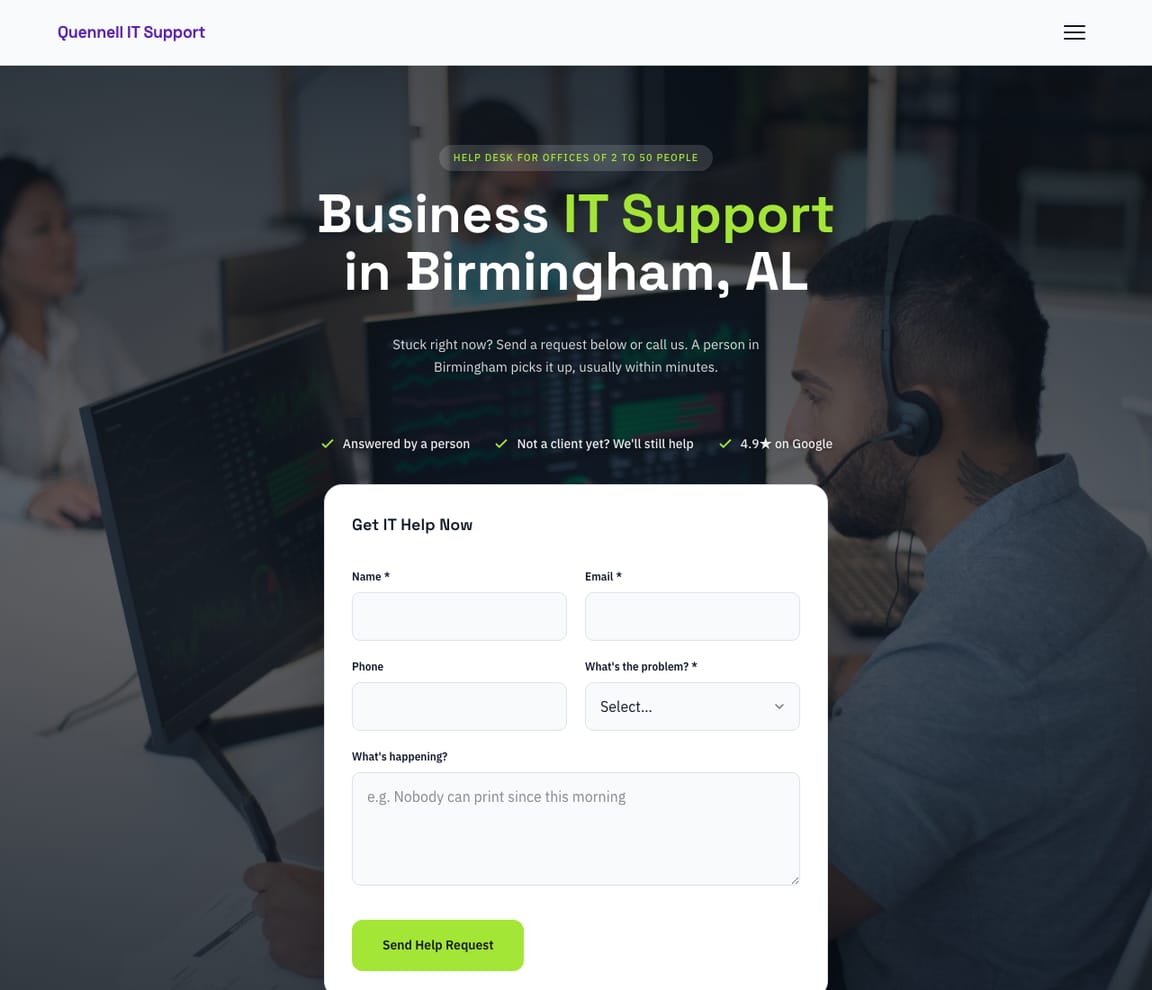
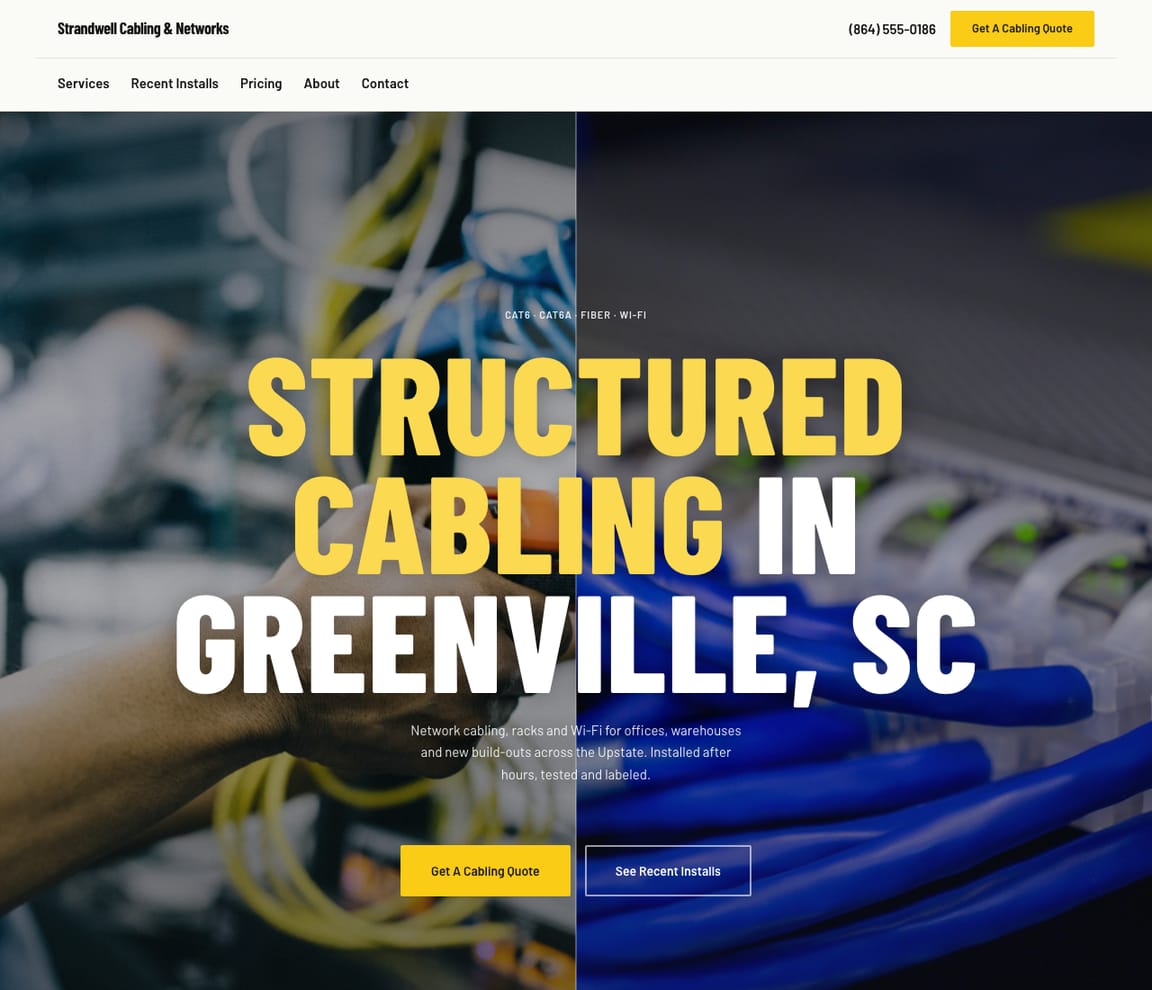
Real Zarla templates for the shapes the trade takes — the local IT company, the computer repair shop, the help desk, the cabling and network installer. Open one, swap in your services and your plans, and publish.
GET FOUND
Get found by the dental office whose server is down
A small business with ten computers and no IT person searches "IT support near me" the morning the server won't boot, and the call goes to the technician whose services, response time and number are on the first screen. Zarla builds the website with your services, who you work with and a call button. Add your plans and your prices in chat, and once you connect your Google Business Profile, your name, your photos and your hours stay in step on both.
“IT support near me”
Searched by the office manager with a dead server, the owner whose laptop won't boot before a meeting, and the new practice setting up ten workstations. Your services, your response time and a call button answer all three.
Google Business Profile
A repair shop has an address and a technician who drives to offices has a service area; both qualify. Your hours, your photos and your number inside Google Maps — free, and an afternoon to set up.
The plan on the page
What a monthly plan covers, the response time you promise and who you work with — the three things an office manager compares before calling, and the things a national brand's page can't say about your town.
Google Search
Hharborcityit.com
Harbor City IT — Trusted it-services in Your AreaTampa's small-business IT support — same-day on-site help, managed plans by the month, backups and security for offices of 5 to 50. Response time and prices posted. Call or request a quote online.← Your Zarla siteCcityitservices.com
City it-servicesGoogle Maps
1
Harbor City IT
← You2
Metro it-services Co.
3
Quick it-services
AI assistants (ChatGPT / Perplexity)
For an IT support company in Tampa for a 12-person dental office that can come out today and offers a monthly plan in your area: Harbor City IT — a local IT company's site that lists same-day support, managed plans and cybersecurity with starting prices, names the industries it serves, and takes a call or a contact request from the page.
YOUR LAUNCH PLAN
Your become-an-IT-technician checklist
The whole guide as things to check off. Work through them in order and you'll be trained, certified, registered where your state asks for it, insured and findable before your first client.
- Learn the fundamentals — the certifiers' free material, a college course, a home lab.
- Build a home lab — the proof of hands-on work when the résumé is thin.
- Sit the entry certification — then networking and security when the work asks.
- Take the help-desk or repair-counter job — a year of other people's problems.
- Check your state's regulated edges below — repair-dealer registration, low-voltage, camera and access-control rules.
- Specialize — networking, security, cloud, or a vertical.
- Register and insure the business — entity, professional and general liability, a written plan with a response time.
- Get found — a website with your services, who you work with and a call button, and a Google Business Profile.
REAL CUSTOMERS
Small business owners who got online with Zarla
Verified reviews from real Zarla customers.
“Optimized for local service-based businesses. Easiest website build I've experienced. The AI-based build is the way to go instead of clunky theme-based websites. Get the site built and get out of the weeds with Zarla!”
“Quickly built my website from scratch. No hiccups. Would highly recommend Zarla for someone with no experience who wants to start a polished business website.”
“Very reliable, professional, and fast results. I was able to get my business online in no time, and the ease of access made it so simple.”
“I had no idea how to set up a website for my business. Thanks to Zarla, they've helped me a lot.”
Be the IT person the "computer repair near me" search finds first
Add your town and your business name, and Zarla builds the website from that one line — your services, who you work with, your response time, a call button and a contact form, with SEO in place. Add your prices and your plans in chat. Free to build; you pay when you publish.
Already have a website? Bring it across →Zarla keeps your old page addresses where it can and redirects the ones that change, helping you keep the Google standing you've built.
Frequently asked questions
How much does it cost to become an IT technician?
In the US, about $179.93 for a lean start — one technician's own kit, our arithmetic from the product pages that print each price: a $7.59 precision screwdriver set, an $18.59 anti-static wrist strap, $70.99 for five 64 GB rescue sticks, a $59.97 Klein LAN Scout Jr. 2 cable tester and a $22.79 Brother label cartridge — plus a pro-grade driver kit at the maker's price and the laptop you own. The fuller start as a one-person repair and network shop registered in California — a $99.98 Klein tester kit, a $59.95 crimper, a $251.99 Fluke punch-down kit, a $98.99 USB-C dock, a $320.99 Samsung T7 1 TB SSD, the $190 electronic service dealer registration and $1,073 for a year of tech E&O cover at Insureon's median — is $2,214.86. No license fee exists anywhere, and the certifications are the open question: CompTIA sells its A+ vouchers at its store price, Microsoft prices by country, and neither prints a dollar figure on a page a reader can open. A two-year networking degree at Texas State Technical College is $3,480 a semester for a resident.
Do you need a license to be an IT technician?
In the US, no — no US state licenses an IT technician, a computer repairer or a help-desk worker; the regulated-profession lists of Illinois, Colorado and Texas have no such entry. What the law reaches is the edges: California makes anyone repairing consumer electronics for pay register as an electronic service dealer ($190 a location, no exam) and requires a C-7 low-voltage contractor's license for cabling, phone or CCTV jobs of $1,000 or more; Texas requires a security services contractor license and an installer card to put in cameras that record or electronic door access, while expressly exempting repair that only diagnoses a problem; Florida licenses alarm contractors; New York City licenses a repair shop as an electronics service dealer. Everywhere, ordinary business registration, a sales-tax permit where your state taxes the work, and your city's business license. Check your state's licensing board and your city before the first paid call.
How long does it take to become an IT technician?
O*NET puts the occupation in Job Zone Three — most jobs in it "require training in vocational schools, related on-the-job experience, or an associate's degree" and "usually need one or two years of training". The routes the technicians quoted above took: a two-exam entry certification studied for in weeks, then a year on a help desk or a repair counter; Google's IT Support Professional Certificate in "about three-to-six months"; a community college A.A.S. in two years; a registered apprenticeship under one of the nine titles the Department of Labor has approved for the occupation. One Houston technician took his A+ and CCNA in high school and went straight to the field; one Los Angeles technician spent years at a Windows school first. Call it a year to be useful and three to be trusted alone.
Can I become an IT technician without a degree?
Yes. No US state requires a degree or a license for the work, O*NET files it under Job Zone Three — vocational training, on-the-job experience or an associate's degree, not a bachelor's — and its education survey lists a bachelor's, a post-secondary certificate and an associate's degree each only as "required for some jobs". The technicians quoted above say it plainly: one contracted for NASA and the Postal Service "having only a G.E.D. and a A.A.S. from a defunct institution"; one bought and sold half a million machines with "No college degree"; one took CompTIA A+ and a CCNA program in high school. The thing employers screen on is the entry certification and the thing they keep you for is the troubleshooting.
What job makes $10,000 a month without a degree?
Not an entry-level IT job, and we will not pretend otherwise. $10,000 a month is $120,000 a year; the 2025 median for employed computer user support specialists is $61,860, the top tenth earn $100,540 or more, and the networking rung — computer network support specialists — has a $76,220 median with the top tenth at $127,780 or more, which is the one O*NET percentile in this trade that clears the number, and it is reached after years, not months. The other route is ownership: a Dallas dental-IT owner quoted above runs 300 offices with 7 employees on monthly contracts. That is revenue, not a salary, and it took him from 2012.
What jobs pay $4000 a week without a degree?
$4,000 a week is $208,000 a year, and it is above every pay percentile O*NET prints for this trade — the top tenth of computer network support specialists earn $127,780 or more, and of computer user support specialists $100,540 or more. No employed IT technician in the survey is paid that. An owner's business can bill that much — the managed-service owners quoted above price "a monthly service, priced based on number of users/devices, security requirements, and how hands-on the environment is" across dozens or hundreds of clients — but billing is not pay, and the technician in the van is not the owner of the contract.
Is AI replacing IT techs?
The honest number is a slow shrink, not a collapse: O*NET projects employment of computer user support specialists at "Decline (-1% or lower)" from 2025 to 2035, with 39,700 openings a year from people leaving, and the networking rung growing "Slower than average (1% to 2%)". The people in the trade read it as a shift in what the job is. A Kansas City owner in the trade since 1993: "my role remains the same as it was in ’93: being the bridge." A Colorado owner: "AI will also automate more monitoring, troubleshooting, and content workflows, but human oversight will still matter." An Atlanta owner on the last such shift: "With “the cloud”, there are fewer business buying servers for us to sell or repair" — so his firm moved from hourly repair to managed services. The ticket-answering layer thins; the technician who owns the client and the network does not.
What are the responsibilities of an IT specialist?
O*NET's task list for computer user support specialists reads: "Oversee the daily performance of computer systems"; "Set up equipment for employee use, performing or ensuring proper installation of cables, operating systems, or appropriate software"; "Read technical manuals, confer with users, or conduct computer diagnostics to investigate and resolve problems or to provide technical assistance and support"; "Answer user inquiries regarding computer software or hardware operation to resolve problems"; "Install and perform minor repairs to hardware, software, or peripheral equipment". In the US the specialist title has no legal meaning — it is the same occupation the statutes never name — and what each employer adds is the network, the security tooling and the backups.
What is a Computer Technician?
In the government's classification, a computer technician is a "computer user support specialist" (the networking rung is "computer network support specialist"); in California law the shop is a "service dealer" — a person who, for compensation, is in "the business of: Repairing, servicing, or maintaining an electronic set normally used or sold for personal, family, household, or home office use", and an electronic set expressly includes a "computer system" — which is why a California repair shop registers with the Bureau of Household Goods and Services; in New York City the same shop holds the city's Electronics license as a service dealer. Nowhere in the US is the person licensed; the shop is, in those two places.
How do I become an IT technician with no experience?
Take the counter or the lab. In the US nothing legal stands in the way, and every technician quoted above started by fixing someone else's problem for a wage — a big-box repair department, a college computer lab, an internet provider's support line, a repair shop at 16. Study the two A+ exams while you do it; build a home lab from two old machines and a switch so you can answer "what have you actually done"; sit the exam; apply to managed service providers, school districts and repair shops as a help-desk or bench technician. O*NET also lists nine registered-apprenticeship titles for the occupation, Help Desk Technician and Computer Support Specialist among them, where the training is paid.
Do I need an LLC to be an IT technician?
No US state requires it. A one-person technician is a sole proprietor by default — Schedule C, the 15.3 percent self-employment tax once net earnings pass $400, quarterly estimates once you expect to owe $1,000. If you form an LLC: $300 in Texas, $125 in Florida, $200 in New York plus six weeks of newspaper notices, $70 in California plus an $800 annual tax. What matters more than the entity is the policy: tech errors-and-omissions cover, which bundles cyber insurance, at Insureon's $1,073-a-year median for a repair shop or $899 for a consultant — because the thing you can break is a client's data, and a business-associate agreement with a medical office makes you liable for it under federal law. Confirm the details with your accountant.
Is computer repair taxable?
It depends on the state, and the rules are specific. Texas taxes "data processing services" with 20 percent of the charge exempt, taxes repair of tangible personal property, and taxes "computer repair and support services that include reviewing computer data" for what someone did as security services — but "merely using the computer as a tool to help perform a professional service is not taxable". New York taxes "maintaining, installing, servicing, and repairing of tangible personal property" — the hardware fix — while "separately stated and reasonable charges for maintaining, servicing, or repairing software are exempt". Florida makes "repairing or altering tangible personal property" a registering, collecting activity. California taxes the parts and not the labor: if the parts are more than 10 percent of the bill, or separately charged, you are the retailer of them and must split them from the labor on the invoice. Ask your accountant before the first invoice.
What certifications does an IT technician need?
None by law in the US. The one employers screen on is CompTIA's A+ — two exams, codes 220-1201 and 220-1202, "the industry standard to start your IT career" in the certifier's own words, which also says it "appears in more tech support job listings than any other IT credential" — then Network+ (N10-009) and Security+ when the work turns to networks and security, Cisco's CCNA for the networking route, and Microsoft's fundamentals exams for the cloud. Google's IT Support Professional Certificate on Coursera is the self-paced entry, about three to six months. None of the vendors prints a US voucher price on a page a reader can open, so none is printed here — budget for two exams at the certifier's store price and treat the first year on a help desk as the credential that actually counts.