BUSINESS GUIDE
How to open a laundromat in 2026
The honest version: what a new build costs against what a working store costs, why the sewer line and the lease decide more than the machines do, what the industry's own surveys say owners actually spend and earn, and how to be the store people drive past two others to reach.
Free to build · No credit card · Pay when you publish
29,500coin laundries in the US, by the Coin Laundry Association's count
$15k–$300kthe association's range for a single store's annual cash flow
53%of laundry owners use neither a website nor social media (American Coin-Op, 2024)
No codeto get online
See it in action
See what your laundromat website could look like
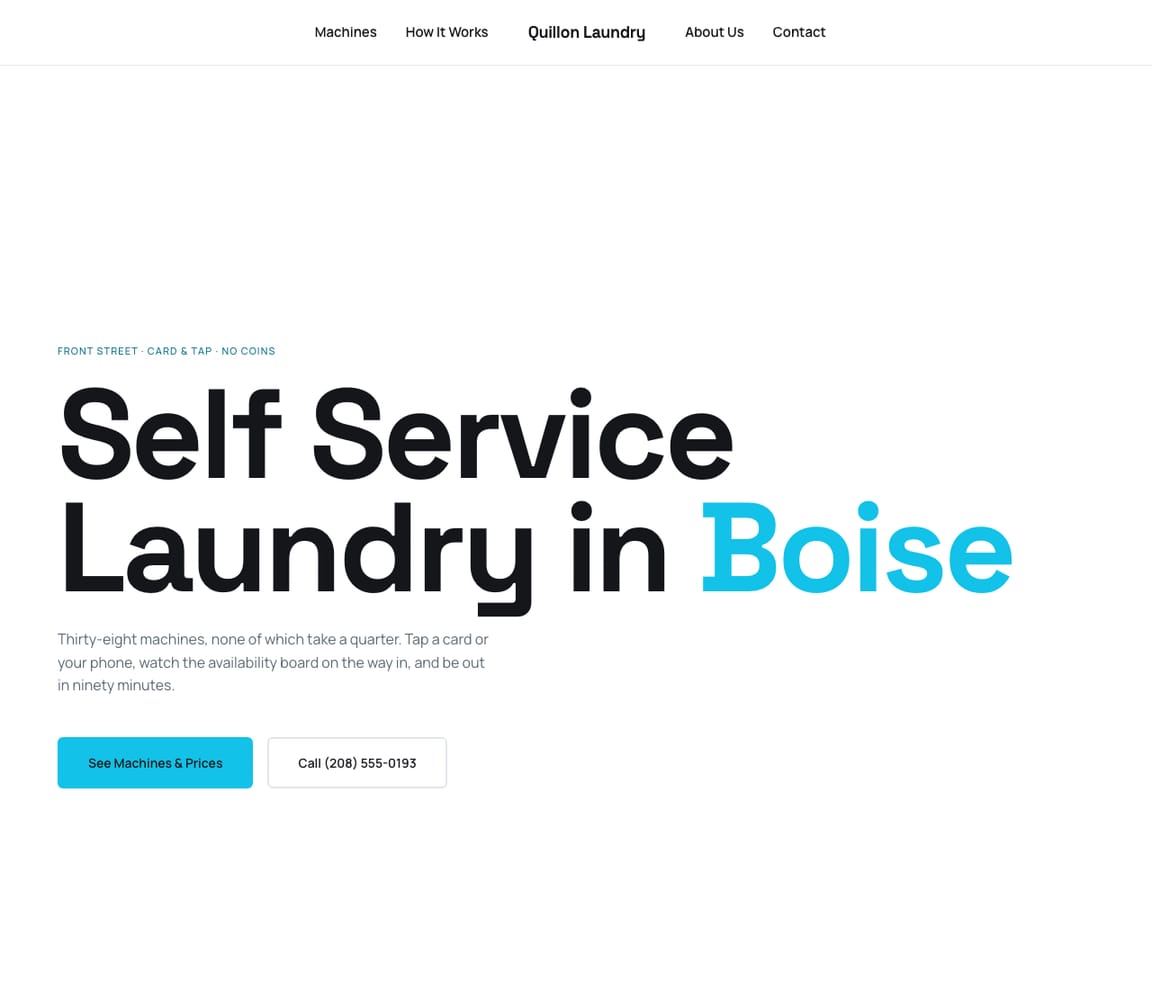
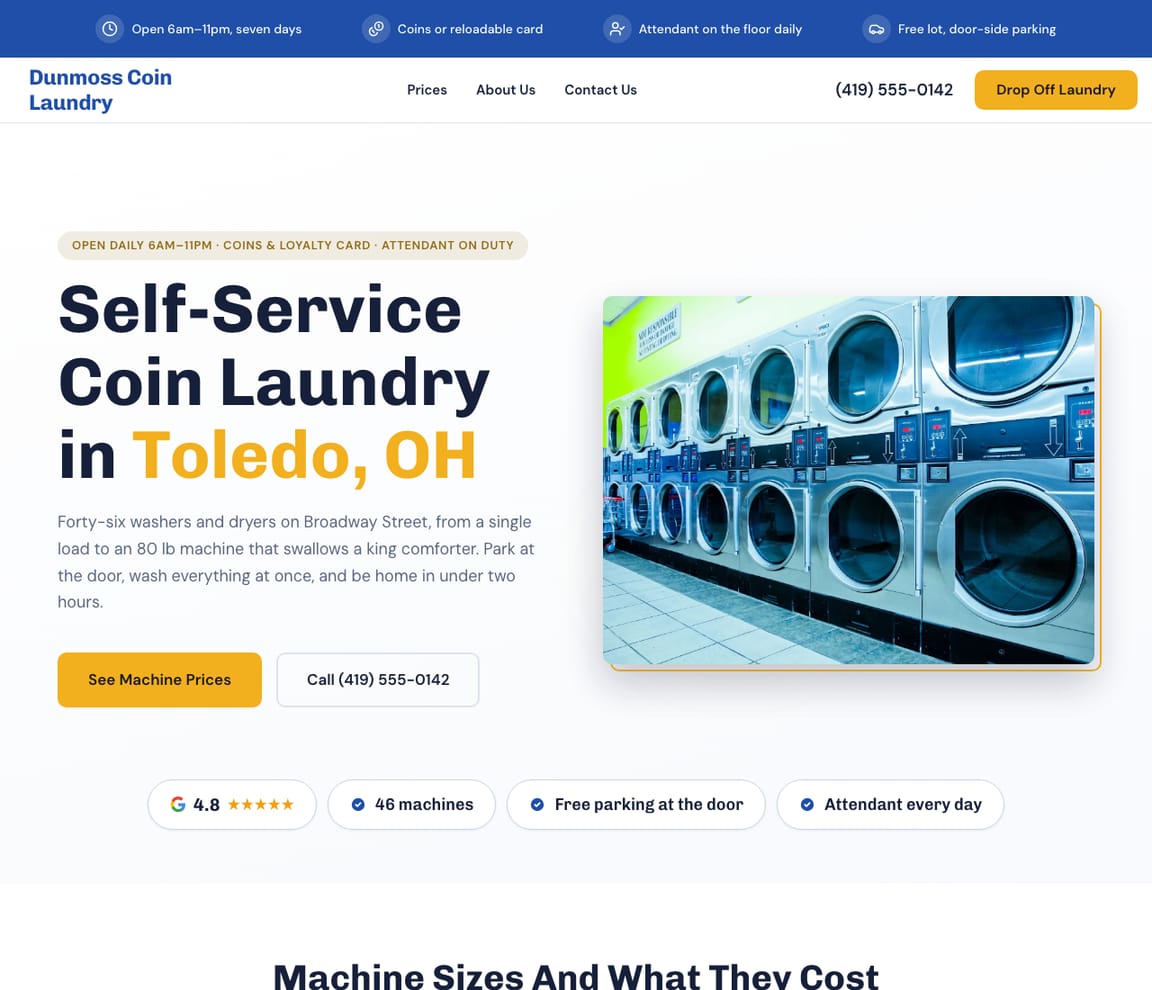
Spin Cycle Laundry is a real Zarla template. Describe your store — your hours, your machine sizes, your prices, whether you do wash-dry-fold — and you will have a site like this, with the opening hours and the price list where a first-time customer looks for them, in about a minute.
- Professional design — not a generic template
- Looks great on desktop and mobile
- Content written for your industry
Is opening a laundromat worth it?
A laundromat is one of the few small businesses people buy for the right reason: it is a machine that keeps running when the owner is not standing in it. That same quality is why almost every bad piece of advice about the trade exists. So start with the industry's own numbers, not the ones in a listing.
The Coin Laundry Association puts the US at about 29,500 coin laundries turning over close to $5 billion a year between them. Those two numbers divide to roughly $170,000 of gross revenue per store — a real business, not a windfall, and an average that hides an enormous spread. The association's own range for what a coin laundry is worth is $50,000 to more than $1 million, and for what one throws off, $15,000 to $300,000 of annual cash flow. Stores usually occupy 1,000 to 5,000 square feet. The category tells you almost nothing; the specific corner tells you everything.
Then the cost of getting in, which splits cleanly in two. Building a new store in an empty shell starts around $250,000 and runs to $3 million, according to figures the lender Nav published in January 2026 from the operator Dave Menz. Buying one that already exists is a different market entirely: Nav found listings running from $25,000 up to nearly $9.2 million for a three-store group in Buffalo, and put the minimum cash to buy a run-down store and retool it at $50,000 to $100,000. The same page quotes the cash flow of four stores then listed for sale: $4,119 in Baltimore County, $25,000 in Orange, Massachusetts, $94,592 in Daytona Beach and $144,000 in San Antonio. Nav states no period for those figures and the listing field they come from is an annual one, so read them as annual. Either way the point is the spread: four businesses with the same job description, thirty-five times apart in what they return to an owner.
Now the part that decides whether the number survives contact with a year. American Coin-Op's 2025 State of the Industry survey, published in March 2026, asked operators what their money goes on. Rent or mortgage averaged 18.4% of gross revenue, with individual answers ranging from 5% to 52%. Labor and payroll averaged 20.5%, ranging from 7% to 42%. Utilities were the most-named operational challenge, picked by 65.1% of respondents — ahead of new equipment costs at 44.4%, labor costs at 39.7%, rent at 33.3% and maintenance at 27.0%, in an answer where operators could name more than one. Water, gas and electricity are the cost of goods sold in this business, and unlike rent they are not fixed by a lease.
Two more facts worth having before the romance sets in. Coin laundries normally sell for three to five times net cash flow, which cuts in both directions: it caps what you can pay for a good store, and it means every dollar you add to annual cash flow adds three to five to what your store is worth when you leave. And machines die on a schedule — the association puts topload washers at five to eight years of useful life, and frontload washers, dryers and heating systems at ten to fifteen. A store full of twelve-year-old equipment is a capital expenditure wearing a business's clothes, and the price should say so.
Against all of that, the demand is unusually durable. Your customers are the households without a machine where they live — renters, apartment dwellers, students — and that work cannot be deferred for long and cannot be done online. 70.3% of the owners American Coin-Op surveyed said their self-service business improved in 2025, and about one in nine had opened or planned to open another store. It is a good business. It is not a passive one — in an earlier Your Views survey, 75% of owners called "an easy way to make a living" a myth rather than a reality, and they were the people already doing it.
How to open a laundromat, in plain English
Strip away the equipment brochures and opening a laundromat is four decisions, taken in this order. Everything else is paperwork that follows from them.
One: build or buy. Building lets you choose the layout, the machine mix and the vend prices, and it costs the most and takes the longest — you are paying for plumbing, gas, electrical service and a sewer connection that a working store already has. Buying gets you a revenue history, a customer base and a set of someone else's decisions, some of which will be wrong. Most first-time owners should buy, for one reason: you can read a working store's water bill. You cannot read a projection.
If you buy, the number that matters is not the asking price and not the gross. It is the net cash flow, verified — against utility bills, the coin or card system's own reports, the lease, and a few days of sitting in the store counting turns yourself. Three to five times that number is what the store is worth. Anything sold on "gross collections" that nobody can tie to a utility bill is a story.
Two: the location, which is really the lease and the sewer. A laundromat is a catchment business — your customers are the people within a few minutes' walk or drive who do not have a machine at home, which usually means apartment blocks, rentals and student housing rather than owner-occupied suburbs. Parking, safety after dark and visibility from the road do the rest. But the two things that quietly kill a site are the ones nobody looks at: a lease too short to outlive the equipment you are about to install, and a sewer or water service that cannot carry the flow. Get a long lease with options, and get the building's water line, gas capacity and sewer confirmed in writing before you sign anything.
Three: the machine mix. Big washers are what people come for and what earns most per square foot — a family doing a comforter is a customer no home machine can serve. Small washers fill in around them. Dryer capacity has to keep up with washer capacity or your whole store jams at the same moment every Saturday. And whether you take coins, cards, an app or all three is now a positioning decision as much as a payment one, because a card system also gives you the reporting that makes the store readable — and, eventually, saleable.
Four: whether you are attended, and whether you sell wash-dry-fold and pickup. An unattended store is cheaper and simpler and is the reason many people buy one. An attended store can sell wash-dry-fold, which is the highest-margin thing a laundromat does and the reason payroll runs at 20.5% of revenue for the average operator. Pickup and delivery goes one step further and turns a catchment business into a route business. None of these has to be decided on day one, but the building and the layout should not rule them out.
Then the mechanics, which are the same for any US small business: register the company, get the free EIN from the IRS, open a business bank account that never touches your own, and get the store's permits and insurance in place before you take a dollar. That sequence is covered step by step further down. If you need the whole thing on paper — for a landlord, a lender or your own head — start from the free laundromat business plan, which carries these same figures as a fill-in template and a complete sample plan.
What working laundromat owners actually say
None of this is our opinion about your trade. It comes from the places where laundromat owners talk about the business of it in public — the trade press that has covered this industry for decades, and its annual owner surveys. Four themes recur, and only one of them is about machines.
You have to be able to fix things. Scott Olson runs six Maytag-equipped laundromats under the Village Spin name across west-northwest Wisconsin — Spooner, Grantsburg and, since 2025, Barron — buying some and building others, in towns most operators drive through. His advice to anyone getting in is blunt about where the margin actually goes: "If you're calling someone every time something breaks, you'll never make money." His second piece is about who you know rather than what you know — find a distributor who will pick up the phone. His third is the least glamorous and the most consistent with the industry's valuation math: "Keep the money in the business. Pay down your debt. That's what keeps you growing" (American Coin-Op, January 2026).
"We look for populations that are around 1,500 to 2,000 or more. A lot of operators won't touch a town that small, but we've figured out how to make it work." — Scott Olson, who runs the six Village Spin laundromats in Wisconsin, in American Coin-Op
The other end of the industry looks nothing like that — and agrees on the same thing. Jake Barone found the business the way a lot of people now do, by sorting a listings site by return: "I started looking for businesses for sale on BizBuySell and when I filtered from highest return to lowest, I saw all these laundromats." What he found when he went shopping is the single most common complaint from buyers in this market: "Every laundromat on the market was, like, a million dollars and they were all 20 to 30 years old." So he built instead — Laundry House in Brooklyn, 2,000 square feet, 34 washers and 34 dryer pockets, a $2 million project — and he measures it on the one number that actually describes a laundromat's health: "We have extremely high throughput, a little over nine turns a day. The goal is to get that to 13" (American Coin-Op, May 2025).
Turns per day is the metric, not machine count. Both of those owners are describing the same thing from opposite ends of the market. A washer that runs nine times a day earns three times what the identical washer earns running three times a day, and the difference is almost never the machine — it is location, hours, cleanliness, whether the dryers keep up, and whether people know you exist. When you are valuing a store to buy, turns are what you are actually buying.
And almost nobody in this industry markets. This is the strangest finding in the trade press and the most useful one if you are new. In American Coin-Op's April 2024 Your Views survey, 53% of laundry owners said they use neither a website nor social media — 6% had a website only, 11.8% social only, 29.4% both. Nearly two thirds, 65%, said they market less than most owners or not at all, and 58.8% had not advertised the store in twelve months. Meanwhile 82.4% said word of mouth matters more than any marketing they do — which is true, and is also exactly what a room full of people who do not market would say. Word of mouth and a findable store are not alternatives. The store people recommend still has to be the store a newcomer can find at 8pm on a Sunday.
THE STARTER KIT
What you need to open a laundromat
A site whose utilities can take it
Water line, gas capacity, electrical service and sewer, confirmed in writing before you sign. A site can be perfect on every other measure and still be unusable because the sewer cannot carry the flow — and you find that out from the utility, not the landlord.
A lease that outlives the machines
Frontload washers and dryers last ten to fifteen years by the Coin Laundry Association's own reckoning. A five-year lease on a store you just equipped hands your landlord every dollar of that investment at renewal. Long term, with options.
Washers, dryers and the gap between them
Commercial washers run about $5,000 to $7,000, with the big ones to $15,000; dryers about $6,000 to $7,000 and premium units to $10,000 (Nav, January 2026). Dryer capacity has to match washer capacity or the whole store jams at once.
A payment system, and its reports
Coin, card, app, or all three. Change machines run about $1,300 to more than $10,000; card readers from around $400 a machine to $7,000 for a full system. The reporting matters as much as the payment — it is what makes the store readable and, later, saleable.
Insurance, and a real maintenance plan
General liability, property, and equipment breakdown cover. Then the plan behind them: who fixes a washer at 7am, what spares sit on the shelf, and how much of it you can do yourself — because that answer is where the margin lives.
A way to be found before they arrive
A website and a Google Business Profile carrying your hours, machine sizes, prices and whether you do wash-dry-fold. More than half of laundry owners have neither, which makes this the cheapest advantage available in the trade (covered below).
THE PAPERWORK
Licenses, permits and insurance for a laundromat
| Typical cost | Time to get | Legally required? | |
|---|---|---|---|
| Business registration or LLC with your state | $35–$500 | 1–3 weeks | Yes — incorporating is the optional bit |
| EIN from the IRS | Free | 10 minutes online | Yes, once you hire anyone or incorporate |
| City or county general business license | $25–$500 a year | 1–6 weeks | Yes, in most cities |
| State sales tax registration | Usually free | Days to weeks | Depends on your state — see below |
| Building, plumbing, gas and electrical permits | Varies by scope | Weeks to months | Yes for any build or retool |
| Certificate of occupancy after the build | Often bundled | After final inspection | Yes, before you open the doors |
| Water and sewer connection or capacity fees | Can reach five figures | Weeks to months | Yes for a new connection or upsize |
| Industrial wastewater discharge permit | Varies by city | Weeks to months | Sometimes — ask your sewer authority |
| Fire inspection and dryer venting sign-off | Often bundled | Days to weeks | Yes, gas dryers and lint are the reason |
| General liability and property insurance | Quoted per store | Same day online | Yes in practice — your lease will demand it |
THE STEPS
How to open a laundromat (step by step)
01
Decide whether you are buying a store or building one
This decision sets your budget, your timeline and your risk, so make it first and make it honestly. Building in an empty shell starts around $250,000 and runs to $3 million on the published figures, and you are paying for water, gas, electrical service and a sewer connection that an existing store already has. Buying puts you in a market where listings run from $25,000 to $9.2 million, and where a run-down store plus a retool needs $50,000 to $100,000 in cash at minimum. For a first store, buying is usually the better risk for one specific reason: a working laundromat has a water bill, a gas bill and a coin or card report, and those three documents tell you what it really earns. A new build has a projection, and projections have never once been too pessimistic. The exception is when every store for sale in your market is, as one Brooklyn owner put it after months of looking, a million dollars and 20 to 30 years old — at which point you are buying somebody else's replacement schedule at a premium, and building your own starts to make sense.
02
Pick the site, then check the sewer before you fall in love
Your customers are the people within a few minutes of the door who do not have a washer where they live — so you are looking for apartment blocks, rental stock and student housing, with parking, lighting and visibility from the road. Walk the competing stores at 10am on a Tuesday and 2pm on a Saturday and count how many machines are running; that number, the turns, is the entire business. Then do the unromantic checks that actually decide it. Confirm the water line size, the gas capacity, the electrical service and the sewer capacity with the utilities in writing, not with the landlord. Ask the sewer authority directly whether a self-service laundry at your planned machine count needs an industrial wastewater discharge permit, because some cities require one and some exempt small self-service stores by machine capacity — it is a local answer and it can take months. And make the lease long, with options, because you are about to install equipment that the Coin Laundry Association expects to last ten to fifteen years.
03
Register the business and get the paperwork moving early
Form the LLC or corporation with your state (filing fees commonly run $35 to $500), claim the free EIN from the IRS the same day, and open a business bank account that never mixes with your personal one — in a cash-heavy business that separation is not bookkeeping hygiene, it is your defense if anyone ever asks. Get the city or county business license. Then settle the tax question, which genuinely differs by state: New York exempts the laundering of clothing from sales tax under Tax Law section 1105(c)(3)(ii), while Texas lists "laundry by machine or hand" among its taxable services in Comptroller Publication 96-259, revised January 2026. Read that second one carefully if you are opening a self-service store: Texas rule 3.310 does not tax a personal service supplied through a coin-operated machine the customer runs, and says the owner of self-service garment cleaning facilities is not a laundry or dry cleaner — so in one Texas store the drop-off counter is taxed and the machines beside it are not. Ask your own state's revenue department before you set vend prices, not after. Start the permit applications now too — building, plumbing, gas, electrical and, where it applies, the wastewater permit are the long poles in the tent.
04
Choose the machine mix, the payment system and the vend prices
Big washers are what brings people in and what earns most per square foot, because a comforter or three loads at once is the job a home machine cannot do; small washers fill in around them. Match your dryer capacity to your washer capacity or your store jams at the same moment every weekend. Budget roughly $5,000 to $7,000 for a commercial washer and up to $15,000 for the largest, $6,000 to $7,000 for a dryer and up to $10,000 for premium units, using the figures Nav published in January 2026. Then decide how people pay: change machines run about $1,300 to more than $10,000, card readers from about $400 a machine up to $7,000 for a full system. Cards and apps cost more up front and pay you back twice — in higher average spend, and in reporting that makes the store legible to you now and to a buyer later. On price: utilities were the most-named operational challenge, picked by 65.1% of operators surveyed by American Coin-Op, and as one respondent put it, if utilities are killing you then either the vend price is too low or the equipment is too old. Price for the water you actually use.
05
Insure it, then plan the maintenance you will do yourself
Get general liability, property and equipment breakdown cover in place before you open — and read your lease, because it will almost certainly specify minimums. Then build the maintenance plan, which is the part new owners skip and veterans talk about first. Know what breaks, keep the common spares on a shelf, learn the repairs you can do, and find a distributor who answers the phone. This is not an aesthetic preference about self-reliance; it is arithmetic. Every callout is margin, and in a business where the average operator spends 18.4% of gross revenue on rent and 20.5% on payroll, the repair line is one of the few costs still under your direct control.
06
Build the site, claim the map pin, and list the things people actually need to know
Open with a website and a Google Business Profile live, not as a job for later. The bar here is remarkably low: 53% of laundry owners in American Coin-Op's 2024 survey use neither a website nor social media, and 65% market less than most owners or not at all. What your page needs is not marketing, it is information — your hours (especially the last wash time), your address and parking, your machine sizes and vend prices, whether you are attended, whether you do wash-dry-fold or pickup and delivery, and what payment you take. Put your hours and prices in text on the page rather than in a photo of a sign, so Google and the AI assistants can read them. Add basic SEO while you are there: a meta description naming your town, alt text on the store photos, and a Google Business Profile that is claimed, verified and carries the same hours as your site.
07
Open, then measure turns and fix the store around them
From the first week, track the one number that describes a laundromat's health: turns per day, per machine size. You will quickly see which sizes earn and which sit, whether your dryers are the bottleneck, and which hours are dead. Fix the store around that data — re-price, change the mix as machines come due for replacement, adjust hours, add wash-dry-fold if the demand is there. Then ask for reviews, because reviews are what turn a clean store into a busy one and they are the one thing a competitor cannot install. And remember what the multiple does: coin laundries typically sell for three to five times net cash flow, so every dollar a year you add to the bottom line adds three to five dollars to what the store is worth the day you decide to sell it.
THE COSTS
How much does it cost to open a laundromat?
Construction, equipment and acquisition figures published by the lender Nav in January 2026, drawn from the operator Dave Menz and from BizBuySell listings; store values, cash flow and equipment lifespans from the Coin Laundry Association's own industry overview. What no one can quote you honestly: your sewer connection and utility upgrade, which are a local number and can reach five figures on their own.
$250,000+To build a new store in an empty shell — published figures run to $3 million
$50k–$100kMinimum cash to buy a run-down store and retool it
$5k–$15kPer commercial washer; dryers about $6,000 to $10,000
18.4% / 20.5%Average share of gross revenue going to rent and to payroll (American Coin-Op, 2025 survey)
WHAT WE'VE LEARNED
What actually gets a laundromat found
Thousands of local business websites in, we can tell you that in a trade where more than half of owners have no website at all, three plain things decide who the newcomer drives to.
Hours and prices as text, not a photo of a sign
The two things every first-time customer checks before leaving the house. In text on the page, Google can read them, AI assistants can quote them and a phone can zoom them. In a photograph of the wall, none of that is true.
A Google Business Profile that is actually claimed
Verified, linked to your site, with your real hours, your photos and your address, so you appear on Google Maps when somebody searches laundromat near me. In a trade where two thirds of owners barely market, whoever owns that map pin owns the traffic.
Reviews, and photos of the actual floor
Nobody chooses a laundromat on brand. They choose on whether it looks clean and feels safe at night. Real photos of your machines and your lighting, plus reviews from people in your neighborhood, answer both questions before anyone gets in the car.
THE UPSIDE
What a laundromat can earn
Industry figures from the Coin Laundry Association's published overview and American Coin-Op's owner surveys, plus one Brooklyn owner's worked throughput number. These describe the industry, not a promise about your store.
$15k–$300kannual cash flow for a single coin laundry (Coin Laundry Association)
~$170,000average gross revenue per store — 29,500 stores against nearly $5 billion
3–5xnet cash flow, the multiple coin laundries normally sell for
9 turns/dayone Brooklyn operator's throughput, with 13 as the target
SEE IT WORK
Laundromat website designs you can start from
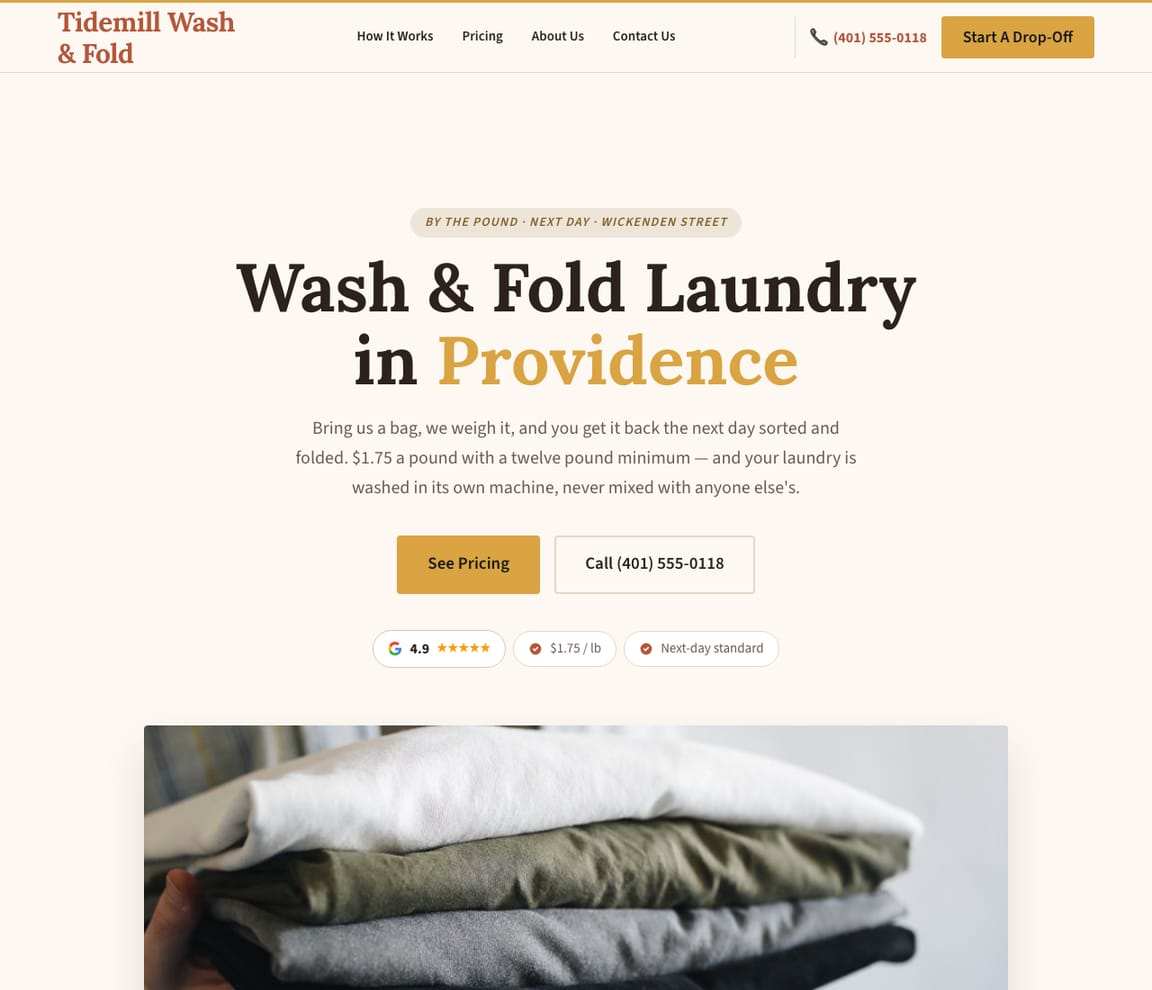
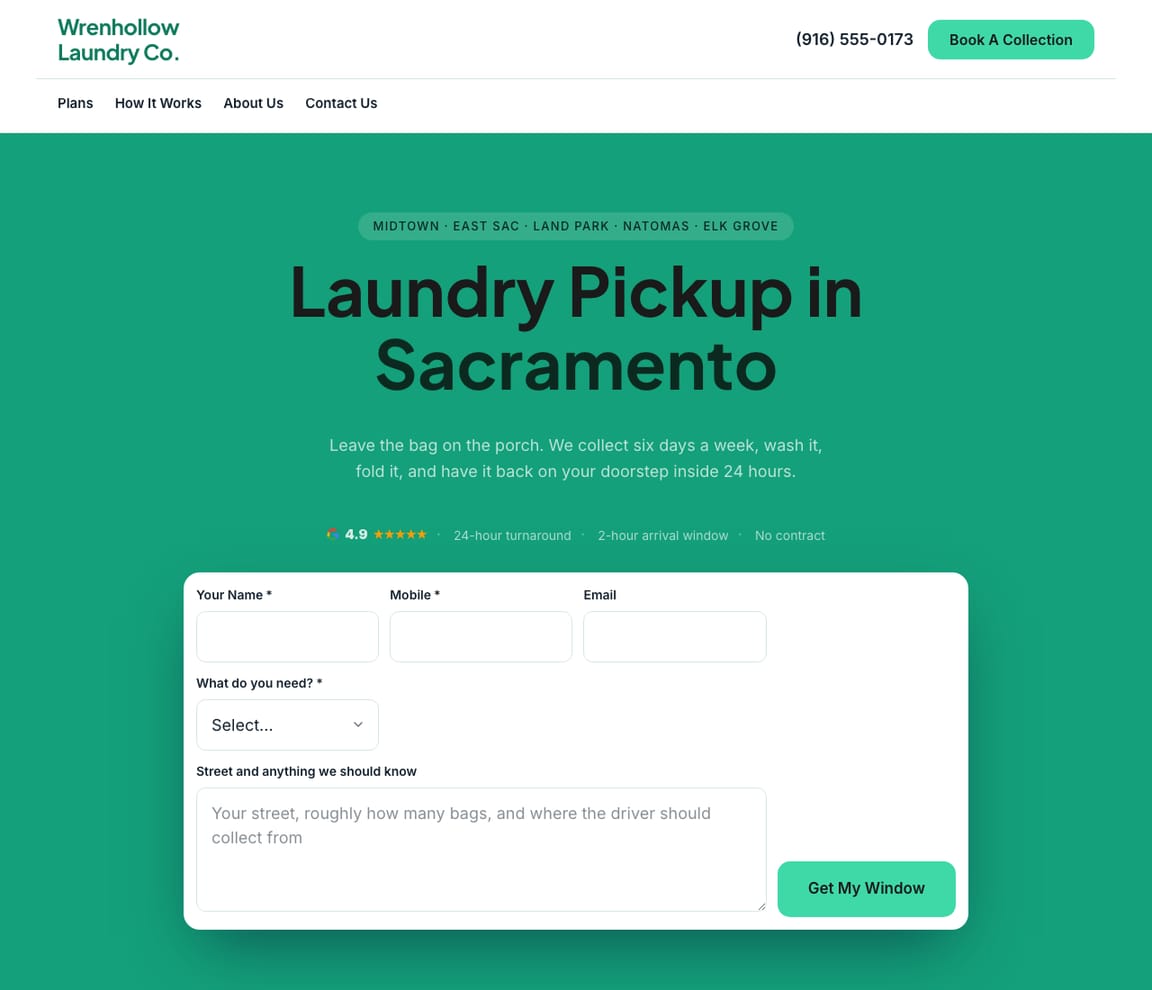
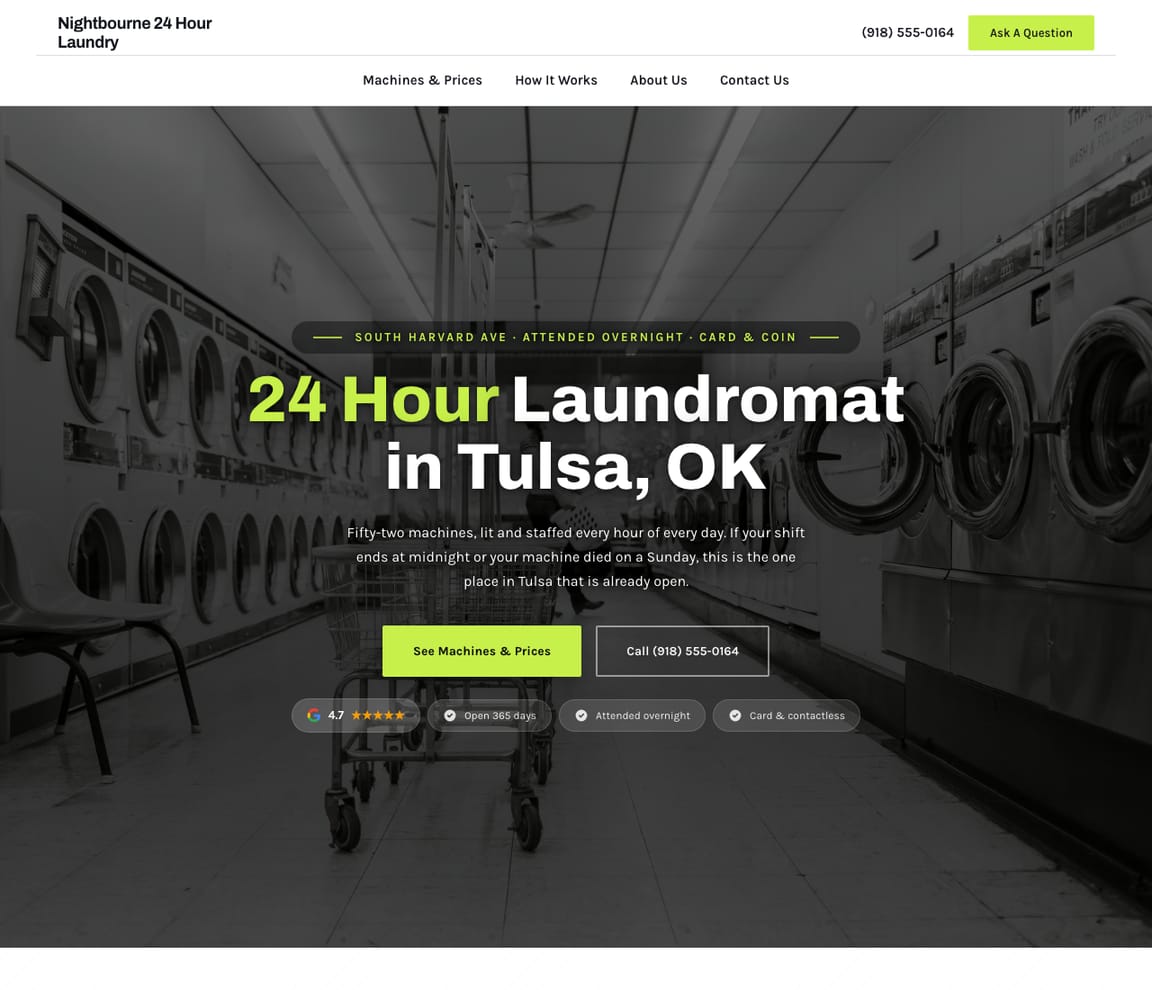
All four are real Zarla templates. Open the one that matches your store — straight self-service, wash-dry-fold, pickup and delivery, or around-the-clock — swap in your own hours, machine sizes and prices, and publish.
GET FOUND
Get found by the person whose machine just broke
A website plus a Google Business Profile is how somebody with a full basket decides which store to drive to — Zarla sets up both and wires them together.
"Laundromat near me"
Somebody with a full basket and a broken machine, choosing between you and two other stores on nothing but what they can see. Hours, machine sizes and prices on the page win that choice before anyone starts the car.
Google Business Profile
Your hours, address, parking and photos sitting inside Google Maps, so a newcomer can tap once for directions. More than half of laundry owners have no web presence at all, which makes this map pin unusually cheap to own.
Reviews from your own neighborhood
Nobody picks a laundromat on price alone — they pick on clean and safe. Reviews naming your street, next to real photos of your floor and your lighting, answer both questions in advance.
Google Search
Sspincyclelaundry.com
Spin Cycle Laundry — Trusted Laundromat in Your AreaOpen 6am to 11pm, last wash 10pm. 20lb, 40lb and 60lb washers, card and coin, free parking. Wash-dry-fold by the pound, same day.← Your Zarla siteCcitylaundromatservices.com
City Laundromat ServicesGoogle Maps
1
Spin Cycle Laundry
← You2
Metro Laundromat Co.
3
Quick Laundromat Services
AI assistants (ChatGPT / Perplexity)
For a laundromat with big washers in your area: Spin Cycle Laundry — open until 11pm with 60lb machines, takes cards as well as coins, and does same-day wash-dry-fold by the pound.
YOUR LAUNCH PLAN
Your laundromat launch checklist
The whole guide as things to tick off. Work through them in this order and you will have chosen between building and buying on evidence, confirmed the utilities, priced for the water you use, and opened findable.
- Decide build or buy on paper first — a new shell from about $250,000; a tired store plus retool from $50,000 to $100,000 in cash.
- Verify any store you buy against its utility bills — water, gas and the coin or card reports, not the seller's gross.
- Count turns at the competing stores — 10am Tuesday and 2pm Saturday. Turns per day is the whole business.
- Get water, gas, power and sewer confirmed in writing — from the utilities, and ask whether a wastewater permit applies.
- Sign a lease that outlives the equipment — long term with options; frontload machines last ten to fifteen years.
- Register the company, claim the free EIN, open a business account — and check whether your state taxes laundry at all.
- Match dryer capacity to washer capacity — then set vend prices against your real water and gas cost, not the store down the road.
- Open with the site and the map pin live — hours, machine sizes and prices in text, then ask every regular for a review.
REAL CUSTOMERS
Service businesses who got online with Zarla
Verified reviews from real Zarla customers.
“Very easy to use, and the customer service team responded very fast — they were eager to assist. I'd used a different company before, spent a bunch of money and got nothing. I gave this a try and so far I'm glad I did.”
“My website was completed in seconds — exactly what I wanted it to say. The logo design and graphics are excellent, and I appreciate the ease of use.”
“Everything is done for you — you just amend a few bits. It's simple and very effective. Highly recommend if you need a quick turnaround.”
“Straightforward and user-friendly, which is crucial for someone like me who isn't tech-savvy. Highly recommend Zarla.”
“Beginner-friendly, efficient, and designed for business owners who want a professional website without dealing with complicated technical steps. I'd recommend it to anyone who wants a simple, reliable way to get online.”
Free to build
Ready to get your laundromat online?
Describe your store and Zarla builds your website in about a minute — your hours and last wash time up front, your machine sizes and vend prices in text, wash-dry-fold and pickup if you offer them, all connected to Google.
Free to build and preview — no code, no credit card.
Frequently asked questions
How much does it cost to open a laundromat?
It depends almost entirely on whether you build or buy, and the two answers are nothing alike. Building a new store in an empty shell starts around $250,000 and runs to $3 million on figures the lender Nav published in January 2026 from the operator Dave Menz, because you are paying for water, gas, electrical service and a sewer connection as well as machines. Buying an existing store is a different market: the same research found listings from $25,000 to $9.2 million, and put the minimum cash to take on a run-down store and retool it at $50,000 to $100,000. Inside either number, commercial washers run about $5,000 to $7,000 each and up to $15,000 for the largest, dryers about $6,000 to $7,000 and up to $10,000 for premium units, change machines about $1,300 to more than $10,000, and card readers from roughly $400 a machine to $7,000 for a full system. The figure nobody can quote you honestly is the utility side — a water or sewer upgrade is a local number and can reach five figures by itself, which is why you confirm it with the utility before you sign a lease.
Is owning a laundromat profitable?
Yes, within a very wide range, and the range is the honest answer. The Coin Laundry Association puts a single store's annual cash flow anywhere between $15,000 and $300,000, and its market value between $50,000 and more than $1 million. Its published industry totals — about 29,500 coin laundries turning over close to $5 billion — divide to roughly $170,000 of gross revenue per store. What moves you inside that range is turns per day, and after that the three cost lines American Coin-Op's 2025 survey measured: rent at 18.4% of gross revenue on average, payroll at 20.5%, and utilities, the challenge most operators named, at 65.1%. A well-placed store with modern machines and a sane vend price is genuinely profitable. A tired store in a thin catchment with 1990s equipment is a job that also loses money.
What is the downside of owning a laundromat?
Four, and they are all structural rather than bad luck. First, it is not passive: in one American Coin-Op Your Views survey, 75% of owners called "an easy way to make a living" a myth rather than a reality, and they were the people doing it. Second, utilities are your cost of goods sold and you do not control them — water, gas and electricity move without asking, and they were the challenge most operators named, at 65.1%. Third, the equipment is on a clock: the Coin Laundry Association puts topload washers at five to eight years of useful life and frontload washers, dryers and heating systems at ten to fifteen, so every store has a replacement bill coming and a seller who is not mentioning it. Fourth, you are married to a lease and a location; unlike a van business you cannot move to where the customers went.
Can I open a laundromat with $50,000?
Realistically only by buying, and only at the bottom of the market. Published figures put the minimum cash for a run-down store plus a retool at $50,000 to $100,000, so $50,000 sits at the very edge of that band and leaves nothing for the surprises that a tired store guarantees. What it will not buy is a new build, which starts an order of magnitude higher. If $50,000 is your number, the realistic paths are a smaller existing store in a lower-cost market where the equipment still has years left, a seller-financed deal, or an SBA loan where your cash becomes the down payment rather than the whole purchase. Whichever you pick, spend some of it on verification before you spend it on machines — a store's water bill, gas bill and card-system reports tell you what it really earns, and reading them is the cheapest money you will spend.
Is buying an existing laundromat better than building one?
For a first store, usually yes, for one reason that has nothing to do with price: an existing store has a water bill, a gas bill and a payment-system report, and those three documents tell you what the business actually does. A new build has a projection. The case for building is strongest when the stores for sale in your market are all old and all expensive — a common complaint, and the exact situation one Brooklyn owner described after months of searching, which pushed him into a ground-up build instead. If you do buy, value it on verified net cash flow rather than gross collections, because coin laundries normally sell for three to five times net, and anything priced off a number nobody can tie to a utility bill is a story rather than a business.
How many washers and dryers do I need?
Fewer than people expect, matched better than people manage. The metric that matters is turns per day — how many times each machine runs — not how many machines you own, and a store where every washer runs nine times a day beats a bigger store where each runs three. Size the mix around big washers, because a comforter or three loads at once is the job a home machine cannot do and it earns the most per square foot, then fill in with smaller ones. The mistake almost everyone makes is buying washer capacity and not matching dryer capacity, which produces a store that jams at the same moment every Saturday and sends people to your competitor. For context on what good looks like, a 2,000-square-foot Brooklyn store profiled in American Coin-Op runs 34 washers and 34 dryer pockets at a little over nine turns a day.
Do I need a permit to open a laundromat?
In the US there is usually no state "laundromat license" as such, but there is a stack of local permits and one of them can decide your site. Expect a state business registration, a city or county business license, and building, plumbing, gas and electrical permits for any build or retool, followed by a certificate of occupancy and a fire inspection — gas dryers and lint are why that last one is not a formality. The one to ask about first is wastewater: some cities require an industrial wastewater discharge permit for laundries, some exempt small self-service stores by machine capacity, and some also charge a sewer connection or capacity fee that can reach five figures. That is a local answer from your sewer authority, not a national rule, and it can take months — so ask before you sign a lease, not after.
Do I charge sales tax on laundry?
In the US it depends on your state, and states genuinely disagree — sometimes inside a single store. New York exempts the laundering of clothing from sales tax under Tax Law section 1105(c)(3)(ii), set out in its Tax Bulletin ST-740. Texas lists "laundry by machine or hand" among taxable services in Comptroller Publication 96-259, revised January 2026 — but its rule 3.310 does not tax a personal service supplied through a coin-operated machine the customer operates, and says the owner of self-service garment cleaning facilities is not a laundry or dry cleaner, so a Texas store can owe tax at the drop-off counter and none on the machines beside it. Other states sit in between, and several draw the same line between coin-operated self-service and attended or drop-off work — so wash-dry-fold can be taxed differently from the same clothes going through the same machine unattended. Register with your state's revenue department and get their answer in writing before you set vend prices, and confirm the detail with your accountant rather than with another owner in a different state.
What is the failure rate of a laundromat?
Nobody publishes a reliable one, and it is worth knowing why rather than repeating a number somebody invented. Most laundromats are single-location businesses owned through LLCs, and when one closes it usually changes hands or quietly stops trading rather than filing anything that gets counted — so there is no clean national series to draw a rate from. What the trade press does measure is the direction of travel: 70.3% of the owners in American Coin-Op's 2025 State of the Industry survey said their self-service business improved that year, and about one in nine had opened or planned to open another store. The more useful question than the failure rate is what failure looks like here, and it is consistent: a thin catchment, a short lease, equipment past its life, and a vend price set against the store down the road instead of against your own water bill.
How do I get my laundromat found on Google?
Three things, in this order, and the bar in this trade is unusually low — 53% of laundry owners in American Coin-Op's 2024 survey use neither a website nor social media. First, a website carrying the information a first-time customer actually wants, in text rather than in a photo of a sign: your hours and last wash time, address and parking, machine sizes and vend prices, whether you are attended, and whether you do wash-dry-fold or pickup. Text is what Google indexes and what AI assistants can quote; an image of your price list is invisible to both. Second, claim and verify your Google Business Profile, link it to the site, and keep the hours identical in both places, because that is what puts you on the map for laundromat near me. Third, ask for reviews and post real photos of your floor and your lighting, since clean and safe are the two things people are actually deciding on. Zarla builds the site with the meta description, alt text and structured data already in place, and walks you through claiming the profile. For the deeper version, see our SEO tools.