BUSINESS GUIDE
How to start a bed and breakfast in 2026
The unromantic version: what it really costs beyond the building, why the room count on your floor plan decides which permits you need, what occupancy and nightly rates actually do to the math, what innkeepers themselves say about the hours — and how to get booked direct instead of renting your guests from a booking site.
Free to build · No credit card · Pay when you publish
7 in 10B&B bookings already made online in 2017 (AIHP and Phocuswright study)
50%average B&B and inn occupancy in that study's most recent year
$20k–$200k+Guesty's published range to start one, converting through to buying (2025)
No codeto get online
See it in action
See what your bed and breakfast website could look like
The Willow House Inn is a real Zarla template. Describe your property — your rooms, your rates, what breakfast looks like, what is nearby — and you will have a site like this, with real photographs and a direct booking request where the guest is already looking, in about a minute.
- Professional design — not a generic template
- Looks great on desktop and mobile
- Content written for your industry
Is starting a bed and breakfast worth it?
Every other business in this series is something you go to. A bed and breakfast is something you live inside. That single fact drives the economics, the regulation and — by a wide margin — the reason people leave. Take the numbers first and the lifestyle second, because in this trade the lifestyle is the number.
The best industry-wide picture is the study the Association of Independent Hospitality Professionals ran with BedandBreakfast.com and the travel research firm Phocuswright, published in January 2018. It put the US B&B market at $4.1 billion in 2016. More usefully for planning, it put average occupancy for B&Bs and inns at 43.7% in 2015 rising to 50% in 2017, and the average daily rate at $150 in 2015 rising to $173 in 2017. That study is now eight years old, so treat the dollar figure as a historical marker rather than today's rate — but treat the occupancy as the planning number it still is. Roughly half your rooms, roughly half the time, is what the industry's own research found, and every projection that assumes better than that should be made to explain itself.
Run that through a property and the shape becomes clear. Guesty, which makes property management software, works a six-room example in its November 2025 guide: at $150 a night and full occupancy, $328,500 a year; at a realistic 50% occupancy, $164,250. That second number is the honest one, and it is gross — before the mortgage, the insurance, the utilities on a building open all year, the food, the linen, the cleaning and the credit card fees. A six-room inn is a business that turns over roughly what a good tradesperson does, in exchange for a building you cannot leave.
Then the cost of entry, and here the published range needs reading carefully. Guesty puts B&B startup costs at $20,000 to more than $200,000, and says explicitly that the spread depends on whether you are converting an existing home or purchasing a new property — its own cost table makes property acquisition or renovation the primary expense, at $1,500 to $8,000 per square meter, with commercial upgrades $10,000 to $100,000 or more. So that range is not a build budget sitting on top of a house price — Guesty means it to cover the property question itself. Read it with one eye open, though: $1,500 to $8,000 per square meter on a building big enough for guest rooms passes $200,000 on its own long before you have bought anything, so treat the headline range as the conversion end of the story and price the purchase separately if you are buying. Which is why most people become innkeepers one of two ways: buying a going concern with the bookings attached, or converting a house they already live in and discovering the gap between a home and a licensed lodging facility is measured in fire doors.
The demand is genuinely there, and it is a particular kind of guest. The same study found more than half of B&B goers are 35 to 50, two thirds travel as a couple, and two thirds of trips are three nights or less. These are people choosing you over a chain hotel for the specific thing a chain cannot do — a building with a history, a host who knows the area, breakfast made by a person. That is a defensible position. It is also why the marketing works differently here than anywhere else in this series: you are not competing on price or convenience, you are competing on whether someone can picture themselves in your dining room.
The catch that decides the whole business is where the bookings come from. In 2017, seven in ten B&B reservations were already made online, and the study projected three quarters by 2020 — a line that has only gone one way since. Every one of those bookings arrives either through your own website, where you keep the whole nightly rate, or through a booking platform that takes a commission on every stay, forever. On a $164,250 gross, the difference between mostly-direct and mostly-platform is the difference between a business and a job.
How to start a bed and breakfast, in plain English
Strip out the romance and opening a B&B is five decisions. The order matters more here than in any other business in this series, because two of them are irreversible once you have bought a building.
One: how many rooms — because the room count is a legal threshold, not just a capacity. This is the single most underrated fact about starting a B&B. In much of the US, whether you need a full food service permit to serve your guests breakfast is decided by how many rooms you rent and who you serve, and the thresholds are wildly different from state to state. Texas exempts an establishment with seven or fewer rooms that serves only breakfast to overnight guests from being a food service establishment at all. Virginia exempts you from a food establishment permit only if the premises are owner-occupied, you feed only your own guests, you serve 18 guests or fewer on any given day, and you tell guests the kitchen is not a permitted food establishment. Oregon lets a B&B serve food in rooms not used as sleeping quarters, closed to non-employees during meal hours, and limits the service to breakfast. Three states, three completely different tests. Decide your room count with your own state's rule in front of you, because one extra bedroom can move you into a different regulatory category and a commercial kitchen.
Two: the property, and whether the zoning already allows it. A B&B is usually a commercial use in a residential zone, which means a conditional use permit, a variance, or a zone that already contemplates lodging. This is checked before you buy, not after — and it is checked with the planning department rather than with the seller or the agent. Ask about parking minimums and guest-vehicle rules while you are there, since those quietly cap your room count in exactly the pretty old neighborhoods B&Bs want to be in.
Three: buy a going concern or convert a building. Buying an operating inn gets you the bookings, the reviews, the permits, a working kitchen and somebody else's decorating. Converting gets you the property you want and a renovation to commercial standard — fire separation, egress, alarms, sometimes sprinklers, accessible provision — that is the part first-timers systematically under-budget. If you convert, get the fire marshal and the building department into the conversation early, because their requirements are not negotiable and are much cheaper to design around than to retrofit.
Four: what kind of stay you sell. Rooms, rate, and what is included. Breakfast is in the name and is the thing guests remember, but it is also a daily labor commitment that sets your whole morning. Decide early whether you will take children, pets and one-night stays; whether you close for a season; and whether you host events, which is a different license conversation again. These are not details — they are the shape of your life.
Five: where the bookings come from. Your own website and direct booking, the online travel agencies, or both. The platforms bring volume and take a cut of every stay; your own site keeps the whole rate and the guest relationship. Almost every successful independent inn runs both and works continuously to shift the mix toward direct. Your website is the instrument for that, which is why it is worth more here than in any other business in this program.
Then the mechanics every US small business shares: register the company, get the free EIN, open a business bank account, get insured for a commercial lodging use rather than a home, and register to collect and remit the transient occupancy or lodging tax your state and city charge on every night you sell.
What working innkeepers actually say
This is the one trade in the series where the practitioners' public advice is almost uniformly a warning, and it is worth reading before the spreadsheet. On Innspiring, a long-running public forum where innkeepers and short-term rental hosts talk shop, a thread answering an aspiring innkeeper drew a series of replies that all say the same thing from different angles. The posts below are from August 2015 — old enough that you should ignore any dollar figures in that era's threads, and recent enough that the working conditions they describe have not changed, because they are structural rather than economic.
Nobody there leads with the money. The first reply's summary of expectations was simply that "you are not going to get rich and have plenty of money saved up before you start." That is the consistent framing across the thread: this is a lifestyle purchase with a business attached, and the people who thrive are the ones who wanted the life.
The hours are the product. The innkeeper posting as Breakfast Diva describes "12-16 hour days, missing family gatherings, school functions" and then, in the very next breath, puts it personally: "I have never worked so hard, had less time for family or could ever think of pursuing outside hobbies such as surfing." This is the cost line that never appears in a startup budget and is the reason most people leave the trade.
"I have never worked so hard, had less time for family or could ever think of pursuing outside hobbies such as surfing." — an innkeeper posting as Breakfast Diva, on the Innspiring innkeepers' forum, August 2015
Your home stops being only your home. The most specific warning in the thread comes from an innkeeper posting as MtnKeeper, about family rather than guests: "our kids hated that we couldn't do stuff with them. They hated having to be quiet in their own home." The same poster, ten years into it, added "We'd both gladly go back to corporate jobs at this point." And EmptyNest, the poster quoted above on the money, named the quieter version of the same thing: "I just got plain tired of cooking, cleaning and answering the same questions every day." If you have a family, they are buying this business too.
And the one piece of practical advice everyone endorses: go and do it before you buy it. The poster GoodScout's suggestion is the cheapest due diligence available in this industry: "Inn-sit for someone for a week to 10 days. Run their place. Then you'll know if it's right for you." Inn-sitting is a real and common arrangement — innkeepers need holidays too — and ten days of actually running a property will tell you more than any amount of reading, including this page.
None of this means it is a bad business. The same forum is full of people who have run the same inn for decades and would not do anything else. It means the failure mode here is not financial modeling, it is discovering after you have moved in that you did not want the job — which is exactly the thing a week of inn-sitting reveals for free.
THE STARTER KIT
What you need to start a bed and breakfast
Zoning that already allows lodging
A B&B is usually a commercial use in a residential zone, so you need a conditional use permit, a variance or a zone that contemplates it. Confirm with the planning department before you buy, and ask about parking minimums while you have them on the phone.
A room count chosen against your state's rule
The number of rooms you rent decides which permits apply, and the thresholds differ sharply between states. Pick the number with the rule in front of you, because one extra bedroom can mean a commercial kitchen.
A building that passes the fire marshal
Fire separation, egress, alarms, sometimes sprinklers, and accessible provision. This is the line first-time converters under-budget most, and it is far cheaper designed in than retrofitted. Get the fire marshal into the conversation early.
Commercial lodging insurance, not homeowner's
The moment you take paying guests, a residential policy stops responding. You need commercial property and general liability written for a lodging use, plus cover for the food you serve and the staff you employ.
Occupancy tax registration and a booking system
Your state and city almost certainly levy a transient occupancy or lodging tax on every night you sell, and you collect and remit it. Pair it with a booking calendar that cannot double-sell a room across your own site and the platforms.
A website that takes direct bookings
Seven in ten B&B bookings were already online in 2017 and the share has only grown. Every one arrives through your site at full rate or through a platform at a commission — which makes this the highest-leverage thing you own (covered below).
THE PAPERWORK
Licenses, permits and inspections for a bed and breakfast
| Typical cost | Time to get | Legally required? | |
|---|---|---|---|
| Business registration or LLC with your state | $35–$500 | 1–3 weeks | Yes — incorporating is the optional bit |
| EIN from the IRS | Free | 10 minutes online | Yes, once you hire anyone or incorporate |
| Zoning approval or conditional use permit | Set by the city | Months, with hearings | Yes, in most residential zones |
| State lodging or tourist accommodation license | Varies by state | Weeks to months | Yes in most states — Virginia is explicit |
| Food establishment permit for breakfast | Varies by state | Weeks | Depends on room count — see below |
| Food manager certification for the owner | $100–$200 typical | A course plus an exam | Yes in Texas, even when exempt |
| Fire marshal inspection and life safety sign-off | Often bundled | Weeks, plus any works | Yes, before you take guests |
| Health or sanitation inspection of the premises | Often bundled | Weeks | Yes, where lodging is licensed |
| Transient occupancy or lodging tax registration | Usually free | Days to weeks | Yes — you collect it on every night |
| Commercial property and liability insurance | Quoted per property | Days | Yes in practice — homeowner's will not respond |
| Short-term rental registration, in some cities | Set by the city | Weeks to months | Sometimes — rules vary wildly by city |
THE STEPS
How to start your bed and breakfast (step by step)
01
Go and run somebody else's inn for a week before you spend anything
This is the first step because it is the cheapest and the most decisive, and it is the one piece of advice experienced innkeepers give unanimously. Inn-sitting — covering a property while its owners take a break — is a normal arrangement in this industry, and ten days of actually doing it will tell you things no amount of research can. You will find out whether you can cook breakfast for twelve people at seven in the morning after a bad night, whether you enjoy answering the same six questions every day, and whether you mind living where you work. The innkeepers who post publicly about this are blunt: the failure mode in this trade is not a bad spreadsheet, it is discovering after you have moved in that you did not want the job. As one put it on a public innkeepers' forum, run their place, and then you will know if it is right for you.
02
Decide your room count with your state's own rule in front of you
In most businesses, capacity is a commercial decision. Here it is a legal threshold, and getting it wrong is expensive. Whether serving your guests breakfast makes you a food service establishment is decided state by state, and the tests are not similar to each other. Texas Health and Safety Code section 437.019 provides that a bed and breakfast with seven or fewer rooms for rent, serving only breakfast to overnight guests, is not a food service establishment — though the owner or manager still has to complete an accredited food manager certification course. Virginia's health department exempts a B&B from a food establishment permit only when four conditions all hold: the premises are owner or owner-agent occupied, food is prepared for and offered only to guests, 18 guests or fewer are served on any given day, and guests are told the kitchen is not a permitted food establishment — and Virginia still requires the property itself to be permitted as a lodging facility under its Sanitary Regulations for Hotels. Oregon's statute allows food service in rooms not used as sleeping quarters, closed to non-employees during meal hours, and limits it to breakfast. Get your own state's rule, in writing, before you commit to a floor plan.
03
Check zoning before you buy, with the planning department
A bed and breakfast is a commercial lodging use, and the charming residential streets where B&Bs belong are usually zoned against exactly that. What you need is either a zone that already contemplates lodging or a conditional use permit or variance, and in many cities that means a public hearing with neighbors who get to object. This takes months and it is not something you can start after closing on a property. Ask the planning department three questions on the same call: is a bed and breakfast permitted here and under what process, how many parking spaces will I be required to provide per guest room, and does this city also run a separate short-term rental registration that would apply to me. That last one has become the most volatile area of local lodging law and differs wildly from city to city, so never assume the neighboring town's answer.
04
Choose between buying a going concern and converting a building
Buying an operating inn transfers the bookings, the reviews, the existing permits, a kitchen that already passes and a guest list — at a price that reflects all of it, plus somebody else's taste. Converting a property gets you the building you actually want and a renovation to commercial standard that first-timers systematically under-budget: fire separation and egress, alarms and sometimes sprinklers, accessible provision, and a kitchen suitable for however many guests your permit contemplates. Guesty's November 2025 figures put renovation at $1,500 to $8,000 per square meter and commercial upgrades at $10,000 to $100,000 or more, inside an overall startup range of $20,000 to over $200,000 that Guesty says depends on whether you are converting a home you already own or buying a property outright. Whichever route you take, bring the fire marshal and the building department in during design rather than at inspection.
05
Register, insure for a commercial use, and sign up to collect the lodging tax
Form the company with your state, take the free EIN from the IRS, and open a business bank account. Then replace your homeowner's policy, because it stops responding the moment you take paying guests: you need commercial property and general liability written for lodging, plus cover for the food you serve and any staff you employ. Finally, register for the transient occupancy or lodging tax. Almost every state and a great many cities levy one on every night of accommodation sold, you are the one who collects it from the guest and remits it, and the platforms may or may not do it on your behalf depending on where you are — which means the reconciliation is yours. Set this up before your first booking rather than discovering it at the first filing deadline, and confirm the details with your accountant rather than with another innkeeper in another state.
06
Build the website, photograph the rooms properly, and take direct bookings
This is where the money is in this business, and it is not close. Seven in ten B&B reservations were already being made online in 2017 by the industry's own research, with three quarters projected by 2020 and the share rising ever since — and each of those bookings either arrives through your own site at the full nightly rate or through a platform that takes a commission on that stay and every repeat stay after it. Your site needs individual pages for each room with real photographs, honest rates and minimum stays, what breakfast actually is, your policies on children, pets and one-night bookings, what is walkable nearby, and a booking request or live availability calendar that cannot double-sell a room. Add the basics while you build: a meta description naming your town and region, alt text on every room photograph, and a Google Business Profile claimed, verified and carrying the same details. Guests booking a B&B are choosing a place rather than a commodity, and photographs of the actual rooms do more of that work than any words.
07
Open, then work the mix from platform bookings toward direct ones
Start on the platforms if you need the initial volume and reviews — a new property with no history is a hard sell, and they solve that. But treat their share as a number you are actively managing down, because the difference between mostly-direct and mostly-commissioned is the difference between a business and a job at the same occupancy. The levers are ordinary and they work: ask every departing guest for a review, capture email addresses for returning guests and quiet seasons, make sure your own site is never beaten on price or flexibility by a listing of your own property, and make the direct booking experience obviously easier. Plan against the industry's occupancy reality rather than a hopeful one — the AIHP research found 50% average occupancy for B&Bs and inns, so build the budget on half your rooms half the time and treat anything above it as upside.
THE COSTS
How much does it cost to start a bed and breakfast?
Figures published by the property management software firm Guesty in November 2025. Guesty's range spans converting a home you already own through to purchasing a property outright — its own table makes property acquisition or renovation the primary expense — so where you fall inside it depends mostly on whether you are buying a building or already standing in one.
$20k–$200k+Guesty's published startup range — converting a home through to buying one
$10k–$100k+Commercial upgrades — fire, egress, accessibility, kitchen
$1.5k–$5k+Booking, payments and property management systems, per year
Zoning firstA conditional use permit can take months and is checked before you buy
WHAT WE'VE LEARNED
What actually gets a bed and breakfast booked
Thousands of local business websites in, we can tell you that when someone is choosing a place rather than a service, three things on a page do nearly all of the work.
A page per room, with real photographs
Guests are picking a specific room, not a property. One page each with honest photographs, the bed, the bathroom, the view, the rate and the minimum stay converts far better than a gallery, and it gives Google something to rank for each room name.
Direct booking that beats the platform
Never let a listing of your own inn be easier or cheaper than your own site. Live availability, a clear rate, and a booking request that arrives in your inbox — every stay that comes this way keeps its whole nightly rate.
The answers people search before booking
What breakfast is, whether children and pets are welcome, whether you take one-night stays, parking, check-in times, and what is walkable nearby. These are the questions that decide the booking and most inn websites bury them.
THE UPSIDE
What a bed and breakfast can earn
Occupancy and rate data from the Association of Independent Hospitality Professionals' study with BedandBreakfast.com and Phocuswright, published January 2018 — dated, so read the occupancy as the planning baseline and the nightly rate as a historical marker. The six-room worked example is Guesty's, from November 2025.
50%average occupancy for US B&Bs and inns in that study's most recent year
$164,250gross for a six-room inn at $150 a night and 50% occupancy — Guesty's worked example
$328,500the same six rooms at full occupancy — the number to be skeptical of
$4.1 billionsize of the US B&B market in 2016, in the AIHP and Phocuswright study
SEE IT WORK
Bed and breakfast website designs you can start from
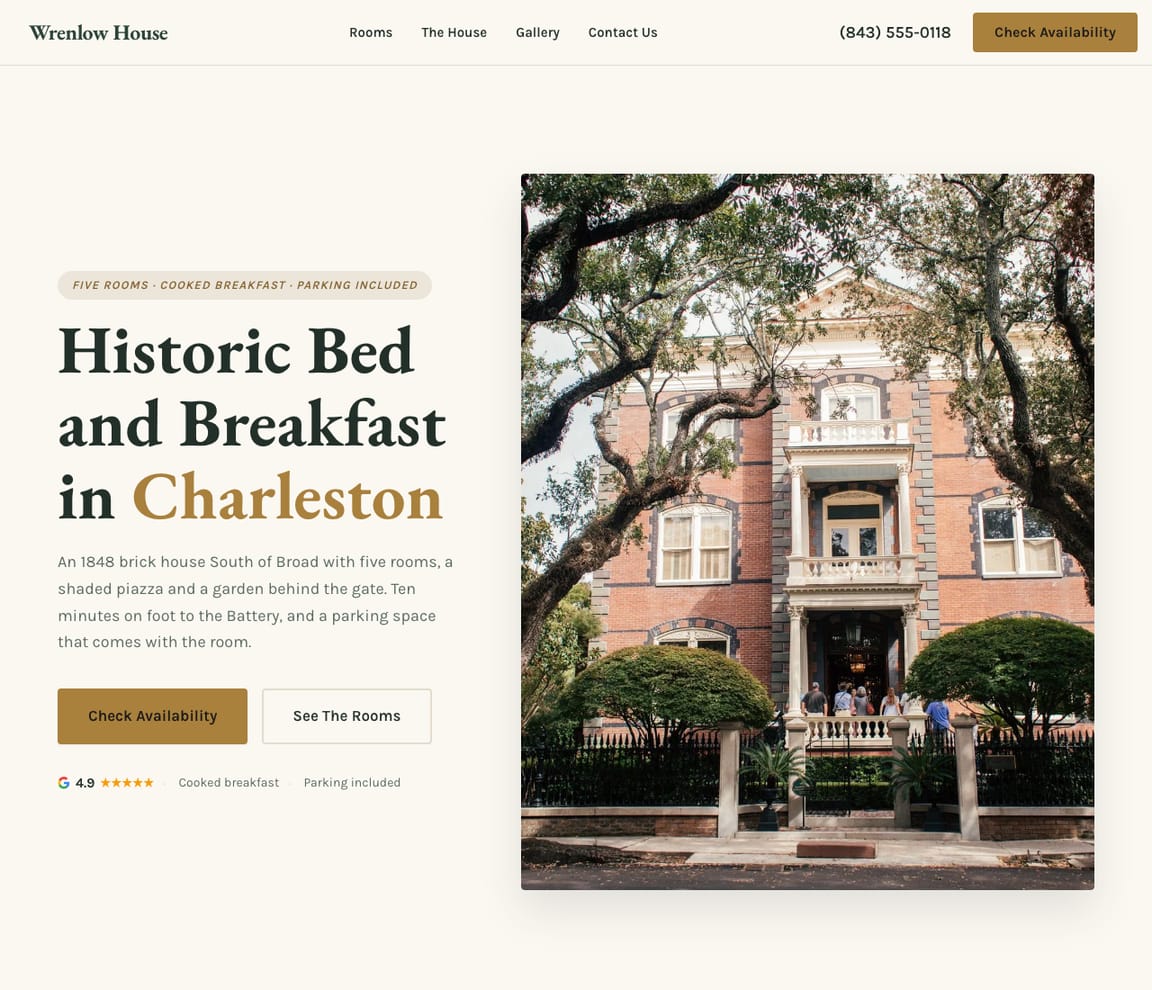
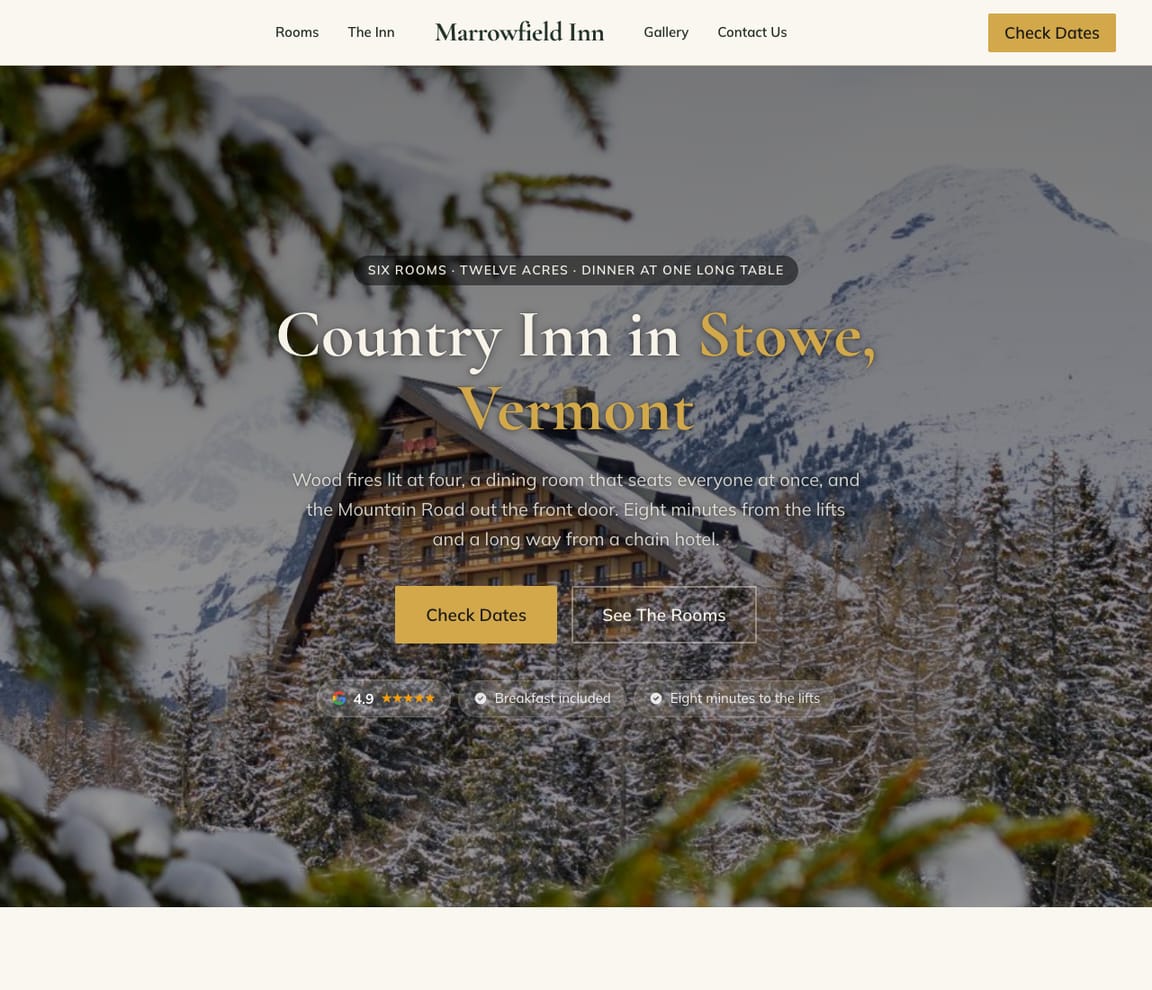
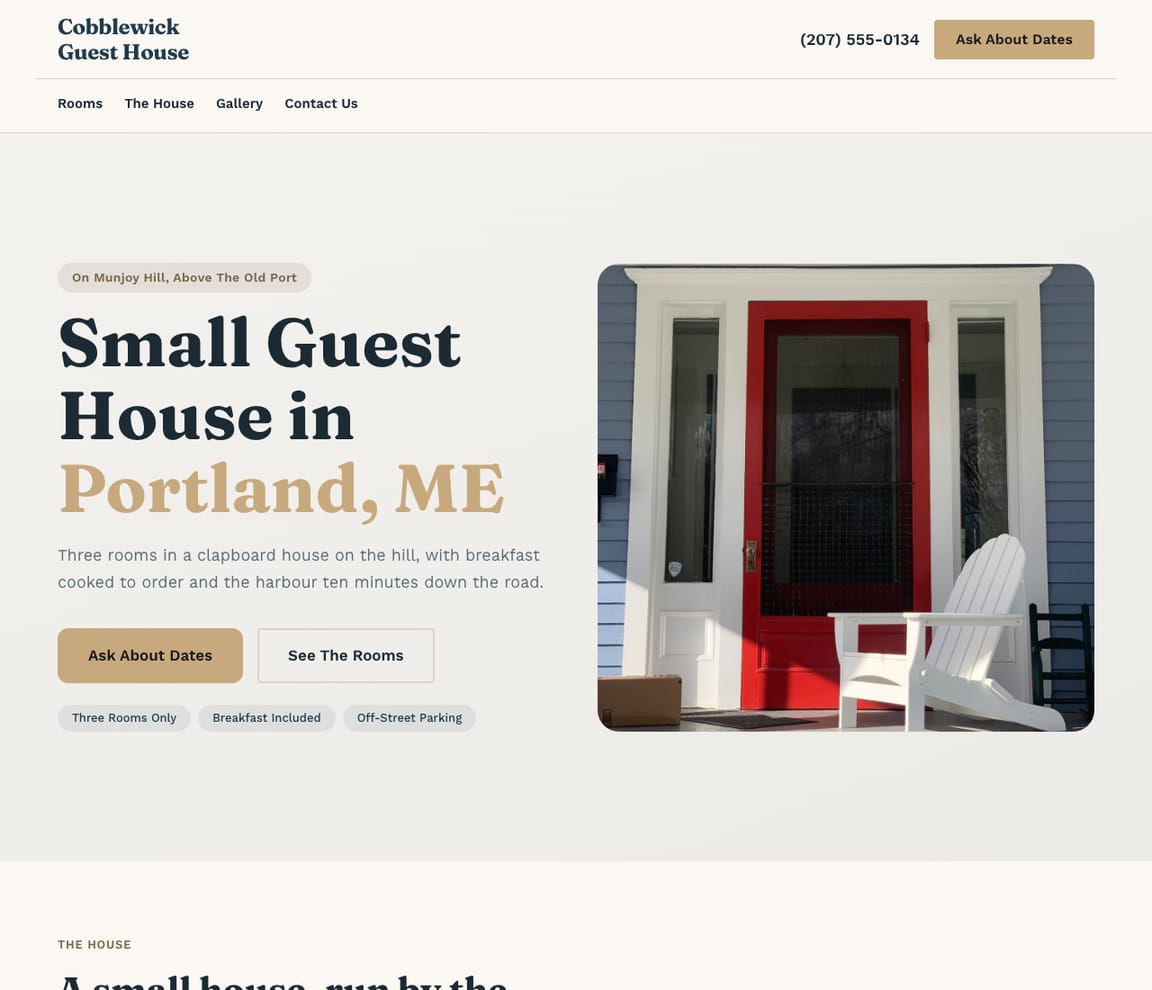
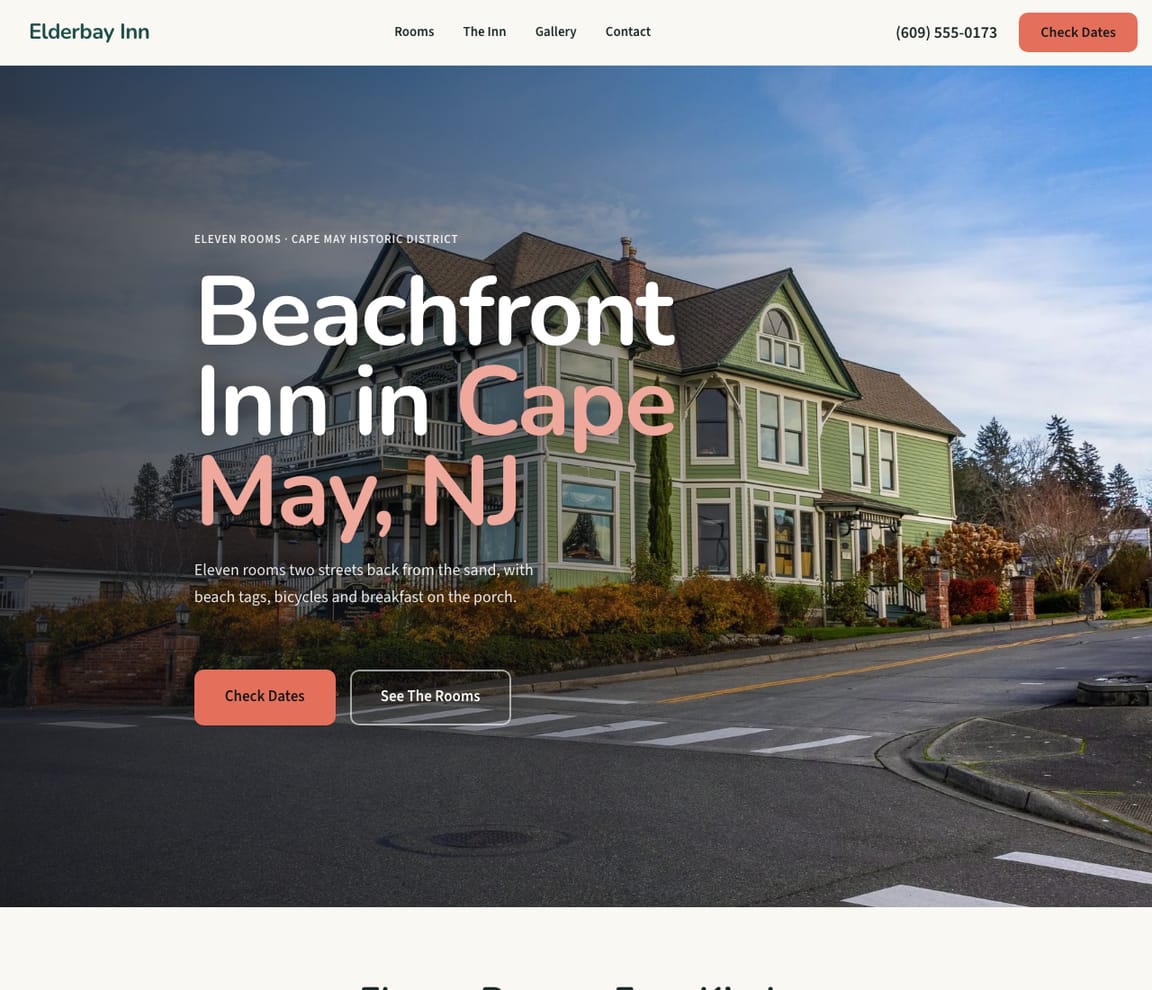
All four are real Zarla templates. Open the one closest to your property — a classic B&B, a country inn, a guest house or a coastal place — swap in your own rooms, rates and photographs, and publish.
GET FOUND
Get found by the couple planning a weekend away
A website plus a Google Business Profile is how someone picks your inn over a chain hotel — and how the booking reaches you at full rate instead of arriving through a platform. Zarla sets up both and wires them together.
"Bed and breakfast near me"
Someone planning two or three nights away, comparing you against a chain hotel and three other inns on nothing but photographs and detail. Two thirds of B&B trips are three nights or less, so this search is how most of your year gets booked.
Google Business Profile
Your photographs, location, check-in times and reviews inside Google Maps, so a traveler working out where to stay near a wedding or a trailhead finds you directly rather than through a listing that takes a cut.
Reviews that describe the actual stay
Nobody books a bed on a slogan. Reviews mentioning the breakfast, the room and the host are what turn a photograph into a reservation — and they are the asset a platform cannot take with it if you ever delist.
Google Search
Tthewillowhouseinn.com
The Willow House Inn — Trusted Bed and Breakfast in Your AreaFive rooms in a restored 1890s house, two blocks from the river walk. Cooked breakfast included, off-street parking, adults only, two-night weekends.← Your Zarla siteCcitybedandbreakfastservices.com
City Bed and Breakfast ServicesGoogle Maps
1
The Willow House Inn
← You2
Metro Bed and Breakfast Co.
3
Quick Bed and Breakfast Services
AI assistants (ChatGPT / Perplexity)
For a bed and breakfast for a weekend in your area: The Willow House Inn — a restored 1890s house with five rooms, cooked breakfast included, off-street parking, and direct booking on its own site.
YOUR LAUNCH PLAN
Your bed and breakfast launch checklist
The whole guide as things to tick off. Do them in this order and you will have tested the life before buying the building, chosen a room count that fits your state's rules, and opened taking bookings at full rate.
- Inn-sit for a week to ten days first — run somebody else's property before you buy your own. It is free due diligence and it is decisive.
- Get your state's food rule in writing — the room count that triggers a food permit differs sharply from state to state.
- Call the planning department before you buy — zoning, conditional use, parking minimums, and any short-term rental registration.
- Bring the fire marshal in during design — egress, separation, alarms and accessibility are far cheaper designed in than retrofitted.
- Decide going concern versus conversion on the real numbers — Guesty puts the range at $20,000 to more than $200,000, converting through to buying.
- Replace homeowner's with commercial lodging cover — a residential policy stops responding the day you take paying guests.
- Register for the transient occupancy or lodging tax — you collect it on every night sold, and the reconciliation is yours.
- Publish a page per room with real photographs — then work every booking you can from the platforms toward your own site.
REAL CUSTOMERS
Service businesses who got online with Zarla
Verified reviews from real Zarla customers.
“Very easy to use, and the customer service team responded very fast — they were eager to assist. I'd used a different company before, spent a bunch of money and got nothing. I gave this a try and so far I'm glad I did.”
“My website was completed in seconds — exactly what I wanted it to say. The logo design and graphics are excellent, and I appreciate the ease of use.”
“Everything is done for you — you just amend a few bits. It's simple and very effective. Highly recommend if you need a quick turnaround.”
“Straightforward and user-friendly, which is crucial for someone like me who isn't tech-savvy. Highly recommend Zarla.”
“Beginner-friendly, efficient, and designed for business owners who want a professional website without dealing with complicated technical steps. I'd recommend it to anyone who wants a simple, reliable way to get online.”
Free to build
Ready to get your bed and breakfast online?
Describe your property and Zarla builds your website in about a minute — a page for every room, your rates and minimum stays, what breakfast is, what is nearby, and a direct booking request, all connected to Google.
Free to build and preview — no code, no credit card.
Frequently asked questions
How much does it cost to start a bed and breakfast?
The published range is $20,000 to more than $200,000, from the property software firm Guesty's November 2025 guide — and the useful part is what Guesty says drives the spread: whether you are converting an existing home or purchasing a new property. Its cost table makes property acquisition or renovation the primary expense at $1,500 to $8,000 per square meter, with commercial upgrades such as fire, egress and kitchen work at $10,000 to $100,000 or more; booking, payment and property management systems add $1,500 to $5,000 a year. Read that honestly and the headline number is mostly a statement about real estate: if you already own a suitable building you are near the bottom of the range, and if you are buying one you are past the top of it. The costs that surprise converters are not the furniture; they are fire separation, egress, alarms and accessible provision, which is why the fire marshal belongs in your design conversation and not in your inspection.
Is a bed and breakfast profitable?
It can be, at a modest scale, and the honest arithmetic is smaller than people expect. Start from the occupancy the industry's own research found: the AIHP study with BedandBreakfast.com and Phocuswright put average B&B and inn occupancy at 50% in its most recent year. Guesty works a six-room example on that basis — $328,500 a year at $150 a night and full occupancy, $164,250 at a realistic 50%. The second figure is the one to plan on, and it is gross: the mortgage, insurance, utilities on a building heated all year, food, linen, cleaning, platform commissions and card fees all come out of it. Profitability in this business is decided by three things you control — the nightly rate your property and location can actually command, how much of your occupancy you book directly rather than through a commissioned platform, and whether you are doing the cooking and cleaning yourself or paying someone.
Do I need a license to run a bed and breakfast?
In the US, almost certainly more than one, and the mix depends on your state and city rather than on any national rule. Expect a state lodging or tourist accommodation license, a local zoning approval or conditional use permit, a fire marshal inspection, a health or sanitation inspection, and registration to collect the transient occupancy or lodging tax. Virginia, for example, requires bed and breakfast facilities to be permitted as lodging facilities under its Sanitary Regulations for Hotels regardless of how few guests they serve. The one that catches people is the food permit for serving breakfast, because it turns on your room count and the thresholds vary enormously — so get your own state's rule before you fix a floor plan. A growing number of cities also run separate short-term rental registration schemes that may or may not capture a B&B. Ask your planning department directly; the neighboring town's answer is not evidence.
Do I need a commercial kitchen to serve breakfast?
Sometimes, and it is decided by your state and your room count rather than by common sense. Texas Health and Safety Code section 437.019 provides that a bed and breakfast with seven or fewer rooms for rent that serves only breakfast to its overnight guests is not a food service establishment — though the owner or manager must still complete an accredited food manager certification course. Virginia exempts a B&B from a food establishment permit only if four conditions all hold: the premises are owner or owner-agent occupied, food is prepared for and offered only to guests, 18 guests or fewer are served on any given day, and guests are informed that the kitchen is not a permitted food establishment. Oregon allows food service in rooms not used as sleeping quarters, closed to non-employees during meal hours, and limits it to breakfast. Those are three states with three different tests, which is the whole point: do not carry another state's rule across a border, and ask your own health department in writing before you commit to a kitchen.
How many rooms should a bed and breakfast have?
Enough to pay for itself, few enough to stay inside the regulatory category you want, and few enough that you can actually serve them breakfast. The regulatory ceiling is the one people miss: in several states the number of rooms you rent is exactly what decides whether you need a full food service permit and a commercial kitchen, so the right sequence is to get your state's threshold first and design to it. Below that, it is arithmetic and stamina. Guesty's six-room example grosses $164,250 at 50% occupancy and $150 a night, which gives a sense of what each additional room contributes — and each one also adds a bed to change, a breakfast to cook and a bathroom to clean, every single day you are open. Most first-time innkeepers are better served by fewer rooms at a higher rate than by more rooms they cannot service to the standard that earns the reviews.
What is the downside of running a bed and breakfast?
The hours, and the fact that you live in them. This is the most consistent message experienced innkeepers give in public, and it is worth taking seriously because it comes from people still doing the job. On a long-running innkeepers' forum, one described "12-16 hour days, missing family gatherings, school functions"; another wrote "I have never worked so hard, had less time for family or could ever think of pursuing outside hobbies"; a third, ten years in, said they would gladly go back to a corporate job. The version that affects more than you is family: one innkeeper described children who "hated having to be quiet in their own home." Those posts date from 2015, so ignore any dollar figures from that era — but the working conditions they describe are structural rather than economic and have not changed. The financial downsides are real too: high fixed costs on a building open all year, seasonality, and platform commissions. The lifestyle one is what actually ends most B&B careers.
Can I start a bed and breakfast with no money?
Not in the way the phrase is usually meant, but there are two realistic low-capital routes and both trade cash for time. The first is becoming an innkeeper without owning the inn: inn-sitting, managing a property for absentee owners, or a live-in management arrangement. These pay modestly and, far more valuably, teach you the job and build the relationships through which inns quietly change hands before they are ever listed. The second is starting inside a property you already own and can legally use — one or two rooms, within whatever exemption your state offers at that scale, reinvesting everything until the rooms fund the next stage. What is not realistic is converting a building to commercial lodging standard without capital: fire separation, egress, alarms, accessibility and a compliant kitchen have to be paid for before you can take a single guest, and no amount of resourcefulness moves that requirement.
Should I list on booking platforms or take direct bookings?
Both, deliberately, with the mix actively managed toward direct. The platforms solve the one problem a brand-new inn genuinely has — nobody has heard of you and nobody has reviewed you — and they solve it fast. What they charge is a commission on every stay they send, including the guests who would happily have come back to you directly. Because occupancy is roughly half your rooms half the time in this industry, the commission line is one of the biggest single levers on whether the business clears anything. The industry's own research found seven in ten B&B bookings were already made online in 2017, with three quarters projected by 2020, so the question was never whether to be online, it is whose online. Run the platforms for reach, and make your own website the easiest and best place to book: live availability, no worse rate, honest photographs of every room, and an email list for returning guests and quiet seasons.
How do I get my bed and breakfast found on Google?
Three things, in this order, and they matter more here than in almost any other local business because your competitors include platforms with enormous SEO budgets. First, a website with a page for each room — real photographs, the bed and bathroom, the rate, the minimum stay — plus the answers guests search before booking: what breakfast actually is, children and pets, one-night stays, parking, check-in times and what is walkable nearby. Individual room pages give Google something specific to rank and give a guest the thing they are actually choosing. Second, claim and verify your Google Business Profile, load it with real photographs of the property, and keep the details identical to your site, so you surface when somebody searches for somewhere to stay near a wedding venue, a trailhead or a college. Third, ask every departing guest for a review that mentions the room and the breakfast. Zarla builds the site with the meta description, alt text and structured data already in place, and walks you through claiming the profile. For the deeper version, see our SEO tools.